Russian President Vladimir Putin’s advisor Nikolai Patrushev’s recent visit to China points to something more consequential than another round of Russia-China strategic rhetoric: Moscow is trying to turn maritime cooperation with Beijing into infrastructure, technology and logistics that can survive geopolitical pressure. The proposals discussed during the October 8-13 visit — linking China’s Maritime Silk […]
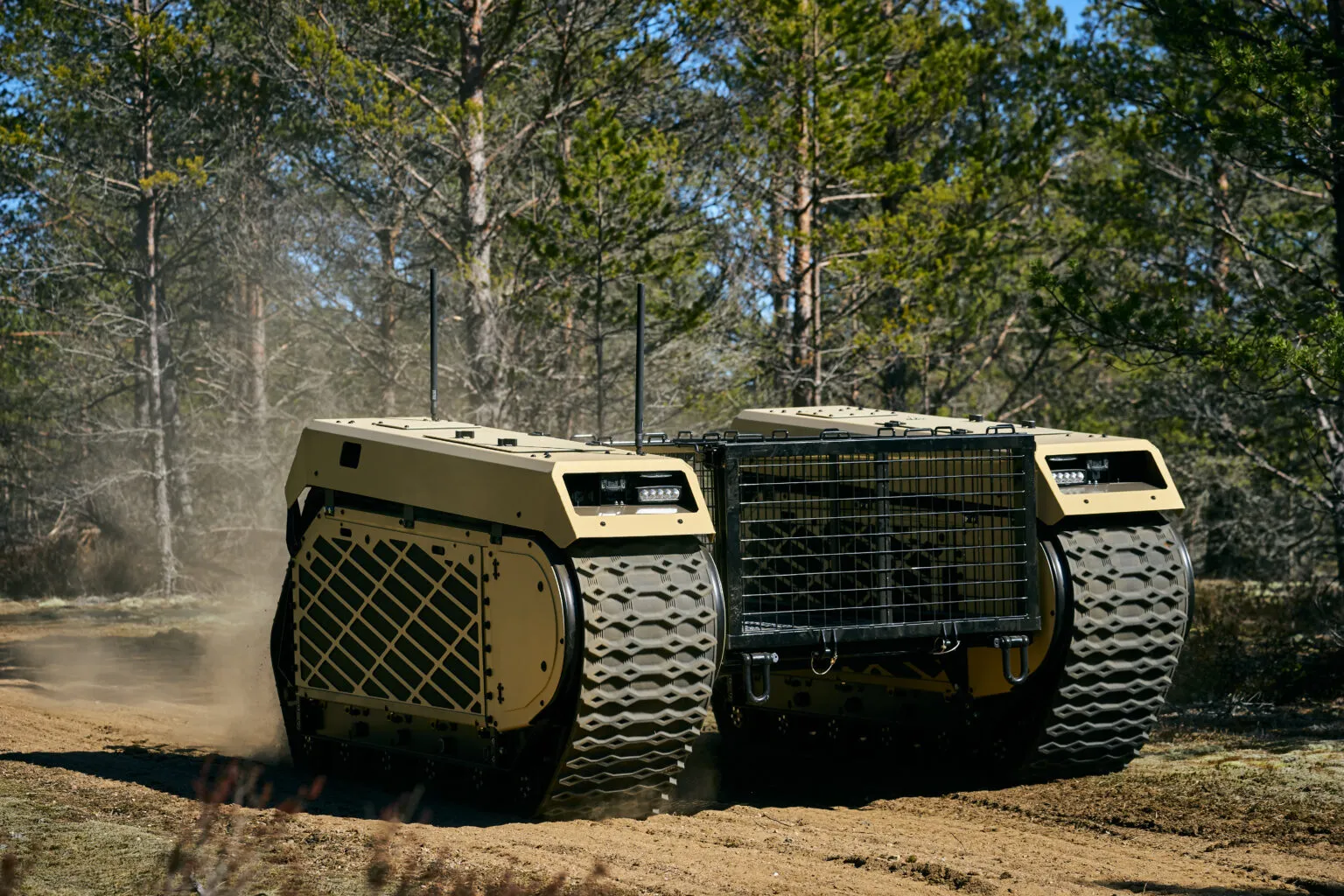
Ukraine’s amphibious ground robot UNEX UGV can tow artillery guns, its project lead said in a video interview, Militarnyi reported on 13 October. The electric platform from ABRIS Design Group (ABRIS DG) also swims, climbs, and hauls cargo on its own deck.
The Defense Ministry’s robot tally, kept in its DELTA system, counts supply and evacuation runs. It logged 25,143 of them in August, a monthly figure that has climbed all year. In April, then-Defense Minister Mykhailo Fedorov said the goal was for robots to handle all frontline logistics. A robot that brings a gun and its shells to a position adds artillery moves to that workload.
A gun behind, shells aboard
The robot can pull a gun or another wheeled vehicle of up to 10 metric tons (about 22,000 lb), the project lead said. Ammunition can ride aboard, so the gun and its rounds reach the position together. No crew has to go with them, he said, and the team has already demonstrated the setup. On its own deck, ABRIS DG says, the robot carries up to 1.7 tons (3,750 lb) on land and 1.25 tons (2,760 lb) on water.
ABRIS DG said US Army testers ran UNEX through scenarios that included towing Joint Light Tactical Vehicles (JLTVs), which are armored US military trucks. The trials took place at the Army’s XTech competition in Vilseck, Germany, in March 2026. UNEX was picked as one of five winners, the company said.
Swims, climbs, backtracks
The robot can float for more than an hour. The team has already crossed the Desna River and narrow stretches of the Dnipro with it, the project lead said. Ultra-low-pressure tires spread its weight over soft ground and swamps. ABRIS DG says it climbs obstacles up to one meter (3.3 ft) high and drives out of water onto ice.
Explore further
Ukraine turned ground robots into a frontline workhorse. Its first competitive tender may reward cheap copies over proven machines, an officer warns
Operators steer it via Starlink or radio. An escort drone can add an overhead view to the robot’s own cameras. If the link drops, the robot retraces its route to where the signal last held.
It runs on a Ukrainian-made 78 kWh battery. The project lead puts its work time at up to six hours and its range at up to 120 km (75 miles), with a top speed of 20 km/h (12 mph). Load and terrain cut into those figures, he added. With a generator now in development, a mission should stretch to about 12–14 hours, he said.
The robot is not built for the zero line, the project lead said. It works 20–30 km behind the front, at night, where armor would add little. Developers also plan demining and air defense versions. Ukraine’s Defense Ministry codified the robot and cleared it for use in its forces in April 2025.
At a conformation show, purebred dogs are evaluated by judges according to written documents that strive to capture the exemplary features of each breed. (These standards are searchable via the American Kennel Club; my dog’s breed standard, for instance, is “interested and even mischievous” in expression, but might be faulted for a “short, prancing, or choppy gait.” Noted.) Hannah Berger files a remarkably observed dispatch from one such show in Virginia, where she has traveled to consider show dogs as signifiers, “the ideal against its approximation.” There’s plenty of human folly here, not limited to the interpretation of a “breed standard” and its pursuit over time. A janitor ceaselessly sweeps away dog hair; a mother silences her child as one might a yapping pet. Berger layers her observations into an ending so clever that I gasped.
Now under the jurisdiction of the American Kennel Club in the U.S., conformation shows measure the degree to which a dog “conforms” to its “breed standard,” a document that transmutes historical function into superficially measurable and marketable qualities: proportions, attitude, gaiting patterns. These documents vary widely in length and style. The greyhound’s standard, for example, is a spare two-hundred-word document that strays from sobriety just once in its description of the eyes: “dark, bright, intelligent, indicating spirit.” The standard of the Coton de Tulear, the bichon-like “national dog” of Madagascar, is nearly eight times as long, describing colors and shapes in percentages and angles. Its “joie de vivre” is mentioned twice.

 Login