
❌

Reading view

Kazakhstan after Kurultai elections: Expanding opportunities for co-operation with the European Union

Parliamentary elections on 23 August completed the formation of Kazakhstan’s new legislature — the Kurultai — the central element of the country’s renewed political system following constitutional reform. Seven political parties took part in the vote. Turnout stood at 74%.

The first convocation of the Kurultai has cemented the completion of the institutional transition and marked the country’s entry into a new political cycle.

Political reforms and their institutional foundations

The decisive factor enabling this far-reaching transformation of the political system has been President Kassym-Jomart Tokayev’s consistent course toward democratic renewal in Kazakhstan.

It was within this framework that constitutional amendments were initiated, the role of representative institutions expanded, political competition strengthened, and powers redistributed among the branches of government.

For European partners this carries particular significance: it demonstrates that the institutional overhaul was not ad hoc but systematic and phased, grounded in political will and a long-term reform strategy.

Kazakhstan in the architecture of engagement with the EU

For the European Union, Kazakhstan remains one of its key partners in Eurasia, primarily in the domains of energy, logistics, and raw materials.

The renewal of the institutional system enhances the predictability of engagement — a quality of particular importance for long-term European projects.
Energy Cooperation and Market Transformation
Energy continues to form one of the central pillars of Kazakhstan–EU relations.

Key avenues include:

  • securing stable hydrocarbon supplies;
  • advancing projects in hydrogen and renewable energy;
  • joint initiatives on decarbonisation;
  • expanding investment in green infrastructure.

Institutional stabilisation after the elections strengthens the durability of the contractual framework in the energy sector, while the new legislative structure facilitates the coordination of long-term economic initiatives.

Transport corridors and logistics

Special emphasis is placed on the development of the Trans-Caspian International Transport Route, which the EU regards as a strategic alternative to traditional trade arteries.

Kazakhstan plays a pivotal role by providing:

  • transit infrastructure;
  • connectivity between China, Central Asia, and Europe;
  • development of the Caspian region’s port system;
  • integration of logistics chains.

A stable institutional environment increases the investment attractiveness of these projects.

Institutional predictability

The formation of the Kurultai creates a more transparent decision-making system, thereby reducing regulatory risks for European partners.

This is reflected in:

•growing investment activity;

  • deeper intergovernmental engagement;
  • more predictable long-term project planning;
  • broader participation by European business.

The 23 August elections have concluded the phase of institutional renewal in Kazakhstan and opened the period of practical implementation of reforms. For the European Union, this means a more predictable foundation for cooperation with Kazakhstan in the key spheres of energy, raw materials, and transport infrastructure. Kazakhstan enters a new political cycle with an updated institutional system, reinforcing its position as a strategic partner of the EU in Eurasia.
  •  

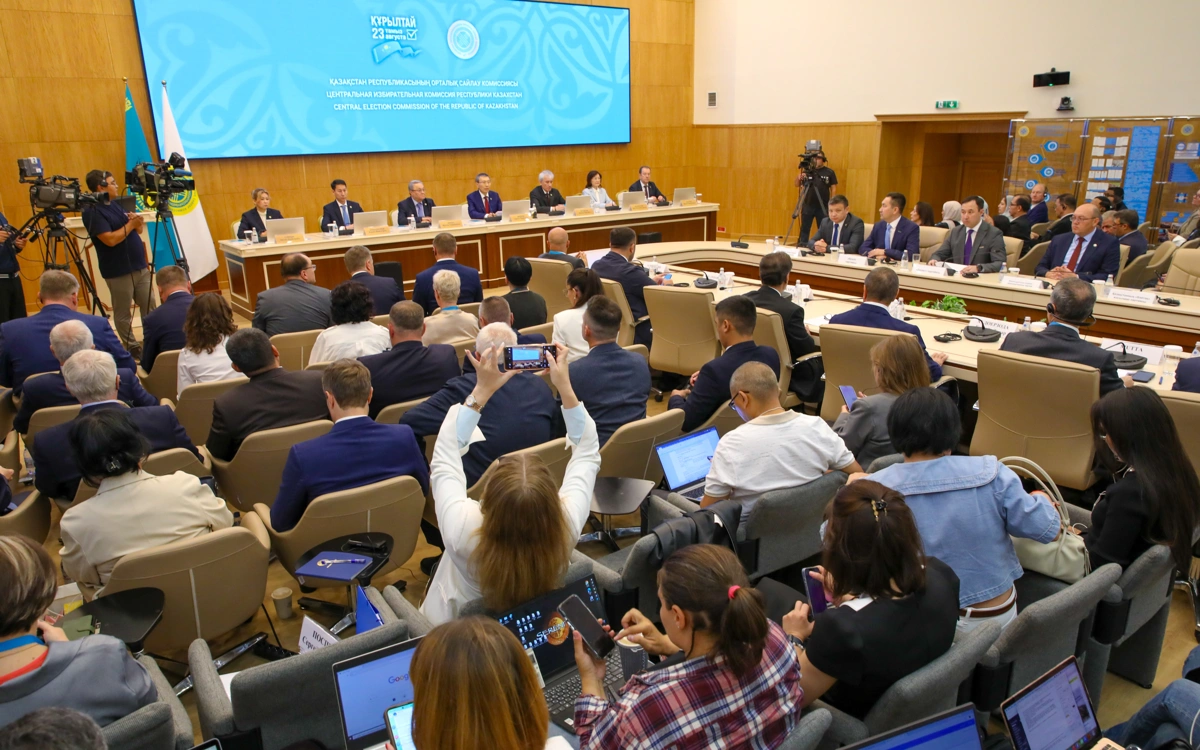
The Central Election Commission announced preliminary results of the Kurultai elections

The Central Election Commission announced preliminary results of the elections for deputies of the Kurultai of the Republic of Kazakhstan, which took place on 23 August, reports a correspondent for the Kazinform agency.

According to preliminary data, the Adilet party received 6,528,948 votes, or 71.17%. The National Social Democratic Party received 469,058 votes, or 5.11%.

The Green Party "Baytak" received 97,751 votes, or 1.07%, the People's Party of Kazakhstan - 285,395 votes, or 3.11%.

The Auyl party received 574,621 votes, or 6.26%. The Ak Zhol Democratic Party of Kazakhstan received 478,083 votes, or 5.21%, and the Respublica party received 509,631 votes, or 5.56%.

In addition, 2.51% of voters voted against all.

cycle
Photo: Victor Fedyunin/ Kazinform

Earlier, Kazakhstan announced the results of exit polls on preliminary vote counts for the Kurultai elections.

  •  

After ending power shortages Kazakhstan can become electricity exporter

Kazakhstan plans to commission 845 megawatts of new power generation capacity in 2027 as part of a broader effort to meet growing electricity demand and build a reserve in the national power system. The planned projects combine gas-fired generation with renewable energy, reflecting the country’s strategy to expand capacity through multiple sources rather than relying on a single type of generation. According to the Energy Ministry, the new facilities are expected to allow Kazakhstan to fully cover its electricity needs as early as the first quarter of 2027.

By the end of the year, the country expects to generate an electricity surplus of around 1.3 billion kilowatt-hours. The 2027 expansion follows a larger planned capacity increase in 2026, when Kazakhstan expects to commission around 2.6 gigawatts of new generation. This includes four gas-fired power plants, expansions of two existing power stations and 10 new renewable energy facilities.

Together, the plans suggest that the government is seeking not only to close the gap between electricity supply and demand, but also to create additional capacity that could provide greater flexibility for the power system.

Gas and renewables form the core of new capacity

Several conventional generation projects are scheduled to be completed in 2027.

Five gas turbine units at the Zhambyl State District Power Plant are expected to add a combined 210 MW. A combined-cycle gas plant at MAEK is planned to provide 160 MW, while the first stage of the Baskuat Energoprom project will add 34.7 MW through five gas piston units. Another combined-cycle plant, developed by Kazakhmys Energy, is expected to contribute 70 MW. At the same time, the government plans to continue expanding renewable generation, with projects totaling 570 MW.

These include a 100-MW solar power plant in the Almaty Region and three solar projects in the Kyzylorda Region with a combined capacity of 70 MW. Wind projects include two 100-MW facilities in the Aktobe Region, a 50-MW wind power plant in the Kyzylorda Region, another 50-MW project in the Turkistan Region and two wind facilities in the Abai Region with a combined capacity of 100 MW. The planned renewable projects account for a substantial part of the capacity expansion, while gas-fired facilities are intended to provide additional dispatchable generation. This mix is particularly important for a power system that needs both new electricity volumes and generation that can respond to changes in demand.

From meeting demand to building a reserve

The expected 1.3 billion kilowatt-hour surplus by the end of 2027 marks an important shift in the government’s projections. The objective is no longer limited to covering immediate electricity consumption but also includes creating a reserve that could strengthen the reliability of the national grid. However, installed generation capacity and actual electricity output are not identical. The amount of electricity ultimately available to the system will depend on factors including the operating performance of new plants, fuel supply, grid infrastructure and, in the case of wind and solar projects, weather conditions.

  •  
❌