A coalition of 27 global wildlife conservation and animal welfare organizations urged Vantara to permanently end all wild animal imports. The billionaire-run zoo in India, funded by the philanthropic arm of Reliance Industries, the country’s largest corporation, has been under for fire for questionable acquisitions of its animals. In an open letter dated Sep. 22, 2026, and addressed to Mr. Amit Aggarwal, president of regulatory affairs at Vantara, the NGOs offer Vantara “suggestions for strengthening your practices and improving outcomes.” The letter came in response to a press statement from Vantara on Aug. 19, 2026, where it announced “voluntary commitments” including a 12-month moratorium on all animal imports, backdated to June 5, 2026. It said it has withdrawn all pending import applications and will not make any fresh applications. The statement also included a letter addressed to India’s CITES Management Authority, which oversees international commerce in endangered plants and animals listed under CITES, a global wildlife trade treaty. After the one-year moratorium expires, Vantara said it would import animals only from “a recognised and accredited zoological facility,” a “CITES registered facility” or for “a conservation breeding programme undertaken in cooperation with a range State.” It also announced an “independent” governing council headed by John Scanlon AO, the former CITES Secretary General, and a “mandatory three-stage review” will oversee any future animal acquisition. Vantara has acquired Tapanuli orangutans, one of the rarest apes in the world. Image by Tim Laman via Wikimedia Commons (CC BY 4.0). Vantara’s announcement came after investigations…This article was originally published on Mongabay
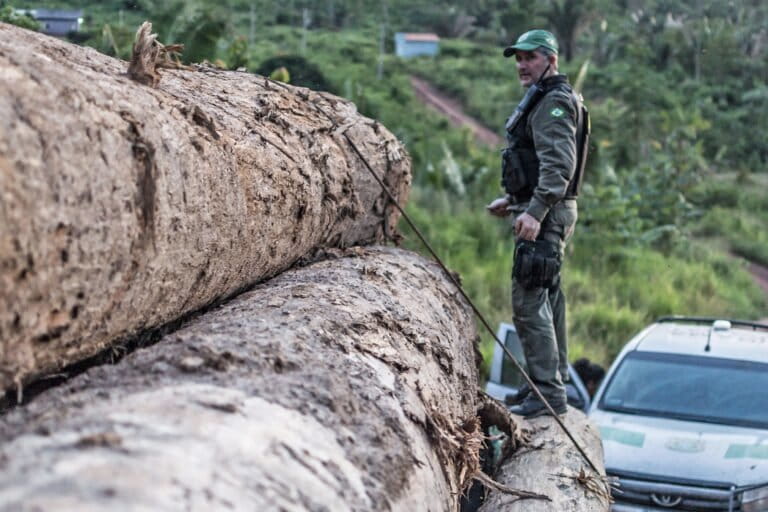
The world has spent a decade trying to put a price on nature. Forests have become carbon sinks, while wetlands are increasingly described as natural infrastructure. Biodiversity is also being drawn into financial markets. Governments and investors have poured billions into carbon markets and conservation finance, including green bonds. Around them, a financial system is emerging on the assumption that intact ecosystems can generate enough economic value to protect them. A more destructive economy has been putting a price on nature for much longer. It makes money by extracting and selling it. Land grabbing, illegal logging, illicit gold mining and wildlife trafficking are usually treated as environmental offenses, so responsibility falls to park rangers, customs officials and specialized police. That view badly underestimates what is happening. In a new paper for the Brookings Institution, we argue that environmental crimes are a serious drag on both sustainable development and climate action. They damage ecosystems and weaken the institutions charged with governing them. They also drain revenue from legitimate companies and public coffers. Enforcement alone will not solve a problem that runs through trade, finance and local political economies. An IBAMA agent participates in a raid on an illegal logging and mining operation within an Indigenous reserve. Image courtesy of IBAMA. Global criminal economy No one knows exactly how large this economy has become. A widely cited estimate puts annual proceeds at between $110 billion and $281 billion, but the true figure is probably far higher, perhaps in the trillions. What makes the business…This article was originally published on Mongabay
MALALA DRIFT, South Africa — In Malala Drift, near the town of Musina in South Africa’s Limpopo province, drought and unreliable access to water are threatening the livelihoods of farmers. Some have abandoned crop production after struggling to secure enough water, while others continue farming under increasingly difficult conditions. The farms lie along the Limpopo River, which separates South Africa from Zimbabwe. But even with a major river nearby, access to reliable water supply is not guaranteed. Farmers say rainfall has become increasingly unpredictable in the past decade, and when the river level falls, they sometimes pay an excavation company to dig into the riverbed to reach water, adding to the cost of keeping their farms operating. The effects of the water scarcity are visible at one of the farms Mongabay visits. Poles that once supported tomato plants are scattered across the property, while irrigation pipes are obscured by overgrown grass. No crops are growing. Kanny Ndou, who used to work here as a laborer and now takes care of the property, said the farm previously produced potatoes, butternut squash and tomatoes for sale in Musina. But after 10 years, Ndou said, the owner stopped farming in 2025 because of unreliable water supply. “We used to grow a variety of vegetables for sale in Musina, but due to inconsistent water supply, the farm decided to stop farming last year,” he said. For years, farmers had faced unpredictable outcomes: a good harvest one season, a bad one the next, he said. Some…This article was originally published on Mongabay
Between 2014 and 2015, a marine heatwave known as “The Blob” warmed an area of the Pacific Ocean larger than the United States and Mexico combined. The massive event fueled toxic algae blooms, collapsed fisheries, killed off millions of emaciated seabirds, sent dead fin whales (Balaenoptera physalus) and sea otters washing up on Alaska and British Columbia coasts, and dotted California shores with starving sea lions. Though best known as a marine heat wave, The Blob was also an extreme acidification event. Yet occurrences of these compound heat-acidity extreme events remain poorly understood. A new study, published in the journal AGU Advances in August, provides a detailed look at the frequency, intensity and duration of these compound events during the last four decades. The study reveals an understudied aspect of marine heat waves that could have implications for the developing 2026-2027 “super” El Niño, in which waters in the equatorial Pacific become unusually warm due to changing wind patterns. An underweight sea lion pup on a beach in February 2015. Image by NOAA Fisheries West Coast. Researchers from the Swiss Federal Institute of Technology (ETH Zurich) found compound heat-acidity events across the globe happen together “more frequently than would be expected by chance,” they wrote. Instead, the researchers attributed their occurrence to underlying ocean physics that allow marine heat waves to become unusually acidic in some regions. These events are mostly short-lived and small, with 67% of the 500 identified events lasting less than three months and extending to an…This article was originally published on Mongabay
“The word ‘security’ is a broad, vague generality whose contours should not be invoked to abrogate the fundamental law embodied in the First Amendment.” ~ Justice Hugo Black, New York Times Co. v. United States (1971) “National security” has become the government’s all-purpose permission slip to behave badly. They have become the magic words that can make constitutional restraints disappear – especially […]
Smoke rose over Riyadh last week as Houthi forces launched strikes on the Saudi capital, as well as on crucial oil infrastructure in major coastal cities. It has been a disastrous month for Saudi Arabia as Houthi forces have made substantial gains along the west coast of Yemen. The Yemeni group scored massive victories in […]

 Login