❌

Reading view

Blackbeard Hypersonic Missile Seen Flying On F/A-18 Super Hornet For The First Time

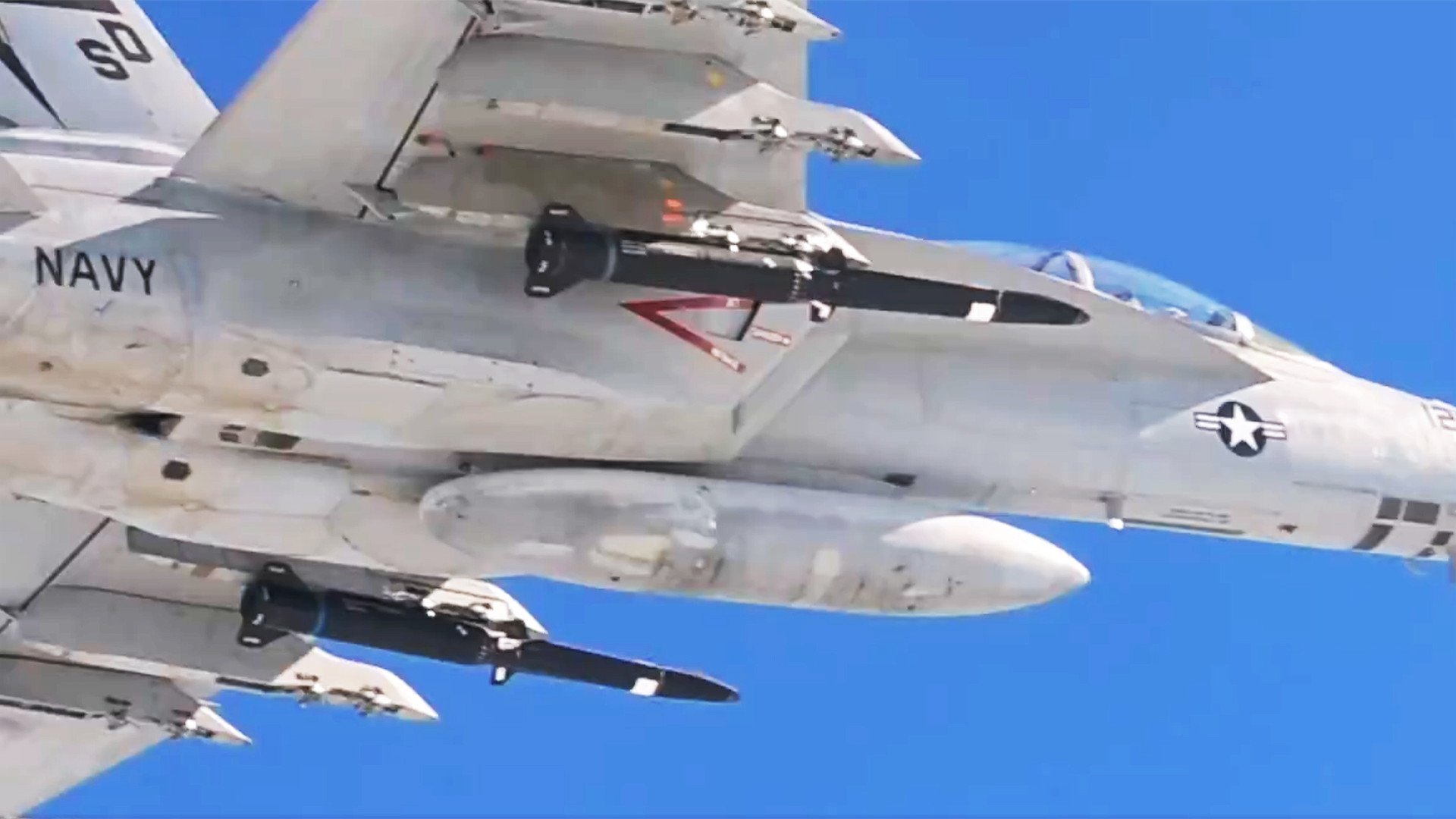
The U.S. Navy has given us the first look at Blackbeard hypersonic strike missiles under the wings of F/A-18E/F Super Hornets during actual flight testing. The Navy is hoping to have Blackbeard in at least limited service no later than 2028, giving its carrier air wings an all-new fast-flying standoff weapon, particularly for engaging enemy ships. The missile is also being designed to be relatively cheap and quick to manufacture.

The Navy’s Office of the Portfolio Acquisition Executive for Aviation (PAE-A) has released a video montage of Blackbeard undergoing flight testing, seen in the social media post below. The service confirmed that it had at least begun test-loading the missiles onto F/A-18E/F Super Hornets in a presentation at the Tailhook Association’s annual convention last month. Now we know the program has moved ahead substantially from that point.

Coming soon to a theater near you…BLACKBEARD!@USPACOM @CENTCOM @PAEAviation pic.twitter.com/KgBtIqdf8I

— NAVAIR (@NAVAIRNews) September 25, 2026

The company behind Blackbeard, defense start-up Castelion, has received several multi-million-dollar contracts from the Navy just this year explicitly to support integration of the weapon onto the Super Hornet, as well as otherwise accelerating its development. In its daily contracting on September 14, the Pentagon announced the Navy had struck yet another deal with Castelion, valued at $43.65 million, “for the manufacturing, assembly, testing, and delivery of the first production lot of 444 All-Up Rounds (AURs), defined as fully functional tactical missiles packaged within specialized shipping and storage containers.”
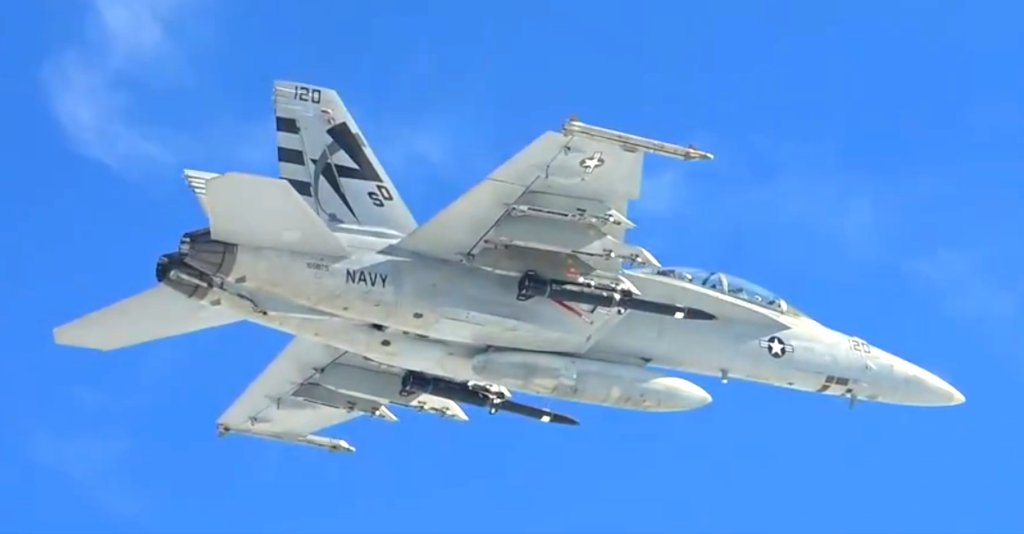
A screen capture from the Blackbeard flight testing video montage the Navy released today. USN capture

In terms of what we know today about Blackbeard’s design and capabilities, as we have previously written:

“A profile photo [seen below] at the company’s headquarters reveals a weapon with a ballistic missile-like booster, on top of which is mounted what could be an unpowered hypersonic glide vehicle (HGV). A booster brings an HGV to the desired velocity and altitude before releasing it toward its target. The concept is in contrast to air-breathing cruise missiles capable of traveling at hypersonic speeds. Hypersonic speed is generally defined as anything above Mach 5, which larger ballistic missiles also reach in the course of their flights. More precise performance figures for Blackbeard are lacking, but Castelion has previously hinted it could hit targets out to just under 500 miles. Alternatively, the second stage may also have its own motor, allowing it to continue accelerating or sustain high-speed flight. A similar arrangement has been suggested as the propulsion system for the Russian Zircon missile.”
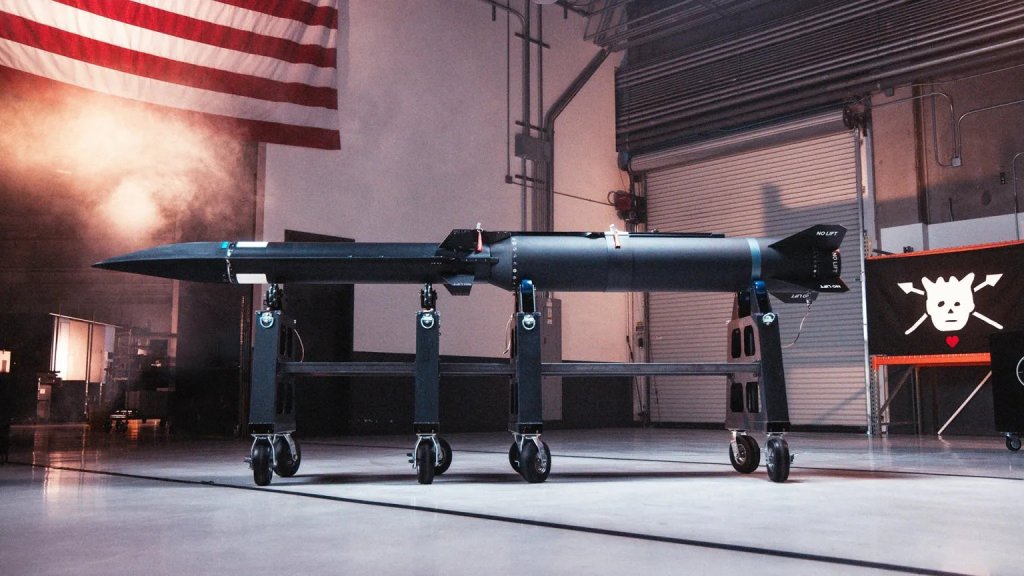
Castelion

“Both stages of the weapon have cruciform fins, while the upper one features a prominent ‘chine’ line along the length of its body, and a slightly beaklike nose. The trolley on which the weapon is mounted provides some idea of its overall size. The blue stripes seen on each stage normally signify that a munition is an inert, non-explosive round utilized for training or tracking purposes. This would indicate a real (unarmed) missile rather than a dummy or mockup.”

A picture shown at Tailhook had also offered a new look at the front of the missile, exposing what looked to be an aperture on one side of the design’s wedge-shaped nose. As we wrote after that image emerged:

“The apparent apertures are also seen pointed up, but many air-launched munitions do flip down after release.”

“How exactly Blackbeard is guided remains unknown, but a downward-angled aperture at the nose end for a seeker system would make sense for this weapon, which the Navy is pursuing primarily as a new way to target enemy ships. In particular, a wide array of existing anti-ship and land attack missiles, as well as certain anti-air types, have variously shaped apertures in their noses for imaging infrared seekers. Imaging infrared has the benefit of being immune to radio frequency electronic warfare jamming. In addition, it is a passive capability that does not send out signals that can give an opponent advance notice of an incoming attack. Blackbeard’s full guidance package very likely also includes some means of navigating to a target area first, and it could have multiple modes of operation.”

The new flight testing footage released today also underscores the relatively small size of Blackbeard overall. While the Super Hornet is set to be the first operational launch platform, it is very likely to be integrated on other aircraft quickly thereafter. The Navy is acquiring Blackbeard under a program called the Multi-mission Affordable Capacity Effector (MACE).
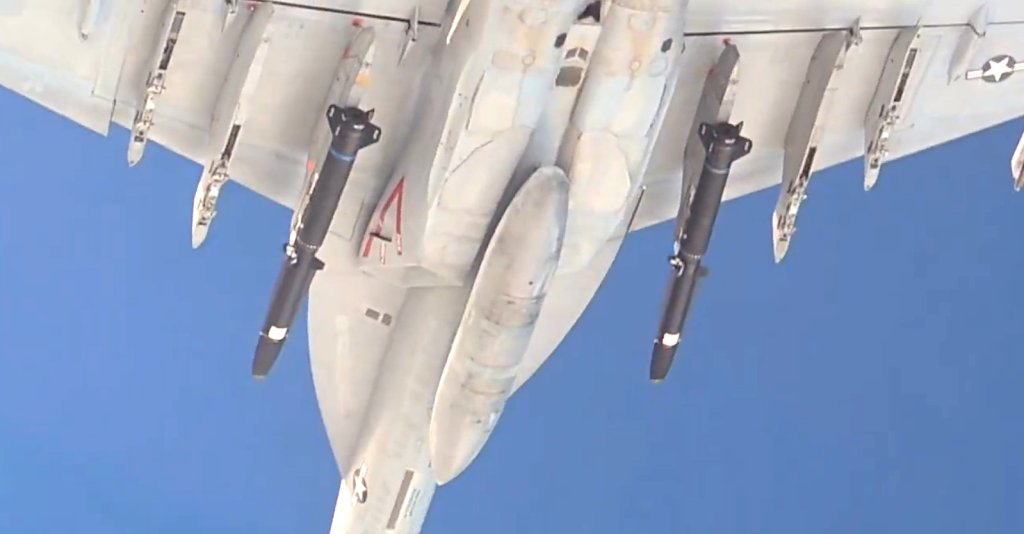
Another screen capture from the new Navy video offering a different of Blackbeards under the wings of a Super Hornet, underscoring their relatively small size. USN capture

Requirements for MACE that the Navy put out previously explicitly called for a design compact enough for carrier-based F-35C (and land-based F-35A) Joint Strike Fighters to carry four of them internally. Whether that remains a goal in any way is unclear. Still, being able to carry some number of Blackbeards internally would not only give those jets a hypersonic strike weapon, but one that they could carry in the most stealthy configuration. The Navy also notably does operate the F-35A outside of the test and evaluation community, which might point to air-launched Blackbeards entering service elsewhere in the future. As an aside, the U.S. Army is pursuing a ground-launched version of this missile, as well.

Another critical aspect of Blackbeard is the emphasis on lower cost and the ability to produce the missiles readily at scale. The conflict with Iran has fully driven home long-standing concerns about the depth of U.S. stockpiles of various critical munitions, as well as its ability to replenish them quickly. Blackbeard reflects a larger push across America’s armed forces to add more cost-effective weapons that can be acquired on faster timetables to their arsenals. Bringing in new, smaller companies like Castelion to develop and build these munitions has also been a major point of focus. To put this all in immediate context, in May, the Pentagon announced a framework agreement to buy 12,000 Blackbeards over the next five years.

As mentioned, the Navy’s stated goal now is to reach an early operational capability with Blackbeard by 2028, if not sooner. What the exact fielding plan for those missiles might be is unclear. PAE-A did write “Coming soon to a theater near you” in its post on X containing the video montage, and tagged the official accounts for U.S. Central Command (CENTCOM) and U.S. Pacific Command (PACOM). CENTCOM oversees U.S. military activities in and around the Middle East, including ongoing operations against Iran. U.S. military officials have also long touted hypersonic weapons, in general, as key to success in any future conflict in the Pacific, especially a high-end fight against China.

It’s also worth noting here that U.S. military hypersonic missile programs across the services have faced repeated setbacks and delays over the years. This, in turn, has prompted discussion about a worrisome gap emerging in this arena between the United States and its chief global competitors, especially China. It is very possible now that Blackbeard could be the first operational air-launched type in American inventory, depending on how the U.S. Air Force does or does not proceed with its Hypersonic Attack Cruise Missile (HACM) program. The Air Force has said previously that it is aiming for HACM to be operational, at least on a limited level, before the end of Fiscal Year 2027, which begins next month.

If nothing else, we have clear evidence that the air-launched version of Blackbeard is now deep in flight testing for the U.S. Navy.

Contact the author: joe@twz.com

The post Blackbeard Hypersonic Missile Seen Flying On F/A-18 Super Hornet For The First Time appeared first on TWZ.
  •  

Marines Rushing To Equip Amphibious Combat Vehicles With New Anti-Drone Jammers

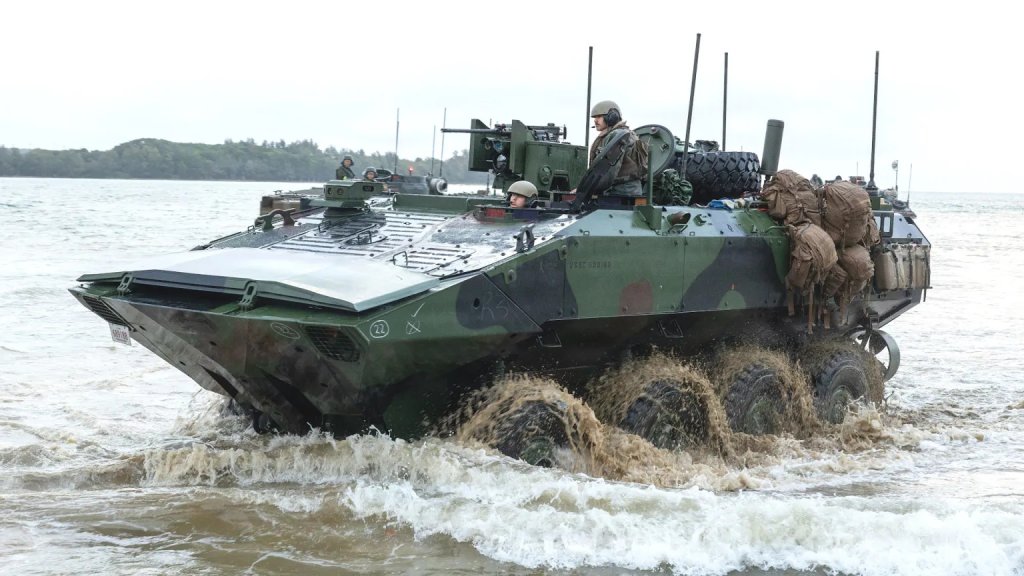
The U.S. Marine Corps is buying Anduril Pulsar-L electronic warfare jammers to meet an urgent operational need to better protect its 8×8 wheeled Amphibious Combat Vehicles (ACV) from drones. This is part of broader efforts the service is pursuing to boost the ACV’s defenses against uncrewed aerial attackers, as well as incoming anti-tank guided missiles and other threats. Drone threats are real now and have notably sidelined even the most advanced heavy armor in Ukraine.

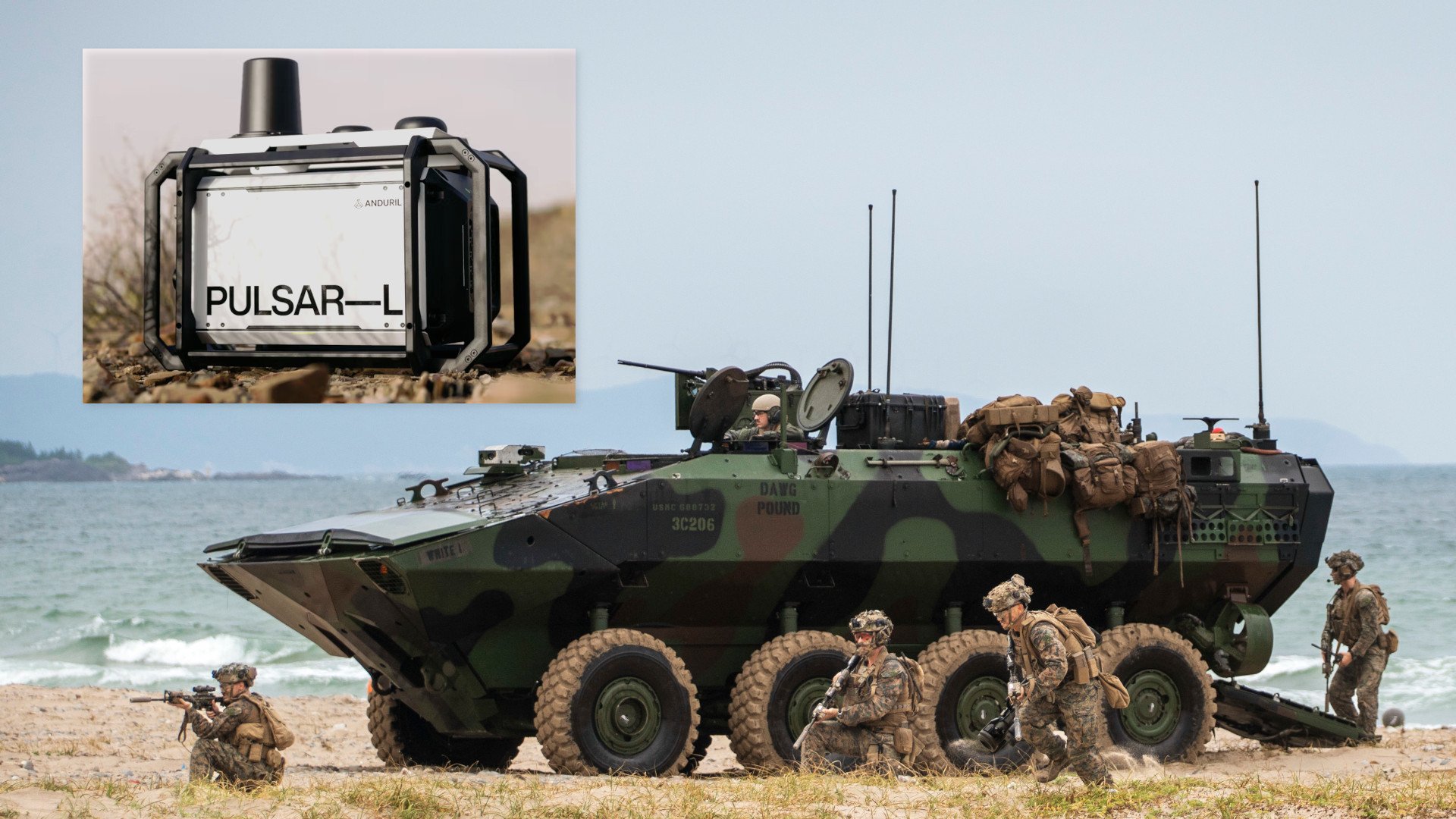
Marine Corps Systems Command (MARCORSYSCOM) announced it had awarded a sole-source deal to Anduril, valued at $15,711,445.50, for an unspecified number of Pulsar-Ls, yesterday. This follows a statement of intent the Command put out last month. Anduril first unveiled Pulsar-L, a lightweight addition to its larger Pulsar family of electronic warfare systems, in April 2025.

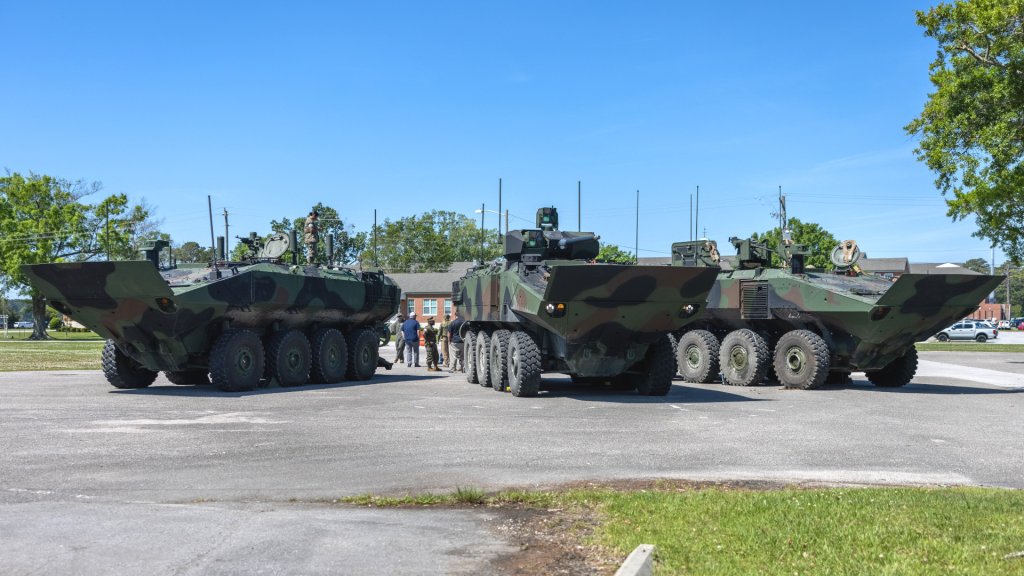
The Marine Corps had 150 baseline personnel carrier variants of the ACV (or ACV-Ps), as well as 21 command-and-control ACV-C versions, in inventory as of April 2026. The default armament for ACV-P currently is just a single .50 caliber M2 machine gun in a remote weapon station on top of the hull. The service’s goal is to eventually acquire 389 ACV-Ps and 33 ACV-Cs, as well as 152 ACV-30s with new 30mm cannon-armed turrets and 34 ACV-R armored recovery vehicle variants. The ACV family has already supplanted the Marine Corps’ previous fleet of tracked Assault Amphibious Vehicles (AAV).

From left to right, an Amphibious Combat Vehicle command and control variant (ACV-C), a 30mm cannon-armed ACV-30, and a standard ACV personnel carrier version (ACV-P). The ACV-R recovery variant is not shown here. USMC/Sgt. Alexis Sanchez

“The Anduril Pulsar-L system is a platform-integrated omni-directional SK C-UAS [soft-kill counter-uncrewed aerial systems] with a combined sensor/jammer package that detects, tracks, identifies, and defeats radio frequency-dependent Group 1 and Group 2 Unmanned Aerial Systems (UASs),” MARCORSYSCOM wrote in a justification for the sole-source contract, which was also released yesterday. “Additionally, the system provides counter positioning, navigation, and timing capabilities.”

The U.S. military definition of a Group 1 drone is any design weighing up to 20 pounds, that is able to fly up to an altitude of 1,200 feet, and that can reach speeds of up to 100 knots. Group 2 is the next tier up, encompassing types with gross weights between 21 and 55 pounds, that can get up to an altitude of 3,500 feet, and hit top speeds of up to 250 knots. Kamikaze drones and other small weaponized types that fall into Groups 1 and 2 are used on a daily basis in Ukraine to attack armored vehicles, as well as unarmored vehicles and personnel. These are threats that have been steadily expanding to other hotspots globally, and that we will come back to later on.

Furthermore, “the Pulsar-L is the only solution capable of being mounted on the ACV to provide a mobile and organic means to effectively and simultaneously execute the entire kill-chain against hostile UASs in the deployed land and maritime/littoral environment while not exceeding the limited ACV space, weight, and power claim allotted to the SK C-UAS solution,” according to MARCORSYSCOM. “This will provide the ACV with an essential defensive capability, directly contributing to increased survivability and force protection while not sacrificing the mobility and operational tempo of the ACV.”

A row of Marine ACVs seen during training. USMC

Pulsar-L is already “in use by the Special Operations Command due to the system’s low weight, proven performance in engaging multiple UASs, and simultaneous execution of the full kill-chain while static or on the move,” the justification document adds. “Additionally, it is the only known commercially available system that meets the minimum requirement to rapidly identify and respond to emerging UAS technologies and tactics without frequent updates to predefined threat data libraries. The Pulsar-L is the only solution that uses machine based learning to continually adapt to these ever-changing threats without requiring vendor updates, allowing the warfighters to continually be effective in the fight.”

The latter point here is a particularly important consideration for electronic warfare systems, in general, which need to be able to accurately detect, categorize, and respond to different waveforms to be most effective. The emergence of new waveforms, as well as changes to how existing ones are emitted, together with new tactics, techniques, and procedures, can all negatively impact a system’s performance. Historically, the process of responding to those developments with updates to built-in threat libraries has been lengthy and complex. The conflict in Ukraine has shown that the cycle of new developments in the electromagnetic spectrum and then the need for new countermeasures can be regularly measured in weeks.

The U.S. military has been heavily investing in so-called cognitive electronic warfare capabilities to help automate and otherwise accelerate various aspects of this process. The ability of a particular electronic warfare suite to adapt autonomously in real-time, even in the middle of operations, has been viewed as the absolute ‘holy grail’ of this concept, which you can read more about here. How exactly Pulsar-L leverages machine-learning and artificial intelligence to this end, and the speed with which it can adapt to changing threats, is still not entirely clear.

Regardless, “there is an unusual and compelling need for the rapid deployment of SK C-UASs to forward-deployed ground units as Marines currently lack the ability to conduct self-defense against emerging UAS threats,” the justification document stresses. “Failure to deliver this capability places Marines at unnecessary risk, potentially leading to mission failure and loss of life, and hampers the Government’s ability to keep them safe during forward deployments.”

MARCORSYSCOM’s justification for the sole-source deal to Anduril does not otherwise elaborate on the urgent requirements that drove the deal, which it says were only formalized on April 7. That is notably roughly a week after the United States and Israel first launched major combat operations against Iran, which is a prolific developer and user of various tiers of weaponized drones. There is no explicit confirmation of any link, but Iranian drones, as well as missiles and other capabilities, have been a real threat to U.S. forces in the region. We have also just gained more insights recently into how forward-deployed Marine Corps elements contributed to those operations. Counter-drone capabilities would also be especially critical in any future amphibious landing operation, wherever it might occur.

Marines prepare to load an M142 High Mobility Artillery Rocket System (HIMARS) onto a KC-130J aircraft somewhere in the Middle East in July 2026. USAF

All that being said, threats posed by armed Group 1 and 2 drones are not at all limited to Iran and the Middle East, nor are they new. They are only likely to become a more ubiquitous feature in the hands of nation-state armed forces and non-state actors in conflict zones globally as time goes on. The nature of these threats is also expanding significantly in scale and scope, especially when it comes to more automated targeting capabilities, thanks heavily to the increasing democratization of AI-driven technologies, something TWZ has explored in depth in the past.

A number of other significant developments in this arena have emerged from the conflict in Ukraine, where electronic warfare systems are heavily employed against drones. This includes the introduction of physical fiber-optic control links that cannot be jammed, as well as the use of mesh-like and often ad-hoc networks to increase resiliency.

The fighting in Ukraine has also underscored the threat that even small kamikaze drones pose to armored vehicles, including types that are far more heavily protected to start with than the Marine Corps’ ACVs. As mentioned, Ukrainian forces have been sidelining their M1 Abrams and other main battle tanks in the face of constant drone attacks.

MARCORSYSCOM’s justification for the Pulsar-L order makes clear that this is just one part of a larger plan to boost the ACV’s defenses.

“Marine Corps program of record for SK C-UAS is planned to initiate in FY27,” the document mentions toward the very end. “The components of this future program will be procured through full and open competition as it is expected that advanced non-kinetic and SK defeat technologies should be mature by this time.”

Another look at a Marine Corps ACV-P, showing the general configuration of these vehicles today. USMC

Marine Corps officials have also talked in the past about integrating active protection systems (APS), which could be blended together with C-UAS capabilities, and other defensive features to the service’s ACV fleet.

“We’re constantly looking at what the next generation of APS is and how we can get that onto the [ACV] platform in a lightweight form factor,” Chris Melkonian, the Marine Corps’ Program Manager for Advanced Amphibious Assault (PM AAA), told TWZ and other attendees at the annual Modern Day Marine exposition in April.

Improved “situational awareness, that’s kind of a gateway to counter-UAS, in terms of the ability to sense your environment,” Melkonian also highlighted at that time. “Take all that video on board and then be able to feed that into [a] counter-UAS system.”

Additional “overhead protection right now is a critical thing that we’re working on right now for this platform,” he added. The practice of adding on anti-drone armor screens on armored vehicles (and now other platforms), especially to protect against top-down attacks, first emerged in Russia in the lead-up to the all-out invasion of Ukraine in 2022. However, the installation of this kind of so-called ‘cope cage’ type armor has now become a global trend, including in the U.S. military.

The U.S. Marine Corps is also pressing ahead with a larger vision to field several tiers of counter-drone capabilities at all levels of its forces, to better protect everything from static installations at home and abroad right down to individual squads.

When it comes to the Marine Corps ACV fleet, the rush order for Pulsar-Ls is an important new step in boosting those vehicles’ defenses against threats that exist now. At the same time, drones are increasingly calling the role of armored vehicles in future conflicts into question.

Contact the author: joe@twz.com

The post Marines Rushing To Equip Amphibious Combat Vehicles With New Anti-Drone Jammers appeared first on TWZ.
  •  

An SR-71 Blackbird Has Vanished (Updated)

Last week, NASA Administrator Jared Isaacman cryptically teased plans for a new high- and fast-flying X-plane with a silhouette of an aircraft that immediately drew comparisons to the famed SR-71 Blackbird as a backdrop. In our report, we looked at what it could mean, including the possibility of reviving the SR-71, or at least using it to inform or even cobble together a new airframe. Now it turns out that an SR-71 that had been on display at NASA’s Armstrong Flight Research Center for years is suspiciously missing.

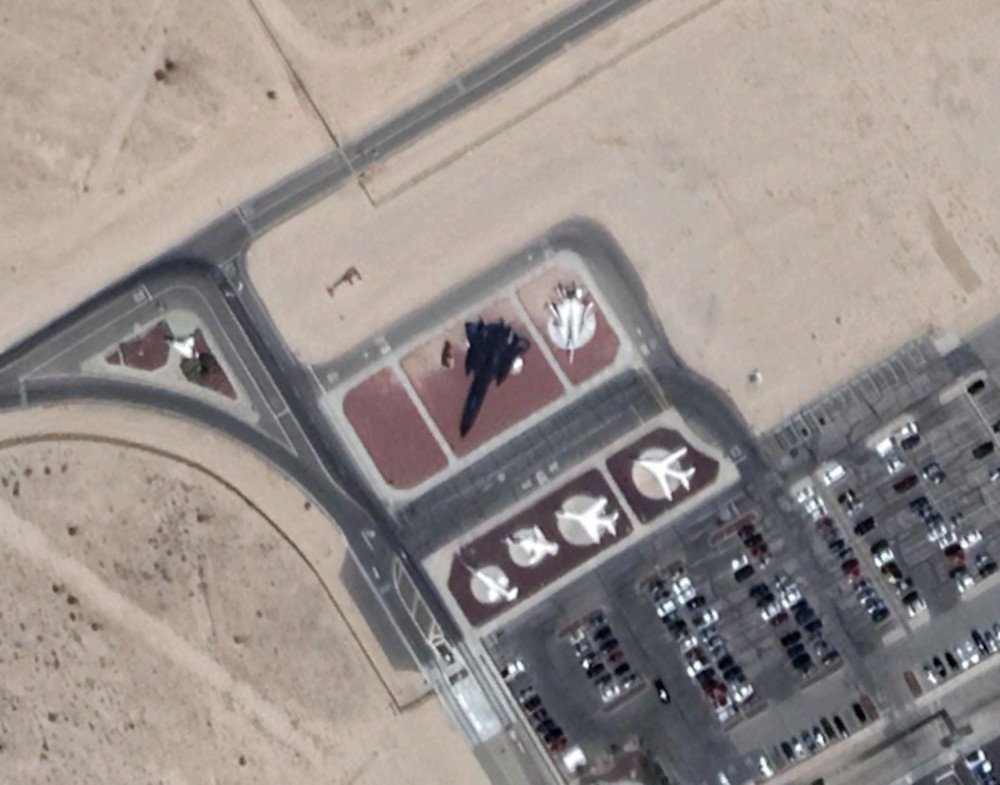
Steve Trimble, Aviation Week‘s defense editor and friend of TWZ, was first to report the disappearance of the former NASA SR-71, also known by the tail number 844, at Armstrong. That facility is collocated with Edwards Air Force Base in California. Trimble’s piece says that satellite imagery shows the jet has not been seen since at least May 17. The aircraft in question, which originally carried the U.S. Air Force serial number 61-7980, was the last Blackbird produced and the last one to fly, taking to the skies for the final time in 1999.

A satellite image taken in 2018 showing SR-71, tail number 844, on display outside of the Armstrong Flight Research Center in California. Google Earth

“The current disposition of the aircraft is unclear, but Aviation Week sources suggest that the aircraft was moved into a hangar earlier this year for an inspection,” according to the story. “The presentation and the disappearance of the display SR-71S with the 844 tail number for NASA raises the possibility of a return-to-flight program after a more than 26-year-long hiatus.”

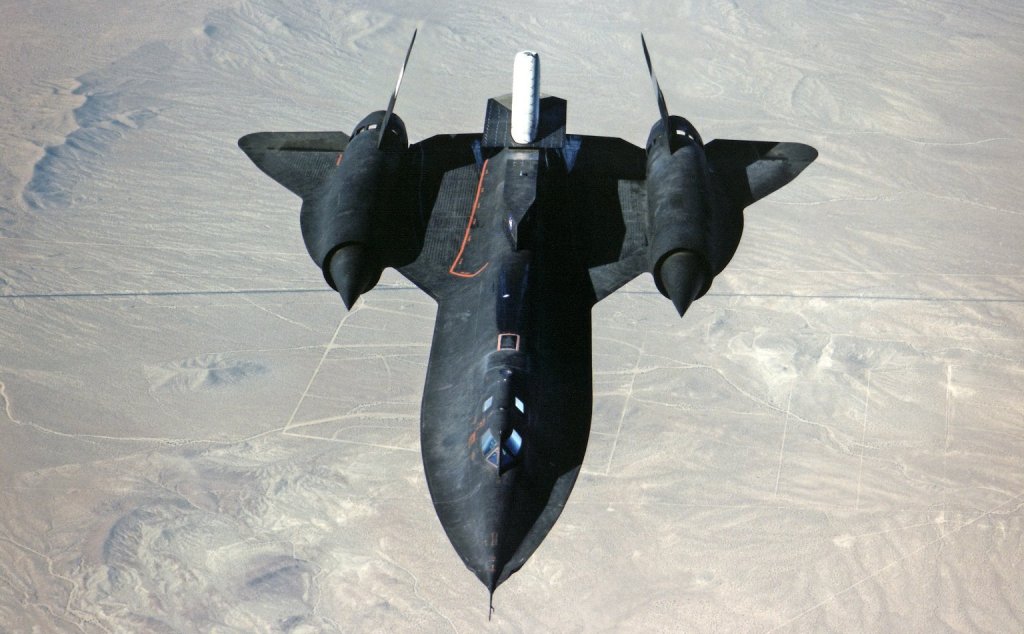
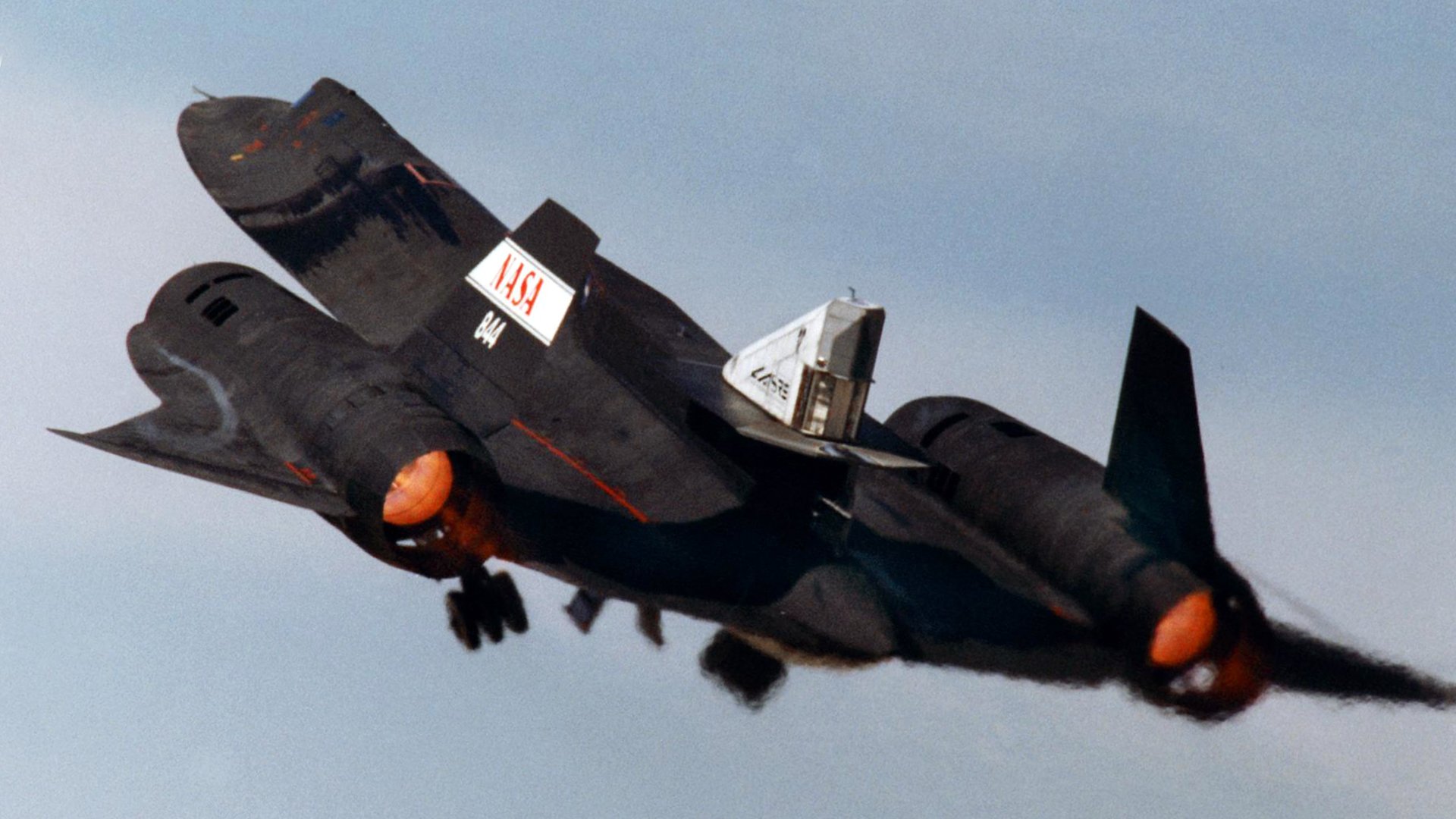
Another look at SR-71 tail number 844 during its service with NASA. This picture was taken on October 31, 1997, during a flight in support of the NASA/Rocketdyne/Lockheed Martin Linear Aerospike SR-71 Experiment (LASRE). NASA

The presentation mentioned above is the one NASA’s Isaacman gave last week at the annual All-In Summit in Los Angeles, California, during which he shared the SR-71-esque silhouette.

“In the service of the first A [aeronautics] in NASA, we are rebuilding our X-plane fleet. The X-59 is researching quiet supersonic flight, but it’s just the beginning,” he said at that time. “As NASA recommits to flight test and works alongside industry to push the boundaries of airframe and propulsion design, it will not be long before NASA once again is flying as high and as fast as we had in decades past, and then even more.”

Isaacman has made expanding NASA’s X-plane fleets a top priority since taking charge of the agency last year.

“You sure that’s a Blackbird?” the NASA administrator said during a live interview that immediately followed his remarks after the image was brought up, but did not offer any further clarification.

NASA Administrator showed this image during a presentation last week while talking about plans for new X-planes. NASA

“NASA has a long history of building and flying experimental aircraft that push the boundaries of what is possible,” NASA told TWZ directly when asked for more information. “As Administrator Isaacman has said, we want to see more X-planes flying in the years ahead, developing the technologies that will allow us to fly higher, farther, and faster than we have in decades. We look forward to sharing more as those efforts progress.”

We have reached back out to NASA in light of Aviation Week‘s report.

As we wrote in our initial reporting on Isaacman’s comments:

“As for bringing a Blackbird back into operation for high-speed testing, which is now at the forefront of military aeronautics (and civilian to a lesser degree) after decades of being sidelined, that would be a very challenging operation. The SR-71s are long retired and have been placed in museums and other display areas. While the Pentagon could technically claw some of them back from their ‘on loan’ status, reconstituting even one of them would be a major undertaking as the entire support ecosystem that once sustained them has been gone for decades. Still, having a Mach 3+ capable jet for testing would be a highly relevant tool in a new age of high-speed flight exploration.”

“On the other hand, building a new test aircraft that aims higher and faster than the SR-71, but may be based on its ‘DNA,’ is certainly possible. Such an aircraft could leverage material science, avionics, flight controls, and engines that are seven decades more modern than its progenitor. Technology demonstrators in this class could also already exist in the classified domain. NASA could possibly assume ownership of one after the Pentagon declassifies it, as well.”

“Regardless of how such an exotic aircraft is obtained, one of the biggest differentiating factors could be that a NASA aircraft is piloted by a human onboard, instead of it being a drone, but an uncrewed aircraft is possible too.“

Aviation Week‘s report today notes that tail number 844 would probably be the best available candidate for returning to flight status. In addition to being the last produced and the last to fly, NASA previously upgraded it, including with “an automated digital flight and inlet control system to virtually eliminate the Blackbird’s problem of violent engine unstarts at high speed.” It has also been sitting in a controlled area in the Mojave Desert that is great for preservation.

It is also worth pointing out here that Isaacman is personally aware of the time and resources it takes to reconstitute high-end vintage military aircraft. He founded private ‘red air’ aggressor firm Draken International, making him once the owner of the world’s largest private air force stocked with old jets. His own private collection includes a demilitarized, ex-Ukrainian two-seat MiG-29UB that he flies regularly. He has also been working to restore a former Royal Air Force swing-wing Panavia Tornado F2 interceptor, which would be the most complex private military jet flying, if or when it returned to working condition.

At the same time, the SR-71 is in a completely different category, having been the very definition of a high-demand, low-density asset even at the very peak of its service life with the Air Force. Only 32 of these jets were ever built, and they were notoriously complex and expensive to operate and maintain. The aircraft’s Pratt & Whitney J58 turbojets ran on JP-7 fuel that is no longer in regular production. After 9/11, the possibility was raised of returning a Blackbird to service to support the Global War on Terror, but doing so was projected to cost between $40 and $45 million – and that was just two years after 844’s last flight.

There is also a possibility, in line with Isaacman’s comments last week, that 844 could re-merge in a substantially different, reworked form. There is even the potential it could be retrofitted for uncrewed, or at least pilot-optional, flight. Any such conversion effort would also be a major undertaking, as would sustaining the resulting bespoke jet. As we noted earlier, NASA could also use the SR-71 at Edwards to help inform other future designs.

At the same time, maybe this is all a coincidence and the SR-71 in question is getting some other form of TLC, but its months-long absence is certainly a curious development in light of the current push for new X-planes under Isaacman’s leadership.

Update: 11:00 PM ET –

NASA has now provided TWZ with the following statement in response to our queries for more information about SR-71 tail number 844:

“NASA has a long history of pushing the boundaries of experimental aviation, and we continue to explore opportunities to build on that legacy. As Administrator Isaacman has said, we want to see NASA flying higher, farther, and faster than we have in decades. We recognize the interest in the SR-71 and its remarkable history at NASA but have no additional information to share regarding the aircraft at this time.”

Update: 9/25/2026 ET –

It has come to our attention that NASA Administrator Jared Isaacman made additional comments regarding the SR-71 at the EAA AirVenture airshow in July.

“There was a time that a lot of the technology that you see demonstrated here in the F-22 Raptor, like thrust vectoring controls, fly-by-wire, was pioneered by NASA. This is during the days when we had X-planes that included the SR71 Blackbird,” Isaacman said during a speech at the event. “We’re rebuilding our X-plane uh portfolio. We’re going higher, we’re going faster, until we blur the lines between in and out of the atmosphere, and that’s underway right now.”

“I’d say that NASA intends to field an exciting, inspiring, and technologically useful portfolio of X-planes, and I want us to go higher and faster than we’ve ever gone before,” he added during a subsequent question-and-answer session when asked specifically about any plans for a new crewed hypersonic aircraft or a successor to the SR-71. “We’ll see if we can pull anything off in the next handful of years, but, yeah, that is an area of great interest from a developmental perspective.”

Isaacman’s full speech at EAA AirVenture 2026 and the subsequent question-and-answer session are contained in the video below. The SR-71 comes up at 7:35 and 36:35 in the runtime.

The SR-71 also came up during a separate panel discussion at the AirVenture show, which included Isaacman.

“What aircraft that you haven’t flown would you like to try?” a member of the audience asked.

“SR-71 Blackbird,” Isaacman chimed in first without any hesitation.

The other panelists agreed.

“Do you have the power to bring that back then, Jared? That’s the next question,” the panel’s moderator added.

“That’s classified,” Isaacman responded.

The full panel discussion can be found in the video below. The exchange above starts at 1:00:50 in the runtime.

Contact the author: joe@twz.com

The post An SR-71 Blackbird Has Vanished (Updated) appeared first on TWZ.

  •  

China Appears To Be Building A Mothership For Large Uncrewed Submarines

For the past six months or so, a curious-looking vessel with a very boxy superstructure has been taking shape at a shipyard in the Chinese city of Shanghai. A new satellite image lends credence to an earlier assessment that this is a mothership to support China’s growing fleets of ever-larger submersible drones, though it could also have other roles.

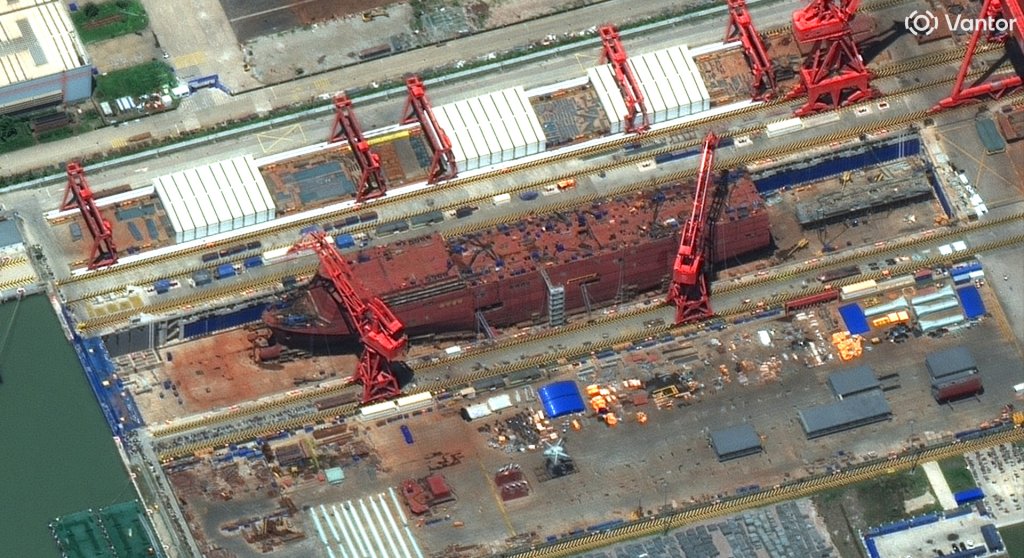
TWZ obtained the image of the ship in question, which was taken on September 10, from Vantor. Since then, it has also received an overall coat of gray paint, pointing to future service with the People’s Liberation Army Navy (PLAN). It is some 669 feet (204 meters) long and around 98 feet (30 meters) at its widest. In terms of basic length and width, the vessel being built now is very roughly comparable to China’s Type 071 amphibious warfare ship. However, it appears to be much taller overall than the Type 071.

The full September 10, 2026, image of the ship in question. Satellite image ©2026 Vantor
Another more recent view of the ship showing its new gray paint job. Chinese internet via X

The new ship has been under construction at the Hudong-Zhonghua Shipyard on Changxing Island in Shanghai since at least April. This yard produces a variety of naval vessels, including surface combatants and amphibious assault ships, as well as commercial designs.

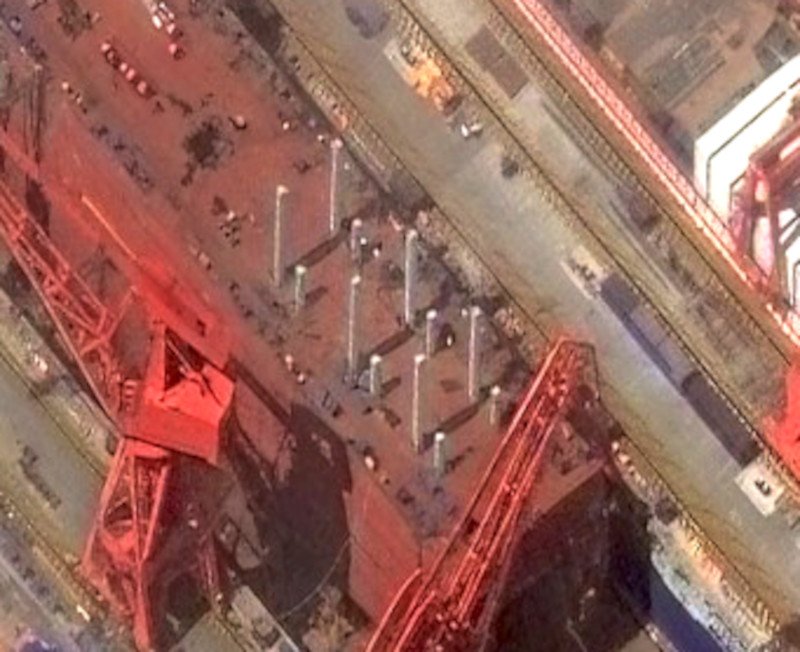
The September 10 image, which shows the ship from the stern, is interesting for a number of reasons. It notably confirms that the design not only has a well deck, but that it is sized around what looks to be a large cradle-like platform visible in the shot. The very roughly 164-feet (50-meter) long rectangular platform has an arch-shaped structure at one end and two teardrop-shaped ones at the other, as well as six pillars, three on each side, in between. The teardrop-shaped structures, in particular, point to the platform being at least a semi-submersible, as they would help with stability and otherwise guide the flow of water while being pulled along.

A closer look at the stern end of the ship, showing the opening for the well deck and the cradle-like platform. Satellite image ©2026 Vantor
An even closer look at the platform. Satellite image ©2026 Vantor
An earlier satellite image of the ship under construction taken on August 24, 2026, which also shows the cradle-like platform being built. Satellite image ©2026 Vantor

The satellite image also clearly shows six large struts extending from the top of the stern end of the superstructure, each one which is paired with a shorter strut, for a total of 12. Earlier this month, independent naval analyst H.I. Sutton, who tracks undersea warfare developments in particular, posited that these struts could be used to lower a platform or some other similar structure below the hull of the ship. He also assessed that they could be used as part of a larger system capable of moving payloads between decks internally. This would help account for the configuration of the core superstructure, especially how high it is all the way from the front to the back. Overall, signs point to the inside of the superstructure being largely hangars and other open work spaces, allowing for multiple large UUVs to be carried and supported. Individual UUVs would be launched and recovered, one at a time, via the cradle.

A closer look at the struts protruding from the top of the ship. Satellite image ©2026 Vantor

In making his assessment, Sutton drew specific attention to a previously shown rendering of a proposed Chinese scientific research vessel with a roughly similar strut-based system at the stern for deploying submersibles and other large payloads. However, on that design, the system was entirely exposed rather than contained with an extended superstructure.

The rendering of the proposed scientific research vessel with a system for deploying payloads at the stern that features four struts. Chinese internet via H.I. Sutton

The platform seen immediately behind the ship being built at the Hudong-Zhonghua Shipyard aligns with Sutton’s assessment about the purpose of the struts. At the same time, launches and recoveries could also be conducted in a more traditional manner via the well deck. The design of the cradle-like platform would seem to suggest the latter option is at least part of the plan.

The general idea of launching and recovering payloads through the bottom of the hull of a ship, including through moon pools, is hardly new. As another point here, Russia is known to have highly specialized mothership submarines that can carry crewed midget submarines and large uncrewed submersibles attached underneath their hulls, and that are also capable of launching ultra-long-range nuclear-powered and nuclear-armed torpedoes. The idea of deploying and retrieving large UUVs via well decks using cradle-like systems is something being explored by other navies globally, including in the United States. All that being said, a large specialized ship built for the purpose of launching and recovering very large underwater vehicles in an operational capacity is unique.

The image from September 10, as well as other recent views of the ship, highlight other features that are now taking shape. This includes a large opening on the starboard side, which could be for launching and/or recovering lifeboats or other watercraft, or moving payloads to and from the pier while docked, as well as a multi-pronged mast on top of the bridge. An additional part of the ship’s superstructure extends behind the bridge area, and there is what looks to be a hangar inside. There is no attached helipad present now, but one could well be added later on somewhere on top of the superstructure. Many naval auxiliaries, as well as commercial ships designed for offshore support and other specialized tasks, have open helipads on raised frames attached to different parts of the superstructures.

A closer look at the area of the superstructure around the bridge, showing the multi-pronged mast on top and what looks to be the opening to a hangar. Satellite image ©2026 Vantor

Though there is growing clarity about the ship’s design, many questions do remain about the full breadth of its intended purpose. In Sutton’s view, the PLAN has a need, just in general, for a dedicated mothership to support its growing uncrewed underwater vehicle (UUV) fleets. The PLAN is pursuing various tiers of UUVs to perform a host of different missions, including intelligence, surveillance, and reconnaissance (ISR), as well as mine-laying, special operations support, and even launching direct attacks on enemy vessels. Larger and larger UUV designs have been steadily emerging in China, which could require more specialized launch and recovery options to be feasibly employed operationally, especially from other vessels at sea. Deployment and retrieval at sea could, in turn, support very long duration missions far from China’s own shores.

“With smaller UUVs, even up to 20 meters like the AJX-002 and HSU-100 paraded in Beijing last year, they are road mobile. Truck mounted cranes should be sufficient for getting them in and out of the water making operations much simpler. With these latest, much larger XXLUUVs [extra-extra large uncrewed underwater vehicles] however, China will start to need dedicated port facilities,” Sutton wrote previously on his website. “Until now China has been using floating docks to house the two XXLUUV prototypes being tested on Hainan. One of these docks was purpose built while the other may have been taken up from general use.”

A Chinese AJX-002 UUV, or a mockup thereof, seen ahead of a major military parade in Beijing in 2025. Chinese internet via X

China's naval unmanned systems.

Consisting of (in order), AI enabled unmanned submersible (HSU-100), used for detection and attack.

Unmanned patrol boat.

Unmanned mine-laying/attack submersible (AJX-002), this was previously mistaken for a nuclear powered torpedo.
Because the… pic.twitter.com/Mlj55XLNBH

— Zhao DaShuai 东北进修🇨🇳 (@zhao_dashuai) September 3, 2025

“This arrangement also has a significant drawback: each floating dock can only carry a single XXLUUV,” Sutton added. “Or if more than one, then they both need to be placed in the water at the same time. Because the whole dock floods, there cannot be one undergoing maintenance while another is being launched or recovered.”

A mothership vessel able to discreetly deploy and recover large uncrewed and crewed submersibles and other large payloads underwater could be tasked with more specialized missions, including cutting cables, retrieving objects from the seabed, and other kinds of undersea espionage. There is overlap here with more benign roles, such as submarine rescue, salvage, and even deep-sea scientific research. There is also the matter of servicing an expanding array of Chinese underwater infrastructure, including sensor and communications networks. As something of a corollary, Russia’s spy ship Yantar is officially described as an oceanic research vessel. In China, the line between military and non-military assets and capabilities, including ships, is often very blurry, to begin with, as TWZ regularly highlights. This dichotomy was observed right at the Hudong-Zhonghua Shipyard around the end of last year after pictures of a commercial cargo ship being used to showcase a new family of containerized weapons, sensors, and other systems went viral online.

It is also worth pointing out that the boxy and largely enclosed design of the ship now being built at Hudong-Zhonghua Shipyard will inherently make it difficult to observe any activities onboard. This will have the additional knock-on effect of helping keep any payloads, as well as the crew, shielded from the elements. This could be valuable for operations in harsher locales, including waters in and around the Arctic, an ever-more strategic part of the world where China is working to be more engaged.

We also do not know if the apparent mothership vessel is intended to be a one-off or part of a larger class. It could be a stepping stone to broader plans or be part of an already extensive fleet of bespoke naval auxiliaries, as well as unique ostensibly commercial vessels, in service in China today. The PLAN’s aforementioned UUV ambitions will bring along significant test and evaluation requirements, as well as the need to support actual future operations.

If nothing else, evidence is only growing that the new ship under construction at the Hudong-Zhonghua Shipyard is intended to serve, at least in part, as a mothership for large submersible drones.

Contact the author: joe@twz.com

The post China Appears To Be Building A Mothership For Large Uncrewed Submarines appeared first on TWZ.

  •  
❌