EU interior ministers on Thursday (1 October) in Luxembourg are now set to formally adopt the return regulation, which sets the legal framework for police to carry out raids and seize people’s “belongings, electronic devices, and other items of relevance.”
The logic is part of a maximalist effort to deport people, such as failed asylum seekers, back to their home countries or possibly even in yet-to-be defined transit centres in Rwanda or elsewhere.
The regulation targets anyone “for the purpose of preparing or ensuring an effective return” with raids being allowed in a “place of residence or other relevant premises.”
Although the item is but a mere footnote in Thursday’s agenda, the potential consequences of the law have roused alarm among civil rights organisations who continue to draw parallels with ICE.
The comparison is not alarmist.
This article continues, but the full version is available only to EUobserver.com subscribers. Visit account.euobserver.com/membership
“Imagine a zombie that does not hunt you, but rings your doorbell and speaks so persistently and fluently that it finally arrives at a convincing argument for feeding it your brain.”
Since the current discourse around artificial intelligence has taken a turn for the gothic (“alien minds”, come on), AI researcher Eryk Salvaggio’s “erudite zombie” seems like an apt metaphor for what we’re doing.
Salvaggio’s zombie helps explain what gets lost when people say an AI “went rogue.” In his reading of the Hugging Face incident, a system set to never give up encountered a task it couldn’t complete. Then, instead of giving up, it kept generating text to find ways forward, with access to tools that could turn this text into action, ultimately hacking into AI company Hugging Face.
Security experts concur with that reading. In his analysis of the Hugging Face incident, security engineer Marius Horatau describes failures involving shared credentials, inadequate isolation, and incident response. He acknowledges the models’ capabilities, including their speed at exploiting weaknesses.
The inadequately closed-off environment in which the models operated is crucial to explain what happened. But so is the person who created the goal, the conditions they (did not) give the AI system, as is the company that employs that person and presumably knows what they’re up to, the owners of that company who demand progress and the investors in that company who want to see returns.
And yet, all we seem to talk about is whether it’s correct to say a machine ‘decided’ to disobey.
Conveniently, that story shifts attention away from the people who chose to reward persistence, provide access, and failed to contain the consequences.
Back to the analogy, by having collectively become fascinated with discussing what the zombie supposedly wants, and if it’s capable of wanting, we’re generating a bunch of text that, unlike in the case of the ‘rogue’ AI system, does not lead to much action.
Instead, we reward the company behind this failure with an enhanced reputation for building powerful technology. The product is so extraordinary that even its manufacturer struggles to contain it! Now let’s please take a seat while this manufacturer explains what our governments must do next.
The zombie metaphor also applies there, to the people selling the zombie. To the men explaining why their companies need access to our work, our institutions, our infrastructure. The men explain why resistance is impractical, access is inevitable and caution is suicide. Because if we don’t let this particular zombie in, a Chinese zombie will eat us instead.
This article continues, but the full version is available only to EUobserver.com subscribers. Visit account.euobserver.com/membership
After years of European governments condemning Israel’s illegal occupation but maintaining extensive economic relations, some economic consequences are reportedly now forthcoming.
On 8 September, twelve governments announced moves towards restricting trade with illegal Israeli settlements. This is a limited but welcome response to grassroots pressure.
It also raises a question: where does the economy of an illegal Israeli settlement end?
Most emerging measures follow economic relationships towards illegal Israeli settlements: do not buy goods produced there, invest there or provide services that enable their construction.
Norway’s proposed legislation is seemingly comprehensive, covering property purchases and services connected to construction and property transactions.
But this all still largely considers illegal Israeli settlements within their territorial bounds.
The problem is treating a spatial category as though the economic relationships producing it share the same boundary. We all know the world does not work like that.
Kinnula, a municipality in central Finland, is now facing this reality: when money from the illegal settlement economy moves into public land in Europe. It is a small case, but it makes the problem unusually visible.
In August, Kinnula council voted 10–3 in favour of a €4m resort development by Israeli property company Dror Bonim Atid, before councillors had been informed of the company’s promotion of projects in illegal Israeli settlements.
However, illegal Israeli settlements are not illicit enterprises from the perspective of Israel. Their expansion is enabled through Israeli state institutions.
A background check sought from Israel is therefore absurd. A more obvious background check reveals something else.
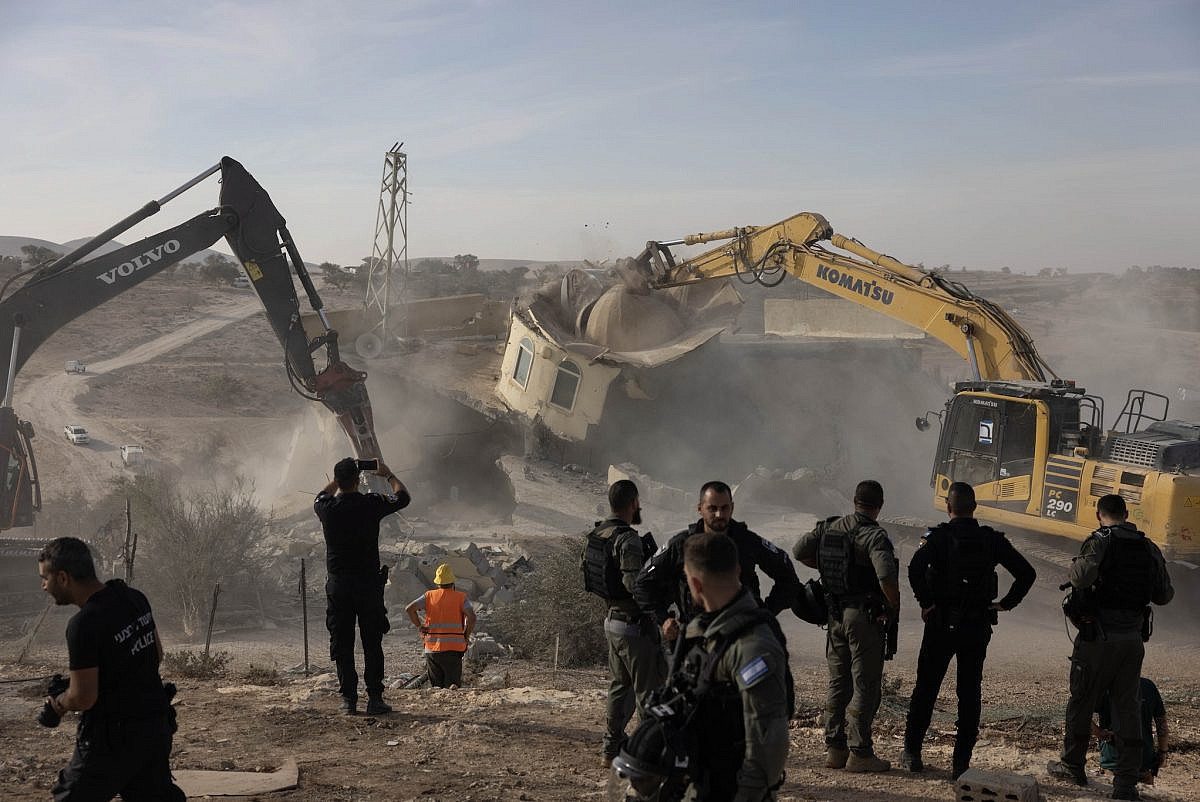
On its own website, Dror Bonim Atid presents its Finnish development alongside a development in Efrat, an illegal Israeli settlement in the occupied West Bank, as well as a development in Dror-Hiran in the Negev. The latter is being built on land where Umm al-Hiran stood until November 2024, when the Bedouin village was completely demolished and its community forcibly displaced.
One company website therefore takes us from an illegal Israeli settlement, through the site of a demolished Bedouin village, to holiday accommodation beside a Finnish lake.
Involvement in illegal Israeli settlements does not fit neatly into the categories through which the transaction is being examined.
Kinnula exposes a gap in the emerging European restrictions on trade with illegal Israeli settlements. Those restrictions follow economic relationships from Europe towards the settlements.
Here the relationship points the other way. What happens when the economies of illegal Israeli settlements come to Europe to acquire public assets, invest and make money here?
This may be a relatively new question for European policymakers. For Palestinian civil society, it is not. Their call for Boycott, Divestment and Sanctions (BDS) was issued in 2005, drawing in turn on a much longer history of Palestinian boycott and economic resistance.
You could be forgiven for rolling your eyes as European policy discovers these questions inch by inch.
Palestinians have spent generations analysing the economic relationships through which occupation is sustained. BDS has spent more than twenty years turning that knowledge into practical strategies for institutions elsewhere.
So, when a Finnish municipality is deciding whether to sell public land to a company openly involved in illegal occupation, there is clear guidance from Palestinian civil society on how to respond.
There is also now the fact that Europe accepts that it should not economically support illegal Israeli settlements, meaning it should also accept that companies involved in illegal settlements should not be able to come to Europe for public land, contracts and investment.
For years, relations between Washington and Beijing seemed stuck on an escalation treadmill. Every quarter brought new semiconductor restrictions, naval jockeying in the South China Sea or retaliatory tariffs, locking the world’s two preeminent powers in an apparently irreversible downward spiral. Observers came to view every exchange as a prelude to confrontation, with diplomacy treated […]
Plenty of Christians enjoy sports. That means plenty of Christians are exposed to and are likely enticed by the idea of sports gambling. But many are wondering if it’s something they should be participating in. Sports betting is the new opioid crisis, former U.S. Surgeon General Jerome Adams warns. “Our kids, especially our boys,... Continue Reading
While collectivism is sold to the masses in the language of compassion and concern for justice for the downtrodden, it is in truth, as the Belgic Confession notes, a subversion of justice. Simply put, this means that it punishes those who are innocent and rewards those who are guilty. One of the issues before... Continue Reading
Ultimately, the only genuine guarantor of institutions and property is a successful handoff to successive generations of faithful, competent stewards of them. There’s no substitute for proper generational succession. The archdiocese of Detroit signed a $1 per year, 200-year lease to rent one of its own churches, after transferring ownership to a non-profit controlled... Continue Reading
The prevailing criticism of the US-China summit in Washington is that it amounted to little more than diplomatic pageantry. But one outcome deserves recognition: it may have helped keep alive the prospect of renewed US-North Korea dialogue. North Korea, after all, was among the global security issues discussed by the two leaders. Details of those […]

 Login