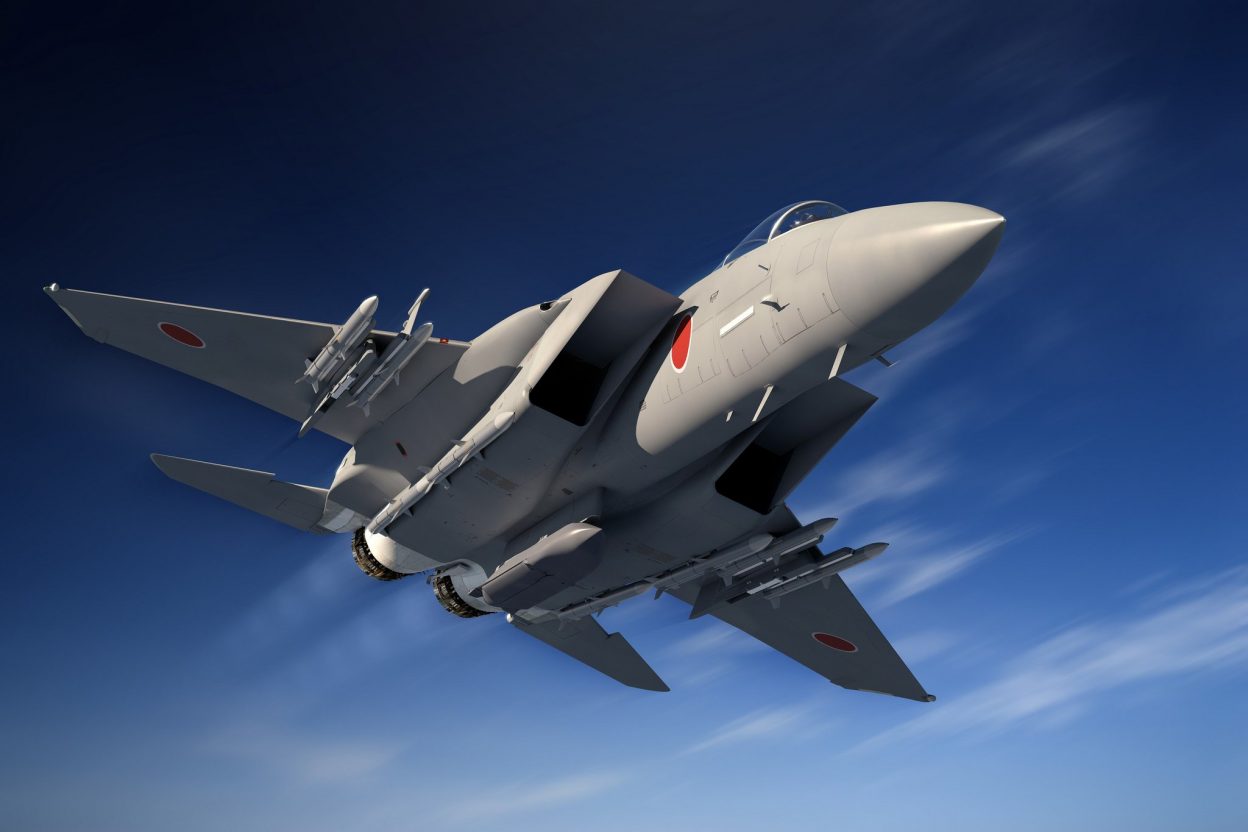
❌

Reading view

Germany Holds ‘Exploratory Talks’ to Join Once Rival GCAP 6th-Gen Fighter Program After FCAS Collapse

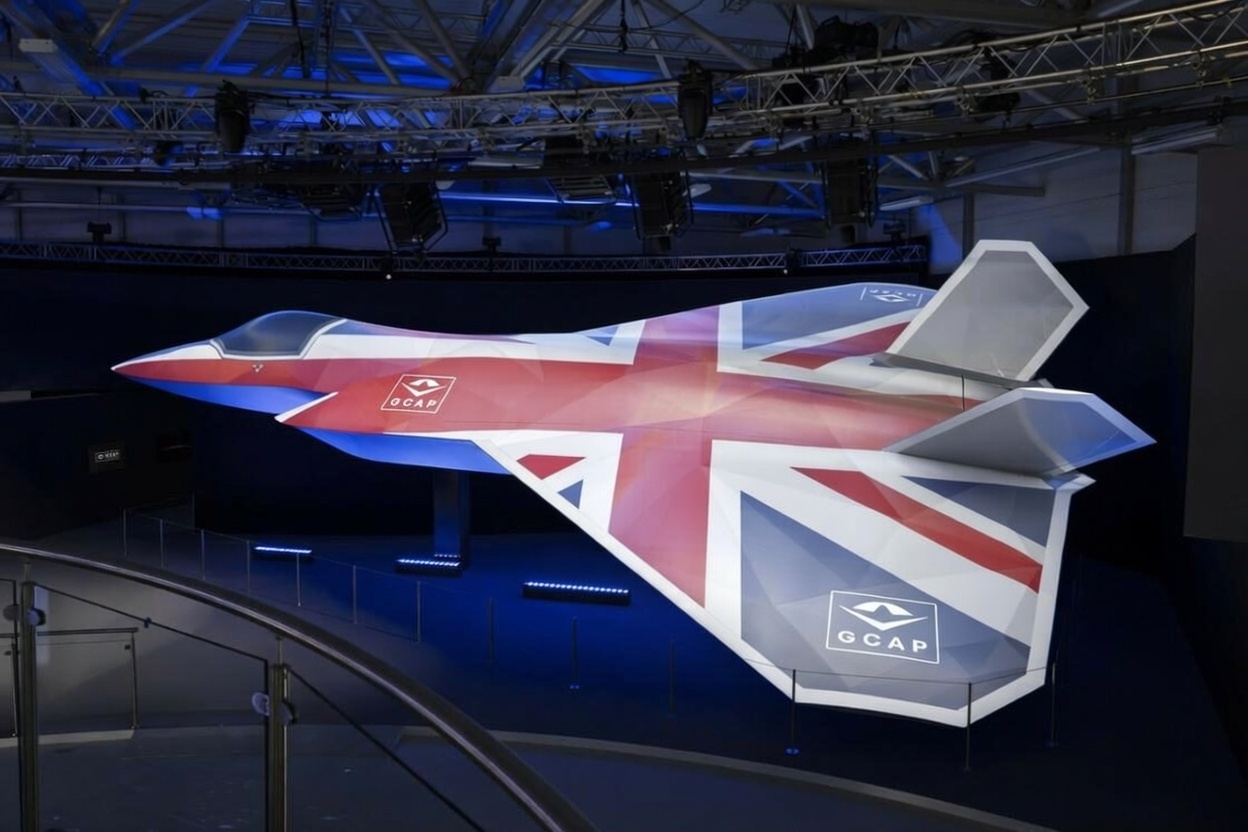
Months after walking away from the Future Combat Air System (FCAS) project, Germany is quietly testing the waters of a rival alliance led by Britain, Japan and Italy.

Germany has held “exploratory talks” about joining the Global Combat Air Program (GCAP) as it charts its future after the FCAS collapse.

The confirmation came after Politico accessed internal German government documents that revealed the United Kingdom’s national armaments director, who oversees defense procurement, sought German participation in the next-generation fighter program. The document noted that London wants to discuss the terms of potential cooperation, such as Germany’s military capability requirements and industrial “workshare.”

Notably, the German defense ministry told Politico it held preliminary discussions on GCAP’s fundamental requirements and program substance, without disclosing whether the United Kingdom had officially offered Germany any specific participant status.

The development comes months after the Friedrich Merz government pulled the plug on the FCAS program it was pursuing with France and Spain. The program had remained stalled amid unresolved disputes between Airbus (representing Germany and Spain) and France’s Dassault Aviation over work-sharing, design philosophy, and supplier selection.

After the program ended, an Airbus-led consortium of defense companies known as “Team Gen 6” filed a position paper on a sixth-generation fighter project with the German government, signaling an industry drive to influence the process.

Over a month after Germany abandoned the FCAS, Airbus Defense and Space said at the ongoing Farnborough Air Show in the UK that it was open to joining forces with Britain, Italy and Japan if it had enough control over the program and work share.

“What we’re ready to do is to join something or to build something where we have a significant portion of the work and the leadership. That’s currently being explored,” head of Airbus’s defense division in Munich, Michael Schoellhorn said at the time.

GCAP has been on Merz’s radar since before it walked out of the FCAS in June 2026, as the EurAsian Times had previously reported.

During a visit to Italy in February 2026, Merz raised the prospect of his country joining the GCAP and received a favorable response from Italian Prime Minister Giorgia Meloni.

While Germany is actively looking for partnerships it could forge for a sixth-generation fighter, France appears more undecided for now.

France and its aerospace giant Dassault could go solo with the FCAS, repeating a historical pattern seen in its development of the Rafale. In fact, French officials have repeatedly said France is currently the only country in Europe with the full industrial ecosystem to design and build a fighter completely independently.

In July this year, Dassault CEO Eric Trappier said a next-generation combat jet could be developed solely in France or in cooperation with other partners, but he did not say which countries could be invited to the effort, if at all.

Meanwhile, India has officially initiated efforts to join the FCAS program. “The Ministry of Defence has initiated efforts in a concerted manner to co-join the 6th Generation Fighter Aircraft Development Programme viz. Future Combat Air System (FCAS) spearheaded by the French Government,” the defense ministry said in its report to the Parliamentary Standing Committee on Defense.
File Image.

Germany’s GCAP Decision: Not So Easy?

GCAP is largely on track after it received a fresh impetus last month, with London committing £8.6 billion ($11.7) to the program in the Defense Investment Plan (DIP) earlier this year. GCAP’s industrial joint venture to design and develop the next-generation fighter, Edgewing, is led by Leonardo (Italy), Mitsubishi Heavy Industries (Japan), and BAE (the UK).

Pneumonia Plague in Russia: Boris Yeltsin Admitted the 1979 Lab Leak. But Moscow Says Siberia is Different.

The group formally admitted Canada as an observer to the program in July this year, as the EurAsian Times previously reported. Following that, Leonardo  CEO Lorenzo Mariani said at Farnborough that a country willing to join the GCAP could do so before the end of this year, with a final deadline of another year—signaling an appetite for expansion.

Although the UK and Italy have openly expressed their willingness to welcome more partners into the GCAP, Japan may remain Germany’s only hurdle if it decides to join the trilateral sixth-generation grouping.

Until now, Tokyo has remained reluctant to open the group to more members, citing concerns about delays and an urgent need for the Japanese Air Self-Defense Forces to replace the F-2 with a next-generation aircraft. It earlier opposed Saudi Arabia’s entry into the GCAP despite the resources that the cash-rich country could potentially bring.

Because of “where GCAP partners are in terms of the program at the moment, what they don’t want to do is to start to have to renegotiate stuff, introducing somebody else at this point and then slow the program down,” Douglas Barrie, a senior fellow for military aerospace at the International Institute for Strategic Studies (IISS), told Breaking Defense.

Even if Japan allows Germany entry into the GCAP on the insistence of the UK and Italy, new challenges could arise over the aircraft’s design philosophy. For one, the GCAP is being built around a maritime scenario, whereas Berlin would want an aircraft suited to its own geography and continental use.

There is already a small discrepancy in the GCAP group’s priorities: Japan wants to simply develop a new fighter by the mid-2030s to replace the F-2, while the UK and Italy are reportedly more interested in GCAP developing a cutting-edge “system of systems,” a fighter that works with a swarm of drones under a less stringent timeframe. Admitting a new member could further complicate matters internally and likely cause delays.

Another major challenge for Berlin could be the distribution of work share, which was unarguably the main bone of contention within the FCAS and the last nail in its coffin.

The three Industry partners are already set in their ways, having established the joint venture, divided responsibilities, and set program structures via Edgewing and GIGO (GCAP International Government Organization). At this point, bringing Germany into the GCAP could risk undermining existing partners’ interests and reopening delicate talks on industrial participation, production shares, and intellectual property.

If the terms are renegotiated, Germany may be offered a junior or subordinate role, with limited say over design, architecture, and key decisions—something that may not be acceptable to Airbus, as indicated earlier this year.

In addition to these challenges, Germany views the UK’s BAE Systems with skepticism,  Politico stated, citing the internal German assessment.

The document reportedly highlights what it calls a “bad experience” with the business during Eurofighter development and says it is reasonable to expect BAE will control the new initiative in a manner incompatible with collaboration “on an equal footing.”

It is pertinent to note that Italy’s defense minister claimed in January this year that the UK was not doing enough to share its cutting-edge technology with its partners, calling it “madness,” months after he said in April 2025 that the UK needed to bring down the “barriers of selfishness.

Besides GCAP, Germany is considering an alternative partnership with Sweden and Spain. In fact, the internal document emphasizes that the three nations would start from a more comparable position than Germany would, because their military requirements are closely linked, and recommends exploring that option, as noted by Politico.

Notably, Michael Schoellhorn expressed his excitement about collaborating with Sweden and Saab on the next-generation fighter in March 2026 during an exclusive interview with the Swedish business newspaper Dagens Industri on the fringes of the Airbus Defense & Space Summit. This means that Airbus has been eyeing Saab as a potential partner.

For now, both options remain on the table, and Germany has yet to decide whether to join the GCAP to get a sixth-generation fighter by 2035 or pursue a partnership that starts on equal footing and allows Airbus to take an equal, if not larger, role.

The post Germany Holds ‘Exploratory Talks’ to Join Once Rival GCAP 6th-Gen Fighter Program After FCAS Collapse appeared first on EURASIAN TIMES.
  •  

Saudi & Turkey Chase F-35 Jets, Heavy Skepticism in India. Why IAF Veterans are Not Too Keen on F-35s?

After years of lobbying by Riyadh, the United States recently greenlit a potential sale of F-35 fighters to Saudi Arabia. Meanwhile, Turkey is looking to rejoin the F-35 program and is aggressively pursuing the Trump administration to approve the sale of stealth jets. 

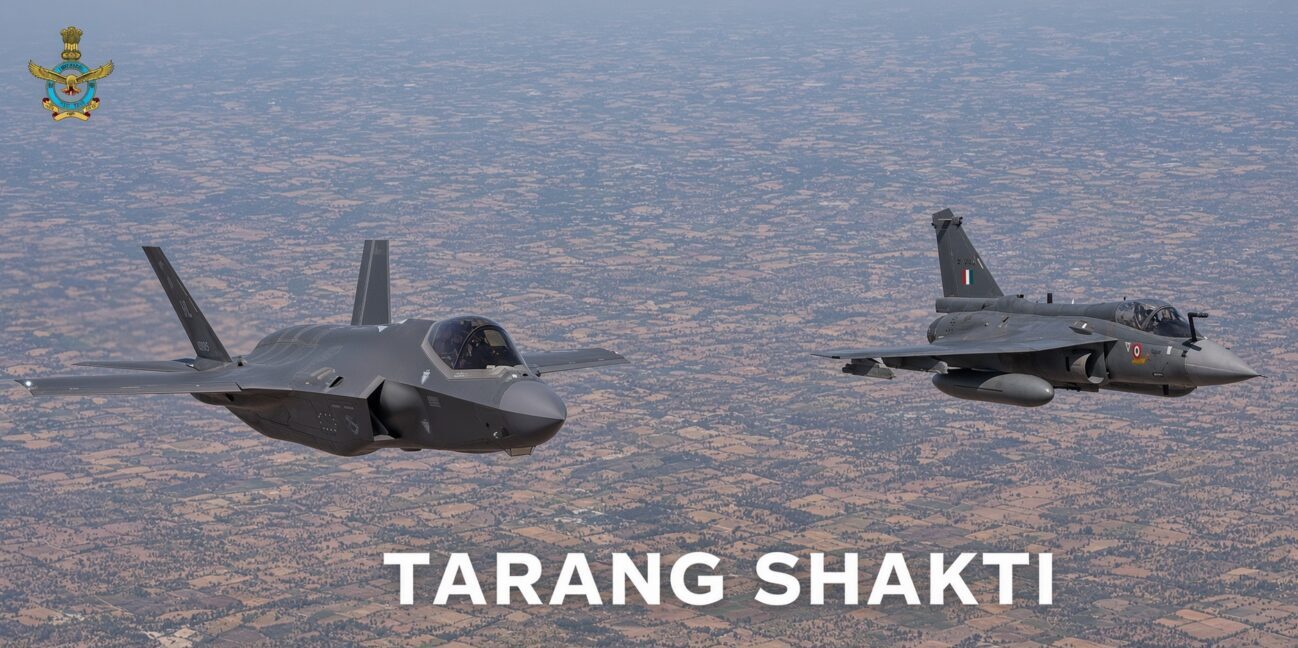
Another interesting case is India, which is hosting Exercise Tarang Shakti, where six F-35 jets are participating. Indian experts call it a unique opportunity for the IAF to evaluate US stealth jets and see how Indian ground and airborne radars detect them.

Notably, this is the first time F-35s are participating in drills with Indian jets on Indian soil.

Many see this as an historic opportunity to train alongside arguably the world’s best jets and give real-time exposure to the IAF’s Rafale, Su-30MKI and Tejas aircraft. Even IAF critics who don’t favor a potential F-35 sale to India see this as a historic opportunity.

Earlier, a EurAsian Times report said the US State Department announced the proposed sale of F-35 Lightning II and related equipment to Saudi Arabia on September 17, 2026. The proposed sale is expected to cover  48 F-35 aircraft and 49 Pratt & Whitney F135-PW-100 engines, along with communications gear, training, spare parts, and other support as requested by Riyadh.

The approval followed years of lobbying by the Saudi kingdom to procure the highly sought-after stealth fighters. Earlier, the Obama administration explicitly ruled it out in late 2015, stating that Israel would remain the sole F-35 recipient in the region to preserve its qualitative military edge (QME).

Later, the Biden administration explored linking a potential F-35 deal to Saudi-Israeli normalization, but talks stalled after the October 7 Hamas attack on Israel.

The US State Department’s proposed sale still requires congressional approval, and analysts believe Saudi’s purchase of the F-35 could hit a roadblock amid concerns about Riyadh’s ties with China and Israel’s opposition to the deal.

Despite being a founding member of the F-35 program and making a significant financial investment, the US expelled Turkey from the consortium and sanctioned it under CAATSA for purchasing the S-400 despite repeated warnings.

Ankara has been actively pursuing a strategy to divest itself of its Russian-made S-400 and sell it off to a potential third-party buyer.

Earlier, the US President similarly responded to questions about lifting CAATSA sanctions on Turkey by saying, “I’ll always speak to President Erdogan. He is a friend of mine, as you know. And I’ll always make him happy.”

As Trump & Xi Talk — U.S. and China’s Nuclear Submarines Race For Dominance in the Indo-Pacific

For now, Turkey’s path to obtaining the F-35s is still full of hurdles that both Washington and Ankara may find hard to remove, including Israel’s stiff opposition, as the EurAsian Times has explained before.

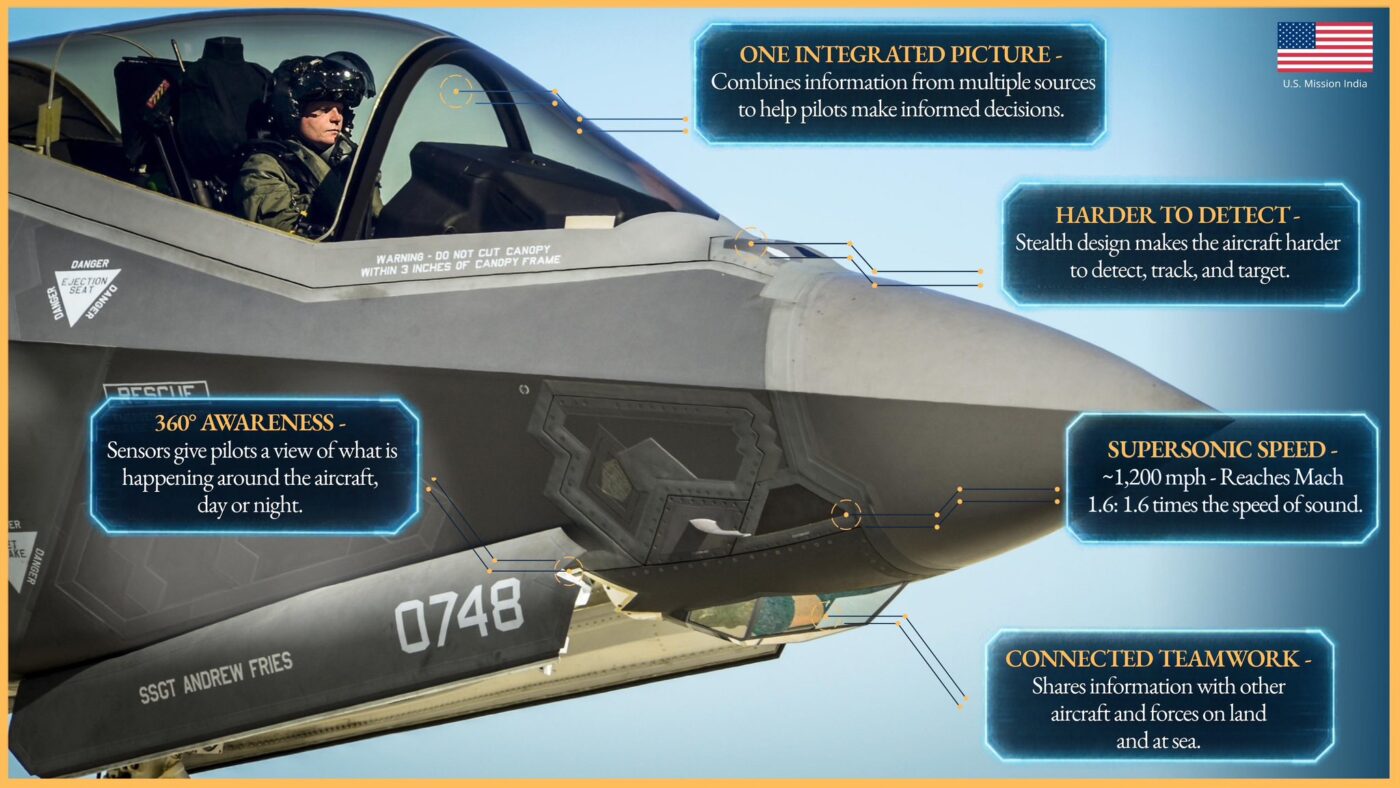
Like Saudi Arabia and Turkey, several countries have made unsuccessful attempts to obtain the F-35, widely regarded as the leading fifth-generation multirole fighter thanks to its advanced low-observable stealth and groundbreaking sensor fusion.

Functioning as a highly networked airborne command node—often described as the “quarterback of the skies”—it shares data seamlessly across friendly platforms. In fact, analysts believe that it is the most capable fifth-generation fighter in service anywhere in the world.

Despite this, India — a country that faces the dual threat of China and Pakistan along its borders — has been somewhat indifferent to what many consider the world’s best jets.

US Pitch for F-35s

Donald Trump unofficially pitched the F-35 to India during a meeting with Indian Prime Minister Narendra Modi in February 2025. “Starting this year, we will be increasing military sales to India by many billions of dollars. We are also paving the way to provide India with the F-35 stealth fighters ultimately,”  he said at the time.

F-35: Image via US Embassy, New Delhi

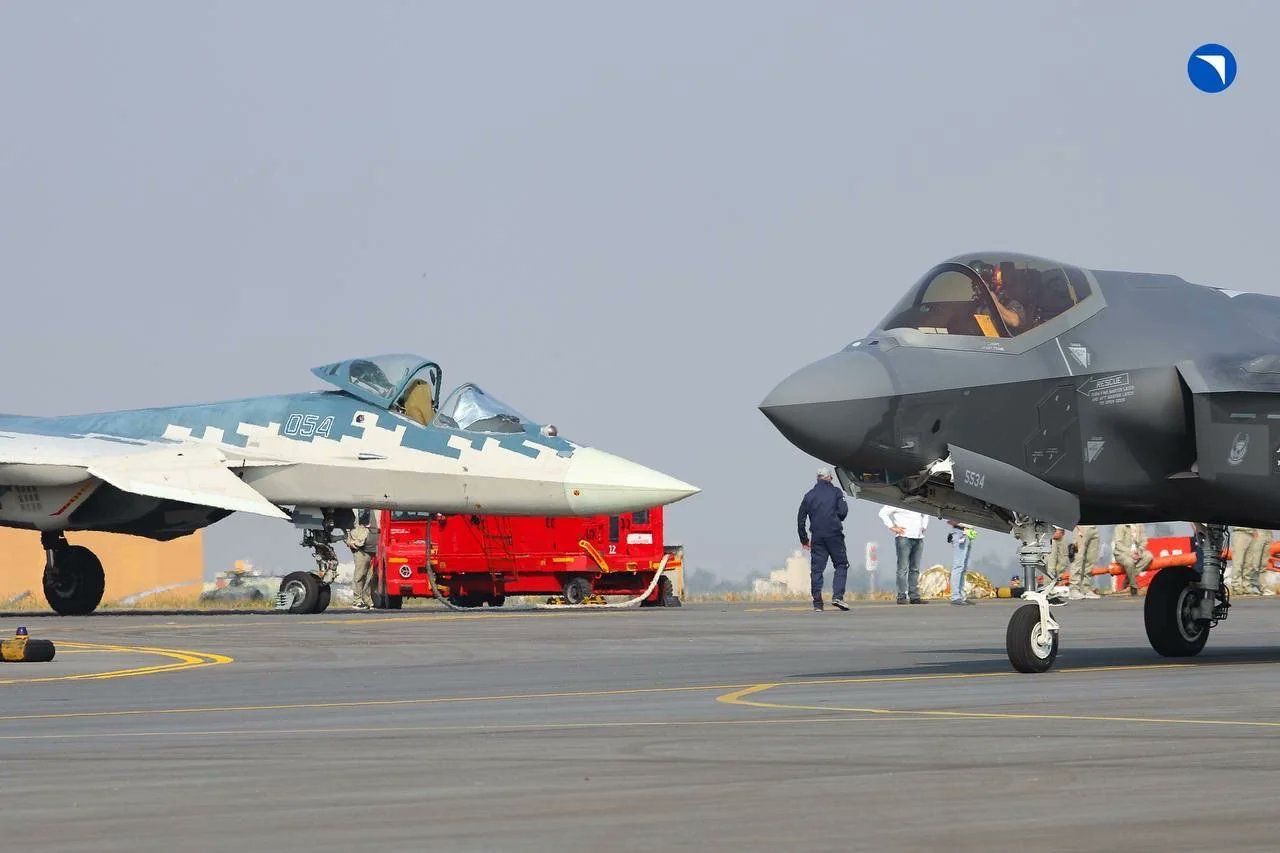
The F-35s were also displayed at Aero India 2025 the same month, where they met the Russian Su-57 on the tarmac for the first time.

During his April 2025 visit to India, US Vice President J.D. Vance appeared to reiterate the offer.

“We, of course, want to collaborate more. We want to work together more. And we want your nation to buy more of our military equipment, which we believe is the best in class. American fifth-generation F-35s, for example, would give the Indian Air Force the ability to defend your airspace and protect your people like never before,” he said, making a more direct appeal.

Although the US never made an official offer, the verbal F-35 pitch and the prospect of acquiring a cutting-edge stealth fighter looked great on paper, particularly since China operates two fifth-generation aircraft (the J-20 and J-35A) and is allegedly exporting the J-35A to Pakistan.

Rafale, Tejas & AMCA: IAF’s “Healthy Mix” of Fighter Jets Leaves Out The Aircraft That May Matter The Most

However, India’s defense community and Indian Air Force (IAF) veterans seemed unimpressed by the F-35 offer despite acknowledging the aircraft’s potent capabilities, a stance recently reiterated as six F-35s made their debut in India-hosted “Exercise Tarang Shakti 2026” in Jodhpur, Rajasthan.

Seven Reasons Why IAF Veterans Oppose F-35

First, Indian analysts and experts believe that buying an expensive stealth fighter off the shelf from the United States would be a liability, since it would do nothing for the Indian defense manufacturing sector and come with an enormous price tag.

Each F-35 is expected to cost $80 to $120 million, with even higher life cycle costs. Therefore, a fleet of F-35s would impose a heavy financial burden that the Indian Air Force would rather allocate to indigenous programs and more flexible and diverse acquisitions.

Second, analysts and veterans have argued that the US would never part with its technology, eliminating domestic manufacturing. They reckon the F-35 procurement would run counter to the “Make in India” and “Aatmanirbhar Bharat” policies.

Air Marshal Anil Khosla (retd), the former Vice Chief of Air Staff (VCAS), earlier stressed that even with approval of limited technology transfer and local manufacturing, significant challenges would remain. At the time, he highlighted production risks arising from the F-35’s complex global supply chain, noting that Lockheed Martin sources components from multiple countries. He cautioned that any disruption or delay in delivering these parts could halt the entire manufacturing process.

Air Marshal Khosla further noted that India’s continued reliance on foreign suppliers would constrain genuine localization, and the IAF would struggle to manage such disruptions.

Notably, this concern takes on greater significance as delivery of Tejas Mk-1A fighter jets to the Indian Air Force has been delayed due to delays in delivery of F404-IN20 turbofan engines, affecting the service’s preparedness.

Photo by United Aircraft Corporation (UAC)
File: F-35 Lightning II and Su-57 Felon captured in the same frame for the first time in history at Aero India 2025

Third, there is concern that diverting resources to acquiring the F-35 would inevitably affect India’s own fifth-generation Advanced Medium Combat Aircraft (AMCA), which aims to deliver a fifth-generation platform with advanced sensors, electronic warfare systems, and networked combat features while fostering a domestic aerospace industrial base.

Experts have urged the IAF to focus on its indigenous programs rather than getting trapped in another round of imports.

Fourth, analysts have also cited logistical challenges and operational incompatibility with India’s diverse air force fleet comprising a mix of Russian Su-30MKIs, French Rafales and Mirage 2000, and Tejas. They believe that adding another fighter type would further complicate maintenance, training, and logistics for an already varied inventory.

France Fires Nuclear-Capable M51.3 Sub-Launched Ballistic Missile For The First Time Amid Russian Threats

Fifth, India operates Russian-supplied S-400 systems, which previously caused friction between the US and Turkey.

“An F-35A deal would likely come with strings attached—most notably, a U.S. demand that India abandon its Russian S-400 air defense systems in favor of the American THAAD,” IAF veteran and commentator Squadron Leader Vijainder K. Thakur earlier stated.

The S-400 is deeply embedded in India’s layered air defense network, and New Delhi has been considering an additional order, meaning it would inevitably become a point of contention in any potential deal.

Sixth, the US has been flagged as an unreliable partner.

“Putting too many military aviation eggs in the unreliable US basket will also be an issue. Americans can be “very unreliable” when it comes to putting sanctions and freezing spares and maintenance support,” IAF veteran and aviation analyst, Air Marshal Anil Chopra (retd), earlier wrote in a detailed EurAsian Times article.

Adding the repeated threat of sanctions by the US and a rapidly changing geopolitical scenario further complicates the purchase.

Seventh, the F-35 is embedded in the US-controlled networks, including the Operational Data Integrated Network (ODIN), which sends information back to American servers. Indian experts view this as a breach of operational independence.

Tarang Shakti: F-35 and Rafale

Furthermore, they have cautioned that the US imposes stringent operational restrictions on its system and could try to limit the F-35’s use in combat, particularly against Pakistan.

Critics worldwide have also stressed that an unpredictable US administration could restrict free F-35 operations by limiting hardware and software supplies, commonly referred to as a kill switch. In fact, this is the reason why countries like Canada and Portugal decided to look for an alternative to the American stealth fighter.

Indian strategic discussions generally prioritize accelerating Tejas production, advancing the AMCA, and exploring local manufacturing options for platforms such as the Rafale. If a foreign fifth-generation fighter is ultimately considered, many experts have indicated a preference for the Russian Su-57 because of the technology transfer, local production, and twin-seat variant.


The post Saudi & Turkey Chase F-35 Jets, Heavy Skepticism in India. Why IAF Veterans are Not Too Keen on F-35s? appeared first on EURASIAN TIMES.

  •  

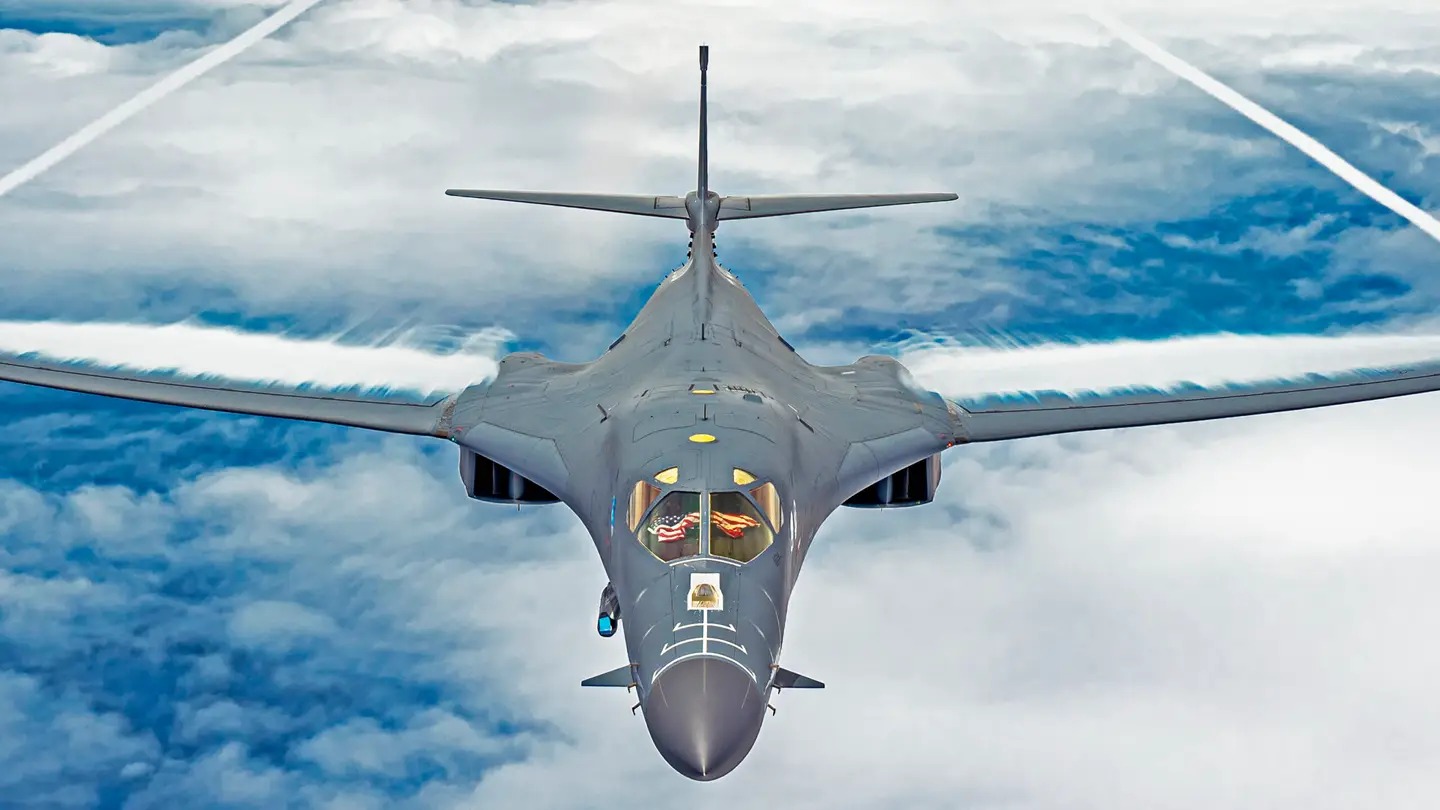
Iran Called RAF Fairford a “Legitimate Target.” Now All 12 U.S. B-1B ‘Lancer’ Bombers Have Left the British Base

The US has pulled out all its B-1B Lancer bombers from RAF Fairford in the United Kingdom, a key forward operating location used for long-range missions against Iran. 

The abrupt move appears to be an attempt by the US to safeguard its long-range strategic bombers from the fate suffered by other military aircraft destroyed by Iranian attacks in the Middle East.

The B-1B bombers arrived at RAF Fairford in March 2026 as part of Operation Epic Fury. Although the US and Iran agreed to a ceasefire in April 2026, the B-1Bs remained stationed at Fairford amid sustained hostilities.

However, the US hastily withdrew all 12 B-1B Lancers from the base on October 4, 2026, amid renewed threats of an Iran-backed plot against the facility.  The Pentagon confirmed the bombers have returned to their home bases.

“While operational security precluded us from ​confirming the movement of our assets and forces ​in real-time, ‌we can acknowledge now that all US bombers that were deployed to RAF Fairford have re-deployed to their home ‌stations in the United States,” a Pentagon spokesman reportedly said ‌in ​a statement.

The pullout was extremely unusual since such actions are rarely taken so swiftly from an allied air base thousands of kilometers away from the combat zone. In fact, some of the bombers and their flight crews left RAF Fairford even as aerial refueling aircraft were still being rushed to support the missions to the United States, the New York Times reported.

These claims point towards an uncanny sense of urgency, although the US military has not officially cited a reason for this rushed exodus of bombers from RAF Fairford.

Nonetheless, the move comes days after five British men in their early 20s were arrested near RAF Fairford in Gloucestershire after reports of three suspicious vans approaching the base hosting the US bombers.

They were held on suspicion of Explosives Act offenses and preparing a terrorist act, but were released on police bail with strict conditions the next day. However, a sixth man—identified as a 25-year-old dual UK-Iranian national—was later arrested in London on suspicion of preparing terrorist acts. He was later released on bail.

An investigation into what was believed to be a sabotage operation is now underway. However, both the United States and the United Kingdom have since hinted that Iran has links to the potential attack or sabotage operation.

US President Donald Trump said the suspects had been looking to ‌do “big damage” whereas Secretary of State Marco Rubio said it involved the “hands of a foreign actor,” without directly naming Tehran. Meanwhile, British Prime Minister Andy Burnham said there are “strong indications” that Iran played a role in the security incident at a crucial base that hosts US assets and troops.

Iran dismissed the allegations and has denied any link to the suspected security incident.

“PM Burnham says the UK Government ‘can confirm our belief that we believe Iran to have played a part’ in the RAF Fairford incident,” Iran’s Foreign Minister Abbas Araghchi wrote on X last week. “I can confirm Iran’s belief that releasing supposed terrorists working for foreign states really says it all. You’re barking up the wrong tree.”

Iranian Threats Triggered A Pullout?

The US military has not given any information on the urgent threat, whether it was an imminent strike or a sabotage- or terror-related incident. However, the threats issued by the Islamic Republic and its forces in the past may have influenced the decision to withdraw the bombers.

As the hostilities resumed between the US and Iran in July this year, the Islamic Revolutionary Guards Corps (IRGC) claimed that the US was launching bomber sorties from RAF Fairford to attack Iranian cities, adding that any base used to carry out such strikes would be a legitimate target.

“The American aggressor army, which used to launch cruise missiles from its vessels in the Indian Ocean in its aggression after the official resumption of the war, with the end of the missile reserves of the aforementioned vessels, yesterday switched to using B1 planes flying from Fairford Air Base, England,” Tasnim News Agency quoted the IRGC as saying on July 23. “As the officials of the Ministry of Foreign Affairs also stated, any base that is used to invade Iran’s territory is our legitimate goal.”

In March 2026, Araghchi told the UK Foreign Secretary, Yvette Cooper, that Iran views the UK’s decision to let the US use British bases as “participation in aggression.” Later, it fired two mid-range ballistic missiles at Diego Garcia, the Indian Ocean military outpost jointly operated by the US and the UK.  Although none of the missiles reached their designated targets, the attack was launched after the UK approved the US use of its bases as launchpads for attacks on Iranian sites targeting the Strait of Hormuz.

File:RAF Fairford (14648075034).jpg - Wikimedia Commons
RAF Fairford – Wikimedia Commons

RAF Fairford, for one, has been a key hub for US heavy bombers—including the B-1B and the B-52—conducting missions against Iranian missile infrastructure. Although Washington could fly long-range bombers to attack Iran from its own soil, using RAF Fairford has been significant because it enables long-range strikes and reduces flight times to Iranian targets by over 50% compared to US-based launches, allowing higher sortie rates.

According to media reports, a proxy sabotage or terror operation by Iran on RAF Fairford remains a major possibility. In the past, the United Kingdom has accused Iran of conducting cyberattacks and employing criminal networks and proxies to strike at its critics and dissidents on British soil for years.

Apart from a terror plot, it is hard to say whether Iran has the capability to strike RAF Fairford, or any other base in the United Kingdom. Iran has long claimed a self-imposed limit of about 2,000 kilometers for its ballistic missiles. However, its March 2026 attempted strike on the US-UK base at Diego Garcia demonstrated a much longer reach, and analysts have said it could potentially strike parts of the United Kingdom.

The US currently has about 45 operational B-1B bombers in its inventory, and many are aging airframes with very low readiness rates.

Therefore, losing even a single bomber would remove a scarce, high-payload platform that cannot be rapidly replaced, particularly while the B-21 Raider remains in the early stages of introduction. Additionally, a successful Iranian strike on a high-value asset at a known forward location would also carry symbolic weight, demonstrating an ability to impose costs far from the primary theater.

Vortices and moisture stream from the wings of a B-1B as it flies behind a US Air Force KC-135 Stratotanker, assigned to 506th Expeditionary Air Refueling Squadron, during a Bomber Task Force mission over the Pacific Ocean, June 25, 2022. (USAF)

Moreover, the US military has already faced a trial by fire in the Middle East during the course of this war and lost several military aircraft, many of them on the ground, a fate that it may not wish to befall its highly potent but limited bomber fleet.

On March 27, 2026, for instance, an Iranian drone struck an E-3 Sentry Airborne Warning and Control System (AWACS) aircraft during a strike at Prince Sultan Air Base in Saudi Arabia. Photos published after the strike showed that the rear fuselage of E-3 #81-0005 was completely burned out and destroyed, with debris scattered around the aircraft.

On March 2, CENTCOM reported that three F-15Es were shot down and destroyed by friendly fire over Kuwait; all six aircrew ejected safely and were recovered. The fourth F-15E was shot down by Iran during combat operations over Iran on April 5; both aircrew were safely recovered during separate search-and-rescue operations.

On March 14, media reports stated that five additional KC-135s were damaged on the ground at Prince Sultan Air Base in Saudi Arabia during an Iranian strike.

Later, Iran managed to damage an F-35A fighter jet over Iranian airspace. A recent Congressional Budget Office (CBO) report stated that replacing/repairing the aircraft would cost $120 million, without saying whether it would be written off or repaired.

On April 5, the US forces were forced to destroy two MC-130J Commando II special operations aircraft inside Iran after the planes became stuck and immobilized while supporting combat search-and-rescue efforts for a downed F-15E aircrew. Meanwhile, the US lost an HH-60W Jolly Green II combat search-and-rescue helicopter after it took damage from small-arms fire during the same operation.

In addition to these manned aircraft, the US lost several unmanned aerial vehicles, including MQ-9 Reapers and MQ-1C Tritons. The US has now lost more than 30 Reapers in the conflict with Iran, several destroyed on the ground by Iran across Middle East bases.

If Washington is preparing another round of strikes on Iran, and Tehran answers as it did against US bases in the Middle East, then RAF Fairford could be in the firing line. The IRGC has already called the base a legitimate target. The Pentagon has not said the B-1Bs left because of that threat. Moving all 12 in a day, while tankers were still being scrambled, suggests commanders were not willing to leave a scarce bomber fleet on a base they could no longer treat as safe.


The post Iran Called RAF Fairford a “Legitimate Target.” Now All 12 U.S. B-1B ‘Lancer’ Bombers Have Left the British Base appeared first on EURASIAN TIMES.

  •  

Rafale, Tejas & AMCA: IAF’s “Healthy Mix” of Fighter Jets Leaves Out The Aircraft That May Matter The Most

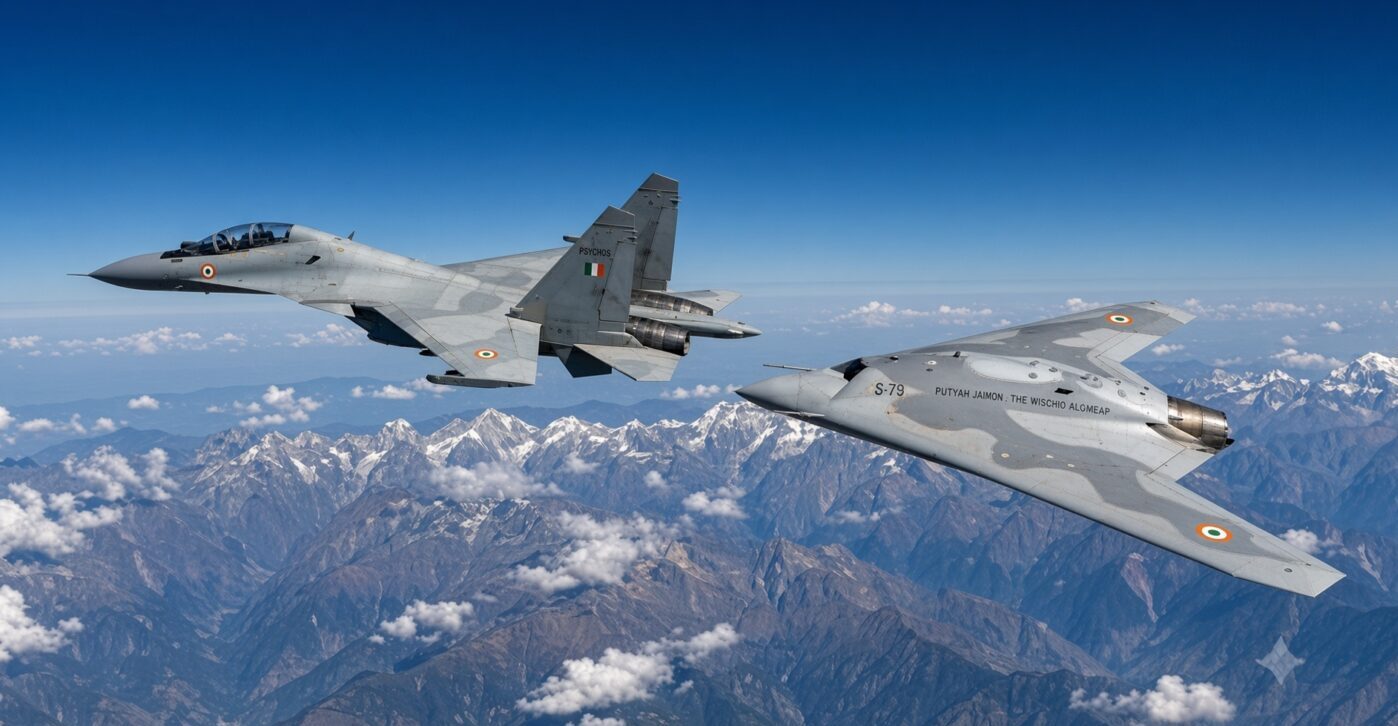
During his interaction with the press ahead of Air Force Day on October 8, 2026, the Chief of the Air Staff (CAS) stated that, in the near future, the Indian Air Force would have a “healthy mix” of LCA Tejas Mk 1A, LCA Mk 2, the French Rafale and the indigenous fifth-generation AMCA.

On the face of it, there is little to quarrel with what the CAS stated.

These aircraft will undoubtedly constitute important elements of the IAF’s future fighter fleet. However, the projection has some infirmities that are difficult to overlook.

The first question is what the CAS meant by the “near future”.

If the statement is intended to describe the fighter fleet that the IAF will field over the next decade or so, the mix is understandable. But if it projects the force structure into the 2040s—and beyond—it raises a more fundamental question.

How far into the future was the CAS extrapolating current procurement plans to arrive at the projected “healthy mix”?

Based on the past record of Indian fighter aircraft development projects, I would think at least 15 years from now, well into the 2040s.

By then, Tejas Mk 1A, Tejas Mk 2, Rafale and AMCA could indeed form the backbone of the IAF’s manned combat-aircraft fleet. But describing that combination alone as a “healthy mix” ignores a major transformation already underway in air warfare.

The manned fighter is no longer the whole equation

There is little doubt that the IAF will continue to depend predominantly on the 4th-generation fighters named by the CAS, quite possibly for the next 20 to 30 years. Fighter aircraft have long service lives, and India’s continuing dependence on legacy and contemporary 4th-generation platforms is therefore likely to persist well into the 2040s and perhaps beyond.

But the fighter force of the 2040s cannot be assessed merely by counting manned fighters across different generations.

The changing character of air warfare will demand a mix of manned and unmanned platforms, with different levels of survivability, autonomy and weapons heft.

This matters because the most dangerous missions in a future conflict will likely involve penetrating increasingly dense and sophisticated air-defense networks. A manned 4th-generation fighter, however capable, is not necessarily the most appropriate platform for every such mission.

The Unmanned Component

The IAF’s future force structure will therefore need an increasing proportion of unmanned combat aircraft.

At one end of the spectrum would be relatively inexpensive unmanned systems able to perform reconnaissance, electronic warfare, decoy and weapons-truck functions. At the other end would be sophisticated unmanned combat aircraft capable of operating alongside manned fighters as loyal wingmen.

The latter could substantially increase the effectiveness of a manned fighter formation. An unmanned aircraft could carry additional weapons, extend the formation’s sensor coverage, perform electronic attack or act as a decoy, while exposing no pilot to the risk of a mission in heavily defended airspace.

There is also an important economic dimension. An unmanned platform does not necessarily have to replicate the capabilities, complexity, or cost of a manned fighter. A future air force could therefore field far more expendable or attritable unmanned combat aircraft than it could afford to field manned fighters.

This would fundamentally alter the arithmetic of air combat.

Why describe only the present procurement mix?

The “healthy mix” the CAS referred to was therefore, in my view, probably intended primarily for mainstream media consumption.

That is not necessarily a criticism of the CAS.

Mainstream reporting tends to operate at shallow depths and gravitates towards readily understood narratives. In India’s case, the Atmanirbharta (self-reliance) narrative is particularly attractive.

Tejas Mk 1A, Tejas Mk 2 and AMCA fit neatly into that narrative, while Rafale provides the foreign component of the mix.

But the full spectrum of capabilities that the IAF will require in the 2040s is considerably more complicated.

It would include manned 4th-generation fighters, 4.5-generation fighters, 5th-generation VLO aircraft and an expanding family of unmanned combat aircraft ranging from relatively inexpensive attritable systems to sophisticated loyal wingmen.

Image for Representation: Indian Air Force

The Uncomfortable Technological Reality

I suspect that the IAF leadership understands this reality.

India’s indigenous technological capability in unmanned combat aircraft is still far short of what it would take to develop and field the full range of systems a future air force will need.

The problem is not simply the airframe. Autonomous operation, artificial intelligence, manned-unmanned teaming, secure communications, distributed sensing, electronic warfare and the ability to operate in a heavily contested electromagnetic environment all present formidable challenges.

MoD bureaucrats are unlikely to be unaware of these limitations either.

Under the circumstances, articulating the full range of what a truly “healthy mix” would entail would perhaps serve little purpose in a public interaction with the media.

But that does not make the issue any less important.

The Real Challenge

The real challenge is not recognizing that India needs a mix of manned and unmanned combat aircraft. It is developing the technologies and industrial ecosystem needed to field them in meaningful numbers.

The IAF of the 2040s will almost certainly still contain large numbers of 4th-generation fighters. There is nothing inherently wrong with that. The question is what surrounds them.

If the future force consists predominantly of today’s manned fighter concepts, supplemented by a relatively small number of AMCA aircraft, it may represent a healthy mix of India’s current procurement programs.

It may not, however, be a healthy mix for the wars India could have to fight in the 2040s and beyond.

The distinction is important. A force structure should not be called “healthy” merely because it contains a balanced selection of aircraft India can build or procure today.

It should be judged against the operational environment in which that force will actually have to fight.

  • Vijainder K Thakur is a retired IAF Jaguar pilot, author, software architect, entrepreneur, and military analyst.
  • Views Personal of the Author
  • Follow the author @vkthakur

The post Rafale, Tejas & AMCA: IAF’s “Healthy Mix” of Fighter Jets Leaves Out The Aircraft That May Matter The Most appeared first on EURASIAN TIMES.
  •  

2nd Country with Both JF-17 & J-10C Jets? Will Azerbaijan Become 3rd Customer of China’s Vigorous Dragons?

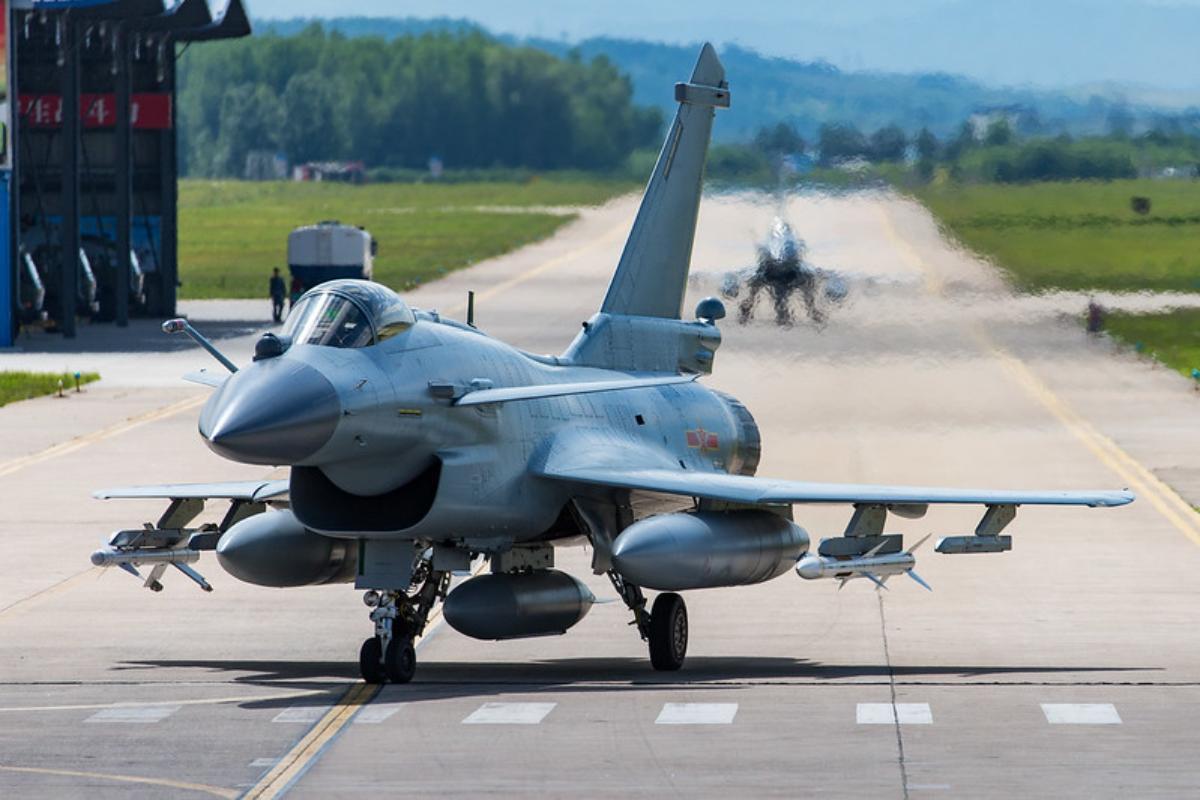
China has displayed a full-scale J-10CE mock-up in Azerbaijani markings at the sixth Azerbaijan International Defense Exhibition (ADEX-2026), which opened at the Baku Expo Center on September 30.

China National Aero-Technology Import & Export Corporation (CATIC), which represents Aviation Industry Corporation of China (AVIC), made its debut at ADEX this year by bringing a range of advanced aviation equipment, including the J-10CE fighter jet, L-15A advanced trainer aircraft, Y-20 transport aircraft, Z-20 helicopter, and Wing Loong drones.

Notably, this comes days after photos of a full-scale J-10CE (Vigorous Dragons) mock-up displayed at ADEX 2026 surfaced on social media, showing Azerbaijan’s national flag markings.

Whether this display leads to a sale of J-10C jets remains to be seen, but analysts see it as a potential pathway.

Azerbaijan has not hinted whether it wants to buy the J-10CE. However, reports of its interest in the aircraft have circulated since the Azerbaijani Air Force Commander, Lieutenant General Namig Islamzade, was photographed examining the aircraft during the Zhuhai Air Show in China in November 2024, as the EurAsian Times reported at the time.

Azerbaijan Air Force already operates the JF-17 Block III fighter produced jointly by China and Pakistan. If Azerbaijan goes ahead and acquires the aircraft, it would become the third country to acquire the J-10C after Pakistan and Uzbekistan, and the second country in the world to operate both the JF-17 and the J-10C after Pakistan.

Image
The J-10CE fighter jet is among a range of Chinese-made aircraft being showcased at ADEX 2026 (Via China Military Bugle on X)

China, for one, has been pushing the J-10CE in the export market by emphasizing that the aircraft has been tested in combat. Pakistan deployed the J-10CE against India during the May 2025 conflict and claimed to have downed multiple Indian Air Force aircraft, including the Rafale, using the long-range PL-15 air-to-air missiles.

IAF called them “Manohar Kahaniya” or Pulp Fiction tales and, in turn, claimed downing nearly a dozen PAF warplanes, including F-16s and JF-17s.

China has positioned itself as a reliable non-Western arms supplier to countries looking to modernize their militaries while reducing reliance on Russia.

Azerbaijan’s existing experience with Chinese avionics, sensors and weapons systems—gained through its JF-17 Block III fleet—could make the J-10CE an attractive option. Chinese experts have presented the more capable J-10CE as a natural high-end complement in a high-low mix, better suited to complex missions than the lighter JF-17.

Coupled with Azerbaijan’s recent acquisition of the Chinese HQ-9BE long-range air-defense system, a J-10CE purchase would integrate Chinese platforms into a cohesive combat architecture for Baku’s forces.

Baku has been considering replacing aging Soviet-era MiG-29s and Su-25s and bolstering its overall military posture to counter Armenia. This could potentially create a perfect opportunity for China’s state export machinery.

Armenia, an arch-nemesis of Azerbaijan, meanwhile, maintains a very limited fighter jet inventory. The bulk of the Armenian Air Force consists of a small number of Su-25 Frogfoots, many of which it lost in the war with Azerbaijan in 2020. It also has older Su-25s and just four Su-30SMs.

Previous reports indicated that Armenia has been in talks with India to acquire 8–12 Su-30MKI multirole fighter jets, in a package variously estimated at $2.5–3 billion, though neither government has confirmed a contract.

Meanwhile, Armenia has emerged as one of the most important buyers of Indian arms, having acquired the Pinaka multi-barrel rocket launcher, the Akash surface-to-air missile system, Swathi weapon-locating radars, ATAGS 155 mm towed howitzers, and the MArG 155 wheeled artillery system.

J-10C

The J-10C is a single-engine, 4.5-generation delta-canard multirole fighter. Its export version, the J-10CE, uses the indigenous Shenyang WS-10 turbofan and carries an AESA radar and an infrared search-and-track sensor. It can be armed with the PL-10, a short-range missile with an imaging-infrared seeker, and the longer-range PL-15.

File Image: J-10C

It also has a glass cockpit, an electronic-warfare suite, beyond-visual-range engagement and precision strike, with in-flight refueling on configured aircraft. A targeting pod supports laser- and satellite-guided munitions. Chinese media often liken it to later F-16s; like the F-16, it uses fly-by-wire to control an unstable airframe.

Chinese state media say the J-10CE will continue to be upgraded for export. Designer Li Jun told China Daily it can be tailored for air superiority or strike, with optional payloads, and that its AESA radar and network-centric systems outperform older mechanically scanned setups. Claims of gallium-nitride radar upgrades, radar-absorbing coatings and engine changes remain unverified.

“The J-10CE can adapt to customers’ needs, including air superiority and strike against ground targets, and can be customized based on the environments and mission requirements of different users. We can also offer optional payload packages to clients,” Li said, making a direct appeal to countries looking to upgrade their fleets.

“The aircraft’s avionics system has received a generational upgrade. Its Active Electronically Scanned Array radar system can rapidly detect and track targets, far outperforming traditional mechanically scanned radars,” Li stated. “The jet boasts powerful features, including network-centric cooperative combat, beyond visual range multiple target engagement in intense electromagnetic scenarios, and multimodal precision strikes. It can also prevail in medium- and low-altitude dogfights,” he added.

However, these reports could not be independently verified.

Despite a coordinated export campaign, the J-10CE has had limited success in the export market.

Countries like Bangladesh and Indonesia have both expressed interest in the jet, but it has not culminated in a deal. Moreover, Egypt recently decided to procure additional Rafale jets (it was also pitched the J-10C).


The post 2nd Country with Both JF-17 & J-10C Jets? Will Azerbaijan Become 3rd Customer of China’s Vigorous Dragons? appeared first on EURASIAN TIMES.

  •  

As Trump & Xi Talk — U.S. and China’s Nuclear Submarines Race For Dominance in the Indo-Pacific

The recent summit between US President Donald Trump and Chinese President Xi Jinping may have projected an image of renewed engagement; however, while two Presidents negotiated above the surface, their navies were preparing for a contest in which nuclear-powered attack submarines (SSNs) could play a decisive role.

The strategic rivalry between Washington and Beijing seems to be moving on a very different track—especially under the waters of the Indo-Pacific.

At the moment, the United States may have a substantial lead in the number of SSNs, technology, and operational experience, but China is rapidly catching up by expanding its undersea capabilities.

In its quest to narrow the gap with the US, China has entered a race for undersea advantage across the Indo-Pacific, which could shape deterrence, sea control, and the strategic balance of power for decades to come.

For maritime domination, both SSNs and SSBNs (nuclear-powered ballistic missile submarines) play critical roles.

SSBNs primarily provide nuclear deterrence by ensuring a credible second-strike capability, whereas SSNs are essentially designed to conduct hunter-killer missions, including tracking and, if necessary, engaging adversary SSBNs, as well as escorting carrier strike groups (CSGs) for sea control missions.

As Korean scholar Dongkeun Lee points out, in the context of the Indo-Pacific, SSN operations can be broadly classified into two primary missions: (1) countering SSBN capabilities and (2) escorting CSGs. The former is closely associated with nuclear deterrence, whereas the latter reflects the traditional sea power function of controlling and protecting key sea lines of communication (SLOCs).

Both missions are particularly important in this part of the world as its principal flashpoints, including the East China Sea, the South China Sea, and the Taiwan Strait, are all maritime domains. Maintaining credible naval capabilities, therefore,  is essential to advancing both deterrence and broader strategic objectives in the region.

Incidentally, around one-third of global shipping traverses the South China Sea. The maritime gateways here are critical not only for China but also for Taiwan, South Korea and Japan.

American CSGs continue to play a major role in controlling and protecting these critical SLOCs. Consequently, SSNs play an equally crucial role in escorting CSGs. By providing lethal undersea capabilities that can silently target threats across multiple domains, including surface and subsurface targets, SSNs can effectively eliminate threats to aircraft carriers.

The United States permanently deploys an aircraft carrier to the Seventh Fleet, based in Yokosuka, Japan, and it is common for more than one CSG to be present in this region at any given time. SSNs’ presence here serves both to protect US carrier groups and to create the possibility of threatening Chinese nuclear submarines.

Likewise, the PRC is rapidly developing its own CSG capability to counterbalance that of the United States in the South China Sea. China’s Yulin naval base on Hainan Island is an important center for its nuclear submarine forces.

Until recently, the undersea dominance tilted heavily in favor of the US. But the alignments are fast changing.

Though the US Navy still leads with an all-nuclear fleet of 71 active submarines (including 51–53 SSNs/SSGNs), China has now surpassed Russia to command the world’s second-largest nuclear submarine fleet with an estimated 9 to 12 SSNs (such as the Type 093 and Type 093A/093B Shang-class) and 6 SSBNs (Jin-class Type 094), totaling roughly 32 active nuclear submarines across its entire naval forces that operate primarily in the Indo-Pacific region.

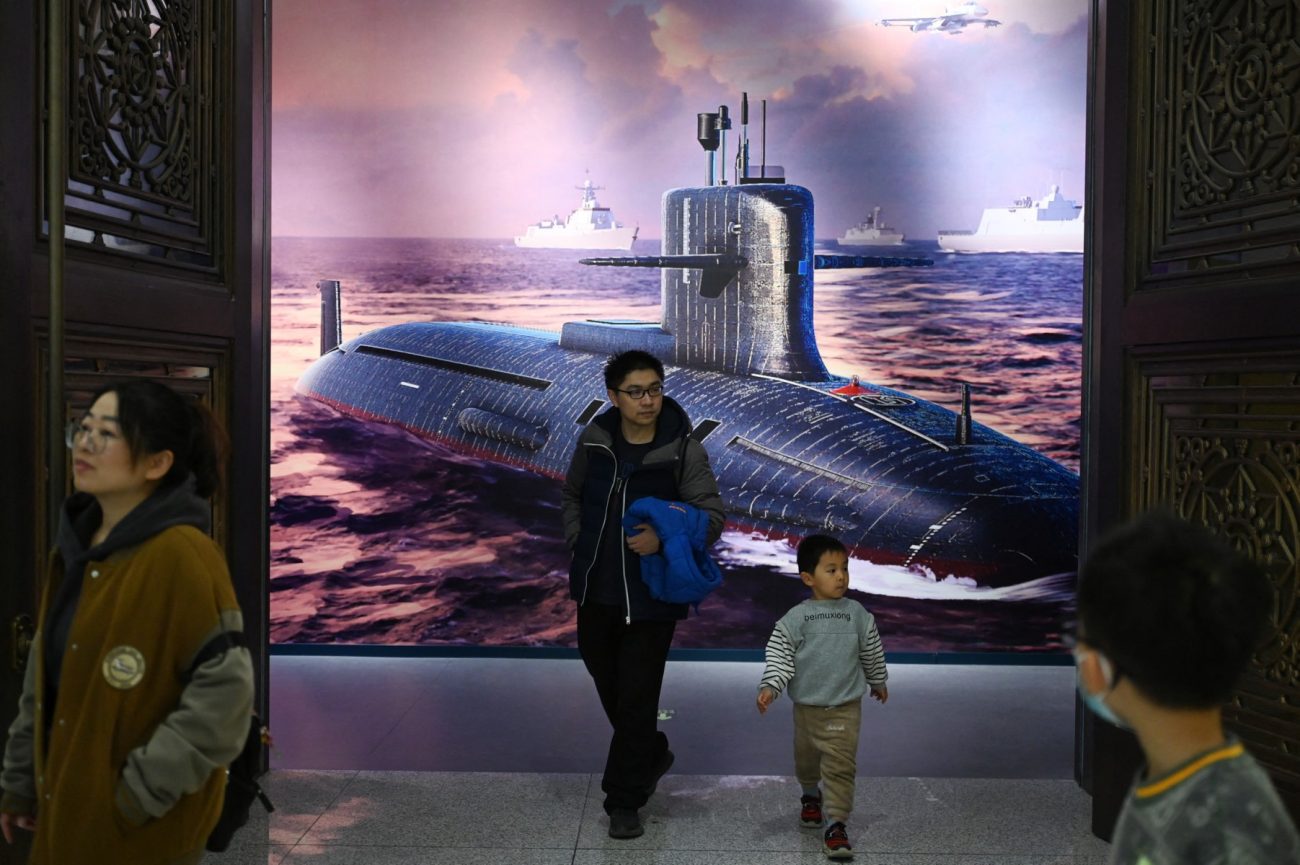
People walk past an illustration of a Chinese nuclear submarine at the Military Museum in Beijing on March 3, 2024. (Photo by GREG BAKER / AFP)

In a recent IISS assessment, China launched 10 nuclear-powered submarines between 2021 and 2025, totaling 79,000 tonnes, against America’s 7 boats at 55,000 tonnes. For the first time, China out-built the US in both numbers and tonnage in a five-year window, it is argued.

“Most significantly, this includes the seventh and eighth Type 094 (Jin) nuclear-armed ballistic-missile submarines (SSBNs), which come as part of the emergence of Beijing’s nuclear triad,” the IISS study says.

It noted that commercially available satellite imagery taken in early 2026 showed six Type 094s in total, spread between the Bohai Shipbuilding Heavy Industry Co (BSHIC) shipyard in Huludao, the 1st Submarine Base at Jianggezhuang, the Xiaopingdao test facility and the 2nd Submarine Base at Yalong Bay on Hainan Island.

“Allowing for additional boats either on deterrence patrol or under cover for refit during this period, it is almost certainly the case that China has launched a seventh and eighth Type-094 in 2024 and 2025, respectively,” the IIISS study concludes.

In addition to the Type 094s, Bohai is also producing nuclear-powered guided-missile submarines (SSGN) for the People’s Liberation Army, with the study suggesting that nine Type 093B (Shang III) boats have been launched between 2022 and this year, based on commercial satellite imagery of the facility and US government assessments.

Incidentally, in March this year,  the US Navy’s intelligence chief, Rear Admiral Mike Brookes, testified before the US-China Economic and Security Review Commission (USCC) that China is undertaking a major shift toward building an all-nuclear submarine fleet as part of a broader effort to strengthen its undersea warfare capabilities and expand blue-water naval power.

According to Brookes, the People’s Liberation Army Navy (PLAN), which operates more than 60 submarines in total, including roughly 50 conventional diesel-electric boats (SSK) and a smaller number of SSNs and SSBNs, is transitioning away from conventional submarines toward a predominantly nuclear construction program to support sustained operations, strategic deterrence and sea-lane interdiction.

Brookes also pointed out that China had expanded submarine production infrastructure across three major shipyards, tripling construction hall capacity and more than doubling production capability to sustain higher output of advanced nuclear boats through the 2030s.

By 2027, China’s submarine force is projected to reach roughly 70 submarines, adding up to six SSGNs, three smaller-class SSNs, and two SSBNs while retiring older Chinese and Russian-built submarines. By 2035, continued expansion could yield up to 80 submarines, with about half nuclear-powered—a major shift in force composition—and projections for the early 2040s include around 20-30 new-class SSGNs and SSBNs.

These platforms will be designed from the keel up for blue-water operations and persistent presence beyond the first island chain, representing an evolution in PLA Navy undersea operational capabilities. China will likely field a more survivable and numerous ballistic missile submarine force equipped with longer-range, more accurate SLBMs, enabling patrols in bastions closer to home waters while holding the US homeland at risk.

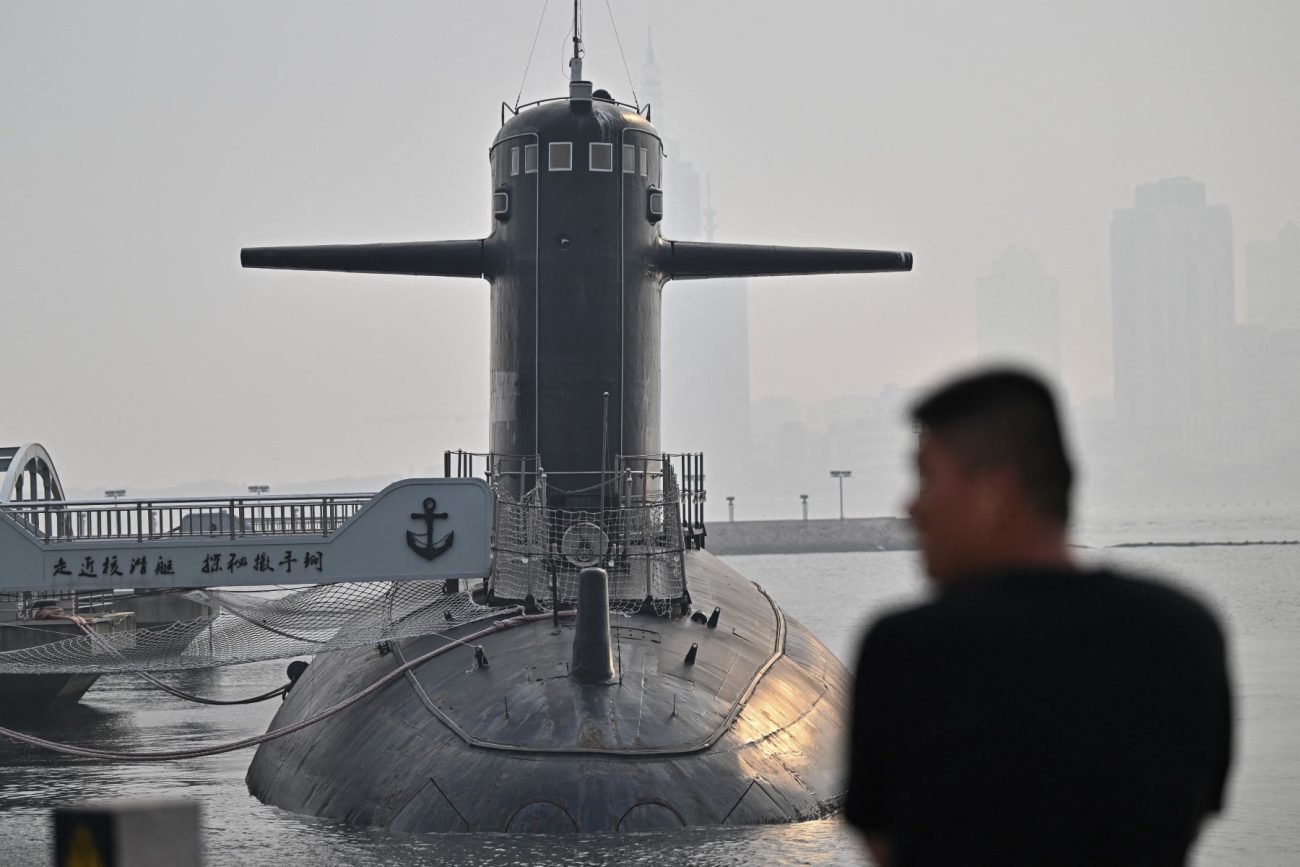
A man looks at a submarine during a media tour by the PLA Naval Museum, organized by the Chinese People’s Liberation Army Navy (PLAN) ahead of the Defense Ministers’ Meeting of the Shanghai Cooperation Organization (SCO) Member States in Qingdao, in eastern China’s Shandong province on June 25, 2025. (Photo by Pedro PARDO / AFP)

Broader deployment of long-range, potentially hypersonic anti-ship and land-attack missiles from undersea platforms is anticipated, along with more sophisticated torpedoes and unmanned vehicles for ISR, mine warfare, and strike missions. Substantial investments in seabed sensors, undersea cables, and unmanned systems will enhance China’s situational awareness while creating vulnerabilities for the US and allies in crisis or conflict.

The Indo-Pacific will remain the PLA Navy’s primary focus, but by 2040 routine submarine deployments to the Indian Ocean, Arctic approaches, and possibly the Atlantic are likely, Brookes cautions.

However, as noted above, the US Navy currently has superior acoustic quieting, combat experience, and highly advanced Virginia-class SSNs. But as the EurAsian Times once explained, the US has a backlog of 12 Virginia-class submarines, in addition to three Columbia-class ballistic submarines.

Its production rate of 1.2 per year falls far short of the required 2.33 per year to meet its own needs and those of its allies (under the AUKUS pact, it is supposed to provide at least three Virginia-class submarines to Australia in the early 2030s).

Only three US shipyards can build nuclear-powered attack submarines (Groton, Connecticut; Quonset Point, Rhode Island; and Newport, Virginia). Only two of them are functional at the moment.

While the US defense industrial base is severely strained, China’s naval shipyards are said to be outperforming. With about 9 older Shang I/II boats plus an estimated 16 Type 093B hulls in service, in trials, or under construction, China is said to have the largest SSN series under construction anywhere.

The 093B reportedly features a vertical launch system for 24 YJ-12/YJ-18 anti-ship cruise missiles and six torpedo tubes, shifting China from torpedo brawls to long-range strike.

In the Indo-Pacific, the undersea race seems to change three fundamentals.

First, the era of uncontested US undersea dominance is over. US SSNs have long hunted Chinese SSBNs inside their bastion, keeping Beijing’s deterrent vulnerable. But now, China can sustain continuous at-sea deterrence patrols from Hainan’s Yalong Bay, protected by surface fleet and seabed sensors. That forces US SSNs to operate closer to Chinese waters, at higher risk, stretching ASW resources thin.

Second, the proliferation of quiet Chinese SSNs with VLS—at least six SSGN hulls launched in the past five years with vertical launch systems that could fire high-speed anti-ship missiles displayed in Beijing—means every US carrier entering the Taiwan Strait or South China Sea now faces a multi-axis underwater missile threat. The carrier’s sanctuary beyond the first island chain, once assumed, is no longer safe.

Third, China’s rapid maritime expansion has fundamentally altered the Indo-Pacific security landscape, prompting Australia and Japan to aggressively build strategic counterweights. Rather than acting in isolation, Canberra and Tokyo have pivoted toward minilateral security alliances, military modernization, and supply chain diversification to offset Beijing’s growing naval dominance.

Australia and Japan, alongside the United States and the Philippines, have formalized a security grouping explicitly designed to counter Beijing’s aggressive maneuvers in the South and East China Seas. This alliance focuses on joint maritime patrols, intelligence sharing, and military interoperability to safeguard freedom of navigation under international law.

Driven by the need to project power across its vast northern approaches, Australia has fundamentally reshaped its defense posture. This is anchored by the AUKUS pact—enabling Australia to acquire conventionally armed, nuclear-powered submarines—positioning the nation as a formidable southern anchor against Chinese naval projection.

For India, which has no SSNs in service (it previously leased from Russia and now plans indigenous production) and operates only three SSBNs (Arihant, Arighaat, and Aridhaman), the implications are significant.

Against India’s slow naval expansion, Chinese nuclear submarines, including intelligence-gathering vessels, now regularly traverse the Indian Ocean.

Overall, one could say that “the silent service” in the Indo-Pacific is becoming loud.

During the Cold War, the submarine race was primarily fought in the Atlantic. Now, it is shifting to the Indo-Pacific, raising uncertainties over whether it will remain free and open.

  • Author and veteran journalist Prakash Nanda is Chairman of the Editorial Board of the EurAsian Times and has been commenting on politics, foreign policy, and strategic affairs for nearly three decades. He is a former National Fellow of the Indian Council for Historical Research and a recipient of the Seoul Peace Prize Scholarship.
  • The author can be reached at prakash.nanda (at) hotmail.com

The post As Trump & Xi Talk — U.S. and China’s Nuclear Submarines Race For Dominance in the Indo-Pacific appeared first on EURASIAN TIMES.
  •  

“Mid Air Horror”: When an F-35 Hit a KC-130 Over California — and Why September Brought the Story Back

The US military lost three military aircraft during peacetime in September 2026 alone, highlighting that accidents continue to hit even the world’s most advanced air force. These incidents also reminded us of the mid-air collision between a KC-130J and an F-35B in September 2020 that ended in one of modern aviation’s most remarkable saves.

On September 28, 2026, two naval aviators ejected from an EA-18G Growler assigned to Electronic Attack Squadron 130 after an arresting gear failed during recovery on the USS Dwight D. Eisenhower aircraft carrier.

Both aircrew were recovered safely. It is currently unknown whether the aircraft was lost or escaped with some damage, and an investigation is underway to determine the cause of the accident.

Earlier in the month, two F-16 Fighting Falcons were destroyed in separate training accidents.

On September 17, an F-16 from the Texas Air National Guard’s 149th Fighter Wing went down in rural Michigan during training from Alpena Combat Readiness Training Center, and on September 22, a US Air Force F-16 from the 52nd Fighter Wing at Spangdahlem Air Base, Germany, crashed on approach after a routine training sortie.

In both cases, the pilot was able to eject, but the aircraft was fully destroyed.

While September was particularly painful for the US military and its prized military aircraft, it also reminds us of the time six years ago when a mid-air collision over California nearly claimed the lives of eight Marines aboard a KC-130J.

When A KC-130 Collided With an F-35B

On the afternoon of September 29, 2020, a U.S. Marine Corps F-35B Lightning II, call sign “Bolt 93,” and a KC-130J Super Hercules tanker, call sign “Raider 50,” collided at around 4:00 p.m. while conducting air-to-air refueling operations in the Kane West Military Operations Area near the Salton Sea in Southern California.

The aircraft were participating in Weapons and Tactics Instructor (WTI) Course 1-21, which is a demanding seven-week advanced training program conducted by Marine Aviation Weapons and Tactics Squadron 1 at Marine Corps Air Station Yuma, Arizona. The course reportedly emphasized integrating Marine aviation into Marine Air-Ground Task Force operations under realistic, high-tempo conditions.

The Raider, assigned to Marine Aerial Refueler Transport Squadron 352, had already refueled one F-35B and was orbiting to tank the second. The F-35B approached the hose and drogue extended from the refueling pod on the tanker’s right wing and struck the underside of that wing.

As expected, the F-35B arrived for aerial refueling. However, as it approached, the hose and drogue extended from the tanker’s right wing, and it struck the underside of the right wing.

The impact was so massive and violent that it sheared off all propeller blades on the tanker’s two right-side engines, damaged the right fuel tank and refueling pod, and caused severe structural damage, including to the landing gear compartment.

Immediately after, fuel began leaking, raising concerns about a potential onboard fire.

The F-35B that collided with the massive refueller aircraft was critically damaged, forcing the pilot to eject. The aircraft crashed in the Ocotillo Wells area near Salton City, according to reports from the time. However, the KC-130J—piloted by Capt. Michael Wolff and co-pilot Maj. Cory Jones—had a gargantuan task ahead of them. They had to land.

USMC F-35B (For Representation)

“It was a really violent collision,” Wolff later recalled, adding that everything happened within “1.2 seconds or something. Not enough time to really react and do anything.” Days after the incident, he said the collision was so violent it sent everything flying inside the aircraft. “It was pretty violent… I got my headset back on, grabbed the yoke, and I got the plane back under control,” the pilot of the unfortunate aircraft told USNI News.

After the impact, the crew discovered the collision had left a hole in the aircraft, letting in a blast of outside air as they braved glaring lights and blaring alarms in the cockpit, while the displays lit up with cascading caution and warning messages.

The collision wiped out both engines on the KC-130J’s right (starboard) side. Yet “the impact did not damage our ailerons, elevators or rudder, so we still have all of our primary flight control surfaces,” Wolff later recalled in his interaction with USNI. “At that point, I’m like, OK, let’s get figuring out what’s going on and the best course of action.” “That’s when – it’s kind of cliché – the training kicks in,” he added.

The crew drew on their deep familiarity with the KC-130J, forged through countless flight hours and simulator sessions rehearsing emergency procedures in the air and on the ground. Aircrews are well known for their rigorous adherence to detailed checklists, along with the almost automatic responses and ingrained knowledge that come from repeated practice. “We start running through everything,” Wolff told USNI News later, “and figuring out where to go and communicating to the crew and then outside” to air traffic control. 

File:KC-130J Hercules '8071 - BH' & F-35B Lightning II '168726 - VM-18' (28200050385).jpg
An F-35B approaching a KC-130J for refueling (Image only for Representation purposes)

The KC-130J crew declared an emergency to Los Angeles Center, reporting a mid-air collision, damage to two engines, a fuel leak, a possible fire, and an emergency descent, as later revealed in the emergency call recording. “We are declaring an emergency. We still have partial control of the aircraft,” Wolff was heard saying in a rather calm manner.

Thick black smoke streamed behind Raider 50 as flames roared from its burning fuel tanks, and the rear crew members confirmed the severity of the damage to engines No. 3 and No. 4. The crew then focused on keeping control of the aircraft and getting it safely back to the ground. “I can see the far right engine – the #4 – from my seat, but I can’t see the #3,” Wolff said. Crew members in the rear of the aircraft “gave me confirmation that [the] thing was toast, and we pulled the fire handle and [made] sure nothing got worse.”

He needed constant updates on whether the fire was dying down or if fuel was still leaking from the wing, stressing that “that communication from the back [crew] is extremely vital to get down safely.”

The crew aboard the aircraft on that fateful day had practiced for an emergency with two engines out, but never for multiple emergencies.

With the tanker still heavy with fuel and only five parachutes available for eight Marines, bailout was not a practical option. The crew committed to landing.

Determined to land safely, the pilots surveyed the surrounding terrain and found Thermal Airport—officially Jacqueline Cochran Regional Airport—a viable landing site. “We had a lot of open space between where we were and there – the Salton Sea and a lot of farmland – and we’re not worried about populated areas,” Wolff said.

However, their troubles were far from over.

A Marine KC-130 crash-landed on September 29, 2020 (Photo circulated online after the incident)

Just as the crew lined up for a runway landing, the aircraft began drifting right because of the ongoing malfunctions and the distance involved.

With only five parachutes for eight crew members and the aircraft still partially controllable on the remaining engines, they committed to a forced landing rather than a bailout. 

After roughly 12–13 minutes of fighting for control—facing multiple system failures, an uncommanded right turn after dipping below minimum control airspeed, and other issues—they executed a gear-up or belly landing in a farm field near Jacqueline Cochran Regional Airport in Thermal, California.

The aircraft skidded several hundred yards and came to rest with extensive damage but intact enough for the entire crew to walk away with only mild injuries.

“It wasn’t quite like the movies where you see you have like a 747 that plows through … We came to a stop pretty quickly,” Wolf said.

Pilot sure earned that DFC

September 29, 2020: a US Marines KC-130 and an F-35 collide during mid-air refueling over California (US). Fighter crashes, pilot ejects safely, KC-130 crash-lands in a carrot field, all 8 aboard survive.

The KC-130 pilot was later awarded the… pic.twitter.com/Xu46wipUUP

— Francisco Cunha – ✈ Aviation et al (@OnDisasters) September 29, 2026

The collision, resulting fire damage, and emergency landing meant the aircraft had to be written off. After investigators finished examining the wreckage, Marine Corps teams spent roughly a week removing it from the field. They recovered the rear stabilizers and the aircraft’s tail section, set them up outside the squadron, and painted them in the unit’s distinctive Raider black as a permanent display and reminder.

For their actions, both Capt. Michael Wolff and Maj. Cory Jones received the Distinguished Flying Cross, the highest award in flying and the fourth highest award for bravery. The award recognized the skill, discipline, and crew coordination.

The collision, engine failure, and safe landing marked one of the rare incidents in which every crew member survived, including the F-35 B pilot.


The post “Mid Air Horror”: When an F-35 Hit a KC-130 Over California — and Why September Brought the Story Back appeared first on EURASIAN TIMES.
  •  

“Akash is The Limit”: India’s AD System Reaches Turkmenistan & Tajikistan: Here’s What Makes It Lethal

As nations worldwide race to bolster air defenses against missiles and one-way attack drones, India’s indigenous Akash surface-to-air missile system—proven in combat against Pakistan during Operation Sindoor in May 2025—is rapidly gaining popularity in the export market. 

India’s Defense Secretary Rajesh Kumar Singh recently disclosed that the Akash air defense system has been exported to three countries.

Although Armenia’s purchase of the system is already known, this is the first time a high-ranking Indian official has revealed that the AD system has been acquired by two other countries in Central Asia: Turkmenistan and Tajikistan.

“The first customer was Armenia, which has taken multiple batteries. Thereafter, we’ve also exported it to Tajikistan and Turkmenistan. Production has stabilized. We have additional orders for our own services, and I’m sure there will be many more from various parts of the world, including some of the areas that you mentioned,” the Defense Secretary told ANI on Oct 1, 2026, in an exclusive interaction.

Describing Akash as a milestone in self-reliance, Singh said, “Akash, I would say that it is one of our success stories. It shows the maturing of our indigenous missile design and production system. It is effective in dealing with high-velocity aerial targets.”

He also noted that production of the Akash missile system has stabilized, and orders from other nations are growing even as procurement for the Indian Armed Forces continues.

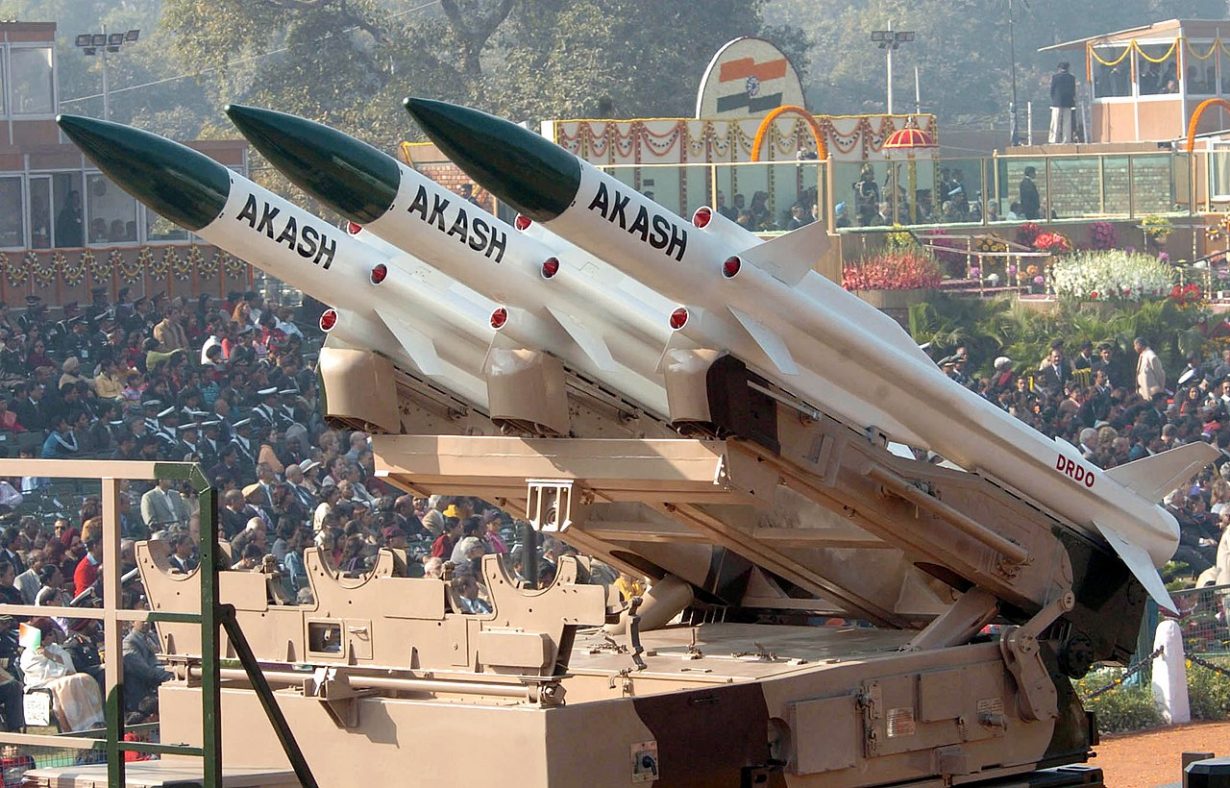
A mobile short-to-medium-range surface-to-air missile system developed by the Defense Research and Development Organization (DRDO), Akash provides area air defense against multifarious air threats to mobile, semi-mobile, and static vulnerable forces and areas. The missile has a range of 25–30 kilometers, can intercept targets at altitudes of about 18–20 kilometers, and carries a 60 kg high-explosive fragmentation warhead.

“The real-time multi-sensor data processing and threat evaluation enables simultaneous engagement of multiple targets from any direction. The entire system is flexible, upscalable, and can be operated in group and autonomous modes. It employs command guidance and relies on phased array guidance radar to guide the missile till intercept,” states BEL, the manufacturer of the system.

With this export, India appears to have gained a foothold in Central Asia, where the countries have historically relied on Russian arms, but are now diversifying arms supplies as Moscow remains embroiled in a protracted conflict with Ukraine.

akash-missile
File Image: Akash Missiles

Notably, China has emerged as the biggest beneficiary of this vacuum left by Russia’s preoccupation with Ukraine, as previously explained in depth by the EurAsian Times. In fact, both Turkmenistan and Tajikistan already operate a host of air defenses sourced from Beijing, making India’s Akash purchase an even more noteworthy development. 

The decision to acquire Akash possibly stems from its strong combat performance during the conflict with Pakistan as part of Operation Sindoor.

Earlier, former DRDO scientist Ravi Kumar Gupta told EurAsian Times: Akash’s versatility gives it an edge over other systems. He said that unlike other surface-to-air missiles that work only at particular altitudes and in specific climates, Akash’s biggest advantage is that it can work “all places.”

“The systems are developed for diverse conditions and can withstand extreme conditions anywhere in the world, which makes them ‘most reliable and sturdy.’ Since the system is fully indigenous, India can fine-tune it to any buyer’s requirements cost-effectively with a high degree of effectiveness against the adversary,” Gupta told EurAsian Times.

Akash: Sky in the Limit

On May 7, 2025, the  Indian Air Force (IAF) launched attacks on terror sites located deep within Pakistan as part of  “Operation Sindoor.” Pakistan retaliated with “Operation Bunyan al-Marsus.”

Following the first round of strikes by the IAF, Pakistan started to attack India’s western sector with waves of drones, including Chinese and Turkish-origin drones, missiles, rockets, and other aerial threats targeting Indian military installations and civilian areas. At one point, more than 600 drones were fired simultaneously across India’s western front. 

The Akash AD—part of a layered air defense network that also included S-400, Barak-8/MRSAM, older systems like Pechora and OSA-AK, counter-UAS grids, and the Integrated Air Command and Control System (IACCS) or Akashteer—showcased resilience in the face of these attacks, ensuring that none of the Pakistani drones and missiles hit any targets.

At the official press briefing on Operation Sindoor, Air Marshal A.K. Bharti, the Director General of Air Operations (DGMO) of the Indian Air Force, specifically praised the Akash AD for thwarting Pakistani attacks.

“Another highlight has been the stellar performance of the indigenous air defense weapon system like the Akash system,” he stated. The sentiment was echoed uniformly across the board, with Lt Gen Rajiv Ghai, who later became the Deputy Army Chief, saying, “BrahMos, Akash and many other homegrown platforms and weapons played a decisive role in Operation Sindoor.”

Notably, small drones made up the majority of Pakistan’s projectiles during the conflict, which were mainly used to scan Indian defenses and overwhelm the air defense network, although a few kamikaze drones, missiles, and aircraft-launched munitions were also used.

Akash operated as a key hard-kill layer against these low-to-medium altitude threats, as its indigenous design, mobility, multi-target capability, and cost-effectiveness suited it well for the threats that characterized much of Pakistan’s response.

According to reports from the time, the Akash intercepted multiple drones and loitering munitions, disrupted swarm attempts, and even helped down guided missiles mid-flight at low altitude.

Akash interceptors helped protect higher-value, longer-range assets by keeping drone-saturation attacks out of the S-400 envelope. However, defense officials cited by Indian media said Akash, which has an interception range of 25 kilometers, played a major role in countering all kinds of threats, including aircraft, armed attack unmanned aerial vehicles (UAVs), and the Turkish Byker Yiha III kamikaze drones. 

“It has been very effective against aircraft and other systems. This is the first time we saw it in active conflict. We hear that Akash has been used, and it has brought down a couple of aircraft. The whole team of scientists who have worked on the project is very, very happy. A great moment for all of them,” former DRDO chairman, Dr. G. Satheesh Reddy, said in an interview with NDTV days after the ceasefire was announced on May 10, 2025.

The most compelling commentary on Akash came from Gaddamanugu Chandramouli, the former Akash project director and DRDO scientist, who spent his entire career developing the system.

“Akash, which was indigenously built from scratch, was used in a combat zone for the first time and has proved to be robust and effective. The automated missile system caught the other countries by surprise,” Chandramouli told The Hindu in May 2025.

The Akash Weapon System can simultaneously engage Multiple Targets in Group Mode or Autonomous Mode. It has built-in Electronic Countermeasures features. The entire weapon system is mounted on mobile platforms. It can effectively engage helicopters, jets, and UAVs at ranges of 4-25 kilometers. It is fully automatic and has a quick response time from target detection to kill.

DRDO claims it is the first system in the world capable of engaging four aerial targets simultaneously at a range of 25 kilometers by command guidance using a single firing unit.


The post “Akash is The Limit”: India’s AD System Reaches Turkmenistan & Tajikistan: Here’s What Makes It Lethal appeared first on EURASIAN TIMES.
  •  

U.S. Awards F-22 ‘Raptor’ Pilots for Ops Midnight Hammer as Pentagon Sends 3rd Carrier Towards Iran

The US honored seven airmen who piloted F-22 Raptors in combat operations in the Middle East with the “Distinguished Flying Cross” (DFC), even as the United States has relaunched a military buildup in the Region.

Of the seven airmen, six were awarded the DFC for their role in “Operation Midnight Hammer,” launched against Iran in June 2025, while one was honored for a mission in the Middle East without disclosing details.

The DFC is the fourth-highest award for gallantry in the military and honors acts of bravery or exceptional accomplishment in the air. 

The USAF launched Operation Midnight Hammer in June 2025 following 12 days of intense clashes between Iran and Israel. The operation included an armada of 125 combat aircraft, including B-2 stealth bombers, F-22 and F-35 stealth fighters, F-16s, F-15Es, and several aerial tankers for refueling, as the EurAsian Times previously reported.

Although the role of the seven B-2 Spirit stealth bombers that dropped 14 bunker-buster GBU-57 MOP bombs on Iran’s underground nuclear facilities has been widely recognized, the F-22 Raptors also played a crucial role in the operation.

These air superiority stealth fighters moved ahead of the B-2 bombers along with the F-35s, conducting air superiority and air defense-suppression missions to clear the way for the B-2s to operate safely and effectively and bomb the three Iranian nuclear sites.

Of the aviators who received the DFC for Operation Midnight Hammer, four came from the Active-Duty 94th Fighter Squadron, part of the 1st Fighter Wing at Joint Base Langley-Eustis, Va., while two came from the associated Virginia Air National Guard’s 149th Fighter Squadron of the 192nd Wing.

Air Combat Command commander Gen. Adrian L. Spain presented the medals to the aviators in a ceremony at the Virginia base on August 31, 2026.

“Their job was to provide air superiority,” Spain said, referring to the F-22s. “The bombers and the rest of the support package relied on these Raptor pilots to clear the skies, shield them from surface threats, and ensure a safe route through heavily contested airspace.”

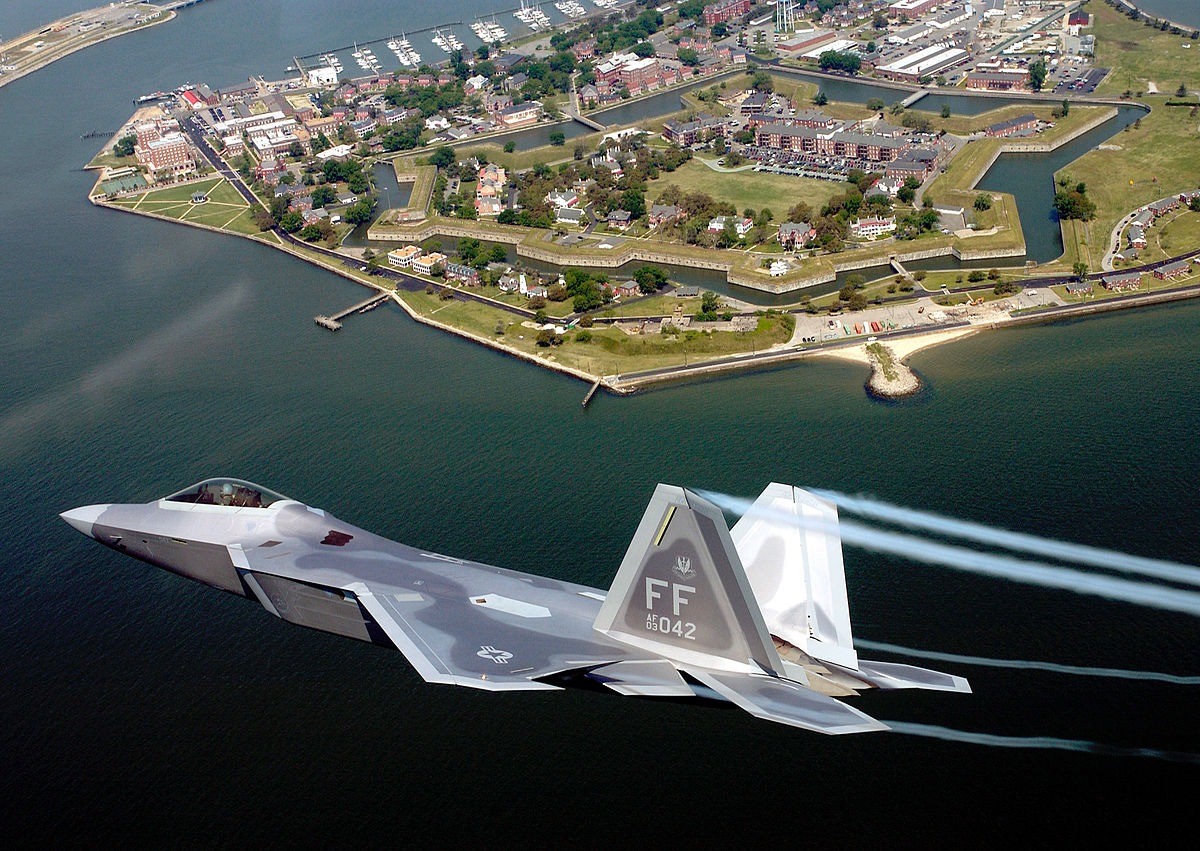
The F-22 is the USAF’s premier fifth-generation air superiority stealth fighter, allowing it to evade radar detection unlike the 4th- and 4.5th-generation fighters. In fact, the Raptor was purpose-built as an air dominance fighter, optimized to clear the skies of enemy aircraft, escort high-value assets, and operate in the most hostile environments.

Before Operation Midnight Hammer, the F-22 Raptors were also deployed against the Yemen-based Houthis in 2024, as the EurAsian Times reported at the time.

F-22 Raptors at Langley Air Base
File: F-22 Raptor flying over Langley Air Force Base

Earlier this year, the F-22 Raptors were once again summoned to the region for Operation Epic Fury, launched against Iran on February 28, 2026, together with Israel’s Operation Roaring Lion.

The F-22 Raptors of the 1st Fighter Wing at Langley Air Force Base were deployed to the Ovda Air Base in Israel for the first time ahead of the operation.

During the initial days of Operation Epic Fury, F-22s reportedly suppressed advanced Iranian air defenses, such as the S-300 and Bavar-373 systems, clearing the way for B-2 bombers and other strike packages.

Flying deep into Iranian airspace, the stealth fighters reportedly carried out pinpoint strikes on high-value targets between March 1 and 9, 2026, including military sites, nuclear-related infrastructure, and IRGC (Islamic Revolutionary Guard Corps) command nodes.

The Raptors also reportedly targeted the “infrastructure connected to the Fordow Fuel Enrichment Plant and Natanz Nuclear Facility,” as US Central Command (CENTCOM) previously noted. It “also coordinated with B-2 Spirit bombers and EA-18G Growler electronic attack jets in layered strike packages designed to overwhelm Iran’s integrated air defenses,” it added.

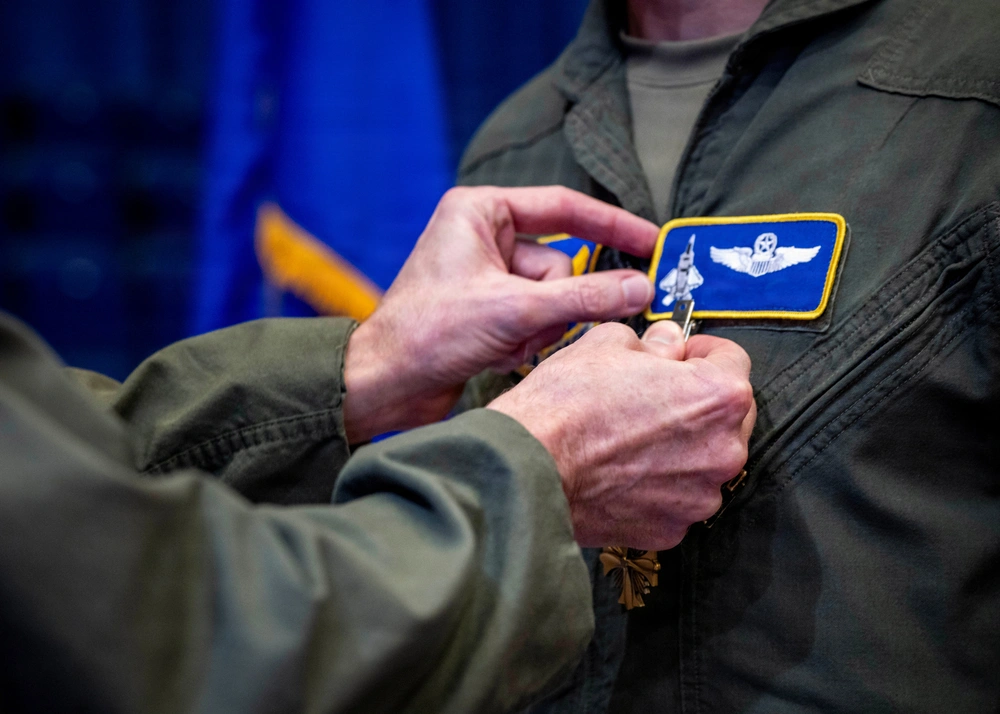
A close-up photograph showing a military pinning ceremony where one person is attaching a medal or badge to another person's flight suit. The recipient is wearing an olive green flight suit with a blue and gold patch depicting a military aircraft and aviator wings. This appears to be a formal military recognition or award ceremony.
File: U.S. Air Force Lt. Gen. Jason T. Hinds, U.S. Air Forces in Europe – U.S. Air Forces Africa commander, pins a Distinguished Flying Cross medal onto a U.S. Air Force pilot during a ceremony in Essen, Germany, Sept. 22, 2026.

The seventh F-22 pilot—whose name was withheld—received the decoration on September 22 from Lt. Gen. Jason T. Hinds, commander of US Air Forces in Europe (USAFE), for commanding a strike package during a Middle East mission in contested airspace.

The pilot faced “challenging conditions including enemy threats” and “directed the aircraft formation, making critical decisions with limited time and little margin for error,” the USAFE stated.

“For more than an hour, [the pilot] remained focused on protecting teammates” and “acted decisively to protect the larger force, and ensured the formation could safely return,” Hinds said. “Their actions helped give the strike package the time and freedom needed to accomplish its mission.”

Interestingly, the DFC was awarded and publicized by the US Air Force at a time when tensions are escalating between the United States and Iran.

US Commences Military Build-Up in Middle East

The US is deploying a third US aircraft carrier to the Middle East as part of a fresh military buildup as President Donald Trump weighs new strikes.

The USS Theodore Roosevelt carrier strike group departed its San Diego base last week on the Pentagon’s order. The USS Makin Island amphibious readiness group followed, with its two amphibious landing ships. About 9,000 sailors, 7,000 aboard the carrier and 2,000 aboard the amphibious ships, are en route to waters near Iran.

With USS Theodore Roosevelt’s arrival, three aircraft carriers would be standing guard in West Asia by late October, according to US officials who spoke to the media. As of now, the carriers USS George HW Bush and the USS George Washington, along with the USS Boxer amphibious readiness group, are in the region amid ongoing hostilities.

This would bring the overall US naval presence to more than 20,000 sailors and Marines, along with hundreds of aircraft, significantly expanding the military posture.

🇺🇸 The USS Theodore Roosevelt (CVN-71) has left San Diego to build a three-carrier presence in the Middle East

Ahead of the U.S. midterm elections, officials confirmed the Roosevelt will join the USS George Washington and the USS George H.W. Bush, a rare trio of supercarriers,… pic.twitter.com/yisXp9TAVu

— Visegrád 24 (@visegrad24) October 1, 2026

Additionally, reports citing informed sources suggest that the US military sent two additional Patriot missile batteries to protect oil and gas facilities in Saudi Arabia and Qatar in recent weeks.

Notably, the two sides have remained locked in a tense battle since July, when they started trading fire after a long lull that followed the June memorandum of understanding. 

Last week, Iran proposed a new deal in which it would open the Strait of Hormuz in return for lifting the US blockade of its ports, unfreezing funds, and removing sanctions on Iranian oil. However, Trump rejected the proposal, saying Iran is seeking an agreement now because it is losing so badly.

The two sides later held indirect talks, signaling that they may be open to negotiating a fresh deal. However, Trump caused a stir again as he told Time magazine this week that the US military could ramp up bombing of Iran after the November 3 midterm elections that will be held amid continued disapproval of the war at home.

Furthermore, the President said that Iran may have something to do with the recent incident involving the FlyDubai flight, adding that it will be hit very hard if Tehran’s connection is verified.

For now, a deal between Washington and Tehran looks more elusive than ever, especially as the Pentagon is moving major military assets to the region. If Trump decides to resume the bombing, the presence of three aircraft carriers will significantly expand his options and fighter jet presence near Iran.

The post U.S. Awards F-22 ‘Raptor’ Pilots for Ops Midnight Hammer as Pentagon Sends 3rd Carrier Towards Iran appeared first on EURASIAN TIMES.

  •  

“Simply False”: Ukraine Rejects Reports That Over 50% Of Its F-16 Fighting Falcons Are Out of Action

Story Updated

Ukraine has outrightly rejected reports of maintenance and supply problems with its F-16 fighter jets, insisting it can keep them flying through winter.

Earlier, as EurAsian Times reported, citing The Wall Street Journal, maintenance delays and a parts shortage had grounded more than half of Ukraine’s fleet.

Ukraine’s Foreign Ministry spokesman Georgiy Tykhy acknowledged that Ukraine’s F-16s operate “intensively and under demanding conditions” and maintenance was “challenging”.

“Certain components for this early F-16 variant are no longer in production and are becoming increasingly difficult to source,” he wrote on X on Friday.

“However, recent reports alleging catastrophically low aircraft availability rates and excessively long maintenance turnaround times are simply false,” he added.

Tykhy said allies were now delivering overhauled aircraft faster than before.

“We have full confidence in our industry partners and their ability to further optimize sustainment processes, ensuring the highest possible levels of F-16 readiness and availability during the coming winter months, when these capabilities will be needed most,” he said.

Belgian company Sabena Engineering, which services Ukraine’s F-16s, also denied what it called “erroneous reports citing significant delays in this critical maintenance program”.

“All appropriate measures are being proactively implemented, in collaboration with its government and industry partners, to maximize aircraft availability and return the aircraft to service,” it said in a statement on Thursday.

Earlier Report

Ukraine’s F-16 fleet is currently facing a major maintenance crisis amid high-tempo operations driven by incessant Russian attacks, The Wall Street Journal stated in an opinion piece on September 30, citing informed sources.

Currently, more than half the fleet is allegedly in a “suspended” or “limbo” state while awaiting repairs and cannot be deployed for combat missions, the source reportedly told the publication.

This means at least half of Ukraine’s F-16 fleet is temporarily out of service.

Although Ukraine has not revealed the size of its F-16 fleet, reports suggest the embattled country has received between 40 and 50 aircraft so far. Of these, at least five have been lost in crashes since August 2024, as the EurAsian Times previously reported, and some have been deployed overseas to NATO countries for training Ukrainian pilots.

The Ukrainian Air Force may currently have fewer than 20, or perhaps 15, F-16s in flyable condition, as per EurAsian Times estimates. Ukraine could exhaust the remainder of its available aircraft by the end of the year at the current rate of operations and maintenance.

Notably, the F-16 requires a scheduled phase inspection every 300 flight hours. The inspection involves checks and servicing of the engine, avionics, hydraulics, fuel systems, and other critical components. This inspection typically takes two to six weeks in the US, but turnarounds are significantly longer in Belgium, where the Ukrainian F-16s are maintained.

The US contracted Sabena Aerospace Engineering in Belgium for intermediate- and depot-level maintenance of Ukraine’s F-16s under a deal worth up to $235.5 million. A phase inspection in Belgium is reportedly stretching to 40 weeks, the publication stated, citing the US Navy’s Rear Admiral Mark Montgomery.

However, experts believe the long maintenance schedule could also stem from delays in obtaining spare parts, extra repairs, scheduling gaps, and other work. In fact, the availability of individual spare parts and components has also been flagged as another pressing concern that further extends maintenance timelines.

It is pertinent to note that aircraft flying intense air-defense missions against Russian drones and missiles accumulate hours faster, especially given the incessant barrage of Russian air strikes.

Ukrainian pilots graduated from RAF Elementary Flying Training, attended by Armed Forces Minister @LukePollard & Ukrainian Ambassador General Valerii Zaluzhnyi. Via: RAF

In general, combat use demands more frequent or deeper maintenance, especially for aging airframes like the Ukrainian F-16s. Each sortie adds flight hours, which calls for inspection and maintenance.

The unavailability of F-16s in the future could be a major setback for Kyiv, as the Fighting Falcons are key to Ukrainian air defense missions. Ukrainian pilots flying F-16 fighter jets have already shot down over 3,150 enemy aerial targets, including 666 cruise missiles and about 2,500 drones of various types, as recently revealed by the Ukrainian Air Force.

The jets equipped with missiles, cannons, and APKWS II laser rockets have proven especially effective—and cost-efficient—against Russia’s growing fleet of one-way attack jet drones. These platforms, which fly at speeds of roughly 375–600 mph (600+ km/h), outpace many of Ukraine’s slower interceptor drones.

Russia launched nearly 2,000 such jet-powered drones in September alone, up from about 350 in June, according to figures cited by the Journal and consistent with Ukrainian official tallies. Meanwhile, Ukraine’s interception rate dropped to about 55% against jet drones, compared with more than 90 percent against older propeller-driven Shaheds.

Notably, the latest reports come days after Ukrainian officials warned that the country has run out of AIM-120 and AIM-9 air-to-air missiles for F-16 fighter jets.

“In Ukraine, the missiles F-16s use are almost gone. AIM-120s and AIM-9s are running out. Patriot batteries are also critically short of PAC-3 interceptors needed to stop ballistic missiles,” Ukrainian President Vladimir Zelensky’s former press secretary Yulia Mendel said in a post on X.

F-16 UKRAINE

About two weeks ago, the Ukrainian Defense Ministry wrote: “An F-16 without missiles is a ‘useless tool.”That’s how “Phantom,” an F-16 wing commander with @KpsZSU, puts it. Every night, our pilots take on Russian drones and cruise missiles over Ukrainian cities. On some missions, with air-to-air missiles in short supply, they finish the job with the onboard cannon. The jets are here. The skill is here. What we need now is more AIM-9s or AIM-120s and Patriot missiles,” appealing for the supply of the key munitions.

This could be especially troubling because the Ukrainian Air Force has increasingly deployed F-16s for offensive missions since March 2025.

One of these jets reportedly downed a Russian Su-35 multirole fighter jet on the eastern front in July 2026, as previously reported by the EurAsian Times.

The Ukrainian Air Force states that the F-16 crews have carried out more than 650 airstrikes against ground targets so far. Both the AIM-120 and the AIM-9 are used in both fighters and ground-based air defense systems, further compounding Ukraine’s long-sustained air defense troubles.

Ukraine’s F-16 Conundrum

The F-16 Fighting Falcon’s unavailability is expected to put Ukraine in a bind in the coming months. 

With the F-16s stuck on the ground and Ukraine’s ground-based air defenses running critically low on interceptors, the country may face an increasing barrage of attacks as it approaches another harsh winter.

In fact, Russia could exploit this vacuum to intensify attacks on major infrastructure and energy targets, just as it has done in the past by increasing the use of ballistic missiles to exploit the shortage of Patriot interceptors.

Besides the F-16s, Ukraine also uses the French-donated Mirage 2000 for air defense missions, but it has only a handful in its inventory. Meanwhile, the other two aircraft, the Su-27 and the MiG-29, are mainly deployed for strike missions and are aging Soviet platforms.

That said, even though Ukraine has publicly disclosed its F-16 woes (missile shortages), it appears to be working to bolster the fleet. Zelensky announced earlier this week that Belgium will transfer three F-16 fighter jets to Ukraine by the end ‌of the year to aid its combat operations against Russia.

”There is an important agreement with Belgium on the transfer of three F-16 fighter jets by the end of this year,” he wrote on X. “We will work to receive these aircraft through an accelerated procedure.”

A coalition of NATO allies pledged more than 100 F-16 fighters to Ukraine, although deliveries have not proceeded at pace. The Ukrainian administration could further press allies to expedite deliveries.

Zelenskyy also said the country received “urgent deliveries” of F-16 ammunition from Belgium and Spain, ahead of a “very good” assistance package: a NASAMS air defense system developed jointly by the United States and Norway.

According to previous reports, the Ukrainian Defense Industry has held talks with Lockheed Martin about localizing intermediate and some depot-level work.

Doing more work domestically would cut transit time and reduce dependence on a single Belgian facility. Ukraine could also tap into regional maintenance facilities in countries like Romania and Poland.

At the same time, Ukraine’s military and political leadership has been reaching out to allies and arms firms to augment its existing capabilities well into the future.

The Ukrainian Air Force commander Lieutenant General Anatoliy Kryvonozhko met with representatives of Lockheed Martin. At the meeting, Conor McGuire, head of F-16 capability development at Lockheed, said the company intends to help Ukraine enhance the combat capability of its existing aircraft platform. Additionally, the two sides discussed a potential transition to the upgraded F-16 Block 70/72 variant, according to reports.

Beyond the F-16, Ukraine also signed a deal with Sweden in June 2026 for Gripen fighters, which includes the transfer of 16 older Saab Gripen-C/D aircraft. However, they will only start arriving in the country in 2027, as the EurAsian Times reported earlier. 

For now, Ukraine is disproportionately dependent on its aging F-16 airframes to shoot down Russian drones and missiles, and issues with their combat readiness and shortage of spare parts could put the country in a state of extreme duress, at least until it mass-produces interceptor drones capable of downing Russian jet drones at scale or iron out maintenance issues on a war footing.

The post “Simply False”: Ukraine Rejects Reports That Over 50% Of Its F-16 Fighting Falcons Are Out of Action appeared first on EURASIAN TIMES.

  •  

Japan’s F-15 Super Interceptor Program Slips to 2029; Tokyo Leans on F-35s, GCAP to Check China

Amid simmering tensions with China, Japan plans to upgrade its F-15J fighter fleet to the “Super Interceptor” variant, while also procuring F-35 Lightning IIs and pursuing a sixth-generation fighter program.

The F-15J is a variant of the F-15 Eagle customized for the Japan Air Self-Defense Force (JASDF), produced under license, and upgraded over the years.

Japan’s F-15 Japan Super Interceptor program is a major modernization effort to upgrade the fleet with advanced sensors, avionics, electronic warfare systems, and expanded weapons capability.

The program reportedly includes 68 F-15Js modernized under an earlier Multi-Stage Improvement Program (MSIP), but Tokyo is currently focusing its attention on upgrading 20 F-15J aircraft to the F-15JSI standard first.

Japan is pushing its F-15 Japan Super Interceptor (JSI) program with fresh investments in the aircraft’s avionics and support systems, with a revised timeline that extends the deployment of the first 20 aircraft to fiscal year (FY) 2029, Janes reported.

“The original plan called for the completion of modifications to the 20 aircraft by the end of FY 2027. However, in light of the progress of the modification program, deployment completion is now targeted for the end of FY 2029,” a spokesperson for Japan’s Acquisition, Technology, and Logistics Agency (ATLA) said.

Notably, Japan has decided to retire older, non-upgraded F-15Js starting in the late 2020s, while keeping the upgraded fleet into the 2030s.

Japan’s Ministry of Defense (MoD) has described the Super Interceptor program as creating a bridge to the 2030s, when the sixth-generation Global Combat Air Program (GCAP) will likely enter service. The F-15JSI will complement Japan’s F-35 fleet. Tokyo’s program covers 147 Lightning IIs — 105 F-35As and 42 F-35Bs — of which dozens have already been delivered, with the rest still on order from the US

Japan-F15JSI
Artist’s impression of F-15JSI or Japanese Super Interceptor. (via Twitter)

The upgrade will essentially boost JASDF’s air defenses and strike options against China’s growing military capabilities and assertiveness in the region, which has led to increased engagements between the two sides.

For example, a Chinese J-15 last year locked its fire-control radar on JASDF’s F-15J during an encounter southeast of Okinawa, as the EurAsian Times reported. No shots were fired, but Japan viewed this as a “dangerous act,” as fire-control locks represent the final step in the targeting process before a missile launch.

Notably, Japan’s F-15Js already handle most air defense identification zone (ADIZ) intercepts, and Okinawa-based squadrons alone often account for most scrambles, mostly against Chinese aircraft. The F-15JSI upgrades will improve Japan’s ability to detect, engage, and strike Chinese forces amid rising assertiveness in the East China Sea, around the disputed Senkakus Islands, and near Okinawa, which lies between Japan and Taiwan

The development comes as the US Air Force (USAF) has confirmed that it will deploy its first Boeing F-15EX Eagle II fighter aircraft to Kadena Air Base in Okinawa, Japan, by the end of the year. About 36 Eagle IIs will be stationed at Kadena to replace older fourth-generation US aircraft based in Japan, with an eye on China.

What is the Super Interceptor Program?

Japan originally received about 213 F-15J and twin-seat F-15DJ aircraft and still operates the world’s largest F-15 fleet outside the United States.

Japan initiated the Super Interceptor program in 2019 as the “F-15 capability enhancement” effort. Boeing and Mitsubishi Heavy Industries (MHI) are jointly undertaking the program through an “integrated partnership,” which will introduce some technologies currently fielded on the F-15EX.

At the heart of the upgrade is replacing the older mechanically scanned AN/APG-63(V)1 radar with the Raytheon AN/APG-82(V)1 active electronically scanned array (AESA) radar.

The AESA radar offers longer detection ranges, better multi-target tracking, jamming resistance, and improved performance against low-observable or high-speed threats. This system will provide the F-15J a dramatic leap in detection range, resolution, and multi-target tracking. The new radar will also support more sophisticated air-to-ground mapping and targeting modes, enabling the aircraft to perform precision strike missions.

The radar is closely tied to the Advanced Display Core Processor II (ADCP II) mission computer (ADCP II), which processes information from the AESA radar, electronic warfare suite, and other sensors much faster. This will enhance situational awareness and support advanced software architectures that allow for easier future upgrades and integration of new weapons or sensors. Succinctly put, this will turn the aircraft into a far more flexible, networked fighter, capable of sharing data with other platforms.

The JSI upgrade will dramatically improve the F-15J’s electronic warfare with the BAE Systems AN/ALQ-250 Eagle Passive/Active Warning Survivability System, or EPAWSS. This sophisticated electronic warfare suite combines radar warning, electronic support measures, and active jamming capabilities into a single, highly integrated package.

EPAWSS will help the aircraft detect and counter a wide range of modern threats, including advanced surface-to-air missiles and fighter radars.

It will improve the aircraft’s ability to operate closer to contested airspace or survive long enough to launch standoff weapons from safer distances, while working with the AESA radar’s EW features to create a layered defensive capability. This would be particularly critical against China’s growing EW capability, AESA radars, and missile threats.

More importantly, the airframe’s hardpoints and systems are modified to carry a substantially larger missile load than the standard F-15J’s eight missiles, potentially more than double in some configurations.

The aircraft will carry significantly more air-to-air weapons, as well as long-range standoff strike options, allowing the JASDF to strike land or maritime targets from hundreds of kilometers away. The upgraded F-15s will be able to act as “missile trucks,” launching precision strikes against Chinese surface ships, coastal missile batteries, radar sites, or other targets from outside the range of many PLA air defenses, while complementing the stealthy F-35 in combat.

Notably, experts believe that Japan could go to war with China over a potential Chinese invasion of Taiwan due to its geographical proximity to the self-ruled islands. The increase in armaments would be particularly useful in that scenario—networked with F-35 aircraft, E-2D Hawkeyes, ground or naval sensors, and US forces, the F-15JSIs could provide volume of fire while stealth assets handle forward roles.

Additionally, the aircraft is expected to receive a host of upgrades to the cockpit, communications, and avionics to modernize the pilot interface and connectivity.

There is also some speculation that the platform will also receive infrared search-and-track technology to enable long-range target identification.

That said, the F-15JSI is not a stealth aircraft and will still face disadvantages against China’s most advanced systems such as the J-20 and future sixth-generation platforms. However, the planned upgrade will transform the F-15J into a more lethal, survivable, and versatile platform tailored to the specific challenges of Chinese air and maritime assertiveness in the region near Japan.


The post Japan’s F-15 Super Interceptor Program Slips to 2029; Tokyo Leans on F-35s, GCAP to Check China appeared first on EURASIAN TIMES.
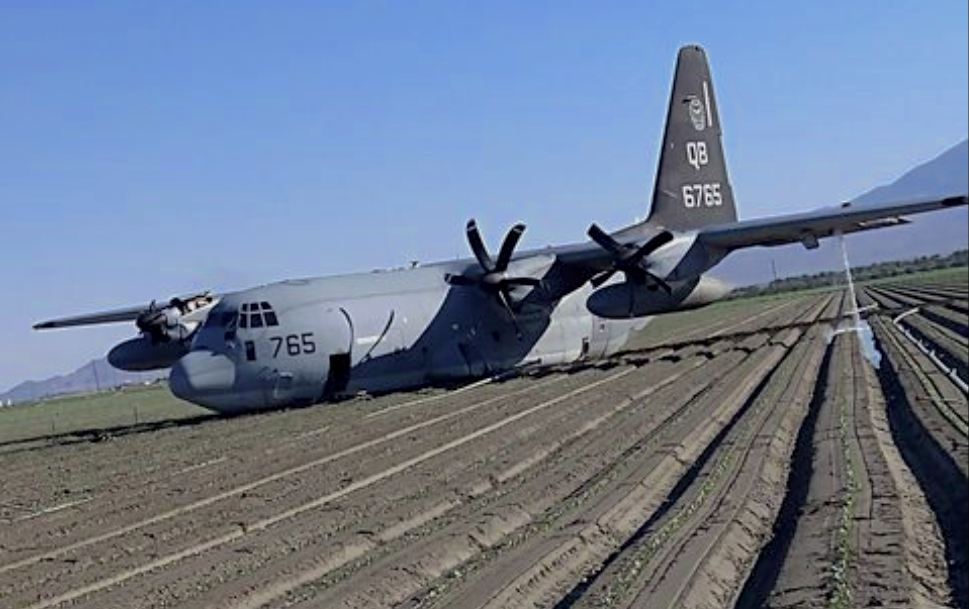
  •  

F-35 For India “Quite Possible” But “Avoid” — Veteran Air Marshal Says as U.S. Stealth Jets Roar Over Jodhpur

More than a year after Donald Trump unofficially offered the F-35 to India, the fighter jet debuted in India’s multinational exercise Tarang Shakti 2026. 

For the first time, six US F-35 Lightning II fighter jets and more than 200 airmen joined the Tarang Shakti multinational drills in Jodhpur, western India.

Photos of the jets appeared on social media ahead of their participation in tactical exercises alongside the Indian Air Force’s stalwarts, including the Rafale, the Su-30MKI, and indigenous Tejas fighters in Jodhpur, Rajasthan.

Meanwhile, the Indian Air Force published a video on September 29, 2026, showing an F-35 and Tejas flying together.

The @usairforce F-35A Lightning IIs are making their exercise debut in India at Tarang Shakti.

Combining stealth, advanced sensors, and information-sharing capabilities, the F-35s bring new opportunities to train with the Indian Air Force and other partners, strengthening… pic.twitter.com/wGfT6OxtAc

— U.S. Embassy India (@USAndIndia) September 29, 2026

The exercise comes more than a year after US President Donald Trump offered the F-35 to India during a meeting with Indian Prime Minister Narendra Modi in February 2025. So, while the deployment is meant to provide the IAF practical exposure to the aircraft’s operations and sensor integration in a multinational setting, it has inevitably sparked questions about whether the US is signaling its intent to sell the fighter. 

F-35 for India?

“Starting this year, we will be increasing military sales to India by many billions of dollars. We are also paving the way to ultimately provide India with the F-35 stealth fighters,” Trump told reporters in February 2025.

Vice President J.D. Vance reiterated the offer during his visit to India in April 2025, saying, “We, of course, want to collaborate more. We want to work together more. And we want your nation to buy more of our military equipment, which we believe is the best in class. American fifth-generation F-35s, for example, would give the Indian Air Force the ability to defend your airspace and protect your people like never before.”

These pitches took many by surprise, but there was a catch: they were merely verbal pitches, not official offers accompanied by formal discussions.

So, Air Chief Marshal AP Singh, chief of the Indian Air Force, ultimately told reporters that India was not considering the F-35 option, adding that it had not received a formal offer. A fervent supporter of augmenting Indian air power, the IAF top boss emphasized that purchasing a fighter jet was not like “buying a washing machine or refrigerator,” implying that the appropriate process must be followed. “We haven’t examined it [F-35].”

“Indian Pilot Crashes UAE Jet Full of Israelis” — The Headline That Would Have Run, Had Machchhar Not Fought Back: OPED

Later that year, the Minister of State for External Affairs, Kirti Vardhan Singh, told Parliament that it had held no formal discussions with the US about acquiring F-35 fighter jets.

However, more than a year later, the deployment of the F-35s for Tarang Shakti gives the impression that the exercise may be an attempt by Washington to keep the door open or provide useful exposure that could entice the Indian Air Force (IAF). 

Meanwhile, the Russian envoy to India praised the F-35 fighter jet in a rare move while arguing that it was not suitable for India.

Speaking at the NDTV Defense Forum 2026, Russian Ambassador to India Denis Alipov said, ”The US is welcome to promote its product. It’s a good aircraft, no doubt about that. But way too expensive. If India goes for that, well, that would be India’s sovereign decision. But we are offering a much better deal. Next year we are going to see hopefully many firsts at the Bengaluru air show.” 

It appears the Russians might be smelling the US offer.

Russia has also been aggressively pursuing to sell India its fifth-generation Su-57, which Moscow positions as a competitor to the F-35.

It has offered New Delhi a host of options, including an off-the-shelf purchase of Su-57 fighters, full licensed production in India, technology transfer, a “two-seat variant,” and help with India’s own fifth-generation aircraft, the Advanced Medium Combat Aircraft (AMCA).

"Good Product But…": Russian Envoy Compares American F-35 With Su-57 Fighter Jethttps://t.co/vUTjeKPq63 pic.twitter.com/4e9n8ufmGx

— NDTV (@ndtv) September 27, 2026

IAF veteran and commentator, Air Marshal Anil Chopra (retd), told the EurAsian Times, “IAF has trained alongside the F-35s in the past, such as in the Pitch Black exercise. The deployment is likely meant to test the waters by enticing the IAF, and probably to create conjecture, considering that no official offer was ever made. They could also be creating a deliberate distraction for India, particularly since the Russians have sustained their Su-57 campaign and expanded the scope of the initial offer to make it more and more appealing.”

“As for the cost factor mentioned by the Russian envoy, everything we buy is expensive. The Su-57 may be cheaper than the F-35 initially when looking at per-unit price, but it wouldn’t be cheap in the long term,” Chopra added.

That said, since both Su-57 and F-35 offers were made to India around the same time, the two jets have been viewed as competitors in the context of India’s acquisition of a fifth-generation fighter to augment its airpower.

As Air Marshal Chopra added: India may need a fifth-gen fighter as a stopgap solution till the AMCA arrives. If the US makes an enticing offer and meets India’s core requirements, American jets offered to the IAF are “quite possible”, but India should best avoid letting the USA get into its fighter aircraft ecosystem.

F-35: Image via US Embassy, New Delhi

F-35 vs Su-57 Showdown?

Although India is developing its own fifth-generation stealth aircraft, the AMCA, it is unlikely to be delivered to the IAF before the mid-2030s. Defense Secretary R.K. Singh recently said the first flight is targeted for September 2028, but the aircraft may take time to become operationally available to the IAF.

This means waiting for the AMCA would leave India with a glaring capability gap vis-à-vis adversaries China and Pakistan. China already operates two different fifth-generation stealth fighters: the J-20 and J-35A, and is currently testing two sixth-generation fighter prototypes. Meanwhile, Beijing could export its 5th-gen J-35A to Pakistan.

Photo by United Aircraft Corporation (UAC)
File: F-35 Lightning II and Su-57 Felon captured in the same frame for the first time in history at Aero India 2025

However, Air Marshal Chopra had earlier told the EurAsian Times that the decision not to show any interest in the Su-57 and the rhetoric about focusing on AMCA is meant to keep American ire and sanctions at bay.

For now, India’s path to bolstering its airpower includes accelerating Tejas production, advancing work on AMCA, and signing a deal for 114 Rafale fighters with France.

Observers have noted that India’s sustained disinterest in buying the F-35, arguably the best fifth-generation stealth fighter on the market, stemmed mainly from American unreliability, including painful delays in delivering F404-IN20 turbofan engines for Tejas Mk-1A jets.

So far, the US has not been able to break into the Indian fighter jet ecosystem, and has pitched multiple warplanes to the IAF, including F-15EX, F-21 (modified F-16), and F/A-18 Super Hornets. However, none of them appears to have lured the Indians. Can the F-35 do? Only time will tell.

Indians are reportedly also concerned about operational costs linked to the F-35, anxiety over introducing a complex Western platform to its fleet, Washington’s unwillingness to transfer the technology and allow local manufacturing, and potential operational restrictions on F-35 use.

Skeptics have noted that the sale may never go through, given that India operates the Russian S-400 air defense system and has integrated it into its layered air defense network.

Earlier, the US expelled Turkey from the F-35 consortium for buying the S-400 and has not yet approved the F-35 sale to it, despite Ankara’s assurances that it would never activate the system.

Meanwhile, India is also aggressively evaluating the French 6th-gen FCAS program.


The post F-35 For India “Quite Possible” But “Avoid” — Veteran Air Marshal Says as U.S. Stealth Jets Roar Over Jodhpur appeared first on EURASIAN TIMES.

  •  

F-47 vs F/A-XX: Can Boeing End the U.S. Navy’s Second-Priority Curse as Seen with Super Hornet, F-35C?

After a long period of uncertainty and an ice-thin contest with Northrop Grumman, Boeing has won the US Navy’s F/A-XX next-generation carrier-based fighter contract, making it the sole developer of America’s crewed sixth-generation combat jets, after F-47.

On September 29, the Department of War awarded Boeing a $20 billion contract for the F/A-XX’s full-scale development phase. The contract covers multiple test aircraft for ground, airworthiness, systems, and weapons integration testing.

“The F/A-XX is a critical pillar in our commitment to maintaining peace through strength. F/A-XX will dominate contested airspace, extend operational reach, and deliver a decisive combat advantage for the warfighter,” Michael P. Duffey, Under Secretary of War for Acquisition and Sustainment, was quoted as saying in the official statement.

Boeing had already secured the Air Force’s F-47 program in March 2025, defeating Lockheed Martin—the company behind both of the service’s fifth-generation fighters, the F-22 Raptor and F-35 Lightning II.

Responding to the Navy award, Steve Parker, president and CEO of Boeing Defense, Space & Security, stated: “Delivering two advanced fighters in parallel was always our plan, and we invested accordingly. We are ready and able to build multiple concurrent future combat aircraft franchise programs.”

The decision ends nearly a year of ambiguity surrounding the F/A-XX, which will eventually replace the F/A-18E/F Super Hornets in US Navy service since the 1990s. Last year, the Pentagon said it was prioritizing the F-47 over the F/A-XX, and asked the House and Senate defense policy committees to divert $500 million from the “accelerated development” of a Navy stealth fighter to the F-47.

However, the US Navy’s leadership and Congress pushed back against the Pentagon and called for increased funding and award of the contract.

In January 2026, the House and Senate Appropriations Committees negotiated a draft defense spending bill that earmarked nearly $900 million for the F/A-XX, a stark increase from the $74 million the Pentagon sought.

Image
File: Artist rendering of the F/A-XX (Boeing Image)

Naval officials and analysts made the case for the F/A-XX by pointing to its utility amid the burgeoning threat from China in the Indo-Pacific theatre. Rep. Ken Calvert, R-Calif., the head of the House Appropriations subcommittee on defense, said, “We need sixth-generation fighters. The US Navy needs sixth-generation fighters. I’m concerned that any hesitancy on our part to proceed with the planned procurement of the sixth-gen fighters for the Navy will leave us dangerously outmatched in a China fight.”

Meanwhile, Daniel Cheever, Commander of Naval Air Forces, was quoted saying: “I’m looking forward to [the F/A-XX] because that sixth-generation means air superiority in that timeframe in the future, which means sea control. And as long as you have air superiority, you have sea control around the globe.”

Beijing has been flying two different prototypes of sixth-generation fighters—the J-36 and the J-50—one of which could possibly evolve into a carrier-based sixth-generation fighter aircraft. This sparked concerns across the US Navy that the service that fielded the world’s first-ever carrier-capable stealth fighter may lose out on this crucial race.

“This achievement marks a new era for the US Navy,” said acting Secretary of the Navy Hung Cao. “The Sixth-Generation fighter is a generational leap in air superiority and will provide the world’s best aviators with unparalleled capabilities to fight, win, and come home safe. We are excited to partner with Boeing, and for our warfighters to continue to dominate the skies and defeat our nation’s enemies.”

Unlike the USAF NGAD program, the US Navy has released little information on a futuristic F/A-XX, although authorities have said the F/A-XX will have a longer range than current aircraft and serve as a covert tip of the spear for the carrier air wing. In addition, the F/A-XX will be interoperable with manned and unmanned platforms such as Collaborative Combat Aircraft (CCA) and increase the capability of every CCA it teams with.

However, a pressing question experts have been discussing after the award was presented to Boeing is whether the naval fighter will be a navalized variant of the F-47, or the aerospace giant will build a new fighter from the ground up.

F/A-XX vs F-47

Boeing can leverage relevant production experience, supply chains, and design work it has already completed for the F-47 program. 

Many aviation enthusiasts have wondered if Boeing will produce the F/A-XX as a navalized version of the F-47; the two aircraft are built for fundamentally different environments and missions, which will influence their design differences.

The F-47 is a land-based air-superiority fighter focused on speed, altitude, long-range penetration, and counter-air roles to succeed the F-22, whereas the F/A-XX is a carrier-based multirole strike fighter to replace the F/A-18E/F Super Hornet and EA-18G Growler.

This distinction means that the naval F/A-XX next-generation fighter jet must be designed for catapult launches, arrested landings, folding wings for carrier storage, saltwater corrosion resistance, and high sortie rates in a maritime environment, while prioritizing range for Pacific operations and multirole strike capability.

File:F-47 Rendering.jpg - Wikimedia Commons
F-47 artist rendering-Wikimedia Commons

Notably, several past studies examined a joint sixth-generation solution and concluded it was unworkable. For this reason, the USAF and the Navy formally split their paths and decided to pursue separate programs based on specific requirements.

The US Navy has consistently asserted that its fighter will have a separate airframe from the Air Force, rejecting the joint approach controversially used for the F-35 program for many practical reasons.

The Navy’s carrier version, the F-35C, required extensive modifications from the USAF’s F-35A baseline, including a larger wing area, stronger landing gear and structure, folding wingtips, a tailhook, corrosion-resistant materials and coatings, and revised fuel and internal arrangements. The changes added weight, cost, and complexity, contributing to schedule delays and performance compromises.

When every percentage of range, stealth, and kinematic performance matters against near-peer threats such as China, the structural and aerodynamic penalties of carrier suitability become more painful for a pure air-superiority fighter.

Image
Boeing’s previously released concept rendering of F/A-XX (Via X)

That said, the F-47 and F/A-XX may share some basic commonalities, which may even help the US Navy’s next-generation fighter program.

The first question is how quickly a workable F/A-XX can be fielded—which really comes down to how much it draws on the already-developed F-47. If the two designs share much commonality, or were developed together, an F/A-XX could fly much sooner than expected.

Boeing released F/A-XX concept renderings, including one shown at the 2025 Tailhook Symposium and newer ones after the award,  that visually resemble its F-47 concepts in areas such as cockpit shape, overall planform, and possible canard-like foreplanes.

Moreover, the two Boeing designs can share high-value subsystems, sensors, software, open mission systems, Artificial intelligence, or Collaborative Combat Aircraft (CCA) integration, and design philosophy without locking both aircraft into the same airframe.

This level of commonality could offer high cost and risk benefits while preserving optimization.

US Navy’s Fighter Program Trails Yet Again

While the F-47 is on track for its first flight, the F/A-XX has yet to receive a designation, and concerns remain about how Boeing will manage the industrial constraints of pursuing two contemporary programs at the same time.

Air Force Brig. Gen. Timothy Helfrich, the service’s Portfolio Acquisition Executive for Fighters and Advanced Aircraft, recently stated, “We’re not too far away from an F-47 production line, which will be additive to the production capacity.”

By contrast, the F/A-XX is roughly 18 months behind the F-47 in program phase and several years behind in physical hardware maturity.

Boeing has already invested heavily in expanded, secure St. Louis facilities sized for multiple advanced fighters. However, with the F/A-XX, the company will likely face significant industrial constraints developing both aircraft simultaneously while still supporting F-15EX and T-7 production. The company is likely to be constrained by a limited specialized workforce and potential supply-chain bottlenecks.

Against that backdrop, the F-47 will likely receive priority focus first so manufacturing lessons, tooling, supply-chain fixes, and digital production processes can be refined on the Air Force lines before F/A-XX ramps into full-scale assembly in the early 2030s.

Notably, the delay in awarding the F/A-XX contract somewhat mimics a historical pattern of laxity in advancing the US Navy’s fighter jet programs, giving dominant USAF programs more leverage.

The US Navy formally launched the F/A-18E/F Super Hornet program in 1992 as a lower-risk alternative. Although the aircraft made its maiden flight on November 29, 1995, its Engineering and Manufacturing Development (EMD) phase faced intense political scrutiny and budget constraints throughout the mid-to-late 1990s over its effectiveness and cost.

Meanwhile, a comparable multirole fighter for the USAF, the F-15E Strike Eagle, progressed much faster.

Selected for the Dual-Role Fighter program in February 1984, the Strike Eagle flew its first production model on December 11, 1986, and reached Initial Operational Capability (IOC) in September 1989—a full decade before the Super Hornet entered fleet service in 1999 and reached IOC in 2001.

Later, the Joint Program Office-managed F-35 program prioritized the F-35A and F-35B because of their earlier operational needs and less complex technical requirements than the F-35C. In fact, the F-35C carrier variant was the last to achieve Initial Operational Capability (IOC) in 2019, following the F-35A (2016) and the F-35B (2015).

Since both contracts are now with Boeing, whether this historical pattern will reverse or shrink remains to be seen.


The post F-47 vs F/A-XX: Can Boeing End the U.S. Navy’s Second-Priority Curse as Seen with Super Hornet, F-35C? appeared first on EURASIAN TIMES.

  •  

The Indonesians facing El Nino’s fires have lessons to teach us (commentary)

In October 2006, I was supposed to be starting my dissertation research on tropical reforestation in Indonesia. Instead, I found myself in the forests of Tanjung Puting National Park in Central Kalimantan helping locals to fight fires with brooms, backpack pumps, and hoses connected to hand-dug water wells. It was an ‘all hands-on deck’ moment for the local NGO I was working with then — Friends of Nature, People and Forests (FNPF) — including Basuki Santoso, FNPF’s Kalimantan program manager, alongside Adut and Isam, who were teenagers at the time. On our first night of firefighting, we slept in the forest on a raised platform that would later become part of a field station. I was awoken in the middle of the night by a sun bear rifling through our makeshift kitchen about 20 feet away. I sat frozen, watching this wild animal who was fleeing the fires while everyone else slept soundly. It was a surreal and humbling moment. Twenty years ago, these severe forest and peatland fires were due to a dangerous combination of El Niño-induced drought, slash-and-burn agriculture and other land clearing, and the grass-fire cycle. Much of Southeast Asia was left choking on the haze, and that was a weak El Niño year. Firefighting in Indonesia often requires resourcefulness as well as resilience and fortitude. Image courtesy of Basuki Santoso. History keeps repeating itself, and it’s hard to watch. Experts say we are now facing a Super El Niño. For the past three months, millions of…This article was originally published on Mongabay

  •  
❌