❌

Reading view

Europe Has the Economic Power to Stand Up to China — It Is Time Brussels Used It


For years, the European Union has struggled with a peculiar contradiction in its dealings with China. The EU is one of the largest and wealthiest trading blocs on earth, capable of determining access to a market of some 450 million relatively affluent consumers, yet it frequently conducts foreign policy as though it were the supplicant.

Hilde Vautmans, the Belgian Renew Europe MEP and European Parliament rapporteur on EU-China political relations, is right to challenge this timidity.

Her report, debated this week in Strasbourg, does not advocate severing relations with Beijing. Nor should it. China is too economically important and too influential on questions ranging from climate change to international security for Europe simply to close the door.

But dialogue must not become an alternative to action.

“Europe has economic power. It’s time to use it,” Vautmans told Parliament ahead of the vote. That sentence ought to be pinned above every desk in the European Commission dealing with China.

The figures make the case brutally clear. In 2025 the EU imported €559.4 billion of goods from China while exporting just €199.6 billion in the opposite direction. The resulting deficit was €359.8 billion — almost €1 billion every day.

As EU Today reported recently, Commission President Ursula von der Leyen has herself warned of a potential “second China shock”, with subsidised Chinese industrial production threatening European manufacturers.

Fine words. But Beijing has heard fine words before.

The Commission’s preferred formulation remains “de-risking, not decoupling”. There is sense in that distinction. Nobody seriously proposes shutting down trade with the world’s second-largest economy. But de-risking becomes meaningless if every risk identified is followed by another dialogue, another working group and another opportunity to postpone difficult decisions.

Indeed, the Commission acknowledges that European companies operating in China face regulatory obstacles, inadequate intellectual-property protection, restrictions on data flows and pressures associated with technology transfer.

Europe possesses formidable weapons with which to respond: anti-dumping duties, anti-subsidy measures, foreign-investment screening, the Foreign Subsidies Regulation, the Anti-Coercion Instrument, procurement restrictions and controls on strategically sensitive technologies.

These instruments should not be deployed indiscriminately. But neither should they sit polished in the armoury while Beijing exploits European openness.

Vautmans is particularly right to connect economics with security and values. China cannot reasonably expect privileged access to European markets while helping sustain the Russian war machine. The European Parliament’s own research service describes Beijing as a “decisive enabler and dual-use provider”, including through goods entering Russian weapons and drone supply chains.

If Chinese companies materially assist Russia’s ability to wage war against Ukraine, Europe should be prepared to impose a direct economic price. The same principle should apply to human rights.

EU Today has warned repeatedly that Brussels’ ritualised engagement with Beijing risks becoming precisely that: ritual.

We reported earlier that the EU-China Human Rights Dialogue risks losing credibility, pointing to the continuing imprisonment of Swedish citizen Gui Minhai and Uyghur academic and Sakharov Prize laureate Ilham Tohti. After round upon round of discussions, Beijing has learnt that European expressions of “deep concern” are inexpensive things to endure.

The problem is hardly new. Years ago, EU Today highlighted calls for concrete EU action over goods associated with forced labour in China, including demands for tougher restrictions on entities implicated in abuses against Uyghurs.

Yet repression continues. In March this year China adopted its new Law on the Promotion of Ethnic Unity and Progress. The European Parliament subsequently condemned what it described as intensified repression and assimilation affecting Tibetans, Uyghurs and other minorities, by the overwhelming margin of 439 votes to 52.

Europe therefore faces a straightforward question. What is the purpose of economic power if it is never translated into political influence?

The EU should not attempt to bully China. Nor should it abandon diplomacy. Vautmans is correct that channels of communication must remain open. But reciprocity must become something more than a word appearing in communiqués.

Where China closes markets to European companies, Europe should be prepared to restrict equivalent access. Where state subsidies distort competition, Brussels should respond rapidly with trade-defence measures. Where strategic dependencies expose Europe to political coercion, alternative supply chains must be built. Where Chinese entities support Russia’s military-industrial complex, sanctions should follow. And where companies benefit from forced labour or serious human-rights abuses, access to the European marketplace should carry consequences.

That is not protectionism. It is leverage.

Totalitarian states understand leverage perfectly well. China routinely uses access to its enormous market as an instrument of statecraft. Europe, by contrast, too often behaves as though exploiting its own commercial strength would somehow represent a failure of diplomacy. It represents precisely the opposite.

The European Commission has spent years discovering that China is simultaneously a partner, competitor and “systemic rival”. It is time to move beyond discovering the obvious.

Vautmans has identified the essential point. Europe already possesses economic power on a scale few countries can ignore. What it appears to lack is the political confidence to use it.

Main Image: by Valentine ZELER, © European Union 2026 – Source : EP

  •  

China Completes First Season of Regular Arctic Container Service

China has completed the first season of regular weekly container shipping between China and Europe via the Northern Sea Route, with the operator completing all eight sailings planned for 2026 before ending departures slightly earlier than scheduled because of Arctic ice forecasts.
  •  

Listen: Are we now heading to a trade war with China?

Production: By Europod, in co-production with Sphera Network.

EUobserver is proud to have an editorial partnership with Europod to co-publish the podcast series “Briefed” hosted by Léa Marchal. The podcast is available on all major platforms.

Find the full transcript below: 

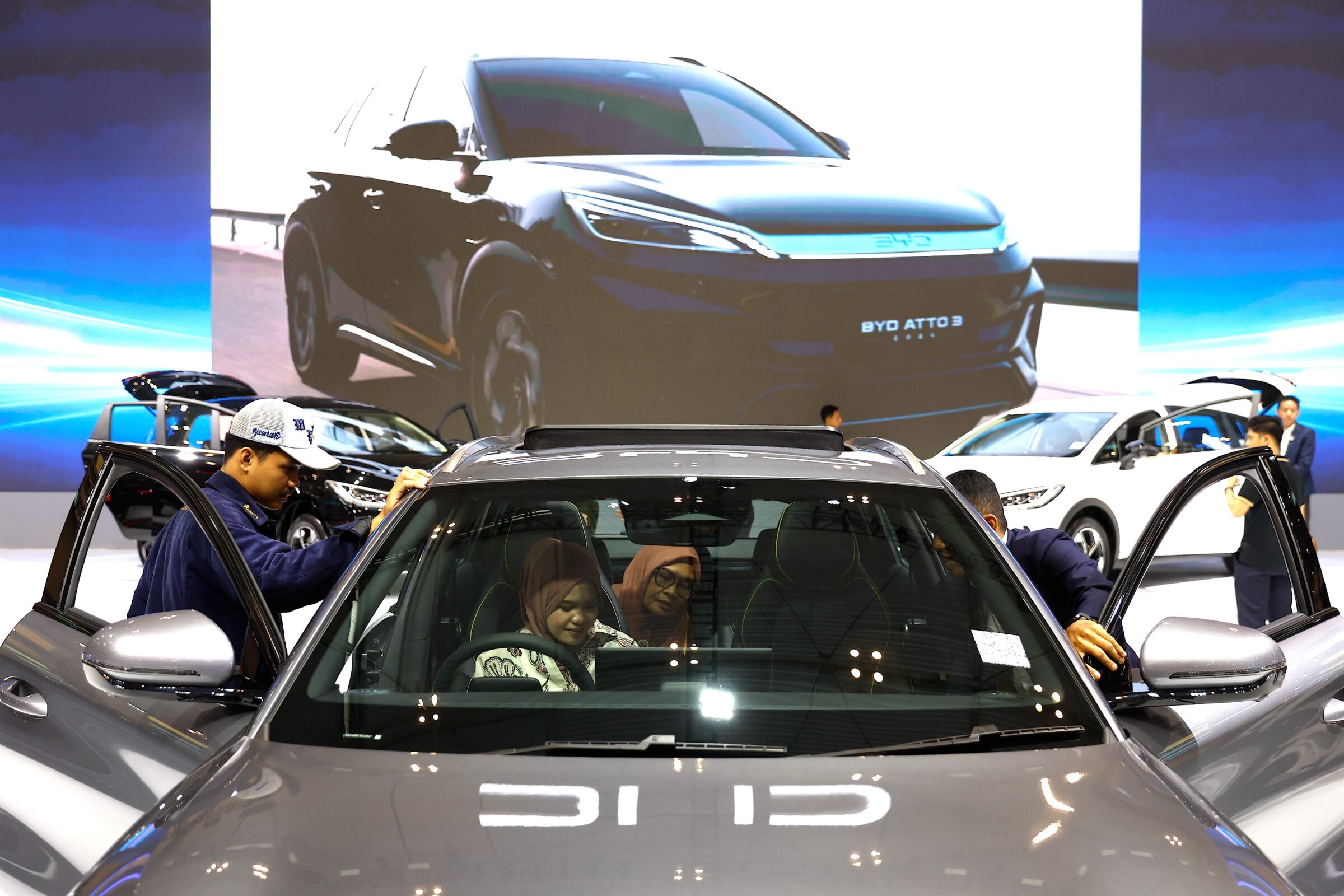
Chinese carmakers are taking an increasing share of the European car market, particularly when it comes to electric vehicles. Why are European carmakers now opening their factories to their Chinese competitors?

Until recently, the main concern in Europe was Chinese-made electric vehicles being imported into the EU. That’s why, two years ago, the EU imposed hefty tariffs on Chinese electric cars.

But Chinese manufacturers have found another way into the European market: they are setting up production here. Some are building factories of their own. Others are entering partnerships with European carmakers and using their existing production sites.

That’s the case with Stellantis and Chinese manufacturer Leapmotor. And now Dongfeng is also negotiating to produce cars at the French plant of Rennes La Janais. Because by moving production to Europe, Chinese manufacturers may be losing one of their main advantages, which is cheap labour.

But low labour costs are only one part of their competitive edge.

Chinese manufacturers also continue to benefit from state support. And setting up production in Europe doesn’t necessarily mean building brand-new factories.

In many cases, Chinese companies are looking to partner with European manufacturers and use factories that are already there — factories that are no longer operating at full capacity. That means they can save significantly on investment costs. And they can also rely on their European partners’ existing sales and distribution networks.

So how big is this Chinese presence in Europe becoming? For 2028, there are already 12 projects involving Chinese carmakers setting up production in Europe. Several are in Spain, with others in France, Belgium, Slovakia, Hungary, Sweden and Austria.

Now, why would European manufacturers allow their Chinese competitors to produce cars in their own factories? Part of the answer is that European carmakers are struggling to keep up in electric vehicles sells. And that is contributing to factory closures and job losses.

European manufacturers have to meet EU targets on average CO2 emissions each year. And producing more electric vehicles is necessary to meet those requirements.

So partnerships with Chinese manufacturers can serve two purposes: they can help European companies fulfilling their green cars objectives, while also keeping existing factories and jobs running.

Though there is a longer-term risk for European manufacturers. The more Chinese companies establish themselves in Europe, the more competitive pressure they could put on European brands — potentially even leading to takeovers. That has happened before: Volvo Cars, for example, was acquired by Chinese group Geely in 2010. 

In Germany, carmakers are for now refusing to open the doors of their production sites to the Chinese. But they do have partnerships with Chinese companies to produce vehicles in China, where they can benefit from lower production costs. That explains why they were very much opposed to imposing tariffs on Chinese electric vehicles.

But the situation is now changing. Volkswagen closed its Dresden factory last year, and other German plants are also facing closure risks. Germany’s car industry is therefore increasingly joining calls for stronger protection against Chinese competition.

And that brings us back to the Franco-German paper that is circulating in Brussels, which calls for measures to restrict Chinese access to the European market.

Because this debate goes well beyond cars. The EU is increasingly concerned about Chinese competition and dependence in a range of strategic industries. This will be discussed next week, when EU leaders meet in Brussels.

The European Commission could also present a new so-called “diversification” tool, either at the summit or around it. One possibility would be to require companies not to rely exclusively on China for certain critical materials. Something which could trigger what we call a trade war. I’ll be following that very closely!

  •  

Central Europe’s Growth Model Is Losing Momentum, IMF Warns

Growth potential across Central and Eastern Europe has fallen sharply from the levels seen around EU accession, with ageing populations, weak productivity, Chinese competition and slower German industry increasingly testing the region’s economic convergence.

The economic model that transformed Central and Eastern Europe after EU accession is losing momentum, according to the International Monetary Fund, which is warning governments that structural reforms are needed if the region is to continue narrowing the income gap with Western Europe.

Carlos Mulas-Granados, the IMF’s regional representative, said on Tuesday that medium-term growth potential across Central and Eastern Europe had declined to around 2.5 per cent, compared with roughly 5 per cent before countries in the region joined the European Union.

The slowdown does not mean that every economy is stagnating. Poland continues to grow faster than much of Western Europe, while the Czech economy has recovered from recent shocks. The concern is instead about the underlying rate at which these economies can expand once temporary fiscal stimulus, EU funding and post-crisis recoveries are stripped out.

Several of the forces behind the region’s earlier success are becoming weaker.

EU accession opened access to the single market, attracted foreign investment and integrated Poland, Czechia, Slovakia and Hungary deeply into European industrial supply chains. German manufacturers in particular moved production eastwards, taking advantage of lower labour costs, skilled workforces and geographic proximity.

That process generated rapid gains in productivity and incomes. It cannot simply be repeated.

Demographics are one of the most immediate constraints. Working-age populations are shrinking across much of the region while ageing increases spending requirements for pensions, health care and social support.

The IMF’s country assessments illustrate the problem. Its assessment of Poland says demographic pressures are mounting even as labour productivity remains comparatively strong, and calls for higher labour participation, better skills and deeper capital markets.

In Slovakia, the Fund expects growth of only 0.9 per cent this year and says adverse demographics and weaker productivity are weighing on the medium-term outlook. The economy remains particularly exposed to manufacturing and the automotive industry.

The Czech Republic faces a similar structural constraint. The IMF estimates its medium-term potential growth at around 1.8 per cent, with population ageing and modest productivity gains limiting further convergence.

External conditions have also changed.

Germany, the region’s principal industrial partner, has experienced prolonged weakness in manufacturing. Central European producers therefore face softer demand from the market around which many of their supply chains were originally built.

At the same time, China has moved from being primarily a source of imports and components to a direct competitor in sectors where Central Europe has substantial industrial exposure, including cars, batteries, machinery and electrical equipment.

That combination is particularly difficult for economies built around export-oriented manufacturing.

The problem overlaps with the wider European competitiveness debate. EU Today reported in July that only 15.7 per cent of the reforms recommended in Mario Draghi’s competitiveness report had been fully implemented at that stage, with important work still outstanding on capital markets, energy and investment.

For Central Europe, progress on those issues has a direct bearing on growth. Smaller national capital markets make it harder for companies to finance expansion. Fragmented energy systems add to industrial costs, while limited access to venture capital can restrict the development of businesses outside established manufacturing sectors.

There are significant differences between countries. Poland’s larger domestic market gives it more insulation from industrial weakness elsewhere and the IMF expects relatively strong growth. Hungary has faced a different combination of weak investment and fiscal constraints, while Slovakia’s dependence on car production leaves it particularly exposed to changes in the European automotive sector.

EU funding remains an important source of investment across the region, particularly for infrastructure and modernisation. But EU transfers cannot by themselves replace improvements in productivity.

The IMF’s argument is therefore less about an immediate recession than about the end of an unusually favourable period of convergence.

Central Europe entered the EU with lower wages, substantial scope to import Western technology and a powerful incentive for Western European manufacturers to move production eastwards. As those gaps narrow, future growth depends more heavily on innovation, skills, investment and domestic productivity.

The region is still converging with Western Europe. The question raised by the latest IMF warning is how quickly that process can continue once the economic advantages that powered its first two decades of EU membership become less powerful.

  •  

How China deploys wartime history against Japan

Beyond all the pageantry, the Chinese leader Xi Jinping had a strategic goal for his Washington visit – to undermine the American relationship with Japan. Xi succeeded, perhaps beyond his expectations. Japanese policy makers saw this coming. They arranged a brief meeting on the sidelines of the United Nations General Assembly between Prime Minister Takaichi […]

The post How China deploys wartime history against Japan appeared first on Asia Times.

  •  

Europe and China Trade Negotiations: Can Brussels Face Reality? Part 1

The EU’s difficulties in negotiating with China go beyond tariffs and quotas — structural economic differences, political fragmentation within Europe and broader geopolitical tensions reveal a fundamental misunderstanding of the China that Brussels is dealing with and the world in which it must compete. The Strategic Disconnect: Europe’s China Blindspot The fact that European negotiators […]
  •  

When Asia’s central banks turn bond vigilante on Trump

TOKYO – For decades, the US enjoyed a remarkable luxury: its two biggest creditors, Japan and China, kept showing up at Treasury auctions with checkbooks open. Now, Donald Trump’s trade wars, tariff threats and widening geopolitical confrontations raise an uncomfortable question: what happens if Washington’s most reliable bankers decide they’ve had enough? Granted, global investors […]

The post When Asia’s central banks turn bond vigilante on Trump appeared first on Asia Times.

  •  
❌