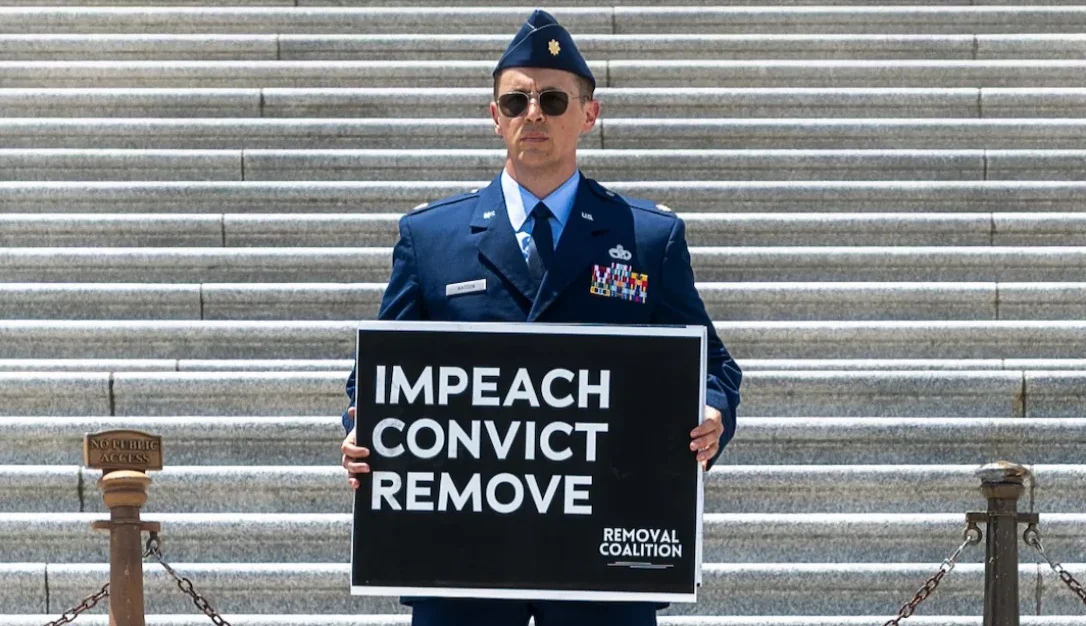
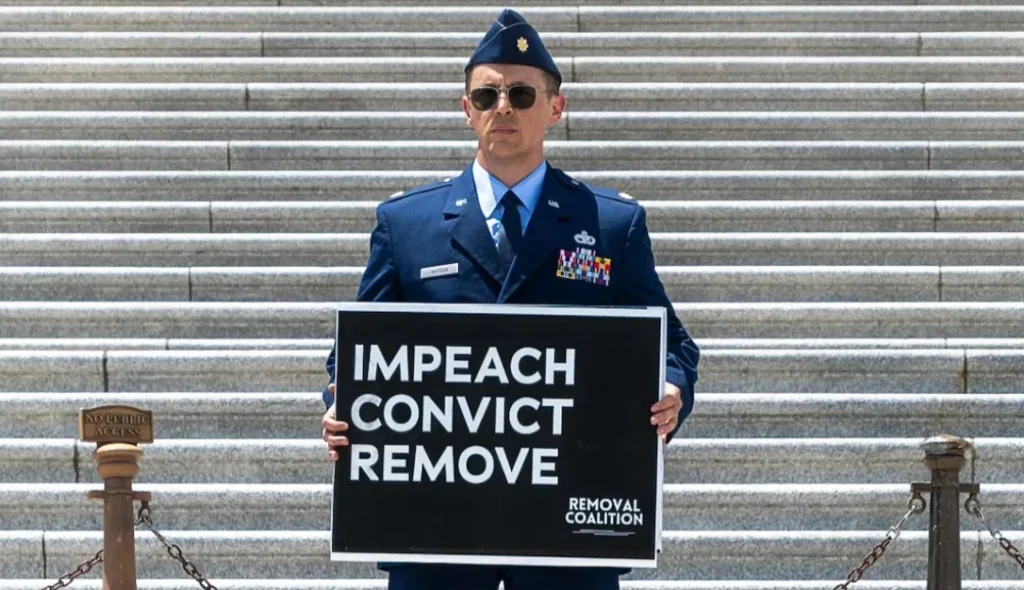
Maj. Jason Watson was arrested after he participated in a news conference calling for Trump to be removed from office over his launching of military actions against Iran, Cuba, and Venezuela without congressional authorization
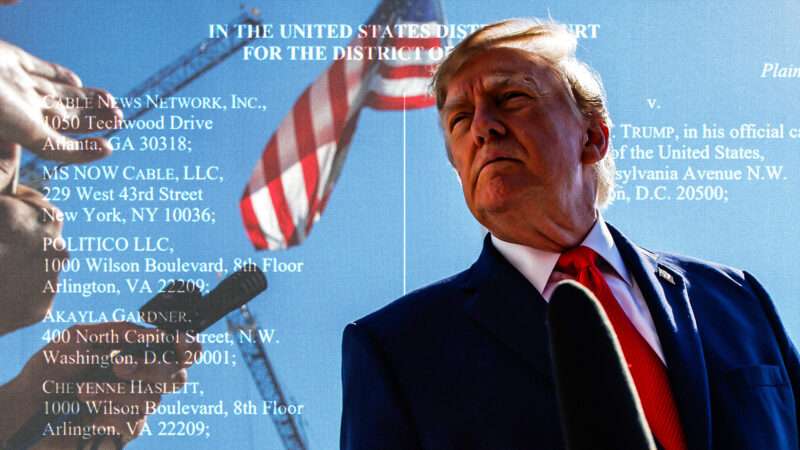
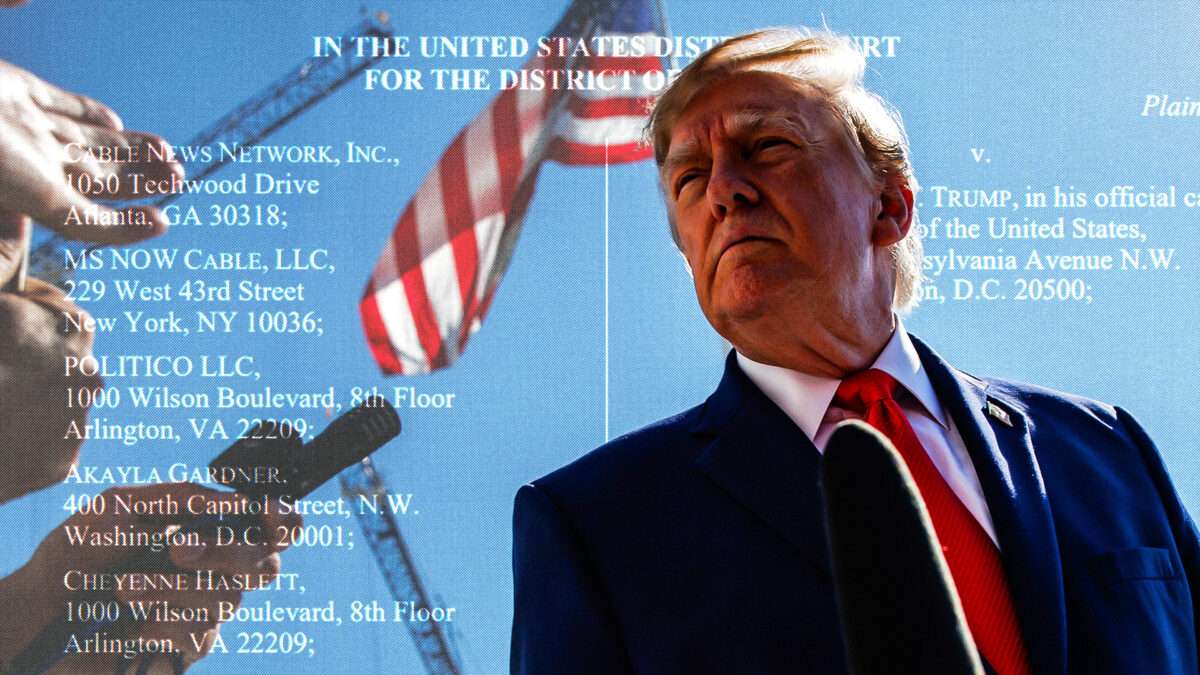
Last month, a federal judge in Washington, D.C., issued a temporary restraining order (TRO) that required restoration of press passes for 78 journalists employed by three news outlets that President Donald Trump peremptorily banned from the White House on September 18. U.S. District Judge Timothy J. Kelly, a Trump appointee, extended that order on Tuesday, granting a preliminary injunction to CNN, MS NOW, and Politico.
While Kelly's TRO was based on CNN et al.'s claim that their sudden banishment violated the Fifth Amendment's guarantee of due process, his justification for the preliminary injunction also addresses their argument that revocation of their press passes violated the First Amendment by retaliating against them for constitutionally protected speech and discriminating against them based on viewpoint. Kelly concludes that the plaintiffs "are likely to succeed not only on their due process claim, but also on their two First Amendment claims."
A retaliation claim requires showing that the plaintiff engaged in conduct protected by the First Amendment, that the defendant's action was "sufficient to deter a person of ordinary firmness" from "speaking again," and that there was "a causal link between the exercise of a constitutional right and the adverse action." Although the government's lawyers did not dispute that the CNN et al.'s journalism is constitutionally protected, they argued that the plaintiffs had failed to satisfy the two other elements.
Kelly disagrees. The "hard passes" at issue in this case, he notes, give journalists unescorted access to the White House "press area," which includes "the briefing room, the press offices, and certain other locations in and around the White House that are open to correspondents." CNN et al. argued that "a hard pass is an important credential because it 'allows a reporter to react to fast-developing news' and gives them 'swift and easy access to key official sources.'" Since "the revocation of Plaintiffs' hard passes matters a lot as to how, whether, and to what extent they can do their jobs," Kelly says, "it is likely that the open-ended ban here would chill a reporter's work."
Trump's "own comments suggest that he intended the revocation of Plaintiffs'
hard passes to alter their reporting on him, bolstering the case that his action here is sufficient to deter a reporter of ordinary firmness from reporting in the same way she had before," Kelly adds. The day he announced the ban, Trump complained that CNN et al. "purposely write negative news" to "try and diminish the Republicans and a Republican administration." Although "the ban would go as far as you can," he added, "I'd love it" if "they could straighten themselves out."
The plaintiffs also have shown "there is likely a causal link between the exercise of their First Amendment rights and the revocation of their hard passes and exclusion from the White House press area," Kelly writes. "President Trump likely banned Plaintiffs from the White House because he believes that their reporting is generally inaccurate and biased against him."
Again, Trump's public comments amply support that conclusion. He explicitly said he was banning CNN, MS NOW, and Politico "as a result of their constant 'reporting' [of] FAKE NEWS," adding that journalists "shouldn't be able to constantly write or report FICTION and LIES when they're covering the President of the United States, the Trump Administration, or the United States of America." When asked whether his decision was motivated by a "particular reason" or "particular story," Trump replied: "No, no. It's really just cumulative stories over the last two years." The problem, he said, was "purposely negative stories."
In a Truth Social post three days later, Trump likewise condemned "Fake News" that he said was "corrupt, purposeful, pervasive, fully coordinated, and totally out of control." CNN et al.'s reporters are "Third Rate Clowns" who "purposefully distort, twist, and degrade with everything they write or publish," he added that evening. "Virtually every story about me, or anything having to do with me, is negative, wrong and, in many cases, DANGEROUS for our Country! No matter how GREAT my Achievements, they trivialize and demean."
Trump offered a similar defense of the ban in a September 28 interview with Time. "It's just bad story after bad story," and "most of them are fake," he complained. "I don't think anybody should be forced to bear fake news, constantly bad stories, because I've done great things." Although "I can name 100 great things I've done," he added, "I never get good press. I never get fair press."
The government's lawyers maintained that Trump or another official "would have reached the same decision" based on the "alternative ground" that CNN et al. had violated "minimum professional journalistic standards" by "publishing classified and national security information." Kelly was not impressed by that belated rationale, which no one mentioned until after the news outlets gave the government a copy of their lawsuit.
"There is no evidence in the record that President Trump made the decision to revoke
Plaintiffs' hard passes on national security grounds," Kelly writes. "Nor at any time has he directly stated that national security was the reason for his decision. When he announced the ban with his post on September 18, he did not mention national security. When he was asked later that day about the 'particular reason' for his action, he did not mention national security."
Trump did mention "national security" in Truth Social posts he wrote the day that CNN et al. filed their lawsuit. But "that expression appears to have been simply another way for him to describe Plaintiffs' alleged inaccuracies and unfairness in their reporting about topics like his achievements or electoral success," Kelly says. "All this suggests that 'national security' was merely a post-hoc justification for the decision, which greatly undermines" the claim that Trump would have "taken the same action in the absence of Plaintiffs' protected speech."
The government also cited letters to CNN, MS NOW, and Politico from the White House Press Office, which were sent four days after Trump banned them. Those letters averred that the three news outlets had violated "the standards of professionalism and decorum expected of those given access to the White House Complex" by "publishing sensitive or classified information" and "trafficking in verifiable falsehoods about national security and other issues."
The letters "hardly move the needle" on the question of why Trump banned CNN et al. from the White House, Kelly says. They "appear to conflate concerns about otherwise protected speech" with "national security concerns," he notes, and they do not even explicitly say that Trump "made the decision for national security reasons."
Each letter lists specific stories to which the White House objected. But Kelly notes that two reporters "had their hard passes renewed after publishing articles that Defendants cite in their September 22 letters as supporting the potential revocation of their hard passes."
The Trump administration tried to shore up its "national security" justification by submitting a declaration from Pentagon Press Secretary Kingsley Wilson. While Wilson explains "how the publication of classified and sensitive information can undermine national security," Kelly notes, she "says little to nothing about President Trump's decision to revoke Plaintiffs' hard passes" and does not say "anything about White House press practices or operations."
The defendants "have not really tried to support" the claim that CNN et al.'s reporting "damaged national security," Kelly says, noting that news stories based on "sensitive or classified information" are "commonplace, for better or worse." If Trump "would have banned Plaintiffs from the White House even in the absence of their protected speech," he suggests, "Defendants would not have had to scramble to make their case with unsigned letters and a declarant who does not even work there."
The evidence of retaliation also supports the claim that Trump discriminated against CNN et al. based on viewpoint, which is presumptively unconstitutional. The U.S. Court of Appeals for the D.C. Circuit, Kelly notes, has held that "the White House Press Area" qualifies as a "nonpublic forum," meaning journalists cannot be excluded because of the views they have expressed.
"It is likely that Plaintiffs were selected by President Trump for revocation of their access to the White House press area because he believes their coverage of him and his administration is generally inaccurate and biased," Kelly writes. "In other words, it was 'an effort to suppress the speaker's activity due to disagreement with the speaker's view,' rather than to vindicate any other purportedly 'compelling governmental interest,' including maintaining professional standards for journalists or protecting national security. Simply put, that is unlawful viewpoint discrimination."
Kelly's decision "is a stinging defeat for Trump's assault on the free press and a powerful vindication of the First Amendment," Caitlin Vogus, senior adviser for advocacy at the Freedom of the Press Foundation, said in an emailed press release. "As Kelly rightly recognized, presidents don't get to use their power to purge journalists because they don't like what they report."
Jerry Seinfeld mocked protesters highlighting Palestinian children’s deaths, dancing onstage and saying he would send a demonstrator’s ticket money to Israel.
Major drivers of the repression include pressure from wealthy pro-Israel donors, government interference, and the political loyalties of university administrators and trustees, according to a new report.
Graham Linehan, the Father Ted creator, may have been unfairly arrested by the Metropolitan Police because of his gender-critical views, the police watchdog has said.
We've reached the point in techno-dystopia where autonomous humanoid robots are out assaulting girls in the street—or so somecoverageof a recent incident in Cologne, Germany, might have you believe. But dig into what really happened, and it's human actions that appear more worrying.
For dystopian police-state flavor, we've got Cologne cops warning that simply commenting about this on Facebook in an unapproved way could be criminal. Without specifying exactly what kinds of comments are off limits or what law might be broken, the North Rhine-Westphalia Police of Cologne (Polizei NRW Köln in German) warned that social media comments about what happened could cross the line and potentially be a criminal offense.
Then there are the humans who were operating the robot that made lewd gestures at passersby and stands accused of grabbing the butt of a 16-year-old girl on a city street in Cologne around midnight. From the looks of things, the humans—not some artificial intelligence system—were in control.
This doesn't appear to be a case of an AI humanoid robot going rogue and getting pervy, but some teenagers engaging in a performance or prank that may have gone too far.
I say may here because it's not entirely clear what happened. There is video footage showing the robot—dressed in gold chains and a fake mustache like some sort of 1980s sleazeball—thrusting in a sexual manner and making jerking-off gestures in front of people gathered on city sidewalks. (Some of them appear annoyed or alarmed; some laugh.) But none of the videos that I could find clearly show any groping. We do see the robot bumping into people, but it's not entirely apparent what was touched or how purposeful these collisions were.
Maybe the alleged "sexual assault"—which is technically the correct term for a nonconsensual butt grab, I guess, but still seems a bit too strong—was totally intentional. Or maybe this is a case of clumsily controlled technology brushing against someone in a way that felt violating but was nonetheless an accident.
What appears to be beyond a doubt is that the robot was being made to engage in lewd gestures, which were played for laughs by teenagers (one 16 and one 19, according to police) who were filming these encounters and posting them to social media.
Is it a crime to make your mustachioed robot thrust its pelvis at passersby?
We probably don't want sleazebots just going around making obscene gestures in public, whether of their own volition or controlled by humans. But, in the U.S. at least, sexual harassment requires some things beyond just making a crude gesture. Laws vary by state, and by the context in which the alleged harassment takes place, but it generally has to be pervasive, severe, or carried out with a specific intent. I don't think this robot's actions would qualify (though there are perhaps other charges that could be brought, involving disturbing the peace or something like that).
But I wish people would chill out with the breathless coverage that attempts to make this into some sort of super grave and alarming incident. If it turns out these two teens did deliberately instruct their robot to touch a girl's butt, that's certainly not OK, and should be dealt with in whatever manner we might deem just if a teen did so directly. But we're not looking at rogue robots attacking girls on the street, or at teenagers cruelly directing their tech toy to seriously sexually assault someone while they filmed it. At worst, we're looking at a livestreamer stunt that was in poor taste, not the imminent coming of robot rape squads.
And setting aside the alleged violation of bodily autonomy—which may or may not have been intentional—the other antics of this robot are kind of funny? Can I say that? I don't think we want to create norms where it's OK to take a robot dressed like a movie pimp out on the streets and have him make sexual gestures at people, but…I laughed. Don't tell the German police.
In The News
A woman named Carli Heller was arrested for telling Anthropic's Claude that she was going to shoot up the sheriff's office in Lee County, Florida. Anthropic notified the FBI, which notified local authorities, and she was arrested for making a threat of mass shooting or terrorism, a felony.
"Heller's is at least the third case in the U.S. since August in which messages typed to an Anthropic chatbot ended up with the police, following incidents in San Antonio and San Francisco," reports Devin Pavlou at Straight Arrow News:
The cases raise questions about how private chatbot conversations are, when companies can hand them to police without a warrant, and whether words typed to a machine can be a crime. Eugene Volokh, a First Amendment scholar at the Hoover Institution at Stanford University, told Straight Arrow he doubts they can in this case.…
In the past, Florida courts have required proof that a person meant to threaten or knew the message would be viewed as a threat, according to Volokh, who has taught law for 30 years. He said a jury is unlikely to find that beyond a reasonable doubt.
"I doubt that this is a punishable threat, unless there is evidence that the woman subjectively realized at the time that the message would be communicated to a human being who would perceive it as a threat," Volokh said.
Heller's lawyer, Scott Moore, "said he plans to challenge whether a chatbot message can be a written threat under Florida law," adds Pavlou.
On Substack
Tara Burns has a good/infuriating roundup of recent "sex trafficking" busts that involve no trafficking charges and in which police just charge people with prostitution and seize their cash. Here's just one of multiple examples:
On October 6, Virginia Beach police announced the results of a months-long human trafficking investigation that culminated in September 24 raids on four massage businesses and a residence. Police said their surveillance showed several women living together and traveling between their home and massage businesses. Apparently, when Asian women work and live together it warrants the attention of the ICE led Hampton Roads Human Trafficking Task Force.
Three apparent sex workers (Xiaochung Peng, Xiaoqin Wu, and Ping Zhang) were arrested on charges involving maintaining a bawdy place, aiding prostitution, and using a vehicle in the commission of a crime. Police seized $55,085, four vehicles, phones, computers, and a security DVR.
No trafficking charges were announced, and police did not report identifying a trafficking victim.
Follow the Money: This investigation involved at least seven law enforcement entities, including two SWAT teams, federal investigators, and a federally funded, ICE led regional human trafficking task force.
Burns also points out that new anti-trafficking grant money from the Department of Justice's Office for Victims of Crime gives priority treatment to programs that support immigration enforcement.
"To help meet its mission, OJP may give priority consideration to applications proposing … projects designed to advance" five particular goals, including "directly supporting law enforcement operations (including immigration law enforcement operations)," it says.
Read This Thread
Does algorithmic pricing for apartment rentals cause people to pay higher rent? It's how this technology is used that determines whether outcomes are fair and beneficial to consumers, or potentially harmful, as Eliza Terziev and I write @ReasonFdnhttps://t.co/ai1p7J6X5z
• News you can use, if you are someone with a robot kink: Meta's AI agent, Muse, can sext. "While pornographic interactions may not be what users expect from Muse's cuddly mascot, Meta says that X-rated conversations are allowed and don't go against its guidelines," reportsWired.
• The latest COYOTE Rhode Island podcast takes a deep look at the disconnect between rhetoric surrounding anti-trafficking policy and how that policy works in practice—how "state surveillance, carceral feminism, and these policies that just loudly claim to save people are often resulting in measurable catastrophic harm."
• "It wasn't all that long ago that if The New York Post published photographs of an aspiring congressman wearing a leather collar and a chain-link leash, his campaign would have immediately been over," writes Lux Alptraum in The New York Times. "Yet that doesn't seem to be the case for Chris Gallant, the gay, gun-toting former Black Hawk pilot who's running for Congress on eastern Long Island. He still may not win, but these photos alone haven't sunk his chances."
• Sarah Hepola's The Only Thing There Is to Want is "a super fun book line by line," writes Phoebe Maltz Bovy, "but here's one of the best: 'Just what every young man wants in bed: Mrs. Robinson, crying.'"
• When you think of countries that have thrived in the tech sector, Finland might not be the first that comes to mind. But for a while, the Finnish company Nokia dominated the cellphone market. "What happened to this brand, the pride of Finnish enterprise and perhaps the defining commercial contribution of a small, isolated, but determined nation?" Arena mag asks (and answers).
• Derek Thompson interviews Daniel Cox about this new book, Generation Uncoupled. "The book argues that problems with dating and romantic partnership are downstream from the decades-long deterioration of American social and civic life," says Cox. "To the extent that we're experiencing a romantic recession, it is a symptom of this broader problem of social disconnection."
The verdict came Friday; here's the backstory, from a decision in March in Fox v. Nexstar Media Group, Inc. by Judge Robert Jonker (W.D. Mich.), allowing plaintiffs' claims to go forward:
These cases arise from the fallout over an internal memo that two senior news managers at WOOD‑TV—Amy Fox and Stanton Tang—either wrote or approved regarding coverage of Pride-month events. According to Fox and Tang, management initially agreed that the memo merely restated corporate policy, but after some colleagues misinterpreted the memo as being anti‑gay—and after the memo was leaked externally—management allegedly shifted its stance and planted news stories that portrayed Fox and Tang as anti‑gay. The plaintiffs contend Nexstar did this to cause Fox and Tang to absorb the blame for the controversy while allowing the company to emerge unscathed.
In early June of 2023, Stanton Tang began to feel concerned about WOOD-TV's coverage of Pride-related events. To him, it seemed that the newsroom's approach to Pride coverage differed from its approach to coverage of other events, such as women's history month or black history month.
As Tang tells it, when it came to the latter events, the newsroom tried to approach coverage in a unified way, to ensure that coverage was diversified, newsworthy, and spread throughout the month. However, when it came to Pride events, the newsroom was deviating from its typical editorial review process, and many reporters were beginning to go cover stories about Pride festivals as soon as they heard that the event was taking place—without discussing with the rest of the newsroom whether the story ought to be covered, whether it was duplicative of another story that had recently aired, or whether some unique aspect of the story could be explored in a way that highlighted the story's overall newsworthiness. Tang was also worried that the volume of Pride stories being covered by WOOD-TV news staff was alienating some of the station's more conservative viewers.
On the morning of June 13, 2023, Tang shared his concerns with his Assistant News Director, Amy Fox. He explained that he wanted to ensure that any Pride‑related reporting included appropriate historical context and that the newsroom was approaching the topic consistently. To address these concerns, he asked Fox to draft an email to the newsroom. Fox did so and then shared her proposed email with Tang. Tang added a few more lines to the email—including a directive for reporters to "get both sides of the issue" when covering Pride events—and told Fox to send the memo to all staff, which she did….
Many coworkers opposed the memo, and some leaked it to outside media outlets, which reached out to Nexstar for comment. Fox and Tang were eventually fired, and Nexstar released two statements that were then quoted by other media outlets:
[1.] Diversity, equity, and inclusion are among Nexstar's core values. Our local TV stations are expected to cover and report the news of the day in an expansive and inclusive fashion, consistent with these values. We're looking into the situation at WOOD-TV, as the communication regarding the station's coverage of PRIDE month activities in the area is not consistent with Nexstar's values, the way we cover the news, or the respect we have for our viewers. We will take appropriate action as necessary to address this situation, and apologize for offending members of the LGBTQ community and WOOD-TV's viewers….
[2.] We can confirm that WOOD-TV made changes to its newsroom leadership team to ensure its ability to continue providing outstanding local news coverage and service to the Grand Rapids community and surrounding area. As these are internal personnel decisions involving matters of personal privacy, we will decline further comment.
"Nexstar's communications director, Gary Weitman" also responded to media queries by saying, in response to a query about whether the firings were "a result of the investigation into the memo," "I think that's a fair assumption … but again not attributable."
The court concluded that Tang and Fox had adequately alleged that statements about them were untrue:
Nexstar's theory seems to be that the only potentially untrue statement that the plaintiffs can point to is Nexstar's statement that "the communication regarding the station's coverage of PRIDE month activities in the area is not consistent with Nexstar's values, the way we cover the news, or the respect we have for our viewers." However, according to Nexstar, there is no question about the truthfulness of this statement because Nexstar's corporate leadership team is the only group of people that can define what Nexstar's values are and because that leadership team has concluded that the memo was not in line with those values….
There are two problems with this theory. First, the record contains evidence from which a reasonable jury could conclude that some members of Nexstar's leadership team did believe the memo aligned with Nexstar's values. Most significantly, Julie Brinks—the plaintiffs' direct manager—indicated numerous times that she believed the memo was in line with Nexstar's journalistic standards, that it did not discriminate against anyone, and that it was being misinterpreted by some members of the news staff. Because Julie Brinks was the person responsible for conveying to the plaintiffs how WOOD-TV was supposed to report the news, a reasonable jury could find her beliefs about the memo and about Nexstar's values and policies especially relevant concerning the question of the statement's truthfulness.
More importantly, though, Nexstar's argument is also flawed because Nexstar fails to recognize that, under Michigan law, a literally true statement can still be actionable. Often, two true statements can be juxtaposed in such a way that they imply an idea that is false, which, under Michigan law, gives rise to a cause of action for defamation. See, e.g., Reighard v. ESPN, Inc. (Mich. App. 2022). Reighard offers a good example of how this type of defamation—often referred to as "defamation by implication"—typically occurs.
The plaintiff in Reighard was the head coach of the women's gymnastics team at Central Michigan University. On February 20, 2019, the university announced that Reighard had been placed on leave and that an investigation was under way. The university did not provide any details about the investigation or the reason for Reighard's leave. Still, an ESPN reporter who had previously authored a book about the Larry Nassar sex-abuse scandal tweeted about the university's announcement in a two-part twitter post. The reporter's first tweet read:
Michigan's attorney general announced today her office is taking over an investigation of John Geddert, the 2012 Olympic team head coach and close friend of Larry Nassar. Several gymnasts have publicly abused [sic] Geddert of physically and mentally harming them.
And his second tweet read:
On the same day as the AG's announcement, Central Michigan said it was putting longtime gymnastics coach Jerry Reighard on leave amid an internal review. No details of the review were shared, but Reighard has a long personal and professional relationship with Geddert.
Read together, the obvious message implied by the tweets is that Reighard was placed on leave in connection with the Nassar scandal. Because every statement contained in each tweet was literally true, however, the reporter saw no need for a retraction. So Reighard sued for defamation…. Because a reasonable jury could have found the tweets' implication—which is that there was a connection between Reighard's administrative leave and the Nassar scandal—to be both false and defamatory, the appellate court held that the claims should [be] allowed to proceed to trial.
The same principle is on display in Hawkins v. Mercy Health Servs., Inc. (Mich. App. 1998). In that case, … [a hospital press release about the death of a patient] stated that "[w]hile the patient was being cared for by two registered nurses and a physician, there appears to have been an inappropriate dosage of medication administered." It also reported that the patient had died. [A] second press release stated that the hospital had "instituted disciplinary action" and that, as a result, "one employee is no longer with the hospital."
The implication of these two press releases, Hawkins argued, is that she was terminated for providing incompetent care to a patient. [She was actually fired for lying about whether she had criticized the doctor in charge of the patient's care. -EV] And the Court of Appeals agreed. It held that a reasonable jury could have found that the implication of the hospital's statements was false even though each part of the statements—taken literally—was, in fact, true. Therefore, it was inappropriate for the trial court to have granted summary judgment to the defendants.
In addition to illustrating the principles underlying a defamation-by-implication claim, Hawkins also touches on another issue that is central to this case: the potential for employers to deflect bad publicity by casting blame on a scapegoated employee during a scandal.
In Hawkins, the hospital was facing intense public scrutiny once it became known that a patient had died after receiving the incorrect dose of medicine. To address that scrutiny, [a team of hospital executives and others] worked together to create a press release that would imply that the hospital had responded to the death by firing the employee who was responsible for it. Outside of that goal, there is no other logical reason to have included details about Hawkins's termination alongside a press release that was otherwise meant to address the patient's accidental death.
The case at hand bears noteworthy similarities to Hawkins. In both cases, the plaintiffs were former employees who alleged that their former employer had defamed them, and in both cases, the result of the defamation was that the company's brand was shielded from harm in the midst of public controversy. Moreover, in both cases, the defamatory statement occurred not because anything the respective employers published was literally untrue, but because of the implication that arose when two statements were placed alongside one another.
In the case at hand, Nexstar's first official statement indicated that the Pride-coverage memo was not consistent with Nexstar's values and that Nexstar would be "taking appropriate action as necessary to address the situation." The second official statement said that Nexstar made changes to the WOOD-TV newsroom leadership team in order to continue providing "outstanding local news coverage." And when a reporter from CNN reached out to ask Weitman whether Fox and Tang, specifically, had been fired as "a result of the investigation into the memo," Weitman responded by saying, "I think that's a fair assumption … but again not attributable."
Weitman later confirmed that it was a "good thing" that CNN was connecting the memo to the terminations of Fox and Tang. Based on this evidence, a reasonable jury could reach the conclusion that Nexstar was deliberately spreading the message that Fox and Tang are anti-gay in order to deflect public outrage away from the company and towards Fox and Tang.
Of course, whether the evidence in the case at hand is actually sufficient to establish that Nexstar did defame Fox and Tang in an attempt to protect its own brand is a question of fact for the jury to decide. The Court's only role, at this stage, is to determine whether a reasonable jury could return a verdict for Fox and Tang on this record. Having reviewed the record, the Court concludes that a reasonable jury could return such a verdict with respect to the defamation claims….
The case did go to a jury, and the jury concluded that defendants did not defame plaintiffs, presumably because the statements weren't sufficiently damaging to plaintiffs' reputations (the jury verdict forms weren't specific on the reason). But it concluded that defendants did place plaintiffs in a "false light," which requires a showing that the statements "were untrue and … would be highly offensive to a reasonable person," and that defendants knew the statements were untrue or were at least quite likely untrue. On that theory, Tang received $1.29M in compensatory damages plus $300K in punitives; Fox received $1.8M in compensatory damages plus $500K in punitives.
Tang and Fox also received $93K each for violations of Michigan's Employee Right-to-Know Act. That Act makes it illegal to "'divulge a disciplinary report, letter of reprimand, or other disciplinary action to a third party' without first providing the employee with written notice that such information is being shared"; plaintiffs alleged that Nexstar had "notif[ied] third-party news outlets about disciplinary action that was being taken against Fox and Tang without first notifying them of such disclosures."
Plaintiff has been a licensed attorney in Florida since 2006 and serves as the president of the residential homeowners' association ("HOA") in the Stillwater Lakes Subdivision ("SLS") where he resides.
On April 14, 2024, Plaintiff was arrested by the Palm Bay Police Department ("PBPD") and charged with criminal mischief and grand theft. His arrest stemmed from a probable cause affidavit (the "Affidavit") which stated the following:
On 04/14/2024, I Ofc. Barraza #158 and FTO Marcum #244 responded to a suspicious incident at Stillwater Lakes. The incidence occurred on the south side of the lake in Stillwater Lakes Subdivision, belonging to the HOA, not the defendant.
There were 3 juveniles' victims that were fishing on the property. The juvenile victims stated a man, later identified as Kyle Patrick Tate (The defendant), approached them with a firearm telling them to get off his property. Kyle willfully deprived the juveniles of their property and threw it into the woods, damaging it. The property included:
Fishing reels and rods: $1900
Tackles boxes containing fishing lures: $150
Cast nets: $150
In addition, Kyle took one of the juvenile's phones which remains unrecovered. (Approximately $1500)
Based on the above information Kyle did deprive the victims of their property by taking the cell phone, and willfully and maliciously damaged the fishing equipment (3 fishing poles, fishing tackle) he was placed under arrest for Criminal Mischief (above $1000) and Grand Theft. Kyle was taken into custody and later turned over to the Brevard County Jail.
On May 2, 2024, Defendants published an article reporting on the incident with the headline: "Florida HOA president pulls gun on kids fishing on property: affidavit." The article reported the details in the PBPD Affidavit, acknowledging that the children involved (which it identified as being aged 7, 10, and 15) did not live in the subdivision and that they were fishing on property that belonged to the HOA, not Plaintiff. It also included quotations regarding the incident from one of the children's (the 10-year-old's) mother[:] … "'A gun should've never been pulled on them,' said the mother of the 10-year-old-child, who asked not to be named in this article. 'It was startling. He's still super shaken up, knowing that on a daily basis we have to drive by this subdivision where this man lives.'" …
Later that day, Defendants' national network published a similar article before their local TV affiliate broadcast the story on its evening news program as a "DEVELOPING STORY" and "BIG STORY" (the "2024 Broadcast"). The broadcast displayed Plaintiff's booking photograph along with a chyron reading: "BOOKING IMAGE/ATTORNEY ACCUSED OF APPROACHING KIDS WITH GUN, THROWING STUFF INTO WOODS[.]"Another on-screen banner, which appears only during the broadcast video embedded on the article website, read: "HOA president pulls gun on kids: officials[.]"Some versions of this banner include the qualifier, "allegedly."
On June 17, 2024, the state attorneys' office filed a Notice of No Information, declining to pursue charges against Plaintiff over the SLS incident.. On October 6, 2025, Plaintiff's arrest and all associated court and arresting records were ordered expunged pursuant to Fla. Stat. § 943.0585 (which allows eligible individuals to petition a court to expunge criminal history records when charges are abandoned).
On April 3, 2026, Plaintiff served Defendants with statutorily-required pre-suit notice which identified his claim that their reporting was false and defamatory and demanded, among other redress, its retraction. In response to Plaintiff's notice, on April 10, 2026, Defendants broadcast a "STORY UPDATE" regarding Plaintiff's arrest and the SLS incident (the "2026 Broadcast"). In this update, Defendants referred to their original reporting and noted Plaintiff's April 3rd notice letter before acknowledging that, upon further research, the case had been expunged. They also noted that they had reached out to Plaintiff's attorney for further clarification but had received no response. The 2026 Broadcast did not mention the words "gun" or "firearm."
The FAC [First Amended Complaint] contends that Defendants' reporting in their published articles and in the 2024 Broadcast was inaccurate and defamatory because it repeated allegations that he was carrying a firearm despite the fact that he was not charged with any firearms-related offenses. Plaintiff argues that the only source for the firearm allegation was "a single Probable Cause Affidavit narrative attributed to the juvenile complainants and supporting no firearms charge." He likewise insists that the 2026 Broadcast "was inadequate as a corrective publication and was itself defamatory by implication and omission" because it did not include express reporting that there were no firearms charges involved and otherwise failed to correct deficiencies he perceived….
Defendants have "a qualified privilege to report accurately on information received from government officials." "The privilege extends to the publication of the contents of official documents, as long as the account is reasonably accurate and fair." A "report may be covered by the privilege even if it omits details or is not as precise as technical or scientific reporting." In [other] words, the press may exercise "editorial discretion in what to publish."
Plaintiff argues that Defendants are liable for defamation because they reported that he "pulled a gun" on three children in the 2024 Broadcast (and the associated published reporting), instead of using the Affidavit's language that he "approached them with a firearm" (despite acknowledging in the FAC that the articles do use those exact words in some places). He says that "[p]ointing or drawing a gun on a child" is conduct covered by aggravated assault crimes for which he was never charged. Indeed, Plaintiff avers that Defendants "knew th[is] difference" and deliberately reserved this terminology for the headlines and the 2024 Broadcast—presumably to attract attention (although he does not explain how their knowledge of the elements of an aggravated assault charge informed their diction). {This is but one of several indications that Plaintiff's brief is primarily the product of artificial intelligence. See also Doc. 46 at 4-5 (Plaintiff's one-paragraph "argument" about the fair report privilege is meaningless).}
Crucially, however, Plaintiff does not dispute (nor provide any alternative explanation for the fact) that he "approached" a 7, 10, and 15-year-old "with a firearm telling them to get off his property." Plaintiff acknowledges that he spoke to the children and has never denied that he was holding a firearm when he did so, he simply avers that he "did not approach any child in any improper, threatening, or predatory manner." But then, Defendants did not report that he did any of those things either—though the Affidavit would likely support such reporting. See Doc. 27-1 at 2 (describing a man approaching small children "victims" with a firearm to accuse them of trespassing while "willfully depriv[ing]" them of their property, throwing their fishing poles in the woods, and "maliciously damag[ing]" them). {Plaintiff's contention that young, unaccompanied children would not feel inherently threatened by a strange man approaching them with a firearm (pointed at them or not) has no basis in reality—particularly where the Affidavit describes that man as "maliciously" damaging those children's property. And the fact that the state of Florida declined to press charges against Plaintiff in no way serves as grounds to distort the undisputed facts.}
Not only was Defendants' reporting unquestionably an accurate and fair account of the facts described in the Affidavit, but it was important, newsworthy information of significant value to the local community. Plaintiff's attacks on the obvious applicability of the fair report privilege echo the frivolity of his FAC.
First, the "substance or gist" of Defendants' reporting plainly "conveys essentially the same meaning" as the information reported in the Affidavit. {No amount of argument from Plaintiff can change the fact that the Affidavit goes well beyond simply listing his charges; it tells a story—a story which was accurately reported by Defendants. Compare Doc. 27-1 (Affidavit stating that Plaintiff "approached [3 juveniles] with a firearm telling them to get off his property") to Doc. 46 at 18 ("That Mr. Tate was charged with theft offenses does not make true the headlines that he pulled a gun on children.").}
Second, Plaintiff's quibble with the plurality of the words, "officials" and "court docs," is not only substantively misguided (booking photos are indeed part of the "court documents" and the involvement of more than one official supports Defendants' use of the plural), but it is ultimately irrelevant to the fact that Defendants' reporting accurately reflected the official records. And finally, the inclusion of quotations from the mother of the 10-year-old victim has no impact on the applicability of the privilege here—particularly where her comments simply echo the Affidavit in her own words.
{Unsurprisingly, Plaintiff has no legal support for his frivolous contentions. His citation to Heekin v. CBS Broadcasting, Inc. (Fla. App. 2001), for the proposition that the inclusion of the mother's quotations defeated the privilege is exemplary. Not only was this case disapproved of by the Florida Supreme Court [in2 008], but the [Court of Appeal] only reversed the lower court's application of the fair reporting privilege because "there [wa]s nothing in the record to indicate that the trial court compared the broadcast at issue with the public records and found the broadcast to be an accurate description of the records as a matter of law." The Court here already found that Defendants' reporting accurately reflects the official records.
Moreover, it is clear that the mother's comments also accurately reflect the Affidavit—albeit with additional details (ie. the firearm with which Plaintiff approached the children was allegedly a shotgun—which Plaintiff does not contest). Her statement that "[a] gun should've never been pulled on them" merely echoes the Affidavit and provides additional support for the Court's earlier conclusion that Defendants' reporting was accurate. } …
Plaintiff's theory that the 2026 Broadcast was defamatory has even less merit. According to Plaintiff's Orwellian framework, the 2026 Broadcast (which aired solely because of his legal demands) is not covered by the fair report privilege because the Affidavit and original court records are now (again, at his request) "not available to any person or entity except upon order of a court of competent jurisdiction"—[i.e.,] that there is no longer any official record upon which to base Defendants' reporting (or the privilege).
Setting this dubious contention aside, Plaintiff forgets that this Court is of competent jurisdiction to order the divulgence of such records. That is not necessary here, however, because the Court has already seen the Affidavit (which is presently available to anyone else via this case's public docket) and it wholly supports the accuracy of Defendants' reporting. {Moreover, Plaintiff's public posting of the Affidavit with complete disregard for its privacy in this suit further undermines the sincerity and veracity of his claims.}
Having found that Defendants' initial reporting in 2024 was covered by the fair report privilege, they had no obligation to "correct" any inaccuracies in 2026. However, the update they provided honored Plaintiff's request to clarify that the criminal case against him "had been expunged" and that the State Attorney's office had no record of it. Moreover, the (accurate) short summary they provided of their 2-year-old original reporting to preface this new information cannot support a defamation claim simply because Plaintiff had the underlying official records expunged. This is particularly true where the records in question obviously still exist and are presently being publicly exhibited in this record.
{Again, Plaintiff's frivolous argument that Defendants created "an implication" by not explaining that Plaintiff specifically was not charged with or convicted of any firearm offenses is wholly without merit. The "implications" Plaintiff complains of arise only from his decision to handle a simple matter of young children fishing where (maybe) they were not supposed to be by approaching them with a firearm, demanding they leave his property, and—at least temporarily—commandeering and "maliciously" scattering (and damaging) their property.}
As Defendants recognized, "[i]n [Plaintiff's] view, if arrest records are eventually expunged, then a news organization retroactively loses the right to report information in the original arrest affidavit." Fortunately for society, Plaintiff's framework for retrospectively punishing news outlets is not the law. The relevant time for assessing applicability of the fair report privilege is the time of publication. Defendants said it succinctly: "[t]he fact that the state expunged [Plaintiff's] records more than a year after [Defendants] reported on his arrest does not retroactively give rise to a claim for defamation, which must be based on facts as they existed at the time of publication."
Plaintiff does not like the story relayed in the Affidavit, but Defendants' reporting on it was accurate and, therefore, protected by Florida's fair report privilege. Plaintiff's success convincing the state to expunge his record a year-and-a-half later has no effect on that conclusion or subsequent, accurate precis of that story….
I e-mailed plaintiff, who had the following comment on the matter:
I am disappointed with the dismissal. This case is about whether Fox fairly reported a police affidavit, not whether the affidavit's account of the incident was true.
I was arrested for criminal mischief and theft; there was no firearm charge. The State Attorney filed no charges, and the record was later expunged. The affidavit says the children told police I approached them with a firearm and told them to leave. It does not say I pointed or pulled a gun, and I didn't. My proposed amended complaint quotes broadcasts Fox filed with the court: an anchor said I was "accused of pointing a gun" at kids, and a reporter, relaying a mother's account, described a child running from a man "threatening him with a shotgun." Those statements convey a materially different accusation from the one in the affidavit. Fox's article and an on-screen caption, by contrast, used the affidavit's word, "approaching."
I dispute the arrest itself, and claims arising from it are being prepared separately. I didn't put my full account of that day into this case because this case doesn't turn on it. My complaint denies that I pulled, pointed, or threatened anyone with a gun; beyond that, the question here is what the affidavit says and whether Fox reported it accurately. The press can fairly report an affidavit even when the affidavit is wrong. What it can't do is attribute to the affidavit an accusation it doesn't make, as was done here.
I believe the court was wrong to conclude that Fox's reporting conveyed essentially the same meaning as the affidavit. The order never analyzed the broadcast statement that I was "accused of pointing a gun." And while it treated the shotgun as an added detail, it never addressed the broadcast's statement that I threatened a child with it. My opposition identified the broadcast statements, and my motion for leave sought to plead them expressly. The court found amendment futile and denied leave as moot. In describing the motion, it focused on the dispute over the proper Fox entity without explaining why the proposed broadcast allegations would not cure the claim.
I support the press's ability to report official records, but questions are raised about the privilege's limits that matter beyond my case:
First, how much latitude does the privilege allow? A report need not be exact. It must give "a substantially correct account" of the record. In Woodard v. Sunbeam Television Corp., 616 So. 2d 501, 502–03 (Fla. 3d DCA 1993), the court found a discrepancy immaterial because it "would not have had a different effect on the mind of the viewer." The order asked whether Fox's reporting conveyed "essentially the same meaning" as the affidavit, borrowing that phrase from Florida's substantial-truth instruction. See Jews for Jesus, Inc. v. Rapp, 997 So. 2d 1098, 1107–08 (Fla. 2008). In a footnote, it reasoned that children would feel threatened by a man approaching with a firearm, "pointed at them or not." That speaks to how the children may have felt. The fair report question is what viewers were told I did, and I think the difference between carrying a gun and pointing one at a child is exactly the kind that changes what a viewer believes happened.
Second, what does attribution protect? "Accused of pointing a gun" is framed as a report of an accusation. But no one accused me of pointing a gun: not the police, who charged criminal mischief and theft, and not the children, as the affidavit recounts what they said. Reporting that the children told police I approached with a firearm would be privileged. Reporting that I was accused of pointing one attributes to the record an accusation it doesn't contain. As early as 1965, in a case about a newspaper's report of a police offense report, a Florida appellate court held that a report may not go "further than a mere report of the news by making charges directly or by inference, insinuation, or assumption, that one is guilty of a crime." O'Neal v. Tribune Co., 176 So. 2d 535, 547 (Fla. 2d DCA 1965).
Third, does the privilege reach sources outside the record? The shotgun account came from a parent's interview, not the affidavit. A Florida appellate court has said that an interview, and a reporter's narration of it, "are not public records," so the privilege "would not apply" to them. Heekin v. CBS Broad., Inc., 789 So. 2d 355, 360 (Fla. 2d DCA 2001), disapproved on other grounds, Anderson v. Gannett Co., 994 So. 2d 1048, 1051 (Fla. 2008). Outside the privilege, repeating another's accusation is ordinarily treated as publishing it. Restatement (Second) of Torts § 578. The order instead found the interview consistent with the affidavit. If consistency with a record extends the privilege to non-record sources, fair report starts to become a truth defense under another name.
I will press forward to the Eleventh Circuit. I welcome any comments from you or your readers.
UPDATE 10/14/2026 1:57 pm: Today, the court also held that defendants are entitled to have their attorney fees paid, under Florida's anti-SLAPP statute.
Is a college educations worth the hassle and expense? Amid concerns over soaring tuition costs and campus political intolerance, a growing share of Americans aren't convinced that higher education is worthwhile. Academics themselves—the honest ones, anyway—acknowledge that they've squandered a lot of goodwill over the years. Fortunately, it's still possible to get an education that justifies the time and money—though the path doesn't necessarily go through college.
High Costs and Political Bias Sour Americans on College
"Three in 10 Americans (31%) think a college education is 'very important,' four percentage points below last year's reading, the previous low among the seven times Gallup has asked this question since 1978," the polling firm reported earlier this month. "As recently as 2013, more than twice as many U.S. adults (70%) said college was very important." Gallup adds that "the percentage of U.S. adults who say a college education is 'not too important' has risen from 6% in 2013 to 29% today, while the percentage saying it is 'fairly important' has increased from 23% to 39%."
Higher education plummeted in public esteem for more than one reason. For years, Americans have voiced concern about rising costs and politicalintolerance on campuses. Last year, even as a Vanderbilt University poll found a slight rebound in favorability toward colleges and universities, the authors noted that "Americans across the political spectrum still are deeply concerned about the affordability of higher education" and "many Americans see political bias in higher education as a serious problem."
The problem was underlined this year when some colleges broke the $100,000 mark in annual costs. "Today, a bachelor's degree at some of America's top schools can cost upward of nearly half a million dollars over four years," reportedBusiness Insider. "And the trend doesn't seem to be slowing down."
Almost at the same time, Vanderbilt released a report warning "there are several worrying tendencies in contemporary academic scholarship in the humanities and social sciences, all of which reflect, to varying degrees, a distinctive form of politicization in which the scholarly enterprise is taken to be subordinate to, or in the service of, political (social or moral) goals beyond the advancement of knowledge and understanding." The goals of this politicization, the study added, "are generally though not exclusively associated with the progressive left."
Unsurprisingly, many Americans balk at paying through the nose so they (or their kids) can spend four years at woke camp. That trepidation undoubtedly contributes to declining college applications at a time when the applicant pool is already shrinking. Many students who do apply to college are applying very modern filters to the schools they'll consider.
"The median student is willing to pay up to $2,617 (12.5%) more to attend a college where the share of students with opposing political views is 10 percentage points lower, suggesting that political identity plays a meaningful role in the college choice process," found a 2025 study from the Annenberg Institute at Brown University which documented "a steady increase in political sorting across American colleges."
This month, a survey from Art & Science Group, a higher education consultancy, found that among college applicants, "the share ruling out colleges solely because of politics in a state rose from 24% in 2023 to 31% in winter 2026 and 34% in summer 2026."
College Still Offers Value for Those Who Choose Wisely
Higher education can still be worthwhile for students who apply due diligence to their selection of schools and fields of study. College offers a good return on the investment of time and money for those who choose wisely.
According to the Education Data Initiative, "an average bachelor's degree has a 560.53% lifetime return on investment with a median lifetime return up to 1,040.14%." But not all degrees are equal. "The most cost-efficient bachelor's degree is in management information systems and statistics, with a lifetime ROI of 1,758.59%," while "a Bachelor of Psychology offers the lowest lifetime ROI at -122.78%, representing a $54,188 loss in degree-based earnings (compared to median earnings with a high school diploma)."
The 10 bachelor's degrees with the highest lifetime earnings are an assortment of engineering disciplines, management information systems and statistics, accounting, finance, economics, mathematics, and the like. But return on investment also depends heavily on the cost of the degree; it's more difficult to get your money's worth when you pay top dollar.
Importantly, science, technology, engineering, and mathematics fields are also the academic disciplines with the least lopsided political balance among professors.
Trade Schools Rise as Employer Demand for College Degrees Falls
But college is not the only choice for young Americans planning their futures. According to a 2025 Harris survey for the American Staffing Association, more Americans now recommend that graduating high school seniors go to trade school (33 percent) than recommend college (28 percent).
Trade schools cost a fraction of what four-year colleges cost. And they satisfy a growing demand for skilled workers.
"Of the 124 skilled trades occupations, 86 are projected to grow or hold steady, and more than 600,000 net new positions are projected through 2035," the Alliance for Skilled Trades, a coalition of companies that depend on trades people, notes in a recent report. "Employers will need to fill about 1.7 million openings each year."
And employers increasingly value experience and in-house training over college degrees of dubious value. Last year, a quarter of employers reported that they were eliminating requirements for bachelor's degrees among new hires.
Higher education still has a role to play. But "education" doesn't have to mean four years of high tuition. It can be a certification program or trade school that launches graduates into a productive life.
After decades of being the default path for many Americans, colleges and universities have alienated people with high prices and intolerant ideological environments. They still have a lot to offer, but now they have to compete with alternatives for the time and money of a skeptical public.
On September 18, 2026, President Trump posted on social media that he was "proud to announce that, effective immediately," he was "banning" CNN, MS NOW, and POLITICO "from the White House." And sure enough, when reporters from those news organizations who hold "hard passes" allowing them to work there showed up the next day, they were denied entry. So Plaintiffs—these three news outlets and three individual hard pass holders who work for them—promptly sued the President and several Executive Branch officials, alleging that Defendants were violating their rights under the Fifth and First Amendments. They also moved for a temporary restraining order restoring their hard passes, which the Court granted. The Court found, under Sherrill v. Knight, 569 F.2d 124, 130–31 (D.C. Cir. 1977) and subsequent precedent, that Plaintiffs were likely to succeed on their claims that their hard passes were revoked without due process required under the Fifth Amendment, were likely to suffer irreparable harm without interim relief, and that the balance of the equities and the public interest tilted in their favor.
Now before the Court is Plaintiffs' motion for a preliminary injunction. The Court will grant that motion as well, finding that Plaintiffs are likely to succeed not only on their due process claim, but also on their two First Amendment claims. Still, no one should interpret the Court's decision to suggest that President Trump's concerns about accuracy and fairness in the media's reporting are unfounded, or that the government is powerless when its true aim is to protect national security when classified information is unlawfully disclosed. That said, for the reasons explained below, the Court will extend the relief it already ordered, which will continue to preserve the status quo while this case proceeds.
Unlike the decision granting the temporary restraining order, which was based only on plaintiffs' Due Process Clause rights, this decision also rules in favor of plaintiffs on First Amendment grounds. An excerpt from the court's conclusion that the Administration likely unconstitutionally retaliated against plaintiffs based on their speech:
"[T]he First Amendment prohibits government officials from subjecting individuals to retaliatory actions after the fact for having engaged in protected speech." The government "may not deny a benefit to a person on a basis that infringes his constitutionally protected interests—especially, his interest in freedom of speech." And even "ordinarily permissible exercise[s] of discretion may become a constitutional deprivation if performed in retaliation for the exercise of a First Amendment right." …
[I]t is likely that President Trump's revocation of Plaintiffs' hard passes is the sort of action that would deter a reasonable reporter or news organization from publishing stories to which he objects. The revocation of Plaintiffs' hard passes matters a lot as to how, whether, and to what extent they can do their jobs. As Plaintiffs attest, a hard pass is crucial to covering the White House because it allows reporters "immediate, unescorted access to the areas of the White House complex designated for the press." Without hard passes, Plaintiffs would miss the newsworthy events that often happen at the White House with "little or no notice." Indeed, the effect on Plaintiffs' ability to do their jobs is so significant that in Sherrill and Karem [the key D.C. Circuit precedents as to hard passes and the Due Process Clause] the D.C. Circuit characterized the loss of a hard pass without adequate process as implicating a separate constitutional interest. And if a one-month suspension from the White House grounds is "an eon in today's news business," then it is likely that the open-ended ban here would chill a reporter's work.
President Trump's own comments suggest that he intended the revocation of Plaintiffs' hard passes to alter their reporting on him, bolstering the case that his action here is sufficient to deter a reporter of ordinary firmness from reporting in the same way she had before. After explaining that he excluded Plaintiffs from the White House because they "purposely write negative news … to try and diminish the Republicans and a Republican administration," President Trump remarked that he is prepared to take "the ban … as far as you can," but that he would "love it" if they "could straighten themselves out." …
Defendants also rely on an out-of-circuit case to argue that President Trump's decision to revoke Plaintiffs' hard passes and ban them from the White House grounds is insufficiently chilling to meet the second element of retaliation. In Baltimore Sun Co. v. Ehrlich (4th Cir. 2006), Maryland's governor prohibited anyone in that state's executive branch from speaking to a reporter and a columnist at a specific newspaper because his press office felt "that currently both are failing to objectively report on any issue dealing with [his] Administration." The Fourth Circuit found the directive at issue—which "select[ed] among reporters when granting interviews or providing access to nonpublic information"—"a pervasive feature of journalism" and "so commonplace" that to allow a retaliation claim to proceed would "plant the seed of a constitutional case in virtually every interchange." …
When President Trump first declared that he was "banning" Plaintiffs from the White House, he said he was doing so "as a result of their constant 'reporting' of 'FAKE NEWS.'" He wrote that Plaintiffs "shouldn't be able to constantly write or report FICTION and LIES when they're covering the President of the United States, the Trump Administration, or the United States of America." The next day, when asked about whether there was any "particular reason" for the ban, he responded: "No … it's really just cumulative stories over the last two years…. [T]hey purposely write negative news. And they do that because they want to try and diminish the Republicans and a Republican administration. And honestly, we've done a fantastic job. Look at the numbers, look at the economic numbers. We have more money coming into our country today than ever before." His posts on September 21 also focused on "Fake News," and how Plaintiffs had "trivialize[d]" and "demean[ed]" his accomplishments, including that he had won re-election in a "LANDSLIDE." His subsequent comments about the ban, including his interview with Time Magazine, again focused on his view that Plaintiffs had failed to give him proper credit for his achievements, including winning re-election in 2024. "If I do the finest thing, if I found the cure to cancer, they would say, 'Why didn't he move quicker?" …
Defendants respond by arguing that, notwithstanding President Trump's other grievances with them, Plaintiffs have failed to show causation because President Trump or some other official "would have reached the same decision … even in the absence of the protected conduct." Defendants argue that their "alternative ground" for revoking Plaintiffs hard passes is Plaintiffs' failure to "maintain minimum professional journalistic standards by publishing classified and national security information." …
[But f]irst, there is no evidence in the record that President Trump made the decision to revoke Plaintiffs' hard passes on national security grounds from the get-go, nor at any time has he directly stated that national security was the reason for his decision. When he announced the ban with his post on September 18, he did not mention national security. When he was asked later that day about the "particular reason" for his action, he did not mention national security. And while it is true, days later, that he used the phrase "national security" in subsequent social media posts about the ban, that expression appears to have been simply another way for him to describe Plaintiffs' alleged inaccuracies and unfairness in their reporting about topics like his achievements or electoral success. All this suggests that "national security" was merely a post-hoc justification for the decision, which greatly undermines the idea that President Trump "would have"—not "could have"—taken the same action in the absence of Plaintiffs' protected speech, even if it is not dispositive on that point.
Second, Defendants point to the September 22 letters sent to Plaintiffs as evidence that President Trump or another official would have taken the same action for national security reasons, even apart from Plaintiffs' protected speech. Those letters, sent four days after the ban was announced, lay out a case for revoking Plaintiffs' hard passes based on alleged violations of "the standards of professionalism and decorum expected of those given access to the White House Complex," including "trafficking in verifiable falsehoods about national security and other issues," and "publishing sensitive or classified information." But the letters hardly move the needle on this point. The letters appear to conflate concerns about otherwise protected speech ("trafficking in verifiable falsehoods about … other issues") with national security concerns….
Third, Defendants try to make their case with each of the September 22 letters' "non-exhaustive list of reporting incidents," associated with each news organization, "including those that have threatened national security and/or spread falsehoods." They also rely on the Declaration of Kingsley Wilson, Press Secretary for the Department of Defense, now also known as the Department of War. These too come up short for Defendants' purposes.
In the Declaration, Wilson lays out how the publication of classified and sensitive information can undermine national security. She describes how the Department of War decided to make a change in how reporters access the Pentagon to try to combat the publication of such information. She also describes how, in her view, that policy—whatever its details (they are never spelled out)—has been successful. The problem is that Wilson's declaration says little to nothing about President Trump's decision to revoke Plaintiffs' hard passes, or anything about White House press practices or operations. Wilson states that "it is reasonable" to expect similar results from the White House's implementation of a similar policy, but she does not purport to know much about the White House or the President's decision here. Thus, it matters little that even if, after discussions with people who work there, she thinks that the decision "would be effective in reducing the amount of information that is published that undermines national security." She also attests—in conclusory fashion—that based on three reporting incidents memorialized in the September 22 letters, the three media organizations here have demonstrated a "willingness" to publish sensitive information relating to national security—and more specifically, the security of the White House, the President, and other senior officials. But she offers no further specifics.
Viewed in light of the whole record, neither the September 22 letters nor the Wilson Declaration suggest that President Trump would have revoked Plaintiffs' hard passes and banned them from the White House even in the absence of the sort of reporting about him that he criticized when he announced the ban. They do not suggest that a ban based on national security concerns was in the works before President Trump made his announcement.
The "reporting incidents" described in the letters stretch as far back as a year and a half. And to repeat, one of the reporters here had her hard pass renewed six months after publishing a story in January 2026 titled "Inside Plans to Rebuild the 'Top-Secret' Bunker Beneath the White House East Wing." Moreover, even accepting Defendants' claims that these incidents damaged national security in some way—a proposition that, as discussed below, they have not really tried to support with evidence here—such reporting is commonplace, for better or worse. Finally, it seems likely that if President Trump or another official would have banned Plaintiffs from the White House even in the absence of their protected speech, Defendants would not have had to scramble to make their case with unsigned letters and a declarant who does not even work there.
As the Supreme Court explained in considering the government's explanation in a different context, the Court is "not required to exhibit a naiveté from which ordinary citizens are free." Freed from such a naiveté, it is not hard to conclude that President Trump likely banned Plaintiffs from the White House because he believes that their reporting is generally inaccurate and biased against him. For that reason, all told, Plaintiffs are likely to succeed on their First Amendment retaliation claim.
And for similar reasons, the court also concluded that the Administration's actions were likely unconstitutional viewpoint discrimination in a nonpublic forum (a conclusion that is consistent, I think, with the D.C. Circuit's precedents on the matter):
For all the reasons explained elsewhere, it is likely that Plaintiffs were selected by President Trump for revocation of their access to the White House press area because he believes their coverage of him and his administration is generally inaccurate and biased—in other words, it was "an effort to suppress the speaker's activity due to disagreement with the speaker's view"—rather than to vindicate any other purportedly "compelling governmental interest," including maintaining professional standards for journalists or protecting national security.
Ted Boutrous, Katie Townsend, Patrick J. Fuster, Connor S. Sullivan, and Connor P. Mui (Gibson, Dunn & Crutcher LLP) represent the media.

 Login