
❌

Reading view

I'm a Walmart store manager at 23. I worked hard to get this life and started as a cashier — here's my career journey.

Kiley Pulley in the Walmart produce aisle wearing her name badge on a brown blazer.
Kiley Pulley transitioned from cashier to store manager within seven years.

Kiley Pulley

  • Kiley Pulley became Walmart's youngest US store manager at 21, starting as a cashier at 16.
  • Her former store manager helped her through her succession plan and interviews.
  • Pulley emphasizes learning daily and adapting for career growth.

This as-told-to essay is based on a conversation with Kiley Pulley, a 23-year-old Walmart store manager in Buckeye, Arizona. It has been edited for length and clarity.

In 2019, when I was 16 years old, I started working at Walmart as a part-time cashier. I wanted my own money, and figured, why not just get a job?

My sister and my mom were already working there, and it was also right down the street from my high school. It was easy for me to get out of school and walk to work.

Over the next few years, I moved through different roles, from cashier to stocker to online fulfillment. Then, when I turned 18, I became an academy trainer, and six months later, a digital team lead.

When I became a team lead in mid 2021, it hit me that I wanted to stay at Walmart full time and make it my actual career. At 19, I became an operations manager, and right before I turned 22, I became the youngest store manager at Walmart in the US.

People ask me, "How did you do it?" My answer is to show up and learn something new every day. Here are six things I've learned along the way.

I realized I could help people by hiring them

Originally, I wanted to start either my own nonprofit or my own business and help out the homeless population; then I realized that I could do all that through Walmart.

I could make a difference through the people that I hire and the impact that I have on my associates at the store.

When I became a team lead, I was making good money, and I also really liked it. I started actively working toward becoming a store manager. I got on succession plans and was on monthly calls with our market manager. When I became an operations manager, I led multiple projects in our market to get myself ready to become a store manager.

I'd also ask to cover for store managers when they'd take off work; that way I could gain additional experience that was needed to be promoted. I remember thinking, I'm going to be a store manager at 21. I'll be the youngest in the company.

I had to learn that my words carried more weight

As an associate, I was friends with everybody. I could joke around with everyone. When I became salaried, everything changed.

One of the biggest learning points for me has been the way I talk and how to engage with people from different cultures. Changing my tone and limiting the joking and playful attitude felt necessary as a leader in the building.

At the time, setting new boundaries for myself made me feel more confident in my new role and even now in my current role.

I was a little nervous when I first went into a salaried position. People said I might have issues managing those older than me, but I've never had problems with my team not respecting or listening to me.

I also made my social media profiles private. I think connecting on social media can make it harder to separate between being someone's manager and being their friend.

I had to learn how to delegate

Getting out of the "if I want it done the right way, I'll do it myself" mindset was a big learning. I realized not everyone's going to know everything that I know, and if I really want to delegate and get tasks done, I'm going to have to teach and train.

A big part of being an academy trainer and team lead is training your associates. Once you get to operations manager, you kind of have to step back and expect your team leads and academy trainers to do that same thing.

I had to learn that if I delegated, things could get done faster or more efficiently.

I had to learn to be a servant leader

When it comes to my associates, if they need something, whether that's ordering the supplies or putting in tickets for them, I want to do that. I want to advocate for them.

I know it makes them more productive, but they'll probably be happier coming to work, too.

Also, everyone likes the appreciation of, "Hey, thank you for doing this today," or "Thank you for going above and beyond on this."

I had to learn to have work-life balance

When I first became salaried, I was always on the clock. I stopped going to the gym, and I sacrificed some time with my fiancé and family. I'd stay at work and say, "They need me."

It was my fault; the team didn't need me that badly. Now, I'm doing better. When I get home, I'm not spending the whole day looking at metrics or constantly texting my team. I've gone back to the gym.

I learned to take a step back and trust my leaders to do what they need to do. I trust that they know what they're doing.

I think there's always going to be some event you could miss out on. That can be hard to juggle sometimes, but I'm lucky enough to have a fiancé who's also career-focused and driven, so we kind of use each other as motivation.

I realized I could build a career without giving up on school

I went to college for business and ended up dropping out when I got my salaried position. I told myself that I'd get back into college when I got my first store.

My old store manager was the one who promoted me through all of the hourly supervisor roles. She even prepped me for my first salaried role. She sat in the office reading interview questions with me. Every time I'd say the word, 'um,' she'd say, "Nope, restart."

She was constantly there for me, and even still having her as someone to go to has been great. My market manager has also known me since before I started promoting. Every time I think I'm too young to be in this room, he's always in my corner.

I'm now enrolled in Live Better U, a program where Walmart pays for certain bachelor's degrees. I'm getting some of my foundational courses, and then I plan to get my college degree.

Keep pushing to learn more

For teenagers starting out, I encourage them to do a good job and learn as much as they can.

Companies are constantly changing, especially with technology. It's important to adapt and not be comfortable with what you already know.

When I look at my future at Walmart, I told myself I'd get to market manager at 27 or 28 — that's my short-term goal. Then, long-term, my goal would be regional EVP.

One thing I always remind myself is that I worked hard to get to this life, so I can't be upset now that I have it. Maybe we don't have time to do all the fun things right now, but if we work hard through our 20s, thinking about where we might end up when we're 30 or 40 keeps me motivated.
Read the original article on Business Insider
  •  

Walmart sees current diesel prices wiping out $2.9 billion tariff refund by end of 2027, Deutsche Bank says.

Walmart semi-truck trailers are parked at loading docks beside a white tractor in a wet lot.
Walmart is expecting up to an additional percentage point of inflation due to fuel costs in 2027, according to Deutsche Bank.

David Paul Morris/Bloomberg via Getty Images

  • Walmart is bracing for billions of dollars in additional fuel costs due to higher diesel prices.
  • The company previously said it would put much of its $2.9 billion tariff refund toward lower prices.
  • Now, higher fuel costs are likely to erase that benefit, and other retailers are likely to follow.

Just when US shoppers might have thought they dodged the tariff jab, energy costs are coming in with the right hook.

Deutsche Bank says Walmart executives are now expecting the added cost of higher diesel prices to wipe out their total expected benefit from tariff refunds and push prices back up, according to a Thursday analyst note following a meeting with Walmart CFO John David Rainey.

"Elevated diesel is pressuring WMT directly through transportation costs and indirectly as suppliers pass through higher costs, including on petroleum-linked products," the analysts wrote. "Elevated diesel costs are beginning to flow through to consumer prices"

The company is now expecting an additional half to one percentage point of inflation in 2027, the note said. At that rate, additional fuel costs this year and next year will completely erase Walmart's $2.9 billion tariff refund.

Walmart said in August that it had been putting the bulk of that tariff refund money toward lower prices for shoppers.

"Like other retailers, we are not immune to sustained increases in fuel and transportation costs, but we work to minimize their impact," a spokesperson told Business Insider.

The spokesperson also said that many of Walmart's current discounts and holiday deals are time-bound, after which some prices may return to regular levels.

"That should not be characterized as a broad-based price increase," the spokesperson said.

Beyond Walmart, which runs one of the most efficient supply chains in all of retail, the energy impact could be even more pronounced.

The Deutsche Bank analysts noted that competing retailers are also hiking prices in similar categories, leaving Walmart with the relative low-price advantage. The bank also upgraded its rating of Walmart's stock.

Read the original article on Business Insider

  •  

Renaissance Masterpiece Reunited in Italy After Nearly 200 Years

A 500-year-old religious triptych by Andrea Previtali has been brought together for the first time in almost two centuries. The reunion forms the centrepiece of a new exhibition examining the painter’s place in the Venetian Renaissance.

Three panels of a Renaissance altarpiece, separated for almost 200 years, have been reunited in Italy for an exhibition opening on Saturday, 17th October, offering visitors a rare opportunity to see a work by Andrea Previtali in its original arrangement.

The painting, created around 1515 for the Church of the Annunciation in Serina, near Bergamo, has been reconstructed through cooperation between the Diocese of Bergamo and the Museo Villa Bassi Rathgeb in Abano Terme, close to Padua. One panel, depicting a bishop saint, belongs to the museum’s permanent collection, while the remaining two have been brought together for the exhibition.

The reunion was confirmed on 16 October by Italy’s Ministry of Culture heritage authority. It forms the central attraction of Andrea Previtali: Disciple of Giovanni Bellini, which runs until 7th February 2027 and examines the career of a painter who worked between two important artistic centres of Renaissance Italy.

Reconstructing a Renaissance Altarpiece

The three panels originally formed a triptych, a type of religious painting consisting of a central image flanked by two wings. Such works were commissioned for churches and private chapels, where they served as devotional objects and demonstrations of the artistic ambitions of their patrons.

Over succeeding centuries, many Renaissance altarpieces were dismantled, removed from their original settings or dispersed among private collections and museums. Their individual panels could subsequently be displayed as independent works, losing much of the relationship between the images originally intended by the artist.

The Previtali triptych provides an example of how those connections can be recovered.

The Museo Villa Bassi Rathgeb holds the panel depicting a bishop saint as part of the collection assembled by Roberto Bassi Rathgeb, an art historian and collector who contributed to renewed scholarly interest in Previtali.

His collection, donated to the municipality of Abano Terme between 1972 and 1980, contains important examples of painting from the Bergamo and Brescia schools.

The collaboration with the Diocese of Bergamo has now made it possible to display the bishop saint alongside the two surviving companion panels from the original altarpiece. Their reunion allows the work to be studied as a complete composition rather than as three separate paintings.

It also offers an opportunity to reassess Previtali’s decisions concerning the relationship between figures, religious symbolism and the architectural arrangement of devotional paintings.

A Pupil of Giovanni Bellini

Andrea Previtali was born around 1480 in Valle Imagna, in the territory of Bergamo, before moving to Venice, where he entered the workshop of Giovanni Bellini.

Bellini was among the most influential painters of the Venetian Renaissance, known for his treatment of colour, light and religious subjects. His workshop trained artists who would help establish the distinctive visual language of sixteenth-century Venetian painting.

Previtali’s connection to his master is documented in an inscription on his 1502 painting Madonna and Child with Donor, now held by the Musei Civici di Padova.

The artist described himself as a pupil of Giovanni Bellini, a declaration that has become an important piece of evidence for reconstructing his early career.

The new exhibition explores that relationship by displaying works by Previtali alongside paintings associated with the artistic environment in which he trained.

Among the loans is Bellini’s Saint Justina, from the Museo Bagatti Valsecchi in Milan. Although painted before Previtali’s mature career, it demonstrates the treatment of sacred figures, colour and composition that influenced succeeding generations.

The exhibition also includes works connected with Francesco Bissolo, Girolamo da Santacroce, Palma il Vecchio and Giovanni Busi, known as Cariani.

Together, they illustrate the movement of artistic ideas between Venice, Bergamo and Brescia during a period in which painters increasingly travelled between workshops, cities and patrons.

Venice, Bergamo and the Changing Renaissance

Previtali’s career developed at a time when the artistic traditions of northern Italy were undergoing considerable change.

The Venetian school placed particular emphasis on colour and atmosphere, while painters working in Lombardy drew on different approaches to portraiture, religious narrative and landscape.

Previtali’s paintings reflect both traditions. His subjects included Madonnas, religious gatherings, portraits and landscapes, often combining carefully observed human figures with detailed natural backgrounds.

After returning to Bergamo, he encountered the work of Lorenzo Lotto, whose approach to portraiture and religious painting introduced further stylistic developments.

The exhibition therefore examines Previtali not simply as a follower of Bellini, but as an artist whose work developed through exchanges between different regional schools.

It also includes Renaissance portraits, among them a painting on loan from the Accademia dei Concordi in Rovigo.

A separate section examines the practical techniques employed in Renaissance workshops, using physical and digital displays to explain how artists prepared, constructed and completed their paintings.

Such research has become increasingly important in the study and preservation of Europe’s Old Master paintings, allowing historians to reconstruct relationships between works that have survived in different institutions.

The restoration and presentation of historic collections also forms part of the wider debate about protecting Europe’s cultural heritage.

The Previtali exhibition has been organised by the municipality of Abano Terme in cooperation with the University of Padua and the Italian heritage authorities. It is curated by Raffaele Campion and Barbara Maria Savy.

Visitors will be able to see the reunited triptych at the Museo Villa Bassi Rathgeb from 17th October until 7th February 2027. The exhibition provides a rare chance to examine the three panels together and to understand how a religious commission created more than five centuries ago fitted into the artistic culture of Renaissance northern Italy.

  •  

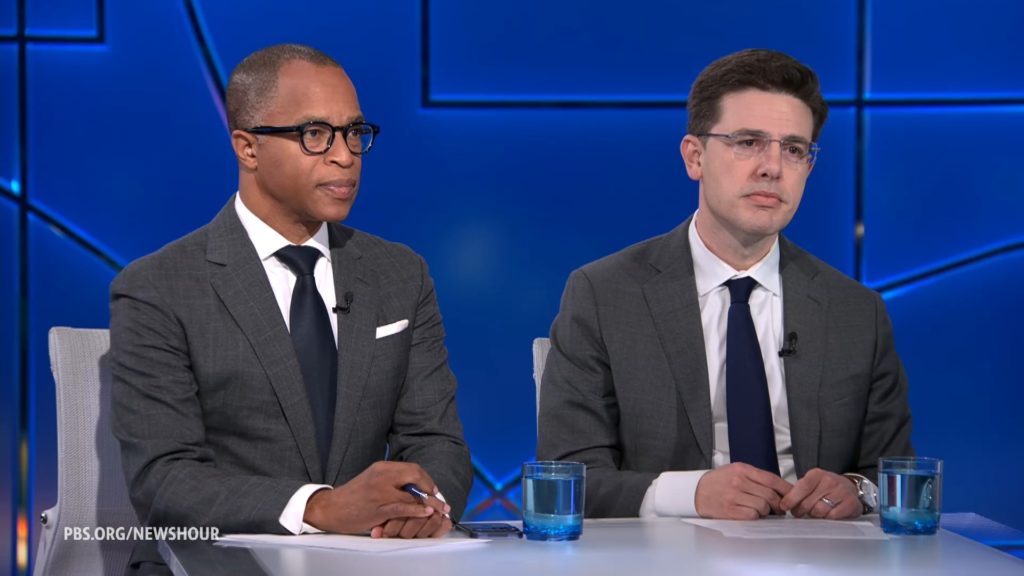
Capehart and Continetti on the White House press secretary's quick exit

Jonathan Capehart of MS NOW and Wall Street Journal opinion columnist Matthew Continetti join Geoff Bennett to discuss the week in politics, the White House press secretary's exit after five days on the job, President Trump's renewed feud with Ukraine's president and new reporting on who is paying for the White House ballroom project.

  •  
❌