
❌

Reading view

Some Progressives Tried To Abolish the Tipped Minimum Wage. Now They're Backtracking.
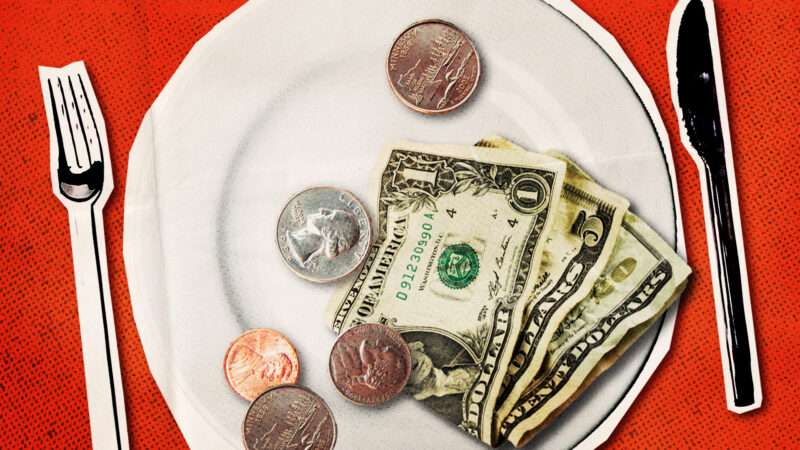
A plate with money on it | Ryan Mackay/Nexus7/Aliaksandr Autayeu/Dreamstime/Fatima Ruiz

In recent years, one of the predominant policy initiatives of the progressive left has been raising the minimum wage in locales around the country. At the same time, left-leaning politicians have sought the elimination of what's known as the tip credit, which allows employers to pay restaurant servers and other tipped employees a lower hourly base wage that they then bolster with gratuities.

Just a few years into this experiment, however, policymakers are showing signs of an about-face on the tip credit's abolition as they grapple with the unfortunate, and predictable, economic results.

In 2022, Washington, D.C., made news headlines when voters passed Initiative 82. As originally designed, it would have repealed the tip credit and required servers to be paid the District's full statutory minimum wage by 2027. (D.C.'s minimum wage was $16.10 per hour in 2022, but has since risen to $18.40 due to inflation indexation.) Prior to Initiative 82, D.C. servers could be paid a $5.35 tipped wage, so long as they earned enough tips to make up the difference between the lower tipped wage and the higher traditional minimum wage.

D.C.'s Initiative 82 was just the beginning. One Fair Wage, a progressive group that lobbies against subminimum wages, quarterbacked an all-out push to eliminate the tip credit in jurisdictions across America. Chicago became the second prominent city to follow suit. States like New York, Connecticut, and Illinois also quickly saw legislation introduced to eliminate the tip credit at a statewide level. (Apart from this recent wave, a small handful of American states—including California, Oregon, and Alaska—have long operated without a tip credit).

But just when it seemed like momentum against the tip credit had reached its apex, progressive politicians started to see the writing on the wall. In the aftermath of the tip credit's repeal, D.C. saw a close to 5 percent decline in full-service restaurant jobs. Tipped worker earnings also dropped by just under $12 million—likely a result, at least in part, of restaurants reducing hours for staff in the face of higher labor costs. At the same time, many D.C. restaurants began implementing service fees or so-called auto-gratuity policies that added mandatory 10-20 percent charges onto customers' bills.

Mugged by this economic reality, D.C. Mayor Muriel Bowser called for the full repeal of Initiative 82. Ultimately, the D.C. Council settled for a partial repeal in 2025, maintaining at least some semblance of a tipped wage that sits below the traditional minimum wage into the years ahead (although the tipped wage eventually rises to 75 percent of the traditional wage by 2034). This was a familiar story: The council had previously repealed Initiative 77, a near-identical attempt to abolish the tipped wage that voters passed in 2018.

After Chicago moved to eliminate the tip credit, the Illinois Restaurant Association found that 89 percent of Windy City restaurants raised menu prices; another 79 percent responded by reducing worker hours. Again bowing to economic reality, the progressive Chicago City Council voted to freeze the tip credit's planned elimination, only to see the effort vetoed by Mayor Brandon Johnson. Eventually, a compromise was brokered to at least pause the tip credit at its current level for two years—which punts the issue until after Johnson stands for election again, allowing a potential successor to endorse a more lasting reversal.

In Michigan, a 2024 state supreme court ruling set the tip credit on the path toward elimination by 2030. But state lawmakers intervened last year, deciding to maintain a 50 percent tip credit in perpetuity after 2031. Notably, Michigan is currently governed by a Democratic trifecta in the governorship and both houses of the Legislature. The tip credit's revival garnered key support from Republican lawmakers to pass in a bipartisan fashion, before being signed into law by Democratic Gov. Gretchen Whitmer.

While progressive efforts to eliminate the tip credit may be motivated by an earnest desire to ensure waiters are paid more, the math isn't that simple. Requiring a server to be paid a $16 traditional minimum wage—up from a $5 tipped wage—might appear to raise their pay on paper. But this fails to consider several important factors.

Under our "No Taxes on Tips" new normal, raising the minimum wage for servers could lead to a partial reduction in tips, which under certain scenarios can result in less take-home pay for waiters once the taxman takes his cut. If more server earnings come in the form of "auto-gratuity" policies—which are treated as taxed wages under the law—then the tax repercussions may grow even grimmer.

But more broadly, these laws attempt to subvert basic economics. As of 2025, Bureau of Labor Statistics data show that D.C. restaurants shed over 1,600 jobs in aftermath of Initiative 82; meanwhile, between 2022 and 2025, restaurant job growth in the District declined by more than 8 percent. This is just one example. The fallout is the inevitable result of restaurants responding to labor costs that suddenly skyrocket, forcing establishments to cut worker hours and sometimes transition to quick-service models that require less hourly staff. And that's to say nothing of the diners who bear the cost with higher prices and new service fees.

"We're watching a beloved bar back, a beloved busser, a dishwasher have their jobs taken away," D.C. restaurant worker Valerie Graham told Reason in 2024. "Not because our owner-operator is an evil billionaire but because they're an independent business owner who had to make some business decisions and there's a callousness with which our industry is talked about."

To be sure, the tip credit has only survived in modified and reduced form in D.C., Chicago, and Michigan—and in the case of Chicago, the about-face is only temporary. But the partial reversals show the tip credit's elimination is not a foregone conclusion. Economic reality continues to rear its head.

The post Some Progressives Tried To Abolish the Tipped Minimum Wage. Now They're Backtracking. appeared first on Reason Magazine.
  •  

Los Tacos No. 1 serves 1,200 NYC customers a day. Its CEO is betting private equity can help it scale.

Smiling restaurant worker in a white T-shirt serves a taco from behind a busy kitchen counter.
Christian Pineda, CEO and cofounder of Los Tacos No. 1, serves a taco at the chain's Chelsea Market location.

Dolly Faibyshev for BI

  • Los Tacos No. 1 came under fire on social media after receiving a private equity investment.
  • Some fans feared the beloved New York City Tijuana-style taco chain would lose its iconic flavor.
  • The chain's CEO told Business Insider they will scale cautiously, preserving quality and low prices.

Christian Pineda, CEO and cofounder of Los Tacos No. 1, couldn't fall asleep.

He was caught in a scroll of enraged social media posts. The storm of customer indignation followed news last month that the beloved New York City taco chain had received an investment from the private equity firm TSG Consumer. The internet seemed convinced their favorite carne asada and adobada tacos would lose their quality, and Pineda had not expected the reaction.

To remedy the situation, he said he felt it was his duty to address his customers directly. He woke up at 4:30 the next morning to clear the air.

"No, we're not going to start charging extra for guac. We're not switching to horse meat. And no, we're definitely not messing with the tacos," read the Instagram post published September 4.

"I wanted to keep it simple, honest, and comical too at the same time," Pineda told Business Insider. "I saw it as inspiring, honestly, to really prove our customers wrong — that private equity is not always bad."

Person in glasses and a white shirt stands by a counter inside a colorful restaurant with Coca-Cola signage.
Christian Pineda, CEO and cofounder, and Jacobo Ackerman, chief operating partner, run the taco chain's day-to-day operations.

Dolly Faibyshev for BI

Colin Welch, managing director and head of New York at TSG Consumer, said the backlash among some underscored what TSG saw in the taco business to begin with: a "cultlike following" customer base protective of the food, and an experience that made Los Tacos a "New York institution."

"It's our responsibility to show those skeptics that it's going to be exactly the same Los Tacos experience, and that nothing's going to change for the worse," Welch said. "We got to show them, not tell them, and that'll happen over time."

The PE firm, founded in 1986 and with $14 billion in assets under management, also has investments in food names Pura Vida Miami, Crumbl, and Dutch Bros Coffee. TSG declined to disclose the terms of the deal or the amount it paid for its investment in or stake in Los Tacos No. 1, which opened in 2013.

Welch said the firm plans to let Pineda and his team run the show, while TSG will provide guidance on future expansion. He pointed to Pura Vida Miami, a lifestyle café chain founded in Miami. It grew from locations in two states to seven since TSG announced its minority stake in 2025.

Crowds gather outside Los Mariscos taco and seafood restaurant on a busy city sidewalk.
Los Mariscos is Los Tacos No. 1's sister restaurant, specializing in fish tacos and other seafood dishes.

Dolly Faibyshev for BI

Pineda said the chain focused on finding an investor that would allow Los Tacos No. 1 to scale in a "cautiously smart" way. With 10 locations in Manhattan and a sister location, Los Mariscos, at Chelsea Market, the taco chain wants to continue expanding into other boroughs and markets. It's looking to open a new location in Brooklyn before the end of the year, and another three new locations are planned to open in 2027.

The PE investment comes after 13 years of growth in New York City — a journey that began with three architects and the search for a good taco.

Selling an experience

Pineda and his co-founders, Tyler Sanders and Kyle Cameron, moved from California to New York City in 2010. They lived together in a one-bedroom apartment in the West Village, where Pineda and Sanders, both architects, spent days knocking on doors to find jobs. They found jobs, but there was one thing they could not find wherever they looked — a good taco.

The three men had been raised on Tijuana-style tacos. Pineda was born in San Diego but was raised between there and Tijuana, where his parents are from. Meanwhile, Sanders and Cameron were born in Brawley, California, a city near the border with Mexicali.

Hanging restaurant sign reads “NO TICKET NO TACO!” above a metal counter area.
"No ticket, No taco" is the order model at all Los Tacos No. 1 locations.

Dolly Faibyshev for BI

Thus, the "No ticket, No taco" order model was born. Customers get a ticket from the cashier, and then have to find and give it to one of the many "taqueros," or cooks, working at once. They can then give the taquero specific instructions for their tacos and watch them prepare the food in front of them. The interactive experience is designed to induce an organized chaos, brought to life by Mexican folk music in the background as the staff speaks in Spanish among themselves.

Growing and scaling a business in NYC

It's no secret that the Big Apple is expensive, and as the cost of living increases, so do expenses for businesses like Los Tacos No. 1.

Since they opened, annual revenue has grown by around 30% each year, and they currently serve about 1,200 customers per day, with an average check of about $20, Pineda said.

In recent months, the expenses that have increased the most are beef, limes, avocados, and tomatoes, Pineda said. Beef prices were 5.9% higher in August 2026 than in August 2025, and they are forecast to increase a total of 9.4% this year, according to the US Department of Agriculture.

Kitchen staff in white uniforms and red aprons cook meat on a griddle beside a vertical rotisserie.
"Psychologically, people think tacos are cheap or should be cheap — and they should — but with the prices of New York City and the quality that we're doing, it's tough," Christian Pineda said.

Dolly Faibyshev for BI

To adjust to these increases, the chain keeps other expenses "tight, lean and sustainable," and will not raise prices or cut quality because of a temporary spike, Pineda said. To keep up, the business has to "be efficient in everything else," Pineda said.

"Our idea was always you need to have the best taco and the cheapest taco," Pineda said. "Our carne asada started at $3.50 in 2013. Now our carne asada tacos are $5.95 after 13 years, so we take pride in that."

Pineda sees the new partnership with TSG Consumer as an opportunity to grow the company while preserving its quality, and maybe going public one day, debuting by ringing the opening bell on a stock exchange.

"We want to be in a room where we're with people who have done 100, 200, 1,000 locations. We haven't done that," he said. "We partner up with them because of their knowledge and the people that they've worked with, the brands that they've helped with — a big goal has been if we can ring the bell — that'd be amazing."

Read the original article on Business Insider

  •  
❌