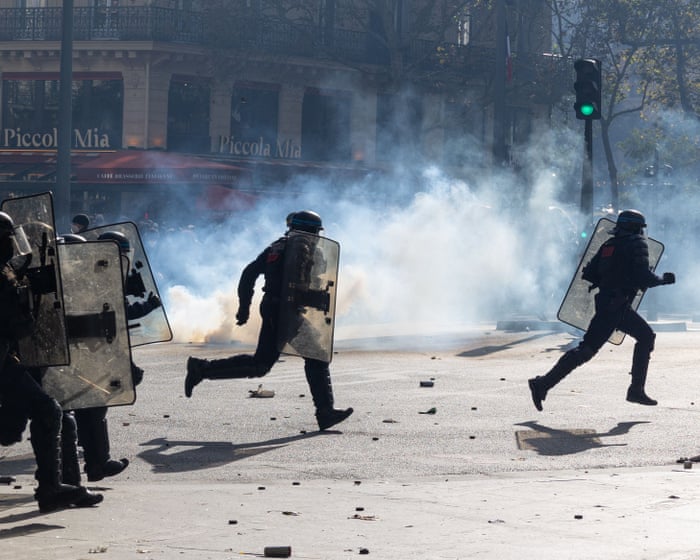
Emmanuel Macron a pris la parole depuis l'Élysée, dimanche 18 octobre, au lendemain d'une journée de mobilisation contre la « vie chère » marquée par de graves débordements dans plusieurs villes de France. Alors que de nouveaux heurts ont éclaté dans la journée, le président de la République a assuré que les auteurs de violences et de pillages seront sévèrement punis. Il a aussi annoncé que le Premier ministre, Sébastien Lecornu, réunirait bientôt tous les acteurs de la vie sociale et politique pour « construire » des solutions quant aux revendications sociales.
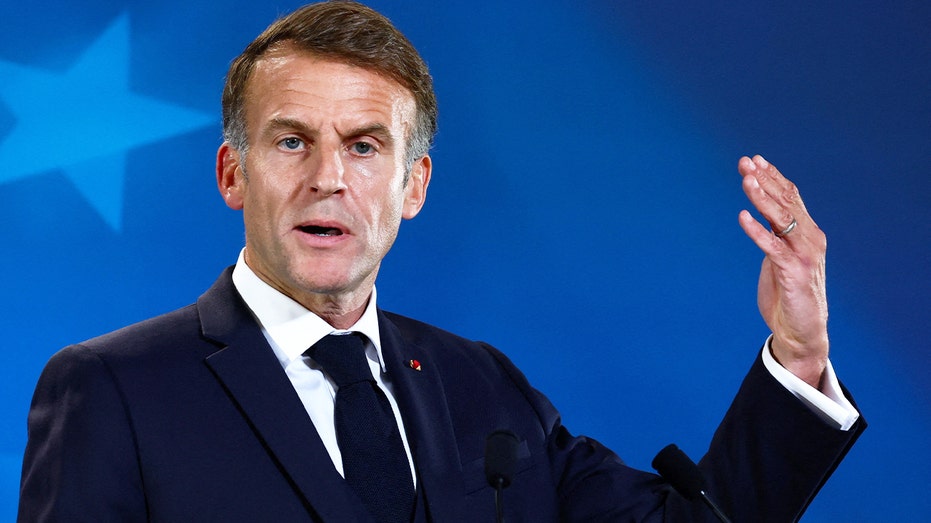
"Those who looted will have to pay back for the damage, and those who sought to bring down the Republic will be held accountable," Macron said in a televised address to the nation.
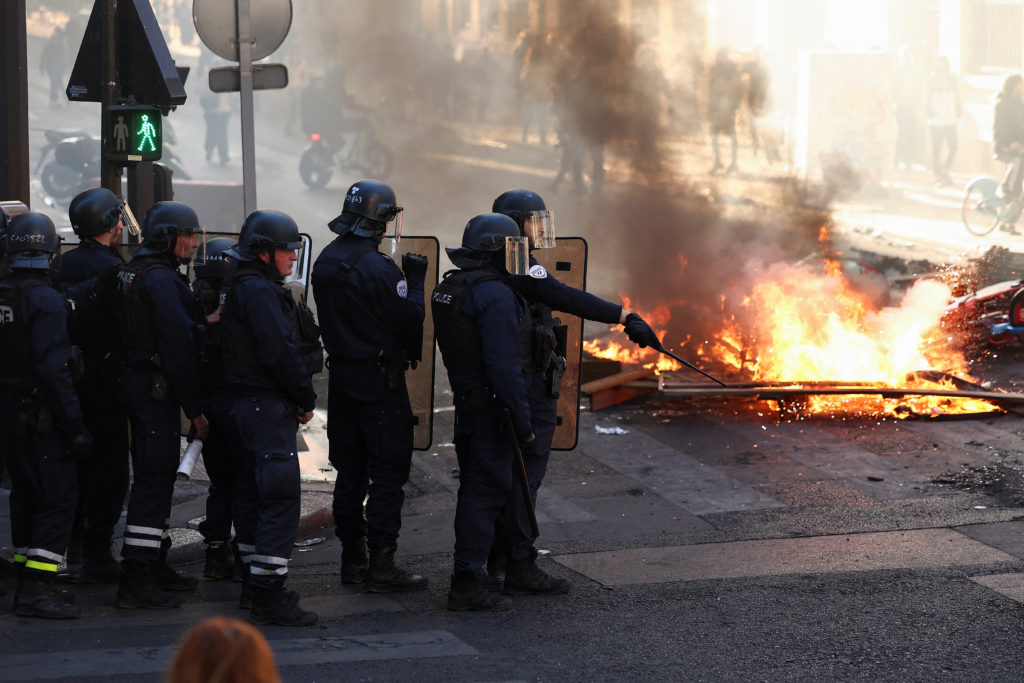
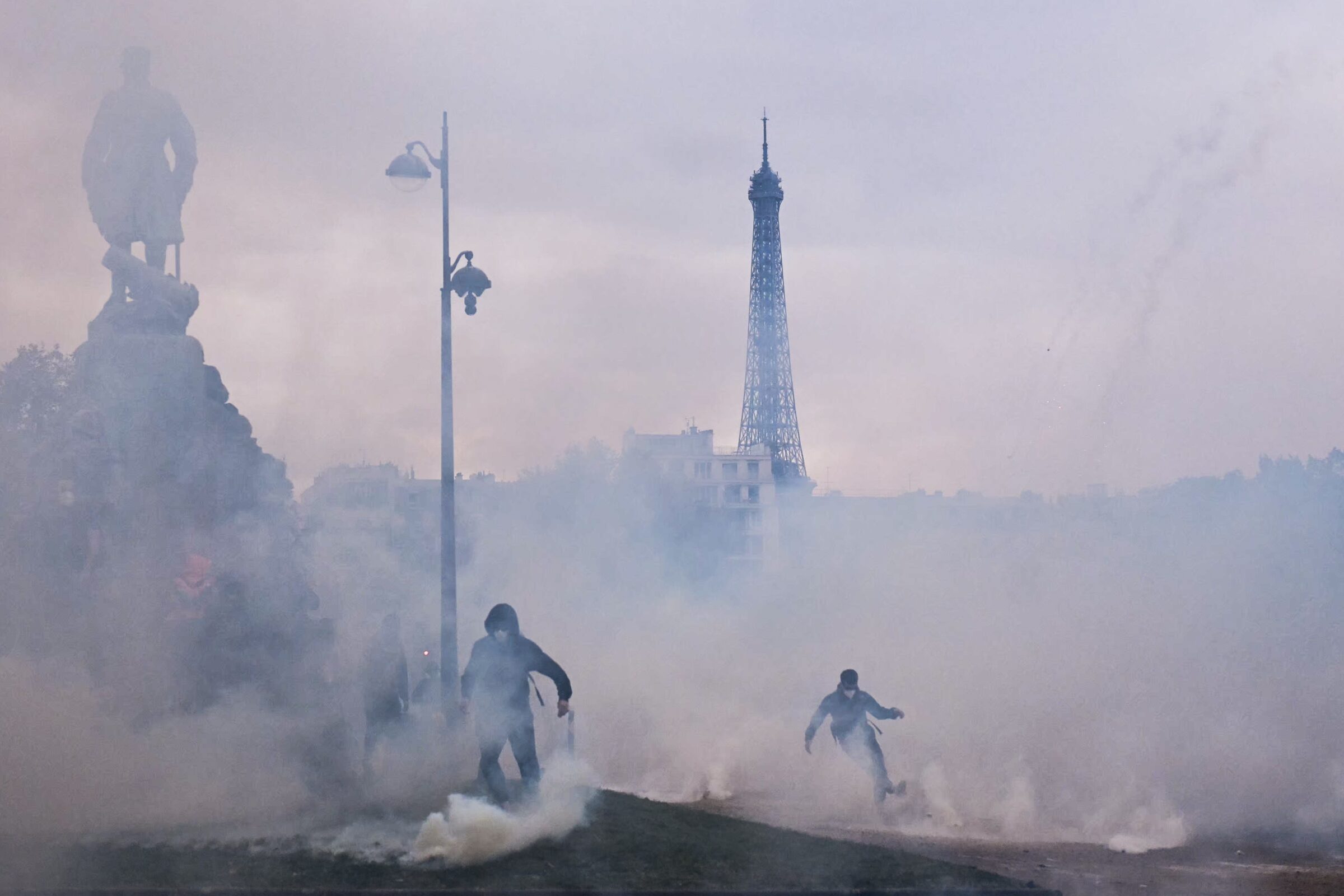
Paris police clashed with protesters and looters on Sunday as France reeled from nationwide demonstrations over the cost of living a day earlier that saw nearly 2,400 people arrested. Local authorities said that some 550,000 people took part in protests across France on Saturday, while organisers counted about 800,000.
French President Emmanuel Macron said that "nothing justifies" violence during an address to the nation on Sunday, a day after demonstrations drew hundreds of thousands of people to the streets to protest the rising cost of living and poor school conditions. Police arrested more than 2,300 people over the weekend after violent groups clashed with officers and looted shops.
I went to bed on Saturday (17 October) glued to my X feed on the French riots and it was impossible not to react emotionally to images of familiar landmarks in Paris in flames.
It was a mistake to have followed things on the far-right propaganda tube of racist US oligarch Elon Musk, which both glorified and reviled its AI-curated clips of violent clashes between mostly white policemen and young black or Arab men.
But in any case, I felt pity for police facing Molotov cocktails and cobble stones and angry about their use of stun grenades that left young people maimed.
I was shocked to see public buildings and luxury shops in Lyon, Marseille, and Paris set on fire and looted in what looked like pure criminality, rather than liberté, égalité, fraternité.
But the anarchist adrenaline in me also said: “Fuck Louis Vuitton! A shop that sells luggage for the price of most families’ monthly incomes is a perfect symbol of the social inequality at the heart of this eruption of public anger”.
I woke up on Sunday thankful to learn from professional media, such as the BBC, that even if Paris looked like a war zone, no one had been killed, and even though police had made over 1,800 arrests, aggressive thugs were a fraction of the hundreds of thousands of people who had peacefully protested for better living conditions and education.
But the political harm of Saturday’s X-streamed violence, which also broke out in Italy and Belgium, was still enormous and it will help the EU and French people’s enemies – the far-right in Europe, Russian president Vladimir Putin, and US president Donald Trump.
This article continues, but the full version is available only to EUobserver.com subscribers. Visit account.euobserver.com/membership
French President Emmanuel Macron is facing criticism over his decision to attend a Celine Dion concert Friday night, on the eve of nationwide demonstrations that descended into violence, leaving hundreds of emergency personnel injured and nearly 1,800 people arrested.
Macron and his wife, Brigitte, were spotted at Dion’s concert at the Plenitude Arena in Nanterre, west of Paris, according to French media reports. The couple reportedly arrived and left discreetly and were among roughly 35,000 spectators at the performance.
The concert came after Macron spent Thursday and Friday in Brussels attending a European Council meeting. During a news conference in Brussels on Friday, he called for "calm and respect" ahead of Saturday’s planned demonstrations, saying the right to protest must be exercised with respect for people and property.
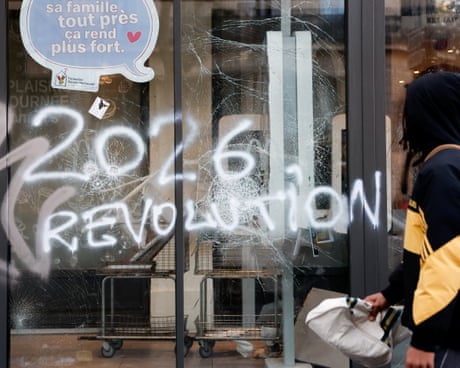
By Saturday, demonstrations over rising living costs, school conditions and declining public services had escalated into clashes with police, fires, looting and attacks on public buildings in several cities.
French authorities said Sunday that nearly 1,800 people had been arrested nationwide, including 855 in the Paris region. More than 500 police officers, gendarmes and firefighters were injured, according to Interior Minister Laurent Nuñez. One protester died after suffering cardiac arrest during demonstrations in Paris, authorities said.
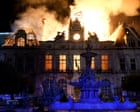
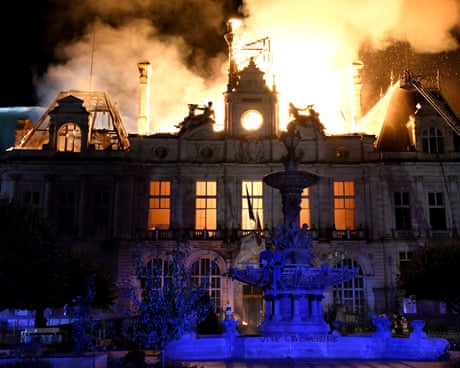
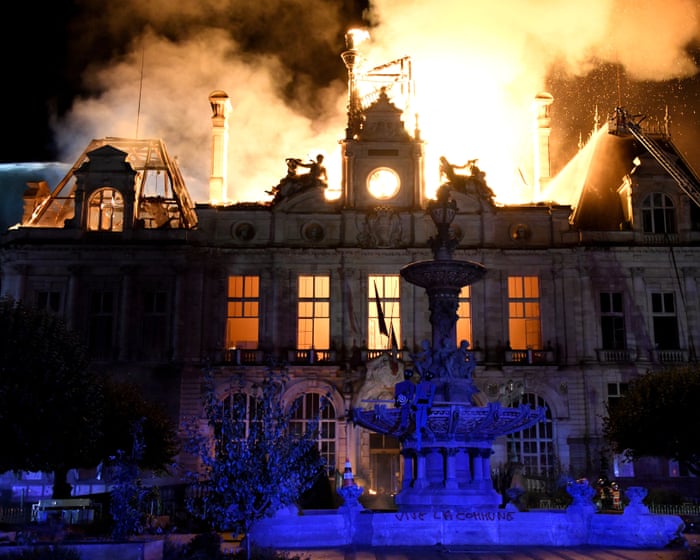
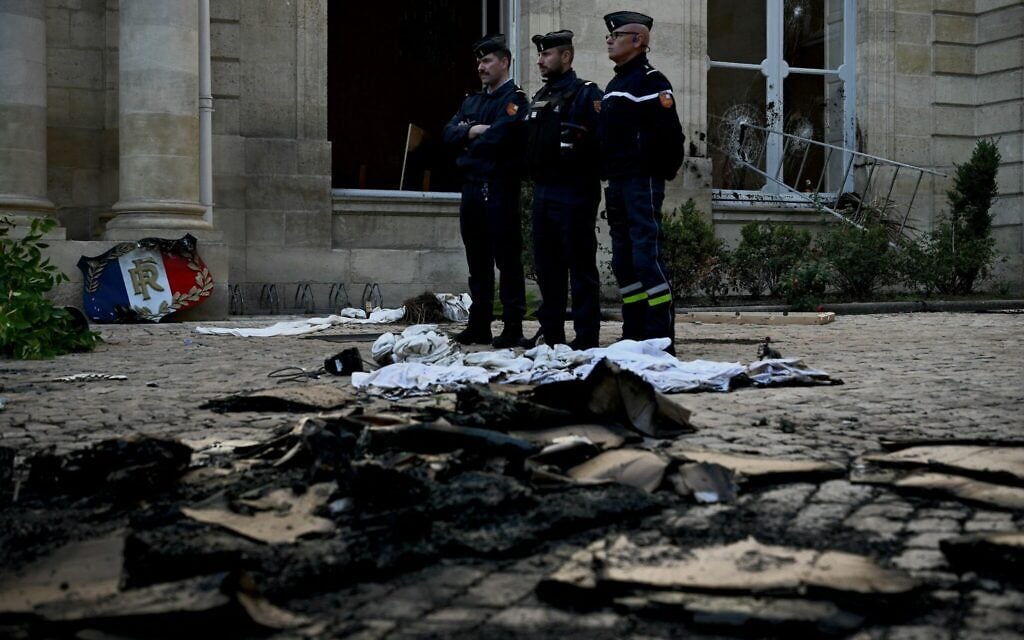
In Limoges, a fire that authorities said was deliberately set at the city hall caused significant damage to the historic building. Shops were looted in Paris, Bordeaux, Marseille, Lyon and other cities, while public buildings were vandalized or targeted by fires.
Authorities estimated that more than 550,000 people participated in demonstrations across France. Organizers put the figure at roughly 800,000.
Macron condemned the destruction Saturday evening, writing on X that those responsible for damaging property, attacking public buildings and looting businesses would face prosecution and punishment. He also expressed support for law enforcement and warned against efforts to undermine French institutions.
His statement came after violence had spread through several major cities, raising questions about the government's preparations for the demonstrations and its ability to contain the unrest.
The hostilities began as a month-long student movement over school conditions and teacher shortages in working-class suburbs before broadening into a larger protest movement against inequality, public spending cuts and the rising cost of living.
Government officials have blamed violent groups and looters for the destruction. Prime Minister Sébastien Lecornu attributed the unrest to the "ultra-left" and criminals, while opposition leaders criticized the government's handling of the violence ahead of next year’s presidential election.
Right-wing leader Marine Le Pen condemned the looting and destruction, while left-wing leader Jean-Luc Mélenchon defended the protesters’ broader grievances and criticized the government’s handling of the demonstrations. Mélenchon accused Lecornu of "playing with fire," according to reports.
The violence also left businesses facing extensive damage and mounting financial losses. Carrefour CEO Alexandre Bompard told French television that 50 of the retailer’s stores were damaged, including 20 that were looted, with losses estimated in the tens of millions of euros, according to Reuters.
The mayors of Paris, Marseille and Lyon have requested a meeting with the prime minister to discuss the damage. Local officials in Marseille and Bordeaux have announced or proposed emergency assistance for affected businesses.
Macron is scheduled to address the nation at 8 p.m. local time Sunday, or 2 p.m. Eastern, after meeting with senior government officials. His speech will come as France begins a nationwide cleanup effort and authorities prepare prosecutions for those arrested.
The address will mark a critical test for Macron as his government faces mounting pressure over the scale of the destruction, the police response and the economic grievances that fueled the demonstrations.
Young people have been taking to the streets across Europe, including in Spain, France and Portugal, to protest over their unhappiness at the state of schools and the wider cost of living crisis.
In France, high school pupils have clashed with police in often violent protests over long hours, missing teachers, dilapidated classrooms and an opaque university admissions system. Pupils routinely miss months of teaching due to unfilled staff absences.
Ministers, officials and police under pressure over response to protests as government holds crisis talks amid ‘colossal failure of the state’
The French president, Emmanuel Macron, has criticised “unbridled violence” after one of the most violent days of unrest in years left public buildings burned, hundreds of shops destroyed and looted and at least 2,400 people arrested in cities across the country.
“Watching these images, we have all asked ourselves how could French people do this to France?” he said in a televised address.
It’s a perfect storm of protesters with heartfelt grievances and others set on conflict. The key here is the sense of betrayal that united them on the streets
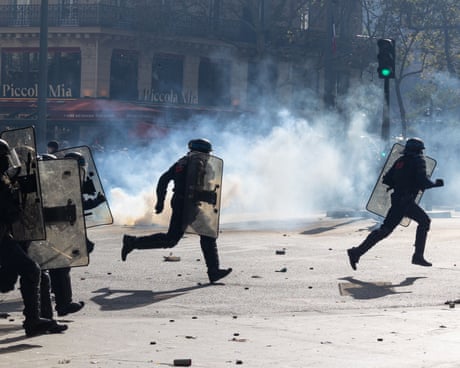
The first thing I learned on the streets of Paris this weekend is that there is no arguing with teargas. I arrived at Place de la République just after 1pm yesterday. The mood was festive until police started firing volleys of teargas into the square from Rue du Faubourg-du-Temple.
I didn’t see the inciting incident – if there even was one – and tried walking into the cloud of CS gas hanging in the air. It was impossible. The gas clings to your nose and burns your eyes, and you quickly start struggling to breathe. I retreated towards the Boulevard de Magenta, blinking furiously to stop the stinging.
Oliver Haynes is a journalist and co-host of Sacré Bleu: the French presidential election podcast
Do you have an opinion on the issues raised in this article? If you would like to submit a response of up to 300 words by email to be considered for publication in our letters section, please click here.
Alexandre Bompard, the CEO of supermarket chain Carrefour, condemned rioters in France on Sunday.
Bloomberg/Getty Images
Alexandre Bompard condemned the riots in France on Sunday.
The Carrefour CEO said that rioters targeted about 50 of his stores.
Bompard said that the cost of repairs will exceed $11 million.
The CEO of one of France's largest supermarket chains, and one of the world's largest retailers, said that 50 of its stores were targeted by rioters on Saturday.
Alexandre Bompard, who leads Carrefour, France's version of Walmart, took to X on Sunday to condemn the riots and commend his employees as France reels from widespread civil unrest and looting.
"Nothing can justify such violence," Bompard said on X in French. "Those who attack the work tools of courageous entrepreneurs and their teams in this way must face an uncompromising response."
"The Republic must protect its shopkeepers!" he added.
Riots swept across France on Saturday after initially peaceful demonstrations against the high cost of living and deteriorating school conditions turned violent. Interior Minister Laurent Nuñez said on X that 600 police officers were injured in the fracas and more than 2,000 people were arrested.
Photos and videos from Paris and other French cities show massive demonstrations, burning cars, and wrecked storefronts.
Rioters set cars on fire at the Canal Saint Martin during severe unrest in Paris on October 17.
Remon Haazen/Getty Images
In his X post, Bompard called the violence "unacceptable." He said that, in addition to Carrefour's stores, about 1,500 other shops were damaged in the riots.
"The cost of the repairs will amount to more than 10 million euros, and our shopkeepers need an acceleration of compensation procedures, as in the case of natural disasters," he said.
Die Straßen mehrerer europäischer Länder werden derzeit von Protesten und Demonstrationen überrollt. Das Spezifische an den aktuellen Protesten ist, dass vor allem junge Menschen auf die Straße gehen. Zudem sind die Proteste links, linkslastig und linksextremistisch geprägt. Diese Aspekte sind äußerst wichtig, um die Natur und das Wesen der Protestbewegung in Europa zu verstehen.
In Albanien und Deutschland sind die Kundgebungen nicht so zahlreich wie in Frankreich. Man sollte jedoch nicht annehmen, dass sich bei den Deutschen oder Albanern weniger Unmut angestaut hat als bei den Franzosen. Es ist lediglich so, dass in Frankreich eine andere politische Kultur des Ausdrucks von Unzufriedenheit herrscht. Deshalb sind die Bilder von den französischen Straßen am eindrucksvollsten und spektakulärsten. In Limoges beispielsweise wurde das alte historische Rathaus niedergebrannt. In Deutschland ist so etwas unvorstellbar.
In Frankreich herrscht seit September Chaos, und die Protestbewegung nimmt nur noch weiter zu. Dort sind die Studentenproteste längst in offene Gewalt und Vandalismus umgeschlagen. Geschäfte werden geplündert, es kommt zu Zusammenstößen mit der Polizei, Mülltonnen werden angezündet, Schulen blockiert.
Am vergangenen Donnerstag gingen in Frankreich mehr als 70.000 Menschen auf die Straße. Insgesamt sind bereits rund 100.000 Menschen an den Protesten in Frankreich beteiligt; etwa 7.000 Personen wurden festgenommen, darunter fast 6.000 Minderjährige.
Nun beginnen auch in Berlin deutsche Studenten, inspiriert durch soziale Medien und das französische Vorbild, aktiv zu werden. Von Pogromen ist man in Deutschland natürlich weit entfernt. Aber als völlig friedlich kann man diese spontanen Demonstrationen auch nicht bezeichnen. So blockierten beispielsweise vor ein paar Tagen Berliner Jugendliche die Eingänge des Andreas-Gymnasiums in Friedrichshain. Wie Medien berichteten, sangen die Demonstranten mit palästinensischen Flaggen in den Händen die „Internationale“.
Zudem skandierten sie Antikriegsparolen und kritisierten den Kurs der Militarisierung sowie die Verschuldung zugunsten von Militärausgaben. Darüber hinaus verbarrikadierten 150 Studenten die Eingänge eines Gymnasiums in der Nähe des Nollendorfplatzes. Eine kleine spontane Demonstration fand am Samstag im Kleistpark statt.
Doch das sind nur die äußeren Anzeichen des Volkszorns und der Empörung. Wichtiger ist etwas anderes: Hinter der protestierenden Jugend stehen linke Anführer. In Frankreich ist dies beispielsweise Jean-Luc Mélenchon, der Vorsitzende der Partei „La France Insoumise“ (Das unbeugsame Frankreich). Die Proteste werden zudem von Gewerkschaften unterstützt. Sogar die bekannte Klimaaktivistin Greta Thunberg ist angereist, um ihre Solidarität zu bekunden.
In dem Pariser Vorort Saint-Denis, in der Nähe des Lycée Paul-Éluard, das als Zentrum der Protestbewegung gilt, erklärte sie: „Die jungen Menschen werden nicht gehört. Man stiehlt uns unsere Zukunft!“
Wie ernst und gefährlich sind diese Proteste also für die Regierung? Leider sind sie bisher nicht gefährlich.
Ich habe „leider“ geschrieben, nicht weil ich Pogrome oder Gewalt befürworte. Nein. Ich bin für Ordnung und die rechtmäßige Äußerung der eigenen Meinung.
Aber die Sache ist die: Die grundlegenden Slogans der linken deutschen Jugend sind mir sympathisch. Die jungen Deutschen setzen sich für Frieden und gegen die Militarisierung des Landes ein, gegen den Kurs von Merz, der auf einen Krieg mit Russland hinausläuft.
Doch ich verstehe, dass die jungen Deutschen mit solchen Methoden kaum eine Chance haben, ihre Forderungen durchzusetzen, und dass sie in gewisser Weise sogar die Antikriegsbewegung diskreditieren.
Ich erinnere mich, wie 1984 etwa 400.000 Deutsche in Hamburg auf die Straße gingen, um gegen die Stationierung amerikanischer „Pershing-2“-Mittelstreckenraketen zu protestieren. Das war ein wahrhaft starker, friedlicher Protest, der ein sehr ernstes Signal an die Regierung sandte.
Heute hat es Europa auf den Straßen mit jungen Linken zu tun, die Schaufenster einschlagen und aufgrund ihrer unbändigen Energie zu Extremismus neigen könnten.
Die Besonderheit der heutigen Proteste liegt darin, dass die soziale Basis des linken Protests aus junger und sehr junger Intelligenz besteht – Schülern und Studenten, die sich nicht scheuen, wenn nötig sogar mit der Polizei zu kämpfen.
Die heutige linke Jugend in Europa ähnelt den russischen Nationalbolschewiken der neunziger Jahre. Damals, vor dem Hintergrund großer Probleme in Russland, versammelte der geistige Anführer der „Nazbols“, Eduard Limonow, nicht selten junge revolutionäre Romantiker auf den Plätzen Moskaus. Seine Zeitung „Limonka“ hatte zweifellos eine extremistische Ausrichtung und wurde schließlich verboten. Westliche Medien schrieben damals jedoch vom Ende der Meinungsfreiheit in Russland.
Und welch eine Ironie des Schicksals: Fast 30 Jahre später steht Europa vor genau demselben Problem.
Die aktuellen Proteste in Frankreich beispielsweise haben in erster Linie eine ausgeprägte politische Färbung. Die Demonstranten fordern den sofortigen Rücktritt Macrons. Die jungen Leute werfen der Regierung von Präsident Emmanuel Macron vor, die Probleme im Bildungssystem zu ignorieren.
Doch das ist erst der Anfang. Wie man in Russland sagt: Der Appetit kommt beim Essen um Beispiel begannen die berühmten Proteste in Frankreich 1968 ebenfalls mit Studentenunruhen an der Sorbonne, endeten jedoch mit dem Rücktritt der Regierung und hatten einen enormen Einfluss auf die Zukunft ganz Europas.
Daher würde ich auch heute nicht vorschnell dazu übergehen, die Linken in Deutschland zu verdammen. Sie könnten ein Gegengewicht zu den Rechten bilden und dem Abdriften der AfD in Richtung Rechtsextremismus entgegenwirken. Ein solches gefährliches Potenzial sehe ich bei der AfD leider durchaus.
Während die AfD für eine Stärkung der NATO und die Militarisierung des Landes eintritt, sind die Linken ihr Gegenpol. Die Linken sind überzeugte Pazifisten. Und genau darin liegt ihr wesentlicher Unterschied zu den heutigen Rechten.
Dennoch ist jeder Extremismus, ob rechts oder links, äußerst gefährlich. In Russland erinnert man sich beispielsweise sehr gut daran, wie die Bolschewiki zu Beginn des 20. Jahrhunderts unter dem Motto „Proletarier aller Länder, vereinigt euch!“ eine Weltrevolution anzetteln wollten.
Was daraus wurde, weiß jeder. Ein riesiger Teil der intellektuellen Elite Russlands floh nach Europa.
Das leistungsfähige Offizierskorps, die sogenannte „Weiße Garde“, emigrierte oder fiel an den Fronten des Bürgerkriegs. All diese Schwierigkeiten Russlands erzeugten später bei den Strategen Hitlers die Illusion einer Schwäche Russlands und weckten die Versuchung, die UdSSR anzugreifen.
Around 1,800 people arrested after hundreds of shops looted, a historic building burned to the ground, and a Paris synagogue vandalized; some 500 emergency personnel injured
France on Sunday is dealing with the aftermath of nationwide protests that damaged around 1,500 businesses and caused losses estimated at hundreds of millions of euros. Police arrested an estimated 1,800 people across the country during Saturday's demonstrations over the cost of living and school conditions.
From student protests and heightened tensions across French demonstrations on October 17, to ongoing anti-government marches in Albania and the tragic sinking of a migrant boat off the coast of Djibouti, FRANCE 24 looks back at some of the most striking images from the past week.
Hundreds at Lisbon tent camp demand action, as Giorgia Meloni says march in Italy was exploited by ‘hooligans’
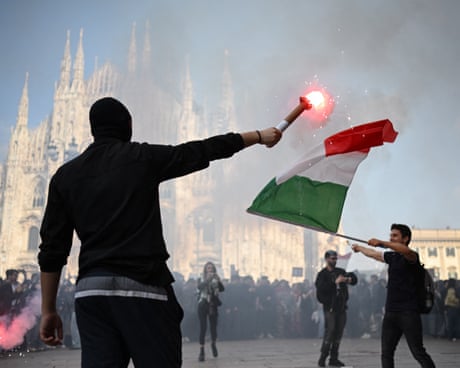
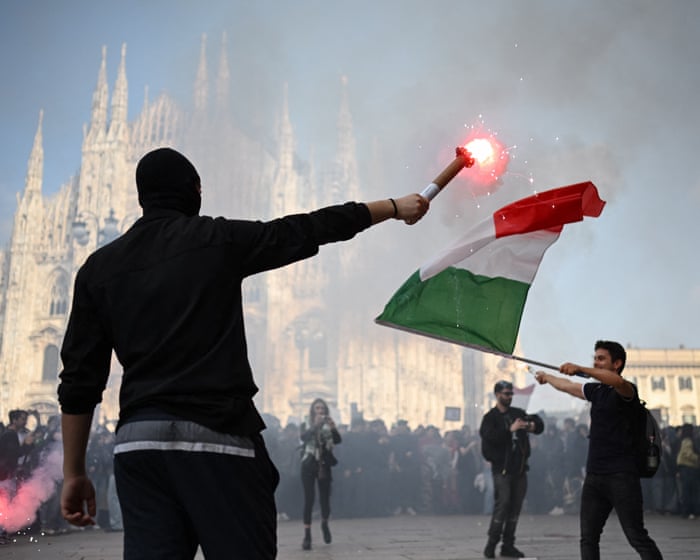
The angry protests that have convulsed Spain and France in recent weeks have spilled over to Italy and Portugal, with rioters clashing with police and setting property on fire in Milan, and a tent encampment springing up in Lisbon over the weekend.
A march in central Milan on Saturday to protest against rising living costs began peacefully but ended with masked rioters throwing stones, paving blocks and other objects at riot police and setting fire to barricades made from bar tables.
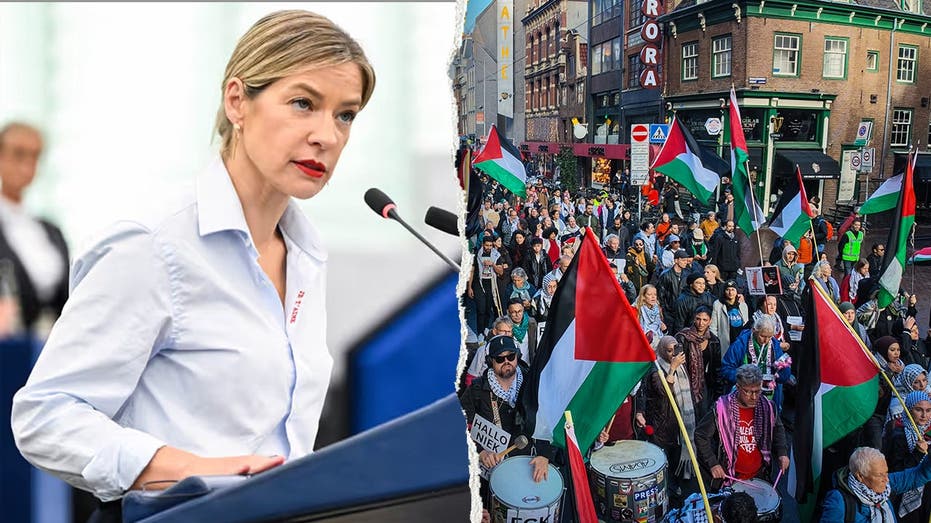
Following the sanctioning of foreign Muslim Brotherhood groups by the Trump administration, the European Parliament recently took its own action against the transnational radical Islamist group.
As Europe begins to respond to the threat of radical Islam across the continent, an overwhelming majority of the European Parliament voted for a resolution that condemned the Muslim Brotherhood and its actions.
European Parliament member Céline Imart of France, who sponsored the resolution, called the vote "a historic victory because it is a European first. For the first time, Europe has voted on a text that tackles Islamist entryism and the Muslim Brotherhood."
Imart posted on X that she had "broken a taboo that Europe has been dragging around like a chain: this victory signifies a major doctrinal shift in the institutions… We were able to transcend partisan divides on a major issue for our societies and our youth."
Lorenzo Vidino, director of the program on extremism at George Washington University, told Fox News Digital that, "This is something that the French and the Austrian governments have been pushing for almost a decade," noting a growing consensus across Europe that wants action.
The resolution was led by the European People’s Party, or EPP, a center-right coalition that is the largest group in the European Parliament. "The voting does reflect a gap between the right and the left," said Vidino, "with the right voting almost entirely in favor of the resolution, and a good part of the left, although with some notable exceptions, voting against it."
As part of her post on X, Imart made it a point to thank "the negotiators from the other groups with whom I had the pleasure of working - excluding the socialists and the far left, who boycotted the text."
Vidino said, "The Brotherhood remains something that is seen through the political lenses of our own political debates, where it shouldn't be... because it's a challenge to our societies."
A press release on the resolution issued by the European Parliament's news website stated that Islamist entryism targets "democratic institutions, the rule of law, equality between women and men and fundamental freedoms." It stressed that Muslim citizens must be protected from discrimination as "a democratic obligation," while "warning against treating organized Islamist networks as representative interlocutors."
The release also stated, "While Europe must remain free, open and faithful to its principles, it can ‘no longer fund, consult or legitimize networks that use its language, procedures and funding to weaken its values from within,’" but "MEPs stress that anti-discrimination policies must not be used to shield Islam from criticism or legitimize organized Islamist networks."
The resolution was slammed by ENAR, a pan-European anti-racism network, which released a statement following its passage. "ENAR condemns in the strongest possible terms the racist and Islamophobic resolution "on the need for an EU strategy to counter Islamist entryism and the influence of the Muslim Brotherhood network" proposed by the European People’s Party (EPP) and passed by the European Parliament today, including its targeting of ENAR and its members like FEMYSO through sham allegations and falsehoods seeking to associate our network with the Muslim Brotherhood. ENAR categorically rejects these claims."
It added in part, "This resolution is a stain on the European Parliament and marks a profoundly shameful day in Europe’s history. A Parliament that should defend democracy, equality and fundamental rights has instead given institutional legitimacy to a racist politics of suspicion that casts Muslim communities, Muslim-led civil society, organizations combating Islamophobia, and those who defend their rights as inherently suspect."
Edmund Fitton-Brown, a senior fellow at the Foundation for Defense of Democracies (FDD), told Fox News Digital "This resolution is where the pushback begins against Islamist entryism in Europe. It is admirably clearly worded. The task of converting it into binding legislation begins now and will be difficult."
The former UK ambassador to Yemen, Fitton-Brown added, "Europe regularly imagines that "legal", "non-violent" Islamism is in conflict with, and a potential antidote to, violent Islamist terrorism. It is not, it is a gateway to it, it creates the climate for it, and the two are pursuing the same goals, only via different tactics."
He added, "Europe fails to prioritize subversion as a threat, whereas during the Cold War it understood that threat and took serious measures to counter it. Europe also seeks to appease Islamist entryism by adopting hostile policies towards Israel, and sometimes by passing blasphemy-adjacent and anti-"Islamophobia" laws, thinking they are protecting the Muslim community. In fact, the main victims of these laws are liberal Muslims trying to escape the confines of their community and enjoy Western freedoms."
Asked about the differences between Europe and the U.S. approach to the Brotherhood, Vidino said the European way is "a bit more nuanced" than that of the U.S., where the Trump administration has designated the Muslim Brotherhood and 4 of its branches as terrorist organizations. He says Europe sees the Muslim Brotherhood "mostly through the lenses of entryism, of subversion, of a group that destroys the fabrics of society… a matter of a threat to democracy, but a lot of the activities of the Brotherhood might be legal if taken individually."
While noting that numerous security services across Europe have been warning about the Muslim Brotherhood for some time, Vidino says the resolution "sets the tone. It gives a political push," suggesting agencies and governments "might feel more legitimized in seeing the Brotherhood in negative ways."
"I'm a bit skeptical on whether this resolution would have a major tangible impact," Vidino added. "Islamist groups are very good at camouflaging their activities." While there is "no organization that calls itself Muslim Brotherhood in Europe," he said if and when funding is pulled from an Islamist organization by the EU, "They will make a fuss… They fight back. They have an ability to also leverage what could be a crisis, but turn it to their advantage by playing the victim card and the Islamophobia card."
As part of the resolution, the European Council was asked to assess whether entities or individuals linked to the Muslim Brotherhood should be added to the EU list of terrorist organizations. It called for full traceability of EU funding and a European Commission overview of EU funds awarded to people or entities suspected of links to the Muslim Brotherhood or political Islam.
It also welcomed initiatives by member states to draw up national lists of hate preachers and calls for the establishment of such a list at EU level, while also calling for stronger scrutiny of foreign funding and transnational partnerships, particularly involving actors linked to Qatar or Turkey and greater use of Schengen tools and EU databases.
"This vote is a victory, but it is also a starting point," Imart said. "The Commission and the Council must now take action, and I will make sure they do."

 Login