Login

In Egypt, the government has seized a newsroom
On September 30, I walked out of a three-hour medical appointment to dozens of missed calls. They were from colleagues: the entire newsroom of Matsadaash, an independent fact-checking platform, had been arrested. Six journalists, five of them trainees in their early twenties, all picked up in less than 24 hours.
I didn’t know any of them. It didn’t matter. An entire newsroom taken in a day, then disappeared: that was enough. I don’t need to know someone to stand with them. If they are journalists arrested for doing their job, I am with them.
For five days, no one knew where they were. Their families and lawyers filed 18 complaints in that time, according to the Egyptian Initiative for Personal Rights (EIPR), which represents them. The Interior Ministry called Matsadaash an unlicensed, foreign-run page, and linked it to the Muslim Brotherhood, which Egypt designated a terrorist organization in 2013. The Matsadaash founder, Abdelrahman Mansour, denies any affiliation.
When the six journalists were finally produced before state security prosecutors, some, according to their lawyers, said they had been blindfolded, bound, stripped, beaten and given electric shocks. State prosecutors said forensic examinations found no injuries. The journalists were charged with joining and financing a terrorist group, reporting fake news and using social media to spread it. On October 13, their pretrial detention was extended for another 15 days. Their salaries, which EIPR and the Egyptian Journalists Syndicate say were paid under employment contracts filed with Egyptian banks, were described, in the prosecution’s words, as “monthly funding in foreign currencies.”
Over three days, each of the six journalists was interrogated for nearly 30 hours. According to EIPR, not one was confronted with a single report they had written that could be called false. Instead, the prosecution’s own statement accused them of “highlighting shortcomings — and nothing else — in state institutions,” belittling officials and amplifying people’s grievances.
But that is precisely our job. It is what we sign up for as journalists — to ask questions of those in power. On October 4, another colleague was summoned for questioning; thankfully, she was released the same day.
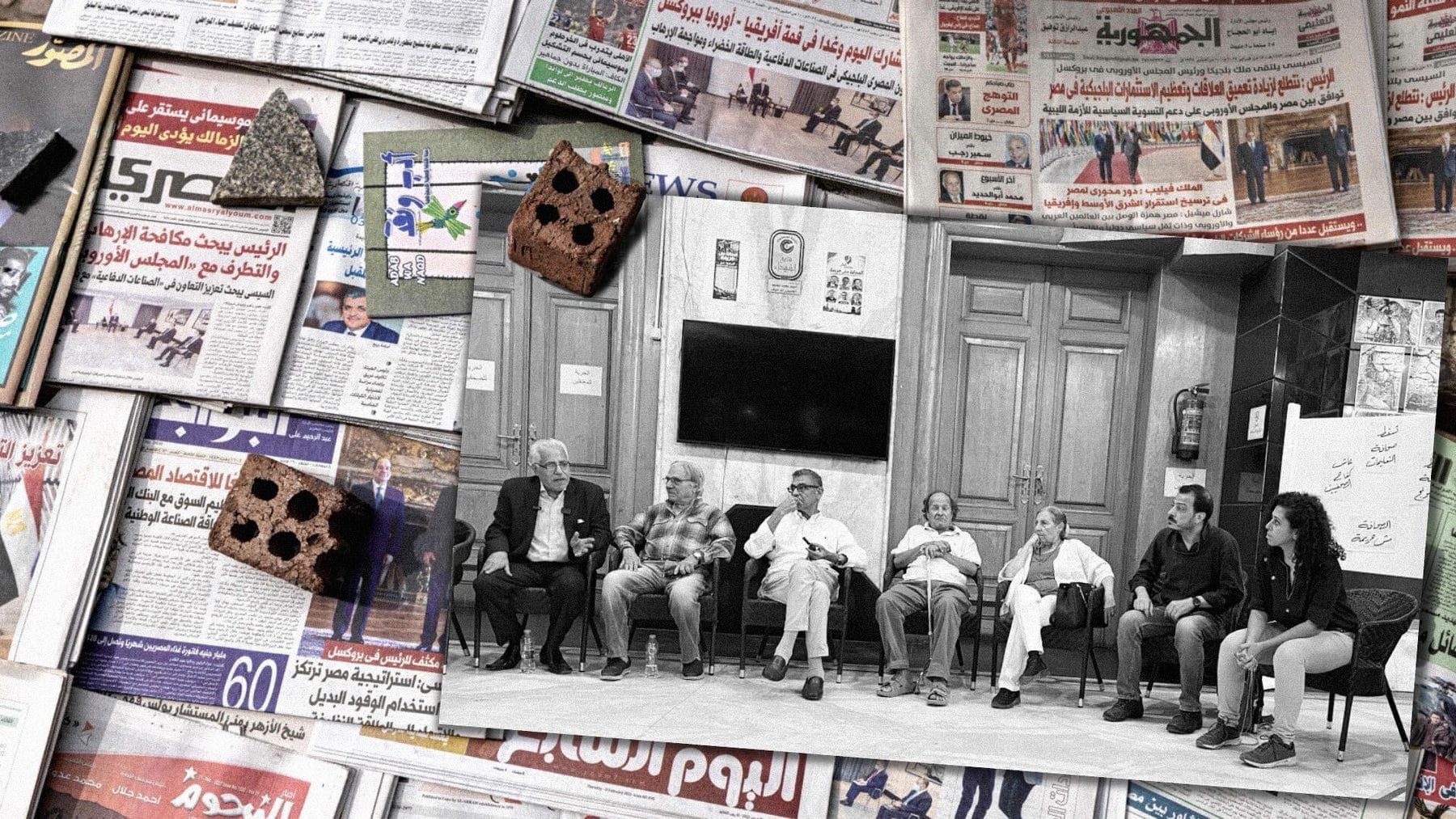
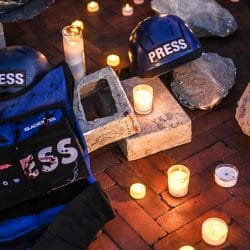
Word spread the way it does now, through social media posts, journalists’ pages and a knot of phone calls I can no longer untangle. Colleagues were gathering at the Journalists Syndicate every day. So I went too. The Syndicate is a union with a long history of standing up for us, and I joined my colleagues there in solidarity with those who had been detained. Not everyone could come every day, but there was always someone — on some days just four, on others more than 20.
Even our older colleagues, in their 60s, 70s and 80s, showed up. Ustaz Mohamed Abdel Kouddous, who once headed the Syndicate’s freedoms committee, is recovering from an accident and could not be there in person, but he was with us through his voice and his written messages. For as long as I can remember, he has been there for every struggle: at Al-Ahram, arguably Egypt’s most prominent daily newspaper; and at the Syndicate, with his megaphone, firing us up. He and I don’t share the same politics, but it has never mattered.
In 2008, on the day of a nationwide strike, plainclothes officers dragged him from his car in broad daylight and held him until nightfall. He asked the Syndicate to demand an investigation, though he expected nothing to come of it. “We do what we need to do,” he said then. It could be the motto of our sit-in today.
Many of us feel embarrassed to eat or to have a cup of tea, not knowing whether our colleagues inside have the same luxury. When I kiss my girls goodnight, I feel ashamed that my colleagues in jail cannot do the same.
I keep thinking about how we got here.
Under Egypt’s former president Hosni Mubarak, the red lines were clear. You did not touch the head of state, his wife and his sons, or a certain institution (the military). But everything else was fair game. We knocked ourselves out writing about poverty and corruption, labor rights and children’s rights, domestic violence, sexual harassment and female genital mutilation.
Then came 2011, and a revolution unlike any other. In Tahrir Square, we rejected violence, and our chant was “selmeya, selmeya” (peaceful, peaceful).
When we brought Mubarak down, he didn’t flee like the Tunisian “strongman” Zine al-Abidine Ben, and we didn’t lynch him like Muammar Gaddafi in Libya. We put Mubarak on trial, in a courtroom. It was dignified. It was the revolution of the dreamers.
In those few years, Egyptian journalists lived with freedoms we had never known. But dreamers are not politicians.
We had lived for decades with no politics: no real political parties, no real elections, no way to learn how power works. So when the door was opened, we didn’t know how to build what we had dreamed of. People kept asking, “What is the alternative?” We had the dream, but not the tools.
What followed our revolution was the opposite of what we fought for: restrictions on a scale we had never seen. The red lines blurred and multiplied, until no one knew where they were anymore. The story of our country, of our revolution and of our journalism is the same story. We are not organized. We are not politicized. But we dare to dream.
Today, at least 25 journalists are behind bars in Egypt, says the Committee to Protect Journalists, almost all of them in pretrial detention. That period is technically limited to two years, but prosecutors file new charges and renew detentions. Some, like the photojournalist Hamdy al-Zaeem, have spent a decade in and out of detention without a single conviction. My colleague Haidar Kandil was taken in June, after documenting arrests of Egypt’s Shia minority.
On the evening of October 14, the lobby of the Syndicate’s headquarters in downtown Cairo was filled with banners and cartoons. Three colleagues and I sat down to write letters to our jailed colleagues: 26 names in total. We fussed over how to organize the letters: how to arrange the names, whether the envelopes should be open or closed, which color went with which name. Colleagues with beautiful handwriting wrote each name in calligraphy. Then we realized we couldn’t spend the whole evening rearranging the deckchairs. At some point, we had to start writing.
But our minds were blank. What could we say? “Why are you inside, and why are we free?” “We feel guilty that we are free and you are paying the price. Maybe we should have paid it instead.”
Of the 26, the only one I have worked with is Haidar. He had a good eye for a story. Like most of the young journalists I work with, he needed guidance, but he was always responsive to edits, to make changes and turn in better copy. We spoke on the phone and exchanged emails and texts, but we had never met. I only know his face from photos online, and here I am pinning his photo on the noticeboard in the syndicate with a #FreeThemAll banner.
In the end, all I wrote was: “I miss you, Haidar. I hope to see you soon. Hang in there. Love, Lina.”
Whenever I feel small, I remind myself that this Syndicate has always fought the good fight. That same evening, the veteran journalist Medhat El-Zahed told us how, during the 1989 Iron and Steel workers’ strike, he and his leftist colleagues were arrested and tortured. The Syndicate’s head at the time, Makram Mohamed Ahmed, was close to the authorities. Still, he protested over the treatment of journalists and visited them in prison.
Today, for the first time, the head of our Syndicate is one of us. Khaled El-Balshy is a dreamer. Eman Ouf, who heads the freedoms committee, is one of us too. The Syndicate has pledged to defend all six Matsadaash journalists. It has asked the Attorney General to investigate the abuse allegations. Its statement chose every word with care, stressing its commitment to the law and to the country’s higher interests, and asked only that our colleagues be released on the Syndicate’s guarantee, or any other, given their young age. It was the most modest of requests. Even that was too much for some.
The tide is so high, and we are so low.
After more than two weeks, we have suspended the sit-in. We are not leaving the Syndicate, and we are not giving up. In our statement, we promised to keep standing with our colleagues through other events, because the battle for press freedom “needs a long breath.”
On October 18, eight independent news outlets from Egypt, Lebanon, Tunisia and Syria, among them Mada Masr and Al-Manassa, announced a joint newsroom to fact-check “Egypt Forum 2026,” the government’s “achievements conference.” The summit runs from October 19 through to October 24 – six days for six journalists. The eight newsrooms have united under the slogan: “Until they return, the fact-checking continues.” The dreamers are learning to organize.
We journalists and dreamers, like those of us who gather in the Syndicate, are stubborn. Many are behind bars of some kind: real ones, imaginary ones, or the bars of a censored internet. But we always walk towards the light. Journalism is how we live and breathe. If we don’t fight for it now, there will be nothing left to fight for tomorrow. No profession, no dignity, and no Syndicate.
This story was published in collaboration with Egab.
Related Articles
How Modi silenced Kashmir
Anuradha Bhasin
First, they came for the journalists
Isobel Cockerell
The systematic silencing of Gaza
Shougat Dasgupta
The post In Egypt, the government has seized a newsroom appeared first on Coda Story.