Social Security is racing towards insolvency because the program pays out more in benefits to retirees than it collects in taxes from working Americans.
Handing out even more generous benefits will make that situation worse. Yet that is exactly what the trustees who run Social Security are planning to do: Retirees will get a 3.6 percent cost-of-living adjustment (COLA) next year. That increase is 0.8 percentage points higher than last year's, and it is 0.9 percentage points higher than what Social Security was expecting to pay.
The Social Security trustees are doing what the law requires during a time of high inflation. That's why Congress ought to intervene here.
It should cancel the COLA.
No, this isn't a demand that lawmakers stick it to America's retirees. It's an appeal for some fiscal common sense. There are three good reasons to cancel this year's COLA.
First: Handing out higher benefits to wealthy retirees simply doesn't make sense when Social Security is trending towards insolvency.
As the Committee for a Responsible Federal Budget notes, the announced COLA would be a $900 increase in benefits for the average retired household—but some retirees could receive as much as $3,600 more.
Paying generous benefits to wealthy households is the main reason Social Security is facing insolvency in the first place. A program originally intended to keep seniors from falling into poverty has become a huge wealth-transfer scheme that overwhelmingly benefits those who don't need the handouts. The COLA doubles down on this flaw.
Second: What about the workers who are paying for those lavish benefits? Wages have risen by 3 percent, on average, over the past year. Those pay increases have already been outpaced by inflation, which is up 3.7 percent in the past 12 months.
You'll often hear retirees talk about how they are living on a "fixed income," but the math simply doesn't bear this out. Social Security beneficiaries will get a COLA that is larger than the average pay increase for the workers who are funding the COLA. Retirees are protected from the impact of inflation while younger Americans must deal with inflation and finance that protection for the elderly. That's crazy.
Third: Cutting the COLA could kick-start a conversation about how to solve Social Security's looming insolvency. The Social Security trustees estimate that an across-the-board cut of about 22 percent will be necessary in 2032. Eliminating COLAs won't meaningfully change that arithmetic, but it would change the conversation—which has for too long been dominated by politicians promising seniors that nothing needs to change. That's wrong—and the sooner that becomes apparent, the better off the political system will be.
If eliminating the COLA is too radical a change, Congress should instead change how the trustees calculate the annual increase.
Currently, the COLA is based on one particular measure of inflation: the Consumer Price Index for Urban Wage Earners and Clerical Workers, otherwise known as CPI-W. This is a relatively narrow index that reflects the spending habits of only about one-third of all Americans, as Romina Boccia points out in her newletter, The Debt Dispatch.
Instead, Boccia suggests using the Chained Consumer Price Index for All Urban Consumers, or C-CPI-U, which covers about 93 percent of all Americans and is generally regarded as a better measure of the rising cost of living. Other parts of the federal government already use C-CPI-U to update such things as tax brackets.
If Congress simply changed how Social Security's COLA was calculated, it could close 12 percent of the program's long-term shortfall. And while some retirees would see smaller COLAs as a result, the result would more closely match those increases to inflation.
Social Security's COLA reflects many of the fundamental flaws with America's old-age entitlement program. Like Social Security as a whole, it is too generous to the rich, too costly to the taxpayers, and too unfair to younger, poorer workers.
Is this really about cost of living? Over the weekend, the civil unrest that had been at a simmer boiled over in cities all over France. Over 1,000 police officers were injured, with seven seriously injured. More than 2,400 people were arrested.
"Rioters…attacked city halls from Lille in northern France to Marseille in the south, where they broke into the local government headquarters and tipped over a bust of Marianne, a symbol of the French Republic," reportsThe New York Times. "A fire destroyed a tourist office in Lyon, and 1,500 shops were damaged or looted nationwide, according to Alexandre Bompard, head of the French federation of commerce and distribution, who estimated that the cost of repairs could run into hundreds of millions of dollars."
"They came prepared," claimed the French journalist Paul Amar on CNews. "They had the addresses of town halls. They had addresses of Jewish shop owners. In a street in Marseille, all businesses owned by Jews were set on fire. Businesses run by Muslims weren't." The Jewish Community Protection Service has disputed such claims.
Reason's Matt Welch has a good write-up of how the violence and destruction have altered Lyon, Paris, Marseille, and Limoges, where the city hall was burned and collapsed.
Ces images doivent faire le tour du monde. Nos voisins doivent savoir.
Lyon l'une des plus grandes villes de France le 17 octobre est l'une des villes les plus touchées.
A Lyon, aucun commerce n'a été épargné, oui aucun commerce n'a aucun épargné vous avez bien lu. Toutes les… pic.twitter.com/15dG6QB5lK
What was nominally about cost of living and budget issues appears to have expanded far beyond those. ("Free Palestine" and "ACAB" graffiti have been seen everywhere.) President Emmanuel Macron has blamed far-left protesters, saying they have taken advantage of the situation. Far-right leader Marine Le Pen has blamed the "Macronist administration that is out of steam, exhausted, and disoriented."
It's not clear to me how the possibility of that retirement age needs to be raised will in any way be changed by, say, donning black balaclavas and breaking into the Louis Vuitton store:
French rioters loot Louis Vuitton store located just 2 KM away from the Élysée. pic.twitter.com/cnb5aWczcN
Here's how it all started: Since September 18, lycée (or secondary-school) students have held demonstrations, starting in the Paris suburb, Créteil. The students said the Education Ministry had neglected them—not enough resources, not enough teachers, and overcrowded classes. (The original demands were met and that strike ended, but not before sparking a wider movement.) This was all happening concurrently as the government was deciding its budget, and public-sector strikes were beginning. High social-program spending, an aging population, and high debt-to-GDP, plus an ever-increasing cost-of-living is resulting in a math problem that politicians have no real way out of except by raising the retirement age. Over the last few years, the French have had several hissy fits over the possibility of that happening.
Lawmakers from left-wing party La France Insoumise were at the first blockade on September 21, which has sparked questions about whether the party helped fuel the protests ahead of April's presidential election. I take all this—the disparate movements, the sheer volume of violence, the political-party involvement, the elections coming up—to mean that what started as an education-quality/cost-of-living protest has been used to lodge all kinds of grievances, and is attracting allies with an unquenchable thirst for violence and destruction.
Scenes from New York: "Darrel Rodriguez, 26, was shot on Saturday in the 7th Avenue Station on 53rd Street, a few blocks from Times Square, the police said. An unidentified man approached Mr. Rodriguez on the northbound E train platform, drew a gun and shot him once in the chest, they said," reportsThe New York Times. The man who shot Rodriguez was wearing a full balaclava-style face covering, and has not been found by the cops.
Philadelphia enacted a ban on such masks back in 2023. Just anecdotally, I've seen a lot of them in New York, but not by people trying to stay warm in the cold—these types of masks are used by people hopping turnstiles, stealing from bodegas, and more. Some bodega owners have started posting signs on their doors saying masks aren't allowed, since it's become such a problem.
"As of Oct. 11, there have been 1,697 crimes in the transit system since the start of the year, 27 more than the same period in 2025," reportsThe New York Times, citing Police Department figures.
In Texas, Ken Paxton appears to have lost the support of suburban women, according to The Washington Post.
"Jewish life in the Emirates has grown quieter and less visible," notesThe New York Times. "Religious symbols have disappeared, and gatherings have moved into private. Many have become more guarded about their online presence and their willingness to speak to the media. Some are reconsidering how openly to identify themselves as Israeli or Jewish, while others weigh whether they can still build a life in a nation they once considered a haven."
Can you really see everything?
YOU CAN SEE EVERYTHING is doing a public service if it gets the general population to question why, precisely, folks lend so much credence to documentaries as vehicles of truth. https://t.co/n7CHwkmDmrpic.twitter.com/IHUvEbKECl
"I recently attended a meeting of the Democratic Socialists of America, where I officially enrolled as a member. Though I was new to the party, I put forth a number of proposals, many of which were met with considerable enthusiasm and, I'm happy to report, have now been incorporated into their manifesto," writes Larry David in a satirical essay for Airmail. "We contend that the only way anyone can be rehabilitated is through the simple act of love. When the D.S.A. takes over, it will be our policy to close the jails and release all prisoners. Once released, the former prisoners will continue to walk around in their orange jumpsuits, the easier to spot them. People will be encouraged to give them a pat on the back, offer some words of encouragement, and maybe even get them to open up about their crimes. Imagine how upsetting it must be to know you've taken a life! To err is human, to forgive, divine. With empathy and compassion, it's easy to see a day when these former convicts will be contributing to society in a very meaningful way." It's not that funny of an essay, but I think it's great for more people to be talking about how asinine DSA ideas are.
Prasad Kalyanaraman, vice president of infrastructure services at Amazon Web Services
BASTIEN INZAURRALDE/AFP via Getty Images
Amazon is on an unprecedented spending spree to build more AI data center capacity than anyone else.
The company has extensive experience, yet even it's struggling to bring capacity online fast enough.
Internal documents show Amazon getting bilions of dollars of Nvidia GPUs before they can be deployed.
At an internal staff meeting in September, AWS CFO John Felton had a joke for Prasad Kalyanaraman, the executive overseeing much of Amazon's AI infrastructure expansion.
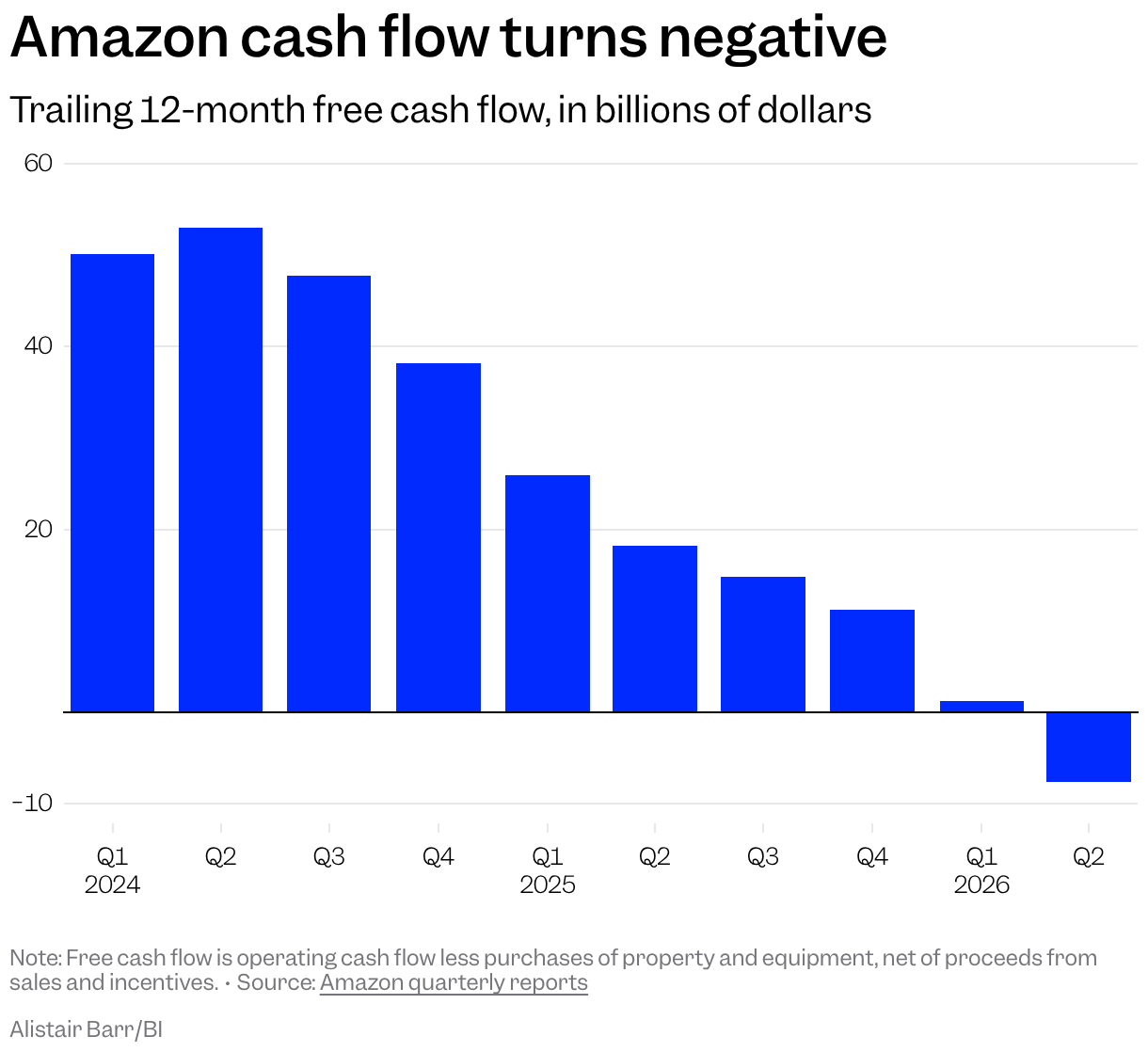
"You've taken us free cash flow negative as a company, so congratulations," Felton said, according to a recording of the meeting obtained by Business Insider.
The remark was lighthearted. But it captured a stunning reversal.
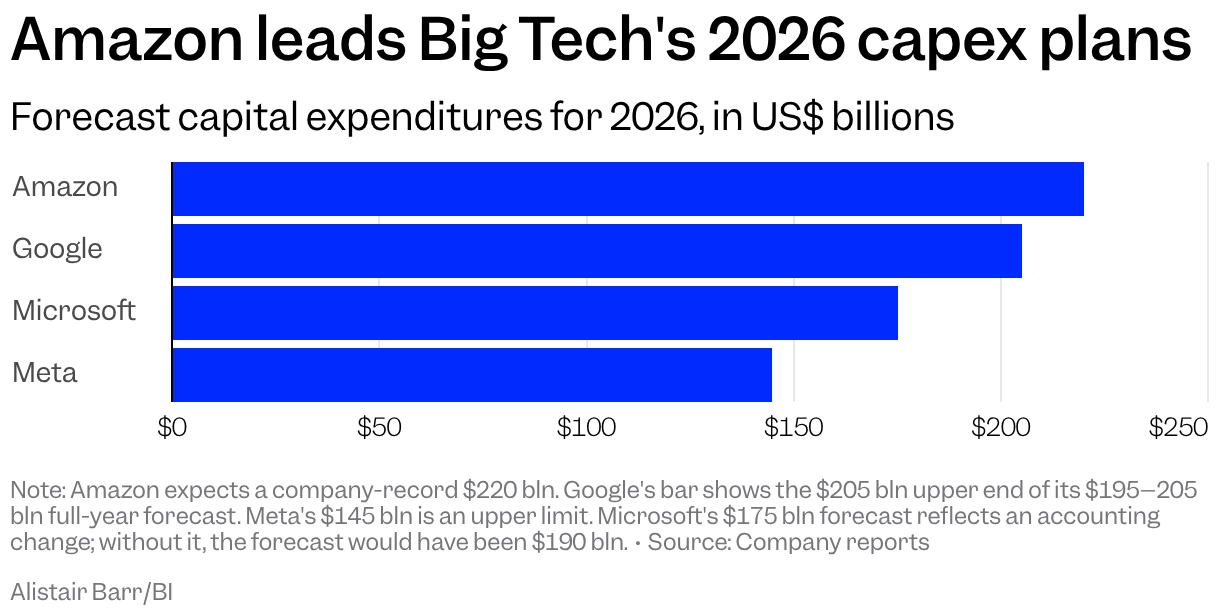
Just two years ago, Wall Street was debating what Amazon would do with its growing cash hoard. Now, cash flow has evaporated as Amazon embarks on its biggest bet ever, spending $220 billion this year alone to build the physical backbone for AI.
At the meeting, Kalyanaraman did not dispute Felton's premise. Amazon's machine-learning and AI business is "hugely free cash flow negative," he said, adding that he expects the company's free cash flow to remain negative for "the next couple of years or so."
Amazon has made big bets before. It spent heavily on cloud computing, fulfillment centers, and its delivery network long before they became some of the company's most valuable assets. Investors questioned those investments at the time, but Amazon ultimately built enormous, profitable businesses from them.
AI is testing this playbook at a far larger scale. Amazon is committing hundreds of billions of dollars to data centers, servers, and power before investors know how quickly those investments will generate revenue.
The company is the best, or among the best, at building data centers, with decades of experience. But the size and complexity of these projects, and the bottlenecks holding progress back, are challenging — even for such a respected cloud pioneer.
Internal documents reviewed by Business Insider and people familiar with the matter show the company trying to coordinate a sprawling industrial system whose parts move on different schedules. A delay in power, equipment, or construction can leave billions of dollars in hardware waiting — and Amazon's cash tied up — while forecasts and costs keep shifting.
Why Amazon thinks it will work
Amazon says it has strong evidence that the capacity will be needed. AWS revenue grew 37% in the second quarter, its fastest pace in 18 quarters, while its backlog reached $496 billion.
CEO Andy Jassy thinks the company has a "clear line of sight" to strong financial returns from this record investment cycle. In his latest annual shareholder letter, he called AI a "once in a lifetime opportunity" and said Amazon would not be conservative in its investments.
"We've been through this cycle with the first big AWS growth wave, and liked the results," Jassy wrote. "We expect to feel similarly about this next wave."
Investors are concerned by the scale of the industry's expansion, especially as AI data centers are costing more to build and taking longer to complete.
The market is "repricing anything that funds multi-year builds against revenue that arrives later," Dan Ives, an analyst at Yorkville Ives, wrote in a recent report. Growing uncertainty around data center permitting and the political fight over electricity prices have given investors another reason to question how quickly these investments will pay off, he added.
Racks, but not enough power
One major industry challenge is securing enough power to run the equipment that goes inside data centers. This includes expensive racks of servers that contain GPUs and other chips that train and run AI models and services such as ChatGPT.
Internal emails from August show Amazon preparing a new "Early Rack Receipt" process for an expected wave of server racks carrying Nvidia's GB300 chips at US facilities before final deployment.
One Amazon email projected the company would take delivery of about $5 billion of Nvidia GB300 racks in August, followed by another roughly $3 billion each month "for the foreseeable future."
Some AWS data center sites had room for more racks but not enough available power to turn them on, people familiar with the effort said, leaving the equipment to be staged at intermediary warehouses until the facilities were ready. These people asked not to be identified discussing sensitive matters.
Timing and coordination
Usually, Amazon doesn't pay for racks until the gear is put into a data center, leaving suppliers to carry the cost of the equipment in transit, according to the internal documents obtained by Business Insider. This helps the company conserve cash.
However, the intensity of the AI data center building boom has made this type of coordination harder. Amazon has to compete more for scarce resources as it jockeys with rivals for access to Nvidia GPUs and other AI components.
Under the new "Early Rack Receipt" process, Amazon now takes ownership of these racks earlier in the supply chain, rather than waiting until the equipment reaches a data center.
The means spending cash sooner. And any delays getting the racks installed and plugged into a reliable power source potentially pushes back the moment when revenue starts flowing from these assets.
At least one AWS supply chain team did not have "a clear forecasted path" for getting racks into data centers, according to one of the emails reviewed by Business Insider.
An Amazon spokesperson said the company routinely stages finished hardware near deployment sites so it can be installed once power capacity is available, calling that approach "best business practice."
The spokesperson added that AWS has "long-established systems" to track infrastructure assets and disputed that the broader company lacks a forecasted path for getting racks into data centers.
This problem is not unique to Amazon.
Bernstein analysts wrote in a recent note that power permits, cooling systems, electrical equipment, construction, and hardware all move on separate schedules.
"Timing is imperfect," the analysts said.
"Inherently uncertain"
John Felton, Chief Financial Officer of Amazon Web Services
Chris Jung/NurPhoto via Getty Images
During the internal staff meeting in September, Felton, the AWS CFO, described the broader problem eloquently: "How do you work in the future when the future is inherently uncertain?"
Kalyanaraman, the AI infrastructure leader, said Amazon's internal outlook for the return on its AI investments had improved. But the assumptions behind those returns keep shifting.
"The forecast is changing on a daily basis," Kalyanaraman said. "The world that we live in is extremely dynamic."
Those shifting assumptions include when data centers will be ready and how much equipment AWS needs to keep on hand, he explained.
An eight-week supply buffer might be routine for a smaller company. But at Amazon's scale, Kalyanaraman said, this could mean holding "billions and billions of dollars" worth of additional equipment inventory — tying up precious cash.
Frugality meets the AI boom
Such tensions are especially striking for Kalyanaraman, a 21-year Amazon veteran who earlier this year was promoted to the elite S-team that reports directly to Jassy.
Amazon's founding story is defined by frugality. It famously used cheap doors as desks when founder Jeff Bezos started in Seattle in the mid-90s.
Kalyanaraman has absorbed this lore into bones. In late 2023, as AWS faced slower growth and layoffs, he urged employees to do more with less. "Frugality breeds innovation," he said back then.
That instinct still shapes his approach. In the September meeting this year, Kalyanaraman told Felton that AWS tries to make major investments at the "last responsible moment," when it has the clearest possible view of demand.
"If we can wait to spend the capital as late as possible, it's better for us," he said.
Amazon CEO Andy Jassy
Bloomberg/Getty Images
But the frenetic pace of the AI boom makes this principle difficult to follow. By the time demand is fully visible, the servers, power, and construction capabilities that AWS needs may no longer be available. That puts pressure on the company to commit more money sooner to secure supply and meet its data center capacity goals.
Kalyanaraman recalled telling Jassy in 2023 that AWS would "surely" be out of its capacity crunch by 2027. Instead, Amazon still expects demand to exceed its available capacity in 2027, the AI infrastructure chief said during the meeting this September.
Secured Power at Risk
Getting enough electricity may be the biggest challenge for an industry leader like Amazon.
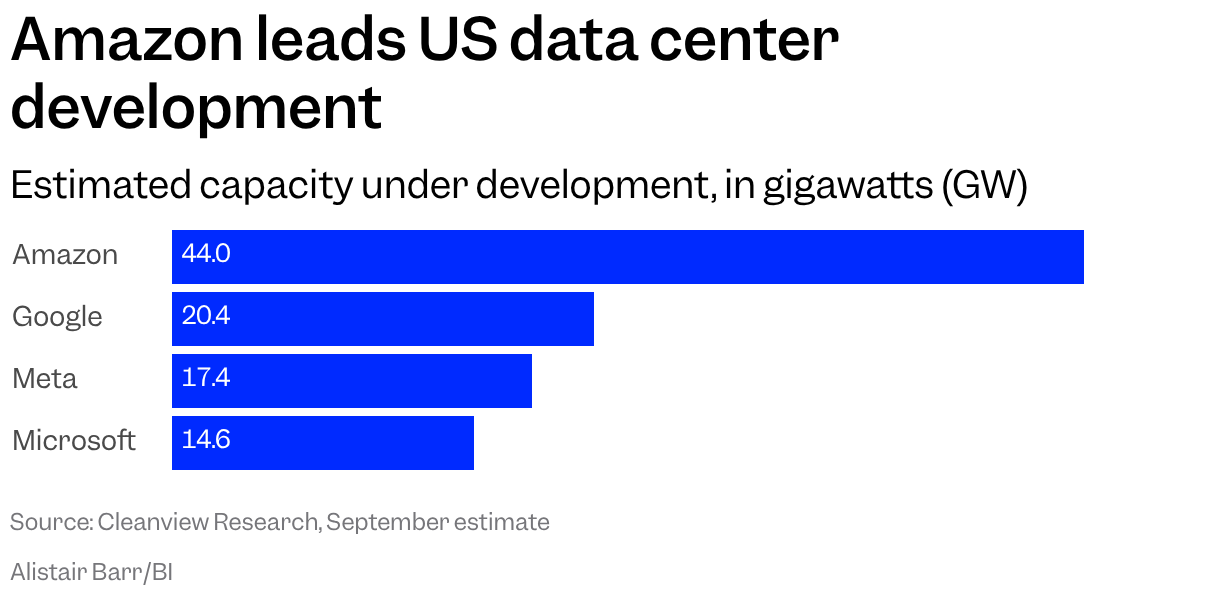
The company has 44 gigawatts of data center capacity under development across 16 states, more than double Google, Meta, and Microsoft, according to Cleanview Research estimates.
An internal AWS dashboard called "Secured Power at Risk" tracks utility and regulatory constraints affecting electricity capacity AWS has lined up for its data centers.
The risks include transmission bottlenecks, requirements to reduce use during grid stress, and "use it or lose it" provisions that can jeopardize capacity if a data center project misses usage or construction milestones.
In other words, AWS is not simply waiting for electricity to arrive. It is managing a portfolio of commitments that can become more costly if a data center project is delayed.
Maryland proposals
A submission to Maryland's utility regulator last year, obtained through a public records request, illustrates the kind of exposure that can accompany massive data center buildouts.
Amazon told the Maryland Public Service Commission that large data center customers could help pay for grid upgrades or bring new power capacity to market without burdening other electricity ratepayers.
The company also proposed setting aside collateral to help utilities get more comfortable with the large investments needed to generate more electricity for data centers. Amazon proposed three years of collateral so that if a large electricity customer abandoned unused capacity, the utility would have time to re-sell the power.
The proposal is not evidence that AWS has made such a payment or posted collateral. It does, however, show that large data centers can face extra financial obligations, beyond their own electricity bills, if projects are delayed or cancelled.
The Amazon spokesperson said such utility rules are not unique to AWS. The company has not disclosed how much cash it has paid upfront to secure power.
New constraints 'keep popping up'
The AI buildout also incurs expenses that are harder to model than a conventional capex plan.
In the September meeting this year, Kalyanaraman said that while reviewing plans for gigawatts of capacity in West Texas, AWS confronted a labor problem: There weren't enough nearby pipefitters, electricians, and other skilled workers to build the facilities.
The company's response, he said, was to pay to construct housing complexes near its data centers so workers could live there for the two or three years needed to complete the projects.
Even the crates used to ship servers have become a planning issue. It may seem absurd to worry about the price of a container when servers cost hundreds of thousands of dollars, Kalyanaraman said. But at AWS's scale, where the company needs so many crates, even trivial items can become a material expense.
"We have new constraints that keep popping up," Kalyanaraman said.
Ontario government inspectors checked several career colleges that had experienced "concerning" growth in applications for the Ontario Student Assistance Program (OSAP), a government financial aid program that helps eligible students pay for post-secondary education. The investigators found problems that raised "serious concerns" at three Academy of Learning institutions, like signs that other people might have been doing students' schoolwork for them—for example, some students finished whole courses in a single day, or even just minutes. A few students could not even name their school or program of study. The inspectors also found shared computer logins from many different locations and said the schools could not prove that OSAP-funded students were really taking the classes they claimed to be enrolled in. These three locations took in more than $219 million in student aid money for about 14,800 students in one year, so the province decided to stop letting new students use that aid at the schools. The colleges deny most of the claims and are fighting the decision in court.

 Login



 (@Guigz75116)


 (@DrewPavlou)