❌

Reading view

Israel announces 10 arrests after West Bank settler attacks on Westerners

Israeli police said on Monday that they had arrested 10 people in the occupied West Bank after settler attacks on an American photographer and a French mayor that drew international condemnation but mixed messages from the government.

In a rare action against rising settler violence, police said they raided several locations across the occupied territory and seized cars and potential evidence related to the attacks.

“Following the severe incidents of violence over the past weekend, including the assault of a media worker and the suspected attacks on foreign civilians, an arrest operation was conducted before dawn,” said Major General Moshe Finchi, the Israeli police’s West Bank commander.

“Suspects were arrested on suspicion of involvement in the violent incidents, violating a military commander’s order concerning a closed military zone, and illegal construction,” he said.
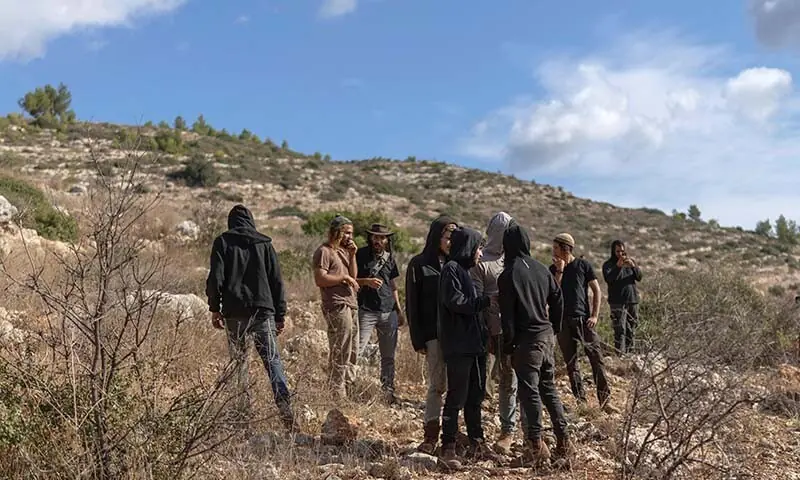
Israeli settlers gather as Palestinians harvest their olive trees in the Israeli-occupied West Bank village of Deir Abu Mashal on October 19, 2026. — AFP

Witnesses say that settlers have been stepping up violent attacks on Palestinians during the ongoing olive harvest, aiming to seize their land during a season that carries cultural importance for the community.

Rights groups note that Israel rarely prosecutes settlers when the victims are Palestinian. The Israeli human rights group Yesh Din said it documents 561 acts of settler or military violence against Palestinians since September 27 — more than 26 incidents a day.

Prime Minister Benjamin Netanyahu, who is facing a tight race for a new mandate, has tried to shore up his pro-settlement right-wing base and has cast doubt on the circumstances behind the recent settler attacks on Westerners.

Netanyahu’s tone has brought unusually strong criticism from the opposition, which has accused him of tarnishing Israel’s image.

US Ambassador Mike Huckabee, a staunch ally of Israel, had called Friday’s beating of veteran photographer Heidi Levine an “act of terror” and demanded punishment. He called Monday’s arrests a “very positive development”.

Levine, 65, who was on assignment for The Washington Post, was taken to a hospital with broken vertebrae. She was visited at her hospital bed both by President Isaac Herzog, who holds a largely ceremonial role, and centre-left opposition leader Yair Golan.

Golan, in a social media post afterwards, said that if he takes power, there will no longer be “a reality in which Jews instil terror in the name of Jewish supremacy, and stain the state we built here”.

Rising international attention

One day after Levine’s beating, settlers attacked a convoy of European diplomats, including the French and Belgian consuls general in Jerusalem as they went through the town of Taybeh in the West Bank on Saturday.

The settlers beat up Bernard Baudoux, 78, the mayor of the northern French town of Aulnoye-Aymeries, who was wearing a sash in the French tricolour during a goodwill visit in which he helped harvest olives.

The mayor, wearing a blue, white and red sash, leans against a vehicle as masked men intercept and surround a car at a village in the occupied West Bank. — AFP

Netanyahu earlier questioned the facts behind the two recent incidents.

On Levine’s beating, he alleged that Palestinians and “far-left” activists were fanning violence. With the attack on the diplomatic convoy, he pointed out that the mayor was a leftist supporter of the Palestinian cause and said that diplomats should have coordinated with the Israeli military.

The top official on human rights in the US State Department, Riley Barnes, on Sunday visited the same town where the mayor was beaten, which is largely Christian, on a trip coordinated with the military. He was unharmed.

The violence by settlers has led British Foreign Secretary Ed Miliband to accuse Israel of an “ethnic cleansing” campaign and for London to impose sanctions on goods from settlements.

Marking Monday’s deadline for Israel accepting construction tenders for the E1 settlements, a major new project that Palestinians fear will divide the West Bank in two, Miliband warned businesses about consequences.

“They should be aware of legal and reputational consequences, including the risk of involving themselves in serious breaches of international law,” Miliband said in a statement.

Israeli Foreign Minister Gideon Saar hit back against what he called an “obsession” with Israel by British Prime Minister Andy Burnham’s government.

“The days when Israel would quietly accept threats, sanctions and attempts to dictate its policies are over,” Saar said.
  •  

India extends detention of top Cockroach Janta Party leaders

A New Delhi magistrate extended the detention of two leaders of India’s youth-led Cockroach Janta Party (CJP) movement by two days on Monday, after they were remanded in custody five days ago.

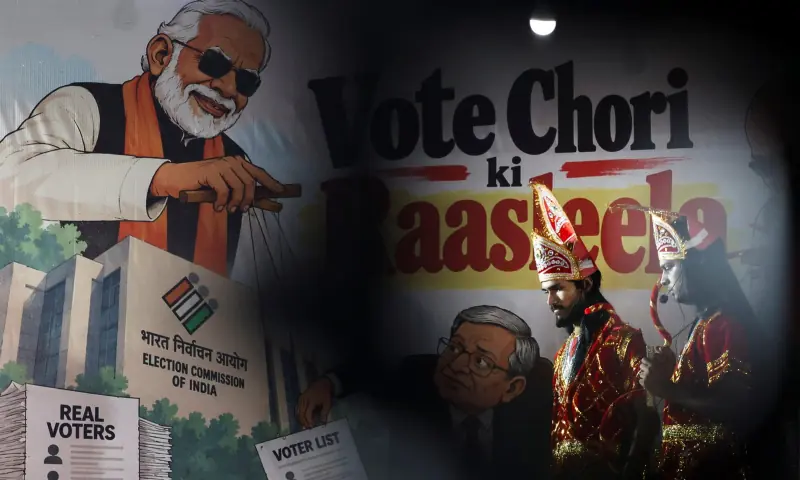
CJP activists and opposition parties have defied a security crackdown to demand the resignation of India’s chief election commissioner, accusing the poll body of manipulating voter rolls to benefit Prime Minister Narendra Modi’s ruling party.

The commission, which oversees voting in the world’s most populous nation, has denied any wrongdoing.

Television footage showed CJP leaders Ashutosh Ranka, 30, and Saurav Das, 27, being taken away in a blue police van from a police station where the hearing took place.

“This is an absolute mockery of the justice system,” the movement’s legal affairs head Ratna Singh told reporters.

Das and Ranka were taken into custody on Oct 14 for their “alleged repeated attempts to disturb public peace and violate the law”, the police said in a statement at the time.

The pair had jumped security barricades to wave the national flag at Jantar Mantar, a decades-old protest site that police have barred people from using.

“Their alleged attempts to instigate others through social media to engage in similar unlawful activities were also taken into consideration,” the statement said.

Jantar Mantar, in the heart of the capital, has been sealed off with yellow metal barricades for more than a week and guarded by security personnel.

Delhi police said last week they had removed the site from the list of designated protest venues.

  •  

Musk says will give SpaceX share to 'every kid in America'

Tech billionaire Elon Musk said on Monday that he would give every child in the United States a share in his SpaceX rocket company.

“Next year, I will give one of my SpaceX shares to every kid in America,” Musk, the richest man in the world, said on X.

“This will be the first of many,” he said, without providing details about how the scheme would work.

There are around 73 million children under the age of 18 in the United States, according to 2024 data from the US Census Bureau.

Musk owns 38 per cent of SpaceX, according to Forbes.

His announcement comes after US President Donald Trump promised last month to give every American adult $5,000 if his Republican party retains control of Congress in November’s midterm elections.

SpaceX set the record for the largest initial public offering in history, raising $85.7 billion in June.

The company’s Starship megarocket reached orbit for the first time in September, a milestone for the rocket central to Musk’s Mars ambitions.

  •  

France announces curfews as government grapples with unrest

France announced partial curfews in Paris and other cities on Monday after weekend demonstrations over soaring prices degenerated into some of the worst street violence in recent years.

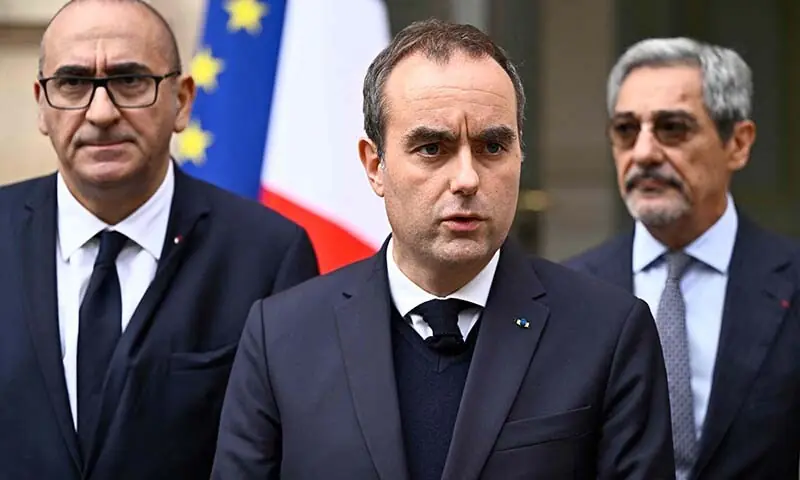
Prime Minister Sebastien Lecornu did not rule out imposing a state of emergency after the interior minister said police had “lost control”.

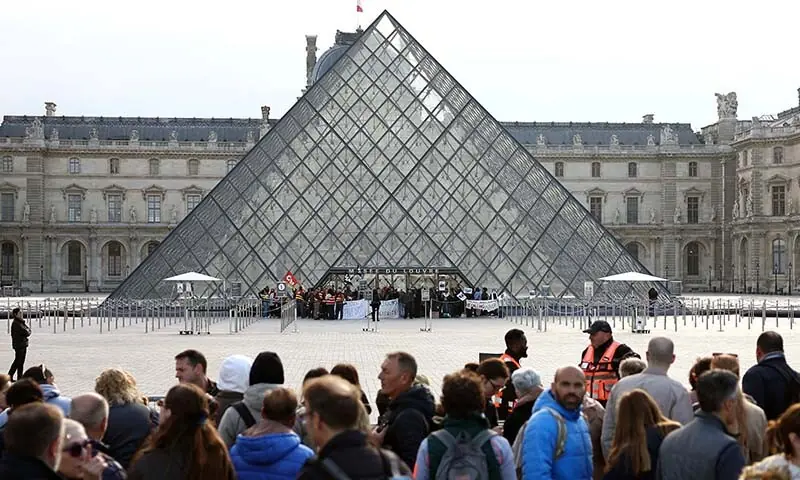
Tourists in Paris had a taste of the disruption on Monday when they found the Louvre closed because of a small group of student protesters.

Facing accusations that it failed to anticipate and respond to the violence, the government has vowed to re-establish order, while officials scrambled to contain public anger.

The unrest, erupting just six months before France elects a successor to President Emmanuel Macron, threatened to continue, with organisers calling for a new round of protests next Saturday.

Authorities said partial curfews would be enforced from Monday evening to Tuesday morning in a number of cities including Paris, Lille and Lyon, to protect businesses.

In the capital, a curfew was ordered from 11pm (2am PKT), while demonstrations were banned from 8pm.

“I’m absolutely determined to restore public order”, Lecornu said.

Other European countries have also seen demonstrations over rising prices, with smaller clashes breaking out in Milan and Belgium over the weekend and protests simmering in Spain and Portugal.

Some half a million people turned out across France on Saturday to denounce the surging cost of living, a culmination of four weeks of protests that began with students demanding better conditions at high schools.

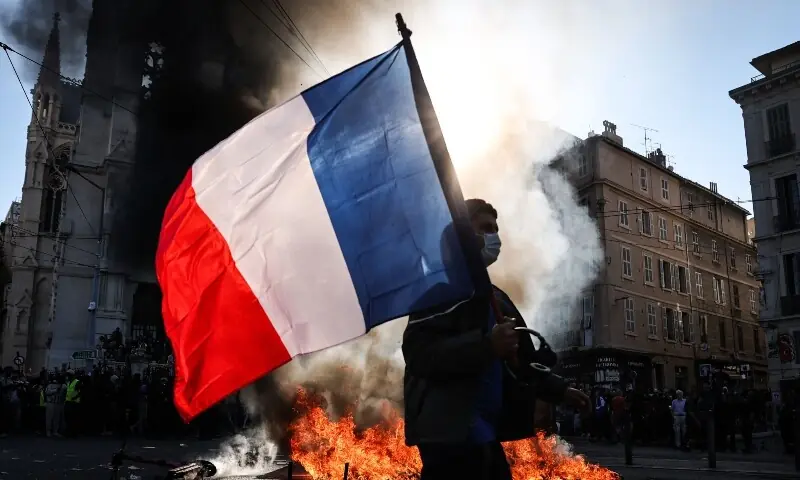
What started as peaceful demonstrations descended into violence in many cities, as masked groups attacked law enforcement, broke into public buildings and set some ablaze, looted shops, and set fire to cars, bicycles and scooters.

Listings for ‘stolen goods’

On Monday, France’s digital minister, Anne Le Henanff, urged online resale platforms to remove listings for “stolen items” following Saturday’s looting and summoned representatives of companies including Vinted and eBay.

CCTV footage shows a masked group breaking into a jewellery shop in Lyon, France, October 17, 2026, in this screengrab obtained from a handout video. — Reuters

After the weekend scenes of chaos, Interior Minister Laurent Nunez offered his resignation, but Macron refused to accept it.

More than 2,500 people were arrested and nearly 1,000 members of the security forces injured. Protesters were also hurt, with one demonstrator’s hand blown off by a police crowd-control grenade.

Macron acknowledged failures in the government response, which had seen 60,000 law enforcement personnel deployed on Saturday.

Nationwide, more than 2,513 people have been taken into police custody since the weekend, Justice Minister Gerald Darmanin said. He added that 67 had been jailed and “dozens” of criminal cases opened.

Darmanin also said authorities would use facial recognition on social media to identify perpetrators.

At least 3,000 shops were damaged, with the cost running into hundreds of millions of euros.

In an address to the nation on Sunday, Macron slammed the “unbridled” violence.

The European Union called the violence “unacceptable” but warned that the right to peaceful protest “must be protected” in France.

Germany condemned the violence and updated its travel advice for France, saying “further outbreaks of violence in the coming days cannot be ruled out”.

China has warned citizens travelling to France to be aware of risks and take safety precautions, state broadcaster CCTV reported.

Louvre blocked

In Paris on Monday, a dozen demonstrators blocked the entrance to the Louvre, the most visited museum in the world, while bewildered tourists looked on.

“We don’t want to get involved. We want to stand back and get away from them,” Pat Boland, a tourist from Australia, said of the protests.

The pensioner, 73, spoke to AFP outside barricades that had been erected at the Louvre, which was closed because a small group of protesters stood by its famed glass pyramid entrance.

Protesters and students from art and culture schools block the entrance to the Louvre Museum during a demonstration in support of a high school student movement demanding better school conditions and government action, in Paris, France, October 19, 2026. —  Reuters
Protesters and students from art and culture schools block the entrance to the Louvre Museum during a demonstration in support of a high school student movement demanding better school conditions and government action, in Paris, France, October 19, 2026. — Reuters

The unrest has flared before presidential elections in April and May that will elect a new French president after a decade of centrist Macron.

Marine Le Pen, the far-right presidential candidate, is riding high in the polls.

The government has accused ultra-left groups of stoking the violence to boost the chances of the far-left firebrand Jean-Luc Melenchon in the presidential polls.

The interior minister and intelligence services were to meet late Monday to discuss the violence.

Europe

During the weekend, clashes broke out on the sidelines of a cost-of-living demonstration in Milan.

“I’m very worried because it’s a new phenomenon, which also originates from an international scenario and therefore feeds itself,” mayor Giuseppe Sala said.

In Belgium, police fired tear gas and water cannon to disperse protesters in Brussels and Liege.

In Spain protesters have set up tents in the heart of Madrid to denounce soaring housing costs, with similar encampments going up in neighbouring Portugal’s main cities of Lisbon and Porto.

  •  

UN agency to end monthly aid to 500,000 people in Gaza over funding shortfall

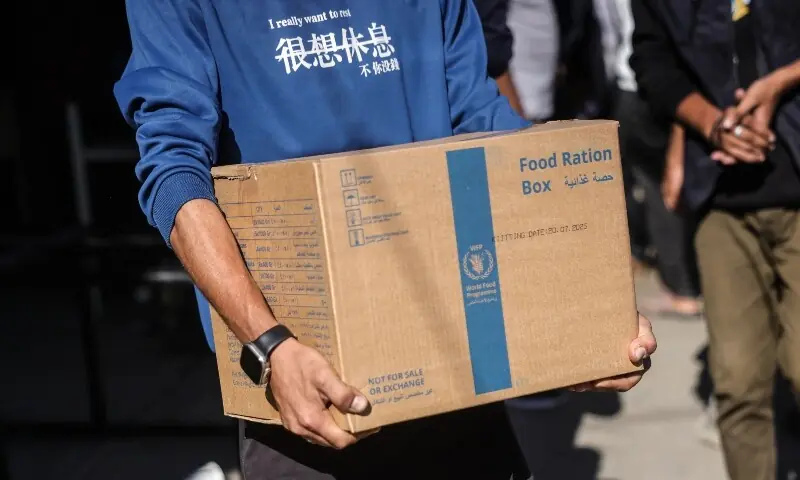
The World Food Programme said Monday it would end monthly assistance to 500,000 people in Gaza due to a funding shortfall, despite acute needs in the war-battered Palestinian territory.

With the cutbacks, 1.1 million Palestinians in Gaza — still about half the population — will be receiving either food or cash assistance each month from the UN agency, in reduced amounts.

The World Food Programme (WFP) said its efforts had mitigated the effects during a famine last year in Gaza and warned that conditions had not improved to the point that it can take away aid.

“People are not safe. Airstrikes continue on a daily basis. People continue to be displaced,” Shaun Hughes, the WFP country director, told AFP at the agency’s office in east Jerusalem.

“Almost everybody remains without a permanent home to live in. And the humanitarian conditions are brutal,” he said.

According to the latest assessments, 1.4 million people — or two-thirds of Gaza’s population — are still “acutely food insecure” and need humanitarian assistance to survive, he said.

In August last year, the UN’s Integrated Food Security Phase Classification said that Gaza was suffering famine conditions.

The famine classification was lifted in December, two months after a US-brokered ceasefire was announced in Gaza. Israel has kept striking Gaza since then, vowing to kill anyone involved in the October 7 attack.

Since the ceasefire, the WFP has been able to step up assistance and had been reaching between 1.5 million and 1.8 million people every month.

“This has been a lifeline. But now, rather than being able to sustain and scale up that assistance, we’re actually having to reduce it,” Hughes said.

“And that’s not because we don’t have humanitarian access to deliver food; that’s because we don’t have funding.”

Less aid to each recipient

In addition to reducing the number of people who receive rations, the WFP has been forced to shrink the content.

Families receiving food assistance will now get only one food parcel instead of two and a smaller bag of wheat flour, the WFP said in an operational note.

The 75,000 families who receive assistance in cash will see the amount reduced from 1,250 to 750 shekels ($400 to $240) per month.

The WFP is funded by governments as well as private donors. It has seen a sharp drop in resources, including after President Donald Trump returned to power in the United States and drastically slashed contributions to UN agencies as well as bilateral aid.

The agency says it needs about $450 million over the next six months for its operations in Gaza and the West Bank, but in 2026 it has only received about half the usual financing for the Palestinian territories.

In September, the agency also reduced by half the number of aid recipients in the West Bank, which Israel has occupied since 1967, from 400,000 to 200,000.

“Now is not the time in the history of Palestine and Gaza to turn away from what is happening in Gaza,” Hughes said.

The WFP says that conditions have moderately improved in Gaza but noted that needs could rise again with the onset of winter.

Israel has allowed more goods into Gaza under the terms of the Trump ceasefire but still imposes heavy restrictions, turning away shipments of anything that is seen as having potential military use — a policy that has included blocking even prosthetic limbs, according to the United Nations.

Israel has ramped up longstanding criticism of the United Nations since the Gaza war, accusing the world body of bias and perpetuating dependency among Palestinians.

  •  

Record El Nino? Depends who's counting

Britain’s Met Office says this year’s El Nino is “unprecedented.” Japan’s weather agency has called it the strongest ever observed. US forecasters say it still trails the biggest events in its record books.

How can they all be right? The answer lies in how they measure El Nino’s strength, with meteorological agencies using different methods to assess the climate phenomenon that make direct comparisons difficult.

“By any measure, we are looking at a very strong El Nino,” climate scientist Emily Becker of the University of Miami told AFP, adding that only once it is over will scientists be able to assess how big it is and “where it fits in the context of history.”

Natural climate driver

The Pacific Ocean’s El Nino Southern Oscillation (ENSO) is the planet’s main natural climate driver. Normally, trade winds blow east to west along the equator, pushing warm water from South America toward Asia, while cold water rises from the depths to replace it.

El Ninos, which occur every two to seven years on average and last nine to 12 months, disrupt this pattern.

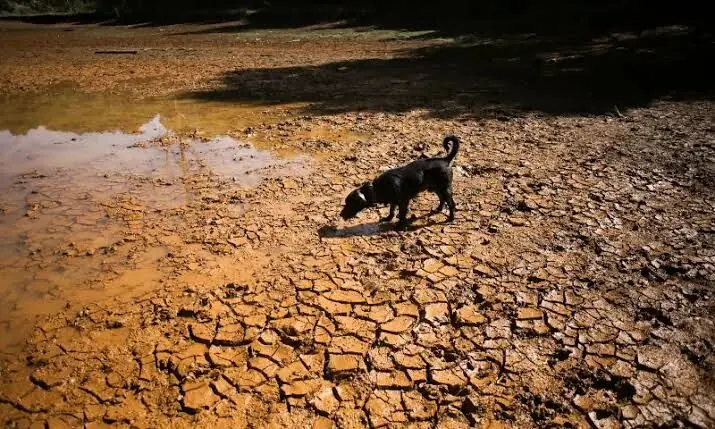
The trade winds weaken and warm water is pushed back east toward the Americas. That shift in where ocean heat is released into the atmosphere ripples across global weather, making some regions cooler and wetter and others hotter and drier.

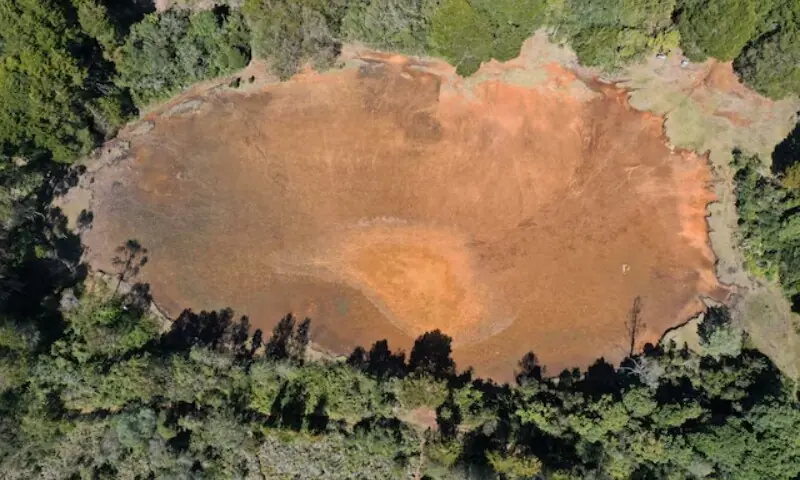
A drone view shows the dried-up Guarne Lagoon at Arvi Park amid drought conditions linked to the El Nino phenomenon, in Medellin, Colombia, September 3, 2026. —Reuters

In describing the El Nino as unprecedented, the Met Office points to raw temperatures in the Pacific.

“Our observations confirm that sea-surface temperatures in the central equatorial Pacific have now surpassed levels recorded during previous El Nino events,” it said in a statement to AFP.

But absolute temperatures are just one way of measuring El Nino’s strength.

Agencies also look at anomalies — how far temperatures rise above a historic baseline — to assess the event.

The Japan Meteorological Agency last week declared this El Nino the strongest on record based on how far sea surface temperatures were above normal in the Nino3 region of the eastern Pacific. By its count, the event beat 1997 in observations going back to 1949.

The US watches a neighboring box, Nino3.4, in the east-central Pacific.

It declares an El Nino when temperatures there run at least 0.5C above normal and the atmosphere responds, weakening the trade winds and shifting tropical rainfall eastward. This process is known as “ocean-atmosphere coupling.”

Accounting for climate change

How “normal” is defined has been a matter of significant debate.

The US National Oceanic and Atmospheric Administration (NOAA) and other agencies including the UN’s World Meteorological Organisation long used the Oceanic Nino Index (ONI), which compares temperatures to a 30-year average that is updated every five years, so that the baseline keeps pace with a warming climate.

But with climate change speeding up and warming oceans worldwide, NOAA now uses the Relative Oceanic Nino Index (RONI), and the WMO is in the process of switching.

RONI also relies on a 30-year average but goes on to measure how warm or cool the east-central Pacific is compared to the rest of the tropical ocean, because it is that difference that drives the weather impacts we care about.

“We were finding a mismatch between the temperature of the tropical Pacific and the impacts,” said Becker about the old index. La Nina years, when the central and eastern tropical Pacific is cooler than normal, were producing stronger effects than their rating suggested, and El Ninos weaker ones.

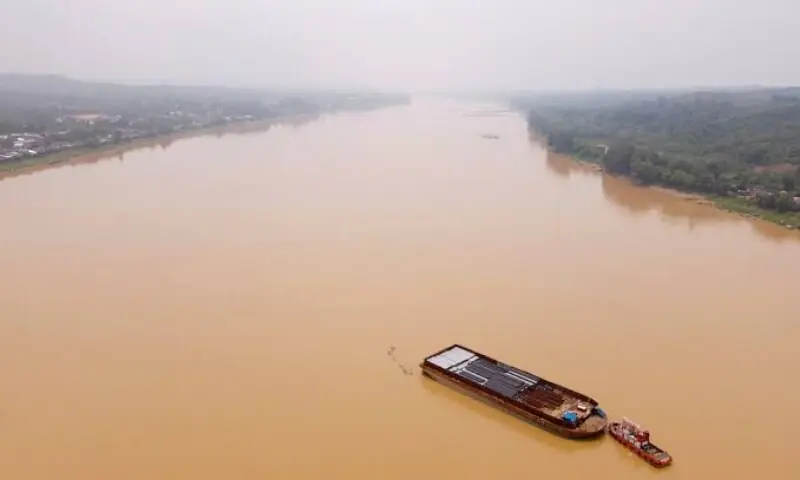
A drone view shows a tugboat alongside a cargo barge loaded with metal pipes, stuck on the Kapuas River, as water levels recede amid a prolonged El Nino-induced drought in Sanggau Regency, West Kalimantan province, Indonesia, September 30, 2026. —Reuters

NOAA projects this El Nino will be the strongest in its records, which go back to 1950, if the three-month average RONI anomaly reaches 2.5°C or higher, a level that would put it above the 1982-83, 2015-16, and 1997-98 events.

The chances are rated “high,” but not yet certain.

“Regardless of where we’re ranking or how we’re measuring this event, it’s an incredible opportunity to study and understand this very powerful phenomenon in the context of a warming world,” said Becker.

  •  

Oil-rich Alberta vote to determine next step towards possible separation from Canada

Alberta decides Monday if it wants to pursue a binding referendum on leaving Canada, with Prime Minister Mark Carney warning a separatist win would bring dangerous uncertainty during a trade war with the United States.

Polls indicate less than a quarter of people in the western Canadian province support independence.

But attention has focused on turnout in the days before the vote, and whether a motivated separatist camp could defy the polls, helped by complacent federalists.

“Don’t let anyone tell you this is already decided. Turnout will determine the outcome,” Carney told a rally on Thursday.

Carney, who grew up in Alberta, has called the referendum “a dangerous bluff” as US President Donald Trump imposes punishing tariffs and levels annexation threats aimed — the prime minister says — at breaking Canadian resolve.

“Vote like Canada depends on it, because it does,” Carney said.

Alberta has the world’s fourth-largest proven oil reserves and separatist momentum has been driven by anger over Ottawa’s management of the sector.

Many Albertans loathed Carney’s predecessor, Justin Trudeau, who they accused of trying to suppress oil production to advance his pro-climate agenda.

“If you want me to pinpoint who is responsible for the separatist sentiment, I think it’s Justin Trudeau,” Alberta Premier Danielle Smith told the Canadaland podcast this month.

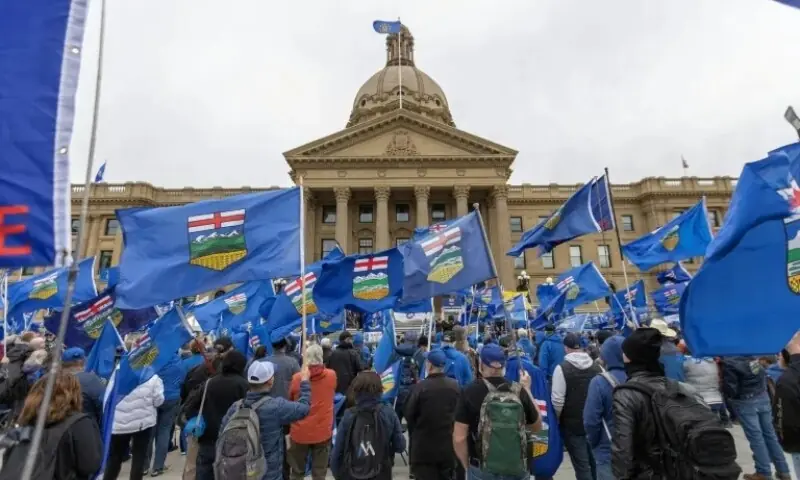
At a separatist rally in Edmonton on Saturday, 61-year-old Sandy Martel said people connected to the oil industry feel “robbed, cheated (and) mistreated.” “It’s time to stand up and say stop,” she told AFP.

The vote comes days after a fire at a military base in the province left at least four soldiers dead and wounded dozens, prompting a national outpouring of condolences.

‘Huge uncertainty’

Smith, a conservative, says she wants Alberta to remain in Canada but called the referendum to settle the divisive issue.

If a majority votes to separate, she has pledged to move forward with a binding referendum.

If the federalists win, Smith says the secession question should be considered closed.

Analysts have compared Smith’s tactics to those of former UK prime minister David Cameron, who had hoped to resolve the debate over Britain’s European Union membership with a vote.

Carney led the Bank of England through the turmoil that surrounded Brexit, and issued a warning to Albertans about that experience on Thursday.

“It wasn’t clear what ‘Brexit’ meant at the time,” he told a Calgary television station.

“For the next few years, while that was being determined, there was huge uncertainty, investments stopped, the economy started to underperform,” he added, cautioning over unintended economic consequences.

AI influence

Monday’s referendum features 10 questions, including several related to immigration, but focus is on question 10, which asks: “Should Alberta remain a province of Canada?” or should the province take the legal steps required for a definitive independence vote? Alberta’s election authority says ballots for question 10 will be counted first, with results expected in the early hours Tuesday.

The pre-referendum period was clouded by avalanches of manipulated AI content.

Carney has urged “a decisive result,” but experts are concerned about a contested outcome no matter the numbers.

“A very likely result of this referendum is going to be a community that sees this election as stolen or at least unfair,” said Aengus Bridgman, director of the Media Ecosystem Observatory at McGill University.

Close Trump allies have also inserted themselves into the discussion, including Treasury Secretary Scott Bessent, who in January described Alberta as a “natural partner” for the United States.

After a separatist party won Quebec’s provincial election on October 5, tech billionaire Elon Musk posted that “they would be better off” if they seceded.

“Alberta and Saskatchewan should separate too,” he added.

Asked about alleged foreign interference, Carney said Thursday that foreign governments, including the US, should not “get themselves involved in our elections.”

  •  
❌