
❌

Reading view

California's 'Wealth Tax' Could Cost the State $39 Billion
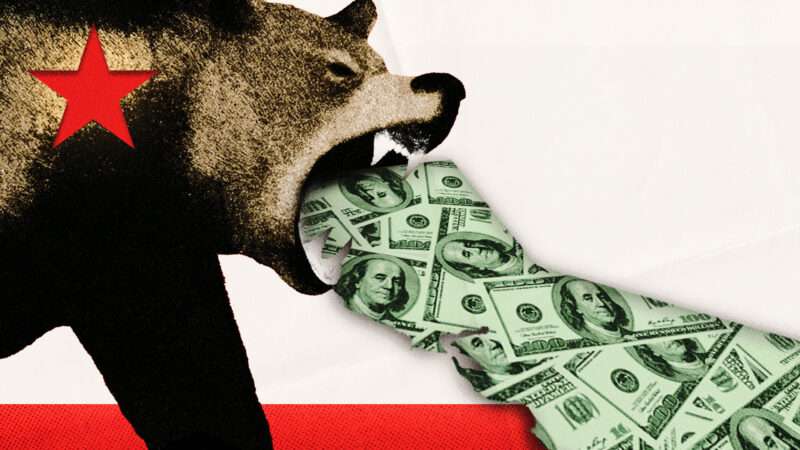
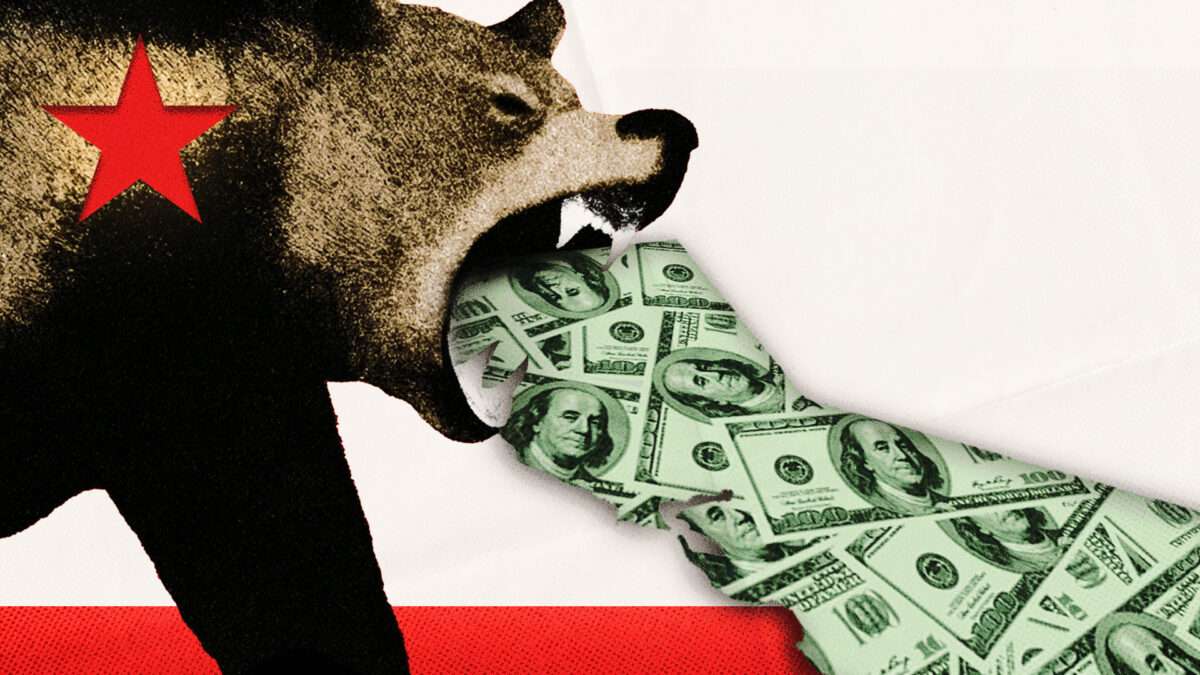
a bear vomits out U.S. dollars against the background of the California state flag | Helistockter/Dreamstime/Midjourney/Fatima Ruiz

A proposed "wealth tax" on California's billionaires could backfire and cost the state tens of billions of dollars in the long run.

If the proposed tax drives wealthier residents out of the state, California could end up losing between $1 billion and $3.5 billion annually in income taxes, according to a working paper published this week. A pair of researchers at Stanford University warn that the state could end up losing an estimated $39 billion because of the consequences of the wealth tax.

"These findings suggest that the Billionaire Tax Act will not fulfill the primary functions for which it was designed," write researchers Benjamin Jaros and Joshua Rauh.

Voters in California will decide next month whether to impose the one-time, 5 percent tax when they vote on Proposition 40. The ballot measure is dividing Democrats—Gov. Gavin Newsom opposes it, while progressive Rep. Ro Khanna (D–Calif.) claims it is the "most important ballot initiative in America and a fight for the soul of our party."

And it's already spurring some billionaires to flee the state—including venture capitalist Peter Thiel and Google co-founder Larry Page. Including those two, the seven billionaires who have publicly said they are leaving the state represent more than $539 billion of the nearly $1.9 trillion aggregate net worth of California's billionaires, the researchers note.

With other departures likely happening more quietly, the new study estimates that the tax will generate about $30 billion, a far cry from the $100 billion that the tax's supporters expect. The "behavioral response" from billionaires in California "has eroded most of the projected tax base," write Jaros and Rauh.

That's still a pretty big pot of revenue. In the long run, however, the state is likely to lose out.

After running 100,000 simulations using different assumptions, the two researchers report that "85 percent of plausible outcomes produce a negative" result in state revenue.

Other recent experiments with special taxes on wealth have backfired in similar ways. In response to a new wealth tax in Washington State, Jeff Bezos relocated to Florida, and iconic Seattle brand Starbucks shifted more of its corporate headquarters to Tennessee. Studies have shown that a "millionaires tax" in Massachusetts contributed to wealth moving out of that state.

Capital is always mobile, despite the best efforts of politicians. And if you were a billionaire living in California, why would you stick around?

Polls show voters are narrowly divided over Proposition 40. A Politico poll published earlier this month showed 46 percent of voters plan to vote for the measure, while 43 percent oppose it. Voters were similarly divided when asked if they expected it to pass or not.

The post California's 'Wealth Tax' Could Cost the State $39 Billion appeared first on Reason Magazine.
  •  

Elon Musk says money will be 'irrelevant' if his vision of a multiplanetary future comes true

Elon Musk is pictured.
Elon Musk says his descendants might have a "tiny fraction" of his wealth.

Jae C. Hong/AP

  • Elon Musk says "money becomes irrelevant" if he's right about what the future holds.
  • The Tesla and SpaceX CEO said AI and robots will be better than humans at everything.
  • The world's richest man said his fortune could be virtually gone within a few generations.

Elon Musk says money could be meaningless one day, and the vast majority of his wealth will likely be gone within a few generations.

The world's richest person predicted that advances in robotics and space travel will create a multiplanetary economy, at which point "money becomes irrelevant" and "conventional currency will not matter."

Value will be measured in mass and power or energy, he continued. "So that's my guess," he said, adding that it seemed a "pretty obvious" outcome to him.

The Tesla and SpaceX CEO shared his vision of a post-money future and his outlook on his personal fortune with his biographer, Walter Isaacson, on "The Builders" podcast. The interview was taped in early August and released on Tuesday.

Musk recommended earlier this year that people stop saving for retirement in 10 or 20 years, as he expects AI and other technologies to supercharge productivity and usher in an age of abundance where people can have "whatever stuff they want."

He made a similar argument to Isaacson, saying "there won't be anything that humans can do that the AI and the robots can't do better." People will likely turn to hobbies like growing their own fruits and vegetables, or making art, to find purpose in life, he said.

Musk's plans for his own money

Musk, who briefly became a trillionaire after SpaceX went public in June, topped the Bloomberg Billionaire Index at Monday's close with an estimated $920 billion net worth.

He defended his personal wealth on the podcast, saying that it mostly reflects his ownership of SpaceX and Tesla, and he needs large stakes in both companies to retain voting power and remain in charge.

His fortune is "going to be taxed quite heavily," Musk said, adding that there isn't "some magical way to avoid taxes" because "if there were, I would know about it."

Musk said his wealth will "get whittled down and a few generations from now — if money still matters, which I don't think it will — my descendants would have a tiny fraction of what I have."

He also outlined what he hopes his foundation will spend his fortune on after he's gone: "Continue the goals. Make life multi-planetary, extend consciousness to the stars, improve sustainable energy on Earth."

Notably, Musk pledged on Monday to gift a share of SpaceX to every child in the US next year, a contribution worth over $10 billion today.

His announcement has won praise from President Donald Trump, who hailed Musk's "incredible generosity" and labeled him a "legendary friend" in an X post.

Musk teased a charitable pledge in late July after Nobel economist Daron Acemoglu publicly challenged him over his prediction of a post-money future.

"If money won't matter in 2036, why don't you pledge to donate your current wealth of approximately $1 trillion to charity no later than 2036," Acemoglu wrote on X.

"I am actually going to do something along these lines!" Musk responded.

Read the original article on Business Insider

  •  

Trump praises Elon Musk's 'incredible generosity' over $10 billion SpaceX stock pledge for kids

Donald Trump holds a document beside Elon Musk in front of a White House backdrop and U.S. flag.
President Donald Trump praised Elon Musk's pledge to give SpaceX shares to children through Trump Accounts.

Kent NISHIMURA / AFP via Getty Images

  • Trump praised Elon Musk's plan to give one SpaceX share to every child in America next year.
  • The pledge could be worth about $10.6 billion at SpaceX's current price.
  • Musk and Trump have a rocky relationship, but appear to be back on the same page in recent months.

Elon Musk’s pledge to give every child in America a share in SpaceX has already paid one dividend: effusive praise from President Donald Trump.

"A BIG THANK YOU to our legendary friend, Elon Musk," Trump wrote Monday, calling the proposed gift an act of "incredible generosity."

He said the shares would go to children through Trump Accounts, the investment accounts created under his administration.

A BIG THANK YOU to our legendary friend, @ElonMusk, for his incredible generosity in giving SpaceX Stock to millions of American children through TRUMP ACCOUNTS! This is exactly what was envisioned when we created TRUMP ACCOUNTS — Bringing together the GREAT PRIVATE SECTOR, Elon and so many more, to invest in our children, by far our greatest and most important asset, and give every American Child a piece of the American Dream. Thank you Elon! President DONALD J. TRUMP

— Donald J. Trump (@realDonaldTrump) October 19, 2026

It was an enthusiastic response to Musk's commitment earlier in the day. "Next year, I will give one of my SpaceX shares to every kid in America," he wrote on X. "This will be the first of many."

Significantly, Trump shared his praise in a post on X, a platform he has eschewed in recent years since launching his social network, Truth Social.

Trump was barred from Twitter in 2021 after the Capitol riot, and while his account was reinstated after Musk bought and renamed the platform, the president has been an infrequent poster since then.

Musk's $10 billion donation promise

There are roughly 72 million children in the US, and SpaceX stock closed Monday at about $148 a share. At that price, one share apiece would put the gift's value at around $10.6 billion. Its eventual value will depend on SpaceX’s share price at the time the stock is transferred.

Trump has been waiting for this particular contribution. In July, he said he thought Musk would donate SpaceX stock to Trump Accounts, even as he referred to their very public falling-out as a "little dispute."

SpaceX President Gwynne Shotwell and her husband had already pledged shares for more than 2 million children’s accounts.

Musk and Trump have a turbulent relationship. The world's richest man was one of Trump's biggest financial backers in the 2024 election, spending more than $200 million to help elect him. The pair were close enough during the first few months of Trump's return to the White House for Musk to earn the nickname "First Buddy."

He then became the public face of the administration's Department of Government Efficiency before leaving in May 2025.

After leaving DOGE, Musk was highly critical of the president's "Big, Beautiful Bill," calling it a "disgusting abomination."

Musk has recently resumed spending heavily to shape Republican politics ahead of the midterms. Since July, he has given about $276 million, including $158 million to the Senate Leadership Fund; the super PAC later sent matching sums to a Texas group supporting Attorney General Ken Paxton's Senate campaign.

Lately, Musk has been seen publicly with Trump several times; the president awarded him the National Medal of Science earlier this month, and when China's leader Xi Jinping visited the US in September, he sat at the president's table at a state dinner.

Details are still unclear on Musk's SpaceX share giveaway

If confirmed, Musk would join other wealthy backers of the program. Michael and Susan Dell contributed $6.25 billion to the accounts of 25 million children, with the gifts directed first to children in lower-income ZIP codes. Musk’s donation would be larger than the Dells' barring a significant drop in SpaceX's share price.

For now, it remains a promise. Musk has not detailed who would qualify as a child under his plan, how he would get shares into every eligible account, or when the transfers would happen next year.

For Trump, the promise brings one of the country’s wealthiest business leaders behind a program he has promoted. "This is exactly what was envisioned when we created TRUMP ACCOUNTS," he wrote Monday.

Read the original article on Business Insider

  •  
❌