U.S. v. Santiago, decided Monday by Judge Chad Meredith (E.D. Ky.), involves this Instagram post:
Santiago is being prosecuted for making threatening interstate communications, in two counts, "one regarding the threat to the President, and one regarding the threat to law enforcement officers." The court allowed the prosecution to go forward:
[T]he question of whether Santiago's speech was a "true threat" or political hyperbole is one that must be determined by a jury, not the Court.
Of course, "courts retain the power to remove a true-threat question from the jury's consideration … if the evidence shows that the speech was protected as a matter of law." But the implication to be drawn from the evidence here is disputed and it is not so clear-cut that the Court can decide it as a matter of law. A reasonable jury could find Santiago's statements to be true threats, and so the matter must be presented to a jury. The First Amendment does not say otherwise because it does not even apply if a jury concludes that the statements were true threats….
For most context, see the FBI agent's affidavit accompanying the criminal complaint; an excerpt:
Between January 27, 2026, and March 27, 2026, kadi_skating [allegedly one of Santiago's user ids] sent the following messages to an unidentified user: …
• kadi_skating: "im filled with political violence now." [January 8, 2026]….
• kadi_skating: "death to trump." [March 2, 2026]
• kadi_skating: "death to the American nazi regime." [March 2, 2026].
• kadi_skating: "and the american people NEED to start shooting at the necks, legs, and arms of ICE agents." [March 2, 2026]
• kadi_skatlng: "STUFF A GRENADE IN THEIR AHH AND BLOW IT UP." [March 2, 2026]
• kadi_skating: "LETS GOOOO no one is spared all of ice is going to die by my hands [March 2, 2026]
• kadi_skating: "I wanna kill n*zis bad." [March 23, 2026]
Emily K. Greenfield and James T. Chapman represent the federal government.
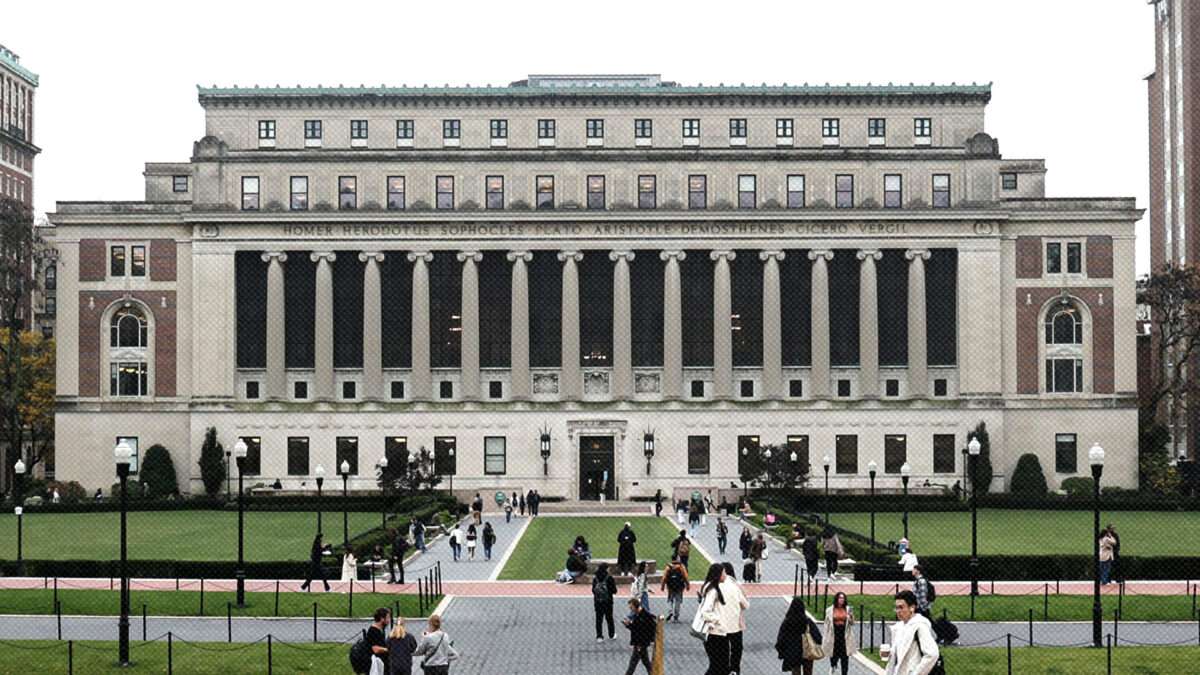
Questioning the prevailing narrative about the "Cornell seven" case is bound to create controversy. And at Columbia University, two student journalists drew condemnation for their views on the case from the unlikeliest of places: a college free speech group.
On October 13, Barnard junior Christina Ma and Columbia junior Nikos Mohammadi published an article called "The 'Cornell Seven' Is Really About Liberalism" in the Columbia Sundial, an independent student publication. The piece argued that the discourse surrounding the alleged rape at Cornell University infantilizes women by omitting the possibility that in a post–sexual revolution, liberal society, women may make regrettable but consensual choices.
"In the world that, for better or worse, follows from it, we cannot claim to stand for sexual freedom and then recoil in disgust when there's a possibility that a young woman simply chose to exercise it," Mohammadi and Ma wrote.
The piece also argues that the "collective frenzy" over the Cornell case has created a climate on campus that makes it "difficult to disagree with the maximalist position on what happened" the night of the alleged rape.
As Mohammadi wrote in UnHerd, the piece caused immense backlash. He said he received an onslaught of messages urging him to commit suicide and demanding that his "career and life be destroyed." But the criticism went beyond threatening DMs and comments.
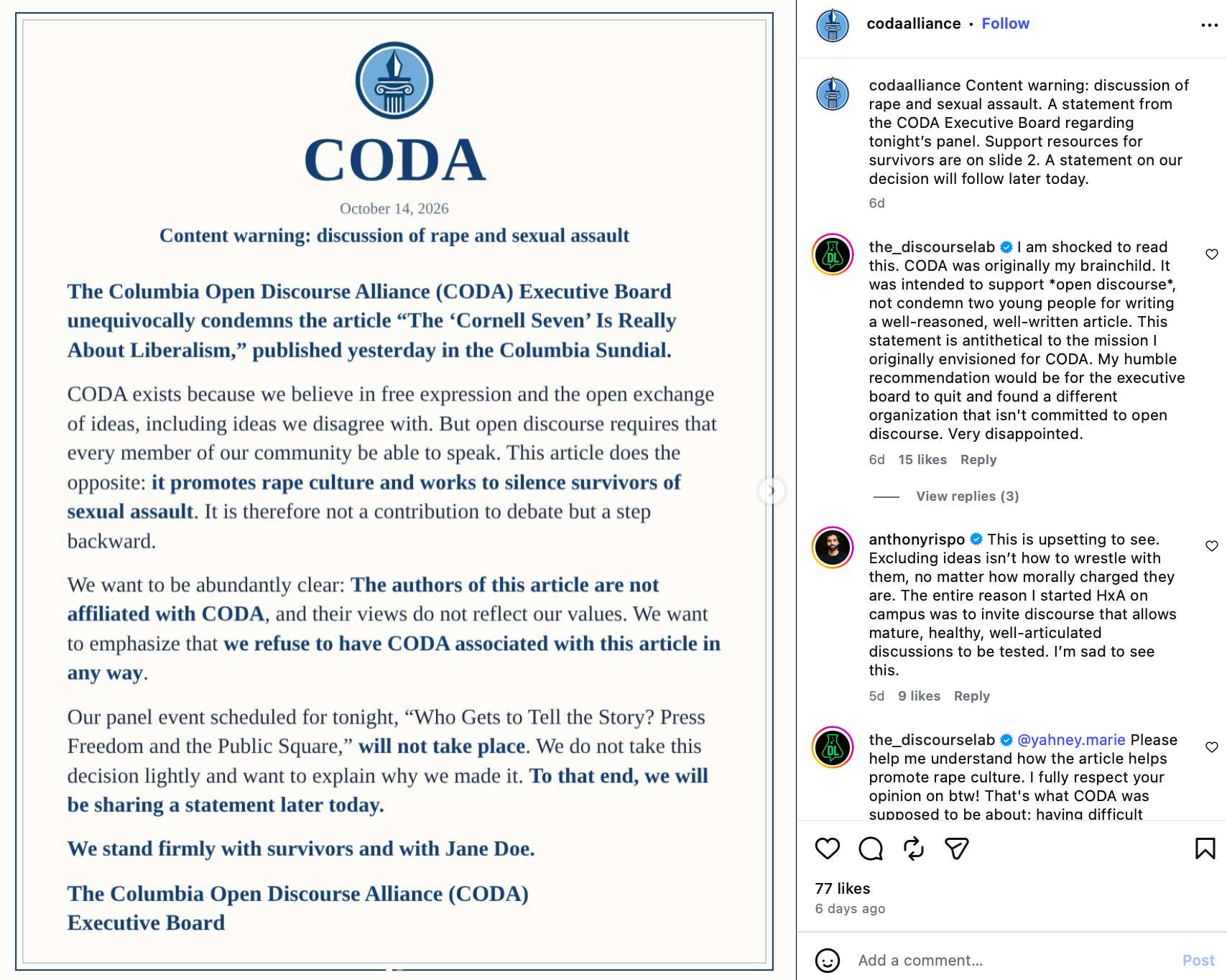
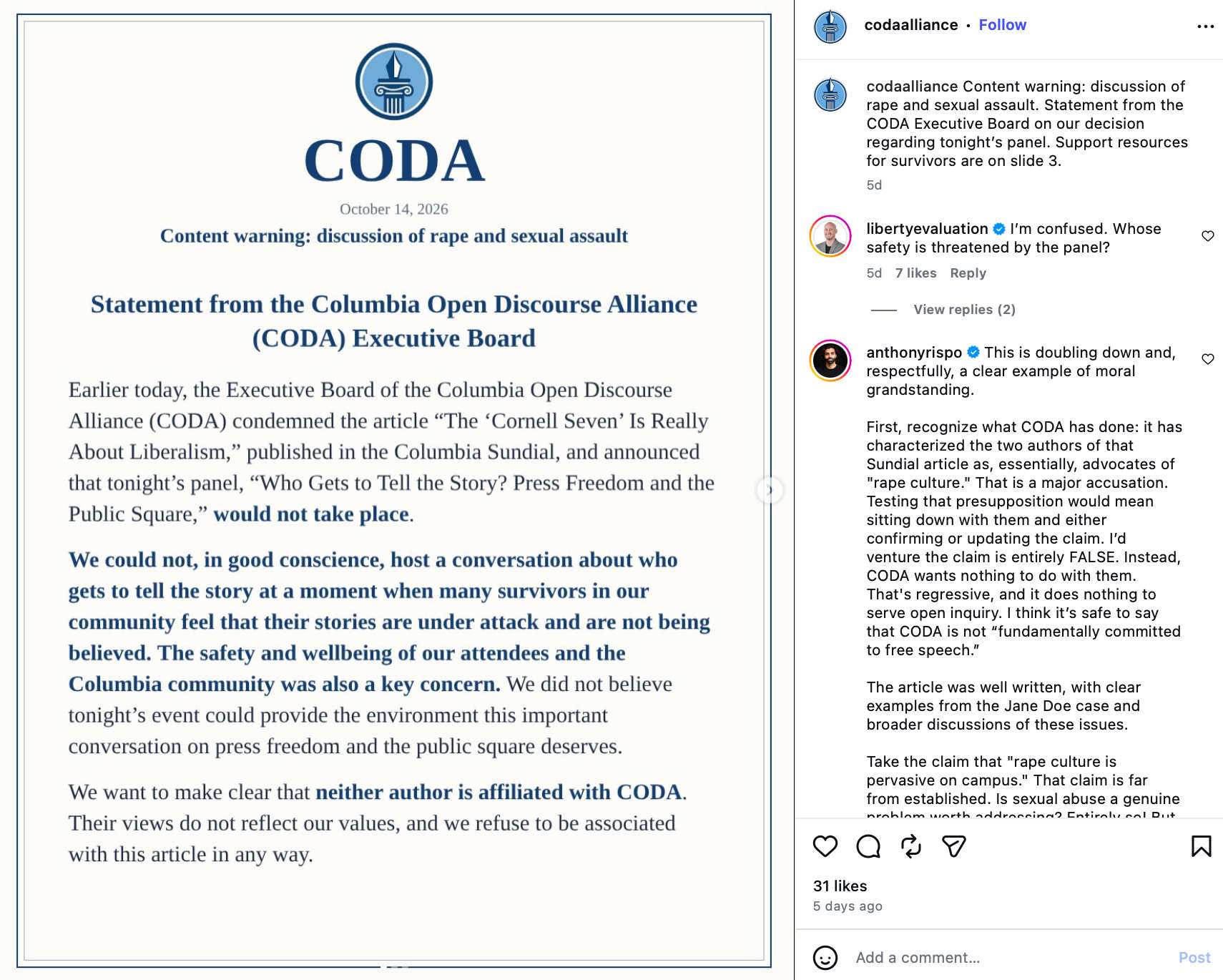
The day after the article's publication, the Columbia Open Discourse Alliance (CODA) canceled an event about press freedom because the Sundial's editor in chief, Nick Baum, had been slated to speak at the event. Although Baum did not author the piece, CODA wrote in an Instagram post that the free speech group "refused" to be affiliated with the Sundial's article "in any way."
CODA also claimed that the event, ironically called "Who Gets to Tell the Story? Press Freedom and the Public Square," could not take place at a time when "many survivors in our community feel that their stories are under attack and are not being believed."
The group added that the Sundial's article "promotes rape culture and works to silence survivors of sexual assault."
The group's president, Aum Desai, told Columbia's student newspaper, the Columbia Daily Spectator, that the group canceled the event "not in spite of, but because of [CODA's] commitment to free expression."
Columbia graduate Clayton Smith, who founded CODA in 2025, quickly commented that he was "shocked" by CODA's statements on Instagram. Smith started the organization to create a central hub for groups hosting events promoting free speech and open discourse, including the Sundial and Columbia's Heterodox Academy chapter.
He tells Reason that CODA's rationale for canceling the event was "ironic" and "hypocritical," and he believes the group should have collaborated with the Sundial if there were legitimate safety concerns at the event. He says he was particularly disturbed by the group's condemnation of the article and CODA's claim that it promotes "rape culture."
"They don't argue or explain how it works to silence survivors of sexual assault. It is a baseless slander that they use to condemn the article because it promoted an opinion they do not like," Smith says.
Smith says he spoke to Desai on the phone after CODA posted the statements, and Desai tried to reassure him that CODA would uphold the principle of free speech. But Smith says he did not leave the phone call feeling "very confident at all" in Desai's commitment.
Desai did not respond to Reason's requests for comment.
CODA faculty adviser and Columbia Business School professor emeritus Eli Noam was traveling in China during the fallout from the Sundial article and was not involved in CODA's decision.
After speaking with members of both CODA and the Sundial, Noam tells Reason that he thinks CODA "made some proper decisions, some correct decisions, and some mistakes."
"I think we're dealing here with…a group of college students who kind of were confronted with a crisis at 2 a.m.," Noam says. "And kind of [made] some judgments that they now regret, and they do."
He tells Reason that it was not "unreasonable to assume there would be a disruption" at the event, given the climate at Columbia and "about this rape allegation." He says the group suddenly "had an event where they needed college security" and could not organize in time. CODA, Noam says, is not yet recognized by the university, and he thinks the group was likely fearful of jeopardizing its recognition.
Still, Noam says CODA's statements condemning the article were "unreasonable," and it was "disappointing that they kind of lost their nerve here."
Although he was not involved in planning the panel, Mohammadi says, to his knowledge, there were no credible threats of violence to the panel. He understood there may have been "disgruntled students" and an "environment CODA did not want to deal with." But instead of simply canceling the event or working with the Sundial to find a solution, Mohammadi says CODA overstepped by condemning the Sundial piece.
James Applegate, an astronomy professor who serves on Columbia's Academic Freedom Council (CAFC) alongside Noam, tells Reason that he disagreed with CODA's decision to cancel the event.
Applegate tells Reason he was considering attending the event, and he was "rather surprised and disappointed" when it was canceled.
He recalled that when he was a professor in 2000, he objected to changes to the school's sexual misconduct policy on the University Senate floor. He says his statements were "similar to what was said in the Sundial article" and there was a "level of emotion in this debate."
"Nonetheless, we had the debate. I was in it, and the degree to which it was civil is shocking when you look at where we are now. And it's sad."
Applegate said he does not condemn CODA, however, "for the simple reason that the atmosphere on college campuses and on the left wing of politics in general in the United States is quite vicious."
CODA's honorary faculty fellow John McWhorter tells Reason he interpreted CODA's statement as "saying that an event about who gets to tell the story is untenable when or if a critical mass of people with such stories don't even feel comfortable telling them— i.e.being a participant in the event." He added, "I imagine some might think of that as cutting the salami a little thin, but then I highly suspect that Desai is equally worried about the event becoming a physical melee of some kind. In that, let's face it, he is hardly unreasonable."
Still, McWhorter said that he would have chosen to have the event himself, "especially as in the likely case that some people did talk about their experiences without any particular repercussions, it may have made the more reluctant people less apprehensive about doing so in the future."
According to Mohammadi, as of Tuesday, the Sundial, College Republicans, Platypus Affiliated Society at Columbia (which discusses leftist thought and history), and Columbia's Heterodox Academy chapter have left CODA.
CODA was not the only group to condemn the Sundial's piece. On October 14, the Columbia Political Review's editorial board wrote that Mohammadi and Ma's piece "violates standards of integrity" and "perpetuates a culture of campus violence, rape, and assault." The editorial board of the Columbia Political Review, which purports to publish "multipartisan political discourse," stated that it would refuse to publish "any article that upholds or recreates cultures and systems of rape, sexual assault, or violence" and it urged "all campus publications to do the same."
And on Monday, Columbia's main newspaper, the Spectator, published a staff editorial accusing the Sundial of violating journalistic ethics by "its page to disparage survivors of sexual violence."
Mohammadi tells Reason the piece underwent "far more editorial scrutiny than any other piece" the Sundial had published given the sensitive nature of the topic.
Free speech student organizations are necessary on Columbia's campus, especially as the school's free speech climate continues to crumble; it recently received a failing grade from the Foundation for Individual Rights and Expression. And while upholding free speech principles may have become more fashionable among those resisting the Trump administration's pressures on academic freedom or those defending pro-Palestinian speech, it is clear that some topics remain taboo in the public square. College is supposed to be a place where students debate controversial topics, form their own beliefs and opinions, and learn from mistakes. Hopefully, the students who demanded condemnation instead of debate will be forgiven for their perversion of free speech ideals, and they will learn to afford such grace and open-mindedness to classmates with whom they disagree.
The Libertarian Party of New Hampshire's (LPNH) X account—which has become infamous for its bigoted and controversy-ridden posts—is finally gone. But the state's spurious role in its banning raises free speech concerns.
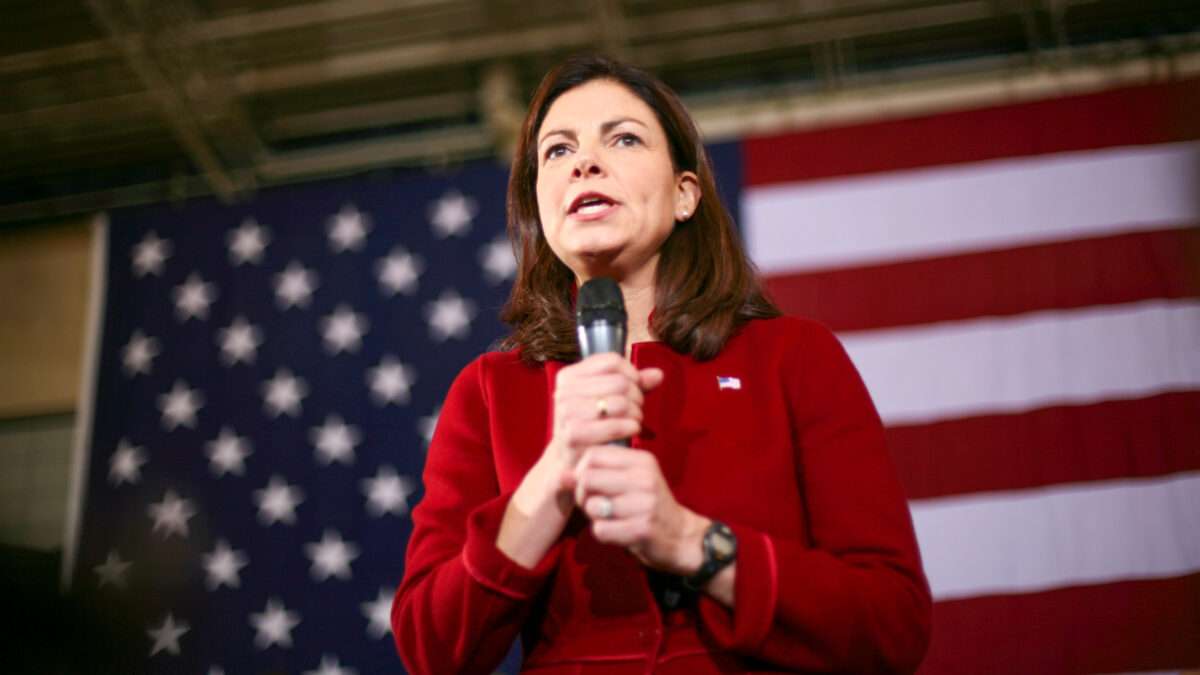
Last week, New Hampshire Republican Gov. Kelly Ayotte sent a letter to X's safety team, asking the company to suspend the account. Ayotte's letter made mention of several clear violations of X's content policies: "This account has openly called for the assassination of elected officials from the New Hampshire Democratic Party, has said it condones murdering elected officials for their policy positions, and most recently threatened a member of House leadership.…I'm calling on X to remove [the posts] and suspend the account immediately."
The letter referenced one particularly bold post from September (which the account later deleted). The post read: "We openly support the assassination of basically every elected democrat in New Hampshire. But if you don't have the balls to do it, then you should probably vote GOP."
X suspended the account the day after Ayotte sent the letter.
The removal of the LPNH account has likely elicited a sigh of relief from the Libertarian Party's (L.P.) leadership, which has repeatedly tussled with LPNH over its extreme rhetoric, undermining of L.P. candidates, and constant creation of P.R. crises for the party. In 2024, the LPNH endorsed Donald Trump for president instead of Libertarian candidate Chase Oliver, pushing the Libertarian National Committee to disaffiliate LPNH from the L.P.'s structure this past May. The Granite State Libertarian Party was designated the state's new L.P. affiliate in September.
Even though the LPNH has clearly violated X's terms and does not adhere to the most basic requirements for L.P. membership (such as pledging to uphold the nonaggression principle), the government should not tell private firms when to enforce their own policies. This sentiment was shared by Granite State L.P., which recently said in a social media post, "While a private company has a right to remove someone screaming about setting people on fire…the government should play zero part in that decision."
Jeremy Kauffman, the chair of the LPNH, is outraged but unsurprised, posting on Sunday that he and the LPNH are "exploring a lawsuit against the New Hampshire government." He tells Reason, "Ayotte's letter was a classic example of jawboning. When a governor sends a demanding letter like this to a private company, there is a clear implicit threat attached."
Speaking to Reason, Trace Mitchell, a technology and free speech expert at the Foundation for Individual Rights and Expression, defines jawboning as, "when the government, through veiled threats or direct coercion, pressures a private entity to take an action that the government could not lawfully take or mandate itself."
In Bantam Books v. Sullivan (1963), the Supreme Court ruled that the government cannot make recommendations to private companies if those recommendations come with legal repercussions—even implied or veiled repercussions. Doing so would qualify as jawboning, which violates the First Amendment. Though Ayotte's letter could be construed as extralegal pressure, it does not imply a punishment for noncompliance and likely falls short of legally recognized jawboning.
Addressing Kauffman's proposed lawsuit, Mitchell says, "In this case he would likely have to show there is something beyond this letter…[like] outside communications, emails or text with X."
Safety officers at X provided no comment to Reason to justify the suspension. It is not clear whether there was any external communication involved beyond the letter. Without a more definite connection between Ayotte's request and X's decision, Kauffman may struggle to win in court. Still, that doesn't make the governor's request any less concerning.
While Ayotte's letter was a surprise, it was not unprecedented. As social media has become the public forum, all levels of government have tried to regulate what is said there. During the COVID-19 pandemic, federal officials under the Biden administration were revealed to be in near-constant communication with major social media firms, encouraging and recommending that misinformation be removed from the platforms. Many of these recommendations were paired with implied threats to review the firms' legal immunity for content posted on their platforms, which spawned a lawsuit that reached the Supreme Court in 2024.
Although the Court dismissed the case for lack of standing, some lawmakers have taken action to address concerns over jawboning, with Sen. Ted Cruz (R–Texas) introducing the JAWBONE Act in June. The bill would make it easier for members of the public to sue government officials who pressure media networks, as well as require increased transparency for all federal communications to media networks.
Even if Kauffman cannot find legal remit, Ayotte's letter was a troubling move for the future of internet speech. Many of the offending posts referenced were months old or had been deleted before the letter was sent. The LPNH has likely been violating X's content policy for years, but X only took action after the government instructed it to.
You don't need a judge to see how that might be concerning.
Holy Trinity is a Ukrainian Catholic parish outside Pittsburgh. It practices the Catholic faith, but with rituals and architecture that are distinctively Ukrainian. The parish owns two plots of land. On one of them, in Carnegie, sits a church, where it holds regular liturgies. The other plot, in nearby Collier Township, has been owned by the parish for more than seven decades. That 41-acre plot houses the parish's cemetery and mausoleum but is otherwise mostly wooded.
About three years ago, Holy Trinity's pastor felt called to turn the second plot into a shrine, a pilgrimage destination for faithful to gather from "near and far." The shrine would "honor Mary, the Mother of God, and would pay homage to the sanctity of life." With the help of lawyers, architects, and traffic consultants, Holy Trinity designed the shrine. It envisioned a 13,000-square-foot chapel with gold domes, a bell tower, a museum, a gift shop, and a retreat center.
But the plot is constrained by Collier Township's zoning code. The code divides the township into districts, each of which allows certain types of buildings. The northern, wooded half of the plot lies in a planned-economic-development district, allowing larger projects like business offices, amusement parks, or country clubs. The southern half is in a rural-residential district, allowing farms and single-family homes. Neither district contemplates shrines.
The zoning code is enforced by Collier's five-member Board of Commissioners. The Board has power not only to rezone land or amend the code, but also to approve or deny some building projects, because the code makes some land uses conditional. For instance, the code conditionally allows new churches in rural-residential districts, but only if the Board approves them. In any event, anything as big as Holy Trinity's shrine needs the Board's approval.
To fit the shrine project into the zoning code, Holy Trinity applied to do two things. First, it asked the Board to amend the zoning code to allow planned cultural centers, including the shrine, in economic-development districts. Second, it sought to rezone some of its rural-residential land into economic-development land, to make a larger plot for the shrine. As part of its application, Holy Trinity included sketches of its shrine plus a traffic study showing minimal impact on the surrounding community. After a live hearing with concerned residents, the Board denied Holy Trinity's application, expressing concern about traffic and Holy Trinity's fundraising projections. Some residents, and at least one Board member, were also troubled once they learned that the shrine's message would be pro-life.
So Holy Trinity tried again with a smaller project. It applied to build a modest chapel entirely on its rural-residential land. Though the Board approved the new application, it came with strings attached, limiting bell ringing, the height of the chapel, and who could be remembered at memorial services….
The majority held that Holy Trinity wasn't entitled to a preliminary injunction, because the harm could be repaired by damages (one of the elements of the preliminary injunction inquiry); on this matter, the majority and Judge Paul Matey's dissent had an interesting and complicated debate. But here's a passage as to the facts that struck me as worth noting, even apart from that controversy:
Finally, and most troubling, both community and Board members objected to the shrine's pro-life message. One resident worried that "Father Jason has been very involved in pro life. This is to be a pro life museum … [W]hen you think very political rights, either side, it brings a lot of danger, a lot of protests, as well as costs that could be incurred by the community." Another complained that "the intent of the shrine was a celebration for Roe vs. Wade being overturned … [and] reparation for sin of abortion and counseling, spiritual direction …. this will bring a bunch [of people] potentially for a rally and this could also bring the opposite as well for protest."
Privately, at least one of the Board's members agreed. The day after the hearing, that commissioner forwarded an email about the shrine's pro-life stance to the rest of the Board: "Looks like we might have dodged a bullet last night. The true inten[t] of the shrine" was pro-life and "This could have been a disaster." Another township officer, copied on the email, seemed to affirm those sentiments. Nothing in the record suggests that any other Board member responded and disagreed. And in her deposition, the Board member who wrote the email confirmed that "one of the reasons" that the Board had denied the application was Holy Trinity's pro-life purpose. She also defended denying land-use approval "based on the nature of the religious service to be held in the building."
These objections hint at unconstitutional religious hostility and content-based discrimination, concerns that would be better addressed on a more developed factual record. But at the very least, they strongly suggest that the Board resists ever approving the shrine project. If so, the rezoning denial is effectively absolute, and the "degree" of burden on Holy Trinity is substantial. Plus, the township does not show that denying approval altogether is the least-restrictive means to serve a compelling interest. That is enough to show that Holy Trinity is very likely to prevail on its RLUIPA [Religious Land Use and Institutionalized Persons Act] substantial-burden claim….
In October, BreakThrough News received a letter from Rep. Jason Smith of the House Ways and Means Committee, threatening to personally subpoena seven members of our journalistic, editorial and administrative staff — including Rania Khalek, Zoe Alexandra and Amanda Yee — unless we handed over our financial records and internal communications.
Through its attorneys, BreakThrough News has now issued an official response, which you can read below. Once again, we expressed that we would not surrender our First Amendment rights in the face of a blatantly unconstitutional abuse of power, and that no legitimate legislative basis has been established for this inquiry. In his own statements, Rep. Smith has made no attempt to disguise the fact that his Committee subpoenas are fueled by opposition to BreakThrough’s editorial stances and viewpoints, which he calls “anti-American.”
We have been overwhelmed by support from our community, who have raised their voices in defense of our constitutionally protected right to free speech under the First Amendment. We ask all readers to continue showing their support by signing the petition below and making a donation to help defend the organization.
Our attorneys’ response explains:
“Threatening compulsory depositions of journalists and newsroom staff to compel document production operates as coercive retaliation by explicitly targeting the core editorial leadership and journalistic staff of BreakThrough News. Allowing a congressional committee to haul journalists into deposition rooms to grill them on domestic and foreign policy reporting sets a dangerous precedent of state-sponsored press intimidation that chills independent journalism nationwide and infringes on core First Amendment protections.”
On October 19, a coalition of ten major civil liberties and press freedom organizations, led by the Freedom of the Press Foundation, issued a joint letter to Rep. Smith demanding an end to the persecution of BreakThrough.
The letter noted: “Serially subpoenaing employees of a small left-wing news outlet to compel them to personally appear before you, for no reason other than to further a vindictive political stunt, is beyond the pale and reminiscent of some of the darkest chapters in our nation’s history.”
We are deeply appreciative of organizations that have spoken out: Freedom of the Press Foundation, American Society of Journalists and Authors, Defending Rights & Dissent, First Amendment Foundation, National Coalition Against Censorship, National Press Photographers Association (NPPA), PEN America, Society of Environmental Journalists, Society of Professional Journalists, and The Media and Democracy Project.
We would like to express our gratitude for the hard work of our legal counsel — the Law Office of Andrew D. Herman and Mara Verheyden-Hilliard of the Partnership for Civil Justice Fund — in responding to this outrageous attack.
Finally, we extend our solidarity and appreciation to all the members of our team, who continue to work tirelessly to produce meaningful journalism in the face of federal threats.
Read our full response below issued by BreakThrough’s attorneys.
A coalition of press freedom and civil liberties organizations is calling on the House Ways and Means Committee to abandon its threat to subpoena staffers at BreakThrough News. The House committee has demanded that BreakThrough employees testify before Congress unless the outlet withdraws its First Amendment and other objections to the committee’s earlier subpoenas and document requests by October 20.
The committee says its inquiry is part of a tax-related investigation into one of BreakThrough’s donors. But the committee and its chairman, Rep. Jason Smith, R-Mo., have also accused the outlet of “anti-American rhetoric” and “messaging that mirrors hostile government propaganda,” pointing to its criticism of immigration enforcement and of US and Israeli foreign policy. The letter outlines that such statements make clear the investigation is targeting BreakThrough for its viewpoints. The coalition warns that letting Congress interrogate a newsroom over its editorial positions sets a dangerous precedent for journalists of every political persuasion.
Freedom of the Press Foundation (FPF) Chief of Advocacy Seth Stern stated: “Rep. Smith’s shameless targeting of BreakThrough News for editorial viewpoints that he dislikes shows a complete disregard of the First Amendment. Congress has many more important things to do than interrogate an entire nonprofit newsroom because lawmakers speculate that disagreement with their opinions must evidence a conspiracy. The committee has not identified any alleged unlawful conduct by BreakThrough or any legitimate legislative purpose for its investigation. People who themselves hold controversial political views should understand the risk of normalizing fishing expeditions targeting dissent.”
Read the full letter below:
Dear Chairman Smith,
We are a coalition of press freedom and civil liberties organizations. We are alarmed by your recent correspondence threatening to issue subpoenas to BreakThrough News, a nonprofit organization that publishes news reporting and commentary. Your letter indicates that you plan to demand that virtually every individual associated with BreakThrough’s newsroom, from its editor-in-chief to its social media manager, appear before Congress unless BreakThrough rescinds its well-founded First Amendment and other objections to your prior invasive demands.
The Committee first demanded records from BreakThrough in February, claiming to be pursuing a tax-related probe into donations from Neville Roy Singham, a U.S. citizen based in Shanghai. Those demands and subsequent ones were outrageous in and of themselves, but serially subpoenaing employees of a small left-wing news outlet to compel them to personally appear before you, for no reason other than to further a vindictive political stunt, is beyond the pale and reminiscent of some of the darkest chapters in our nation’s history.
Although your justifications have repeatedly shifted in your various letters and subpoenas to date, you have admitted the true impetus for the inquiry is the groups’ viewpoints, stating they have “amplified anti-American, foreign-aligned narratives on social media, and pushed messaging that mirrors hostile government propaganda.” You further stated, “I will absolutely not stand by and allow our tax code to be abused to push anti-American rhetoric on our home soil.”
The First Amendment protects those who voice even controversial opinions shared by hostile governments abroad, but your primary examples of BreakThrough’s “anti-American” views are criticism of ICE’s tactics and Israel’s U.S.-funded wars – policies that many millions of Americans who have never received funding from or even heard of Mr. Singham also dislike.The fact that foreigners also dislike those policies might underscore their unpopularity, but it does not diminish BreakThrough’s right to share similar views.
Your letter also raises BreakThrough’s alleged connections to a lawfully organized domestic political party, the Party for Socialism and Liberation. Such connections are not illegal and, like receiving donations from a U.S. citizen living abroad, cannot come close to supporting broad subpoenas seeking a news entity’s internal documents or depositions from its entire staff.
Beyond the blatant unconstitutionality of targeting news outlets for their political views, House subpoenas must serve a legislative purpose. Fishing expeditions do not suffice.
BreakThrough News’s reporting and commentary, no matter how distasteful you may find it, is protected by the First Amendment, just as your own views are protected no matter how distasteful others may find them. As the Supreme Court wrote over 80 years ago, “if there is any fixed star in our constitutional constellation, it is that no official, high or petty, can prescribe what shall be orthodox in politics, nationalism, religion, or other matters of opinion.”
The First Amendment exists to protect people with politically disfavored views from people like you. Speech that politicians approve of is not in need of constitutional protection.
The threatened subpoenas are clearly designed to target BreakThrough for reporting and editorial viewpoints with which the Committee disagrees. Subpoenas of journalists and newsrooms obstruct First Amendment activity by forcing cash-strapped news outlets to spend time and money defending their rights, and by intimidating not only reporters but also sources, donors, and readers.
We demand that you refrain from issuing further unlawful and retaliatory subpoenas, and drop your entire unconstitutional inquiry into BreakThrough News.

 Login