❌

Reading view

The AI boom is good for people who write about AI. Ask Derek Thompson.

Derek Thompson

Courtesy of Derek Thompson; BI

  • The AI boom is swallowing the US economy.
  • That extends to people who make a living writing, says author Derek Thompson: Stories about AI are the most lucrative thing he can produce.
  • Thompson, who writes about a wide range of topics, says he's torn between writing stories he knows his audience wants, vs other topics he cares about.

Derek Thompson writes and talks about a lot of things.

But some things pay better than others: "Dimes for analysis, dollars for facts, and Benjamins for facts about artificial intelligence," he tells me.

Thompson, a longtime Atlantic writer who left to launch his own Substack in 2025, has an avid following — Barack Obama reportedly reads him to stay on top of AI developments.

That following also creates an inherent tension: If he only creates work he knows will have a big audience, it squeezes out other subjects he's passionate about, like the way technology affects the media we consume. Or why he thinks Americans should embrace a pro-building mindset — the subject of "Abundance," the recent book he co-wrote with Ezra Klein.

I talked to Thompson about AI — of course — along with some of his other passions, like why he thinks pro sports are a conspiracy that lets the richest people in the world turn "their already-elevated wealth into exospherically extreme wealth." You can hear our entire conversation on my Channels podcast. The following is an edited excerpt:

Peter Kafka: Perhaps the only thing Americans agree on is data centers — they hate them, and don't want them built in their communities. What is the "Abundance" view on data centers? Could you argue that building them is good for the country — just like building more housing is good?

Derek Thompson: I don't see data centers and houses as being equivalent. I think data centers are houses for chips. Really, they're igloos for chips because they're very, very cold houses.

While I feel incredibly passionate about removing barriers to building housing where people want to live, I feel less passionate about saying we need to make sure that every AI company can site every data center wherever it wants to build it.

There are costs to an economic infrastructure project that leans so heavily into data centers that other modes of construction are being starved for resources. Jason Furman, an economist at Harvard, just published a graph showing that in the last year, while data center construction's up by more than 60%, construction of hospitals is down, construction of offices is down, construction of housing is down, construction of just about everything else that you can name, including manufacturing facilities, is down because data centers are essentially eating the economy and crowding out a lot of other investment.

Am I anti-data centers in the extreme? No. Do I think data centers are just like houses? Absolutely not. I think houses for people are more important to emphasize as a matter of public policy than houses for chips.

Last year, you wrote this great piece about how "Everything is Television," where you argue that it's inevitable that all media becomes video. But you've also said that you've become a video podcaster because your podcast company nudged you to do that. How much of the video push is corporate incentive, and how much is what people want?

My theory is that it's corporate incentives because it's what people want.

Companies have attempted pivoting to video infinity times. But other pivots to video, especially in the last few years, have essentially become the norm. Everyone's podcast goes to YouTube now, or Spotify or Netflix. That suggests to me that the instinct to pivot to video reflected a reasonable corporate interpretation of an underlying consumer reality: that, at the end of the day, what most people want to do with most of their time is sit on a comfortable couch or chair and look at moving images.

There does seem to be something spookily, biologically inherent about the degree to which we want to just watch moving images. Television went from zero to 50% adoption rate in a decade.

There is just something true, with a capital T, about the media success of a technology that allows us to do nothing but turn our minds into a receiver for moving images. I'm not saying that's good. I'm just saying that apparently is the situation.

How has going independent changed how you work and what you make?

When you go from being a salaried employee, where you make one amount of money all year, no matter what, to being self-employed, where the line goes up the harder you work, it's very hard to ignore that signal and not work harder.

I feel more harried about work than I did. When that line doesn't go up, when it starts to slip, when 12 months has elapsed since a big article I wrote last year, and because 10% to 20% of subscribers are gonna drop out of the list, it sucks to see any number go down. And then I start to think, "God, I gotta work harder. I gotta get that next article to make the revenue line go back up."

Are you more inclined to think, "That story about sports billionaires did well, let's do more of those," in a way you might have been insulated from at The Atlantic?

Yeah, there's no question. And again, this is not something I think is altogether good. I said one thing I've learned from a year on Substack is that it's dimes for analysis, dollars for facts, and Benjamins for facts about artificial intelligence.

Recognizing that it's dimes for social analysis and Benjamins for AI analysis, there is a part of the job that pulls me toward writing more about AI than I might ...

Because the market wants it.

The market clearly wants it. That said, I do think artificial intelligence is not only the most important but also the most interesting story in the world. It's an economic story. It's a safety story. It's a stock story.

I have this long list of essentially social essays that I want to write. Stuff like "Everything Is Television." But I know that if I only write those essays for a month, if I only write those essays for a year, the line's gonna go down.

And so I'm interested in AI, and fortunately, the AI stuff sells. The AI reporting that I do creates a zone of extraordinary comfort for me to spend time writing stories that I know won't make money, but I think could be really, really broadly read as social analysis.
Read the original article on Business Insider
  •  

The latest K-beauty craze is made from dead Americans' skin. Now it's aiming for the US.

Close-up of a woman's face and neck with a blue-gloved hand holding a syringe. The center of the syringe is cut out and filled with a human skin texture

Getty Images; Alyssa Powell/BI

A hot, new beauty treatment driving tens of millions of dollars in sales around the globe is now aiming for the US market. Its unusual ingredient: skin from dead Americans.

Each year, tens of thousands of Americans donate bodily tissue upon their deaths, generally by checking a box at a motor vehicle department or through an authorization made by a loved one. Over the past few years, tens of millions of dollars' worth of donated skin has traveled from American tissue banks to biotech companies in South Korea, the beauty capital of the world. There, among other uses, it is turned into injectable beauty treatments.

The maker of the market-leading Korean brand said last week it has signed a distribution contract to introduce its skin-derived injection to the US market next year. It isn't clear whether the product can be sold in the US without approval from federal regulators.

Business Insider traced the tissue supply chain to understand how donor tissue from, say, San Antonio can end up for sale at a clinic in Seoul — and how much money is being made along the way.

People who donate tissue "have no idea of how much money is changing hands in the course of all of this," Ana Iltis, a professor at Wake Forest and former president of the American Society for Bioethics and Humanities, told Business Insider. "With tissue donation, there's a lot of money at stake."

Donors and their families can't be paid for organ or tissue donations under US law.

A K-beauty trend

For decades, American plastic surgeons have used products made from human tissue for skin grafts and reconstructive surgeries. That practice includes aesthetic uses — such as cartilage for a nose job or skin for a breast augmentation — though many doctors prefer to use the patient's own tissue for such procedures.

Now, skincare treatments made from human tissue can be purchased for a few hundred dollars and administered at a med spa or dermatology clinic in under an hour. In South Korea, a mecca for cutting-edge beauty treatments, at least 10 biotech companies are making or planning to introduce skin-derived injections.

They are the latest generation of a treatment known among beauty obsessives as "skin boosters." Get your algorithm just right, and your social-media feeds will soon be full of before-and-afters showing off the purported benefits of these products. They depict patients, typically women and sometimes young ones, going from dull to dewy, fine-lined to smooth.

This year, the skin-derived injections are projected to generate $75 million in sales in South Korea, according to analysts at Yuanta Securities.

No brand is bigger than Re2O, which one dermatologist on Instagram called "the Love Potion No. 9 for cells." It accounts for between 60% and 70% of sales in the category, according to L&C Bio, its manufacturer.

A client lies under towels while a practitioner uses a syringe and handheld device during a facial treatment.
South Korea is a mecca for cutting-edge beauty treatments.

JUNG YEON-JE/ Getty Images

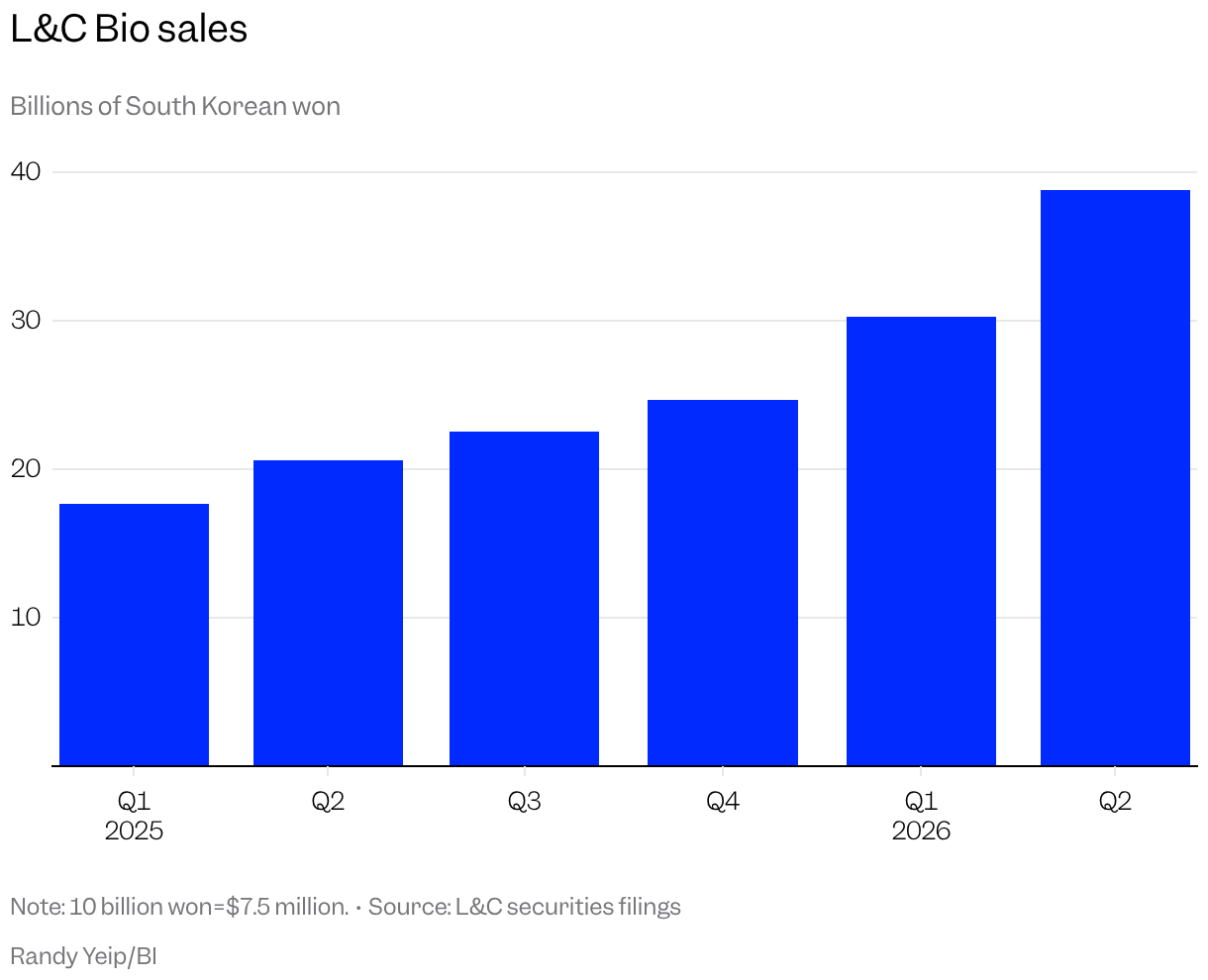
Re2O notched the equivalent of more than $17 million in sales in the first half of this year, helping swing the company to an operating profit of about $11 million after a loss of about $326,000 in the same period last year, L&C Bio said. It has expanded the product line with Re2O Fine, marketed for more delicate skin, and is planning to launch a human fat-derived filler next year.

The company said it sold 700,000 units of Re2O as of September. It is available in Singapore and China, and has been approved in the United Arab Emirates, Peru, and Thailand.

Last week, L&C Bio said that it has signed a contract to deliver at least $60 million of Re2O to the US over the next five years. The company also said it may explore acquiring US tissue banks with its US distribution partner.

L&C Bio's plan to introduce Re2O to the US could spark a regulatory showdown. L&C Bio has said Re2O falls into a category of products such as skin grafts that don't require approval from the US Food and Drug Administration.

Some products that manufacturers claim qualify to be sold under this category don't actually meet the applicable criteria, the FDA told Business Insider. The agency said it wouldn't discuss any specific products under investigation.

"Products derived from donor skin that have been decellularized, dried, and ground into a powder for injection as a cosmetic 'skin booster' may raise significant questions" and may have to go through a more complex regulatory approval process, the agency said.

L&C Bio said it wouldn't comment on its discussions with regulators.

Bar chart showing L&C Bio's quarterly revenue rising steadily from 17.7 billion South Korean won in the first quarter of 2025 to 38.8 billion won in the second quarter of 2026.

Re2O's biggest competitor, CellREDM, came onto the South Korean market in late 2025. It has been such a success that in the quarter ended June 30, operating income for its maker, Hans Biomed, soared to over $3 million after barely eking out a profit in the year-earlier period.

The tissue business

"In the human tissue business, access to raw materials is the lifeblood of the industry," L&C Bio's founder and CEO, Whan Chul Lee, said in Korean in a February interview with a South Korean news outlet.

For his company and its competitors, that lifeblood flows from the United States.

Roughly 90% of all the human tissue used in South Korea is imported, according to South Korea's Ministry of Food and Drug Safety. Less than 4% of South Korean adults are registered to donate organs, and even fewer donate tissue. Korean biotech companies have turned primarily to the US, where well over half of adults are registered donors.

Cadaver skin is collected in the US by organ procurement organizations, known as OPOs, and tissue banks. In the transplant system, skin is treated as a tissue, not an organ.

After tissue is collected, its route can vary. A nonprofit OPO often transfers it to an American tissue bank. The tissue bank pays a fee to the OPO, depending on factors like the amount and quality of tissue recovered. The fee covers the cost of the tissue recovery as well as a margin that supports other programs offered by the OPO.

Tissue banks — which can be nonprofit or for-profit entities — supply donor skin to Korean biotech firms.

Much of the US skin supplied to South Korea is used for more traditional medical purposes, like skin grafts for burn victims. L&C Bio makes such therapeutic products and says it prioritizes supply for them.

A person walks in a subway station by ads for plastic surgery.
Tens of millions of dollars' worth of donated skin has traveled over the past few years from American tissue banks to biotech companies in South Korea.

Ed Jones/AFP via Getty Images

L&C Bio spent more than $25 million on donor skin from US tissue banks between 2023 and 2025 and $3.8 million in the first half of this year, according to corporate filings. The company told Business Insider that a quarter of its skin supply is used to make Re2O.

Organ distribution is coordinated by a public-private partnership with the federal government. Tissue is handled differently. It is distributed through commercial relationships.

The more traditional business aspects of the tissue industry have been a subject of debate since the federal law governing America's organ recovery and distribution system was enacted in the 1980s. In a system that relies on altruism, money changing hands could affect public trust, Jerold Mande, who helped write the National Organ Transplant Act, told Business Insider.

There is little data on American attitudes toward tissue donation. A survey of more than 1,000 families of donors in the US published in a 2010 academic journal found less than 30% said they thought it was acceptable for donated tissues to be processed and distributed by for-profit companies.

Revenue from tissue, primarily skin and bone, drove 93% of American OPO profits between 2013 and 2017, or a total of about $107 million per year in profit at 51 OPOs, according to a study in the medical journal Transplantation. The Association of Organ Procurement Organizations called the study outdated, said the money collected for tissue helps fund other life-saving work, and objected to the study's use of the word "profit."

"Reimbursed funds go directly back into the organization, supporting organ procurement as well as aftercare programs for donor families such as bereavement support and grief counseling," said Jenny Daigle, a spokesperson for the Association of Organ Procurement Organizations. Organizations must have a margin and reserves to remain financially stable, she added.

Human tissue donations help millions of people in the US each year, including skin for burn victims, bone for cancer survivors, and eyes for the visually impaired, Daigle said.

Organ donor option in driver license
Tens of thousands of Americans donate bodily tissue each year upon their deaths, often by checking a box at a motor vehicle department.

Patrick Sison/ AP Photo

Regenerative Biologics, a Florida tissue bank, provides all the skin for Re2O, L&C Bio confirmed to Business Insider.

Regenerative's CEO, Sandy McCann, said her tissue bank acts as an intermediary, supplying skin collected by other organizations, and provides L&C Bio only with skin from donors who have given consent for international and cosmetic use. If other American tissue banks have skin that they can't use, "many times we can place it where someone can," she said.

Regenerative had just over $16 million in annual revenue in 2024 and 2025, according to reports filed with a Florida regulator.

By reviewing South Korean government records and images of product packaging, Business Insider identified two other US tissue banks, South Texas Blood and Tissue and RTI Surgical, that supply tissue for skin-derived injectable beauty treatments made by Korean companies.

South Texas Blood & Tissue supplies skin used to make South Korea's No. 2 brand, CellREDM. The tissue bank is based in San Antonio, sometimes called "Military City, USA" because of the large military base there. Educational materials on the tissue bank's website say that donor skin "heals patients suffering from burns or other traumatic wounds, and in reconstructive surgeries, including those wounded during military service."

South Texas Blood & Tissue said each of its tissue donors helps an average of 75 recipients. International distribution and commercial use are longstanding practices in the tissue industry, the group said. Tissue donor families have the option to decline cosmetic, international, or research use, the group added.

"Our top priority is to serve as good stewards of these tissue donations, and to ensure that all tissue we recover has the greatest impact possible," it said.

RTI, a Florida tissue bank that does business as Evergen, said it transfers a small amount of unprocessed donor skin to DOF, a tissue bank in South Korea that manufactures the skin-derived injection product Juveacell. RTI added that it is "dedicated to honoring the generosity of donors and their families."

The Axel Springer Global Reporters Network harnesses the resources of the company's newsrooms to publish ambitious scoops, investigations, interviews, opinion pieces and analysis. It allows journalists — including those from POLITICO, Business Insider, The Telegraph, WELT, BILD, Onet and Fakt — to collaborate on major stories for an international audience of hundreds of millions across platforms: online, print, TV and audio.

Read the original article on Business Insider
  •  

Techies are throwing billions at robots; the 'hardware tourists' are piling in

Robot video

Getty Images; Rebecca Zisser/BI

For decades, hardware was a hard sell in Silicon Valley. Now investors are pouring tens of billions into machines that can do things in the real world.

A Goldilocks set of conditions has made robotics one of tech's hottest bets. As investors look beyond chatbots to the next frontier in AI, cheaper hardware, smarter AI models, labor shortages, and competition with China are fueling interest in machines capable of performing physical work.

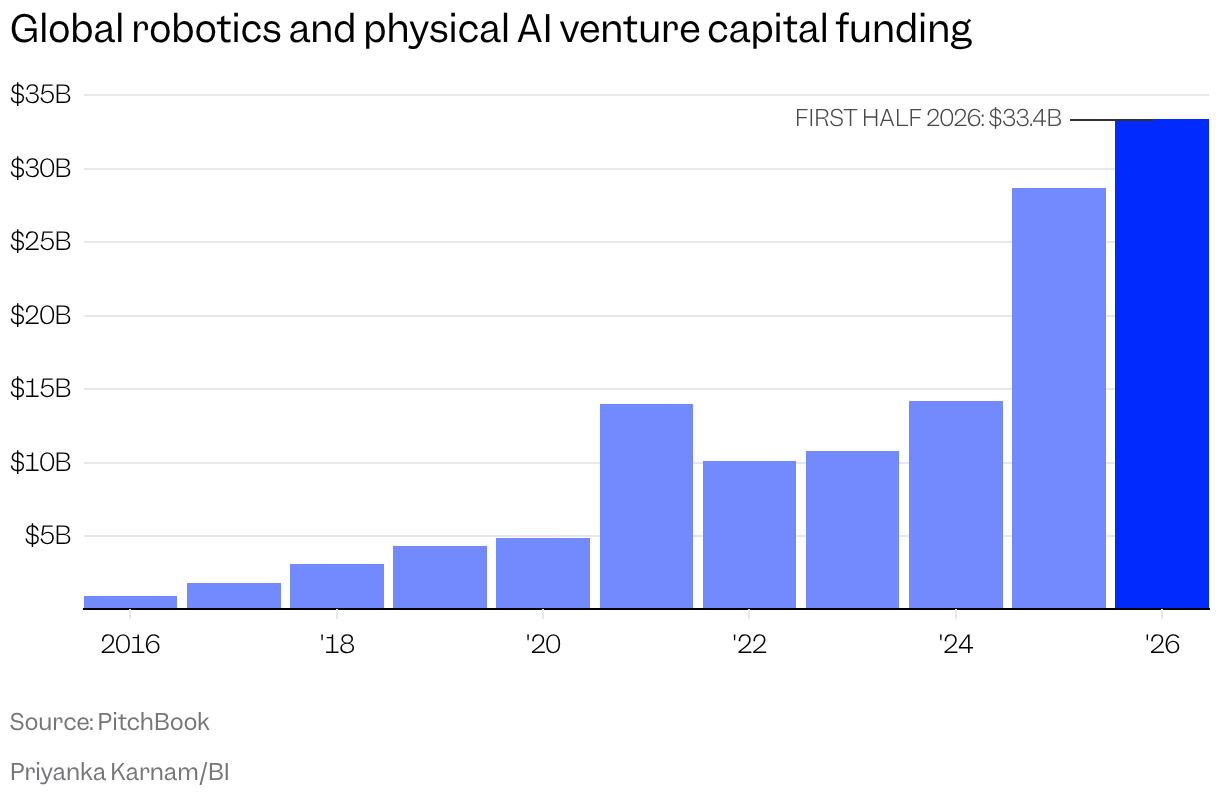
Robotics and physical AI companies raised $33.4 billion globally in the first half of this year alone, according to PitchBook data. That's already more than the $28.7 billion the sector raised in all of last year — and an astronomical rise from 2020, when funding came in at just under $5 billion.

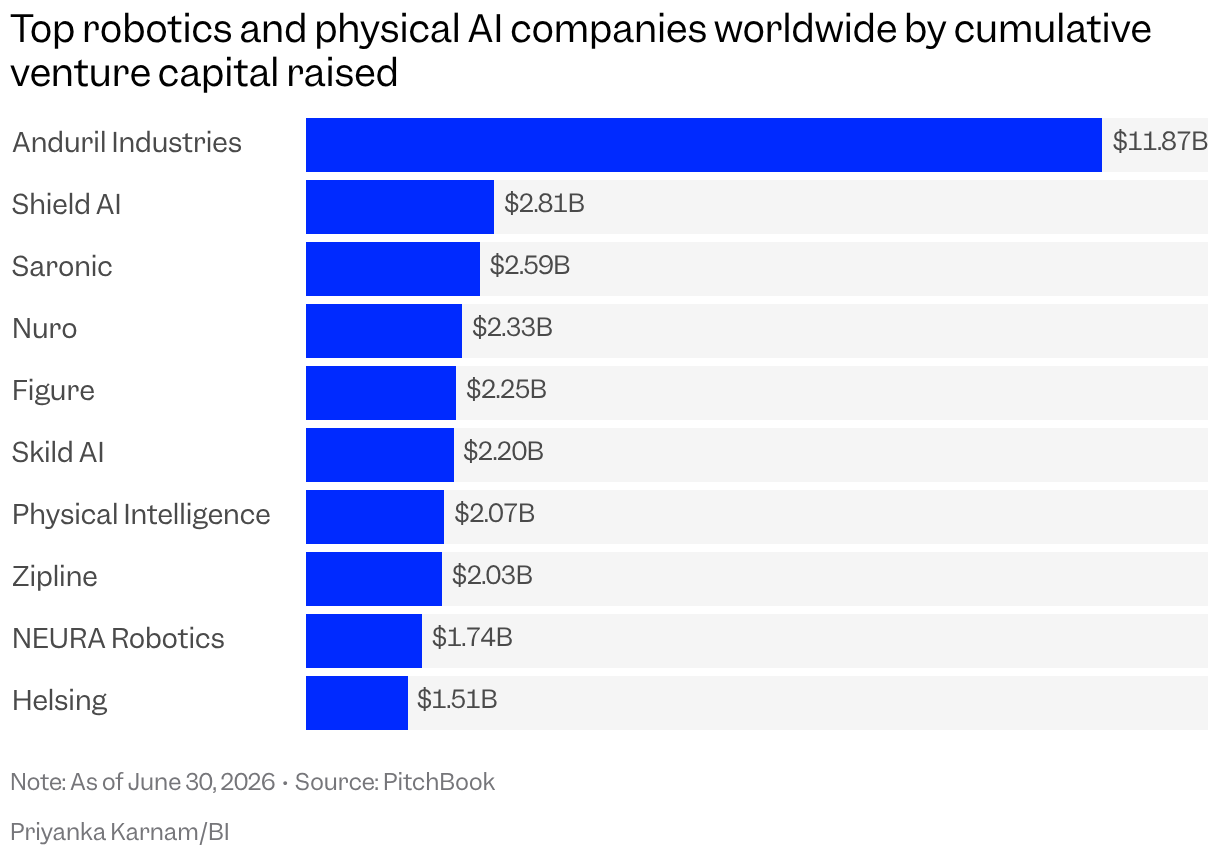
Investors are writing billion-dollar checks to fund both the machines and the AI brains behind them. Defense company Anduril raised $5 billion in May, co-led by Thrive Capital and Andreessen Horowitz. Autonomous shipbuilder Saronic raised $1.75 billion in March in a round led by Kleiner Perkins. Skild AI, which builds software to control different kinds of robots, raised $1.4 billion in January in a round led by SoftBank. Physical Intelligence, which is also building an AI model to command robots, raised about $1 billion in May, co-led by Leopold Aschenbrenner's Situational Awareness and Lux Capital.

"This is off the charts," Ken Goldberg, a UC Berkeley robotics professor and cofounder of warehouse robotics startup Ambi Robotics, told Business Insider. "In my 45 years in this field, this is the most funding and energy and interest in robotics that I've ever seen."

This is the first installment of Robonomics, Business Insider's new series on the rise of robots and their impact on business, jobs, and everyday life. We'll go inside factories and warehouses where humans work alongside robots, meet the founders, investors, and workers driving the boom, and examine how the technology is reshaping industries from manufacturing to defense. We'll also ask how close robots are to becoming part of everyday life, and what is still standing in their way.

Global robotics and physical AI VC funding reached $33.4 billion in the first half of 2026, exceeding every prior full year shown.

The prize is enormous. Unlike software, which is largely confined to work done on screens, robotics companies are going after physical labor, from factories and construction sites to robot butlers in every home. Nvidia CEO Jensen Huang, who popularized the term "physical AI," has described robotics as the "technology industry's first opportunity to address a $50 trillion industry that has largely been void of technology until now." Many Nvidia veterans have launched their own robotics startups.

Jensen Huang
Nvidia CEO Jensen Huang

Bloomberg/Bloomberg via Getty Images

But investors are pricing companies as though the robot revolution has already arrived. Startups still in research and development command multibillion-dollar valuations, often with little revenue and few deployments to show for it. Humanoid maker Figure AI, for example, secured a $39 billion valuation last year, even as its deployments remain limited to small factory pilots.

"Robotics is going to happen, and a lot of money will still be lost," said Sarah Guo, founder of the venture firm Conviction, which is an investor in robotics startups Sunday Robotics and Watney. "Both things are true."

From not to hot

From industrial arms assembling electronics to Roombas cleaning floors, robots have long been part of everyday life.

What venture investors struggled to see was how to make money from them. Building robots required expensive hardware, factories, and supply chains, often to produce machines that could perform just one narrow task. Why fund that when you could back a college dropout building the next viral app?

Guo used to tell fellow investors that robotics was a good way to lose a lot of money over many years. "The models didn't work," she said. "Every robot was a brittle, single-purpose system hand-built for one task."

Ajay Agarwal, a partner at Bain Capital Ventures, was among the few investors willing to bet on robotics during the internet era. In 2004, he backed Kiva Systems, which pioneered warehouse automation with fleets of mobile robots that brought products directly to human workers.

Kiva Systems
A Kiva Systems robot moves a shelf to fill orders at an Amazon fulfillment center

Bloomberg/ Getty Images

Bain led every successive funding round because Kiva was "not able to raise money on Sand Hill Road," Agarwal told Business Insider. By the time Amazon bought it for $775 million in 2012, Bain was its only institutional investor.

More than two decades later, AI has changed the calculation. Advances in machine learning are helping robots perceive their surroundings, make decisions, and adapt to new tasks, raising hopes that companies can build more versatile machines instead of engineering a different robot for every job. Cheaper computing and hardware are also making the economics more attractive.

Some of Silicon Valley's biggest names are now chasing that vision. Former Uber CEO Travis Kalanick's Atoms raised $1.7 billion in July to pursue automation in food, mining, and transportation. Rivian CEO RJ Scaringe's Mind Robotics has raised $900 million this year, while former Cruise CEO Kyle Vogt's home robotics startup, The Bot Company, has raised at least $300 million.

Top robotics and physical AI companies by cumulative VC raised: Anduril Industries leads with $11.9 billion, far ahead of Shield AI at $2.8 billion and Saronic at $2.6 billion.

Big Tech and AI labs, too, are joining the rush. OpenAI has advertised robotics jobs with base salaries reaching $500,000 a year. Meta acquired robotics startup Assured Robot Intelligence in May and is testing robots in its data centers. Google has invested in humanoid maker Apptronik, which is also working with DeepMind to develop AI models for robots. Elon Musk, meanwhile, is staking Tesla's future on the Optimus humanoid.

Optimus
Tesla's Optimus humanoid

CFOTO/ Getty Images

Some venture firms are setting aside dedicated capital for robotics. In August, Andreessen Horowitz raised $1.1 billion for "Machine Age," its first fund focused on the physical infrastructure behind AI, including robotics.

The gold rush

For longtime robotics investors, alarm bells are ringing. Industry veterans whisper about "hardware tourists" piling into robotics deals — investors drawn by AI hype who underestimate how difficult it is to build machines that work reliably in the real world. There is precedent for caution. Venture firms poured billions into autonomous vehicles in the 2010s, only to see startups fold or consolidate as self-driving technology proved harder and more expensive to commercialize than expected. Years later, only a handful of deep-pocketed players have managed to bring robotaxis to the public.

Robotics faces its own formidable obstacles. Unlike large language models trained on vast amounts of internet text and images, robots lack a comparable trove of data showing them how to act in the physical world. Dozens of startups are now scrambling to collect it, but nobody knows how much will be enough. And even smarter AI won't eliminate the challenges of manufacturing, maintaining, and deploying expensive hardware.

"The most difficult part of physical AI is the physical part," said Charly Mwangi, a partner at VC firm Eclipse who has backed The Bot Company and robotics startup Genesis AI. "The next few years are going to be really, really hard for the robotics industry as companies go from the lab to deployments."

Some of the most speculative robotics bets are attracting the biggest checks. Humanoids and general-purpose robot models were the two fastest-growing areas of robotics investment last year, according to venture firm F-Prime. "You cannot raise money on demos forever," said Sanjay Aggarwal, an F-Prime partner and coauthor of the firm's annual robotics report. "I would personally be surprised if all these companies independently exist two or three years from now."

There are signs that some startups are becoming real businesses. Field AI, which is building an AI "brain" that works across robots, has crossed $100 million in revenue and customer contracts from more than 30 customers, including construction firms, data center operators, and defense companies, Business Insider previously reported. Skild AI said last month that it had reached $100 million in annual recurring revenue from more than 60 customers. Its projects include robots assembling Nvidia's Blackwell chips with Foxconn and kitchen pilots with Mitsui, a Japanese conglomerate.

Nvidia's Blackwell chips
An Nvidia GB200 Blackwell GPU

Bloomberg/ Getty Images

Believers see robotics on the cusp of a breakthrough that could put machines to work in nearly every corner of the economy. Brad Porter, the former head of Amazon Robotics who now runs workplace robotics startup Cobot, says the field could be nine to 18 months away from major advances in dexterous manipulation — the ability of robots to handle objects with the ease of human hands.

"When I think of a 'ChatGPT moment' for robotics, it is cracking dexterous manipulation," Porter said. "Then there will be a Cambrian explosion of robots."

The question is whether these breakthroughs will arrive quickly enough to justify the money pouring in.

At Business Insider's Growth Mode event this month, Menlo Ventures partner Matt Murphy singled out robotics among the fields attracting enormous amounts of financing "before they're really showing traction." Abundant funding, he warned, can make startups "sloppy."

For investors, he said, that means "a lot more opportunity to have a really big crater."

Have a tip? Contact Rya Jetha via email at rjetha@businessinsider.com or Signal at rjetha.07. Use a personal email address and a nonwork device; here's our guide to sharing information securely.

Read the original article on Business Insider

  •  
❌