Minnesota Lt. Gov. Peggy Flanagan’s (D) campaign is walking back its account of her college academic honors, confirming she was in fact a member of Phi Beta Kappa after initially stating she had never joined the prestigious honor society due to membership costs. “I can verify that Lt. Governor Peggy Flanagan is a member of…
Minnesota Lt. Gov. Peggy Flanagan’s (D) campaign is walking back its account of her college academic honors, confirming she was in fact a member of Phi Beta Kappa after initially stating she had never joined the prestigious honor society due to membership costs. “I can verify that Lt. Governor Peggy Flanagan is a member of…
Minnesota Democratic U.S. Senate nominee and Lt. Gov. Peggy Flanagan previously claimed she graduated Phi Beta Kappa despite never belonging to the prestigious honor society, while her official state biography suggests she completed two college majors when she actually earned one major and a minor, according to an exclusive report published Wednesday by the Wall Street Journal.
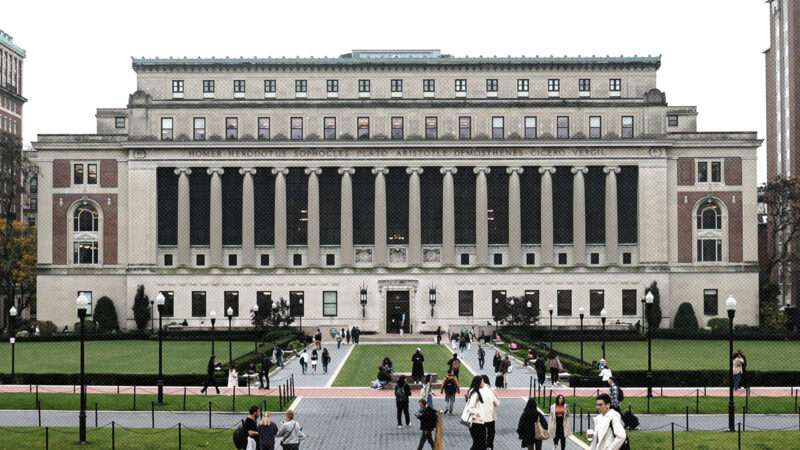
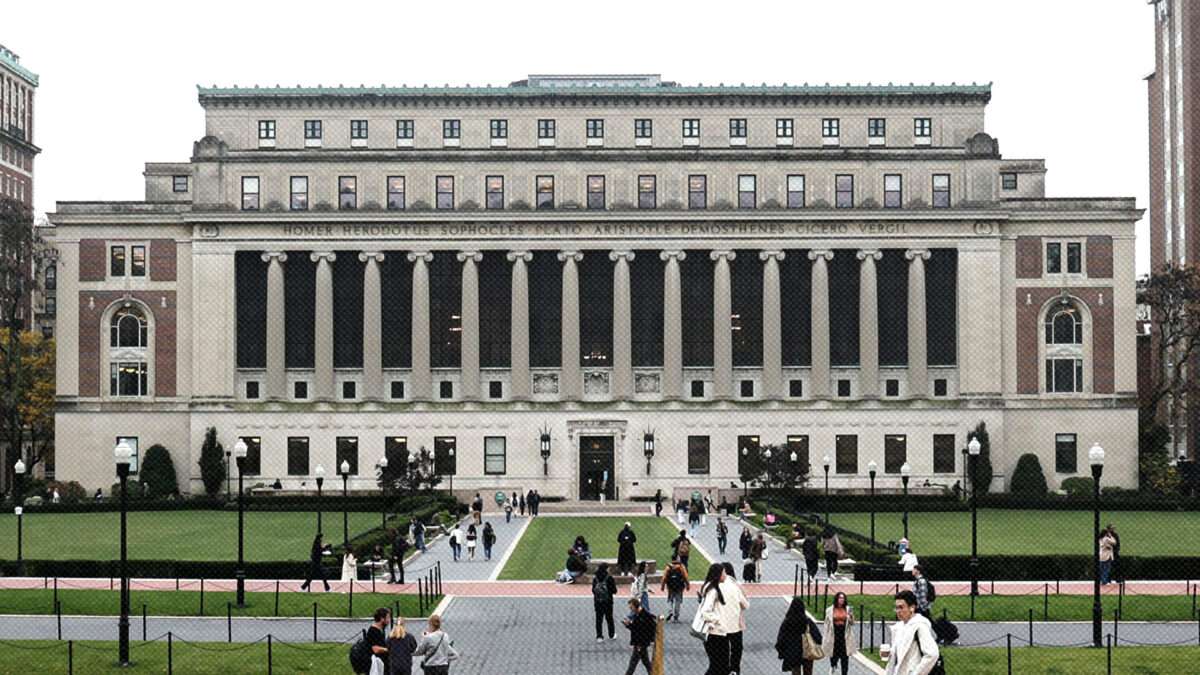
Questioning the prevailing narrative about the "Cornell seven" case is bound to create controversy. And at Columbia University, two student journalists drew condemnation for their views on the case from the unlikeliest of places: a college free speech group.
On October 13, Barnard junior Christina Ma and Columbia junior Nikos Mohammadi published an article called "The 'Cornell Seven' Is Really About Liberalism" in the Columbia Sundial, an independent student publication. The piece argued that the discourse surrounding the alleged rape at Cornell University infantilizes women by omitting the possibility that in a post–sexual revolution, liberal society, women may make regrettable but consensual choices.
"In the world that, for better or worse, follows from it, we cannot claim to stand for sexual freedom and then recoil in disgust when there's a possibility that a young woman simply chose to exercise it," Mohammadi and Ma wrote.
The piece also argues that the "collective frenzy" over the Cornell case has created a climate on campus that makes it "difficult to disagree with the maximalist position on what happened" the night of the alleged rape.
As Mohammadi wrote in UnHerd, the piece caused immense backlash. He said he received an onslaught of messages urging him to commit suicide and demanding that his "career and life be destroyed." But the criticism went beyond threatening DMs and comments.
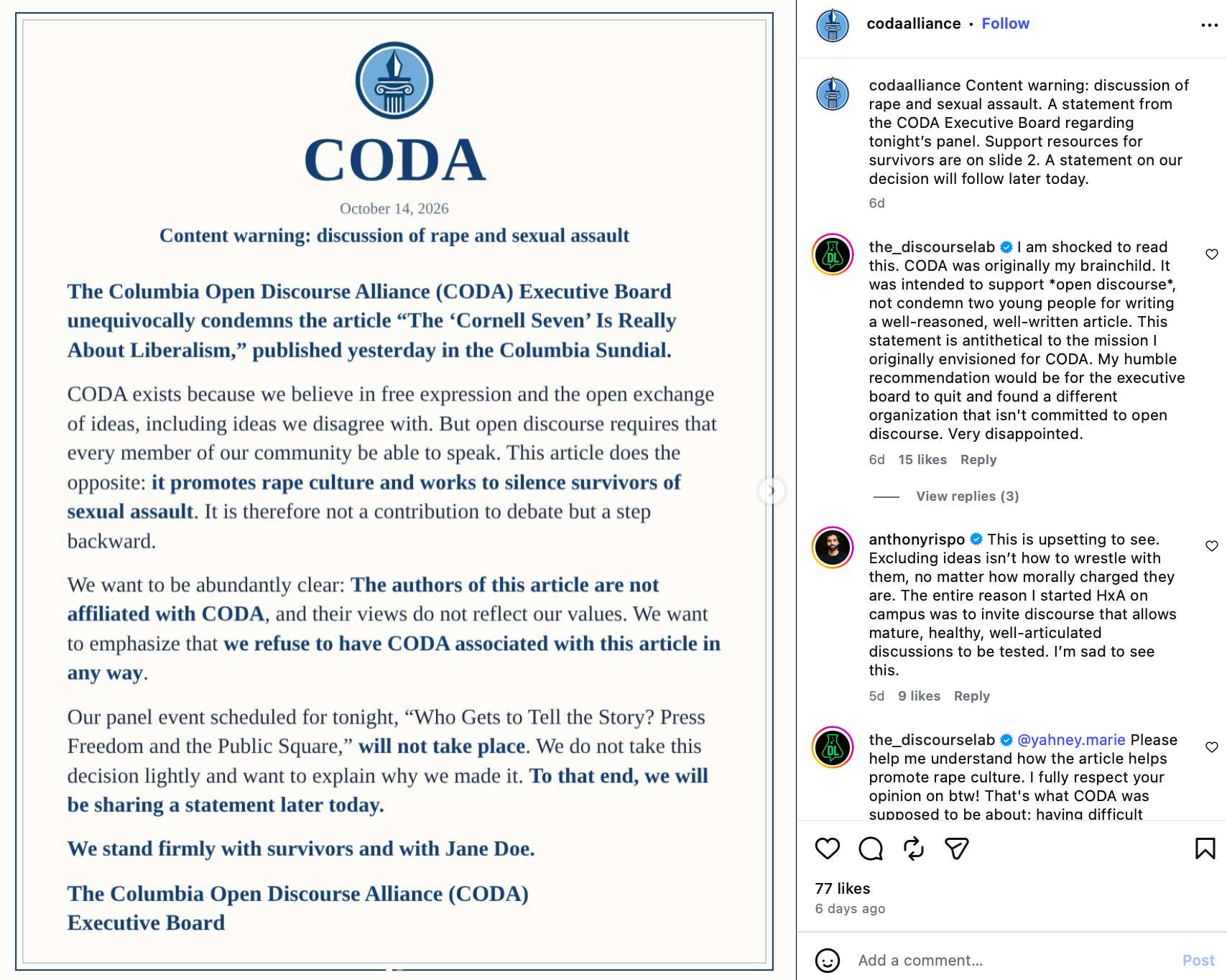
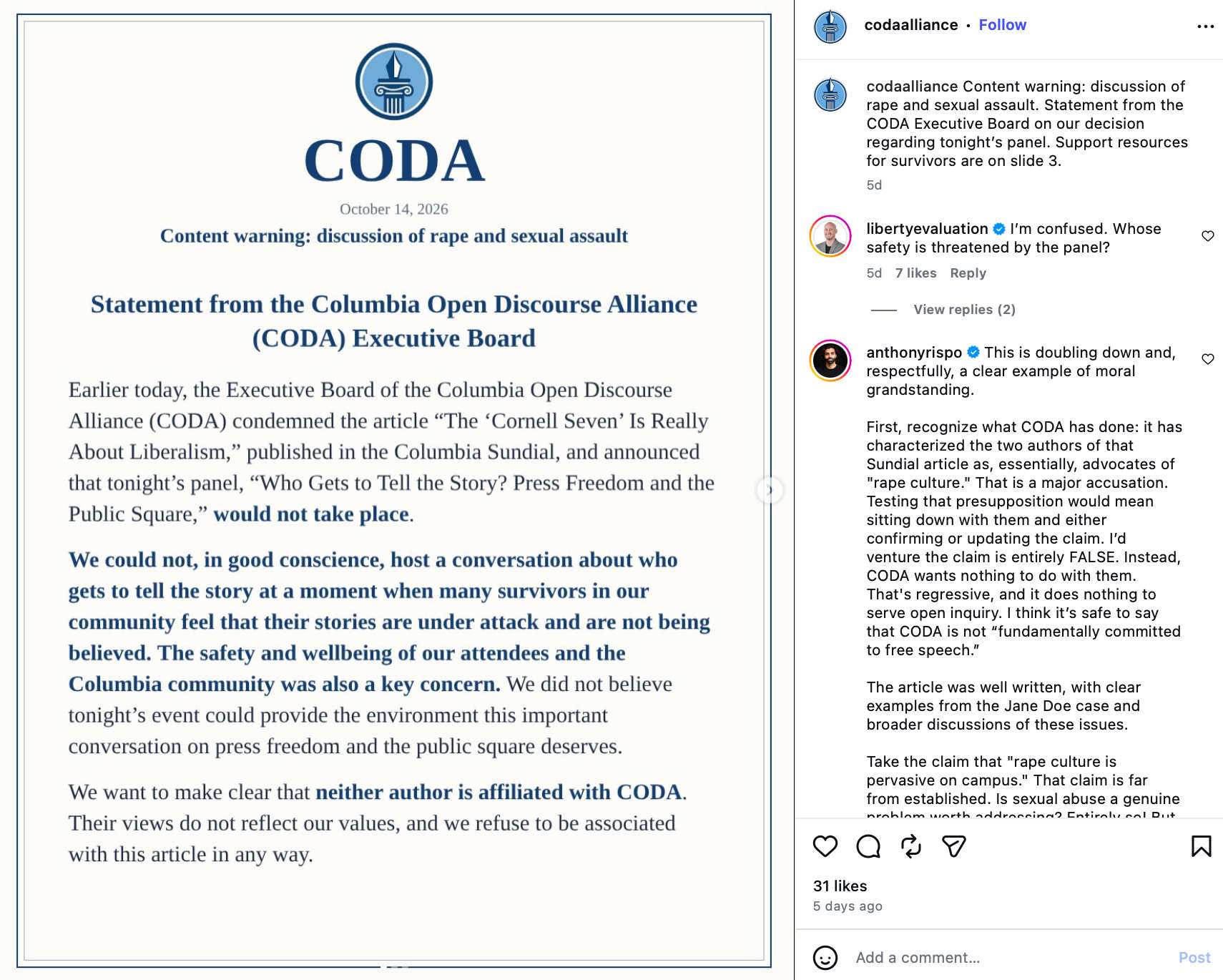
The day after the article's publication, the Columbia Open Discourse Alliance (CODA) canceled an event about press freedom because the Sundial's editor in chief, Nick Baum, had been slated to speak at the event. Although Baum did not author the piece, CODA wrote in an Instagram post that the free speech group "refused" to be affiliated with the Sundial's article "in any way."
CODA also claimed that the event, ironically called "Who Gets to Tell the Story? Press Freedom and the Public Square," could not take place at a time when "many survivors in our community feel that their stories are under attack and are not being believed."
The group added that the Sundial's article "promotes rape culture and works to silence survivors of sexual assault."
The group's president, Aum Desai, told Columbia's student newspaper, the Columbia Daily Spectator, that the group canceled the event "not in spite of, but because of [CODA's] commitment to free expression."
Columbia graduate Clayton Smith, who founded CODA in 2025, quickly commented that he was "shocked" by CODA's statements on Instagram. Smith started the organization to create a central hub for groups hosting events promoting free speech and open discourse, including the Sundial and Columbia's Heterodox Academy chapter.
He tells Reason that CODA's rationale for canceling the event was "ironic" and "hypocritical," and he believes the group should have collaborated with the Sundial if there were legitimate safety concerns at the event. He says he was particularly disturbed by the group's condemnation of the article and CODA's claim that it promotes "rape culture."
"They don't argue or explain how it works to silence survivors of sexual assault. It is a baseless slander that they use to condemn the article because it promoted an opinion they do not like," Smith says.
Smith says he spoke to Desai on the phone after CODA posted the statements, and Desai tried to reassure him that CODA would uphold the principle of free speech. But Smith says he did not leave the phone call feeling "very confident at all" in Desai's commitment.
Desai did not respond to Reason's requests for comment.
CODA faculty adviser and Columbia Business School professor emeritus Eli Noam was traveling in China during the fallout from the Sundial article and was not involved in CODA's decision.
After speaking with members of both CODA and the Sundial, Noam tells Reason that he thinks CODA "made some proper decisions, some correct decisions, and some mistakes."
"I think we're dealing here with…a group of college students who kind of were confronted with a crisis at 2 a.m.," Noam says. "And kind of [made] some judgments that they now regret, and they do."
He tells Reason that it was not "unreasonable to assume there would be a disruption" at the event, given the climate at Columbia and "about this rape allegation." He says the group suddenly "had an event where they needed college security" and could not organize in time. CODA, Noam says, is not yet recognized by the university, and he thinks the group was likely fearful of jeopardizing its recognition.
Still, Noam says CODA's statements condemning the article were "unreasonable," and it was "disappointing that they kind of lost their nerve here."
Although he was not involved in planning the panel, Mohammadi says, to his knowledge, there were no credible threats of violence to the panel. He understood there may have been "disgruntled students" and an "environment CODA did not want to deal with." But instead of simply canceling the event or working with the Sundial to find a solution, Mohammadi says CODA overstepped by condemning the Sundial piece.
James Applegate, an astronomy professor who serves on Columbia's Academic Freedom Council (CAFC) alongside Noam, tells Reason that he disagreed with CODA's decision to cancel the event.
Applegate tells Reason he was considering attending the event, and he was "rather surprised and disappointed" when it was canceled.
He recalled that when he was a professor in 2000, he objected to changes to the school's sexual misconduct policy on the University Senate floor. He says his statements were "similar to what was said in the Sundial article" and there was a "level of emotion in this debate."
"Nonetheless, we had the debate. I was in it, and the degree to which it was civil is shocking when you look at where we are now. And it's sad."
Applegate said he does not condemn CODA, however, "for the simple reason that the atmosphere on college campuses and on the left wing of politics in general in the United States is quite vicious."
CODA's honorary faculty fellow John McWhorter tells Reason he interpreted CODA's statement as "saying that an event about who gets to tell the story is untenable when or if a critical mass of people with such stories don't even feel comfortable telling them— i.e.being a participant in the event." He added, "I imagine some might think of that as cutting the salami a little thin, but then I highly suspect that Desai is equally worried about the event becoming a physical melee of some kind. In that, let's face it, he is hardly unreasonable."
Still, McWhorter said that he would have chosen to have the event himself, "especially as in the likely case that some people did talk about their experiences without any particular repercussions, it may have made the more reluctant people less apprehensive about doing so in the future."
According to Mohammadi, as of Tuesday, the Sundial, College Republicans, Platypus Affiliated Society at Columbia (which discusses leftist thought and history), and Columbia's Heterodox Academy chapter have left CODA.
CODA was not the only group to condemn the Sundial's piece. On October 14, the Columbia Political Review's editorial board wrote that Mohammadi and Ma's piece "violates standards of integrity" and "perpetuates a culture of campus violence, rape, and assault." The editorial board of the Columbia Political Review, which purports to publish "multipartisan political discourse," stated that it would refuse to publish "any article that upholds or recreates cultures and systems of rape, sexual assault, or violence" and it urged "all campus publications to do the same."
And on Monday, Columbia's main newspaper, the Spectator, published a staff editorial accusing the Sundial of violating journalistic ethics by "its page to disparage survivors of sexual violence."
Mohammadi tells Reason the piece underwent "far more editorial scrutiny than any other piece" the Sundial had published given the sensitive nature of the topic.
Free speech student organizations are necessary on Columbia's campus, especially as the school's free speech climate continues to crumble; it recently received a failing grade from the Foundation for Individual Rights and Expression. And while upholding free speech principles may have become more fashionable among those resisting the Trump administration's pressures on academic freedom or those defending pro-Palestinian speech, it is clear that some topics remain taboo in the public square. College is supposed to be a place where students debate controversial topics, form their own beliefs and opinions, and learn from mistakes. Hopefully, the students who demanded condemnation instead of debate will be forgiven for their perversion of free speech ideals, and they will learn to afford such grace and open-mindedness to classmates with whom they disagree.
After facing public backlash, Polymarket has removed a market that allowed users to wager on the fate of the seven Cornell University students accused of sexually assaulting a woman at a fraternity house in 2024. The prediction market archived the market, which asked whether any of the so-called Cornell 7 would be charged with a…
After facing public backlash, Polymarket has removed a market that allowed users to wager on the fate of the seven Cornell University students accused of sexually assaulting a woman at a fraternity house in 2024. The prediction market archived the market, which asked whether any of the so-called Cornell 7 would be charged with a…
Caitlin Conway is a mom of two who lives in Colorado.
She sends her two kids, ages 8 and 5, to a forest school and homeschools them.
She says the impact on them physically and emotionally is unparalleled.
This as-told-to essay is based on a conversation with Caitlin Conway. It has been edited for length and clarity.
Years ago, when my oldest was an infant, my husband and I had seen a documentary about outdoor schooling in Nordic countries. It really resonated with us, but it also felt intense because we're not used to seeing that kind of setup here. It was cool, but also terrifying — kids were using knives in the woods.
Then I found a forest school in Colorado, where we live.
We started forest school when my oldest was 4.5
We started my son on the coldest day of the year, in February, and I was nervous. We sent him out, and when he came home, he didn't say anything about the weather. He never even mentioned that it was cold; he was immediately engrossed.
It was his primary source of education until two years ago, through first grade. They age out of a full-day program around then, so we now homeschool and leverage a homeschool enrichment program for him because we were not ready to leave the program. My youngest attends forest school three days a week and is also homeschooled the other days.
The school goes from 9 a.m. to 3 p.m. every day as long as it's 15 degrees Fahrenheit or warmer. Sometimes they have a shelter; sometimes they don't. They learn how to keep their bodies warm.
The primary focus is on social and emotional development. It gives kids opportunities to test their capabilities, both physically and emotionally. The guides are there to keep them safe, but they're not there to solve a kid's every problem. They learn to negotiate conflicts with each other and can get help when they need it.
When at home, we also prioritize being outside
We don't follow a strict homeschooling curriculum. Our main focus is on exposure. We homeschool so they can continue to stay outside and strengthen their bodies and minds. We've also found a group of people through forest school that we call our homeschool co-op. It's two other families, and we all help facilitate "adventure days" outside.
I'm not sitting at a kitchen table with them all day. We do an art program, and both kids also take piano lessons and swim. We also do our own work around reading, writing, and math.
I never expected to be homeschooling my kids, but they love it
I don't have an educational background. I come from early-stage start-ups and am currently a real estate agent. But I continue to double down on this method because I see an incredible impact on my kids' ability to adapt to different situations. They can sit still at a restaurant, but they can also jump off a cliff into a river. They know that bravery has a great payoff.
The hardest part is other people's opinions. We've had to defend what we're doing, something I'm sure every homeschool parent has had to do. An instant reaction to me sharing that my kids are in the woods all day is, "But how are they learning if they're not in the real world?" That can be frustrating, but I think it's important to make sure people know there are other options for early childhood development.
Jammu And Kashmir: Medical interns launched a fresh strike on Tuesday, announcing that they would call it off only after receiving a formal order confirming the stipend hike.
The lack of teachers (particularly in areas where rents are at their highest: viz. Lisbon/ Algarve) has led municipalities to start thinking outside the box. Two town halls (Grândola and
Four academics from the University of Cyprus School of Medicine have achieved recognition in international rankings, with professor George Hadjigeorgiou in the top 1 per cent of global scientists and three others in the top 5 per cent.
Hadjigeorgiou has been ranked in the top 1 per cent by the AD Scientific Index, while associate professors George Nikolopoulos and Panagiotis Zis, along with assistant professor Nikolaos Kadoglou, are in the top 5 per cent.
Zis and Kadoglou also feature in Stanford University’s World’s Top 2 per cent Scientists list for 2025 in the Single Year Scientific Impact category.
The AD Scientific Index utilises Google Scholar data, ranking researchers based on the Total H index, which assesses their scientific output and the impact of their work over their careers.
The Stanford list, also known as the Ioannidis List, uses Scopus data to assess scientific impact during the most recent reference year.
Its composite indicator considers citations, the H index and other measures, while also accounting for a researcher’s position in the author list.
The university said the distinctions highlighted the international reach of its academics’ research and their contribution to scientific knowledge.
The recognition comes as the School of Medicine expands its international educational presence, with an English language medical programme scheduled to launch in 2027.
NTA Exam Calendar: Candidates are advised to visit the respective official exam websites for application, eligibility, and examination-related updates.
Zia Yusuf claims undercover investigation broke the law as broadcaster stands by its journalism
Here is an explainer by Jill Ambrose about the Jackdaw decision.
But environmental groups have condemned the decision. Ami McCarthy, head of politics for Greenpeace UK, said:
Approving Jackdaw shows the toxic grip fossil fuel lobbyists still hold over our energy policy. Andy Burnham promised pragmatism [see 8.40am], but there is nothing pragmatic about rubber-stamping a project that won’t lower energy bills, won’t boost energy security and will create just 27 full-time jobs …
True pragmatism means severing our reliance on expensive oil and gas that leaves British households broke, supercharges extreme weather, and leaves our energy security at the mercy of petrostates.
Is the prime minister living in a parallel universe? One where we haven’t just endured our hottest summer on record, with droughts, wildfires and, in all likelihood, the most heat-related deaths on record? And where the UN hasn’t warned that we’re on the brink of breaching the all-important 1.5 degree warming limit?
Shell will be cheering this decision but it won’t knock a penny off our energy bills, which is what’s keeping people up at night, or make a meaningful difference to our gas supply.
Jackdaw will provide around just 2% of our gas demand for roughly ten years. It has been oversold and won’t stop the decline in North Sea jobs, as it will be largely unmanned and operated remotely.
HPBOSE has extended the registration deadline for Class 9 and 10 students for the 2026-27 academic session. Schools can also correct registration details from November 17 to November 25, 2026.
According to a report, around 15 million (1.5 crore) people have moved to the countryside in recent years to take up farming or start small businesses.
A woman known as Jane Doe who accused seven men at Cornell University of sexual assault at a fraternity house sent a letter to the school saying she “felt unsupported and disebelieved” by the Ivy League institution’s president, Michael Kotlikoff. Cornell has responded to the letter, first obtained by The New York Times, and sent…

 Login