Tesla posted a highlight reel showing off its robotaxi navigating real-world road conditions, including robotaxis getting in the way.
Andrej Sokolow/picture alliance via Getty Images
Tesla posted footage of its robotaxi driving without a safety driver ahead of its Q3 earnings call.
Two of the clips included footage of a Waymo robotaxi and Avride encroaching on Tesla's path.
The clips showed the Tesla Robotaxi slowing down.
Tesla took some subtle jabs at its robotaxi competitors ahead of its third-quarter earnings call on Wednesday.
On a website Tesla created for its robotaxi safety report, the company uploaded clips of its self-driving cars maneuvering in real-world conditions without a driver behind the wheel. Obstacles and hazards included stormy weather, a pedestrian crossing at a green light, stray pets, and rival robotaxis getting in the way.
Ashok Elluswamy, Tesla's VP of AI, also posted the video on X, calling it "Robotaxi B-roll."
At around the 1:44 mark of Elluswamy's post, the video shows a robotaxi coming to a complete stop in its own lane as a Waymo makes a wider-than-usual right turn. The Waymo can be seen encroaching into Tesla's lane before it returns to its own path.
A Waymo spokesperson did not immediately return a request for comment.
In another short clip, the Tesla robotaxi is seen driving at night, braking for an Avride car that pulled up from the right, a little too far into the Tesla's path.
Avride is a robotaxi company that offers robotaxi rides through Uber in Dallas and is testing rides with a safety driver behind the wheel in Austin.
A spokesperson for Avride did not immediately respond to a request for comment.
Tesla posted the footage as it seeks to make its case publicly on robotaxi safety. The company began offering a limited number of autonomous rides without an in-car safety monitor in Austin in January.
In the newly posted safety report, Tesla said its robotaxi service has driven 3.3 million miles autonomously — relatively small compared to Waymo's more than 271 million miles driven as of June.
Tesla said during its Q3 earnings call that it will launch unsupervised Cybercabs in Dallas in November.
On Wednesday, the Elon Musk-led automaker reported that its operating income fell 56% year over year to $718 million in the third quarter — below Wall Street's estimates of $746.3 million — while overall revenue of $28.05 billion came in a smidge below analysts' estimates.
Tesla pointed to higher operating expenses tied to its AI efforts, or "SI"/"Super Intelligence" as Trump prefers, and other R&D projects. Lower regulatory credit revenue and weaker energy storage gross profit also weighed on profitability, while lower vehicle prices hurt revenue.
"While we continue to execute on innovations to reduce the cost of manufacturing and operations, over time, we expect our hardware-related profits to be accompanied by an acceleration of SI, software and fleet-based profits," the company reported.
It's not all bad news for Tesla's profits. The company is still solidly in the green, and it beat on the bottom line. Tesla reported 48 cents in adjusted earnings per share, above the 44-cent analyst consensus estimate. Free cash flow of $1.5 billion was also a surprise after Wall Street had expected negative free cash flow of $4.92 billion.
The automaker also sees areas of profit growth in its future: autonomy subscriptions are trending up, and Tesla said it's offering the right, region-specific product mixes.
During the earnings call, Tesla's chief financial officer, Vaibhav Taneja, said the company is experiencing its "highest backlog" of vehicles in four years. The company, he said, is trying to increase vehicle production.
He also added that Tesla has secured $30 billion of borrowing to support expected capital expenditures, but the company doesn't expect to "make any draws under any of the new facilities in this calendar year."
"The main takeaway is that Tesla's surprisingly positive cash flow quarter did not come from stronger profits," Thomas Monteiro, senior analyst at Investing.com, said after the report.
"Added to the equation is the fact that Tesla's AI spending remains broadly inefficient, with research costs up nearly 70% and operating margins down to just 2.6%, while at SpaceX AI is already one of the biggest sources of revenue," the analyst added.
The new quarter has already made waves
The Tesla story continues to play out in real time, and it's had a busy month since the fourth quarter kicked off in October.
On Tuesday, during SpaceX's earnings call, Musk said that Tesla and SpaceX had each formed committees to explore a potential merger. Both companies are helmed by Musk — and he owns billions of dollars in stock of each.
Anticipation of the potential mega-merger has been building around the companies for much of 2026, and has only increased since SpaceX went public. Musk said he was not included in those committees and that calling the merger a foregone conclusion "would be overstating it."
It also came less than a week after Tesla held its high-flying demo for the Roadster. The sports car performed a gymnastics routine, including briefly jumping into the air and twirling over a lineup of other Tesla vehicles.
Tesla had a high-flying demo for the coming Roadster. It came nine years after the company first floated the sports car.
Tesla
It came nine years after Tesla first promised to relaunch the Roadster. Musk first showed off a prototype of the vehicle in 2017 and predicted a 2020 product launch.
GM executives confirmed to Business Insider that humans are still staffing OnStar call centers to handle emergencies.
General Motors
GM says it's keeping humans in its OnStar call centers to help with emergencies.
It comes as OnStar is getting a fresh makeover, complete with AI.
"The stakes are too high," an exec told BI about the human-in-the-loop.
GM is giving OnStar an AI overhaul. The automaker says it is not coming for the person who answers when your airbags deploy.
On Wednesday, during the company's tech conference, GM Forward, Ed Nightingale, GM's vice president of digital products, told Business Insider that the automaker would continue to use human OnStar staffers on emergency calls to contact first responders.
"That's something that isn't changing," Nightingale said. "We feel that, when it comes to a crash or a problem being solved, they want to make sure that there's a human in the loop. The stakes are too high."
After publication, a GM spokesperson told Business Insider that OnStar Advisors "aren't going away" and will remain a core part of the OnStar experience.
Humans-in-the-loop are a notable constraint on GM's AI ambitions compared to other software companies. Other AI-enabled companies, such as SpaceX, have recently highlighted how few customer calls are routed to humans.
GM said that keeping people involved in complex or sensitive situations is an intentional part of its AI strategy. Technology handles more routine interactions, while humans take the call during an emergency.
It also comes as the company gives OnStar — its 30-year-old in-car emergency service — a much bigger job.
GM showed off OnStar AI on Wednesday. It's a new voice assistant designed to understand a vehicle and the driver using it. The automaker said it can answer questions about vehicle alerts, control some functions, plan routes around bad weather, and offer more context-aware suggestions, including from information through a driver's digital calendar.
The assistant will arrive first on the 2027 Cadillac Lyriq via an over-the-air update in the coming months, GM said. Other vehicles will follow.
GM also plans to unify its brand-specific mobile apps under the OnStar AI name next summer.
Onstage, Sterling Anderson, GM's chief product officer, said the company was turning the 30-year-old service into "an intelligent platform."
The shift is part of a large bet from GM.
GM is focusing heavily on its tech capabilities. On recent earnings calls, CEO Mary Barra has highlighted GM's subscription products. Anderson previously told Business Insider about how AI has allowed the company to cut product development time in half, starting with the GMC Hummer EV, which only took 20 months of development. Industry-average product development is typically around 5 years.
On Wednesday, the company also highlighted the development of its hands-off, eyes-off self-driving features, set to make their debut in the Cadillac Escalade IQ in 2028.
GM still has to persuade drivers that the new tools are valuable enough to use — and, in some cases, pay for.
Nightingale said subscriptions only retain customers when drivers can see the benefit.
Work at GM? We want to hear from you. Contact Ben Shimkus at bshimkus@insider.com or Signal at bshimkus.41. Use a personal email address and a nonwork device.
Alaska Airlines is launching new cabins on its long-haul and select Boeing Max 10 planes.
Alaska Airlines
Alaska Air Group announced new premium economy seating on Alaska and Hawaiian Airlines flights.
The large recliners will have leg and calf rests, 38 inches of pitch, and upgraded dining.
It also announced upgraded business-class and lie-flat seats on some Boeing 737 Max 10s.
Alaska Air Group is the latest US air carrier to shore up its premium seating offerings — part of an industry-wide boom to cater to passengers who will pay more for premium perks.
In September, Alaska Air Group, which operates Alaska Airlines and Hawaiian Airlines, unveiled a new premium economy cabin called "Premium Reserve" and upgraded business-class suites. The new cabins are planned for long-haul international flights and select domestic routes.
Since acquiring Hawaiian for nearly $2 billion in 2024, Alaska has been pursuing its "Alaska Accelerate" plan to expand its premium offerings and international presence from its Seattle hub, including two new routes to Japan and Tahiti starting in 2027.
With its upgrades and expansion, Alaska increasingly looks like a major global carrier rather than the largely domestic airline it was once known as.
"We believe premium is more than a seat," Ben Minicucci, CEO of Alaska Air Group, said in a statement. "It's how guests feel from the moment they book their trip to the moment they arrive at the airport, to when they're in the air with us."
A new premium cabin and lie-flat seats on 737 Max 10s
Available to book on both airlines starting next summer, Alaska and Hawaiian's new premium economy will feature wide reclining seats with leg and calf rests and a pitch — or the distance from one seat to the seat in front of it — of 38 inches.
It will also include a 16-inch, Bluetooth-capable screen, outlets and USB-C charging ports, and upgraded in-flight dining menus.
A rendering of Alaska Airlines' Premium Reserve seating on a Boeing 737-10 Max.
Alaska Air Group
Alaska already offers a premium-economy-like cabin called Premium Class, but the cabin type will be a first for Hawaiian.
Premium Reserve will be available on Alaska's 787 and select 737 Max 10 aircraft, as well as Hawaiian's A330 fleet, with flights beginning in 2028. Alaska doesn't yet have the Max 10, which was nearing the finish line for certification after years of delays tied to safety and quality concerns. But CNBC reported on Monday that regulators have again delayed certification due to a newly discovered software issue.
Beyond premium economy, lie-flat business class — called "Aurora Suites" on Alaska and "Leihōkū Suites" on Hawaiian to retain each airline's distinct branding — has gotten a refresh.
A rendering of Hawaiian Airlines' refreshed business class.
Alaska Air Group
Hawaiian's Leihōkū Suite, its 787 business-class product, serves select routes to Asia, Oceania, and North America. It will be added to the A330 and feature "hotel-quality bedding and enhanced onboard amenities."
Alaska's Aurora Suites will be deployed on all 787 Dreamliners and include upgraded upholstery and materials. Both suites will have sliding doors, Bluetooth, big in-flight screens, and access to airport lounges.
Aurora will also be installed on 737 Max 10 planes flying select transcontinental routes, joining the increasing number of airline narrowbody planes with lie-flat premium seats.
Rendering of Alaska Airlines lie-flat seats on the Max 10.
Alaska Airlines
These premium cabins won't be cheap. A round-trip business-class flight from Seattle to Tokyo in mid-March is about $6,500 on Alaska; the same seat to London is about $5,300. Basic economy is about one-fifth of each of those business-class fares.
Hawaiian Airlines' fleet of A330s will also offer new nonstop flights from Seattle to Osaka, Japan, and Papeete, Tahiti, beginning in May and June 2027, respectively. Introductory round-trip Main Cabin fares will start at $1,199 to Osaka and $999 to Papeete; the planes will have Hawaiian's existing business-class product until the fleet's new interiors begin rolling out in 2028.
Alaska is facing fierce competition. It's up against legacy US carriers with already massive widebody fleets, extensive international networks, and well-established premium products.
The airline knows it's playing catch-up.
"I think where you're seeing strength with the legacy carriers is in the premium space and in the international space," Minicucci said in an April 2026 earnings call. "And if you look at our strategy under Alaska Accelerate, that's exactly where we're leaning into."
Courting passengers who pay a premium
In post-COVID air travel, US airlines are moving away from packing as many people as possible into economy to increase revenue. Instead, they are pivoting toward customers who will spend more on premium travel experiences, such as airline lounges and higher-tier in-flight amenities.
A McKinsey analysis published in June found that on transatlantic wide-body flights, business-class cabins are earning almost as much as economy cabins, even though they carry far fewer passengers.
That premium demand has remained despite rising oil prices and soaring airfares amid the war in Iran, partly buoyed by continued spending from more affluent travelers.
"The folks who are more oriented towards purchasing into our premium cabins have been super resilient," Minicucci said in a 2025 earnings call.
A rendering of Hawaiian Airlines' Premium Reserve seating on an Airbus A330.
Alaska Air Group
United Airlines' director of onboard products and partnerships, Peter Wolkowski, told Business Insider during the UK's Farnborough Airshow in July that premium economy is its fastest-growing cabin on the company's 787 fleet.
In 2025, Delta's premium revenue increased 7% year-over-year, while its main cabin revenue decreased. On an earnings call in October 2025, then-Delta president Glen Hauenstein predicted that premium revenue was expected to exceed Main Cabin revenue by 2027.
"When you think about what's different and what's changed over the last 10 or 15 years, the premium products used to be loss leaders, and now they're the highest-margin products," he said.
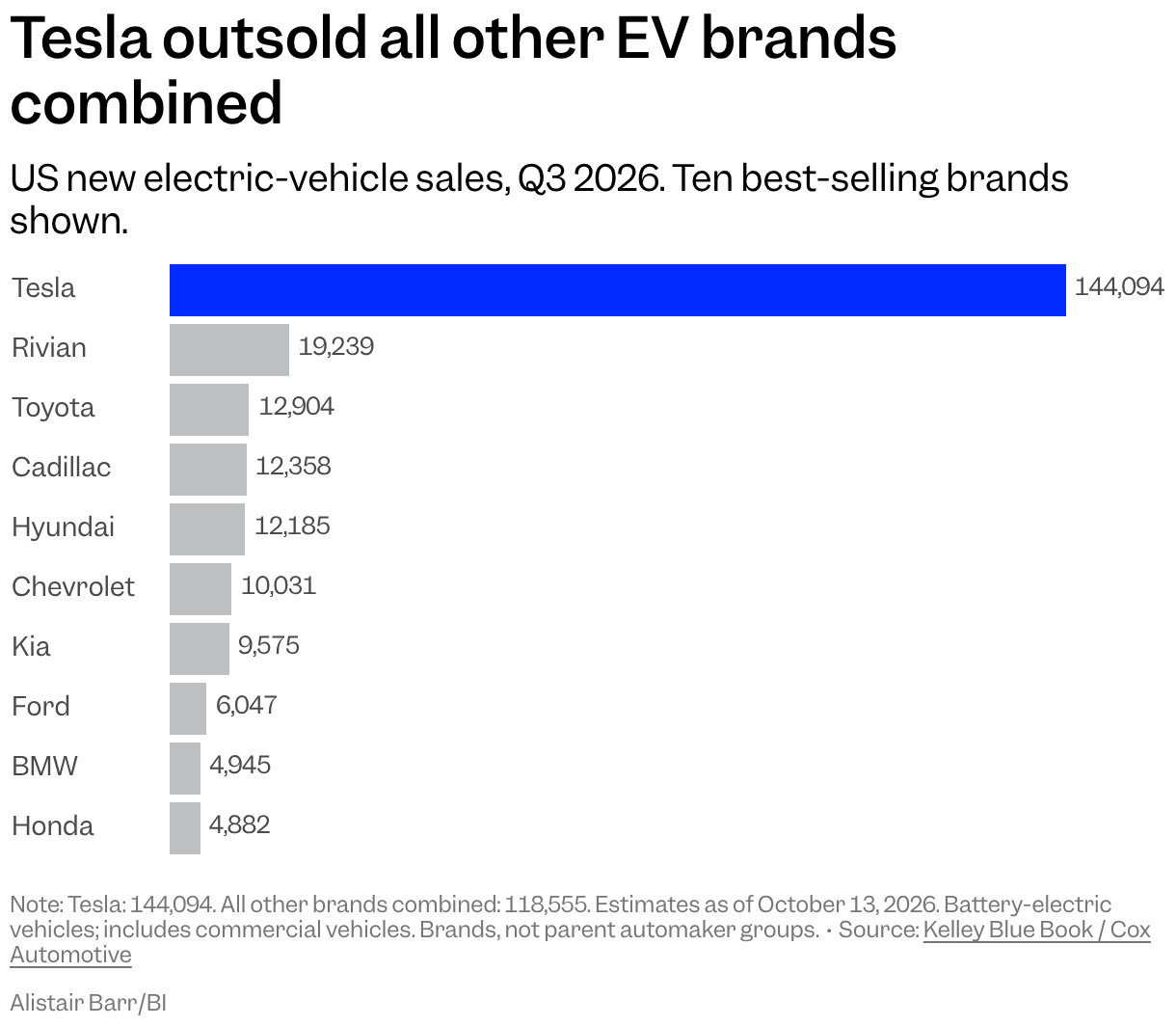
Tesla accounted for more than half of US electric-vehicle sales in the third quarter.
Its quarterly sales increase exceeded the entire market's gain, Cox estimates show.
High gas prices are helping EVs compete, though sales remain below last year's levels.
Tesla is taking a bigger slice of America's electric-vehicle market as high gas prices give drivers another reason to consider ditching the pump.
The company sold an estimated 144,094 vehicles in the US in the third quarter, up from 124,800 in the previous three months, according to Cox Automotive's latest sales report.
That increase was bigger than the gain for the rest of the US EV market. Put another way: Tesla drove the recovery. Everyone else, taken together, went backward.
The figures offer a new twist on the EV comeback I wrote about in July. Back then, sales had finally improved after the slump that followed the end of federal incentives in the US. Several manufacturers were benefiting, but only those withthe fortitude to stick with EVs after federal government support waned.
While recovery continued in the third quarter, it became more dependent on Tesla.
Americans bought 262,649 new EVs during the period, about 6% more than in the second quarter. Sales outside Tesla fell roughly 3%, based on a comparison of Cox's latest counts with its second-quarter report.
Tesla's own sales rose about 15% from the second quarter. It supplied 54% of the country's new EVs in the third quarter, extending its lead from the previous period.
High gas prices help make the case for going electric, according to Cox.
"With gas prices well above $4 a gallon, electric vehicles look better than ever," Stephanie Valdez Streaty, Cox's director of Industry Insights, said in the company's analysis of the quarter.
Expensive gasoline and diesel make running a conventional vehicle more painful. For drivers who can charge cheaply, particularly at home, an EV offers a valuable alternative to repeated trips to the pump.
There's an important caveat to the comeback story: Sales are improving from a depressed level.
Total US EV sales were down almost 40% from a year earlier. Last year's third quarter was unusually strong because buyers rushed to claim federal incentives before they disappeared.
Tesla's sales were down about 20% against that comparison. The company remains heavily dependent on two vehicles. The Model Y and Model 3 accounted for roughly 97% of its US sales in the latest quarter.
The Cybertruck sold over 4,300 units, and Tesla has stopped making the Model S and X. (There's a Roadster, though not until 2028).
So Tesla's growing dominance isn't a story of every model flying out of showrooms, or of selling more cars than a year ago.
For now, it is winning a larger share of a smaller market. As Americans return to EV shopping, Tesla is capturing more of their business.
During SpaceX's Tuesday earnings call, Elon Musk said both of the companies had created "special committees of independent directors" to discuss a potential merger.
Musk, who helms both companies and owns billions of dollars in stock of each, said he can't be part of those exploratory groups.
"Do I think it would be a good idea? Yes," he said on the call. "But at the end of the day, the shareholders have to be supportive of this, and particularly on the Tesla side, we will need a 50% vote of all shares, not just those who vote, but of all shareholders."
He said clearing that bar would be "quite a high hurdle."
It's the most detailed update investors have received yet on the idea of a tie-up, which has been the subject of much chatter since SpaceX went public earlier this year. If the companies ultimately decide to merge, it would further consolidate Musk's business empire, often referred to as Musk Inc.
His businesses have been on a consolidation kick. In 2025, xAI acquired Musk's social media company, X (formerly Twitter), and in February, SpaceX acquired xAI.
Musk also runs the brain-chip startup, Neuralink, and the tunnel-building firm The Boring Company. Both operate independently, but have had business collaborations within Musk Inc.
Tesla and SpaceX's stocks were up in after-hours trading following the news. SpaceX was up around 6.6% and Tesla 1.6%.
Musk sees clear benefits in tying the knot
"I do think there's a lot of merit to combining the companies as we are pretty much in the superintelligence singularity," Musk said during the call.
The most recent result of that partnership: On Thursday, Tesla demoed its long-awaited Roadster, which includes a version with SpaceX technology. The high-powered sports car's top trim will include cold-gas thrusters. The car launched, hovered, and flipped in the air during the demo.
While Musk is for the two companies tying the knot, he said investors shouldn't think it's a sure thing.
"I don't think we should necessarily assume that a SpaceX and Tesla merger is a certainty," he added. "That would be overstating it."

 Login