❌

Reading view

Prosecution for Threatening to Cut President's Face Off and Feed It to Stray Dogs Can Go to Jury

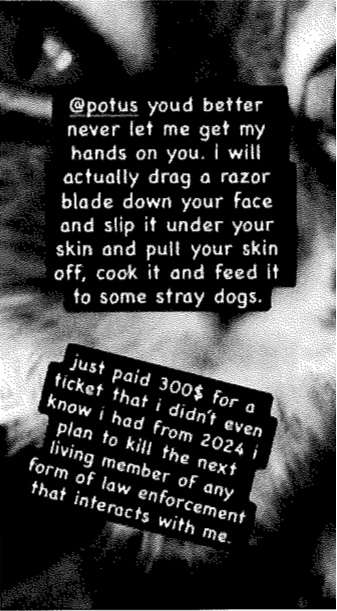
U.S. v. Santiago, decided Monday by Judge Chad Meredith (E.D. Ky.), involves this Instagram post:

Santiago is being prosecuted for making threatening interstate communications, in two counts, "one regarding the threat to the President, and one regarding the threat to law enforcement officers." The court allowed the prosecution to go forward:

[T]he question of whether Santiago's speech was a "true threat" or political hyperbole is one that must be determined by a jury, not the Court.

Of course, "courts retain the power to remove a true-threat question from the jury's consideration … if the evidence shows that the speech was protected as a matter of law." But the implication to be drawn from the evidence here is disputed and it is not so clear-cut that the Court can decide it as a matter of law. A reasonable jury could find Santiago's statements to be true threats, and so the matter must be presented to a jury. The First Amendment does not say otherwise because it does not even apply if a jury concludes that the statements were true threats….

For most context, see the FBI agent's affidavit accompanying the criminal complaint; an excerpt:

Between January 27, 2026, and March 27, 2026, kadi_skating [allegedly one of Santiago's user ids] sent the following messages to an unidentified user: …

• kadi_skating: "im filled with political violence now." [January 8, 2026]….

• kadi_skating: "death to trump." [March 2, 2026]

• kadi_skating: "death to the American nazi regime." [March 2, 2026].

• kadi_skating: "and the american people NEED to start shooting at the necks, legs, and arms of ICE agents." [March 2, 2026]

• kadi_skatlng: "STUFF A GRENADE IN THEIR AHH AND BLOW IT UP." [March 2, 2026]

• kadi_skating: "LETS GOOOO no one is spared all of ice is going to die by my hands [March 2, 2026]

• kadi_skating: "I wanna kill n*zis bad." [March 23, 2026]

Emily K. Greenfield and James T. Chapman represent the federal government.

The post Prosecution for Threatening to Cut President's Face Off and Feed It to Stray Dogs Can Go to Jury appeared first on Reason Magazine.

  •  

"The Three Words That Explain American Government: 'Right to Sue,'" by Stanford Law Prof. Diego Zambrano

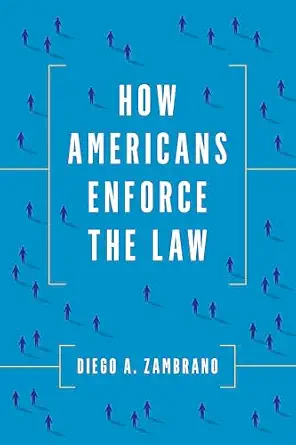
I read and much enjoyed—and highly recommend—my Stanford colleague Diego Zambrano's book, How Americans Enforce the Law. He was kind enough to write up for us this post that captures the core of his argument, and I'm delighted to pass it along (though I encourage people to read the whole book):

The headlines are full of stories about a federal government retreating from enforcement. Agencies are dropping investigations, abandoning regulations, shrinking staffs and changing enforcement priorities. One week, the EEOC drops discrimination cases. The next week, the SEC and CFPB wind down investigations into securities fraud and wrongdoing affecting consumers. Critics fear that the Department of Justice's antitrust division will overlook mergers when it is convenient for the administration. And the DOJ has abruptly reduced enforcement of the Foreign Corrupt Practices Act. Facing these changes, Americans might worry that a wide range of laws will go unenforced.

But that concern misses something unique about the American system of government. We have never relied only on bureaucrats to enforce our laws.

All the way back to the colonial period, American legislators have repeatedly done something unusual: they have given ordinary people the right to sue alongside government officials. In almost every regulatory area that most Americans care about—be it regulation of wages and hours, environmental pollution, consumer protection, or securities fraud—statutes allow both government officials and private parties to file suit to enforce the law. All of this happens through little-known provisions called "private rights of action," which is just a technical name for a right to sue. Thousands of these provisions build a second enforcement system alongside the bureaucracy, turning employees, consumers, competitors and their lawyers into co-enforcers of public law.

This system of private enforcement of the law is highly unusual. In much of the rest of the world, whenever a government faces a regulatory problem, it typically empowers government officials and bureaucrats to police legal violations. In France, Germany, Japan, and even the UK, legislators are far less likely to let anyone sue over, say, environmental pollution or employment discrimination.

Consider the case of oil spills. In 1989, the United States faced the Exxon Valdez oil spill off the pristine waters of Alaska.  Millions of gallons of oil laid waste to coasts, waters, and fisheries for hundreds of miles. What most Americans don't know is that a decade later, France also faced a catastrophic oil spill, caused by a ship called the Erika. So how did governments react? In the United States, private plaintiffs sued Exxon directly under existing tort and maritime law, eventually winning substantial damages. Congress, meanwhile, enacted a statute called the Oil Pollution Act with a new right-to-sue those responsible for oil spills. By contrast, in France, the oil spill led primarily to a major criminal prosecution and, eventually, to new national and European regulatory measures (including a new bureaucracy called the European Maritime Safety Agency). When France finally adopted a right to sue in 2016, it paled in comparison to the American version.

Why is the United States so different? Part of the answer, as I argue in a new book, is that Americans have always done this. Back in the colonial period, state legislatures adopted what they called "penal statutes," that empowered any person to enforce regulatory statutes and collect a bounty. So when Massachusetts wanted to regulate the storage of gunpowder, it allowed private informers to sue neighbors who stored it improperly. And this model applied across many areas of colonial life: alcohol consumption, trade, taxation, public morals, church attendance, and more. The Founders used the same tool across the board: Thomas Jefferson and James Madison co-wrote Virginia statutes full of penal statutes, and John Adams handled these suits routinely as a colonial lawyer.

The key feature of this system is that even though private parties file suit for their own aims—the employee wants their full wages paid or the consumer wants a refund for a shoddy product—they inevitably enforce the law. And those lawsuits benefit everyone else because employers and manufacturers may change their behavior with respect to other employees and consumers. In that sense, every single plaintiff is a little bureaucrat or, as some courts call them, a "private attorney general."

This system has the added benefit of reducing political disruptions in enforcement. Even though any single administration can change the enforcement priorities of the EEOC, SEC, CFPB, or Department of Justice, the president cannot control thousands of lawyers and their clients. Private enforcement, then, makes enforcement less dependent on what the bureaucracy and president want.

Right. So you might think that when the bureaucracy won't pursue wrongdoing, the obvious solution should always be new rights to sue. Indeed, many news stories decrying a lack of government enforcement immediately call for more private lawsuits.

But there's a problem with that solution. Private enforcement is not tailor-made for every regulatory area. It makes the most sense to empower private parties when the bureaucracy is truly faulty, under-resourced, politically vulnerable, or likely to be captured by regulated entities. When this isn't the case, private enforcement can cause more problems than it solves.

Consider, then, the enormous problems that rights to sue pose in the environmental context and in the construction of housing and infrastructure. There, broad rights to challenge government approvals can let private parties oppose the construction of housing, mass transit, green energy, and other projects. Examples of ruinous lawsuits abound. Neighbors in a Maryland suburb—backed for years by a nearby country club—sued to delay the Purple Line light-rail project over concerns for a microscopic organism, while the Sierra Club sued to stop a major Mojave solar energy project over the potential impact to a desert turtle. So even if a city government has approved a project that might benefit thousands of people, a single crank can use a right-to-sue to stop the project. In these settings, rights to sue have contributed to delays and increased costs of housing and infrastructure.

We need a careful approach to rights to sue. Yes, we need more of them in some areas. Especially if the government won't enforce anti-corruption or consumer protection statutes. And yes, in employment law, securities, and antitrust, private enforcement often makes a lot of sense. But this is not necessarily the case in environmental law and construction. There, we need better bureaucracies, not thousands of people with the ability to oppose construction projects for any number of reasons.

When the bureaucracy retreats, Americans should rest assured that private parties will still enforce the law. But that power to enforce the law should be given carefully.

The post "The Three Words That Explain American Government: 'Right to Sue,'" by Stanford Law Prof. Diego Zambrano appeared first on Reason Magazine.

  •  

Body Armor Ban Struck Down by N.Y. Federal Court

From today's decision by Judge John Sinatra (W.D.N.Y.) in Heeter v. James:

New York enacted a first-of-its-kind law prohibiting law-abiding residents-who are not engaged or employed in an eligible profession-from purchasing body armor for self-defense. New York enacted this legislation "to further strengthen gun laws." New York's body armor legislation, however, violates the Second Amendment….

In D.C. v. Heller (2008), the Court made it clear what the term "Arms" meant when the Second Amendment was ratified. In explaining that "[t]he 18th-century meaning" of the term "Arms" is "no different from the meaning today[,]" the Court quoted multiple dictionaries from the Seventeenth Century. Specifically, "[t]he 1773 edition of Samuel Johnson's dictionary defined 'arms' as '[w]eapons of offence, or armour of defence.' 1 Dictionary of the English Language 106 (4th ed.) (reprinted 1978) (hereinafter Johnson). Timothy Cunningham's important 1771 legal dictionary defined 'arms' as 'any thing that a man wears for his defence, or takes into his hands, or useth in wrath to cast at or strike another.' 1 A New and Complete Law Dictionary; see also N. Webster, American Dictionary of the English Language (1828) (reprinted 1989).'' As a result, this Court is bound by Heller's textual analysis, which demonstrates that the word "arms" included armor at the Nation's founding (as it does today)….

The State submits that, during the Founding Era, armor "had become rare or even entirely obsolete in everyday American English" and "the protective leather gear of th[e] pre-Kevlar era was notoriously ineffective against bullets, meaning civilians did not typically wear such body protection either." This argument runs headlong into the definitions adopted by Heller, nevertheless indicating that the term "arms"—as it was defined in the Founding Era—included defensive body armor that (according to the State) was supposedly rarely utilized in 1791.

Body armor may be used more today than Defendants' understanding of its use in 1791. But it strains credulity to say that an arm that was rarely used during the Founding Era—yet still protected by the Second Amendment per Heller—is no longer protected despite being much more common among Americans today.

Moreover, this conclusion is consistent with Heller's clear statement that the Second Amendment "extends, prima facie, to all instruments that constitute bearable arms, even those that were not in existence at the time of the founding." While body armor may not have been in common use at the founding—although the commonly understood definition of "arms" included body armor—neither were other arms commonly used for self-defense, such as resolvers, semiautomatic pistols, and stun guns. See Caetano v. Massachusetts (2016) (Alito, J., concurring). The defensive body armor available today is "no more exempt from the Second Amendment's protections, simply because [it was] unknown to the First Congress, than electronic communications are exempt from the First Amendment, or electronic imaging devices are exempt from the Fourth Amendment." …

Even if the definitions put forth by the Supreme Court in Heller are dicta, this Court has an "obligation to accord great deference to Supreme Court dicta," absent a change in the legal landscape. Defendants have not suggested—nor can they—that a change in the legal landscape exists that would require this Court to ignore how Heller defined the term "arms." …

Because Plaintiffs have demonstrated that body armor is an "arm" protected by the Second Amendment, the burden shifts to the State to justify its regulation by demonstrating that it is consistent with the Nation's historical tradition of arms regulation. The State fails to do so….

The State argues that there exists a "centuries-long historical tradition" demonstrating that, "when body armor has been in use, it has been subject to government regulation." Yet, the State is unable to identify a single regulation on body armor post-ratification…. The State contends that its body armor ban is consistent with "English monarchs and parliaments" who "regularly issued laws forbidding or restricting the wearing of armor …." Not only is this analogy irrelevant to the regulation of arms in the United States, but it also ignores the historical reason the right to keep and bear arms is "understood to be an individual right protecting against public and private violence." Accordingly, the Court interprets the English history put forth by the State in light of these principles and articulates that it is not "sufficiently probative" to defend New York's body armor ban….

The State points to the Statute of Northampton for support for its position that there is a long-standing tradition of restricting who can purchase body armor. The law prohibited anyone to "go, nor ride armed by night, nor by day, in fairs markets, nor in the presence of the justices or other ministers, nor in no part elsewhere, upon pain to forfeit their armor to the King and their bodies to prison, at the king's pleasure." Notwithstanding the ink that continues to be spilled over this law, the Supreme Court has stated that "the Statute of Northampton—at least as it was understood during the Middle Ages—has little bearing on the Second Amendment adopted in 1791." N.Y. State Rifle & Pistol Ass'n, Inc. v. Bruen (2022)….

The State's analogy to the Statute of Northampton is an attempt to justify its body armor ban by speculating that individuals only wear body armor to terrify the public. Yet, this ignores the reality put forth by Plaintiffs, that the public is more likely to reach for body armor to protect themselves from terrifying circumstances. In Rahimi, the Supreme Court concluded that "[a]n individual found by a court to pose a credible threat to the physical safety of another may be temporarily disarmed consistent with the Second Amendment." Here, however, the State is suggesting that a merely broad-based suspicion over the population at large is sufficient to justify a universal ban on the sale and purchase of a specific type of arm. And to the extent that the State analogizes this to prohibiting criminals from purchasing body armor, other statutes already criminalize the use of body armor while committing violent crimes. The State's categorical prohibition of a specific type of arm to law-abiding citizens at large, is untethered from any historical tradition-including the Statute of Northampton….

Nicolas J. Rotsko (Fluet) represents plaintiffs.

The post Body Armor Ban Struck Down by N.Y. Federal Court appeared first on Reason Magazine.

  •  

Rezoning Request for Catholic Shrine May Have Been Denied Because of Shrine's "Pro-Life Message"

From Judge Stephanos Bibas, joined by Judge Tamika Montgomery-Reeves, in Monday's Holy Trinity Ukrainian Catholic Church v. Township of Collier:

Holy Trinity is a Ukrainian Catholic parish outside Pittsburgh. It practices the Catholic faith, but with rituals and architecture that are distinctively Ukrainian. The parish owns two plots of land. On one of them, in Carnegie, sits a church, where it holds regular liturgies. The other plot, in nearby Collier Township, has been owned by the parish for more than seven decades. That 41-acre plot houses the parish's cemetery and mausoleum but is otherwise mostly wooded.

About three years ago, Holy Trinity's pastor felt called to turn the second plot into a shrine, a pilgrimage destination for faithful to gather from "near and far." The shrine would "honor Mary, the Mother of God, and would pay homage to the sanctity of life." With the help of lawyers, architects, and traffic consultants, Holy Trinity designed the shrine. It envisioned a 13,000-square-foot chapel with gold domes, a bell tower, a museum, a gift shop, and a retreat center.

But the plot is constrained by Collier Township's zoning code. The code divides the township into districts, each of which allows certain types of buildings. The northern, wooded half of the plot lies in a planned-economic-development district, allowing larger projects like business offices, amusement parks, or country clubs. The southern half is in a rural-residential district, allowing farms and single-family homes. Neither district contemplates shrines.

The zoning code is enforced by Collier's five-member Board of Commissioners. The Board has power not only to rezone land or amend the code, but also to approve or deny some building projects, because the code makes some land uses conditional. For instance, the code conditionally allows new churches in rural-residential districts, but only if the Board approves them. In any event, anything as big as Holy Trinity's shrine needs the Board's approval.

To fit the shrine project into the zoning code, Holy Trinity applied to do two things. First, it asked the Board to amend the zoning code to allow planned cultural centers, including the shrine, in economic-development districts. Second, it sought to rezone some of its rural-residential land into economic-development land, to make a larger plot for the shrine. As part of its application, Holy Trinity included sketches of its shrine plus a traffic study showing minimal impact on the surrounding community. After a live hearing with concerned residents, the Board denied Holy Trinity's application, expressing concern about traffic and Holy Trinity's fundraising projections. Some residents, and at least one Board member, were also troubled once they learned that the shrine's message would be pro-life.

So Holy Trinity tried again with a smaller project. It applied to build a modest chapel entirely on its rural-residential land. Though the Board approved the new application, it came with strings attached, limiting bell ringing, the height of the chapel, and who could be remembered at memorial services….

The majority held that Holy Trinity wasn't entitled to a preliminary injunction, because the harm could be repaired by damages (one of the elements of the preliminary injunction inquiry); on this matter, the majority and Judge Paul Matey's dissent had an interesting and complicated debate. But here's a passage as to the facts that struck me as worth noting, even apart from that controversy:

Finally, and most troubling, both community and Board members objected to the shrine's pro-life message. One resident worried that "Father Jason has been very involved in pro life. This is to be a pro life museum … [W]hen you think very political rights, either side, it brings a lot of danger, a lot of protests, as well as costs that could be incurred by the community." Another complained that "the intent of the shrine was a celebration for Roe vs. Wade being overturned … [and] reparation for sin of abortion and counseling, spiritual direction …. this will bring a bunch [of people] potentially for a rally and this could also bring the opposite as well for protest."

Privately, at least one of the Board's members agreed. The day after the hearing, that commissioner forwarded an email about the shrine's pro-life stance to the rest of the Board: "Looks like we might have dodged a bullet last night. The true inten[t] of the shrine" was pro-life and "This could have been a disaster." Another township officer, copied on the email, seemed to affirm those sentiments. Nothing in the record suggests that any other Board member responded and disagreed. And in her deposition, the Board member who wrote the email confirmed that "one of the reasons" that the Board had denied the application was Holy Trinity's pro-life purpose. She also defended denying land-use approval "based on the nature of the religious service to be held in the building."

These objections hint at unconstitutional religious hostility and content-based discrimination, concerns that would be better addressed on a more developed factual record. But at the very least, they strongly suggest that the Board resists ever approving the shrine project. If so, the rezoning denial is effectively absolute, and the "degree" of burden on Holy Trinity is substantial. Plus, the township does not show that denying approval altogether is the least-restrictive means to serve a compelling interest. That is enough to show that Holy Trinity is very likely to prevail on its RLUIPA [Religious Land Use and Institutionalized Persons Act] substantial-burden claim….

The post Rezoning Request for Catholic Shrine May Have Been Denied Because of Shrine's "Pro-Life Message" appeared first on Reason Magazine.

  •  
❌