❌

Reading view

Christodoulides demands that EU resume talks on mutual defence clause

President Nikos Christodoulides has sent a letter to European Commission President Ursula von der Leyen demanding that the European Union resume discussions on its mutual defence clause, after the matter found itself at the centre of discussions when EU leaders met in Cyprus in April, but has since fallen off the agenda.

The sending of the letter was confirmed to the Cyprus Mail by presidential press office director Victor Papadopoulos, though he said he could offer no further details, while news website Politico quoted Christodoulides as having written that “I cannot overstate the importance of this provision for the EU and its member states”.

This, he wrote, rings true “especially in times of geopolitical uncertainty”.

“Given the gravity of the challenges we face, Cyprus would welcome the resumption of discussions at the relevant preparatory bodies. I would therefore appreciate an update on the proposals under consideration, as well as a timeline for next steps,” he wrote.

The leaders of the EU’s 27 member states had during a European Council summit in Nicosia in April resolved to demand the creation of a defence “playbook”, with Cypriot government sources at the time lamenting that “nothing has been done” in the decade since the first and only time that the bloc’s mutual defence clause was activated.

It was France which triggered Article 42.7 of the Treaty of the European Union, better known as the Lisbon Treaty, after Paris was hit by a series of terrorist attacks in November 2015.

Article 42.7 not attached to any formal operational plans

While the text of the treaty states that “if a member state is the victim of armed aggression on its territory, the other member states shall have towards it an obligation of aid and assistance by all the means in their power”, it is not attached to any formal operational plans or international military structures.

Government sources lamented in April that “there is no clear picture of procedures, capabilities, or response times across member states”, and also decried what they described as a lack of clarity regarding the types of support which can be requested, what each member state may provide, and how quickly assistance can be delivered.

They also stressed that if a member state triggers Article 42.7, assistance must not be optional.

“It is a legal obligation, not a political choice,” they said, before adding that “member states cannot question the reasons” behind the triggering of the clause if it is triggered, provided that an armed attack has taken place.

However, in the six months since that summit, the matter of defence has slipped down the European agenda, with the most recent European Council summit, held in Brussels, being dedicated largely to the EU’s multiannual financial framework, its budget for the years between 2028 and 2034, while conversations on defence centred on Ukraine, which remains, for now, outside the bloc.

Focus inside EU has now shifted to multi-year budget

The focus on the budget has come with most leaders across Europe aiming to have the next multiannual financial framework devised and agreed upon by the member states by the end of this year.

Christodoulides had said on this matter last week that should an agreement not be reached by the end of this year, “I believe we would be sending a negative message, not only to European citizens, but to the world”.

Mutual defence was most recently discussed at the European Parliament last month, with the EU’s foreign policy chief Kaja Kallas decrying “Russia’s hybrid warfare in Europe” and calling for measures to be taken against it.

“Putin is a textbook bully. Moscow’s hybrid attacks are designed to intimidate us, paralyse our societies and make us hesitate to act. That is precisely what Putin wants. We should not let fear dictate our choices. We should match the level of these attacks with concrete action and a confident response. Europe’s security requires it and citizens expect it,” she said.

Cypriot MEPs called for stronger Article 42.7, looser relations with Turkey

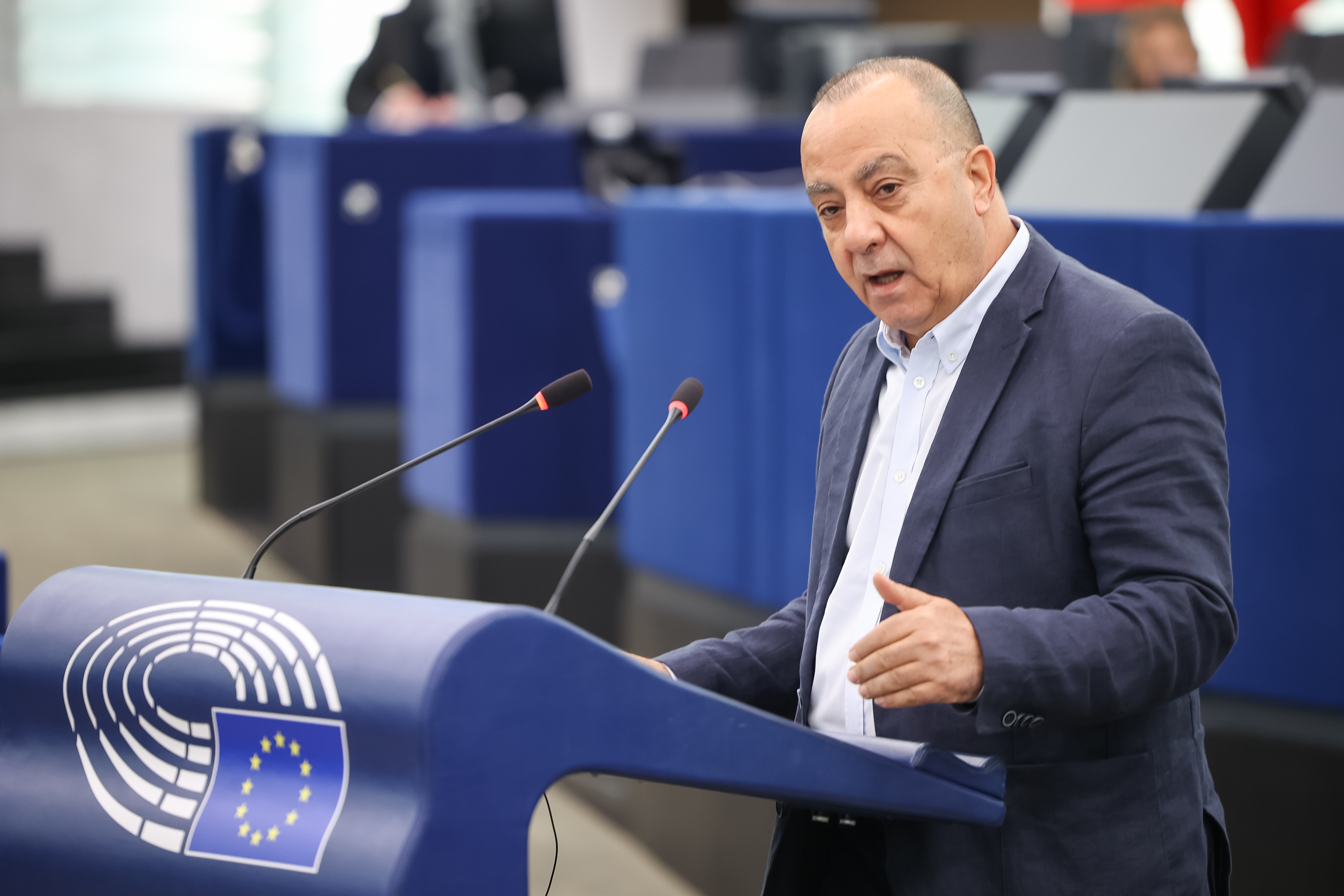
In response, Cypriot MEP Costas Mavrides, of Diko, said that “hybrid attacks are also taking place for years by the neo-Ottoman Erdogan regime against member states in the eastern Mediterranean” in reference to Turkish President Recep Tayyip Erdogan.

He called for the EU’s mutual defence clause, Article 42.7 of the Treaty of the European Union, which is commonly known as the Lisbon Treaty, to be made “workable and operational”, before telling to Kallas that “your double standard policy is increasing part of the problem” regarding Turkey.

Fellow Cypriot MEP Geadis Geadi, of Elam, also called for the EU to “establish a clear roadmap for activating Article 42.7”, saying that this should “ensure that the mutual defence clause can be applied immediately and effectively”, and also criticised the EU for not treating Turkey and Russia in the same way.

“Mrs Kallas, be careful when you shake hands which are stained with the blood of hundreds and thousands of innocent people,” he said.

  •  

Erhurman promises to start negotiations if Christodoulides accepts rotating presidency

Turkish Cypriot leader Tufan Erhurman has said that he will “immediately” accept the opening of formal negotiations with the aim of resolving the Cyprus problem if his counterpart, President Nikos Christodoulides, unconditionally accepts that there be a rotating presidency in a post-solution Cyprus.

He said the issue had most recently been raised during the United Nations’ high-level week last month, when both he and Christodoulides were in New York, with Christodoulides having requested a tripartite meeting with him and either UN Secretary-General Antonio Guterres or Cyprus problem envoy Maria Angela Holguin.

With Christodoulides pushing for a meeting before both men returned to Cyprus, Erhurman said that Holguin had informed him that “the Greek Cypriot side was ready to accept the rotating presidency”.

In response, he said, he had said that “I am ready to sit at the negotiating table if the Greek Cypriot leader, Nikos Christodoulides, explicitly and unconditionally accepts the rotating presidency”.

However, he said, he “received no response” to this, and as such, no meeting was held before both men returned from New York.

“Our stance is consistent and stable. We are ready for all kinds of negotiations, but the preparation must be done properly. We are pushing for a result,” he said.

In the absence of this commitment, he said, “I did not want a token meeting” or a “photo opportunity meeting”, but instead, “I want to get work done.”

Christodoulides said Erhurman wishes to set ‘preconditions’

Those comments come after Christodoulides had accused him of attempting to set “preconditions” on the resumption of negotiations to solve the Cyprus problem in reaction to his insistence on a rotating presidency.

“It is clear that the Turkish side … is setting terms and preconditions for the resumption of talks. They are demanding that we accept, in advance, specific positions of interest to the Turkish Cypriot community, while showing absolutely no willingness to discuss or accept our own positions on other significant aspects of the Cyprus problem,” he said.

He added that “it is for this reason that I have repeatedly stated that all these issues must be discussed at the negotiating table”.

“In my view, setting terms and preconditions prior to the resumption of negotiations is a tactic which does not facilitate progress,” he said, before adding that the Turkish Cypriot side’s view is “particularly revealing” as it “sheds light on why the talks have not yet resumed” and “highlights one of the primary reasons for this continued delay”.

Dana: Rotating presidency an indispensable component of political equality

The rotating presidency has long been viewed by the Turkish Cypriot side as being fundamental to the political equality between Cyprus’ two major communities which is stipulated by United Nations resolutions.

Erhurman’s undersecretary Mehmet Dana had told the Cyprus Mail that it is an “indispensable component” of political equality, saying that “political equality forms the foundation of a structure requiring the joint exercise of a limited number of specific powers, shared competences, and this is not open to negotiation”.

He added that the “primary reason” for the collapse of previous rounds of negotiations on the Cyprus problem, and “specifically” those between Nicos Anastasiades and Mustafa Akinci at Crans-Montana in 2017, was that “political equality was made a subject of negotiation and subsequently used to cause a deadlock in the process”.

Therefore, he said, “guided by the [United Nations] secretary-general’s approach that ‘this time must be different’, acceptance of this issue in principle must occur prior to the commencement of the negotiation process”.

“Naturally, once the rotating presidency is accepted in principle, the specific terms, such as the duration of the respective tenures and other details, would be negotiated once the talks actually begin,” he said.

  •  

Cypriot MEP likens EU to Pontius Pilate on climate, Turkey in Cop31 debate

Cypriot member of the European Parliament Giorgos Georgiou, of Akel, likened the European Union to Pontius Pilate, as the Strasbourg plenary session discussed preparations for next month’s Cop31 climate summit, which will be held in the Turkish Mediterranean city of Antalya.

“The climate crisis is here. Wildfires, heatwaves, drought, catastrophic floods, a state of constant emergency. It is the European peoples, of course, who pay the price,” he said, before adding that The Left, the European grouping to which he belongs, is “demanding the obvious” from the Cop31 summit.

He said that what must be achieved is “action, not new promises”, as “we have already been burned and drowned by promises”.

“The battle against the climate crisis is, of course, not merely an environmental one. It is a struggle for social justice and equality, free from exclusion, yet, regrettably, Turkey has sought to obstruct the participation of the Republic of Cyprus and to weaponise the conference,” he said.

In this, he said that Turkey is “aiming to politically promote the illegal secessionist entity in the occupied territories” through its hosting of Cop31, and that this alleged aim is “consistent with the illegal Turkish-Libyan memorandum”, the maritime jurisdiction deal which was ratified by the Libyan parliament on Tuesday.

“As for you, shall I say it? I shall. You are acting like Pontius Pilates regarding Turkey, and perhaps even regarding the climate,” he said.

Pontius Pilate was the fifth governor of the Roman province of Judea and is best known in the contemporary era for being the official who presided over the trial of Jesus and ordered his crucifixion. His name has become a metaphor for refusing personal accountability for a harmful decision and moral cowardice.

Climate change ‘even more pronounced in Europe’

Diko’s Costas Mavrides also spoke during the Cop31 debate and stressed that “climate change is, in fact, not an ideology”, and that it is “even more pronounced in Europe, and particularly in the Mediterranean”.

He stressed that “such global problems … require global approaches and international cooperation”, and on this front stressed the need for “concrete, measurable targets aimed at closing the gap between stated objectives and their practical implementation”.

In addition, he, too criticised Turkey for what he decried as “weaponising” the summit, saying that this has come “once again to the detriment of the Republic of Cyprus”, and that the Turkish government has “attempted to block the president of Cyprus’ participation”.

As such, he called on the European Union’s institutions to “stand firmly in defence of this member state of the European Union and the United Nations”.

Christodoulides, Erhurman to attend summit in Antalya

Cypriot President Nikos Christodoulides had announced last week that he will “of course” attend the summit, adding that, “I am pleased that, thanks to the decisive contribution of our partners, and following our diplomatic and political efforts conducted away from the public eye, we have achieved a result”.

His participation had initially been in doubt as the Republic of Turkey does not recognise him as a head of state.

Asked whether he may also be expecting “unpleasant surprises” during the summit, he said that “we are preparing for any eventuality, and I must tell you that we do not rule one out”.

“At the same time, there will also be reactions from the Republic of Cyprus’ side, a member state of the European Union, of the EU which has 27 member states,” he said.

Turkish Cypriot leader Tufan Erhurman, too, said he will attend the summit, saying that “we received an invitation from the president of the Republic of Turkey, Recep Tayyip Erdogan” and that “we will be in Antalya”.

He added that he has “learned from the press” that President Nikos Christodoulides “has also announced that he will be there, as is customary”.

“As we always say, diplomacy and dialogue are always beneficial,” he said.

Turkey has been designated as a co-host for the summit, alongside Australia, with Turkish Environment Minister Murat Kurum designated as the chairman of Cop31 and Australian Climate Change Minister Chris Bowen set to preside over negotiations between political leaders at the Antalya summit.

While Turkey does not recognise Christodoulides as a head of state, a host country does not have the right to unilaterally exclude any United Nations member state from the negotiations which take place during the 12-day summit.

  •  
❌