❌

Reading view

Venture capitalists are questioning the neolab math

Menlo Ventures' Matt Murphy speaking to Ben Bergman at Tech Insider: Growth Mode.

JY Studio

  • A version of this story originally appeared in Business Insider's weekly VC Insider newsletter.
  • Sign up for BI's VC Insider newsletter here.

Ben here. Up until recently, it was a great time to be the founder of a neolab, the lavishly funded, research-first AI startups founded by top talent who defected from the likes of OpenAI or Google DeepMind.

We reported last month that Jeff Dean, Google's former chief scientist, is seeking a valuation as high as $50 billion for his new AI science startup. OpenAI cofounder Ilya Sutskever's Safe Superintelligence is worth $32 billion. Another OpenAI alum, Mira Murati, is raising a round for Thinking Machines Lab at a valuation of around $40 billion.

But lately, in conversations with multiple VCs around Silicon Valley, there is a growing divide about whether neolabs can make the economics work with their multibillion-dollar price tags and formidable competition from frontier labs.

One VC at a top firm, who asked that I not use his name, told me neolabs are the most hotly debated type of investment right now.

"Some would say you shouldn't invest in any, and others would say this is basically all you should be investing in because software's dead, and you either have to own models or hardware, and even if you enter at a billion, the company could be worth a trillion," he said.

Biggest neolab valuations

Business Insider; Randy Yeip

When I recently asked Menlo Ventures partner Matt Murphy at Business Insider's Growth Mode conference which sector he thought was most overhyped, he immediately cited neolabs, which was noteworthy, given that Menlo invested in some of them.

Murphy pointed to an example from his time as an early board advisor at Google, which he said did so well because it "was like a match thrown into a bonfire."

"The opposite thing you want to do is start a match with a bonfire," Murphy told me. "That's the risk of what's going on now with companies raising such large rounds."

Another Menlo partner, Deedy Das, posted last month about the "difficult game" of making neolab math work.

Das seemed a bit taken aback by the reaction to his post and later texted me: "Like all startups, many will fail, some will work."

Picking which ones will work is why VCs get paid the big bucks.

Neolabs are a power-law bet taken to an extreme, Radical Ventures' Aaron Rosenberg told me.

Investors know most will likely burn enormous sums on compute and talent without ever becoming profitable. But the rare winner could become a foundational AI company worth hundreds of billions or more.

"We're confident that the best neolabs will attract ongoing support," Rosenberg said. "Talent continues to transition out of the incumbents and academia into founder roles, and we see no signs of that slowing."

Like Radical, New Enterprise Associates wrote a bullish view in June. One of the authors, Andrew Schoen, told me his views have not changed. "There are neolabs I know of that are finalizing billion-plus-dollar rounds of equity financing, and those processes are moving very smoothly and quickly," he said.

The Buzz

Menlo Ventures' partners Shawn Carolan, Matt Murphy, and Venky Ganesan.

Will Mackie Productions

Katie here. Many of tech's biggest names gathered at the Ritz-Carlton in San Francisco on Saturday, at a black-tie event in the name of Menlo Ventures' 50th anniversary.

Hollywood titan turned venture capitalist Jeffrey Katzenberg of Dreamworks fame asked the audience to join a prayer "for the blockbuster IPO of Anthropic," a joking reference to Menlo's early investment in the company.

I also spotted Morgan Stanley's storied technology banker Michael Grimes, who is undoubtedly holding his own AI IPO prayers. Other attendees included an array of public company and startup CEOs, including those from Snowflake, Zscaler, Legora, and OpenRouter.

As Menlo partner Venky Ganesan quipped, there was more AUM (assets under management) in the room than in many countries, given the attendees' net worth and the investment capital they manage.

Menlo isn't the first venture firm to host a splashy anniversary party; Index Ventures recently went big for its 30th anniversary.

A person at a rival venture shop expressed disappointment that their firm doesn't host such celebrations.

Menlo's night ended with concerts from two super confidential Grammy Award winners trying to rake in those AI bucks!

Around the Cap Table

Post of The Week

There are only 130 US tech companies, public or private, valued at $10B or more (decacorns). That’s roughly 20 to 30 new companies per decade, for the last five decades. This year alone, with a quarter to go, there have been 42 decacorns minted privately. Either this is the most…

— Rory O'Driscoll (@rodriscoll) October 21, 2026

The VC Insider team

Ben Bergman, chief correspondent, in Los Angeles. Katie Roof, editor at large, in San Francisco. Pranav Dixit, senior technology editor, in San Francisco. Leena Rao, executive editor, in Los Angeles.
Read the original article on Business Insider

  •  

Google's new AI shopping cart tracks deals across stores

Ever find something you want to buy online, leave it sitting in a browser tab and then completely forget where you saw it? Maybe you spotted a great pair of headphones while searching Google. Later, you found a birthday gift at another retailer. Before long, you've got a dozen tabs open and no idea which store had the better deal.

Google thinks it has a solution. On Oct. 15, the company began the U.S. rollout of Universal Cart, a new artificial intelligence-powered shopping tool that brings products from different retailers into one place. It also tracks prices, watches for restocks and helps you find savings before checkout.

With holiday shopping approaching, the timing could be especially useful. But there's another question worth asking. Will having everything in one cart help us spend less, or simply make it easier to buy more?

AMERICANS SAY THEY'RE BROKE. SO WHY CAN'T THEY STOP SPENDING SO MUCH?

Join our upcoming CyberGuy LIVE class: 5 Ways to Travel Smarter and Save Money

In this free live online class, Kurt "CyberGuy" Knutsson will share five practical ways to protect your trip and your wallet this holiday travel season. You'll learn how to secure your phone and personal information, find better travel deals, avoid common scams, save money on bookings and use technology to make your travels easier and less stressful. No technical experience is needed.

Join us Saturday, October 31, at 11 AM ET / 8 AM PT. Register for free now at CyberGuyLive.com.

AMAZON ABOUT YOU MAY KNOW YOU A LITTLE TOO WELL

What is Google Universal Cart?

Google Universal Cart is a shopping hub that works across Google Search and the Gemini app. Instead of keeping separate lists of products you might buy, you can save items from different retailers in one place. For example, you might find a coffee maker while searching Google and add it to your Universal Cart. Later, while talking with Gemini about gift ideas, you could save a pair of sneakers from another store. When you return, both products will be waiting for you. Google first previewed the tool in May 2026. Now, Universal Cart is rolling out to U.S. shoppers. It uses Google's Shopping Graph, which contains more than 60 billion continually refreshed product listings. That information helps the system monitor prices and availability across supported products.

4 ways Google's new AI shopping cart can help you save

The biggest attraction here is convenience. But Google has added several features that could also help you avoid paying more than necessary.

1. Keep products from different stores in one cart

Shopping online often means bouncing between websites. You find something at Target, check another item at Walmart and then head to Sephora for a gift. Remembering where you saw everything can become a chore. Universal Cart lets you save supported products you discover through Google Search and Gemini. More importantly, your saved items stay together when you return to shopping. That could come in handy when you're shopping for several people or making a big purchase that requires some research. You can keep your options organized without committing to buying anything right away.

2. Get alerts when prices drop or products return

Here's the feature I find particularly interesting. Universal Cart can monitor saved products and notify you when a price drops. It can also alert you when something that sold out becomes available again. Suppose you're considering a new television but aren't ready to spend the money. Rather than checking the same retailer every morning, you can save it and let Google's shopping system watch for changes. The alerts could be especially helpful heading into Black Friday and the holiday shopping season. Still, remember that a price reduction doesn't automatically guarantee the lowest price available.

IDENTITY THEFT PROTECTION IS CHANGING: WHAT TO LOOK FOR

3. Find promo codes and credit card savings

This is where Google's AI starts doing some extra work. Universal Cart can surface relevant promotional codes and consider benefits associated with your payment cards. Let's say you have multiple credit cards but can't remember which one offers better rewards at a particular retailer. Universal Cart uses information from Google Wallet to understand supported credit card benefits and help you choose between payment methods. It can also show relevant promotional codes directly in your cart, potentially helping you find savings you might otherwise miss. However, I would still check the details before choosing a card. Rewards programs come with conditions, and the highest points offer may not always translate into the greatest savings.

4. Check out without starting over

Once you're ready to buy, Universal Cart offers a more streamlined checkout experience with participating retailers. In some cases, you can complete the purchase using Google Pay directly from the cart. Alternatively, Google can transfer your selected items to the retailer's website so you can finish your order there. Google says its simplified checkout experiences include retailers such as Nike, Sephora, Target, Ulta Beauty, Walmart and Wayfair, along with many Shopify merchants. However, the available checkout options depend on the retailer. Either way, the retailer remains the seller of record and handles order confirmations and customer support. That means you'll continue dealing with the merchant for delivery questions or returns.

119,000 FAKE SHOPS COULD STEAL YOUR CREDIT CARD DETAILS

How to get started with Google Universal Cart

Google began rolling out Universal Cart to U.S. users on Oct. 15. The feature works across Google Search and the Gemini app, although availability may vary as the rollout continues. To explore it, open Google Search or Gemini and look for products you're interested in buying. When Universal Cart becomes available in your shopping experience, you can save supported products from different retailers. Google says those items will remain in your cart when you return, allowing you to pick up where you left off. You can also use the cart to monitor price changes, discover promotional offers and review available checkout options. However, Google hasn't provided a single set of instructions that applies to every device. The appearance and placement of these features may vary.

NEW AMAZON AI SEARCH TURNS WORDS INTO SHOPPABLE IMAGES

Does Google's Universal Cart work with every retailer?

Not necessarily. Google says Universal Cart can organize products across retailers, but that doesn't mean every online store supports every feature. The products you can save depend on supported shopping experiences. Meanwhile, checkout options vary depending on the merchant. Some purchases can happen through Google Pay in the cart, while others require you to finish on the retailer's website. Google originally introduced Universal Cart in May with plans to bring it to Search, Gemini, YouTube and Gmail. However, its October 15 launch announcement specifically confirms availability across Search and Gemini in the U.S. Google has not announced a confirmed launch date for Universal Cart integration with Gmail or YouTube.

What's powering Google's new shopping experience?

Behind the scenes, Google uses something called the Universal Commerce Protocol, or UCP. It's a shared technical standard designed to help AI-powered shopping tools communicate with retailers and payment systems. For shoppers, the technical details are less important than what they make possible. UCP helps Google connect product discovery with checkout, reducing the need to jump between different shopping experiences. Google has also been expanding AI shopping beyond the cart. Its Let Google Call feature, for example, can use AI to contact nearby stores and check product availability. Amazon has been developing AI-powered shopping tools, while OpenAI offers AI agents that can assist with shopping-related tasks. The competition to become your digital shopping assistant is heating up.

What about your shopping privacy?

Having Google organize your shopping could be convenient, especially if you already use Search and Gemini. Still, it's worth considering how much shopping information you're comfortable keeping within your Google account. Universal Cart uses Google Wallet to help identify supported payment benefits and relevant offers. However, Google's launch announcement doesn't provide detailed information about how long Universal Cart shopping data is retained or exactly how it may be used for advertising. Before relying on the feature, review your Google account's privacy settings and Google's published privacy policies. For now, I would avoid assuming that adding something to Universal Cart keeps that shopping interest private. And if you're buying a surprise gift for someone who shares access to your Google account, think twice before saving it there. Of course, the usual online shopping precautions still apply. Before completing a purchase, check the final price and verify that you're buying from a legitimate seller. A familiar checkout experience shouldn't replace those basic habits. For more help spotting suspicious sellers, see our guide on how to tell whether an online store is real or a scam.

Kurt's key takeaways

I like the idea of having one place to keep track of everything I'm considering buying, especially when the holidays roll around. The price alerts could be genuinely helpful. And if Google's AI can find a discount code I would have otherwise missed, I'm all for it. But I'm also watching where this is heading. Google is making shopping increasingly convenient, and that convenience can be a double-edged sword. When a company knows what you're interested in buying and makes checkout easier, there's less time to reconsider a purchase. My advice? Use Universal Cart to do your homework and save money. Just don't let the technology do the deciding for you.

Would you trust Google's AI to help you shop and choose how to pay, or are we giving tech companies too much influence over what we buy? Let us know by writing to us at CyberGuy.com.

Sign up for my FREE CyberGuy Newsletter

  • Get my best tech tips, urgent security alerts and exclusive deals delivered straight to your inbox.
  • For simple, real-world ways to spot scams early and stay protected, visit CyberGuy.com – trusted by millions who watch CyberGuy on TV daily.
  • Plus, you'll get instant access to my Ultimate Scam Survival Guide free when you join.

CLICK HERE TO DOWNLOAD THE FOX NEWS APP

Copyright 2026 CyberGuy.com. All rights reserved.

  •  

Hugging Face is launching a new AI model that lets scientists 'chat with DNA'

Hugging Face logo sticker over a dark website interface with AI platform text and an Explore AI Apps button.
Hugging Face released a new AI model that can analyze and generate DNA sequences.

Samuel Boivin/NurPhoto via Getty Images

  • Hugging Face released a new AI model that allows users to "chat with DNA."
  • Carbon-X can analyze and generate DNA and allows researchers to ask questions in plain language.
  • Hugging Face said the model can help researchers who work outside the big AI labs.

Hugging Face is releasing an AI model that could make it easier for scientists to study DNA and develop new genetic treatments, the company announced Thursday.

Carbon-X is a "first of its kind" model that combines DNA analysis and generation with plain language, allowing researchers to ask questions and essentially "chat with DNA," according to Lewis Tunstall, a senior research scientist at Hugging Face.

Hugging Face, which Nvidia agreed to acquire for nearly $13 billion in September, is a platform for sharing and developing AI models and also releases its own. The company worked with research labs in Italy and China on Carbon-X, which is an open-source model. Hugging Face built Carbon-X by training an existing language model, Qwen3-14B, on genomic sequences and natural language. It was trained on DNA sequences from humans, other mammals, plants, and fungi.

As an example of how Carbon-X can be used, Tunstall said a researcher could provide a DNA sequence and ask whether a particular mutation could increase a person's risk of disease. The model would then offer a prediction and explanation. It can also generate new DNA sequences, which could help researchers develop new gene therapies.

Tunstall said the company was partly motivated to build Carbon-X to prevent biology researchers from becoming dependent on the major AI labs, noting how AI has disrupted mathematics.

"If you want to really push the frontiers of mathematics, you likely have to be at one of these AI labs like OpenAI or Anthropic, because they're the ones who have the best mathematics models," he said, suggesting a similar situation is likely to play out in other fields of science.

"We wanted to provide the open research community with tools that don't make them fully dependent on some external single provider," he added.

Researchers can run Carbon-X on their own computers, avoiding the need to share sensitive patient data with external AI companies. He also said that some of the misalignment behavior observed in larger models, such as the OpenAI agents that famously hacked Hugging Face in July, has not yet been observed in smaller, more specialized models.

Tunstall said generalist chatbots also sometimes refuse to answer legitimate biology questions from researchers because they mistake them for attempts to "design a bioweapon." He said viruses were explicitly excluded from Carbon-X's training data in order to avoid misuse of the model.

While Carbon-X is likely to be used by researchers, Tunstall said the model represents a small step toward a future where AI can help provide more personalized medical care.

"I think the holy grail is, in general, this concept of personalized medicine where we're able to, as individuals, take our own patient records, our own genomes, and use this to ultimately find or even maybe design our own treatments," he said.

Read the original article on Business Insider

  •  

Most AI data centers may never be built. Blame the 'bragawatts.'

Kevin O'Leary speaks during the Romain College of Business Innovative Speaker Series at the University of Southern Indiana Wednesday, Sept. 23, 2026.
Kevin O'Leary speaks at the University of Southern Indiana.

MaCabe Brown / Courier & Press / USA TODAY NETWORK via Imagn Images/Reuters

  • Newcomers like Kevin O'Leary face skepticism due to a lack of experience in data center development.
  • Bernstein analysts dubbed O'Leary and others "bragawatts."
  • Most announced projects will never happen. "Press releases are cheap…concrete is not."

The AI industry has a problem with bragging.

Companies are announcing enormous new data centers to power the AI boom. Some promise facilities bigger than anything the industry has built before.

There's just one problem: Most of these projects may never happen.

Bernstein Research analyzed thousands of planned US data centers and concluded that only about 35% of the announced capacity is likely to get built. That's roughly 170 gigawatts of data center capacity out of a total of almost 500 gigawatts.

The rest? A significant chunk of it belongs to a category the industry has a wonderfully dismissive name for: "Bragawatts." These are ambitious announcements, often from newcomers with little experience building data centers, that have a slim chance of becoming reality.

"Press releases are cheap…concrete is not," Bernstein analysts wrote in a research note.

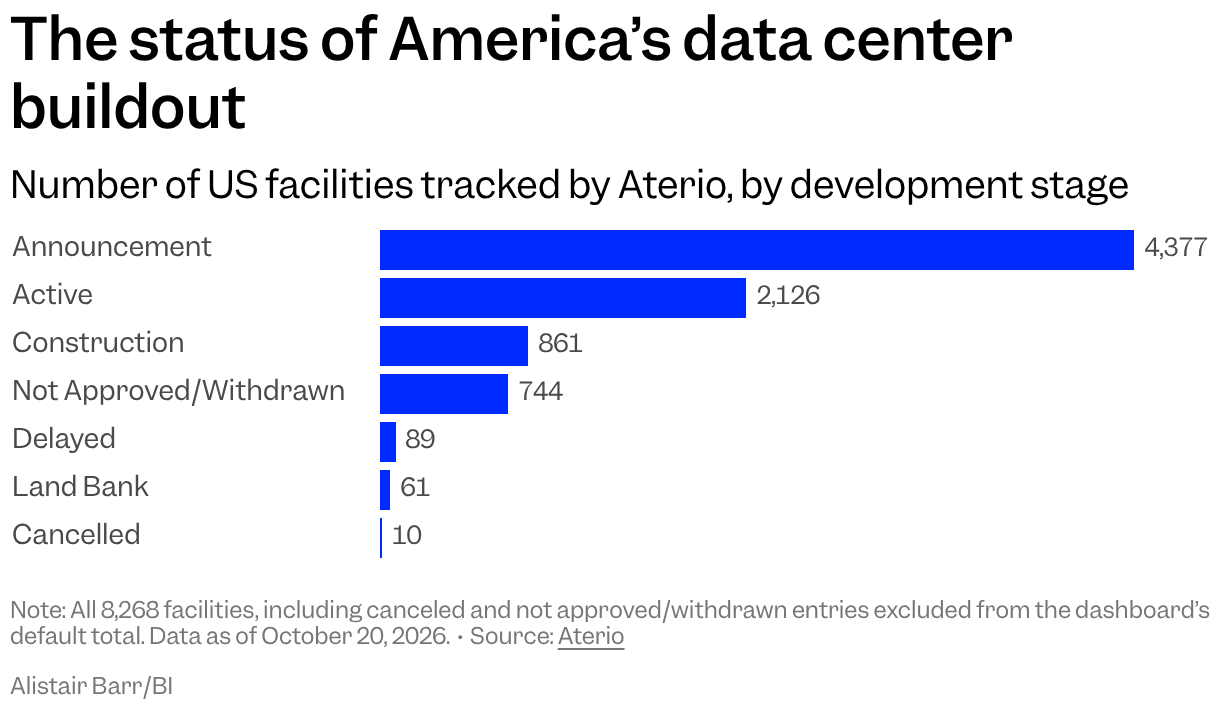
Among 8,268 tracked US facilities: Announcement 4,377; Active 2,126; Construction 861; Not Approved/Withdrawn 744; Delayed 89; Land Bank 61; Cancelled 10.

Bernstein began its analysis with more than 7,000 data center projects across North America, drawing on information from Aterio, a company that tracks construction through satellite imagery, permits, and other records. The analysts narrowed that to more than 5,000 projects (partly by excluding those already canceled).

Then they assessed the chances of these remaining projects being completed. The analysts considered factors such as whether construction had started, whether electricity was available, and whether the companies involved had successfully built data centers before.

The results revealed a striking divide.

The 'bragawatt brigade'

Kevin O'Leary
Kevin O'Leary.

Daniel Delgado Jr./Disney via Getty Images

Experienced operators including Amazon, Google, Microsoft, and Meta landed at the top. Bernstein gave these companies perfect scores of 5 out of 5 for their development credentials. Other data center specialists, such as Digital Realty, Equinix, and CoreSite, got top marks, too.

O'Leary Digital, associated with celebrity investor Kevin O'Leary, ended up at the bottom, with a credibility score of 0.35 out of 5, according to Bernstein. His company has announced 15 gigawatts of data center projects, and Bernstein estimates that only 489 megawatts, or about 3%, will actually materialize.

"Sorry, Kevin," the analysts wrote.

Although the term "bragawatts" has been doing the rounds in the data center industry lately, it's unclear who coined it, Bernstein analyst Madison Rezaei told me.

"I wish I could take credit for that," she said. "I believe I originally heard it from an Equinix executive, but I don't think he owned it either."

She said that while some ambitious newcomers could succeed, they haven't yet demonstrated they can deliver.

"It's not that all of these guys are sort of terrible and not going to deliver, but we just have lower confidence because we don't know them," Rezaei said.

O'Leary Digital responds

O'Leary Digital disputed Bernstein's assessment, saying the research doesn't account for substantial work that occurs before construction begins.

While acknowledging that O'Leary Digital is a young company, CEO Paul Palandjian said the team has decades of experience building major infrastructure projects and that its proposed 15 gigawatts of capacity would be built in stages over several years.

The company said it has secured binding agreements covering about 11,000 acres in Utah and 13,000 acres in Alberta, obtained a 30-year development agreement in Utah, and made progress on planning, engineering, and permits at both sites. It also said the projects would generate their own electricity.

The company said its early development work is funded, additional capital is committed to reaching key milestones, and experienced engineering and construction partners are involved.

"We would rather be judged on milestones than on a model," Palandjian said.

'An announcement in search of a project'

Opponents of the proposed La Osa data center attend a Pinal County Board of Supervisors meeting in Florence, Arizona, on Aug. 26, 2026.
Opponents of the proposed La Osa data center attend a Pinal County Board of Supervisors meeting in Florence, Arizona, on August 26.

USA TODAY Network via Reuters Connect

Other low scorers in the "bragawatt" brigade included Vermaland and Joule Capital Partners, according to Bernstein analysis based on Aterio data.

Joule has announced 50 data center projects with a combined capacity of 11.7 gigawatts. Bernstein estimates that only about 11% of that capacity will actually get built. Almost all of Joule's planned capacity remains at the announcement stage, with little evidence of construction progress or of major customers committing to use the facilities, Bernstein wrote in a July note to investors.

The analysts gave Joule a credibility score of 2.05 out of 5, placing it among the lowest-ranked developers in its database.

"An announcement in search of a project," the analysts wrote.

Vermaland has announced plans for a massive data center project in Arizona. Bernstein estimates that only 4% of its proposed 2.2 gigawatts of capacity will get built. The company is primarily a landowner, not a data center developer. Its proposed $33 billion La Osa project near Eloy had already been sharply scaled back amid local opposition and without construction approval. In late August, regulators formally rejected the project. Even before that, the analysts gave Vermaland a credibility score of 0.75 out of 5.

Joule and Vermaland didn't respond to emails seeking comment this week.

A yawning gap for data centers

Sergio Toro, CEO of Aterio, sees similar patterns in his firm's voluminous, detailed data.

Aterio's tracking shows that roughly 30 to 40 gigawatts of new data center capacity get announced each month. Yet only about 7 gigawatts begin construction each month, while 2 to 3 gigawatts actually start operating.

This leaves a yawning gap.

Many announced projects get withdrawn before construction begins — and before real money has been spent.

"They just make the announcement, but they didn't get their approvals. Or they make multiple filings in multiple locations to see which one gets selected," Toro told me. "That's why we track with satellite if there's real movement on the ground or not."

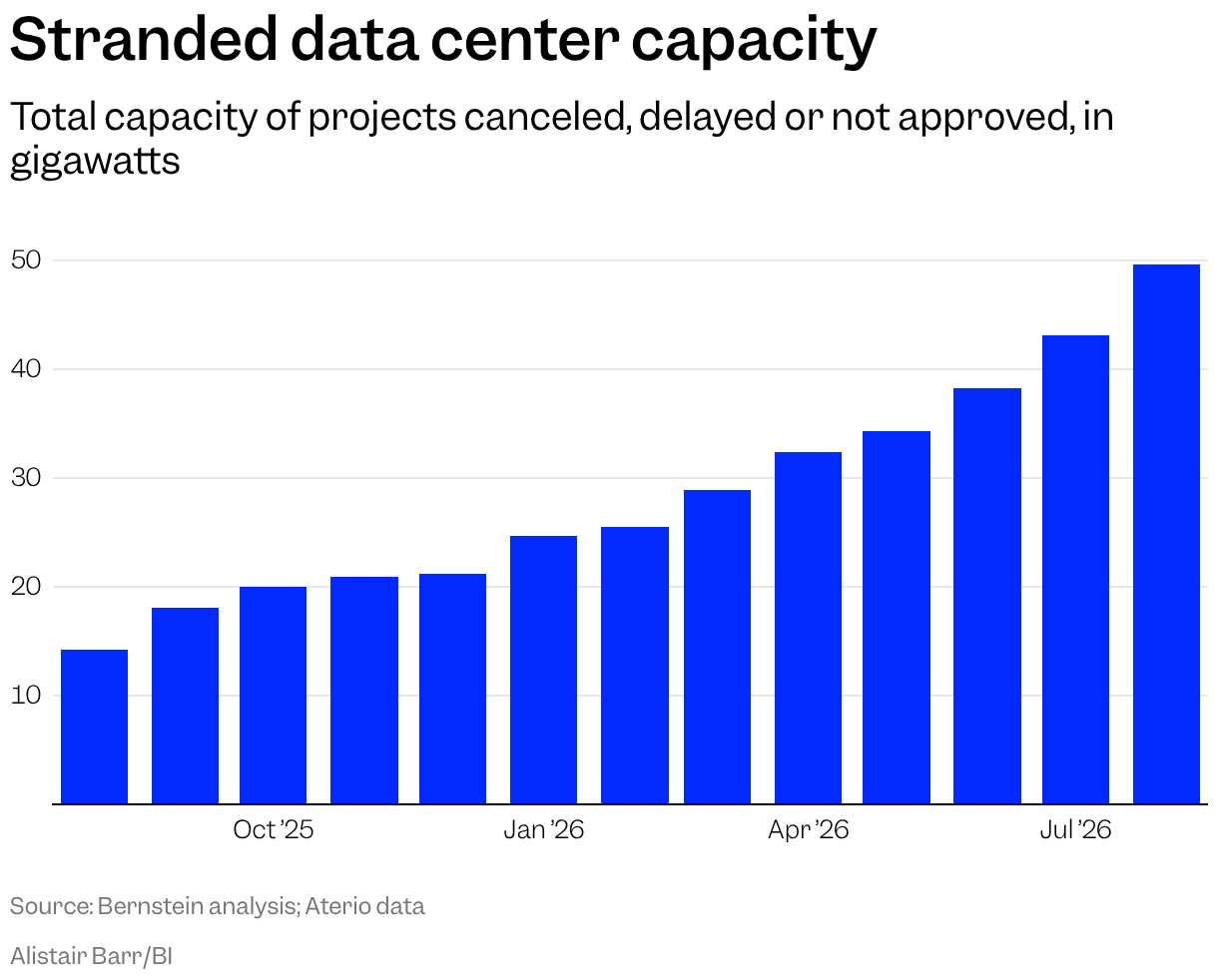
Indeed, Bernstein analysts wrote recently that the amount of "stranded" data center capacity has surged. These are projects that are either canceled, delayed, or not approved.

Column chart showing total stranded data center capacity rising from 14.2 gigawatts in August 2025 to 49.6 gigawatts in August 2026. Stranded capacity means projects canceled, delayed or not approved. Monthly totals are 14.2, 18.1, 20.0, 20.9, 21.2, 24.7, 25.5, 28.9, 32.4, 34.3, 38.2, 43.1, and 49.6 gigawatts.

The AI boom's three tiers

Toro sees three broad groups competing to build AI infrastructure.

At the top are the established technology giants, including Amazon, Microsoft, and Google. They've built data centers for decades and generally deliver on their commitments. Most of their projects will get done, he said.

In the middle are "neoclouds," newer companies such as CoreWeave that rent out computing power specifically for AI. Although they're more vulnerable to financing problems and delays, many are making solid progress, especially because some of these players already have access to electricity.

"We see them advancing quite well," Toro said. "Sometimes we see some delays, but it's not something significant or any kind of big capacity that is at risk."

Then come the newcomers making extraordinary promises. That's where most delays and cancellations happen, Toro said.

Even Amazon needs a backup plan

NEW CARLISLE, INDIANA - OCTOBER 2: In this handout provided by Amazon, a technician works at an Amazon Web Services AI data center in New Carlisle, Indiana on October 2, 2025.
A technician works at an Amazon Web Services AI data center in New Carlisle, Indiana.

Noah Berger/Getty Images via Amazon Web Services

Not every project that disappears was a fantasy, though. Even a top player like Amazon struggles sometimes to secure electricity and other supplies on time for these huge projects.

Business Insider's Eugene Kim reported exclusively this week on the challenges Amazon faces with its record AI buildout.

The biggest, most experienced tech companies deliberately pursue more potential data center capacity than they need because they know some developments will fail or get delayed.

Major AI companies were committing to three or four times the space and electricity they needed over the following two years, Jeffrey Moerdler, a data center lawyer, estimated during an interview with Bernstein analysts.

His reasoning: Of data center projects that haven't started construction, roughly a third will arrive on schedule, another third will be delayed, and the remainder won't happen.

Rezaei and Toro estimate that the top players don't over-commit that much — more like double the capacity they need at most.

The strategy provides a "Plan B," as Toro put it, in case of delays involving electricity, equipment, permits, local opposition, or other factors.

Texas has a ghost problem

AUSTIN, TEXAS - JULY 03: In an aerial view, the Decker Creek Power Station is shown on July 03, 2024 in Austin, Texas. The state of Texas is developing plans to double its Texas Energy Fund of $5 billion. The move seeks to bolster an expansion of the power grid, as new predictions of surges in electricity usage loom.
The Decker Creek Power Station in Austin.

Brandon Bell/Getty Images

This helps explain another extraordinary number.

Data center companies have requested connections for roughly 450 gigawatts of electricity demand on Texas' main power grid, more than five times the grid's roughly 85 gigawatts of existing capacity, according to Toro and others. 

Many of those requests are placeholders rather than firm construction plans. Toro calls them "ghost projects."

These speculative projects clog the waiting lists for electricity connections, making the electricity shortage look a lot worse than it actually is.

"Developers routinely spam projects across several sites, and many are speculative builds with no customer yet," Ryan McEntush, a partner at venture capital firm Andreessen Horowitz, wrote in a recent blog. "Often these new developers have never even plugged in a GPU, let alone a power plant."

Texas has paused applications to review and weed out projects that aren't serious. Toro, from Aterio, expects this to favor the established players at the expense of the bragawatts.

The real AI boom

None of this means the AI infrastructure boom is imaginary.

Aterio tracks thousands of buildings, including major projects already under construction. Bernstein estimates that nearly 80% of the capacity the largest technology companies are directly developing is credible.

And when speculative projects disappear, Rezaei doesn't expect a wave of unpaid debt. Many will fail before building begins, the stage when developers borrow serious money through project financing.

Some of those missing data centers were never really coming in the first place.

Sign up for the AI Insider newsletter here. Reach out to me via email at abarr@businessinsider.com

Read the original article on Business Insider

  •  

Sundar Pichai explains how a team of AI agents helps him run the company

Sundar Pichai, chief executive officer of Alphabet Inc., arrives for a meeting on artificial intelligence with tech executives at the White House in Washington, DC, US, on Tuesday, Sept. 29, 2026. The gathering follows a surge in concern about AI potentially posing a threat to humans. Photographer: Aaron Schwartz/Bloomberg via Getty Images
The Google CEO said he uses AI agents to track Google's model development and internal discussions.

Bloomberg/Getty Images

  • Sundar Pichai said he uses AI agents to track Google's model development and internal discussions.
  • The bots summarize updates and monitor how Google's computing resources are used.
  • Pichai said humans still make consequential decisions about resource allocation.

Even Google's CEO needs help keeping up with Google.

On the Sources podcast released Wednesday, Sundar Pichai described to host Alex Heath how he delegates some of the information-gathering that comes with running the tech giant.

“It could easily take me an hour a day to kind of catch up, what's happened in the last 24 hours, right?" Pichai said. "But now I have agents running which summarize and bring that information to me. I can still go deeper, and I do so often."

Pichai said that his AI agents give him a way to "understand the model development arc," figure out how Google's computing resources are being used, and follow threads spread across numerous internal chat groups without having to read through every conversation himself.

“Similarly, there are agents with telemetry into our compute usage by product area, efficiency, utilization, and giving me inputs and insights, you know," Pichai added. "I think it's made all of us, you know, be better at what we do."

That doesn't mean Pichai has handed over the important calls to AI. He said humans — including himself — remain directly involved in consequential decisions about allocating computing resources.

Managing agents is becoming a skill in its own right, giving some workers a new set of headaches, from checking the bots' output to preventing them from duplicating work or straying beyond their assignments. Business Insider previously reported that the need to manage agents is making everyone a boss without higher pay.

Delegating to bots doesn't necessarily make work easier, either. A Cisco engineering director who manages more than 10 agents told Business Insider that overseeing them involves more task switching and can make work feel more intense without shortening his days.

For the Google CEO, however, continuous work is a plus.

"So because your agents, they're running in the cloud, they're running 24/7, they have your context, and so they can pick up things where you left off," Pichai said. "It's a continuum there. By the time it's doing that, you would be applying yourself to the next problem and so on."

Read the original article on Business Insider

  •  
❌