Katelyn Lesse, head of platform engineering at Anthropic.
Chris Ratcliffe/Bloomberg via Getty Images
Anthropic platform engineering head Katelyn Lesse said that Claude now writes all her team's code.
Lesse shared ways that Claude Code has helped the company become more efficient.
Anthropic nears an initial public offering at a potential $2 trillion valuation.
A top Anthropic engineer says that Claude Code has already wiped out all human coding at one of the AI lab's central teams.
Katelyn Lesse leads the AI startup's platform engineering group, which handles the company's core services, developer tools, and product infrastructure — it's essentially the engine room of Anthropic. Lesse said at Grafana Labs' ObservabilityCON event on Tuesday that among her staff, which tallied 200 as of this summer, the era of human-written code is fully over.
"When it comes to our team and how we're actually building and maintaining our systems, all of our code is written by Claude," Lesse said. "Like, literally all of it."
Anthropic's heavy reliance on Claude Code has helped it remain relatively small, as it approaches an initial public offering that could value it at nearly $2 trillion. The company's revenue growth slowed in the third quarter of this year. Maintaining its lofty valuation may depend on selling more companies on the AI-first approach espoused by Lesse and other Anthropic leaders.
Lesse said that people on her teams are still designing systems and verifications, and then offloading the actual coding to Claude. She said that when the company changed the programming language of a major codebase from Python to Rust, workers developed a way to verify the final product.
"But the grunt work of building the pieces and actually monitoring the pieces and actually making sure that we felt good about it, that was agents all the way down," Lesse said.
Lesse said Anthropic already lets agents fix tests autonomously, with no human interaction, and it's thinking about how staff can get comfortable with agents autonomously making changes to the actual codebase, given the improvements in AI models over the last year.
"As engineering leaders, we're like terrified, and we're like, let's be really careful about this, but I think the line is starting to push," Lesse said.
Anthropic has also embraced Claude Code companywide. It released a report last week saying that as AI agents have worked more inside the company, it has hired for a smaller share of junior technical positions. And in May, Anthropic said that Claude then wrote more than 80% of the entire company's production code.
Have a tip? Contact this reporter via email at scouncil@businessinsider.com, or over text, Signal, Telegram, or WhatsApp at 415-757-8198. Use a personal email address, a non-work WiFi network, and a non-work device;here's our guide to sharing information securely.
Ethem Coban, a researcher at Meta, left the company earlier this month to launch a legal tech startup, according to a person familiar with the matter. Coban, who worked on teaching Meta's language models to reason through legal questions, has been in talks to raise $6 million at a $25 million valuation.
Talks are still early, and the terms of the deal could change.
The startup is the latest entrant in an increasingly crowded legal tech market. Long seen as laggards, lawyers have spent the past two years experimenting with tools built on large language models. Early movers like Harvey and Legora saw a crush of demand, setting off a wave of investment in startups promising to transform how lawyers work.
Now, that opportunity is attracting researchers from the companies building the underlying models.
Coban spent almost two years at Meta, most recently at its Superintelligence Labs, where he helped train models to give better answers to legal questions and reduce hallucinations, the person said. He previously studied law at American University and Goethe University in Frankfurt.
A spokesperson for Meta didn't respond to a request for comment.
Coban has told investors that his new company aims to help law firms and corporate legal teams build and customize models around their expertise. The bet is that companies will increasingly want to own their AI rather than license it from outside companies, because it gives them more control over their data.
Law firms also see a chance to turn mountains of case files into a competitive advantage that other firms can't simply buy off the shelf. Kirkland & Ellis, the industry's revenue leader, has committed $500 million to building proprietary software. Latham & Watkins has been buying its own Nvidia servers to customize models in-house.
For Coban, the challenge won't be convincing law firms that they need artificial intelligence. It will be persuading them that someone who knows how the models work from the inside is best suited to build them.
Companies are announcing enormous new data centers to power the AI boom. Some promise facilities bigger than anything the industry has built before.
There's just one problem: Most of these projects may never happen.
Bernstein Research analyzed thousands of planned US data centers and concluded that only about 35% of the announced capacity is likely to get built. That's roughly 170 gigawatts of data center capacity out of a total of almost 500 gigawatts.
The rest? A significant chunk of it belongs to a category the industry has a wonderfully dismissive name for: "Bragawatts." These are ambitious announcements, often from newcomers with little experience building data centers, that have a slim chance of becoming reality.
"Press releases are cheap…concrete is not," Bernstein analysts wrote in a research note.
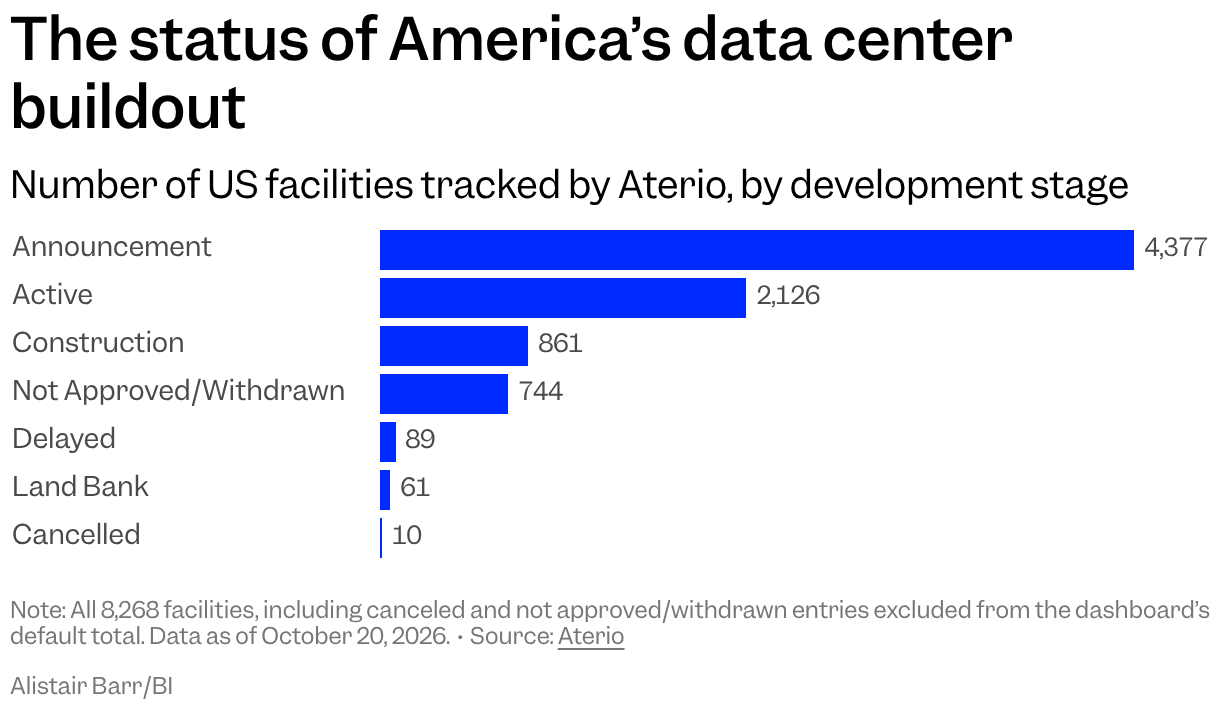
Bernstein began its analysis with more than 7,000 data center projects across North America, drawing on information from Aterio, a company that tracks construction through satellite imagery, permits, and other records. The analysts narrowed that to more than 5,000 projects (partly by excluding thosealready canceled).
Then they assessed the chances of these remaining projects being completed. The analysts considered factors such as whether construction had started, whether electricity was available, and whether the companies involved had successfully built data centers before.
The results revealed a striking divide.
The 'bragawatt brigade'
Kevin O'Leary.
Daniel Delgado Jr./Disney via Getty Images
Experienced operators including Amazon, Google, Microsoft, and Meta landed at the top. Bernstein gave these companies perfect scores of 5 out of 5 for their development credentials. Other data center specialists, such as Digital Realty, Equinix, and CoreSite, got top marks, too.
O'Leary Digital, associated with celebrity investor Kevin O'Leary, ended up at the bottom,with a credibility score of 0.35 out of 5, according to Bernstein. His company has announced 15 gigawatts of data center projects, and Bernstein estimates that only 489 megawatts, or about 3%, will actually materialize.
Although the term "bragawatts" has been doing the rounds in the data center industry lately, it's unclear who coined it, Bernstein analyst Madison Rezaei told me.
"I wish I could take credit for that," she said. "I believe I originally heard it from an Equinix executive, but I don't think he owned it either."
She said that whilesome ambitious newcomers could succeed, they haven't yet demonstrated they can deliver.
"It's not that all of these guys are sort of terrible and not going to deliver, but we just have lower confidence because we don't know them," Rezaei said.
O'Leary Digital responds
O'Leary Digital disputed Bernstein's assessment, saying the research doesn't account for substantial work that occurs before construction begins.
While acknowledging that O'Leary Digital is a young company, CEO Paul Palandjian said the team has decades of experience building major infrastructure projects and that its proposed 15 gigawatts of capacity would be built in stages over several years.
The company said it has secured binding agreements covering about 11,000 acres in Utah and 13,000 acres in Alberta, obtained a 30-year development agreement in Utah, and made progress on planning, engineering, and permits at both sites. It also said the projects would generate their own electricity.
The company said its early development work is funded, additional capital is committed to reaching key milestones, and experienced engineering and construction partners are involved.
"We would rather be judged on milestones than on a model," Palandjian said.
'An announcement in search of a project'
Opponents of the proposed La Osa data center attend a Pinal County Board of Supervisors meeting in Florence, Arizona, on August 26.
USA TODAY Network via Reuters Connect
Other low scorers in the "bragawatt" brigade included Vermaland and Joule Capital Partners, according to Bernstein analysis based on Aterio data.
Joule has announced 50 data center projects with a combined capacity of 11.7 gigawatts. Bernstein estimates that only about 11% of that capacity will actually get built. Almost all of Joule's planned capacity remains at the announcement stage, with little evidence of construction progress or of major customers committing to use the facilities, Bernstein wrote in a July note to investors.
The analysts gave Joule a credibility score of 2.05 out of 5, placing it among the lowest-ranked developers in its database.
"An announcement in search of a project," the analysts wrote.
Vermaland has announced plans for a massive data center project in Arizona. Bernstein estimates that only 4% of its proposed 2.2 gigawatts of capacity will get built. The company is primarily a landowner, not a data center developer. Its proposed $33 billion La Osa project near Eloy had already been sharply scaled back amid local opposition and without construction approval. In late August, regulators formally rejectedthe project. Even before that, the analysts gave Vermaland a credibility score of 0.75 out of 5.
Joule and Vermaland didn't respond to emails seeking comment this week.
A yawning gap for data centers
Sergio Toro, CEO of Aterio, sees similar patterns in his firm's voluminous, detailed data.
Aterio's tracking shows that roughly 30 to 40 gigawatts of new data center capacity get announced each month. Yet only about 7 gigawatts begin construction each month, while 2 to 3 gigawatts actually start operating.
This leaves a yawning gap.
Many announced projects get withdrawn before construction begins — and before real money has been spent.
"They just make the announcement, but they didn't get their approvals. Or they make multiple filings in multiple locations to see which one gets selected," Toro told me. "That's why we track with satellite if there's real movement on the ground or not."
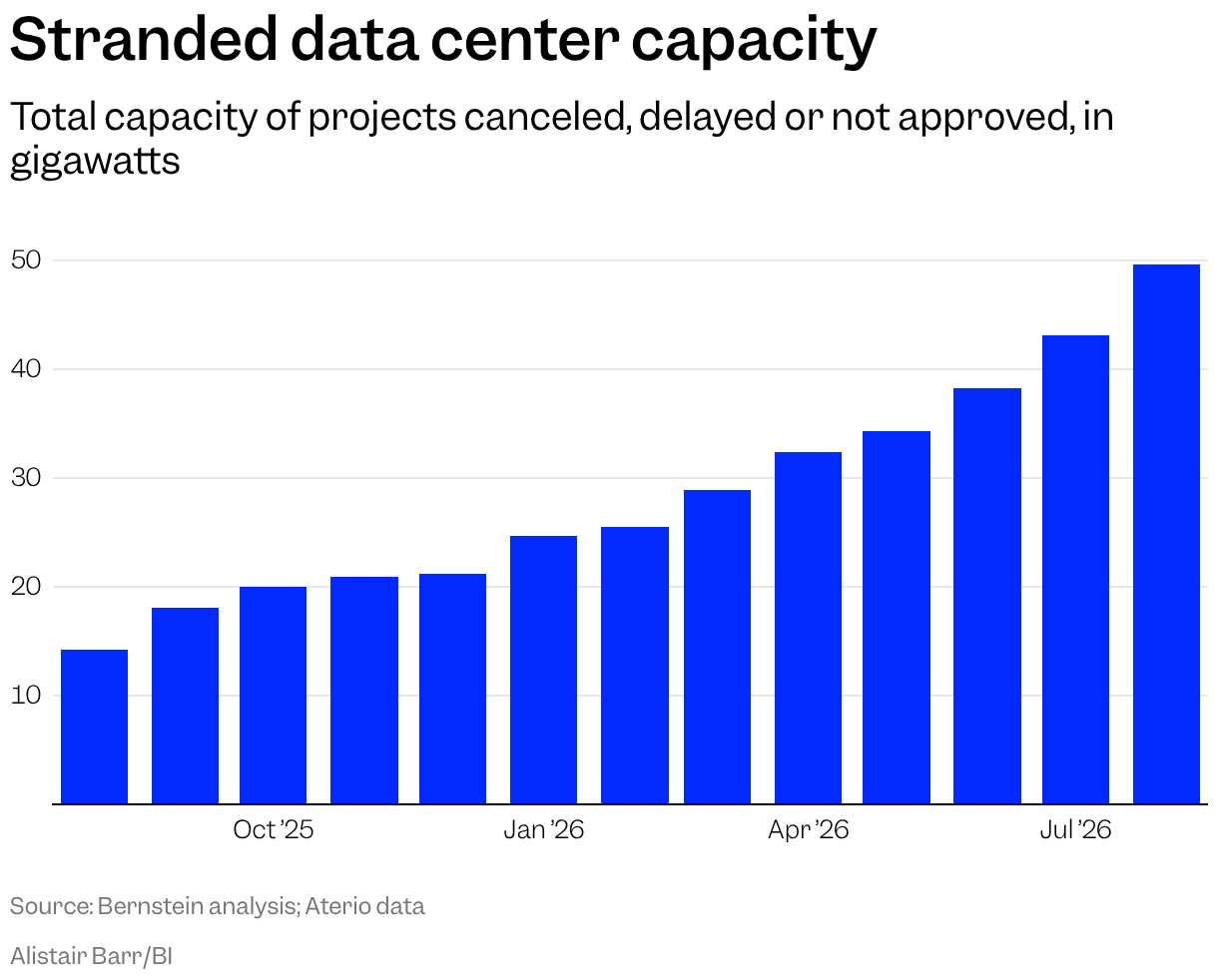
Indeed, Bernstein analysts wrote recently that the amount of "stranded" data center capacity has surged. These are projects that are either canceled, delayed, or not approved.
The AI boom's three tiers
Toro sees three broad groups competing to build AI infrastructure.
At the top are the established technology giants, including Amazon, Microsoft, and Google. They've built data centers for decades and generally deliver on their commitments. Most of their projects will get done, he said.
In the middle are "neoclouds," newer companies such as CoreWeave that rent out computing power specifically for AI. Although they're more vulnerable to financing problems and delays, many are making solid progress, especially because some of these players already have access to electricity.
"We see them advancing quite well," Toro said. "Sometimes we see some delays, but it's not something significant or any kind of big capacity that is at risk."
Then come the newcomers making extraordinary promises. That's where most delays and cancellations happen, Toro said.
Even Amazon needs a backup plan
A technician works at an Amazon Web Services AI data center in New Carlisle, Indiana.
Noah Berger/Getty Images via Amazon Web Services
Not every project that disappears was a fantasy, though. Even a top player like Amazon struggles sometimes to secure electricity and other supplies on time for these huge projects.
The biggest, most experienced tech companies deliberately pursue more potential data center capacity than they need because they know some developments will fail or get delayed.
Major AI companies were committing to three or four times the space and electricity they needed over the following two years, Jeffrey Moerdler, a data center lawyer, estimated during an interview with Bernstein analysts.
His reasoning: Of data center projects that haven't started construction, roughly a third will arrive on schedule, another third will be delayed, and the remainder won't happen.
Rezaei and Toro estimate that the top players don't over-commit that much — more like double the capacity they need at most.
The strategy provides a "Plan B," as Toro put it, in case of delays involving electricity, equipment, permits, local opposition, or other factors.
Texas has a ghost problem
The Decker Creek Power Station in Austin.
Brandon Bell/Getty Images
This helps explain another extraordinary number.
Data center companies have requested connections for roughly 450 gigawatts of electricity demand on Texas' main power grid, more than five times the grid's roughly 85 gigawatts of existing capacity, according to Toro and others.
Many of those requests are placeholders rather than firm construction plans. Toro calls them "ghost projects."
These speculative projects clog the waiting lists for electricity connections, making the electricity shortage look a lot worse than it actually is.
"Developers routinely spam projects across several sites, and many are speculative builds with no customer yet," Ryan McEntush, a partner at venture capital firm Andreessen Horowitz, wrote in a recent blog. "Often these new developers have never even plugged in a GPU, let alone a power plant."
Texas has paused applications to review and weed out projects that aren't serious. Toro, from Aterio, expects this to favor the established players at the expense of the bragawatts.
The real AI boom
None of this means the AI infrastructure boom is imaginary.
Aterio tracks thousands of buildings, including major projects already under construction. Bernstein estimates that nearly 80% of the capacity the largest technology companies are directly developing is credible.
And when speculative projects disappear, Rezaei doesn't expect a wave of unpaid debt. Many will fail before building begins, the stage when developers borrow serious money through project financing.
Some of those missing data centers were never really coming in the first place.
Meta CEO Mark Zuckerberg considered moving out of California because of a proposed billionaire tax.
Zuckerberg would get $20 billion in "immediate liquidity" if the billionaire tax passes.
Meta made the offer to Zuckerberg to help keep him in California after he considered leaving.
Meta CEO Mark Zuckerberg considered moving out of California because of its proposed billionaire tax, Meta disclosed in a new SEC filing on Wednesday.
Next month, Californians will vote on Proposition 40, a one-time tax on the assets of the state's billionaires.
The filing said that Zuckerberg told a special committee formed by Meta that he was considering moving.
In response, the committee concluded that it was "critically important" for Zuckerberg to keep running Meta close to its Silicon Valley headquarters — particularly to its AI division, Meta Superintelligence Labs.
The filing said the committee got Zuckerberg to agree to remain in California or any other jurisdiction where Meta has its corporate headquarters for eight years, barring unforeseen circumstances.
As part of its efforts to ensure he can remain in charge as it raises more cash for its AI initiatives, the company is granting the Meta CEO a new stock class.
The shares would give Zuckerberg $20 billion in "immediate liquidity" to cover the tax by selling stock without losing control of Meta, if the tax passes. The new shares wouldn't add to Zuckerberg's net worth or increase his percentage ownership of Meta.
"The goal is to keep Mr. Zuckerberg continuing to lead the Company from California," the filing says.
Meta declined to comment. A person familiar with the matter said that the new class of shares, which totals $150 billion, is also intended to raise capital, compensate employees, and keep Meta's stock price on the right track.
Meta's filing showcases how tech billionaires are responding to the tax proposal. Some, including Google cofounder Sergey Brin and former CEO Eric Schmidt, poured hundreds of millions of dollars into attack ads against the proposal.
While Zuckerberg has taken a lower-key approach, it's clear he's been taking the proposed tax seriously.
The Meta CEO, who is worth about $240 billion according to Forbes, has multiple residences in California, including in Palo Alto and Lake Tahoe.
He also has a sprawling property portfolio outside the state, including a doomsday bunker in Hawaii, a waterfront mansion in Miami, and a castle in Ireland.
Have a tip? Contact this reporter securely on Signal at charlesrollet.12 or +1-628-282-2811. Use a personal email address and a non-work device; here's our guide to sharing information securely.

 Login