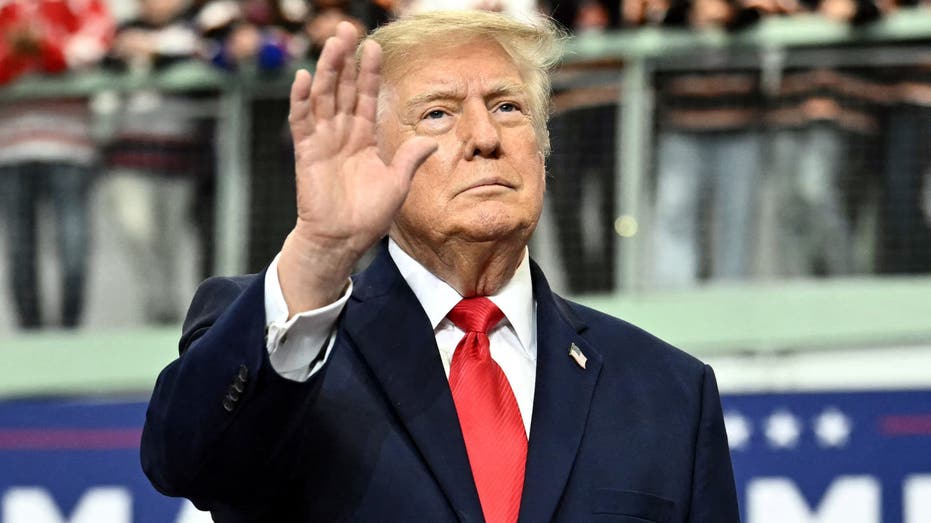
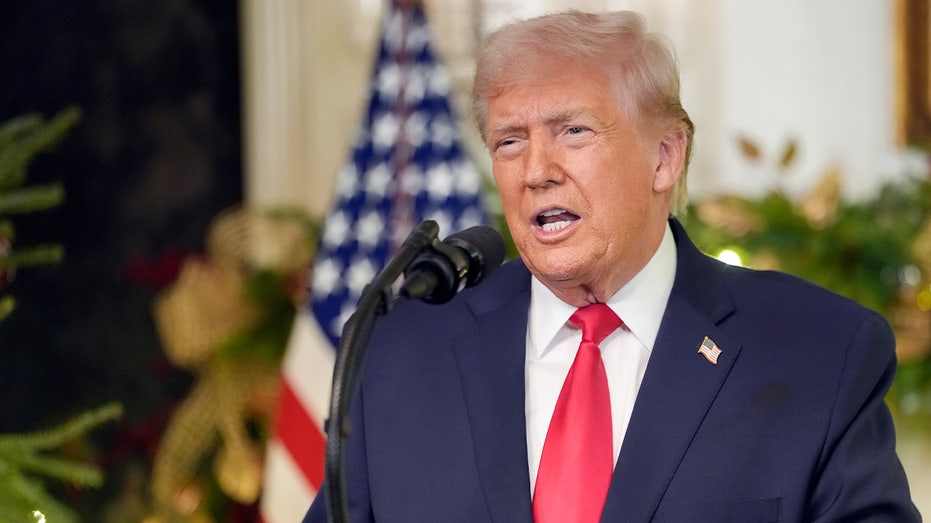
President Donald Trump has been a part of many Team USA golf events recently, making appearances at the 2025 Ryder Cup in New York and this September's Presidents Cup in Illinois. On Wednesday, you could say Team USA returned the favor.
The President held a rally on the campus of Clemson University in South Carolina, and among the guest speakers was Jacob Bridgeman, the two-time PGA Tour winner who made the Presidents Cup clinching putt for the Americans in September.
Bridgeman, a South Carolina native who played collegiately at Clemson, was sure to join in on one of the Tigers' fight songs before sharing supportive remarks for President Trump.
"I just thank President Donald Trump for having me here. It has been great to get to know him and to have him, as he mentioned, at the Presidents Cup, watching us have a pretty historic comeback on Sunday.
"And thank you to my captain, Brandt Snedeker, he had some good remarks for us after the round at the tournament for our President here, so thank you to him. Just glad to be here with you guys and proud to represent one of the best states in the country. I travel a lot, I travel 25 to 30 weeks a year, and every time I come home it feels like at home and there is no place I would rather be.
"Thank you for everyone who lives in this great state, and thank you for making it what it is, and thank you to the President for having me."
Bridgeman, making his Presidents Cup debut, went 1-2-0 in the biennial event, with his win coming during Sunday's singles matches against Min Woo Lee. The Americans faced a three-point deficit heading into the final day, but ultimately came away with a 17-13 victory.
As the former Clemson standout alluded to, Team USA captain Brandt Snedeker had some glowing remarks for President Trump after the team managed to pull off the comeback.
"One last shoutout: Donald Trump. President Trump. He told me, 'I [am] going to bring energy today for you. You guys need it,'" Snedeker said on Sunday evening. "I told him if we did this, he gets all the credit. So, thank you, President Trump."
President Trump, an honorary chairman for the event, briefly addressed the crowd from the first tee before play began.
"You know, the fake news media will say I get a very bad reception," Trump said as the crowd laughed. "But we get a good reception.
"[PGA Tour CEO] Brian [Rolapp] said, 'Could you make a short speech?' I said, 'No, I don't have the courage to make a speech. These people wanna see golf. They don't wanna hear speeches.' I'll only say this: Our country is doing great, better than ever before."
Since the event's inception in 1994, the Americans have fallen to the International team just once in the Presidents Cup.
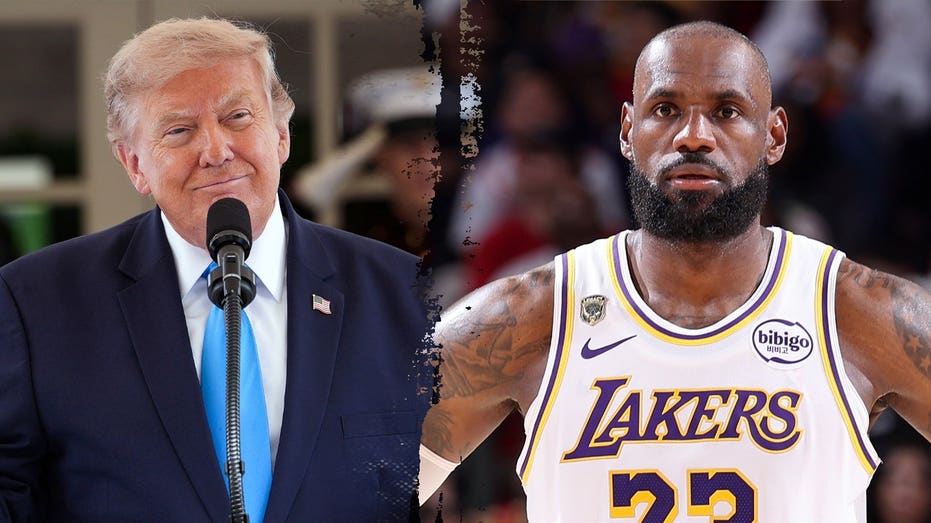
LeBron James is officially back in the crosshairs of President Donald Trump over his performative antics during the national anthem during his debut with the Philadelphia 76ers this week.
James, who has turned into something of a golf addict, was spotted taking some practice swings in his new 76ers gear as the rest of the team stood respecting the anthem during Tuesday's game against the defending NBA champions.
"While listening to our National Anthem, LeBron James disrespects our Country! I said right from the beginning that he’s no good, a TOTAL DISGRACE. LeBron James should apologize to all of those Great American Warriors and Heroes who died for the American Flag, and all that our Country stands for!" the President wrote Thursday in a Truth Social post.
This isn't the first time James has pulled this stunt. Last year, on Christmas Day, while playing for the Los Angeles Lakers, he went through the same golf swing routine.
It's no secret that Trump isn't a fan of James. Earlier this year, the president said why he believes Michael Jordan was better than James.
"Michael Jordan is a guy that's a friend of mine, play golf with him. He's a really good guy. And I think LeBron is, maybe he's a racist, but maybe he doesn't like Trump, I don't know. But I only like people that like me. So, I would say Michael Jordan all the way," the president said.
LeBron's history of anthem antics
In October 2019, as James was embroiled in drama surrounding his loving support of China, he pulled this stunt during the anthem. "LeBron is READY," the NBA on ESPN Twitter account proudly tweeted as if it was Game 7 of the NBA Finals.
Do you want more instances of LeBron disrespecting the anthem? Let's fast-forward to 2023 at a USC basketball game featuring his son, Bronny James. That's the drama queen arriving to his seats during the anthem and taking a seat as the rest of the arena shows respect.
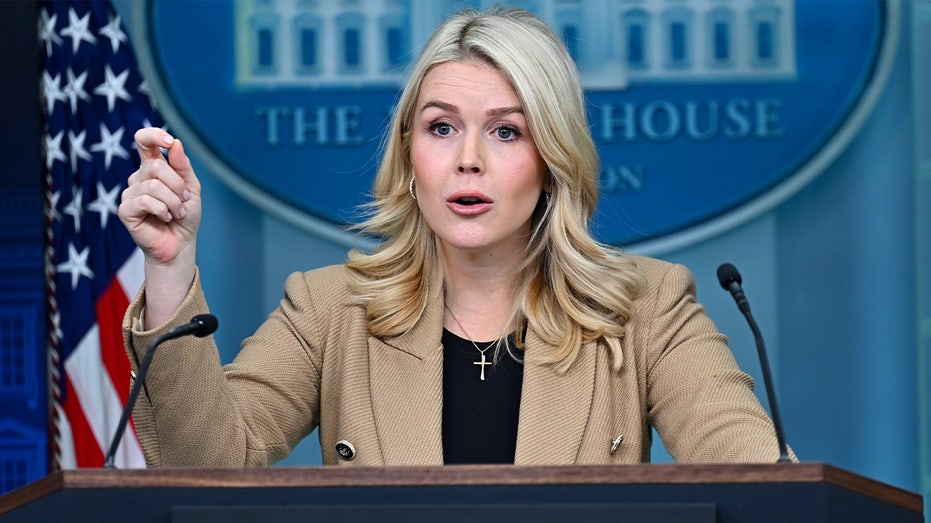
MANCHESTER, N.H. - Former White House press secretary Karoline Leavitt says she is helping President Donald Trump choose his next press secretary after his first pick for the job lasted just five days.
"I've offered my help to the president to help him select someone who can serve him and the country well," Leavitt said Wednesday evening in an exclusive interview with Fox News Digital.
Leavitt served as Trump's press secretary from the start of the president's second term until Aug. 27, when she stepped down from the demanding role to spend more time with her two young children, including a daughter who was born in May.
Her successor, political commentator Katie Zacharia, took over earlier this month, but lasted just five days in the role, making her the shortest-serving White House press secretary in U.S. history.
"White House press secretary is a tough job. I know that because I did it, obviously for almost two years, and many people say it's one of the hardest jobs in politics," Leavitt emphasized.
She noted that the job "takes a lot of preparation and sometimes you don't know how someone will perform until they go out there."
"We wish Katie the best. The job obviously was not for her, but we wish her and her family well," Leavitt added.
When it comes to whom Trump will choose next for the position, Leavitt said the president "is continuing to look over options. There's a lot of people who want that job. It's an amazing job. It provides you with incredible opportunities."
Asked what advice she's offered to Trump, Leavitt said, "I'll keep my private counsel to the president private, but I do obviously talk to him about what the job entails, and he knows it very well."
"Nobody understands the press better than Donald Trump. He knows he needs someone who is tough, who is smart, who understands his policies, who is loyal, and who can go out there and put up a fight," she added.
Leavitt, a New Hampshire native, served as an intern in the Trump White House after graduating from Saint Anselm College in 2019. She later became an assistant White House press secretary at the end of Trump's first term.
After Trump's defeat in the 2020 presidential election, Leavitt worked as communications director for Republican Rep. Elise Stefanik of New York. She then served as spokeswoman for the Trump-aligned super PAC MAGA Inc. before taking over as press secretary for Trump's 2024 presidential campaign.
After being named White House press secretary following the 2024 election, Leavitt made history as the youngest person ever in the role.
Leavitt also ran for Congress in 2022, winning a heavily contested GOP nomination in New Hampshire's 1st District before losing the general election to incumbent Democratic Rep. Chris Pappas.
Asked if she might make another run for public office in her home state when Democratic Sen. Maggie Hassan is up for re-election in 2028, Leavitt quickly said, "No, I'm all set. I don't have any plans to run for office in the near future at all, or in the future at all."
"I am home with my family, and we're really excited about that," she explained. "Right now I'm really focused on being a wife and a mother to my two very young children. That's why I made the decision to leave Washington. So we're just happy to be home and enjoying the ride."
Leavitt officially becomes a Fox News contributor at the start of November.
President Donald Trump has faced some of the lowest approval ratings among modern presidents.
Anna Moneymaker/Getty Images
Polls estimate Trump's approval rating at 34% among registered voters and 36% among likely voters.
Gallup previously tracked presidential approval ratings for nearly 90 years until earlier this year.
Bill Clinton had the highest recorded approval ratings when he left the Oval Office in January 2001.
Only two weeks out from the midterm elections, President Donald Trump's approval ratings have reached their lowest point during his second term.
The latest poll conducted by The New York Times in partnership with Siena University shows that only 34% of registered voters approve of Trump's handling of the job, while 60% disapprove.
The American Research Group, a different New Hampshire-based pollster, asked the same question and found that 29% of respondents approved of Trump's job performance during a similar polling period, while 67% disapproved. The poll also found that only 27% of surveyed Americans approve of the president's handling of the economy.
These new polls stand against a changing polling landscape.
For nearly 90 years, the Gallup presidential approval polls measured Americans' public opinion on the president's job performance, but now, they're a thing of the past.
In February, Gallup, the analytics and polling company that pioneered presidential approval ratings, confirmed they were ending the practice, which, since the 1930s, had asked Americans: "Do you approve or disapprove of the way [the current president] is handling his job as president?"
In Gallup's latest poll, conducted in early December 2025, 36% of respondents said they approved of Trump's performance, and 59% of respondents said they disapproved of his handling of the presidency.
The American Presidency Project at the University of California, Santa Barbara, compiled the final Gallup ratings for each presidential term over the past 70 years — from Harry Truman to Joe Biden — and indicated how popular each leader was when they left the Oval Office.
See how the last 13 US presidents ranked in their end-of-term polling, from the lowest to the highest final approval ratings.
Richard Nixon
AP Images
Final approval rating: 24%
While Richard Nixon won the 1972 election in a historic landslide, the end of his presidency was tainted by the Watergate scandal that led him to resign on August 9, 1974, when facing the threat of impeachment and removal.
Surveyed between August 2 and 5, 1974 — after the House Judiciary Committee had passed articles of impeachment against the president, but before Nixon resigned — 66% of respondents to the Gallup poll said they disapproved of Nixon's presidency, the highest disapproval rate of any president on the list.
Harry S. Truman
Bettmann/Getty Images
Final approval rating: 32%
Assuming the presidency after Franklin D. Roosevelt's death, Harry Truman served two terms that covered the aftermath of World War II and the beginning of the Cold War, including the Korean War, which was widely unpopular and contributed to his low approval rating by the end of his second term in 1953.
When asked December 11 to 16, 1952, 56% of poll respondents said they disapproved of his handling of the presidency during his term.
Jimmy Carter
More than half of the poll respondents in December 1980 said they disapproved of Carter's presidency.
Original Caption
Final approval rating: 34%
Jimmy Carter had high approval ratings and a single-digit disapproval rating in the early days of his term, but his handling of international affairs, such as the Iran hostage crisis in 1979, along with a struggling economy, ultimately made him widely unpopular by the end of his term.
He lost the 1980 presidential election to Ronald Reagan and faced a disapproval rating of 55% in polling conducted December 5 to 8, when he was readying to leave the White House.
George W. Bush
Getty
Final approval rating: 34%
Despite uniting the nation in the wake of the 9/11 attacks, George W. Bush saw his public approval fade during his second term. His approval rating spiked after the 2001 terrorist attacks, the beginning of the Iraq War in 2003, and the capture of Saddam Hussein.
After his reelection, his popularity began to decline as the Iraq War extended. His handling of Hurricane Katrina in 2005 and the onset of the 2008 financial crisis also contributed to his low approval ratings.
From January 9 to 11, 2009, as Bush prepared to hand over the presidency to Barack Obama, 61% of poll respondents said they disapproved of his handling of the presidency during his second term.
Donald Trump
Trump's disapproval rating at the end of his first term came second only to Richard Nixon's before he resigned.
Doug Mills-Pool/Getty Images
Final approval rating: 34%
Donald Trump's first presidency was divisive from the start, as he entered the White House with an approval rating below 50%. He's the first president in modern history to never exceed 50% approval on the Gallup polls during his entire presidency.
While his approval ratings dwindled over the course of his four years in office, his handling of the COVID-19 pandemic in particular came under scrutiny ahead of his loss in the 2020 election.
His lowest approval rating in office came during his final Gallup poll, conducted January 4 to 15, 2021.
Most of that polling period took place immediately after the Capitol insurrection on January 6, and Trump faced a disapproval rating of 62%, the second-worst only after Richard Nixon's at the time he left office.
Joe Biden
Biden's approval rating was 40% by the time he left the White House.
Mandel Ngan - Pool/Getty Images
Final approval rating: 40%
While Joe Biden saw approval ratings above 50% during his first six months in office, rising inflation, illegal immigration, and the wars in Ukraine and Gaza contributed to a decline in his approval ratings.
His lowest-ranking Gallup poll, in which 36% of respondents said they approved of his handling of the role, came in July 2024, a month after his debate performance against Trump shifted focus toward his age and fitness for office.
As he left office, in polls collected January 2 to 16, 2025, Biden received a disapproval rating of 54%.
Lyndon B. Johnson
Lyndon Baines Johnson, President of the United States, at his desk in the White House in Washington on August 26, 1966.
AP Photo
Final approval rating: 49%
After assuming the presidency because of John F. Kennedy's assassination, Lyndon B. Johnson won the 1964 election in a historic landslide, but he faced decreasing approval ratings over his handling of the Vietnam War.
Low approval ratings, along with a divided party, led Johnson to withdraw from the 1968 presidential race.
At the time of his withdrawal, only 36% of poll respondents said they approved of his handling of the presidency.
By the time he left the office, however, his approval rating had risen to 49%. In polling conducted January 1 to 6, 1969, 37% of respondents said they disapproved of his handling of the role, and 14% said they had no opinion, one of the higher percentages among the listed presidents.
Gerald Ford
AP Photo
Final approval rating: 53%
Assuming the presidency upon Nixon's resignation, Gerald Ford served as US president from August 1974 until January 1977, after losing the election to Jimmy Carter.
During his presidency, Ford faced mixed reviews, with his approval dropping after he pardoned Nixon and introduced conditional amnesty for draft dodgers in September 1974.
Polled December 10 to 13, 1976, after he had lost the reelection to Jimmy Carter, 32% of respondents said they disapproved of Ford's handling of the presidency, and 15% said they had no opinion on it, the highest percentage of the listed presidents.
George H. W. Bush
President George H.W. Bush addresses the nation on February 27, 1991 from the White House Oval Office.
AP
Final approval rating: 56%
Though the elder Bush lost his reelection bid in the 1992 presidential election against Bill Clinton, public opinion of him was generally positive by the end of his term.
In the weeks before his 1992 nomination as the Republican presidential candidate, however, George H. W. Bush had only a 29% approval rating, the lowest of his presidency. A recession and a reversal of his tax policy contributed to his drop in popularity.
In polling conducted January 8 to 11, 1993, 37% of respondents said they disapproved of his handling of the presidency, while 56% said they approved.
Barack Obama
At his lowest polling, Obama had a 37% approval rate, which rose to 59% by the time he left the Oval Office.
Brendan Smialowski-Pool/Getty Images
Final approval rating: 59%
Since the beginning of his presidency in 2009, Barack Obama had a high approval rating for a modern-day president; he averaged nearly 47% approval over eight years.
At his lowest point, in polling conducted September 8 to 11, 2011, 37% of poll respondents said they approved of his presidency, a decline most likely influenced by the president's healthcare policies and his handling of the 2008 economic crisis and the subsequent rise in unemployment rates.
In polls conducted January 17 to 19, 2017, when Obama was leaving office, 37% of respondents said they disapproved of his handling of the role, with 59% saying they approved.
Dwight D. Eisenhower
Fox Photos/Getty Images
Final approval rating: 59%
After winning the 1952 election in a landslide, Dwight D. Eisenhower saw high approval ratings throughout his presidency, never dropping below the disapproval rating.
Holding office during the critical Cold War years, Eisenhower saw his approval remain positive through the end of his second term, with only 28% of respondents polled December 8 to 13, 1960, saying they disapproved of his handling of the presidency, the lowest among the presidents listed.
Ronald Reagan
Reagan enjoyed high approval ratings during his presidency, leading to the election of George H. W. Bush as his successor.
Arnie Sachs/CNP/Getty Images
Final approval rating: 63%
Ronald Reagan's strong leadership toward ending the Cold War and implementing his economic policies contributed to consistently positive ratings during his presidency and the subsequent election of his vice president, George H. W. Bush, as his successor to the presidency.
By the time he left office, 29% of respondents in a Gallup poll conducted December 27 to 29, 1988, said they disapproved of his handling of the presidency.
Bill Clinton
Pool/Getty Images
Final approval rating: 66%
After winning the 1992 elections against the incumbent George H. W. Bush, Bill Clinton saw high approval ratings throughout his presidency, though he faced mixed opinions at times during his first term because of his domestic agenda, including tax policy and social issues.
Despite being impeached in 1998 by the House of Representatives over his testimony describing the nature of his relationship with Monica Lewinsky, Clinton continued to see positive approval ratings throughout his second term.
By the time he left the White House, he had an approval rating of 66%, the highest of all the presidents on this list.
In the poll conducted January 10 to 14, 2001, only 29% of respondents said they disapproved of his handling of the presidency.
FIRST ON FOX: A federal judge appointed by former President Barack Obama is being accused of "misconduct" in a case involving President Donald Trump.
House Judiciary Committee Chairman Jim Jordan, R-Ohio, is demanding an investigation into U.S. Judge Kathleen Williams of the Southern District of Florida after she sanctioned Trump's lawyers over his case against the Internal Revenue Service (IRS).
Jordan wrote to the Judicial Conference of the United States that "there is evidence that Judge Williams abused her judicial authority and violated fundamental tenets of judicial impartiality in connection with an unusual and unsupported order that imposed sanctions after the plaintiffs voluntarily had dismissed the underlying action."
The letter is being co-led by Rep. Darrell Issa, R-Calif., chairman of the panel's subcommittee on courts.
Trump, his adult sons Eric and Donald Jr., and the Trump Organization filed a lawsuit against the IRS in early 2026 seeking $10 billion in damages after a contractor with the agency leaked the president's tax returns to the press. The contractor, Charles Littlejohn, was sentenced to five years in federal prison.
Trump, who filed the lawsuit in his personal capacity, had it voluntarily dismissed in May. Shortly after, however, the administration announced a settlement agreement that included $1.776 billion for an "anti-weaponization fund" for victims of "lawfare" by the Biden administration. Trump himself would receive no compensation, but would get a formal apology from the federal government and bar the IRS from ever auditing Trump or his family.
Williams, however, then accused the plaintiffs of purposely manipulating the courts to achieve the settlement and sanctioned two of the president's lawyers in a July order. Her order referred lawyer Alejandro Brito to the Florida Bar for potential disciplinary action and prevented lawyer Daniel Epstein from practicing under her jurisdiction for at least a year.
Jordan's letter called the timing of Williams' order "suspect" for coming after the case was voluntarily withdrawn.
He also accused Williams of basing the action on an amicus brief submitted by left-wing judicial activist group Democracy Defenders Action. The brief, which the group said was submitted on behalf of 35 former federal judges, called on Williams to reopen the case despite the dismissal by the involved parties and accused both sides of "fraud" over the settlement.
"Judge Williams issued her July 13 order after the plaintiffs filed a notice of voluntary dismissal of the case, ending the dispute between the parties," Jordan and Issa wrote. "Although Judge Williams invoked the court's inherent authority to impose sanctions, the Committee is not aware of Eleventh Circuit precedent applying inherent sanctions authority after a plaintiff has voluntarily dismissed a case based on briefing by partisan nonparties on an unrelated question the court never decided."
They concluded, "Judge Williams's conduct risks undermining public confidence in the federal courts. Accordingly, we respectfully ask that the Judicial Conference review this matter, including whether it warrants referral to the Judicial Council of the Eleventh Circuit or other appropriate action, and that you inform the Committee of steps taken no later than 5:00 p.m. on November 5, 2026."
Issa told Fox News Digital in his own statement, "The rogue federal judges who make up the Trump Resistance in Robes continue to disappoint but never surprise. Judge Williams hasn't only shown her liberal contempt for President Trump â but crossed a bright ethical line by going after his attorneys."
Trump allies, particularly in Congress, have clashed with federal judges on multiple fronts so far this term. Republicans have accused what they call "activist judges" of weaponizing their courts to block Trump's agenda.
Democrats, meanwhile, backed up Williams' skepticism of Trump's settlement. The anti-weaponization fund proposal, which has since been blocked by other courts, has received bipartisan pushback.
Politico has issued a correction and re-examined multiple articles after the White House threatened "consequences" if the outlet doesn't retract its recent reporting on President Donald Trump's chief of staff Susie Wiles, Fox News Digital has confirmed.
In a letter addressed to Politico's global editor-in-chief Jonathan Greenberger on Monday, White House counsel William Scharf slammed three "demonstrably false and defamatory articles" about Wiles, including claims that Trump was mulling Wiles' ouster, and that he had a "freak-out" when Politico published its story.
"These publications reflect far more than sloppy reporting or an unfortunate, inadvertent reliance on unreliable sources. They instead reveal a disturbing pattern of the publication of sensational falsehoods despite direct, on-the-record refutations from senior White House officials and even the President of the United States himself, as well as documentary evidence provided to Politico, all of which established clearly that claims central to Politico's planned reporting were false. Put simply, your publication was told the truth and presented with corroborating evidence, and yet chose to publish fanciful fiction regardless," Scharf wrote in the letter first reported by Axios that has been obtained by Fox News Digital.
"This is not a question of competing interpretations, editorial judgment, or political disagreement. It is a question of whether a major news organization may knowingly publish demonstrably false factual allegations, disregard documentary evidence contradicting those allegations, and then hide behind anonymous sources when confronted with the truth. It may not. I therefore demand that Politico retract these defamatory articles and issue corrections promptly, or face the consequences," he later continued.
Scharf gave Politico "48 hours" to reverse its reporting and issue an apology to both Trump and Wiles before the White House explores "appropriate and available legal remedies."
"The White House has no obligation to pretend that this persistent conduct is consistent with responsible journalism. Nor should Politico expect that its institutional behavior will be insulated from scrutiny. After all, freedom of the press is not a professional exemption from accountability," Scharf told Greenberg.
"I therefore demand that Politico immediately correct or retract these publications, issue a prominent and public apology to the President of the United States and to Ms. Wiles, and remove the false reporting from your digital archives. Failure to do so or otherwise respond justifying Politico's publications within 48 hours will prompt an immediate review of Politico's relationship with the White House, and, of course, consideration of all other appropriate and available legal remedies."
Politico responded on Wednesday, insisting it strives for accuracy in its reporting and "categorically rejects the false accusations" that it "chose to publish fanciful fiction" and "purposeful falsehoods designed to mislead the public."
"That said, Politico takes seriously assertions like those made in your letter. Accordingly, consistent with its commitment to ensuring its reporting is as accurate as possible, Politico re-examined all three articles identified in your letter and did follow up reporting," Politico's attorney wrote in a letter obtained by Fox News Digital.
"As a result, Politico determined it was appropriate to correct one of the three articles identified in your letter," the letter continued.
Politico did not offer an apology to Trump and Wiles or correct the report that Trump was considering moving on from Wiles. Instead, Politico corrected an article to note that Wiles simply offered "positive reinforcement" for then-White House press secretary Katie Zacharia's Fox News appearance on "Hannity" last week before she stepped down, but did not play a direct role in booking the interview.
"The updated version of that article, reflecting the information obtained through Politico's further reporting, has now been published. Promptly and transparently making corrections, as Politico has done here, is a hallmark of journalistic ethics and integrity, and of the very professionalism your letter falsely claims Politico is lacking," Politico's attorney wrote.
The White House did not immediately respond when asked for comment.
Politico has been in the crosshairs of the Trump administration in recent weeks as among the outlets that were banned by the White House last month, which had been reversed by a judge's ruling.
"To be clear, any error that you could identify in Politico's reporting about the President or his administration would not excuse the White House's unconstitutional retaliation and discrimination against Politico for the content of its news coverage," Politico's response said.
"The White House's efforts to retaliate against Politico for its constitutionally protected journalism, and to discriminate against Politico based on what the President perceives to be its editorial viewpoint is a profound affront to the most fundamental constitutional rights," the response continued. "Politico will defend its journalism and the right of its reporters to pursue their mission and report fearlessly on the President and other White House officials for the benefit of the American public, notwithstanding the White House's ongoing attempts to intimidate Politico and chill and punish that reporting."
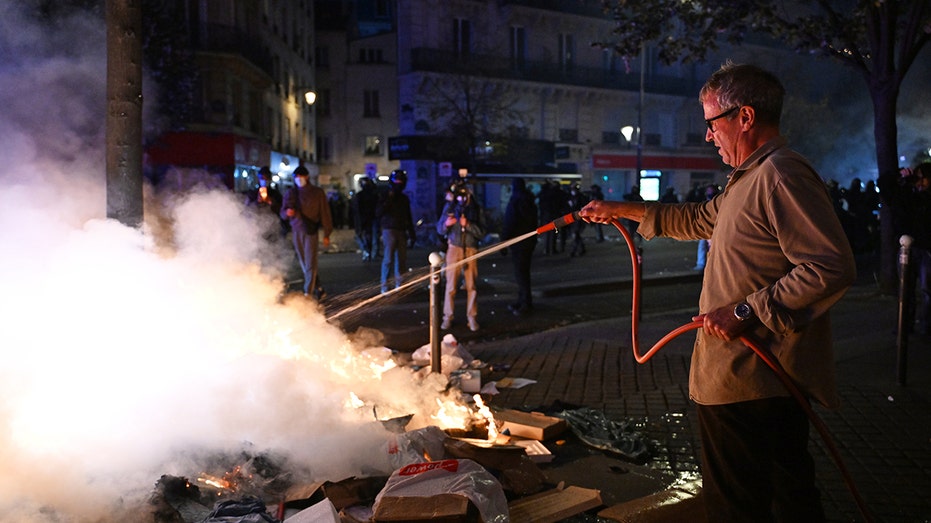
As violent riots grip France, British political leader Nigel Farage warned Americans against repeating what he described as Europe's mass immigration failures, arguing that years of unchecked migration have transformed European cities and fueled unrest that could eventually spread elsewhere.
"People like me who were warning about this years ago have sadly been proven right, but the problems are gonna be here for a very, very long time," Farage told Fox News Digital in an interview. "Please, please don't make the same level of mistakes that we have," he said in his message to Americans.
Violent riots have erupted across parts of Europe in recent weeks, particularly in France, with Farage pointing to years of mass migration and failed political leadership as key factors fueling the unrest. The Reform UK leader singled out Emmanuel Macron, arguing that the French president should have mobilized the military to confront the violence, after education protests spiraled into riots, destruction and theft.
"Macron was asleep at the wheel, and it isn't just that he was at a concert," Farage said. "And whilst the French do have effective police forces, the scale of the uprising, I mean the mass looting, the mass looting and violence that took place in Paris was genuinely horrendous."
"Meloni's reaction was swifter and a better sign of leadership," Farage said, referring to the Italian leader deploying 500 military troops to Milan in response to recent riots. "But the problem is, for people like Macron, who have always said, any criticism of immigration, whether legal or illegal, makes you racist, they psychologically find it hard to face up to their own failures of policy."
Farage warned that the unrest he described in France and elsewhere in Europe could eventually erupt in Britain, pointing to demonstrations in London and questioning whether British leaders would respond more forcefully than Macron.
"You know, my real worry is they can happen in this country too," Farage said. "We've got the same hard left here. We've the same hate mobs that march, chanting in the streets of London, from the river to the sea."
"I'm concerned that these things could happen here. And I wonder whether a British prime minister has got any more courage than President Macron in France," he added.
Farage contrasted Europe's failure to control its borders with President Donald Trump's immigration crackdown in the United States.
"Look, whatever you think of President Trump's current policies, one thing he has done, and he promised he'd do. He's closed the southern border," Farage said.
Trump vowed Tuesday to treat potential rioters in the U.S. "very rough," pointing to the unrest in France, he said at a rally in Greenville, North Carolina, before being interrupted by a protestor in the crowd.
"They're crazy, these people. Look at that guy. He's a nutjob," Trump said, in reference to the protester.
He warned that he would crack down on potential threats, saying he would not allow similar unrest to take hold in the U.S.
"That's what you witness over the last three or four days. You watch nutjobs like him in France ruining their country," Trump said. "We're not going to put up with it by the way."
"If a possible threat, which could happen, I hope you won't get angry if I treat them very, very rough, because that's what's going to happen. They're not going to destroy our country," he said.
On Tuesday, British counterterrorism police rearrested two men suspected of assisting Iranian intelligence in an alleged plot targeting RAF Fairford, a U.K. base used by U.S. bombers.
"I've called again and again for this to be declared a national security emergency. I have been ignored. If the Americans removing their bombers from RAF Fairford isn't enough warning. I don't know what is," he said.
"We've just become so caught up over here in Europe and Britain with this human rights culture, which puts the interests, frankly, of the bad guys above the interests of the majority."
After changing the names of the Gulf of Mexico and Lake Ontario, Trump has set his sights on a bigger body of water.
Anna Moneymaker/Getty Images
Google CEO Sundar Pichai said no when Trump asked him to rename the Atlantic Ocean, the president said.
Trump has floated the idea of renaming either the Atlantic or the Pacific to the "Trump Ocean."
Earlier this year, he issued orders to change the names of the Gulf of Mexico and Lake Ontario.
President Donald Trump's plan to rename the Atlantic Ocean hit choppy waters when he took it to Google.
At a Wednesday rally in South Carolina, Trump said he considered putting his name or "America" on one of the two oceans that flank the US: the Atlantic and the Pacific.
"I’m not going to put either Trump or America on any other ocean but these two," he told the crowd.
Then, he said, he called Google to ask about making the change on Google Maps.
The tech giant had previously changed its US labels for the Gulf of Mexico and Lake Ontario to the Gulf of America and Lake America after executive orders from the president.
"I spoke to a brilliant guy, Sundar. He heads all of Google," Trump said, referring to CEO Sundar Pichai. He also praised Google cofounder Sergey Brin, calling both men "totally brilliant guys," before joking that they were "still rattled from the Gulf."
Trump recounted putting his idea directly to Pichai: "Sundar, I’m thinking of the Atlantic Ocean. Can you handle it?"
"No, no, no. This time I’m not doing it," Trump quoted Pichai as replying. "Oceans are different, sir. They cover really a lot of countries. Please don't ask us to do that."
"So I'll probably pass," Trump told the crowd. "Should I pass it?" He then answered his own question: "I think let's keep it the Atlantic Ocean."
Google did not immediately respond to a request for comment.
It was not Trump's first ocean pitch. At a Tennessee rally in early October, he floated "Trump Ocean" or "Ocean of the Americas" for the Atlantic or Pacific.
He has also mused about renaming a river, calling New Mexico "New America," and rechristening the Strait of Hormuz the "Trump Strait."
While those ideas remain proposals, Google Maps did adopt "Gulf of America" and "Lake America" for US users after the names changed in federal records. Users in Mexico and Canada still see the original names for the gulf and lake, respectively. Users in the rest of the world see the original names, followed by Trump's new names in brackets.
The changes have created a dilemma for people who make maps for an international audience. "The issue of international acceptance is also a factor, as some nations may not accept it," Joseph Wright, CEO of Replogle Globes, told Business Insider's Joshua Nelken-Zitser after the lake order.
"We sell globes worldwide."
For now, Trump's Atlantic idea appears to have sunk before it reached Google Maps.
Should President Donald Trump deliver a primetime address next week with the avowed purpose of impacting the elections nationwide?
Yes. Absolutely yes.
President Trump is often the best proponent of his own policies, and the much-anticipated "blue wave" would effectively paralyze those policies and his plans to finish the battle with Iran, build the Golden Dome and Golden Fleet, and slow, if not reverse, the regulatory overhaul underway.
Loss of the Senate majority would also mean near-zero chances of confirming any appellate judges or Supreme Court justices. Spending on the Pentagon would also plummet as Democrats return to their long-standing position of insisting that every dollar of increased defense spending must be matched by one for non-defense domestic discretionary spending.
If President Trump makes these arguments directly to voters and names the names of the senators or Senate candidates who are key allies or the Democratic nominees he believes are from the far, far left, the sharpened focus could help mobilize his base to again support his agenda one last time.
There are precedents for such an appeal, and they had mixed results.
On October 24, 2022, President Biden made a direct closing argument for Democrats at Democratic National Committee headquarters, 15 days before Election Day. The expected "red wave" that year was reduced to a ripple.
On October 25, 2006, President George W. Bush held a nationally televised news conference less than two weeks before the midterms. President Bush discussed Iraq and framed the election choice around national security and taxes. It was a news conference, not a formal primetime address. The GOP got "thumped," to borrow President Bushâs own characterization of the 2006 results.
The takeaway from that limited data set? A speech could work to rally a presidentâs base voters. A press conference wonât.
President Trumpâs rallies around the country have always served as a feedback loop for his messaging. He knows itâs his base that turns out, and he tries out various messages and themes, then amplifies what works and cuts what doesnât in subsequent rallies and in his conversations with the press.
Getting the feedback is particularly important when it comes to turning out the base. As the president has been everywhere in the past month, he has a good idea of what "works" in this campaign cycle.
The Trump PAC may even want to buy network time for an address, or it may simply allow social media to do its thing. A tight 15 minutes would play and play, give birth to ten thousand posts and reels and, crucially, focus the base and independent voters on the stakes, which are very high indeed.
President Trump has got a fine writing staff, but brevity is not second nature to him or them when it comes to speeches. If he does try such a direct appeal, the crucial points I hope he makes in succinct fashion are these:
Economists see the next few years as a boom for the nation. We canât screw it up by ceding control of taxes and spending to Democrats. The 71 economists surveyed by The Wall Street Journal this week predict continued and expanding economic growth, falling gas prices and tamed inflation ahead. "Morning in America" is beginning to dawn again.
Iran is defeated, but the mop-up will take some months, even though oil exports from the Middle East have risen to levels that exceed prewar levels. President Trump knows the scorecard on the battle by heart. He should repeat it again. The United States has decisively triumphed over the evil Iranian regime, and he will finish the job. It will be easier with Republican majorities.
The battle with Iran has demonstrated to the world the need for missile defense and a vibrant, modernized Navy. The president should emphasize his plans for both and warn that Democratic majorities present mortal threats to each.
"Medicare for All" is a clever way of saying "higher taxes, rationed healthcare, and diminished healthcare for seniors." President Trump should pledge again to stop efforts to pass Obamacare 2.0.
The only thing Democrats can agree on is a combination of obstruction and impeachment. Their commitment to weaponizing all of government and bringing back McCarthyism â this time aimed at every Trump supporter and not just him â is extremely strong. Democrats are unapologetically calling for these things, as well as for packing the Supreme Court and many other radical plans.
The Democrats have put forward the most radical set of candidates in American history. Abdul El-Sayed in Michigan, Peggy Flanagan in Minnesota, Troy Jackson in Maine and James Talarico in Texas are all extremists camouflaged as Democrats. In Alaska, they have attempted to defeat the great Senator Dan Sullivan by running a "decoy Dan Sullivan" in an attempt to get leftist Mary Peltola over the finish line. Retreads like left-winger Sherrod Brown in Ohio should not replace the effective and able Jon Husted. Congresswoman Ashley Hinson is exactly what Iowa needs. North Carolina should send Michael Whatley to Washington to continue his long-standing partnership with the president. These are easy choices when the big picture is set before voters, especially when they are reminded of just how far off the normal political map El-Sayed, Flanagan, Talarico and Troy Jackson are.
The president should explicitly ask voters to support Mike Rogers in Michigan, Michele Tafoya in Minnesota, Ken Paxton in Texas and Susan Collins in Maine. President Trump should note that Rogers and Tafoya are likely to be as independent-minded as Sen. Collins, who has often opposed presidential policies, but that all of them represent their states very well.
States that are "light blue" or "light red" deserve senators that represent them, not Hamas or other extremist positions.
President Trump should close by reminding everyone of the mess he inherited. The once wide-open border is now completely closed and sealed tight, with the long-awaited wall nearing completion. Fraud in Minnesota, California and other blue states is being exposed and corrected. Inflation is way down from the 9.1% it reached under President Joe Biden but needs to go down further still, and President Trump and his economic team can get that done with support from Congress, not obstruction.
And the evil regime in Iran that has terrorized the world for 47 years is on its last legs and wobbling. Its nuclear weapons program is obliterated and will not be allowed to be rebuilt. There is work to be done with our allies across the globe, but taking us down the impeachment road because the Democrats have no proposals to do anything else would be a disaster for everyone.
"Americaâs Golden Age is indeed upon us," President Trump should conclude. "I need your vote, and so do these great Republican candidates. Please make a plan to vote and turn out. Thank you. God bless our troops everywhere, but especially in the blockade and at the bases around the Islamic radicals in Iran, and those confronting Hamas, Hezbollah and the Houthis, and God bless the United States."
Hugh Hewitt is a Fox News contributor and host of "The Hugh Hewitt Show" heard weekday afternoons from 3 PM to 6 PM ET on the Salem Radio Network, and simulcast on Salem News Channel. Hugh drives Americans home on the East Coast and to lunch on the West Coast on over 400 affiliates nationwide, and on all the streaming platforms where SNC can be seen. He is a frequent guest on the Fox News Channelâs news roundtable, hosted by Bret Baier weekdays at 6pm ET. A son of Ohio and a graduate of Harvard College and the University of Michigan Law School, Hewitt has been a Professor of Law at Chapman Universityâs Fowler School of Law since 1996 where he teaches Constitutional Law. Hewitt launched his eponymous radio show from Los Angeles in 1990. Hewitt has frequently appeared on every major national news television network, hosted television shows for PBS and MSNBC, written for every major American paper, has authored a dozen books and moderated a score of Republican candidate debates, most recently the November 2023 Republican presidential debate in Miami and four Republican presidential debates in the 2015-16 cycle. Hewitt focuses his radio show and his column on the Constitution, national security, American politics and the Cleveland Browns and Guardians. Hewitt has interviewed tens of thousands of guests from Democrats Hillary Clinton and John Kerry to Republican Presidents George W. Bush and Donald Trump over his 40 years in broadcasting. This column previews the lead story that will drive his radio/ TV show today.
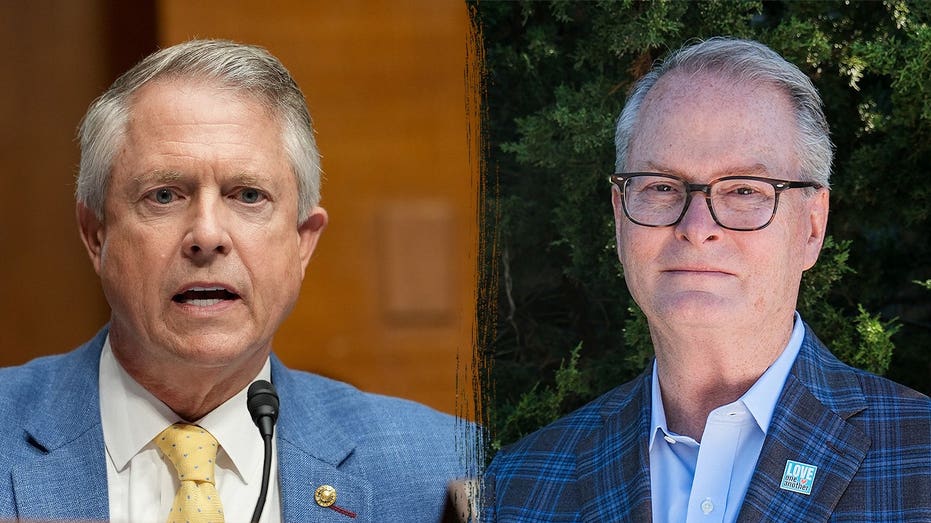
Sen. Roger Marshall, R-Kan., and Democratic challenger Adam Hamilton repeatedly sought to distance themselves from the most unpopular elements of their respective parties Wednesday night during a contentious Kansas Senate debate.
Both candidates battled over President Donald Trump, immigration, the war in Iran and more in a race that could help determine control of the Senate.
The debate opened on a personal note, with both candidates pressed over controversies that have fueled attack ads in the closing weeks of the campaign.
Marshall was questioned about a New York Times review that found his former medical practice sued more than 700 patients over unpaid bills. The Republican defended the practice while emphasizing the millions of dollars in free care his practice provided.
"Every year we gave away $3 to $4 million of charity, but we also had a business," Marshall said. "We had 300 employees, we had a mortgage payment, we had electric."
Hamilton, meanwhile, was questioned about his handling of allegations involving a volunteer at his church's summer camp alleged to have been a sexual predator. Hamilton acknowledged that he should have ensured the individual did not return to the camp after an initial investigation.
"I should have checked to make sure that he wasn't going back," Hamilton said. "That was a mistake on my part."
The candidates spent much of the rest of the debate trying to define each other by their respective national parties.
Marshall repeatedly warned that electing Hamilton would help hand control of the Senate to Democrats and Senate Minority Leader Chuck Schumer, while Hamilton sought to portray himself as an independent-minded Democrat willing to break with his party.
That divide came into focus when the moderator played footage of Trump campaigning for Marshall in Kansas earlier this week and telling voters to "pretend, please, that I'm on the ballot."
Asked whether that meant he would support every part of Trump's agenda, Marshall said no and pointed to recent disagreements involving immigration enforcement in southwest Kansas and beef imports.
"Just like with my wife, I can disagree with her. My wife is always right," Marshall joked. "And President Trump is not always right."
Nevertheless, Marshall emphasized his support for much of Trump's agenda and urged the president's supporters to turn out for him.
"We need the Trump voters to come out," Marshall said. "If you want the Trump agenda to continue, if you want secure borders, if you want a strong military, if you want lower taxes, then you â and you voted for President Trump â you need to come out."
Hamilton faced a similar challenge when moderators pressed him over his past support for Democrats and his campaign message of "leading from the middle."
Hamilton later said he did not want biological males competing against his 12-year-old granddaughter in sports, calling it "not a fair fight," while arguing that decisions over athletic participation should generally be handled locally rather than by the federal government.
The Kansas contest has emerged as an unexpectedly competitive Senate race in the closing weeks of the midterms. Marshall is seeking a second term in a state that has not elected a Democratic U.S. senator since 1932, while Hamilton, a longtime pastor, has campaigned as a moderate Democrat.
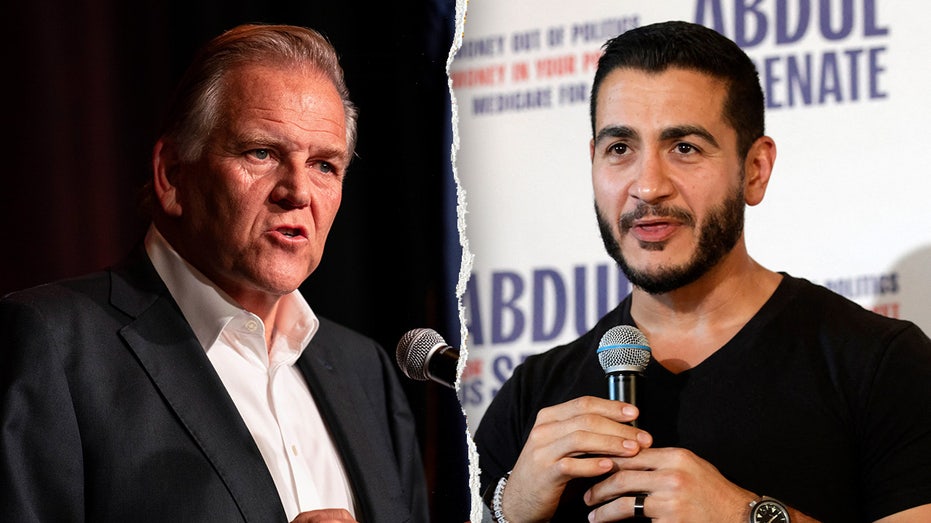
President Donald Trump was the unofficial third person on stage at Wednesday's Michigan U.S. Senate debate, as Democrat Abdul El-Sayed repeatedly invoked him while seeking to cast Republican Mike Rogers as Trump's "sock puppet."
El-Sayed mentioned Trump 18 times during the hour-long debate and repeatedly called Rogers' responses "MAGA bingo," accusing the Republican of relying on Trump-aligned talking points. Rogers, however, broke with Trump on a couple of trade issues.
The phrase became a running theme throughout the night, with El-Sayed declaring "MAGA bingo" after Rogers accused him of supporting socialist policies, open borders and defunding the police. Rogers eventually turned the attack back on his opponent, suggesting that the real bingo game was every time El-Sayed included Trump in his answer.
Rogers, however, did not align with Trump on every issue. He split with Trump on trade, calling the president's tariffs a "mixed bag" and saying tariffs on Canada may have been "not well thought through."
He also opposed Chinese automakers building vehicles in the United States, saying during the debate that Congress should ban the ability for the Chinese to build cars in the United States. El-Sayed countered by pointing out that Trump has said he would be open to Chinese automakers building vehicles in the United States and questioned whether Rogers would stand up to Trump on the issue.
WATCH: ROGERS CALLS TRUMP TRADE AGENDA A âMIXED BAGâ:
Wednesday evening marked the second debate between El-Sayed and Rogers, just weeks before Michigan's midterm election.
The battle for the swing state's open Senate seat has drawn national attention not only because it could help determine control of the upper chamber, but because it has emerged as a major test of the Democratic Party's progressive wing in a key battleground state.
El-Sayed, backed by progressive heavyweights including Sen. Bernie Sanders, I-Vt., and Rep. Alexandria Ocasio-Cortez, D-N.Y., has campaigned on a progressive agenda that includes Medicare for All, higher taxes on the wealthy, ending U.S. military aid to Israel and abolishing ICE.
While El-Sayed worked to paint Rogers as a Trump-aligned "corporate politician," Rogers repeatedly branded his Democratic opponent as having a "pattern of deception," accusing him of misrepresenting his record and shifting his positions.
Throughout the debate, Rogers cast El-Sayed as being outside the political mainstream, tying the Democrat and his policies to the Democratic Socialists of America and hammering him over his past support for defunding the police.
Rogers also claimed that some of El-Sayed's donors and supporters were tied to Hamas, Hezbollah and the Muslim Brotherhood.
At one point, Rogers questioned El-Sayed's allegiance to the country after accusing El-Sayed of having donors tied to Hamas, asking, "Are you for America or are you for these terrorist groups overseas?"
The most contentious moment of the debate came during a question on public safety, when Rogers hammered El-Sayed over his past support for defunding the police, accused him of deleting social media posts on the issue and pointed to El-Sayed's past comments involving former Egyptian President Mohamed Morsi, who was backed by the Muslim Brotherhood.
El-Sayed fired back that it was "beneath" Rogers to question his commitment to the Constitution, declaring that he was "proud to be an American" and calling Rogersâ line of questioning "shameful."
El-Sayed, a Muslim and first-generation American whose parents emigrated from Egypt, has faced scrutiny over his rhetoric on the war in Gaza and his positions on Israel, leading some members of Michigan's Jewish community to openly disavow the Democratic candidate. During the debate, Rogers said that his campaign was doing well with the Jewish community, which he claimed is fearful of El-Sayed's rhetoric.
Rogers said that El-Sayed was too "extreme" for Michigan, pointing to prominent Democrats who said they can't back the party's nominee, including the former Michigan Democratic Party chairman and the former finance chair for Sen. Elissa Slotkin's campaign.
Michigan Republicans echoed that argument following the debate, pointing out that El-Sayed used to campaign with Twitch streamer Hasan Piker, who once said that America deserved the 9/11 terrorist attacks.
"We cannot afford Abdul El-Sayed's far-left, big-government policies, and we cannot risk electing a person who campaigns with the likes of Hasan Piker and seemingly justified the horrific terrorist attack targeting children and the Jewish community in Bloomfield Hills," MIGOP Chairman Jim Runestad said in a statement.
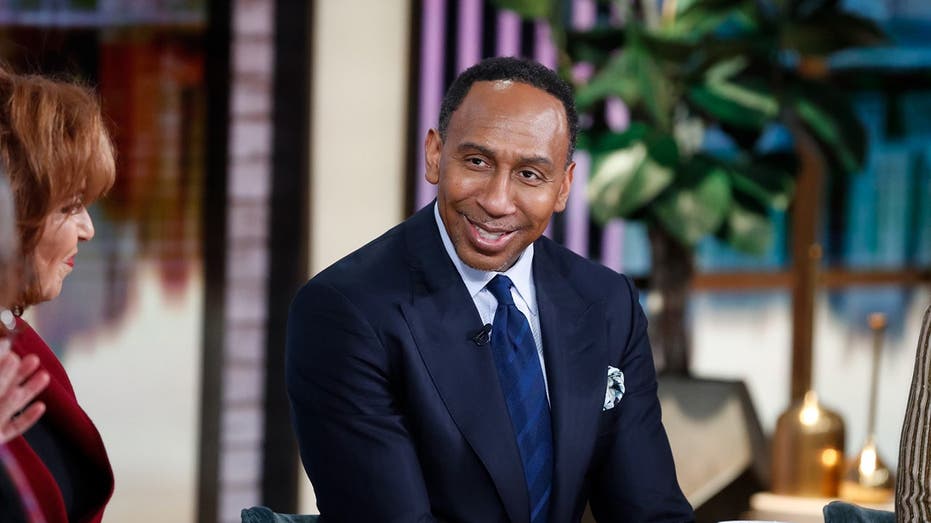
ESPN host Stephen A. Smith defended his trip to the White House to meet with President Donald Trump during an episode of "The View" Wednesday, telling the co-hosts he wouldn't apologize for sitting down with the president.
Co-host Sunny Hostin asked Smith, "He has this history of racial bias that is so clear. Did you think meeting with him, that you got anywhere?"
"I don't know. We'll find out, but he’s the president of the United States, and I’ll be damned if I’m not going to try," he said. "And the reality is I’m just speaking from a constitutional perspective in that regard.
"And it points to a bigger issue. There are so many people that have this mentality, ‘Why even waste time talking to him?’ Whether you like him or not, he’s the president of the United States of America. He’s not going away until 2028. At least. He’s not going away."
Smith met with Trump, comedian Bill Maher and Kid Rock at the White House Oct. 15.
Hostin raised the possibility that Trump could be impeached after the midterm elections, but Smith rejected the idea.
"I think you’re going to have a situation where the Republicans are going to maintain the Senate," Smith said. "They’ll probably lose the House. So, you’ll get folks to impeach him, but then they’ll step in and save him, and it will be an ongoing continuous thing.
"And don’t get me started with that because I get disgusted with all that pomp and circumstance. I’m so sick and tired of us acting like that’s going to do something. He’s not going away until 2028.
"You’re going to have to deal with him," he continued. "And when it comes to getting things done, I’m all about exhausting every means and every measure to try to do what’s in the best interest of our community. I’m not apologizing for that to anybody."
The co-hosts told Smith they had invited Trump onto the show, but, on Tuesday, co-host Ana Navarro said there was "no way in hell" she would meet with the president.
"It’s easy for the cast of ‘The View’ to attack people for meeting with President Trump or crow about how they would never take a meeting with him," Nicholas Fondacaro, associate editor of the Media Research Center's NewsBusters, told Fox News Digital in a statement about the exchange.
"One, they’ll never be asked. Two, they’re not counted on by anyone to be a champion of their cause.
"It’s clear that ‘The View’ truly believe him to be the bumbling racist caricature that they and the rest of the liberal media paint him to be to their viewers," he continued. "They were visibly shocked to learn that Trump seemed to hear him out and called him a few days later to hear his argument again before he met with others about the HBCUs issue."
Navarro also pressed Smith on the meeting and questioned whether he pushed back on the president.
The ESPN host said he pressed Trump several times regarding the war in Iran and added that Maher grilled the president during the meeting as well.
"The only other thing I would add is I’m kind of disappointed that you’re asking whether or not I pushed back because that shows me that you’re not watching my SiriusXM show enough because I push back on Trump all the time," Smith said.
"Last night, I'm having dinner at the White House with the president, Bill Maher and Stephen A. Smith. We all agreed socialism and communism has no place to have a foothold in our government," he said, before referring to Michigan Senate candidate Abdul El-Sayed.
Asked how the dinner went, Kid Rock said the group had a great conversation.
"It was epic," he said. "And the thing that was the greatest — there's so many points, I could do an hour on it — is that, you know, two Democrats, two Republicans sit down, break bread, have laughs, talk about, have tough conversations on a lot of the issues."
Peter Thiel, cofounder and chairman of Palantir Technologies Inc.
Bloomberg/Getty Images
Thiel criticized the US-Iran war, diverging from Trump's foreign policy stance, POLITICO reported.
"There were a lot of mistakes that were made," Thiel said at a lecture earlier this month.
Despite his criticism of the war in Iran, Thiel highlighted his continued support for Trump.
Billionaire technology investor Peter Thiel said he's skeptical of the US war with Iran and does not believe the United States should have launched it, putting the major Republican donor at odds with President Donald Trump over one of the administration's defining foreign policy decisions, POLITICO reported.
Thiel's remarks, delivered on October 12 at a private event, are his most explicit statements to be revealed publicly about the war with Iran and come less than two weeks before the midterm elections in which Trump's party is grasping to maintain power in Congress. The audio of Thiel's comments was obtained by Decoded by POLITICO from a lecture earlier this month.
"I'm skeptical of [the war], I think we should not have done it," Thiel said. "There were a lot of mistakes that were made."
Thiel added, "Maybe we don't have the hard power. Maybe we're going to lose the soft power war."
In the full lecture, Thiel made clear his strong opposition to neoconservatives and Middle East wars. Despite his criticism of the Iran war, Thiel highlighted his continued support of Trump and suggested he wanted to protect the president.
Still, Thiel's break over the war represents one of the most important examples to date of a fierce Trump ally sharing deep concerns about the conflict.
The comments were part of Thiel's lecture series in Nashville, which Decoded has documented since their start this fall. In the latest lecture, Thiel issued extensive warnings about what he described as the unchecked power of the International Criminal Court, drawing on comments from Bush-era figures Donald Rumsfeld and Dick Cheney.
"I read the Cheney family's Trump derangement syndrome as an attempt to buy favor with the [International Criminal Court] and avoid prosecution. Probably too late," Thiel said. "And I have come to suspect that the threat of an ICC arrest warrant is the sword of Damocles hanging over the Trump administration as it tries to persecute this war in Iran."
Thiel also discusses meeting with Israeli Prime Minister Benjamin Netanyahu in early 2024, after the October 7 attack, where he said he asked the president about his plans in Gaza. Thiel said Netanyahu told him, "I can't just Dresdenize it," referring to the Allied bombing of the German city of Dresden during World War II that killed roughly 25,000 people.
The first big tech investor to back Trump in 2016, and then have a high-profile speaking role at the Republican National Convention that year, Thiel was also the biggest financial backer of super PACs supporting Vice President JD Vance's Senate campaign in 2022. POLITICO reported in March that Vance was "skeptical" of the U.S. striking Iran in the lead-up to the beginning of the war.
Representatives for Thiel and the White House did not respond to requests for comment.
This story originally appeared on POLITICO and is courtesy of the Axel Springer Global Reporters Network, which harnesses the resources of the company's newsrooms to publish ambitious scoops, investigations, interviews, opinion pieces, and analysis. It allows journalists — including those from POLITICO, Business Insider, WELT, BILD, Onet, and Fakt — to collaborate on major stories for an international audience of hundreds of millions across platforms.

 Login