❌

Reading view

John Oliver Warned Against Cherry-Picked Studies. Then He Cherry-Picked His Own.

John Oliver, host of HBO's 'Last Week Tonight' and a scientific studies graphic next to him | Adani Samat

In 2016, the HBO comedian and political commentator John Oliver produced a terrific segment on how TV pundits routinely cite garbage science. After showing clips of newscasters and commentators making absurd claims such as, "A new study showing that drinking a glass of red wine is just as good as spending an hour at the gym," and The Today Show's Al Roker commenting, "You find the study that sounds best to you, and you go with it," Oliver commented, "No! No, no, no, no, no, no, no! You don't just get to cherry-pick the parts that justify what you were going to do anyway."

Then Oliver added a useful rule: "If they are going to keep saying 'a study says,' they should have to provide sourcing and context or not mention it at all." (Though the segment specifically targeted the misuse of "scientific" studies, all the same principles apply to the social sciences.)

What's so noteworthy about that 2016 segment is that in his other monologues, on issues ranging from SWAT teams to homelessness, Oliver has routinely ignored the principles he laid out. In his overly simplistic takes on complex policy issues (often designed to dunk on his ideological opponents for comedic effect), he often fails to provide appropriate context and appears to be guilty of choosing research "that sounds best," as Roker put it, or at least that supports whatever point he's determined to make.

Oliver is one of America's most influential pundits, so he should be held to the highest of journalistic standards. And Last Week Tonight is indeed more diligent than many TV news programs. The show employs researchers who interview the authors of the studies it cites. Oliver is a comic, not an academic, so we can excuse him for not posting footnotes, and he routinely cites his sources on screen. When we emailed the show's producers to point out problems with their research, to their credit, they sent back a detailed response that we'll quote from in this article. (In a few cases, they pointed to Reason articles using some of the same studies, albeit with full citations and more context. In cases in which their criticisms were correct, we've annotated the original articles.)

Many of the show's researchers are former reporters and editors who abide by journalistic standards. Nevertheless, the show has a long track record of citing social science findings without the appropriate context, massaging them to support whatever point Oliver is trying to make.


Rent

In his excellent 2016 segment on scientific studies, Oliver noted: "There is a lot of bullshit currently masquerading as science. Not all scientific studies are equal. Some may appear in less-than-legitimate scientific journals, and others may be subtly biased because of scientists feeling pressured to come up with eye-catching positive results."

Cut to a 2022 segment titled "Rent," and we find Oliver citing a study that his wiser self would have characterized as "bullshit."

"Right now, there is not a single county in the U.S. where a worker earning minimum wage can afford a modest two-bedroom rental home," he said. He was citing a study designed to produce an "eye-catching" result. It was published not by a reputable journal, but by the National Low Income Housing Coalition, an advocacy group that lobbies for government spending on housing and rent subsidies, including expanding the National Housing Trust Fund and increasing federal appropriations to the Department of Housing and Urban Development.

The biases are not particularly subtle. Why would a minimum-wage worker need a two-bedroom home? In the study, "can afford" doesn't mean "have enough money to buy the cheapest available," as most English speakers would interpret it. The authors use it to mean renting a two-bedroom home at the 40th percentile price point of the local market (that is, a little cheaper than the median unit), using no more than 30 percent of their income, excluding government benefits, pensions, or other nonearned support.

Oliver also didn't mention who these minimum-wage workers are. In 2025, according to the Current Population Survey, a third of hourly workers paid the federal minimum or less lived in a parent's or grandparent's home, a fifth were married and living with a spouse, and only one in eight lived alone.

When we asked the show's producers why they failed to disclose that their source was an advocacy group seeking government funds, they pointed to the onscreen credit and responded: "We trust our viewers' intelligence enough to think they might be able to read it and conclude that the National Low Income Housing Coalition is interested in building low-income housing, nationwide, possibly even as part of a coalition."

I don't share their confidence that most viewers can read the onscreen source line and tell from the organization's name whether it's an advocacy group. There's a double standard here: When Oliver doesn't like what a study says, he's not content to just trust his viewers; he makes it explicit, as he did with the "ethanol lobbying groups" mentioned above.

Oliver's producers wrote us: "When we rely on studies from advocacy groups, we look at the underlying data and speak to researchers to better understand it; we discard many studies as a result."

This one belonged in the trash.


Sports Betting

In a 2025 segment, Oliver cited an eye-catching statistic about how sports betting was driving a spike in bankruptcies. "Unsurprisingly, the rise of online sports betting has been found to correlate with a rise in gambling harms, with one study showing that in states that allowed it, there was a 28 percent increase in bankruptcies, translating to about 100,000 extra bankruptcies a year."

I'll give Oliver credit for saying "correlate with" rather than "cause," but the rest of that sentence ("in states that allowed it, there was a 28 percent increase") implies direct causality.

The bigger problem is that the "100,000" figure is clearly wrong. When I contacted the study's authors, they told me they don't know where that figure came from, and it doesn't appear anywhere in the study. Last Week Tonight's producers told us they pulled it from a Business Insider article, but in the video, Oliver said it came from the study.

If Oliver's researchers had done the same calculation as the authors, multiplying the per-person effect by the at-risk population, they'd have found about 30,000 extra bankruptcies a year, not 100,000, and a 6 percent to 7.5 percent increase, not 28 percent.

Oliver also left out important context: He was citing an unpublished working paper. The peer-reviewed version appeared after the Last Week Tonight segment aired, and it included substantive changes. Working papers from credible researchers, like this one, are valuable, but Oliver should have made it clear he was citing a preliminary draft circulated to other researchers for comment, not a published study.


Homelessness

In 2021, Oliver did a segment making a case for a policy called "Housing First," which includes placing more homeless people in permanent supportive housing. The problem is that building and maintaining these units is expensive, so permanent supportive housing doesn't scale easily. Oliver set out to dismiss that objection by citing research showing the alternative is even more costly.

"One study in Florida," Oliver said, "found that, just between money spent on incarceration and emergency medical treatment, their communities and local governments had spent an average of just over $31,000 per person per year, when the estimated cost of providing them with permanent supportive housing would have only been around $10,000 per year."

The Florida study's finding was an outlier. The Central Florida Commission on Homelessness commissioned it, and Housing First advocates promoted it because it produced the headline they wanted. I give Oliver credit for noting that the study "tracked a decade's worth of spending on just 107 chronically homeless people," but he left out additional context.

In 2018, a committee convened by the National Academies of Sciences, Engineering, and Medicine evaluated permanent supportive housing. It concluded that there is "no substantial evidence that [it] contributes to improved health outcomes" and "insufficient evidence" that it's cost-effective.

Studies exist on both sides of this issue, and we can debate whether permanent supportive housing is more cost-effective than the alternative, but Oliver cited one study and implied it was conclusive.

Oliver also neglected to mention that the paper was written by a consulting firm led by a supportive-housing advocate, though if you looked closely, you could see the organization's name on the screen as he delivered his monologue.


Ethanol

Oliver and I agree that the federal government shouldn't be subsidizing ethanol. But in a 2024 segment titled "Corn," Oliver pointed to a study claiming that ethanol is more harmful to the environment than gasoline and implied that only self-interested lobbyists say otherwise.

"While ethanol lobbying groups have long argued that it slashes greenhouse emissions," he said, "one recent study found that corn ethanol produced under the renewable fuel standard has a carbon footprint at least 24 percent higher than regular gasoline."

What Oliver doesn't mention is that the 2022 study he cited was highly contested. It was challenged not only by "ethanol lobbying groups" but also by the U.S. Department of Agriculture under the Biden administration. The study's claim that ethanol has a higher carbon footprint than gasoline also contradicts a 2010 Environmental Protection Agency projection that ethanol would be about 20 percent cleaner than gasoline. Argonne National Laboratory, running the government's standard model, credits ethanol with cutting greenhouse emissions by more than 500 million tons in 15 years.

The problem isn't that Oliver is wrong; it's how he presented this study. Whether ethanol mandates are good or bad for the environment is a complicated, contested issue, with strong studies on both sides (and plenty of weak ones). Plucking one from the pile and reporting its findings is misleading.

Ethanol subsidies are bad because they involve politicians using mandates to buy farmers' votes, and top-down mandates generally lead to less optimal decision-making. But it's not clear that ethanol increases carbon emissions.


SWAT Raids

In a 2014 segment on police militarization after the fatal shooting of Michael Brown in Ferguson, Missouri, Oliver said, "There has been a massive rise in both the number and the use of police department SWAT teams," and showed a news clip that stated: "The number of SWAT raids has gone up by 1,400 percent since the 1980s. An estimated 50,000 now take place every year." Instead of mocking the clip, as he often does, Oliver cited it approvingly.

So where did the claim of a 1,400 percent increase come from? It's based on a voluntary mail-in survey, which isn't a reliable way to gather data. No official count of SWAT raids exists, and almost nobody tracks them, then or now, so the figure rests on departments' self-reporting of how often they "deployed," with no shared definition of what that means.

The 1980s figures that form the baseline for the 1,400 percent increase in SWAT raids come from a mid-1990s survey, making them especially unreliable. No one was counting SWAT raids at the time, and there's no way to verify them.

Oliver followed that clip by citing another study: "Just keep that clip in mind," he said, "when I tell you that 79 percent of SWAT deployments are now for executing search warrants, and most of those were for drug investigations."

Again, there's missing context. That 79 percent figure comes from a small, nonrandom sample generated by an American Civil Liberties Union records request; the organization could get data from just 20 of America's roughly 18,000 police agencies.

When we pointed out to Oliver's producers that the data on SWAT teams were stripped of their context, they replied that since this segment aired, "We've become more diligent about critically interrogating the sourcing on studies in our shows." They also argued that more "recent studies," if anything, suggest that the studies they cited "understated the true scope of things." And they pointed to instances of Reason citing the same data.

I agree with Oliver's position on SWAT raids, but he really should be agitating for better data. We're permitting state violence without anyone keeping the detailed records that could help us understand the costs and benefits. But that doesn't excuse citing two studies based on weak data and presenting them as fact.


Tipping

In a 2025 segment on tipping, Oliver said, "Recent analyses have found that poverty rates for tipped workers are over twice as high as for nontipped workers."

Twice as high as for which nontipped workers? The analysis he's citing included all nontipped workers in the U.S., including CEOs and neurosurgeons. Oliver, who reportedly makes $30 million a year, also pulled up the nontipped average. The right way to evaluate tipping is to match tipped and untipped workers by job: Waiters have about the same poverty rate as fast-food workers, and hotel maids about the same as other cleaners. If you control for job, age, and hours, the gap closes.

It's another study designed to generate a talking point, which isn't surprising since it was published by the Economic Policy Institute, a progressive, left-of-center think tank. The organization's name appeared onscreen as Oliver delivered his monologue, but, once again, viewers would need to hit pause to look it up and figure out what the Economic Policy Institute stands for.

Oliver's 2016 segment on "scientific studies" shows that he should know better. It's possible to construct arguments by citing good research responsibly, while providing the proper context and sourcing. It's possible to follow research where it leads, instead of retrofitting it to preconceived ideas. You just have to be willing to present data that capture reality in all its messiness, even if that means it won't generate an easy laugh line.

To keep up with our video series Wrong Number featuring Aaron Brown, and to receive bonus content and more, click here to enter your email address.

The post John Oliver Warned Against Cherry-Picked Studies. Then He Cherry-Picked His Own. appeared first on Reason Magazine.


  •  

Dementia risk may be linked to seemingly harmless daily habit, new research suggests

Frequent daytime napping among older adults has been linked to a higher risk of developing dementia, according to a study published in The Journal of Gerontology: Medical Sciences.

Researchers from the Johns Hopkins Bloomberg School of Public Health tracked nearly 1,000 adults age 65 and older who showed no signs of memory or thinking problems when the study began in 2013.

A decade later, the researchers found that daily rest habits — like how often people nap, how long they sleep and whether they fall asleep by accident — are linked to long-term brain health.

ONE TYPE OF SLEEP LINKED TO DRAMATICALLY LOWER RISK OF DEMENTIA, PARKINSON'S AND 81 OTHER DISEASES

The study found that participants who napped frequently, defined as most days or every day, had a 48% higher risk of developing dementia compared to those who rarely or never napped.

IMAGE

Whether the naps were intentional also appeared to play a role. Seniors who fell asleep unintentionally had a 39% higher risk, while shorter naps were also linked to poorer outcomes.

Napping for 30 minutes or less was linked to a 40% increased risk of dementia, even after researchers adjusted for other health factors. For naps longer than 30 minutes, the association was less pronounced after researchers accounted for nighttime sleep patterns.

The research team stressed that looking at daytime napping habits gives a much clearer picture of overall health than looking at nighttime sleep alone.

THIS ONE QUESTION MAY REVEAL WHETHER YOUR BODY IS GETTING THE REST IT NEEDS, STUDY FINDS

"Our study highlights the importance of looking beyond just how long people nap and considering other napping characteristics, such as how frequently they nap and whether their naps are intentional," study authors Adam Spira, Ph.D., a professor at the Bloomberg School, and postdoctoral fellow Kening Jiang, Ph.D., told Fox News Digital.

CALLOUT:

"This study provides important longitudinal evidence that frequent and unintentional daytime napping were associated with a higher risk of developing dementia among older adults."

The findings held true even after accounting for nighttime sleep length, daytime drowsiness and indicators of sleep apnea.

"Nighttime sleep and daytime napping are closely related," Spira and Jiang went on. "Daytime napping may compensate for poor nighttime sleep, but it may also reduce the drive to sleep at night, potentially contributing to nighttime sleep disturbances, another important potential risk factor for dementia."

TEST YOURSELF WITH OUR LATEST LIFESTYLE QUIZ

Researchers pointed out that daytime resting does not necessarily cause brain changes. Rather, changing nap habits could be an early warning sign of underlying changes in the brain.

Brain regions that help regulate wakefulness can start to break down in the early stages of dementia, leading to more frequent daytime fatigue, they noted.

CLICK HERE FOR MORE HEALTH STORIES

To double-check this, the team re-analyzed the data after removing anyone who developed dementia during the first five years.

The link between frequent, accidental naps and dementia remained just as strong, suggesting that changes in napping habits can show up years before a formal diagnosis.

The researchers emphasized that this was an observational study with limitations.

"We did not directly intervene on participants’ napping behaviors to examine whether changing these behaviors would affect their dementia risk," Spira and Jiang told Fox News Digital.

CLICK HERE TO SIGN UP FOR OUR HEALTH NEWSLETTER

"Although we don’t know whether napping causes dementia, our study findings suggest that daytime napping patterns may be useful indicators of future dementia risk," they added.

CLICK HERE TO DOWNLOAD THE FOX NEWS APP

The findings suggest that daytime napping patterns in older adults may be worth monitoring, particularly when naps become frequent or happen unintentionally, according to the researchers.

  •  

Most AI data centers may never be built. Blame the 'bragawatts.'

Kevin O'Leary speaks during the Romain College of Business Innovative Speaker Series at the University of Southern Indiana Wednesday, Sept. 23, 2026.
Kevin O'Leary speaks at the University of Southern Indiana.

MaCabe Brown / Courier & Press / USA TODAY NETWORK via Imagn Images/Reuters

  • Newcomers like Kevin O'Leary face skepticism due to a lack of experience in data center development.
  • Bernstein analysts dubbed O'Leary and others "bragawatts."
  • Most announced projects will never happen. "Press releases are cheap…concrete is not."

The AI industry has a problem with bragging.

Companies are announcing enormous new data centers to power the AI boom. Some promise facilities bigger than anything the industry has built before.

There's just one problem: Most of these projects may never happen.

Bernstein Research analyzed thousands of planned US data centers and concluded that only about 35% of the announced capacity is likely to get built. That's roughly 170 gigawatts of data center capacity out of a total of almost 500 gigawatts.

The rest? A significant chunk of it belongs to a category the industry has a wonderfully dismissive name for: "Bragawatts." These are ambitious announcements, often from newcomers with little experience building data centers, that have a slim chance of becoming reality.

"Press releases are cheap…concrete is not," Bernstein analysts wrote in a research note.

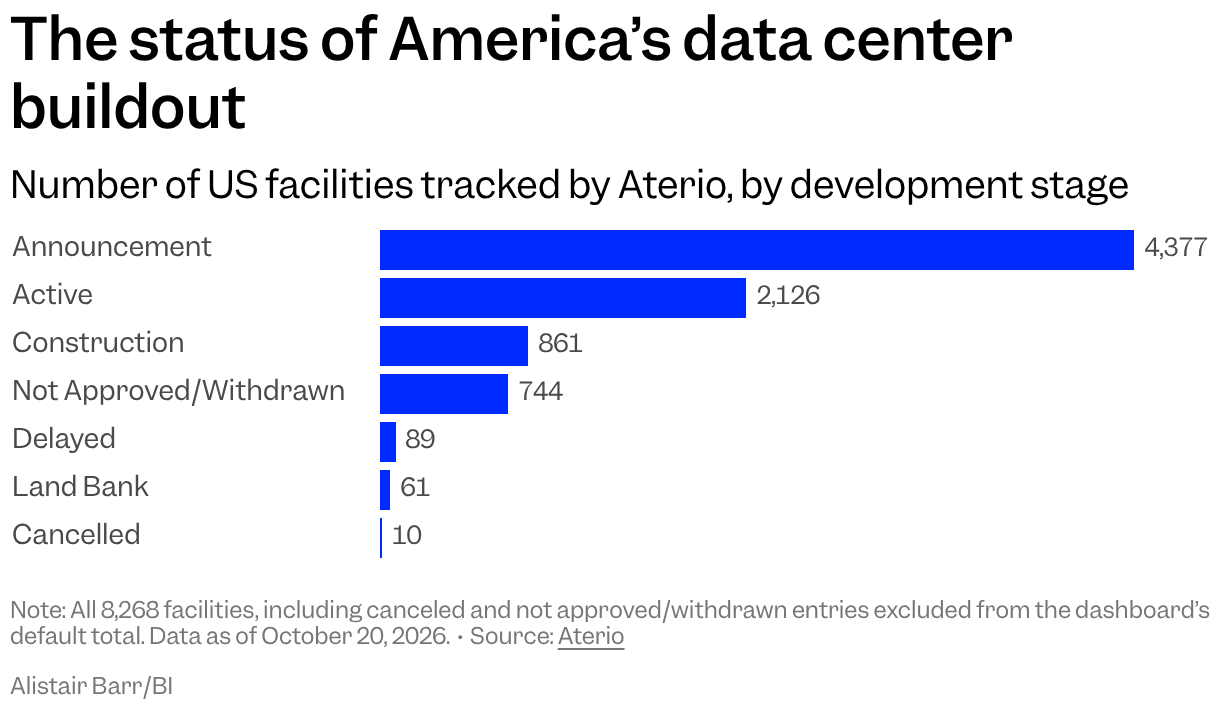
Among 8,268 tracked US facilities: Announcement 4,377; Active 2,126; Construction 861; Not Approved/Withdrawn 744; Delayed 89; Land Bank 61; Cancelled 10.

Bernstein began its analysis with more than 7,000 data center projects across North America, drawing on information from Aterio, a company that tracks construction through satellite imagery, permits, and other records. The analysts narrowed that to more than 5,000 projects (partly by excluding those already canceled).

Then they assessed the chances of these remaining projects being completed. The analysts considered factors such as whether construction had started, whether electricity was available, and whether the companies involved had successfully built data centers before.

The results revealed a striking divide.

The 'bragawatt brigade'

Kevin O'Leary
Kevin O'Leary.

Daniel Delgado Jr./Disney via Getty Images

Experienced operators including Amazon, Google, Microsoft, and Meta landed at the top. Bernstein gave these companies perfect scores of 5 out of 5 for their development credentials. Other data center specialists, such as Digital Realty, Equinix, and CoreSite, got top marks, too.

O'Leary Digital, associated with celebrity investor Kevin O'Leary, ended up at the bottom, with a credibility score of 0.35 out of 5, according to Bernstein. His company has announced 15 gigawatts of data center projects, and Bernstein estimates that only 489 megawatts, or about 3%, will actually materialize.

"Sorry, Kevin," the analysts wrote.

Although the term "bragawatts" has been doing the rounds in the data center industry lately, it's unclear who coined it, Bernstein analyst Madison Rezaei told me.

"I wish I could take credit for that," she said. "I believe I originally heard it from an Equinix executive, but I don't think he owned it either."

She said that while some ambitious newcomers could succeed, they haven't yet demonstrated they can deliver.

"It's not that all of these guys are sort of terrible and not going to deliver, but we just have lower confidence because we don't know them," Rezaei said.

O'Leary Digital responds

O'Leary Digital disputed Bernstein's assessment, saying the research doesn't account for substantial work that occurs before construction begins.

While acknowledging that O'Leary Digital is a young company, CEO Paul Palandjian said the team has decades of experience building major infrastructure projects and that its proposed 15 gigawatts of capacity would be built in stages over several years.

The company said it has secured binding agreements covering about 11,000 acres in Utah and 13,000 acres in Alberta, obtained a 30-year development agreement in Utah, and made progress on planning, engineering, and permits at both sites. It also said the projects would generate their own electricity.

The company said its early development work is funded, additional capital is committed to reaching key milestones, and experienced engineering and construction partners are involved.

"We would rather be judged on milestones than on a model," Palandjian said.

'An announcement in search of a project'

Opponents of the proposed La Osa data center attend a Pinal County Board of Supervisors meeting in Florence, Arizona, on Aug. 26, 2026.
Opponents of the proposed La Osa data center attend a Pinal County Board of Supervisors meeting in Florence, Arizona, on August 26.

USA TODAY Network via Reuters Connect

Other low scorers in the "bragawatt" brigade included Vermaland and Joule Capital Partners, according to Bernstein analysis based on Aterio data.

Joule has announced 50 data center projects with a combined capacity of 11.7 gigawatts. Bernstein estimates that only about 11% of that capacity will actually get built. Almost all of Joule's planned capacity remains at the announcement stage, with little evidence of construction progress or of major customers committing to use the facilities, Bernstein wrote in a July note to investors.

The analysts gave Joule a credibility score of 2.05 out of 5, placing it among the lowest-ranked developers in its database.

"An announcement in search of a project," the analysts wrote.

Vermaland has announced plans for a massive data center project in Arizona. Bernstein estimates that only 4% of its proposed 2.2 gigawatts of capacity will get built. The company is primarily a landowner, not a data center developer. Its proposed $33 billion La Osa project near Eloy had already been sharply scaled back amid local opposition and without construction approval. In late August, regulators formally rejected the project. Even before that, the analysts gave Vermaland a credibility score of 0.75 out of 5.

Joule and Vermaland didn't respond to emails seeking comment this week.

A yawning gap for data centers

Sergio Toro, CEO of Aterio, sees similar patterns in his firm's voluminous, detailed data.

Aterio's tracking shows that roughly 30 to 40 gigawatts of new data center capacity get announced each month. Yet only about 7 gigawatts begin construction each month, while 2 to 3 gigawatts actually start operating.

This leaves a yawning gap.

Many announced projects get withdrawn before construction begins — and before real money has been spent.

"They just make the announcement, but they didn't get their approvals. Or they make multiple filings in multiple locations to see which one gets selected," Toro told me. "That's why we track with satellite if there's real movement on the ground or not."

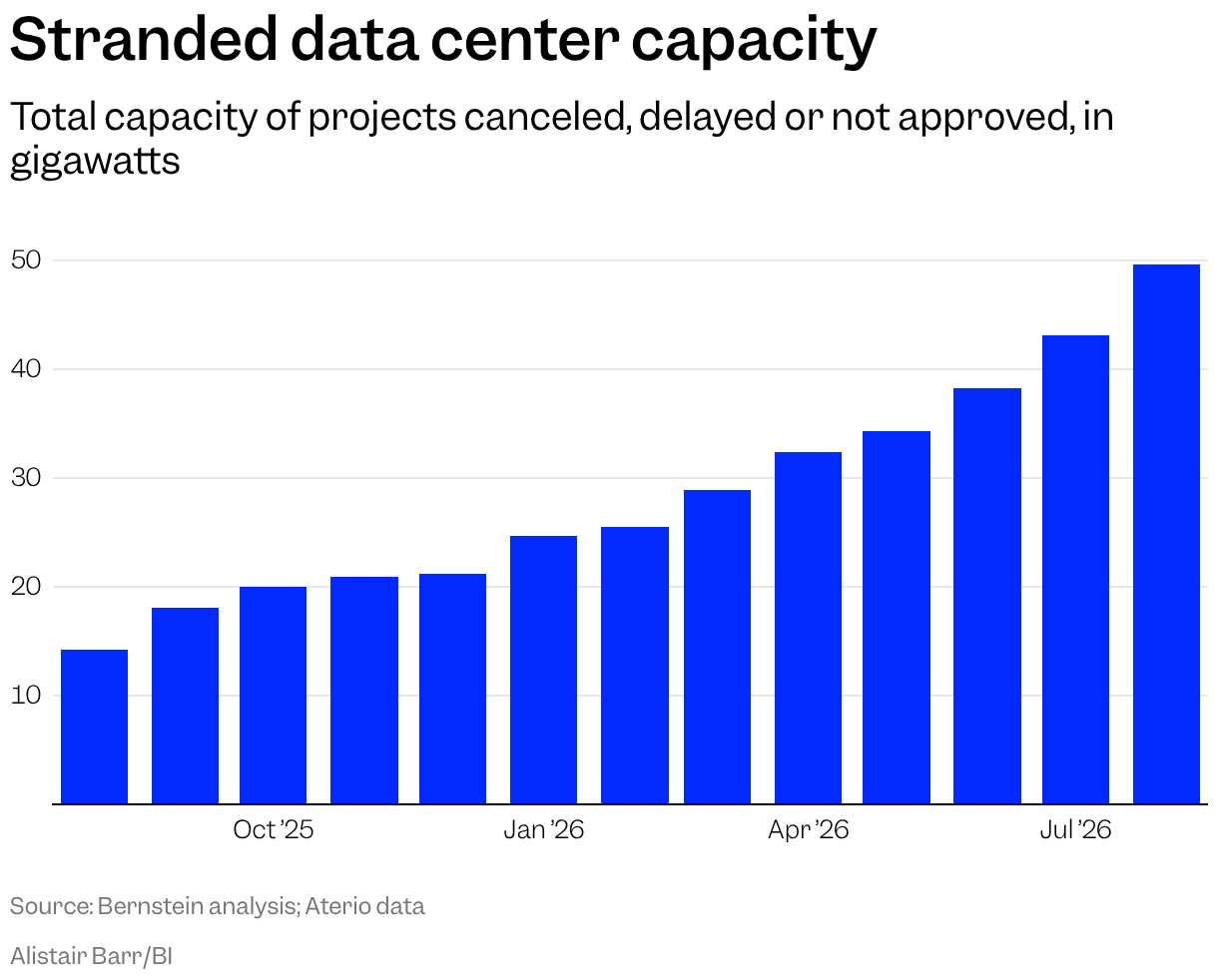
Indeed, Bernstein analysts wrote recently that the amount of "stranded" data center capacity has surged. These are projects that are either canceled, delayed, or not approved.

Column chart showing total stranded data center capacity rising from 14.2 gigawatts in August 2025 to 49.6 gigawatts in August 2026. Stranded capacity means projects canceled, delayed or not approved. Monthly totals are 14.2, 18.1, 20.0, 20.9, 21.2, 24.7, 25.5, 28.9, 32.4, 34.3, 38.2, 43.1, and 49.6 gigawatts.

The AI boom's three tiers

Toro sees three broad groups competing to build AI infrastructure.

At the top are the established technology giants, including Amazon, Microsoft, and Google. They've built data centers for decades and generally deliver on their commitments. Most of their projects will get done, he said.

In the middle are "neoclouds," newer companies such as CoreWeave that rent out computing power specifically for AI. Although they're more vulnerable to financing problems and delays, many are making solid progress, especially because some of these players already have access to electricity.

"We see them advancing quite well," Toro said. "Sometimes we see some delays, but it's not something significant or any kind of big capacity that is at risk."

Then come the newcomers making extraordinary promises. That's where most delays and cancellations happen, Toro said.

Even Amazon needs a backup plan

NEW CARLISLE, INDIANA - OCTOBER 2: In this handout provided by Amazon, a technician works at an Amazon Web Services AI data center in New Carlisle, Indiana on October 2, 2025.
A technician works at an Amazon Web Services AI data center in New Carlisle, Indiana.

Noah Berger/Getty Images via Amazon Web Services

Not every project that disappears was a fantasy, though. Even a top player like Amazon struggles sometimes to secure electricity and other supplies on time for these huge projects.

Business Insider's Eugene Kim reported exclusively this week on the challenges Amazon faces with its record AI buildout.

The biggest, most experienced tech companies deliberately pursue more potential data center capacity than they need because they know some developments will fail or get delayed.

Major AI companies were committing to three or four times the space and electricity they needed over the following two years, Jeffrey Moerdler, a data center lawyer, estimated during an interview with Bernstein analysts.

His reasoning: Of data center projects that haven't started construction, roughly a third will arrive on schedule, another third will be delayed, and the remainder won't happen.

Rezaei and Toro estimate that the top players don't over-commit that much — more like double the capacity they need at most.

The strategy provides a "Plan B," as Toro put it, in case of delays involving electricity, equipment, permits, local opposition, or other factors.

Texas has a ghost problem

AUSTIN, TEXAS - JULY 03: In an aerial view, the Decker Creek Power Station is shown on July 03, 2024 in Austin, Texas. The state of Texas is developing plans to double its Texas Energy Fund of $5 billion. The move seeks to bolster an expansion of the power grid, as new predictions of surges in electricity usage loom.
The Decker Creek Power Station in Austin.

Brandon Bell/Getty Images

This helps explain another extraordinary number.

Data center companies have requested connections for roughly 450 gigawatts of electricity demand on Texas' main power grid, more than five times the grid's roughly 85 gigawatts of existing capacity, according to Toro and others. 

Many of those requests are placeholders rather than firm construction plans. Toro calls them "ghost projects."

These speculative projects clog the waiting lists for electricity connections, making the electricity shortage look a lot worse than it actually is.

"Developers routinely spam projects across several sites, and many are speculative builds with no customer yet," Ryan McEntush, a partner at venture capital firm Andreessen Horowitz, wrote in a recent blog. "Often these new developers have never even plugged in a GPU, let alone a power plant."

Texas has paused applications to review and weed out projects that aren't serious. Toro, from Aterio, expects this to favor the established players at the expense of the bragawatts.

The real AI boom

None of this means the AI infrastructure boom is imaginary.

Aterio tracks thousands of buildings, including major projects already under construction. Bernstein estimates that nearly 80% of the capacity the largest technology companies are directly developing is credible.

And when speculative projects disappear, Rezaei doesn't expect a wave of unpaid debt. Many will fail before building begins, the stage when developers borrow serious money through project financing.

Some of those missing data centers were never really coming in the first place.

Sign up for the AI Insider newsletter here. Reach out to me via email at abarr@businessinsider.com

Read the original article on Business Insider

  •  
❌