
❌

Reading view

Trump Wants To Force Data Centers To 'Make Their Own Electricity.' Deregulation Would Work Better.

trump-data-centers-v2 | Illustration: Ron Sachs-CNP/CNP / Polaris/Newscom/Donald J. Trump/Truth Social

With public opposition toward data centers growing and midterm elections on the horizon, politicians across the spectrum have introduced overreaching policies to stymie data center development and ease voters' minds. These politicians now include President Donald Trump, who has historically been a staunch supporter of the industry.

"New and large, in some cases gigantic, Data Centers are mandated by me to make their own electricity, and give or sell any excess back to the local community, or grid," Trump declared on Truth Social on Wednesday. "If companies want to make their Data Centers popular, pay the community, and/or individuals within the community, a 'dividend.' I have watched the process closely, and Data Centers that were highly unpopular in a certain area have become extremely popular when a financial deal is struck."

While Trump has suggested that power plants pay for their own power before, ​these comments are in stark contrast to him saying less than a couple of months ago that "the only reason that communities throughout the U.S.A. should not want Data Centers is if they want to end up being backward and poor." Still, the president is not wrong that the strategy could boost data centers' popularity; polling regularly shows that concerns over higher energy prices are one of the main reasons people oppose data centers in their communities.

However, mandating that these power plants "make their own electricity" is the wrong way to accomplish this objective, in part because generation costs are not the leading factor in higher electricity prices—transmission infrastructure, such as wires and poles, is. And regulatory barriers, as well as a lack of competition in the building of this infrastructure, are mostly to blame. 

Regardless, if the goal is to have data center companies produce their own electricity, easing regulations would have more impact than imposing a mandate. As Travis Fisher, director of Energy and Environmental Policy Studies at the Cato Institute, tells Reason, "If a tech company buys electricity from the owner of a power plant, in most states the power plant owner then becomes a public utility (even if the transaction occurs off-grid), which brings heavy scrutiny in the form of economic regulation."

To ease these regulatory barriers, Fisher and other experts have advocated for a Consumer Regulated Electricity model that allows large-load customers to connect directly to unregulated power producers off the grid. 

Fisher also notes that lower power costs don't automatically translate into lower utility rates. He tells Reason, "Even if a data center were to bring a matching or beating amount of supply relative to their demand, based on the way retail rates work, I am not convinced that that guarantees that prices will fall." 

On top of not solving the main driver of higher electricity prices, the mandate isn't needed because many data centers have already begun to produce their own power. A report from energy research firm Cleanview shows that operating power capacity dedicated to data centers has nearly doubled since June, while capacity under construction has roughly quadrupled. Additionally, companies including Anthropic and Microsoft are already volunteering to cover consumers' electricity costs.

By calling on power producers to make their own electricity, Trump joins the growing chorus of politicians who are convinced that the government, not the market, is best equipped to dictate how data centers grow and operate. And, in typical Trump fashion, a "mandate" on social media without any legal action behind it has left the public and investors to guess what, if anything, is actually coming. 

Building power plants requires long-term planning and investments meant to last decades, making Trump's tendency to impose abrupt policy changes less than ideal. "The fact that the rules change, not just every four years, but occasionally overnight via tweet," says Fisher, does not make for "a great investment environment."

The post Trump Wants To Force Data Centers To 'Make Their Own Electricity.' Deregulation Would Work Better. appeared first on Reason Magazine.

  •  

Russia’s tax service runs on two key data centers. Drones went after one of them overnight, along with a chemical plant that supplies explosives makers

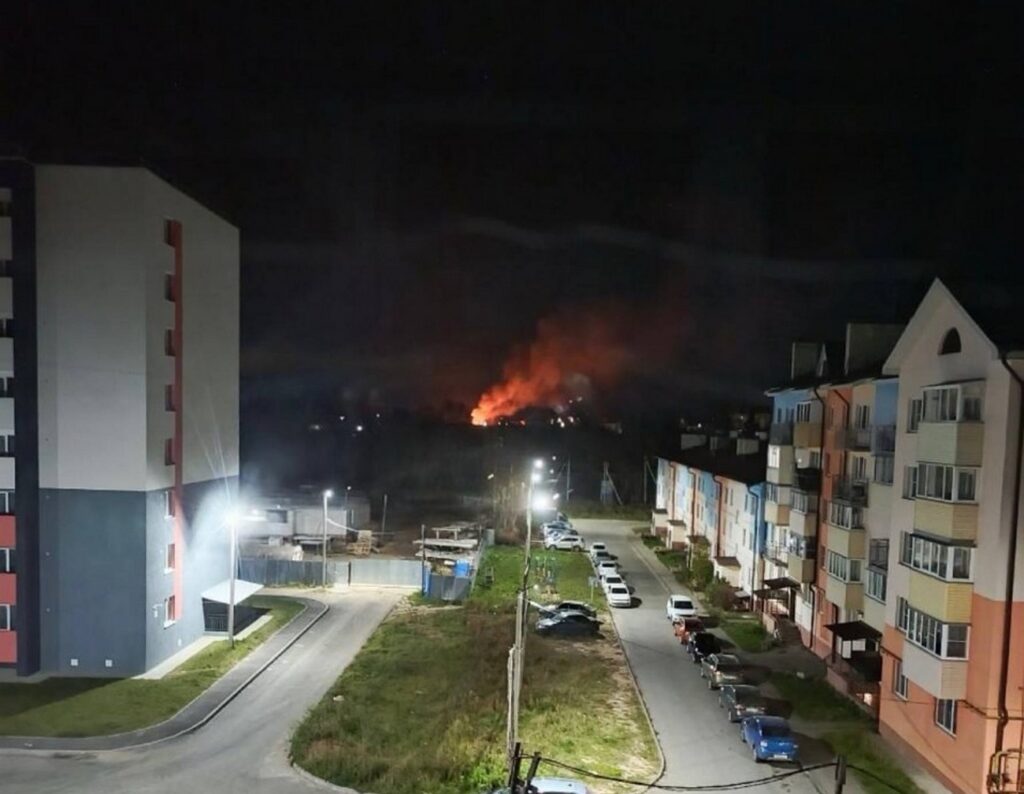
russia’s tax service keeps its databases two places drones went after one overnight also hitting air base explosives-chemical plant · post fire seen residential area gorodets nizhny novgorod oblast near

Drones attacked a Russian tax-service data center overnight on 23 October, Ukrainian monitoring channel Exilenova+ reported. A chemical plant in the Urals was also attacked, and a fire broke out near a Russian bomber base by late morning. Russian officials admitted injuries and damage but blamed falling debris. Ukraine has not commented.

Ukraine's long-range drones have widened their target list from Russian refineries to the servers and chemicals that keep Russia's state and war industry running.

The tax service's data center in Gorodets

The target in Gorodets, Nizhny Novgorod Oblast, is one of the Federal Tax Service's two key data centers, which work as a geographically distributed pair. It stores and processes state registers, including tax databases, Exilenova+ said. The extent of the damage is unconfirmed. The site lies about 785 km from Ukraine's northern border in a straight line.

The moment of impact at Russia’s Federal Tax Service data center in Gorodets last night. pic.twitter.com/PftC6keRpY

— Exilenova+ (@Exilenova_plus) October 23, 2026

Eyewitness footage shows a blast and fire in the area of the data center, which serves both the tax service and the Finance Ministry, Russian Telegram channel Astra found. The center opened in 2015. Mikhail Mishustin, then head of the tax service and now Russia's prime minister, attended the launch.

Nizhny Novgorod Governor Gleb Nikitin claimed air defenses repelled 19 drones. Falling debris injured three people in the Gorodets district and damaged several homes, an educational facility, and an infrastructure facility, he said, and local schools switched to remote learning. A Pantsir air defense missile hit a house, Exilenova+ claimed, though officials recorded it as a drone hit.

Ukrainian strikes inside Russia on Gorodets, Berezniki, and Voronezh, with distances from Ukraine, 23 October 2026
Ukrainian strikes inside Russia on Gorodets, Berezniki, and Voronezh, with distances from Ukraine, 23 October 2026. Map: Euromaidan Press/Datawrapper

This month, drones already hit three Yandex data centers and a VK data center near St. Petersburg.

A chemical plant behind Russia's gunpowder

In Berezniki, Perm Krai, smoke rose over Uralchem's Azot plant as air defenses fired, Astra reported. The regional security ministry announced a drone attack at about 06:00, and authorities closed the airspace within 50 km of the city. Ukraine's long-range Liutyi drones visited Berezniki, Exilenova+ wrote.

Our old friends, the Liutyi drones, paid Berezniki a visit today. Haven’t seen them in a while. 🫡 pic.twitter.com/NXuhIJ3xpm

— Exilenova+ (@Exilenova_plus) October 23, 2026

The attack on Azot was continuing in the morning, the channel wrote, adding that the plant covers about 140 hectares with some 90 production buildings. It makes ammonia, nitric acid, ammonium and potassium nitrate, and urea. Russian defense plants use its nitric acid to make explosives and gunpowder, including the Perm gunpowder plant, Astra said. Berezniki lies 1,500–1,600 km from Ukraine's border and the war zone.

Smoke rises over Uralchem's Azot chemical plant in Berezniki, Perm Krai, after a drone attack, Russia, 23 October 2026
Smoke rises over Uralchem's Azot chemical plant in Berezniki, Perm Krai, after a drone attack, Russia, 23 October 2026. Photo: Exilenova+/Telegram

Drones attacked Azot before, on 11 September. Earlier this year, Ukraine's Security Service hit Lukoil's refinery in the same region.

phones down water off factory roof broken open russian-occupied luhansk counts damage after another night drones · post fire occupied during drone attack 23 2026 ukraine news ukrainian reports
Explore further

Phones down, water off, a factory roof broken open: Russian-occupied Luhansk counts the damage after another night of drones

Fire near a Su-34 base in Voronezh

Late in the morning, Voronezh Governor Aleksandr Gusev declared a missile alert, and explosions followed in the city. Gusev later claimed air defenses downed several "jet-powered aerial targets." Debris set dry grass on fire in a suburb and damaged outbuildings and several cars, he said, adding that no one was hurt.

Missile alert in several regions of the Russian Federation.

Explosions have been heard in Voronezh. We are assessing the situation. pic.twitter.com/GY0NRZTo4x

— Exilenova+ (@Exilenova_plus) October 23, 2026

Eyewitness footage shows fire and smoke near Baltimor military airfield, Astra found. The strike preliminarily hit the grounds of a former military aviation engineering university and a nearby parking area for military aircraft, Exilenova+ said.

Fire and smoke near Baltimor military airfield in Voronezh after a Ukrainian attack, Russia, 23 October 2026
Fire and smoke near Baltimor military airfield in Voronezh after a Ukrainian attack, Russia, 23 October 2026. Photo: Astra/Telegram

Baltimor hosts the 47th Guards Bomber Aviation Regiment, whose Su-34s Russia uses to strike Ukraine, Militarnyi reported, saying Ukraine attacked the airfield with missiles. Voronezh lies about 185 km from Ukraine's border. Smoke rose over the base after an attack on 27 May, and a fire broke out near it on 2 September.

Moscow counts drones, Kyiv stays silent

Russia's Defense Ministry claimed it downed 443 drones overnight over 20 Russian regions, including Nizhny Novgorod Oblast and Perm Krai, as well as Russian-occupied Crimea and two seas. Ukraine's General Staff has not reported on the strikes. A night earlier, drones reportedly hit a sanctioned weapons plant near Moscow.

Russia's air defenses now have to cover state servers and Ural chemical plants as well as the airfields its bombers fly from.

  •  

US-China AI race turning ASEAN neutrality into a liability

For decades, Southeast Asia has turned great-power rivalry to an economic advantage. By maintaining healthy ties with Washington and Beijing, ASEAN governments attracted investment, expanded trade and preserved room for diplomatic maneuver. The great-power race for artificial-intelligence dominance, however, is changing that bargain. As the United States and China build competing technology networks, neutrality may […]

The post US-China AI race turning ASEAN neutrality into a liability appeared first on Asia Times.

  •  
❌