❌

Reading view

I'm a CTO who was awake for 48 hours because of the PHP crisis. October feels like the month of hell for tech.

Nick Woodhead
Nick Woodhead had to scramble in response to a security flaw that threatened the majority of the world's websites.

Courtesy of Nick Woodhead

  • Nick Woodhead said he went 48 hours without sleep while helping patch a major website vulnerability.
  • The CTO said that with security problems piling up, October feels like "the month of hell" for tech.
  • Because AI makes it easier to find and exploit security gaps, Woodhead expects more disruption.

This is an as-told-to essay based on a conversation with Nick Woodhead, founder of the AI company GPTree and chief technology officer at Rothco and Compubox. He spoke with Business Insider on Thursday to share how he's responded to vulnerabilities in the PHP programming language that could affect the majority of the world's websites. The following has been edited for brevity and clarity.

It's always a nightmare when these things happen. Since Tuesday evening, I haven't slept. It's coming close to 48 hours working on this. I'm a CTO, but I also run an agency for multiple clients and have my own company with my own product. So, balancing my time to get everything updated — it's just been exhausting.

About 70% of the internet runs on a programming language called PHP. I'm actively involved within the PHP community itself, so I did get a warning on Tuesday evening regarding the vulnerability and the fact that it was already being addressed by the PHP team. That gave me a head start.

I have some teams offshore, so I was able to jump on that with them.

It's not just applying the patches. It's making sure that nothing was already exposed. We already had infrastructure in place to easily deploy patches, but it still requires a good amount of manual involvement.

I knew that as soon as I walked into the office on Wednesday, I'd have to have my teams jump on this. They were already waiting for the patches to be released.

People are willing to help

One of the biggest headaches, especially on the client side, is that we have a lot of legacy systems, which are running on older versions of PHP that are no longer supported, and official patches are not going to be produced. For those, we ultimately had to come up with other plans. For example, taking sites temporarily offline or moving them behind VPNs.

Eventually, because it's an open-source community, those patches have already been backported, or implemented, by the community. So now we're shuffling back to some of those older systems to get them patched.

That's one of the nice things about PHP. There's such a vast community of people all willing to roll up their sleeves and jump in and help.

Even though I've been in leadership for the last 10 years, I've never taken my hand off the pulse in terms of being connected with the code and the infrastructure. So, I've been hands-on with the development and infrastructure teams to help make sure these issues are resolved. We've been reviewing logs and looking for any potential signatures of a breach that this vulnerability exposed.

The month of hell

It's also meant keeping up to speed with the latest news that's coming out and what other people are finding. We're in a position now where we feel comfortable and safe, but there are new vulnerabilities in the coding tool Node.js. We have some Node services, so now we're looking at how that potentially affects us. October just seems like the month of hell from a technology perspective.

I don't think there is an end in sight with the advancements in AI. For all the positives we get from it, there are a whole bunch of negatives, and this is a perfect example.

OpenAI has already stated that they found many more of these types of vulnerabilities that, thankfully, haven't been leaked. Over the coming months, they are either going to be patches or this information is going to get leaked in the same way and cause the same kind of panic.

I don't think we're at the end of the road yet. There's going to be a lot more to come.
Read the original article on Business Insider
  •  

I booked a one-way ticket to Bali after a layoff in fintech. I stayed in Asia for over a year — here's where my money stretched the furthest.

headshot of a woman with a warm beige background
Tiffany Tang.

Courtesy of Tiffany Tang

  • Tiffany Tang founded DrinkFolks after a transformative journey across Asia in 2023 and 2024.
  • Tang's layoff in 2023 led her to Bali, where she decided to extend her 30-day trip to over a year.
  • DrinkFolks, inspired by Tang's travels, supports women-led farms and brings jamu to the US market.

This as-told-to essay is based on a conversation with Tiffany Tang, the 30-year-old founder of DrinkFolks. It has been edited for length and clarity.

I'm the founder and CEO of DrinkFolks, which brings jamu, a 1,300-year-old Indonesian herbal remedy, to the US as a prebiotic root tonic.

For the first two years of my career, I was an assistant director at a gallery owned by the first female fine arts dealer in America. From 2017 to 2021, I worked at Christie's International Real Estate in marketing and communications roles.

For the next year, I was a senior communications manager at CSM Sport & Entertainment before taking on a similar role at a fintech company that helped millions of Americans sustainably build their credit scores through rewards.

I felt positively about that job, but I was laid off in May 2023

I was grateful to work there. We were doing big things, and I really learned what it was like to be at a mission-driven company.

The most interesting thing about my layoff was how incredibly calm I felt upon hearing the news. Our CMO told me first, and she was a friend, my college professor, and an executive I admire and respect.

When she told me, I said I didn't blame her, and this was a time for a reset. Turns out, the layoff was the best thing that could've ever happened to me.

A few weeks after my layoff, I booked a one-way ticket to Bali

For a long time, my self-worth was my net worth — my title, my salary, my career trajectory. When the layoff hit, I lost my sense of self. Reflecting afterward, all I could think was: who am I without the high-paying job?

A few weeks earlier, I had watched the movie "Eat, Pray, Love." When the layoff came, something in me said that this was my moment. I opened Kayak, found a one-way ticket to Bali for around $1,000, and booked it. Bali felt approachable and warm.

What was supposed to be a 30-day reset changed the course of my life

I originally planned to travel in Southeast Asia for a month but ended up staying from June 2023 through August 2024.

My awakening happened on day three. One of the first things I did in Bali was a Panchakarma, a full-body Ayurvedic detox at a retreat in Ubud. There was an optional silent day; one of the first times in my life I rooted and looked inward.

Sitting with my journal, I knew I had to stay. I was still negotiating my severance, so I did the math: my savings, my investments, what each month would cost. When my severance came through a few weeks later, it jump-started the journey.

The deeper turning point was Hong Kong

Everyone I met understood me on an indescribable level. It was the only time in my life I was speaking Cantonese to people outside my family, reconnecting with my heritage. By the time I came home for the holidays, I had decided: I was moving to Asia.

The spark for the company was the women I met. Across Indonesia and Southeast Asia, I sat with women quietly building something of their own. I wanted to help these women build generational wealth for their families. I built DrinkFolks as a way to sustainably invest in them — 3% of every sale goes to women-led farms and nonprofits across Southeast Asia through our FolksFund — while supporting health stateside by bringing ancient wisdom into people's homes.

I started the company in January 2024, took every jamu class I could find in Bali, visited the source of jamu in Yogyakarta, and reformulated recipes in my Hong Kong kitchen.

By October 2024, I was back in the US, working with California food scientists to scale up my home-tested recipe. We launched in NYC in October 2025. Today, we're in 70+ stores across the US.

Living in Southeast Asia made the math work

My salary before the layoff was $160,000 a year, plus equity. When I set off, I had roughly $14,000 between savings and severance — my spreadsheet calculated 4.6 months of runway — and I felt comfortable investing that in myself.

I budgeted like it was my job. I tracked my actual spending obsessively for the first four and a half months and came in at roughly $7,700 total.

All-in, I averaged about $1,300 to $2,300 a month, including flights, lodging, food, everything. My money stretched furthest in Cambodia and least in Hong Kong, which was financially similar to New York City. For comparison: my overhead, including my mortgage, maintenance, electricity, and WiFi in New York today is about $2,500 a month.

In terms of cost of living comparisons, here's my breakdown

Healthcare was the biggest surprise, in the best way. I got into a motorcycle accident on the Pakse Loop in Laos, and seven stitches cost me around seven dollars, including painkillers and a week of antibiotics.

Cambodia was the best value. It's the most adventurous, outdoorsy country I visited, and I didn't want to explore alone, so I stayed in hostels for as little as $6 a night — partly a budget move, mostly a way to meet people. It's also where I met my first fellow Americans of the entire trip.

Hong Kong was the opposite — groceries and eating out gave me real sticker shock. I softened it with a genuine energy exchange: I moved in with a college friend and threw dinner parties several times a week, cooking meals for them in exchange for a place to stay. It was worth every dollar — I met some of my truest friends and future business partners there.

The layoff was honestly the best thing that ever happened to me

a woman holds up two drinks in a grocery store
Tang's first time seeing DrinkFolks on shelves in LA.

Courtesy of Tiffany Tang

It gave me the confidence to build DrinkFolks, a better sense of my heritage, and a version of myself I'm proud of. I've learned to never say never, but right now, I'm exactly where I'm supposed to be.

My advice is to use your layoff as your launchpad. Things happen for you, not in spite of you. If you have even the slightest chance to live in that moment for yourself — for me, that was travel — take it as a gift and a blessing, not a crisis to survive.

Treat budgeting as freedom, not constraint. My money stretched so much further than I imagined. Clear parameters gave me the space to figure out who I am outside my job.

Read the original article on Business Insider

  •  

Ascolti tv, ennesimo ribaltone nel scontro tra La Ruota della Fortuna e Affari Tuoi: chi vince? I dati Auditel

Ascolti tv ieri 22 ottobre 2026: i dati Auditel dell’access prime time

Affari Tuoi su Rai1 con 4.673.000 spettatori (22.4%). Il mercoledì Stefano De Martino aveva intrattenuto 4.110.000 spettatori (20.8%). Sulla stessa rete Cinque Minuti con 3.832.000 spettatori (19.6%). Nella puntata precedente Bruno Vespa aveva interessato 3.868.000 spettatori (19.6%).

La Ruota della Fortuna su Canale 5 con 4.326.000 spettatori (20.8%). Nella puntata precedente Gerry Scotti aveva ottenuto 4.089.000 spettatori (20.9%).

Ascolti tv, Otto e Mezzo scende poco sotto il 9% di share

Otto e Mezzo su La7 con 1.821.000 spettatori (8.9%). Il mercoledì Lilli Gruber aveva conquistato1.857.000 spettatori (9.3%).

4 di Sera su Rete 4 con 1.052.000 spettatori (5.3%) nella prima parte e 886.000 spettatori (4.2%) nella seconda parte. Nella puntata precedente Paolo Del Debbio aveva raggiunto 1.122.000 spettatori (5.7%) nella prima parte e 931.000 spettatori (4.7%) nella seconda parte.

TG2 Post con Monica Giandotti con 542.000 spettatori (2.6%).

Leggi anche: Ascolti tv, De Martino spalla a spalla con Scotti: chi vince tra La Ruota della Fortuna e Affari Tuoi

Per quanto riguarda gli ascolti tv ieri 22 ottobre 2026 per l’access prime time delle altre reti:

N.C.I.S. – Unità Anticrimine su Italia 1 con 945.000 spettatori (4.7%), Il Cavallo e la Torre su Rai3 con 1.149.000 spettatori (5.8%) e Un Posto al Sole con 1.520.000 spettatori (7.4%), TV8 Football Night con 328.000 spettatori (1.7%), Cash or Trash – Chi Offre di Più? con Paolo Conticini sul Nove con 667.000 spettatori (3.2%).

Ascolti tv, L’Eredità batte Caduta Libera

Nel preserale L’Eredità su Rai1 con 4.007.000 spettatori (24%). Nella puntata precedente Marco Liorni aveva intrattenuto 4.213.000 spettatori (25.3%). Caduta Libera su Canale 5 con 2.320.000 spettatori (15.4%). Il mercoledì Max Giusti aveva raggiunto 2.220.000 spettatori (14.7%).

CLICCA QUI PER GLI ASCOLTI TV DELLA SETTIMANA

L'articolo Ascolti tv, ennesimo ribaltone nel scontro tra La Ruota della Fortuna e Affari Tuoi: chi vince? I dati Auditel proviene da Affaritaliani.it.

  •  

Ascolti tv, Doc domina e Le Iene sul podio: come sono andati la sfida Del Debbio-Formigli e il ritorno di Cucciari

Ascolti tv ieri 22 ottobre 2026: i dati Auditel della prima serata

Doc – Nelle tue mani 4 su Rai1 con 3.989.000 spettatori (23.5%). Nella puntata precedente aveva incollato al video 4.002.000 spettatori (25.1%).

Tutto per la mia famiglia su Canale 5 con 1.716.000 spettatori (11.1%). Nella puntata precedente aveva appassionato 1.618.000 spettatori (11%).

Le Iene su Italia 1 con 1.036.000 spettatori (7.8%). La scorsa settimana Veronica Gentili aveva interessato 893.000 spettatori (7.3%).

Ascolti tv, Ore 14 Sera rallenta e pareggia con Splendida cornice

Dritto e Rovescio su Rete 4 con 877.000 spettatori (6.6%). Nella puntata precedente Paolo Del Debbio aveva ottenuto 676.000 spettatori (5.6%).

Piazzapulita su La7 con 805.000 spettatori (5.8%). La scorsa settimana Corrado Formigli aveva chiuso con 770.000 spettatori (5.7%).

Ore 14 Sera su Rai2 con 755.000 spettatori (5%). Nella puntata precedente Salvo Sottile aveva raggiunto 928.000 spettatori (6.6%).

Splendida cornice con Geppi Cucciari torna su Rai3 con 828.000 spettatori (5%).

Leggi anche: Ascolti tv, Tale e Quale Show spezza la voce a Il Volo: bene Griggi e Cazzullo mentre Fazio…

Per quanto riguarda gli ascolti tv ieri 22 ottobre 2026 per le altre reti:

La partita Juventus – Rennes di Europa League in differita su TV8 con 736.000 spettatori (3.7%), Comedy Match con Katia Follesa sul Nove con 445.000 spettatori (2.5%).

CLICCA QUI PER GLI ASCOLTI TV DELLA SETTIMANA

L'articolo Ascolti tv, Doc domina e Le Iene sul podio: come sono andati la sfida Del Debbio-Formigli e il ritorno di Cucciari proviene da Affaritaliani.it.

  •  

Buzzy insurtech Corgi is hiring experienced investment bankers. The catch? The pay is commission-only.

Group applauds around a corgi on a Nasdaq podium as orange confetti falls before a large Corgi screen.
Corgi's cofounders ring the Nasdaq bell to celebrate the listing of its ETF last year.

PR Newswire

  • Buzzy insurtech Corgi has a knack for launching new businesses, and investment banking may be next.
  • The firm posted a job for a managing director of investment banking.
  • Unlike typical investment banking jobs, the pay is commission only.

Corgi launched as an insurance startup, but it's been rapidly expanding into new businesses like thematic ETFs and 24/7 cafe/coworking spaces.

A job filing posted this month suggests it's now eyeing M&A investment banking.

The company, valued at $5 billion, is hiring for a "Managing Director, Investment Banking" role, according to the posting. It says the company is "seeking experienced Managing Directors with established client relationships, deep sector expertise, and a proven track record of originating and closing transactions."

The company says it's seeking someone with more than five years of experience. Unlike traditional investment banking jobs, which typically pair a hefty base salary with performance-based compensation, this job is "commission only, with no base salary."

"Payouts are tied to collected transaction fees, with terms based on origination and execution responsibilities and agreed upon before joining," the listing says.

Investment banking managing directors across the industry made a median of $1.1 million a year in 2025, according to Prospect Rock Partners, and in previous years, bonuses made up more than two-thirds of total compensation.

A commission-only contract could be seen as a hard sell for your average banker, but Corgi's prolific fundraising — $266 million this year and $431 million in total since its 2014 launch — and its vision of "building an AI financial infrastructure company" may be attractive to an ambitious young banker.

The company did not respond to a request for comment about its plans or the job posting.

Corgi was founded by Emily Yuan and Nico Laqua in 2024, offering a range of insurance products for startups. Its recently opened cafés are positioned as a marketing tool for startup founders.

While an investment banking platform may seem to be an odd choice for an insurer, it is a clue that this is part of the firm's vision to serve startups by helping them sell their businesses.

The posting said candidates should have relationships with "founders, sponsors, and referral partners" — in other words, those who can connect startup founders with private equity investors that could buy their companies.

Read the original article on Business Insider

  •  

Should we panic and turn off the internet?

Stephanie Cohen speaks during the Web Summit conference in Lisbon in November 2025.
Stephanie Cohen, Cloudflare's chief strategy officer.

Zed Jameson/Bloomberg via Getty Images

  • This week's cyber freakout explained: AI is making software weaknesses easier to find and exploit.
  • The message from Cloudflare's Stephanie Cohen and Vercel's Tom Occhino: Don't panic!!!
  • Do we need everything connected to the internet? Paper bank statements work well.

A few weeks ago, I heard a strange story about a friend who works at one of the Big Tech companies in Silicon Valley.

She'd recently ripped out the connected devices in her home, ordered paper bank statements, and stocked up on canned goods in her basement.

Now, she's a very sane, experienced person, and quite senior at one of the largest internet companies on earth. Why was she disconnecting so much? Just to be sure, my family ordered paper bank statements, too. It was still a head-scratcher, though.

Fast forward to this week, and her actions look a little less crazy.

AI models have exposed serious security weaknesses in software used by roughly 70% of websites. Meanwhile, US banks are finding AI agents inside customer accounts, including some that appear to be acting without their owners' instructions, Axios reported.

'Black October'

The digerati have now entered full freakout mode. Much of the internet meltdown is happening on, well, the internet, my colleague Alice Tecotzky noted.

On X and Reddit, warnings of a looming “Black October” spiraled into visions of AI grinding civilization to a halt. One lengthy post on X warned of a potential “global cyberattack/AI swarm” and offered a survival checklist: Stockpile cash in small bills, print out your neighbors' phone numbers, download maps, buy a hand-crank radio, and stash a gallon of water per person per day.

Oh, and don't forget the manual can opener. You don't want to survive the AI apocalypse only to be defeated by a tin of beans.

Nikita Bier, a prominent app developer and former head of product at X, best captured the mood.

"It's time to turn off the internet," he posted Wednesday night.

A Cloudflare exec says it's 'a little bit scary'

If you're reading this, you haven't done that yet. But should we really be worried?

I put that question to Stephanie Cohen, chief strategy officer at Cloudflare, which helps protect about 20% of the internet.

"The world is a little bit scary right now," she told me on the side of Cloudflare's annual conference in San Francisco this week.

Here's the problem. The internet is built on decades of software, much of it riddled with security holes.

Some of these weaknesses have been known for years. However, fixing them takes time and money, and hackers often lacked the skills to exploit them anyway. So they were left alone.

AI changes that calculation dramatically. Someone who previously needed years of training to break into a computer system can now get help from an AI model. And these tools can search for weaknesses at a speed humans simply can't match.

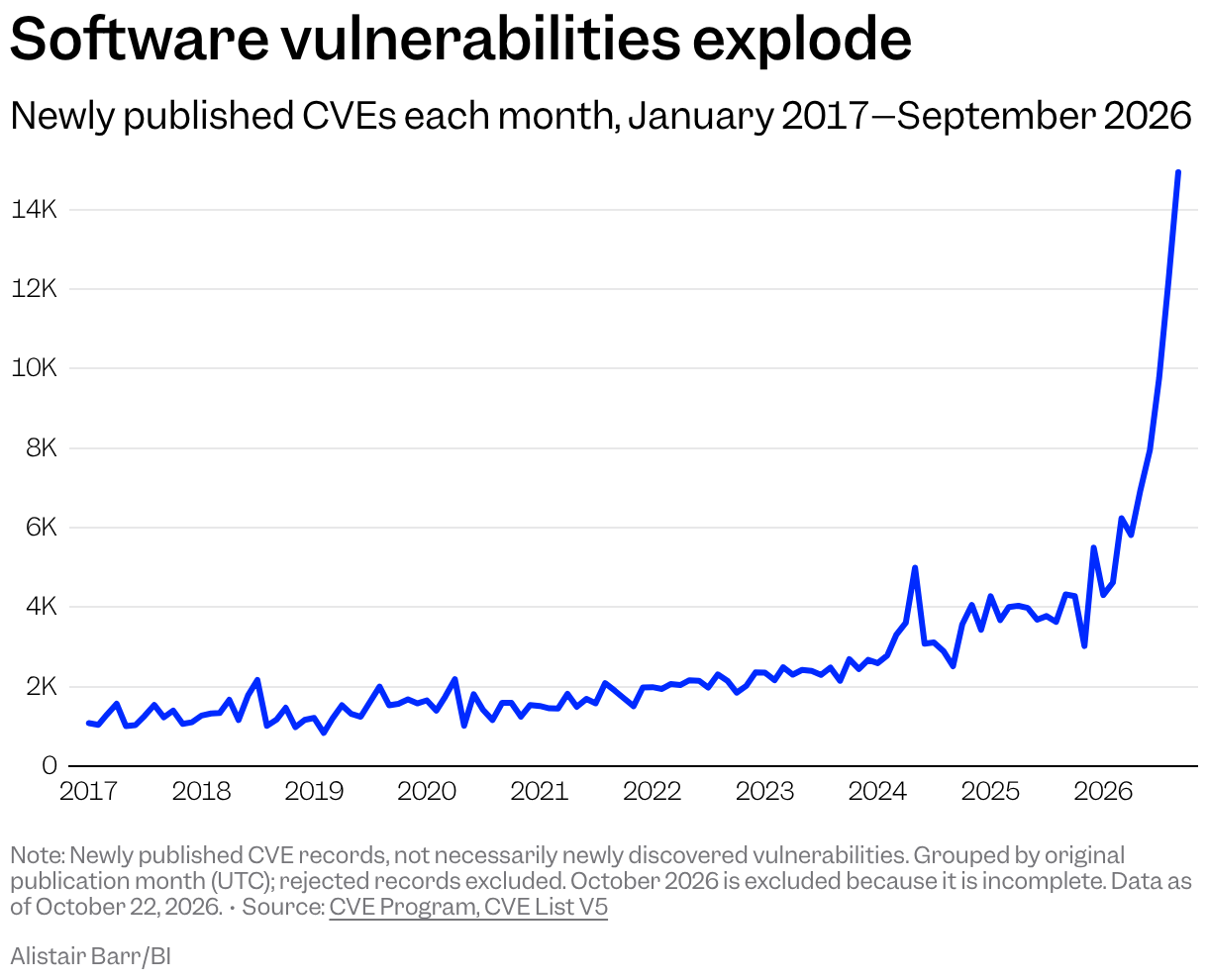
The result: The number of newly published software vulnerabilities (Common Vulnerabilities and Exposures in industry lingo) has exploded.

Line chart showing monthly newly published CVE records from January 2017 through September 2026. Counts rose from 1,083 in January 2017 to 14,934 in September 2026.

Now, there's a frantic race between people trying to break into systems and those trying to protect them.

Don't panic about AI

Cohen's message, though, was surprisingly reassuring.

AI helps the good guys find and fix these problems. Cloudflare, for instance, released protections for the latest vulnerability to customers, including those using its free service.

And there's a bigger effort underway.

OpenAI has launched an initiative called Patch the Planet, working with Cloudflare and other security professionals to use AI to find weaknesses in widely used software and help repair them.

Tom Occhino, chief product officer at Vercel, told me recently that his company has been talking with partners about launching a nonprofit that would fund a swarm of good AI agents that go out on the internet to find and fix software flaws.

Amazon is joining the fight, too. Its new Continuum service, available Thursday, uses AI agents to find security holes and propose fixes. Amazon said that people maintaining freely available software can use it to help protect the wider internet.

Humans may still have to check and approve these repairs, but the prospect of AI helping clean up decades of neglected software is encouraging.

The irony of this is not lost on some in the industry.

"The funny thing is everyone was saying AI slop code will cause a cyber crisis but it's actually all the old human slop causing it and the AI is just cleaning it up," software engineer Ben Kaufman wrote on X on Thursday.

Either way, Cloudflare's Cohen thinks these AI-inspired freakouts will push the industry to do better — by exposing issues and adding urgency to get them patched.

"We may end up in a world where actually we've become significantly more secure at the end," she said.

The trouble is getting there.

A fundamental question about the internet

Tom Occhino (left), chief product officer at Vercel, talks with Meta executive Prashant Ratanchandani at Vercel's Ship SF conference.

Alistair Barr/Business Insider

When I ran into Occhino recently at a Vercel conference in San Francisco, he described a world in which software that everyone assumed was safe suddenly looks vulnerable because increasingly capable AI models are scrutinizing the basic systems that underpin the internet.

That led to a more fundamental discussion between us: Why did we connect so many things to the internet in the first place?

For years, the technology industry has raced to put everything online. Thermostats. Refrigerators. Doorbells. Cars. Bank accounts.

We assumed that connecting something to the internet automatically made it better.

Perhaps we should reconsider.

Before the internet

I remember the world before the internet. It worked pretty well. We managed to buy groceries, pay bills, heat our homes, and generally get through the day without every appliance talking to a computer somewhere.

That doesn't mean abandoning online banking or throwing your smartphone into the sea.

Occhino, for one, isn't particularly worried about hackers wiping out his bank account. Modern banks have sophisticated protections, and he recommends everyone turn on additional login security.

Maybe the cybersecurity crowd, which spends its life immersed in online threats, is missing something obvious.

Not everything needs to be connected.

Occhino put it neatly: "There's certain things that don't make sense to be on the internet in the first place."

Perhaps that's the lesson from this week's panic. We don't need to turn off the internet.

We just need to remember where the off switch is.

Sign up for the AI Insider newsletter here. Reach out to me via email at abarr@businessinsider.com

Read the original article on Business Insider

  •  

Wait, the average Muse agent purchase is over $200? Tell me what you're buying!

meta use billboard
Meta Muse, hard at work at spending your money.

Smith Collection/Gado/Getty Images

  • Meta says that over a quarter of Muse users made purchases with the AI agent.
  • The average order was over $200 — that's a lot of clams!
  • If this is you, please tell me what you're using it for.

Something just blew my mind, and I'm asking for your help to figure it out.

According to Meta's Q3 earnings call on Wednesday, more than a quarter of Muse users so far have used the AI agent make purchases — and the average order size is over $200.

I'll say that again: average order size over $200.

This is shocking to me, and I'm someone who has been actively and happily using Muse for a variety of things. I've been perfectly happy to give Muse access to my email, my calendar, my credit cards, and even my Apple health data.

But I've been slightly reticent about using it to actually buy stuff. Not that I'm totally worried about it getting stuff wrong (although the one purchase I did try to make with it was to order a salad for lunch, and it attempted to place the order on my HSA card after I failed to recognize the last 4 digits of that card, oops).

I think it's more I enjoy shopping online myself? I mean, for most things, I suppose. For "fun" stuff like clothes or personal items, I enjoy browsing and the hit of dopamine when you check out. (Others take this to the extreme, using "dopamine sites" that let you browse fake restaurants and "order" food that never arrives.) The other night I ordered — on a real site — cotton balls, razor blade refills, a plain white t-shirt, and a pair of scissors from the Target app while watching TV and even that boring purchase with a total under $30 gave me a small thrill. Why would I want to cede that joy to AI?

I understand, however, that not all purchases are fun. My colleague, Peter Kafka, used Muse to help him place an order for a new washing machine — the kind of purchase that is difficult to decide on, not particularly fun or exciting to make, and fairly expensive. Things like plane tickets, washing machines, or car insurance are in that category of stuff you have to buy, cost a lot of money, are fairly complicated to decide which option to buy, but bring very little joy during checkout.

I can understand why you might want to hand that off to an AI agent.

If you are using Muse to place big $$$ orders, what the heck are you buying?

My best guess here is that people are using Muse for airplane flights and hotels — the kind of big dollar items that are kind of annoying to book yourself, and you care mainly about just booking the right dates.

Am I right? You tell me!

Comment below, or you can email me at: knotopoulos@businessinsider.com. Or, you know, tell your Muse to email me.

Read the original article on Business Insider

  •  

Tale e Quale Show, Carlo Conti cala il bis: ecco chi arriva in giuria. Anteprima

Andrea Delogu e Sergio Friscia saliranno sul banco dei giurati nel prossimo appuntamento del varietà di Rai 1, affiancando lo storico trio composto da Malgioglio, Siani e Lamborghini.

Andrea Delogu ritrova Carlo Conti dopo i Summer Hits, Friscia reduce da LOL e protagonista su RDS

ROMA – I motori di Tale e Quale Show sono più caldi che mai e la macchina dell’intrattenimento di Carlo Conti non accenna a fermarsi. Archiviati i successi degli ultimi appuntamenti, siamo in grado di svelarvi in anteprima assoluta i nomi dei giudici speciali che arricchiranno la sesta puntata del programma.

Per il prossimo turno di imitazioni, il tavolo della giuria raddoppia il carico di ironia e fascino: a valutare le performance e i complessi carichi di trucco delle celebrità in gara ci saranno la conduttrice Andrea Delogu e l’attore e showman Sergio Friscia.

Un colpaccio tra comicità e carisma

I due volti amatissimi del piccolo schermo e della radiofonia italiana siederanno accanto al trio fisso composto da Cristiano Malgioglio, Alessandro Siani ed Elettra Lamborghini. La scelta di Conti punta chiaramente su un mix esplosivo: da un lato la freschezza, la competenza musicale e la verve di Andrea Delogu; dall’altro la travolgente comicità siciliana e la forte empatia di Sergio Friscia, un fuoriclasse quando si parla di tempi comici, imitazioni e improvvisazione.

Con la competizione che entra nel vivo e i concorrenti pronti a sfidarsi a colpi di trasformazioni sbalorditive, la presenza di Delogu e Friscia promette di regalare dinamiche imprevedibili, commenti pungenti e gag esilaranti che terranno incollati i telespettatori.

Due giudici sulla cresta dell’onda: tra radio, grande comicità e il pomeriggio di Rai 2

I due quarti giurati d’eccezione stanno attraversando un momento d’oro nelle rispettive carriere. Sergio Friscia si conferma una colonna portante dello spettacolo italiano: oltre a proseguire quotidianamente il suo fortissimo cammino nella radiofonia nazionale su RDS, lo showman si sta godendo il grande riscontro per la sua partecipazione al cult comedy show LOL: Chi ride è fuori ed è attualmente impegnato a teatro con il suo spettacolo comico Oggi è di nuovo oggi.

Per Andrea Delogu si tratta invece di un attesissimo ritorno nei panni di giurata d’eccezione su Rai 1. La conduttrice e scrittrice, reduce dal successo estivo dei TIM Summer Hits al fianco proprio di Carlo Conti, si prepara infatti a riprendere saldamente le redini del pomeriggio di Rai 2: per lei è in arrivo la conduzione della nuova stagione de La Porta Magica, il fortunato factual show quotidiano che racconta i percorsi di cambiamento e di rinascita di persone comuni.

L’appuntamento con la sesta puntata è fissato in prima serata su Rai 1 mercoledì 28 ottobre.

LEGGI TUTTE LE NOTIZIE DELLA SEZIONE MEDIATECH

L'articolo Tale e Quale Show, Carlo Conti cala il bis: ecco chi arriva in giuria. Anteprima proviene da Affaritaliani.it.

  •  

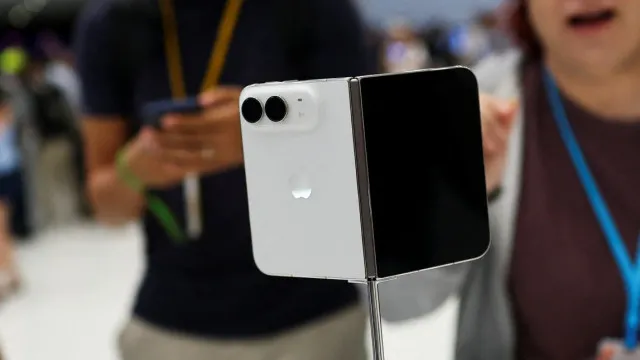
Apple launches into foldable market as iPhone Duo sales begin

Sales of Apple’s first folding phone, the iPhone Duo, began on Friday, with market watchers betting on whether the device can reinvent the small foldables market in the same way the iPhone did for smartphones.

The Duo’s reception could prove an early test for new CEO John Ternus, the former hardware chief who unveiled the phone barely a week after taking charge in September.

It could also have large implications for a niche category in which ⁠rivals such as Samsung Electronics and Huawei Technologies have sold premium ​offerings for several years.

Within minutes of pre-orders opening last Friday, Apple’s estimated delivery dates for the Duo had slipped to late January as demand outpaced supply.

The US company called the response from customers “nothing short of extraordinary.”

With the massive demand, Apple capped pre-orders at two handsets per customer and limited sales significantly for walk-in shoppers, resulting in muted crowds unlike the hype that typically accompanied new iPhone releases.

In China, France, Hong Kong, India and Japan, units would be available only for customers who had ordered online

In Sydney, the first Apple store to sell the phones on Friday, a queue of customers formed outside before opening at 8am local time (2100 GMT or 2am PKT).

Simon Krishnan, a 48-year-old engineer, paid A$3,899 ($2,734) for a Duo with 512GB memory.

“This is a bit of a luxury item for me, because it’s so expensive, but I just think, you know what? Life’s too short,” he said.

In China, a soft consumer market combined with memory costs pushing prices higher has led to six straight quarters of declines in smartphone shipments.

Apple’s market share, however, has rebounded as some phone buyers trade up to premium devices while others seek value at the lower end of the market, putting pressure on mid-range brands.

Liu Wei, a 26-year-old healthcare professional, already has a foldable phone from Xiaomi, but still queued outside a central Shanghai Apple store from 6am to get his hands on Apple’s first foldable.

“I’ve used Apple products for many years and I have more trust (in the brand), so I bought one on launch day to try it out,” he said.

In Hong Kong, May, 38, who declined to give his full name for privacy reasons, secured a 256GB iPhone Duo, which retails for HK$17,499 ($2,231.73), during an online pre‑sale and aimed to resell the handset for a profit of around HK$4,000: “A few meals’ worth of money,” he joked.

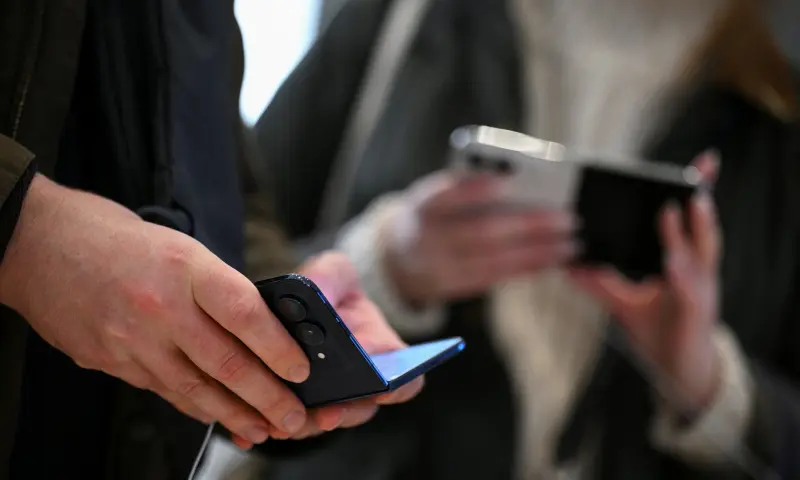
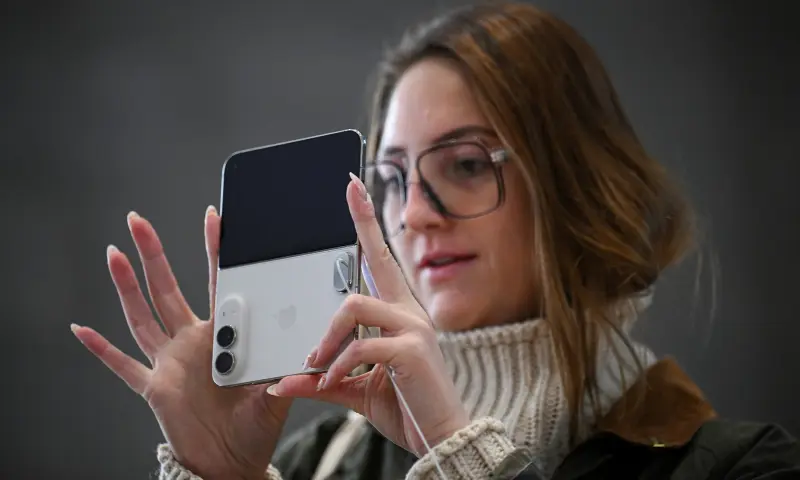
People use the new foldable iPhone Duo, on its launch day at an Apple store, in Berlin, Germany, on October 23, 2026. — Reuters

Mixed reviews

Early reviews have praised the Duo’s design as well as its sturdy and barely visible hinge, a major feat for phones whose prominent creased screen has long been a drawback and potential deterrent for buyers.

But reviewers have said camera compromises including the absence of a telephoto lens and third-party apps that still need to be reworked for the new display size could disappoint some buyers.

They have also said the Duo in its smaller, folded state is less handy for the litany of quick tasks that most users carry out each day on standard iPhones, with several prominent reviewers recommending against the Duo for many Apple customers.

“It’s been a lot of fun trying the Duo out for a week, but it feels like I’ve gotten to use an extraordinarily polished prototype — not a finished product that I’d want to buy and carry,” longtime Apple commentator John Gruber, author of the blog Daring Fireball, wrote in a review.

Tech commentator Marques Brownlee, popularly known as MKBHD, said in a YouTube review that “if you’re just a regular person who doesn’t do much more than texting, social media and browsing here and there, then it is probably a no. But if the $2,000 doesn’t mean much to you, and you like the idea, after the learning curve and getting used to not having facial identification, it is a really fun phone.”

 People use the new foldable iPhone Duo, on its launch day at an Apple store, in Berlin, Germany, on October 23, 2026. — Reuters
People use the new foldable iPhone Duo, on its launch day at an Apple store, in Berlin, Germany, on October 23, 2026. — Reuters

Tough to find

The limited supplies could disappoint Apple fans lining up in front of stores to buy the Duo. Apple told Reuters that walk-in availability would vary by country, with limited stocks in the US, Australia, Canada, Mexico and much of Britain and Europe.

“Foldables have been an established category for years, but adoption has remained relatively limited compared with conventional smartphones. Apple’s entry could bring the format to a much broader audience,” said Francisco Jeronimo, vice president at market researcher IDC.

IDC expects Apple will take 44 per cent of the foldable value in 2026 on 31pc of foldable units.

By 2027, it will become the market leader in the category both in value and units shipped, IDC forecast.

“Apple has made a convincing case for this form factor,” Jeronimo said after spending a week with the passport-shaped Duo.

“Now comes the next test: turning excitement into availability, adoption and a lasting new chapter for the smartphone market,” Jeronimo said.

  •  

Sundar Pichai says Google is far from the ‘end state’ of self-improving AI

Google CEO Sundar Pichai
Sundar Pichai says Google's researchers are using AI to help build the next AI models.

Hardik Chhabra/ The India Today Group via Getty Images

  • Sundar Pichai said Google was still in the early phases of recursively self-improving AI.
  • Researchers are working with AI agents to build better models, he said.
  • Sergey Brin recently said Google was "starting to get onto that RSI treadmill."

Google's AI models may be helping to build their successors, but CEO Sundar Pichai says the moment of fully self-improving AI is still a while away.

Speaking on an episode of the "Big Technology Podcast" this week, Pichai said that Google researchers were using AI agents to assist them when building models, but caveated that it was still early days.

"We are pretty far from the end state of RSI," said Pichai, referring to recursive self-improvement. "The right way to describe it is, you have RSI loops along with AI researchers in various aspects of model development. I would say you almost have agents helping AI researchers, in some automated way, work together to build these models."

Pichai added that he expected that continuum to keep making progress into next year.

Earlier this month, Google cofounder Sergey Brin said the company's Flash series of models, as well as Gemini 4, were demonstrating how AI was helping to build itself, and that Google was "starting to get onto that RSI treadmill."

"And now our researchers and the model work hand in hand to make the next version of the model," he said.

Brin has been increasingly involved in Google's Gemini efforts and has leveraged his power as cofounder to shift resources to projects he deems most effective, Business Insider previously reported. This has included pushing for more focus on RSI.

A report from the firm Gladstone AI, published earlier this month, said that most researchers interviewed from companies including Anthropic and DeepMind believed RSI will start within the next three to 12 months, and possibly sooner without government intervention.

In another moment on the "Big Technology Podcast," Pichai was asked about how much AI was being used to code internally. The company said in April that 75% of new code inside Google was generated by AI.

"That number in our world today is like meaningless in the sense that every part of code we now touch is influenced by AI deeply," Pichai said. With Gemini 4 Argon, he said, people were going to tackle harder problems. He also said Google was seeing a one-third decrease in code rollbacks, where software is reverted to a previous version because of a bug or system issue.

"And so I think people are writing code more productively, and better code with it," he said of AI tools.

Pichai also uses AI to track Google's model development and internal discussions, he told the "Sources" podcast this week.

Have something to share? Contact this reporter via email at hlangley@businessinsider.com or Signal at hughlangley.01. Use a personal email address and a non-work device; here's our guide to sharing information securely.

Read the original article on Business Insider

  •  

What smart people are saying about the AI cybersecurity 'vulnerability tsunami'

Hooded silhouette sits at a dark workstation facing multiple computer screens displaying code.
Cybersecurity flaws were recently identified in the popular PHP programming language.

Annette Riedl/picture alliance via Getty Images

  • Executives and AI analysts alike are warning of major cybersecurity threats.
  • Experts say critical systems, from energy and water to healthcare, may be especially exposed.
  • Here's what smart people are saying about the biggest threats to the internet at the moment.

CEOs and AI analysts alike are sounding the warning on cybersecurity vulnerabilities that could not only expose large swaths of personal data but also allow bad actors to wreak havoc on the internet.

On Wednesday, OpenAI said its agents helped detect severe cybersecurity vulnerabilities. Two "critical" flaws were found in the infrastructure of PHP, an open-source programming language that 70% of websites use.

Here's what smart people are saying about the biggest cybersecurity threat of the moment.

Jason Clinton, Anthropic's deputy chief information security officer

Anthropic's deputy security chief, Jason Clinton, warns that a "vulnerability tsunami" is coming — and says critical infrastructure hasn't caught up.

Clinton posted on X on Wednesday about the need to "patch critical infrastructure" before core network vulnerabilities get exploited. On Thursday, he issued another warning to companies.

"As bad as things have gotten in the past 4 days, they are going to get a lot worse before they get better," he wrote.

"Security leaders, never let a crisis go to waste: please go to your boards and ask for help right now. not for ai, for the basics. (we need to hold on for ~18 months.)," he added.

Andrew Curran, AI analyst

Andrew Curran, a prominent AI analyst, weighed in on several cybersecurity threats from Wednesday to Thursday.

"Regarding potential attacks on energy, food, and water infrastructure, the threat is quite real. Someone is currently probing infra and feeling it out, it is an active threat. Even a little preparation can be helpful, just in case," Curran wrote on Wednesday in response to an NSA cybersecurity advisory about threat actors.

On Thursday, Curran also highlighted a hack of Quest Diagnostics, which he said serves "roughly half" of the US's hospitals and physicians.

Matt Shumer, AI investor

In February, Matt Shumer, the former CEO of Hyperwrite, published a viral essay on his website titled "Something Big Is Happening," in which he warned of large-scale disruptions wrought by AI that could upend the world order.

Shumer published another essay on Thursday on his website and LinkedIn, this time titled "The Internet Is Under Attack. Here's How to Protect Yourself and Your Family."

"Right now, as you read this, swarms of AI agents are likely trying to break into the websites you use. Not one of them. Many of them," Shumer wrote. "We are in the middle of the biggest cybersecurity moment in years."

This is what could happen, per Shumer's post:

Your information leaks, so scammers know your name, birthday, address and bank, and their calls and texts sound real. Your accounts get taken over through some site you used once, years ago, with the same password you use everywhere. And the things you depend on, like an app, a pharmacy or a store's website, go down for days.
To be clear: this is ongoing, but the worst-case scenarios people are most scared of haven't happened. I hope they never do. But it's better to be safe than sorry, especially since this is going to keep happening.

Shumer also outlined four ways people can protect themselves, including updating all their software and staying off sites they're unfamiliar with while companies and websites alike make their security updates.

He also advises that people protect their bank accounts by being extra cautious about any and all codes and links that they receive. People should also "close the doors you aren't using" by unplugging smart gadgets and deleting apps that aren't being utilized.

"Every connected thing is another way in," Shumer wrote.

Marc Benioff, CEO of Salesforce
Marc Benioff
Salesforce CEO Marc Benioff

Business Insider

Marc Benioff agreed with Anthropic's Jason Clinton in an X post on Thursday.

"Jason is 100% right. Code red," Benioff wrote, along with a red alarm emoji.

Read the original article on Business Insider

  •  
❌