❌

Normal view

Russian Army Breaches Ukrainian Defenses in Zaporozhye
15 October 2026 at 19:52

File image.

In the Zaporozhye direction Russian troops have advanced almost 13 kilometers, overcome two lines of defense, restored control over Lyubetskoye, Novosoloshino and Nikolskoye, and continue to apply pressure on Orekhov. In the Sumy direction assault units of the “North” grouping have advanced on 19 sectors by up to 800 meters, conducting fighting near Khoten and in the tree lines near Korenok. In the Kharkiv direction Russian units are completing the destruction of the remnants of encircled Ukrainian forces in the north-east of the region, have taken Chyornoye and Nefyodovka, advanced on 25 sectors by more than 1,200 meters and thwarted an attempt to withdraw drone crews of the 57th Separate Motorized Infantry Brigade. In the Dobropolye direction Russian units have entered the village of Dobropolye, while the Ukrainian side has withdrawn from Matyashevo and destroyed a dam, creating a water obstacle. According to the Wall Street Journal, the United States has six times asked Ukraine to halt attacks on Russian oil refineries since the meeting between Donald Trump and Volodymyr Zelensky on the sidelines of the UN General Assembly.

Zaporozhye direction  

Attempts to retake Dachnoye have brought no success. Russian troops have restored control over previously lost sectors and continue fighting near Filippovka and Ivanovka. In the Orekhov direction Russian troops have regained control of Tsvetkovo and the adjacent section of the railway. The advance continues on several sectors west of previously captured positions. Russian units hold Gulyaypolskoye and the southern part of Novosyolovka. Fighting continues near Orekhov, Malaya Tokmachka and Novodanilovka.

The Orekhov direction remains one of the most dynamic. The Russian side continues intensive fire effect. One of the notable events has been the advance of Russian units by almost 13 kilometres in Zaporozhye region. The troops overcame two lines of defense — one two-tier and the other single-tier. Lyubetskoye, Novosoloshino and Nikolskoye have come under control. The latter is located at a road junction and makes it possible to develop the advance toward Omelnyk from the north. Lyubetskoye and Novosoloshino had previously been temporarily lost.

On the northern sector Russian assault troops are conducting offensive operations near Velikomikhaylovka. On the north-western sector units continue the offensive on a broad front west of Golubkovo, Samoylovka and Svetlaya Dolina. West of Zarnitsa the advance is proceeding with the support of artillery and drone crews near Barvinovka and Vasilkovoye. Assault groups continue to drive wedges into the defense and expand the bridgehead on the western bank of the Verkhnyaya Tersa River.  

Sumy direction  

Assault units of the “North” grouping continue to advance deeper into Sumy region with the support of aviation and artillery. Ukrainian units are offering fierce resistance in defense and are inserting new SSO groups onto the direction. Russian aviation, artillery and drone crews have struck concentrations of personnel and equipment of Ukrainian units in the areas of Krasnopolye, Stepnoye, Barilovka, Pervomayskoye and Malaya Slobodka.

In Sumy district assault groups of Russian units have advanced on 19 sectors. Overall progress in a single day reached up to 800 meters. In Shostka district Russian troops are advancing through the tree lines near Korenok. Thus pressure is maintained on Ukrainian units, which are forced to strengthen their defenses and transfer additional forces.  

Kharkiv direction  

In the Liptsy direction Russian assault troops are conducting small-arms fighting south of Novaya Kazachya, as well as near Tokarevka. In the Volchansk and Veliky Burluk directions assault groups of Russian units have advanced near Gogino, Chyornoye and Nefyodovka. Overall progress on 25 sectors exceeded 1,200 meters.

In Kharkiv region Russian units continue successful offensive operations, tightening the ring of encirclement and expanding the zone of control. Assault troops have advanced up to 1.2 kilometers into the depth of the Ukrainian defense. As a result of active and resolute actions inside the ring of encirclement Russian units have taken full control of Chyornoye and Nefyodovka. Clearance is under way in these settlements. Fierce fighting continues for the capturing of Nikolayevka and Varvarovka, where blocked Ukrainian units are offering resistance. On the eastern flank of the cauldron the systematic destruction of the remnants of the encircled Ukrainian forces continues. Fighting also continues near Prikolotnoye, Kotovka and Gogino. 

Dobropolye direction  

Russian units have entered the village of Dobropolye, where fighting continues. Ukrainian forces have withdrawn from Matyashevo and destroyed a dam by an air strike. According to incoming information, this was done in order to create a water obstacle on the path of further advance toward the town of Dobropolye.

Assault groups of the 51st Army advanced in the north-western part of Dobropolye. Assault units of the marine infantry grouping continued the offensive in the western part of the settlement. Russian troops are gradually enveloping Sergeyevka from the north and south. New positions are being captured in the village. Clearance of the southern outskirts of Dobropolye is under way. Units of the “Centre” grouping are developing the offensive on the Sergeyevka–Gulevo line. Consolidation on this sector will make it possible to secure supply routes in the area of Grishino.

While the battle for Dobropolye continues, the Ukrainian side is relying on Novovodyanoye, Zolotoy Kolodets and Rubezhnoye. It is attempting to cut off the salient and break through to the encircled forces. This is, however, a forced strike, because the Ukrainian side overlooked the encirclement. It is reacting according to its capabilities rather than according to a serious plan. Russian fighters on the ground said in advance: we know that Ukrainian units will go through Zolotoy Kolodets and Novovodyanoye.


Conclusion  

In the Sumy direction fighting remains positional in character; in the Kharkiv direction clearance of the Volchansk cauldron is nearing completion; in the Dobropolye direction the greater part of the town is under control; on the Zaporozhye front the advance continues after the restoration of control over a number of key settlements. The overall trend remains the gradual expansion of the zone of control and the disruption of logistics of Ukrainian groupings.

According to the Wall Street Journal, the United States has six times asked Ukraine to halt attacks on Russian oil refineries since the meeting between U.S. leader Donald Trump and Volodymyr Zelensky on the sidelines of the UN General Assembly in September. Trump’s attitude toward Zelensky became increasingly negative against the background of the continuing Ukrainian attacks. Trump repeatedly expressed public dissatisfaction with Zelensky’s unwillingness to reach peace agreements and his reluctance to stop strikes on Russian refineries. According to Trump, Ukraine needs a new leader capable of reaching an agreement with Russia. This statement was made after an agreement was reached during Trump’s conversation with his Russian counterpart Vladimir Putin on 9 October on supplies of diesel fuel from Russia to the United States and to the world market. Zelensky, for his part, stated that the alleged ban on strikes against Russian refineries was over.  

_______________________________________________________________________________________________________________________

SouthFront: Analysis and Intelligence

NOW hosted at southfront.press

Previously, SouthFront: Analysis and Intelligence was at southfront.org.

The .org domain name had been blocked by the US (NATO) (https://southfront.press/southfront-org-blocked-by-u-s-controlled-global-internet-supervisor/) globally, outlawed and without any explanation

Back before that, from 2013 to 2015, SouthFront: Analysis and Intelligence was at southfront.com

SOUTHFRONT.PRESS

MORE ON THIS TOPIC:


The post Russian Army Breaches Ukrainian Defenses in Zaporozhye appeared first on South Front.
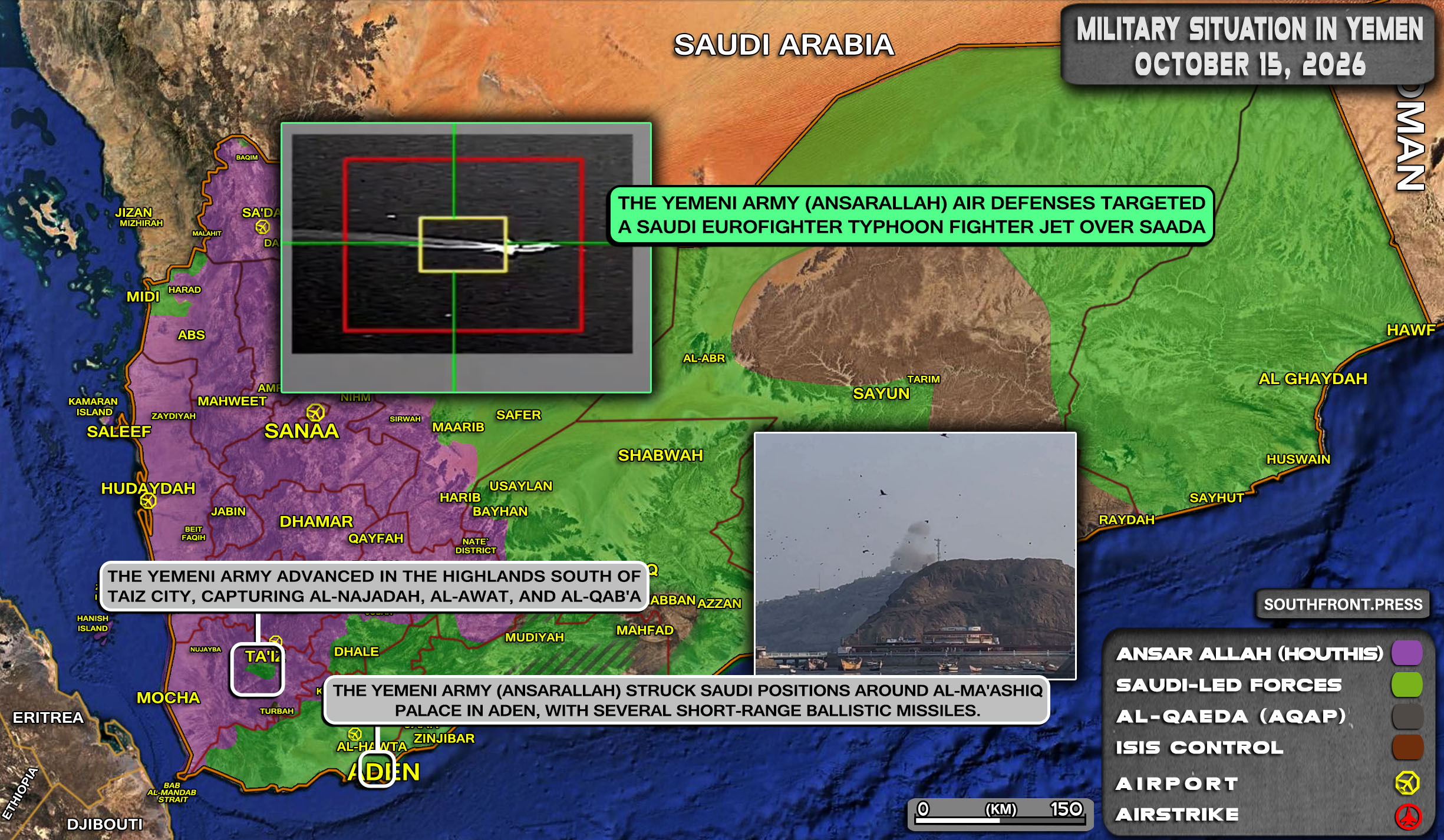
Military Situation In Yemen On October 15, 2026 (Map Update)

15 October 2026 at 19:14

Click to see full-size map.

  • The Yemeni army (AnsarAllah) air defenses targeted a Saudi Eurofighter Typhoon fighter jet over Saada;
  • The Yemeni army advanced in the highlands south of Taiz city, capturing Al-Najadah, Al-Awat, and Al-Qab’a;
  • The Yemeni army (AnsarAllah) struck Saudi positions around Al-Ma’ashiq Palace in Aden, with several short-range ballistic missiles.

_______________________________________________________________________________________________________________________

MORE ON THIS TOPIC:


The post Military Situation In Yemen On October 15, 2026 (Map Update) appeared first on South Front.

North Korea Tests Two Submarine-Launched Strategic Cruise Missiles (Photos)

15 October 2026 at 17:54

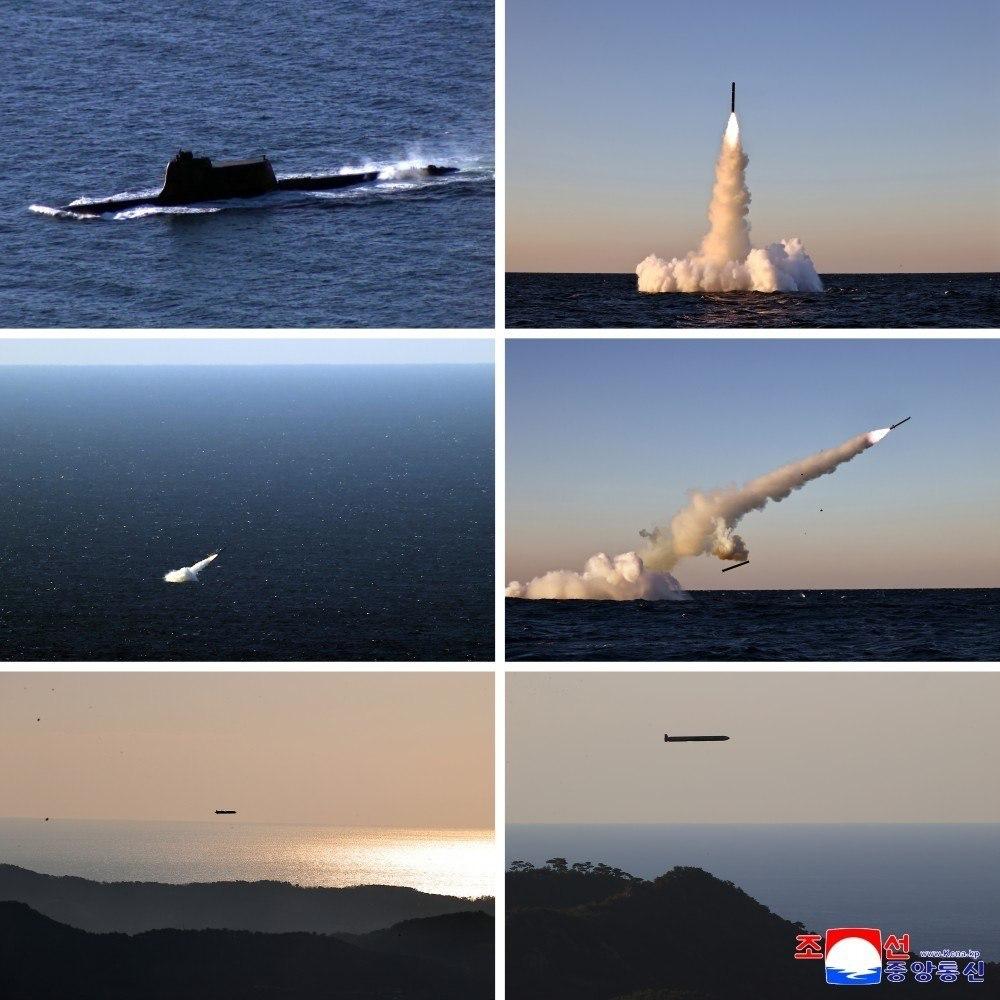
Click to see full-size image. (Korean Central News Agency)

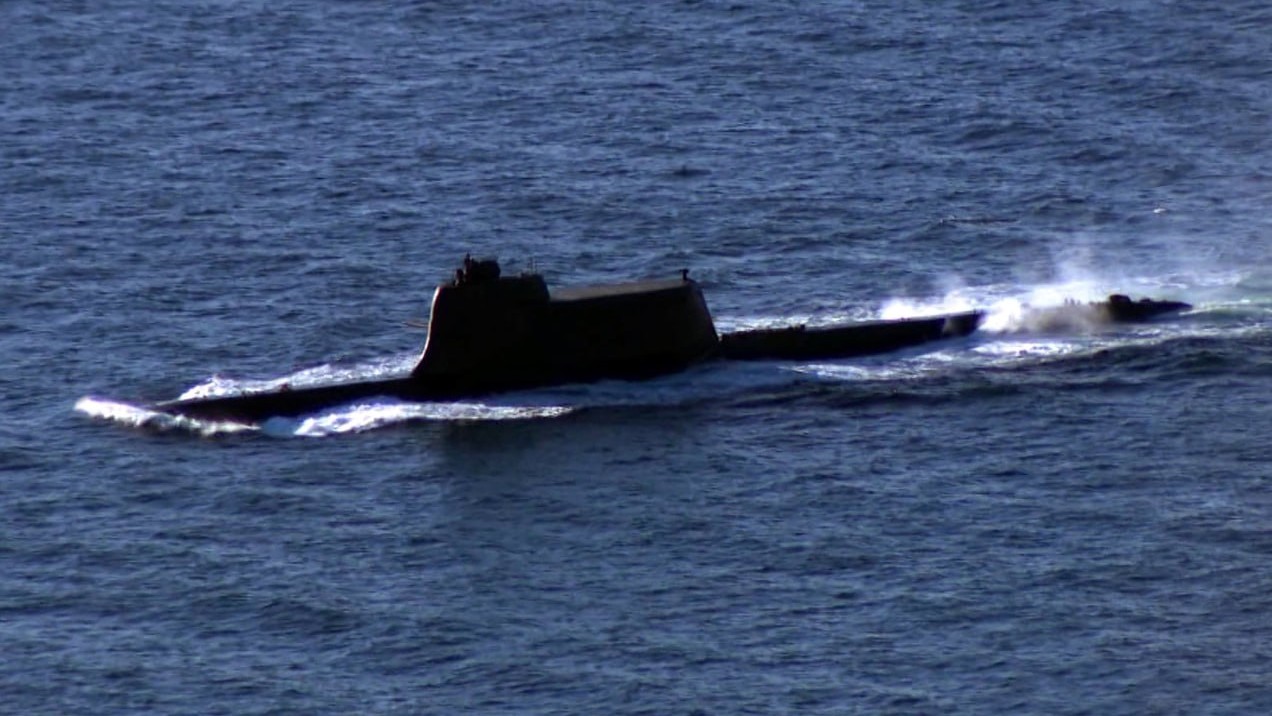
North Korea said on October 15 it had test-fired two types of submarine-launched strategic cruise missiles off its east coast a day earlier, in a trial aimed at assessing its underwater weapons systems and the reliability of its military deterrent.

The Korean Central News Agency, or KCNA, reported that the tests were designed to examine the readiness of the country’s underwater combat systems and improve the navy’s ability to carry out strategic missions. It said the test “did not have any adverse impact on the security of neighboring countries.”

KCNA did not identify the missiles or disclose their ranges, flight times or intended targets. The designation “strategic” suggests a role in North Korea’s nuclear deterrent, although Pyongyang did not say whether the tests involved nuclear warheads.

Click to see full-size image. (Korean Central News Agency)

South Korea’s military said it had monitored the launches using multiple surveillance assets, tracking the missiles from before launch through the end of their flights.

Capt. Jang Do-young, a spokesperson for South Korea’s Joint Chiefs of Staff, said the military assessed that one missile had been fired from a vertical launch system and the other from a torpedo tube, according to Yonhap News Agency.

South Korean analysts and international news reports identified the vessel shown in the images as the Hero Kim Kun Ok, a roughly 3,000-ton submarine unveiled by North Korea in September 2023. Pyongyang presented it as its first tactical nuclear attack submarine, claiming it could launch nuclear weapons from underwater.

If the identification is correct, the October 14 launches would be the submarine’s first publicly reported live weapons tests.

North Korea previously announced submarine-launched cruise missile tests in January 2024, when it said two Pulhwasal-3-31 missiles had been fired from the smaller, approximately 2,000-ton 8.24 Yongung submarine. That vessel has been used in earlier underwater weapons demonstrations.

The latest test was overseen by Kim Jong-sik, a member of the ruling Workers’ Party’s Central Military Commission, Missile Administration chief Jang Chang-ha and naval underwater weapons engineers, KCNA reported. North Korean leader Kim Jong Un was not reported to have attended.

Shin Jong-woo, secretary-general of South Korea’s Korea Defence and Security Forum, said the latest launches showed that “combat system tests for operational deployment are under way,” according to Reuters.

The commander added that North Korea was likely to test a submarine-launched ballistic missile from the vessel before long.

The tests followed North Korea’s launch of tactical ballistic missiles toward the East Sea on October 12 and a series of other weapons demonstrations in recent weeks. Pyongyang has also highlighted its expanding arsenal at a newly opened defense museum, including missiles designed to extend its potential reach against the United States.

The submarine tests fit into Kim’s broader effort to expand the country’s naval capabilities and diversify the platforms from which it could use nuclear weapons.

_______________________________________________________________________________________________________________________

SouthFront: Analysis and Intelligence

NOW hosted at southfront.press

Previously, SouthFront: Analysis and Intelligence was at southfront.org.

The .org domain name had been blocked by the US (NATO) (https://southfront.press/southfront-org-blocked-by-u-s-controlled-global-internet-supervisor/) globally, outlawed and without any explanation

Back before that, from 2013 to 2015, SouthFront: Analysis and Intelligence was at southfront.com

SOUTHFRONT.PRESS

MORE ON THIS TOPIC:


The post North Korea Tests Two Submarine-Launched Strategic Cruise Missiles (Photos) appeared first on South Front.

Houthis Strike Saudi-Run War Operations Center at Aden’s Palace (Videos)

15 October 2026 at 17:25

File image.

Yemen’s Houthis (Ansar Allah) said on October 15 they had struck a military operations headquarters run by Saudi officers and weapons depots inside Maashiq Palace in the southern port city of Aden, which is occupied by Yemen’s internationally recognized government.

In a statement, Houthi military spokesman Brig. Gen. Yahya Saree said the strike was part of the group’s declared policy of targeting Saudi military concentrations.

“Any Saudi military presence is considered a legitimate target for our forces wherever it may be,” Saree said.

At least six explosions were heard near the palace, witnesses told The Associated Press. A security official said two blasts occurred on a hill near the complex and two others close to its security gate, prompting residents to flee the area.

Two Yemeni government officials separately told Reuters that the Houthis had fired several missiles at the palace complex.

A Yemeni government official said government leaders who were in Aden were safe. Many senior officials are based outside the country, mainly in Saudi Arabia. The extent of damage to the reported targets and any casualties were not immediately established.

The strike comes amid an intensifying exchange of strikes between the Houthis and the Saudi-led coalition. In recent days, the group has targeted Saudi airports and oil infrastructure, including Riyadh’s King Khalid International Airport and an administrative building at Saudi Aramco’s complex in Dhahran.

The coalition, which backs Yemen’s internationally recognized government, struck fuel facilities in Houthi-held areas on October 13, accusing the group of using civilian infrastructure to support its missile and drone operations.

The attack on Maashiq Palace marks a rare strike near the government’s main seat in Aden, extending the confrontation into southern Yemen as the Houthis pursue their campaign against Saudi military and strategic targets.

_______________________________________________________________________________________________________________________

SouthFront: Analysis and Intelligence

NOW hosted at southfront.press

Previously, SouthFront: Analysis and Intelligence was at southfront.org.

The .org domain name had been blocked by the US (NATO) (https://southfront.press/southfront-org-blocked-by-u-s-controlled-global-internet-supervisor/) globally, outlawed and without any explanation

Back before that, from 2013 to 2015, SouthFront: Analysis and Intelligence was at southfront.com

SOUTHFRONT.PRESS

MORE ON THIS TOPIC:

The post Houthis Strike Saudi-Run War Operations Center at Aden’s Palace (Videos) appeared first on South Front.

Iran Shifts Tactics as Attacks on Hormuz Shipping Intensify

15 October 2026 at 11:11

File image.

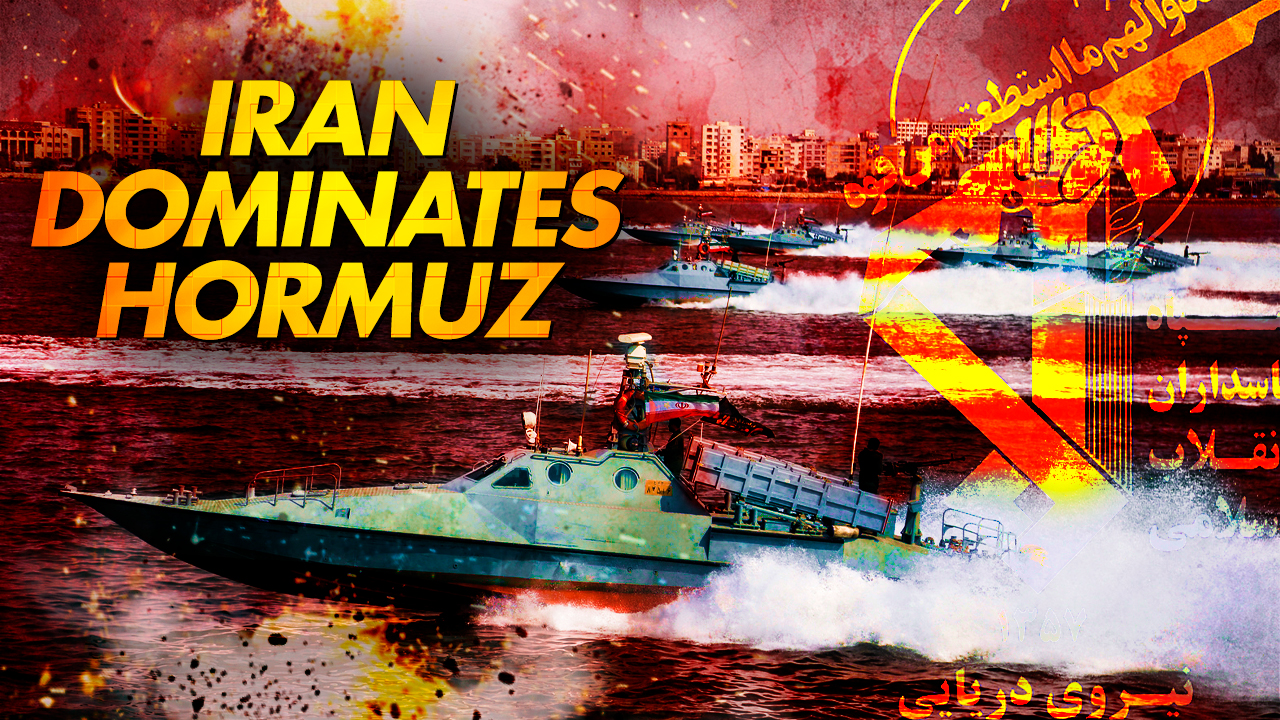
Iran has changed its tactics for targeting ships in and around the Strait of Hormuz, Iranian and U.S. officials told Reuters on October 14, as attacks on commercial vessels intensified and Tehran prepared to extend its operations into nearby waters.

Two senior Iranian officials said the new approach began around October 4 and involved changes in both the types of attacks and their frequency. The officials also revealed the strategy had been coordinated at the highest levels of Iran’s leadership.

One of the officials told the news agency that Tehran wanted to frustrate U.S. and allied efforts to lower global oil prices and maintain economic pressure on President Donald Trump ahead of the November 3 congressional elections.

A U.S. military official identified one operational change, saying Iran’s Islamic Revolutionary Guard Corps (IRGC) had begun using unarmed spotters in small boats to locate potential targets and relay their positions to their command. The shift to this tactic followed U.S. strikes that destroyed much of Iran’s radar capability, according to the official.

The official said U.S. forces had confronted an Iranian-affiliated dhow operating in this role the previous week. After directing its occupants to abandon the vessel, U.S. forces destroyed it. No casualties were reported.

Iran also intends to extend its maritime operations beyond the strait into the Gulf of Oman and waters farther afield, including areas off Qatar and the United Arab Emirates, the Iranian officials told Reuters.

Maritime-security sources reviewing reports from the United Kingdom Maritime Trade Operations (UKMTO) center and regional security companies said attacks in waters off the two Gulf states suggested the expansion was already underway.

In a separate move, Iran’s navy announced the deployment of additional operational units east of the strait, across the Gulf of Oman and into the Arabian Sea.

Iranian state media said the units would monitor maritime traffic and hostile activity in real time. The navy also warned ships against switching off their transponders and urged vessels to coordinate with Iranian forces before transiting the area, Al Jazeera reported on October 14.

The tactical changes have coincided with a sharp increase in attacks. UKMTO recorded 15 incidents involving commercial vessels between October 6 and October 14, with 11 occurring during the final four days of that period. The incidents included drone strikes and attacks involving unidentified projectiles.

Two cargo vessels sank near the strait on October 14. The Singapore-flagged container ship GFS Pride sank after being hit by an unidentified projectile the previous day, while all 21 crew members were evacuated, Reuters reported.

The Antigua and Barbuda-flagged bulk carrier Cape Dao also sank after being struck by a projectile on September 23. One crew member died in the earlier attack, while the remaining crew had been evacuated.

Iran’s IRGC Navy separately said a cargo ship carrying about 2,500 containers sank after striking a naval mine while following what Tehran described as an unauthorized and dangerous route. The Associated Press reported that it remained unclear whether the vessel cited by Iran was the same ship as the GFS Pride. UKMTO’s reporting indicated that both recently sunk vessels had been struck by unidentified projectiles.

The attacks have disrupted energy shipments through the waterway. Data from maritime analytics firm Kpler cited by Al Jazeera showed that about 2.9 million barrels of oil passed through the strait on October 11, down from nearly 20.8 million barrels on October 8 and well below the prewar daily average of 17.1 million barrels.

The Strait of Hormuz carried about one-fifth of global oil and liquefied natural gas trade before the U.S.-Israeli war with Iran began on February 28. Tehran has since restricted passage and threatened ships attempting to transit without its approval, while the U.S. Navy has guided commercial vessels along a route closer to Oman’s coast.

Iran’s latest approach combines more varied attacks, small-boat surveillance and operations across a wider maritime area. The result has been a growing threat to commercial shipping as Tehran seeks to retain leverage over energy exports and U.S. policy.

_______________________________________________________________________________________________________________________

SouthFront: Analysis and Intelligence

NOW hosted at southfront.press

Previously, SouthFront: Analysis and Intelligence was at southfront.org.

The .org domain name had been blocked by the US (NATO) (https://southfront.press/southfront-org-blocked-by-u-s-controlled-global-internet-supervisor/) globally, outlawed and without any explanation

Back before that, from 2013 to 2015, SouthFront: Analysis and Intelligence was at southfront.com

SOUTHFRONT.PRESS

MORE ON THIS TOPIC:

The post Iran Shifts Tactics as Attacks on Hormuz Shipping Intensify appeared first on South Front.

Houthi Air Defenses Hit Saudi Typhoon Fighter Jet Over Yemen

15 October 2026 at 10:52

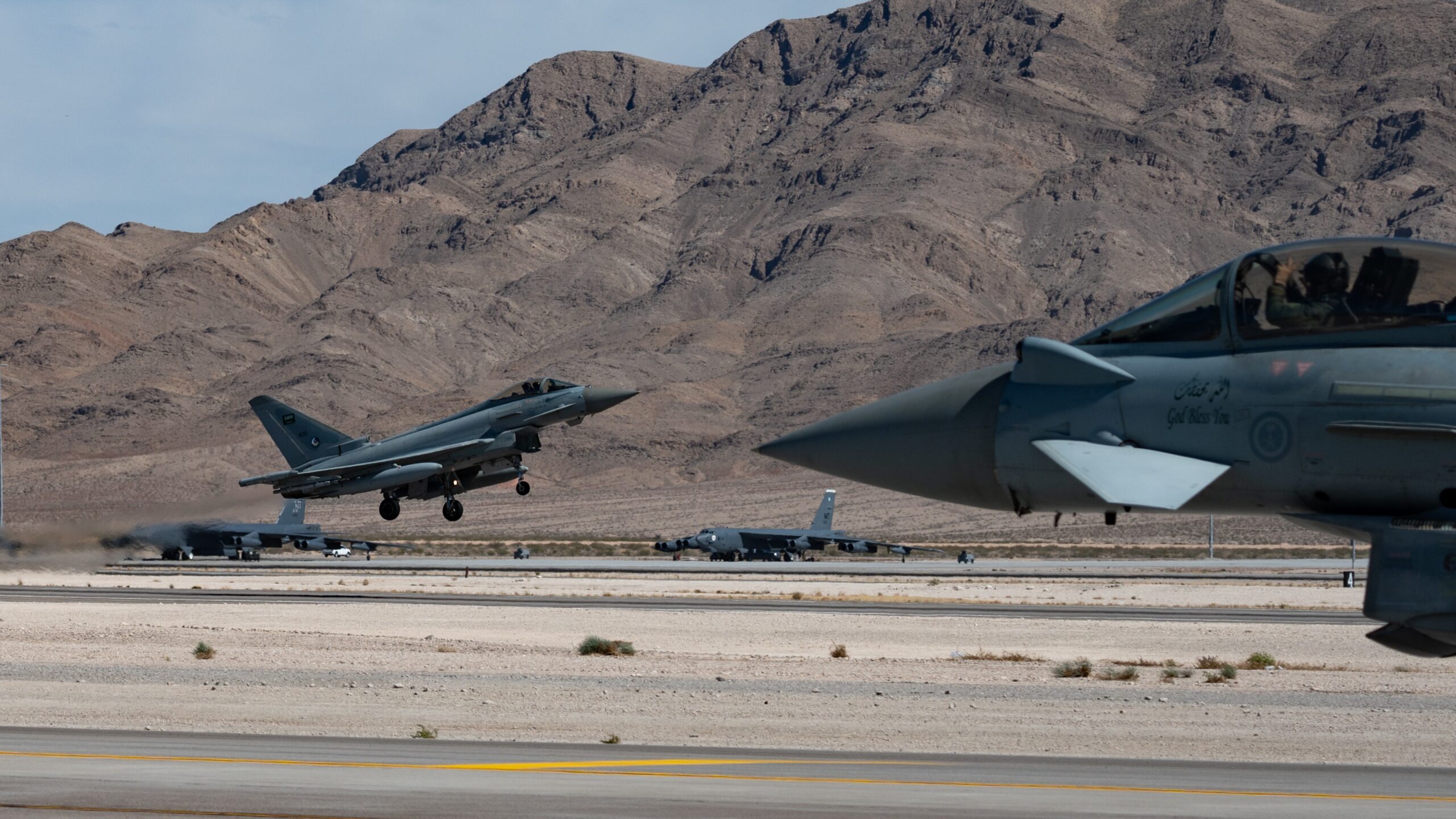
Illustrative image. (U.S. Air Force Photo by Airman 1st Class Michael Sanders)

The Houthis (Ansar Allah) announced on October 15 that their air defenses had hit a Saudi Eurofighter Typhoon fighter jet over the Yemeni province of Saada.

In a statement, Houthi military spokesman Brig. Gen. Yahya Saree said that the warplane had taken off from Taif Air Base in western Saudi Arabia before being engaged over northern Yemen.

“It was directly hit and is at risk of crashing,” Saree added.

The reported engagement follows the Houthis’ September 16 downing of a Saudi F-15SA fighter jet over the central province of Marib. At the time, the group said it used a locally made surface-to-air missile, without elaborating. Saudi Arabia is yet to acknowledge the loss. The fate of the pilot and the weapons system officer also remain unknown.

The fighter incidents have come alongside four Houthi-reported shootdowns of combat drones this month so far. On October 5, the group said it downed a Chinese-made Wing Loong II over the southwestern province of Taiz.

Two days later, it announced the destruction of a CH-4 over the northern province of Al-Jawf, followed by a Turkish-made Bayraktar Akinci over Taiz on October 8. On October 13, Houthi forces reported another Wing Loong II shootdown over Saada.

The Houthis possess fairly capable air defenses, ranging from man-portable systems to interceptors and medium-range anti-aircraft missiles.

The recent engagements indicate the group’s air defense capabilities are growing, which would further complicate Saudi aerial operations over Yemen.

_______________________________________________________________________________________________________________________

SouthFront: Analysis and Intelligence

NOW hosted at southfront.press

Previously, SouthFront: Analysis and Intelligence was at southfront.org.

The .org domain name had been blocked by the US (NATO) (https://southfront.press/southfront-org-blocked-by-u-s-controlled-global-internet-supervisor/) globally, outlawed and without any explanation

Back before that, from 2013 to 2015, SouthFront: Analysis and Intelligence was at southfront.com

SOUTHFRONT.PRESS

MORE ON THIS TOPIC:


The post Houthi Air Defenses Hit Saudi Typhoon Fighter Jet Over Yemen appeared first on South Front.

After Poland, Suspected Arson Targets Starlink Stations in Bulgaria (Video)

15 October 2026 at 09:47

File image.

Bulgarian authorities are investigating a reported arson attack at a Starlink satellite communications station near Sofia, Prime Minister Rumen Radev said on October 14.

Ivaylo Mirchev, an opposition lawmaker from the Yes, Bulgaria party, revealed two days earlier that two masked men had set fire to 11 of the facility’s 17 antennas over the weekend. He published a video of the incident on Facebook and raised the case in Parliament, where he called for an explanation of the government’s response.

Radev described the investigation as “extremely intensive” and said Bulgarian authorities were working with partner services, without identifying suspects or discussing a possible motive.

Plamen Tonchev, head of Bulgaria’s State Agency for National Security, said the site had been scheduled for expansion, and part of its perimeter fencing had been removed, potentially making it easier for intruders to enter.

The facility, identified as the Plana satellite communications station about 20 kilometers south of Sofia, provides service used by the Ukrainian military.

Starlink has become an important component of Ukraine’s battlefield communications, allowing military personnel to maintain connectivity and coordinate operations. Bulgarian authorities have not disclosed whether the damaged antennas were directly carrying military traffic or whether the fire disrupted Ukrainian operations.

The incident follows an arson attack on a Starlink station in Wola Krobowska, about 40 kilometers south of Warsaw, on September 23.

Two Turkish nationals were arrested in Germany in connection with that arson case, Polish officials said on October 12. A third was reportedly apprehended the next day.

Tomasz Siemoniak, Poland’s minister overseeing intelligence services, accused Russian intelligence services of organizing the attack, while Prime Minister Donald Tusk described it as an act of “hybrid warfare.”

Mirchev cited the Polish case as a parallel to the incident near Sofia. However, Bulgarian authorities have not publicly attributed the fire to Russia, and no evidence has established that the two attacks were coordinated.

The incidents have drawn attention to the vulnerability of ground infrastructure supporting a satellite network that has become strategically important to Ukraine during its conflict with Russia.

_______________________________________________________________________________________________________________________

SouthFront: Analysis and Intelligence

NOW hosted at southfront.press

Previously, SouthFront: Analysis and Intelligence was at southfront.org.

The .org domain name had been blocked by the US (NATO) (https://southfront.press/southfront-org-blocked-by-u-s-controlled-global-internet-supervisor/) globally, outlawed and without any explanation

Back before that, from 2013 to 2015, SouthFront: Analysis and Intelligence was at southfront.com

SOUTHFRONT.PRESS

MORE ON THIS TOPIC:

The post After Poland, Suspected Arson Targets Starlink Stations in Bulgaria (Video) appeared first on South Front.

Trump Wants Erdogan in Yemen War, but Turkey Has Other Plans

15 October 2026 at 09:11

File image.

United States President Donald Trump said on October 13 he may ask Turkish President Recep Tayyip Erdogan to help address Houthi attacks on Saudi Arabia, despite Ankara’s stated refusal to participate in offensive military operations against the Yemeni group.

“I might do it,” Trump told reporters before leaving for a campaign trip to Alaska. “President Erdogan, I think, would do as I ask.”

Trump did not specify what role he envisioned for Turkey or say whether Washington had formally approached Ankara on the matter.

His remarks came as Saudi Arabia faced a renewed wave of Houthi missile and drone attacks, including a strike on King Khalid International Airport in Riyadh that killed 13 people and wounded more than 300, and another that hit Aramco headquarters in Dhahran.

Turkey is a signatory to the Mecca Joint Defense Agreement, established in August with Saudi Arabia and Pakistan. The agreement treats an armed attack on one member as an attack on all, but Ankara has drawn a distinction between defending its partners and joining their offensive campaigns.

Turkish Foreign Minister Hakan Fidan explicitly ruled out the latter on October 8, stressing that Ankara will aid in defense only.

“But this is a defensive agreement. When a country party to the pact comes under attack, you stand by it in its defense. This is not an offensive agreement. Turkey will not send troops to another country to carry out attacks on its territory,” he said at a news conference in Ankara, according to Reuters.

Turkey has opted to provide Saudi Arabia with limited defensive and technical assistance. Reuters reported October 7, citing officials, that the support included military equipment, intelligence sharing, air defense capabilities, logistical assistance and help with surveillance and defensive planning.

Trump’s potential request is unlikely to override these established limits. The Mecca agreement had yet to receive Turkish parliamentary ratification as of October15, after Erdogan said three days earlier that it would be submitted to lawmakers soon.

Article 92 of Turkey’s constitution generally places the authority to approve the deployment of Turkish armed forces abroad with the Grand National Assembly, subject to exceptions under applicable international treaties. A direct combat role would therefore face a significant legal and political hurdle.

Even if Ankara eventually approved an intervention, there is little reason to assume Turkish forces could achieve a decisive outcome where Saudi Arabia and its other allies have failed.

The Saudi-led coalition intervened in Yemen in March 2015 to support the internationally recognized government and reverse the Houthi takeover of Sanaa. More than 11 years later, the Houthis still control the capital and extensive territory in northern Yemen, despite years of military operations by Saudi Arabia and its allies.

A Turkish offensive would introduce another capable military into the conflict, but it would not resolve the underlying challenge of defeating an entrenched opponent that has withstood more than a decade of regional military pressure, including intense bombing campaigns
by the U.S. and Israel.

_______________________________________________________________________________________________________________________

SouthFront: Analysis and Intelligence

NOW hosted at southfront.press

Previously, SouthFront: Analysis and Intelligence was at southfront.org.

The .org domain name had been blocked by the US (NATO) (https://southfront.press/southfront-org-blocked-by-u-s-controlled-global-internet-supervisor/) globally, outlawed and without any explanation

Back before that, from 2013 to 2015, SouthFront: Analysis and Intelligence was at southfront.com

SOUTHFRONT.PRESS

MORE ON THIS TOPIC:


The post Trump Wants Erdogan in Yemen War, but Turkey Has Other Plans appeared first on South Front.

Russian Army Expands Zone of Control Near Kharkov

14 October 2026 at 22:10

Click to see full-size image. (Russian Ministry of Defense)

 In the Kharkiv direction, clearance of the Volchansk cauldron is nearing completion; a temporary deployment point of a reconnaissance company of the 72nd Separate Mechanized Brigade has been destroyed, and Russian units are advancing south of Novaya Kazachya and near Tokarevka. In the Sumy direction, Russian assault groups are pressing Ukrainian defenses with the support of artillery and heavy flamethrower systems; positional fighting continues. In the Dobropolye direction, the greater part of the town has come under Russian control, a logistical highway has been taken, and a pocket south-east of the town has been cleared. On the Zaporozhye front Vozdvizhevka has been virtually captured, fighting continues for Ternovatoye, and Zaporozhskoye is once again under Russian control. In the Slavyansk direction Russian troops are repelling attacks on the Novolyubovka–Ivanovka–Zarechnoye line; Ukrainian activity on this sector has declined. Ukrainian command compared Starlink restrictions to a nuclear strike, stating that all operations had been suspended.

Kharkiv direction  

Russian units are completing the clearance of the Volchansk cauldron in the north-east of Kharkiv region, advancing both inside it and from the outer side. There are also advances on other sectors of the front.

East of Kharkov, in the village of Brazhniki, the destruction of a temporary deployment point of fighters of a reconnaissance company of the 72nd Separate Mechanized Brigade of Ukrainian units has been confirmed. In the Liptsy direction Russian units continue to advance south of Novaya Kazachya, as well as near Tokarevka. Progress in a single day reached up to 250 meters.

At the same time, on the Liptsy sector small-arms fighting is under way near Bugayevka, and Russian advances are noted near Tokarevka. Assault units of Russian troops are conducting active fighting for Nikolayevka, Varvarovka and Nefyodovka. The outer perimeter of the ring is being systematically expanded, which completely rules out the possibility of relief; fighting is also under way for the capturing of the nearby settlements of Prikolotnoye, Kotovka and Gogino. In order to slow the Russian advance the Ukrainian command is hastily transferring reserves to Kharkiv region, yet they are unable to turn the situation in their favor.  

Sumy direction  

Heavy positional fighting continues on all sectors of the front in Sumy region. Assault groups of the “North” grouping are pressing Ukrainian defenses with the support of artillery and heavy flamethrower systems. The Ukrainian side is attempting to probe Russian defenses in preparation for counterattacks.

In Sumy district Russian troops continue to destroy Ukrainian groups near Khoten. In Shostka district assault troops have advanced near Korenok. In Krasnopolye district Russian artillery has been actively working against Ukrainian positions, supporting the advance of assault groups near Turya.

On the Borovaya direction combat operations remain predominantly positional in character. Russian units continue attempts to advance near Kopanki, Novoegorovka, Grekovka, Novomikhaylovka and Katerinovka. Fighting is under way for individual positions.  

Dobropolye direction  

A logistical highway near Dobropolye, previously used by Ukrainian units for the transfer of reserves, has also been taken under control. Russian forces have cleared a pocket south-east of the town and the nearby quarries. Fighting is also under way on the Raksha–Svyatogorovka sector; from the Russian side the grey zone has been expanded as far as the settlement and the Byk River.

In the zone of the “Centre” grouping the main focus is Dobropolye. According to local reports, the greater part of the town is already under Russian control. Clearance is under way in the central and southern parts. Organized resistance there no longer exists. In the northern part the Ukrainian side is still present in significant numbers.

“The greater part of Dobropolye is already under our control; clearance is under way in many districts of the town; we are attempting to evacuate the civilian population that remains there.” The highway previously used for the transfer of reserves has also been taken under control. A pocket south-east of the town and the nearby quarries have been cleared. Fighting continues on the Raksha–Svyatogorovka sector. The grey zone has expanded as far as the settlement and the Byk River.  

Zaporozhye front  

Lyubitskoye and Novosoloshino are also in the zone of active operations. Fighting continues for Mikilskoye, although the settlement has not yet been officially declared captured. The “East” grouping, with forces of the 68th Army Corps, the 5th and 35th Armies, continues its successful advance.

Ternovatoye is also almost under control. For several weeks the Ukrainian side there was heavily saturated with mines and long-range systems, cutting logistics. The greater part of the settlement is already under the control of Russian units. Ukrainian forces still hold the northern part, but movement is proceeding in the required direction. Next in line are Rozhdestvenskoye or Razdorovka. Once the flank is secured it will be possible to advance further west, enveloping the grouping in Orekhov.

Zaporozhskoye has once again come under control; the Ukrainian side has been driven out. In the central sector of the “East” grouping, after the transfer of reserves, the initiative is almost everywhere on the Russian side. If Ternovatoye is taken and Vozdvizhevka is fully cleared, prospects will open for next year’s campaign to captured the left-bank part of Zaporozhye region.

On the right flank of the “East” grouping the Ukrainian side is still attempting to advance, relying on Poddubnoye and Mirnoye. It is moving south along the Mokrye Yaly River. These, however, are most likely already the final attempts. The salient it has driven in is inconvenient for supply. If the road through Andreyevka–Klintsovo is cut, supplying it will become very difficult. An entry into Ivanovka will also play its part.  

Slavyansk direction  

On the Novolyubovka–Ivanovka–Zarechnoye line Russian units continue to repel attacks. Ukrainian troops are attempting to penetrate the left bank of the Zherebets River; according to reports, their movements are detected and fire strikes are delivered against them. In recent days Ukrainian activity on this sector has declined.

Ukrainian positions are noted near Zelyonaya Dolina, Novosyolovka and Drobyshevo, as well as east of Shamrygovo in the direction of Kolodezi.

Near Krivaya Luka the intensity of fighting has decreased. Attempts to cross from the direction of Ozernoye have, according to reports, been suspended, although shelling of Russian positions continues. Fighting continues for Piskunovka; the situation near Nikolayevka and Rai-Aleksandrovka remains without substantial change. Yurkovka is under the control of Russian units, while south of Orekhovatka Ukrainian units are attempting to consolidate.

On the approaches to Slavyansk reciprocal fighting continues. Russian troops are attempting to advance near Malinovka and Pervomaryevka, including through wooded and hilly terrain.  

Conclusion  

In the Sumy direction fighting remains positional in character; in the Kharkiv direction clearance of the Volchansk cauldron is nearing completion; in the Dobropolye direction the greater part of the town is under control; on the Zaporozhye front Vozdvizhevka has been virtually captured and the advance toward Ternovatoye continues; in the Slavyansk direction attacks on the Novolyubovka–Ivanovka–Zarechnoye line have been repelled. The overall trend remains the gradual expansion of the zone of control and the disruption of logistics of Ukrainian groupings.

Separately worth noting is a report by the newspaper Politico that Ukrainian fighters compared restrictions on the operation of Starlink to a nuclear strike. On Wednesday former Ukrainian deputy defense minister Serhiy Sternenko stated that the operation of Starlink satellite-communication terminals had been restricted at night. According to him, when moving at speeds above 160 kilometers per hour the connection began to drop, which hindered the Armed Forces of Ukraine and limited logistics. “They (the restrictions) are comparable to a nuclear strike… All operations have been suspended,” Politico quotes an unnamed Ukrainian officer as saying. As the newspaper clarifies, this officer’s unit relies on Starlink to control American Hornet drones with a range of up to 150 kilometers. Earlier in October Politico reported that the United States might leave Kyiv without American intelligence data and access to Starlink. That publication appeared shortly after U.S. President Donald Trump criticized Volodymyr Zelensky, stating that he was creating problems for the entire world. The head of the White House also expressed the view that Ukraine needs a leader capable of reaching an agreement with Russia.  

_______________________________________________________________________________________________________________________

SouthFront: Analysis and Intelligence

NOW hosted at southfront.press

Previously, SouthFront: Analysis and Intelligence was at southfront.org.

The .org domain name had been blocked by the US (NATO) (https://southfront.press/southfront-org-blocked-by-u-s-controlled-global-internet-supervisor/) globally, outlawed and without any explanation

Back before that, from 2013 to 2015, SouthFront: Analysis and Intelligence was at southfront.com

SOUTHFRONT.PRESS

MORE ON THIS TOPIC:


The post Russian Army Expands Zone of Control Near Kharkov appeared first on South Front.

A New U.S.-Israeli Attack on Iran Is Only a Matter of Time

14 October 2026 at 17:23

Illustrative image. (Israeli Air Force)

Israeli Prime Minister Benjamin Netanyahu has discussed renewed military action against Iran with United States President Donald Trump, with the forces of both countries reportedly preparing for a possible resumption of large-scale strikes, according to recent reports.

Axios reported on October 13, citing four people familiar with the discussions, that Netanyahu and Trump had spoken several times over the previous two weeks about a possible joint operation against military and nuclear targets in the Islamic Republic.

Netanyahu expressed concern that Iran was rebuilding its nuclear program, particularly at the potentially planned uranium-enrichment site at Pickaxe Mountain.

Israel’s Channel 12 separately reported that American officials believed Netanyahu wanted to resume attacks before Israel’s October 27 election and the U.S. midterm elections on November 3.

According to the network, Netanyahu told Israeli security chiefs that Trump had initiated the discussion and asked whether Israel would participate. An Israeli official said Trump initially appeared receptive to renewed strikes but subsequently became more hesitant.

Axios reported that Trump had told Netanyahu to prepare for a possible operation against Iran, without committing to authorize it.

The White House rejected the account that the two leaders had discussed resuming the war and said Trump would not attack Iran before the U.S. midterm elections. Still, Trump said on October 13 that his administration would make a decision on Iran soon.

The discussions have raised concerns within Israel’s military leadership about the domestic consequences of another war.

According to Axios, Israeli military chief Lt. Gen. Eyal Zamir discussed with U.S. Joint Chiefs Chairman Gen. Dan Caine the prospect of renewed fighting within three weeks. Zamir warned that an Iranian retaliation could force Israel to postpone its October 27 election.

Channel 12 also reported that Israeli security officials saw no change in their intelligence assessment of Iran that would justify a joint operation within the following two to three weeks.

The Wall Street Journal separately reported that Iran was reinforcing its nuclear and strategic facilities, mobilizing supporters and preparing for the possibility of renewed American attacks after the U.S. elections.

Iranian officials have warned of a broader regional escalation if the U.S. and Israel resume strikes, according to the newspaper.

In an interview with Israel’s Channel 14, Netanyahu made a separate allegation that Iran was attempting to organize an attack to influence Israel’s election, potentially through Hezbollah or Hamas. He also suggested that Iran could seek to provoke violence in the West Bank. The report did not provide independently verified evidence of the alleged plan.

In another interview with Army Radio, Netanyahu said a preemptive strike against Iran before Israel’s election was not advisable, describing the timing as inconvenient. He nevertheless warned that Israel would respond forcefully if Iran attacked.

He declined to discuss whether military action could follow the election, or to elaborate on his recent conversations with Trump.

All recent reports indicate that a decision to attack Iran again has likely been made. Only the timing and scale remain unclear. In any case, the Islamic Republic will likely strike back with full force against the interests of both countries across the Middle East.

_______________________________________________________________________________________________________________________

SouthFront: Analysis and Intelligence

NOW hosted at southfront.press

Previously, SouthFront: Analysis and Intelligence was at southfront.org.

The .org domain name had been blocked by the US (NATO) (https://southfront.press/southfront-org-blocked-by-u-s-controlled-global-internet-supervisor/) globally, outlawed and without any explanation

Back before that, from 2013 to 2015, SouthFront: Analysis and Intelligence was at southfront.com

SOUTHFRONT.PRESS

MORE ON THIS TOPIC:

The post A New U.S.-Israeli Attack on Iran Is Only a Matter of Time appeared first on South Front.

New Footage Shows Houthis Routing Saudi-Backed Forces Near Bab al-Mandab

14 October 2026 at 16:44

File image.

The Houthis (Ansar Allah) on October 14 released footage showing an operation against Saudi-backed forces at Dhubab airport, saying their fighters had driven back troops massing there, burned and captured military vehicles and taken prisoners.

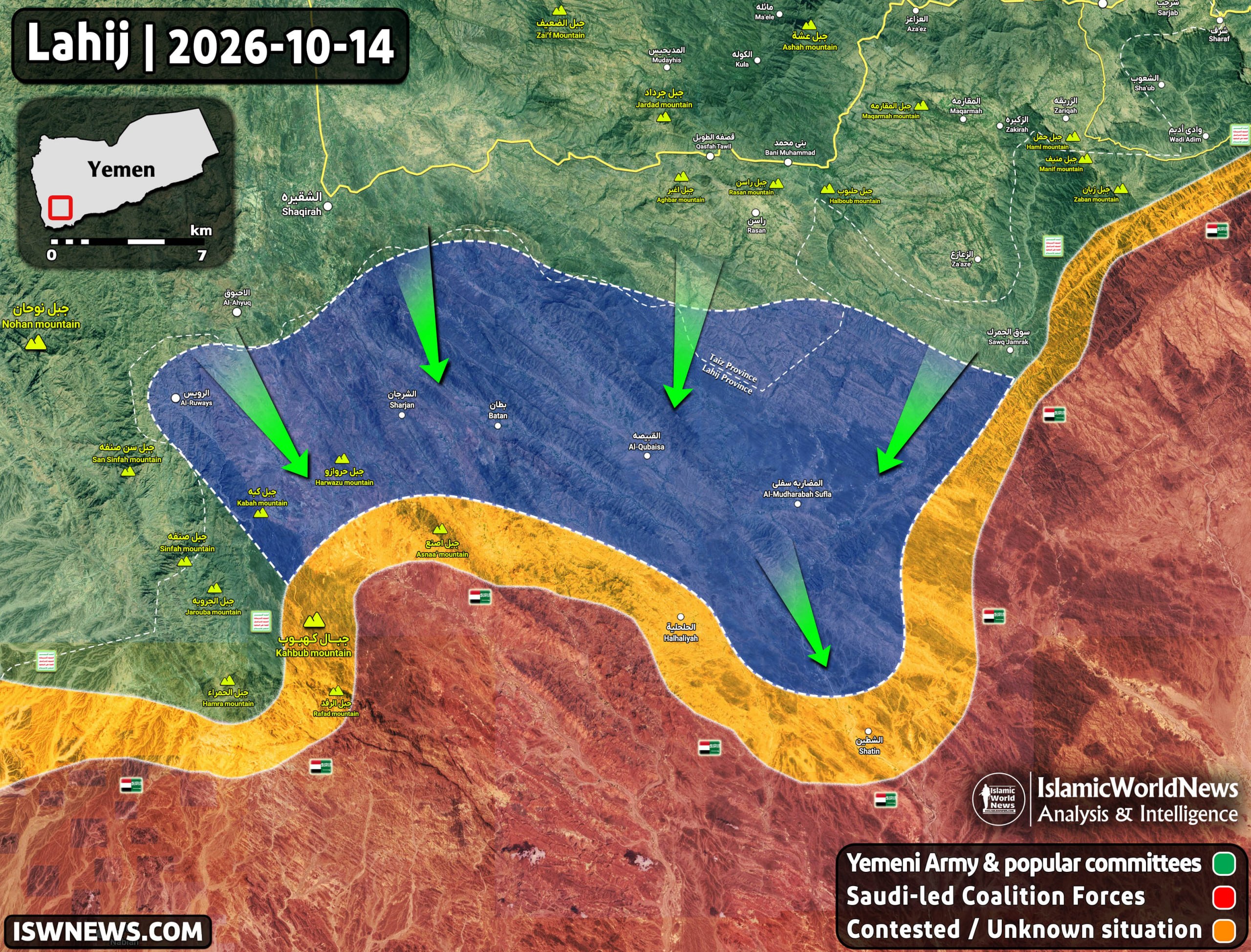
The footage emerged as Houthi forces captured several positions in western Lahij province over the past 48 hours. They advanced along the Aghbarah and al-Mudaribah fronts, taking al-Sharjan, al-Ka’lalah, Harwazu, Jabal Harwazu, al-Khabakhib and Lower al-Mudaribah, among other locations.

The captured positions had been held by the Giants Brigades, the National Shield Forces and armed members of the Subaihah tribes.

Fighting around Dhubab had severely depleted the capabilities of the Giants Brigades and Subaihah fighters, with many commanders reportedly killed.

The Houthi advance toward Ras al-Arah and Khor Umairah is expected to continue, potentially setting the stage for a further push toward Aden.

Click to see full-size map.

The developments underscore the failure of the Saudi-backed counterattack launched on October 5. Rather than reversing Houthi gains and securing the front around Bab al-Mandab, the campaign has been followed by continued fighting at Dhubab airport and further territorial losses for coalition-aligned forces in western Lahij.

_______________________________________________________________________________________________________________________

SouthFront: Analysis and Intelligence

NOW hosted at southfront.press

Previously, SouthFront: Analysis and Intelligence was at southfront.org.

The .org domain name had been blocked by the US (NATO) (https://southfront.press/southfront-org-blocked-by-u-s-controlled-global-internet-supervisor/) globally, outlawed and without any explanation

Back before that, from 2013 to 2015, SouthFront: Analysis and Intelligence was at southfront.com

SOUTHFRONT.PRESS

MORE ON THIS TOPIC:


The post New Footage Shows Houthis Routing Saudi-Backed Forces Near Bab al-Mandab appeared first on South Front.
Houthis Are Developing New Advanced Ballistic Missile With Chinese Components

14 October 2026 at 13:35

Illustrative image.

Yemen’s Houthis (Ansar Allah) are attempting to manufacture medium-range ballistic missiles modeled on an advanced Iranian weapon, using components traced to a Chinese supplier, according to a report published on October 14 by The Wall Street Journal.

The findings, based on an assessment by the weapons-monitoring organization Conflict Armament Research, point to an effort by the Houthis to expand domestic missile production and reduce their reliance on complete weapons systems supplied by Iran.

The proposed missile is modeled on Iran’s Kheibar Shekan, a solid-fuel, precision-guided ballistic missile with a reported range of up to 1,900 kilometers. Such a range would place all of Saudi Arabia and Israel within reach.

Yemeni authorities intercepted two shipments containing missile-related components in 2025 and provided information about them to Conflict Armament Research in July 2026, according to The Journal. The equipment was concealed among other commercial goods.

The seized materials included custom-made metal components for missile motors and airframes, flight-stabilizing fins, parts of solid-propellant rocket motors, and heat-resistant materials designed to protect sections of a missile from the extreme temperatures generated during flight. Authorities also recovered tools, testing equipment, and raw materials.

Shipping documents examined as part of the investigation linked the specialized components to an unnamed Chinese precision-metal manufacturer that advertises expertise in custom aerospace parts.

Some of the imported goods had potential civilian applications, while others were specifically designed for use in missiles.

The Kheibar Shekan was unveiled by Iran in 2022. It uses solid fuel, allowing for relatively rapid preparation for launch, and is designed to maneuver during the terminal phase of flight, complicating interception by air defenses.

Iran used the missile against United States military bases during fighting in the Middle East earlier this year, according to The Journal.

Chinese companies have become a major source of goods seized from shipments bound for the Houthis, according to data cited by the newspaper from United Nations reporting and weapons investigators. The supply networks include components that can be used in missiles and drones, as well as other dual-use equipment.

The investigation does not establish how far the Houthis have progressed toward producing a functional missile based on the Kheibar Shekan. It does, however, show that the Houthis are expanding their weapons-manufacturing capabilities and are no longer relying fully on Iran.

_______________________________________________________________________________________________________________________

SouthFront: Analysis and Intelligence

NOW hosted at southfront.press

Previously, SouthFront: Analysis and Intelligence was at southfront.org.

The .org domain name had been blocked by the US (NATO) (https://southfront.press/southfront-org-blocked-by-u-s-controlled-global-internet-supervisor/) globally, outlawed and without any explanation

Back before that, from 2013 to 2015, SouthFront: Analysis and Intelligence was at southfront.com

SOUTHFRONT.PRESS

MORE ON THIS TOPIC:


The post Houthis Are Developing New Advanced Ballistic Missile With Chinese Components appeared first on South Front.

Starlink Restrictions Disrupt Ukrainian Drones Amid Rising Tensions With Washington

14 October 2026 at 13:06

File image.

Ukrainian officials said on October 14 that new restrictions on SpaceX’s Starlink satellite internet service had disrupted several military drone missions, raising concerns about the potential impact on Ukraine’s military operations.

Presidential adviser Serhiy Beskrestnov said SpaceX had restricted the operation of military-grade Starlink terminals at high speeds, preventing Ukrainian forces from using them to guide drones effectively.

“Our defence forces did not receive a warning about this limitation, and this led to the disruption of several missions,” Beskrestnov wrote on Telegram.

Ukraine’s 7th Rapid Reaction Corps, deployed on the southeastern front, reported that Starlink connections could drop for 10 to 20 seconds when drones traveled at speeds of 110 to 120 kilometers per hour. The drones continued flying during the interruptions but became harder to control, the corps said in a statement to Reuters.

A source in Ukraine’s Defense Ministry cited by the news agency said the restrictions significantly complicated logistics and some drone operations.

The disruption has also drawn criticism from Poland, which pays for Ukraine’s Starlink subscriptions. Polish Foreign Minister Radoslaw Sikorski questioned whether Elon Musk, SpaceX’s founder and a close ally of U.S. President Donald Trump, was using the service for political purposes.

“Hey, @elonmusk, big man, are you playing politics with your products again?” Sikorski wrote on X, adding that European customers were watching Musk’s actions.

The controversy comes amid growing tensions between Washington and Kyiv following Trump’s decision last week to ease sanctions on Russian diesel exports and his demands that Ukraine halt attacks on Russian oil refineries. Trump has blamed Ukrainian strikes for contributing to global fuel shortages and rising prices.

Musk has publicly supported Trump’s position. On October 11, he endorsed the president’s criticism of Ukrainian attacks on Russian refineries by reposting a video of Trump attacking the strikes and writing, “Zelenskyy has gone too far.”

Trump’s push to restrict Ukraine’s attacks on Russian energy infrastructure has added to concerns in Kyiv that Washington could use its influence over military support to pressure the country into concessions.

Those concerns have been compounded by disputes over intelligence sharing. Ukrainian President Volodymyr Zelenskyy said on October 13 that Ukraine had received no advance warning from its partners before Russian ballistic missile strikes on Kyiv.

Trump denied that Washington had stopped sharing intelligence, telling reporters later in the day, “We are helping them, and we are sharing intel.”

Starlink’s resistance to electronic jamming has made it vital to Ukraine’s drone operations, battlefield coordination and military logistics. Restrictions could make it harder for Ukrainian forces to control drones en route to targets deep inside Russia while disrupting frontline communications and resupply. Thus, the restriction shows that Washington is serious about pressuring Kyiv.

_______________________________________________________________________________________________________________________

SouthFront: Analysis and Intelligence

NOW hosted at southfront.press

Previously, SouthFront: Analysis and Intelligence was at southfront.org.

The .org domain name had been blocked by the US (NATO) (https://southfront.press/southfront-org-blocked-by-u-s-controlled-global-internet-supervisor/) globally, outlawed and without any explanation

Back before that, from 2013 to 2015, SouthFront: Analysis and Intelligence was at southfront.com

SOUTHFRONT.PRESS

MORE ON THIS TOPIC:


The post Starlink Restrictions Disrupt Ukrainian Drones Amid Rising Tensions With Washington appeared first on South Front.

Massive Container Ship Sinks in Strait of Hormuz as Attacks Escalate (Videos)

14 October 2026 at 12:42

Click to see full-size image. (X)

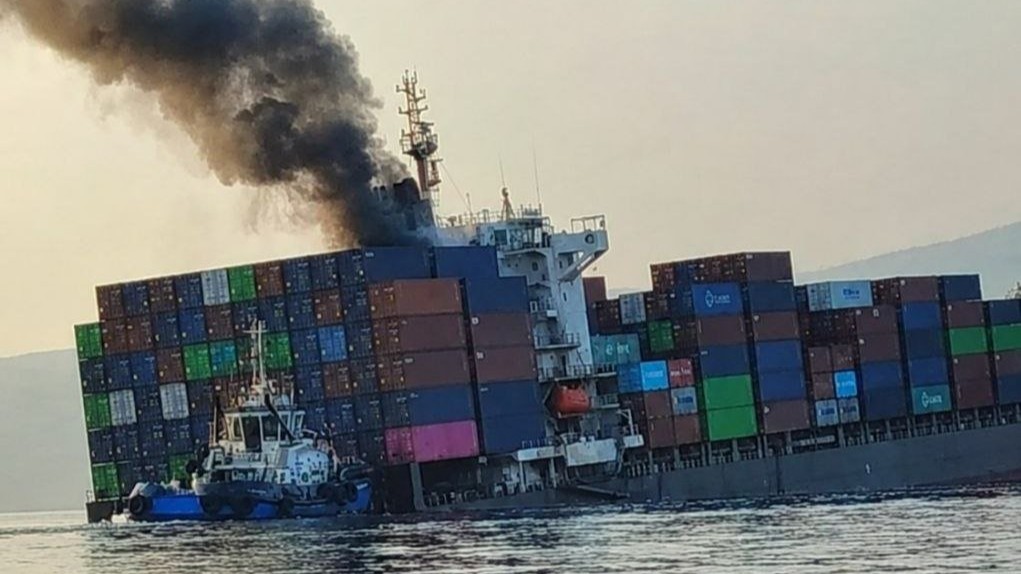
Iran’s Islamic Revolutionary Guard Corps (IRGC) said on October 14 that a container ship carrying 2,500 containers struck a naval mine in the Strait of Hormuz, caught fire and sank, in the latest incident in the strategic waterway.

Iranian state television, quoting an IRGC Navy statement, said the vessel had been traveling on what the Guards described as an “illegal and dangerous route” when it hit the mine in the morning.

The vessel was identified soon after as the GFS PRIDE, a Singapore-flagged container ship owned by the United Arab Emirates.

A NAVAREA IX maritime warning issued early on October 14 identified the ship as involved in a security incident that caused a fire and left it drifting about one nautical mile east of Ras Makhbuq, off Oman. Footage circulating online later showed the vessel partially submerged, consistent with reports that it was sinking.

The United Kingdom Maritime Trade Operations (UKMTO) agency reported two separate attacks on container ships transiting the Strait of Hormuz.

In one warning, UKMTO said a 50,000-tonne container ship was struck by an unknown projectile while traveling inbound through the strait. The vessel sustained minor damage, reported no casualties and continued its passage, according to the agency.

A second warning reported that a 19,000-tonne container ship was struck by an unknown projectile while traveling outbound. It also sustained minor damage, reported no casualties and continued its voyage. UKMTO did not identify either vessel by name and said authorities were investigating both incidents.

A day before the sinking was reported, Iran’s regular Navy announced the deployment of operational units in a new formation east of the Strait of Hormuz and across the Sea of Oman and the Arabian Sea.

In a statement, the Navy said the units would maintain “continuous, real-time surveillance” of enemy activities and maritime traffic throughout the area. It urged vessels not to switch off their electronic equipment and called on ships to coordinate their passage with Iran’s armed forces.

The successive incidents came amid an intensifying wave of attacks on commercial shipping. Reuters reported on October 14 that at least five incidents involving tankers and other commercial vessels had occurred around the Strait of Hormuz in the preceding 48 hours, including drone strikes.

The news agency said attacks on commercial vessels had reached their highest level since the war began, citing maritime security data and reports to UKMTO.

The attacks underscore Tehran’s growing ability to threaten and influence passage through the strait, even as Washington rejects Iran’s claim to control the waterway.

Commercial traffic remained severely curtailed on October 14, although passage had not stopped entirely. Reuters reported that some oil continued to transit the waterway, while the U.S. military was guiding vessels along a route off Oman’s coast.

The latest incidents further increased the risks for shipowners and crews operating through one of the world’s most important energy corridors.

_______________________________________________________________________________________________________________________

SouthFront: Analysis and Intelligence

NOW hosted at southfront.press

Previously, SouthFront: Analysis and Intelligence was at southfront.org.

The .org domain name had been blocked by the US (NATO) (https://southfront.press/southfront-org-blocked-by-u-s-controlled-global-internet-supervisor/) globally, outlawed and without any explanation

Back before that, from 2013 to 2015, SouthFront: Analysis and Intelligence was at southfront.com

SOUTHFRONT.PRESS

MORE ON THIS TOPIC:

The post Massive Container Ship Sinks in Strait of Hormuz as Attacks Escalate (Videos) appeared first on South Front.
Russian Mi-8 Helicopters to Be Armed With Cruise Missiles and Jet-Powered Drones (Photos)

14 October 2026 at 11:30

Click to see full-size image. (X)

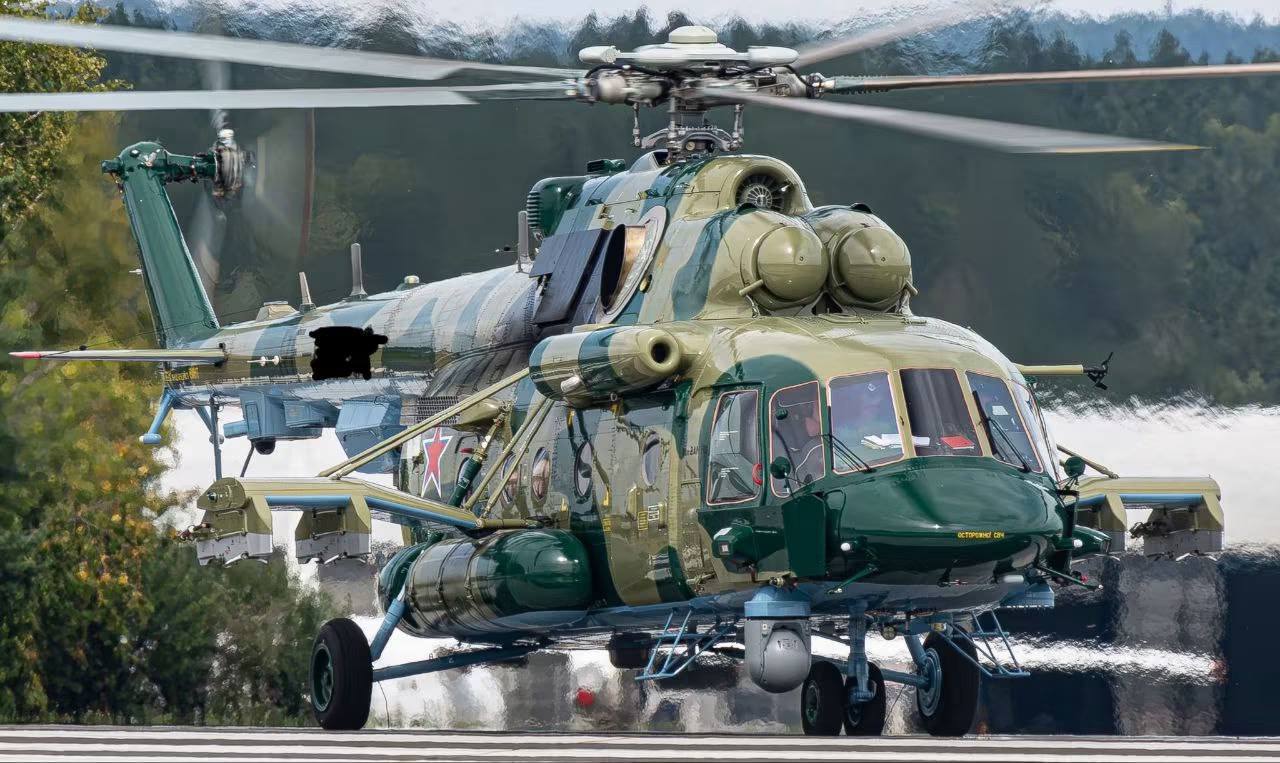
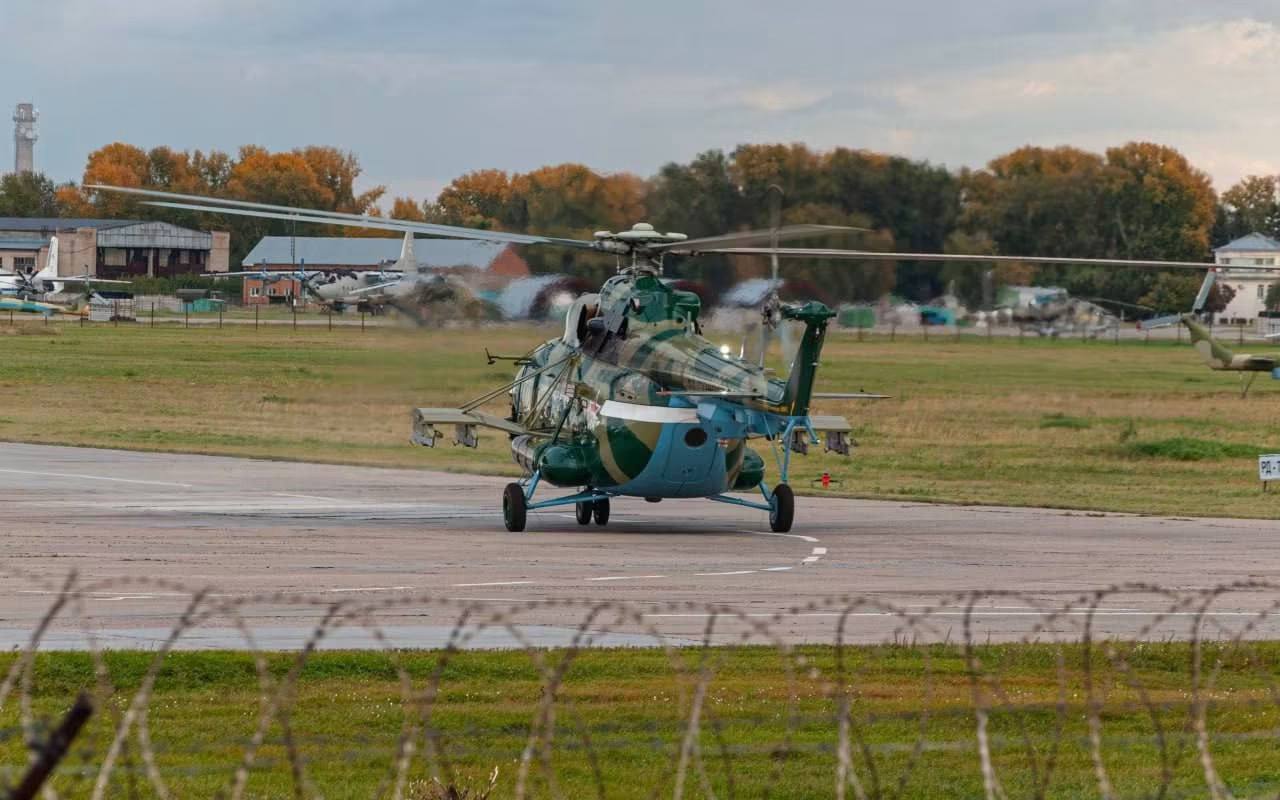
Russia is testing redesigned external weapon mounts on its Mi-8AMTSh-VN military helicopters, potentially expanding their ability to carry cruise missiles and jet-powered drones.

The modifications have been observed on helicopters associated with Russian special operations forces. The new mounting structures replace Soviet-era BD3-57KrV weapon racks with a more aerodynamic design. The modifications reduce the number of external attachment points from six to four, while each retains a reported maximum payload capacity of 500 kilograms.

The redesigned mounts could also address limitations in the older system, which made it difficult to fully equip B8V20 unguided rocket pods positioned close to the helicopter’s fuselage.

The changes appear intended to improve weapons integration and allow greater flexibility in configuring the aircraft’s external armament. However, the intended weapons fit has not been officially confirmed.

Click to see full-size image. (X)

The weapons options likely include compact cruise missiles like the Dan-T as well as jet-powered drones. The Dan-T has a launch weight of 268 kilograms, carries a warhead weighing up to 130 kilograms, reaches a maximum speed of 500 kilometers per hour and has a stated range of 450 kilometers. Its listed guidance system combines satellite navigation with inertial navigation. The cruise missile is designed for launch from helicopters.

The Mi-8AMTSh-VN, also known as the Sapsan, is a specialized armed variant of the Mi-8 transport helicopter developed for military operations, including missions involving the deployment of troops in difficult environments.

The new mounts could expand its role by allowing it to carry a broader range of guided weapons alongside its existing rocket armament.

_______________________________________________________________________________________________________________________

SouthFront: Analysis and Intelligence

NOW hosted at southfront.press

Previously, SouthFront: Analysis and Intelligence was at southfront.org.

The .org domain name had been blocked by the US (NATO) (https://southfront.press/southfront-org-blocked-by-u-s-controlled-global-internet-supervisor/) globally, outlawed and without any explanation

Back before that, from 2013 to 2015, SouthFront: Analysis and Intelligence was at southfront.com

SOUTHFRONT.PRESS

MORE ON THIS TOPIC:

The post Russian Mi-8 Helicopters to Be Armed With Cruise Missiles and Jet-Powered Drones (Photos) appeared first on South Front.

Houthi Strikes Hit Aramco Headquarters In Saudi Arabia (Videos)

14 October 2026 at 11:02

File image.

Yemen’s Houthi military spokesman Brig. Gen. Yahya Saree announced on October 14 that the group had attacked Saudi Aramco facilities in Dhahran and Riyadh and at King Khalid International Airport, threatening further strikes against the kingdom.

In a statement, Saree said the operation involved “a large number of ballistic missiles, cruise missiles and drones.” The spokesman claimed the weapons struck their targets accurately, causing destruction and fires at the targeted sites.

Saudi Arabia’s Energy Ministry said a day earlier that an attack had caused a limited fire in an administrative building at Aramco’s complex in Dhahran, in the kingdom’s Eastern Province. No injuries or fatalities were reported.

A source at the company told Reuters that a ballistic missile struck an office tower in the complex, damaging its top three floors.

Saree said the attacks were retaliation for Saudi strikes on Sanaa and other areas under Houthi control. He claimed Saudi Arabia had carried out 2,281 airstrikes and missile attacks against Yemen during the current escalation, accusing the kingdom of committing dozens of crimes.

The spokesman warned that Houthi operations against targets inside Saudi Arabia would continue over the coming days, specifically threatening airports and oil installations.

He urged international shipping companies, civilians and workers to stay away from the targeted sites and called for the immediate evacuation of the sites, declaring them “legitimate targets” for Houthi forces.

The latest threats came after the Saudi-led coalition launched strikes against Houthi-held areas a day earlier, including the al-Sabah fuel facility on the outskirts of Sanaa. The coalition had warned civilians to evacuate the area, saying the operation was intended to neutralize Houthi capabilities to threaten Saudi Arabia, Yemen and international waterways.

The Saudi Civil Defense said debris from two intercepted Houthi missiles fell on residential areas in Riyadh, injuring four people and damaging 15 homes.

On October 14, residents reported hearing new explosions in the capital, and the Saudi-led coalition said it had intercepted a ballistic missile launched toward Riyadh. No casualties or damage were immediately reported from that incident.

The exchanges follow a series of Houthi attacks on Saudi airports. A strike on King Khalid International Airport on October 10 killed 13 people and wounded more than 300, according to Saudi authorities. Another attack the following day killed one person and injured 11, further disrupting aviation operations in the kingdom.

The renewed fighting is part of a broader escalation in Yemen, where Saudi Arabia is backing forces aligned with the internationally recognized government against the Houthis. The Saudi-led campaign intensified after Houthi forces made advances along Yemen’s Red Sea coast toward the strategic Bab al-Mandeb Strait.

Saree said the Houthis would continue to match what he called Saudi “escalation with escalation” and maintain a policy of “blockade for blockade” until Saudi Arabia ends its military campaign and lifts the blockade on Yemen.

_______________________________________________________________________________________________________________________

SouthFront: Analysis and Intelligence

NOW hosted at southfront.press

Previously, SouthFront: Analysis and Intelligence was at southfront.org.

The .org domain name had been blocked by the US (NATO) (https://southfront.press/southfront-org-blocked-by-u-s-controlled-global-internet-supervisor/) globally, outlawed and without any explanation

Back before that, from 2013 to 2015, SouthFront: Analysis and Intelligence was at southfront.com

SOUTHFRONT.PRESS

MORE ON THIS TOPIC:

The post Houthi Strikes Hit Aramco Headquarters In Saudi Arabia (Videos) appeared first on South Front.
Russia Pits Citadel Drone Killer Against German and U.S. Systems

13 October 2026 at 17:29

Click to see full-size image. (Rostec)

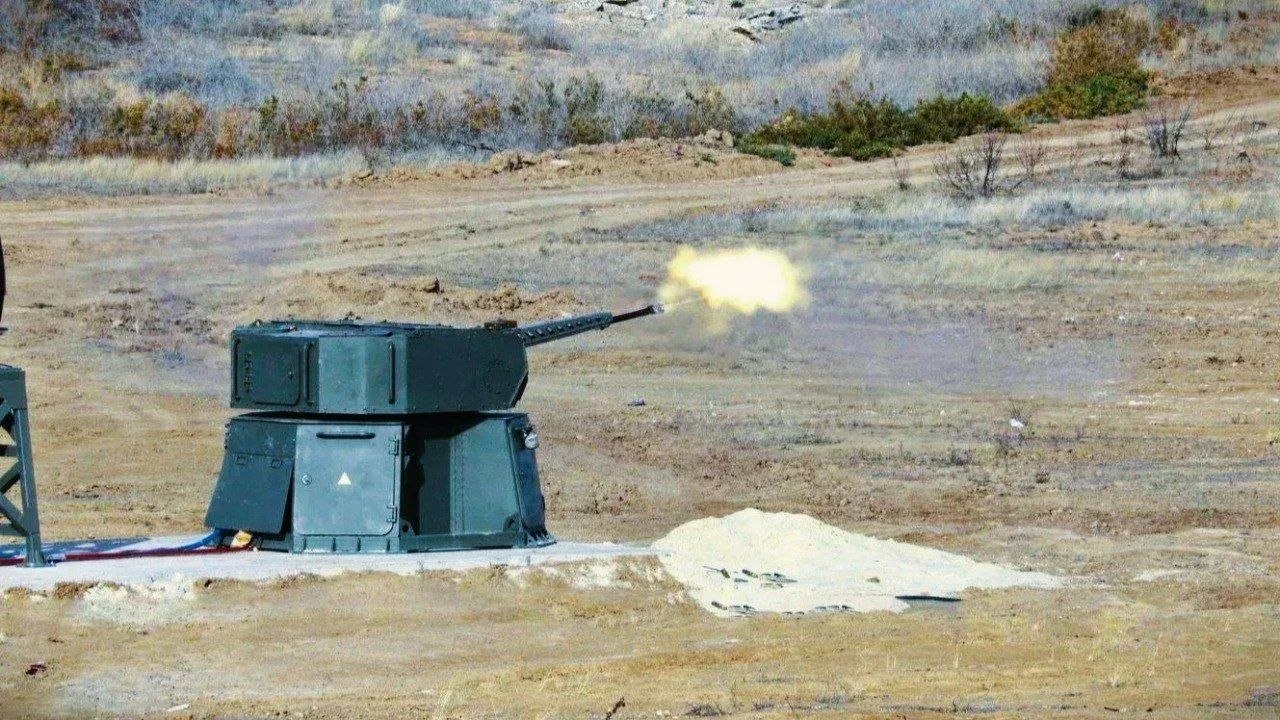
Russia’s state defense corporation Rostec revealed that its Citadel anti-aircraft gun system can destroy drones while using several times less ammunition in some cases than conventional anti-aircraft artillery.

“Thanks to its fire control system and shells with remote-detonation fuses, the Citadel anti-aircraft artillery system has demonstrated significantly lower ammunition consumption per target destroyed than standard anti-aircraft artillery systems. In some cases, consumption is several times lower,” a Rostec representative told Izvestia, according to the TASS news agency on October 13.

The ZAK-30 Citadel is designed to protect fixed installations against all types of drones. It combines radar and electro-optical sensors operating in visible and infrared spectrums with an automated fire-control system that detects and tracks targets, calculates firing solutions and directs the guns.

The system uses 30 mm programmable fragmentation ammunition with remote-detonation fuses. Rather than requiring a direct hit, the shells detonate at a calculated point along a drone’s flight path, scattering fragments intended to destroy or damage the target.

Each combat module carries 300 rounds and has a stated engagement range of up to 1,000 meters against fixed-wing drones and 800 meters against small multicopters.

The system includes a command post that can control several combat modules positioned approximately 1 kilometer away and has a crew of five.

Rostec also compared Citadel with foreign counter-drone systems, including Germany’s Rheinmetall Skynex, which uses a 35 mm cannon and programmable AHEAD fragmentation ammunition, and the U.S. Phalanx close-in weapon system and land-based C-RAM, both armed with 20 mm Vulcan guns.

The Russian company said Skynex’s larger-caliber ammunition produces a powerful fragmentation field but increases the system’s weight and cost, while Phalanx and C-RAM rely on high rates of fire and consume more ammunition because they do not use the same type of programmable airburst projectiles as Citadel.

Russia’s Defense Ministry announced on October 6 that Citadel systems had been supplied to the armed forces for counter-drone operations. It is still unclear, however, how many have been delivered.

_______________________________________________________________________________________________________________________

SouthFront: Analysis and Intelligence

NOW hosted at southfront.press

Previously, SouthFront: Analysis and Intelligence was at southfront.org.

The .org domain name had been blocked by the US (NATO) (https://southfront.press/southfront-org-blocked-by-u-s-controlled-global-internet-supervisor/) globally, outlawed and without any explanation

Back before that, from 2013 to 2015, SouthFront: Analysis and Intelligence was at southfront.com

SOUTHFRONT.PRESS

MORE ON THIS TOPIC:


The post Russia Pits Citadel Drone Killer Against German and U.S. Systems appeared first on South Front.
Military Situation In Yemen On October 13, 2026 (Map Update)

13 October 2026 at 17:37

Click to see full-size map.

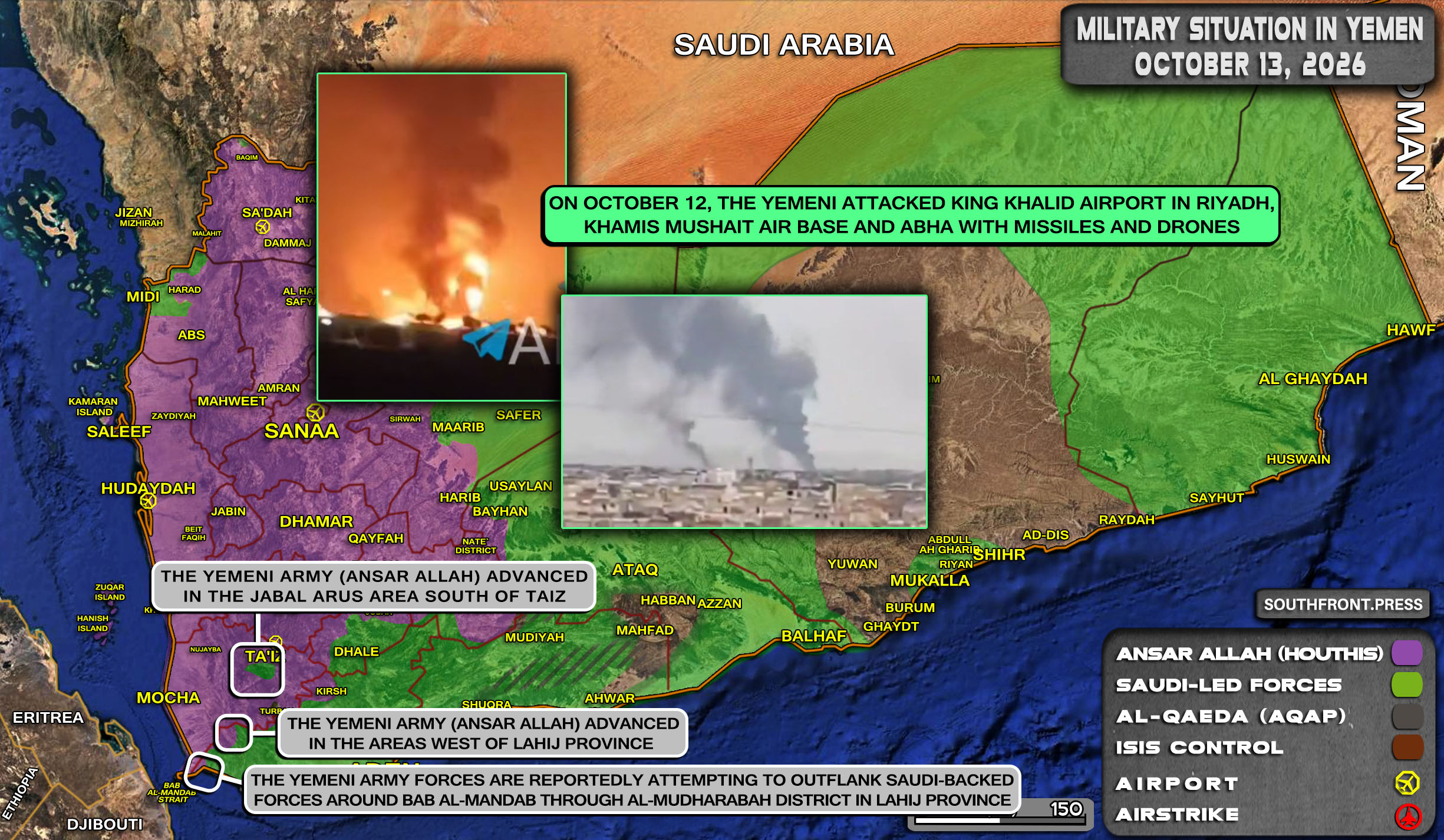
  • The Yemeni army (Ansar Allah) advanced in the Jabal Arus area south of Taiz;
  • The Yemeni army (Ansar Allah) advanced in the areas west of Lahij province;
  • The Yemeni army (Ansar Allah) forces are reportedly attempting to outflank Saudi-backed forces around Bab al-Mandab through Al-Mudharabah district in Lahij province;
  • On October 12, the Yemeni attacked King Khalid Airport in Riyadh, Khamis Mushait Air Base and Abha with missiles and drones.

_______________________________________________________________________________________________________________________

MORE ON THIS TOPIC:


The post Military Situation In Yemen On October 13, 2026 (Map Update) appeared first on South Front.
Russia Pits Citadel Drone Killer Against German and U.S. Systems

13 October 2026 at 17:29

Click to see full-size image. (Rostec)

Russia’s state defense corporation Rostec revealed that its Citadel anti-aircraft gun system can destroy drones while using several times less ammunition in some cases than conventional anti-aircraft artillery.

“Thanks to its fire control system and shells with remote-detonation fuses, the Citadel anti-aircraft artillery system has demonstrated significantly lower ammunition consumption per target destroyed than standard anti-aircraft artillery systems. In some cases, consumption is several times lower,” a Rostec representative told Izvestia, according to the TASS news agency on October 13.

The ZAK-30 Citadel is designed to protect fixed installations against all types of drones. It combines radar and electro-optical sensors operating in visible and infrared spectrums with an automated fire-control system that detects and tracks targets, calculates firing solutions and directs the guns.

The system uses 30 mm programmable fragmentation ammunition with remote-detonation fuses. Rather than requiring a direct hit, the shells detonate at a calculated point along a drone’s flight path, scattering fragments intended to destroy or damage the target.

Each combat module carries 300 rounds and has a stated engagement range of up to 1,000 meters against fixed-wing drones and 800 meters against small multicopters.

The system includes a command post that can control several combat modules positioned approximately 1 kilometer away and has a crew of five.

Rostec also compared Citadel with foreign counter-drone systems, including Germany’s Rheinmetall Skynex, which uses a 35 mm cannon and programmable AHEAD fragmentation ammunition, and the U.S. Phalanx close-in weapon system and land-based C-RAM, both armed with 20 mm Vulcan guns.

The Russian company said Skynex’s larger-caliber ammunition produces a powerful fragmentation field but increases the system’s weight and cost, while Phalanx and C-RAM rely on high rates of fire and consume more ammunition because they do not use the same type of programmable airburst projectiles as Citadel.

Russia’s Defense Ministry announced on October 6 that Citadel systems had been supplied to the armed forces for counter-drone operations. It is still unclear, however, how many have been delivered.

_______________________________________________________________________________________________________________________

SouthFront: Analysis and Intelligence

NOW hosted at southfront.press

Previously, SouthFront: Analysis and Intelligence was at southfront.org.

The .org domain name had been blocked by the US (NATO) (https://southfront.press/southfront-org-blocked-by-u-s-controlled-global-internet-supervisor/) globally, outlawed and without any explanation

Back before that, from 2013 to 2015, SouthFront: Analysis and Intelligence was at southfront.com

SOUTHFRONT.PRESS

MORE ON THIS TOPIC:


The post Russia Pits Citadel Drone Killer Against German and U.S. Systems appeared first on South Front.
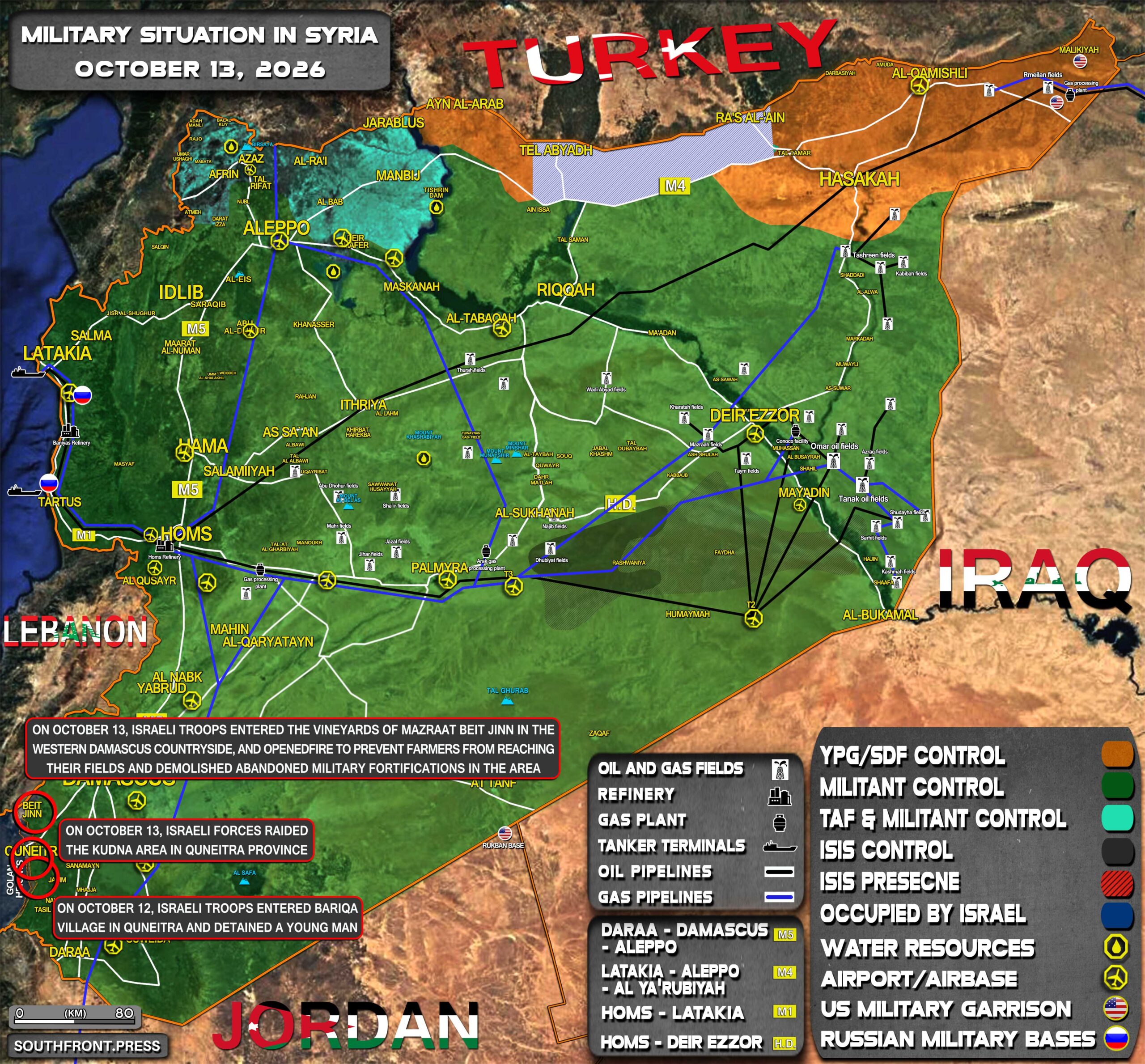
Military Situation In Syria On October 13, 2026 (Map Update)

13 October 2026 at 17:19

Click to see full-size map.

  • On October 13, Israeli forces raided the Kudna area in Quneitra province;
  • On October 13, Israeli troops entered the vineyards of Mazraat Beit Jinn in the western Damascus countryside, and opened fire to prevent farmers from reaching their fields and demolished abandoned military fortifications in the area;
  • On October 12, Israeli troops entered Bariqa village in Quneitra and detained a young man.

_______________________________________________________________________________________________________________________

MORE ON THIS TOPIC:


The post Military Situation In Syria On October 13, 2026 (Map Update) appeared first on South Front.
❌