❌

Normal view

A Free Speech Group at Columbia Canceled an Event About Free Speech Over 'Cornell 7' Article Controversy

21 October 2026 at 20:26
Campus building at Columbia | Luiz C. Ribeiro/TNS/Newscom

Questioning the prevailing narrative about the "Cornell seven" case is bound to create controversy. And at Columbia University, two student journalists drew condemnation for their views on the case from the unlikeliest of places: a college free speech group. 

On October 13, Barnard junior Christina Ma and Columbia junior Nikos Mohammadi published an article called "The 'Cornell Seven' Is Really About Liberalism" in the Columbia Sundial, an independent student publication. The piece argued that the discourse surrounding the alleged rape at Cornell University infantilizes women by omitting the possibility that in a post–sexual revolution, liberal society, women may make regrettable but consensual choices.

"In the world that, for better or worse, follows from it, we cannot claim to stand for sexual freedom and then recoil in disgust when there's a possibility that a young woman simply chose to exercise it," Mohammadi and Ma wrote. 

The piece also argues that the "collective frenzy" over the Cornell case has created a climate on campus that makes it "difficult to disagree with the maximalist position on what happened" the night of the alleged rape.

As Mohammadi wrote in UnHerd, the piece caused immense backlash. He said he received an onslaught of messages urging him to commit suicide and demanding that his "career and life be destroyed." But the criticism went beyond threatening DMs and comments. 

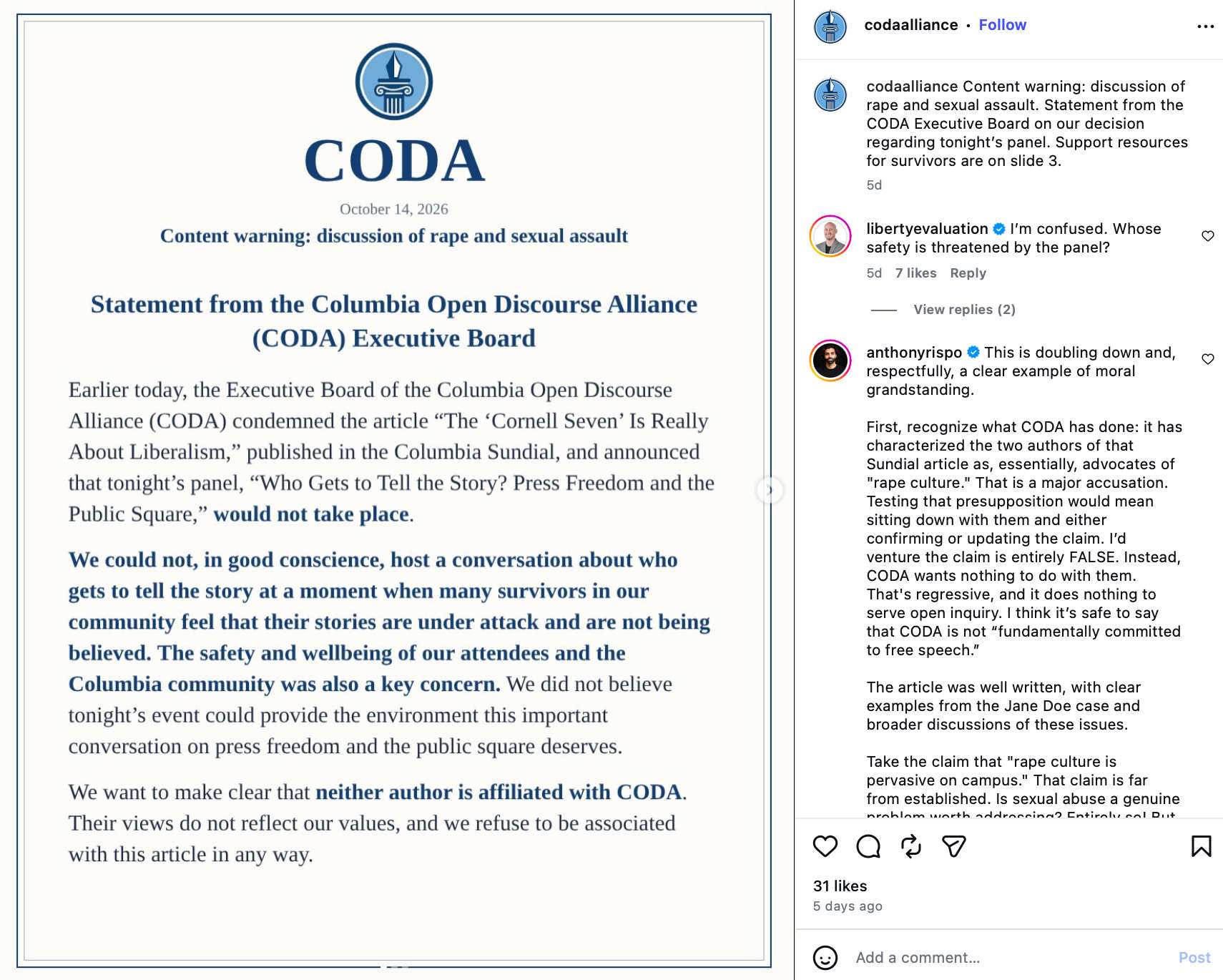
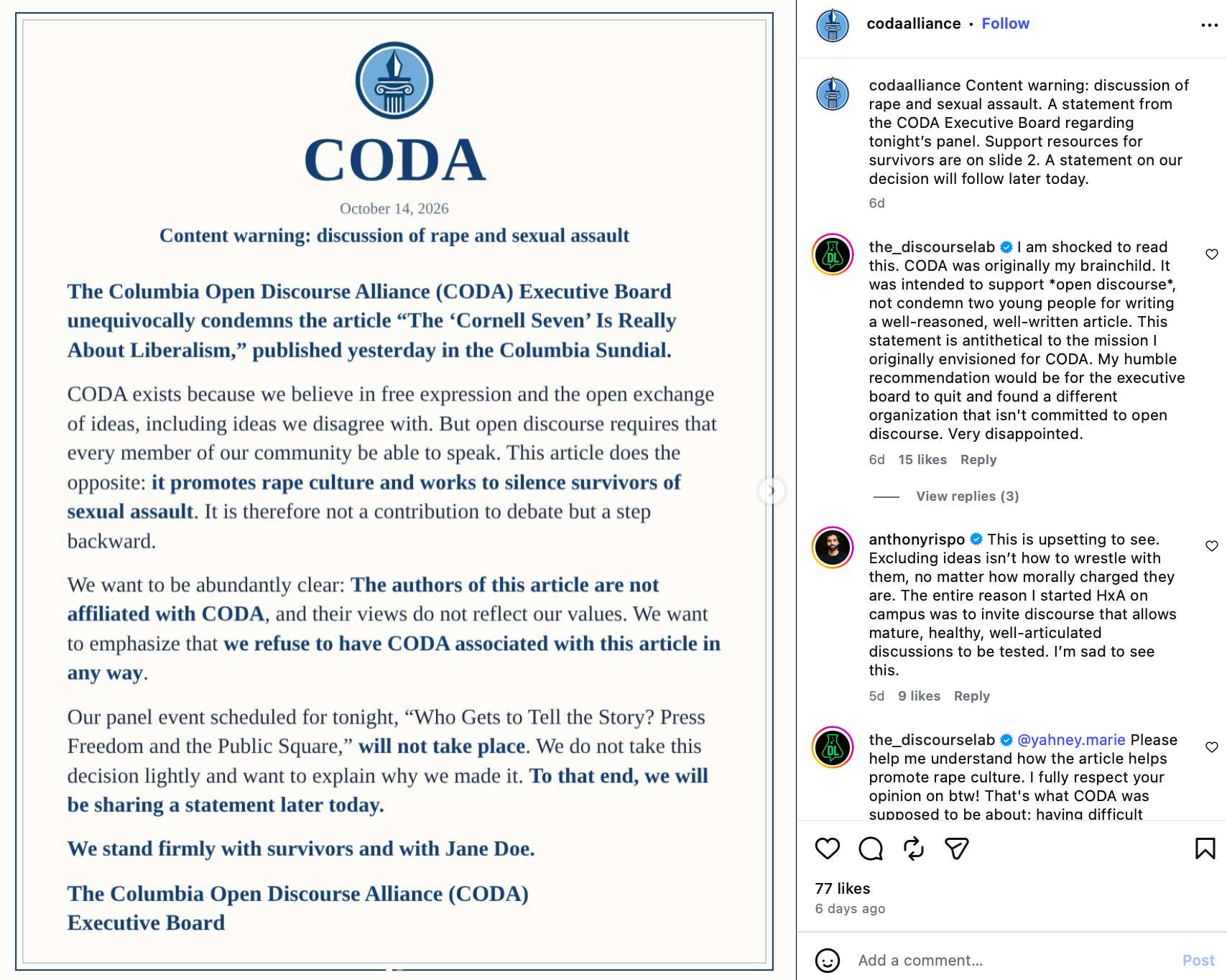
The day after the article's publication, the Columbia Open Discourse Alliance (CODA) canceled an event about press freedom because the Sundial's editor in chief, Nick Baum, had been slated to speak at the event. Although Baum did not author the piece, CODA wrote in an Instagram post that the free speech group "refused" to be affiliated with the Sundial's article "in any way." 

CODA also claimed that the event, ironically called "Who Gets to Tell the Story? Press Freedom and the Public Square," could not take place at a time when "many survivors in our community feel that their stories are under attack and are not being believed."

The group added that the Sundial's article "promotes rape culture and works to silence survivors of sexual assault." 

The group's president, Aum Desai, told Columbia's student newspaper, the Columbia Daily Spectator, that the group canceled the event "not in spite of, but because of [CODA's] commitment to free expression." 

Columbia graduate Clayton Smith, who founded CODA in 2025, quickly commented that he was "shocked" by CODA's statements on Instagram. Smith started the organization to create a central hub for groups hosting events promoting free speech and open discourse, including the Sundial and Columbia's Heterodox Academy chapter.

He tells Reason that CODA's rationale for canceling the event was "ironic" and "hypocritical," and he believes the group should have collaborated with the Sundial if there were legitimate safety concerns at the event. He says he was particularly disturbed by the group's condemnation of the article and CODA's claim that it promotes "rape culture."

"They don't argue or explain how it works to silence survivors of sexual assault. It is a baseless slander that they use to condemn the article because it promoted an opinion they do not like," Smith says. 

Smith says he spoke to Desai on the phone after CODA posted the statements, and Desai tried to reassure him that CODA would uphold the principle of free speech. But Smith says he did not leave the phone call feeling "very confident at all" in Desai's commitment. 

Desai did not respond to Reason's requests for comment.

CODA faculty adviser and Columbia Business School professor emeritus Eli Noam was traveling in China during the fallout from the Sundial article and was not involved in CODA's decision.

After speaking with members of both CODA and the Sundial, Noam tells Reason that he thinks CODA "made some proper decisions, some correct decisions, and some mistakes."

"I think we're dealing here with…a group of college students who kind of were confronted with a crisis at 2 a.m.," Noam says. "And kind of [made] some judgments that they now regret, and they do." 

He tells Reason that it was not "unreasonable to assume there would be a disruption" at the event, given the climate at Columbia and "about this rape allegation." He says the group suddenly "had an event where they needed college security" and could not organize in time. CODA, Noam says, is not yet recognized by the university, and he thinks the group was likely fearful of jeopardizing its recognition.  

Still, Noam says CODA's statements condemning the article were "unreasonable," and it was "disappointing that they kind of lost their nerve here."

Although he was not involved in planning the panel, Mohammadi says, to his knowledge, there were no credible threats of violence to the panel. He understood there may have been "disgruntled students" and an "environment CODA did not want to deal with." But instead of simply canceling the event or working with the Sundial to find a solution, Mohammadi says CODA overstepped by condemning the Sundial piece. 

James Applegate, an astronomy professor who serves on Columbia's Academic Freedom Council (CAFC) alongside Noam, tells Reason that he disagreed with CODA's decision to cancel the event.

Applegate tells Reason he was considering attending the event, and he was "rather surprised and disappointed" when it was canceled.

He recalled that when he was a professor in 2000, he objected to changes to the school's sexual misconduct policy on the University Senate floor. He says his statements were "similar to what was said in the Sundial article" and there was a "level of emotion in this debate." 

"Nonetheless, we had the debate. I was in it, and the degree to which it was civil is shocking when you look at where we are now. And it's sad." 

Applegate said he does not condemn CODA, however, "for the simple reason that the atmosphere on college campuses and on the left wing of politics in general in the United States is quite vicious."

CODA's honorary faculty fellow John McWhorter tells Reason he interpreted CODA's statement as "saying that an event about who gets to tell the story is untenable when or if a critical mass of people with such stories don't even feel comfortable telling them— i.e.being a participant in the event." He added, "I imagine some might think of that as cutting the salami a little thin, but then I highly suspect that Desai is equally worried about the event becoming a physical melee of some kind. In that, let's face it, he is hardly unreasonable."

Still, McWhorter said that he would have chosen to have the event himself, "especially as in the likely case that some people did talk about their experiences without any particular repercussions, it may have made the more reluctant people less apprehensive about doing so in the future."

According to Mohammadi, as of Tuesday, the Sundial, College Republicans, Platypus Affiliated Society at Columbia (which discusses leftist thought and history), and Columbia's Heterodox Academy chapter have left CODA. 

CODA was not the only group to condemn the Sundial's piece. On October 14, the Columbia Political Review's editorial board wrote that Mohammadi and Ma's piece "violates standards of integrity" and "perpetuates a culture of campus violence, rape, and assault." The editorial board of the Columbia Political Review, which purports to publish "multipartisan political discourse," stated that it would refuse to publish "any article that upholds or recreates cultures and systems of rape, sexual assault, or violence" and it urged "all campus publications to do the same."

And on Monday, Columbia's main newspaper, the Spectator, published a staff editorial accusing the Sundial of violating journalistic ethics by "its page to disparage survivors of sexual violence." 

Mohammadi tells Reason the piece underwent "far more editorial scrutiny than any other piece" the Sundial had published given the sensitive nature of the topic.

Free speech student organizations are necessary on Columbia's campus, especially as the school's free speech climate continues to crumble; it recently received a failing grade from the Foundation for Individual Rights and Expression. And while upholding free speech principles may have become more fashionable among those resisting the Trump administration's pressures on academic freedom or those defending pro-Palestinian speech, it is clear that some topics remain taboo in the public square. College is supposed to be a place where students debate controversial topics, form their own beliefs and opinions, and learn from mistakes. Hopefully, the students who demanded condemnation instead of debate will be forgiven for their perversion of free speech ideals, and they will learn to afford such grace and open-mindedness to classmates with whom they disagree.

The post A Free Speech Group at Columbia Canceled an Event About Free Speech Over 'Cornell 7' Article Controversy appeared first on Reason Magazine.

Fans Don't Want a 24-Team College Football Playoff. The NCAA Thinks You'll Watch Anyway.

20 October 2026 at 15:45
A few BYU football players celebrate on the field, one of them has ripped off his helmet. | Aaron Baker/Icon Sportswire CHE/Aaron Baker/Icon Sportswire/Newscom

Hello and welcome to another edition of Free Agent! Be careful when you're behind the wheel this week.

College football is great! Surely you want even more of it, right? We'll get into the problems with a 24-team College Football Playoff (CFP), then talk about the NBA's new betting restrictions, and close with thoughts about President Donald Trump's new government golf course plans. And just in case you don't make it to the end, here's a shortcut to our survey on who you're rooting for in the World Series.

But first, many congratulations to "Gary's 1st Entry" on outlasting everyone else in our NFL Survivor group. There's no prize other than this shoutout, so be sure to print out today's newsletter, highlight this paragraph, and frame it in gold. Perhaps Gary can keep going and challenge Primetime Paulie Rothrock's 13-game winning streak from last season.

Locker Room Links

Watering Down College Football Is a Mistake

Saturday was one of the best days of college football ever—or perhaps it could have been, if we thought any of the five top-10 teams who took a loss were now certainly out of playoff contention. Instead, Georgia, Notre Dame, Indiana, Alabama, and Texas are all still very much alive in the championship hunt.

Today was one of the craziest days in college football history:

- First time ever five teams ranked in the top 7 lose in a single week
- First time the No. 1-ranked team loses to an unranked team in consecutive weeks since 1990
- First time Texas, Alabama, and Georgia all lose… pic.twitter.com/psVRoM5s5b

— Bobby Football (@Rob__Paul) October 18, 2026

With two losses, Alabama and Texas are at least on the edge of the playoff bubble with perhaps no more room for error. But that's only true under this year's CFP format. Next year, the playoff is almost officially set to balloon to 24 teams, making the chaos of a day like Saturday matter even less.

Fans will always celebrate a huge upset or major rivalry win, of course—Tennessee fans don't need playoff stakes as an excuse to get drunk when they beat Alabama. But the joy of a rivalry win in the past was always bigger because of the off-field stakes, too—the first loss for your rival meant they probably wouldn't be national champions, the second meant they'd be out of the Rose Bowl, a third meant you could be proud your team sent them packing for the Alamo Bowl. Winning is great; ruining your rival's season is even better.

With 24 teams in the playoff, the joy is a bit diminished because it will take four or possibly five losses to knock a powerhouse program out of the CFP (Iowa, at 8–4, was ranked 23rd by the committee before last year's playoffs). It'll be a bit like a rivalry win in college basketball—we win, you suck, congrats on getting a slightly worse NCAA Tournament seed.

In the business of sports, more inventory for TV is king, and the powers that be think more teams playing more playoff games will make more money. At Free Agent, we don't begrudge institutions for trying to make more money—we all do the same every day. But it's not clear abandoning conference championship games will be the answer, especially when the Big Ten and SEC championships apparently outdraw many playoff games.

ESPN and the power conferences know fans aren't happy about it—just look at all the chatter online, and how the crowd at BYU reacted when College GameDay discussed expansion on Saturday (especially when BYU would probably benefit from expansion!). They're betting enough people will watch to make the expansion profitable anyway. The last hope is that fans get loud enough to bully them into abandoning expansion—which only occasionally works, sometimes on things small (putting the trophy logo on the court for the NBA Finals) and large (soccer's European Super League). If any powerhouse considers going independent, that might shock leaders into a rethink too.

Almost every sport I know is adding more: more teams, bigger playoffs, more for TV. As fans, we still eat it up, of course—much to the excitement of the TV executives who are selling commercial time to the people trying to reach us, the viewing public. (The only counterexample is the MLB proposal to cut eight games from the regular season—I'd love to see each sport I follow cut its season by about 25 percent to make regular season games matter more, so I'm interested to see how this goes.)

Perhaps I'm biased because my favorite team, Michigan State, is a dumpster fire—they could expand the playoff to 64 teams and the Spartans still wouldn't deserve a bid. I personally don't have a whole lot at stake in the playoff format now or anytime soon. But as a neutral, the chaos of Saturday might have been viewed with my full attention in the past—instead, this year I just had it on in the background while I played video games.

Sports Are Regulating Bets Without Politicians, Part 3

After last year's major betting scandal, the NBA asked sportsbooks late last week to stop offering certain types of potentially problematic bets. The sportsbooks, which the NBA says handle roughly 99 percent of the U.S. betting market, agreed. No politician or regulation was necessary to solve the problem.

No longer can bettors bet on unders for a bit player who likely won't get more than 12 minutes of playtime. Bettors also can't wager on the opening tip or on players to miss specific shots. Parlays that string together under bets on the same player's statistics are also out (this one seems a bit harsh—if you just want to bet on a certain major player to have an off night, you can bet on stats separately, but not in a big multiplier parlay). Bets on players who have two-way contracts between the NBA and G League were already banned.

This all comes on the heels of similar developments last year in the NFL and MLB. While some people want to ban prop bets altogether, the NFL asked sportsbooks to eliminate bets in four different categories. Sportsbooks largely agreed or weren't offering those bets anyway. MLB, in light of some pitching-related scandals, asked for a $200 limit on pitch-specific bets and to keep them out of parlays—sportsbooks agreed to that too.

As I wrote last year, "Ideally, this is how the regulation of the sports betting industry should go….These approaches are catching the nuances of what works for both the leagues and for sportsbooks without the heavy-handed approaches of politicians who would use an axe to ban all prop bets instead of a scalpel to limit problematic bets."

It's important to note leagues are able to do this because they have commercial partnerships with the sportsbooks. Otherwise, the leagues would have no direct leverage over a sportsbook offering a bet the league doesn't like. Keep that in mind the next time you see people bemoaning a league partnership with a sportsbook or a prediction market.

Trump's Golf Course Plans Have People Teed Off

President Donald Trump has new plans for the National Park Service golf course at East Potomac—again. Last time new plans were announced, the site plan still had its historic miniature golf course, a par-3 course, and the existing road still ringing the property for bicycling, running, etc. Much of the public didn't like that plan anyway—now, none of that remains in the latest plans, just 18 holes of golf and a driving range.

Trump announces plans for the redeveloped East Potomac Park golf course. pic.twitter.com/ZiGYgc99Uo

— Andrew Leyden (@PenguinSix) October 18, 2026

What's really going on here seems quite clear to me: Like so many other things going on in the second Trump administration, this is a scheme to enrich the Trump family. The plan?

Step 1: Cancel a lease that was signed during the first Trump administration with a nonprofit group operating the golf course and working, in the long term, on major capital improvements and renovations.

Step 2: Use taxpayer dollars to pay for renovation of the course into, allegedly, a championship-level course capable of hosting major golf tournaments (no matter that the area has next to zero parking, is a mile from the nearest Metro station, and only accessible by narrow roads not meant to handle tens of thousands of spectators). 

Step 3: Have the federal government sign a sweetheart deal with, who else, the golf division of the Trump Organization to operate the course on extremely favorable and profitable terms.

If you're wondering why the Trump administration is doing something, corruption is usually a good guess.

The arguments for the course don't make much sense. There are plenty of adequate, competitively priced golf courses in the broader Washington, D.C., area. Several of them are already capable of hosting professional golf tournaments. Between LIV Golf and the PGA Tour, there were three tournaments at three different courses in the last couple years. The 2030 PGA Championship and 2037 Ryder Cup will happen just over the D.C. line in Bethesda, Maryland.

East Potomac is not the nicest course around, no thanks to the legal limbo it's been in for the past year. But if the National Park Service is going to, for some reason, be in the business of running a golf course, it should be a course that emphasizes and teaches its history instead of the pipe dream of a corrupt madman.

Who Ya Got? 2026 World Series Edition

For the first time in 46 years, we've got a World Series contested by two teams that have never won it before. Brewers against Rays is also a rare instance of the top seeds from each league outlasting the randomness of the MLB playoffs to make the World Series. And before you trot out the tired line that "TV executives must be seething about the small market teams" remember that they care much more about getting a playoff series that goes seven games with close results in each game (What did I say above? Inventory rules all!).

In any case, I want to know who you're rooting for. At first glance, neither team seems super objectionable to me. Come back next week for my thoughts. But make sure you sound off and take 10 seconds to respond to our World Series poll here.

Replay of the Week

Kick-six alert! (Honorable mention to the blocked extra point returned for two the other way.)

"A kick-six type opportunity."

Chris Lewis was all over this one on the CBS Sports Network call of Nevada-North Dakota State. 🏈🔥🎙 pic.twitter.com/eRt42xcYIt

— Awful Announcing (@awfulannouncing) October 18, 2026

That's all for this week. Enjoy watching the real game of the weekend: MSU men's hockey (No. 2 in the nation!) against New Hampshire.

The post Fans Don't Want a 24-Team College Football Playoff. The NCAA Thinks You'll Watch Anyway. appeared first on Reason Magazine.

She was harassed for crude remarks about Modi at a Cockroach protest. Now she can’t leave home

20 October 2026 at 07:30

​After a protest clip went viral, a teenager’s life was torn apart by threats that sent her and her family into hiding. Plus, a book on citizen journalism

• Don’t get This is India delivered to your inbox? Sign up here

Before 24 July, a person I will call R was preoccupied with the ordinary routines of teenage life: experimenting with makeup, grumbling over mathematics homework and hanging out with friends at a tea stall.

That month, as the fever of student protests spread across the country, the 15-year-old watched on her phone as young people poured into Jantar Mantar, the designated protest site in Delhi, demanding education reform. She went too. But an 11-second video clip from the protest site, in which she made crude and profane remarks about the prime minister, Narendra Modi, upended her life.

Continue reading...

© Photograph: Sajjad Hussain/AFP/Getty Images

© Photograph: Sajjad Hussain/AFP/Getty Images

© Photograph: Sajjad Hussain/AFP/Getty Images

Foamy war? St Andrews students play out modern take on ancient ritual

19 October 2026 at 15:17

Scottish university’s annual tradition once involved giving out raisins but fancy dress and shaving cream now in vogue

Nobody at the University of St Andrews in Scotland seems to remember how Raisin Monday became a giant foam fight. For 600 years, first-year students have taken part in the ritual of thanking older students for mentoring them through their first few weeks of university life.

Traditionally, freshers would give their elders a pound of raisins – hence the name. This Monday however, hundreds wore fancy dress as they streamed on to St Salvator’s lower college lawn at 11am armed with cans of shaving foam, covering one another in soapy clouds as they have for the past few decades. Groups of students dress as Smurfs, mice, bananas, grandmas, sunflowers and chefs to participate in the annual rite of passage.

Continue reading...

© Photograph: Murdo MacLeod/The Guardian

© Photograph: Murdo MacLeod/The Guardian

© Photograph: Murdo MacLeod/The Guardian

Brickbat: Studying Hard or Hardly Studying

19 October 2026 at 09:00
Students at an Academy of Learning center | Academy of Learning Career College/Facebook

Ontario government inspectors checked several career colleges that had experienced "concerning" growth in applications for the Ontario Student Assistance Program (OSAP), a government financial aid program that helps eligible students pay for post-secondary education. The investigators found problems that raised "serious concerns" at three Academy of Learning institutions, like signs that other people might have been doing students' schoolwork for them—for example, some students finished whole courses in a single day, or even just minutes. A few students could not even name their school or program of study. The inspectors also found shared computer logins from many different locations and said the schools could not prove that OSAP-funded students were really taking the classes they claimed to be enrolled in. These three locations took in more than $219 million in student aid money for about 14,800 students in one year, so the province decided to stop letting new students use that aid at the schools. The colleges deny most of the claims and are fighting the decision in court.

The post Brickbat: Studying Hard or Hardly Studying appeared first on Reason Magazine.

Why small colleges are closing and the toll on students and communities

Across the nation, scores of small private colleges and universities are either closing or under threat. As each school shutters, students, faculty, and the surrounding community struggle to find a way forward. Paul Solman reports on one such school and the effects of its demise. It's part of our higher education series, Rethinking College, and produced in collaboration with the Hechinger Report.

Students in France are fighting for stronger public education

14 October 2026 at 23:05

High school and university students in France continued their protests on Tuesday, October 13, demanding government investment in public education. Approximately 480,000 protesters took to the streets in the latest iteration of the mobilization, with families, teachers, and trade unions backing students’ demands. 

Read more: French students shut down schools in historic strike against austerity

The mobilization remains marked by widespread police violence. Police used tear gas and dispersal grenades on crowds, including at Tuesday’s central march in Paris. Hundreds of students were injured and thousands arrested in these incidents, prompting reactions from human rights organizations. 

In response, the public joined students as they blocked high schools and organized marches to physically shield them from potential harm. Trade union members, notably from the education sector, were highly represented in these support lines. 

“The CGT reaffirms the urgent need to address the demands of those who are the country’s future ,” the General Confederation of Labor (CGT) asserted. “The CGT salutes their fighting spirit. It welcomes the strong anti-fascist tone of the demonstrations, which shows that there is no inevitability to the continued flourishing of fascist ideas or to the far right’s rise to power.” 

Students demand access to higher education

Since the beginning of the month, French students have organized three massive demonstrations to warn against the state of education under austerity. “For several weeks, high school and university students have been mobilizing to denounce the deterioration of their study conditions, the Parcoursup system, staff and resource shortages, policies that are dismantling public services, and – more broadly – the future this society holds in store for them,” the trade union federation Solidaires recognized in their statements. 

Trade unions continued their support for student mobilizations. The banner reads: "Electricity and gas workers stand with the youth. Our rage is nuclear." Source: CGT/Facebook
Trade unions continued their support for student mobilizations. The banner reads: “Electricity and gas workers stand with the youth. Our rage is nuclear.” Source: CGT/Facebook

Equal access to higher education has been high on the protesters’ demand list since the beginning. This refers in good part to how students are currently recruited into university courses – the Parcoursup admission platform. Introduced in 2018 under Macronist ministers to replace a previous system that randomized selection for oversubscribed courses, Parcoursup was supposed to “rationalize” admissions.

In practice, however, critics and applicants emphasize the platform allows institutions to apply unclear selection criteria and even discriminate against students from working-class areas.

In September 2026, the left party La France Insoumise warned that 126,652 students were not able to access a course as a result of the system – up from 77,000 in 2023. “This selection process is the product of austerity-driven political choices deliberately implemented by successive Macron-era governments,” the party warned.

“Parcoursup is a social sorting machine,” Solidaires echoed. “The platform organizes competition among young people for places that the State deliberately refuses to create. It transforms the right to study into a privilege, scarcity into selection, and austerity into supposed individual failure.”

Commodification of education

Jean-Luc Mélenchon, the left’s presidential candidate, pointed out that these choices are part of a broader political agenda: “the commodification of education and knowledge.”

Trade union briefs on the subject back this interpretation. At the beginning of this school year, Solidaires warned that thousands of those left without higher education placings are being sacrificed in the name of austerity. 

“But not everyone experiences this violence in the same way,” they wrote. “The wealthiest families can afford private schooling, fund housing on the other side of the country, or sustain a year without studying. Young people from working-class backgrounds, however, have no way out. A lack of options means either being forced into the job market or military service – abandoning their plans for good – or facing precariousness, isolation, and debt at a private institution.”

“We have shifted from an egalitarian system to a discriminatory one: pay for your own future,” Mélenchon concluded in a recent interview.

Read more: Greek university labor leaders face charges after supporting students

The left leader anticipated that student demands will be an important topic during the upcoming election campaign, where the left is contrasting a program of rupture with neoliberal policies to the far right’s intention to build a debt brake not unlike Germany’s. In practice, this would translate into years of sustained attacks on social security and public services. 

Trade unions and progressive organizations announced their support for the youth mobilizations will continue as they build campaigns to resist the government’s intention to impose billions in cuts to pensions and social security while spending record amounts on rearmament.

For their part, student unions invited their members to remain active and join a general mobilization against the cost of living crisis this Saturday, October 17.

A gang rape allegation at Cornell highlights how Title IX guides campus sex assault cases

Cornell University's handling of an alleged fraternity house gang rape is raising questions about how a decades-old federal civil rights law shapes colleges' treatment of campus sexual assault.

Cornell president admits he never followed up on gang rape allegation ahead of no-confidence debate

Cornell University President Michael Kotlikoff knew in 2024 that a student had reported being gang raped at a fraternity house, but never followed up to learn what had happened to her or whether any of the accused students had been punished.

College Still Has a Future, but It's No Longer the Default Choice

14 October 2026 at 12:00
An arrow trending down, with a college mortarboard on it | Illustration: Dragan Andrii/Gbautista87/Dreamstime

Is a college educations worth the hassle and expense? Amid concerns over soaring tuition costs and campus political intolerance, a growing share of Americans aren't convinced that higher education is worthwhile. Academics themselves—the honest ones, anyway—acknowledge that they've squandered a lot of goodwill over the years. Fortunately, it's still possible to get an education that justifies the time and money—though the path doesn't necessarily go through college.


High Costs and Political Bias Sour Americans on College

"Three in 10 Americans (31%) think a college education is 'very important,' four percentage points below last year's reading, the previous low among the seven times Gallup has asked this question since 1978," the polling firm reported earlier this month. "As recently as 2013, more than twice as many U.S. adults (70%) said college was very important." Gallup adds that "the percentage of U.S. adults who say a college education is 'not too important' has risen from 6% in 2013 to 29% today, while the percentage saying it is 'fairly important' has increased from 23% to 39%."

Higher education plummeted in public esteem for more than one reason. For years, Americans have voiced concern about rising costs and political intolerance on campuses. Last year, even as a Vanderbilt University poll found a slight rebound in favorability toward colleges and universities, the authors noted that "Americans across the political spectrum still are deeply concerned about the affordability of higher education" and "many Americans see political bias in higher education as a serious problem."

The problem was underlined this year when some colleges broke the $100,000 mark in annual costs. "Today, a bachelor's degree at some of America's top schools can cost upward of nearly half a million dollars over four years," reported Business Insider. "And the trend doesn't seem to be slowing down."

Almost at the same time, Vanderbilt released a report warning "there are several worrying tendencies in contemporary academic scholarship in the humanities and social sciences, all of which reflect, to varying degrees, a distinctive form of politicization in which the scholarly enterprise is taken to be subordinate to, or in the service of, political (social or moral) goals beyond the advancement of knowledge and understanding." The goals of this politicization, the study added, "are generally though not exclusively associated with the progressive left."

Unsurprisingly, many Americans balk at paying through the nose so they (or their kids) can spend four years at woke camp. That trepidation undoubtedly contributes to declining college applications at a time when the applicant pool is already shrinking. Many students who do apply to college are applying very modern filters to the schools they'll consider.

"The median student is willing to pay up to $2,617 (12.5%) more to attend a college where the share of students with opposing political views is 10 percentage points lower, suggesting that political identity plays a meaningful role in the college choice process," found a 2025 study from the Annenberg Institute at Brown University which documented "a steady increase in political sorting across American colleges."

This month, a survey from Art & Science Group, a higher education consultancy, found that among college applicants, "the share ruling out colleges solely because of politics in a state rose from 24% in 2023 to 31% in winter 2026 and 34% in summer 2026."

Employers haven't stopped hiring from prestigious colleges and universities. But the definition of "elite" has changed, with some firms leery of traditional Ivy Leagues and preferring southern schools where costs are lower and ideological tolerance still has a place.


College Still Offers Value for Those Who Choose Wisely

Higher education can still be worthwhile for students who apply due diligence to their selection of schools and fields of study. College offers a good return on the investment of time and money for those who choose wisely.

According to the Education Data Initiative, "an average bachelor's degree has a 560.53% lifetime return on investment with a median lifetime return up to 1,040.14%." But not all degrees are equal. "The most cost-efficient bachelor's degree is in management information systems and statistics, with a lifetime ROI of 1,758.59%," while "a Bachelor of Psychology offers the lowest lifetime ROI at -122.78%, representing a $54,188 loss in degree-based earnings (compared to median earnings with a high school diploma)."

The 10 bachelor's degrees with the highest lifetime earnings are an assortment of engineering disciplines, management information systems and statistics, accounting, finance, economics, mathematics, and the like. But return on investment also depends heavily on the cost of the degree; it's more difficult to get your money's worth when you pay top dollar.

Importantly, science, technology, engineering, and mathematics fields are also the academic disciplines with the least lopsided political balance among professors.


Trade Schools Rise as Employer Demand for College Degrees Falls

But college is not the only choice for young Americans planning their futures. According to a 2025 Harris survey for the American Staffing Association, more Americans now recommend that graduating high school seniors go to trade school (33 percent) than recommend college (28 percent).

Trade schools cost a fraction of what four-year colleges cost. And they satisfy a growing demand for skilled workers.

"Of the 124 skilled trades occupations, 86 are projected to grow or hold steady, and more than 600,000 net new positions are projected through 2035," the Alliance for Skilled Trades, a coalition of companies that depend on trades people, notes in a recent report. "Employers will need to fill about 1.7 million openings each year."

Note that new positions are opening even as the population of job-market entrants shrinks.

And employers increasingly value experience and in-house training over college degrees of dubious value. Last year, a quarter of employers reported that they were eliminating requirements for bachelor's degrees among new hires.

Higher education still has a role to play. But "education" doesn't have to mean four years of high tuition. It can be a certification program or trade school that launches graduates into a productive life.

After decades of being the default path for many Americans, colleges and universities have alienated people with high prices and intolerant ideological environments. They still have a lot to offer, but now they have to compete with alternatives for the time and money of a skeptical public.

The post College Still Has a Future, but It's No Longer the Default Choice appeared first on Reason Magazine.

No, Giving Immigrants Research Jobs Is Not Fraud​

13 October 2026 at 19:00
Vice President J.D. Vance | Aaron Schwartz - via CNP/Polaris/Newscom

Vice President J.D. Vance—who is heading the Trump administration's efforts to eradicate fraud—has set his sights on another alleged form of wasteful spending. 

Last week, Vance announced a probe into nine universities over alleged J-1 visa fraud as part of the Trump administration's broader crackdown on foreign worker programs. Vance's central complaint is that the named universities—which include Harvard, Stanford, and the Massachusetts Institute of Technology—are "employing J-1 visas for federally funded grants at a rate of about 61 percent" compared to the "national average of just 38 percent." 

"Something weird is going on at these universities," Vance added. "They're using these visas way too much. They're using them to undercut the wages of American grad students and American researchers, and it simply has to stop." Naturally, he figured that this warranted a fraud investigation.

Labor Department Inspector General Anthony D'Esposito, who is leading the investigation, had some harsh words for universities. "Improperly used J-1 visa classifications to avoid employment obligations, exploit taxpayer-funded programs, and undermine American workers will not be tolerated." He said, "I don't care how prestigious a university thinks it is. Break the law and screw the American people, and I will personally cuff you in the university square." He also raised concerns that universities were exposing American research to foreign adversaries, specifically China.

The press conference sounded more like an indictment of the J-1 program than of fraud. Unlike the H-1B visa—which allows employers to sponsor high-skilled foreign workers—the J-1 is more like an exchange program than a dedicated work visa; it doesn't require employers to pay the prevailing wage or visa holders to pay Social Security or Medicaid taxes within the first two years. Universities using the program to hire cheaper foreign labor is simply a feature of the program.

The real picture is much muddier than Vance cited figures suggest. The inspector general's announcement states that "approximately 61 percent of postdoctoral workers and researchers supported by federal grants at the nine universities are foreign nationals, compared to 38 percent at other universities." Foreign nationals could include H-1B holders and other visa categories, not just J-1s as Vance claimed. Additionally, the 38 percent figure comes from unspecified "other universities," rather than the national average.

D'Esposito had a fiery tone, but neither he nor Vance pointed to a single instance of a university breaking the rules. Their evidence is merely a statistic showing these schools, which are elite research institutions, hire a lot of foreign researchers. Vance's primary objection isn't that these universities have broken the law; it's that they are hiring foreigners instead of Americans, undermining his protectionist agenda.

Opposition to visa programs is, unfortunately, found on both the left and the right. In his first term, President Donald Trump enacted a slew of restrictions that complicated the H-1B visa application process and increased denial rates to 24 percent in FY 2018 (up from 6 percent in FY 2015).  In 2020, the administration was forced to rescind key policies behind those rising denials after a federal judge ruled they hadn't followed the required rulemaking process. In September last year, Trump imposed a $100,000 fee on H-1B petitions. A federal judge struck it down in June, saying it exceeds the president's authority and violates the separation of powers.

Other presidents have used federal power as leverage against higher education. But Trump's war on universities—including the freezing of federal funds for universities like Columbia and Harvard for alleged instances of antisemitism—is mostly unprecedented. These actions are indicative of a more enduring problem: Federal dollars come with federal influence, and as long as universities depend on federal funding, they will remain at Washington's mercy. If universities want lasting independence, the answer isn't to reduce their use of the J-1 visa. It's to get off the federal teat altogether.

The post No, Giving Immigrants Research Jobs Is Not Fraud​ appeared first on Reason Magazine.

An Illinois College Tried To Cancel Its Flock Contract. Flock Refused.

13 October 2026 at 18:45
A Flock automated license plate reader on a pole with a solar panel, behind a fence. | Illustration: Feng Yu/Dreamstime/Charles McClintock Wilson/ZUMAPRESS/Newscom

Flock Safety, an Atlanta-based company worth more than $8 billion, manufactures automated license plate readers (ALPRs), cameras that capture images of license plates and store them in a database that police can search.

Recently, the company has been under intense scrutiny over concerns about privacy and the cameras' capacity for misuse, leading some cities to cancel their Flock contracts. But it turns out that getting rid of Flock is easier said than done.

"When Elgin Community College hired Flock Safety to install six surveillance cameras in April 2025, President Peggy Heinrich thought they would 'enhance the safety and security of students,'" Lisa Kurian Philip reported last week at the Chicago Sun-Times.

The Chicago-area school signed up for a one-year contract with the company. It was not alone: Five of Illinois' 12 public universities, plus four of its community colleges,

But Heinrich began to have second thoughts as she learned more about how the cameras can be used—for example, Flock allowed U.S. Immigration and Customs Enforcement (ICE) to access over 80,000 of its cameras. In September 2025, ICE arrested a student near Elgin's campus.

More than half of Elgin's students are Latino, Heinrich told the Sun-Times, and enrollment began to suffer.

"In August of 2025, Flock publicly announced it would no longer conduct pilot projects with federal agencies," according to the company.

Still, Heinrich said, the school chose to end its contract with Flock "out of an abundance of caution for our students."

"Elgin Community College staff notified Flock in October 2025 that they wanted to cancel their contract and have the cameras taken down," Philip wrote. "Within a day, Heinrich said, Flock rejected the request and refused to uninstall the equipment on the basis that the company had not breached their agreement."

The school reached out again in December, offering to pay out the rest of the contract, but according to Heinrich, Flock did not respond.

Since the school no longer wanted the cameras to operate, and Flock refused to remove or disable them, officials zip tied garbage bags over the cameras on campus. But in a peculiar twist, "workers in an unmarked vehicle, which Heinrich assumed belonged to Flock, repeatedly removed the coverings."

This continued until the school's contract expired in April, when Flock finally removed the cameras.

Granted, the situation is somewhat complicated by the fact that while Elgin is a public institution, Flock is a private company.

"Per Flock contract conditions, the company retains ownership of the products it sells to cities," Caroline Haskins reports at Wired. "This means that when people damage or destroy cameras, cities are on the hook for the cost." Covering cameras with garbage bags will apparently work until Flock comes and cuts them down, but removing or disabling the cameras without the company's permission will incur fees to replace them, even if the city has already said it doesn't want them anymore.

But since the product that Flock sells is a searchable database of license plate images compiled from its interconnected nationwide system of cameras, the reality is more complicated than that.

Indeed, while Flock says repeatedly that customers own all data that their cameras capture, that's little comfort when the information is also available to any other customer with access to Flock's database.

Between June 2024 and May 2025, police in Illinois searched the Flock database over 4,000 times for immigration-related reasons, even though a state law prohibits ALPRs' use for that exact purpose. This implies the searches were done at ICE's request, meaning federal immigration authorities could access not just the license plate data in those Illinois communities, but also the thousands of communities nationwide that use Flock cameras.

It's also particularly troubling that Flock would make it so difficult for customers to end their contracts. In that, Elgin Community College is not alone: Plenty of jurisdictions have kept using Flock even after supposedly canceling the service, though it's usually the police who fight the cancellations.

In June 2025, the Austin, Texas, City Council declined to renew its Flock contract. Though the city police department supported the program, officials cited concerns about the cameras' capacity to target vulnerable communities.

But in February of this year, public radio station KUT reported that at least two neighboring towns were sharing access to the Flock database with Austin police.

In July 2025, the Board of Lucas County Commissioners in Toledo, Ohio, voted 2–1 to approve 27 Flock license plate cameras across the county, costing $250,000 over four years. But a week later, one commissioner changed his mind, citing fears of how the data would be used, and the board voted again to rescind the previous approval.

In a letter to the Lucas County prosecutor the following day, Sheriff Michael J. Navarre said the commissioners "have a legal obligation to honor this contract" and alleged that the decision to rescind it was borne out of personal animus toward him.

"I cannot sit idly by and allow them to make decisions out of spite that negatively impact the safety of my deputies and the community they protect," he wrote. To be clear, what apparently put everyone at risk was the decision not to move forward with a series of license plate cameras.

County prosecutor Julia R. Bates wrote back to the sheriff in September 2025, stating that since he had already signed the contract from the original resolution, the rescission was "void."

Elgin Community College's experience is not quite the same—in that case it wasn't the police department, but Flock itself, that refused to take down the cameras. But it's still indicative of the widening rift between those who worry about our growing surveillance state and those who apparently see it as worth the tradeoffs.

The post An Illinois College Tried To Cancel Its Flock Contract. Flock Refused. appeared first on Reason Magazine.

❌