Battle for Dobropillia — huge Russian losses and the brutal destruction of the city.
A possible explanation for inaccuracies in Russian maps — they are lying to improve their position in ceasefire negotiations.
The Wall Street Journal said Elon Musk came up with the idea of cutting off Ukraine’s military Starlink.
How the Starshield restriction has affected the front line.
Maps of the day — a Russian death field between Rodynske and Dobropillia, plus an overall view of the front.
Videos of the day — the funeral of five children killed by Russian bombing; a driver in Kyiv burned alive after a drone strike; war criminal and liar Sergei Lavrov speaks about the bombing of Ukraine; a cat alerted an operator to approaching Russians; an interceptor drone shot down a Geran.
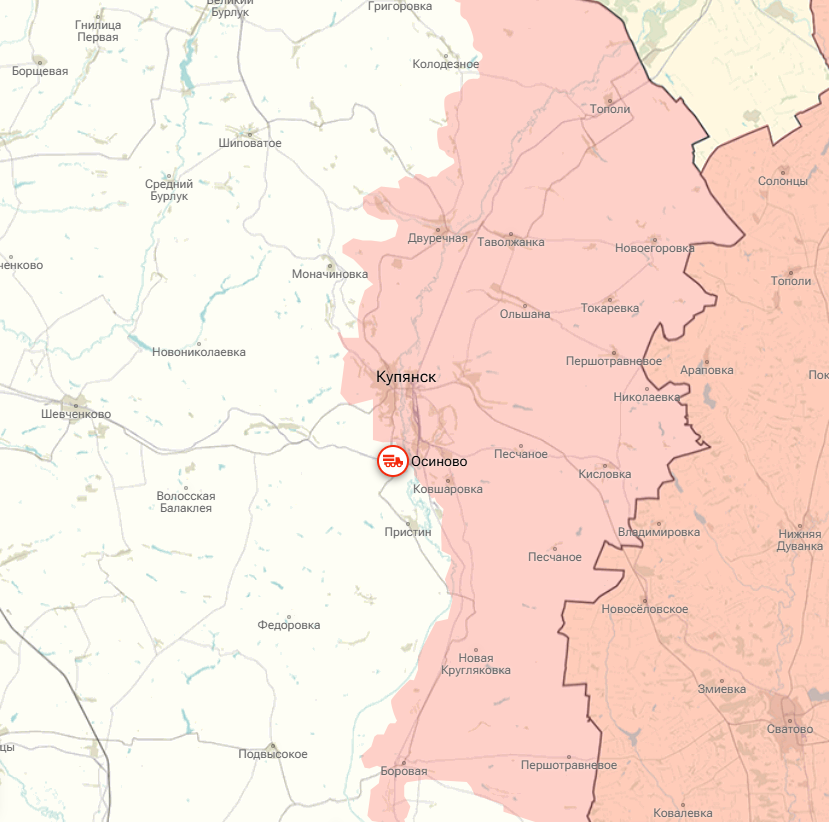
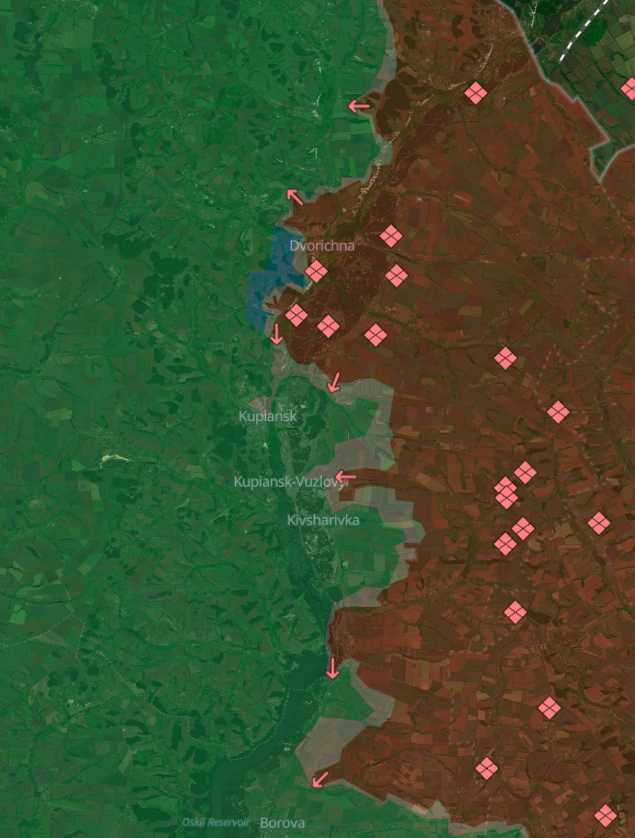
The battle for Dobropillia in images and maps — huge Russian losses and the brutal destruction of the city. The heaviest fighting is currently taking place on this section of the front. Following its defeat in the north near Lyman, the Russian command is now trying here, in the south, to bypass the Sloviansk-Kramatorsk agglomeration, since a direct attack from the east has also failed.
The Kremlin has currently deployed its largest forces to the area north-east of Pokrovsk, where it is trying to break through Ukrainian defences.
Described this way, it sounds highly technical. People can detach emotionally from information written in this manner and follow events merely as arrows on maps.
In reality, however, the arrows conceal tragedies that are very difficult to imagine. This week, visual evidence emerged that may better convey the scale of human suffering and losses on both sides.
The first shows the city of Dobropillia itself from the air after Russian bombardment that is slowly consuming it.
This article continues, but the full version is available only to EUobserver.com subscribers. Visit account.euobserver.com/membership
These are not yet Star Wars, but we may be approaching the first destruction of an enemy satellite in space.
Fighting is taking place directly in Dobropillia.
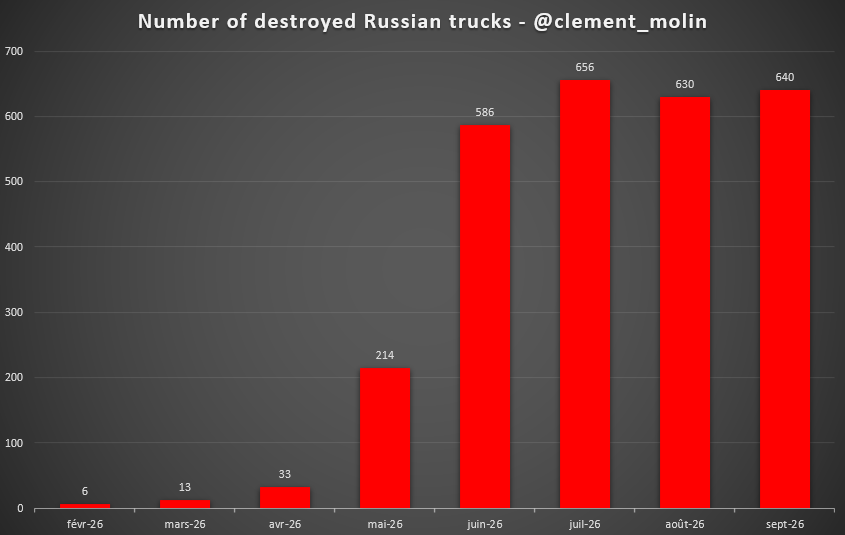
On the first day of restrictions on Starlink functionality, Ukrainian army attacks on Russian logistics dropped sharply, before beginning to return to their previous level — chart.
Russia continues to pound Kyiv with ballistic missiles, while power outages occurred across Ukraine.
St Petersburg experienced one of the largest air raids of the entire war over the weekend, but the damage was limited.
Maps of the day — Dobropillia
Videos of the day — a Russian glide bomb fails to explode and bounces off an apartment block in Sumy; a bomber drone destroys a Smerch multiple rocket launcher; the road between Pavlohrad and occupied Pokrovsk
These are not yet Star Wars, but we may be approaching the first destruction of an enemy satellite in space. Marco Langbroek is a Dutch scientist whose original field was Palaeolithic archaeology. He now works at the prestigious Dutch Delft University of Technology, at its Faculty of Aerospace Engineering, where he observes and tracks objects orbiting the Earth.
Among other things, he specialises in observing classified spy satellites. After the downing of flight MH17, he was among the experts involved in the investigation. He was the first to publicly point out that the Russian missile which shot down the civilian aircraft may have been detected by US early-warning satellites.
The same scientist was the first this time to notice the unusual behaviour of the Russian military satellite KOSMOS 2612, which began carrying out manoeuvres in the immediate vicinity of the European satellite ICEYE-X36.
At first glance, this report appears to have nothing to do with the war in Ukraine, but that is not the case. ICEYE-X36 is originally a Finnish satellite, launched into space in March 2024 from the Vandenberg space base in the United States, which is also used for the space programme — both military and civilian.
ICEYE-X36 uses radar observation and has cooperated with the Ukrainian government since 2022. Radar can monitor the Earth’s surface even through cloud cover, and Langbroek speculates that it is probably working for the Ukrainian military.
He began reporting on the situation on Saturday (17 October), calling it highly concerning.
“If Ukraine is indeed using ICEYE-X36, this means that a satellite of one country — Russia — is closely approaching a satellite of another state — Ukraine — with which it is at war,” Langbroek wrote. He wondered whether “we are perhaps witnessing the first real anti-satellite attack directly in orbit in the course of its preparation”.
This article continues, but the full version is available only to EUobserver.com subscribers. Visit account.euobserver.com/membership
In 2022, the Neptune missile sank the cruiser Moskva; in 2026, it is destroying aircraft at airfields.
Ukraine has run out of Patriot missiles, while parts of Kyiv are without electricity following new air raids.
The order to slow down Starlink came from the White House, Reuters reported.
What is new in the “captured” part of Kharkiv region? Ukrainian soldiers capture a Russian soldier in its centre.
Drones sank a ship off the Bulgarian coast, and Sofia turned to Nato.
Maps of the day– Kharkiv region
Videos of the day – a Russian drone destroyed a grocery store in Odesa while it was fully operational; a strange drone with a strange name
In 2022, the Neptune missile sank the cruiser Moskva; in 2026, it is destroying aircraft at airfields. On Thursday, the Ukrainian president released a report saying that a strike on the Borisoglebsk Russian military airfield in Voronezh region had destroyed four Su-34M strike aircraft on the ground and damaged two more.
Volodymyr Zelensky also released a satellite image, which is the lead photograph of Friday’s Ukraine Battlefield update.
The airfield lies around 340 km from the front line and was built to accommodate even the largest aircraft types in the Russian air force’s inventory: the Tu-160 and An-124.
In this war, however, it serves as a base from which smaller Su-34s take off for glide-bomb attacks. It is therefore a place from which otherwise almost invulnerable aircraft operate, bombing Ukrainian army positions directly on and near the front line.
Ukraine does not yet have fighter jets capable of shooting down enemy aircraft at the distances from which they release their bombs, while the Patriot system has no missiles of the type that have already shot down several Su-34s in mid-air. The destruction of four aircraft and at least damage to two more is therefore a major success.
Several aspects are noteworthy: the weapon used; the apparent capacity to react exceptionally quickly; the Russian military’s continuing reluctance to build protected aircraft shelters at airfields; as well as its carelessness during operations. Crucially, the impact on operations is easy to calculate in this case.
Zelensky confirmed that the successful attack was carried out using a Neptune missile. It is one of the Ukrainian arms industry’s most successful achievements.
It was originally designed to fight enemy ships. It is launched from ground-based launchers and flies close to the terrain on its way to the target. The manufacturer completed the first battery shortly before the invasion began.
Until it sank the Black Sea Fleet’s flagship in April 2022, it was not known whether the Ukrainians had made it operational. The sinking of the cruiser Moskva provided a clear answer.
Since then, the missile has been repeatedly upgraded. The aim was not only to extend its range, but also to enable it to strike ground targets. Both have been achieved, as the attack on Borisoglebsk demonstrates.
As almost always, local residents managed to record the moment of its arrival and impact on the target:
Ukrainian forces carried out a missile strike on Russia’s Borisoglebsk airbase tonight, with at least one massive explosion and post-strike fire seen. pic.twitter.com/aA1xxZlhCl
The photographs below most likely show the consequences. There are signs of fire at the aircraft stands marked one and six. The damaged aircraft probably stood there.
Two Su-34 wrecks are clearly visible at positions two and five, while at positions three and four, alongside a crane clearing debris, there is mainly a large burnt-out area and the outline of one Su-34.
Even the Russians do not keep so many aircraft together for long at an airfield relatively close to the front line during wartime. The Ukrainians therefore had a very short window between detecting the target and carrying out the attack. That they succeeded points to highly accurate intelligence and a very short response time.
Even so, it was very careless of the Russians to park at least four, but more likely as many as six, valuable combat-ready aircraft so close together, even for a short time.
Russian Z-bloggers criticised the fact that, despite repeated assurances that hardened shelters were being built, there are still none at Borisoglebsk airfield.
By 2022, Russia had built 147 aircraft, including prototypes. Exact production figures since the start of the invasion are not known, but according to Polish analyst Jaroslaw Wolski, Russia lost between a quarter and a third of its annual production on Thursday, which is estimated at between 18 and 24 aircraft. This is more likely an upper estimate, and average actual production over the entire period of the invasion is probably lower.
Meanwhile, the Oryx website has counted 44 Su-34s lost to date; with the additional six, the total has now reached 50.
Russia has therefore produced no more than around 200 aircraft of this type, a quarter of which it has lost in combat, while at least half of the remainder are unfit for combat as a result of wear and tear.
The Russian Z-channel Fighterbomber said on Friday that the annual flying time of a Russian air force fighter jet amounted to thousands of hours: “No, not hundreds, not one thousand, but thousands. Divide that by the number of days in a year and you will see how much each individual fighter jet works on average per day.”
It wrote this in connection with its claim that, although the Ukrainian air force was incapable of fighting the Russian one, it and Ukrainian drones were nevertheless “consuming the resources of all our fighter jets, which have essentially been continuously in the air for five years, taking turns with one another”.
Fighterbomber did not mention Su-34s in this context, but these aircraft bear the main burden of front-line missions, meaning they too are heavily used: “This inevitably leads to malfunctions and crashes, resulting in repairs that take an aircraft out of combat readiness, with another aircraft taking over its tasks …”.
Fighterbomber concluded that although “we have many aircraft, there are still too few of them”.
Since this year, Russia has been able to mount six glide bombs under each Su-34, rather than four. The loss of six aircraft — since even damaged aircraft cannot fight, at least temporarily — therefore means at least 36 fewer precision-guided bombs against Ukrainian positions each day.
This assumes, of course, that every aircraft flies only one mission per day. In practice, they fly more, making this a significant relief for soldiers on the front line.
Ukraine has run out of Patriot missiles, while parts of Kyiv are without electricity following new air raids. A shortage of the most advanced surface-to-air missiles, which alone can effectively shoot down Russian ballistic missiles, is nothing new. Ukrainian batteries have previously had nothing to fire, leaving them to watch Russian air raids helplessly.
CNN reported most recently that this had happened again. Russian missiles consequently damaged three Kyiv power plants again on Wednesday morning.
The destructive air raid was repeated on Friday morning. It led to emergency power cuts. “Power outages have been recorded in Kyiv, as well as in Kyiv, Volyn, Odesa, Zaporizhzhia, Dnipropetrovsk, Kharkiv, Sumy and Chernihiv regions. Work to restore supplies has already begun wherever the security situation permits,” NEC Ukrenergo said.
The NV website reported that 370,000 customer connections in Volyn region alone had been left without power.
The situation is exacerbated by the fact that the heating season officially began in Kyiv on Thursday. However, as NV wrote, this was not possible in two Kyiv districts because energy workers had not had time to deal with the consequences of the attacks.
At the same time, a dispute is under way between Volodymyr Zelensky and the capital’s mayor, Vitali Klitschko. According to the president, Kyiv’s leadership had “almost entirely” failed to meet the deadlines of the so-called Resilience Plan, which was intended to prepare the city for winter. Klitschko rejects this, but he had already come under criticism from the media in previous months.
The order to slow down Starlink came from the White House, Reuters reported. The respected news agency said, citing sources within the administration itself. However, it has no information on who specifically issued such an order.
The restriction concerns the military component of the system, called Starshield. Elon Musk also drew attention to this in a post, which essentially confirms the accuracy of the Reuters report.
No reliable information on whether the system was functioning was available on Friday.
What is new in the “captured” part of Kharkiv region? Ukrainian soldiers capture a Russian soldier in its centre. In the context of the entire war, this is an insignificant episode, but the Russian defence ministry still insists that it has captured 65 villages and 1,200 square km of territory in the north-eastern part of Kharkiv region, and has moreover encircled some Ukrainian units.
A video has appeared online from the village of Buzove — its location is highlighted in red on the map of the Ukrainian Petrenko account — where a group of Ukrainian soldiers captured a Russian hiding in bushes by the road. There was also a dead Russian soldier there.
For comparison, this is how Russian maps — specifically those of the state news agency Ria Novosti — depict the same territory. Buzove is not named on the map, but it lies roughly halfway between the village of Reznikove — marked by a black assault-rifle symbol in a white circle — and Ivanivka, which is a short distance to the left and below. According to the Russians, the village is 12 km in a straight line from the nearest Ukrainian positions.
Drones sank a ship off the Bulgarian coast, and Sofia turned to Nato. Drones attacked in Bulgaria’s exclusive economic zone as recently as last week. One of the vessels sank and all 10 sailors are presumed dead.
Earlier this week, the HS Dignity, flying the flag of Guinea-Bissau, was sunk 31 km off the Bulgarian coast. According to the BBC, 10 people were missing.
As many as 18 drones damaged the Ukrainian vessel Chelsea-3, which was sailing from Turkey to a Ukrainian port along the Black Sea coast to avoid the Russian military.
🛳️ Route of the vessel hit by drones off Bulgaria's coast overnight
Bulgarian Prime Minister Rumen Radev said that the Chelsea 3 is Ukrainian-owned and sails under the Maltese flag.
The crew — seven Ukrainians and eight Azerbaijanis — was rescued.
It is almost certain that Russia was behind the attacks. Even the government, which is otherwise sympathetic towards Russia, is convinced of this and has summoned the Russian ambassador. Sofia has also asked Nato to deploy aircraft to protect vessels in the Black Sea.
Videos of the day
A Russian drone struck an ordinary grocery supermarket in Odesa while it was fully operational.
Russian forces carried out a drone strike on a Ukrainian supermarket in Odessa this morning.
A Geran-4 slammed into a busy Tavria V supermarket in Mayaky, injuring multiple people and setting the building ablaze. pic.twitter.com/iuDmascrvV
The drone in this video not only looks unusual, but also has a highly unusual name — Prince Vladimir Svyatoslavich. This design allows vertical take-off, after which the drone transitions to conventional flight, increasing its speed and range compared with ordinary FPV drones. According to the manufacturer, its range reaches 50 km.
Це — новий російський дрон-камікадзе «Князь Владимир Святославич». Був.
Ворогом цей безпілотник заявлений як «ударний для середніх дистанцій». Але до цілі він не долетів — один із підрозділів «Дронопаду» збив його перехоплювачем, який ми передали бійцям завдяки вашим донатам.… pic.twitter.com/UXN9lFLkTP
By Tuesday (13 October), Russia had demonstrably lost 24,192 pieces of heavy equipment (24,170 on Monday, 5 October). Of these, 19,155 (19,133) were destroyed by Ukrainians, 1,002 (1,003) were damaged, 1,194 (1,194) were abandoned by their crews, and 2,841 (2,840) were captured by the Ukrainian army. This includes 4,453 (4,452) tanks, of which 3,358 (3,357) were destroyed in combat.
Ukraine lost 12,259 (12,238) pieces of equipment, of which 9,652 (9,633) were destroyed, 713 (711) damaged, 695 (695) abandoned, and 1,199 (1,199) captured. This includes 1,471 (1,466) tanks, of which 1,131 (1,126) were destroyed in combat.
Note: Neither side regularly reports its own fatalities or destroyed equipment. Ukraine publishes daily figures for Russian casualties and destroyed equipment, which cannot be independently verified. This overview uses data from the Oryx project, which has compiled a list of equipment losses documented exclusively by photographs since the beginning of the war.
The Russians are making a mockery of Trump’s energy ceasefire.
What the restrictions on Starlink mean and how they are being felt.
The Russians are pushing towards Dobropillia.
The 3rd Army Corps reported on the next phase of Operation Vivaldi, but we learned nothing new.
Maps of the day — Lyman, Dobropillia
Videos of the day — a drone hit a flying Mi-28 helicopter; how a heavy machine gun is used in drone warfare; civilians fleeing the fighting were struck by artillery and mortar fire
Trump’s America is becoming a rogue state. Ukraine, as well as Europe as a whole, must now accept that the United States is openly supporting Russia’s aggression against Ukraine. Under the pretext of efforts to end the war, the US government — and, as of Tuesday, a major technology company as well — are openly backing the fight against Ukraine and, therefore, against European security.
The United States has recently taken several decisions in quick succession that could help Russia win the war, at a time when it was failing to do so on the battlefield.
US president Donald Trump eased sanctions on trade in Russian oil, enabling Russian president Vladimir Putin to better finance his aggression against Ukraine, and effectively called for the overthrow of Ukraine’s legitimate president.
A growing number of voices claim that the US has stopped providing intelligence on Russian air raids (this has not been confirmed, and some authorities deny it).
And the United States has now also deprived the Ukrainian army of the ability to carry out effective medium-range strikes.
It did so by dramatically restricting the Starlink service over Ukraine’s occupied territories. In practice, this will have serious consequences for the Ukrainian army’s ability to use drones for its previously highly effective attacks on Russian logistics.
What the restrictions on Starlink mean and how they are being felt. Since this morning, the Ukrainian army has reported restrictions on the operation of receivers for SpaceX’s satellite system.
Thanks to Starlink boss Elon Musk’s equipment, they destroy hundreds of Russian army trucks and other military equipment every month at distances of 30 to more than 100 km.
However, on the night of 14 October, Ukrainians lost access to the military part of the system known as Starshield, meaning that the devices did not function at speeds above 160km/h. This means drones cannot carry out combat missions because their operators cannot guide them to their targets.
The situation deteriorated further during the day. Serhii Sternenko reported that the army later reported losing control at speeds above 70 km/h. This means grounding Ukraine’s drone fleet for medium-range attacks.
It is highly likely that this is not a technical problem but a response to a request from the Trump administration, since otherwise the Ukrainian army would have received an explanation — which, according to Ukrainian sources, did not happen.
According to our observations, communications may have been interrupted for 10 to 20 seconds during drone flights,even at speeds of 110 to 120 kilometres per hour,” Oboronka news outlet quoted a military source.
A technical problem is unlikely, as the Ukrainian military would have received an explanation in that case, which,according to Ukrainian sources, did not happen. The question now is how long the outage will last. It is also unclear to what extent the decision was made by Musk and to what extent by Trump.
“Our defence forces received no warning of such a restriction, which led to the cancellation of several missions. It is clear that this is no coincidence and is connected to the current political situation,” wrote Serhii “Flash” Beskrestnov, for example.
He described as an even more serious problem than the restriction of medium-range attacks the fact that Starlink is now crucial to intercepting Russian air raids on Ukrainian cities.
“Through their actions, our partners are depriving us of one of the few means of protecting the country against jet-powered Shahed drones,” said Beskrestnov, a leading drone expert.
Among European politicians, Poland’s foreign minister responded by asking Musk whether he was once again engaging in politics, and reminding him that his European customers were watching him closely.
Naturally, the Russians are delighted.
However, the change will not affect Ukrainian long-range air strikes. The drones carrying them out are not guided using Starlink, so the restrictions will not affect their operations.
Hey, @elonmusk, big man, are you playing politics with your products again? As your European customers, we are watching you. https://t.co/T385xpUEUu
The Russians are making a mockery of Trump’s energy ceasefire. The US president characteristically announced with great fanfare that he had brokered an energy ceasefire between Ukraine and Russia.
Although the Russian army did not observe it for a single day, the Ukrainians stayed away from Russian refineries for 48 hours. That is no longer the case after today, but before then the Russians carried out a massive air raid, including on the capital.
They used as many as 39 ballistic missiles and more than 100 drones. Since Trump had earlier deprived Ukraine of effective air defence in the form of missiles for Patriot systems, it has nothing with which to defend itself against such attacks. As a result, the Russians struck three Kyiv thermal power plants on Wednesday.
Overnight, the Russians used 39 ballistic missiles and more than 120 attack drones and loitering munitions against our energy and critical infrastructure in Kyiv, the Kyiv region, and Kharkiv. A targeted Russian ballistic missile strike specifically against energy infrastructure…
— Volodymyr Zelenskyy / Володимир Зеленський (@ZelenskyyUa) October 14, 2026
The Kremlin does not even conceal that a Trump ceasefire means nothing to it.
“Tonight, the Armed Forces of the Russian Federation carried out a massive strike using precision-guided weapons and long-range strike drones against communications and energy infrastructure facilities in Kyiv, Kyiv region and Kharkiv region,” said a statement by the Russian defence ministry.
It also included a list of the power plants hit. The Russians boasted that they had struck six of them. For each one, they used the formula that it was “supplying electricity to military logistics facilities, weapons depots and military equipment”.
Mike Pence, who served as Trump’s vice-president during his first term, wrote that Putin did not want peace but Ukraine, and that Trump should impose harsh sanctions rather than strike a deal with Putin. None of this, however, will happen.
Putin doesn’t want peace. Putin wants Ukraine. Enough is enough.
President Trump should rescind the diesel deal with Russia and return to the strong policies of our four years in the White House; use the Lindsey Graham Sanctioning Russia Act to impose harsh sanctions on any… pic.twitter.com/uw11mEkh0x
The Russians are pushing towards Dobropillia. All analysts agree on this. Their advance is slow, but persistent. It is enabled by the mass deployment of Russian soldiers.
The Kremlin has currently concentrated its largest number of forces in this sector. It therefore appears that the capture of Dobropillia is the Russian command’s main objective in these weeks.
“The Russians here have a seemingly endless pool of manpower and a clear numerical advantage, allowing them to significantly increase the flow of infiltrators and thus the likelihood that some will penetrate Ukrainian defences,” wrote the OSINT account Playfra, whose map can be found below. However, the price of the unceasing waves of infantry is, according to it, “colossal losses” on the Russian side.
Dobropillia sector.
In the same way, this sector is also worsening.
The Russians have a seemingly infinite manpower pool here and a clear numerical advantage, which allows them to significantly increase the flow of infiltrators and, as such, the chance of some passing through… https://t.co/BoiqRuCRs5pic.twitter.com/pKBIhHZW3d
French analyst Clément Molin published a time-lapse map of the past four months based on DeepStateUA data. Its latest version is not the most accurate and does not correspond to other sources, but it illustrates the slow pace of the Russian advance.
During the last 4 months, Russia 🇷🇺 made a slow but steady progress in the direction of Dobropilla
Russian forces continue to advance and capture villages and small towns south of Dobropilla. Shevchenko and Bilytske fell, Russian forces are now attacking Dobropilla from the… pic.twitter.com/mTDRo4DcPf
The Polish analytical account Thorkill examined the situation north-east of Dobropillia in greater detail. It sees a significant Russian advance there.
It bases this assessment on Sentinel satellite data which, it said, showed no signs of Russian bombardment in the areas of Zolotyi Kolodiaz, Novotroitske and Andriivka — an indication, in its view, that they are under Russian army control.
Sytuacja w rejonie: Zołote Kołodiazi – Nowotroickie – Andrivka (Dobropole).
Mniej więcej miesiąc temu we wpisie o bardzo dużej liczbie FAB-ów z modułami UMPK zrzucanych przez rus w rejonie Andrivki, sygnalizowałem że sytuacja 1 Korpusu "Azowa" GN na płn od Dobropola jest dużo… pic.twitter.com/KihWWAuI7u
Playfra sees the situation far less negatively. It did confirm Russian infiltration in Andriivka, which lies as much as 20 km behind the notional front line, but said that around eight Russian groups of two to four soldiers were moving throughout the area and did not pose a threat.
For easier orientation: Zolotyi Kolodiaz is at the tip of the green salient on Playfra’s map. On Thorkill’s map above, it is located in the lower centre, within the red area.
The two depictions of the situation therefore differ radically. However, there is agreement that the Russians are currently exerting the greatest pressure near Dobropillia and are advancing slowly.
Dobropillia direction.
The situation is quite peculiar tactically:
South, after the clearing conducted since August, some Russian groups still remain in the dotted square, mixed with some new infiltrators, but they aren't significant.
The 3rd Army Corps reported on the next phase of Operation Vivaldi, but we learned nothing new. Andrii Biletskyi, the commander of what is perhaps the strongest component of Ukraine’s army, published a new video confirming the liberation of another 101 square kms north of Lyman. Since the start of Operation Vivaldi, this brings the total to 277 square km.
Четвертий сезон операції «Вівальді»: Білецький оголосив про взяття ще 101 км²
Третій армійський корпус та придані підрозділи звільнили ще три населені пункти — Зелену Долину, Липове й Колодязі, — повідомив у своєму зверненні бригадний генерал Андрій Білецький. Протягом… pic.twitter.com/0Msxrau6yw
The Ukrainian project DeepStateUA, which is close to the army and respects the operational silence it has declared, also published its map of the area.
The latest version includes the liberation of the villages of Kolodiazi, Zelena Dolyna and Lypove. However, this is not new information but merely reflects changes that have been discussed since August.
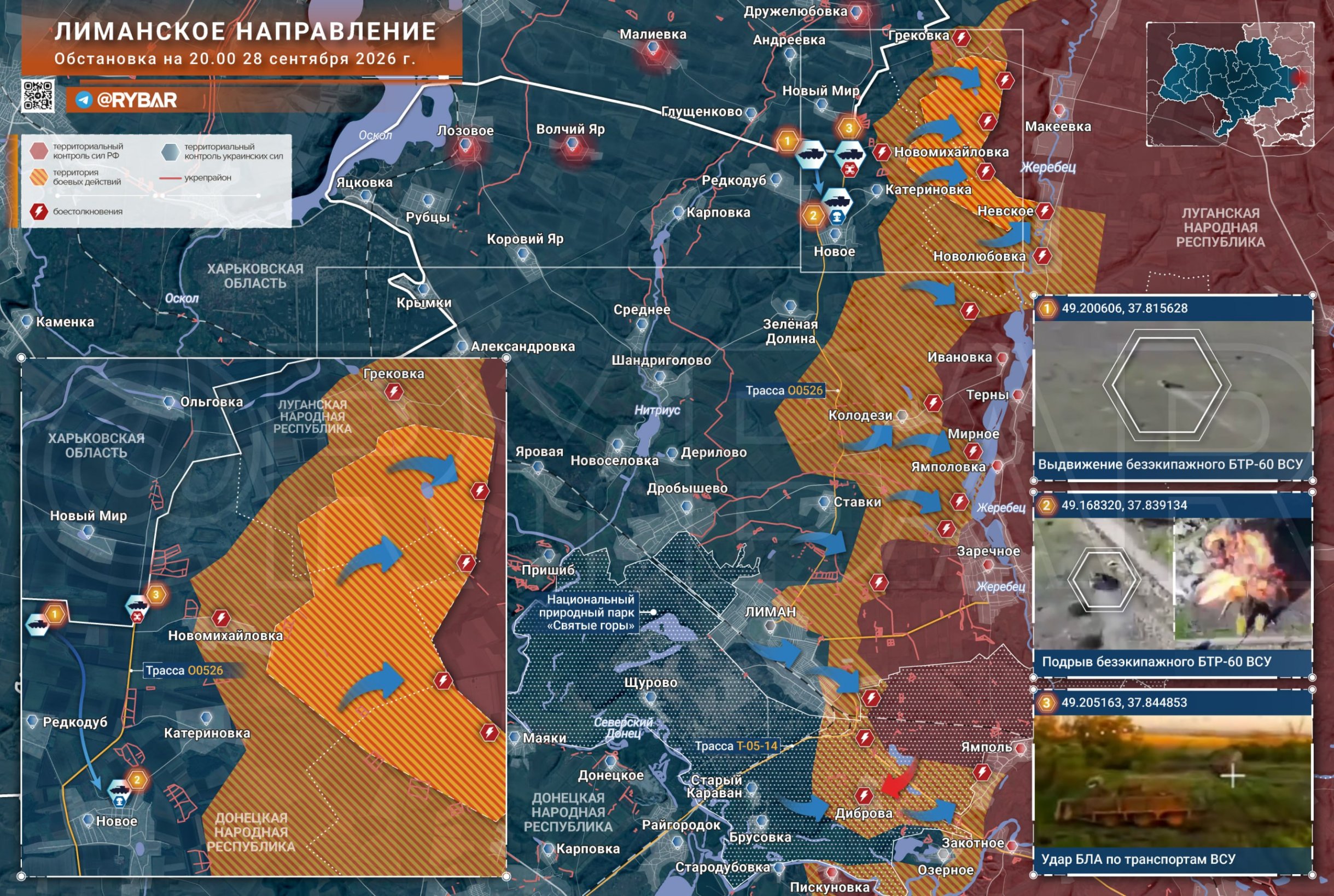
Russian sources, especially Rybar, have also repeatedly reported that fighting is actually taking place further east. According to them, Ukrainian soldiers have already reached several locations, including the village of Terny on the Zherebets River. This area is marked red on DeepStateUA’s map, indicating that it is under Russian control.
Poland’s Thorkill has more recent data. Over the weekend, it published a map consistent with Rybar’s claims that Ukrainians had reached the Zherebets near Terny and further north.
Sytuacja w rejonie Nowego (Łyman), część IV.
Po blisko miesięcznej przerwie wczoraj w Donbasie była w końcu bezchmurna pogoda i można było przyjrzeć się na Sentinelu co się mniej więcej dzieje na tych najciekawszych odcinkach frontu. Jeżeli chodzi o rejon na płn od Łymanu -… pic.twitter.com/2yods3H3Yk
A Ukrainian drone pursued and caught up with a Russian Mi-28 attack helicopter in Kharkiv region. The Russians were on a combat mission; the footage clearly shows a missile being launched. The outcome of the attack is not yet known.
Ukraine's 115th Mechanized Brigade "Aliens" struck a Russian Mi-28 with drone, downing it pic.twitter.com/wefYKaMDk4
The following photographs are related to the previous video. The image on the left appeared on the Russian internet at the beginning of the month, described as the result of an FPV drone strike. It is currently unknown whether this is the same incident or another, as yet unidentified one.
In early October, Russian sources published photos showing damage to the right side of a Mi-28 attack helicopter, specifically the pneumatic emergency escape ladder just below the pilot’s cockpit, claiming it had been hit by an FPV drone.
A 12.7mm US heavy machine gun being fired. The close-up footage shows what the trigger looks like, but above all reveals the tactics for using the weapon. The machine gunner fires a short burst at Russian positions, then reports over the radio that the task has been completed.
A confirming “plus, plus” is heard twice from the other end — “plus” is used in radio communication to confirm receipt of a message — after which the soldier covers the machine-gun position with a camouflage net and goes into hiding to avoid being detected by Russian drones.
Ukrainian soldier supresses Russian assault with a Browning M2 from WW2.
Only the Ukrainian version of events is known about the footage below. It shows civilians from the Kupiansk area attempting to move to safety. However, they are struck by fire while on the move — the number of casualties is unknown and they cannot be seen in the footage.
According to the Khartiia unit, which published the video, the Russian army subjected the group to artillery and mortar fire. The claim cannot be verified. In any case, it illustrates that it is a mistake to remain in areas affected by fighting.
Цивільні – живий щит росіян, а потім – їхня мішень для інформаційної провокації.
У Купʼянську вранці 13 жовтня росіяни прикривалися мирними жителями, виводячи їх до труби газогону, й самі ж накрили групу мінометним та артилерійським вогнем. Серед людей були жінки та дитина. pic.twitter.com/lB6AGd7fFk
By Tuesday (13 October), Russia had verifiably lost 24,192 pieces of heavy equipment (24,170 on Monday, 5 October). Of these, 19,155 (19,133) were destroyed by Ukrainians, 1,002 (1,003) were damaged, 1,194 (1,194) were abandoned by their crews, and 2,841 (2,840) were captured by the Ukrainian army. This includes 4,453 (4,452) tanks, of which 3,358 (3,357) were destroyed in combat.
Ukraine lost 12,259 (12,238) pieces of equipment, of which 9,652 (9,633) were destroyed, 713 (711) damaged, 695 (695) abandoned and 1,199 (1,199) captured. This includes 1,471 (1,466) tanks, of which 1,131 (1,126) were destroyed in combat.
Note: Neither side regularly reports on its own dead or destroyed equipment. Ukraine publishes daily figures for Russian casualties and destroyed equipment, which cannot be independently verified. This overview uses data from the Oryx project, which has compiled a list of equipment losses documented exclusively by photographs since the start of the war.
They looked like Russian “porcupines” and fought where the Kremlin considers Russian rear territory. They were protected by their own drone.
Drones also struck Yandex’s third data centre.
The battle for Dobropillia on a new type of map.
Storm Shadow/SCALP-EG missiles caused the largest single massacre of senior Russian officers of the entire war in August.
Maps of the day — Dobropillia, Kharkiv region
Videos of the day — Abrams as a porcupine; MANPADS against a Geran; Russian port during an air raid; nighttime FPV drone combat; Kyiv resident narrowly escapes death at a playground
They looked like Russian “porcupines” and fought where the Kremlin considers Russian rear territory. They were protected by their own drone. Both the Russian and Ukrainian armies are continuing their efforts to return tanks and combat vehicles to the battlefield.
Russia recently attacked near Dobropillia with tanks fitted with upgraded Arena-M active protection systems.
The system itself proved effective, but was ultimately unable to withstand the flood of drones, and the attack ended in defeat and the destruction of the tanks deployed.
Last week, we also wrote about a successful operation by Ukrainian tanks from the 475th Assault Regiment.
And the same Ukrainian unit, also known as CODE 9.2, demonstrated a new use of heavy armoured equipment over the weekend.
Compared with the first case, this one revealed an important detail about the operation of accompanying drones and, thanks to geolocation, can also be used to verify the accuracy of Russian maps.
The battle took place in the Kharkiv region and involved a US-made Bradley combat vehicle as well as a tank. According to one source, it was an Abrams of Australian origin, although the appearance of its gun barrel does not suggest this.
In a video released by the unit, the Bradley advances first towards Russian positions and begins laying down covering fire. The tank joins it later, firing directly at the target.
While the Bradley’s turret has retained its mobility, the tank has effectively become an assault gun of the type known from the Second World War.
Its turret does not appear to be capable of moving, and the crew must aim the entire tank at the target. This reduces the effectiveness and speed of firing, while increasing its chances of survival.
A tank modified in this way is virtually indistinguishable from similar Russian adaptations. What distinguishes these attempts is, once again, the involvement of accompanying drones.
Aside from the heavy Vampire, first seen at 1:30, this primarily includes an FPV drone which, at 1:58, neutralises in an aerial duel the same type of Russian weapon that had attempted to strike the tank.
This is another example of how heavy equipment must be accompanied by drones at this stage of the war if it is to remain combat-capable.
Despite air support, another drone strikes it at 2:16 — after another had narrowly missed earlier. The tank remained mobile and withdrew successfully.
Beyond the operation itself, its location is also noteworthy: near the village of Anishchyne in the north-eastern part of the Kharkiv region, on the axis Russia calls the Velykyi Burluk direction.
The Ukrainian Telegram account Petrenko, which also provided the map below, precisely identified the site of the battle.
“The video reveals a discrepancy between reality and Russian claims of an alleged massive advance, the encirclement of Ukrainian units and the capture of more than 65 settlements,” the author wrote.
He noted that both vehicles operated in territory that most Russian maps mark in red — as a “Russian” zone.
This is the same area about which we have written repeatedly. For comparison, below is a map by the Russian state agency Ria Novosti. The village of Anishchyne does not appear on it, but the settlement of Vilkhuvatka — Olkhovatka in Russian — serves as a reference point in the centre-right.
The tank and Bradley were fighting around five km north of a location that Russia marks as securely captured.
Drones also struck Yandex’s third data centre. Graphs circulated online, particularly on Sunday, suggesting that Ukrainian attacks on Russia’s largest internet provider had restricted the operations of Russian bots around the world.
However, this has not yet been objectively proven. Russia has indeed reported outages affecting various internet-based services after each attack, but that is so far the only confirmed effect.
On this occasion, French analyst Clément Molin pointed out that the Russian Varyag drone brigade had attacked data centres in Ukraine in recent weeks and had boasted, among other things, of damaging Kyivstar, Ukraine’s largest operator.
The situation has now been reversed, as it was previously with attacks on ships and warehouses. This time, however, to Russia’s disadvantage.
Russia 🇷🇺 bombed multiple data centers in Kyiv, Dnipro or Odesa these last few weeks and proudly showed footage about it
Now, Ukraine is bombing Yandex data centers and causing much more harm to Russia than Russia did to Ukraine.
The first centre hit was in Sasovo, in the Ryazan region, followed by a second in Kaluga, in the Kaluga region. On Sunday, the third of Yandex’s four largest centres was struck, this time in Vladimir, in the Vladimir region.
“This complex houses one of the company’s Galushkin supercomputers, which is among the most powerful in Russia,” Kommersant wrote, adding that the facility had been taken out of service, affecting 10 core Yandex services, including its email service.
The defence ministry is also working on the issue in an effort to protect the company’s remaining facilities. Citing its sources, Kommersant said replacing the damaged capacity could take up to six months.
The battle for Dobropillia on a new type of map. As the war evolves, so do the ways it is mapped. This Ukrainian OSINT profile, for example, has depicted the fighting for the important Donbas town — which protects the Sloviansk-Kramatorsk agglomeration from the south-west — on a dynamic map.
Among other things, it shows that Russian forces are infiltrating the town through the village of Hanivka from the Nove Shakhove area.
Mashovets Dobropillia Russia wants Kramatorsk, to the north-east. Its strongest attack here heads west, into Dobropillia: up to 40 men a day along the Byk river.
If Dobropillia and Druzhkivka hold to late December, Russia would have to replan the offensive. pic.twitter.com/OXg8F1WYXy
For a clearer picture, we are also including a static DeepStateUA map, as the previous one is rotated and does not follow the usual compass orientation.
The two maps are rotated by around 90 degrees in relation to each other. On the following one, Dobropillia is in the centre-left. Nove Shakhove, from where Russian infiltrators are advancing, is almost at the centre, exactly 10 km to the east as the crow flies. A small arrow directly next to the settlement’s name indicates the direction of Russian attacks.
The green area in the upper part of the map is the so-called Dobropillia salient, which was fought over a year ago.
Russia reported nothing significant concerning Dobropillia after the weekend. “On the Dobropillia axis, our forces continue to push forward, but Ukrainian units retain the ability to counterattack. Heavy fighting is under way,” the Two Majors wrote, for example.
The Ukrainian Telegram channel Petrenko published a map over the weekend showing sites of new infiltrations. Its interpretation differs considerably from DeepStateUA’s version. Russian forces are shown closer to the town, but the direction of their advance is the same as in the two previous sources.
The sites of the recorded incursions were established on the basis of videos showing drones killing Russian soldiers attempting to advance further west.
Storm Shadow missiles caused the largest single massacre of senior Russian officers in August. On Friday (9 October), a joint project by Russian exile newspaper Meduza and the BBC’s Russian service added another 17,124 names to its list of Russian war casualties. This was the number it had counted since 21 September. In total, 276,113 Russian soldiers killed in the war are now known by name.
On the same day, the project’s authors published a detailed analysis of events in Donetsk on 26 August. The Ukrainian air force had attacked a building in Donetsk with Storm Shadow/SCALP-EG missiles.
The strike was so intense that the target must have been something significant. Almost immediately, there was speculation that the building housed an important Russian headquarters.
Meduza and the BBC counted 20 high-ranking Russian military personnel killed during a joint meeting of the headquarters of the Centre group of forces and its subordinate 41st Army — 18 at the scene and another two from their injuries in the following days.
This week, in our update of Russian losses in Ukraine: – 17,000 names added to our list since September 21https://t.co/lBGxPNvv8z
They included seven colonels, six lieutenant colonels, five majors, one captain and one senior non-commissioned officer. They were identified thanks to access to nominal lists of headquarters staff as of 25 July and after that date.
It also emerged that this was not the first time officers of the 41st Army had had a bad day. During an attack on 8 September 2025, it lost a lieutenant colonel, two majors and a lieutenant. The toll on 4 August 2026 was even worse, when the army lost two lieutenant colonels, three majors, two captains and one lieutenant at once.
The following images illustrate the scale of destruction caused by the strike on 26 August:
— Special Kherson Cat 🐈🇺🇦 (@bayraktar_1love) August 26, 2026
Videos of the day
As Russian jet-powered drones become more widespread, videos are also appearing more frequently of Ukrainian soldiers shooting them down with man-portable air-defence systems, known by the English acronym MANPADS. This is one of them.
A Ukrainian soldier shot down a Russian jet-powered Geran-4 drone using an Igla-1 MANPADS over Ukraine’s Rivne region this morning. pic.twitter.com/4onx7UNclQ
Despite its best efforts, air defences at one of Russia’s ports were unable to shoot down a Ukrainian drone, which subsequently struck a Black Sea Fleet vessel. Note the beams of light used to assist with targeting.
Один из Z-блогеров опубликовал видео работы ПВО в гавани (Новороссийск?) и попадание дрона ВСУ в военный корабль. Дата съемки неизвестна, однако, уже видны те самые синие лучи, которые пару лет назад решили ввести как лучшее средство подсветки цели. Покупали их военные обычно за… pic.twitter.com/WvDuR369Z3
The Russian soldiers in this nighttime video appear relaxed. They were probably moving through an area they still considered relatively safe. But a waiting drone equipped with a thermal camera was tracking them.
A Ukrainian FPV drone lying in ambush at night spots a passing Russian assault group of four soldiers on a quad bike, waits for the right moment, then takes off and strikes them. pic.twitter.com/MD83B4RkKk
A Kyiv resident narrowly avoided a Russian drone at the last moment as it crashed into a playground.
A man narrowly escaped a Russian drone strike on the grounds of a kindergarten in Ukraine’s Kyiv region yesterday. pic.twitter.com/aOwWNAa6Vj
— Special Kherson Cat 🐈🇺🇦 (@bayraktar_1love) October 9, 2026
What are the losses
No update on Friday.
By Monday (5 October), Russia had verifiably lost 24,170 pieces of heavy equipment (24,138 on Tuesday, 22 September). Of these, 19,133 (19,105) were destroyed by Ukraine, 1,003 (1,000) were damaged, 1,194 (1,194) were abandoned by their crews, and 2,840 (2,839) were captured by the Ukrainian army. This includes 4,452 (4,448) tanks, of which 3,357 (3,353) were destroyed in combat.
Ukraine lost 12,238 (12,175) pieces of equipment, of which 9,633 (9,579) were destroyed, 711 (702) damaged, 695 (695) abandoned and 1,199 (1,199) captured. This includes 1,466 (1,464) tanks, of which 1,126 (1,125) were destroyed in combat.
Note: Neither side regularly reports its own dead or destroyed equipment. Ukraine publishes daily figures for Russian casualties and destroyed equipment, which cannot be independently verified. This overview uses data from the Oryx project, which has compiled a list based exclusively on photographically documented equipment losses since the start of the war.
Russia continues to pressure cities, while the first autonomous counter-drone turrets have been deployed in Kyiv.
Ukraine is maintaining pressure on Russia’s oil industry, reporting that it has disabled 51 percent of refinery capacity.
Russia still sees a large pocket of encircled Ukrainians in Kharkiv region, but no such pocket exists.
Ukraine says it destroyed a Russian Su-34 and Su-35 on the ground. Satellite imagery provides no clear evidence.
Maps of the day– Kharkiv region
Videos of the day – intense trench fighting; Russians shot down a balloon carrying an FPV drone; Russia has revived the idea of a barrage of tethered balloons; ground drones repelled an FPV drone attack using a counter-drone net – views from both sides.
Russia continues to pressure cities. Ukraine has begun testing AI-controlled machine-gun turrets in them. The new autonomous weapon is intended to protect key sites from drone attacks, typically bridges and similar infrastructure. Air force spokesperson Yuri Ihnat said on Monday that the AI turrets, which receive information from other air-defence components, had achieved their first shoot-downs, including of Geran-5 drones.
Ukrainian president Volodymyr Zelensky reported on Saturday, before Ihnat’s announcement, that 12 turrets of the kind shown in the military video below had been installed in the capital by that date. Another eight are planned.
They are armed with a 12.7mm heavy machine gun, which is not effective against a Geran flying high and fast, but becomes effective during the final phase of its flight, when it comes within the weapon’s range. The soldier in the footage said 50 rounds were sufficient to shoot down a Geran with AI assistance.
AI is entering Ukraine’s air-defense fight — and it is already helping shoot down Russia’s jet-powered Shaheds.
Air Force spokesperson Yurii Ihnat said AI-assisted turrets using machine vision have already successfully engaged Russian Geran-5 jet-powered UAVs.
Details of the turrets’ precise deployment are, understandably, not yet known. However, both Russian and Ukrainian sources commented on them in interesting ways. Ukrainian expert Anatoliy Khrapchynskyi told the NV website, among other things, about the risk that fully autonomous turrets pose to civilians. Serhii Beskrestnov was the first to warn about it on Monday: “I warn you that, for your own safety, you should not stand by windows during an air-raid alert.”
Khrapchynskyi noted that this rule has applied to any weapon since the start of the war. People should not stand by windows during air raids precisely because air defences or debris from downed weapons can damage buildings and injure people. There is a two-wall rule: if you cannot get to a shelter, hide somewhere in your flat protected from a potential blast by two walls, such as in a corridor.
“This does not mean that robotic turrets will fire at windows. They will target moving aerial targets, but they could hit civilian infrastructure,” Khrapchynskyi conceded.
The Russian Telegram channel Two Majors complained that while Ukraine was already using AI turrets in practice, and although promising projects of the same kind existed in Russia, bureaucracy and high costs were holding back their introduction into service.
The same Russian source was among those that published a video showing an entire bridge across the Dnipro in Kyiv being wrapped in a counter-drone net.
But after several days in which Russian Gerans targeted only Kyiv’s bridges, they attacked Zaporizhzhia in the same way overnight from Monday to Tuesday. Russia injured five city residents, including two Red Cross workers, and halted or restricted traffic on several bridges in Zaporizhzhia, causing traffic jams in the city during the morning.
Zaporizhzhia lies about 30 km from the front and is a natural supply route for fighting units. Taking the bridges out of action would create a serious logistical complication, but the same applies as in Kyiv: their complete destruction is unlikely. Russia will also be satisfied with constant attacks causing minor damage, but sufficient to halt traffic.
Among other sites hit by Russian weapons was one of the hospitals in Kryvyi Rih, which was struck by two missiles. Two people were injured during the air raid.
Ukraine is maintaining pressure on Russia’s oil industry, reporting that it has disabled 51 percent of refinery capacity. “More than half of the enemy’s capacity has been taken out of operation. This is the result of carefully planned, methodical and systematic work aimed at exhausting Russia’s war machine and destroying its military-economic potential,” new minister Yevhen Khmara said.
His statement cannot currently be verified, but footage of another fire at oil infrastructure in Russia emerged on Tuesday morning. It was at the Volodarskaya production and distribution centre in Moscow region. It lies just under 40 km southeast of central Moscow in a straight line, and its premises contain a large oil depot. It is also a pipeline junction through which fuel flows to Moscow, including aviation fuel for Moscow’s airports.
Ukrainian attack drones successfully struck Russia's Volodarskaya LPDS tonight, a major storage and distribution hub supplying jet fuel, diesel, and gasoline for the Russian capital, Moscow.
Ukraine says it destroyed a Russian Su-34 and Su-35 on the ground. Satellite imagery provides no clear evidence. The attack targeted Khanskaya airfield in Krasnodar region, from which a training unit normally operates.
The incident took place over the weekend. Satellite images showing clear traces of explosions and fire appeared relatively quickly, but it is not possible to identify what exploded and burned.
The usual Russian source, Fighterbomber, did not comment on the matter at all.
📍Satellite imagery of the aftermath of the UAV attack on "Khanskaya" airfield.
Russia still sees a large pocket of encircled Ukrainians in Kharkiv region, but no such pocket exists. The image below shows a map of the part of Kharkiv region where active military operations are under way. It was produced by the Russian defence ministry and shown by Two Majors on its Telegram account.
Alongside the image, the same source again cited Kremlin claims in listing alleged Russian successes in this sector: “In the Kharkiv direction, the Northern Group of Forces reported further advances. In the Lyptsi sector, our troops advanced near Tokarivka and captured several enemy strongpoints. In the Vovchansk and Velykyi Burluk directions, advances were reported in the areas of Prykolotne, Kotivka, Varvarivka, Reznikove, Mykolaivka, and Annopil.”
We have already written in Ukraine Battlefield update that no pocket exists, and that Ukrainian and independent sources follow the northern part of the front only marginally, because far less is happening there than Russia claims.
Among respected OSINT projects, Playfra most recently covered this battlefield on Saturday. The first map from this source shows the section of the front located at the top right of the Russian map. This is where the alleged encirclement is supposed to be, which various Russian sources have been reporting for almost a month.
The fighting here consists of Russian infiltration attempts, which are “chaotic and unorganised”. Playfra unequivocally rejects any encirclement.
Bilyi Kolodyaz-Velykyi Burluk directions.
No particular changes. The Russians continue infiltration attempts to encircle Ukrainian units in the Dehtiarne salient, though, once again, for now there is definitely no encirclement of the Ukrainians here. Russian infiltrations remain… https://t.co/ZlzDhwdMDhpic.twitter.com/GZz4lHkxSp
The following map from Playfra shows the same section of the battlefield as that seen in the Russian defence ministry’s version. The gap between reality and Russia’s claimed successes here is among the largest along the entire front, from Sumy to Kherson:
For comparison, the same area according to Finland’s Black Bird Group:
And according to the Russian project Slivochny Kapriz, which is relatively reliable. In all cases, Kharkiv is at the bottom left and the village of Dihtiarne, directly on the Ukrainian-Russian border, is at the top right:
Three-quarters of Ukrainians support peace talks. In the second half of September, the Kyiv International Institute of Sociology asked respondents whether they supported peace negotiations with Russia.
Exactly three-quarters — 75 percent — said they supported peace talks, 21 percent were against, and the remainder could not give a definite answer. This was virtually identical to the result in February 2025, when 74 percent of respondents answered the same question positively.
This is also shown by the Kyiv polling agency’s graph, whose analysts stressed that willingness to negotiate does not equal willingness to accept Russian terms.
Views on who will win the war have shifted more significantly. As the next graph shows, the difference between February 2025 and September 2026 is again almost zero, but there has been a significant change compared with July this year.
At the beginning of the summer, 60 percent of Ukrainians were certain they would win the war (dark blue), while 25 percent considered it more likely than not. Now, only 47 percent are certain, but 79 percent of respondents in total still expect a Ukrainian victory.
The change was probably driven by optimism in July, when Crimea was almost completely isolated and a successful campaign of medium-range strikes began. Although it continues, the one-off shift in public mood has since returned to its original level.
There have been minimal changes in views on how long Ukrainians are prepared to fight. The largest group — 62 percent — said (dark blue) they were prepared to do so for as long as necessary. Four percent (light blue) said one year, while 23 percent (orange) said they could endure only a few more months. However, the number who say resistance should continue for only months has fluctuated around 20 percent for more than two years.
Videos of the day
Videos like this were common in 2023. It is unclear when this one was made, because the prevailing nature of the fighting is different today. The Ukrainian squad in the footage clears Russian trenches.
In the more than seven-minute recording, views from the ground alternate with those from a reconnaissance drone hovering above the battlefield, which gave the Ukrainians an overview of the enemy. The fighting is confused, but the basic orientation is simple: Ukrainians with green identification markings attack from right to left.
Full video.
Original combat POV footage documenting a tactical operation to clear fortified positions in a contested tree line. The video shows real-time close-quarters maneuvers, tactical coordination, and direct trench combat.
— 𝔗𝔥𝔢 𝕯𝔢𝔞𝔡 𝕯𝔦𝔰𝔱𝔯𝔦𝔠𝔱 🦩🇬🇪🇺🇦🇺🇲🇬🇷 (@TheDeadDistrict) October 5, 2026
A Russian drone destroyed a balloon carrying a Ukrainian FPV drone beneath it. Ukraine is trying to use favourable wind currents in this way to extend the range of its small drones, which can then operate deeper in the Russian rear.
Twenty-first-century warfare in Moscow. A Russian soldier with a man-portable air-defence system shot down a Ukrainian drone by firing over a busy road.
Russian channels have released previously unseen footage from a drone attack on Moscow-area refineries.
The footage reportedly shows a mobile air-defense team using 9K38 Igla-series MANPADS engaging a Ukrainian FP/Liuity-type drone moments before it struck an oil storage… pic.twitter.com/9dJXPTZ6XG
Tethered balloons saw their greatest use during the Second World War, when they were deployed by armies on both sides. Balloon barrages protected London in the summer of 1940 and the Normandy landing fleet in June 1944, as well as German cities.
The principle was the same as in this Russian propaganda video. Balloons tethered to the ground by cables floated above cities and militarily important targets to prevent enemy aircraft from flying low. Ideally, they would hit the cables and crash. This principle may now be applied against drones.
👀 Russia has begun producing aerostats to protect oil refineries from drones.
A Russian FPV drone was targeting a Ukrainian unmanned ground vehicle. Just before impact, it successfully deployed a defensive launchable net.
Footage from a Russian FPV drone shows it diving toward a Ukrainian unmanned ground vehicle. Moments before impact, the UGV fires an anti-drone net from its rear section, catching and bringing down the attacking FPV. pic.twitter.com/MednUTUs45
— Special Kherson Cat 🐈🇺🇦 (@bayraktar_1love) October 3, 2026
This was not an isolated case. Another video from a different location shows a similar situation, but this time from the perspective of a camera on the ground drone.
Se me acaban las palabras para describir esto.
Las imágenes proporcionadas por la cámara instalada en un sistema terrestre no tripulado ucraniano 🇺🇦 muestran su sistema de red anti-drones “KARAKURT” funcionando en condiciones reales de combate.
By Monday (5 October), Russia had verifiably lost 24,170 pieces of heavy equipment (24,138 on Tuesday, 22 September). Of these, Ukraine destroyed 19,133 (19,105), 1,003 (1,000) were damaged, crews abandoned 1,194 (1,194), and the Ukrainian army captured 2,840 (2,839). This includes 4,452 (4,448) tanks, of which 3,357 (3,353) were destroyed in combat.
Ukraine lost 12,238 (12,175) pieces of equipment, of which 9,633 (9,579) were destroyed, 711 (702) damaged, 695 (695) abandoned and 1,199 (1,199) captured. This includes 1,466 (1,464) tanks, of which 1,126 (1,125) were destroyed in combat.
Note: Neither side regularly reports its fatalities or destroyed equipment. Ukraine publishes daily figures for Russian casualties and destroyed equipment, which cannot be independently verified. This overview uses data from the Oryx project, which has compiled a list of equipment losses documented exclusively by photographs since the beginning of the war.
Russia is making no progress at all on the front, and September was among its worst months.
Russia wants to cause Kyiv’s economic collapse, and pontoon bridges are being prepared in the city.
Ukraine’s air defences neutralised 83 percent of drones launched in September, compared with 92 percent in May.
Videos of the day – attacks on Kyiv’s bridges; what a TM-62 anti-tank mine can do; what anti-drone protection for the Kerch Bridge looks like; Russian communists shouted “Down with the tsar!”, and frontline sounds from a Russian soldier’s video.
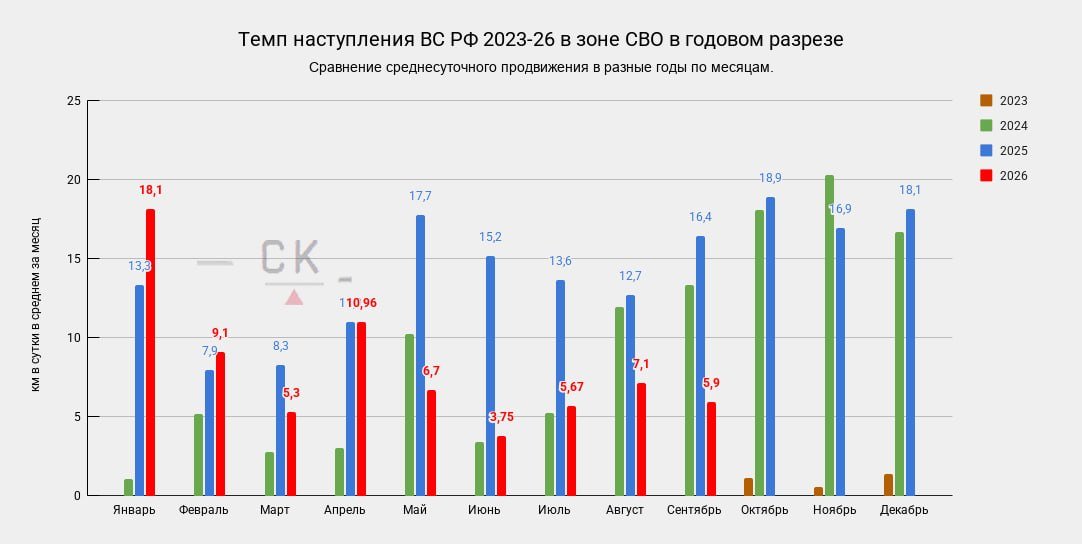
Russia is making no progress at all on the front, and September was among its worst months. Russian president Vladimir Putin claimed in Valdai at the beginning of the month that his subjects had captured 1,300 square km of territory in September. This is further evidence that he is either being given completely fabricated figures or is deliberately lying himself.
If Putin were right, his army would have experienced its most successful period since the first two months of the invasion. Defence ministry reports reflect this. Almost every day, they report the capture of more and more villages. In reality, the situation is different. Russian forces became bogged down in every direction even before the rains arrived, and throughout the year they have failed to achieve any operational success that would justify the further hundreds of thousands killed and wounded.
As every month, various analysts have again published their calculations of how the front line moved. Not even estimates from Putin’s own Z channels agree with his figure.
“The average daily rate of advance by the Armed Forces of the Russian Federation in the SVO zone [special military operation] in September 2026 was +5.9 km². The average rate of advance over the entire offensive up to October 2026 is +9.92 km² per day,” Russian project Slivochny Kapriz wrote about September.
It, too, is an unreliable source that regularly overestimates the significance of “flag operations”, but even its data makes it clear that 2026 is lagging significantly behind the previous year.
Even if this author’s figures were correct, the Russians advanced by 177 square km during September’s 30 days, more than seven times less than Putin claims.
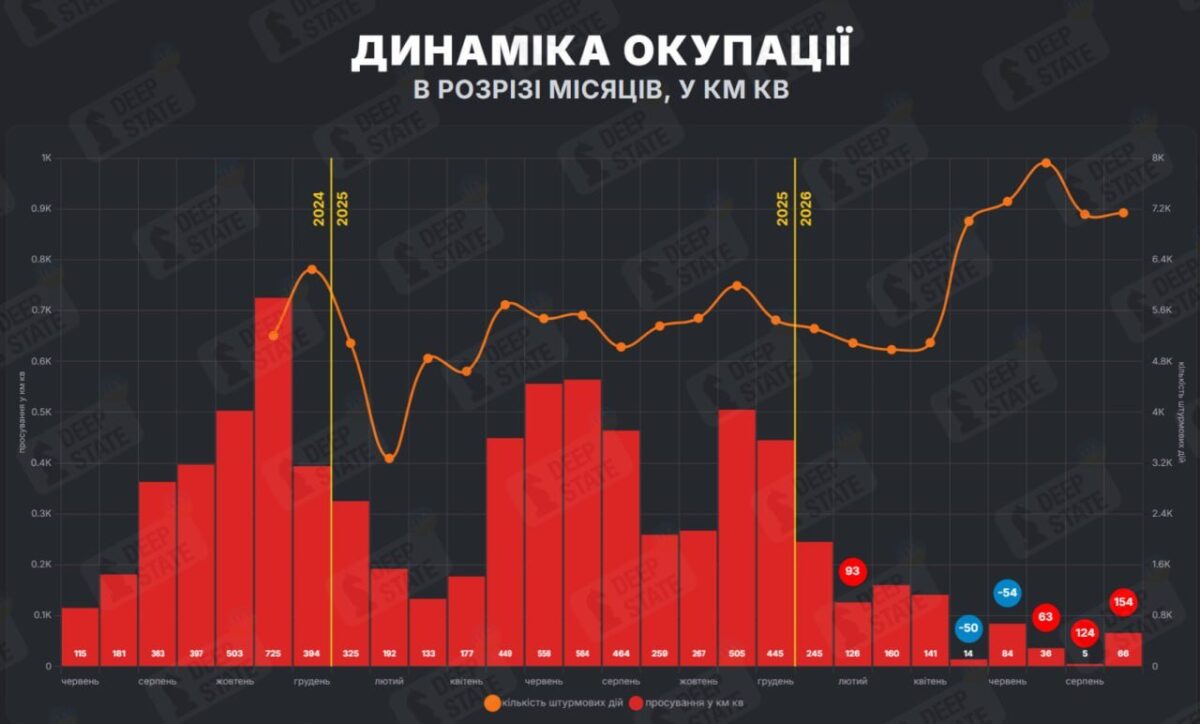
Ukrainians from DeepStateUA also published an estimate very close to Slivochny Kapriz’s figures. According to this OSINT project, Ukraine lost 154 square km in September.
However, the Ukrainian analysts treat their own data cautiously and warn their readers that “the operational security of our forces remains the highest priority in our work”.
In other words, during Ukrainian counter-offensives, DeepStateUA only reports successes after a delay so as not to jeopardise the operations’ success.
They therefore now recall that their statistics do not yet include 270 to 320 square km of liberated Ukrainian territory in various sectors. “July will therefore also end as a month in which the Armed Forces of Ukraine have the upper hand, while for August and September this will only become clear when official announcements of successes are available. In the meantime, part of the liberated territories may be lost again,” DeepStateUA wrote on Friday (2 October).
The most optimistic by far are currently Finnish analysts from the Black Bird Group, who see a balance of 190 square kms in Ukraine’s favour in September.
Over the month of September, the Russian net gains were negative 190 km2. This marks the greatest monthly net territorial loss for Russia in our dataset since the June of 2023.
Emil Kastehelmi, one of the project’s authors, pointed out that the sharp change for the better stems from the fact that it also captures some changes that DeepStateUA has not yet taken into account. Nevertheless, he said: “Russia has failed to reverse a situation that has persisted for almost the entire year. The results of the major Russian offensive are minimal, and this is likely to remain the case for the rest of 2026.”
Among Western analysts, the most sceptical is Konrad Muzyka of Rochan Consulting, who credits the Russians with even more gains than Slivochny Kapriz — as much as 235 square kms of advance. Yet this figure still does not come close to Putin’s. Even if it were the most accurate of all, which cannot be determined, it would amount to an area roughly equivalent to the size of Košice, including all its suburbs, forests and agricultural land within the city’s administrative boundaries.
The plan for this year, meanwhile, was to capture the rest of Donetsk region, including the remaining large cities of Kostiantynivka, Druzhkivka, Kramatorsk and Sloviansk. The Russians are closest to doing so in Kostiantynivka, but Ukrainian soldiers remain there too.
Here is a short summary of territorial changes in Ukraine for September 2026. Our dataset shows an overall Russian territorial gain in September, but a sharply uneven pattern: gains around Dobropillia, Velykyi Burluk, Kramatorsk and Komyshuvakha coincided with substantial losses… pic.twitter.com/jrq0zXiqri
— Konrad Muzyka – Rochan Consulting (@konrad_muzyka) October 1, 2026
Russia wants to cause Kyiv’s economic collapse, and pontoon bridges are being prepared in the city. There is now no doubt that the Russian army has begun a systematic effort to disrupt transport between western and eastern Kyiv. Over the weekend, further drones struck several bridges across the Dnipro.
They included the Northern Bridge, which a Russian drone attacked during the day amid heavy traffic.
🚨 BREAKING: Russian forces launched a drone strike hitting the Northern Bridge in Kyiv, damaging the road surface.
The strike coincides with German Chancellor Friedrich Merz’s unannounced visit to the capital to meet with Ukrainian leadership. pic.twitter.com/j1UHYoBMa7
Ukraine’s transport minister Mykola Kalashnyk said 600,000 cars cross Kyiv’s bridges every day. In an interview with Suspilne, he announced that construction of embankments and pontoon bridges would begin this week. If the existing bridges become impassable, they are intended to maintain as much traffic as possible between the river’s two banks. Kalashnyk said the temporary crossings should have at least half the capacity.
However, this will take around three months; in the meantime, work will also be carried out to improve the resilience of road bridges.
Transport expert Dmytro Bespalov is sceptical. As he said in an interview with NV, Kyiv’s bridges are irreplaceable, and the only thing that can keep traffic moving across the Dnipro is the military.
However, the task of keeping the bridges operational is complicated by their poor technical condition. Because of their age and the lack of maintenance funding, Bespalov rates the Southern and Northern bridges at four on a scale of one to five, where one is ideal condition and five is emergency condition. He says two other bridges are at level five.
Even in this condition, such large structures are not easy to destroy, but they are certainly more vulnerable. Like many others, Bespalov believes that Russia lacks the means to destroy the bridges completely and is seeking to disrupt traffic during the winter. “The aim is probably an economic blow. I fear it will be very painful. It will not kill us, but I am very concerned about the economic consequences it will have,” he added.
Air defences neutralised 83 percent of drones launched in September, compared with 92 percent in May. This follows from data by the Shahed Tracker project, which recorded 6,732 Russian drones launched against Ukraine over the month, of which 5,561 were shot down or disabled through electronic jamming.
Shahed type OWA-UAS stats Sep2026 [per UA Air Force Reports]
As the same source’s chart for August shows, the effectiveness rate did not change, but the number of drones launched by Russia rose sharply month on month by almost 1,600.
Shahed type OWA-UAS stats Aug2026 [per UA Air Force Reports]
In May, when Russia used a record 8,150 drones, it was as high as 92 percent. At that time, the Russian army began a mass transition to jet-powered drones, leading to a temporary slowing of the pace of attacks. The trend is now unfavourable: monthly attack statistics have begun to rise sharply, while the effectiveness of countermeasures is declining, as Geran-4 drones and especially Geran-5 drones still present a serious problem.
Shahed type OWA-UAS stats May2026 [per UA Air Force Reports]
Total: 8150 (New Record) Claimed Intercepted: 7476 (Official: 5053 Shahed type OWA-UAS) Hits: 508 (674 Not Intercepted) Interception Rate: ~92%
As another video showing the moment a Geran-5 was hit demonstrates. Technical solutions already exist, but faster interceptor drones are not yet available in sufficient numbers.
Another Geran-5 drone shot down by a STING S interceptor drone from Wild Hornets. Combat work by pilots of the 1020th ZRP. pic.twitter.com/kkPHaCIrKG
One TM-62 anti-tank mine contains seven and a half kilograms of explosives. This is enough to destroy the remains of a building used as a shelter by Russian soldiers.
❗️A Ukrainian heavy Baba Yaga-type drone destroys a building with Russian soldiers inside by dropping a TM-62 anti-tank mine. pic.twitter.com/XClgIqMvwe
A video recently circulated online showing Kyiv residents protesting against tree felling. It was widely used as alleged evidence that Ukrainians have had enough of the government. However, their protest was civic, not political. These Muscovites are communists and dared, very timidly, to chant “Down with the tsar!” Police intervened immediately.
У Москві комуністи зібралися на погоджений мітинг, почали скандувати «Долой царя», і після цього їх побили й розігнали мусора. pic.twitter.com/MD6MVxSBPS
This video must be watched with the sound on. It illustrates the saturation of the battlefield with drones. The Russian soldier who recorded it says he counted five drones.
"I’ve already counted five. It’s a damn swarm." position of 🇷🇺1199th Motorized Rifle Regiment (probably occupied south 🇺🇦) 🍂 is coming pic.twitter.com/K9H3wcRdse
Three lines of anti-drone barriers protect the Kerch Bridge, which links Crimea to Russia, from attacks from the sea.
Exilenova+ says Russia has set up layered defenses around the approaches to the Crimean Bridge, with multiple lines against Ukrainian surface and underwater USVs plus FSB patrol ships. The stated aim is to shield the bridge’s vulnerable elements. pic.twitter.com/rxMPPe6gXW
By Monday (5 October), Russia had verifiably lost 24,170 pieces of heavy equipment (24,138 on Tuesday, 22 September). Of these, 19,133 (19,105) were destroyed by Ukraine, 1,003 (1,000) damaged, 1,194 (1,194) abandoned by their crews and 2,840 (2,839) captured by the Ukrainian army. This includes 4,452 (4,448) tanks, of which 3,357 (3,353) were destroyed in combat.
Ukraine lost 12,238 (12,175) pieces of equipment, of which 9,633 (9,579) were destroyed, 711 (702) damaged, 695 (695) abandoned and 1,199 (1,199) captured. This includes 1,466 (1,464) tanks, of which 1,126 (1,125) were destroyed in combat.
Note: Neither side regularly reports on its own dead or destroyed equipment. Ukraine publishes daily figures for Russian casualties and destroyed equipment, which cannot be independently verified. This overview uses data from the Oryx project, which has compiled a list of equipment losses documented exclusively by photographs since the beginning of the war.
In a sign of humble progress, the FP-7 ballistic missile saw its first deployment.
Russian forces are now attacking Kyiv’s bridges.
No resolution to jet-powered Geran drones with new threat is on the horizon.
Ukraine lost another MiG-29 and its pilot, while Russia has lost a Mi-8 helicopter with a crew of three.
Videos of the day: attacks on a bridge in Kyiv; a drone struck a school full of children and teachers; a ground drone recorded the impact of two glide bombs.
FP-7 ballistic missile made in Ukraine were deployed for the first time. This is progress, but one should not expect miracles.
“Ukrainian tactical ballistic missile. FP-7. First combat deployment. Thank you for the results. Next step: serial production. Glory to Ukraine!” With these words and a short video, Ukrainian president Volodymyr Zelensky announced a long-awaited milestone in Ukraine’s arms programme. The next step is expected to be the deployment of the larger and more dangerous FP-9 missile.
Ukrainian tactical ballistic missile. FP-7. First combat use. Thank you for the result. Next up: production. Glory to Ukraine! pic.twitter.com/IxdjVg51c1
— Volodymyr Zelenskyy / Володимир Зеленський (@ZelenskyyUa) October 1, 2026
For now, however, this was only its first deployment against an unknown target, with an unknown outcome. The Russian analytical channel Military Informant did not rule out the possibility of the footage being recorded at a training ground with the intention to deflect criticism of Fire Point, the Kyiv-based manufacturer whose production is behind schedule.
The FP-7 missile is an interesting technical achievement that could expand the Ukrainian army’s ability to strike important targets. Expectations should be kept low. This is because the missile has not yet entered serial production its specifications lag behind those of Russia’s short-range Iskander missiles.
The FP-7 is based on the Soviet-origin 48N6 surface-to-air missile, used in some versions of the S-300 system and still deployed by Russia in the more modern S-400. A Ukrainian outlet says that the FP-7 has an estimated range of only 200 km and a warhead weighing up to 150 kg.
Russia’s Iskander missiles weighs more than twice as much, and Russia has already used a version with an extended range well beyond 500 km. The Ukrainian FP-7’s use will therefore be limited to areas up to roughly 100 km from the front line. It is certainly not a means for strategic strikes against Russian industry deep inside enemy lines.
Ukraine could strike further with a FP-9 missile, and developing them remains a goal to work towards. The two types of missile differ significantly. They were analysed in August by the Russian Telegram channel Russian Engineer. The FP-7 is smaller and the FP-9 larger. Its maximum range is estimated at 855 km (far enough to reach Moscow,) its warhead is expected to weigh up to 800 kg.
The outlet focusing on the war’s technical parameters compared the Iskander with the FP-9:
“The 9M723 Iskander-M missile has a diameter of 920 mm, while the FP-9’s is 1,100 mm. The missiles are 7.2 and 9.5 metres long. The solid-fuel rocket motor is approximately 4.2 metres long in the 9M723 and 6.5 metres in the FP-9. Fuel mass is estimated at 2.6 and five tonnes. With a warhead weighing around 500 kg, calculations indicate ranges of up to 500 km and 1,000+ km. If the warhead weighs around 800 kg, the range will be approximately 800 km.”
The media’s performance estimate therefore matches official Ukrainian data.
According to the Russian Engineer Telegram channel, the FP-9 is conceptually based on the Iskander and builds on the Ukrainian Sapsan project, which was never brought to the final stage.
The Ukrainians displayed both missiles at a trade fair in Denmark in August, where the following photographs were also taken:
The Russians have started attacking Kyiv’s bridges. This fulfils the wishes of Russian pro-war hawks, who for years have complained that bridges in the capital of the invaded country were still standing.
This article continues, but the full version is available only to EUobserver.com subscribers. Visit account.euobserver.com/membership
The Ukrainian army stays in control of front lines, but safety in cities deteriorates.
Kyiv was on fire again as Russian attacks on cities intensify.
Rubikon published stats on destroyed Ukrainian drones, decoys being the second most prominent.
Russia’s defence ministry will not let go of the Armata: it wants to turn it into an air-defence system, drawing ridicule.
Maps of the day: Sloviansk-Kramatorsk direction; Orikhiv direction, Oleksandrivsk direction, Kupiansk direction.
Videos of the day: a burning Tu-95MS strategic bomber; a Ukrainian firefighter showed how they extinguished the Academy of Sciences building.
The Ukrainian army stays in control of front lines, but safety in cities deteriorates. The war has reached a stage in which two separate conflicts appear to be taking place simultaneously.
While Ukraine is currently losing the battle in the air and its cities are continually suffering missile and strikes by jet drones, the situation on battlefields is far better.
Last week, Denník N spent time in Ukraine with former chief of the general staff Daniel Zmeko. During the trip, reporters met commanding officers from several brigades and battalions operating from the Izium area to Zaporizhzhia, and all of them said they had the situation under control.
The officers spoke about the accuracy of Russian maps, which they said did not correspond to reality. In some places, Russian soldiers are as far as 20 km from the locations where, according to the Kremlin, they are supposed to be.
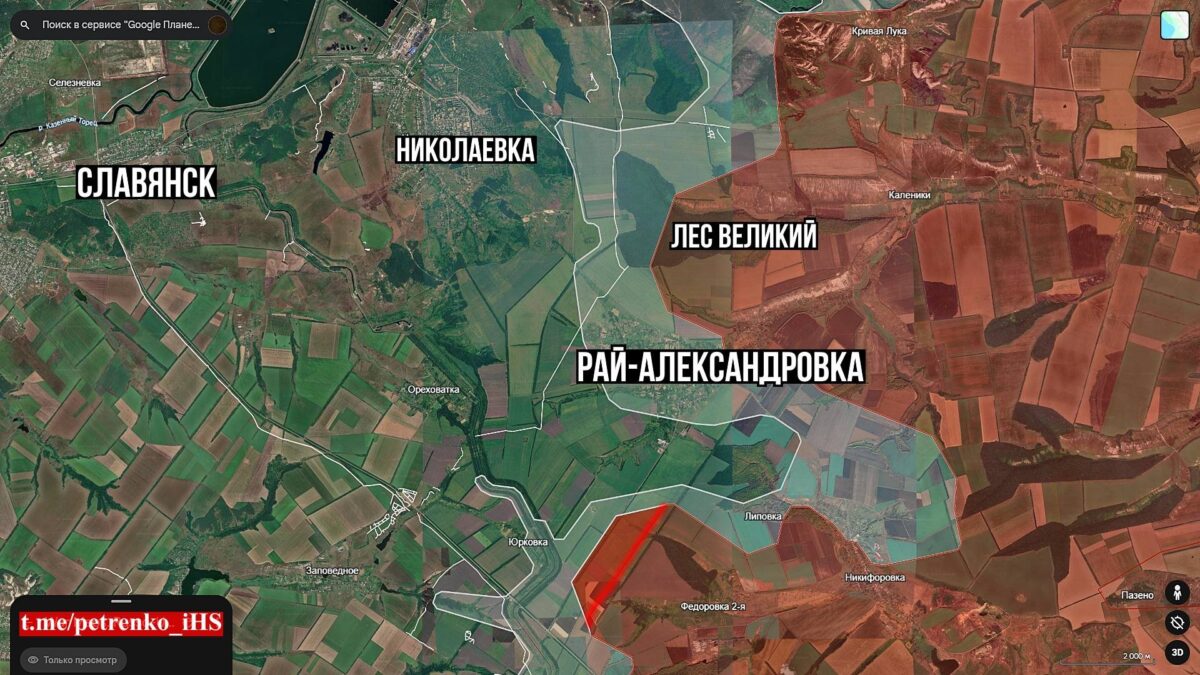
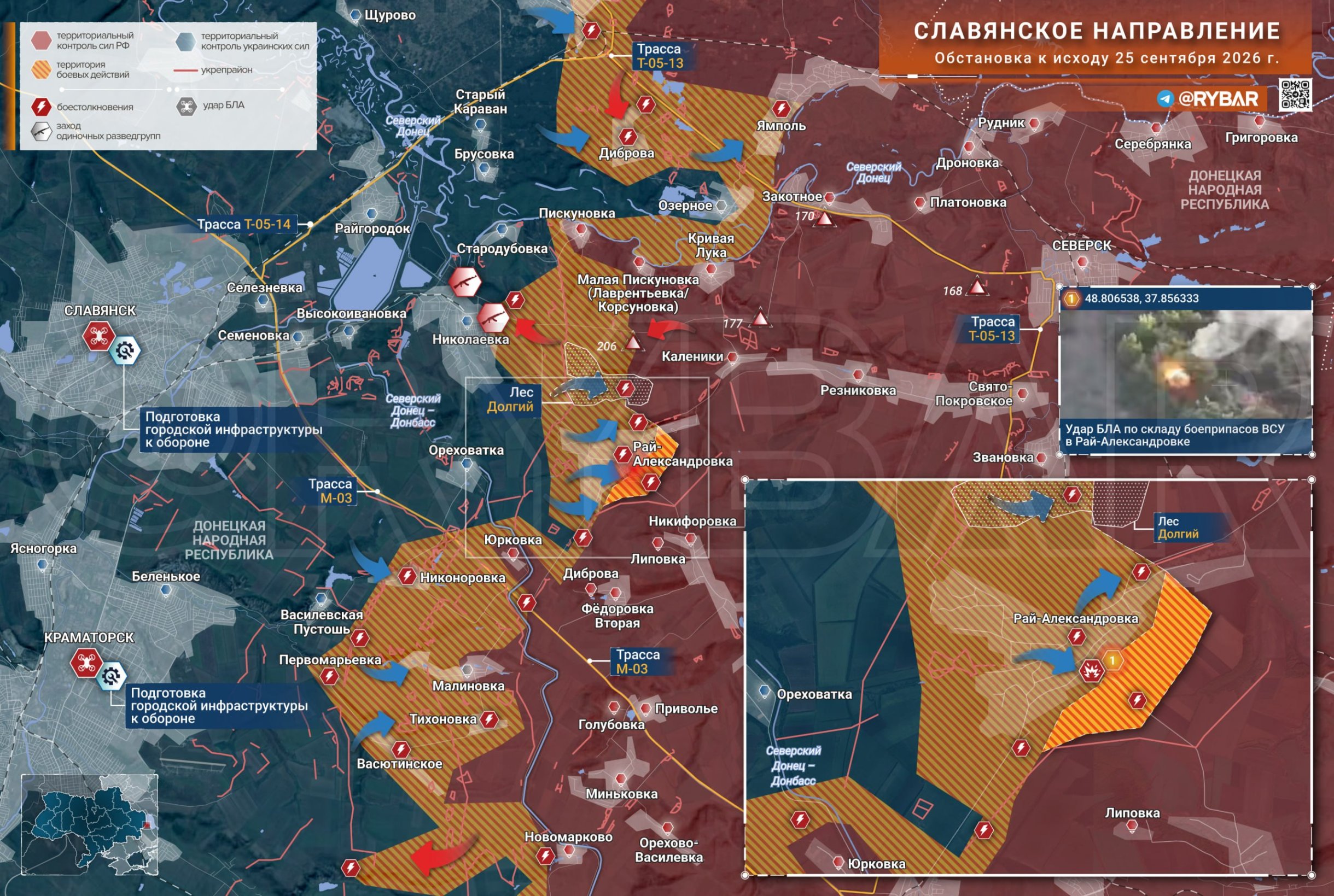
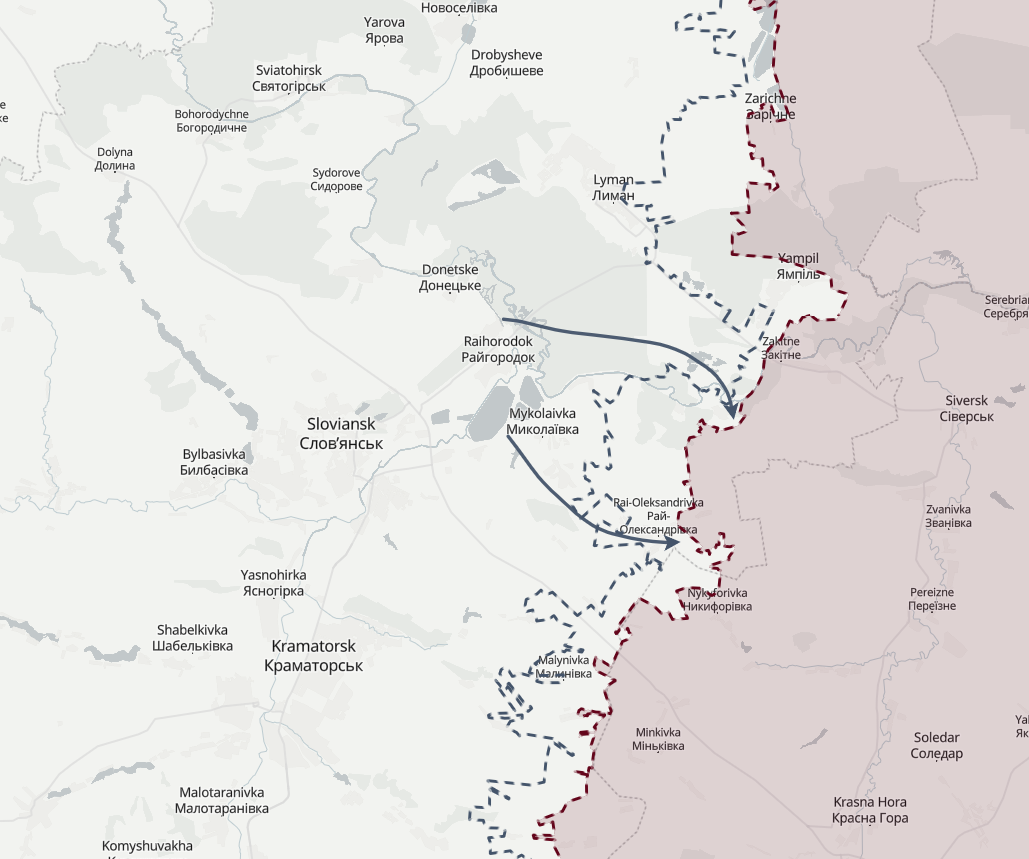
Northern flank of the Sloviansk-Kramatorsk agglomeration: This is a specific section of the front where the Ukrainian army has been reporting its advances only very slowly, while Ukrainian analysts have remained silent so as not to disclose anything sensitive. Russian bloggers, by contrast, are depicting the situation more closely to reality.
Yet official Russian maps persist with utterly nonsensical lines. We do not know to what extent this is an effort to deceive domestic and foreign audiences, and to what extent they genuinely believe it in Moscow. It is worth looking at how the regime wants the situation to appear, and what it is really like.
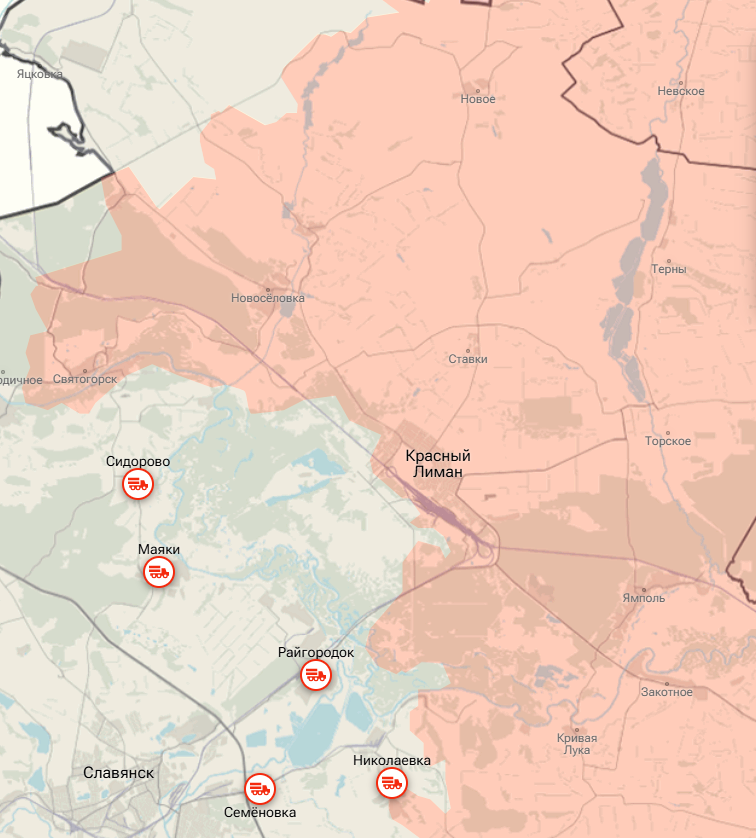
The first map in the overview was produced by the Russian state news agency RIA Novosti and depicts the area around Lyman, on the northern flank of the Sloviansk-Kramatorsk direction, as of 29 September. Lyman is shown as occupied in the middle of the map. The map’s author also continues to insist that the Russian army had captured Sviatohirsk — at the tip of the red salient in the centre of the map — and that Russia controls the entire, now non-existent salient with the village of Novoselivka at its centre. Yet Russian outlets Rybar and Two Majors write that fighting is taking place on the Zherebets river around the villages of Terny — on the far right of the map — and Yampil.
The following map is much closer to reality. According to it, the front line roughly follows the Zherebets river, which corresponds to Rybar’s claims.
In the Lyman direction, in Donetsk region, Ukrainian defenders successfully repelled three attempts by the russian fascist invaders to advance near the settlements of Ridkodub, Novoselivka and Drobysheve.
Kupiansk direction: The city of Kupiansk is a similar case to Sviatohirsk. Putin declared it captured in August last year. And once the commander-in-chief had declared this, his news agency continued to draw the map as though it were true. Kupiansk is shown as occupied in its centre, but there are further inaccuracies.
For example, the Kremlin agency claims that the Ukrainian bridgehead on the eastern bank of the Oskil river south of the city no longer exists. Ukrainians do face major difficulties supplying it, and various analysts have repeatedly warned of an impending disaster, but the Russian map is nevertheless hopelessly inaccurate.
Also note the small town of Borova at the bottom centre. RIA Novosti also shows it as occupied, although this is not the case.
This time, we will compare the Russian agency’s data with a map by Ukrainian analysts at DeepStateUA, because they updated it on Tuesday to reflect a new advance by Ukrainian units north of Kupiansk — again in the centre of the map — near the village of Dvorichne. In recent weeks, they have succeeded in reducing the Russian bridgehead on the western bank of the Oskil; the change since the end of August is marked in blue. Borova is again at the bottom centre, while below Kupiansk is the Ukrainian bridgehead that Russia claims does not exist.
Orikhiv: This is one of the places where Ukrainian officers said during reporters’ trip to Ukraine that Russian maps were particularly inaccurate.
The Russian map is again from RIA Novosti and again ignores reality along the entire length of this section of the front. Its main target is the city of Zaporizhzhia, with a population of three quarters of a million, in the centre left, while the small town of Orikhiv, at the bottom centre, is a defensive hub.
Putin’s news agency places soldiers roughly 12 km from the southern edge of Zaporizhzhia; in reality, they are around 24 km away. It shows Orikhiv as occupied and the Russian army advancing from the east towards the village of Novorozivka, north of Orikhiv.
The OSINT project Playfra covers this area in the greatest detail. Its map appears to depict a different war altogether. Everywhere, Russian positions are significantly shifted compared with those shown by RIA Novosti.
The differences have a simple explanation. On the western flank near Zaporizhzhia, the Kremlin agency simply ignores the successful counterattacks carried out by Ukrainians there this year. On the eastern flank, it uncritically accepts every claim by the Russian defence ministry and, with equal lack of scrutiny, considers captured every small village where a Russian soldier raised a flag during a suicidal mission, even several months ago. Although those soldiers have since been killed or captured, RIA Novosti acts as though they still control the village.
Playfra also offers a more detailed view of the current fighting around Orikhiv, drawing on analyses by Ukrainian analyst Kostyantyn Mashovets.
Orikhiv direction.
Factually, no changes. Clearings are conducted constantly, but the Russians also continue to infiltrate: the global situation doesn't change. The stalemate situation that I had reported some weeks ago, as well as the gray zone, remains both actual as of the… https://t.co/6rau9f7wcKpic.twitter.com/5uIK3K78Bm
Of course, Russians too occasionally notice that they are living in a parallel reality. Most recently, the influential Aleksandr Kharchenko wrote about it:
“Comparing our maps with Ukrainian ones can be shocking. The zones of control differ by dozens of kilometres,” he acknowledged, adding that both sides lie, although he focused specifically on false Russian reports.
He described Russian soldiers who are the first to break into a village as heroes. But, according to him, wars are not won through heroism, but through a functioning system.
“Errors in our maps and information arise because they rely on heroes. Everywhere a Russian soldier is sitting is considered our territory,” Kharchenko argued that this had to change because “our territory is only where a Russian soldier is sitting with food, water and ammunition. This is territory from which we can fight the enemy”.
Kyiv was on fire again as relentless Russian attacks on cities intensify. In the capital, Russians particularly targeted energy infrastructure. “Not a single day has passed since the summer without the enemy attacking energy infrastructure. But this is the first such massive and complex attack since the end of the previous heating season,” Ukrainian PM Serhiy Koretskyi told NV.
In addition to causing serious damage, the attacks on Kyiv and other cities killed at least five residents and injured another 14.
President Volodymyr Zelensky also said that, thanks to the delivery of new surface-to-air missiles, five Russian ballistic missiles had been shot down.
Since last night, emergency services and repair crews have been working to address the aftermath of the Russian strike. It was a difficult attack – nearly 190 attack drones, as well as ballistic missiles. And the main target was energy infrastructure in the capital and the Kyiv… pic.twitter.com/wUNWEUdpTL
— Volodymyr Zelenskyy / Володимир Зеленський (@ZelenskyyUa) September 30, 2026
Rubikon published stats on destroyed Ukrainian drones, decoys being the second most prominent. Ukraine’s response is continuing in parallel with the Russian offensive against cities. But the stats currently weigh against Ukraine.
While the effectiveness of Ukrainian air defence has fallen dramatically since the arrival of Russian jet drones, Russia has successfully shot down Ukrainian ones. For example, the recent large-scale drone raid on Moscow involved several hundred drones — and, according to some sources, more than 1,000 — but only 10 penetrated the airspace above the Russian capital.
In this context, the Russian Rubikon unit published interesting statistics. Although it operates at and near the front, its data for September show that, of 827 Ukrainian drones hit, as many as 247 were Maya-type drones — unmanned decoys intended to deceive Russian air defences. They look very similar to FP-1 attack drones but, unlike them, carry no warhead.
For context, the top two most frequently intercepted Ukrainian UAVs by Russian forces are both decoy drones — the “Maya.” This suggests that Ukraine’s deception strategy is working, as the Ukrainian Defense Forces have increasingly begun deploying decoy UAVs to mislead Russian… https://t.co/NKPvbzm38U
Russia’s defence ministry will not let go of the Armata: it wants to turn it into an air-defence system, drawing ridicule. Zvezda News is a media outlet directly controlled by the Russian defence ministry. On Monday evening, it published technical news on the long-forgotten T-14 Armata tank, which Russian propaganda had claimed would revolutionise tank warfare.
Today, it is beyond any doubt that the project is dead and new information confirms this, but its authors presumably intended to convey precisely the opposite.
“Rostec has upgraded the Russian T-14 Armata tank into a short-range air-defence system,” the report stated, citing military expert Oleg Shaladin.
The list of new features appears impressive at first glance. The new version of the Armata has received new electronic equipment; its 125 mm main gun is to be replaced by a 152 mm gun, allowing the tank to fire Kornet anti-tank missiles with a range of 10 km. The new Armata will also be able to use Krasnopol guided artillery shells, which are used by more modern howitzers, while the tank is also to gain the ability to operate as the aforementioned short-range air-defence system.
Further changes have already been made to the project, but even the brief list above makes it clear that the Armata is no longer intended to be a tank, but rather some kind of hybrid capable of fighting everything and nothing at the same time.
Among others, the Russian Telegram channel Military Informant commented on the report, openly mocking it. It said Rostec had mixed together “all the old tales from 10 years ago” in its list of changes, but that in practice “the tank never got beyond parades and training grounds, because it was created for an entirely different war, which ultimately never happened. It became conceptually obsolete from the outset, without even having had the chance to fight”.
Videos of the day
Russia has lost another Tu-95MS strategic bomber. This is the 12th confirmed loss of this type — the Oryx website has not yet updated its figures, so it records only 11. According to available information, the aircraft crashed shortly after taking off from a base in Amur region. Six crew members were reportedly killed, while one survived with injuries. Armed with cruise missiles, the aircraft was probably heading for Olenya air base, from which Russia attacks Ukraine.
A Russian Tu-95MS Bear heavy bomber crashed on takeoff in Amur this evening during a training flight.
Denník N wrote on Tuesday about the attack on the headquarters of the Ukrainian Academy of Sciences. A video has since emerged from the helmet camera of one of the firefighters involved in the rescue operation.
Helmet-cam footage of Ukrainian firefighters tackling the blaze at the National Academy of Sciences of Ukraine in Kyiv on Monday after a Russian drone strike. pic.twitter.com/DqEcz3wPlK
By Tuesday (22 September), Russia had verifiably lost 24,138 pieces of heavy equipment, compared with 24,098 on Monday (14 September). Of these, 19,105 (19,065) were destroyed by Ukrainians, 1,000 (1,000) were damaged, 1,194 (1,194) were abandoned by their crews and 2,839 (2,839) were captured by the Ukrainian army. This includes 4,448 (4,447) tanks, of which 3,353 (3,352) were destroyed in combat.
Ukraine lost 12,175 (12,143) pieces of equipment, including 9,579 (9,551) destroyed, 702 (698) damaged, 695 (695) abandoned and 1,199 (1,199) captured. This includes 1,464 (1,462) tanks, of which 1,125 (1,120) were destroyed in combat.
Note: Neither side regularly reports its own deaths or equipment losses. Ukraine publishes daily figures for Russian casualties and destroyed equipment, which cannot be independently verified. In this overview, we use data from the Oryx project, which has compiled a list based exclusively on photographically documented equipment losses since the start of the war.
The Ukrainian offensive continues on the northern flank of the Sloviansk-Kramatorsk sector of the front.
Russia has begun targeting data centres in Ukrainian cities.
Ukrainian drones struck a factory producing missile guidance systems.
It is no longer discussed as often, but Ukraine’s medium-range campaign is continuing successfully.
Maps of the day – a map of sites struck in Kyiv; Ukrainian successes around Lyman and Sloviansk.
Videos of the day – a swarm of Russian drones approaches Kyiv; a Ukrainian drone carrying a flag flew over the occupied town of Hola Prystan; the Ukrainian army used drones to deliver food to residents of occupied Oleshky in Kherson region.
The Ukrainian offensive continues on the northern flank of the Sloviansk-Kramatorsk sector of the front. “The situation on the Lyman axis remains difficult. According to reports from the ground, the enemy is trying to push Russian forces beyond the Zherebets River, along which meeting engagements are continuing. Ukrainian forces are active in the Yampil area and on the approaches to Lyman. Heavy fighting is under way to stabilise the line and individual positions,” the Russian Z-channel Two Majors wrote on Monday (28 September) morning.
Last week, the Ukrainian army asked OSINT experts not to help Russia by publishing their analyses. We therefore currently have information mainly from Russian accounts and from what official Ukrainian sources selectively release to the public. By coincidence, several reports concerning this particular battlefield emerged on Monday morning.
Ukrainian president Volodymyr Zelensky was the first to announce, without further details, on Sunday afternoon that there were “important results from our units taking part in Operation Vivaldi on the Lyman axis”.
On Monday morning, the 3rd Army Corps, which is conducting Operation Vivaldi, released details. “The opponent was misled and slept through the real strike,” corps commander Andriy Biletsky said.
The 3rd Army Corps liberated the villages of Nove, Ridkodub, and Katerynivka, and “restored control” over Karpivka and Novomykhailivka. It should be noted that two different timelines intersect at this point.
While Two Majors and other Russian accounts refer to current events, the report by Biletsky’s corps only acknowledges events that took place at the beginning of the summer. The Ukrainian command has only now admitted them and described them as the third phase of Operation Vivaldi. It also reported the capture of 250 Russians.
The Ukrainians also released previously unknown footage from the operation, showing an outdated BTR-60 armoured vehicle loaded with explosives and remotely sent to destroy a fortified Russian position, which it succeeded in doing.
During Operation Vivaldi, Ukraine’s 3rd Army Corps converted Soviet-era BTR-60 armored personnel carriers into a massive unmanned explosive vehicles, using them to breach some of the Russian fortified positions during the offensive. https://t.co/1dKZ6TtE3Hpic.twitter.com/9SR9FbrZjx
The Ukrainians managed to convince the Russians that their target was the village of Shandryholove, to which they sent their reserves for counterattacks. However, the Ukrainians struck in the village of Nove, further east. This is where the footage of the BTR-60 attack was recorded.
French analyst Clément Molin said that Biletsky was referring in this case to events from May and June. According to him, the battlefield map looked like this at the time:
Ukraine 🇺🇦 just announced the 3rd part of "Vivaldi" operation, liberating multiple villages back in May and June
Today, the situation is even worse for the Russians. The Russian military channel Military Informant published two maps which still show the now non-existent salient north of Lyman, but the area without a Russian presence around the city has expanded.
“The Ukrainian army is advancing and pushing the Russian Armed Forces away from the city and surrounding villages. Russian forces, in turn, are trying to bring the situation under control and are conducting counterattacks. It is not difficult to see that the loss of these positions significantly complicates the entire operation towards Sloviansk,” Military Informant wrote.
Importantly, the improvement has not only occurred near Lyman, but also partly east of Sloviansk. “On the Sloviansk axis, Ukrainian forces carried out local counterattacks and pushed Russian forces out of positions east of Mykolaivka, as well as from the areas of Rai-Oleksandrivka and Velykyi Lis. However, the enemy advanced west of Fedorivka Druha towards the Siverskyi Donets-Donbas Canal,” the Ukrainian account Petrenko said.
Rybar also confirmed Ukrainian attacks on the approaches to Sloviansk last week:
Finnish analysts from Black Bird Group recorded the same development. On their map, one Ukrainian advance runs from Sloviansk directly towards Rai-Oleksandrivka, while the other is slightly further north. Mykolaivka is in the centre, Sloviansk to its left and Lyman above it.
Russia has begun targeting data centres in Ukrainian cities. “Today, in Kyiv alone, Russian jet-powered drones ‘destroyed’ two kindergartens and two schools, an ordinary residential building, a car repair shop, several warehouses and telecommunications facilities,” Zelensky wrote on Sunday evening.
The following map shows some of these sites.
Weekend Ukraine map thread for Sunday 27th September 2026
Russian strikes targeting specifically civilian areas continue to increase, leaving many dead. The map below shows some (but not all) of the recent strikes upon Kyiv, which has been pounded this week. Cities will be left… pic.twitter.com/SW2mrzWdwn
The last category in Zelensky’s list of “targets” – telecommunications facilities – is worth noting. More specifically, these are data centres, which Russian drones have begun attacking in an attempt to cause internet coverage outages. They reportedly struck, among other sites, the headquarters of the major telecommunications operator Kyivstar. The Russian Z-channel Veteran’s Notes wrote that nine centres had been struck over the previous week.
The Russian Telegram channel Rybar, which consistently refers to Ukraine as “so-called”, assessed the results as “visible”, but said no “digital collapse” had occurred.
According to Rybar, some services were disrupted, but destroying several servers was insufficient to cause more serious damage. Moreover, digital infrastructure is decentralised and therefore more resilient.
Nevertheless, the Russians expect the new campaign to deliver longer-term results. “In addition to causing economic damage, it allows us to identify the opponent’s weakest points,” Rybar wrote. It expects that this will eventually make it possible to maximise the damage.
Ukrainian drones struck a factory producing missile guidance systems. This happened overnight from Friday to Saturday, when at least five production halls at the Azov Optical-Mechanical Plant in Rostov region were damaged. Satellite imagery also confirms the strikes.
Satellite images from the Sept 26 strike on the Azov Optical-Mechanical Plant in Russia’s Rostov region show hits on 5 workshops across 6 buildings, foundry 022 burning, optics 008 hit twice, assembly 009 at least 3 times, galvanic 010 once, machining 024 twice with a roof… https://t.co/Zm6XEbdFl3pic.twitter.com/lVLFPWjbY7
The location of the factory is marked on a map published by the Ukrainian general staff. The Ukrainian army said that it produces optical and electronic systems for guiding artillery, missiles and anti-tank weapons.
⚡️⚡️ Azov Optical and Mechanical Plant hit
During the night of 26th September 2026, units of the Defence Forces of Ukraine struck production facilities at the Azov Optical and Mechanical Plant in Azov, Rostov region, russian federation.
The attack was complex. Ukrainian website Militarnyi reported that it involved, among other weapons, Neptune missiles originally designed as anti-ship missiles.
The same source wrote that Russia manufactures at the factory components for Kh-31P anti-radiation missiles, R-74 short-range and R-37M long-range air-to-air missiles, Kh-101, Kh-35U and Kh-59/Kh-69 cruise missiles, Oreshnik intermediate-range ballistic missiles, as well as guided glide bombs.
It is no longer discussed as often, but Ukraine’s medium-range campaign is continuing successfully. For the third consecutive month, Ukrainian drones have destroyed more than 600 trucks at distances of 35 to 300 km from the front, despite Russian countermeasures. The chart below, by Clément Molin, indicates that 640 Russian logistics vehicles have been destroyed so far in September.
When the campaign began with an effort to isolate Crimea, the Hornet drone was the most frequently mentioned. But even then, medium-range strikes were carried out by several types of drone. Military correspondent Francis Farrell wrote for the Kyiv Independent about one of them, named Zozulya.
“Its old-fashioned silhouette and simple piston engine driving a wooden propeller evoke the first fighters of the world wars. But without a pilot, and controlled from a command room anywhere in Ukraine via satellite coverage, this aircraft also represents the cutting edge of modern drone warfare,” the author wrote about the unmanned aircraft, a photograph of which was already shown by the Ukrainian army in April.
It does indeed show an almost primitive-looking weapon, on which nothing, apart from the panel receiving a Starlink satellite signal, evokes the 21st century:
— Special Kherson Cat 🐈🇺🇦 (@bayraktar_1love) April 25, 2026
Unlike Molin, the analytical account Playfra said that the number of so-called middle strikes had fallen slightly, but that they remained effective because the Russians “still cannot jam Starlink, which is essential if they want to stop Ukrainian medium-range strikes”.
The same source said that the smaller amount of video evidence was due to the Ukrainians no longer publishing it. This does not mean, however, that conclusive footage is not public. Some of it is also published by Russian sources, such as the Russian Telegram channel Military Informant in the images below:
Videos of the day
A swarm of Russian drones near Kyiv. Judging by the sound, these are older versions powered by a piston engine and a pusher propeller.
A drone carrying a Ukrainian flag flew over the occupied town of Hola Prystan in Kherson region, which had a population of 13,000 before the war. The town lies just 13 km south-west of the better-known Oleshky.
🇺🇦Над окупованою Голою Пристанню Херсонської області до 317-ї річниці міста пролетів український дрон із прапором громади. pic.twitter.com/2TcPlNwOXU
According to Ukrainian sources, the humanitarian crisis in Oleshky itself is deepening. Several thousand residents still live in the town and have very limited access to food. The Ukrainian army attempted to improve their situation using drones.
🔴 BREAKING: Ukraine delivered about 4 tons of food to temporarily occupied Oleshky in the Kherson region using drones.
The aid was delivered to 100 locations for residents, despite Russian forces reportedly shooting down aid drones and confiscating food. pic.twitter.com/TmGtZ9r3Bl
By Tuesday (22 September), Russia had demonstrably lost 24,138 pieces of heavy equipment (24,098 on Monday [14 September]). Of these, 19,105 (19,065) were destroyed by Ukrainians, 1,000 (1,000) were damaged, 1,194 (1,194) were abandoned by their crews, and 2,839 (2,839) were captured by the Ukrainian army. This includes 4,448 (4,447) tanks, of which 3,353 (3,352) were destroyed in combat.
Ukraine lost 12,175 (12,143) pieces of equipment, of which 9,579 (9,551) were destroyed, 702 (698) were damaged, 695 (695) were abandoned and 1,199 (1,199) were captured. This includes 1,464 (1,462) tanks, of which 1,125 (1,120) were destroyed in combat.
Note: Neither side regularly reports its own deaths or destroyed equipment. Ukraine publishes daily figures for Russian casualties and destroyed equipment, which cannot be independently verified. This overview uses data from the Oryx project, which has compiled a list of equipment losses documented exclusively by photographs since the beginning of the war.

 Login