❌

Normal view

Why the stories working people tell ourselves about ourselves matter

9 September 2026 at 21:49
TRNN Editor-in-Chief and Co-Executive Director Maximillian Alvarez speaks at the Reuther-Pollack Labor History Symposium in Wheeling, West Virginia, on Sept. 5, 2026. Photo Credit: TRNN.

Over the 2026 Labor Day weekend, I had the honor of speaking at the Reuther-Pollack Labor History Symposium in Wheeling, West Virginia, organized by the Wheeling Academy of Law & Science (WALS) Foundation. The symposium takes place in Wheeling every year and adopts a different theme each year; this year, the theme was “The Art of Labor.” I got to represent TRNN and speak alongside a truly incredible lineup of artists and working-class warriors, including: Tabitha Arnold, the great textile artist and tapestry maker; Erik Ruin, printmaker and shadow puppeteer; and Shaun Slifer, a multidisciplinary artist and the Creative Director for the West Virginia Mine Wars Museum. 

The text below is a transcript of the talk I gave at this year’s Symposium, which has been lightly edited for clarity and readability. You can also listen to the audio recording of my speech on The Real News Network podcast feed. 

https://www.spreaker.com/show/2952221/episodes/feed

Thank you. It is genuinely an honor to be here on these hallowed grounds with all of you in Wheeling, West Virginia. It really, really means a lot to me to be here with all of you.

I also have to say: I really appreciate it when Vince or anyone else tells me that that first-ever Working People interview I recorded with my dad, Jesus Alvarez, meant something to them—because it meant everything to me. It started everything. 

I didn’t start out to become a labor journalist or to do the kinds of interviews I do with working people. I didn’t set out to make a life reporting on working-class struggles from working-class areas around the country, on the front lines of a class war that is hitting all of us in similar and different ways. I didn’t start out to be or do any of that. I started because I didn’t want my dad, the greatest man I know, to go to his grave feeling like a failure after we had lost everything during the Recession, including the house I grew up in, just like millions of other families. And we have continued to struggle, just like millions and millions and billions of us around the world have continued to struggle. And so, to be here standing in front of all of you—having started the show back then as a ruse to get my dad to talk about something he was so deeply depressed about and wouldn’t talk about—it means a whole lot for me and my family.

I really do want to thank all of you for being here. And of course, I want to thank Seán P. Duffy, Vincent DeGeorge, and everyone at the WALS Foundation for bringing us all together here on this hallowed ground. 

I came here today from Baltimore to talk with you all about why stories matter to me, and why I believe they matter to us, or should matter more. 

I wouldn’t be here without the stories that made me. And the same is true for all of us and every one of us. 

And when I say “I wouldn’t be here,” to start, I mean it literally. I quite literally and very quantifiably would not be standing here right now, speaking in this room with you all, alongside all these amazing people—none of you would have ever had to hear my name or see my ugly face, if I wasn’t such a hopeless, relentless, lifelong lover of stories. 

(Also, I know y’all were hoping Kim Kelly would be here today. I apologize, I am no Kim Kelly. I am a fill-in for Kim Kelly, but I am one-third of the tattoos and one-third of the talent. So that’s what you’re getting today!)

I wouldn’t be doing the work that I do now as a journalist and Co-Executive Director of a news organization, I certainly wouldn’t be doing it the way I do it, I would not have pursued all those ill-advised degrees in literature before that, I would not have written or said or filmed all the things that I have and will, if I wasn’t an eternal believer in the awesome, human-making, history-making, and society-making power of stories. 

Whether I’m reading them, writing them, watching them, listening to them, studying them, teaching them, recording them, filming them, remembering them, dreaming about them, thinking about them, or thinking through them, I love stories, and I need stories to live. Always have, ever since I can remember remembering anything. 

Like any fool in love would do, I followed that need wherever it took me. I have madly chased it headfirst into the best and worst times of my life. It got me to the most beautiful, ivy covered college campuses I’ve ever seen, and it got me through the most body-crushing, mind-numbing, soul-rotting jobs I’ve ever had. It led me to my wife and fellow literature dweeb Meg, who’s sitting back there, and it opened up the path for me to make the purpose-filled life I have now, and to do the purpose-filled work I do now.

I have continued to chase that love and that need for stories headfirst into the best and worst places in the world, where the best and worst of humanity is on display. From picket lines to protest marches, from union halls to student encampments on college campuses, from the horror-filled halls of immigration courts where masked federal thugs are kidnapping and disappearing innocent people daily, to rural, urban, and suburban communities fighting data centers all over the country, from “deep red” Texas to “deep blue” Maryland, from Occupied Palestine to East Palestine, Ohio, from communities that have been devastated by poverty, industrial pollution, and organized abandonment and disinvestment to communities that have been devastated by plant closures and school shootings, from poisoned coal mining towns in West Virginia to poisoned neighborhoods in South Baltimore where that very same coal ends up, where that very same coal sits and moves through the giant coal terminal pier right next to people’s houses, and where that very same coal ends up in the poisoned lung tissue of the people who live there and have been inhaling that toxic coal dust for generations.

I have followed my need for stories and our people’s need to have our stories told and heard. I have followed that need to wherever I need to be, and I have followed it all the way here to Wheeling, West Virginia. (You wanna talk about stories? There are a few more storied places than this.)

And though it has caused me and my family more pain and grief and debt and disappointment along the way than I can ever possibly sum up to you, I have learned to check myself by asking myself: If the need that I have, if the love that I’ve followed, brought me to this beautiful place and gave me the chance to be here now with you beautiful people, then how can it be wrong? 

If that need and that love has led me to my life’s continuing work of lifting up the stories of our fellow workers around the US and around the world, of using every medium and platform and every tool and skill I have to offer to help people find confidence in their own voice and share their story in their own words—if it has guided me to the frontlines of the class war to report the news through the stories and voices and faces and lives and bodies and souls and firsthand realities of the people at the center of “the story”—if that absurd, magical, lifelong pursuit of stories has in any way helped me help other working people like me and my family believe that their stories are actually worth telling and hearing and remembering, that their lives truly do matter more than this world has led us to believe and that we all truly do deserve better than what this world has forced us to accept—and if it has helped me help others see that we can get better and make a better world the better we are to each other and the more we share our stories and listen to each other’s stories—if my love and my need for stories and my belief in stories has contributed anything at all to that, then how can it not be worth it? 

But when I say, “I wouldn’t be here without the stories that made me,” I also mean it in the sense that I wouldn’t be the “I” that I am. I am me because of the stories that made me, the stories that made me more me than who I was before I experienced them, the stories that continue to make me who I am now and who I will be in all those versions of me to come. 

I come from a family of storytellers. Being here in West Virginia, I got a sense you guys will know what I’m talking about. One of many things Mexicans and West Virginians have in common. I am the me that I am because of the people who raised me, the people who are and continue to be my life, the people who taught me how to live and be a person and become a self through their presences, their absences, and their stories. The stories they told and the stories they showed me and my siblings. Stories that hit back to the deepest end of my childhood beginnings of consciousness, stories that built my consciousness, stories that brought me out of human mud and helped shape me into human being. 

For the same reasons I can always remember it being such a natural feeling to look out car windows and be fascinated and dazzled by all the warm lights of being out there, all those other homes and other lives people-like-me-but-not-me are living—for the same reasons I’ve always wondered about those other homes and lives and people—for all the same reasons I have always projected myself outward onto them and thought about them out of genuine curiosity and interest and goodwill—and for all the same reasons I have grown as a person the more I consider selves and lives that are not mine, I have always been naturally drawn to stories as a lifesource. Stories my family told me, stories I heard on the radio or saw on the TV, stories I read, stories I created. 

Stories about human-beings-like-me-but-not-me, living in selves-and-bodies-like-mine-but-not-mine, living in times, places, circumstances, and worlds that are not the ones I live in and experience everyday. Stories that take my lifeworld and my perspective and open them up, open me up, to lives-like-mine-but-not-mine, to human perspectives other than the only perspective I can ever have and have ever had ever since I was born, ever since I’ve been me, Maximillian Lee Alvarez. All those stories now live on in me, and will continue to live on in me, so long as I live on as me.

Those stories live on through me in the impressions they have left on me. And they will continue to live on in me as formative parts of the person I became once those stories and my experiences of them became part of me. And they will continue to be a part of me and every version of me—all those selves I’ll ever become—so long as I am gifted to live on this earth as me. 

These stories live on in the words I say and in the stories I tell to others. Because they have shaped the “me” that I am and the ways I use language to communicate with others and with myself, and the ways I use language to communicate myself to others and to myself.

They live on in the ways I cope with pain and failure, and what I learn from them. 

Those stories live on in my thoughts and in the way I think. Now and for the rest of my life, they have their place in the vast, dazzling multiverse of mindstuff that my mind has to draw upon and remember from and think and dream and imagine with.  

Over my lifetime, the stories I’ve found, the stories I’ve made, and the stories I’ve been told have shaped, challenged, corrected, sharpened, and reinforced my internal sense of right and wrong, good and evil, beautiful and ugly, and what it means to be good, do good, and live a good life. 

And if you’re feeling lost about those things right now, I’m telling you: Go back to our stories! We are not the only ones to face hard times. Our ancestors who faced such times left us their stories so that we would know what to do now. Don’t let those stories go to waste! There is power in them. We have power in them. (More on that in a minute.)

All those stories live on in the ways I try and have tried and will try to live and act and see and be in the world, in the ways I try and have tried and will try to see and treat other people and other life. And again, what I’m saying is true for me is, I fully believe, true for each and every one of us. And that on its own—even if you just take the people here in this room—is a miracle of life and nature and god and a joyous wonder to behold, on par with gazing out at the stars in the sky!

And yet, we so disinterestedly take all this for granted every day. We don’t appreciate stories enough, including our own stories and the stories of others. And I don’t think we appreciate this enough about the stories that make us and the roles stories play in making us human (and the role storylessness plays in our loss of humanity). 

Just like we have been trained and trained ourselves to accept an unacceptable culture of violence and mass death that takes and destroys life everywhere with the kind of scale and self-serving abandon that would make the ancient gods of old blush, we have been trained and trained ourselves to lose touch with the magical, life-giving force of stories. And our life-sustaining love for stories has been beaten out of us by AI slop, by a shitty, commercialized culture industry, by living under capitalism and end-times fascism, etc. I get why we feel that way, and I feel it, too. But there’s something really, really wrong there.

Like our air and water and soil and atmosphere, I think we have been trained and trained ourselves to let stories be poisoned and polluted for so long that we will at worst cheer on their destruction or at best live monotonously without any urgent sense of duty or need to stop the destruction. Both paths inevitably lead to the same place: our own peril as a people, a society, and a species. 

That’s why I think we miss the magic of stories and the magic in stories that’s all around us, available to us in so many forms, living in our heads and shaping who we are every day. 

That’s why I think we tend to look at stories and the stories of others so mistrustfully or disinterestedly or scornfully or selfishly. We tend these days to not look for stories at all, let alone stories that challenge us and grow us. We don’t give them our time, and so many that are shoved in our faces aren’t worth our ime. And when we do look for them, we often look for the stories that we already know or stories that ultimately serve to stop us from growing and knowing more, stories that serve to stunt our being and reinforce the selves and prejudices we already have. What a waste of good magic! 

Of course, we all want stories like that to some extent, and we all need stories that function like that to some extent. We all watched The Office five times during Covid. That’s fine. But what I’m talking about goes much deeper. 

I’ll use myself as an example to try to explain. 

I grew up in Southern California, post-Cold War, in the ‘90s. We were a middle-class mixed-immigrant family. We were the American Dream. And that’s why my dad and my mom and my family were so depressed after the 2008 Crash and the Recession, because we had had and lost the American Dream, and that really does a number on you and your soul.

The era I grew up in before the Crash was an era of America in which a lot of the dreams that I was foolish enough to have for my life still felt possible. And over the last 25-30 years, I think a lot of us have come to the awakening that many of those dreams, our dreams, are not possible in America anymore. At least not for working people like us. And after doing this kind of work for nearly a decade now, I’ve gotten confirmation from working people all over this country that I’m not the only one who feels that way. 

It’s a real gift to contain all those different selves that I’ve been over my life, including the deep-red-conservative, Orange County dumbass who didn’t know much about life. I don’t despise or regret that version of myself, I accept him for all his faults. And I know I had a lot of right reasons for believing the wrong things back then. And I know that I still have so many good parts of me that were there in me when I was a conservative and that are here in me now as the lefty nut job you see before you. Because they’re just good things about being a good person. I don’t care who taught them to me, I’m just grateful they did. 

I don’t see people in rigid identity or ideology boxes, and I try not to see myself that way either. And I definitely don’t like to see stories that way. And it’s in part because of stories that I don’t see the world that way. And yet, in this country, that is the way that we have trained ourselves to see each other and ourselves and our stories.

I remember being that younger, more conservative-type person and going into a Barnes & Noble and saying, “I want to read good, classic literature.” And the employee I talked to was like, “Oh, do you want French literature? Spanish literature? Feminist literature? African-American literature?” And I remember saying, “No, no, no. I want literature. I don’t want any of those ‘special interests.’” 

That was a very juvenile way for me to think and feel about literature, but I think a lot of us can still relate to that feeling. I’m so grateful to literature especially, and to all the storytellers in my life and all the storytellers I’ve come across in my life, for teaching me over time, and for constantly reminding me, that that’s not what stories are there for. I’m grateful to them for teaching me how much it cheapens our relationship to stories—and the potential and beauty and magic we can derive from them—when we look at them and treat them this way. And stories themselves are the cure for this sickness. The more I read literature of all kinds, the less I thought about stories this way. The more I loved and connected with literature of all kinds, the more I grew and felt and thought and developed as a person with different kinds of me inside. 

And so, I learned a very valuable lesson early on in life: That literature about other people, and that stories about other people—from other people’s perspectives, about the ways that they are living as people in this world—are not a threat to who I am. They make me who I am. They grow who I am. 

And it’s for those reasons that it seems so clear and obvious when I say, “I wouldn’t be here without the stories that made me, and you wouldn’t be here without the stories that made you.” 

Think of all those stories that still live in your head today, that you still talk about with your friends and siblings, that you still have living somewhere in the recesses of your mind as warm memories of reading a good book, watching a good movie, or having a good conversation. 

For me, I think about sitting in my living room with my whole family back home, watching the movie Glory, the epic historical drama about the 54th Massachusetts, the first Black regiment to fight in the Civil War. Why did our whole family of Alvarezes connect with that movie? I could go on a whole dissertation about why we connected with that movie (but I won’t do it here, don’t worry). We bawled our eyes out watching it then, and I still bawl my eyes out when I watch it now. We saw so much of ourselves—the Americans we believed we were, the America we believed we lived in and believed we were a part of—in that movie. And we clearly weren’t the only ones. 

It doesn’t matter that I don’t know what it’s like to be a “freed” Black slave in the Antebellum South; and it doesn’t threaten my understanding or sense of being to watch a movie that storytellers, story-makers, and story-actors have produced to try to help me understand. It enhances my being. It gives me more access to beings- and selves- and lives-like-mine-but-not-mine, and they then become part of my experience and shape who I am and how I am in the world. 

That’s part of the magic I’m talking about, the magic that makes us who we are, which we all just take for granted. It’s like we put on glasses that removed the power of stories from our vision, made it invisible to us. But it’s there. It’s all around us. It’s there in us. 

It was there when I was listening to Tracy Chapman’s “Fast Car” while driving here to Wheeling. Truly, one of the most beautiful stories about love and working-class life ever told in our language. And no matter what stage of my life I was in, it didn’t matter to me that I didn’t know what it was like to live as a Black, working-class lesbian in the industrial Midwest around the ‘80s and ‘90s. I still knew enough to know that to live was to love, to seek love, to be loved, and to pursue happiness, and I still knew enough to know why it is a heartbreaking tragedy for someone to have their love and their lives and their happiness denied or taken from them.  

Who among us human beings hasn’t feared making the wrong choice immortalized in Chapman’s line, “We got to make a decision: leave tonight or live and die this way”? Who among us living people cannot relate to the pain and fear and drama and yearning in the stories of other people who spend their precious, short time on this earth living unfulfilled, unhappy lives full of unrequited love and unrealized dreams, even if they weren’t our dreams?

I could relate to that even as a kid. I relate to it so much more now as an adult, now that I am far more aware of the limited time we in general and I specifically have to live. And that gives me so much more capacity to feel empathy and solidarity with others whose lives and loves and happiness and flourishing are beaten, crushed, lost, or denied. How could I feel anything but the natural human solidarity my heart feels when listening to Chapman’s song? And how can I not remember that listening to the song as a kid helped me begin to imagine and explore the unknown emotional depths of my own human heart?

The specifics of the story and the selves involved do not describe the specific story and self I already know as my own, but they still embody dramatically heightened versions of what I have known and experienced in my own life, dramatically and beautifully heightened versions of our human experience of life and love and loss and yearning. 

None of the details that differentiate the story in “Fast Car” and its lovelorn protagonist from my own life story are reasons for me to say, “That’s not my story.” Those are reasons for me to connect with another person’s story—to get closer to them, and to become more myself, the more they and their story become part of me and mine.  

Here’s another story. My wife Megan Berkobien just co-translated this book I’m holding in my hand, Goodbye, Ramona by Montserrat Roig.  

It’s a beautiful, incredible book. Everyone should go read it. It’s a Catalan novel about Spanish Civil War times. I don’t know what the hell that’s like, but for the same reasons that my Mexican ass got two useless degrees in Russian literature, I don’t care. I don’t need anyone’s cultural permission to connect with my fellow human beings. Reading the stories of other people has only ever given me light and goodness. It’s never taken anything away from me or made me a worse person. 

Reading the first chapter of Goodbye, Ramona transports me to the mind of a trapped woman—a woman whose husband is a tyrant and makes her feel powerless—as she wanders like a ghost in the streets looking for him after he has suddenly gone missing in the wake of a bombing in Barcelona. In Roig’s beautiful, harrowing description—and in Meg and Cristina’s beautiful, harrowing translation—you see the damage of his tyranny on her psyche, and you feel the fear and anxiety in the way she describes what she’s doing and what she’s thinking. 

That’s the raw, human stuff that makes me feel as close as I can get to living and seeing through the head of another person. What a gift that is! And how necessary it is, especially in times like these when we live and exist so far away from each other, when we are so alienated from each other and isolated from each other, when we can be standing next to other people in the grocery store line or sitting next to each other in traffic but the spaces between us and our minds and hearts feels as vast as the distance between us and the moon. 

We have stories to bring us closer, and yet we continue to let capitalism, a broken society, and the wickedness of the powerful push us away from each other. But it doesn’t have to be this way. And I hope that the stories that I have helped to tell, all these stories I’ve recorded and published, will continue to remind people of that. I hope these stories remind people of who we really are and who our neighbors really are. I hope these stories by and for our fellow workers not only remind us that every life is precious, but that they remind us what life is all about. I hope that they remind us what a gift it is that we are all here, and what a cosmic tragedy it is that we allow life itself and our lives to be treated with such inhumane disregard.

That’s why I interviewed the family of a Kroger worker, Evan Seifried, who committed suicide just an hour north of here, in Milford, Ohio, in 2021. And that’s why Evan’s story has impacted me so much. 

For 19 years, with a virtually spotless record, Evan worked at a local Kroger grocery store in Milford, where he eventually became the dairy department manager. But from October 2020 to March 2021, Evan suffered a torturous campaign of bullying, harassment, and sabotage from two store managers, and his union abandoned him when he needed help. Evan took his own life, and his family will never be the same, and the world will never be as bright as it was with Evan in it. I thank god that I don’t know firsthand what it’s like to go through such a horrific tragedy, but because I heard them tell it, every other thing about me and my human being feels the Seyfried’s story and their pain and their fight for justice as my own. After learning about Evan’s story and after speaking with his loved ones about his story many times, I am forever changed by him and by them. 

So, of course, I thought of Evan and the Seyfrieds, and I thought of my own family, when I saw the soul-crushing news story this past week of Pierre Damas Bel, the poor 20-year old young man who committed suicide in Springfield and walked into traffic after our government slapped a criminal ankle bracelet on him and told him he was a worthless cockroach. I know what it feels like to have others in my own country, even my own government, see me this way. Everyone here has some way of trying to understand what that feels like, but we don’t try hard enough. Stories help us get better at trying. And we need to get better, we need to do better, we need to be better. For Evan, for Pierre, for all of us. 

I’m not the same person I was when I walked into that Barnes & Noble way back when looking for “just good literature.” I don’t look to stories or look for stories in that same one-way, transactional mode anymore; I don’t look to stories or look for stories that are just going to reflect me back to me. 

I don’t just gravitate to stories that I gravitate to because I see something of me reflected in them. I gravitate to stories because a light in them draws me in, and that light then reflects in me and stays with me after I connect with them. 

Every great human-made creation, construction, and operation embodies a whole that would not exist but for the sum of every worker and every ounce of human work that contributed to its existence. All those workers with all their lives and all their labor contributed to bringing all these magnificent things into existence, and all of us workers with all our lives and all our labor contribute to them, improve upon them, and keep them running. So, too, have all these stories contributed to bringing the me that I am into existence. And these stories will continue their work of shaping how I live and act and see and feel and think.

Stories have been and continue to be the most ever-present, ever-abundant, ever-beautiful reminder that I need other people to live, to be, to be me. 

And the ever-present, ever-abundant, ever-beautiful number and forms of human stories all around us—all the stories that have already been told, all the stories yet to be told, all the stories that live on in our books, our films, our songs, our campfire tales—each and every one of them is a reminder to us that we need each other, too. 

‘Treated worse than cattle’: 2,500 Tyson workers laid off, plant shutters overnight

4 September 2026 at 15:19
Tyson workers were blindsided by the closure of their plant August 14. Photo: Caitlyn Clark
Labor Notes logo

This story originally appeared in Labor Notes on Sept. 01, 2026. It is shared here with permission.

Ouano Tante worked the afternoon shift at the Tyson beef plant in Joslin, Illinois, for five years. But when she and hundreds of her co-workers arrived at work on August 13, they found the plant closed.

They speculated that someone on the morning shift might have gotten injured. Then two mid-level supervisors came outside in tears. Plant supervisors told workers the plant was closing permanently, effective immediately.

Inside, the early-morning shift had just ended when the workers were informed it would be their last. The cafeteria erupted into chaos. Plant supervisors stood guard by the doors, workers said, while everyone received their closure paperwork.

“People were crying, shaking,” Tante said. “When we were leaving the parking lot, there were so many car accidents. People were so upset.”

“They gave no reason, nothing,” said Ahoro Asselissime. “People have no job. No money to pay our bills. For 11 years, I made money for them. And now they’re not doing anything for me.”

DISASTER FOR COMMUNITY

Joslin is home to just 56 residents. But 2,500 workers from Africa, Latin America, and Burma toiled at the meatpacking plant there, butchering cattle for Tyson, one of the world’s largest meatpacking companies. The workers were represented by Food and Commercial Workers (UFCW) Local 1546.

Most of the workers live in the Quad Cities, clustered around the Illinois-Iowa border 160 miles west of Chicago. Everyone there knows someone who works at Tyson, the area’s ninth-largest employer. The closure announcement sent the community into a tailspin.

Tante, originally from Togo, had the job of determining the age of cattle by checking the size of their teeth. An overhead conveyor would move carcasses, suspended by their ankles, along the chain. Tante checked the teeth, sprinted up a set of stairs to mark the cattle’s ankles with ink, then sprinted back down to catch the next carcass.

Simultaneously, other workers drained blood from the animal by slicing the neck with knives. If Tante didn’t work fast enough or was off-pace with the other workers, she said, she could get cut by their knives.

PALTRY SEVERANCE

The laid-off workers will be paid for 36 hours a week until October, but that’s far less than they had been making with overtime.

“I got $500 this week,” said Asselissime. “My rent is $925. I have to put gas in my car, buy food for my kids. Everything is so expensive now.” Prior to the closure, Asselissime could expect around $900 a week.

“I’ve been sounding the alarm about how Tyson treats their workers for years,” said Nana Ouro-Agoro, founder of Akwaaba, a nonprofit organization that provides support to the Quad Cities’ immigrant population.

Originally from Togo, Ouro-Agoro came to the Quad Cities after winning the immigration lottery in 2008. She learned that many of her neighbors worked at Tyson, where they were frequently injured on the job and afraid to speak out. Workers told her they were being treated “worse than the cattle.”

“It was hard for me to sleep at night, hearing my fellow immigrants were working hard, getting injured, and nothing was being done,” she said.

Akwaaba helped Tyson workers with translation services and resources to help them assert their rights, including when Tyson abruptly fired dozens of Togolese workers as alleged retaliation for reporting injuries and sexual harassment. Now, about 500 of their clients—roughly 1 in 4—are out of work.

And because so much of the local economy depends on income from Tyson workers, “we’re going to see a crisis in every sector,” Ouro-Agoro said.

ONE MONOPOLY AFTER ANOTHER

It’s been a profitable few years for Tyson. So why shutter the plant? Tyson cites the nationwide cattle shortage.

Cattle stock in the United States is at a 75-year low. The costs of raising cattle have gone up significantly for ranchers, in part due to drought and higher prices for fertilizer and diesel, exacerbated by the war on Iran.

But the crisis facing Tyson workers and cattle ranchers alike is driven by one major factor: corporate consolidation. The “Big Four”—Tyson, Cargill, JBS, and National Beef—own over 80 percent of the U.S. beef industry.

The Big Four have, according to multiple court decisions, colluded to fix prices for just about everything, from the price customers pay at the grocery store to the price cattle ranchers receive for their livestock.

Yet despite the strain placed on cattle herds, U.S. beef production in real terms has remained relatively steady, due to the heavier weight of today’s cattle compared to decades ago.

Tyson isn’t the only one closing plants. JBS, the world’s largest meatpacker, closed a facility in Memphis in June, laying off 200. JBS also announced plans to close a 1,500-worker processing plant in Souderton, Pennsylvania, but efforts from union and political leaders pushed JBS to convert the plant to a smaller facility, saving 400 jobs.

With nearly 4,000 meatpacking jobs cut just this summer, is the cattle shortage really to blame?

As of the most recent fiscal quarter, Tyson’s operating income is up 8 percent, or $547 million, over last year. Tyson attributes the increase to growth in its chicken and prepared foods segments.

Tyson CEO Donnie King took home nearly $35 million in total compensation last year, 781 times more than the median Tyson worker and double the average CEO-to-worker pay ratio among S&P 500 companies.

While cattle shortages could be cutting into beef profits (Tyson reported a third-quarter beef operating loss of $138 million), overall the company is making money hand over fist. And as the meatpackers squeeze cattle producers, the shortage itself is a problem of the Big Four’s own making.

But meatpacker consolidation is only one piece of the puzzle. The meatpackers may claim that they are also the victims of collusion—by the grocery giants.

Walmart, Amazon, Kroger, and Albertsons can collude to lower prices paid to meatpackers too. Estimates place Walmart at between 20 and 25 percent ownership of the grocery industry, while Amazon (thanks to its acquisition of Whole Foods) is now the second-largest grocery retailer in the U.S.

Grocers are pushing down prices paid to packers, while packers are slashing prices paid to ranchers. In 1980, cattle producers took home $0.63 of every consumer beef dollar and the packers and retailers took home a combined $0.37. As of 2021, that number is exactly flipped, according to More Perfect Union. All the while, workers and consumers get the shortest end of the stick; price collusion lines the pockets of meatpacking and grocery store executives, while depressing worker wages and inflating consumer prices.

UNION PENS AGREEMENT

After the Joslin plant closure, the union released the following statement: “UFCW Local 1546 has a long-standing and proud union partnership with Tyson Foods, and we were extremely disappointed in not receiving advance notice of this news. If given the opportunity, we could have sat down and found an economic solution to keep this plant operating, but sadly our voice was silenced.”

Four days after the company’s closure announcement, Local 1546 President Robert O’Toole signed an agreement with Tyson, which includes severance pay of one to four weeks, depending on years of service, on top of the two months of payments.

The UFCW agrees to “not to take any steps or action to… interfere in any way with the orderly closing of the Plant, and the Union agrees not to support any such steps or action by others.”

Many workers feel their union leadership has left them hung out to dry. “The union doesn’t care about us, Tyson doesn’t care about us,” said Asselissime. “A lot of immigrants work for this company, from Mexico, from Africa. That’s why they don’t care.”

Some workers were already mobilizing independently. The day after Tyson announced the closure, laid-off workers rallied outside the plant gates with community supporters and political groups. The workers demanded Tyson make a plan to keep the plant open; if that wasn’t possible, they wanted six months of severance pay, not two.

At various points in its history, the UFCW has taken up key fights against the packers. In 2007, it spearheaded a lawsuit against the Department of Homeland Security after ICE raids detained 12,000 workers at six meatpacking plants.And in 2008, after a 16-year battle, it organized the world’s largest pork processing plant, the Smithfield plant in Tar Heel, North Carolina.

But in recent years, the International union seems to have changed its tune, tying itself to the meat cartels in exchange for short-term, modest gains. Now Tyson workers say that labor-management “partnership” is swinging back at the members, with little response from union leadership.

“The union hasn’t said anything, aside from telling us to go apply for unemployment,” said Tante. “I thought the union should defend us, so I was surprised they didn’t do anything. The union could have fought for us to get more severance, but they didn’t.”

PROTESTS CONTINUE

Several hundred maintenance workers who remain in the plant are reportedly dismantling equipment and preparing the plant for demolition.

Meatpackers are notorious for refusing to sell plants to other packers, wanting to stifle competition. In 2018, for example, when Tyson closed a plant in Cherokee, Iowa, it refused to sell until the next owners agreed to limit the number of cattle they would slaughter there.

While some workers might move and get jobs at other plants, Tyson has not outlined formal transfer rights or relocation stipends (in previous plant closures, relocation bonuses have been up to $15,000). JBS has held mass hiring events in the Quad Cities for those willing to relocate to Nebraska or Utah.

Veronica Ceballos, originally from Mexico, worked at Tyson for 19 years, commuting on rural backroads through harsh Iowa winters. Even after she injured her back working on the line, she transferred to a different position and continued working. Since her children are now adults, she says, she has the flexibility to relocate if necessary. But she worries for co-workers who don’t have that option.

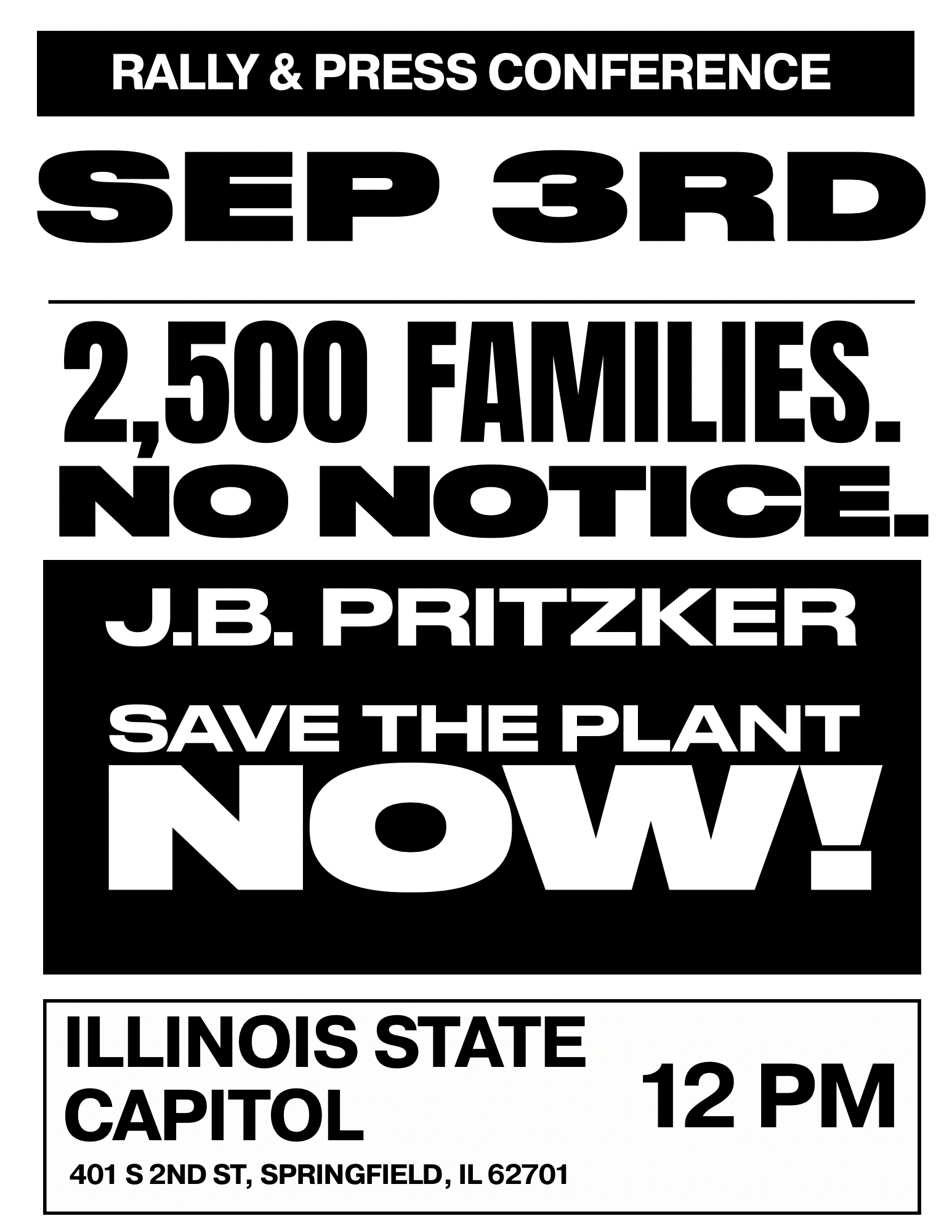
Several hundred Tyson workers and their families have continued organizing protests and rallies, calling on Illinois governor J.B. Pritzker to invoke eminent domain to bring the plant under state ownership and re-open its doors, and on Tyson to increase severance pay to six months. On September 3, workers and community supporters will caravan to Springfield to march on the state capitol building at noon.

“There are people who’ve worked at Tyson for 20 years, 30 years. People with health issues, people who are sick, people who can no longer work elsewhere,” Asselissime said in a speech at a rally of about 100 workers on August 27. “We need fair severance pay, so we can have a future.”

Caitlyn Clark is a national organizer at Essential Workers for Democracy (www.ew4d.org), an organization dedicated to rank and file member education and empowerment for workers in grocery, meatpacking, and retail.

Correction 09/10/2026: Workers were informed about the plant closure on August 13, not August 14 as previously stated.

“A manufactured conspiracy”: Minnesota’s labor movement denounces federal surveillance operation

21 August 2026 at 16:23
Demonstrators march during the nationwide "Stop ICE Terror" rally through downtown Minneapolis, Minnesota, on January 20, 2026 in protest against US President Donald Trump's policies. Photo by ROBERTO SCHMIDT / AFP via Getty Images
Workday Magazine Logo

This story originally appeared in Workday Magazine on Aug. 21, 2026. It is shared here with permission.

On Tuesday morning, a coalition of leaders and members from labor, community, and faith organizations in Minnesota denounced Operation Puppet Master, an alleged campaign by the Department of Homeland Security (DHS) to spy on Minnesotans during Operation Metro Surge earlier this year. In a press conference held outside of Target’s headquarters in downtown Minneapolis, the coalition urged Minnesotans to continue standing in solidarity with one another, and demanded companies headquartered in the state sign the business for democracy pledge.

The call comes after the New York Times published a report on August 13 about the campaign by DHS. Details were made public in a motion for discovery filed by Kevin Riach, an attorney for healthcare worker Isaac Sant. According to the motion, federal agents “surreptitiously recorded dozens of conversations with ordinary people who were simply exercising their First Amendment right to protest ICE’s lawless rampage in our state. The agents gathered information about Minnesotans from law enforcement databases and internet searches, and created dossiers that are apparently now available agency-wide.” 

The documents describe surveillance and infiltration of union and community meetings during and before Operation Metro Surge. Eighteen organizations, including labor unions, were listed in a chart connecting them to Direct Action Minnesota (DAMN), a group of individuals who resisted what coalition members call a “terror campaign” by Immigration and Customs Enforcement (ICE) during Operation Metro Surge. Sant is one of 15 individuals who were indicted and charged by the federal government for conspiracy in what organizers have called an act of political repression and retaliation. More than half of the 15 are rank-and-file union members, and now the federal government is claiming labor organizations to be part of the alleged conspiracy. The motion continues: “With no evidence, the government alleged to the grand jury that this conspiracy in this case extends far beyond the defendants to include the AFL-CIO, the Minneapolis Federation of Educators, the Minnesota Association of Professional Employees, Monarca, Veterans for Peace, and the Grease Pit bicycle repair shop, among others.”

In addition to the AFL-CIO, Minneapolis Federation of Educators (MFE) Local 59, and Minnesota Association of Professional Employees (MAPE), SEIU Local 26 is also named by DHS along with the Workers Solidarity Circle and Black Cat Workers Collective. The motion also states that Homeland Security Investigations subpoenaed financial records for several labor unions, including SEIU locals in Minnesota and the Communication Workers of America (CWA). 

Alec Stewart is a MAPE union member and one of the Minnesota 15. “The revelation of Operation Puppet Master exposes that while the government was targeting immigrant communities, tearing families apart, abducting children and murdering folks in the street, they were also attempting to disrupt and dismantle one of the facets of Minnesota that makes us so unique, and that is our strong and unified labor movement,” he said at the press conference.

Treasure Thoreson is a teacher, executive board member at MFE Local 59, and one of the Minnesota 15. Thoreson spoke at the press conference about the food drives, fundraisers, grocery deliveries, and support that educators gave to their community all while continuing to show up to schools to educate students. “The government feels so threatened by our ability to come together and use our protected First Amendment rights, our legal rights as unionists that they feel they must surveil and disrupt. However, that to me is a signal that what we are doing is effective, impactful, and powerful,” she said. According to Thoreson, a GoFundMe that she donated to was flagged by DHS as evidence that she is part of a conspiracy.

Gabriel Van de Water is a community organizer and artist who is one of the Minnesota 15. Van de Water referred to a report by Human Rights Watch detailing the human rights abuses that happened under Operation Metro Surge. “Human Rights Watch referred to the occupation as a manufactured crisis. This administration has chosen to follow up that crisis with a manufactured conspiracy,” said Van de Water. “The Minnesota 15 case and others like it must be understood as an attempt to criminalize dissent, to make an example out of some of us so that all of us hesitate to exercise our rights to protect one another. We will not allow this to happen.”

Kieran Knutson is president of CWA Local 7250, which was also named in the document. “We are more determined than ever to stand up to our repressive government. We are more determined than ever to stand in solidarity with working class people,” he said. “The Minnesota 15 are some of the finest people I know. These are our people, we have their backs. We know that this prosecution against them is a bogus attack on the entire movement.”

Emilia Gonzalez Avalos, the executive director of Unidos MN, a grassroots social justice organization, spoke about the surveillance and infiltration enacted by the federal government on community members and noted the silence of corporations like Target. “They sat in our libraries, in training rooms, and wrote down what we thought about the Constitution. They took down license plates outside a church in Roseville, and built files of the families inside, their addresses, children, and where they work. Federal agents walked into a Target store in Richfield and detained two citizens who were at work,” said Gonzalez Avalos. “To this day, Target has said nothing about it. We came here today because that silence still has answers available.”

Target has been the center of national boycott campaigns for rolling back its diversity, equity, and inclusion commitments, and now this Minnesota coalition is demanding that the corporation meet with coalition members before early voting begins on September 15. Best Buy, 3M, and Cargill were also named by the coalition as corporations that are being urged to sign the pledge.

There is also a labor-endorsed call to boycott Target during the back-to-school season. President of MFE Local 59 Marcia Howard highlighted this call by the American Federation of Teachers that was supported by the national AFL-CIO, which passed a resolution supporting the boycott at its constitutional convention held in Minneapolis in June. 

“Educators spend eight billion dollars on back to school supplies,” said Howard. “Between AFT calling for a boycott and AFL-CIO extending that boycott, the only thing that this corporation needs to do is make good. Make good for Alex Pretti, for Renee Good. For all of us who have been in the streets, for our students, for each other.”

Target made $5.1 billion in profits in 2025, and its chair and former CEO Brian Cornell pulled in over $21 million. 

Minnesota AFL-CIO president Bernie Burnham speaks in front of Target’s headquarters in downtown Minneapolis. The AFL-CIO was one of the organizations listed by DHS. Photo by Amie Stager.

Bernie Burnham, the president of the Minnesota AFL-CIO, which represents 1000 local unions and hundreds of thousands of workers in the state, said at the press conference that “attacks on labor are not new. Those with power always push back when they face the kind of solidarity we saw in Minnesota last winter.” Burnham continued, “Instead of holding federal agents accountable for shooting and killing Renee Good and our [American Federation of Government Employees] union brother Alex Pretti, or addressing the dangerous and deadly conditions within immigration and detention facilities, the Trump administration continues to weaponize our federal government to intimidate our unions, our communities, and anyone who peacefully opposes their radically authoritarian agenda.”

Coalition members say they remain unintimidated. “Countless Minnesotans rose to the occasion and stood strong in the face of what the Trump administration tried to do to our communities and the whole nation owes those Minnesotans a debt of gratitude,” said Phillip Cryan, the executive vice president of SEIU Healthcare Minnesota & Iowa. “We keep us safe. If they come after any of us, 15 of us, or 1500 of us, the hundreds of thousands of us who did what we needed to do this winter to protect our communities, will be there to support them.”

Neoliberal policy hollowed out universities. now they are collapsing.

19 August 2026 at 17:32
University of Montana Missoula summer campus scene showing University Hall and a sculpture of the UniversityÍs grizzly bear mascot, The University of Montana has about 11, 000 students and is in the city of Missoula. Photo by: Don and Melinda Crawford/UCG/Universal Images Group via Getty Images

This article was originally published by Truthout on Aug. 17, 2026. It is shared here under a  Creative Commons (CC BY-NC-ND 4.0) license.

If education is indeed the great vehicle of social and economic mobility, then higher education is no longer delivering the promise of the “American dream.” In fact, this “dream” has become a fiscal nightmare. Colleges and universities saw 9,000 job cuts and buyouts in 2025, and several college closures, mergers, and looming budget crises have already been announced in 2026. Portland State University is one of the most recent casualties, with a projected deficit of $35 million.

How did we get here?

Universities have been operating like corporations for quite some time now. Business terminologies — like return on investment (ROI), efficiency, strategic alignment, move the needle, transparency, buy-in, revenue generating, burnout, bottom line, deliverable, best practices, and others — have been normalized in strategic plans and administrative reports.

The boards of trustees and presidents running these academic corporations/factories have been boldly claiming that education is business. And just as businesses fail due to strategic missteps, poor financial decisions, and various forms of mismanagement, this “business” called higher ed is on the brink of a great collapse. This collapse has not happened overnight. It certainly did not start with the COVID-19 pandemic. It certainly did not start with blocking international students from attending U.S. universities. It certainly did not start with Donald Trump and the resurgence of McCarthyism, although the various draconian attacks on higher ed under his presidency have exacerbated the collapse.

Decades of mismanagement, fiduciary irresponsibility, a lack of shared governance and accountability, and divestment are responsible for a plethora of failures. Irrespective of these failures, university presidents and boards have been transparent about their singular mindset (at least in their visible actions). To them, growth is essential, but such growth can only take place by cutting various services and programs that are no longer deemed “essential.” Faculty and staff at many institutions have raised warning flags, insisting that universities cannot cut their way to growth. Such illusory growth will weaken programs and prevent students from truly being educated. Such short-term growth will ultimately threaten the long-term foundation of higher ed and lead to the collapse of one of the biggest arenas of 21st-century thought: the university.

There are also other reasons for this collapse. For decades, universities have overspent on real estate, building fancy residence halls, offering attractive dining services, and raising tuition for students. All of this “added value” has been accompanied by cuts to essential student services (particularly those serving the most marginalized students) and insufficient compensation for overworked faculty and staff. Recent reports by the American Association of University Professors have found that faculty salaries still have not recovered from the decreases they saw during the early COVID-19 pandemic.

While faculty salaries have declined, large investments in athletics, online courses with low completion rates, and other designer programs have drained operational costs and endowments. Decades of reduced investment in the well-being of faculty have led to widespread burnout, watered down the system of tenure and shared governance, and led to the rise of the most exploited class in higher ed: the gig hustlers called “adjuncts.” This system, which Adrianna Kezar calls The Gig Academy, has created serious inequity and contributed long-term damage to faculty morale.

The infrastructure of higher ed has been further damaged by administrative bloat, with institutions hiring consultants — like enrollment management companies — that demand hefty price tags, all while cutting essential staff and overworking the ones that remain. In 2023, Forbes reported on this “skyrocketing” bloat and warned that such exponential growth in non-instructional staff in higher ed will drive up the cost of tuition and push vulnerable institutions to the brink of financial crisis. Meanwhile, due to staff cuts, overworked and underpaid faculty and staff are being asked to meet the demands of students who are increasingly coming to them underprepared and with various issues of mental health, food insecurity, homelessness, and learning styles and disabilities requiring multiple accommodations.

But unlike corporations, there is no government backing to bail universities out of their millions of dollars in structural deficits. They are simply closing or merging, destroying the lives of faculty and staff at various ranks and causing serious educational derailments for their students. The age of “the great resignation” that we witnessed during the pandemic has been replaced by “the age of massive layoffs” in higher ed. In my own state of Oregon, sweeping academic restructuring is underway, with 36 faculty layoffs and the closure of the award-winning and nationally recognized University Studies, a general education interdisciplinary program.

Let’s face it: The greatest danger facing higher education is not the “demographic cliff” but the loss of its fundamental mission to educate students. This shift has been accompanied by the loss of public trust in higher ed to serve the public good. The greatest danger facing higher education is not in its ability or inability to provide students with “job-related skills and training,” but the increasing and crushing debt, akin to a mortgage, that students and their families will be struggling to pay for decades.

No university education should cost over $60,000 per year to deliver just an undergraduate degree, which only a handful can truly afford. And these days, some universities are charging over $90,000 per year. There is no justifiable ROI for this kind of exorbitant cost. Yet, most of us who have been in higher ed for a while now know well that the millions of dollars of structural deficits that almost every university is currently facing did not just accumulate overnight. They are a result of shifting priorities.

Universities are no longer mission-driven to create critical, thoughtful, responsible, and well-rounded citizenry to participate in democracy and serve the public good. Instead, higher ed has traded its long-term intellectual benefits for short-term market and profit-driven (sometimes predatory) programs, with the sole and narrow purpose of training a generation of students for the workforce. This focus on job training, under the umbrella of “professionalism,” may or may not even succeed given the volatility of job markets in the age of artificial intelligence. Yet the disciplines that will be necessary to combat AI, like the humanities, are routinely being devalued.

While university administrators are speculating like gamblers to gauge which revenue-generating “programs” will ultimately survive, they are reducing, cutting, or hamstringing the disciplines in the arts, humanities, and sciences that have a long and storied tradition of cultivating “critical thinking.” Yet this strategy conflicts with studies that show the liberal arts, particularly the humanities, are valuable in terms of long-term employment prospects. According to the Mellon Foundation report “Humanities Graduates Can Find a Great Job. It’s Time to Make This Fact Known”:

The American Academy of Arts and Sciences reports that, at latest count, 96.3 percent of terminal humanities bachelor’s degree holders between the ages of 23 and 32 were fully employed, a share that is on par with that for degree holders in the same age range across all fields. Further, the earnings of terminal bachelor’s degree holders in the humanities are comparable to those of their counterparts in the behavioral/social sciences and the life sciences, while the job satisfaction levels among humanities graduates are in line with those of degree holders in all fields.

This and other reports emphasize that students need to learn and practice deep critical thinking, problem-solving, and ethical reasoning as basic skills to enter and succeed in the job market.

In response to the closure of Hampshire College, Ken Burns, one of the school’s most celebrated alumni, hit the nail on its head: “The greatest danger that faces higher education,” Burns said, “is this transactional tendency that everything is about an exchange that ultimately is economic.” What is lost in this game is the mission that education should be “transformational.”

As bell hooks wrote in Teaching to Transgress: Education as the Practice of Freedom, “The classroom remains the most radical space of possibility in the academy.” These days, in the age of fascism and corporatization, any radical space is a threat, and every effort is being made to destroy those threats. Federal policies target disciplines that challenge the status quo or question power structures, like sociology, pushing for them to be eliminated from the curriculum altogether.

This transformation was underway long before the current right-wing attacks on higher education, as universities slowly eroded critical programs through the use of the terminology of “academic prioritization.” Recently, “academic prioritization” has been replaced by new terminologies of “long-term sustainability,” “strategic growth potential,” “indoctrination,” and “demand programs.”

Irrespective of these terms, the end goal is to reduce and eliminate programs, mostly in the humanities, that have created transformational spaces for generations of students, particularly those from marginalized backgrounds, those who are economically disadvantaged, and first-generation students. Colleges and universities around the country have eliminated humanities majors in art, music, theater, philosophy, history, religious studies, global languages, gender and sexuality studies, and ethnic studies, citing decreased enrollments.

In April, the University of Montana eliminated its master’s degree program in English, focused on Literature and Ecocriticism, raising serious concerns about the university’s identity. “English is such a fundamental core subject within the humanities, and it’s almost like the heart of the humanities is being cut out,” said English Department Chair Louise Economides.

The University of Montana is not the only university where the “heart of the humanities” is being cut out with little to no conversation. The attack has been relentless nationally. Eric Hayot and Matt Seybold have described this crisis as “a crisis of civil society writ large.” They write:

There is no condition in which the humanities are under attack in which the whole university is not under attack. There is no condition in which the university is under attack that the whole of educational infrastructure, public and private, from pre-K up, is not under attack. And there is no condition in which education is under attack in which civil society can remain unimperiled.

Yet none of this is a surprise. While the right-wing attacks on these disciplines and departments have been relentless in recent years, faculty have been witnessing this slow collapse of the arts, humanities, and sciences for quite some time now. The market-driven model that encourages packing students into classrooms like sardines to maximize profits is not conducive to the personal attention that students need in disciplines like the arts and humanities. Many of these departments, slated to be reduced or cut, have been deliberately hamstrung by their administrations (citing low enrollment numbers), resulting in their inability to offer a robust curriculum. The overemphasis on the number of majors these disciplines have is a deliberate strategy to discredit these disciplines. If these programs are retained, they are treated as second-class departments simply serving as the “general education requirements” for the more profitable “revenue-generating” programs.

Higher ed is on the verge of collapsing because it has lost its soul. Can this soul be restored? Perhaps. But this would require a nationwide movement to restore public trust and reclaim higher education, building an academy that is not solely transactional or profit-driven but is deeply invested in serving and collaborating with its broader communities and society writ large. If we cannot do this, then we are one step closer to witnessing the weakening of our civil society and the end of our democracy.

There’s no such thing as ‘unskilled work’: Barbara Ehrenreich’s ‘Nickel and Dimed’ 25 years later

19 August 2026 at 17:05
Monica Garcia,44 of Merry Maids, cleans the home of Rubi Courtland in Burbank Friday just one of dozen of homes she and the rest of the crew will clean in a week. Photo by Carlos Chavez/Los Angeles Times via Getty Images
https://workingpeople.libsyn.com/rss

In her 2001 masterwork Nickel and Dimed, the late Barbara Ehrenreich went undercover to report on the daily realities working people in America face trying to get by on minimum-wage. After working as a housekeeper, a nursing aide, a home cleaner, a server, and more, Ehrenreich wrote that “The first thing I discovered is that no job, no matter how lowly, is truly ‘unskilled.’” It is difficult to overstate the impact that Ehrenreich’s book and body of work have had on US culture and working-class politics over the last 25 years, and the enduring relevance of her work today. In this special episode of Working People, we commemorate the anniversary of Nickel and Dimed and celebrate the life and legacy of Ehrenreich by speaking with a panel of guests who are carrying on that legacy today.

Panelists include: Deirdre English, coauthor of three books with Barbara Ehrenreich, former editor in chief of Mother Jones, and a former director of the Magazine Center at the Graduate School of Journalism at the University of California at Berkeley; Alissa Quart, editorial director of the Economic Hardship Reporting Project and author of seven books, most recently Bootstrapped: Liberating Ourselves from the American Dream; and Ann Larson, author of Cleanup on Aisle Five: Essential Work, Poverty Wages, and the View from Behind the Supermarket Register and a fellow with the Economic Hardship Reporting Project.

Additional links/info:

Featured Music:

  • Jules Taylor, Working People Theme Song

Credits:

  • Audio Post-Production: Jules Taylor
Transcript

The following is a rushed transcript and may contain errors. It will be updated.

Maximillian Alvarez:

Alright. Welcome everyone to Working People, a podcast about the lives, jobs, dreams, and struggles of the working class today. Working People is a proud member of the Labor Radio Podcast Network and is brought to you in partnership with In These Times Magazine and the Real News Network. This show is produced by Jules Taylor and made possible by the support of listeners like you. My name is Maximillian Alvarez, and today we’ve got a very special episode for you guys. And we’re talking about the work, life, and legacy of a very special person, the late great Barbara Ehrenreich. 25 years ago this year, Barbara published what is still to this day one of the most essential and impactful books about working class life in America ever. And the book is called Nickel and Dimed: On Not Getting By in America. And if you listen to this show, then chances are you’ve probably heard of it or you may have already read it.

But if you haven’t read it yet, and if you haven’t dug into Barbara’s incredible body of work, then frankly, I kind of envy you because you have a feast before you, a feast for your mind, your heart, and for your soul. And to commemorate the 25th anniversary of Nickel and Dimed, the Nation Magazine just published a really beautiful and vital forum with folks from around the worlds of labor and journalism testifying to the enduring power and relevance of Barbara Aaron Reich’s work today. As author and friend of the show, Alyssa Cort writes in that forum, “The first thing I discovered is that no job, no matter how lowly, is truly unskilled.” This is from Barbara Ehrenreich’s 2001 masterwork, Nickel and Dimed. I read it that year when I was 29. Eventually, Barbara became my good friend and colleague as we created a media organization, The Economic Hardship Reporting Project, and wrote and edited articles together.

To recap, for that book, Barbara went undercover, reporting as she worked as a housekeeper, nursing aide, a home cleaner, a waitress at Jerry’s and Hearthside Restaurants, and a Walmart worker all in her later 50s, wrestling with cleaning products, carrying huge diner orders, and sometimes living in motels. The book was a departure from her earlier acidly funny and sociological work, ranging from midwifery to middle-class anxiety, but for which she rarely interviewed a soul. It’s hard to underestimate the effect nickel and dimes vacuum cleaner’s eye view of what it means to work a minimum wage job in this country had on so many of us. For those blinded by America’s late 20th century comforts, Barbara’s book helped us to stop unseen low wage workers. It also showed us what anyone who has ever made a pizza or taking care of a child already knew, but had perhaps not articulated that there is no such thing as “unskilled work.” As Barbara wrote, “The working poor, as they are approvingly termed, are in fact the major philanthropists of our society.” And Nickel and Dimed also helped precarious creatives like me and my ilk, freelance writers, art handlers, grad students, bookstore clerks, all paid hourly and shabbily, see themselves more clearly as being on a continuum with other working people.

Now, we’ve linked to the Nation Forum commemorating Barbara Ehrenreich and the 25th anniversary of Nickel and Dimed in the show notes for this episode. And you should definitely go read it when you have some time. And it goes without saying, but I’m going to say it anyway, that you should really, really go read Nickel and Dimed. And hopefully by the end of today’s episode, you’ll see why. There’s really so much that I want to say and could say here about Barbara Ahrenreich, but to keep it short and sweet, I’m just going to say this. I never had the honor of meeting or knowing Barbara personally, but I know that I would not be here doing the work that I do on this podcast, on the Real News Network and beyond without her. Her work has inspired generations of working class journalists and non-traditional storytellers just like me.

Her advocacy and institution building has made it more possible for people like us to have places to publish our work and for working class stories and voices to be heard. And I am so grateful to Barbara for that and to all who carry on her beautiful vital legacy today. And I am so grateful to all of our amazing guests on the show today who are doing just that. Thank you all so much for being here. Please introduce yourselves to our listeners.

Deirdre English:

I’m Deirdre English. I’ve written three feminist and class-conscious books with Barbara Ehrenreich, the former editor-in-chief of Mother Jones Magazine and a professor of journalism at the University of California Berkeley.

Alissa Quart:

I’m Alissa Quart. I created the Economic Hardship Reporting Project with Barbara. I’m a journalist and a poet. I’ve written seven books and edited one anthology. My last book was called Bootstrapped: Liberating Ourselves from the American Dream. And the one before that was Squeezed: Why Our Families Can’t Afford America.

Ann Larson:

Hi, my name is Anne Larson. I’m the author of Cleanup on Aisle five: Essential Work: Poverty Wages and The View from Behind the Supermarket Register. I’m a fellow with the Economic Hardship Reporting Project, and Barbara Ehrenreich is one of my intellectual and journalistic heroes and mentors.

Maximillian Alvarez:

Hell yeah. Well, thank you all so much for being here. It really, really is an honor to be chatting with all three of you, and all three of you are my journalistic heroes, and I think you are all living testaments of the incredible legacy of the incredible Barbara Erin Reich. And I wanted to start by asking more about that. Whether you got to know her in person or through your work, tell us and our listeners more about Barbara and what she and her work have meant to you.

Deirdre English:

I got to know Barbara because we were both on the faculty of an experimental radical college called the College at Old Westbury with a mission of social justice and a very multiracial student body and teaching staff. And we taught women’s studies courses together, some of the first back in the ’70s, and then we spent seven years writing three different books together. Perhaps the one I’ll mention is called For Her Own Good: Two Centuries of the Expert’s Advice to Women, which is about the impact of health and mental health professionals on creating stereotypes about women based on gender, class, and race, and helping to authorize those stereotypes to make them seem as though they were scientifically based and authoritative. So Barbara and I were really more than friends and coworkers. We were really sisters. I lived in the same house with her for periods of time.

I’m the godmother, or as she called me, the goddess mother of her two children who I am still very close to and who are remarkable testaments to Barbara’s influence too. Her kids are both extraordinary writers and activists. I’ve had a lifelong relationship with Barbara and profoundly influenced by her. She influenced. And then when I was at Mother Jones, I became her editor and she had a column. She did a cover story on one of her books, and she was a frequent advisor. And then finally with the founding, we’ll be talking about Nickel and Dimed and that whole period. But then with the founding of the Economic Hardship Reporting Project, I certainly consulted with her then, and now I continue that role with Alyssa by being on the board. And so Barbara’s just had a profound lifelong impact on my thinking and my commitments. So

Maximillian Alvarez:

Deirdre, I got to ask from one editor to another, going from friend to editor is not an easy transition to make, especially when you’re editing Barbara Ehrenreich. How was that transition for you guys?

Deirdre English:

Pretty smooth because Barbara was such a great writer. It’s actually the best writers who are the easiest to edit. They get the big picture and they get back in the day when we had a paper publication before it was digital, sometimes you just have to cut for space and the professionals know how to do that. So no, no, no, we never had any arguments. But I’ll just say one more thing though. An editor should always remember that the piece belongs to the writer. So your role is to help the writer, not to impose yourself on the writer. So throw that in too.

Ann Larson:

I never met Barbara Ehrenreich, but I read Nickel and Dimed pretty soon after it came out. And I think I was the graduate student at that time, maybe my first year in graduate school. And this was 25 years ago, this was still sort of end of history type era. We just had Bill Clinton for eight years, and there was this sense that everything had worked out how it was supposed to work out. Capitalism was great. It had defeated all the other alternatives, and everybody got what they deserved in life. If you worked hard, you could succeed. And meritocracy was the name of the game. And so Nickel and Dimed just sort of punctured that myth so profoundly and so completely that it was so necessary at that time. I taught the book or portions of the book in a class I was teaching at the time as a graduate student.

And I remember being struck by how funny it was that students that I taught, we were reading these about poverty and low wages and living in motel rooms and cleaning shit out of toilets, and yet we’re all just laughing and hooting and hollering through the whole thing. And I just remember thinking, “What an amazing writer that you could write about these topics that are so dark, and yet we’re all laughing the whole way through.” I just think that’s a very rare talent that she had. And then we can talk about this a little bit more, but at that time I was a graduate student. I was planning on a career in academia. The idea of service work was not something that I worried about for myself, though I had come from a working class background. But a few years later, I found myself working in a supermarket.

And I remember thinking about nickel and dimed and seeing it differently once I’m doing the service work and a line from the book, I hadn’t read it in several years at that point, but I remembered a line from the book. I’m working behind the cash register and I’m tired and it’s weeks and weeks and I’m struggling to learn the job. And Barbara Arenak’s voice popped into my head and it said, “What you don’t necessarily realize when you’re selling your time by the hour is that what you’re actually selling is your life.” And I just thought how apt that was and how accurate it was that she’d really captured that I was now living, I was now experiencing. And so that influenced me and made me think I should write about this job because Barbara did it. She sort of forged a path for me.

Alissa Quart:

I read it when it came out in 2001, but my favorite book by far was Fear Falling. So I had been introduced to her earlier than that. I had been, like Ann, at CUNY Grad Center in English and Sociology and had been adjuncting. It was the introduction for me to what I would later call the middle precarious, this kind of precarious middle class where we were making, I don’t remember what it was, Anne, it was 2,000, $3,000 a class, and we were somehow supposed to also go to graduate school. So I started to see after I read Nickel and Dime, a continuum for the first time between my own experience as a kind of unstably middle-class person and the people around me who were serving food and taking out the garbage and making people’s beds in hotels. And I saw the connection, which I think had been purposely obfuscated by third wave Democrats, which is part of what Anne was saying also.

And I too had gotten lost in the aestheticism of the ’90s in its attitudes, in its stances. It was a very alluring decade for Generation X people who were into alternative culture. You could just lose yourself in Sleeter Kinney or something and in poetics and theory and get disconnected from the experience of class even when you yourself were living it. So what it was, it was both a reminder and a form of self-knowledge reading it because I suddenly was like, “Wow, my time here adjuncting at Kingsborough Community College where people are screaming at me and I can’t afford my rent even in the East Village is being stolen in a way.” And so I actually wound up dropping out of graduate school for better or worse as a result. And then years later, obviously I met her. I was working on a film called The Last Clinic, which is about the clinic at the Center of the Dobbs case in Mississippi, women’s health.

And I was the producer and the writer with the great director, Macy Crow, and I was raising money from Barbara. And I called her and it was unbelievable. I was sitting in the middle of a magazine office. She said, “Hi, Alyssa.” And she starts talking about Jane, which I believe she had firsthand experience with. And I just was like, “My God.” I mean, I fell in love, I think. I felt like I had finally found not just a mentor, but family, a mother of sorts, a spouse of sorts, a place where I belonged as a person, but also as a mind and a kind of politics, which in journalism is hard to find, let’s be frank. This is not a field filled with activists or unusual poetic people or people who are incredibly moral. And she was all those things. And also as a woman, she was incredibly generous to other women, and we can talk more about that.

I feel like she didn’t have some of the conventional gender identifications of a lot of boomer women who might see themselves as internalized masculinity and all this kind of stuff. She really was about women and about encouraging women. I mean, she had a lot of male friends and male colleagues and men in her life. But I think she wasn’t competitive and defensive in a gendered way, which really set her apart, honestly. So after this love match, I started working for her at the Economic Hardship Reporting, and she insisted we call each other co-editors, which of course was a marketing person’s nightmare. She’s like, “We have an anarchist socialist nonprofit.” I was like, “Okay, but I better not share this with our funders. Flat hierarchies.” I was like, “Okay.” But I knew also that this was the only way I could actually do this was with somebody like this.

And the idea of our organization was to fund people who were truly working class and fund people like she and I who were journalists who wanted to write entirely about income inequality and no longer had the resources. So actually, yeah, Max, you were one of the people I encountered early on.

Maximillian Alvarez:

Yeah, baby. I mean, like I said, we are all in some way or fashion living proof of Barbara’s incredible legacy, and that includes me and this show. I mean, not only would I not be doing this work, there wouldn’t be a market for this work without someone like Barbara. And on top of that, the Economic Hardship Reporting Project has sponsored episodes of the show. They’ve connected us to folks that we’ve interviewed on this show. It’s an incredible, incredible organization and legacy that you and Barbara built from the ground up. And it’s touched so many of us and helped tell so many of our stories. And I think I’m honored to be in the struggle with all of you to carry that legacy forward however we can. But I want to go backward again because I think you guys have really touched on something that is super important for folks to understand about Nickel and Dimed itself and everything in it because you can’t understand it just by reading it today.

You have to understand who we were and where we were at the time that it was published. And it was published in 2001 and written in a turn of the millennium America that feels so incredibly far away today in many respects. I mean, I was still a teenager then. I was a conservative, middle-class, dipshit, mixed race kid in Orange County in Southern California who still didn’t really know a whole lot about life and who had no idea how bad things were going to get over the next 25 years. I identify with the stories that y’all were telling because when this book came out, my family was part of the middle class in that post-Cold War boom. And then we lost our middle-class status in the post – 2008 crash Great Recession, including the house that I was raised in. And so I read the book very differently later on in life than I would have had I picked it up in 2001.

So I want to really take listeners back to that time. And I wanted to ask if you could say more about who you were then, what the country was like then, and what working in America was like then.

Deirdre English:

Barbara never bought into the boom myth. I think that certainly throughout the Reagan years, which were the 1980s, Barbara was continuously aware that wages were still stagnant for the working class. The postwar boom really ended by the ’80s, and the boom was for the business elite and corporations, and it was Reagan deregulation. And then moving forward a little bit in time, Barbara never fell in with the Clintons. And in fact, a lot of her concern with poverty came about because during Clinton’s regime, the push to eliminate welfare, welfare as we know it, and to force women mothers into jobs to justify their welfare payments, that was actually the impetus of writing nickeled and dimed. I was actually part of a group with Barbara that I think was called the Committee of 100. It was 100 feminists who were protesting Clinton-esque welfare reform, and we failed to stop it.

And then Barbara was left with the question, well, what is actually going to happen to these working women who are being pushed off welfare and into the workforce? And so if that’s supposed to be the answer, get a job. Let me go out and look and see whether you can support yourself on a low wage job. And that was the genesis of nickel and dimed. So that would be some part of my answer to your question.

Ann Larson:

I mentioned earlier this idea of the end of history and the meritocracy had went out and everything was as. We were in the best of all possible worlds and how nickel and dime sort of punctured that myth. I do think also one of the things that I remember from that period is this kind of looking back, it seems like we were all living in this myth, in this kind of dream world, and our feet weren’t really on the ground in a way. I really thought I was going to get a job in academia and be a professor. I mean, I think about that now, given my background and the fact that I went to CUNY and I studied English, and that was never going to happen. That was always a failed venture. But I believed it. I got on that path and people told me it was going to work out.

If you work hard, it’s all going to work out. And so one of the things that I think nickel and dimed does is it not only punctures the myth, and I’m talking more about Barbara’s work in general, books like Fear of Falling and Natural Causes. She wanted to see the world as it really is, not how we wish it would be. She was really a critic of delusion in all its forms. And this goes from in Bait and Switch, she talks about the myth that just by updating your personality or getting a new wardrobe is going to be the key to a new job. Or in another book that she wrote, kind of busting the myth that positive thinking can cure breast cancer. She sort of refused to succumb to that kind of thinking. She was really insistent on science, on evidence, on rational thinking.

And even in one of the last books she wrote, if not the last, she wrote about these mystical experiences that she had as a young person that sort of hinted at something supernatural beyond the realm that we live in every day. But even that didn’t change her mind about the fundamental class divide in the world and the fundamental reality that we live in. And I just find this very inspiring. To me, it’s a very kind of socialist way of thinking without. Barbara didn’t wear her socialism on her sleeve. She wasn’t out there pounding the gavel. What she showed is a way of looking at the world in a concrete and material way and an insistence that we not be diluted about how things really are. And that way of thinking, that really grounded concrete way of thinking is the foundation for political change.

Alissa Quart:

Yeah, I love that, Ann. When I think about what was going on in 2001, I mean there’d be a terrorist attack six months after Nickel and Dime came out, World Trade Center buildings falling, killing over 3,000 people. There’s the Enron scandal. There’s all those accounting crises. And Wikipedia launched that year and kind of a notion of unskilled expertise, which I think is important too, because she was really pushing in nickel and dime for rethinking what unskilled labor was. And I think the knots had a complex relationship with what skilled and unskilled labor was, especially thinking work, what had to be done by amateurs and what could be done by professionals. And I also think one of the things that was interesting about that time, not just this forcing us to see what the Democrats, the centrist Democrats were masking with the end of AFPC and so forth.

It was also a moment when people could publish these kind of books. Which is less and less common. I mean, Anne, who’s on this panel, just did. I do. A few other people do, you do Max. But I think there was a time when No Logo was a bestseller, Fast Food Nation, Michael Paulin’s early books. And these were mega sellers, as was Nickel and Dimed. There was an audience for them. And there was also a real hot critique of commercialism and a lot of these factors. I mean, my first book branded The Buying and Selling of Teenagers was in this vein. And I do see Nickel and Dimed as part of that as a kind of materialist account. The years that transpired after the Forever War would say, oh, do we have the energy to worry about the consumer economy and labor? Shouldn’t we be worried about the threat against our nation?

There was all these different enemies that have been constructed since then. But it was pretty clear in that ’90s knots period, even though it was being masked, that those were the polls. It was like this flushed consumer economy that rested on the backs of workers, that rested on the brainwashing of teenagers to buy shit, that rested on people being fed terrible meals, supersize me, and Michael Moore’s films were about that. So I think that’s part of the scene that I think of. And I also think of just the level of consumerism in that time. You can’t even imagine. It was very go-go before there was a crash.

Maximillian Alvarez:

Well, and that’s what I remember. I mean now it’s like I tell my daughter, it’s like, yeah, that was the era of what I would call free range capitalism, where we were allowed to run around as consumers and stretch our legs a little more. We had a little more buying power. And the consumer felt like an important thing in the economy, whether you were going to a restaurant or staying at a hotel. It felt like you could still vote with your wallet as the proverb goes. That we still had some power to determine what the economy looked like and get what we could from it. We could still make enough to earn a good living. Like Ann was saying, our feet weren’t even really touching the ground. But that bubble burst for me at least after 2008. And in the years that have followed, I feel like I’ve only come to see more and more what Barbara saw back then that me and my family couldn’t.

Because when we heard about worker issues like that, we saw them as consumers. And we saw them as, well, I’m the fast food consumer going in paying for my meal, or I’m the student going to get an education. Why is it my job to care about the employee on the other side? They should be doing their job kind of thing.That was such a prevalent way of thinking in America and sure as hell in conservative, middle-class, Orange County, California. But again, that really came crashing down for me and for so many of us over the next 25 years. And frankly, reading Nickel and Dimed in the America, in the world that we’ve got here and now in 2026 is quite a trip. And I wanted to ask y’all, why do you think it is still important for folks to read Nickel and Dimed and Barbara’s work in general today?

What can her work still teach us now? Or what has it been trying to teach us for years that we still haven’t learned but really need to?

Deirdre English:

Well, the economic pain has spread. And I think that Alissa really was speaking directly to that when talking about the middle-class precariot and the fact that a middle-class way of life has become increasingly unaffordable to the working class and to large parts of the middle class. I mean, of course in America, everybody thinks they’re middle-class, so it becomes very hard to talk about class for that reason. But basically the great increase in unaffordability since first the enormous crash of 2008 that wiped out so much value and showed that all that home ownership was based on a bubble economics, and then the rise of the forever war, so absorbing so much of our economy in military spending. So we’ve just seen so many social failures during this period of time. And I just want to also mention that the rise of what you were talking about, the consumer economy is also the rise of the service economy from the worker point of view.

And that was a big shift in the working class because it was largely women who got those service jobs, as Anne has written about so brilliantly in her book about grocery store work. I mean, obviously there are men working in grocery stores too, but the “opportunities for women that are often blamed on feminism,” like that feminists encourage women to go into the workforce. Well, no, economics forced women into the workforce. Feminism tried to make circumstances better for them. I don’t think we’ve succeeded. But Barbara was just very aware in nickel and dime, those are all jobs of women workers in the service economy. And so that was really burgeoning while the kind of extractive industries were all being outsourced and technology was coming in and absorbing a lot of those kinds of jobs. So Barbara was just so aware of the shifts in demographics and economic policy and economic reality so that she always saw under the surface of what people thought was going on to what was really going on.

Alissa Quart:

I sometimes see her as sort of like an ultra violet light, like forensic dusting where we can see things that we wouldn’t otherwise see. I love what you just said. That was so smart, Deirdre, and about the consumer economy being a service economy being female. And when we’ve been assigning Looking at the Economic Hardship Reporting Project, a lot of the pieces we assigned were people who have taken low wage work writing about what it’s like inside of that, including Anne, but also Joseph Williams, Danelle Alexander, Daryl Wellington, a bunch of other people. And that to me was part of what Barbara also wanted to do towards the end of her life was she didn’t want to just be the sort of co-pastoral woman underground, my man Godfrey, I’m going to go into the supermarket in a mask and become the worker. It was like she wanted to hire the person who had actually been that, who was a writer and a reporter and an active mind who could name and wasn’t doing it as a stunt.

And I think that to me, that was part of the understanding of the line between journalist and practitioner that started to expand in the knots when experts in amateur started to blend a little more. Publications like The Global Post started assigned to local reporters rather than to have white dudes fly in to cover shit. And I think she was doing the domestic version of that. Let’s not have people parachute in. Let’s have people write from their own place. And I followed that to the letter. I mean, I just thought it was really important. And also having people who could think critically. Anne here is such a great mind and you really are. And she can interpret a lot of the things that she was experiencing structurally. And that’s another thing that Barbara was really interested in.

Ann Larson:

Just wanted to note that one of the things I’m thinking about hearing this conversation is that Barbara was a baby boomer. And I don’t know, that seems important. Somehow we have this whole, hey boomer where we make fun of the boomers, God love them.

Deirdre English:

Okay, boomer.

Ann Larson:

Right, that they’re just like these clueless. And there’s some truth to it. They grew up in this time where there was more opportunity and you get education and it’s going to work out for you. And there was room for upward mobility in a lot of cases thanks to government investment and public goods. And we all know what the French call the tant glory is, these 30 years after World War II when working class was making gains. And so for Barbara to be in that generation and yet recognize all the things that people on this panel are talking about and just see through that mythology and to see, as Deirdre put it, what was under the surface, I think we should pause on how extraordinary that is. I mean, I think one of the reasons that was the case is because she had working class roots herself.

I grew up in Montana and I believe her dad was a minor. But then her dad, if I’m remembering correctly, ended up becoming an executive. He advanced in his career and ended up leaving the mines and became something of a professional. And so she got to see this upper mobility, this transformation. But it wasn’t just that she had a really good memory for that period of her life when she’d been working class, but she really just, she saw welfare being cut. As Alyssa mentioned, she saw what was happening to aid to families with dependent children. She saw free trade agreements sending jobs overseas and that expanding the service economy that she wrote about. And so it wasn’t just a good memory, although that was part of it. She just never lost her talent for recognizing the way the material world was the foundation for what was happening in people’s lives.

And in terms of what’s changed, I mean, I think there’s no better example of what stayed the same than the minimum wage has been stuck at 725 since 2009 or something like this. I mean, this is something out of just the dystopian universe that we have not raised the minimum wage since 2009. And I just think Barbara saw that this was the way things were going. And she was able to see not only through this and of the mythology that we’ve described, but even in her own generation, in which so many people had a different experience, and even in her own experience, her own family kind of crawled out of the working class. She still stayed true to her vision and to herself. And I think that’s very rare.

Deirdre English:

We baby boomers, we came of age in the ’60s and there was a vast movement to be a part of. And Barbara and I were both very much a part of it. The anti-war movement where I really came of age in my college days doing that and worked on two documentaries about the anti-war movement, about anti-war Vietnam, and working with Vietnam vets. And then the women’s movement that Barbara and I both really kind of shared our journey into that world and into what was missing in the women’s movement and what was missing in the labor movement, which was a lack of feminist consciousness and on the left. So all of those, there was this big thing, the movement, and we felt very much a part of it, supported by it, buoyed by it, but also the productive arguments that happened within it. And so Barbara wasn’t a lone figure, she was a standout figure, but I think she always felt part of a much larger community and with multifaceted elements in it from the labor movement, from the women’s movement, and many others.

Alissa Quart:

Yeah. I mean, I think it’s important to note, like you just said, she didn’t see a different distinction between advocacy and journalism, like that thick line that we’ve been taught in J schools for decades, the voice of God and NPR and neutrality and all the major newspapers. She thought it was really important to bring the movements into writing. And that I hope is also another part of her legacy. And honestly, I mean, look at the DSA. I mean, she was the first co-chair with Michael Harrington. So it’s not just what she’s done as a writer or what she’s done institutionally, it’s politically. And I think that is also a legacy within journalism to not forget politics on that level.

Maximillian Alvarez:

Yeah, I think that’s all beautifully and powerfully put. And it really reminds me of Barbara and the rare writers and people who see and fight and write the way that she did, have taught me ever since. Like y’all said, you don’t necessarily need to see the world through socialist goggles, but once you stop seeing them through the kind of capitalist goggles that are welded to our eyes from birth, then you start seeing things how they really are and you become a socialist real quick. So that’s what it was for me is I was so conditioned for so long to see the country I lived in a certain way. And it was a massive financial crash that taught me otherwise. It was our government bailing out the banks and big corporations while families like mine fell through the drain that taught me that. It was working on a warehouse and factory floors with people I had been taught to say were dumb and deserved to be in those jobs because they couldn’t do anything else.

And here I was with a degree from the University of Chicago doing the exact same job in 2010. I mean, life taught me a lot of what capitalism and America tried to keep from me for many years. And Barbara taught me a lot more about that. And I was so grateful when I kind of lost that innocence, that American innocence of realizing the world and the country that I actually did live in, instead of believing I lived in the fiction that had been presented to me. I was so grateful to have a book like Nickel and Dimed to help guide me from that point to a greater consciousness and to more answers and to more hope about what can be done about this for families like mine, for people like me, for the hundreds of people and workers that I’ve interviewed on this show over the years, their families.

I’m so, so grateful to Barbara, to Nickel and Dimed for all that they have helped provide me in my long sort of recovery from the hangover of the capitalist fiction that I and my family had lived under for the first half of my life. And I wanted to sort of turn that into our final question here because I could talk to y’all for hours, but I know I have to let you go soon. And I wanted us to sort of finish by talking about the legacy of Barbara Ahrenreich herself and of course her work, including Nickel and Dimed, whose 25th anniversary we are celebrating this year. And so I want to frame the question this way. We now have the benefit of hindsight to see in our past what we frankly could not see coming in the future that lay before us 25 years ago.

With our life experience and with all the lessons that Barbara Ehrenreich has taught us, what wisdom can we offer through the gift of foresight to ourselves today with everything that we’re facing and to our descendants 25 years from now?

Deirdre English:

Well, I mean, I would say Barbara actually foresaw herself the advent of AI on middle-class jobs. And she actually very presciently wrote in an essay in Time Magazine that I haven’t read since it came out, but it struck me so much at the time that maybe the middle class was soon going to be facing the downward mobility that the working class was experiencing. And that when the robots came, when technology came for writing jobs, journalism jobs, teaching jobs, white collar jobs, the way it was already coming for so many working class jobs, definitely factory jobs, that maybe the middle class would wake up and understand their commonality, which Alyssa has been speaking to and which Alyssa is very alive to talking about the precariot. Maybe they would begin to understand that the bosses were not their friends and that the scraps that they were getting from the owner’s table were getting less and less and that they would begin to experience a sense of unity and class consciousness and fighting spirit.

And so that’s happening. It’s going to accelerate. And one hopes that what will also accelerate is what Barbara called for, which is that unity and oppositional spirit.

Alissa Quart:

Yeah, I’m hoping for this unity. And I’ve been talking to people about how they’re affording America. I wrote a book called Squeeze Why Of Families Can’t Afford America almost 10 years ago now. And I’ve been returning to some of those topics because it seems very of the moment, the middle precarious. And what startles me is people saying things like middle-class people, people who earn six figures saying things like, “I don’t feel like America likes me.” And just that emotionalism of that, I feel like that is where this kind of emotional politics is going to start, where people feel like they’re part of a gradient, a range of class positions that are being kept down by people who are manufacturing insecurity for really the 99%. And that concept is no longer just pablem, but it’s something that people actually live and vote by and connect to each other around.

Ann Larson:

I’ll just end by, I really want to emphasize something Deirdre just said, which strikes me as really important about movements. I think just one generation after Barbara as a Gen Xer, I didn’t feel like I was part of a movement. It was like all individuals who were working hard and trying to make it work in the professional class or whatever. And I think what Barbara would want us to do is rebuild these movements that used to serve as a foundation for social action, for thinking, for camaraderie, for solidarity. I’m also the co-founder of an organization called the Debt Collective that is trying to organize the debtors to bring some sense of community and collective strength to people that are drowning in debt. It’s why I’m so proud to be part of the Economic Hardship Reporting Project where I think the organization publishes people that are writing as part of movements, that they see journalism, like Alyssa just said, is not just something that you should be objective and talk about facts, but as part of a movement building work.

And to me, this is, I think, a real key to. We can’t think of individuals. You can do your best as an individualism, but there’s a limit there unless you have a movement behind you, unless you have a culture that supports the kind of thinking and work that Barbara did and that we should all be trying to do.

Maximillian Alvarez:

All right, gang, that’s going to wrap things up for us today. I want to thank our guests, the great Deirdre English, Alissa Quart, and Ann Larson. I also want to thank the Nation Magazine and the Economic Hardship Reporting Project for all the vital work that they do and for helping us put this special episode together. Go check them out, subscribe and support them using the links that we provided in the show notes. And of course, I want to thank you all for listening, and I want to thank you for caring. We’ll see y’all back here next time for another episode of Working People. And in the meantime, go explore all the great work that we’re doing at the Real News Network, where we do grassroots reporting that lifts up the voices and stories from the front lines of struggle. Check us out across our YouTube channel, our different podcast feeds, our website, and our social media pages, and help us do more work like this by going to therealnews.com/donate and becoming a supporter today.

I promise you guys, it really does make a difference. I’m Maximillian Alvarez. Take care of yourselves, take care of each other, and rest in power, Barbara Ehrenreich. Solidarity forever.

Capitalism is killing summer

18 August 2026 at 16:58
People cool off at Coney Island beach on June 29, 2026 in the Brooklyn borough of New York City. Photo by Spencer Platt/Getty Images
Jacobin logo

This story originally appeared in Jacobin on Aug. 17, 2026. It is shared here with permission.

It’s a “Hot Socialist Summer,” proclaims the New York City Democratic Socialists of America Instagram. Indeed, it has been a summer of socialist victories, with more socialists winning electoral office in June than ever, including Claire Valdez and Darializa Avila Chevalier, who are headed to Congress; and the socialist New York City Mayor Zohran Mamdani is visible everywhere, from announcements about an impending municipally owned grocery store with cheap food staples to the Knicks victory parade to announcing huge gains in back pay for the city’s deliveristas, those who deliver food for DoorDash and Uber Eats.

All this good news feels somehow related to the celebratory atmosphere of summer, a time of cookouts in the park and block parties and dips in bodies of water. But our ability to enjoy summer is deeply tied to the success of the socialist project. That’s because capitalism is ruining summer, and dear reader, only socialism can save it.

Let’s start with the worst part: the weather, brought to you by fossil fuel capitalism. When we think of summer, most of us nostalgically recall childhoods playing on the block, going to the beach, running around barefoot, families grilling at the park — all made possible by the warm, sunny weather. People are still doing all those fun things, but there have been fewer days on which to do them as of late, because the climate crisis has brought some truly horrible weather.

This summer has been marred by deadly heat waves all over the world, including in places like Spain, which used to be a summer vacation destination but at times reached 109 degrees Fahrenheit this summer. Not to mention the awful air quality, which produced many days we couldn’t go outside, caused by wildfires from Canada — a regular feature of the ongoing climate crisis. And on days that were not too hot or polluted to enjoy the outdoors, we were often pelted with flooding rainstorms. All of these forms of extreme weather, and many others, are products of or wildly exacerbated by the climate crisis.

While Democrats, amply funded by fossil fuel capitalists, run away from climate as an issue, claiming it doesn’t poll well, a rising ecosocialist movement fighting for publicly funded renewable energy and against the vampiric, energy-sucking data centers, and electing politicians who will stand up to the fossil fuel and tech polluters, is our only hope.

Of course, summer 2026 has not been an uninterrupted apocalypse. On some days, the weather has been perfect. But for many, capitalist wealth hoarding means that the places they can go to enjoy these days are limited. Since most people don’t have their own private island, the mass enjoyment of summer requires public space. In New York City — mostly because we had social democratic government and powerful unions in the middle of the twentieth century — we do have great pools, beaches, baseball fields, and shady parks. Ninety years ago this summer, as Ted Hamm recently chronicled for the Indypendent, 50,000 New Yorkers attended the grand opening of a new pool in Sunset Park.

“This is the finest swimming pool in the country,” said then Mayor Fiorello LaGuardia, who socialist Mayor Zohran Mamdani has cited as a role model, “and it’s all yours.”

That same summer, LaGuardia, who was never anti-capitalist but was closely allied with socialists and revered for his pro-worker policies, opened eleven new pools across the five boroughs, all of which are still open today.

Lifeguards getting ready at Astoria Pool in Astoria Park, Queens, New York. Photo by: Lindsey Nicholson/UCG/Universal Images Group via Getty Images

New York has continued in this tradition, and the current socialist administration has done so with enthusiasm and intention. This summer, after seventeen years of disuse, Mayor Mamdani reopened the beautiful art-deco-style Orchard Beach Pavilion, built in 1936 with funding from the Works Progress Administration, now renovated with the historic architecture preserved, with upgraded concessions and communal spaces. Mamdani also expanded the lifeguard program to improve access to its wonderful pools and beaches; the lifeguard union pushed for better pay and bonuses, and the mayor widely publicized those improvements to the job, increasing the number by 150, expanding our access to safe swimming at the city’s fourteen miles of public beaches and seventy-nine outdoor pools. This administration has prioritized summer fun for all, allowing huge free street watch parties during the Knicks playoffs and the World Cup, as well as free outdoor film screenings.

American-style capitalism and its insane work culture also robs us of the time to enjoy summer’s pleasures.

But in much of the United States, people are not so lucky. Good public swimming pools have become harder to find, thanks to austerity and privatization (as well as, in some places, the legacy of segregation). Less than half of Americans live within three miles of a forest. And tragically, 70 percent of our shoreline in the United States is privately owned, with only 10 percent protected by robust public access laws. The rich don’t want to pay taxes to make beautiful public spaces, and they’ve been allowed to not only hoard that wealth but also our most stunning natural resources.

Wrecking the weather and robbing us of beautiful spaces aren’t the only ways that capitalists deprive us of the full fruits of summer. American-style capitalism and its insane work culture also robs us of the time to enjoy summer’s pleasures. As Claire Valdez, a trade unionist and socialist assemblywoman from Queens who was elected to Congress in June, pointed out on the popular Instagram show Subway Takes, New York City has the best beaches, but most people are so busy working that they don’t have enough leisure time to go. The United States is the only rich country that does not obligate bosses to give workers paid vacations; without a union to negotiate such benefits, or fair wages, and with so little else provided — health care, housing, college — many can’t afford to stop working even for a couple weeks.

Socialism is the antidote to the wage slavery and work addiction that the boss class prefers. In fact, socialists invented summer vacation. Ninety years ago, in response to trade union demands and a “holiday movement,” Léon Blum, socialist prime minister of France, mandated paid vacation for all the country’s workers. Blum’s Popular Front government was so committed to summer vacation that it not only required the bosses to allow it but also invested in making summer getaways possible for workers, negotiating with railways to offer vacation packages that workers could afford. Communist governments were also ahead of other countries on summer vacation, requiring employers to offer time off and investing in resorts, campgrounds, and spas where workers could not only relax and return ready to work but also have adventures and experiences outside of work, whether exploring unknown places, engaging in activities like biking, or indulging in the apparently socially sanctioned “resort affair.”

New York City summer benefits enormously from our own socialist history and a current administration eager to govern in that tradition. But as Hamm pointed out in his Indypendent piece on the swimming pools, 1930s working-class New York had a freely flowing spigot of federal money to rely on through the New Deal. Mamdani is trying to do a lot with a very different federal government, one seeking to not to improve summer vacation for working-class people but actually worsen its conditions, even cutting staff and access to cherished public vacation spots like National Parks.

The vibes this summer are strong and the commitment to socialist summer fun meaningful. But it will take a much more fundamental rearrangement of our economy to address climate change, redistribute property and wealth for broadly shared public space, and rewrite labor relations to allow us the real time off that we deserve.

Authoritarians will target effective legal organizing, Minnesota defendant warns

13 August 2026 at 17:45
Cameron Kennedy poses for a photo near his home in Minneapolis, Minnesota on June 18, 2026. Photo by Bridget Bennett for The Washington Post via Getty Images

This article was originally published by Truthout on Aug. 12, 2026. It is shared here under a  Creative Commons (CC BY-NC-ND 4.0) license.

The U.S. government is attempting to use conspiracy charges to imprison organizers, just as it did in its war against the Black Panther Party, New Left, and other 1960s and ‘70s radicals through its counterintelligence program, COINTELPRO. Through this method, the Trump regime shares the goal of the Nixon administration of disrupting and attempting to destroy domestic opposition to its authoritarian agenda.

Two weeks after the September 2025 murder of right-wing activist Charlie Kirk, Donald Trump issued the National Security Presidential Memorandum 7 (NSPM-7), entitled “Countering Domestic Terrorism and Organized Political Violence.” The memorandum created a category of “domestic terrorist” that, while lacking legal authority, broadly includes anyone who believes in things deemed as constituting “anti-Americanism, anti-capitalism, and anti-Christianity; support for the overthrow of the United States Government; extremism on migration, race, and gender; and hostility towards those who hold traditional American views on family, religion, and morality.” NSPM-7 openly calls for “investigative” tactics designed to “disrupt” and “dismantle” political movements and organizations.

Following the recent use of conspiracy charges to successfully convict people in both the Prairieland case in Texas and the Spokane 3 case in Washington, 15 community members in the Twin Cities were indicted on June 16 for resisting the Trump administration’s December 2025 immigration crackdown dubbed “Operation Metro Surge.” According to the indictment, all defendants are identified as “members and associates of … Direct Action Minnesota (‘DAMN’),” which helped organize Minnesota’s resistance. That organization is now defunct in light of the arrests and revelations about government infiltration.

The primary charge against these 15 community members is that each of them “did knowingly conspire, with other persons known and unknown … to prevent by force, intimidation, and threats officers and employees of the United States Department of Homeland Security from discharging the duties of their officers.” Those accused of “conspiracy” are alleged to have done such routine organizing activities as moderating meetings, engaging in fundraising, posting on social media, and communicating on the secure texting app Signal. Some are also accused of participating in an anarchist speaking tour, called “Breaking the ICE: Lessons from the Resistance in Minnesota,” which followed the collapse of the government’s campaign against the people of Minnesota.

Though the mainstream media headlines touted an “Antifa conspiracy,” anarchists are mentioned more in the 94-page indictment, with references to anarchism on 17 pages. While there are many local anti-fascist groups, and exponentially more people who identify as anti-fascist, the way the government is using “Antifa” to signify a single organization is simply false. People with a wide variety of beliefs and political commitments consider themselves anti-fascist. Anarchists historically have fought fascists as far back as the 1936 Spanish Revolution, prior to World War II, as they believe in the possibility of a cooperative world that is diametrically opposite the one that fascists envision. In painting the defendants as members of antifa and as anarchists, the government is attempting to both scare the public and to marginalize and isolate the accused. The U.S. has a long history of targeting anarchists, going back to repression against immigrant anarchist labor organizers in 1880s Chicago, when four outspoken anarchists were hanged for organizing for the eight-hour workday.

Anarchists traditionally oppose all forms of hierarchy, exploitation, and domination, while both advocating and practicing democratic decision-making. Anarchists pose an intersectionally informed opposition to the contemporary cultural, political, and economic organization of society, while offering an alternative vision of a just, cooperative, and free society.

In the interview that follows, organizer Cameron Kennedy, one of the so-called “Minnesota 15” defendants, discusses his thoughts on anarchism, the role it played in organizing opposition to Operation Metro Surge, and how other communities can organize resistance.

The interview that follows has been lightly edited for clarity.

Paul Messersmith-Glavin: What does anarchism mean to you?

Cameron Kennedy: I think anarchism is deeply misunderstood by most. To me, it’s an egalitarian blueprint for resisting oppression and building a better world that democratizes every aspect of society. That democratizes our communities and workplaces and gives each of us agency and responsibility; where resources are distributed evenly and fairly and not hoarded by the billionaire class.

This wasn’t just a movement without leaders — this was a movement where everyone became a leader.

Maybe more importantly to me personally, it’s a code of conduct that guides my actions and my thinking: to always treat others with respect and grace, to always question and adapt to my surroundings, to educate and work to better myself, to engage with my neighborhood and community, to recognize oppression in all its forms and have the courage to confront it in any capacity I can, as we struggle for a just society.

What aspects of the Twin Cities’ response to Operation Metro Surge, starting late in 2025 until earlier this year, resonate most with anarchist practices and principles?

I think the resistance we saw here in the Twin Cities is deeply and directly influenced by anarchism. There is a strong anarchist and labor history in the Twin Cities that goes back more than 100 years. Anarchists have been deeply involved in movements here, especially since the 2008 Republican National Convention, and in the many uprisings against police brutality, like those around the police murders of Jamar Clark, Philando Castile, George Floyd, and too many others. I think this involvement played a role in introducing the wider population to anarchists’ organizing.

The resistance to Metro Surge was entirely decentralized, meaning there were no leaders and everything was organized on a hyperlocal scale by average working people, connected through apps like Signal and WhatsApp, giving everyone the ability to coordinate in unison at a macro scale. Mutual aid, long associated with anarchism, became a practice that every neighborhood committed to — for instance, to get food and rent money to our immigrant neighbors who were too under threat to leave their houses.

The raids and indictments woke the Twin Cities up again.

The rapid-response loops and Whipple Watch were designed to observe and report all ICE [Immigration and Customs Enforcement] activity through this decentralized network, in which nearly 100,000 people participated at the height. [Whipple Watch is a counter-surveillance project comprised of locals using their constitutional right to observe law enforcement, specifically at the Bishop Henry Whipple Federal Building, where most ICE operations are based.] This gave us the ability to respond to ICE raids in as little as three to five minutes almost anywhere in the Twin Cities. This wasn’t just a movement without leaders — this was a movement where everyone became a leader, and that’s exactly what anarchism is. That self-agency, the air-tight community communication, confrontational nature, and adaptability are why our resistance was so successful against Operation Metro Surge.

How have the indictments of the 15 of you been received by the wider community, namely the 100,000+ people that turned out in subzero temperatures to resist ICE?

My co-defendant Cal said it best: “Homeland Security really kicked the hornets’ nest with this one.” The movement against ICE had burned out post-Metro Surge, after the state of Minnesota moved toward a strategy of local law enforcement cooperating with ICE to arrest immigrants on low-level offenses, turning folks over to ICE at county jails. This allowed ICE to quietly and more effectively carry out its work without the constant flashy confrontations of Metro Surge. The raids and indictments woke the Twin Cities up again. Hundreds have rallied at our court dates and the community is mobilizing for another wave of repression. Bluntly, the raids enraged the Twin Cities back into action.

For myself, I’ve received nothing but support here. My neighbors have offered to help my partner and I any way they can, donating money and food. People recognize me on the street and thank me for the work I’m alleged to have done. It’s very clear that the government’s claim that we are “a danger to our own community” is a load of horseshit and just about anyone in the Twin Cities will tell you as much.

Do you have any advice for how organizers can best use the Signal app for secure communication? What are the best protocols for using that app to organize securely and effectively?

The number one rule is: “Always assume there is a fed in the chat and don’t say anything you don’t want read back to you in court.” I firmly believe mass-oriented organizing is crucial, but in that type of approach, it is impossible to avoid infiltration from the state. I don’t think there is any point in vetting large rapid-response groups, but I don’t think we should then throw the baby out with the bathwater and abandon mass organizing just because of that. Smaller groups doing mutual aid in the Twin Cities, who were being directly targeted by ICE for supporting their neighbors with grocery runs and rent money, restricted their chats to small groups on a need-to-know basis with trusted individuals. There is no bulletproof way to do this work though. Right now, the State Department is using rapid-response chats that nearly 100,000 people were in as evidence of “conspiracy.” Under an authoritarian state, resisting means taking necessary risks to protect our community and even very legal methods will be targeted if they are effective.

Also in rapid-response chats, it’s really important to use the SALUTE method of reporting ICE activity. SALUTE stands for size, activity, location, uniform, time, equipment. So, for example, that might look like utilizing your constitutionally protected right to observe ICE in your neighborhood and reporting to your local rapid-response group something like: “It’s 8:17 am. There are six ICE officers armed with assault rifles, less-lethal weapons, and riot gear. At 38th and Chicago, that are currently detaining one person. No one else on scene.” By giving accurate and precise information, we avoid the rumor mill and unneeded panic that further confuses and spreads fear in the community.

What lessons have you learned from the successful resistance to the ICE surge that you can pass on to other communities that may be targeted in the future?

I think this decentralized hyperlocal organizing is key, as is being confrontational and taking risks (if you can). Protests still serve a purpose, but it’s clear our politicians aren’t listening and they aren’t protecting us; in fact, they are using local police to attack our community and protect ICE despite what they may say in speeches. This is why it’s up to us to take personal responsibility to protect our communities and not show fear when we confront the state that is murdering our neighbors in the streets.

The government’s claim that we are “a danger to our own community” is a load of horseshit and just about anyone in the Twin Cities will tell you as much.

Activating every element of society — from neighborhoods, workplaces, places of worship and even hobby groups — and then combining them in an informal alliance working together to resist ICE is also essential. Combining unions, activist groups, and rapid-response networks is what lead to the first successful general strike in the U.S. in generations. Those connections built a foundation for society to resist effectively together.

Final note: I want people to study what we did in Minneapolis with a critical lens, then apply and adapt it to where you are. The Twin Cites won the battle of Metro Surge while losing more than 1,700 people to deportations and two people to state-sanctioned street executions. The larger war ICE is waging against communities across the country is still raging and intensifying, and in the last few weeks, we have seen record amounts of families being ripped apart.

I firmly believe that solidarity with each other, including groups you might normally never work with, is key: organizing at a micro level with agency, like anarchists, instead of under the control of a large organization, taking orders from leadership like our dysfunctional political system has indoctrinated us to do. And having the courage to confront the brutality of ICE in a way that effectively protects our immigrant neighbors and isn’t merely performative.

Take responsibility, take risks, take care of each other, and never rely on the very state that is ripping our communities apart and murdering our people to solve the problem that both political parties created. Together, we will march arm-in-arm through the ruins that capitalism has brought on itself into a far better world of our own making.

Layoffs, long waits, obscene prices: How corporate administrators mismanaged Vermont’s flagship health network into a historic crisis

13 August 2026 at 16:58
Unionized nurses, healthcare workers, and their supporters march through the streets of Burlington, Vermont, on August 6, 2026, to protest job cuts, demand fair contracts, and advocate for safe staffing levels amid ongoing contract negotiations with the University of Vermont (UVM) Health network. Photo courtesy of AFT-Vermont.
https://workingpeople.libsyn.com/rss

Frontline healthcare workers and the patients they serve are facing a major crisis at the University of Vermont Health network—the state’s leading healthcare provider. “In June, UVM Health eliminated over 140 positions across its network, a third of which were union positions,” Matt More reports at The Rake Vermont. “The cuts, which the hospital estimated will save $9.5 million, comes as the network faces a $300 million budget shortfall… Later that month, UVM Health handed down a speed-up order to its Medical Group, which includes outpatient clinics and more than 1,000 physicians, which practitioners say will result in briefer appointments with patients.”

How did Vermont’s flagship health network end up in this crisis? How is it affecting healthcare workers and their patients? And what can be done to fix it? In this episode of Working People, we speak with Melissa Lavallee, secretary of UVMMC Support Staff United and VP of healthcare for AFT-Vermont; and Teagan Cook, lead outpatient chemotherapy scheduler at her hospital and a chief steward in UVMMC Support Staff United.

Additional links/info:

Featured Music:

  • Jules Taylor, Working People Theme Song

Credits:

  • Audio Post-Production: Jules Taylor
Transcript

Maximillian Alvarez:

Alright. Welcome everyone to Working People, a podcast about the lives, jobs, dreams, and struggles of the working class today. Working People is a proud member of the Labor Radio Podcast Network and is brought to you in partnership with In These Times Magazine and The Real News Network. This show is produced by Jules Taylor and made possible by the support of listeners just like you. My name is Maximillian Alvarez, and today we are headed north to the state of Vermont, where frontline healthcare workers and the patients they serve are facing a major crisis at the University of Vermont Health Network, the state’s leading healthcare provider. In an article published in the Rake Vermont, which is an independent worker-owned news outlet based in Vermont, writer Matt Moore breaks down the situation like this. “In June, UVM Health eliminated over 140 positions across its network, a third of which were union positions, according to AFT Vermont, which represents workers there.

The cuts which the hospital estimated will save $9.5 million comes as the network faces a $300 million budget shortfall. Rules set by the Green Mountain Care Board, which regulates Vermont hospitals, will require UVM Health to cut expenses by that amount over the next three years. Later that month, UVM Health handed down a speed up order to its medical group, which includes outpatient clinics and more than a thousand physicians, which practitioners say will result in briefer appointments with patients. Owen Foster, the former chair of the Green Mountain Care Board, took aim at what he saw as the excesses of UVM Health in a board meeting last September. “It’s essentially an expensive and ineffective layer of overpriced and unnecessary corporate bureaucracy that has proven itself both physically and spiritually distant and unconnected from the mission of our flagship academic medical center and the needs of Vermonters,” Foster said.

Foster found that the surplus revenue earned by UVM Medical Center was being siphoned off by UVM Health to subsidize its hospitals in New York State that the network has been unable to manage profitably to the tune of over a hundred million dollars over the last several years. He noted that at the same time that UVM Health was shutting down kidney dialysis services in St. Alban’s, Rutland, and Newport, it was moving $10 million from UVMMC to its New York hospitals. Multiple executives, many of whom had received a combined $3 million in bonuses in 2024, were laid off in October of 2025 as part of a restructuring process. However, the most recent round of cuts and likely future cuts are aimed directly at the caregiver and support levels, leading to reductions in the quality of care for a majority of Vermonters.” To talk about all of this, I am really grateful to be joined on the show today by two guests.

Melissa Lavalle is secretary of UVMMC Support Staff United and VP of Healthcare for AFT Vermont. And Teagan Cook is lead outpatient chemotherapy scheduler at her hospital and a chief steward in UVMMC Support Staff United. Melissa Teagan, thank you both so much for joining me today. I really appreciate it. And I know we got a lot to dig into here, and I want to talk to you about everything that’s happening now at the UVM system with these devastating cuts or restructurings or whatever we’re calling them and the events that led to this point. But before we do that, I’d really love to start by getting to know more about you all and the work that you do. Every week we strive to remind listeners that there are flesh and blood human beings and fellow workers behind every name tag, every job title, and every one of us has a story worth telling.

So please tell us more about yourselves and how you got into this work and the kind of jobs that you do.

Melissa Lavalle:

Thank you so much for having us. I’m Melissa and I’ve lived in Vermont my whole life. I was born here. My family lives here. I was the kid that moved furthest away because I was 45 minutes from mom and dad. I’ve worked retail. I’ve been a grocery store clerk. I was a photographer inside a Kmart for Holy Mills. And when they were going to cut my health insurance, I decided it was time to get into a job line that would give me health insurance. And that’s what brought me to working in medical. I’ve been a medical assistant and I am currently the finance and admin assistant for the psychiatry and mental health departments. There’s a lot of backend bureaucratic needs, paperwork, vacation time, continuing education stuff. And so I am the department Santa. I love my job and love serving the folks that are giving wonderful and such needed mental health care to our community.

Teagan Cook:

Thank you so much for having us. I’m Teagan. Like you said, I’m the lead outpatient chemotherapy scheduler here at UVMMC. And I got into my job after previously working in law, which is where I have a degree. Not the one you can actually do something with, but still a degree in law. And the industry of law has just so many miserable soul-sucking problems without a lot of real emotional reward, at least that I was feeling. So I ended up moving into healthcare, which is a place where you can actually make a real difference to real people. And not all of it is couched in a bunch of pseudo-Latin nonsense. A lot of it is just making real connections with your patients, understanding what their daily lives look like. A lot of what my day-to-day looks like, if you came behind my computer, it would look like I was playing Tetris a lot of the day because I’ve got the blocks of each person’s treatment that we’re trying to all stack together to make fit to get as many people as possible safely treated in the amount of time and the amount of space that we have.

It’s very rewarding. I get to make contact with a lot of different people from across the state. I’ve got patients in New York, I’ve got patients in New Hampshire, I’ve got some patients in Canada. And working here has been really incredibly rewarding. But unfortunately, as time has gone on over just the past three years that I’ve been here, sometimes the stress and the weight has started to outweigh that reward in some ways that are really specifically related to the way that our labor as workers here is treated.

Maximillian Alvarez:

And I want to really talk to y’all about that at the shop floor day-to-day level. But I guess I need your help here because I want to talk about the crisis that is happening right now in the UVM Health Network. And first we need to help our listeners understand what is this crisis exactly? What do folks need to understand? Is it a budget crisis? Are you facing draconian cuts? Is it a shortfall? I guess we don’t have to get too far into the weeds that we lose sight of the whole plot, but help us understand what exactly the nature of the crisis that y’all are facing there at UVM is right now.

Melissa Lavalle:

It is incredibly complex, and I can kind of scratch the surface. For years, for decades, management at the top was kind of left alone to do what they want. And what they wanted to do was give incredible salaries to the folks at the very top. We went from being Fletcher Allen to University of Vermont Medical Center, and then the Health Network was formed. So now the network encompasses five hospitals in Vermont, and I think two or maybe three in Northern New York as well. So that necessitated an extra level of administrative folks at the top, and they’re not the ones making $20 an hour by any stretch of the imagination. Vermont’s really unique that we have what’s called the Green Mountain Care Board. It came out of the work of activists in 2011 in the passing of Act 48, which ostensibly created universal healthcare in Vermont.

We never had a governor that was able or willing to find funding for that. So instead this advisory board was created and yearly Green Mountain Care Board reviews and either approves or denies budgets for hospitals in the state. About three years ago, Green Mountain Care Board really put their foot down. Vermont is the most expensive state in the country to buy or get healthcare. And they said, “This is insane. UVM Health has an obvious monopoly on the state. You folks have been making way too much profit for too long, and now it’s going to be a cut.” So the budget, instead of having any growth to it, actually had a reduced amount of profit that was allowable. So now that they’re not able to charge the most exorbitant prices for literally everything, they are saying, “We’re losing money every day. Austerity measures need to go into place.” And what that looks like is those 140 cuts and staff just being overworked in almost all locations.

Teagan Cook:

Yeah, Melissa has a much more of a bird’s-eye view of it than I do because Melissa is much deeper into the daily goings on of the union. So she’s much more well-briefed than I am. But as far as how I’ve seen this in my day-to-day work, it’s been, for example, in my clinic, which is the outpatient cancer clinic at the flagship hospital in the network, the scheduling team is about three weeks behind at any given moment, which doesn’t necessarily sound like a big deal if what you’re generally familiar with as far as healthcare scheduling is just a primary care physician’s office. If you’re three weeks behind looking at that, generally it’s not going to be a huge deal for scheduling. But here in the outpatient cancer clinic, these are patients who are coming in twice a week or every single day, five days long once a month, or they’re coming in every other week, which means that if we get three weeks behind, we are operating so far behind the patient’s actual reality that it functionally doesn’t even make sense for us to be doing our jobs because we are working with outdated information that we then have to crosscheck with the more up-to-date information that we’re seeing in the chart.

Everything takes longer because we have to do that. We get further and further behind. Patient care falls further and further behind. And we’re all very concerned about the safety of the care that we’re able to deliver because of this. And this could be solved with safer, better staffing by increasing our numbers by just two or three more people. And we’ve been refused for months and months and months. Even while going through an official grievance process to try to address the issue, we have continued to be denied.

Maximillian Alvarez:

Well, I want to ask one more kind of clarifying question here because it seems like in all the kind of research I was able to do before we started recording this episode, there’s some competing narratives going on here, and that’s sort of muddling the picture and making it hard for folks to understand what’s going on here and why it’s so egregious. So I wanted to ask who is behind the narrative that this is a $300 million budget shortfall that requires squeezing people at the bedside level, people in the office level, and cutting back the most essential labor and piling more work onto the most essential workers?

Melissa Lavalle:

So there’s always yours, mine and theirs, but Green Mountain Care Boards saying, “You folks have made way too much money off of Vermonters for way too long. You need to lower your prices.” UVM Health is saying, “Oh my God, we used to make this much money, but now we’re only allowed to make this much money.” So normally in my mind, folks would lower the prices of things. What they’ve done instead is lower the number of available inpatient beds. So they’re seeing fewer patients, so therefore less money is getting made. And there was a law that went in that said they had to drop their prices on cancer infusion drugs because those were just astronomical through the roof. So care board says you’re making too much. Hospitals says we’re not making enough any longer. And from the union’s perspective, we’re saying this was poor management over decades and you’re now asking your lowest paid workers to bear that burden.

Maximillian Alvarez:

Well, let’s talk about that sort of how we got here question. Because sadly, this is a story that I have heard from healthcare workers across the country in different contexts. I’ve talked to workers on the picket line at a private Catholic hospital here in Baltimore saying very similar things. I’ve interviewed workers on strike at Kaiser Permanente in the Pacific Northwest saying similar things. Workers in Chicago at a university healthcare system there, very similar story. But the devil is also in the details and not every story’s the same. But it feels like the effects that people are feeling are very similar, which is that workers are being burnt out because they’re being asked to do more with less for less while either hedge fund type corporations are buying up their hospitals and forcing them to speed up production for the sake of more profits. Or you got a system like your guys’ system where you’re being forced to claw back your operations to sustain an unreasonably poorly managed from the top down system.

Again, those are different situations, but the effect is very similar on the workers and the patients. But as you said, Melissa, that didn’t happen overnight. And so I wanted to ask how the hell did it happen? And how did you all as rank and file workers experience this over that time?

Melissa Lavalle:

A fact I heard once that really blew my mind was most hospitals used to be owned by the doctors. They were kind of co-ops that the doctors owned. And so if something terrible happened, you know whose door to knock on to complain. But letting hedge fund managers, letting private equity into healthcare. And even in Vermont, UVM Health is a nonprofit network, but letting business managers run health decisions does not work. And every other industrialized country in the world has figured it out that it’s most effective not to be paying these insurance middlemen to do nothing but mostly deny folks. Are governments capable of administering Medicare, which folks are generally happy with. With Medicaid, folks are generally happy with. And this introduction of the business element into health is where things went wrong, to be totally honest. Folks are making money off of something that should not be a money-making enterprise.

Teagan Cook:

I mean, I think what it boils down to, to your point, Melissa, is the fact that hedge fund managers, extremely well-paid executives in the healthcare industry, it’s kind of like the final frontier of late stage capitalism. This is the last way that you can profit off of not only your workforce, but the physical bodies of your workforce and the people around you. UVM Health has a monopoly on healthcare in Vermont, which means that all of their workers are here receiving care from them for the vast, vast majority, which means that not only are we struggling to get them to pay us wages that are meaningful in the economy of Vermont, which is total trash garbage right now, but there’s also the fact that we are functionally handcuffed to whatever decisions they’re making about what our healthcare is going to be like. I know, and I’m not alone in this, my fiance and I have been having to have really serious talks about when we get married, what’s going to happen to his healthcare?

Is it going to be worth it? Are we going to have to delay our wedding? I don’t know when I’m going to be getting married until we get a new contract for our union because I don’t know what my healthcare is going to look like. I don’t know what guarantees I’m going to have, and I’m not going to be able to get married if I have to pay $800 a month for me and my fiance to both have care as chronically ill people.

Maximillian Alvarez:

Jesus, man. I don’t know how people can hear stories like that from everybody everywhere all over the place. And we all just accept it as like, well, I guess that’s just the way things got to be, but that’s not the way things got to be. And I do want to talk about in the end, what can be done? What can folks listening do? But by way of getting there, I wanted to bring things back down to that worker and patient eye level. Can you tell us how, since those initial cuts, what this is translating to for frontline workers providing healthcare and for patients seeking healthcare?

Melissa Lavalle:

Patients seeking healthcare are definitely experiencing waits. They know it. They know why. When my husband goes to his primary care that’s part of the network, there’s one person to check in and check out folks in an office with 25 providers. You’re waiting longer when you call in to try to talk to a nurse to get a prescription refilled from your primary care. It’s just more work, more stress. You know that the cuts happened. And it’s so weird how they always seem to happen a couple of months before bargaining. So we have been in bargaining. And when we did our pre-bargaining survey, we’re doing combined bargaining between our support staff unit and the technical professionals unit of the VFNHP nurses union. So your radiologists, your respiratory therapists, those sort of folks.

But the layoffs really also energized our members to see that this is why we’re bargaining. And when we did our pre-bargaining survey, 3,300 members across the board, the priority was safe staffing. And our folks are not in great economic shape. We know wages are a thing, but we work in healthcare because we care about our patients and because we know we are the patients as well. And that was far and away what folks cared about, that when community members are coming to us, that we are safely staffed and they’re not going to get worse because they came to UVMC for care.

Teagan Cook:

Yeah, I think that the staffing is really the critical issue. And some of those layoffs did affect union members and some of them were non-unionized staff. For example, folks in IT, folks who were in MGET, which is medical group education and training. Those are the folks who train newly oncoming doctors how to use our health record system, which is byzantine and complex. So you know how it is. The money that the people at the top are getting is never going to trickle down, but the consequences that the people at the top impose trickles down. So it takes longer for these doctors to get appropriately onboarded. It takes longer for them to get the hang of how things are supposed to be done in these systems so that things are going through workflows correctly so that people like me are making sure that you are getting scheduled out for your treatments appropriately and safely.

People in IT getting laid off. I have had a ticket out for a fax machine that my unit uses to get looked at since April, and nothing has happened about it. And that doesn’t sound like a big deal except for the fact that not all outside facilities will accept electronic faxes. And that means that we are not able to, until that gets addressed, send imaging orders to those other hospitals because they won’t accept them because they’re only e-faxable right now because we don’t have a fax machine, which can result in patients getting delayed care in something as important as getting imaging done to figure out if their chemotherapy is working or not.

It’s difficult. The layoffs and the threat of more layoffs has created such an environment of paranoia and distrust, which is the exact opposite thing that anyone needs. We’re already all struggling enough, but it’s just created an incredibly difficult work environment from the things that are tangible, like the stupid fax machine, to wondering every day when you come into work, is this the day where I find out that I don’t have a job anymore and that my patients are going to call in and just end up waiting on the line for three hours to get a simple answer.

Maximillian Alvarez:

So where do things stand now and what can be done about this? And what can anyone who is listening to this conversation right now do to help?

Melissa Lavalle:

The base of the problem is the for-profit healthcare system. That just has to be the foundation that we’re working from. In our bargaining, like I said, priority safe staffing, we’re fighting for safe staffing committees. The hospital came proposing takebacks from our first contract. So that is one of the places where we’re kind of far apart. But one of the things we’re also doing on top of joint bargaining is a common good platform. We’re asking for protections for our immigrant coworkers. If they get detained, they don’t lose their jobs position, they don’t lose their health insurance. They get time off to go to these appointments when they need to, even if it’s short notice, like we know is happening more and more often. We’re asking the hospital to join our local community group as Migrant Justice, and they have a Milk with Dignity program to only source milk from farms in Vermont that treat their workers appropriately, give them safe housing, give them safe work conditions, pay them fairly.

And we are also saying that the hospital, in all its poverty, stop using its very high paid lobbyists and publicity folks to fight us in our plate for universal healthcare. Act 48 is on the books. We intend to get it funded and enforced. And every time we’ve tried in the past, the hospital, which is a huge economic driver in the state, has had their people at the state house pushing back, pushing back. And the time has come to stop. We cannot cut our way out of this. And I would encourage everybody listening, if they don’t have a union that they can get involved in and push them to fight for universal healthcare, get involved with a grassroots organization. They are just literally everywhere. Folks see this problem, and we know what the solution is. It’s a single-payer healthcare system.

Teagan Cook:

Yeah. I mean, what Melissa said, what it comes down to is that the for-profit healthcare system is functionally a vampire that is sucking us out of money without any real significant payoff. I don’t know anyone who has gone from being on Medicaid or Medicare to being on private health insurance and gone, wow, this is so much better.

Maximillian Alvarez:

All right, gang, that’s going to wrap things up for us today. I want to thank our guests, Melissa Lavalle, Secretary of UVMMC Support Staff United and VP of Healthcare for AFT Vermont, and Teagan Cook, lead outpatient chemotherapy scheduled at her hospital, and a chief steward in UVMMC Support Staff United. And of course, I want to thank you all for listening, and I want to thank you for caring. We’ll see y’all back here for another episode of Working People. And in the meantime, go explore all the great work that we’re doing at the Real News Network, where we do grassroots reporting that lifts up the voices and stories from the front lines of struggle. Check us out across our YouTube channel, our podcast feeds, our website, and our different social media pages, and help us do more work like this by going to therealnews.com/donate and becoming a supporter today.

I promise you guys, it really makes a difference. I’m Maximillian Alvarez. Take care of yourselves. Take care of each other. Solidarity forever.

Foreign oil giant BP locks out workers at its last unionized refinery in USA

10 August 2026 at 18:01
Oil workers and members of United Steelworkers Local 7-1 picket outside British Petroleum’s oil refinery in Whiting, Indiana, on Feb. 14, 2026, to demand a fair contract. Photo courtesy of United Steelworkers Local 7-1.

For the last five months, oil giant British Petroleum (BP) has locked 800 workers out of their jobs at a crude oil refinery in Whiting, Indiana. The facility, located on the southwestern shore of Lake Michigan, is BP’s last unionized oil refinery in the United States. BP says it is pursuing “modernized job structures, training, and upskilling,” but workers and their union—United Steelworkers Local 7-1—say that the company has not bargained in good faith, that its contract proposals pose blatant existential threats to workers’ jobs, pay, and collective bargaining rights, and that the company is illegally trying to crush the union out of existence with the lockout. In this episode of Working People, we speak with three locked out workers at the BP oil refinery in Whiting: Eric Schultz, president of USW Local 7-1; Leno Miller, assistant griever for USW Local 7-1; Tim Powell, a 19-year member of USW Local 7-1, and a volunteer for the lockout assistance committee. 

Additional links/info: 

Featured Music: 

  • Jules Taylor, Working People Theme Song

Credits: 

  • Audio Post-Production: Jules Taylor
Transcript

The following is a rushed transcript and may contain errors. It will be updated.

Maximillian Alvarez:

Alright. Welcome everyone to Working People, a podcast about the lives, jobs, dreams, and struggles of the working class today. Working People is a proud member of the Labor Radio Podcast Network and is brought to you in partnership with In These Times Magazine and The Real News Network. This show is produced by Jules Taylor and made possible by the support of listeners like you. My name is Maximillian Alvarez, and today we are going to Whiting, Indiana, where for the last five months, oil giant British Petroleum or BP has locked 800 workers out of their jobs at a crude oil refinery on the southwestern shore of Lake Michigan. This is the last unionized BP refinery in the United States, and this is a really important struggle and a really important story. But with everything in the world and the news being so crazy these days, it has not gotten the attention that it deserves from national media.

But that is why we are so lucky to have someone like Sarah Lazare, a brilliant journalist and the editor of the excellent Workday Magazine going where others won’t and lifting up the stories that need to be told and heard. In her recent report titled Locked Out Refinery Workers Say BP is Trying to Starve Us and Crush the Union, which was jointly published by Workday Magazine and the American Prospect. Sarah writes, “British Petroleum, one of the 10 largest oil and gas companies on earth, kicked out its workforce at the Whiting Crude Oil Refinery, which at its peak produces 440,000 barrels a day on March 19th. The previous contract expired in January and United Steelworkers Local 7.1 declined management proposals that workers say would existentially threaten the local. The union has been locked out for over 140 days, and it says it is fighting for its survival against an employer that wants to cut pay in jobs, undermine workers’ ability to strike and tear the local away from national bargaining.

The lockout is illegal,” the union says. By late May, United Steel workers had filed 15 unfair labor practice charges with the National Labor Relations Board, alleging that the company is refusing to bargain in good faith and using threats, coercive statements, and surveillance. The fight has become a test of endurance. On one side are workers who are not receiving the equivalent of strike pay, though members can ask for help from an assistance fund financed by the United Steel workers. On the other side is an oil company that brought in $189.2 billion in revenue in 2025. In an email to Workday Magazine and the prospect, BP spokesperson Cesar Rodriguez said that the company is pursuing, “Modernized job structures, training, and upskilling.” But workers say that this is just code for greater disposability and degraded conditions, and they declare a new pay progression would make it easier for BP to fire people and harder for workers to get to the highest rates of pay.

They’re also concerned about the proposed loss of dozens of jobs from the bargaining unit. On March 2nd, management presented the local with their last, best and final offer and the union membership voted it down. A revised settlement was offered the next day, but it too was rejected. On March 17th, the union gave a counter offer. Just four hours later, the company rejected our counterproposal, issued notice of the cancellation of rolling extensions and a notice of intent to lock us out of our jobs effective at midnight on March 18th, according to the United Steel workers. To talk about all of this, I am really grateful to be joined on the show today by three guests. Eric Schultz is the president of United Steel Workers Local 7.1. Leno Miller is an assistant griever for USW Local 7.1. And Tim Powell is a 19-year member of USW Local 7.1 and a volunteer for the Lockout Assistance Committee.

Eric, Leno, Tim, thank you so much for joining me today on the show, especially with everything that you guys got going on. I really, really appreciate it. And I do wish we were meeting under less horrifying and infuriating circumstances. And we’re going to talk about the lockout and everything that’s going on right now. But before we do, I’d love for listeners to get to know you first because most people have never met or spoken to folks in your line of work. So tell us more about yourselves, how you got into this work, and the kind of jobs that you do on a day-to-day basis before this lockout began.

Eric Schultz:

Yeah, absolutely. Thank you for taking the time to have us. Again, my name’s Eric Schultz. I’m a machinist in the refinery. I hired in October of 2009. I started off in our machinist apprenticeship program. So that was a four-year apprenticeship where you learn the refinery inside and out from a mechanical standpoint. What machinists do out here? It’s kind of an amalgamated trade. It’s more like a millwright machinist. We’ll do anything from repairing pumps in the field, turbines, compressors. We have shop work where we repair relief valves, the pumps and the turbines inside the shop. So we do a lot of things from A to Z as far as a maintenance millwright mechanic would do. And then so that was 2009, about 2014, July of 2014, I came onto the union board as a divisional rep. I represented our machinists and our instrument in electrical groups.

And then about five years ago, I became president of local.

Maximillian Alvarez:

Yeah, man. You machinists need to rebrand as the MacGyver union because you’re out there fixing things that I didn’t even know existed or that are taped together and you got to have an intimate knowledge of this machinery and the kind of machinists I’ve talked to from the railroad industry to the gas and oil industry to Kellogg’s. There are just so many nuances that none of us understand. So I can only imagine the kind of stuff that you guys are doing out there in the field.

Eric Schultz:

Yeah. Especially in an oil refinery, it’s a very niche market. You run into equipment that you wouldn’t run into in many other fields. We’ve got equipment from the 1940s and 1950s all the way up to incredibly modern equipment. So you kind of need to know the gamut. And we’ve got some amazing machinists out here that they’re absolutely experts on their units. They’re the ones that our operators will turn to to ask for help troubleshooting. Even our engineers walk into the main shop where our pump mechanics are, turbine mechanics, and ask them to help diagnose what went wrong and what they could do to fix it. So we’ve got some amazing mechanics out here, machinists. Hey,

Leno Miller:

My name’s Leno Miller. I’m a operations specialist for the refinery. I grew up in the area. I’ve carried a card my entire adult life, first of which out of high school, I carried a Teamsters card for a couple years. I worked at the local UPS plant. After that, I ended up in an automotive plant. I carried a UAW card before I got into the refinery. I hired in just shy of 20 years ago. So if BP refuses to come back to the table and bargain in good faith, I can get 20 years on the outside locked out, which not a good feeling, but that’s where we’re at. Inside the refinery, like I said, it’s been almost 20 years. So I started out as an operator, which do rounds, take samples, monitor the equipment on a day-to-day basis. We work 12-hour shifts, swing shifts. From there, I became a board operator, a council operator, which is a specialist by trade what’s referred to in the refinery.

And then I ended up becoming a chief operator as well, a chief operator and a council operator, which is a cross-qualified position, which is one of the positions that the company is proposing to do away with. So I would essentially get bumped down from a chief operator and a board operator to a technician. I would lose my specialist qualification and my pay that comes with it.

Tim Powell:

I’m Tim Powell. I started almost 20 years ago. It was 19 years this January. Started at the Cats and it was spent just about 10 years.

Eric Schultz:

No one’s gonna know what the Cat is…

Tim Powell:

Yeah. So I started over at basically a gasoline processing unit. Spent 10 years there. Had an opportunity to transfer to another part of the refinery where we were basically make diesel using high pressure hydrogen and crude oil. And I was an outside operator for most of that time. About six years ago, I got onto the console board operator job as well. So specialists, we take training every year. We do training every quarter going through computer training. Now they’re trying to say that we need to interview for these jobs again and see if we’re still qualified to be there if they’re even going to keep the job. I’m third generation USW on both sides of my family. There’s been union people throughout my family from coal miners to steel workers, city bus drivers. I mean, my family has lived on a union paycheck for generations.

Maximillian Alvarez:

Well, let’s talk about that.Because I started this show eight years ago not knowing much about unions at all. I did not grow up in a union family. In fact, back in the day, we were more of an anti-union family. We didn’t know anything. And to be honest, the few union jobs that my brother had had at a Rite Aid just weren’t good. And so I think now that we’re at a point in this country where less than 10% of the workforce is actually in a union, it’s important to talk to folks out there about what being in a union means. And so I wanted to ask you guys, why is it important for workers in this industry especially, and workers in general, to have a union? Tell us more about why being in a union is important to you and your family. And then let’s sort of unpack some of the nuances of labor relations in this industry that listeners need to know about.

Because again, we’re talking about the last unionized BP refinery in the United States.

Eric Schultz:

Yeah, sure. I mean, from my perspective, the first thing that most people come to, they think about is pay. Pay, retirement, when they think of a union. For me personally, I feel like in this industry, it’s more about the ability to collectively bargain, meaning we have 800 people that get to stand shoulder to shoulder, elect representatives, the representatives, then go sit down with the company. And you’re on as close to equal footing as you’re going to get. Without a union, it’s each man or woman for themselves. So the byproduct of that collective bargaining, yeah, it gets pay and it’s retirement, but to me, most importantly, it’s having a voice on the working conditions inside the plant, safety issues. We’ve got a contractual joint health and safety committee where members of the union sit down with members of management monthly to identify safety issues and then create programs to try to address those issues.

So at the end of the day, we do make good money because we work in an incredibly profitable industry and it’s a highly complex job that all of us do out here. But what good does that do if at the end of the day, you’re going to go home and you’re not going to be the same way that you left? You’re going to go home injured or even worse. And this is an industry that when things go wrong, they can go wrong real fast. Incidences can turn into fatalities very fast in this industry. An incident that spirals out of control inside of an oil refinery is highly likely to affect the community. And if you follow along in the news in the last year or two, it seems like once a month we’re reading about a refinery fire in which the community is ordered to shelter in place because of toxic releases that are getting into the community.

So to me, the most important piece of a union is to make sure that we go home safe and that when you retire, you actually can enjoy your retirement and not be struggling with debilitating injuries or diseases, which are very prevalent in this industry. You look at the cancer rates for an oil worker versus any other line. You look at mesothelioma, different issues. We have asbestos is all over the refinery. Everywhere you look, there’s stickers on piping that say warning asbestos. So we live with these things every day. And that’s to me the biggest thing that a union could do is help protect its workforce.

Maximillian Alvarez:

Well, and just to sort of underline everything that you said in red pen, listeners are going to have the hairs on the back of their neck standing up the same way I am because I’ve interviewed on this show a worker, Leo Linder, who was on the deep water horizon when it blew in the Gulf. So if folks are wondering how bad could it get, that’s how fucking bad it can get. Pardon my French. But it can get bad in so many other ways like we’ve been covering on this show. We talked to folks in Roseland, Louisiana near the Smitty Supply Plan where that massive explosion in fire happened and people said it was raining black sludge all over the place. I mean, we’ve talked to residents of East Palestine, Ohio where that Norfolk Southern train derailed over three years ago. And you’ve heard the hell that they’re going through.

You’ve heard the hell that railroad workers are going through and how they are being crushed into oblivion while all of our communities, our supply chain are being put at long-term risk for the sake of short-term, massive profits for Wall Street shareholders and company executives. This is part of the same horrible, vicious cycle that we’re hearing about from working people in different industries in different parts of the country all over the place. So please, I beg you, pay attention to what these guys have to say. Leno, sorry to hop in there. Please hop back in.

Leno Miller:

No, you’re spot on. And the refinery operates not only in Whiting, it’s basically in the center of three communities. It operates in Hammond, Indiana as well and also East Chicago. So it’s in the middle of a very populated area that has accepted the risks of operating a large crude oil refinery in the middle of it. But the promise that was made was the community was going to get some of the benefit of that. We were going to get the jobs. And it’s like you said, that’s where they’re breaking the promise. So if you’re bringing in workers from out of state to try to replace us and you’re trying to extract wealth out of the community, not even wealth, you’re just trying to extract a basic income and a basic way of life from the area in order to send it to shareholders and wealthy executives, especially it’s a foreign oil company.

So I mean, that’s the goal, right? And that’s what people need to understand. They’re trying to take from our community and from people that actually live and work here in order to send it elsewhere.

Tim Powell:

To build on something that Eric said too about the equal footing to have when we’re talking, when we’re negotiating with this company, a union honestly to me is the only way that everybody who has a particular job is going to get that same pay. Doesn’t matter how much the guy next to you is kissing ass to the company. It doesn’t matter if you’re a bad woman or what color you are. You’re getting that pay. It’s not that your friend across the aisle is going to get an extra 20 bucks an hour because he’s buddies with the boss. Everybody gets the pay for that work. And that’s the only guarantee honestly to me in this country that you have that.

Eric Schultz:

Yeah, absolutely. One of the company’s large proposals that they have on the table is to eliminate seniority as a means for promotion. And they view it as, well, it’s a flawed system. It’s not always the best person that gets it with seniority. They want to go what they call merit-based. Well, you look at, well, let’s look at reality. Let’s look at outside of a union facility. Do women and men in this country make the exact same amount of money for doing the exact same job? Why not? Because the merit-based system is so effective. Do minorities make as much money as white men in this country for doing the exact same job? Absolutely not. I mean time and time again, no one would even argue that case. Well, is that a merit-based system? It is. So merit, they act like merit is some great system that only the best and the brightest rise to the top.

And they’re full of shit and everybody knows that. The guy who plays softball and goes to the bar with the supervisor afterwards is more likely to get the good jobs and get better pay. The executive’s nephew that gets brought right into the plant and gets to go to the front of the line, that guy is more likely to make more money than everybody else. That’s what merit-based systems are. So absolutely, that’s one of the main issues with them. And back to the safety piece, another one of their issues, and I don’t want to get too much into the nuances of the proposals because we would need a three-hour show probably. But what one of them is the reclassification of all of our jobs. So as Leno was saying, right now he’s risen to the level of an operations specialist. We have operation specialist field, operations specialist board, and then operations specialist cross qualified, which is you do them both.

That is the top of the top. So they want to eliminate those roles, but then still have us do the same work. But they want to call us tech threes and tech fours, and then the company would get to pick the tech fours. But then they also, for our operators, they want them to have to know five different jobs throughout the refinery. Places that are, it might take you 15 minutes to get from this unit to the next unit, and that’s hoping there’s not a train stopped in the middle of the refinery. So they want to spread everybody out and make them the term jack of all trades, the ace of none. Well, if you just go back a few years ago, our sister refinery in Toledo, Ohio, which BP has since sold, it’s no longer a British Petroleum facility, but there was a double fatality.

Two brothers were killed in a fire out there. And the Chemical Safety Board, when they came back, when they finally concluded their study, one of their findings that they punished the company for was rotating the operators too much so that they didn’t just get good in one area. So the company’s taking credit for, well, I’ve got this many operators that can handle this many jobs, but they can’t do it. They necessarily can’t do it well. You do it better when you specialize. So flash forward, so the Chemical Safety Board says that the company was wrong for the way that they were handling operations. So what does this management group decide to do? They decide to put a proposal on a table to do exactly here what they were doing in Toledo and spread our operators too thin. And people just saw the proposal, the average person in the community, they wouldn’t understand the implications of the company’s proposals.

And it would make it incredibly unsafe out here. Not to mention making these guys do a lot more work for less money, but again, more importantly, you’re going to have a bunch of people who just aren’t going to be as familiar with the equipment. When stuff goes wrong, you need the people that just know instantaneously, instinctively how to get out there and what to do.

Maximillian Alvarez:

Well, and I mentioned earlier that this is the sickness that we’re seeing spread to industries all across the board. And even though people may not understand the nuances of y’all’s contract, they understand that sickness of the corporate-minded Wall Street-minded obsession with cutting costs year after year, piling more work onto fewer workers, removing important layers of security to save a buck, and all at the expense of the workers who are being asked to do way too much for less than they were getting before. That leads to hazards all over the damn place. That’s the same stuff that we’ve heard from your fellow machinists at Boeing who described like, “Hey, how did job conditions and planes get so bad at Boeing over the years?” Well, this is part of it. That worker that I interviewed on the Deepwater Horizon when it blew in the Gulf, he said the same thing.

BP was pushing speed over safety and look at the results. I mean, the same thing was said to us by the railroad workers. They’ve been cutting jobs. They’ve been making the trains longer and heavier. They’ve been making workers be on call twenty four seven, running them into the ground. And it’s only a matter of time until those short-term profits run out and you end up with a massive, massive, dangerous problem that’s going to take years to fix. And that is, again, I really, really want to stress for folks, those are the stakes of what we’re talking about here, not just for frontline workers in these industries, but for fence line communities living near these industries or living near a railroad track, living near the Gulf of Mexico or any coast where your ability to go outside is basically in the hands of wealthy corporations that are making disastrous decisions that could impact you and your family.

But I don’t want to belabor the point because I know we have limited time here. And I wanted to, before we get really into the lockout itself, Eric, I wanted to ask if you could unpack for our listeners the baseline of understanding that we need to have for labor relations in this industry, how this is working with bargaining with BP. I mean, because we had to learn that four years ago when the railroad workers almost went on a national strike. I had to become a PhD in the Railway Labor Act and explain quickly that there are 13 craft unions. There are four major rail carriers. Everyone’s bargaining in sort of different fashion. So listeners of this show are a little familiar with hairy labor questions like that. But I guess just for your average lay listener, what are the things that folks need to understand about how bargaining works in this industry so that they understand everything that we’re going to talk about with the lockout?

Eric Schultz:

Yeah, sure. So in the oil industry, we bargain at a national level. Not every facility, but every USW facility is in one way or another part of the national oil bargaining pattern agreement. And that’s been since the 1960s. Since the 1960s, there’s only been. We haven’t had a national strikes. We had one in 2015. Prior to that, 1980, I believe. So there’s really, yes, how is the labor relations in the industry? National oil bargaining, it’s been a stabilizing influence for both our members and the companies. Usually when we’ve got our final settlement offer on the table, the top table will bargain it and then it gets passed out to everybody else across the country and we put it across the table locally. Typically, you always feel like, “Man, I wish we got more. It wasn’t great, but 90-something percent of the membership votes yes for it.” And that’s probably how good bargaining works is neither party walks away feeling like they absolutely got the whole hog.

Both parties feel like, yeah, we got something, we gave up a little bit of something and we move on. So that’s how it’s typically been. Now this is a lockout, and there’s only been two lockouts in the oil industry in the last 25 years that we’re aware of. And there’s one common denominator between the two lockouts is there’s one guy that was at ExxonMobil on the HR team, on the negotiating team that was part of the lockout in Beaumont, Texas. Again, it was an Exxon refinery in Beaumont, Texas. They were locked out for 10 and a half months. While they were locked out, British Petroleum liked what they saw. They hired one of the guys from that team, his name’s Jordan Marks. They hired him and he came to Whiting and started working in the background. He wasn’t at the table with us in the first round of bargaining, but he had been there looking at the contract and trying to devise a way to do here what he did in Beaumont, Texas.

And so that’s where we’re living right now. Part of the reason that we believe that we filed so many labor board charges is that it was apparent that the company was at best surface bargaining. They had no intent to get an agreement this round of bargaining. Their intent was to push us into a strike. And then eventually if we didn’t strike, then they were just going to lock us up. So this was preordained. The company had this in mind the entire time, and that’s absolutely apparent. Now, national bargaining, everybody else, every other corporation that’s a part of it agreed to the patent. There was only one other site. There’s a site in California that’s having issues too. But the rest of the country, the membership all voted yes, and the companies all voted yes on national oil bargaining. We are in an absolute different spot than our peers.

When we get together with our sisters and our brothers from other locals, people that work for Marathon, people that work for Exxon, Chevron, they don’t have these problems. Most of their negotiations were not contentious. Obviously they didn’t get everything they wanted, but they all got a deal on time. So that’s kind of where we’re at is we’re just in this spot where British Petroleum chose years ago to go down this road in an effort to break the union here, to eliminate the union.

Maximillian Alvarez:

Let’s talk a little more about that. Let’s talk about how we got to this point. And what are the key contract issues and working conditions that you’re fighting with the company over right now? And how far back does this fight go?

Eric Schultz:

So it started, I mean, they kind of tested the waters in our last round of bargaining. So our last contract negotiation period was in 2022. It was another round where the rest of the country, the companies and the unions all agreed to national pattern and moved on down the road. We had to roll our contract for weeks after the expiration of the contract because British Petroleum had a 120-day strike and lockout notice on the table, which is something that they also did. Jordan and his cronies in Beaumont, Texas, there was a little bit less, but they put a strike and lockout notice on the table for them, the previous contract. So again, it’s lazy just bringing the exact same lazy playbook. So that was last round of bargaining. And eventually we had enough people in management that had a spine and could push back against corporate interests that were pushing for that 120-day strike and lockout notice.

And they pulled it off the table and we went down the road. So really it started last round of bargaining where you could see the items on the walls. Our smaller bargaining units, we also represent a plant right across the street called White and Clean Energy, which is a British petroleum plant. We represent our plant guards, our pipeline employees. And we’ve seen the company coming just absolutely trying to gut their contracts. And that’s what we saw this round. I mean, it’s hard to answer what are the issues because it’s everything. They basically took the contract book and went from cover to cover. And they’re proposing to change pretty much anything that benefits a union worker. Again, with the job reclassifications, we have decades of memorandums of agreements, letters of understandings, side agreements that govern how our job classifications work and how they’re policed. They want to eliminate all those and start all over again and then put management’s rights on everything.

Once we ink the deal, their proposal is going forward, the company can make any changes they want that they see fit. So who would sign a contract that the very next day it’s rendered useless because the company could go and change it however they want? And that’s where our job classifications, how we’re trained, what kind of work we have to do, how they can eliminate someone, how they can terminate someone for the company’s, their interpretation of lack of ability. So that elimination of seniority for the bidding into higher positions, elimination of plant seniority for the purpose of layoffs. So right now their proposal is they could basically, once we sign the deal, if they wanted to eliminate one of our groups, our lab, we represent our laboratory employees. As soon as we sign the deal, the company could then give us a piece of paper saying, “Oh, by the way, we’re going to lay off 50 people in the lab.

And then it would just go by that. Whereas right now we have plant seniority. If they wanted to lay off 50 people, it’s the 50 junior people, which makes it painful on the company. But what it does is it forces them to come sit down and be reasonable and have a conversation about how can, okay, you have to reduce headcount. We don’t want to talk about it, but we will. We’re not afraid to have hard conversations. And then we’ll work out a way to try to help them meet their goals, but at the same time protect our members. They want to eliminate that. I mean, it just goes on and on and on. Management’s rights for the use of AI. Their original proposal was that the contract language would survive the life cycle of the contract. They said it would go into perpetuity, meaning you’re going to agree to something that forever you’ve given up your rights, your local, state and federal rights to bargain over the use of artificial intelligence forever.

And that’s just ridiculous, absolute ridiculous language. But again, it just goes on and on and on. Any one of these issues during a regular year would’ve been a very contentuous issue that could have led to a strike or a lockup. And instead, they decided to throw the entire kitchen sink at it.

Maximillian Alvarez:

And the way that they’re trying to sweeten this deal is offer one time payments to you guys. Basically blood money to say like, “Hey, take this couple thousand dollars and sign away your collective bargaining rights.” I mean, that’s nuts. And that’s me speaking. That’s just me editorializing, but this is kind of making my head spin. And I know I could talk to you guys for hours, but we don’t have that long. And so with the time that we have, I wanted to go back around the table and just ask if you guys could sort of tell listeners how this whole lockout situation has unfolded as you’ve experienced it. Give us a worker’s eye view breakdown of events on the ground since the lockout began to now. How are you guys holding up after five months of this?

Tim Powell:

Well, with me being on the assistance committee, we’re meeting at least three days a week, sometimes more, usually six to seven hours a day. And everybody brings in their necessity bills. They bring in your mortgage, your rent, your car note, your car lease, your medical bills if they’re broken down in the monthly things, insurance, our medical insurance. The things we need to live that we can no longer provide for ourselves because BP took away our paychecks. We on the assistance committee hear the sad stories every day of like, “Well, we had to cut this back. We weren’t able to do this with the kids this summer. We weren’t able to do this. I had to sell this.” And you get jaded to it because you’re hearing it all the time, but every day there’s another heartbreaking story that you’re hearing because this person put in between.

I’ve got guys who have put in two years, I’ve had families that have come in, the guys have been here 25 years and they can’t provide how they’ve been providing for their family for the last 25 years. It’s crazy.

Leno Miller:

Yeah, it hurts. And that’s by design. I mean, that’s what BP is the company that we’ve, all three of us have been here on average close to 20 years. And by design, the company that we’ve. I mean, we’ve all missed holidays, birthdays. We’ve been dedicated workers for 20 years. And in order for short-term gains to be able to take from us, this company just posted in three months they made $5.7 billion and they’re paying a bigger dividend. We’ve been here sacrificing our personal lives for 20 years and they are intentionally hurting us and our families. So it’s shameful.

Tim Powell:

Now just are the holidays we’ve missed, but you mentioned 12 hour shifts, 16, 18 hour shifts, 12 to 19 shifts in a row. I mean, yeah, it’s great money when we’re working, but you don’t see your family for 19 days. You go home and you say hey to the wife and you fall asleep. For them not to think that this is a sacrifice every day that what we’re doing for them to then make a sacrifice even farther on this, it just drives you out of your mind.

Leno Miller:

That goes back to you asked the benefits of a union. We’re the union. The union is its workforce. The union is voted by us. It represents us. It is us. It’s the workforce. A Fortune 500 company, the workers are a line item. You’re a number on a spreadsheet. You mean absolutely nothing to them. Nothing at all. So Bernie’s Petroleum has no loyalty to us whatsoever. The only thing they care about is their shareholders. That’s it. It’s short-term value. Like I said, they made $5.7 billion in three months and increased their dividend while we were locked out.

Maximillian Alvarez:

So where do things stand now? Like what can be done and what can folks listening to this do to stand in solidarity with y’all and the other 800 folks who have been locked out here?

Eric Schultz:

So unfortunately, we’re at a standstill right now. Again, as Leno just mentioned, that’s by design. They didn’t lock us out with the intent to hurry up and get a deal. They locked us out knowing that they have a number in their mind. They know how many months that they wanted this to go. They’re going to want to put as much economic stress and pain on families as possible with the intent that eventually will crack. Eventually enough of the membership will be. When they’re visiting the assistance committee asking for help, those conversations will turn from uncomfortable right now, painful, turn to hostile and panicked. That’s what the company wants. We’re not there yet. We’re not even close to there yet, but that’s their design. We don’t foresee, unfortunately, this ending anytime soon. The things that we’re trying to do, we’re hoping to make some headway is public pressure, try to make sure that the community understands what’s going on and then try to ask the community to be vocal, to stand up and support us and tell British Petroleum to end the lockout and get back to the table.

And for the first time, actually come seriously with the desire to bargain. We’re asking the same of our local leaders, whether it’s political leaders or community leaders. We’re asking the same of state officials, federal officials. We feel like if we can get enough public pressure, enough political pressure, enough economic pressure on maybe somebody in London will finally say, “All right, enough’s enough. Let’s go. Go get a deal.” So that’s kind of where we’re at right now is just in this holding pattern and doing everything we can to keep our membership and their families propped up. Just yesterday, one of our representatives, Carolina Ramsey, she’s also the one that runs our. She oversees our entire assistance committee. She helped organize a school supply giveaway and backpack giveaway. That was really well attended. We had a lot of local political leaders pitched in and put the word out to get these supplies sent in, book bags and everything that would be needed to go inside of them.

So between things like that, the food pantry, we’ve had our local food bank, Northwest Indiana Food Bank, teamed up with the United Way and we had four mobile distributions where they came out to the union hall and dropped off food. Like Tim was talking with our assistance committee. We’ had our assistance committee up and running since about maybe a month into this. And we’ve given out quite a bit of money, and we’ll continue to do so. And everything we’re doing is with the intent to try to make sure that people stay calm, that people have at least their basic needs met and just kind of supplement them while at the same time asking them to go out and find work because that’s how we’re going to win this is by being able to withhold. And we’ve had numerous people go out of state to find jobs.

It’s an interesting spot to be in. Some people had no problem right away going to find a job. It depends what field you came from. If you were in the local pipe fitters union before you came and worked here and you still paid your dues in the background and still kept your car, you probably went right back to work. Same thing if you were in the electrician’s union, carpenter’s union. But some of our operators are in a much different spot because this is such a niche field. Where do you go to the next refinery to go find a job? And that’s where people are having to go out of state to go find work. And a lot of people can’t because we’re almost, it’s like we’re toxic to them because they know, “Oh, well, why would I waste money to hire this guy or gal if they’re going to leave and go right back to British Petroleum once the lockout’s over?” So we’ve had a lot of people say, “They told me they loved me.

They loved everything about the interview and my resume. They’d hire me, but they ask that I commit to I’m not going to go back to the refinery when the lockout ends.” And when people would honestly tell them, “I can’t promise that,” then they’d say, “Well, thanks. If you change your mind, let us know.”

Maximillian Alvarez:

Well, and what you’re talking about goes the other way as well. I mean, for folks out there listening, the question of why should anyone stand in solidarity with 800 union workers who’ve been locked out by their employers? Because you stand with your fellow worker. I mean, you do it because it’s what’s right to do. That’s our policy on this show. It’s been our policies from the beginning. But on top of that, I think anyone living near this facility in Indiana or Illinois would want to know that that dangerous, complex facility is being operated by undertrained scab workers right now. And we don’t ever want to punch down and say your fellow worker is your enemy. I mean, those people who have taken those jobs have their own bargain with God that they’re going to have to kind of deal with. But the point of fact is, is that the trained specialists that you’re talking about are not operating the specialized machinery in that oil refinery right now.

Leno Miller:

Yeah. To expand on that too, one of their proposals that’s a sticking point for us, as Eric mentioned, that they brought to the table last time as well is the strike and lockout. Right now we can serve 24-hour strike notice. Currently, they want 150 days. Their BP stance publicly that they keep repeating over and over is that they need that. They need at least that 120 to 150 day strike notice to be able to continue to operate the refinery safely in the event of a work stoppage. How much notice did they give us when they locked us out? 24 hours. So both things can’t be true. Either you don’t need it or you’re lying, right? Or you are operating unsafely currently in the community. If it’s unsafe to operate without that much of a notice and preparation, then that’s how you’re currently operating unsafely.

Eric Schultz:

And to point out the 24-hour notice that we have, that’s not Wildcat 24-hour notice. That’s not mid-contract. That’s only after the contract expires. So I think a lot of people in the community don’t see that, don’t understand that. So they think just on any random Tuesday, I could just wake up in a bad mood and serve the company 24-hour strike notice. No, no. This is after you’ve spent months negotiating a contract. You knew that February 1st was the contract expiration. And our goal is to be as early as possible to hash out any issues so that by February 1st, you got a deal. You get that national agreement comes down from the top table. You take it to membership, you vote on it, and you move on. What they want to do is make that February 1st where we’re now that once February 1st comes, now we can serve notice.

And it’s something that we don’t take lightly. We could have done it this round of bargaining. And a lot of our members were upset that we weren’t serving strike notice when the contract expired because of all the ridiculous proposals that the company had on the table. So it’s something that we’re not going to just flippantly serve strike notice. We understand that people, it’s painful for us to be on strike. We’re willing to do it, just we don’t take it lightly. Well, so February 1st comes, now what they want to do with this 150-day strike and lockout notice is they won’t even start really bargaining, seriously bargaining until about 148 days into that 150-day strike and lockout notice, because that’s how they’re working it now. Our contract expires February 1st. They’re not serious about the proposals until the end of January. They just keep wanting to play mess around and they want to do this art of the deal stuff where they just put crazy things on the table knowing that, hey, we’re going to pull them off and we’ll meet in the middle type of thing.

So that’s all they’re going to do. They’re going to shift us 148 days down the road. Now maybe they’ll start to bargain. Meanwhile, the rest of the country, the national pattern folks all went back to work.

Maximillian Alvarez:

Well, and Tim, I wanted to toss it to you to have the final word here. Being a volunteer for the lockout assistance committee, any final notes that you wanted to give for folks out there listening? Folks in the area or folks listening from around the country, anything that they can do to help?

Tim Powell:

You touched on a point about not punching down on your fellow workers, whether it’s in your union or out in the community. This is 800 families who don’t have the money right now to go out to eat. They’re cutting down on all of their summer projects, their summer vacations. Things aren’t getting the jobs that you normally do around the house during the summer, like doing your deck, your fence, and that kind of stuff. We’re not able to spend that. We’re not able to employ a contractor. We’re not able to tip the waitress at the restaurant because we’re not even going to the restaurants. Everybody is seeing a reduction in the wages because we are cut out. We have a couple of websites. I’m sure that we can share those, but I can’t remember all of them right off the top of my head right now, but Eric can get to that.

But we gladly appreciate any donation that we can get. Any help is helping. I was here yesterday handing out backpacks and notebooks and all the school supplies yesterday. It’s not just taking that money off the people’s hands. It was also like your wife isn’t having to freak out at the store trying to figure out how she’s going to buy the stuff.

Eric Schultz:

Yeah, I will say to your point, the website, you ask how people can help. The easiest way is we propped up a website specifically for what we’re dealing with. It’s called supportoilworkers.com. On that website, it answers all those questions. If you wanted to send a check to help our assistance committee help pay bills or that money also goes to help just run the hall on a day-to-day basis, making sure that we have food for picketers, making sure that we’ve got the toiletries and things like that at the hall. So there’s an address and a way to send a check there. There was a link to an Amazon store for us, and that’s been fantastic. Every day we get shipments in here of diapers, formula, non-perishable food items, toiletries, things like that. They go, we stock them on the shelves and then members are free to come and take anything that they need.

So support oilworkers.com. And then today, hopefully today it’s going to start. We’ve been working with a company that we’ve used for years for all of our swag, our t-shirts and hats, ImagePoint. And today, hopefully we’ll have this store up and running. We’re going to have a pop-up store. There’s two shirts that people can pick from, and it’s going to be nationwide. We’ll be blasting this out every which way we can. It’s only going to be up for two weeks. And you can pick either of these shirt designs and a multitude of colors and styles, anything from a hooded sweatshirt to a tank top to a regular t-shirt. And then the proceeds for that will go help our strike and defense fund. So again, today I will send you that link once we get it up and running. We’re just getting the bugs ironed out of it.

There’ll be a couple of shirts. It’ll run for two weeks, then it’ll shut down. They’ll print, they’ll go into production, and they’ll start mailing out all the shirts to whoever purchased one. And then a couple weeks later, we’re going to pop up a second store with two different shirts. So all in, there’s going to be four different shirt designs for people to pick from. And we’re kind of hoping that some people that if you have the means and you really want to show some support, we hope that some people will choose to try to collect all four of those shirts.

Maximillian Alvarez:

Alright, gang, that’s going to wrap things up for us today. I want to thank our guests, Eric Schultz, President of United Steel Workers Local 7.1, Leno Miller, Assistant Griever for USW Local 7.1, and Tim Powell, a 19-year member of USW Local 7.1, and a volunteer for the Lockout Assistance Committee. And of course, I want to thank you all for listening, and I want to thank you for caring. We’ll see you all back here next time for another episode of Working People. And in the meantime, go explore all the great work that we’re doing at the Real News Network, where we do grassroots reporting that lifts up the voices and stories from the front lines of struggle. Check us out across our YouTube channel, our podcast feeds, our website, and our different social media pages, and help us do more work like this by going to therealnews.com/donate and becoming a supporter today.

I promise you guys, it really does make a difference. I’m Maximillian Alvarez. Take care of yourselves. Take care of each other. Solidarity forever.

New York City nurses say AI is replacing them

7 August 2026 at 17:52
Nearly 15,000 nurses, who are the members of New York State Nursing Association (NYSNA, walk off their jobs at five privately-run hospitals, including Mount Sinai Hospital, Mount Sinai Morningside, Mount Sinai West, Montefiore Einstein, and New York-Presbyterian in Manhattan, in the Bronx on Monday, January 12, 2026, in New York City, United States. Photo by Selcuk Acar/Anadolu via Getty Images

This story originally appeared in Prism on Aug. 03, 2026.

Following the largest nurses strike in New York City history, Marilyn Shuler and 11 of her co-workers returned to their jobs at Montefiore Hospitals in the Bronx in February, only to find that their work environment had changed in a major way. 

At the time, Shuler worked in utilization review, a department that ascertains the need for medical care and whether care is covered by insurance. The veteran nurse, who worked at Montefiore for almost 40 years, had to begin using Datavant, a tool used to abridge the process by which the hospital sends patient and care information to insurance companies. Datavant’s website refers to itself as an AI platform.

Shuler said she and other nurses thought the tool would just help process the backlog of cases created by the nurses strike. But when case volume returned to normal, the 12 nurses working in utilization review were told to continue using Datavant. 

In early July, after a few months of using the tool, Shuler was laid off from the position she held for six years. Her colleagues were all laid off too. They felt they had been replaced by artificial intelligence.

Shuler’s case and that of her colleagues, she said, is far from an outlier. Hospitals will continue to automate and eliminate the jobs of nurses and other workers through AI, Shuler added. 

Job automation keeps nurses up at night. It was a concern raised by nurses represented by the New York State Nurses Association (NYSNA) earlier in the year, when 15,000 walked off the job demanding a new contract. 

“Artificial intelligence should never replace real human caring from a nurse,” NYSNA President Nancy Hagans said in a press release issued when the 12 nurses at Montefiore lost their job.  

Montefiore representatives deny having replaced workers with Datavant. 

“As is often the case, the claims by NYSNA are inaccurate and misleading,” Joe Solmonese, Montefiore’s senior vice president for government relations and strategic communications, said in an email. “What is true is that we are always investing in new technology to ensure the best care and outcomes for our patients and will continue to do so for the betterment of the people we serve.”

A spokesperson for the hospital said that Datavant’s tools are a nonclinical program that helps facilitate the paperwork process, but did not address whether the program uses AI.

Shuler said the laid-off nurses did not receive proper notice from the hospital. A union representative told the nurses on May 6, National Nurses Day, that the hospital planned to eliminate the 12 utilization review positions. 

“We just can’t believe that a machine can replace all the decades of … clinical judgment and knowledge that we have,” Shuler told Prism. 

Job automation through AI is bound to impact nurses in other parts of the country too. Joe-Ann Fergus, the executive director of the Massachusetts Nurses Association, said her union, which is engaged in a fierce contract battle with the largest hospital network in the state, is pushing back against an AI future in which hospitals deprioritize workforce development. A future in which hospitals deskill their workers, she said, could be disastrous for patients and hospitals alike.

“We have already begun to see that in places where AI has been introduced around triaging,” Fergus said. “The younger, newer clinicians, the more exposure they have to AI, and the earlier exposure they have to AI, the higher the risk of them deskilling.”

Fergus said healthcare workers should have a background education, but that they should also supplement that with real experience in the field and trial and error. Reading X-ray scans, Fergus said, is an example of a practice that is enhanced by AI tools. But workers should still be able to know what they are looking at.

“We will lose the skill of doctors being able to read those tools as well, and when the inevitable happens that the system goes down, then nobody’s going to know how to read the images,” Fergus said. 

Using an AI system that does not account for the historical inequities of the healthcare industry, Fergus said, is also a deep concern. Fergus worries that hospitals might look to save money on the AI products they contract with and end up with a service that is not attuned to serving a diverse population.

“If there’s any issues of racism, or the system is not properly programmed for the population that it’s in, then that additional programming of the AI can amplify the disparities that already exist and can actually result in injuries,” Fergus said. 

Despite hospitals onboarding AI systems as an addition to workers’ current workflows, Fergus said it is only a matter of time before hospitals look to automate jobs. She said most hospitals will likely see this as short-term savings. 

But if they don’t create more staffing to maintain and continuously train the products, “then the systems become obsolete, and they become harmful to the patients,” Fergus said.

Editorial Team:
Sahar Fatima, Lead Editor
Lara Witt, Top Editor
Stephanie Harris, Copy Editor

Secrets of the Atomic City

6 August 2026 at 11:00
Paducah’s downtown flood wall murals pay homage to the Atomic City and depict scenes from the Gaseous Diffusion Plant in July in Paducah, Kentucky.

Holbrook Mohr and Mitch Weiss | The Atavist Magazine | July 2026 | 2,284 words (8 minutes)

This is an excerpt from issue no. 178, “Toxic Lies.”


January 3, 2026

In the isolation ward of a hospital in Birmingham, Alabama, a nurse approaches Ron Fowler’s bed, cell phone extended in her hand.

“You have a call,” she says.

Fowler’s eyes flutter open. He tugs off his oxygen tube and, with trembling fingers, accepts the phone.

“Thanks,” he whispers, before turning his attention to us—the callers.

From his voice it’s clear that something is very wrong; he sounds nothing like his usual self. He’s due the next day to meet us for an interview in Paducah, Kentucky, where he and his friend Chuck Deuschle worked at a uranium-enrichment plant that helped fuel America’s nuclear arsenal. Years ago they blew the whistle on the government and its contractors for poisoning thousands of atomic workers. “Can’t make it,” Fowler chokes out. “Blood clots. Hospital. They may have to remove some toes—if those clots don’t reach my heart first. If they do…” He trails off, the terrible ending hanging in the air.

The Atavist, our sister publication, publishes one deeply reported, elegantly designed story each month. Support The Atavist by becoming a member.

Fowler, soon to turn 77, is desperate to talk before it’s too late—to pull up the memories one more time and commit them to the historical record. He and Deuschle had both moved to Kentucky to work at the nuclear plant, only to discover a grim secret: The facility was exposing people to dangerously high levels of radiation and toxic chemicals, and had concealed the truth about it from employees and the surrounding community. This went on for decades. Faced with a choice—either walk away or stay and sound the alarm—Fowler and Deuschle returned to work, day after day.

More than thirty years later, lying in the hospital with cancer, Fowler is certain that the plant doomed him to a slow, painful death. At 83, Deuschle is also fighting a serious health issue: an unexplained autoimmune disease. They believe their fellow whistleblowers—Deuschle’s wife, Kay, and their friend Garland “Bud” Jenkins—succumbed to illnesses caused by the plant. Still, they’d do it all again. Someone had to reveal the callous disregard the government and the plant’s operators had shown their own people.

Fowler and Deuschle have never shared their story in full—the details of what it was like to live, breathe, and possibly die from their commitment to the truth. But they want people to know, particularly in light of recent news reports: In August 2025, more than a decade after the plant was shut down, a private firm announced that it planned to revive uranium-enrichment operations there. To Fowler and Deuschle, it seems wrong to begin a new chapter in Paducah’s nuclear story. Many former employees are still seeking compensation for their exposure to radiation. Will future generations of workers be any safer?

Fowler struggles for each breath.

“Time’s up,” the nurse says gently, reaching for the phone. “You need to rest.”

Fowler grips the device tighter.

“Call tomorrow when you meet with Chuck,” he implores. “I’m staying alive until then.” He pauses for a moment. “Just make sure Chuck’s with you. Promise me.”

We promise.

1.

One morning in late 1991, Ron Fowler stood in front of the bathroom mirror, parting his hair to the side and noting the first strands of gray at his temples. His beard was neatly trimmed, his black slacks and white dress shirt crisply pressed. He was ready. Today would be his first day at the Paducah Gaseous Diffusion Plant, a uranium-enrichment facility about ten miles outside Paducah, Kentucky. This was more than just a job—it was the start of a new life.

Fowler was a health physicist, an expert in the science of radiation protection. For years he’d traveled the country to train workers at nuclear plants in safety protocols. The pay was great, but being on the road weeks at a time had worn him down. When he moved to Paducah in his early forties, Fowler had already lived in Illinois, Pennsylvania, Maryland, Virginia, and Arkansas. Paducah promised stability: the perfect place to settle through retirement. His wife’s parents even moved from Illinois to be nearby.

After eating breakfast—a sausage patty and a scrambled egg—he kissed his wife, Sandi, goodbye and slipped out the door. He steered his green Oldsmobile Delta 88 through the country roads outside Paducah and let his mind drift back to his childhood in Florence, South Carolina. Life there had been simple. His father, who dropped out of school in the fourth grade, supported the family by working on the railroad. Florence was a place where men had jobs, women tended to the home and children, everyone went to church, and neighbors helped neighbors who fell on hard times. Paducah felt just as close-knit. Folks looked out for one another, and honest labor was rewarded.

Situated on the Ohio River where it meets the Tennessee, Paducah owes its origins to trade; it was founded in 1827 by William Clark of the Lewis and Clark expedition and named for a powerful Native American tribe. The area is naturally beautiful—the city is surrounded by rolling hills and sprawling plains dotted with ponds. For Fowler, a keen fisherman, it was paradise. Paducah had about 27,000 residents when he arrived. It was big enough to have all the right shops, yet small enough that restaurant owners knew whether regulars preferred barbecue or fried catfish, the local staples.

As Fowler drove, the plant appeared in the distance. It spread over some 3,500 acres—750 of them secured by fences and gates—and sat amid modest homes and farms. The community was proud of this place because of its long history supporting the military. Originally, it was a TNT munitions factory, built during World War II. Later, as Cold War tensions escalated, officials scouted locations for a uranium feed facility to supply weapons-production sites in Piketon, Ohio, and Oak Ridge, Tennessee, with the material required to make nuclear bombs. Paducah native Alben Barkley leveraged his position as Harry S. Truman’s vice president, campaigning aggressively to repurpose the munitions factory in his hometown. He recognized that the project likely would inject billions into the local economy and transform living standards for the region’s blue-collar workforce.

Construction of the nuclear plant began in 1951. By the following year, it was enriching uranium for atomic bombs and the Navy’s nuclear fleet. Rising from the countryside, the gleaming buildings looked like modern marvels, and the economic windfall lifted Paducah residents’ spirits. Meanwhile, employees at the plant—everyone from nuclear technicians to welders, cooks, and janitors—were united in patriotic pride. Their jobs paid well, and the workers believed that they were helping fend off communism. It was no wonder Life magazine printed a photo spread of the site.

As the Cold War thawed, the mission changed but the jobs remained. The plant began recycling materials—gold, among other things—extracted from dismantled atomic weapons while continuing to enrich uranium, now for nuclear power plants instead of bombs. Wages allowed families to buy homes and cars and afford vacations—the American middle-class dream. The plant operated like a self-contained town for its 1,700 employees: It had its own security force, fire department, library, post office, and health clinic. A shuttle service ferried employees around the plant’s grounds. Workers participated in golf leagues and fishing tournaments. The Uranium Enrichment News kept everyone informed about goings-on at the site.

Though the plant was owned by the Department of Energy, it was run by contractors. Union Carbide initially oversaw operations, followed by Martin Marietta, which later merged with Lockheed to become Lockheed Martin. Management changed, but to employees that just meant a different name on their paychecks. The people on the ground were like family—fiercely loyal to one another and to the plant they called the Atomic City.

Fowler smiled as he drove through a security gate into a sprawling lot. He parked by the administrative building and checked in with a secretary, who called someone to escort him to his department. From there he would lead health and safety training sessions. The federal government had known as early as 1944 that radiation was hazardous and had issued policies to limit worker exposure. It was Fowler’s job to help ensure that regulations were enforced, to protect both employees and the surrounding community from contamination.

He had barely settled in when a coworker poked his head in.

“Want to see the place?”

The complex was huge—more than five hundred buildings connected by nearly twenty miles of access roads. Fowler was impressed until, as he rounded a corner on his tour, a yellow triangular sign with the radiation symbol caught his eye. There was no step-off pad in sight. In a nuclear facility, a step-off pad is a buffer zone between a hazardous area and a clean one. Workers at the Paducah site were supposed to remove radiation-tainted clothing and footwear before crossing through these zones to ensure they didn’t unwittingly transfer dangerous materials to other parts of the plant or transport it home with them.

Fowler flagged down a worker leaving the building where the warning sign was posted. “You don’t have a step-off pad down here,” Fowler said. The worker shrugged and said there was nothing to worry about.

“That sign says otherwise,” Fowler said. He explained that protocol required a pad and training for workers so they knew how to use it.

The worker’s expression was unchanged as he walked away.

Fowler’s pulse quickened as he imagined invisible particles on boot soles spreading throughout the plant or, worse, tracking onto kitchen floors or into rooms where children played. He hurried to his division manager’s office. The supervisor listened, then leaned back in his chair and tapped a pen on his desk calendar. He said he’d call a meeting about the issue.

That night at home, Fowler sat at the kitchen table watching Sandi cook. Normally, he’d have been joking with his wife about her limited culinary range—she often made breakfast for dinner—but tonight his mind was elsewhere. The sizzle from the stove filled the silence between them.

Sandi knew something was wrong. In the years since they first met at a bar in Joliet, Illinois, she’d become attuned to her husband’s moods. Despite his imposing frame—six foot two, 245 pounds—Fowler had always been the gentle sort and quick to laugh. Their courtship progressed quickly, and within four months of meeting Fowler had moved in to her family’s home in Aurora. They married there so her father, a former school principal paralyzed from a stroke, could attend.

“What is it, Ron?” Sandi asked, spatula in hand.

He sighed. “Something’s not right at work.”

“What do you mean?”

“The way they treat radiation—like it can’t hurt them. No precautions,” Fowler said.

“That doesn’t make sense,” Sandi replied, frowning.

“I know.” Fowler shook his head. “I’ve never seen anything like it.”

Uranium is a silvery-white radioactive metal. More than 99 percent of it found in nature is U-238, and the rest is U-235, an isotope that can sustain the chain reactions needed to fuel nuclear power production and atomic weapons. Enrichment is the process of increasing the concentration of U-235 in a supply of uranium. At different points, enrichment produces one powder Paducah workers called black oxide—not to be confused with the coating of the same name applied to some metals to improve corrosion resistance—and another, uranium tetraflouride, that’s known as green salt. Eventually, uranium hexafluoride, a colorless crystalline solid, is heated into a gas that’s pushed through microscopic porous barriers. This process, called gaseous diffusion, separates U-235 from U-238; at plants like the one in Paducah, it’s done hundreds of times in a cascade until the desired enrichment level is reached.

Uranium enrichment is hazardous business. Fowler knew that any leak, spill, or accident at the Paducah plant could damage kidneys and lungs, irritate skin, and increase cancer risk. More insidiously, simple mistakes or oversights by workers could have that same result. During his first few weeks on the job, Fowler explored the plant on his own, and what he found unsettled him. Employees worked in radioactive areas without protective suits or masks. Some couldn’t read and might not understand warning signs. People left the site after their shifts without changing clothes or showering, likely conveying radioactive dust home to their families. Some workers even warmed their lunch on top of machines in hazardous areas.

Fowler knew that things needed to change, and quickly. He took his concerns to the plant manager, Steve Polston, who heard him out and then called a meeting about step-off pads—the very issue Fowler had flagged on his first day. At the meeting, Fowler outlined the safety gaps he’d observed at the plant, but it seemed to him as though the senior managers in the room could barely feign interest. He heard what would become something of a refrain: “We’ve been doing it this way for years.” He was also told that Department of Energy officials visited the site regularly and hadn’t raised concerns.

More worried than ever, Fowler spent the next several months developing new safety protocols. He beamed with satisfaction as he handed the plan to Polston. In the period that followed, however, he became frustrated with how officials implemented the measures. Even when company-issued safety equipment was made available, Fowler noticed that much of it was obsolete. And he watched in disbelief as employees poked holes in respirator masks to smoke while working.

“I’m not making progress,” he told Sandi one night between sips from a can of Miller Lite. “No one is listening.” He likened his work to “scooping water out of the ocean.”

Sandi, who had studied his training manual to understand his work, gently touched his arm. “Be patient,” she suggested. “Maybe you just have to get to know the people better.”

Fowler’s shoulders dropped. “It seems like more than that,” he said.

Railroad jobs have ‘gotten worse’ since Biden and Congress blocked workers from striking

5 August 2026 at 16:10
Railroad car inspection. Photo via Getty Images.

In 2022, the United States nearly experienced its first national railroad strike in decades, until then-President Joe Biden, along with Democrats and Republicans in Congress, stepped in to block a strike before it could begin. Rail labor unions were forced to accept contracts that did not substantively address long-brewing crises in the freight rail industry that have had disastrous consequences for frontline workers, trackside communities like East Palestine, Ohio, the passenger rail system, and the US supply chain writ large. In this episode of Working People, we speak with returning guest “Jay,” a veteran train dispatcher who’s been in the industry for 22 years, about what has changed—and what hasn’t—for rank-and-file railroad workers on the job over the last four years.

Additional links/info: 

Featured Music: 

  • Jules Taylor, Working People Theme Song

Credits: 

  • Audio Post-Production: Jules Taylor
Transcript

The following is a rushed transcript and may contain errors. It will be updated.

Maximillian Alvarez: Alright. Welcome everyone to Working People, a podcast about the lives, jobs, dreams, and struggles of the working class today. Working People is a proud member of the Labor Radio Podcast Network and is brought to you in partnership with In These Times Magazine and The Real News Network. This show is produced by Jules Taylor and made possible by the support of listeners just like you. My name is Maximillian Alvarez, and we’ve got a really important episode for y’all today. And it’s about a crisis that affects all of us, even if we don’t think that it does. And I’m really grateful to be joined by a familiar voice that listeners are going to recognize from a number of the one-on-one and panel interviews that we did with railroad workers back in 2022 when the United States was on the verge of its first national railroad strike in a generation.
To protect him and his job, we just call him Jay around here. And we won’t name the railroad company that he works for, but he’s a veteran-trained dispatcher who’s been in the industry for 22 years, basically the railroad equivalent of an air traffic controller and a 911 dispatcher rolled into one. It was rank and file workers like Jay who first alerted us to the long brewing crisis on the nation’s freight rail system, which is also impacting our passenger rail system, our whole supply chain, and the towns and cities where these trains pass through all over the country. We’d learned about the Wall Street takeover of the railroads, the deregulation, the corporate consolidation, the profits and margins obsessed mania that has led to disastrous, unsafe, and unsustainable policies and decisions that have put frontline workers, trackside communities, and the public at large at long-term risk for the sake of massive short-term profits for the rail carriers, their executives, and their shareholders cutting or automating jobs year after year, piling more work onto fewer workers, running those workers into the ground, spitting them out of the industry, and then hurriedly hiring untrained workers to replace them.
We’d learned a lot about this crisis leading up to the potential strike in 2022, which then President Joe Biden and both parties in Congress conspired to break before it even had a chance to begin. We saw the costs of this crisis with the catastrophic train derailment and chemical disaster in East Palestine, Ohio in 2023. So today we’re talking with Jay again to ask the simple question, has anything gotten better on the railroads? So Brother Jay, it is so great to have you back on the show again, man. I know it’s been a minute. First and foremost, how you doing, brother? How you been doing since we last heard from you?

Jay: It has been a minute. How many years now? What is this? 2022? What? Four years now. Already four years. Boy, I feel like it’s growing faster and faster every year, the older I get. But I’m doing well despite facing strong opposition and tough headwinds. I don’t let anything stop me. I mean, if you’re going to do something, you may as well set out, put your hand to it, you may as well do it right. And somebody’s got to tell the truth because if everybody believes someone else is going to do it, nobody’s ever going to tell anything. So here we are, and I’m looking forward to what we have to discuss today.

Maximillian Alvarez: Right on, man. And in terms of speaking the truths that need to be heard, I mean, you recently filed a formal complaint with the Surface Transportation Board. And by the looks of that complaint, it does not sound like the things that you and I were talking about four years ago have gotten much better. In fact, it sounds like they’ve gotten worse.

Jay: I would absolutely say they’ve gotten worse. Unfortunately, something that I figured out, and you continue to see this with the Wall Street syndrome that’s afflicting corporate America, I mean all across the country. It doesn’t matter what job it is, what profession it is, it’s cut, cut, cut, cut to prosperity. But in reality, there is no prosperity when you’re cutting. The prosperity is actually a false, it’s almost like a false flag operation. If a company’s not bringing in new revenues, new investment, new business, whatever the case may be, and yet you continue to show record profits, when as a portion of the company’s earnings, a very small portion often is what your new increases or new customers were, how do you support that? Where does your money come for stock buybacks? Where does the record revenue come quarter after quarter, year over year? And the reality of the situation is it’s not actual revenue.
It’s cutting conductors, it’s cutting engineers, it’s combining trains, it’s eliminating crew districts, it’s cutting car inspectors, hiring non-contracted workers, which are known as scabs to most union workers. Oftentimes these folks are paid less, and we already know with expenses the way they are, that a living wage in America probably at this point would be nothing short of about 25 bucks an hour. I mean, let’s just call it what it is. So if you’re making less than that, man, you’re struggling. Power bills are going up, school taxes are increasing, fuel goes through the roof. I mean, not as bad as it has been in the past, but at 450, 479 a gallon, that’s not exactly good either.

Maximillian Alvarez: No, it ain’t great, man. I’m dying over here.

Jay: Yeah. I mean, it’s costing me 70 bucks to fill a mid-size SUV where it used to cost me 45 or 50. And I mean, for a lot of people, you have to think, in the 1980s, if you looked at what an average conductor engineer earned then and compared it to today’s dollars, if our wages had kept up, I mean, my God, we’d be over a quarter million a year. And you think about that, it’s the middle class that drives the economic engine that is the prosperity of America. It’s the middle class that supports all of the other parts of the middle class. So your food service industry, your hospitality industry, any manufacturing company, let’s say you build lawn tractors. Well, if somebody’s going to need a lawn tractor, they’re first going to have to own a home. And if you buy a home and you want to have it built, well, guess what?
Somebody’s got to ship the lumber. Here’s where the railroad comes in. But before you even do that, somebody’s got to go log it. So there’s a lot of different hands that touch all of this stuff from the time it was a tree standing in the forest till it’s a two by four in your living room wall and all of the transportation in between. But if all you have is filthy rich and broke poor with no middle class, you don’t have anything because who needs a railroad when nobody’s buying anything to ship?

Maximillian Alvarez: Yeah, man. It’s like they’re planning for society without humans. It’s like, who’s going to buy your products if no one can afford to live? Who’s going to create anything if you’re all putting AI into your goddamn programs and operational systems? It’s like you see that same sort of blindness that has led Wall Street and corporate executives to take our vital supply chain and destroy it, doing all the things that you’re talking about, destroying the workers in the process, destroying the infrastructure in the process, destroying towns like East Palestine in the process and just moving on because they’re raking in more money than they ever have. It’s like we’re careening towards a cliff and what’s going to happen when those profits run out? Does anyone think beyond a few years in these corporate offices? It sure doesn’t seem like it. But I wanted to sort of ask in that vein, after all the attention that you guys were able to get in 2022, especially as we got to the edge of a potential strike, and then after East Palestine being such a international disaster, it felt like for a fleeting moment, the railroads were feeling like they were going to have to make some concessions and change some of their behavior a bit.
That’s what people have asked me for years ever since. I wanted to pose that question to you. Did they change at all in that aftermath? Did it just go away after a couple months?

Jay: I mean, I think as an industry, and we’re talking the class one industry, a lot of your short lines are operated by people that are trying to do what’s right. You have small companies, in some cases they’re family-owned. Now a lot of them have been getting bought up by holding companies now, but a lot of the smaller companies weren’t the problem to begin with. It’s your giant Wall Street traded companies. And everybody knows that it’s a shell game. Everybody knows the math is a fraud. And the way it’s represented is not the way it’s actually happening. So they said, “Well, there needs to be more detectors out there. We need to have better technology. They need to be fewer miles apart.” Because I think it was an article that I read last year that Transport Canada had written about a rail car wheel bearing, that if it went bad, it could catastrophically fail in as little as 12 miles.
And you got to figure, I mean, if you’ve got a 286,000 pound rail car and you’ve got, let’s see, four axles underneath of it, so that gives you eight contact points. It means you have eight bearings. You take that 286,000 pounds, divide it out by eight, and what? I don’t know, I can’t do the math in my head. It’s like 17 tons or something pressing down on that bearing, something like that, somewhere in that neighborhood. So with that kind of pressure on there, when something stops spinning the way it’s supposed to and the lubricant goes away, you could just imagine how hot that gets and how fast. An empty car will last longer, a loaded one will not. And the more the heavier it is, the quicker the thing’s going to fail because the heat’s going to build exponentially. But putting detectors every so many miles is all well and good.
I don’t disagree with that. But then you have to look at the operating rules that we have, and the operating rules haven’t changed. So for example, on our detectors, we can’t go slower than eight miles per hour over a detector, or it’ll give us a train too slow message. It causes the transducers and stuff not to read right and they lose track of what they’re counting and don’t know what to do. And when that happens, depending on the type of train it is, then the conductor will have to get down and go walk the train for an inspection. Well, that train might be 15,000 feet long now. And yeah, I said 15,000 feet. That’s insanity. A train does not need to be that big.
I saw one that was 46,000 tons, 330 loads, and the thing had nine engines on it with split multiple DP sets. And anytime you ask somebody in leadership about this, they say, “Well, give me a data-driven solution. Data, data, data, AI, models, blah, blah, blah.” Listen, let me tell you something. If you’re going to build a model, the only way you’re going to be able to build a model is on things that have already happened in most cases. Now, you can have predictive models and futuristic models and all that, but all of those are based on past behavior. So if someone like myself comes in and says, “Look, I don’t like that. And here’s why I don’t like it. I can’t put my finger on it yet, but something just doesn’t feel right. Or I can tell you this isn’t going to go the way you think it’s going to go.
And the first thing I get is, well, give me a data-driven solution.” Well, you’re dismissing my concern and you’re saying it doesn’t matter, but yet you’re willing to look at the model someone else built, which is an opinion and take it for the gospel, but you won’t listen to me because my narrative doesn’t agree with yours. That’s a bit of a problem.
And the damage to the equipment, Max, oh my God, dude. I mean, springs are missing on the side of these cars, loaded chlorine cars without springs on the side of them. Draft gear broken in places. I’ve never seen it broken, and yet somehow it’s still out there running. Bolster angularity issues, cars lifted off of the truck. So the truck is actually riding crooked down the railroad underneath the car, burning a hole through the bottom of the equipment. I’ve had two instances where the bottom of a rail car, the welds have broken and fallen out of the bottom of the car while the train was moving. Thankfully, a dragging equipment detector caught both of those. Another one, the car literally ripped in half and caused a catastrophic derailment, put cars everywhere, delayed the morning commute for all the passenger trains. I mean, it’s crazy. You had that big explosion underneath I-10 out on the BN a year or two ago.
It was caught on a tractor trailer dash cam on the TransCon. Mind you, the Southwest Chief goes scorching through there about 90 miles an hour twice a day. God forbid if that train had been coming when the tank car wrecked and blew up.
I mean, multiple pileups on the Pittsburgh line up through Pennsylvania. CSX has had multiple pileups. They’ve had bridge failures. I mean, just like, what are we doing, dude? A railroad is a capital intensive business. You’ve got to spend money to make it run. And they’re not doing that. They’re just milking the money out to make the numbers of Wall Street look good.

Maximillian Alvarez: Yeah, I think that’s very succinctly and powerfully put. It is a shell game, right? Because you can see this for yourself if you live near a railroad or drive across the country. Everyone knows our infrastructure’s going to shit. It’s just like a lot of this stuff, maybe folks don’t see it on their phones or their timelines, but if you go outside and walk around, you’ll see that everything’s kind of fallen apart while the people who are supposed to be maintaining it are making bank and the people, the workers who actually are tasked with maintaining it are getting crushed.
Yeah, I see it everywhere that I go, but I wanted to ask what that has looked like from the dispatch office. Because it’s like the country was alerted last year to the long brewing crisis in air traffic controlling as well. And the shortage of air traffic controllers that we’ve had for years that no one’s been listening to when union reps and workers are complaining about it. But I think that folks still don’t know what it looks like for a worker like yourself, all that you’re responsible for from the dispatch office. And they can understand what it’s like to be an engineer on a train that used to be a mile long that’s now three miles long. We can at least imagine that. But what does it look like to be a dispatcher who used to have the area expansion equivalent of a one-mile train going to a three-mile train?
How much terrain are you covering and how many people do you guys have to do it under these policies?

Jay: I mean, there’s nothing short of just straight up saying it’s bad. I mean, they’ve doubled the size of the territory. In fact, the job that I work is two jobs smashed together into one. And one thing that I used to do an awful lot, and this is indicative of your old heads as they call us, the ones that have been around for a while. New school, let me tell you something. The standard that we had to adhere to when I hired is not the standard now, not even close. You just do not have to be qualified like you used to have to be. Now it’s DEI this, DEI that. We have a number we have to meet, and it doesn’t really matter whether or not you actually can do the job or do the job well. They just want a body in the seat. And when they doubled the territory, I went from having time to plan, time to think about what I wanted to do, time to be deliberate about giving track time out.
So from a train dispatcher’s perspective, and most people have probably never met a train dispatcher, it’s a pretty niche craft. Just like most people will never meet a locomotive engineer. It’s pretty rare. You just don’t. I mean, you’re more likely to meet a civil engineer or a lawyer than you are a locomotive engineer. And that’s not to in any way degrade them. That just shows you how niche these jobs are. But if you consider what a train dispatcher does, I literally manage every aspect of the operation of the railroad. So I have 400 plus miles of territory. That spans multiple lines in multiple states, two telephones, numerous radio bases, sometimes anywhere from eight to as many as 18 control screens in addition to your train sheets, your bulletins, all the paperwork that you need to move trains safely. So you might have dimensional shipments on one or two trains or maybe three.
Then you have work zones for maintenance of way. So you might have three or four of those. And depending on the company you work for, those may be handled differently. You might need absolute block protection, you might need to protect switches. You might have to issue Form Ds or track authorities. I mean, all of these different things going on. Then you have people that get impatient and don’t want to wait for the three-mile long train, so they charge through the crossing and break the gate off. Well, now that’s another problem. So then I get a call from the police that I have to facilitate protecting that crossing and running trains at 15 miles an hour because the lights will stay on indefinitely. If the gate can’t go back up, the lights will just flash continuously. So we slow the train down because people come up, see the lights are flashing, not look for a train, pull out in front of it and get hit.
And I don’t need that. I’ve had enough fatalities in my career.
And I have to send a maintainer. I have to slow the trains down. And now you look at that and you say, okay, well, here comes a train that’s 15,000 feet long. I was going to put him in the siding, but there’s just one problem. He doesn’t fit by two railroad car lengths. And 30 minutes behind him is Amtrak. Now I get a broken gate. Amtrak’s still doing almost 80. He’s going to be on that guy’s rear end in a couple of minutes. I mean, literally, you’re literally going to look away and look back and boom, there he is going to be. I mean, that’s a little exaggeration, but that’s what it feels like. And that’s in addition to your rail grinders, your camping, your tying surface gangs, your rail gangs, your bridging building guys, your CNS guys that have to do their switch testing and their crossing tests.
And then you have trespassers out there messing around. We were just talking earlier, I’ve had two fatalities and a partial amputation in the last two and a half months involving trespassers. And for me, it’s a lot of paperwork. It’s a headache. It stops my trains and makes me a lot of mess to deal with. But like I said just a minute ago, I’ve had so many fatalities in my career, I’ve lost count, and I just removed myself from it. It’s just another phone call, another headache, another problem to deal with. And that might sound awful, but you have to realize trauma doctors and nurses have to do the same thing. They see horrible stuff every day. And if they let it get to them personally, they wouldn’t be effective at their jobs anymore. And nobody wants a trained dispatcher that’s not effective.

Maximillian Alvarez: Oh, and again, I was joking with you before we started recording that it’s like whether I’m talking to you or the longshore guys in the Port of Tacoma or guys on oil rigs in the Gulf, the amount of things you have to juggle in your head at once and maintain your focus and decision-making kind of capacity without getting paralyzed by the stakes of everything that you’re managing is wild to me. Because the second I start thinking about it, I start breaking out into a cold sweat because a rube like me who’s trying to envision the job that you do, I start by thinking like, okay, yeah, imagine a map where you got the trains moving at certain speeds. This one’s got to stop here so that one can go. But then the reality starts filling in of a 400 square mile area, multiple lines, trains that are now three miles long, moving a lot slower than they used to, breaking down, screwing up the flow of everything, not just on the freight system, but on the passenger rail system that’s coming up on the same line, like you said.
And then you add the layers that you’re also talking to the maintenance of way guys who are, for listeners, those are the guys on the ground checking the track, maintaining the track, fixing the track. And then you also have the bridges. Those are their own sort of interchange kind of system that you got to navigate. Do you ever have time to take a bathroom break?

Jay: You have to take one because if you don’t, you’ll never get one. Sometimes it is so bad that I literally just, I put everything down on the desk and I get up and I walk out and take a breather. I just can’t do it. I have to clear my mind for a second and just go catch my breath, go over to the bathroom, whatever it is, wash my face off, just refreshing up a little bit and maybe grab something to eat, fill my water cup, and then it’s right back in the seat and you’re charging at it again. And a lot of the policies and stuff that are being implemented don’t make sense. And you’re seeing this all across the class ones. They’re talking about technology like Trip Optimizer and Trip Optimizer now zero to zero. That’s a General Electric/Wabtec program. And what they’re doing is they’re saying, okay, well, the engineer has to use Trip Optimizer all the time on every trip.
If it’s working, he or she has to use it.
There’s a couple parts I want to touch on here. So the rip optimizer, don’t let me forget that, Max, write that down. The Trip Optimizer underpowering trains, then putting throttle restrictions in and saying, “Okay, well, the train has three engines, but over this particular piece of territory, he’s only allowed to use one.” So we run 11 daylights out of that engine. It’s wide open, notch eight full throttle. The train’s doing 16 miles per hour on 60 mile per hour track. And then here comes the UPS train behind it. And he’s all kinds of hot because he’s got, well, UPS loads on it. And hey, guess what? You ordered your package on Monday and UPS told you it was going to be there on Thursday. Well, if that’s going to happen, the train that’s carrying the trailer, your package is in needs to be on time, doesn’t it?
So he doesn’t have time to follow that big turd of a freight train doing 16 miles an hour. And they think they’re saving fuel, but dude, they’re beating a snot out of the engine. I mean, the traction motors are. Go ahead.

Maximillian Alvarez: Just a quick parentheses on that. Because again, for lay listeners, when you hear trip optimizer, it’s like so many great slogans that don’t actually mean what you think they sound like they mean. That’s

Jay: Right.

Maximillian Alvarez: Because what is being optimized here is basically they’re like, how can we pay as little as possible with the fuel we have with the trains as long as they are going as slow as 16 miles an hour when they should be going 60? Is that a fair sort of summation of what is being optimized here? Absolutely. It’s not making the package delivery more efficient.

Jay: No, what you said is literally what it’s doing. And here’s the interesting thing. So statistics. My grandfather told me this years ago, he was actually a corporate executive for Black & Decker a long time ago. He said, “Jay, there’s a lie, a damn lie, and then there’s statistics.” I said, “Well, tell me what you mean by that.” And he’s like, “Listen, you can make a statistical output be anything you want it to be by manipulating the input.” So they’ll say they’re saving fuel, but they’ll only calculate the fuel burn on the lead unit. They don’t calculate the distributed power unit that’s a hundred cars back in the train that’s been in notch eight for the last eight hours, guzzling fuel like crazy, and the train still can’t make two-thirds of track speed on if it’s lucky. And then they’ll say, “Well, we’re saving fuel. All right, we’re saving fuel.
But okay, well, how far under track speed did you go to save that fuel?” So they’re not lying about what they’re saying. It’s truthful. It’s just missing the information that actually would tell you that it’s actual bullshit.

Maximillian Alvarez: Well, and the bullshit, and again, I’m just making sure, A, that I have this right and that listeners are following along. Because all these things like the railroads themselves are interconnected. And to put it back in the kind of understanding that we were getting from you and your fellow railroad workers from 2022, it’s that the whole TripOptimizer thing, the whole precision scheduled railroading racket is basically this system implemented from the top down into the corporate structure and strategy of the railroads to maximize profits and cut costs and maximize shareholder dividends year after year. And so that’s where you get a railroad system that maybe your average person thinks like, “Well, the whole point of the railroads is to deliver good freights, rail service, get the freight there on time, yada, yada, yada.” But what we’ve come to learn is that it’s almost like the whole point of the railroads that we though we knew is secondary to the fact that the railroads are just this money-making widget that these bloodsuckers can squeeze a lot of profit out of.
And so that’s why they don’t care about delivering things on time or more efficiently. They don’t care about higher speed rail or faster trains or anything like that. That’s why they’re piling all these cars onto these trains and getting rid of more and more of the workforce. And the trains are going slower. They’re stalling, they’re braking, they’re breaking the track. But all those sorts of costs are still worth it to them because all this other crap is generating massive profits for them, even if it’s putting all of us at risk. And I guess the last point I’ll say is that the thing that everyone got into in 2022 was what this was doing to the workers, particularly the conductors and the engineers who have to be on these trains and who have to be on call basically twenty four seven now because with these trains being so inefficient, big, breaking down, all that stuff, the workers still have to be on call and they have to be there whenever the damn train gets there and they have to stay on that train wherever it breaks down.
So do I have that sort of right, Jay, that it’s like all these things are different interlocking parts of the same kind of problem, But the TripOptimizer stuff and everything else that we’ve been talking about are basically all designed to maximize profits in the short term. And they’re not about making the freight rail system any better for anyone other than the people getting those dividend payouts.

Jay: It’s calculated vandalism. I mean, that’s what it is. Think about capital expenditures and operating expenses, capital investment. So if you have capital expenditure versus operating expense, you consider that an overworked train dispatcher, for example, can’t effectively plan to let a maintenance of way gang out, can’t effectively plan to let a real grinder out, can’t effectively plan to get thermite welding done or any of the other stuff that needs to be done to maintain the infrastructure. Because at the end of the day, I mean, yeah, you might run big trains and think you’re saving money, but tonnage is tonnage and tonnage causes damage. Now what causes even more damage is excessive in-train force. That can really wear your curves out a lot quicker. That can cause track to shift. If a train goes in emergency and all of a sudden the front end sits down and the ASN runs into it, I mean fricking boom.
And all of a sudden it shifts the track out to the side by three or four inches. You say, “Well, how did that happen?” Listen, energy’s got to go somewhere. And if you can control a train safely, you can dissipate the energy with a dynamic brake as heat. You can dissipate it with friction brakes as heat or what have you. But when the train gets too big and it gets unruly and decides it’s going to do whatever it wants to do, and you combine that with Trip Optimizer, which causes engineer skill atrophy because he or she never exercises their skills any longer, and there’s no government policy to force a railroad to make them let the engineer run 50% of his or her monthly miles to keep his or her skills sharp. What you run into is a situation where the trip optimizer is programmed to work within a given set of parameters.
So you have a group of nerds sitting in a room somewhere, usually from a foreign country, and they’re plugging away at zeros and ones, and they build a model of what they think trip optimizer should do. Here’s your territory, here’s your grade. This has been all GIS and spatial mapped, and the train should run like this. And they plug it in, and most of the time it does a decent job. But then you introduce a variable you can’t control. You introduce a train as a kicker. So as soon as you touch the air to try to stop the train, boom, it goes in emergency. Or you introduce a snowstorm or ice, which will ice up the brake shoes. And then when you go for the brakes, nothing happens for the first 12 or 15 miles because you’re busy melting ice off of the brake shoe.
Well, most of the new dispatchers have no idea what that means to a train crew. They’re not qualified like we used to be. I mean, I used to watch the weather, dude, constantly. I had the weather pulled up from my entire territory. I knew where there were thunderstorms. I knew where there was thunder snow. I knew where there was sleet. I knew if there was going to be tornado warnings or watches. I knew all that. And that was always in my head and I was thinking about that stuff. And for a locomotive engineer, if you got this train going and you think, okay, I haven’t set the air in a minute because it’s snowing outside, you might need to drag the train with the brakes on every so many miles just to keep those brakes nice and up. Because God forbid you have the dispatcher that decides, oh, hey, I’m 22 and I don’t know how to put my phone down.
And here I am in a job that requires my attention, but I need to go check Facebook. So I’m not going to line the signal up for that train on this downhill mountain grade. And here comes an engineer that he’s been qualified for six months. He hasn’t touched a throttle in six months because every single trip he has optimizer. So all of a sudden he thinks, man, this thing’s doing a decent job. I think I can trust it. And then the snowstorm comes and the unexpected approach signal comes because the dispatcher’s out playing on the phone. And he goes to take over the train, sets the air, and nothing happens. Goes for the dynamic brake, the engines start to load up, and the wheels lock up and start slipping because of the ice and snow. So you start spraying sand to try to get the wheels to spin again.
Because what you need is for the wheels to rotate to be effective for dynamic braking. So more air, nothing happens. More air, nothing happens. Unbeknownst to him at the bottom of the hill, here comes an Amtrak train with 300 people on it and they’re crossing over in front of him. And this train blows through the stop signal at 45 miles an hour and slams into the Amtrak train right in the side and kills 30 people. And the company’s going to say, well, the engineer was qualified. He was supposed to have control of his train. We tested him. He had good operating rules, exams, and we wrote him up 32 times for these minor violations. Nobody wants to talk about the degradation of the skills because he never ran the damn train. And that dude, that pisses me off. Because

Maximillian Alvarez: It’s like, again, I know I’m using very caveman style metaphors here, but just bear with me. But when you say the atrophy of engineer skills, it’s like imagine a long-haul trucker sitting behind the wheel and the trip optimizer is basically a cruise control that is driving the damn thing for him, but it’s driving it 18 miles an hour on the highway with – That sounds like

Jay: Georgia and Alabama and Mississippi.

Maximillian Alvarez: Yeah, but with 50 trucks hitched to it. And so then yeah, you’re just sitting there and you have to be watching, you have to be vigilant, but the damn autopilot is doing everything for you, not because it’s what you have been trained to do as an engineer, but because it is what the program has been trained to do so that it makes more money for the rich assholes who’ve never been in a cab like you are sitting in at that moment. And then the worst part is that, like you’re saying, that if you’re sitting there and then something goes wrong and you have these sort of cascading failures, the finger’s all going to be pointed at the person sitting in that seat.

Jay: Yeah, 100%. And at the end of the day, and this is kind of sad, but I think we need to be honest about this. When a person is involved, we all want blood. It seems to be human nature. If a computer does it, nobody seems to care. I mean, you might get mad, then stomp around and snort and carry on, steam, come out your dose, whatever else. But nobody really does anything. But if a person screws up, man, you just want to destroy their life for some reason. You want to go after that person and we all have that in us. And even if we want to deny it, we know it’s true, which it’s a sad thing. And this is kind of where you have to really keep this stuff in perspective. You have to remember, until you know the whole story, and I’m guilty of this myself, it’s easy to draw a conclusion.
It’s easy to judge, it’s easy to devalue something or whatever. But if you don’t know everything that happened behind it, boy, you feel like a real asshole when you finally figure it out. I wanted to make a point earlier and I forgot, I said about capital expenditures and operating expenses. And I said about this being a capital intensive business, fuel expenses, things like that. So you can hide that under an operating expense. And let me just make this point quick because this is good stuff.
And to Wall Street, that’s great. Operating expenses, diesel costs, cost of rail, whatever the case may be, or not cost of rail rather, cost of labor. And then you have capital investment. Now, this is where you’re going to buy your rail, you’re going to have these huge capital plans that they spend every year. We’re going to replace 13 bridges. We’re going to do X number of hundred miles of rail, ballast ties, blah, blah, blah, blah. So to anybody investing in a company that doesn’t really understand how it operates, and I’m an investor too, but I don’t personally want to see record profit continually because I know it’s not possible. It’s a damn bubble that you’re sitting on, and sooner later that damn thing’s going to pop and you’re pew, down you go. So you better know how to move your money quick. I’d rather see a steady earnings report with a little bit of growth and a little bit of loss here and there.
That tells me a company is healthy in my opinion. And believe me, I’m no hedge fund manager and I wouldn’t want to be. But you can tell Wall Street, oh, we’re going to buy rail, blah, blah, blah. Capital investment’s the best thing. And to somebody who doesn’t know any better, this looks like a growing company. It looks like the company’s doing great. Oh, look at all the money they’re spending on all this stuff. The company’s growing surely. Bullshit. It’s smoke and mirrors. The company’s not growing it freaking all. Dude, listen, when the war on coal started and started destroying coal miners jobs and everything else in the name of green, whatever have you, closing the power plants, all of that, the coal was the bread and butter for the railroad for decades. I mean, you made money on coal like you wouldn’t believe me. I mean, dude, it’s crazy.
Intermodal, there’s not really a lot of money in. It’s a tight market. The pricing structure is tight. You’re competing directly with trucks. And the performance, honestly, since precision scheduled railroading, I mean, look at the shift from rail back to truck. That tells you how bad the performance is. And you know who pays the price? The captive shippers, the chemical shippers, the agriculture companies have to ship trainloads of grain over to the ports to get it exported or their grain rots. That grain has to move in a couple of weeks, literally from the bread basket of America to the port to get loaded on a ship and go, or the grain’s going to be gone and the farmers are going to lose all of their revenue for the year. A loss like that would be devastating to them. And the railroad can’t provide the service. So what do they do?
They say, “Well, we’re just going to raise the rates on those people.” And then you hear about the merger that’s being proposed right now between Union Pacific and Norfolk Southern. And it’s being met with some serious resistance by shippers. Why? Because of what I just said. They know what’s going to happen. Honestly, the way I see it from the class one perspective right now is a house of carts. They’ve gotten themselves to a point where there’s nothing else left to continue cutting, and the truth is going to come out. And when it does, the stock price is going to tank. The people that should have gotten rich are going to lose hundreds of millions of dollars, and they don’t want that to happen. They want to get their golden parachute and jump out of the plane and let you on the damn thing. All the engines are shut off because nobody put fuel in it.
I hate to say it, but that’s the truth.

Maximillian Alvarez: Well, as we turn the final corner here, let’s talk about that. I don’t want to beat people over the head with the doom and gloom, and we’re not saying that this is the only way it has to be. We’re having this conversation so that we can do something to avoid the disastrous horizon that we’re careening towards right now. But I think it’s important that we sort of look clear-eyed at what we are heading towards. And I wanted to ask, Jade, if you could just impress upon folks the stakes of what we’re talking about. Because some people may be interested in this for different reasons. I mean, you were mentioning the coal and the environmentalists who had their message about the destructive nature of coal. And I think a lot about that because I’ve interviewed these union coal miners. We’ve reported on deep red striking coal miners in Alabama, but I’ve also interviewed coal mining families in West Virginia where the coal is extracted that ends up at the port here in Baltimore.
And I’ve talked to the working class people here in Baltimore who are dying because of all the coal dust coming off those uncovered CSX rail cars for generations. So I don’t think it’s just the environmentalists did this or that. I think, again, the corporations fucked everybody. And working people across the board from the inside the coal mines to the port side communities here in Baltimore are left with the toxic remains or the black lung. But that’s not to say that we always got things right in the past. I think we didn’t. The whole point is to sort of learn, okay, pitting environmentalism and labor against each other was always a stupid idea. In fact, the UAW was one of the driving forces for the environmentalist movement in the first Earth Day because the Cuyahoga River kept catching on fire. And Walter Ruther was like, “What good is a union contract and a vacation if you take your family to a lake that’s poisonous?” I mean, the divide and conquer from the top, it’s been pushed on us for so long.
And now we’re in a state where it’s just like life is getting harder. Everything’s getting scarier. I think society, the things that made us feel like neighbors to each other has been eroding and we fear each other. We don’t know each other. We feel alienated, we feel forgotten, we feel beaten down. And the thing is we’re right. We are. That’s the kind of common feeling that I hear from folks across industries, across states, across ethnicities, across the political spectrum. Everyone feels that way. And yet the people who don’t feel that way are the ones becoming trillionaires, the ones raking in these record profits because they have massive shares in the railroad companies or the people raking in money from government contracts to plop AI data centers in rural red counties or blue cities here in Baltimore. It’s kind of an all-out attack. And so it can be hard to wrap your head around all of this and see the monstrous future that we’re heading towards.
So I wanted to ask you, Brother Jay, because the last time we talked, I’m sorry I’m talking so much, but it’s been so long. And whenever you and I talk, we have such a great back and forth and I wish we could talk for hours more, but this just reminded me of the fact that the last time we talked was six months before East Palestine. And you were warning me and anyone who would listen that something like that, you didn’t know it was going to be vinyl chloride. But a lot of what you described ended up basically being what happened in East Palestine. A lot of those conditions you talked about, a lot of the fallout. And so here we are six years later. And I hope folks heed your warning more now than we did then. But if we don’t address these issues, what are we in store for on the freight rail system?
And why should people care about that even if they don’t know anything about the freight railroads? Because this is impacting passenger rail, the economy, everything. People do need to care about that, but I wanted to give you the final words about why they should.

Jay: I mean, honestly, Max, well, there’s a lot to unpack there, which we don’t have time to unpack all of it. But if I had to think about what people could do now to try to address these things, I would say your best course of action, and as much as nobody wants to hear politics, would be to get politically active. And when I say that, that doesn’t mean go out and terrorize people. It doesn’t mean burn things down. It doesn’t mean any of that. It means educate yourself. Who are these people that are running for office? What do they believe? Do they share the values that you share? Just because somebody has a college degree doesn’t mean they’re qualified to be a politician.
Oftentimes, I find that the people that have the most sense are the people that grew up, they had a hard life. They know what it is to work for a dollar. They know what it is to have to pay for things, and they know what it is to want something and not be able to afford it. And in some cases, they know what it is to need something and not be able to afford it. And honestly, a lot of the policy shifts need to take place to reign in on these things are going to happen at the polls. That’s where they’re going to start. They’re going to start your city councils and you could run. I mean, just because somebody thinks they can’t do it, why can’t you do it? Now, I will tell you, the political system is heavily stacked so that particular people, either the left or the right, you have to have the right people backing you with a lot of money if you’re going to go anywhere.
And that’s because we left it go as long as we did without addressing it. And I kind of think it’s almost like a cancer. You want to catch cancer early if you’ve got a skin cancer or something. You catch it early, usually no problem. They cut it off, done. Dude, let that shit go and you may as well go buy a box because that’s where you’re going to be. And I feel like this is the same thing. It’s this corporate greed has been let go for too long. It’s been unchecked. It’s been left to fester. It’s a malignancy in our society. It’s not just the railroad, it’s the airlines, it’s every freakingwhere. And what happened to America building our own things? I mean, my God, dude, are you kidding me? Look at that steam engine. It just ran across the country. What a marvel. That thing is just the big boy, right?
Wow. We built that here in America. We built that in the 1940s going into the World War II. I mean, men literally grabbed wrenches the size of a daggone computer monitor and were cranking on nuts and bolts that you hold it the size of your hand to build these machines. We did that here. And now because of what we’re dealing with, everything’s been outsourced. The skills that we once had are gone. Nobody knows how to build a bridge anymore like the Pennsylvania Railroad did. The Keystone bridges. They literally had that keystone. They held them together. Nobody knows how to do that anymore. It’s lost. It’s gone. All of the skills that we used to have in the country to.
I mean, I don’t even. Dude, it’s hard to even. I can’t even process it. My mind’s going a thousand miles an hour right now thinking of what we’ve lost because we’ve not been good stewards of what we were given. Artificial intelligence. What is the first word in artificial intelligence? Artificial in all capital letters. Come on, hello. Wake up. Self-driving cars, all well and good. Have I used the technology? Yes. Do I trust it? Absolutely not. I watch that shit like a hawk. And if it does something I don’t like, man, I am on it. But we’ve seen people posted videos online sleeping in their Teslas and running into tractor trailers and hitting pedestrians and whatever else. I mean, it’s out there. It’s not like this hasn’t been reported before. But that ultimately ties back to skill atrophy once again. You trust the computer because it does just good enough, just often enough that you think you can.
And boy, that’s a dangerous place to be, dude. That’s a dangerous place to be. And it’s happening everywhere. Honestly, if the FAA would allow it, the airlines would fly the damn plane with one engine on and the other one shut down because they could save fuel. And I’m here quoting that. Oh, it’d save. Look how much money we’d save. Oh my gosh. But they wouldn’t consider the fact, not that they wouldn’t consider it, they wouldn’t give a fuck. If the left engine’s the one that’s running and the right engine’s shut down, the plane’s trying to turn right the whole time. So you have the rudders or whatever those things are called, ailerons, whatever, facing the opposite direction to counter the force from the engine just to keep the plane straight. Well, that would cause fatigue and then the damn thing would snap off and down you go.
And then everybody would say, “Oh, what happened?” Well, corporate greed happened. “Look at Boeing, dude. Are you kidding? How did Boeing get away with what they got away with? They killed hundreds of people. They lied about it. They found the emails that they were deceiving the government. What happened? Nothing. Not a single executive went to jail and they knew their names. What does that tell you? That’s pretty disgusting. And honestly, I know that some people don’t believe in faith, some people don’t believe in that kind of stuff. But for me, I look at it and I say, if men did what men were supposed to do and led the way they were supposed to lead, got out there, got involved in their school board meetings, got involved in their local governments, led their families, raised their kids, had supportive wives that were right behind them and right beside them the whole time, how different would things be if we had done that in the 1950s instead of looking at it today and saying, “Well, what now?” Instead of all the broken families and all the fatherless children and all of that.
That’s really gotten my attention lately. It really has.

Maximillian Alvarez: Well, I have a lot of thoughts on that. And I want us, especially men, to be able to talk to each other about this stuff because you and I have been upfront on our conversations. We’re from different sides of the political spectrum, but we don’t even identify each other that way. That’s the fourth or fifth or sixth or 10th thing that we know about each other.
And it’s like when you know each other that way, and it’s like when you only know each other through the politics first and then everything kind of flows downstream from that, it’s not impossible, but it’s so much harder to build really meaningful, genuine, organic kind of connections. And I guess all I’m saying is that there is a real problem, I think, that is affecting men in this country. But it goes so much beyond what we’re talking about here because I am also, as a man in this cis, hetero guy in this country who’s got, I’ve got my family, I’ve got my daughter, I got my wife, I got my mom, I got my sister, I got all that. All these people I love and care about in my family, it is not their job to address the crisis in this country of predatory men destroying people’s lives all the way up to Epstein level atrocities, to the shop floor sexual harassment that still happens rampantly daily in this country.
We have a real big fucking problem with men, and men have a lot of problems that they’re not talking healthily about. And I don’t care what it’s going to take, but I’m down to be part of those discussions. I don’t think we’re going to get it here because we have to wrap up, but we’ll just have to do another conversation and bring more folks into that conversation. But there’s a lot of things you said I agree with and a lot of things you said that I vehemently disagree with. But I think if we could at least agree on that final point that it’s like whatever our thoughts are about this, we actually do need better, healthier ways for men to talk about this stuff, process this stuff. And we actually have a real imperative duty to do that given what horrible men are doing to this fucking society, to the people that we live around.
This has gone on long enough. It is not just one political party or another. It could be Graham Platner, it could be Donald fucking Trump, man. We actually need to get together as working people, as men who can sit down and talk through this ourselves. I don’t want anyone else talking through it for us. I think that’s really what I want us to just come to agreement on.

Jay: Well, Max, when you talk to your grandpa, I remember you said you called him Graham. So when you talk to your grandpa, everybody in his era knew everybody. Everybody in the community knew everybody. You knew the neighbor down the street, the neighbor down the street knew the neighbor across the street. You’d sit out on your porches in the evening, they’d all talk to each other. I mean, everybody knew everybody. You had that real sense of belonging and that real sense of community. And that’s the point that I’m trying to make. Most people that are turning to private media are doing so because they’re tired of the corporate lies. They’re tired of it. They want somebody that’s genuine and honest. That’s what people really want. And I think that’s what most guys want. I think that’s what the ladies want. They just want somebody to be honest with them.
And they’ll come to the private media and they’ll listen to conversations like this. And they’re like, think about it. I wouldn’t walk up to you in public and be like, “Hey, Max, I’m a Republican.” How weird is that? Nobody does that.

Maximillian Alvarez: Well, and we even said the same thing about all the reporting we were doing in East Palestine. This was, I believe Ashley McCollum, an incredible working class hero herself who used to live right down the street from where the train derailed in East Palestine. And she’s gone through hell ever since. But she asked the blunt question. It’s like if you run up to a burning car and you see a person inside, do you ask them who they voted for? No. No, you pull them out. And if we can just start from there, I think we’ll be okay. But I think the fact that so many people don’t feel that way is why we have such a big problem that needs addressing now by us. And in that spirit, brother, I cannot thank you enough as always for coming on, talking openly, just being real with me in our audience, keeping it real all the time.
It’s always such a great conversation whenever you and I get together, brother, and it’s been really, really great seeing you again.

Jay: I appreciate the fact that we can set aside differences in disagreements. And honestly, a lot of times you strengthen relationships in your disagreements if you do so civilly.Because remember what I said earlier about not knowing the whole story. There’s a reason that you feel the way you feel and a reason I feel the way I feel. But if we could never sit down and talk to one another, we’re never going to learn what those are. And you may find out you have a whole hell of a lot more in common than you ever thought you did if you just take the time to say hello.

Maximillian Alvarez: All right, gang, that’s going to wrap things up for us today. I want to thank our guests, longtime friend of the show, Jay, veteran-trained dispatcher who’s been in the industry for 22 years. And of course, I want to thank you all for listening, and I want to thank you for caring. We’ll see y’all back here next time for another episode of Working People. And in the meantime, go explore all the great work that we’re doing at the Real News Network, where we do grassroots reporting that lifts up the voices and stories from the front lines of struggle. Check us out across our YouTube channel, our podcast feeds, our website, and our different social media pages, and help us do more work like this by going to therealnews.com/donate and becoming a supporter today. I promise you guys, it really makes a difference. I’m Maximilian Alvarez. Take care of yourselves.
Take care of each other. Solidarity forever.

The labor movement is divided over how to deal with AI

4 August 2026 at 19:42
Members and supporters of SAG-AFTRA picket in front of Netflix on Sunset Boulevard, as negotiations continue between the actor's guild and the Alliance of Motion Picture and Television Producers (AMPTP) continue in Los Angeles, CA, Tuesday, Nov. 7, 2023. Jay L. Clendenin / Los Angeles Times via Getty Images

This article was originally published by Truthout on Aug. 03, 2026. It is shared here under a  Creative Commons (CC BY-NC-ND 4.0) license.

Artificial intelligence (AI) has permeated our workplaces, where many employers have sought to boost productivity, cut labor costs, and eliminate jobs via the technology. A 2025 Pew Research Center poll found that 1 in 5 workers now use AI in their jobs.

Organized labor’s response to the AI has been fraught. Where some see an inevitable shift that simply needs to be regulated and could potentially even create jobs, others see a dangerous trend that will result in further job losses along with a variety of other problems.

The tension is succinctly summarized by a recent Politico headline: “Voters fear AI. Unions want the jobs.”

The ongoing debate over data centers encapsulates this tension. Across the country, community members have spearheaded efforts to block their construction over concerns about water depletion, higher utility bills, noise, and air pollution.

In March, Sen. Bernie Sanders (I-Vermont) and Rep. Alexandria Ocasio-Cortez (D-New York) introduced the Artificial Intelligence (AI) Data Center Moratorium Act, which would institute a pause on data center construction until federal safeguards can be established. “We need serious public debate and democratic oversight over this enormously consequential issue,” said Sanders in a statement on the bill. “The time for action is now.”

The legislative effort is backed by multiple unions including National Nurses United (NNU), the American Association of University Professors (AAUP), and the Association of Flight Attendants. “The unchecked explosion of AI data centers is a public health crisis, an environmental crisis, and a workers’ rights crisis,” declared NNU co-president Jamie Brown at a press conference announcing the bill.

However, there are also many unions that oppose any moratorium on data centers, particularly building trade unions that believe such construction can stimulate economic growth for struggling communities and provide members with work.

“We need the guardrails on AI, we just don’t think that a moratorium is the way to get there,” AFL-CIO President Liz Shuler told Punchbowl News in June.

The International Brotherhood of Electrical Workers (IBEW) is even calling on members to contact their congressional representatives and make social media posts connected to the issue. “I’m a proud IBEW member and I oppose any bans on data center construction since these bans would eliminate good-paying union jobs,” reads suggested text for a social media post.

In June, Michigan Gov. Gretchen Whitmer appeared at the groundbreaking ceremony for Oracle and OpenAI’s planned 1.4-gigawatt data center in the state’s Saline Township. Alongside OpenAI CEO Sam Altman, Whitmer told the assembled crowd that the state was setting an example for “the rest of the world” by ensuring the “responsible adoption” of AI.

The project was opposed by many residents and local lawmakers. Rep. Rashida Tlaib (D-Michigan) called it “disgusting” and said she was “disappointed” with Whitmer, while Democratic State Rep. Dylan Wegela of Garden City said it was a “complete betrayal of the working class” and that the governor had sold out “Michigan to big tech billionaires.”

However, the data center was backed by North America’s Building Trades Unions (NABTU), and its president, Sean McGarvey, was present at the groundbreaking. “America’s ability to lead in the next era of innovation depends, in part, on America’s ability to build, and our members are proud to be helping make that future possible,” he told the crowd.

Speaking to Politico in June, Senator Sanders’s chief political adviser, Faiz Shakir, said that the data center jobs heralded by certain unions won’t necessarily establish lasting occupations.

“It’s fine to say that [data centers will] be built with good-paying union jobs now — and I hope that that’s the case — but what we’re also looking for on behalf of the working class of America is long-term sustainability of jobs,” he said. “It doesn’t help a lot in our view if you have a short-term infusion of good, union paying jobs at the cost of the decimation of many, many long-term jobs.”

Support for AI within organized labor is receiving a boost from AI companies themselves. Last year, the American Federation of Teachers (AFT) announced that it would create an AI training hub in New York City via $23 million from Microsoft, OpenAI, and Anthropic.

“The industry funding is part of a drive by U.S. tech companies to reshape education with generative A.I. chatbots,” noted The New York Times. “These tools, like OpenAI’s ChatGPT and Microsoft’s Copilot, can produce humanlike essays, research summaries and class quizzes.”

AFT President Randi Weingarten said the academy was inspired by the work of other unions, like the United Brotherhood of Carpenters, and that the idea for the National Academy for AI Instruction sprang from a partnership established between Microsoft and the AFL-CIO in 2023.

“AI holds tremendous promise but huge challenges — and it’s our job as educators to make sure AI serves our students and society, not the other way around,” declared Weingarten. “The direct connection between a teacher and their kids can never be replaced by new technologies, but if we learn how to harness it, set commonsense guardrails and put teachers in the driver’s seat, teaching and learning can be enhanced.”

The way Weingarten is selling the hub is seemingly at odds with that of Roy Bahat, who first proposed the idea. In a LinkedIn post made shortly after the announcement, Bahat, who heads the venture capital firm Bloomberg Beta, essentially admits that the center can serve as a test case for applying AI more broadly — or, as Nolan Higdon put it in Truthdig: “Teachers are guinea pigs in Big Tech’s broader project to reengineer labor, one profession at a time.”

“If we can figure out how teachers should teach with and about AI, we can affect the lives of millions of educators, and millions and millions of young people,” explains Bahat in the post. “And if we can figure out how to train teachers on using AI, maybe we can figure it out for other occupations.”

The training hub, and union leadership’s wider connections to AI, have sparked criticism from labor activists and rank-and-file members.

“Using AI compliments, intensifies, and accelerates privatization of the public sector, and that’s in addition to any harm that it’s doing to work.”

“Using AI compliments, intensifies, and accelerates privatization of the public sector, and that’s in addition to any harm that it’s doing to work,” author and teacher union activist Lois Weiner told Truthout. “The labor movement should be contesting the idea that the imposition of AI is inevitable. That’s the labor movement’s responsibility.”

“What makes this so disturbing is that it raises fully the problem of union democracy,” she added. “These decisions were made without informed debate with union members. They have a moral responsibility to community and the kids we serve to have a voice.”

Trevor Griffey, a labor historian, lecturer at UCLA and UC Irvine, and vice president of legislation for AFT Local 1474, told Truthout that, since the collaboration was established, the AFT national has focused too much on trying to help teachers adapt to AI, and too little on organizing worker power in school districts. He believes unions should go on the offensive and push for deeper reforms, as AI is already having a dramatic impact. He points out that groups like the California Federation of Labor Unions are trying to bring together statewide unions in California to lobby on a range of bills targeting the dangers of Big Tech.

“The question is less where unions stand on AI or other forms of technology, and more how they organize to resist the unsafe and unethical use of automation at work,” he told Truthout. “Unions need to invest in strategic research and organizing to support workers most likely to be negatively impacted by employers’ adoption of AI-powered technology — both at work, and in building political power sufficient to prevent the unethical and unsafe use of new technology. Beyond just regulating AI, unions should push for full employment and/or universal income policies to mitigate the disruptions to people’s lives that AI-related layoffs are already having.”

These sentiments were echoed by Vishal Reddy, a union negotiator for nursing home workers and the executive director of WorkFour.

“Unions at the local, international, and federation levels need to put real money and organizing capacity into figuring out which affirmative AI-related demands — four-day workweek, UBI [universal basic income], AI dividends, and so on — actually resonate with a wide swath of workers,” he told Truthout. “Just like in bargaining, we want to know which affirmative policy would be most deeply and widely felt, so we can prioritize it in the fights ahead, including May Day 2028.”

“That means cross-union convenings, issue campaigns, commissioned polling and research, and real resourcing behind the bargaining fights where these policies are already surfacing,” Reddy added. “For example, if a fight over a 32-hour workweek is on the table somewhere, that’s exactly where the labor movement should be throwing its weight.”

‘We Were Simply Animals’

4 August 2026 at 18:06

Forced disappearances have plagued Mexico for decades. In 2019, something remarkable happened: Twenty-one disappeared people were found, alive. They had been toiling in narco-slavery camps, an under-covered aspect of Mexico’s illicit drug trade. But there wasn’t a happy ending. (This story was originally published in Spanish by Quinto Elemento Lab):

Freedom had not been kind to the captives. Few had been able to regain even the wretched standard of living that had pushed them into the arms of the cartels in the first place. Many were scarred by paranoia, trapped in addiction or suffering mental illnesses. Some had been abandoned by their partners or families. More than one, we learned, died after being rescued, some by their own hand. We came to feel that these men had been triply betrayed: first by the narcos who had lured them into the mountains, then by the government that failed to look for them, and finally by a society that refused to welcome them back into its fold.

We are telling their stories not because we hope to secure justice, but simply to establish the truth. This was a modest ambition shared by one of our interlocutors, Andrés. He told us that many of the survivors’ accounts had been doubted. He’d even read criticisms on social media: That’s what they deserve for being shiftless and lazy. “Those people should try thinking before they speak, because they don’t know when they might suddenly find themselves in a similar situation,” Andrés said. “They might be lucky enough to be rescued, or unlucky enough to die out there. I decided to give this interview because this situation’s not going to change. In Mexico, there’s sexual slavery, human trafficking, forced labour. This didn’t start yesterday; it’s been going on for many years.” 

Corporate profiteers destroyed journalism. Worker-owned media can save it.

30 July 2026 at 15:59
Kitsy Higgins, a striking advertising worker, speaks surrounded by other striking workers and supporters in front of the Pittsburgh Post-Gazette building on the North Shore for a news conference, Thursday, Aug. 15, 2024, after the National Labor Relations Board filed for a temporary injunction that would return strikers to work. Photo credit: Alexandra Wimley/Pittsburgh Union Progress.

When workers at the historic Pittsburgh Post-Gazette newspaper hit the picket line in October of 2022, they had no idea that they would be on strike for over three years—or that the strike would end with new owners taking over the paper and most strikers losing their jobs. But now, a new chapter is being written in their epic story. This week, workers and community supporters launched the Pittsburgh Progress, “a cooperative news organization, owned and democratically run by its workers and members… dedicated to looking out for, and telling the stories of, the working-class people who form the heart and soul of our diverse communities.” In this episode of Working People, we discuss the birth of the Pittsburgh Progress, and what it means for working people in and beyond Pittsburgh, with Steve Mellon and Natalie Duleba, both former strikers at the Pittsburgh Post-Gazette and both founding worker-members of the newly launched Pittsburgh Progress. 

Additional links/info: 

Featured Music: 

  • Jules Taylor, Working People Theme Song

Credits: 

  • Audio Post-Production: Jules Taylor
Transcript

The following is a rushed transcript and may contain errors. It will be updated.

Maximillian Alvarez:

Alright. Welcome everyone to Working People, a podcast about the lives, jobs, dreams, and struggles of the working class today. Working People is a proud member of the Labor Radio Podcast Network and is brought to you in partnership with In These Times Magazine and the Real News Network. This show is produced by Jules Taylor and made possible by the support of listeners like you. My name is Maximillian Alvarez, and today, amidst so much bleak and awful and overwhelming news bombarding us at all times from all over the world, we’re going to do something different and we’re going to talk about some good news for once. Because this week, a new worker-owned cooperative launched in Pittsburgh, Pennsylvania, and it’s called the Pittsburgh Progress. Here’s their story, which you can find on their website. “The Pittsburgh Progress is a cooperative news organization owned and democratically run by its workers and members.

It was formed in the weeks and months after owners of the Pittsburgh Post-Gazette announced on January 7th, 2026, their intention to close the newspaper. This move by the post-Gazette came just weeks after unionized workers there had won a strike lasting more than three years. Those workers and their community supporters initially formed the organization Pittsburgh Alliance for People Empowered Reporting or Paper, with a mandate to research the creation of a daily news outlet more deserving of Pittsburgh. Paper quickly resolved that any new publication would, unlike the block-owned Post-Gazette, respect its employees and address the concerns of all working class people in the region. The publication would serve as an essential and sustainable source of communication and connection in the Pittsburgh region. Workers and their supporters decided on a publication name, the Pittsburgh Progress, in a nod to the striking Post-Gazette Workers Award-winning strike publication, The Pittsburgh Union Progress.

Work continues on the Pittsburgh Progress website, marketing strategy, and the building of a newsroom. We continue to raise funds to lift up worker-centered journalism in Western Pennsylvania, and those funds will be used to hire full-time staff and freelance journalists dedicated to looking out for and telling the stories of the working class people who form the heart and soul of our diverse communities.” So to talk about the birth of the Pittsburgh progress and what it means for working people in and beyond Pittsburgh, I am really grateful to be joined once again on the show by some familiar voices. Steve Mellon is a journalist who was on strike at the Pittsburgh Post-Gazette for more than three years and is now a founding worker member of the Pittsburgh Progress. And Natalie Duleba is a former post-Gazette striker. She serves as local secretary of the newspaper Guild of Pittsburgh, and is now also a founding worker member of the Pittsburgh Progress.

Natalie, Steve, it is so great to see you both and thank you so much for coming back on the show for over three years while you guys were on strike at the Pittsburgh Post-Gazette. We’ve gotten to know you and your coworkers over the many conversations that we’ve had on this show, on the Real News Network, when I was at Breaking Points. It’s been a long road. Did you ever think that it would lead you here?

Steve Mellon:

No, I certainly did not. Our hope, I think Natalie probably feels the same way. I won’t speak for you, man and Natalie, but we were hoping to win the strike and get a contract. That was our goal. And we thought we had accomplished that. We had an incredible community support during the strike. That was a long, hard battle. And Max, you know that. You guys cover the strike more than any other publication, more than any other organization, you know that. But we did win the strike. We won. We went back to work. Things were going pretty well. We had a big rally in front of the Post Gazette. All the community showed up to support us. We went back in. Things were going pretty well. I think we were as acrimonious as the strike was, we were working together. We were resolving conflicts. We were actually producing good journalism.

That all changed on January 7th when the company announced it was just. Max, this came just about an hour and a half after the Supreme Court had denied the Post-Gazette’s request for a stay on a healthcare issue that was related to the strike. It was think of the last gasp effort of the owners of the Post-Gazette to delay the consequences for their lawbreaking actions. Don’t forget that this strike was a result of a law-breaking action by the owners of the Post-Gazette. So they announced the closure of the paper within, I think, what, Natalie, two hours or so after that announcement came down that the Supreme Court had denied their request for a stay. They announced the closure of the Post-Gazette. And it’s like at that point, I think that among a lot of us, Max, there was a lot of anger and frustration is that we did all this stuff to win, and yet the system still fails you.

The system’s not going to let workers win. And at that point, I think a lot of us, we were angry, we were frustrated. That very quickly settled into, we have to do something about this. We cannot let this stand. And we had an extraordinary meeting that night. I think January 7th was a Wednesday, Natalie, I believe. And that night we had an extraordinary meeting of our membership and we just decided like, no, we’re not. You learn things about yourself and your community when you strike for three years, about your colleagues. I looked at Natalie and Erin and all the people we’ve been to strike on. I thought we can do whatever we want. We have a community support, we have the skills, we had the talent, we had the determination. And after a series of meetings, we though, let’s form our own publication, one that we can inoculate against corporate abuse, against the influences of money.

And the result was a worker, community-owned cooperative, a multi-stakeholder. So no, I had no idea I’d be in its position to be like a co-owner with so many other people in the community and my coworkers of a publication. So no, I did not expect to be here, but it feels good.

Natalie Duleba:

Yeah. During the strike, our goal was always to get back to work, but also to build a Post-Gazette that ourselves, but also journalists that came after us could build a life with. And the Post-Gazette still remains. The Venetulas Institute for Journalism did buy the Post-Gazette from the blocks. And Steve and I were among the journalists who were not retained, who were not hired by Venetulas. But we do still have former strikers who are at the Post-Gazette doing the good work to get a new contract with new owners. And we’re hoping that the victories that we got during the strike are carried forward in that bargaining. There’s a bargaining session that is happening today.

And I think that the Venetulas at least knows that the journalists of the newspaper Guild of Pittsburgh aren’t afraid of a fight. But I think that the strike really taught us that if you want something, you got to get it yourself. And when we were looking at the possibility there was no Post-Gazette, a huge vacuum in Pittsburgh, they’re like, “Well, something should replace it.” And some of the other publications in the city were circling vultures, and some of them have expanded into areas that they weren’t in before. But even with the Post Gazette continuing, the new owners did cut the newsroom by about 40%, 80% of which were strikers. We all have an intimate understanding of the gaps in the coverage and communities that told us during the strike and after the announcement of the closure that they felt underrepresented, misrepresented. Those of us before we were not rehired, we were willing to bring that knowledge and that trust in the community to Venetulus to maybe start to repair the damage and reputation the post-Gazette suffered underneath the blocks.

But they weren’t interested in that, at least from us. So yeah, it is wild to think that we’re building our own news outlet. That’s not something that any of us though was going to happen. We wanted to get back to the post-Gazette, but now we’re in control of our own destiny in a way that we weren’t during the strike. Yes, we were out there fighting for ourselves, but also we’re at the mercy of the slow cogs of the justice system. And this is like we’re setting the pace, we’re doing the work ourselves, and it’s fully under our control, which is really amazing, but it is also a lot. It’s like, it’s our responsibility. Yay. It’s our responsibility.

Maximillian Alvarez:

I know it intimately. Yeah, it’s such a head spinner where you’re like, oh shit. Now we got to do that. Oh shit, we get to do that. It forces you to confront the sort of decision-making that affects our lives on a day-to-day level. And it is both liberating and terrifying to have more of that decision-making power yourself instead of just trusting it to be done for you by our higher ups. But so many of us, for that reason, I don’t think have even considered what it would look like in our day-to-day work lives to have that agency, to have that democratic cooperative sort of model rather than the kind of top-down authoritarian model that we’re all so comfortable and used to, which we’ve been conditioned to be used to by force for many, many generations. But I digress. I wanted to hover on that for a second and ask about your time at the Pittsburgh Post-Gazette.

What did working and striking at a paper like the Pittsburgh Post-Gazette teach you about what a project like the Pittsburgh Progress needs to be and why it needs to be?

Steve Mellon:

Well, we learned several things during the strike. Quite honestly, when I was a journalist, I tried to be out on the street a lot and talking to people. But it wasn’t until I went on strike that I was put into conversations with people in various communities that were underrepresented. And I learned a lot during the strike, especially after the strike was over. After we’d won the strike and the Post-Gazette announced its closure. And at that point, Max, we had conversations with people in the community. One of the first questions we asked, I remember, was what does it mean to lose the Post-Gazette? What does it mean to you and your community to lose the Post-Gazette newspaper? Because at that point, we didn’t know that the Venezuelas Institute was going to step in and buy it. And one of the responses really stuck with me is a young woman stood up and she said, “The closure of the Post Gazette doesn’t mean anything to me because they’ve not been relevant to my community for years.” Now, as a journalist who spent his life, a good chunk of my professional life reporting on this city, that was heartbreaking to hear that these institutions that I’d given my life to were irrelevant to the communities that had supported us during the strike and had leaned into our effort, Max.

That’s like, well, what’s wrong with this? What’s wrong with this? This is an issue. And it gets not just to journalism. It’s like we’re seeing the crumbling of communities all over this country.

There are a lot of forces that profit from creating division. And newspapers, news organizations have failed in their duty to be the cohesive force. And it’s like, okay, that’s an issue. How do we solve that? We kicked around several different ideas. And one, I don’t know anything about co-ops, Max, but in our discussions, when we brought up the fact that. Because we talk about nonprofit models, these different models. When somebody said, “What about a co-op?” People got really excited about that. And when we started talking about a co-op, that’s when we started to see a lot more people to show up. I was at a journalism conference in Hershey, Pennsylvania about two months ago, and there was a lot of talk at that conference about engaging with your audience. How do you engage with your audience? Honestly, if we haven’t figured out that at this point, then we failed anyway.

But we thought, okay, well, we’re not going to engage in our audience. We’re going to ask them to become stakeholders in this process. And I think that is a game changer. I think this model going forward is one that can be replicated. There are co-ops, successful news co-ops that exist in other places, a whole list of them. So we’re not new to this. But I do think that what we can do here in Pittsburgh is build on those models and take the lessons we learned from the strikes, take ideas from the communities, the people that we met during the strike, the people that we reported on for a pup, and use those to build a publication where we are not going to have people stand up at a town hall and say, “The Pittsburgh progress is irrelevant to my community.” We’re trying to make sure that that does not happen to us.

And our way of making sure that happens is having that young woman in the room when we’re making decisions.

Natalie Duleba:

The things that I learned at the Post Gazette, besides the things like the skills that I built there that I’m bringing in, I was a copy editor and a pay designer before the strike. I came back to be full-time on the web desk. I’m bringing those skills into this. I’m glad that I can bring that extra oomph to what I can offer. But also I think that being on strike, we saw what it was like to be on the other side of business interests overriding journalistic ethics or the coverage of the strike was just insulting, honestly, because we knew where these things were being obfuscated, but it went deeper of the Post Gazette trying to hide the fact that people weren’t talking to them because they were holding our picket line and getting around not saying the mayor is not responding to comment on this issue because he’s not responding to any comment, but not putting in, he’s not talking to us at all because he’s respecting a picket line, shades the way that people may have perceived that article.

They may think the mayor is running away from accountability on this issue or leaving off said in a press release so it looks like somebody who was holding a picket line maybe gave them a quote. And an average reader might know about the strike, but not know that that came from a press release. And then they’re like, maybe they could see the way that these perceptions change potentially. Or even a local news station that has a business relationship with the post Gazette had coverage during the summer when SAG and WGA were on strike and they had a segment where they talked about all the active strikes in the country and they didn’t mention us. The strike that at that point I think had gone on for over a year at that point. We were deep into our strike. It wasn’t like it was brand new.

And to just see, okay, so the business relationship you have with the post Gazette, I mean allegedly, it’s not like I got this confirmed by anybody, but why else would they leave it out if not because of that business relationship? There’s no other reason why I could think to not put the strike that’s happening in your own city into report about strikes that are happening across the country. And there’s no way that there’s not other communities, other issues that have been covered in that way that have felt like the nuance has been left out or that there has been gaps that have not been filled with reporting. And us being so intimately on the other side of it, I think really places us in such a great position to poke at that. What is not being said in these press releases?

What is the CEO or the founder of this big company obfuscating with legal language? Where when you poke at it, you can like, oh, well, technically what they said is correct, but there’s all this stuff that they’re leaving out that we learned by talking to the working class, the people of Pittsburgh, the regular everyday citizens that are affected by these decisions, who have first person experience being the little guy who was affected by that. And it sucks to be on that side of it, but it has allowed us to build that extra lens of looking at things that way. I mean, journalists are trained to ask questions and poke at things, but I think seeing behind the veil intimately and personally is going to allow us to easily see where that is happening. And also, I mean, we had a little exercise when you’re in one of our founders’ meetings about what don’t we want our newsroom to look like?

What behaviors do we want to avoid when we’re building our newsroom and our editorial practices? And a lot of it came down to not understanding why things are being done.

Why is this decision being made? Why is this policy in place? And why aren’t these things being communicated to the people who actually have to follow these rules? And I think that the transparency that comes in being a worker-created newsroom and a worker-led newsroom will allow. When someone’s laid off, that sucks, but a lot of times an owner just says, “We got to lay you off because we are losing money, I guess.” And you just have to take the word for it. But hopefully we don’t have to ever confront that type of thing. But if we do, that’ll be a decision that is made collectively where you understand what’s gone into it, why. And it’s not a callous just cutting of the cord there so that the owner, I guess, doesn’t get to buy a second summer home. It’s like you’ve been involved in the whole process and there’s trust that is just baked into a democratically run newsroom or any business, I suppose, but we’re talking about a newsroom here.

But we want to try to build a newsroom that people are on the same page, that is collaborative, and that people understand the mechanics that are going on and that the work and the journalism that is being done is ethical and not bowing to business interests. And I think that we’re well on our way to doing that.

Maximillian Alvarez:

Oh yeah. Well, let’s bring this down to paper level and talk about what this looks like in the now officially launched publication. I know as we said in the intro, and as y’all say on your website, this is a work in progress. Y’all are growing, but you have officially launched. So tell folks more about what the Pittsburgh progress is, where it’s going, and what they’re going to find there, and what they can do to support y’all.

Steve Mellon:

Well, right now, we did launch on Monday. We’re considering that our soft launch. We’re working up to becoming a regular daily publication. We just started this process. It’s kind of crazy, Max, to think that this wasn’t even a topic of discussion until January 7th. And it took a couple of weeks before we had consensus about to even move forward with the idea of a new publication. And so a lot has happened very quickly. We’ve had to come up with a business. We’re journalists, Max, we’re not business people, but we’ve had to become business people. And it’s like, okay, the learning curve for this is very, very steep. We’ve had to come up with a business plan. We’ve had to come up with bylaws. It’s over and over and over again. It’s your social media strategy. We’ve had to hire people to do some of the things that we just don’t know how to do, and we don’t want to mess them up.

We have to become incorporated. How do you do that in a timely manner? And all these things. So a lot has happened very quickly. It wasn’t until quite honestly a couple of weeks ago that we were able to sit down and think about, “Oh, wait a minute. If we’re going to publish, we got to have some stories in this damn thing.” So we put together a slate of stories that we felt matched what we want to be and what we want to do that align with our mission to give people a glimpse of what we hope to be in the very near future. If you look at pittsburghprogress.com right now, you’ll see, I think, five or six stories. Our lead story right now is about organized nurses here who are fighting for our contract. That’s a big, big story in this town where these big medical companies have such a big footprint.

Nurses on the front lines of that. So that’s one of our lead stories. Natalie has a story on third places for the members of the LGBTQ community. We have a review of a new book on WPA workers. Kim Kelly wrote the foreword for that. You guys all know and love Kim Kelly. So we have our origin story is another part of that. We have a couple sports stories. We are really going to lean into high school sports because we’re interested in not covering the millionaire. God love them, our millionaire sports heroes. We are interested in covering the sports played by the sons and daughters of the working people of this region. So that’s what you’ll find when you go there now. We’re going to continue to build on that. We’re still working. We’re a small team right now. We’re building and adding, but we’re a small team and we’re having to walk and chew gum and tie our shoes and bake dinner and comb our hair all at the same time.

So it’s going to take a minute to get this thing up to where we want it to be. And we’ve learned, Max, that this group of people, when we get together, we set our mind to something, we can accomplish that thing. And this is a goal we have set for ourselves. And I know we’ll do it. I know we have a community of support. People who want to support this, learn more about it, go to pittsburghprogress.com. You’ll find a button that says join us. It’s like a maroon button, a red maroon button. Click join us. You can learn about progress. You can learn how to support this effort. If you have questions, you can reach out to me or Natalie, I’m sure you’re willing to answer questions too. We’re hoping that there are. I’ve been in journalism a long time, Max. Most people that I was in journalism with, most of the people that I knew in journalism all over the country, none of them are in the business now.

They’ve had to get out. Their newspapers have closed. They did not make enough money to support their families. For one reason or another, they’re out of the business. That’s got to stop. What’s the model for that? Well, we think this is a model that can be replicated in other cities. One of the things, we have a couple of goals here. At least that’s the way I see this. One goal is to do just what Natalie said, provide news coverage that is ethical and that focuses on the needs and concerns of the working class people in our region. But another goal is to say, “This can be done and this is possible. There are other cooperative news organizations that have done this. This is our model. We want to build on those models and say, okay, we’re going to take the baton and run with it.

We are going to run like hell with that baton, and we want somebody else to pick that up too. So we’re all running here and building news organizations that are engaged in covering the news, informing, being a source of communication, but are also building community. And I think that’s one of the things I learned about working in newspapers as a young man. This is back in the ’80s. I worked at weekly newspapers. These weekly small daily newspapers in small towns were part of the fabric of that community and held the community together by being a voice where people could look at that publication and recognize themselves and recognize their community. That’s gone. What we see in a lot of newspapers that post, because that is an example of this, we have an institution talking to other institutions. And what happens when that worker voices, regular people voices are lost?

One of our goals is to do that here in Pittsburgh is create a publication that does not do that, where people can look at that publication and recognize themselves and recognize the community that they care about and that they’re willing to invest in. So that’s where I see where we’re at right now and where we want to go.

Natalie Duleba:

Yeah. The pittsburghprogress.com is our website, but we’re also on Instagram, BluSky and Facebook. You can find us on all three of those by searching for the Pittsburgh Progress and all the same, the link to how to join us is available in all those places. And giving us a follow there is really helpful. And also you can stay up to date on the next steps in our rollout. But I think that having edited all of the stories that went up for the soft launch, that I would encourage people who want to support us to really. Obviously, I’d like you to read all of them, but if you do, you’ll see the way that they actually plug into each other, that they build on each other, the same concepts of building community. We have a high school football coach who has led an incredible team, but he’s also committed to staying at this high school to build up these young men into not only good football players, but also good young men and having that commitment there.

And there’s a football club, a soccer football that’s for a community football club. And the runner of that is similarly aligned and also has similar goals of making the players better people as well as improving their skills. The review that Erin put together of American-made stories of work, it’s a look at the working class voices of many generations ago and how they echo into today’s concerns, even if the technology has changed, but it’s still working class people trying to carve out a space for themselves and finding connections through the lens of history. Also, it’s just like you feel smarter after reading it. And my own story, these are business owners who you think that the kicker is more than money. Obviously they’re running a business, but they want to build community with their customers and fill gaps that they see in their own communities. These are all sober spaces, trying to have that safe third space for people to come to and build community and find like-minded people they can be themselves around.

And then the McGee story of nurses trying to fight for the best for their patients because they’re passionate about what they do and they’re going against big UPMC interests. And I think that seeing the way that came together and how when you let journalists pick where they can find these stories and how they do blend together, if we can continue that, I’ll be so happy and so pleased. And as Steve said, I think that as people feel more alienated from each other and from the bigger interests that control the country, that they will turn to one another and be like, “Let’s do it with each other, with our neighbors who are the people that we know and trust, and we can count on to follow through on what they’re saying they’re going to do.” I mean, our strike was sustained by donations from regular people and the other worker-led newsrooms that we’ve spoke to, they’ve been so open with us about how they did it, how we can follow their example and learn from their mistakes.

There’s been no gatekeeping amongst the worker-led newsrooms that we’ve spoken to. And it’s the same story of journalists who were let go by a new owner or had their publication shut down, and they just turned to one another and said, “What if we did it?” We have the skills, we can learn the new skills that we need to get it off the ground and get it going. And I think that the contraction and consolidation of, as Steve said, of these local newspapers that serve communities as that continues to happen and be gutted by private equity, I think that’ll be the workers who build those things back up, that we’ll see more worker-led newsrooms under various models pop up and fill the gap that business interests left in the pursuit of more profit, more money. And I’m excited to be part of the fabric of that, that there’s other rust belt cities or cities maybe who don’t have the same kind of working class history as Pittsburgh to be like, “We know how to cover our city.

We know these communities. We don’t need permission from a rich person to do this work. Let’s do it ourselves. Let’s get off the ground and they can rely on our lessons and the resources that collectively these worker-led newsrooms are putting together to offer.” And I would really love to see that. And I’m hopeful that we can find our place there, get our legs under us, and that we continue to see the support that we saw during the strike and during the past six months, which it is wild to think it’s only been six months since January 7th. I mean, a little bit more than six months, but what’s that? Is it that Margaret Mead quote of, “Never undermestimate the work that a small dedicated group of people can do.” I’m butchering that, but that’s the sentiment is that people who are passionate and committed to a thing can achieve it because that’s how everything has ever gotten done is people roam up their sleeves and putting in the sweat equity.

This way, all of our work is going to directly benefit us, not rich owners who don’t actually need the money and have never had to worry about being able to pay for the food on their table or keeping the lights on. And Steve said that in his origin story on our website, and it was echoed in the conversation that Aaron had with the editor of American Made. If you resonate with any of that, you’re going to resonate with what we’re doing. So if you want to be part of our story of our effort, check us out on pittsburghprogress.com, on Instagram, BluSky, Facebook. You can hear everything that we’re doing in the next couple months as we head toward our hard launch. We really love it.

Maximillian Alvarez:

All right, gang, that’s going to wrap things up for us today. I want to thank our guests, Natalie Duleba and Steve Mellon, both former strikers of the Pittsburgh Post Gazette, and both now founding worker members of the newly launched Pittsburgh Progress, a cooperative news organization owned and democratically run by its workers and members. Go check them out using the links that we provided in the show notes. And of course, I want to thank you all for listening, and I want to thank you for caring. We’ll see y’all back here next time for another episode of Working People. And in the meantime, go explore all the great work that we’re doing at the Real News Network, where we do grassroots reporting that lifts up the voices and stories from the front lines of struggle. Check us out across our YouTube channel, our podcast feeds, our website, and our different social media pages, and help us do more work like this by going to therealnews.com/donate and becoming a supporter today.

I promise you guys, it really makes a difference. I’m Maximilian Alvarez. Take care of yourselves. Take care of each other. Solidarity forever.

Amid deadly temperatures, GOP advances bill to ban federal heat protections for workers

24 July 2026 at 19:27
Rep. Mark Messmer (R-IN) attends a news conference following a House Republican Conference meeting at the U.S. Capitol on January 13, 2026 in Washington, DC. Photo by Kevin Dietsch/Getty Images
Common Dreams Logo

This story originally appeared in Common Dreams on July 24, 2026. It is shared here under a Creative Commons (CC BY-NC-ND 3.0) license.

A Republican-controlled House committee passed legislation earlier this week that would prevent the US Labor Department from enacting federal standards to protect workers from extreme heat, a move that came amid sweltering heat across the country.

The Heat Workforce Standards Act, led by Rep. Mark Messmer (R-Ind.), passed the House Education and Workforce Committee on Tuesday in a 18-15 vote along party lines. If enacted, the legislation would bar the Occupational Safety and Health Administration (OSHA) from implementing nationwide heat protections for workers—including those proposed by the Biden administration in 2024.

The Biden Labor Department estimated that its proposed rules would protect around 36 million workers. Trump’s Labor Department has done nothing to move forward with the Biden-era proposal.

The AFL-CIO, the largest labor federation in the US, has condemned the GOP bill, noting that “extreme heat is one of the deadliest workplace hazards in America.”

“House lawmakers are considering legislation that would block OSHA from issuing or enforcing a federal heat safety standard,” the labor group said earlier this week. “That’s the wrong direction when workers’ lives are on the line.”

Ahead of Tuesday’s vote, a coalition of labor unions and advocacy groups wrote in a letter to members of Congress that the Republican legislation “would permanently remove the federal government’s authority to address a workplace hazard that is already resulting in worker fatalities.”

“The Bureau of Labor Statistics recorded 55 worker deaths from heat exposure in 2023, a number that safety researchers widely consider to be an undercount due to frequent misclassification or underreporting of heat-related illnesses and fatalities,” the coalition wrote. “More broadly, heat-related deaths in the United States have more than doubled since 1999, and extreme heat now claims more lives each year than any other weather-related hazard.”

“Workers have no control over extreme heat, and many are unable to refuse hazardous assignments without jeopardizing their livelihoods,” the groups added. “Congress should not respond to an escalating occupational hazard by permanently removing the Department of Labor’s authority to address it.”

The Groundwork Collaborative, Workshop, and Harvard Law School’s Center for Labor and a Just Economy estimated in a report published earlier this year that basic, federal workplace heat protections could save up to 1,500 lives annually. The report observed that major industry groups, including the US Chamber of Commerce, have mobilized against proposed national heat protections.

“Companies like Amazon and the United Parcel Service (UPS) that employ hundreds of thousands of workers subjected to extreme workplace temperatures make public statements about their commitments to worker safety while actively lobbying to weaken or block heat regulations,” the report noted. “As extreme heat intensifies, the cost of inaction will be measured in lives lost. The question facing policymakers is no longer whether effective protections exist, but whether they have the political will to stand up to those unscrupulous employers lobbying hard to block them.”

❌