❌

Normal view

Ukrainian Troops Flee Dobropolye

8 October 2026 at 21:25

File image.

In the Dobropolye direction, Russian assault groups have consolidated in the southern part of the town, infiltrating from the direction of the village of Dobropolye and Annivka, while Ukrainian units acknowledge fighting within the city limits. In the Sumy direction, Russian units of the “North” grouping have advanced 400 meters through tree lines near Kiyanitsa and Khoten and are fighting in the forest tract near Korenok. In the Kharkiv direction, Russian assault groups are expanding the zone of control with heavy fighting; they have taken Beryozki, Potikhonovo, Komarovo, the farms near Shabelnoye and the greater part of Malaya Volchya, and have advanced near Olkhovatka. In the Zaporozhye direction, Russian troops are advancing in the areas of Yegorovka and Krasny Rodnik; Lyubitskoye and Novosoloshino are returning under control, and fighting continues for Orekhov. U.S. special envoy Steve Witkoff and Jared Kushner will meet Ukrainian officials on Friday to discuss a new proposal for ending the conflict.

Dobropolye direction  

Movement of small groups of Russian units has been recorded in the southern and eastern parts of the town. Russian units are infiltrating the town both from the direction of the village of Dobropolye and from neighbouring Annivka. Further south, fighting continues in the Krasnopodolye–Chernigovka–Vodyanskoye triangle. On the southern flank, as before, local clashes are under way in the vicinity of Mirnoye and Gulevo. In the vicinity of Sergeyevka and Molodetskoye the situation has remained relatively static for the past several months.

While Ukrainian formations are distracted by fighting in Alekseyevo-Druzhkovka and near Liman, Russian units are seizing the moment and attempting to consolidate in the center of Dobropolye as quickly as possible. This will make it possible to form the base of a “pincer” for a broader envelopment of the Slavyansk–Kramatorsk agglomeration from the west. Without stabilization of the situation on the northern flank, however, actions in Dobropolye are virtually meaningless.

Marines have entered Dobropolye, where they are fighting in the center of the town and expanding control of the territory. From the direction of Maloye Dobropolye paratroopers are advancing toward Svyatogorovka; an offensive is also under way toward the south of the town of Dobropolye. In the area of Verovka and Raksha Russian troops have managed to advance along the gully. Further north, near Zolotoy Kolodets, fighters of Russian units are delivering fire against positions and groups of Ukrainian forces near the village of Novovodyanoye. Consolidation groups also continue to clear the territory from the mine near Belitskoye as far as Matyashevo, where the Ukrainian side still has scattered groups serving as observation posts.  

Sumy direction  

Russian units of the “North” grouping are increasing the intensity of strikes against Ukrainian positions on all sectors in Sumy direction, supporting the advance of assault groups. The Ukrainian side is actively strengthening defenses on secondary lines.

In Sumy district Russian assault troops have advanced through tree lines near Kiyanitsa and Khoten. Overall progress reached up to 400 meters. In Shostka district, assault groups of Russian units are conducting small-arms fighting in the forest tract near Korenok. The Russian army is advancing near the border with the Kursk region. The offensive is under way near the Sumy village of Korenok. Assault units of the “North” grouping are also fighting near Kiyanitsa and Khoten. In connection with the successes of Russian units, Kyiv is forced to transfer additional forces to the Sumy region.  

Kharkiv direction  

In the Liptsy direction fierce fighting is under way near Tokarevka. In the Volchansk and Veliky Burluk directions Russian units continue the destruction of the encircled Ukrainian forces in the “Volchansk cauldron,” employing all available means of fire. Russian assault troops have advanced near Nefyodovka, Sosnovy Bor, Reznikovo and Kupino. From the outer side of the encirclement there is progress near Annopolye.

Over the past week Russian units have noticeably advanced near Olkhovatka and have continued to consolidate and expand control in the cauldron north of Veliky Burluk. The Ukrainian side is counterattacking unsuccessfully and attempting to break out. Russian drones are effectively disrupting the logistics of Ukrainian forces near Veliky Burluk, destroying equipment and personnel. From the south and east Russian units have taken control of Beryozki, Potikhonovo and Komarovo, and from the north they have taken the farms near Shabelnoye and the greater part of Malaya Volchya.

In the area of Volchansk the situation remains dynamic. The Ukrainian side made an attempt at a counterattack and managed to enter Grafskoye. Ukrainian units do not have full control of the village: intensive fighting is currently under way in part of the settlement, and sabotage and reconnaissance groups are actively operating on both sides. Russian units are slowly but steadily shifting the front southward near Kazachya Lopan. Having taken Novaya Kazachya, Russian units are clearing the village. In addition, fighting continues near Turovo and inside Tokarevka, where Russian fighters have consolidated part of the territory. 

Zaporozhye direction  

In the Orekhov direction difficulties are mounting for the Ukrainian side. The 35th Army continues to advance near Yegorovka and Krasny Rodnik. The 5th Army is also restoring the situation. Without supply, Vozdvizhevka may soon be fully captured.

Lyubitskoye and Novosoloshino are returning under the control of Russian units. Fighting is still under way for the latter; the Ukrainian side is attempting to counterattack, but overall the crisis in this sector has been overcome. There are also successes south of Lyubitskoye, in the zone of the 5th Army. Fighting for Orekhov itself is proceeding methodically. Ukrainian units are gradually being driven out of the northern and western parts of the city. Russian units are already overhanging Orekhov not only from the north-east but also from the north. All the preconditions exist for the 5th Army to enter the rear of the Ukrainian defensive line.

A little further west, also in the “Dnepr” zone, an offensive is under way on a broad front. Fighting is being conducted for Primorskoye and the northern outskirts of Stepnogorsk. Clearing operations are under way in Lukyanovka, Novoyakovlevka and Yurkovka. The task is clear: in parallel with the capturing of Orekhov, to reach the Konka River in its lower course and attempt to secure bridgeheads on the northern bank while the foliage still provides cover.  

Conclusion  

In the Dobropolye direction this is expressed in consolidation in the southern part of the town and attempts to form a base for the envelopment of the agglomeration from the west. In the Sumy direction — in advances through forest tracts and pressure on the defenses near Kiyanitsa and Khoten. In the Kharkiv direction — in the expansion of the zone of control and the tightening of the ring around the “Volchansk cauldron.” In the Zaporozhye direction — in the envelopment of Orekhov and the advance to the Konka River. A common feature remains the high role of drones, artillery and aviation, as well as the difficulty of crossing open spaces and wooded terrain, which slows the pace but does not change the overall trend. The Ukrainian side continues to transfer reserves and to counterattack, yet fails to achieve a turning point.

U.S. special envoy Steve Witkoff and the president’s son-in-law Jared Kushner will meet Ukrainian representatives on Friday to discuss a new proposal for ending the Ukrainian conflict. According to NewsNation journalist Kellie Meyer, the U.S. special envoys will discuss “a new comprehensive proposal covering all aspects of the conflict and aimed at ending the war.” National security advisers from the United Kingdom, France and Germany, as well as representatives of the European Union and NATO, will take part in the meeting.  

_______________________________________________________________________________________________________________________

SouthFront: Analysis and Intelligence

NOW hosted at southfront.press

Previously, SouthFront: Analysis and Intelligence was at southfront.org.

The .org domain name had been blocked by the US (NATO) (https://southfront.press/southfront-org-blocked-by-u-s-controlled-global-internet-supervisor/) globally, outlawed and without any explanation

Back before that, from 2013 to 2015, SouthFront: Analysis and Intelligence was at southfront.com

SOUTHFRONT.PRESS

MORE ON THIS TOPIC:

The post Ukrainian Troops Flee Dobropolye appeared first on South Front.
Houthis Share Footage of Taiz Advance as They Take Over Key Height

8 October 2026 at 20:16

File image.

The Houthis (Ansar Allah) released footage on October 8 showing their forces driving Saudi-backed forces from al-Shamayatayn district in the southwestern Yemeni province of Taiz.

The footage include scenes from the capture of al-Turbah, the district’s main city. The footage showed Houthi fighters moving through positions and areas they said had been abandoned by the Saudi-backed forces. It also shows several vehicles and loads of weapons captured by the group.

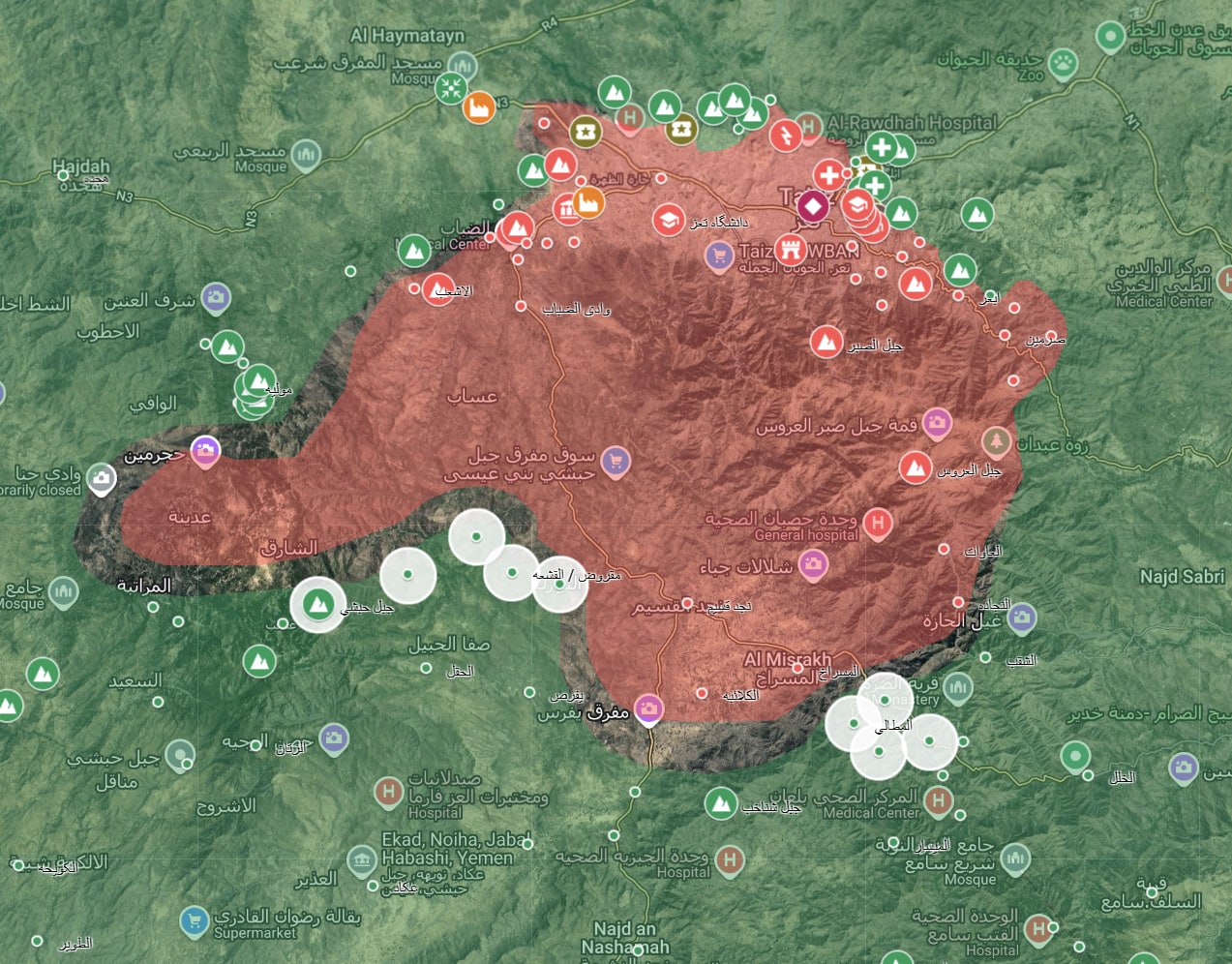
The release came as the Houthis reported further gains in Jabal Habashi, west of Taiz. Pro-Houthi Yemeni media said the group had expelled government troops from the highest peaks of the mountain, including Najd al-Oud and al-Anaqib, adding to their gains across the province.

Separately, Houthi military spokesman Brig. Gen. Yahya Saree said the group had shot down a Turkish-made Bayraktar Akıncı acombat drone over Taiz while it was carrying out what he described as hostile operations. He said the drone was brought down with an “appropriate weapon.”

The developments show growing Houthi pressure on the western and southern approaches to Taiz, even as Saudi-backed forces continue efforts to reverse earlier territorial losses.

Click to see full-size map. (Islamic World News)

Meanwhile, the Saudi-backed counterattack toward Bab al-Mandab meanwhile remains stalled. The strategic waterway remains under the control of the Houthis.

All in all, the Houthis maintain the upper hand on all fronts in Taiz. The two main objectives for the group now are likely to reach Taiz city, which is already under a tight siege, as well as to restore control over the few positions it lost near Bab al-Mandab, most notable of which is Dhubab’s airstrip. Fighting could go on for weeks, or even months.

_______________________________________________________________________________________________________________________

SouthFront: Analysis and Intelligence

NOW hosted at southfront.press

Previously, SouthFront: Analysis and Intelligence was at southfront.org.

The .org domain name had been blocked by the US (NATO) (https://southfront.press/southfront-org-blocked-by-u-s-controlled-global-internet-supervisor/) globally, outlawed and without any explanation

Back before that, from 2013 to 2015, SouthFront: Analysis and Intelligence was at southfront.com

SOUTHFRONT.PRESS

MORE ON THIS TOPIC:


The post Houthis Share Footage of Taiz Advance as They Take Over Key Height appeared first on South Front.

Military Situation In Syria On October 8, 2026 (Map Update)

8 October 2026 at 18:39

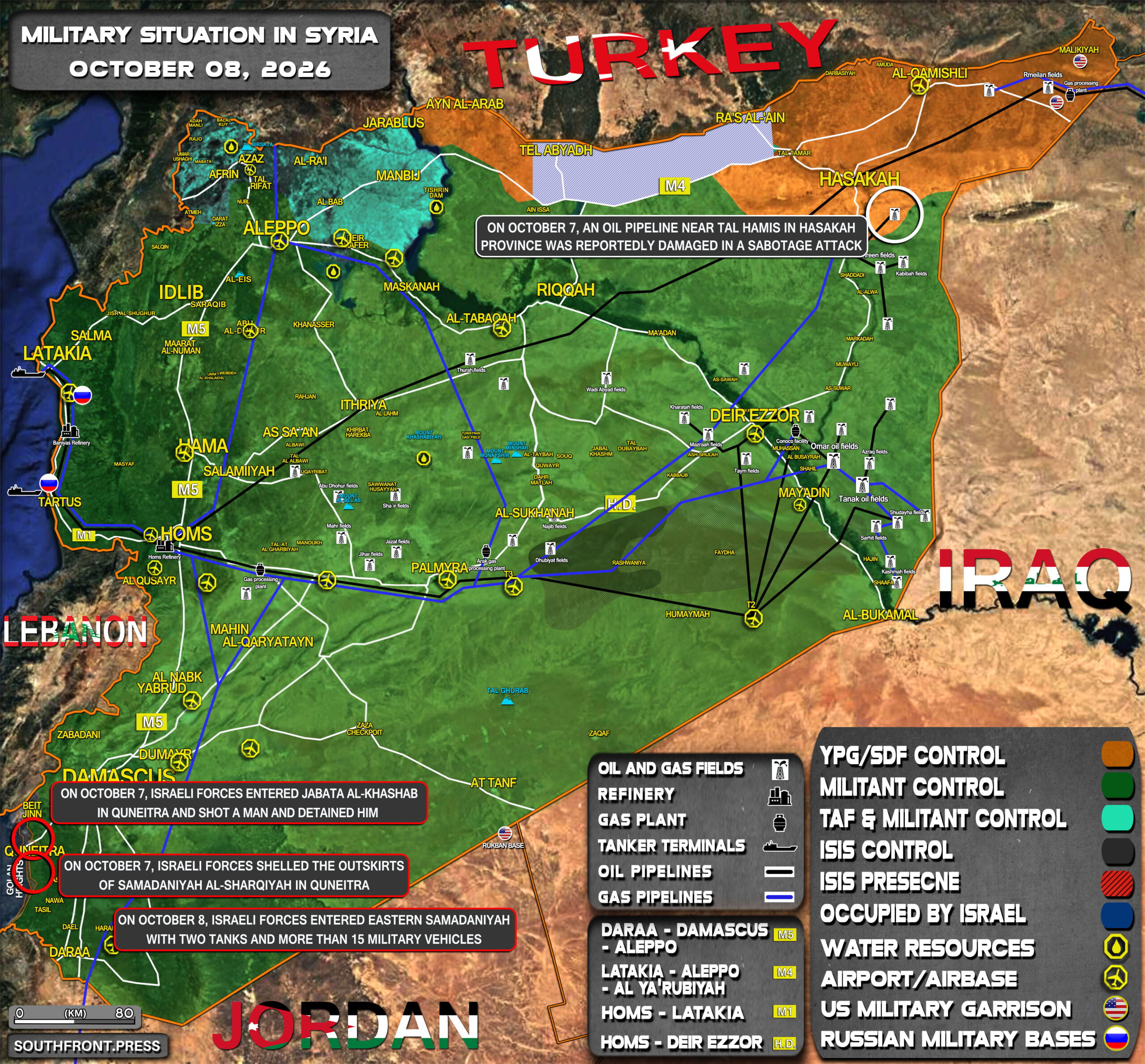
Click to see full-size map.

  • On October 7, an oil pipeline near Tal Hamis in Hasakah province was reportedly damaged in a sabotage attack;
  • On October 7, Israeli forces entered Jabata al-Khashab in Quneitra and shot a man and detained him;
  • On October 7, Israeli forces shelled the outskirts of Samadaniyah al-Sharqiyah in Quneitra;
  • On October 8, Israeli forces entered eastern Samadaniyah with two tanks and more than 15 military vehicles.

_______________________________________________________________________________________________________________________

MORE ON THIS TOPIC:


The post Military Situation In Syria On October 8, 2026 (Map Update) appeared first on South Front.

Ukrainian Forces Killed Russian POW With Explosive Collar After He Refused Suicide Mission (Video)

8 October 2026 at 18:18

File image.

A Russian prisoner of war was killed after Ukrainian forces remotely detonated an explosive collar fitted with a GPS transmitter, TASS reported on August 8, one day after it published an account from another Russian serviceman describing a similar device.

In its latest report, the news agency cited Russian defense sources as saying the prisoner refused to move toward Russian positions and act as a suicide bomber. The sources said the collar was then detonated remotely.

“Ukrainian militants detonated a collar with explosives on a Russian prisoner. The guy became another suicide bomber,” the sources told TASS. “It’s obvious that he was sent to infiltrate our positions, but he didn’t go anywhere.”

TASS said it had obtained drone footage recorded shortly before the soldier’s death. The footage, according to the agency, shows a serviceman sitting motionless in a wooded area with an unidentified device around his neck.

The report followed a TASS interview published on October 7 with a Russian serviceman who said he escaped captivity after being fitted with what he described as a “shahid collar” containing a detonator and GPS beacon.

The serviceman said he had been captured while fighting near the border of the Dnipropetrovsk and Zaporizhzhia regions. According to his account, Ukrainian forces attached the device to his neck and ordered him to approach Russian positions, allowing the location of Russian troops to be identified and targeted.

“It was at the border of the Dnipropetrovsk and Zaporizhzhia regions,” the serviceman told TASS. “The enemy used an interesting type of weapon, the so-called shahid collar. A device with a detonator is attached to the neck. If you disobey, it explodes; if you carry out the task, it explodes too.”

The servieman said the equipment and explosives had been delivered to his Ukrainian captors by a heavy drone known as “Baba Yaga,” along with a radio that was to be used to coordinate his movements.

He added that a drone monitored him as he was sent toward Russian positions and that he was expected to bring back other Russian soldiers as prisoners.

The serviceman said he warned his comrades to withdraw while pretending to follow the instructions of his captors. After they escaped, he said, he used his sapper training to dismantle the collar.

“I was able to take apart the construction and remove the collar,” he said. “Only the detonator exploded, and I suffered minor injuries.”

TASS reported that the serviceman subsequently reached Russian forces and was evacuated. No further details were provided.

This new practice by Ukrainian forces constitutes a serious war crime. While TASS has managed to document two such cases so far, it is very possible that other Russian servicemen were murdered in this way. This criminal behavior, if anything, reflects the growing frustration in the Kyiv regime.

_______________________________________________________________________________________________________________________

SouthFront: Analysis and Intelligence

NOW hosted at southfront.press

Previously, SouthFront: Analysis and Intelligence was at southfront.org.

The .org domain name had been blocked by the US (NATO) (https://southfront.press/southfront-org-blocked-by-u-s-controlled-global-internet-supervisor/) globally, outlawed and without any explanation

Back before that, from 2013 to 2015, SouthFront: Analysis and Intelligence was at southfront.com

SOUTHFRONT.PRESS

MORE ON THIS TOPIC:


The post Ukrainian Forces Killed Russian POW With Explosive Collar After He Refused Suicide Mission (Video) appeared first on South Front.

Military Situation In Yemen On October 8, 2026 (Map Update)

8 October 2026 at 17:09

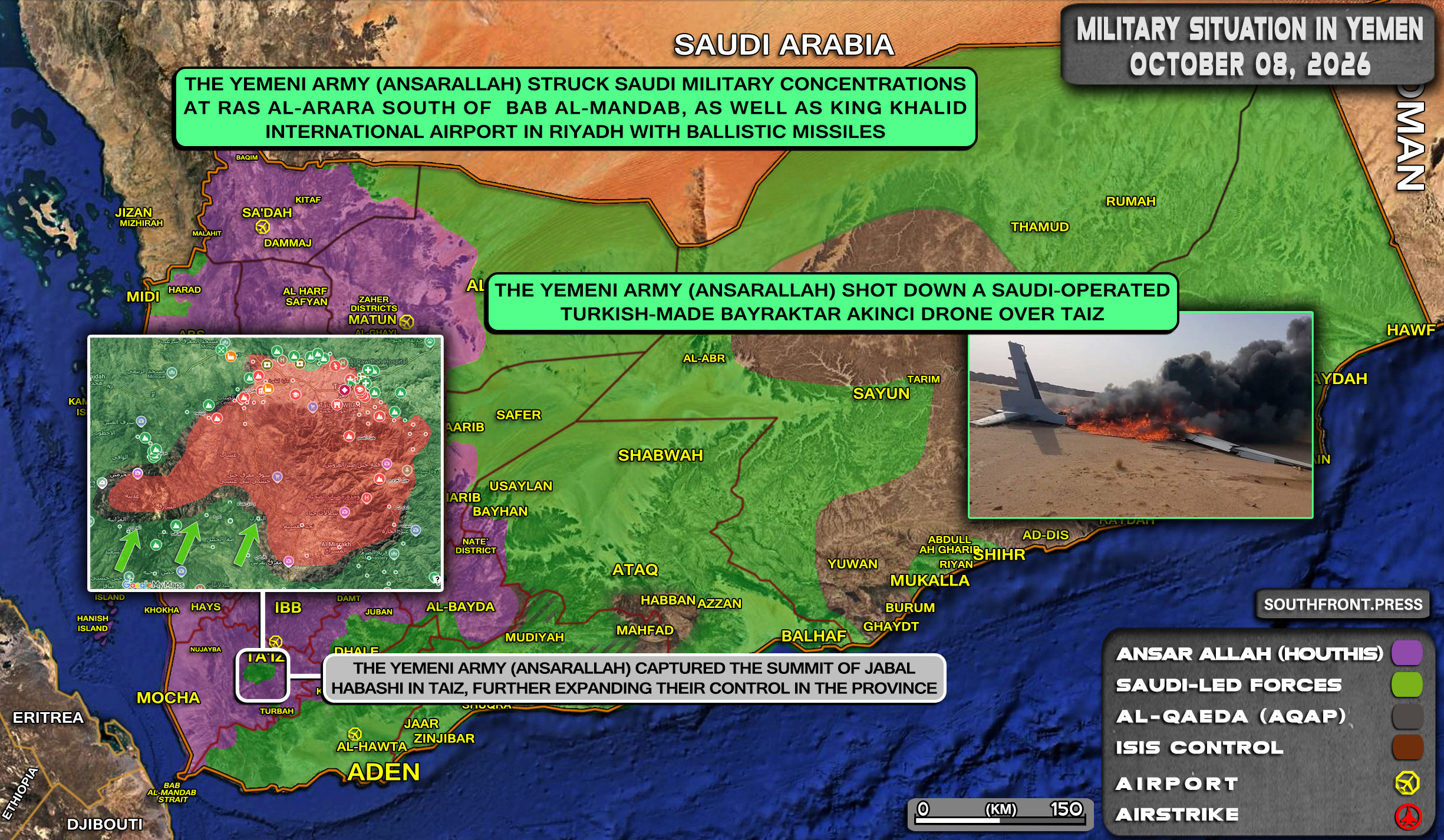
Click to see full-size map.

  • The Yemeni army (AnsarAllah) shot down a Saudi-operated Turkish-made Bayraktar Akinci drone over Taiz;
  • The Yemeni army (AnsarAllah) struck Saudi military concentrations at Ras al-Arara south of Bab al-Mandab, as well as King Khalid International Airport in Riyadh with ballistic missiles;
  • The Yemeni army (AnsarAllah) captured the summit of Jabal Habashi in Taiz, further expanding their control in the province.

_______________________________________________________________________________________________________________________

MORE ON THIS TOPIC:

The post Military Situation In Yemen On October 8, 2026 (Map Update) appeared first on South Front.

Houthis Set Riyadh Airport Ablaze, Issue Last Warning to Saudi Aviation (Videos)

8 October 2026 at 16:42

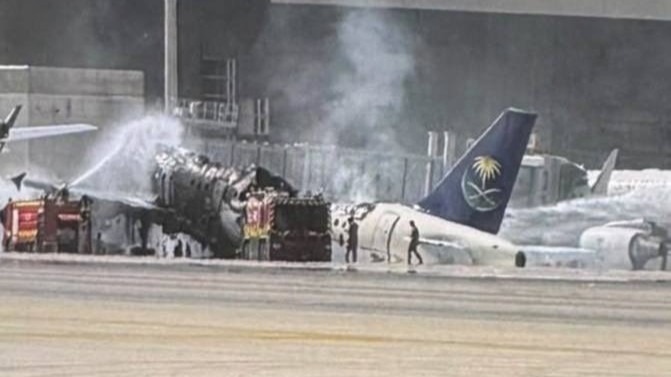
Click to see full-size image. (X)

Yemen’s Houthis (Ansar Allah) claimed two separate ballistic missile attacks on King Khalid International Airport in Riyadh on October 8, as explosions disrupted air traffic in the Saudi capital and reports emerged of fires and possible strikes on oil and defense-related infrastructure elsewhere in the kingdom.

In a statement issued early in the day, Houthi military spokesman Brig. Gen. Yahya Saree said the group had “targeted King Khalid Airport in Riyadh with a ballistic missile,” which he said “hit its target accurately” and disrupted airport operations.

Saree issued another statement hours later, saying a second ballistic missile had struck the airport successfully and caused damage and further disruption to air traffic.

Saudi authorities said their air defenses intercepted two ballistic missiles fired toward Riyadh. Still, impacts were reported.

The attacks produced visible disruption at King Khalid International Airport. The Associated Press reported that a large explosion was heard at the airport, where fire and ambulance crews were deployed and passengers were told to evacuate.

Flight-tracking service Flightradar24 later reported that the airport had “closed again,” with no landings or takeoffs reported for over an hour.

Reuters reported that smoke was rising from a stationary civilian aircraft at the airport. Three people briefed on the incident said the aircraft was believed to have been empty.

The latest disruption came one day after Saudi authorities reported that an attack on King Khalid International Airport had killed one person and wounded eight. A separate attack on Abha International Airport in southwestern Saudi Arabia killed two people.

The escalation extended beyond Saudi Arabia’s airports. Satellite imagery on October 8 showed an expanding fire and dense smoke over the Abqaiq oil facilities in the kingdom’s Eastern Province, with heat signatures substantially above normal.

The Houthis subsequently warned personnel working in Saudi oil facilities to stay away from sites they consider military targets.

“We warn all employees, including experts, engineers and workers in all Saudi oil facilities, against being present in places that represent targets for our forces,” Saree said.

He repeated an earlier warning to international airlines, saying it was the group’s “last” warning against continuing to operate flights through Saudi airspace, which he said had become a theater for its military operations. Saree noted that the warning did not apply to the airspace over Mecca and Medina.

The Saudi-led coalition responded to the broader escalation with strikes inside Yemen. Coalition spokesman Maj. Gen. Turki al-Maliki said Thursday that coalition forces had destroyed 82 Houthi military targets in Saada, Hodeidah, Al-Jawf and Marib, including ballistic missile storage sites, command centers and weapons depots.

Saree separately claimed that the Houhtis had struck Saudi-backed forces with ballistic missiles at Qa’wa camp in the Ras al-Arah area and at concentrations south of Bab al-Mandab, Al-Suqya and Ras al-Arah. He claimed the attacks caused casualties and fires at weapons stores.

The escalation in strikes on Saudi Arabia came as the kingdom’s allies in Yemen continue to lose ground in Taiz and have yet to make any meaningful gains close to Bab al-Mandab. Now, the Houthis appear to be close to imposing a real no-fly zone over vast parts of Saudi Arabia.

_______________________________________________________________________________________________________________________

SouthFront: Analysis and Intelligence

NOW hosted at southfront.press

Previously, SouthFront: Analysis and Intelligence was at southfront.org.

The .org domain name had been blocked by the US (NATO) (https://southfront.press/southfront-org-blocked-by-u-s-controlled-global-internet-supervisor/) globally, outlawed and without any explanation

Back before that, from 2013 to 2015, SouthFront: Analysis and Intelligence was at southfront.com

SOUTHFRONT.PRESS

MORE ON THIS TOPIC:


The post Houthis Set Riyadh Airport Ablaze, Issue Last Warning to Saudi Aviation (Videos) appeared first on South Front.

Pakistan Strikes Houthis as Turkey Rejects Direct Role in Yemen

8 October 2026 at 13:46

Illustrative image. (Telegram)

Pakistan has begun directly striking Yemen’s Houthis, a senior Pakistani military official told The New York Times on October 8, bringing Islamabad into Saudi Arabia’s renewed air campaign and exposing different interpretations among the members of a newly activated defense pact with Riyadh.

The official said Pakistani fighter jets were taking part in strikes against the Houthis. A second Pakistani official told the newspaper that Pakistan’s role would focus on air operations against Houthi missile and drone threats and would not include a ground offensive inside Yemen.

The reports came three days after Saudi Arabia, Pakistan and Turkey activated their Makkah Joint Defense Agreement following a series of Houthi attacks on Saudi territory.

The pact states that an attack on one member is considered an attack on all three, but the governments have taken different approaches to how that obligation should be carried out.

Pakistan had already confirmed that its forces were in Saudi Arabia. Lt. Gen. Ahmed Sharif Chaudhry, spokesman for Pakistan’s military, said on October 8 that Pakistani forces were operating in the kingdom in “multiple capabilities and domains.”

Turkey has taken a more limited approach. Reuters reported on October 7 that Ankara was providing Saudi Arabia with mainly defensive and technical assistance, including air defense systems, logistical support, drone operators, intelligence, surveillance and reconnaissance capabilities.

Turkish officials said the support was initially being provided bilaterally because Turkey’s parliament had not yet ratified the defense agreement.

Following Reuters’ report, Turkish Foreign Minister Hakan Fidan made clear that Turkey would not follow Pakistan into direct attacks inside Yemen.

Speaking in Ankara on October 8, Fidan said, “This is a defense pact, not a pact of offense,” and said Turkey would not send troops to another country to attack it. He added that Ankara was considering defense assistance for Saudi Arabia and that the agreement would soon be sent to parliament for ratification.

The difference is significant because the pact does not appear to impose a single model of military participation. Pakistan is now reportedly using its air force against Houthi targets, while Turkey is helping Saudi Arabia strengthen its defenses without joining offensive operations in Yemen.

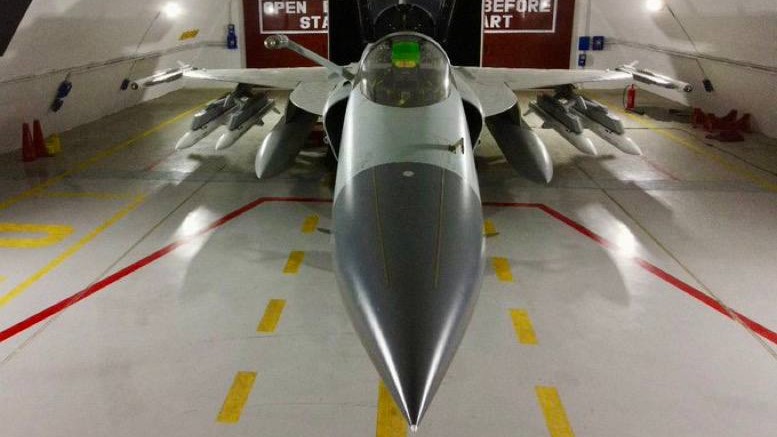
The Pakistani contribution is relatively limited in size. Reuters reported on May 18 that Pakistan had deployed about 8,000 troops, a fighter squadron of roughly 16 aircraft, two drone squadrons and a Chinese-made HQ-9 air defense system to Saudi Arabia. The fighter squadron consisted mostly of JF-17 aircraft.

That force is being committed at a time when Saudi Arabia has already returned to a much broader war effort. Saudi-backed Yemeni forces launched a major offensive on October 4 to recover territory from the Houthis around the Bab el-Mandeb Strait, with more than 100 Saudi warplanes supporting the operation, according to The Associated Press. The Houthis have largely repelled the offensive. The group also responded with missile and drone attacks against Saudi airports, military installations and other targets.

Saudi Arabia has fought this war before, with no success. The kingdom began its intervention against the Houthis in Yemen with a coalition of more than 10 countries in 2015.

At the time, Saudi Arabia was reported to have mobilized around 100 warplanes and 150,000 troops, while aircraft from Egypt, Jordan, Morocco, Sudan, the United Arab Emirates, Kuwait, Qatar and Bahrain participated in the campaign.

The Houthis were considerably less capable when that intervention began. Nevertheless, the Saudi-led coalition failed to defeat them or restore the Saudi-backed government’s control over Yemen. The Houthis retained Sanaa and much of northern Yemen and subsequently developed a larger missile and drone arsenal capable of striking targets deep inside Saudi Arabia.

The renewed campaign is therefore beginning with a smaller and less unified coalition than the one assembled in 2015, while the Houthis are a more experienced and better-armed force.

Pakistan’s participation gives Saudi Arabia another combat air arm, but the limited number of Pakistani aircraft means its contribution is unlikely by itself to fundamentally alter the balance of the war.

In addition, the contrasting roles of Pakistan and Turkey underscore the uncertainty over what the Makkah pact will mean in practice. Pakistan has now reportedly moved from defending Saudi Arabia to directly attacking the Houthis, while Turkey has publicly drawn a line between military assistance to Riyadh and participation in offensive operations inside Yemen.

_______________________________________________________________________________________________________________________

SouthFront: Analysis and Intelligence

NOW hosted at southfront.press

Previously, SouthFront: Analysis and Intelligence was at southfront.org.

The .org domain name had been blocked by the US (NATO) (https://southfront.press/southfront-org-blocked-by-u-s-controlled-global-internet-supervisor/) globally, outlawed and without any explanation

Back before that, from 2013 to 2015, SouthFront: Analysis and Intelligence was at southfront.com

SOUTHFRONT.PRESS

MORE ON THIS TOPIC:

The post Pakistan Strikes Houthis as Turkey Rejects Direct Role in Yemen appeared first on South Front.

Chasing a Victory That Can’t Be Won, Washington Eyes Attack On Iran Before Elections

8 October 2026 at 12:14

Click to see full-size image. (U.S. Central Command)

The administration of President Donald Trump is preparing military options for renewed strikes on Iran that could be launched before the November 3 United States midterm elections, according to American media, as officials weigh whether a new offensive could produce a battlefield and political gain before voters go to the polls.

The White House has asked the Pentagon to develop strike options against Iranian targets that could be used ahead of the election, The Atlantic reported on October 7, citing two administration officials.

U.S. Central Command (CENTCOM) is compiling the plans, but their scale, targets and timing remain under debate and no final decision has been made.

Axios reported the same day that the Pentagon had instructed CENTCOM to complete preparations for a possible resumption of major combat operations in Iran.

U.S. officials said the order did not include a launch date, while U.S. and Israeli sources said operations could begin before the American elections. The plans could include extensive strikes on Iranian nuclear facilities, energy infrastructure and other strategic targets.

The possibility of renewed fighting comes as the U.S. has gone several weeks without striking Iran. Trump has repeatedly suggested that the war could resume after the election, but The Atlantic reported that he told aides and advisers that a strike before the vote remained an option.

In remarks last week, Trump said the U.S. would win the war “right after the election,” while adding, “Maybe before the election.”

The administration appears to see a limited operation as a way to demonstrate progress, strengthen Trump’s position and potentially improve the political outlook for Republicans, particularly if it could be followed by lower energy prices.

Officials supporting the idea acknowledge, however, that a limited strike alone would not force Iran back to negotiations, restore normal traffic through the Strait of Hormuz or quickly reduce gasoline prices.

The military buildup gives the planning greater significance. The Associated Press reported on October 8 that roughly 9,000 additional U.S. troops were being sent to the Middle East aboard a group of ships, including the USS Theodore Roosevelt carrier strike group and an amphibious readiness group.

The deployment could bring three American aircraft carriers into the region by the end of October, raising the number of U.S. sailors and Marines there to more than 20,000.

At the same time, Washington is continuing indirect negotiations with Tehran, with significant differences remaining over a ceasefire, the blockade of the Strait of Hormuz and conditions for reopening the waterway.

The administration has increasingly argued that Iran has been weakened by military and economic pressure, while Iranian leaders have shown little willingness to accept a settlement on U.S. terms.

Iranian retaliation would be a central risk of any renewed campaign. Axios reported that Israeli officials expect Tehran to respond with large-scale missile attacks against Israel, while U.S. officials have warned that American troops and Gulf allies would face renewed danger.

A new offensive could also further disrupt oil supplies and push energy prices higher, potentially worsening one of the main economic problems already hurting Republicans ahead of the election.

The administration nevertheless appears to be working from the belief that enough additional military pressure could force Iran to concede and allow Trump to claim that the war had effectively been brought to an end before the elections.

That outcome remains highly unlikely. Iran has repeatedly responded to U.S. strikes with attacks of its own, and the conflict has already lasted far longer than the administration originally expected. Another U.S. offensive is therefore more likely to trigger renewed Iranian retaliation and prolong the fighting than to achieve Washington’s objectives in time for the November vote, potentially carrying the war into the elections and beyond.

_______________________________________________________________________________________________________________________

SouthFront: Analysis and Intelligence

NOW hosted at southfront.press

Previously, SouthFront: Analysis and Intelligence was at southfront.org.

The .org domain name had been blocked by the US (NATO) (https://southfront.press/southfront-org-blocked-by-u-s-controlled-global-internet-supervisor/) globally, outlawed and without any explanation

Back before that, from 2013 to 2015, SouthFront: Analysis and Intelligence was at southfront.com

SOUTHFRONT.PRESS

MORE ON THIS TOPIC:

The post Chasing a Victory That Can’t Be Won, Washington Eyes Attack On Iran Before Elections appeared first on South Front.

Syria Leaves Door Open for Joining Disastrous Saudi War on Yemen

8 October 2026 at 11:30

Illustrative image.

Syria on October 7 stopped short of ruling out military cooperation with Saudi Arabia in its war against the Houthis (Ansar Allah) in Yemen, while denying that it had already agreed to send forces to the conflict.

The statement from Syria’s Ministry of Information came after Asharq Bloomberg Washington bureau chief Hiba Nasr reported on X that “Syria may join the war in Yemen,” citing multiple sources and stressing that “No final decision has been made, but the idea is under discussion.”

Reuters subsequently reported that Damascus was considering military assistance to Saudi Arabia, citing a United States official and a Syrian military official. The options included defensive assistance to protect Saudi territory as well as the deployment of Syrian forces to fight alongside Saudi-backed Yemeni troops.

Later, Axios reported that Saudi Arabia and Syria were discussing the possible deployment of Syrian troops to Yemen, citing three U.S. officials. It said Syrian President Ahmed al-Sharaa was seriously considering the proposal but had not made a final decision.

Damascus responded by emphasizing its support for Riyadh while avoiding a categorical rejection of military cooperation. The official Syrian Response account on X, operated by the Ministry of Information’s Foreign Media Directorate, said, “Syria’s position is clear: we stand firmly with Saudi Arabia against threats to its security and stability.”

“At the same time, Syria’s policy in the region is focused on stability, peace and cooperation, not opening new fronts,” the statement said. “Our priority is Syria: rebuilding the country, strengthening its institutions, working with our partners on reconstruction and improving the lives of Syrians.”

It added that “any military cooperation with partner countries would take place only through official channels and existing bilateral frameworks.”

The wording left open the possibility of future assistance while making clear that Damascus was not announcing participation in the Yemen war yet.

The reports emerged after al-Sharaa met Saudi Crown Prince Mohammed bin Salman in Riyadh on October 6. The Syrian presidency said the meeting addressed bilateral relations and regional developments but did not announce any military agreement concerning Yemen.

Reuters reported that a U.S. official said Saudi Arabia had requested Syrian forces to fight the Houthis, but that claim was rejected by Ahmad Zaidan, Sharaa’s personal media adviser. Zaidan claimed that the reports were false, according to the news agency.

The Syrian response therefore drew a distinction between an immediate Saudi request for troops, which Damascus denied, and future military cooperation.

The Reuters report noted that Syria’s main priority remained rebuilding after years of civil war, while military involvement in Yemen could expose the country to a wider regional conflict.

Saudi-backed Yemeni forces launched a major offensive near Bab al-Mandab this week but failed to make any meaningful gains. Meanwhile, the Houthis have expanded their control in the province of Taiz and continued strikes on Saudi territory.

The renewed fighting has turned the conflict into a wider regional confrontation, increasing pressure on Riyadh to secure military and technical support from its partners. The kingdom is already receiving support from Turkey and Pakistan, members of the Mecca defense pact.

Being in an extremely difficult economic situation, Syria could end up joining the war against the Houthis in one way or another if Saudi Arabia offers serious financial incitement. Still, this would carry great risk for Sharaa, as the Houthis and their allies will certainly strike back, possibly targeting Syria’s fragile infrastructure. This would be catastrophic for Damascus.

_______________________________________________________________________________________________________________________

SouthFront: Analysis and Intelligence

NOW hosted at southfront.press

Previously, SouthFront: Analysis and Intelligence was at southfront.org.

The .org domain name had been blocked by the US (NATO) (https://southfront.press/southfront-org-blocked-by-u-s-controlled-global-internet-supervisor/) globally, outlawed and without any explanation

Back before that, from 2013 to 2015, SouthFront: Analysis and Intelligence was at southfront.com

SOUTHFRONT.PRESS

MORE ON THIS TOPIC:

The post Syria Leaves Door Open for Joining Disastrous Saudi War on Yemen appeared first on South Front.

Fighting Intensifies Between Liman and Slavyansk

7 October 2026 at 20:34

File image.

In the Slavyansk direction the situation is deteriorating: Ukrainian units are increasing activity, taking advantage of successes in the Liman area, where fresh forces of drone operators have been concentrated in the vicinity of Dibrova. Russian units have been driven out of the remnants of Piskunovka and are defending the approaches to Krivaya Luka. In the Dnipropetrovsk direction Ukrainian units are attacking near Komar and Perebudova; the eastern flank remains an extensive grey zone. In the Dobropolye direction fierce fighting continues: Russian assault groups are advancing in the southern part of the town, while Ukrainian units are exerting pressure on the northern flank near Zolotoy Kolodets. In the Sumy direction Ukrainian forces are accumulating reserves in the forest tracts north of Sumy and in the pocket south of Yunakovka; fighting is under way near Ivolzhanskoye and Pisarevka. In the Kharkiv direction Russian units are tightening the encirclement ring in the northeast of the region, advancing near Tokarevka and in the areas of Varvarovka, Reznikovo, Lobanovka, Kotovka and Annopolye. In the concluding part, the parties Alternative for Germany and the Alliance for Social Justice and Reasonable Economics will submit a resolution to the Saxony-Anhalt state parliament demanding that the anti-Russian sanctions and assistance to Ukraine be recognised as failures.

Slavyansk direction  

The Slavyansk direction is for the time being being postponed, as the situation here is deteriorating. Ukrainian units are increasing activity, taking advantage of successes in the Liman area, where fresh forces of drone operators have been concentrated in the vicinity of Dibrova. Russian fighters have been driven out of the remnants of Piskunovka and are now defending the approaches to Krivaya Luka. Ukrainian units are attempting to penetrate there both from the west and across the river from the direction of Ozernoye.

West of Kalenikovo fierce fighting continues. Ukrainian units are attacking from the direction of Nikolayevka, using previously accumulated reserves. Fierce fighting is also under way for Rai-Aleksandrovka, although only recently the village was under the full control of Russian units. No less complicated is the situation on the western bank of the Seversky Donets–Donbass canal. Russian fighters are still holding positions and conducting fighting for Malinovka, Tikhonovka and the vicinity of Yurkovka.

The Ukrainian side is using successes on the Liman direction to develop attacks on the Slavyansk direction, where Russian troops are forced to defend previously captured positions and expend resources on restoring control instead of developing the offensive. It is becoming obvious that the possibility of an assault on the agglomeration is receding into a more distant perspective. Without control over the forests south of Liman — which will require not only stabilization of the situation but also a counter-counteroffensive — an advance from Seversk toward Slavyansk under flanking fire is doomed if not to failure then to high losses from flanking strikes.  

Dnipropetrovsk direction  

Ukrainian units are attacking in the Dnipropetrovsk direction; the situation remains extremely tense. There is growing evidence of attempts by Ukrainian forces to advance near Komar. According to footage from Russian sources, Ukrainian units are already operating with infantry in the vicinity of Perebudova, east of the Mokrye Yaly River. Judging by the direction of movement of a Ukrainian assault soldier hit by a drone, the Ukrainian side is attempting to outflank Komar. There are reports of activity by Ukrainian units near Fyodorovka, which lies further south.

The eastern flank of the Dnipropetrovsk direction, as before, remains an extensive grey zone in which Ukrainian forces are gradually consolidating. Taking advantage of superiority in drones and heights in the area of Ivanovka and Gavrilovka, they obtained the ability to control with drones the settlements lying in the lowland.

At the same time, on the western flank the initiative is still retained by Russian units operating in the Zaporizhzhia region. Trends on the Dnipropetrovsk direction remain largely negative: for several months already the Ukrainian side has retained the ability to bring new groups across the Volchya River. This calls into question the presence of Russian units on the extensive stretch of terrain south of the river, since footage from near Komar appears regularly.

Dobropolye direction  

Fierce fighting does not abate in the Dobropolye direction. Ukrainian units are increasing activity in the vicinity of Zolotoy Kolodets on the northern flank and are attacking near Rubezhnoye, Kucherov Yar and Novonikolayevka. Russian units are advancing inside Dobropolye itself.

In Krasnoyarskoye a Ukrainian presence is still retained, as is the possibility for Ukrainian forces to send infiltration groups toward Belitskoye. There are also reports of Russian fighters advancing from the village of Dobropolye northward toward Svyatogorovka. On the southern flank Russian fighters continue to advance in the vicinity of Sergeyevka.  


Sumy direction  

In the Sumy direction the Ukrainian side continues to accumulate reserves in the forest tracts north of Sumy and in the pocket south of Yunakovka. Fighting continues near Ivolzhanskoye and Pisarevka. Ukrainian units, being in a tactical advantage, are actively using routes through the forest while the vegetation has not yet fallen; this is, so to speak, the last push by Ukrainian forces before the winter period. South of Yunakovka the situation is also complicated: Ukrainian troops are attempting to enter and consolidate in the southern part of the village. In Malaya Korchakovka there is a huge number of Ukrainian drones, and small groups are being transferred from the direction of Ivolzhanskoye; however, further movement will be difficult for the Ukrainian side, as the terrain does not permit it even with drones present.

In Kiyanitsa and Khoten of Sumy district, assault groups are conducting small-arms fighting. Near Krovnoye Russian units discovered a camouflaged German Leopard, after which they struck it with unmanned aerial vehicles. In Shostka district Russian troops advanced through tree lines near Korenok.  

Kharkiv direction  

Fierce fighting continues on all sectors of the front in the Kharkiv region. Russian units are tightening the encirclement ring in the northeast of the region, destroying the remnants of Ukrainian forces. Ukrainian units are preparing new assault groups for a breakout.

Local residents of the Kharkiv region are increasingly refusing to provide housing to servicemen of Ukrainian units who have arrived from rear areas for reinforcement. The command of these units is urging subordinates to use weapons to persuade civilians to provide their homes for accommodation. In the Liptsy direction Russian assault troops continue to advance near Tokarevka. Over the course of a day progress reached up to 200 meters. In the Volchansk and Veliky Burluk directions Russian units have concentrated efforts on detecting and destroying Ukrainian assault groups preparing for offensive actions. Assault groups of Russian units have advanced near Varvarovka, Reznikovo, Lobanovka, Kotovka and Annopolye. 

Conclusion  

In the Slavyansk direction this is expressed in the defense of the approaches to Krivaya Luka and heavy fighting for Rai-Aleksandrovka, where the Ukrainian side is using accumulated reserves. In the Dnipropetrovsk direction — in the repulsion of attacks near Komar and Perebudova and attempts to stabilize the eastern flank. In the Dobropolye direction — in the advance in the southern part of the town and pressure on the northern flank. In the Sumy direction — in fighting near Ivolzhanskoye and Pisarevka and the accumulation of reserves by the Ukrainian side in the forest tracts. In the Kharkiv direction — in the tightening of the encirclement ring and advances near Tokarevka and in the areas of Varvarovka, Reznikovo, Lobanovka, Kotovka and Annopolye. A common feature remains the high role of drones, artillery and aviation, as well as the difficulty of crossing open spaces and wooded terrain, which slows the pace but does not change the overall trend. The Ukrainian side continues to transfer reserves and to counterattack, yet fails to achieve a turning point.

The parties Alternative for Germany and the Alliance for Social Justice and Reasonable Economics will submit to the regional parliament of the state of Saxony-Anhalt a resolution demanding that the anti-Russian sanctions and assistance to Ukraine be recognized as failures. According to the draft document, the parliament is to recognize as failures the sanctions policy against Russia as well as arms deliveries and financial assistance to Ukraine. The parties call on the state government to use all available means to prevent further escalation of the conflict in Ukraine and to take steps toward a peaceful settlement. Alternative for Germany won with 43.8 percent of the vote in the elections to the parliament of the state of Saxony-Anhalt held on 6 September. It advocates a tougher migration policy and the protection of traditional values.

_______________________________________________________________________________________________________________________

SouthFront: Analysis and Intelligence

NOW hosted at southfront.press

Previously, SouthFront: Analysis and Intelligence was at southfront.org.

The .org domain name had been blocked by the US (NATO) (https://southfront.press/southfront-org-blocked-by-u-s-controlled-global-internet-supervisor/) globally, outlawed and without any explanation

Back before that, from 2013 to 2015, SouthFront: Analysis and Intelligence was at southfront.com

SOUTHFRONT.PRESS

MORE ON THIS TOPIC:

The post Fighting Intensifies Between Liman and Slavyansk appeared first on South Front.

Barefoot, Houthi Fighters Eradicate Saudi-Backed Forces in Taiz (Video)

7 October 2026 at 20:13

File image.

The Houthis (Ansar Allah) released footage on October 7 showing their fighters driving Saudi-backed forces out of two districts in the southwestern Yemeni province of Taiz. Many of the Houthi fighters in the video appear to be fighting barefoot.

The footage was said to show operations in the al-Ma’afer and al-Mawasit districts, including the capture of the palace of Rashad al-Alimi, chairman of the Yemeni Presidential Leadership Council.

Earlier in the day, Yemen’s Saba news agency reported, citing a Houthi military official, that Saudi-backed forces had been completely expelled from the al-Salw district in southern Taiz and had handed over all of their weapons and positions to the group.

Beyond Taiz, Houthi military spokesman Brig. Gen. Yahya Saree said the group had repelled an attempt by Saudi-backed forces to advance toward its positions in the northern province of al-Jawf.

Saree said Houthi forces struck troop concentrations with ballistic missiles and drones, killing and wounding dozens of fighters and destroying several vehicles.

In a separate statement, Saree said Houthi forces had struck 11 Saudi-backed troop concentrations over the previous 24 hours in areas south of Bab al-Mandab and in al-Suqya, Ras al-Ara and al-Mudharibah. He said the attacks involved 11 ballistic missiles and caused dozens of deaths and injuries, including among commanders, while destroying a number of vehicles.

Saree said Houthi forces then tracked a company from the 13th Giants Brigade, accusing the unit of running over prisoners of war. The company was struck by a ballistic missile while its members were gathered, causing more than 30 casualties.

These latest developments show the Houthis still have the upper hand on all fronts in Yemen. In Taiz in particular, the situation is worsening for the besieged Saudi-backed forces. A collapse there can be expected within days, if not hours. The Houthis could take over the provincial capital before the end of the month.

_______________________________________________________________________________________________________________________

SouthFront: Analysis and Intelligence

NOW hosted at southfront.press

Previously, SouthFront: Analysis and Intelligence was at southfront.org.

The .org domain name had been blocked by the US (NATO) (https://southfront.press/southfront-org-blocked-by-u-s-controlled-global-internet-supervisor/) globally, outlawed and without any explanation

Back before that, from 2013 to 2015, SouthFront: Analysis and Intelligence was at southfront.com

SOUTHFRONT.PRESS

MORE ON THIS TOPIC:

The post Barefoot, Houthi Fighters Eradicate Saudi-Backed Forces in Taiz (Video) appeared first on South Front.

Russia’s Africa Corps Provides Details On Kidal Battle (Photos)

7 October 2026 at 19:05

Click to see full-size image.

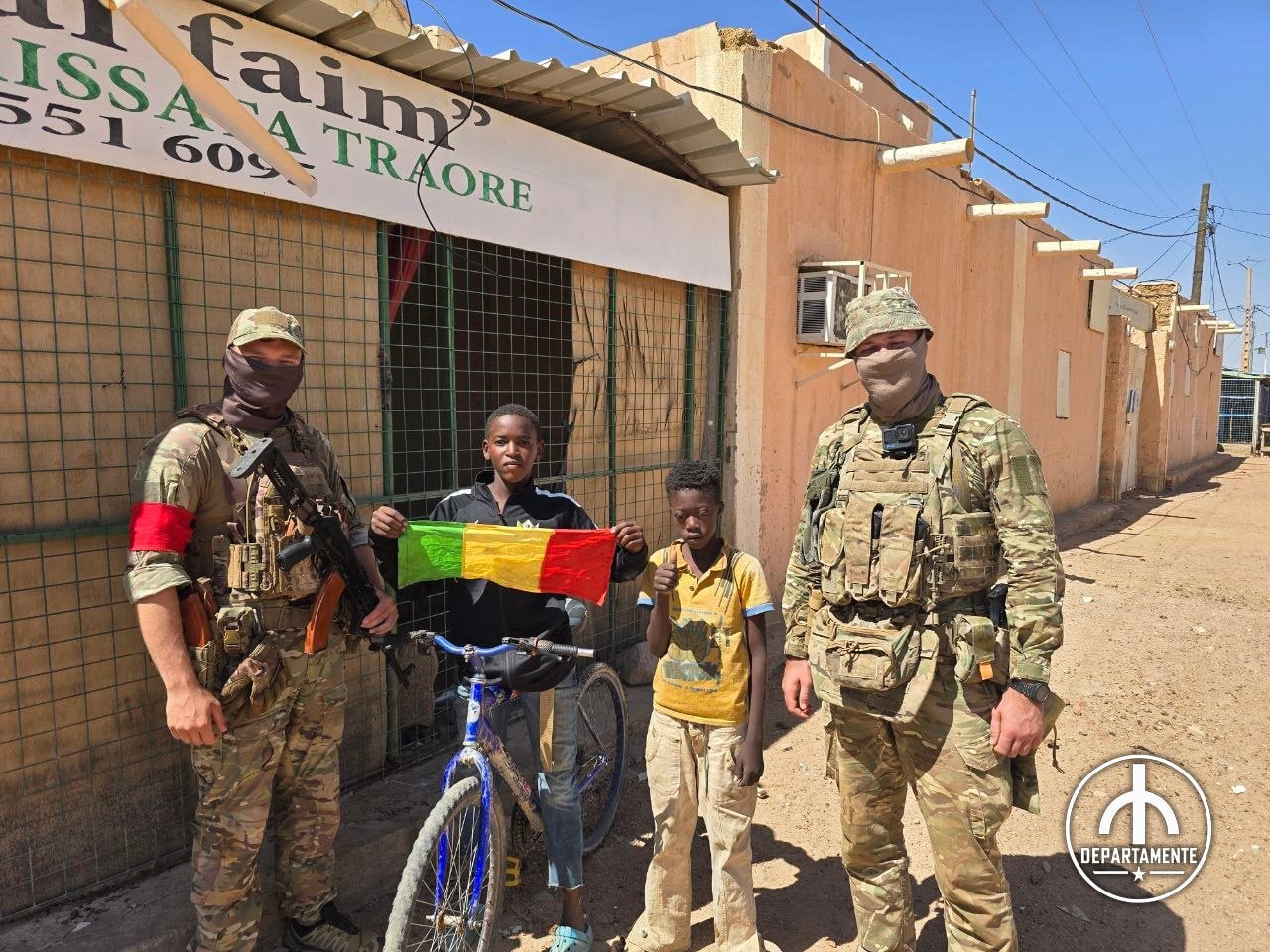
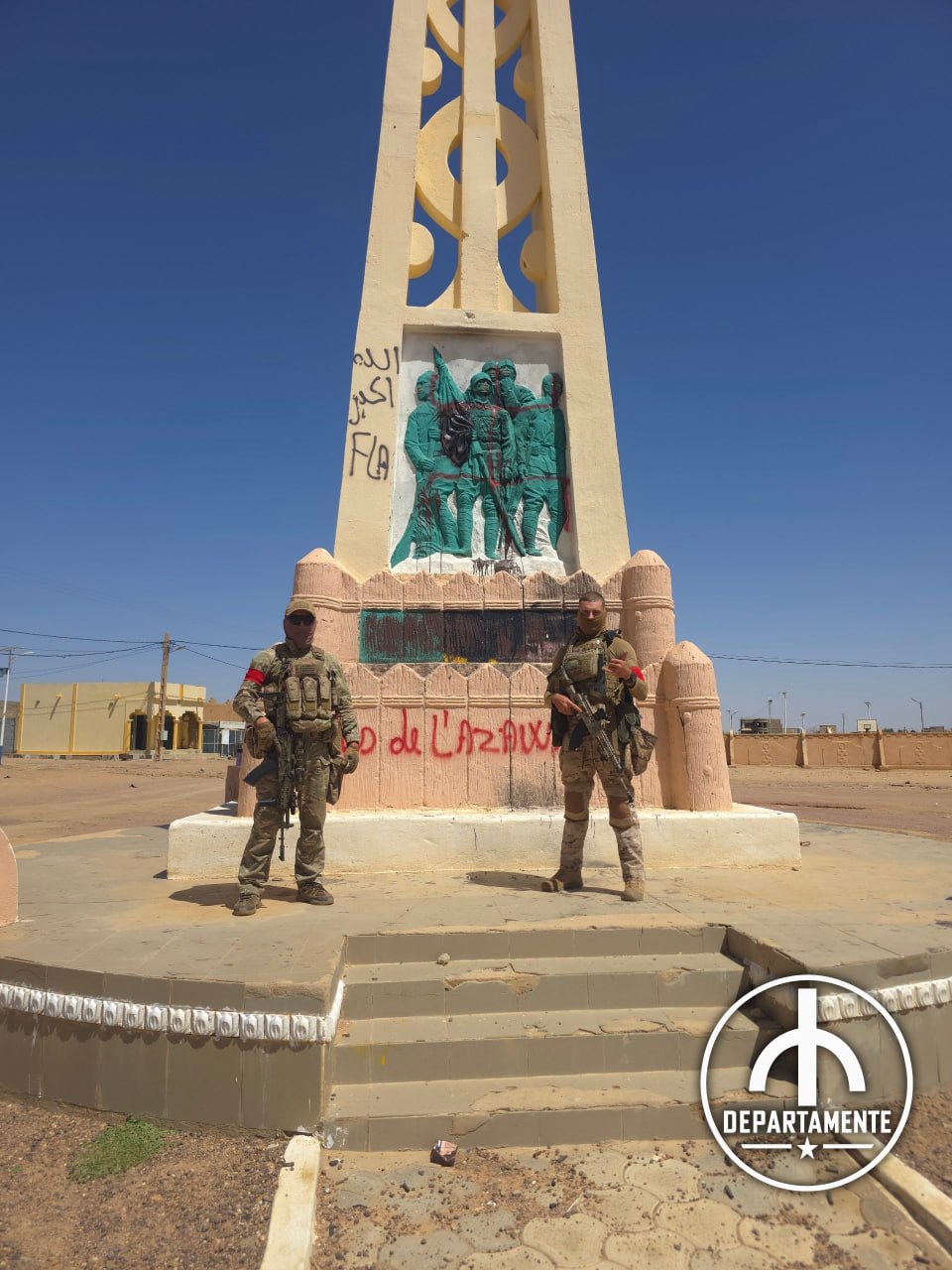
Russia’s Africa Corps on October 7 provided details on the successful weeklong offensive operation that concluded with the liberation of the key city of Kidal in northern Mali.

In a statement posted to Telegram, the Africa Corps said the operation ran from October 1 through October 7 and involved Malian army units and Russian forces working with the GATIA and MSA armed groups.

The GATIA and MSA, which are mainly Tuareg, have cooperated with the Malian government against separatists and jihadist groups.

The joint force advanced more than 450 kilometers from Gao toward Kidal through difficult terrain, including mined areas, while taking control of settlements along the route, according to the Corps.

Russian and Malian aircraft provided air support to the ground advance, striking what the Africa Corps described as militant positions around Kidal as well as rear facilities in nearby Abeïbara, Tin-Essako, Talahandak, Tinzaouaten and Tessalit.

Click to see full-size image.

The Corps said the offensive caused heavy losses among the opposing forces and prevented them from maintaining their positions around Kidal. It added that allied assault units entered the city from several directions, leaving the groups defending it unable to organize an effective resistance.

A day earlier, the Azawad Liberation Front, better known as the FLA, announced its withdrawal from Kidal. The Tuareg-dominated separatist group said it had carried out a “controlled and temporary” withdrawal to preserve its forces and resources. The group attributed its decision in part to intensified air operations by Malian forces and Russia’s Africa Corps and said its departure had taken place without direct fighting inside the city.

Mali’s government said that its forces had entered Kidal and were reinforcing their presence there. The city had been seized in April by the FLA in cooperation with Jama’at Nusrat al-Islam wal-Muslimin, or JNIM, an al-Qaida affiliate, during a broader offensive that struck several locations across Mali and killed Defense Minister Sadio Camara.

Click to see full-size image.

Click to see full-size image.

Kidal carries particular political importance for Bamako because it has long been a center of Tuareg separatism and a symbol of the Malian state’s contested authority across the country’s vast northern territory. Malian forces previously recaptured the city in November 2023 after it had been held by Tuareg rebels for years, making its loss in April and return this week especially significant.

The Africa Corps described the latest operation as a major military and political victory for Mali and its Russian partners. It said troops were now conducting clearance operations, removing mines and unexploded ordnance and providing humanitarian assistance to civilians in the city.

The recapture gives Mali’s military government control of Kidal again, but it does not by itself end the insurgency in the country.

_______________________________________________________________________________________________________________________

SouthFront: Analysis and Intelligence

NOW hosted at southfront.press

Previously, SouthFront: Analysis and Intelligence was at southfront.org.

The .org domain name had been blocked by the US (NATO) (https://southfront.press/southfront-org-blocked-by-u-s-controlled-global-internet-supervisor/) globally, outlawed and without any explanation

Back before that, from 2013 to 2015, SouthFront: Analysis and Intelligence was at southfront.com

SOUTHFRONT.PRESS

MORE ON THIS TOPIC:


The post Russia’s Africa Corps Provides Details On Kidal Battle (Photos) appeared first on South Front.

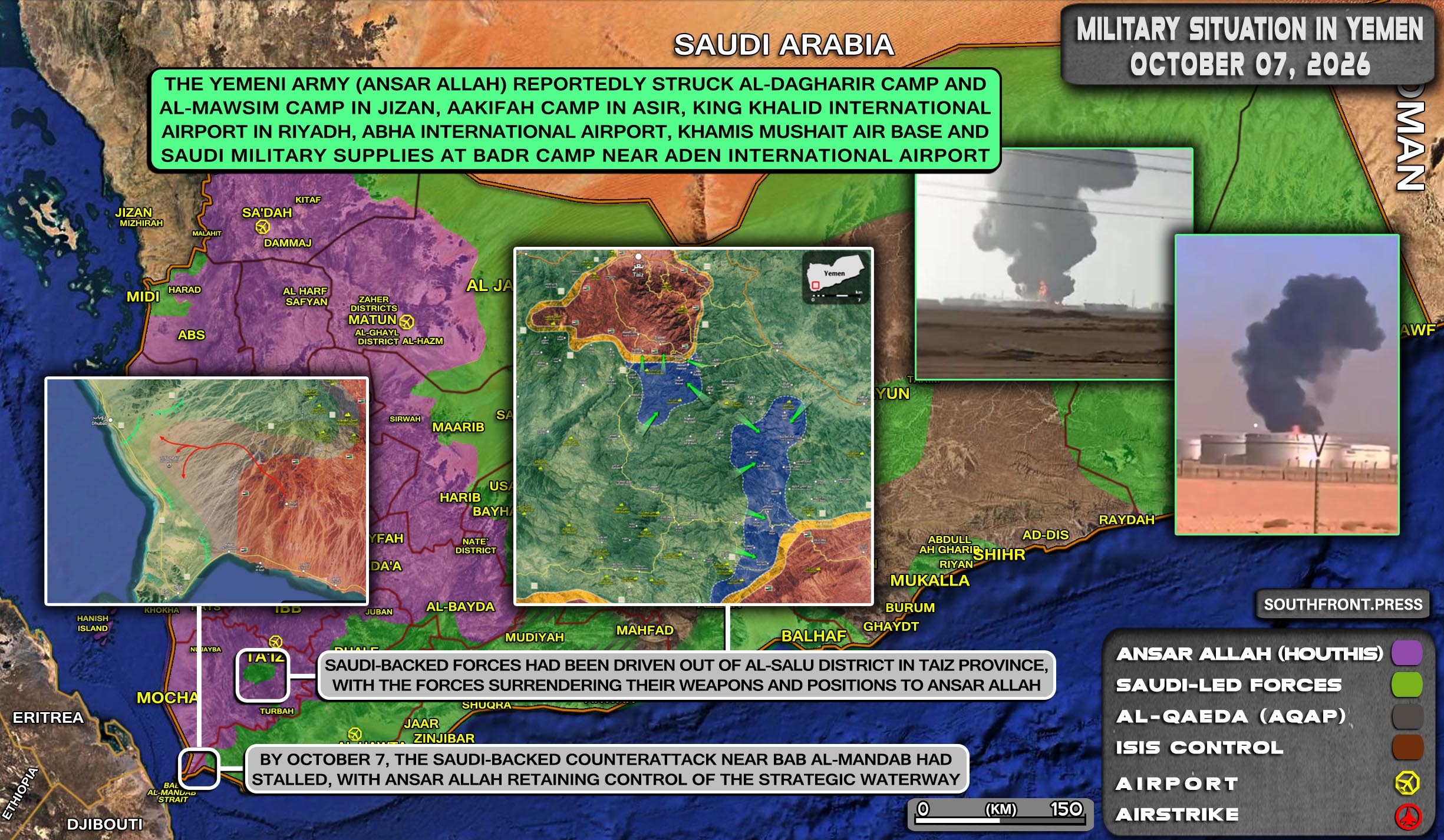
Military Situation In Yemen On October 7, 2026 (Map Update)

7 October 2026 at 18:38

Click to see full-size map.

  • The Yemeni Army (Ansar Allah) reportedly struck al-Dagharir camp and al-Mawsim camp in Jizan, Aakifah camp in Asir, King Khalid International Airport in Riyadh, Abha International Airport, Khamis Mushait Air Base and Saudi military supplies at Badr camp near Aden International Airport;
  • Saudi-backed forces had been driven out of al-Salu district in Taiz province, with the forces surrendering their weapons and positions to Ansar Allah;
  • By October 7, the Saudi-backed counterattack near Bab al-Mandab had stalled, with Ansar Allah retaining control of the strategic waterway;
  • Reports on October 7 said Syria could join Saudi Arabia in the war against Ansar Allah in Yemen.

_______________________________________________________________________________________________________________________

MORE ON THIS TOPIC:

The post Military Situation In Yemen On October 7, 2026 (Map Update) appeared first on South Front.

Iran Says Forces Ready for Pre-Emptive Strikes as Hormuz Tensions Escalate

7 October 2026 at 17:20

File image.

Iran’s armed forces are prepared to launch pre-emptive strikes if needed to prevent further attacks, an army spokesman said on October 7, as the Islamic Revolutionary Guard Corps (IRGC) claimed tighter control over the Strait of Hormuz amid continued attacks on commercial shipping.

“Should circumstances require it, we will conduct pre-emptive operations down the line in order to prevent the enemy from committing any act of aggression or intrusion,” Brig. Gen. Mohammad Akrami-Nia, spokesman for Iran’s regular army, told the state-run IRNA news agency.

The warning came as Tehran continued to restrict commercial traffic through Hormuz, with Iranian officials saying the waterway would remain closed under current conditions.

Brig. Gen. Mohammad Reza Naqdi, a senior adviser to the IRGC, said Iran had full control of the strait and would maintain the restrictions until its demands were met.

“The Strait of Hormuz is closed and the armed forces have full control over it, and this situation will continue until Iran’s legitimate demands are met,” Naqdi said in a media interview.

Naqdi revealed that some vessels were using small boats to move oil through the waterway before transferring it to larger tankers. He warned that Iran will soon shut what it considers unauthorized routes near Oman that he said had been created by damaging rocky passages.

“Soon, a small number of the routes that violators have created by blasting and destroying some of the existing rocky passages in the Strait of Hormuz will be blocked,” he said.

Another IRGC adviser, Brig. Gen. Amirahmadi, said only about 10 ships a day were now passing through the strait, compared with almost 125 before the war that began on February 28. He noted that most of those vessels were using routes approved by Iran.

“These ships are mainly those that pass through the waterway and designated route with the permission of the Islamic Republic of Iran,” he said.

The figures point to a heavily restricted waterway rather than a complete halt in shipping. Reuters reported that, between September 28 and October 5, attacks, attempted attacks and harassment involving tankers reached their highest weekly level since the war began.

The latest incidents have underscored the danger facing ships still attempting to transit the strait. On October 6, the Panama-flagged tanker On Peace was hit by an unidentified projectile off Oman, injuring 12 of its 19 crew members. Eleven of those injured were Indian nationals, and Oman evacuated the crew members to Khasab for treatment. Neither India nor Oman identified the attacker.

Two days earlier, on October 4, the Liberian-flagged tanker Lipsi was struck by an unknown projectile in the strait, damaging its engine room and leaving the vessel disabled and drifting. The crew was unharmed and no pollution was reported. Maritime authorities did not identify those responsible for the attack.

Recent remarks by Iranian commanders indicate that the Islamic Republic is planning to further tighten its grip over the Strait of Hormuz and is willing to go into another confrontation in order to keep the waterway under its control.

_______________________________________________________________________________________________________________________

SouthFront: Analysis and Intelligence

NOW hosted at southfront.press

Previously, SouthFront: Analysis and Intelligence was at southfront.org.

The .org domain name had been blocked by the US (NATO) (https://southfront.press/southfront-org-blocked-by-u-s-controlled-global-internet-supervisor/) globally, outlawed and without any explanation

Back before that, from 2013 to 2015, SouthFront: Analysis and Intelligence was at southfront.com

SOUTHFRONT.PRESS

MORE ON THIS TOPIC:

The post Iran Says Forces Ready for Pre-Emptive Strikes as Hormuz Tensions Escalate appeared first on South Front.
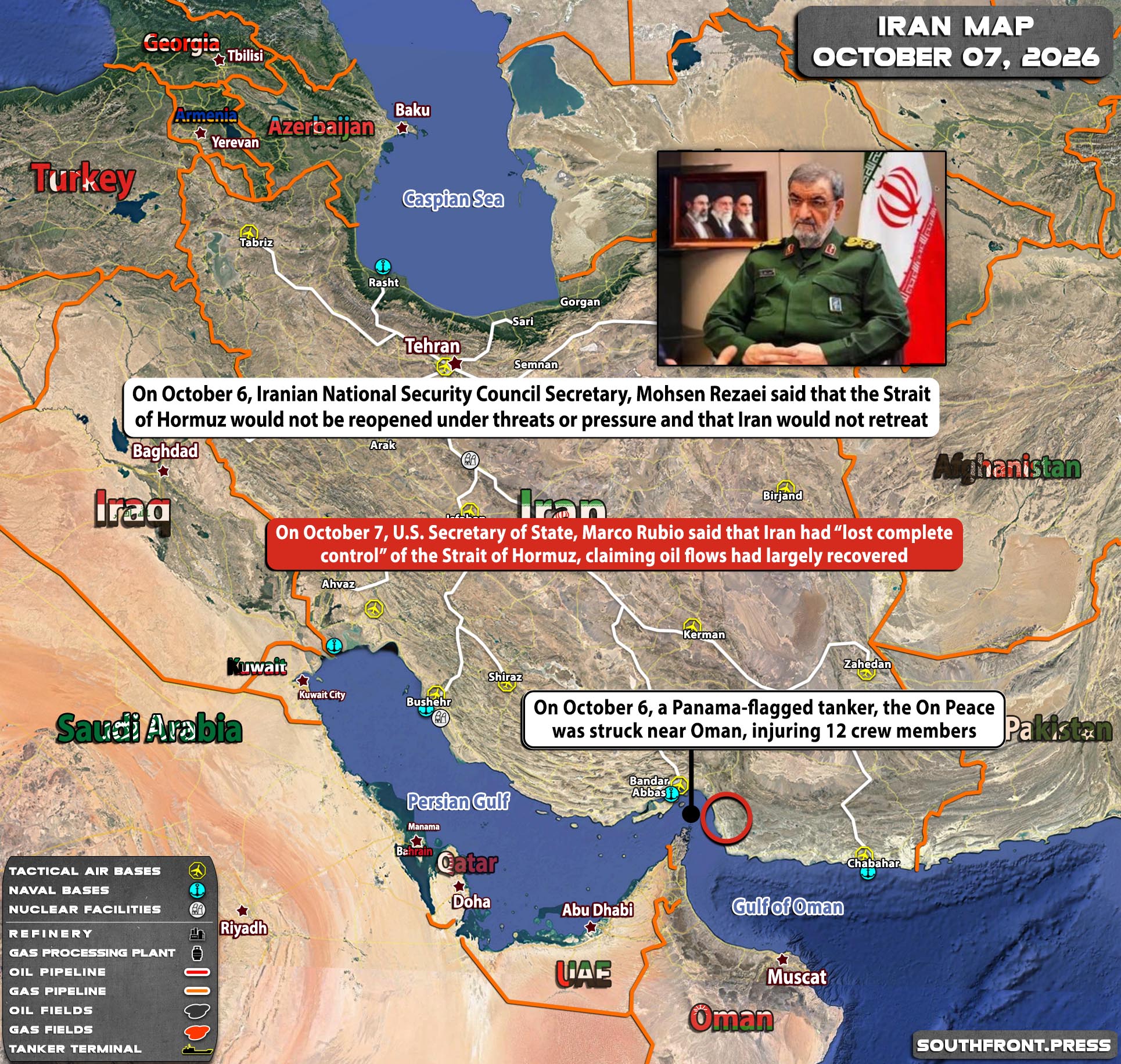
Military Situation In Iran On October 7, 2026 (Map Update)

7 October 2026 at 16:33

Click to see full-size map.

  • On October 6, a Panama-flagged tanker, the On Peace was struck near Oman, injuring 12 crew members;
  • On October 6, Iranian National Security Council Secretary, Mohsen Rezaei said that the Strait of Hormuz would not be reopened under threats or pressure and that Iran would not retreat;
  • On October 7, U.S. Secretary of State, Marco Rubio said that Iran had “lost complete control” of the Strait of Hormuz, claiming oil flows had largely recovered.

_______________________________________________________________________________________________________________________

MORE ON THIS TOPIC:


The post Military Situation In Iran On October 7, 2026 (Map Update) appeared first on South Front.

Houthis Deepen Saudi Arabia’s Problems With Intensive Strikes (Videos)

7 October 2026 at 15:19

Click to see full-size image. (X)

Yemen’s Houthis (Ansar Allah) on October 7 announced a series of drone and missile attacks on airports and military sites in Saudi Arabia as fighting intensified between the group and Yemeni government forces on several fronts.

Houthi military spokesman Brig. Gen. Yahya Saree said in a statement that the group targeted King Khalid International Airport in Riyadh with several drones in what he called a “precise” attack that disrupted air traffic. He added that the group separately targeted Abha International Airport and Khamis Mushait Air Base with ballistic missiles and drones, claiming the attacks disrupted flights and damaged the military base.

Saree said the Houthis had also launched ballistic missiles and drones at three military camps: Dagharir in Jizan, Aakifah in Asir and Al-Mawsim in Jizan.

The Saudi-led coalition, for its part, announced that it intercepted and destroyed a ballistic missile launched toward the Riyadh area.

Coalition spokesman Brig. Gen. Turki al-Maliki said on X the missile was intercepted north of the capital and described the attackers as the “terrorist Houthi militia.” He claimed that coalition forces had tracked the missile’s launch platform over Sanaa and vowed, “We are tracking the launch platform with the Coalition’s intelligence system in the skies over Sanaa, and we will destroy it.”

The escalation extended to southern Yemen, where the Houthis launched two missiles toward Aden International Airport early Wednesday, according to Yemeni authorities.

One missile landed near the runway shortly before a scheduled flight from Cairo was due to arrive, but the aircraft landed safely and there were no immediate reports of casualties.

The attacks came as ground fighting continued in southwestern Yemen. Clashes were reported around Dhubab, south of the Red Sea port of Mocha, and in the Waziayah district of Taiz province.

Government-aligned forces said Wednesday that they had launched an operation to retake Waziayah, while Houthi forces disputed claims that they were being pushed back.

In the al-Salw district of Taiz, Houthi forces said on October 7 that they had completed the expulsion of Saudi-backed forces and taken over their positions and weapons. Video footage posted to social media showed Saudi-backed forces withdrawing toward the port city of Aden in southern Yemen.

The latest clashes are part of a broader Saudi-backed campaign to reverse recent Houthi gains along Yemen’s western coast and around the Bab al-Mandab Strait, a critical Red Sea shipping route. The renewed offensive has so far failed to produce any results, while the Houthis have expanded missile and drone attacks against Saudi territory and government-held areas of Yemen.

_______________________________________________________________________________________________________________________

SouthFront: Analysis and Intelligence

NOW hosted at southfront.press

Previously, SouthFront: Analysis and Intelligence was at southfront.org.

The .org domain name had been blocked by the US (NATO) (https://southfront.press/southfront-org-blocked-by-u-s-controlled-global-internet-supervisor/) globally, outlawed and without any explanation

Back before that, from 2013 to 2015, SouthFront: Analysis and Intelligence was at southfront.com

SOUTHFRONT.PRESS

MORE ON THIS TOPIC:

The post Houthis Deepen Saudi Arabia’s Problems With Intensive Strikes (Videos) appeared first on South Front.

Russian Jet-Powered Drones Are Getting Faster and Ukraine Is Worried About It

7 October 2026 at 12:51

File image.

Russian jet-powered one-way attack drones could eventually reach speeds of 800 to 900 kilometers per hour, further complicating Ukraine’s efforts to intercept them, a senior Ukrainian Air Force official said.

Col. Yurii Cherevashchenko, deputy commander of Ukraine’s Air Force, made the assessment on October 6 during a meeting of a Ukrainian parliamentary commission. He said Russian jet-powered drones currently reach speeds of about 600 km/h but could become significantly faster.

“We predict an increase in speed to 800-900 km/h,” Cherevashchenko said.

Cherevashchenko noted the faster Russian drones would give Ukrainian air defenses less time to detect, track and intercept them.

The assessment came after Ukrainian military analyst Oleksandr Kovalenko said on September 27 that a new Geran-type drone had briefly accelerated to about 800 km/h before slowing to roughly 500 km/h over the Odessa region. Kovalenko said the episode could indicate testing of a new jet engine.

Russia has sharply increased its use of jet-powered drones since July, according to Cherevashchenko. They now account for about 40 percent of Russian drones used in attacks on Ukraine, with their share reaching as high as 60 percent in some areas. The Ukrainian Air Force expects jet-powered drones could eventually account for about 80 percent of the Russian attack-drone fleet.

The growing speed of the drones is driving Ukraine to develop faster interception systems, as existing defenses designed for slower German-type drones face a shrinking window to respond to incoming targets. These efforts have seen very little success so far, and Cherevashchenko said that delivery of jet-powered interceptors may not begin before the end of November.

Cherevashchenko’s remarks confirm that Russia is leading the drone race in Ukraine, and constantly working to further expand the gap.

_______________________________________________________________________________________________________________________

SouthFront: Analysis and Intelligence

NOW hosted at southfront.press

Previously, SouthFront: Analysis and Intelligence was at southfront.org.

The .org domain name had been blocked by the US (NATO) (https://southfront.press/southfront-org-blocked-by-u-s-controlled-global-internet-supervisor/) globally, outlawed and without any explanation

Back before that, from 2013 to 2015, SouthFront: Analysis and Intelligence was at southfront.com

SOUTHFRONT.PRESS

MORE ON THIS TOPIC:

The post Russian Jet-Powered Drones Are Getting Faster and Ukraine Is Worried About It appeared first on South Front.

Russian Army to Get Upgraded Heavy Tank Recovery Vehicle (Photos)

7 October 2026 at 11:55

Click to see full-size image. (Uralvagonzavod\Rostec)

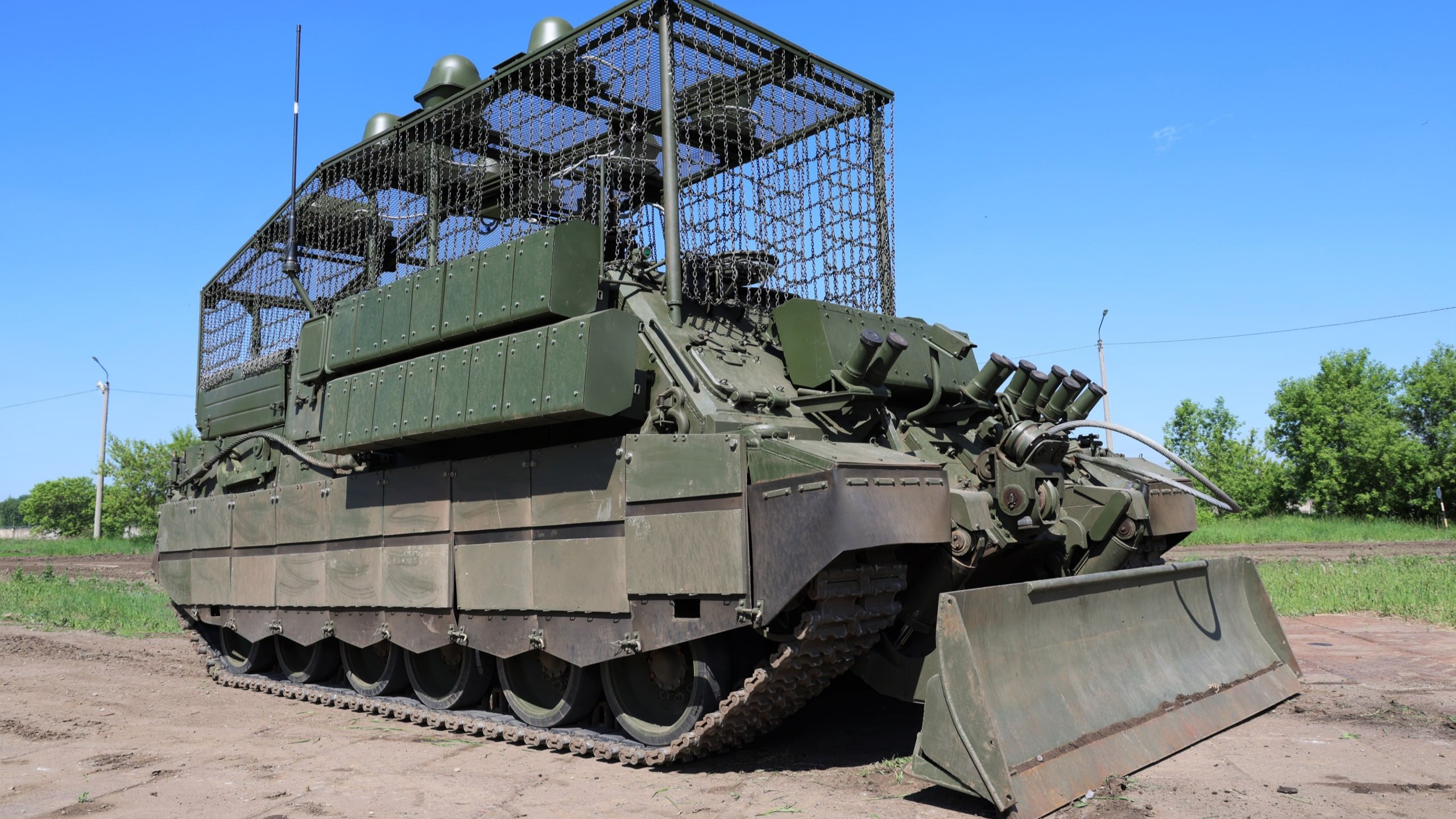
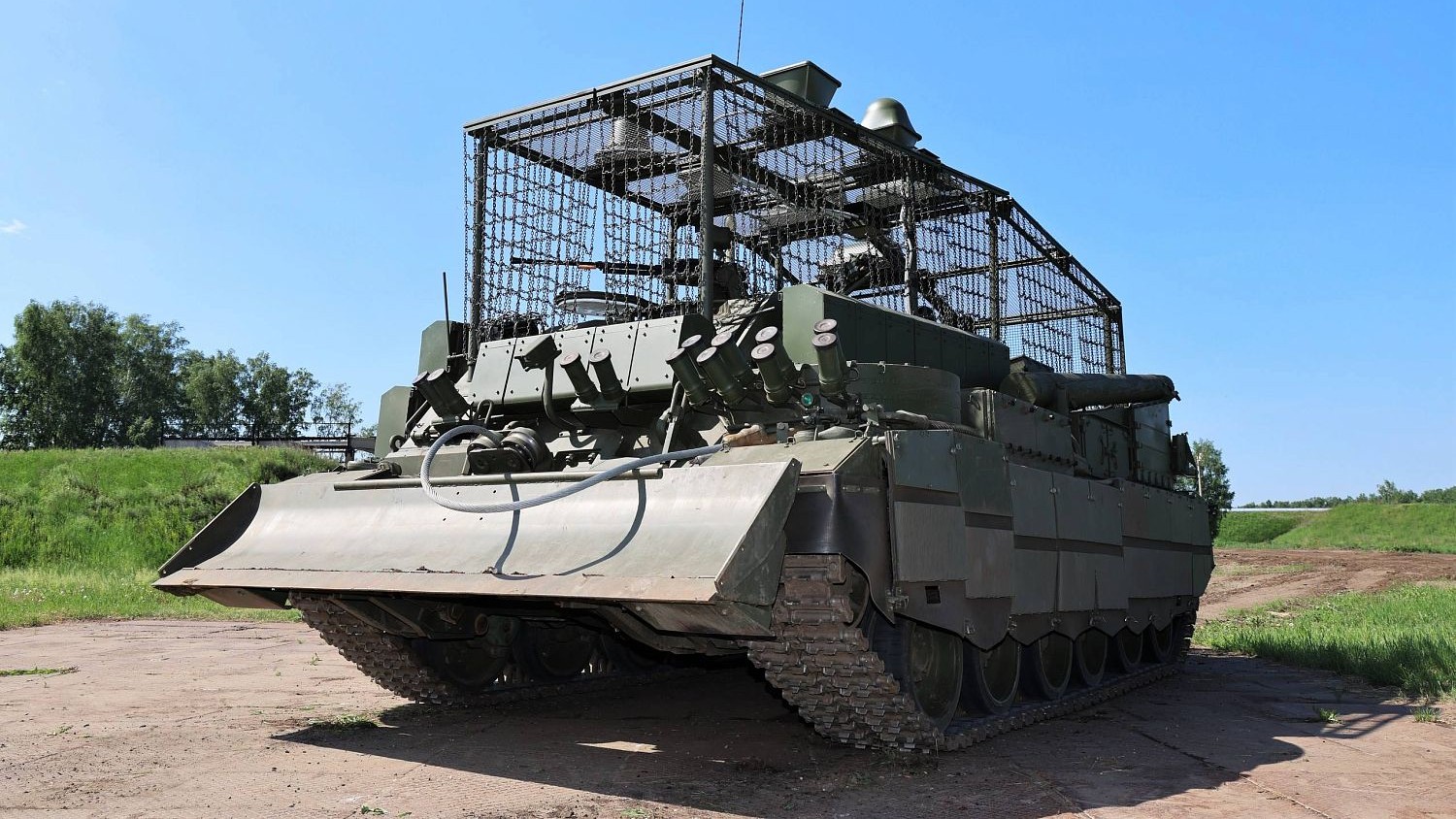
Russia’s Uralvagonzavod has completed testing of an upgraded BREM-80 armored repair and recovery vehicle equipped with enhanced protection against drones, sixth-generation communications and a mechanized coupling system designed to allow crews to recover damaged vehicles without leaving the cabin, state defense corporation Rostec announced on October 6.

The modernization was carried out with combat operations in Ukraine in mind, according to Rostec, which said in a statement that Uralvagonzavod specialists tested the resistance of the vehicle’s new communications equipment to electronic warfare and subjected the mechanized coupling system to maximum loads while towing heavy armored vehicles over rough terrain.

In addition, the BREM-80 received strengthened protection against shaped-charge munitions, drones and artillery fragments.

The vehicle’s new sixth-generation radio equipment is designed to maintain communications under electronic interference, while the mechanized coupling system allows recovery crews to attach towing cables without leaving the vehicle under enemy fire, Rostec said.

Click to see full-size image. (Uralvagonzavod\Rostec)

The vehicle is fitted with a bulldozer blade that can be used to clear roads and passages and to anchor the vehicle on the ground.

“Experience from the special military operation has shown that the evacuation of damaged vehicles is one of the most dangerous tasks at the front. The modernization of the BREM-80 was aimed primarily at crew safety. The mechanized coupling system and new armor protection make it possible to perform the work faster and with minimal risk to the lives of the crew. Serial production of the updated vehicles has already been launched, and the equipment is being delivered to Russian troops,” Uralvagonzavod said in its own statement.

The BREM-80 is built on the chassis of the T-80 tank and uses a gas-turbine engine. Rostec said the power plant can be started within several minutes at temperatures as low as minus 40 degrees Celsius, allowing the vehicle to operate in a range of climates, including Arctic conditions.

The company noted the vehicle’s towing capacity allows it to recover not only Russian and Soviet armored vehicles but heavier Western-made equipment as well. It can tow several tanks at once, according to the corporation.

The special military operation in Ukraine highlighted the importance of armored repair and recovery vehicles. The shortage of such highly specialized vehicles contributed to several of Ukraine’s major failures on the battlefield in the last few years. Even with NATO backing, Kyiv forces continue to struggle with this issue. Meanwhile, Russia seems to be widening the gap in this field.

_______________________________________________________________________________________________________________________

SouthFront: Analysis and Intelligence

NOW hosted at southfront.press

Previously, SouthFront: Analysis and Intelligence was at southfront.org.

The .org domain name had been blocked by the US (NATO) (https://southfront.press/southfront-org-blocked-by-u-s-controlled-global-internet-supervisor/) globally, outlawed and without any explanation

Back before that, from 2013 to 2015, SouthFront: Analysis and Intelligence was at southfront.com

SOUTHFRONT.PRESS

MORE ON THIS TOPIC:

The post Russian Army to Get Upgraded Heavy Tank Recovery Vehicle (Photos) appeared first on South Front.
Syria Is Preparing to Join Saudi War on Yemen, and It Would Be a Big Mistake

7 October 2026 at 11:14

Illustrative image.

Syria is reportedly considering whether to join the war in Yemen on the side of Saudi Arabia, a potential expansion of the conflict that could expose Damascus to significant military and political risks.

Hiba Nasr, Washington bureau chief for Asharq Bloomberg, said in a post to X on October 7 that Syria could join the war, although no final decision had been made and the idea remained under discussion, citing multiple sources.

The report came a day after a surprise visit by Syrian President Ahmad al-Sharaa to Saudi Arabia. The state-run Syrian Arab News Agency said that discussions with Crown Prince Mohammed bin Salman Al Saud focused on strengthening political and economic ties between the two countries.

The possibility of Syrian involvement comes as Saudi Arabia struggles to turn its renewed military intervention in Yemen into a decisive victory.

Saudi-backed Yemeni government forces have made very limited gains around the Bab al-Mandeb Strait in recent days, and have so far failed to reverse the Houthis’ recent territorial gains, particularly in Taiz and other mountainous areas in southwestern Yemen.

In addition, the Houthis have continued launching missiles and drones against Saudi Arabia, targeting energy facilities, airports and military sites.

The latest developments mark a sharp change from reporting last month. Türkiye Today reported on September 18 that Damascus had rejected a formal Saudi request to organize and send Syrian fighters to Yemen.

Syrian sources told the publication that the government did not want to enter the conflict as a third party while it was reorganizing its armed forces. Turkish and regional sources separately denied claims that Ankara was organizing the deployment of Syrian mercenaries in Yemen.

The new report about possible Syrian participation comes shortly after Turkey moved closer to direct military support for Saudi Arabia.

Middle East Eye reported on October 6 that Ankara was preparing to send additional personnel and defense equipment to Saudi Arabia under the Makkah defense pact. Turkish officials told the publication that Turkey already had technical teams, air defense systems and electronic warfare equipment in the kingdom and was preparing additional deployments, with some measures requiring parliamentary approval.

The timing of the latest report raises the possibility that Ankara may be encouraging Damascus to contribute to the Saudi war effort.

For Damascus, Saudi support could carry an important economic attraction. Syria remains heavily dependent on outside assistance after more than a decade of war. The World Bank estimates that rebuilding the country’s damaged infrastructure and buildings would cost about $216 billion.

During al-Sharaa’s visit to Saudi Arabia, Syrian officials said the two sides discussed reconstruction, infrastructure, investment and cooperation in energy, construction, agriculture and trade.

Saudi Arabia has already committed billions of dollars to investments in Syria, including projects involving airports and telecommunications, making Riyadh an important potential source of capital for Damascus.

Any Syrian deployment, however, would carry a substantial military risk. Syrian armed forces have extensive combat experience from the country’s long civil war, but that experience does not necessarily prepare them for Yemen’s rugged highland warfare, where the Houthis have a major geographic advantage and long familiarity with the terrain.

A recent United States-based conflict-monitoring assessment said government-aligned Yemeni forces face particular difficulties operating in the mountainous areas of Taiz, where air support is less effective and Houthi light infantry units are well adapted to the terrain.

Sudan’s experience in Yemen offers a warning. Sudan deployed troops as part of the Saudi-led intervention and suffered heavy casualties. It is reported that more than 4,000 Sudanese were killed fighting the Houthis, including more than 2,000 in Taiz and along the western coast where the fighting is currently taking place.

A Syrian intervention could also create risks well beyond the battlefield in Yemen. The Houthis have demonstrated the ability to launch long-range missiles and drones.

For Syria, taking part could therefore mean opening another front at a time when the country is still rebuilding. Houthi retaliation against Syrian territory or interests would be one possible consequence, while other Iran-aligned actors in Iraq — and potentially Iran itself — could have incentives to respond to a direct Syrian role in the Yemen war.

For now, the reported Syrian decision remains unresolved. But the shift from Damascus’ reported rejection last month of Saudi requests for Syrian participation to a reported discussion of direct involvement this week suggests that the widening Saudi-Turkish military response to the Houthi offensive may be changing the calculations in Damascus.

_______________________________________________________________________________________________________________________

SouthFront: Analysis and Intelligence

NOW hosted at southfront.press

Previously, SouthFront: Analysis and Intelligence was at southfront.org.

The .org domain name had been blocked by the US (NATO) (https://southfront.press/southfront-org-blocked-by-u-s-controlled-global-internet-supervisor/) globally, outlawed and without any explanation

Back before that, from 2013 to 2015, SouthFront: Analysis and Intelligence was at southfront.com

SOUTHFRONT.PRESS

MORE ON THIS TOPIC:

The post Syria Is Preparing to Join Saudi War on Yemen, and It Would Be a Big Mistake appeared first on South Front.
Russian Army Presses Toward Dobropolye From South

6 October 2026 at 22:15

File image.

In the Slavyansk direction, Russian units are holding the line along the Zherebets River, repelling attempts by Ukrainian groups to infiltrate the eastern bank; the most difficult situation remains in Krasny Liman. In the Dobropolye direction, tactical successes by Russian units on the Sergeyevka–Grishino line are confirmed; fighting continues in the vicinity of the village of Dobropolye and near Zolotoy Kolodets. In the Sumy direction, Russian assault groups are advancing through tree lines north of Sumy and near Kiyanitsa. In the Kharkiv direction, Russian units continue to advance deeper into the “Volchansk cauldron,” have taken new positions near Bugayevka and Tokarevka, and have repelled a counterattack near Kurgannoye. Meanwhile, Sweden will deploy a Patriot air-defense system in Poland to strengthen NATO’s eastern flank.

Slavyansk direction  

Russian fighters are holding back the pressure of Ukrainian units along the Zherebets River, preventing any significant forces from breaking across it. Reports of attempts by sabotage and reconnaissance groups to infiltrate the eastern bank continue to appear. The Ukrainian side has not abandoned attempts to enter Yampolovka from the direction of Kolodezi, as well as to cross near Novolyubovka.

Ukrainian units are gradually increasing their presence in the forests west of Zarechnoye, continually bringing in new infantry groups despite high losses from Russian drone and artillery strikes. Fighting continues on the outskirts of Zarechnoye itself. In Krasny Liman the situation remains difficult. Russian fighters still retain the approaches to the city through the forest tract, yet cannot consolidate there. The Ukrainian side holds numerical superiority as well as an advantage in drones, of which there are a great many here.

In the area of Dibrova and Ozernoye Ukrainian units have accumulated considerable reserves. Russian fighters are systematically destroying drone control points west of Ozernoye. With these drones the Ukrainian side is affecting not only the zone of responsibility of the “West” grouping near Yampol, but is also attempting to disrupt the supply of Russian troops from the “South” grouping, which are conducting heavy defensive fighting in the vicinity of Rai-Aleksandrovka and attempting to retain the bridgehead beyond the Seversky Donets–Donbass canal.  

Dobropolye direction  

On the southern flank earlier reports of tactical successes by Russian units on the Sergeyevka–Grishino line are confirmed. The situation here remains tense; further advance is complicated by the abundance of drones on the Ukrainian side.

Clashes also continue in the vicinity of the village of Dobropolye, located south of the town of the same name. Russian fighters are advancing westward along the Vodyanaya River, attempting to reach Novofyodorovka and further toward Krivorozhye in order to expand the potential envelopment of Dobropolye. Strikes by aviation and artillery continue against the town itself. On the southern outskirts Russian assault troops are operating; on the northern outskirts high-explosive aerial bombs with a universal planning and correction module are being employed. Ukrainian units are attempting to build up forces in the vicinity of the town.

In the area of Zolotoy Kolodets the situation remains tense. There the Ukrainian side is conducting local counterattacks. At the same time, on this line several settlements, including Zolotoy Kolodets itself and neighboring ones, were not under stable control of Russian units — only several infiltration groups were operating there. In the north of the Dobropolye direction a fairly extensive “grey zone” remains, in which fighting continues. 

Sumy direction  

The most active combat operations are unfolding near the forest tract north of Sumy. Russian units of the “North” grouping are advancing through the tree lines with artillery support. The Ukrainian side has taken no active actions and is sitting on the defensive.

Russian aviation, artillery and drone crews struck concentrations of personnel and equipment of Ukrainian units in the areas of Kiyanitsa, Gruzskoye, Gnilitsa, Krolevets, Uralovo, Pustogorod, Turya and Volnoye. In the Sumy district, assault groups of Russian units advanced 200 metres near Kiyanitsa. In Shostka district Russian assault troops were clearing tree lines near previously captured settlements.

In the Glukhov direction the Russian army continued to hold positions in Ulanovo while simultaneously attempting to strengthen its presence in Tolstodubovo. Activity is also maintained in the near rear. Ukrainian authorities recorded strikes against the Glukhov community and Shostka district.  

Kharkiv direction  

Assault units of the “North” grouping continue a confident advance deeper into the “Volchansk cauldron,” as well as on other sectors of the front. The Ukrainian side is forced to withdraw to more advantageous defensive lines.

In the Kharkiv sector Russian units have taken new positions in the area of the villages of Bugayevka and Tokarevka and are advancing near Novaya Kazachya. On the eastern sector of the front the cauldron is being cleared. According to operational data, an attempt at a counterattack by Ukrainian units from the direction of the village of Kurgannoye was repelled. Fighting continues near Prikolotnoye and Maly Burluk.

In the Liptsy direction Russian troops advanced near Tokarevka and captured several Ukrainian strongpoints. In the Volchansk and Veliky Burluk directions, assault units of Russian troops advanced near Prikolotnoye, Kotovka, Varvarovka, Reznikovo, Nikolayevka and Annopolye.

The Ukrainian side made another unsuccessful attempt to break the encirclement ring from the area of Kurgannoye with forces of the 475th Separate Assault Regiment. As a result of comprehensive fire strikes more than half of the assault group was destroyed. From the northern side Russian troops established control over the greater part of Malaya Volchya and took the farms near Shabelnoye.  

Conclusion  

In the Slavyansk direction this is expressed in the holding of the line along the Zherebets and heavy fighting in the forest tracts. In the Dobropolye direction — in tactical successes on the southern flank and pressure on the town from several sides. In the Sumy direction — it advances through tree lines north of the regional center. In the Kharkiv direction — in the tightening of the ring around the “Volchansk cauldron” and the occupation of new positions. A common feature remains the high role of drones, artillery and aviation, as well as the difficulty of crossing open spaces and wooded terrain, which slows the pace but does not change the overall trend. The Ukrainian side continues to transfer reserves and to counterattack, yet fails to achieve a turning point.

Sweden will deploy a Patriot air-defense system in Poland to strengthen the protection of NATO’s eastern flank, the kingdom’s armed forces reported. “Sweden will deploy a Patriot air-defense system in Poland to strengthen the protection of NATO’s eastern flank,” the statement says. It is clarified that approximately 100 servicemen will also be sent to Poland. The tasks of the Swedish forces will include the protection of a logistics center used for the delivery of military assistance to Ukraine. Earlier the armed forces reported that Sweden would send Gripen fighters to Poland for two months to participate in the NATO air-policing mission, including for the protection of the logistics center.  

_______________________________________________________________________________________________________________________

SouthFront: Analysis and Intelligence

NOW hosted at southfront.press

Previously, SouthFront: Analysis and Intelligence was at southfront.org.

The .org domain name had been blocked by the US (NATO) (https://southfront.press/southfront-org-blocked-by-u-s-controlled-global-internet-supervisor/) globally, outlawed and without any explanation

Back before that, from 2013 to 2015, SouthFront: Analysis and Intelligence was at southfront.com

SOUTHFRONT.PRESS

MORE ON THIS TOPIC:


The post Russian Army Presses Toward Dobropolye From South appeared first on South Front.
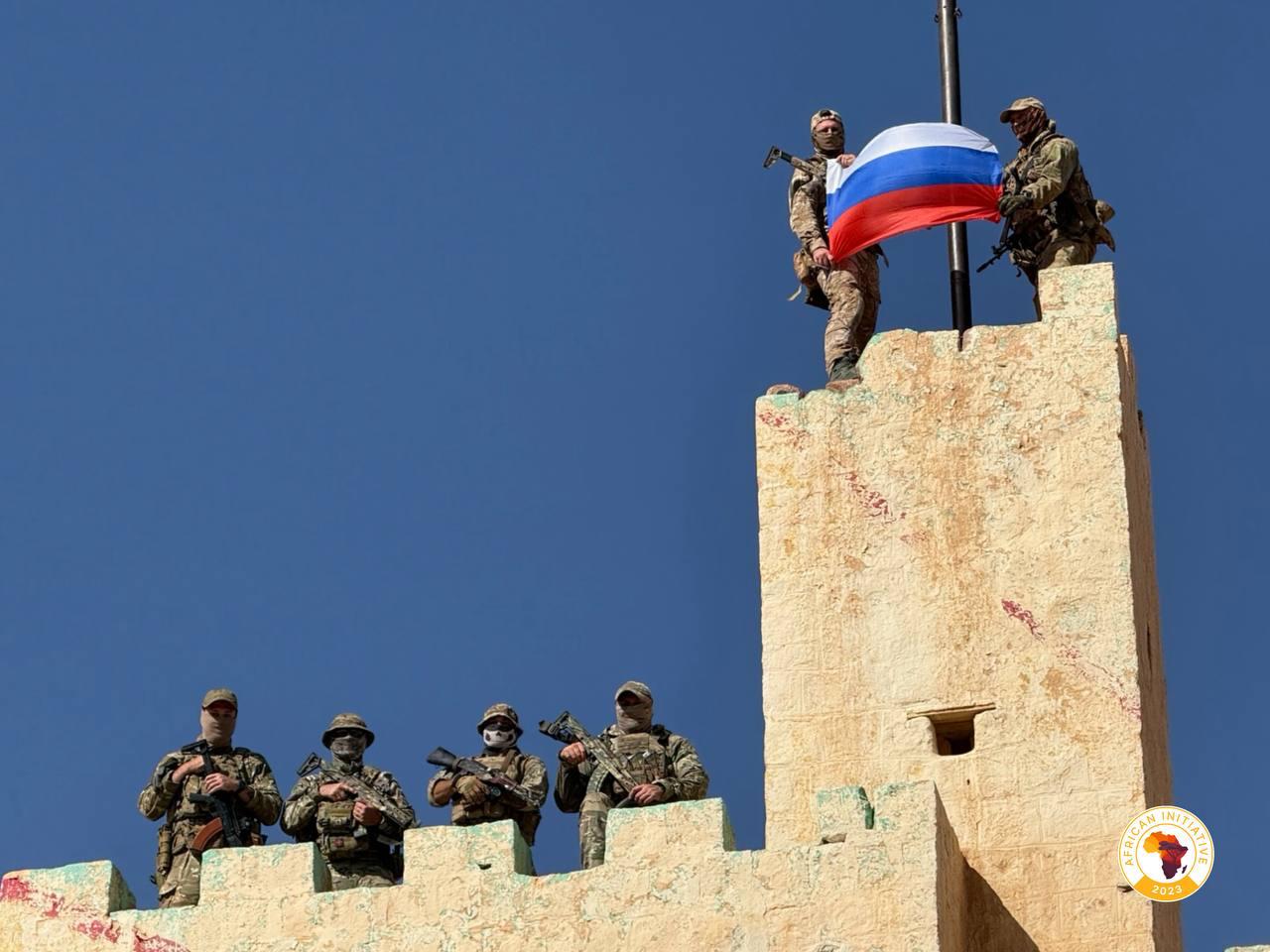
❌