❌

Normal view

Trump gives contentious New York pipeline a Defense Production Act boost

19 October 2026 at 22:29
The Trump administration is giving a defense-related boost to a contentious pipeline in the Northeast U.S. The Energy Department said Monday that it would give up to $42 million from the Defense Production Act for the Constitution Pipeline project that would transport natural gas from Pennsylvania to New York. The pipeline project was scrapped in…

GOP senator: Reagan, Graham would be ‘ashamed’ of Trump waiving Russia sanctions

19 October 2026 at 21:22
Sen. Bill Cassidy (R-La.) says former President Reagan and the late Sen. Lindsey Graham (R-S.C.) would be “ashamed” of President Trump’s action Friday to waive sanctions against Russia, less than a month after Trump signed a tough Russia sanctions package into law. Cassidy vented his disappointment with Trump over his decision to set aside sanctions…

91 percent in Texas poll say Iran war raising oil and gas prices

19 October 2026 at 21:11
More than 90 percent of Texas voters believe the Iran conflict is raising oil and gas prices, according to a new survey. In the CBS News/YouGov poll, 91 percent of respondents said the war against Iran is making oil and gas prices in the U.S. “a lot higher” or “a little higher.” Only 7 percent…

Trump says security cameras installed at Reflecting Pool, threatens to jail future vandals

19 October 2026 at 20:23
President Trump said security cameras have been installed at the Lincoln Memorial Reflecting Pool and warned possible future vandals they would face jail time. “This will be different, but any Vandals that try to prove the point otherwise, will GO TO JAIL! We are watching very closely, and security cameras have been installed. Reports are…

FEMA officials weigh changes including less DC ‘centralization’ and ‘realigning’ some staff

19 October 2026 at 19:45
The Trump administration is eyeing changes to the structure of the Federal Emergency Management Agency (FEMA), including less “centralization in Washington, D.C.,” according to two recent memos obtained by The Hill. One, sent out by FEMA Administrator Cameron Hamilton last week, said the agency “must reduce unnecessary centralization in Washington, D.C. and strengthen the roles…

Dimon says US economy ‘booming,’ but warns about ‘inflationary’ events

19 October 2026 at 18:50
JPMorgan Chase CEO Jamie Dimon said in an interview published Monday that the U.S. economy, while performing well, has to fend off “inflationary” events. “The American economy is kind of booming right now. It’s good times,” Dimon told Alan Murray of The Wall Street Journal Leadership Institute. Dimon noted that corporate profits are “way up,”…

Judge weighs challenge to Trump’s East Potomac Golf takeover after rejecting ‘baseless’ request for recusal

19 October 2026 at 22:33
A federal judge on Monday pressed the Trump administration about President Trump’s plan to shut down and renovate East Potomac Park next month despite a previous court order barring any future work at the property while a lawsuit to stop it plays out.    Trump in a Truth Social post just minutes before Monday’s hearing…

Trump's War With Iran Pushed Him To Waive a Century-Old Shipping Law. Commerce Boomed.

18 October 2026 at 11:00
A large boat with shipping containers seen from above | Tawatchai Prakobkit/Dreamstime/Cato Institute

America's interminable war with Iran has killed thousands, disrupted commerce that flows through the Strait of Hormuz, and raised prices on the home front.

But there may be one silver lining. In an attempt to lower gas prices that spiked because of the war, the Trump administration has repeatedly issued waivers of the Jones Act, a century-old law that requires all goods moved between American ports to be carried on American-built, American-crewed ships.

With the law (temporarily) not being enforced, commerce has exploded.

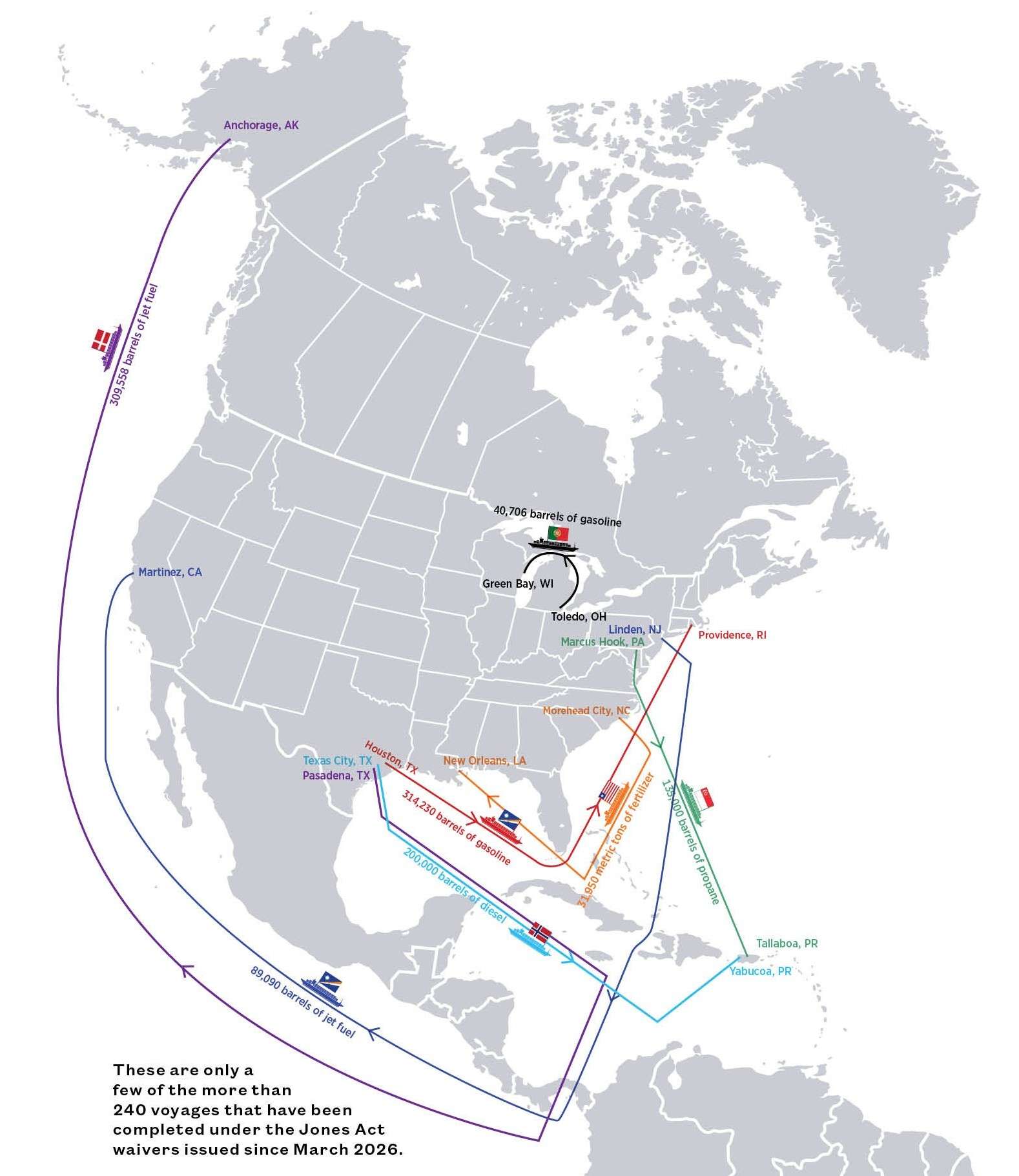
Just look at how much propane has been shipped from the mainland United States to Puerto Rico, says Colin Grabow, a trade policy analyst at the Cato Institute and perhaps the nation's foremost advocate for abolishing the Jones Act.

A map showing U.S. fuel shipping routes
Cato Institute / Joanna Andreasson

Since March, when the first waiver was issued, Puerto Rico has imported more than 800,000 barrels of propane from the mainland. That's more than twice the amount of American propane shipped to Puerto Rico in the last 22 years combined.

America is one of the world's leading producers and exporters of propane, but the lack of Jones Act–compliant ships capable of carrying gas means that it has been nearly impossible to ship propane from the mainland to outlying parts of the country. In the past, Puerto Rico has imported gas from Nigeria, Chile, and elsewhere because those deliveries don't have to comply with the Jones Act.

For years, libertarians have argued that the Jones Act unfairly impoverishes American consumers and businesses that want to buy and sell things within the same country in order to artificially inflate the price of moving those things across water. Waiving the law seems to have proven that point: There are plenty of ships capable of moving gas and oil around the country as long as the government gets out of the way.

"The instant the Jones Act no longer applied to energy shipments, mainland propane displaced foreign imports, suggesting it had been the cheapest option all along," says Grabow.

Puerto Rico is hardly the only winner.

The Jones Act waivers are offering a glimpse into a world where the law doesn't exist. From March through mid-August, there had been 210 voyages completed that otherwise would have been deemed unlawful without the waivers, according to an analysis of Maritime Administration data by the Institute for Energy Research.

It's a world where American oil and natural gas can be more easily shipped from the Gulf Coast to New England, which had previously been importing energy from Russia and Europe. Another big winner is California, which had been importing gasoline from as far away as the Bahamas because it was nearly impossible to legally ship gas from Texas or Alaska to the West Coast.

President Donald Trump reupped the Jones Act waiver in mid-May. Another extension, issued in August, will last for 90 days but applies only to ships carrying energy products such as gas and oil. Before that waiver expires in November, lawmakers ought to kill the Jones Act permanently.

There is some irony in the fact that one of Trump's most successful policy maneuvers has paused a protectionist law that limited commerce, when so much else of his economic policy has been focused on erecting barriers to trade. It's also amusing that it was a war in the Middle East—something Trump pledged to avoid—that triggered this change.

Still, the proof is in the shipping. The free traders were right all along.

The post Trump's War With Iran Pushed Him To Waive a Century-Old Shipping Law. Commerce Boomed. appeared first on Reason Magazine.

EU Resists Further Delay to Carbon Pricing as Energy Costs Divide European Leaders

17 October 2026 at 07:57

Italy and five other member states have failed to secure a further postponement of the EU’s new carbon market for heating and transport fuels, although European leaders have ordered a fresh assessment of its impact on households and businesses.

European Union leaders have resisted demands for another postponement of carbon pricing for road transport and building fuels, exposing deep disagreements over climate policy, industrial competitiveness and the burden of energy costs on European households.

At the European Council summit in Brussels on 15–16 October, the Visegrad countries — Poland, Hungary, Slovakia and the Czech Republic — pressed for the second European Emissions Trading System, known as ETS2, to be delayed until 2030. Italy and Greece joined calls for greater flexibility over carbon costs, although Rome also sought a national exemption from aspects of the energy-price regime rather than simply a uniform delay. No further postponement was agreed.

The European Council conclusions call on the European Commission to update its assessment of ETS2, particularly its design and safeguards. Leaders also demanded action to reduce volatility in the existing carbon market and limit the effect of carbon prices on electricity costs.

The outcome stops short of the further postponement sought by several governments, but demonstrates how far energy affordability has moved towards the centre of European climate negotiations.

The growing rebellion over ETS2

ETS2 is designed to extend the principle of carbon pricing to fuels used for heating buildings, road transport and certain smaller industrial activities. Unlike the existing Emissions Trading System, which covers large industrial installations and power generation, the new mechanism reaches sectors closely connected to everyday household expenditure.

Under the scheme, fuel suppliers must purchase allowances corresponding to the emissions associated with the fuels they sell. Households and motorists will not buy allowances themselves, but suppliers may pass those additional costs through to customers.

That distinction is fundamental. A policy designed to encourage investment in cleaner heating systems and vehicles may initially appear to consumers as an increase in petrol, diesel and domestic heating bills.

The current legislative timetable provides for ETS2 to become operational in 2028, following an earlier one-year postponement. The latest demands from several Central European governments would push that date back to 2030.

Their argument is that consumers and smaller businesses cannot reasonably be expected to absorb another source of energy-price pressure while European economies continue to contend with geopolitical uncertainty, expensive fuel and comparatively weak industrial competitiveness.

Czech Prime Minister Andrej Babiš has been particularly outspoken in his criticism, arguing that carbon pricing risks weakening Europe’s industrial base and making everyday life more expensive.

Italy has supported calls for greater flexibility, with Prime Minister Giorgia Meloni presenting the discussion as part of a wider attempt to restore competitiveness and make the transition more affordable.

Why other governments opposed another delay

The initiative encountered resistance from governments concerned that repeatedly postponing established climate legislation would weaken investment certainty and reduce confidence in European policy.

The Nordic member states have been particularly reluctant to reopen the timetable. Their position reflects a broader concern that businesses investing in clean technologies need credible long-term rules, rather than legislation liable to be revised whenever political opposition intensifies.

Carbon pricing is intended to change economic incentives gradually. Higher costs for carbon-intensive fuels are supposed to make alternatives such as better-insulated buildings, electric vehicles and cleaner heating more financially attractive.

Critics of further postponement argue that delaying implementation would also delay those incentives, potentially increasing the eventual cost of reaching the Union’s emissions-reduction targets.

Yet the opposition has exposed a weakness in that argument: consumers cannot always respond quickly to price signals. A household relying on an older heating system or a worker with no practical alternative to driving may face higher costs long before affordable low-carbon options become available.

That issue has been central to earlier discussions over ETS2. EU Today reported on stronger carbon-price safeguards in June, when European institutions moved to provide additional market intervention if allowance prices rose sharply.

Commission ordered to reassess the economic impact

Rather than endorsing a new delay, European leaders have asked the Commission to review ETS2’s economic impact and safeguards.

The summit also urged faster progress on adjustments to the Market Stability Reserve, the mechanism intended to help manage the supply of carbon allowances and prevent excessive price volatility.

Under the existing scheme, market interventions can increase or reduce allowance availability in response to defined conditions. For ETS2, safeguards are especially politically sensitive because the cost of carbon allowances may ultimately be reflected in household transport and heating expenditure.

The European Commission’s updated auction arrangements already envisage auctions of ETS2 allowances beginning in 2027, ahead of the system’s operational launch in 2028.

That timetable gives governments a relatively narrow window to settle the remaining political disputes and put protective measures into effect.

A central part of the response is the Social Climate Fund, intended to support vulnerable households, transport users and small businesses through investments in energy efficiency, cleaner heating, improved transport and temporary financial assistance.

EU Today previously examined the European Investment Bank’s €3 billion advance financing initiative, which aims to accelerate support for households before the new carbon market becomes fully operational.

The central practical question is whether such assistance reaches consumers quickly enough to offset rising costs, particularly in member states where incomes are lower and households remain heavily dependent on fossil fuels.

Climate commitments meet industrial reality

The ETS2 dispute is connected to a broader argument over Europe’s existing carbon market and its effects on energy-intensive industries.

Manufacturers already face substantial costs arising from electricity, fuel, regulatory requirements and international competition. Governments concerned about deindustrialisation argue that European climate policy must account more directly for these pressures.

The summit conclusions acknowledged those concerns by demanding a predictable carbon market that limits price volatility and protects industry against the relocation of production to jurisdictions with less demanding environmental rules.

At the same time, leaders reaffirmed the importance of maintaining carbon pricing as an incentive for investment and emissions reduction.

For the governments seeking a postponement, the Commission’s new assessment offers an opportunity to maintain pressure for further concessions. For governments defending the existing timetable, it provides an alternative to another politically damaging delay.

The immediate result is therefore a compromise over scrutiny rather than a change in law. ETS2 remains scheduled for 2028, while Brussels must demonstrate that its safeguards can withstand both market volatility and political opposition.

The next phase will be determined less by arguments about long-term emissions targets than by the ability of EU institutions and national governments to show households and businesses how the transition can be financed without placing disproportionate costs on those least able to adjust.

EU Delays Methane Rules as Energy Crisis Forces Brussels to Ease Import Requirements

15 October 2026 at 09:18

The European Commission has proposed postponing new methane reporting and verification obligations for fossil-fuel imports by one year, responding to pressure from energy suppliers and member states amid disruption to global oil and gas markets.

The European Commission has proposed delaying key methane emissions requirements for imported oil, gas and coal by one year, acknowledging that the present energy crisis could make the original timetable difficult to enforce without threatening Europe’s fuel supplies.

The legislative proposal presented on 14th October would postpone obligations requiring importers to demonstrate that their overseas suppliers meet monitoring, reporting and verification standards equivalent to those imposed on European producers.

The requirements were scheduled to take effect on 1st January 2027. Under the revised arrangements, compliance would begin in 2028, with the first annual demonstrations to national authorities due by 31st May 2029.

The decision follows months of pressure from European governments, American energy companies and importers concerned that the regulation could complicate contracts and restrict access to alternative supplies during a period of exceptional international disruption.

Energy security takes precedence

The Commission’s explanatory memorandum places the decision directly within the consequences of the Middle East conflict, which has disrupted trade through the Strait of Hormuz since February.

According to the Commission, approximately 20 per cent of global liquefied natural gas supplies and 25 per cent of seaborne oil trade have been affected. Alternative producers have only partially compensated for the interruption, leaving European buyers competing for increasingly expensive supplies.

Brussels acknowledges that the disruption is likely to continue affecting energy markets after the immediate crisis subsides, partly because damaged infrastructure will require time to repair and restart.

Under these circumstances, importers have warned that they may be unable to obtain sufficient fuel meeting the original compliance requirements by January.

The Commission’s formal amendment to Regulation 2024/1787 responds to these concerns by extending deadlines rather than cancelling the legislation.

The development follows wider discussions about Europe’s energy costs. As EU Today reported during the Brussels summit, high energy prices have become a central concern for governments attempting to protect European industrial competitiveness.

Washington presses for regulatory relief

The United States has been particularly concerned about the effect of the methane rules on transatlantic energy trade.

American producers have become increasingly important suppliers of liquefied natural gas to Europe since Russia’s full-scale invasion of Ukraine in 2022 accelerated the diversification of European energy imports.

According to the reporting on the Commission’s decision, American companies, including ExxonMobil, have raised objections to the requirements, while Washington has pressed Brussels to provide additional flexibility.

French President Emmanuel Macron has also expressed concern about the legal risks facing importers attempting to demonstrate compliance across complicated international supply chains.

The problem involves obtaining reliable emissions measurements from production facilities that may be located thousands of miles from Europe and operate under different regulatory systems.

European importers must then establish whether the information satisfies EU standards, even when the companies operating those facilities are not themselves subject to European jurisdiction.

For suppliers with several production sites, transport arrangements and intermediary contracts, collecting consistent and independently verified information can be a substantial undertaking.

Climate legislation remains in force

The Commission insists that the postponement does not represent an abandonment of its methane reduction objectives.

The original EU methane regulation entered into force in August 2024. It introduced requirements covering methane measurement, leak detection, reporting and restrictions on routine venting and flaring.

Methane is a powerful greenhouse gas, and emissions from oil and gas operations can arise through equipment leaks, deliberate releases and incomplete combustion.

The International Energy Agency estimates that more than 350 billion cubic metres of gas were lost globally through flaring, venting and leakage in 2024. Reducing those losses could increase the quantity of gas available for commercial use.

The Commission is therefore attempting to preserve its environmental objectives while allowing additional time for verification systems and national enforcement arrangements to become operational.

The proposal also postpones methane-intensity reporting obligations for EU producers and importers from August 2028 to August 2029. Requirements to demonstrate compliance with maximum methane-intensity values would move from August 2030 to August 2031.

Existing obligations to provide information about overseas emissions, in force since May 2025, would remain unaffected.

Parliament faces another regulatory confrontation

The proposed changes require approval from the European Parliament and the Council under the ordinary legislative procedure.

That process could expose differences between governments seeking greater flexibility and lawmakers concerned about weakening the timetable for reducing fossil-fuel emissions.

Industry representatives have sought longer extensions, while environmental organisations argue that delaying methane reductions will not resolve the structural causes of Europe’s energy problems.

Brussels is also confronting the consequences of its decision to phase out Russian gas imports. As EU Today’s examination of the Nord Stream 2 legal challenge explained, the Union’s efforts to eliminate dependence on Moscow have already generated disputes over energy security and European regulatory authority.

The Commission now faces two competing requirements: maintaining a common environmental standard for imported fossil fuels while ensuring that suppliers remain willing and able to serve the European market.

Whether the proposed one-year extension proves sufficient will depend on the recovery of international energy supplies and the ability of producers, importers and national authorities to establish reliable verification arrangements before the revised deadlines.

Von der Leyen Offers Extra Year on EU Methane Rules as Energy Costs Bite

7 October 2026 at 08:46

The European Commission is preparing to give fossil-fuel exporters another year of flexibility under the EU’s methane regime as Brussels responds to high energy prices, pressure on European refineries and concerns over security of supply.

European Commission President Ursula von der Leyen has announced an additional year of flexibility for energy exporters facing new EU methane requirements, marking the latest adjustment to climate legislation as Brussels attempts to contain rising energy costs.

Addressing the European Parliament in Strasbourg on Tuesday, von der Leyen said Europe remained exposed to high energy prices and volatile international fossil-fuel markets and confirmed that exporters would receive “one more year” to prepare for the methane rules.

She also announced a strategic dialogue with the European refining sector aimed at reducing costs and protecting supplies, according to the Commission’s published remarks.

The announcement affects a regulation that has increasingly become an energy-security issue rather than solely an emissions policy.

The EU’s Methane Regulation, adopted in 2024, introduced progressively stricter requirements for companies supplying oil, natural gas and coal to the European market. Importers have already been required to provide information about the origin of fuel and the systems used to measure and reduce methane emissions.

A more demanding stage was due from January 2027. Importers would have to demonstrate that fuel supplied under contracts concluded or renewed since August 2024 came from producers operating monitoring, reporting and verification systems equivalent to EU standards.

The rules are technically complex because European importers do not always buy directly from producers. Gas and oil may pass through traders, hubs, blending systems and several contractual relationships before reaching Europe.

The Commission’s own guidance for importers acknowledges those difficulties, particularly where companies must trace production information through complicated supply chains.

EU Today highlighted the problem in July, when an International Energy Agency assessment raised concerns that the rules could restrict Europe’s available oil supply. The dispute has since intensified because European fuel markets have become considerably tighter.

That pressure can also be seen in the cost of imported energy. EU Today reported last month that the value of EU petroleum imports had risen by 55.8 per cent in the second quarter of 2026 even though the physical volume purchased increased by only 1.2 per cent.

Von der Leyen’s intervention therefore comes against a different market background from the one in which the methane legislation was originally adopted.

The Commission has not abandoned its objective of reducing methane emissions from fossil-fuel production. Methane remains one of the most powerful greenhouse gases, and the regulation is intended to use the size of the European energy market to influence production standards outside the EU.

Instead, Brussels is attempting to adjust implementation so that regulatory requirements do not further restrict supply at a time of elevated energy prices.

The precise legal form of the additional year of flexibility has not yet been detailed in von der Leyen’s announcement. Existing requirements remain contained in Regulation (EU) 2024/1787, meaning that changes to deadlines or enforcement will have to be translated into the appropriate legal or administrative measures.

The Commission had already moved towards greater flexibility earlier this year. In July it issued recommendations designed to clarify contractual arrangements and advised national authorities on the application of penalties to importers while security-of-supply concerns persisted.

The broader problem is European energy competitiveness.

Von der Leyen told Parliament that Brussels intends to begin a strategic dialogue with refineries. European refining capacity has contracted over the longer term, leaving the continent more dependent on imported diesel and other finished petroleum products when individual plants close or external supply routes are disrupted.

The Commission is also expected to propose measures aimed at increasing electricity’s share of European energy consumption as part of its attempt to reduce dependence on imported fossil fuels.

The latest methane adjustment therefore fits a wider shift in Brussels. Climate targets remain formally intact, but implementation is increasingly being examined alongside energy prices, industrial competitiveness and the security of physical supplies.

The extra year gives exporters additional time. It also gives the Commission another year to resolve a question that has become much more urgent in 2026: how far Europe can tighten conditions on imported energy while remaining heavily dependent on those imports.

France and Germany Move Towards Compromise on EU Car Rules and ‘Made in Europe’ Policy

2 October 2026 at 10:48

France and Germany are moving towards a possible compromise over the future of Europe’s automotive industry, linking negotiations over EU vehicle-emission rules with a separate dispute over how strongly European-made products should be favoured in subsidies and public procurement.

The negotiations bring together two issues that have divided Paris and Berlin: Germany’s demand for greater flexibility in rules governing combustion-engine vehicles and France’s campaign for stronger “Made in Europe” requirements in EU industrial policy.

Officials involved in the discussions believe a broader Franco-German agreement may now be possible, although differences remain over how European content should be defined and whether products made in countries with EU free-trade agreements should receive similar treatment.

The automotive dispute follows the Commission’s decision in December 2025 to propose significant changes to rules that had originally required a 100 per cent reduction in tailpipe CO₂ emissions from new cars from 2035.

Under the revised automotive package, manufacturers would instead face a 90 per cent tailpipe-emissions reduction requirement from 2035.

The remaining 10 per cent could be compensated through mechanisms linked to low-carbon steel produced in the EU and the use of e-fuels and biofuels.

EU Today reported before the Commission presented the package that pressure from Germany, Italy and European manufacturers was forcing Brussels to reconsider the original 2035 framework.

The subsequent proposal confirmed the shift.

In March, EU Today also examined the Commission’s decision to link low-carbon European steel directly to vehicle-emissions compliance, creating a connection between automotive climate rules and support for Europe’s heavy industry.

Germany has continued to argue for a technology-neutral approach.

Berlin wants legislation to leave scope for combustion engines operating on renewable or low-carbon fuels rather than treating battery-electric vehicles as the only route towards lower emissions.

That position is particularly important for Germany because of the scale of its automotive sector and the large industrial supply chain built around combustion-engine technology.

France’s priority is different.

Paris wants EU industrial policy to ensure that public subsidies and procurement increasingly support products manufactured inside Europe.

The argument centres on the Commission’s Industrial Accelerator Act, proposed in March as part of a wider strategy to strengthen European manufacturing.

The legislation introduces “Made in EU” and low-carbon requirements for public procurement and public support schemes covering strategic sectors including automotive manufacturing, steel, cement and aluminium.

The dispute is over what “European” should mean.

France favours a relatively strict definition focused principally on production inside the EU’s 27 member states.

Germany has advocated what Economy Minister Katherina Reiche has described as a “Made with Europe” approach, under which some products from close trading partners could qualify if those countries provide equivalent market access to European companies.

That could potentially include states such as Norway and Switzerland and partners including Canada.

Spain has been among countries seeking a middle position between the French and German approaches.

The issue matters because modern automotive supply chains do not stop at the EU’s external border.

Battery materials, semiconductors, electric motors and other components can pass through several countries before final assembly, while Britain and Turkey remain deeply integrated into European vehicle production.

The EU-UK relationship is particularly sensitive because stricter rules of origin for electric vehicles are due to apply from 2027.

EU Today previously reported that European and British manufacturers were seeking another delay to those rules because the regional battery supply chain had not developed as quickly as originally expected.

At the same time, the EU is attempting to reduce dependence on Chinese electric vehicles, batteries and critical inputs.

The Commission has committed €1.8 billion to a Battery Booster strategy intended to strengthen the European battery value chain.

European electric-vehicle demand is continuing to grow. A 16-market European survey examined by EU Today showed battery-electric cars taking more than a quarter of new registrations in July, although large differences remain between national markets.

Manufacturers must therefore make investment decisions while several important elements of the regulatory framework remain under negotiation.

Factory conversion, battery plants and new vehicle platforms require investments planned years in advance. The conditions applying after 2030 will directly affect where those investments are made.

A Franco-German understanding would not determine the final EU rules. The European Parliament, Commission and other member states remain part of both legislative negotiations.

It could, however, bridge two of the most important disputes: Germany’s demand for greater technological flexibility in the 2035 vehicle regime and France’s demand that public money be used more directly to support European production.

The negotiations now underway suggest Paris and Berlin are increasingly treating those questions as parts of the same industrial bargain.

Spain, Portugal and Luxembourg Push EU for 2040 Renewables Target

30 September 2026 at 08:57

Spain, Portugal and Luxembourg have called on the European Commission to establish a specific EU renewable-energy target for 2040 as Brussels prepares the next stage of the bloc’s climate and energy legislation.

The three governments have written to Energy Commissioner Dan Jørgensen arguing that a post-2030 renewables target would give investors greater certainty, accelerate deployment and reduce European dependence on imported fossil fuels.

Their intervention comes as the Commission prepares a new renewable-energy framework covering the decade after 2030.

The EU currently has a legally binding target requiring renewable sources to account for at least 42.5 per cent of final energy consumption by 2030, with an ambition to reach 45 per cent.

There is, however, no equivalent renewables target for 2040.

The European Commission says it is preparing a post-2030 renewable-energy framework for adoption before the end of this year. It is intended to complement the Union’s wider climate legislation and provide guidance for the next decade of energy investment.

Spain, Portugal and Luxembourg want that framework to contain a numerical target rather than rely solely on the EU’s overall greenhouse-gas reduction objective.

The proposal creates a policy divide with governments that want Brussels to use a broader definition of low-carbon or “clean” energy.

France, Sweden and Finland are among countries that have supported an approach allowing nuclear generation to contribute alongside renewable sources towards European decarbonisation targets.

France in particular operates the EU’s largest nuclear fleet and has repeatedly argued that European energy legislation should treat nuclear power according to its low carbon emissions rather than exclude it from frameworks designed specifically around renewable technologies.

Luxembourg, by contrast, has long opposed nuclear energy and has raised concerns about radioactive waste, safety and the financing of new reactors.

The argument is therefore not simply about the scale of the 2040 ambition. It concerns the structure of European energy investment over the next 15 years.

The Commission’s existing renewable-energy rules set the 2030 floor at 42.5 per cent, almost double the share recorded at the beginning of the decade.

Renewables accounted for 26.2 per cent of EU energy consumption in 2025, according to Commission figures.

Investment will have to increase substantially if the Union is to meet its existing target before any higher post-2030 requirement is introduced.

Grid capacity is another constraint. Wind and solar generation can be built faster than many traditional power stations, but projects increasingly depend on new transmission lines, interconnectors, storage and distribution infrastructure.

EU Today reported in June that member states were resisting greater Commission control over cross-border electricity-grid planning, illustrating the institutional difficulties surrounding an expansion of European electricity infrastructure.

The latest initiative also sits alongside the EU’s legally binding 2040 climate target.

In March, the Union formally approved legislation requiring net greenhouse-gas emissions to fall by 90 per cent from 1990 levels by 2040. EU Today reported on the final approval of the 2040 target, which is intended to bridge the gap between the bloc’s 2030 commitments and climate neutrality by 2050.

How that 90 per cent reduction is achieved is now moving to the centre of the policy debate.

For Spain and Portugal, greater renewable generation is also tied to their ambitions to expand electricity exports from the Iberian Peninsula into the rest of Europe. Limited interconnection capacity across the Pyrenees has historically restricted those flows.

The Commission’s post-2030 framework will therefore have consequences beyond environmental policy. It will influence investment decisions in power generation, grids, industrial electrification, hydrogen, storage and manufacturing.

The political question confronting the Commission is whether those decisions should be driven by a dedicated renewable-energy benchmark or by a technology-neutral emissions objective under which nuclear and renewable generation compete for investment.

With the 2040 climate target already fixed in law, the next dispute is increasingly about the energy system that will be built to reach it.

❌