Zelensky asked EU leaders for an additional 70 billion euros to help cover Ukraine's defense and "resilience" needs in 2027, as Kyiv grapples with a budget shortfall amid escalating Russian attacks.
Slovak prime minister Robert Fico appears to have become Russia’s most prominent ally in the European Union, following the demise of Hungary’s pro-Kremlin leader.
Juraj Blanár, Slovakia’s foreign minister, announced controversial plans to revive a joint committee with Russia back in August – just a day before the anniversary of the Soviets occupying Czechoslovakia in 1968.
His announcement also came before Fico headed off to meet his counterparts at a summit in Brussels on Thursday (15 October).
And “so that there are no surprises, on the 25th [of October] there will … be a meeting of the joint economic commission with the Russian Federation,” Fico told the European affairs committee in Slovakia’s parliament on Wednesday.
The central European leader announced the closer ties with his aggressive neighbour immediately after planning a trip to Lviv in Ukraine early next month.
But if Fico does actually go to Lviv, just over the border from Poland, it would be the deepest he has travelled in the war-torn country so far.
And while he has not visited Kyiv in three years since returning to power, Fico has made plenty of time to go to Moscow during this time.
Many factors point to Slovakia now openly supporting the Kremlin, even as Russian attacks on Ukrainian civilians intensify, killing dozens of people.
The Institute for European Security Studies (IESS), a Kyiv-based think tank, noted, in its analysis, that a recent statement by Slovak defence minister Robert Kaliňák did not consider Russia a threat, despite Russian intelligence services having been linked to attacks in Slovakia including, potentially, a drone attack on a manufacturer near Prešov.
The IESS also highlighted the renewed Slovak-Russian cooperation at the level of military attachés, with two Slovak military personnel sent to the Russian capital while a Russian officer went to Bratislava.
This swap of soldiers was promised by Fico to Putin when they met in the Kremlin on 9 May.
And to make matters worse, a Russian military attaché was captured on video handing cash to an associate of the Slovak fake news site Hlavné správy.
The Ukraine think-tank warned that Slovakia’s magnetism towards Russia should not be ignored.
“In the end, by lowering Nato’s guard and reopening the doors to Russian intelligence, Slovakia is doing exactly what Moscow needs: disabling the West’s defences from the inside out,” it said.
Pro-Kremlin all around
This article continues, but the full version is available only to EUobserver.com subscribers. Visit account.euobserver.com/membership
The Slovak-Ukrainian talks will be held in Lviv on Nov. 5 and focus on expanding border crossings, providing humanitarian assistance to Ukraine, and establishing a school for Ukrainian children in Bratislava.
Growth potential across Central and Eastern Europe has fallen sharply from the levels seen around EU accession, with ageing populations, weak productivity, Chinese competition and slower German industry increasingly testing the region’s economic convergence.
The economic model that transformed Central and Eastern Europe after EU accession is losing momentum, according to the International Monetary Fund, which is warning governments that structural reforms are needed if the region is to continue narrowing the income gap with Western Europe.
Carlos Mulas-Granados, the IMF’s regional representative, said on Tuesday that medium-term growth potential across Central and Eastern Europe had declined to around 2.5 per cent, compared with roughly 5 per cent before countries in the region joined the European Union.
The slowdown does not mean that every economy is stagnating. Poland continues to grow faster than much of Western Europe, while the Czech economy has recovered from recent shocks. The concern is instead about the underlying rate at which these economies can expand once temporary fiscal stimulus, EU funding and post-crisis recoveries are stripped out.
Several of the forces behind the region’s earlier success are becoming weaker.
EU accession opened access to the single market, attracted foreign investment and integrated Poland, Czechia, Slovakia and Hungary deeply into European industrial supply chains. German manufacturers in particular moved production eastwards, taking advantage of lower labour costs, skilled workforces and geographic proximity.
That process generated rapid gains in productivity and incomes. It cannot simply be repeated.
Demographics are one of the most immediate constraints. Working-age populations are shrinking across much of the region while ageing increases spending requirements for pensions, health care and social support.
The IMF’s country assessments illustrate the problem. Its assessment of Poland says demographic pressures are mounting even as labour productivity remains comparatively strong, and calls for higher labour participation, better skills and deeper capital markets.
In Slovakia, the Fund expects growth of only 0.9 per cent this year and says adverse demographics and weaker productivity are weighing on the medium-term outlook. The economy remains particularly exposed to manufacturing and the automotive industry.
The Czech Republic faces a similar structural constraint. The IMF estimates its medium-term potential growth at around 1.8 per cent, with population ageing and modest productivity gains limiting further convergence.
External conditions have also changed.
Germany, the region’s principal industrial partner, has experienced prolonged weakness in manufacturing. Central European producers therefore face softer demand from the market around which many of their supply chains were originally built.
At the same time, China has moved from being primarily a source of imports and components to a direct competitor in sectors where Central Europe has substantial industrial exposure, including cars, batteries, machinery and electrical equipment.
That combination is particularly difficult for economies built around export-oriented manufacturing.
The problem overlaps with the wider European competitiveness debate. EU Today reported in July that only 15.7 per cent of the reforms recommended in Mario Draghi’s competitiveness report had been fully implemented at that stage, with important work still outstanding on capital markets, energy and investment.
For Central Europe, progress on those issues has a direct bearing on growth. Smaller national capital markets make it harder for companies to finance expansion. Fragmented energy systems add to industrial costs, while limited access to venture capital can restrict the development of businesses outside established manufacturing sectors.
There are significant differences between countries. Poland’s larger domestic market gives it more insulation from industrial weakness elsewhere and the IMF expects relatively strong growth. Hungary has faced a different combination of weak investment and fiscal constraints, while Slovakia’s dependence on car production leaves it particularly exposed to changes in the European automotive sector.
EU funding remains an important source of investment across the region, particularly for infrastructure and modernisation. But EU transfers cannot by themselves replace improvements in productivity.
The IMF’s argument is therefore less about an immediate recession than about the end of an unusually favourable period of convergence.
Central Europe entered the EU with lower wages, substantial scope to import Western technology and a powerful incentive for Western European manufacturers to move production eastwards. As those gaps narrow, future growth depends more heavily on innovation, skills, investment and domestic productivity.
The region is still converging with Western Europe. The question raised by the latest IMF warning is how quickly that process can continue once the economic advantages that powered its first two decades of EU membership become less powerful.
Ukrainians want peace more than anything, but only the language of strength works on Putin, says Katarína Mathernová, the EU’s ambassador to Ukraine.
Mathernová has no doubt about the Russian leader’s ultimate goal; she is convinced that Putin wants to destroy Ukraine.
“He set this out very clearly in his essay, and that is precisely why he launched this full-scale war. Unfortunately, the peace that Ukrainians so desperately want can only be achieved by putting pressure on Russia. Putin understands only one language — the language of strength,” she said in an interview.
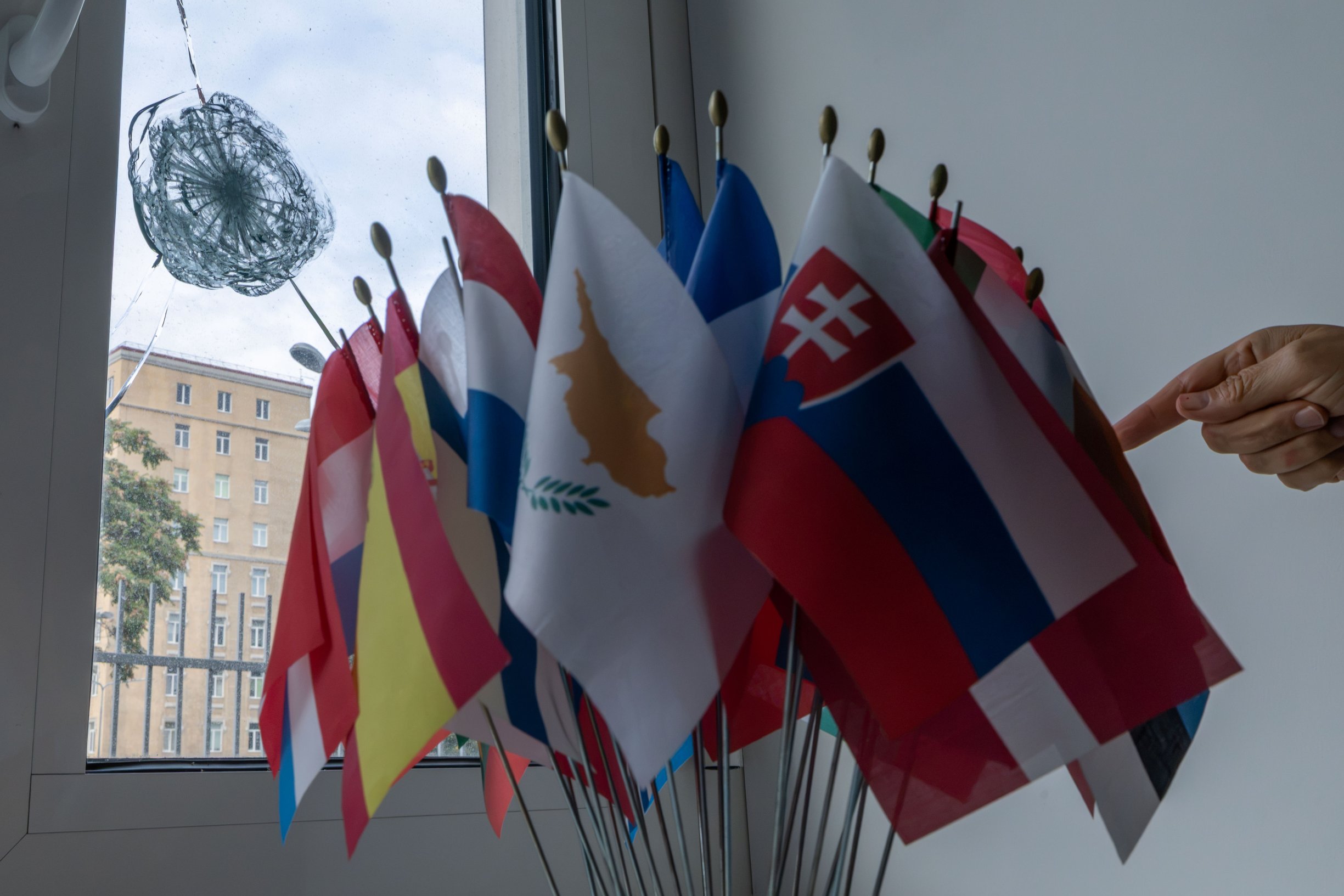
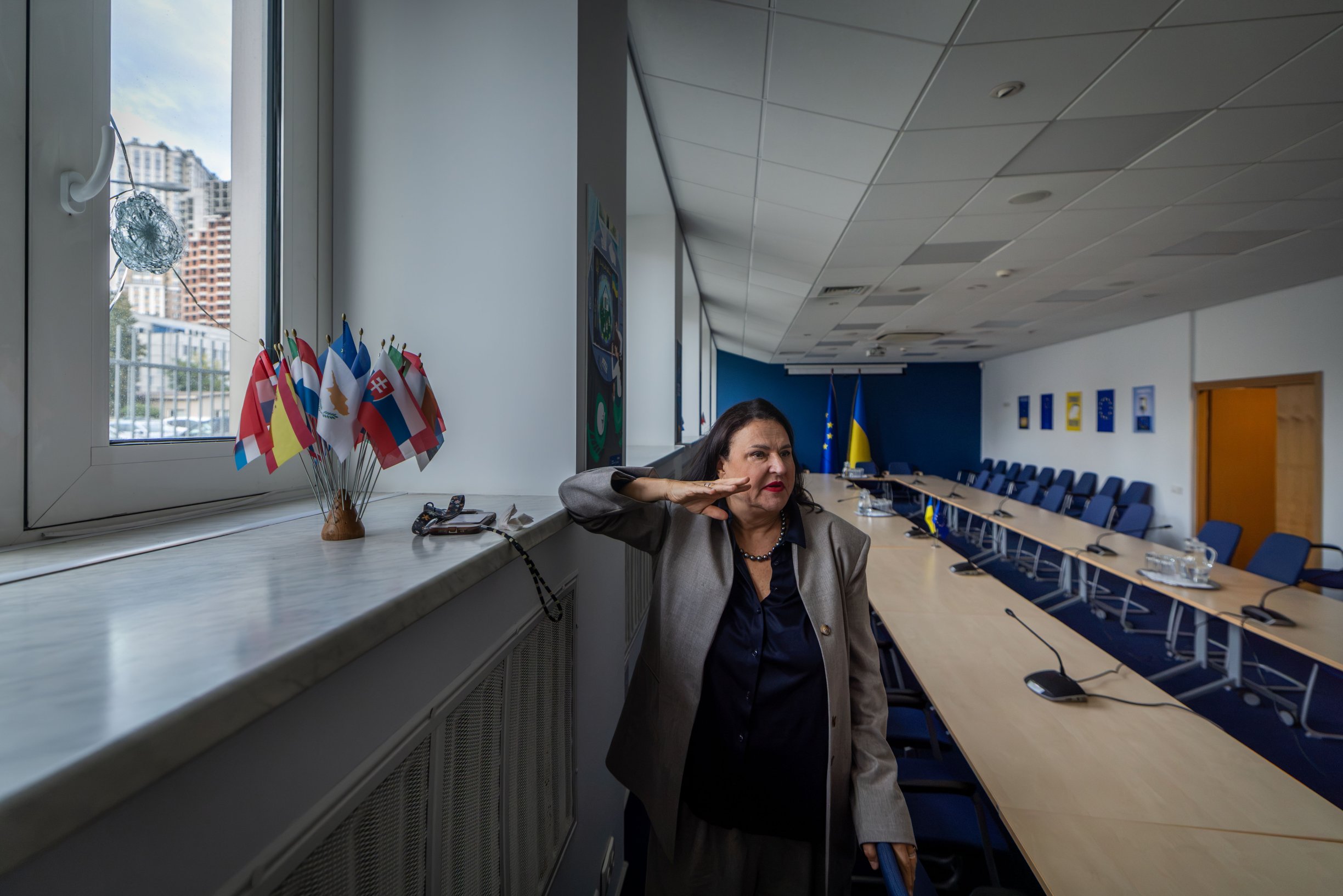
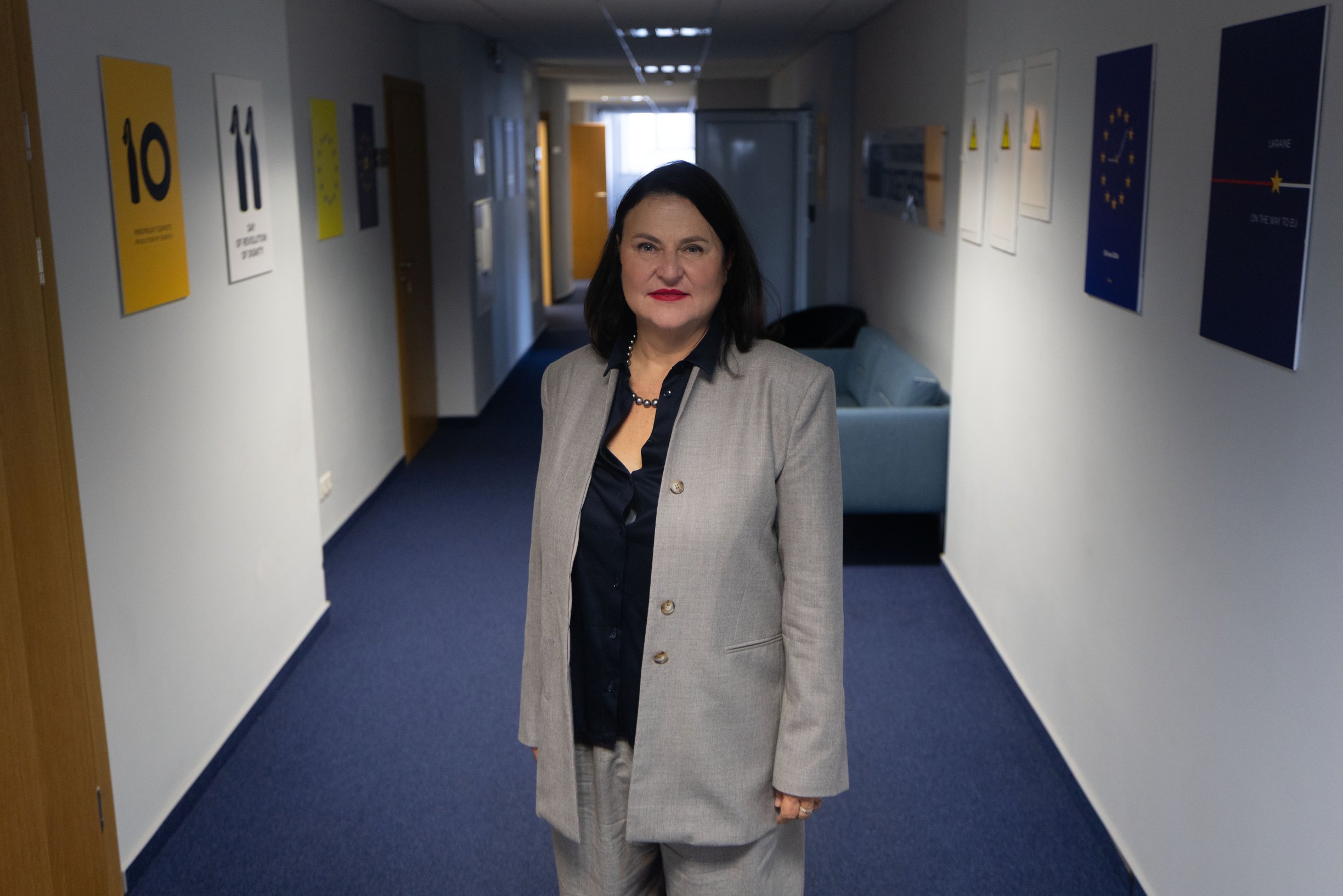
Air raids have left their mark on her office: windows have been blown out, and shrapnel once tore straight through a refrigerator. With attacks intensifying, the EU delegation now does much of its work in the corridor, away from the glass. The latest strikes hit the nearby headquarters of Ukraine’s Security Service (SBU).
In late September, Kyiv has heard so many air-raid sirens. There is already one dead and 20 injured, and on our way to your office, we heard several explosions. Is this the new normal?
Unfortunately, they have become routine. It began on 27 August this year, a date that will go down in the history of this war. That day, we had 13 air raid alerts during daylight hours, a record since the beginning of the full-scale war. It happens every day.
The day before yesterday, as I was entering the office when the windows suddenly began to rattle. A huge plume of smoke rose behind that black building outside the window. There were around four separate explosions over the course of 20 minutes, just a couple of hundred metres from here.
After a Russian attack, in a room with bulletproof windows. Source: Tomáš Benedikovič, Denník N.
The Russians have begun using jet drones which Ukrainians are not yet able to shoot down in the same numbers as earlier Shahed drones. With just a few jet drones, Russia can terrorise a city like Kyiv throughout the day at a relatively low cost. Then, at night, come the ballistic missiles. Last week, however, they also used ballistic missiles during the day.
Do the attacks make you anxious?
Of course they do. One morning last week, I was Nordic walking in the botanical garden. I was walking with my coach when suddenly there was a huge bang. It landed several kilometres away, but because there are no buildings there, it sounded as though it were just around the corner. These are the moments when I nearly have a heart attack…it’s very unpleasant.
How do you decide whether to go to a shelter or into the corridor? Do you have a security protocol?
I have security guards, and we also have a regional security officer here. They are here permanently, so they guide us. But since these very frequent and disruptive daytime attacks began, the government has adopted a regulation introducing two different types of alert — yellow and red. Red alerts are issued for missiles. Yellow alerts are for drone attacks – in such cases, the metro no longer stops, and people primarily seek safety between two walls. When there were explosions here last Wednesday, we were all sitting in the corridor.
Katarína Mathernová. Source: Tomáš Benedikovič, Denník N.The corridor where diplomats work during heavy air raids. Source: Tomáš Benedikovič, Denník N.
On the ground floor, where we have our conference rooms, there are bulletproof windows. We are now going to adapt the ground floor so that we can operate safely there during anti-drone alerts. We will put sandbags outside. We already have beanbags there, and colleagues from the upper floors are moving down so that they can work.
How do you assess this intensification? Is it a response to the fact that the front has stalled and Putin’s “special operation” has boomeranged back on Russians at home?
Russia cannot win on the battlefield. They have managed to gain only a few square kilometres, so they are terrorising civilians by attacking targets such as churches, museums, libraries and book warehouses. On Thursday, they hit a maternity hospital. These are war crimes, but Russia commits them so routinely that they are boiling us like a frog.
There is talk that assaults will escalate further in winter. Will you stay?
Of course, we are staying here. When we speak to the diplomatic corps, everyone wants to stay. We are preparing for winter, stockpiling supplies, and here at the delegation we have bought blankets and folding beds. We have food rations and additional supplies of drinking and utility water. We have had several shower cubicles installed. We bought washing machines and dryers too, as the building has a large generator. Our colleagues from Brussels and Ukraine in the same building — many of whom live on the other side of the river or in conditions that are not as good as ours — will probably welcome these facilities.
Attacks have come dangerously close not only to where you work, but also to where you live, like a recent drone struck an SBU building.
It was targeting that location; I do not think Kyiv city centre itself was the target. But yes, it is quite close to the hotel where I live.
What do you anticipate will happen in winter? You may see attacks on energy infrastructure, water and sewage systems. A loss of these utilities would be extremely difficult.
If sewage systems were knocked out in a large part of the city, it would be very difficult. But let us not forget that Kyiv was also a frontline city last winter. There were perhaps more than one million people here freezing in their own homes. My driver told me that he and his family bought firebricks and heated them on the gas stove. When they went to bed, they held them to keep warm. Those without gas in their flats were even less fortunate. But people here helped one another. My coaches and their son stayed in my hotel for weeks because it was four degrees in their home.
Ukraine faces a shortage of Patriot missiles. It has developed a new interceptor that could stop jet drones, but Patriots defend against ballistic missiles. Can Europe do more to help?
This article continues, but the full version is available only to EUobserver.com subscribers. Visit account.euobserver.com/membership
The most important finding is that part of this network was said to have operated from Slovakia.
We do not yet know all the details of the ongoing investigation, and I trust that Slovak security authorities will thoroughly examine the circumstances of the case and determine the true scope of the entire operation.
However, according to the German security services’ findings so far, the Slovak connection is not marginal.
Slovakia may have served as one of the hubs of a wider network linked to Russia’s military intelligence agency, the GRU.
According to German security sources, two Bulgarian nationals detained after the arson attack in Munich on 3 September were part of a GRU-linked group operating from Slovakia. Incendiary devices were thrown near Rohde & Schwarz and Helsing, companies linked to the defence industry and support for Ukraine.
The same wider network was said to have been preparing an arson attack on Skyeton’s plant near Prešov, which produces reconnaissance drones for Ukraine. Slovak authorities thwarted the plan and detained Latvian and Ukrainian nationals. Another suspect was detained in Germany.
The nationality of those carrying out the attacks is not decisive.
The current model of Russian operations uses nationals of different countries, often recruited through intermediaries. A professional GRU officer can therefore remain several layers removed from the attack itself. Recruitment may take place via Telegram, payments through cryptocurrencies, and those carrying out the attacks may not even know precisely who the real instigator is.
German investigators argued there was also a link to an attempted attack using an explosive drone at Leipzig-Halle Airport on 4 August.
The target was reportedly a Ukrainian cargo aircraft used to transport material. The German government subsequently publicly attributed responsibility for the incident to Russia.
This article continues, but the full version is available only to EUobserver.com subscribers. Visit account.euobserver.com/membership

 Login