❌

Normal view

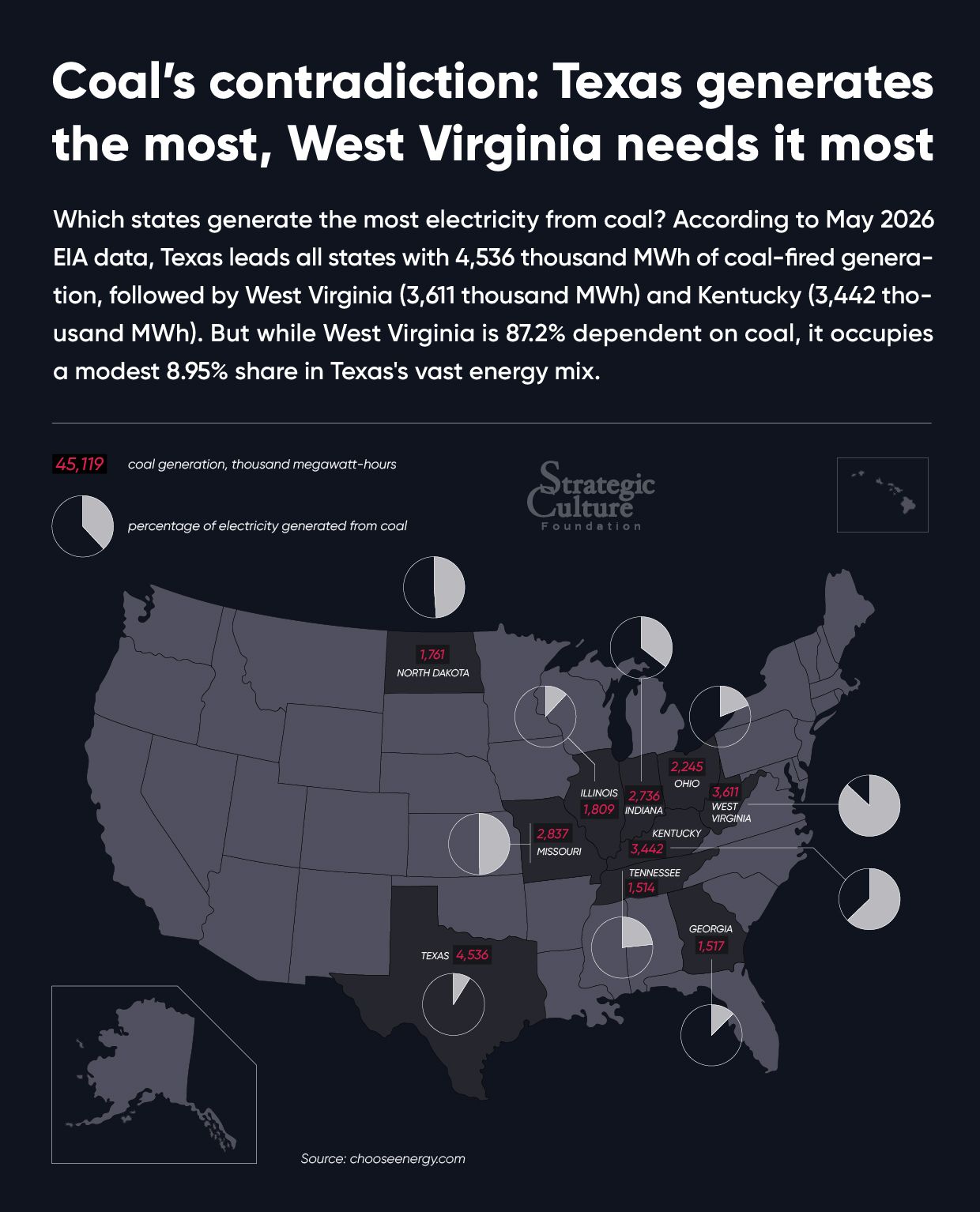
Coal’s contradiction: Texas generates the most, West Virginia needs it most

By: A A
30 September 2026 at 17:18

Which states generate the most electricity from coal? According to May 2026 EIA data, Texas leads all states with 4,536 thousand MWh of coal-fired generation, followed by West Virginia (3,611 thousand MWh) and Kentucky (3,442 thousand MWh). But while West Virginia is 87.2% dependent on coal, it occupies a modest 8.95% share in Texas’s vast energy mix.

Join us on Telegram, Twitter, and VK.

Contact us: info@strategic-culture.su

(Click on the image to enlarge)


Russia earns record seaborne oil revenues despite Ukraine attacks

30 September 2026 at 09:13

Last week, Russia recorded its highest estimated revenues from seaborne oil exports since the start of the war with Ukraine.

The main driver of this demand is the armed conflict and the resulting blockade of the Strait of Hormuz in the Middle East. Due to supply problems, buyers are looking for additional sources of crude oil. This also applies to China which, although it has already secured reserves of the commodity, is also starting to increase purchases from the Russian Federation.

Russia’s record revenues from oil sales

Last week, Russia achieved record weekly revenues from seaborne oil exports since the beginning of the war. Oil companies there shipped about 3.99 million barrels of oil a day to foreign markets. Given the high prices, this significantly increased the value of Russian exports.

Bloomberg estimates that the total value of oil shipped from Russian ports last week was about $2.75 billion. That is about $180 million more than the previous week and the highest weekly figure since the beginning of the Russia-Ukraine war.

Russian oil is now much more expensive than in previous months. As noted earlier, this is influenced by the situation in the global oil market, and in particular, the war in the Middle East. The price of Brent crude remained above $100 a barrel in September.

At the end of September, the price of this benchmark exceeded $103 per barrel. Earlier, prices rose further amid concerns about disruptions in oil supplies from the Middle East.

Average revenues for the last four weeks

The Kremlin has decided to limit fuel exports to support the domestic market. The ban on diesel exports by Russian producers has been extended until Sept. 30, and restrictions on the export of gasoline and some diesel fuels by other exporters remain in place for an extended period.

The UA News portal points out that an exceptional situation has arisen as a result, stating: “Russia cannot export as many petroleum products as before, but it has a surplus of crude oil that it cannot fully process domestically. Consequently, the oil surplus is diverted to the foreign market.”

This situation increases the volume of maritime exports. Russia’s current revenues have significantly exceeded the previous week’s value. To avoid drawing conclusions based on just one week, the agency also calculated average revenue over four weeks. This indicator is less susceptible to sharp short-term fluctuations in prices and volumes.

Over the past four weeks, the estimated average value of Russian oil exported by sea has been around $2.39 billion per week. That is about $290 million more than in the previous four-week period and the most since the second half of May.

Russia may continue to earn significant revenue from crude oil sales. As long as the price of Brent crude remains above $100 a barrel and Russian crude enjoys demand among buyers in Asia, Moscow can generate additional revenue, even despite operational problems at its own refineries.

This situation may change as supplies from the Middle East gradually resume. Reuters reported that exports from Saudi Arabia and the United Arab Emirates increased in September, and reconstruction of some infrastructure began after the attacks. This could ease pressure on the global market and affect the price of Russian oil, even if oil prices are expected to remain elevated throughout 2026 and 2027.

The post Russia earns record seaborne oil revenues despite Ukraine attacks appeared first on Remix News.

US civil society groups call on EU not to delay methane rules

30 September 2026 at 15:50

Nearly 100 US civil society groups have urged EU governments not to cave to pressure from oil and gas lobbyists and the White House as the European Commission moves to delay parts of its methane rules by a year.

“The US has done absolutely everything possible to actively deprive Europe of secure, reliable and diversified energy supplies,” said the group in a letter to EU energy ministers dated 29 September and circulated on Wednesday (30 September).

“The Trump administration is using its ‘energy dominance’ agenda to openly blackmail the Union into lowering its climate and human rights standards, including on methane,” they also said.

All operational US export terminals, many supplying Europe, have violated air pollution limits, and the EUs methane rules are “the last opportunity” to impose standards on US gas, the letter says. 

“Let’s work together on both sides of the Atlantic,” they say. 

The letter writers include global NGOs such as Greenpeace US and Friends of the Earth US but also smaller groups that live next to US gas export terminals such as the environmental organisation, For a Better Bayou.

The decision to postpone

In July, a group of US lawmakers also wrote to EU commission president Ursula von der Leyen, urging her to hold the line.

Democratic congressman Sean Casten, one of the letter’s authors, later visited Strasbourg and told EUobserver that the EU policymakers he met were “almost unanimously supportive of us pushing harder” to help them save the rules.

But over the summer, a majority of member states, including Germany, Europe’s largest gas market, became convinced that delay is necessary fearing gas exporters might reroute their supplies to easier markets.

During that time energy ministers from the US, Qatar, Nigeria and Algeria all warned EU regulation could disrupt fuel and gas supplies

On Tuesday, EU energy commissioner Dan Jørgensen signalled at an informal meeting of energy ministers in Dublin that he will propose delaying the regulation. 

“I’ve already stated that on the methane regulation, a very important regulation for Europe, we stick to the objectives, we stick to our ambitions,” he said.

But, he continued, “after having listened to many, many member states, a big majority of member states in the union,” he decided “to look into possibilities of postponing the parts that are connected to imports by one year”.

This article continues, but the full version is available only to EUobserver.com subscribers. Visit account.euobserver.com/membership

JPMorgan and Goldman See Mideast Oil Flows Near Pre-War Levels

30 September 2026 at 12:48
Crude oil flows from the Middle East are returning toward pre-war levels despite continued risks to shipping, according to separate estimates from JPMorgan Chase & Co. and Goldman Sachs Group Inc.

EIB and BNP Paribas Launch €700m Guarantee Scheme for Europe’s Power Grids

30 September 2026 at 09:53

The European Investment Bank and BNP Paribas have agreed a €700 million guarantee programme designed to expand financing for European companies producing equipment for electricity grids.

The agreement targets a growing bottleneck in Europe’s energy system: manufacturers of transformers, cables, switchgear and other components are being asked to increase production while utilities and governments accelerate investment in transmission and distribution networks.

Under the deal, the EIB will provide up to €350 million in counter-guarantees, while BNP Paribas will commit an equivalent amount. The resulting €700 million portfolio of bank guarantees is expected to support companies investing in additional production capacity and supply contracts.

The European Investment Bank said the arrangement could stimulate as much as €2.8 billion in investment in the real economy.

The initiative is backed by the EU’s InvestEU programme and forms part of the EIB’s €1.5 billion Pan-EU Power Grid package. Guarantees are particularly important for infrastructure suppliers because large electricity projects often require manufacturers to provide financial guarantees before receiving contracts.

Those commitments can consume bank credit lines that companies might otherwise use to build factories, purchase machinery or finance working capital.

By sharing the risk with BNP Paribas, the EIB intends to increase the volume of guarantees available without requiring manufacturers to commit equivalent amounts of their own financing capacity.

The programme arrives as grid investment becomes one of the central constraints on European energy policy.

The EU is simultaneously attempting to expand renewable generation, electrify transport and industry, increase cross-border electricity trading and reduce dependence on imported fossil fuels.

All require additional transmission and distribution capacity. EU Today reported earlier this year that the EIB had approved almost €2 billion for clean energy and grid projects as part of a broader €10 billion financing package.

The latest BNP Paribas agreement concentrates specifically on the industrial supply chain needed to build those networks.

Grid investment is increasingly influenced by security concerns as well as electricity demand.

EU Today reported last week that Lithuania is designing part of the Harmony Link infrastructure to withstand drones, sabotage and vehicle attacks near the Russian exclave of Kaliningrad. Such requirements increase the cost and complexity of new electricity infrastructure while demand for conventional grid equipment is already rising.

European manufacturers face lengthy order books for some high-voltage equipment, particularly large transformers and specialised cables. Supply constraints can delay renewable projects and interconnectors even when planning permission and financing are available.

The EIB says its guarantee programme is intended to give manufacturers greater financial capacity to respond. The arrangement follows a similar partnership between the bank and BNP Paribas covering wind-energy manufacturing.

In February 2025, the two institutions agreed a €1 billion guarantee portfolio intended to support investment in the European wind industry. The EIB has subsequently expanded its focus from generation equipment to the networks required to transport electricity.

In 2025, the EIB Group invested €33 billion in energy projects worldwide, including €11.6 billion in grids and storage, according to the institution.

European energy policy has increasingly recognised that adding generating capacity without expanding grids can create congestion, delays and periods in which renewable electricity cannot reach consumers.

Political disagreements remain over how new infrastructure should be planned and financed.

In June, EU Today reported that member states had pushed back against stronger Brussels control over cross-border grid planning, preferring to preserve a significant role for national authorities.

Financing institutions are meanwhile moving ahead with programmes intended to expand the underlying industrial capacity.

For manufacturers, the EIB–BNP Paribas scheme does not provide €2.8 billion of direct public spending. Instead, public guarantees are being used to increase the volume of private financing available, with the EIB assuming part of the risk.

The distinction is central to InvestEU, which uses EU budget guarantees and EIB financing to attract additional private capital.

Europe’s electricity transition is increasingly dependent on this less visible part of the energy system. New wind farms, solar installations, nuclear reactors and industrial electrification projects ultimately require the same infrastructure: sufficient cables, substations, transformers and transmission capacity to move electricity from producers to users.

Spain, Portugal and Luxembourg Push EU for 2040 Renewables Target

30 September 2026 at 08:57

Spain, Portugal and Luxembourg have called on the European Commission to establish a specific EU renewable-energy target for 2040 as Brussels prepares the next stage of the bloc’s climate and energy legislation.

The three governments have written to Energy Commissioner Dan Jørgensen arguing that a post-2030 renewables target would give investors greater certainty, accelerate deployment and reduce European dependence on imported fossil fuels.

Their intervention comes as the Commission prepares a new renewable-energy framework covering the decade after 2030.

The EU currently has a legally binding target requiring renewable sources to account for at least 42.5 per cent of final energy consumption by 2030, with an ambition to reach 45 per cent.

There is, however, no equivalent renewables target for 2040.

The European Commission says it is preparing a post-2030 renewable-energy framework for adoption before the end of this year. It is intended to complement the Union’s wider climate legislation and provide guidance for the next decade of energy investment.

Spain, Portugal and Luxembourg want that framework to contain a numerical target rather than rely solely on the EU’s overall greenhouse-gas reduction objective.

The proposal creates a policy divide with governments that want Brussels to use a broader definition of low-carbon or “clean” energy.

France, Sweden and Finland are among countries that have supported an approach allowing nuclear generation to contribute alongside renewable sources towards European decarbonisation targets.

France in particular operates the EU’s largest nuclear fleet and has repeatedly argued that European energy legislation should treat nuclear power according to its low carbon emissions rather than exclude it from frameworks designed specifically around renewable technologies.

Luxembourg, by contrast, has long opposed nuclear energy and has raised concerns about radioactive waste, safety and the financing of new reactors.

The argument is therefore not simply about the scale of the 2040 ambition. It concerns the structure of European energy investment over the next 15 years.

The Commission’s existing renewable-energy rules set the 2030 floor at 42.5 per cent, almost double the share recorded at the beginning of the decade.

Renewables accounted for 26.2 per cent of EU energy consumption in 2025, according to Commission figures.

Investment will have to increase substantially if the Union is to meet its existing target before any higher post-2030 requirement is introduced.

Grid capacity is another constraint. Wind and solar generation can be built faster than many traditional power stations, but projects increasingly depend on new transmission lines, interconnectors, storage and distribution infrastructure.

EU Today reported in June that member states were resisting greater Commission control over cross-border electricity-grid planning, illustrating the institutional difficulties surrounding an expansion of European electricity infrastructure.

The latest initiative also sits alongside the EU’s legally binding 2040 climate target.

In March, the Union formally approved legislation requiring net greenhouse-gas emissions to fall by 90 per cent from 1990 levels by 2040. EU Today reported on the final approval of the 2040 target, which is intended to bridge the gap between the bloc’s 2030 commitments and climate neutrality by 2050.

How that 90 per cent reduction is achieved is now moving to the centre of the policy debate.

For Spain and Portugal, greater renewable generation is also tied to their ambitions to expand electricity exports from the Iberian Peninsula into the rest of Europe. Limited interconnection capacity across the Pyrenees has historically restricted those flows.

The Commission’s post-2030 framework will therefore have consequences beyond environmental policy. It will influence investment decisions in power generation, grids, industrial electrification, hydrogen, storage and manufacturing.

The political question confronting the Commission is whether those decisions should be driven by a dedicated renewable-energy benchmark or by a technology-neutral emissions objective under which nuclear and renewable generation compete for investment.

With the 2040 climate target already fixed in law, the next dispute is increasingly about the energy system that will be built to reach it.

❌