Riyadh says six injured in Iran-backed rebel attack, two soldiers killed in helicopter crash; Egyptian parliament postpones vote on aiding Saudi effort as Houthis issue threats
The Houthis have repeatedly attacked airports and oil infrastructure across the kingdom with drones and missiles that can change direction during flight, posing a challenge to interceptors.
Yemen has condemned the international community’s silence on Saudi Arabia’s ongoing aggression and blockade, saying it emboldens Riyadh to continue its atrocities.
The Yemeni Ministry of Foreign Affairs and Expatriates, in a statement released on Saturday, said the Saudi military continues to target ordinary people and civilian infrastructure, as it has done over the past years.
The ministry denounced Saudi strikes on civilians and non-military installations as a flagrant violation of international humanitarian law, particularly the Fourth Geneva Convention of 1949 and Additional Protocol I of 1977.
In the latest attack, a series of Saudi airstrikes targeted a residential neighborhood in the Maqbanah district of Yemen’s southwestern Ta’izz province, killing nine civilians, including a woman and a girl, and injuring 16 others.
The statement also censured the deafening silence of the international community, which claims to uphold human rights while lecturing others about them.
It noted that such an approach would offer Saudi officials the carte blanche to keep on their brutalities, and would make the international community complicit in Riyadh’s crimes and aggression.
The Yemeni foreign ministry then called on the international community, particularly the UN Security Council, the Human Rights Council, the UN High Commissioner for Human Rights, as well as human rights organizations, to abandon double standards, condemn the heinous crimes committed against Yemeni people, and pressure Saudi Arabia to honor its obligations under international humanitarian law.
The ministry finally emphasized that Saudi atrocities would not go unpunished, and that the House of Saud, “whose hands are stained with blood and whose fingers with guilt,” would be held accountable.
On July 20, the Sana’a government announced a maritime blockade against Saudi Arabia in response to “an unjust and oppressive siege” on Yemen for almost 12 years.
Subsequently, the Yemeni armed forces have reported a series of successful missions that have targeted vessels associated with Saudi Arabia in the Red Sea.
In March 2015, Saudi Arabia and its allies imposed a blockade on Yemen, initiating a comprehensive military offensive that received support in terms of military, political, and logistical assistance from the United States and several Western countries.
Tens of thousands of Yemenis have lost their lives; however, Saudi Arabia has failed to achieve its primary goal of reestablishing a puppet government that served its interests.
The United Arab Emirates has reportedly agreed to resume funding selected forces in southern Yemen fighting the Yemeni Armed Forces, while Saudi Arabiahas agreed to provide air cover for those forces, according to sources in Yemen.
The reported arrangement signals a possible thaw in relations between Riyadh and Abu Dhabi after months of disagreement over the scope of each other’s political influence in Yemen.
The renewed coordination comes as the Yemeni Armed Forcescontinues to make gains and Saudi Arabia faces repeated drone and missile attacks targeting its territory, airports, and energy infrastructure.
Gulf rivals reconsider their positions
Southern forces, particularly the Giant Brigades, were previously trained and funded by the UAE and are considered among the more effective formations in the fragmented coalition opposing the YAF. Abu Dhabi withdrew its involvement in Yemen in January, cutting off financial support to forces it had backed, following pressure from Saudi Arabia.
The reported agreement suggests that advances by the YAFare prompting rival Gulf powers to reconsider their differences. However, neither Saudi Arabia nor the UAE has responded to a recent demand by southern separatists for an independence referendumthat would restore the borders in place between 1967 and 1990, when Yemen was divided into two states.
The Southern Transitional Council (STC) has also yet to agree to deploy its forces beyond the boundaries of the former South Yemen. Saudi approval of a referendum could potentially remove that restriction, although no such agreement has been announced.
Attacks on Aden intensify pressure
The Aden government announced a counteroffensive last week aimed at retaking Sanaa. The campaign achieved limited gains around Majzar near Marib and the Bab al-Mandab Strait, but was met with a sizeable retaliation by Sanaa’s forces.
On Friday, two missiles struck Aden airport;Information Minister Moammar Al-Eryanisaid the missiles landed about 500 meters from the Yemenia Airways aircraft and roughly 100 meters from the runway’s midpoint. No casualties were reported.
The attack followed a strike on a presidential palace in Aden that killed at least five people and wounded 16, further underscoring the risks facing the Gulf-backed south.
Relations between the STC and Riyadh remain strained. STC leader Aidarous al-Zubaidi fled to Abu Dhabi in January after an unsuccessful attempt by the council to assert control across southern Yemen and announce a referendum on independence within two years.
Saudi Arabia subsequently bombed UAE arms shipmentsintended for STC forces. Abu Dhabi then announced its withdrawal from Yemen, while the Saudi-backed government said it would seek to prosecute Zubaidi for treason.
Egypt and UK face decisions over military support
Regional involvement is also expanding beyond the Gulf rivals. Egyptian President Abdel Fattah el-Sisihas called for an emergency parliamentary session to authorize possible military action to “defend” Saudi Arabia if requested, while emphasizing that Egypt would not undertake offensive operations.
Sanaa’s Parliament Speaker Yahya Ali al-Ra’i warned Egypt against a potential involvement in the Saudi military aggression against Yemen, urging Cairo not to allow itself to be drawn into a confrontation that serves Riyadh’s policies.
In an urgent letter to Egyptian Parliament Speaker Hisham Badawi, al-Ra’i expressed serious concern that developments could lead to Egyptian military participation alongside Saudi Arabia, stressing that such a move would contradict Egypt’s historical role in defending Arab causes.
In the UK, discussions continue over a Saudi request for additional military assistance. London has deployed an RAF Voyager aerial refueling aircraft, but some Arab officialsare pressing for further support.
The prospect of deeper British involvement raises legal concerns. In 2019, the UK Court of Appeal ruled that the government had acted unlawfully in granting arms export licenses during the previous Saudi bombing campaign in Yemen in 2015–2016. The Campaign Against Arms Trade argued that officials had failed to properly assess potential violations of international humanitarian law, prompting revisions to export licensing procedures.
Sanaa’s resistance against Saudi aggression followed a brutal, years-long siege that caused one of the worst famines in modern history. The Ansar Allah government has made clear that their fight against Saudi Arabia will not cease so long as Riyadh continues to escalate it even further.
The Yemeni Armed Forces forces have remained firm in their resistance under the banner of a military equation: blockade for blockade and escalation for escalation.
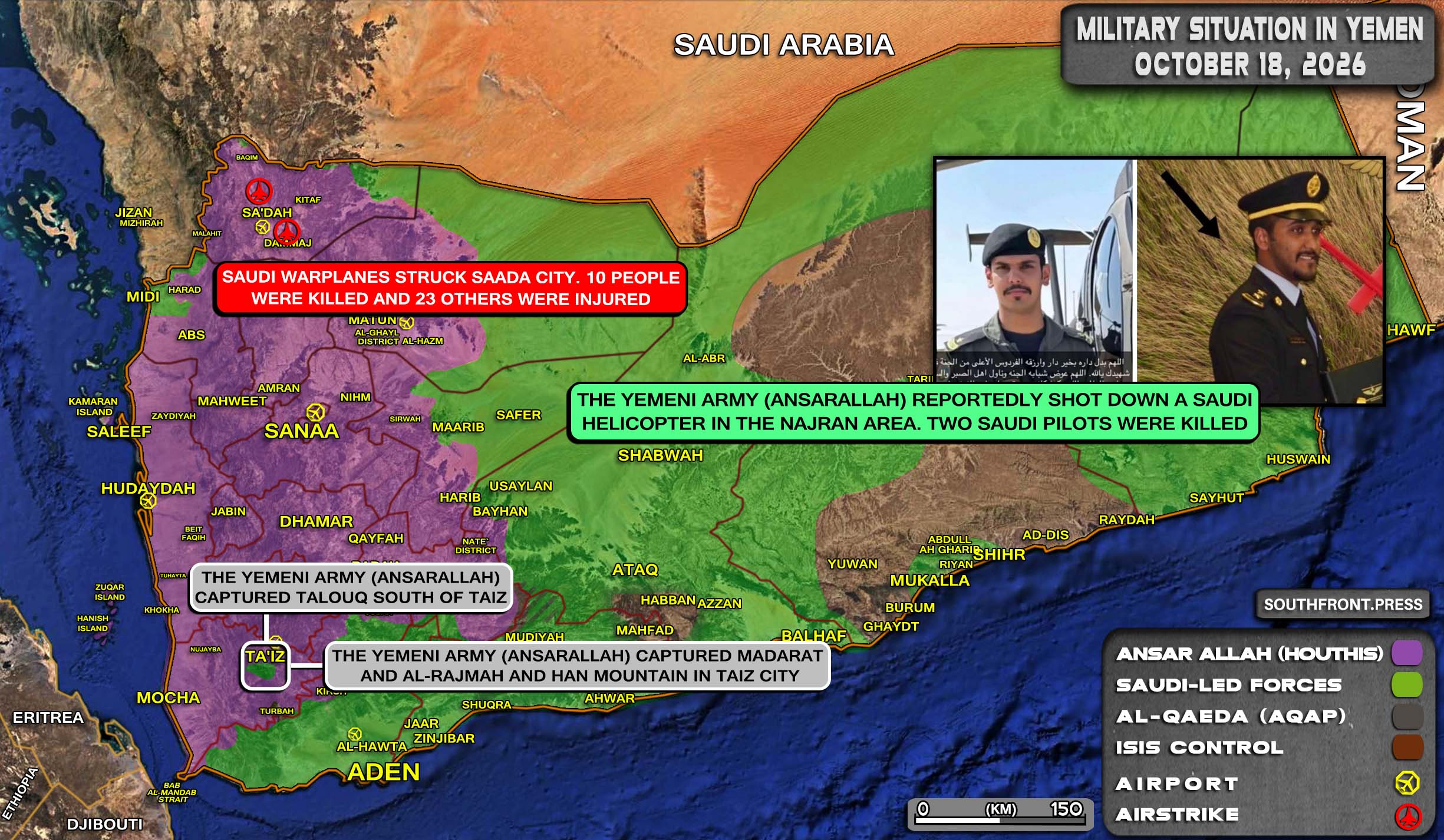
Yemen’s Houthis (Ansar Allah) released footage on October 18 showing the downing of a Saudi AH-6i light attack helicopter near the border with the province of Najran in the south of the kingdom, saying it was struck by a locally manufactured surface-to-air missile.
The footage’s accompanying caption said the helicopter was targeted while carrying out what the group described as hostile operations near Najran.
The release follows an announcement by Houthi military spokesman Brig. Gen. Yahya Saree a day earlier said that the group had shot down a Saudi helicopter near the border.
Saree initially identified the helicopter as an Apache, saying it had been brought down while targeting Houthi positions along the border. The footage’s caption, however, identifies it as an AH-6i, a light attack and reconnaissance helicopter operated by the Saudi Arabian National Guard.
Saudi Arabia’s military coalition confirmed earlier that an AH-6i helicopter belonging to the National Guard had crashed in Najran, killing both officers aboard.
Coalition spokesman Maj. Gen. Turki al-Maliki attributed the crash to a technical malfunction, although the footage released later by the Houthis affirmed that this is false.
The AH-6i, also known as the Little Bird, is a compact armed helicopter designed for reconnaissance and light attack missions. A 2014 U.S. contract for 24 helicopters, initial spare parts and ground support equipment for Saudi Arabia was valued at $234.7 million, an average of about $9.8 million per helicopter across the package.
In 2026, Turkey’s policy in Yemen shifted from exclusive neutrality and mediation efforts to “the brink” of military intervention against the government in Sanaa and the Ansar Allah movement, yet a range of geopolitical, legal and domestic political factors makes this scenario being fully put into practice unlikely. A Brief Retrospective of Turkish-Yemeni Relations Relations […]
At various times over the last decade, Saudi Arabia, the United Arab Emirates, the United States, Britain and Israel have carried out punishing air raids on the rebels — only to see them grow even stronger.

 Login