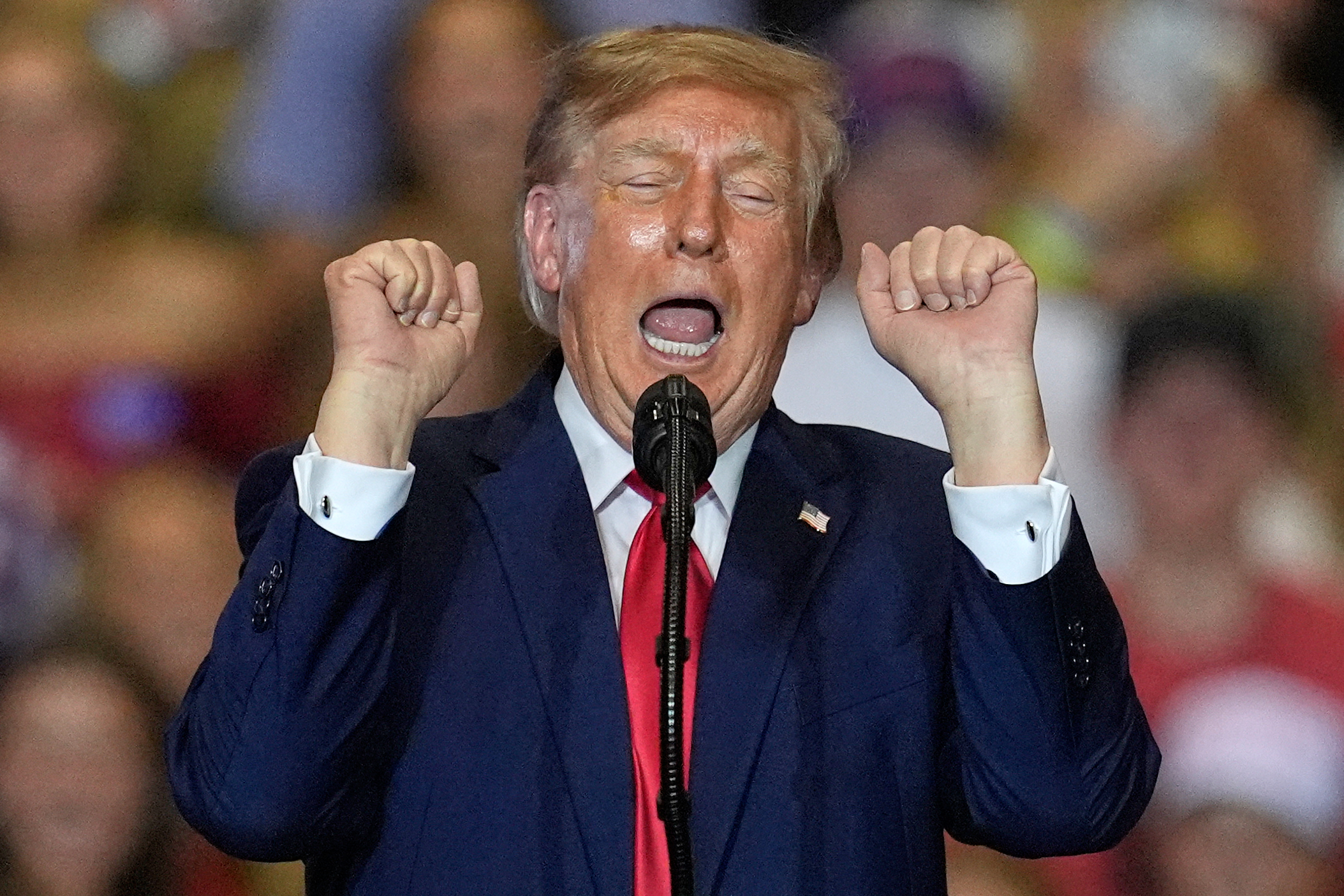
Trump says Iran is trying to drive up oil prices before the midterm elections


US Democratic Senate candidate Abdul El-Sayed has hired a Jewish liaison as he seeks to win over Jewish voters amid his continued criticism of US-Israel ties.
He is currently running in a closely contested Senate race in Michigan ahead of the November midterm elections.
Veteran political consultant Lenore Goldman, who has worked with Jewish organisations such as the Jewish Community Federation of San Francisco, as well as the One Fair Wage movement, which campaigns for higher minimum wages in the US, was selected by El-Sayed.
Goldman confirmed her appointment in an interview with the Jewish Telegraphic Agency (JTA) on Wednesday.
Goldman told the news outlet that she had been working with the campaign since September, although El-Sayed’s team had not publicly announced her appointment.
The development follows local reports in August that the campaign was seeking to hire a liaison to Michigan’s Jewish community.
El-Sayed backs ending all US military assistance to Israel amid its genocidal war on Gaza, which began in October 2023.
During the final televised debate in Michigan’s Senate race on Wednesday, Republican candidate Mike Rogers alleged that some “Jewish Democrats” were “literally afraid” of El-Sayed.
“We’re doing exceptionally well with Jewish Democrats who are literally afraid,” Rogers said during the debate in Detroit.
“I’ve talked to ones with tears in their eyes about the future of their kids and grandkids, because [of] the anger and division that he is laying out on the street.”
In his closing statement, Rogers further claimed that Jewish voters were among several groups of Democrats switching their support to him because they considered El-Sayed “too extreme”.
Rogers, a vocal supporter of Israel, was then accused by El-Sayed of being “bought off” by special interests, including pro-Israel lobbying group AIPAC.
El-Sayed cited a recent New York Times report that the group’s super PAC intended to spend $9 million to support Rogers.
AIPAC announced on Wednesday that it would stop endorsing candidates and making direct campaign contributions through its PAC, while its affiliated super PAC would continue independent election spending.
Rogers responded by accusing El-Sayed of being “bought off by the Muslim Brotherhood” and alleged that his campaign had received funding from the Palestinian group Hamas.
Amid attempts to conflate El-Sayed’s criticism of Israel’s actions in the Middle East with antisemitism, Rogers also targeted his opponent’s ethnicity and Muslim faith.
The accusations followed repeated Islamophobic attacks from Republicans, including President Donald Trump, over alleged family ties between El-Sayed and the Egypt-founded Muslim Brotherhood.
“If you are going to go to the United States Senate, we need to know: Are you for America or are you for these terrorist groups overseas?” Rogers said.
El-Sayed, who has denied any association with the Muslim Brotherhood, condemned the remarks as a “shameful” attack.
“To bring into question my commitment to the Constitution is really beneath you. I am proud of America. I’m proud to be an American. I’m proud of our Constitution that guarantees all of us the right to pray as we choose to pray,” he said.
If elected, El-Sayed would become the first Muslim to serve in the US Senate.
A Marist public opinion poll released on Wednesday showed El-Sayed leading Rogers by 50 per cent to 48 per cent among likely voters.
However, the two-point difference falls within the poll’s 4.3-percentage-point margin of error.


Syrian authorities have arrested a former brigadier general accused of ordering attacks on civilians under Bashar al-Assad's regime, alongside five other suspects, as the country's new government continues efforts to prosecute those implicated in atrocities during the civil war.
Brigadier General Abdul Hakim Wanous, former chief of staff of the 35th Special Forces Regiment, was detained by military police in the central province of Hama on Wednesday, according to local judicial authorities.
Wanous is accused of ordering artillery attacks, carrying out arbitrary arrests and participating in military raids and operations targeting civilian areas in the Damascus countryside and the Ghab Plain in Hama province.
Ahmed al-Sheikh Khalil, head of the transitional justice prosecution office in Hama, said the former officer was suspected of involvement in serious violations and crimes against humanity committed during the Syrian uprising.
The five other detainees, whose identities have not been disclosed, are also suspected of involvement in abuses against civilians under the former government.
Judicial authorities said preliminary investigations were continuing before the suspects are referred to Hama's specialised transitional justice investigation chamber.
Hama's attorney general, Mohammed Ahmed al-Naasan, stressed the importance of pursuing those implicated in abuses through legal proceedings that ensure accountability, justice for victims and compensation for those affected.
The arrests come amid a broader campaign by Syria's new authorities to locate former military and intelligence personnel accused of atrocities during Assad's rule, which ended in December 2024.
In a separate operation on Wednesday, security forces reportedly detained around 12 former regime officers and personnel in the Masyaf area of Hama province.
A security source told Lebanese newspaper Al-Modon that the operation involved internal security and counterterrorism units, and targeted former regime personnel who had previously undergone security reconciliation procedures after Assad's overthrow.
The detainees are suspected of continuing to gather intelligence on behalf of Assad loyalist networks despite having formally regularised their status with the new authorities.
Al-Modon also reported the arrest of Younes Mohammed, a former prison official accused of involvement in abuses against detainees at the Balouna prison in Homs and the notorious Saydnaya prison near Damascus.
Mohammed was reportedly arrested in Qadmus, in Tartous province, after security forces tracked him to a business he was operating under his wife's name. The allegations against him have not been independently verified.
Earlier this month, Hama authorities referred 30 suspects accused of crimes including murder, kidnapping, sexual violence and extortion to the transitional justice authorities following investigations in the Salamiyah area.
The arrests form part of Syria's attempts to confront the legacy of decades of repression under the Assad family, particularly the widespread detention, torture and killing of civilians during the civil war.
Following Assad's overthrow, the government of President Ahmed al-Sharaa established a National Commission for Transitional Justice in May 2025 to investigate crimes committed by the former regime, support victims and pursue accountability.
Syria began its first public trial of senior Assad-era officials in April 2026, including Atef Najib, a former intelligence chief and cousin of Bashar al-Assad, whose treatment of detained teenagers in Daraa helped ignite the 2011 uprising.
In August, a Damascus court convicted Najib and several other former regime figures, including Bashar al-Assad and his brother Maher, who were tried in absentia, over crimes committed during the uprising.
However, human rights organisations have raised concerns about the capacity of Syria's judicial system to prosecute the vast number of alleged perpetrators while ensuring fair trials and protecting witnesses.
Human Rights Watch has warned that gaps in the country's legal framework, alongside questions over judicial independence and due process, could undermine accountability for crimes committed during the conflict.
The organisation has also called for investigations into abuses committed by all parties to the civil war, rather than limiting prosecutions to former government officials.

Saudi Aramco reportedly ordered employees to evacuate its headquarters in Dhahran and work remotely on Thursday, amid escalating Houthi attacks on oil facilities across Saudi Arabia.
Reuters, citing six sources familiar with the matter, reported that it was the first time since the resumption of the war in Yemen in September 2026 that the Saudi oil giant had instructed staff to leave its main headquarters.
Aramco did not respond to the news agency's request for comment.
Bloomberg separately reported that the evacuation followed an alarm at the company's headquarters, citing people familiar with the situation.
The cause of the alarm was not immediately known, while neither Aramco nor the Saudi Energy Ministry responded to Bloomberg's requests for comment.
The evacuation comes just over a week after Aramco's headquarters was targeted in an attack on 13 October, which reportedly caused damage to several floors of the complex.
Reuters, citing three people familiar with the incident, reported at the time that the strike caused extensive damage and sparked a fire that spread across multiple floors.
Bloomberg reported that the attack struck a tower within the office complex, damaging approximately three floors.
However, the Saudi Energy Ministry said in a statement on Tuesday that the attack had caused only a limited fire and resulted in no injuries or deaths.
Aramco's Dhahran headquarters houses a major operations centre responsible for monitoring and coordinating the company's vast oil and gas infrastructure.
The facility helps oversee onshore and offshore oilfields, refineries, export terminals and thousands of kilometres of pipelines.
Its operations coordination centre plays a central role in monitoring production and distribution networks, coordinating activities and responding to disruptions.
According to Aramco's 2017 annual report, the Dhahran operations centre monitors the company's distribution network to ensure continuity and respond to operational problems.
Dhahran, located between Dammam and Khobar in Saudi Arabia's Eastern Province, is home to Aramco's main administrative, operational and research facilities.
The company also established a research and development centre in the city in 2000.
The surrounding Eastern Province is the heart of Saudi Arabia's oil industry, containing some of the kingdom's most important energy facilities.
These include the giant onshore Ghawar oilfield and the offshore Safaniya field, as well as major crude processing and export infrastructure.
At Abqaiq, Aramco operates its largest crude oil processing and stabilisation facilities, while Ras Tanura is home to a major oil export port and terminals.
An extensive pipeline network connects the oilfields to processing, refining and export facilities, while the East-West Pipeline transports crude from the Eastern Province to Yanbu on the Red Sea coast.
Thursday's evacuation followed Houthi attacks on Saudi energy and transport infrastructure the previous day.
On Wednesday, Houthi forces targeted the Shaybah oilfield and King Fahd International Airport in Dammam, in the latest escalation of attacks against the kingdom.
Saudi authorities said the airport attack killed two people and injured eight others.
Airport operations subsequently resumed, with air traffic returning to normal.
Bloomberg, citing the Saudi Energy Ministry, reported that the attack on the Shaybah oilfield had not affected production.
The latest incidents have raised concerns over the security of Saudi Arabia's critical energy infrastructure as the conflict with the Houthis intensifies.
Aramco, one of the world's largest oil producers, operates an extensive network of facilities that are central to Saudi Arabia's economy and global oil supplies.
The evacuation of its main headquarters marks a significant precautionary measure amid the continuing attacks, although there was no immediate indication that Thursday's evacuation had disrupted oil production or exports.


Washington, DC - The midterm elections in the United States are in full swing, with early voting starting in most states.
The results will set the tone of US foreign and domestic policy for the rest of President Donald Trump's term. Control of both chambers of Congress - the Senate and the House of Representatives - is at stake.
If the Democrats flip one of the two chambers, which are currently under the control of Trump's Republican Party, they can thwart Trump's legislative agenda.
And if they can gain control of the Senate, they can block his judicial nominees. The upper chamber is also responsible for confirming cabinet appointees, ratifying treaties and holding impeachment trials.
There are 35 seats in the 100-member chamber up for grabs in this year's election, which will conclude on 3 November.
The current makeup of the Senate is now 53-47, so the Democrats need to flip four seats without losing any to reclaim the majority in the legislative body.
In most Senate races, the results are all but known before the votes are cast due to the political makeup of the states where the contests are playing out.
Barring a miracle, Republicans will win in Alabama, and Democrats will win in Massachusetts. That leaves a handful of competitive states that will determine the fate of the Senate.
The New Arab looks at the candidates in five key close races and where they stand on the issues.
The Senate contest in Michigan is one of the most closely watched races in the election. Abdul El-Sayed, a progressive public health advocate, is taking on Mike Rogers, a Trump-backed former Congress member.
In recent weeks, Rogers and his allies have tried to focus the race on El-Sayed's Muslim identity, smearing him with baseless accusations of ties to the Muslim Brotherhood, Hezbollah, Hamas, and Iran.
Trump has repeatedly mocked El-Sayed's name. "His name is actually Abduladadalalala. It's Adulbabababababa Mohammed Al-Sayed," the US president said at a rally last week.
El-Sayed has pushed to refocus the race on the issues - particularly the affordability crisis, tariffs and the rise in the price of gasoline linked to the Iran war and his support for universal healthcare.
The progressive Democrat opposes US aid to Israel and argues that Washington should focus on investing in communities at home.
He has accused Israel of carrying out a genocide in Gaza - an allegation backed by leading human rights groups and United Nations investigators.
"I oppose the illegal and unjustifiable war in Iran and demand an immediate end to the hostilities," El-Sayed says on his platform.
Rogers initially supported the war with Iran, calling the decision to launch the conflict the "right thing to do".
But the former Republican legislator curbed his enthusiasm for the conflict as it dragged on and proved unpopular with voters. "The war with Iran needs to end, and end quickly," he said in a campaign ad in September.
Rogers is a staunch supporter of Israel. "When I get to the United States Senate, I will continue to unconditionally support Israel's right to defend itself," he said earlier this year.
In a sign that highlights the declining popularity of Republicans, Democrats are mounting a competitive Senate challenge in deep-red Texas, which has been a Republican stronghold for decades.
Public opinion polls have shown Democratic State Representative James Talarico neck-and-neck with Republican Attorney General Ken Paxton.
Talarico has focused his campaign on fighting corruption, closing tax loopholes and lowering the cost of living. Paxton has presented himself as a defender of Trump's agenda, emphasising securing the southern border against irregular migration.
On foreign policy, Talarico calls for conditioning US aid to Israel. He broadly backs Israel's right to "defend itself", while focusing his criticism of Israeli atrocities in Gaza and the West Bank on Prime Minister Benjamin Netanyahu.
"As a former teacher, seeing the death and the destruction in Gaza, seeing what’s happening to children in particular, makes me sick to my stomach," he said at a CNN townhall last week.
Talarico has stopped short of calling the atrocities a genocide, saying that the issue is a legal determination that should be made by international courts.
He has pledged to work to "end the forever war in Iran that’s driving up the cost of gas and groceries".
In contrast, Paxton has backed Trump's military action in Iran, but in a recently leaked audio recording he bemoaned the war's impact on gasoline and diesel prices.
"It's the war, it's gas prices, it's diesel," he said when asked about the issues dragging his campaign, according to Axios, which first reported on the leaked remarks.
Paxton is a strong supporter of Israel. As attorney general, he has defended and enforced laws to penalise companies and individuals that boycott Israel.
Maine generally leans Democratic in presidential elections, but Republican Susan Collins has won five consecutive elections in the northeastern state, earning her a reputation as one of the most tenacious politicians in the country.
This time, Democrats are hoping to use the mounting anger against Trump to finally topple the 73-year-old senator.
But the Democratic push was off to a terrible start after the party's nominee, Graham Platner, stepped down due to allegations of sexual misconduct.
Platner was replaced by former state Senate President Troy Jackson.
Collins, who has shown willingness to break with Trump, has promoted herself as an experienced and hardworking "common sense" leader.
Jackson has focused on his deep roots in the state as a former logger and supporter of workers' rights.
The Democrat agrees that Israel is committing genocide in Gaza. "When I'm in the US Senate, I’ll never vote in favour of US taxpayer-funded military aid to Israel," he wrote in a social media post in July.
Collins is an unflinching advocate for Israel and has backed continuing military aid to the US ally, calling herself a "strong supporter" of the assistance, which totals at least $3.8 billion annually.
On Iran, the Maine senator has been a rare Republican dissenter against the conflict, voting repeatedly with Democrats to curb Trump's war powers.
Jackson, however, has argued that Collins' presence in the Senate tilts the balance in favour of Republicans and enables Trump's agenda, including the Iran war.
"Senator Susan Collins says that she voted against [the war] nine times, but she didn’t have the votes," Jackson said during a debate earlier this month.
"Well that sounds like then we probably ought to have Democrats in charge of the US Senate so that we have the votes."
Alaska is another traditional Republican stronghold where Democrats are making gains and hoping to stage a big surprise.
The race pits Trump-backed two-term senator Dan Sullivan against former Democratic Congresswoman Mary Peltola. The Democratic candidate's campaign slogan is "fish, family, freedom", focusing on lowering costs in Alaska.
Sullivan is running on his record of helping push large tax cuts and "historic investments" in the US military. The senator has voted consistently against Democratic efforts to restrict Trump's ability to continue the war with Iran.
Last week, he appeared to blame the Democrats' energy regulations for the rising fuel prices in an effort to defend the war with Iran.
"Ladies and gentlemen, the conflict in the Middle East is temporary. The true forever war is the national Democrats’ war against Alaska oil and gas and our jobs. That’s the forever war," he said, according to Alaska Public Media.
Peltola has been overtly critical of the war and Sullivan's votes in support of Trump's military campaign in Iran.
"This war is driving up our energy bills and hurting Alaskans with no end in sight," she said earlier this month.
Both Peltola and Sullivan are staunch Israel supporters. Sullivan has voted repeatedly on pro-Israel measures in Congress, including sponsoring a measure to deepen military cooperation with the US ally.
When she served in the House of Representatives between 2023 and 2025, Peltola was one of the most uncompromising pro-Israel Democrats.
In 2024, she joined Republicans in voting to ban then-President Joe Biden from withholding weapons from Israel. She backed a bill to impose sanctions on the International Criminal Court in response to the arrest warrant against Netanyahu.
Former Democratic Senator Sherrod Brown is attempting to make a comeback in the Midwestern state that has been trending in Republicans' favour over the past decade.
He is taking on Jon Husted, who replaced Vice President JD Vance in the Senate after the Trump administration took office last year.
Beyond the single seat, the contest is of symbolic importance. It would restore the Democrats' competitive edge in the Midwestern state and serve as an early dig at Vance, who is expected to run for president in 2028.
Brown has made his opposition to the Iran war a key theme in his campaign.
"Jon Husted has voted 14 times to continue the reckless Iran war as gas and grocery prices continue to rise," he recently wrote in a social media post. "I’ll vote to end the war the first chance I get."
In March, Husted proclaimed that the war was going "much better than anyone thought it would".
But like other Republicans in competitive races, he has tempered his support for the conflict.
"The war needs to come to an end as quickly as possible so that we can lower gas prices," he told Politico earlier this month.
Husted and Brown are more closely aligned when it comes to Israel. Both are strong supporters of the US ally.
Ali Harb is a journalist based in Washington, DC. His work focuses on US foreign policy, elections, and Arab American communities
Follow him on X: @Harbpeace
Edited by Charlie Hoyle