❌

Reading view

Iran Unveils Underground Arash Drone Arsenal (Videos)

File image.

Iran’s army on October 22 released footage of an underground facility producing Arash one-way attack drones, while state television reported that a new version carries a 100-kilogram warhead.

The footage showed dozens of drones inside the facility during a visit by Army Chief Maj. Gen. Amir Hatami. Iranian media described the release as the army’s first public video showing its advanced, domestically developed drones and their production.

Hatami said Iran had expanded its drone capabilities beyond the weapons themselves to include the infrastructure and personnel needed to manufacture, maintain and deploy them.

“We have reached a significant level of maturity in the field of drones and unmanned systems in general,” Hatami said, adding that more drones would be unveiled in the future.

Hatami noted that the army’s drone development program began in cooperation with the Defense Ministry and has since expanded into an industrial effort involving universities, researchers and technology companies.

He said a substantial portion of the army’s equipment was now intended for what Iran calls asymmetric warfare, which relies on weapons and tactics designed to challenge a conventionally stronger opponent.

“Today, we are particularly active in the production, distribution and maintenance of these weapons,” Hatami said.

Hatami also acknowledged damage to Iranian military equipment and facilities during recent wars, but said the army had prepared for conflicts in which it would rely on more than conventional weapons.

“Some of the equipment and facilities belonging to us were damaged in the recent wars, but the enemy thought that we did not distinguish between conventional and asymmetric warfare,” he said.

The announcement comes as Iran continues to emphasize its ability to sustain domestic weapons production and prepare for future confrontations.

The footage offered a rare look inside Iran’s underground drone program, although the army did not disclose the facility’s location or its production capacity.

The older Arash-2 is a one-way attack drone designed for long-range strikes. It is reported to have a range of up to 2,000 kilometers.

The newly shown model appears to be a separate version of the Arash family. Its reported 100-kilogram warhead would represent a substantial increase over the specifications commonly published for the older model.

_______________________________________________________________________________________________________________________

SouthFront: Analysis and Intelligence

NOW hosted at southfront.press

Previously, SouthFront: Analysis and Intelligence was at southfront.org.

The .org domain name had been blocked by the US (NATO) (https://southfront.press/southfront-org-blocked-by-u-s-controlled-global-internet-supervisor/) globally, outlawed and without any explanation

Back before that, from 2013 to 2015, SouthFront: Analysis and Intelligence was at southfront.com

SOUTHFRONT.PRESS

MORE ON THIS TOPIC:

The post Iran Unveils Underground Arash Drone Arsenal (Videos) appeared first on South Front.

  •  

Iran Reports Seven Tankers Struck or Disabled in a Single Day

File image.

Iran said on October 22 that seven oil tankers were damaged in and around the Strait of Hormuz, with four vessels catching fire after being struck and three others disabled after hitting naval mines.

Iranian state television, citing a statement by the Islamic Revolutionary Guard Corps (IRGC) Navy, said four vessels were struck simultaneously a day earlier while transferring oil between ships in the northern Persian Gulf. The Corps accused the vessels of following an unauthorized route.

Three other vessels were damaged and immobilized after striking naval mines west of the Strait of Hormuz, according to a separate statement by the Corps.

The IRGC warned that continued United States efforts to facilitate commercial shipping through routes Tehran considers illegal could prompt a wider response targeting American military bases in the region.

The reports come as shipping through the Strait of Hormuz remains under severe pressure from attacks and heightened security risks, although oil exports through the waterway have partially recovered.

Preliminary data published by MarineTraffic on October 19 showed that 120 vessels crossed the strait during the week of October 12-18, a 40.9% decline from 203 crossings the previous week. The figures could be revised as additional vessel movements are identified.

At the same time, Kpler data cited by Reuters on October 22 showed that oil flows through the strait averaged 11.7 million barrels per day in October, up from 9.75 million barrels per day in September. The October figure was still about 82% of the average recorded before U.S. and Israeli strikes on Iran began on February 28.

The recovery in oil shipments has been supported partly by convoys traveling close to Oman’s coastline under U.S. naval protection, according to the news agency. Around one-third of crossings have continued to use a northern route controlled by Iran, although those movements remain difficult to track.

The increased oil flows have not restored normal operating conditions. Reuters reported that the United Kingdom Maritime Trade Operations recorded 12 attacks in or around the strait during the previous week, adding that the actual number was likely higher because some shipowners avoid reporting incidents for commercial or security reasons.

The latest attacks were likely a warning by Iran to both the U.S. and Israel, who are reported to be planning another large-scale attack on the Islamic Republic.

_______________________________________________________________________________________________________________________

SouthFront: Analysis and Intelligence

NOW hosted at southfront.press

Previously, SouthFront: Analysis and Intelligence was at southfront.org.

The .org domain name had been blocked by the US (NATO) (https://southfront.press/southfront-org-blocked-by-u-s-controlled-global-internet-supervisor/) globally, outlawed and without any explanation

Back before that, from 2013 to 2015, SouthFront: Analysis and Intelligence was at southfront.com

SOUTHFRONT.PRESS

MORE ON THIS TOPIC:

The post Iran Reports Seven Tankers Struck or Disabled in a Single Day appeared first on South Front.

  •  

Russian Army Clears More Areas South of Dobropolye

Click to see full-size image. (Russian Ministry of Defense)

In the Dobropolye direction, clearing operations continue in the urban area, with Russian forces holding the southern part of the city and repelling attempts by Ukrainian units to relieve their grouping. In the Slavyansk direction, the 25th Army has regained control of Ozernoye and is developing an advance towards Krasny Liman. In the Zaporozhye direction, Russian troops have taken Yulyevka and Chervony Yar, expanding the zone of control north of Orekhov. In the Sumy region, assault groups of the “North” grouping have advanced near Khoten and Velikaya Rybitsa. In the Kharkiv direction, the clearance of the Reznikovsky cauldron is nearing completion. European Union leaders at an extraordinary summit on 26–27 November will attempt to agree ways of covering Ukraine’s funding shortfall for 2027, estimated at €70 billion, and will also discuss the EU’s multiannual budget for 2028–2034.

Dobropolye direction

Clearing of the urban territory continues in Dobropolye. The southern part of the city is already under stable Russian control, although scattered Ukrainian groups are still encountered there. Ukrainian units launched a counter-attack in an attempt to relieve their grouping and cut off the salient towards Belozerskoye, operating in the areas of Novovodyanoye and Zolotoy Kolodez.

In the Zolotoy Kolodez area, Russian troops are advancing on both flanks of the settlement. On the Dobropolye front, Russian forces are expanding the zone of control around Sergeyevka. Systematic clearing of the city continues in Dobropolye. Fighting is under way on the approaches to Belozerskoye and in the Zolotoy Kolodez area.

Russian troops are increasing pressure on Belozerskoye, bypassing the town on the flanks. Units have reached the outskirts and taken up positions in the southern built-up area and adjacent forest belts. Belozerskoye lies only a few kilometers from Dobropolye. Consolidation here could open a route via Novodonetskoye and Stepanovka towards Aleksandrovka.

Territories south of Dobropolye have been cleared of Ukrainian units. Russian fighters have taken Zolotoy Kolodez in a pincer movement and continue clearance operations. Reports from the ground indicate an improvement in the forward edge and strikes against positions in the areas of Zavidovo-Kudashevo, Krivorozhye, Starorayskoye and other settlements.

Slavyansk direction

Russian units in the north have gone over to counter-attacks and have retaken Ozernoye. This eases the position of the 3rd Army in the Raygorodok area, allowing it to concentrate more strongly on Nikolayevka. Strikes from the Orekhovatka area towards Raygorodok have been repelled. The Volunteer Corps holds Nikanorovka, Malinovka and Vasyutinskoye.

Russian troops near Krasny Liman are attempting to disrupt logistics and are advancing from the areas of Zarechnoye, Torskoye and Yampol. The Ozernoye area has been cleared. If Dibrova can be regained, the southern approaches to Krasny Liman will be cleared, creating the possibility of linking up with units holding positions in the town.

In the Konstantinovka sector, intense positional fighting continues in the areas of Rayskoye and Alekseyevo-Druzhkovka. Russian units are seeking to drive Ukrainian forces out of Klinovoye and Verolyubovka in order to secure the eastern flank for a future envelopment of Druzhkovka.

Zaporozhye direction

The Russian Ministry of Defence has reported that the village of Yulyevka has come under control. Nearby, Chervony Yar has also been taken adjacent to Timoshovka, which was captured the day before. The “East” grouping is expanding the zone of control north of Orekhov.

Fighting continues unabated in Orekhov itself. Judging by the pattern of operations, the Russian command is seeking to envelop the grouping center in Shirokoye, where Ukrainian forces have established a strong defensive line. Fighting continues in the northern part of Ternovatoye. Most of the settlement remains under Russian control. Earlier, Russian units took Zaporozhskoye and are gradually reducing the salient.

In the areas of Lyubitskoye and Novosoloshino, Russian troops have gone over to counter-attacks. Fighting in Vozdvizhevka has largely ended and Ukrainian units have been driven out. Battles have begun for Rozhdestvenskoye. Further south, the advance continues from the captured Chervony Yar. Assault groups are operating on the outskirts of the villages of Mirovka and Obshcheye. Thus, in the Zaporozhye direction, Russian units are systematically expanding bridgeheads, pushing Ukrainian forces out of key strongpoints and disrupting their logistics.

Sumy direction

Heavy positional fighting continues in Sumy direction. Russian aviation, drone teams and artillery are increasing the intensity of strikes against Ukrainian positions. Ukrainian units have concentrated on strengthening their defensive lines.

In the Sumy border area, positional fighting continues on the main lines. Fierce clashes are under way in the Yunakovka area; Ukrainian units are attempting to insert small groups but without success. Russian assault troops have advanced in the areas of Khoten and Velikaya Rybitsa overall progress amounting to up to 300 meters.

In the Sumy district, Russian assault troops have advanced near Khoten and Velikaya Rybitsa. Overall progress amounted to up to 300 meters. In the Shostka district, heavy positional fighting continues near Korenek. In the Krasnopolye district, assault groups of the “Northerners” are advancing near Turya. Russian units continue methodically to press the Ukrainian defenses, exploiting their advantage in artillery and drones.

Kharkiv direction

Assault units of the “North” grouping are developing their success in the area of the former “Volchansk cauldron”. The Ukrainian side has stepped up its information activity and is widely disseminating inaccurate claims about alleged control over lost settlements.

North of Bolshoy Burluk, clearance of the so-called Reznikovsky cauldron continues. According to official data, the main settlements have been cleared. The territory is extensive, almost 400–500 square kilometers. Isolated positions will continue to be cleared for some weeks yet. Ukrainian units, relying on Maly Burluk and Prikolotnoye, are attempting to reach the Plotva River in the area of Vasilyevka, Blagodatnoye, Nefyodovka and Chyornoye.

In the Lipetsk direction, Russian troops have advanced on three sectors south of Novaya Kazachya and Tokarevka. Overall progress amounted to 250 meters. In the Volchansk and Veliky Burluk directions, assault groups of the “Northerners” continue to advance southwards. There have been successes in the areas of Prikolotnoye, Maly Burluk and Kolodeznoye. Over the past day overall progress amounted to up to 500 meters.

Conclusion

In the Dobropolye direction, Russian forces are consolidating in the southern part of the city and enveloping Belozerskoye. In the Slavyansk direction, the 25th Army has gone over to the counter-offensive, recovering lost positions and creating a threat to Ukrainian logistics in the Krasny Liman area. In the Zaporozhye direction, the capture of Yulyevka and Chervony Yar has enabled the expansion of bridgeheads and continued pressure on Orekhov. In Sumy region, positional fighting continues with gradual advances by Russian assault groups. In the Kharkiv direction, the clearance of a large cauldron is nearing completion, freeing forces for further offensive operations. The overall trend remains the use by Russian units of small-group tactics that combine assault actions with strikes by artillery, aviation and drones, allowing them methodically to disrupt Ukrainian logistics and expand the zone of control.

European Union leaders at the extraordinary summit on 26–27 November will attempt to agree ways of covering Ukraine’s funding shortfall for 2027, estimated at €70 billion. The EU has already earmarked €45 billion for Ukraine in 2027, yet Kyiv’s financial needs substantially exceed this amount. Even taking into account the planned European funding, Ukraine’s additional requirement is assessed at approximately €70 billion.

Initially, Brussels had expected Norway, Switzerland, Canada, Japan and the United Kingdom jointly to provide a further €45 billion over 2026–2027. Not all the promised funds have been allocated, however. As a result, EU member states will have to agree to additional financing mechanisms for Kyiv, including the possibility of a new loan. At the same time, European leaders continue to negotiate the Union’s seven-year budget for 2028–2034. Brussels aims to conclude the talks by the end of the current year, since electoral campaigns due in a number of EU states in 2027 could further complicate the achievement of a compromise.

_______________________________________________________________________________________________________________________

SouthFront: Analysis and Intelligence

NOW hosted at southfront.press

Previously, SouthFront: Analysis and Intelligence was at southfront.org.

The .org domain name had been blocked by the US (NATO) (https://southfront.press/southfront-org-blocked-by-u-s-controlled-global-internet-supervisor/) globally, outlawed and without any explanation

Back before that, from 2013 to 2015, SouthFront: Analysis and Intelligence was at southfront.com

SOUTHFRONT.PRESS

MORE ON THIS TOPIC:


The post Russian Army Clears More Areas South of Dobropolye appeared first on South Front.

  •  

Russia’s ‘Geran-4 Seeker’ Drones Strike Two Ukrainian NASAMS Systems (Videos)

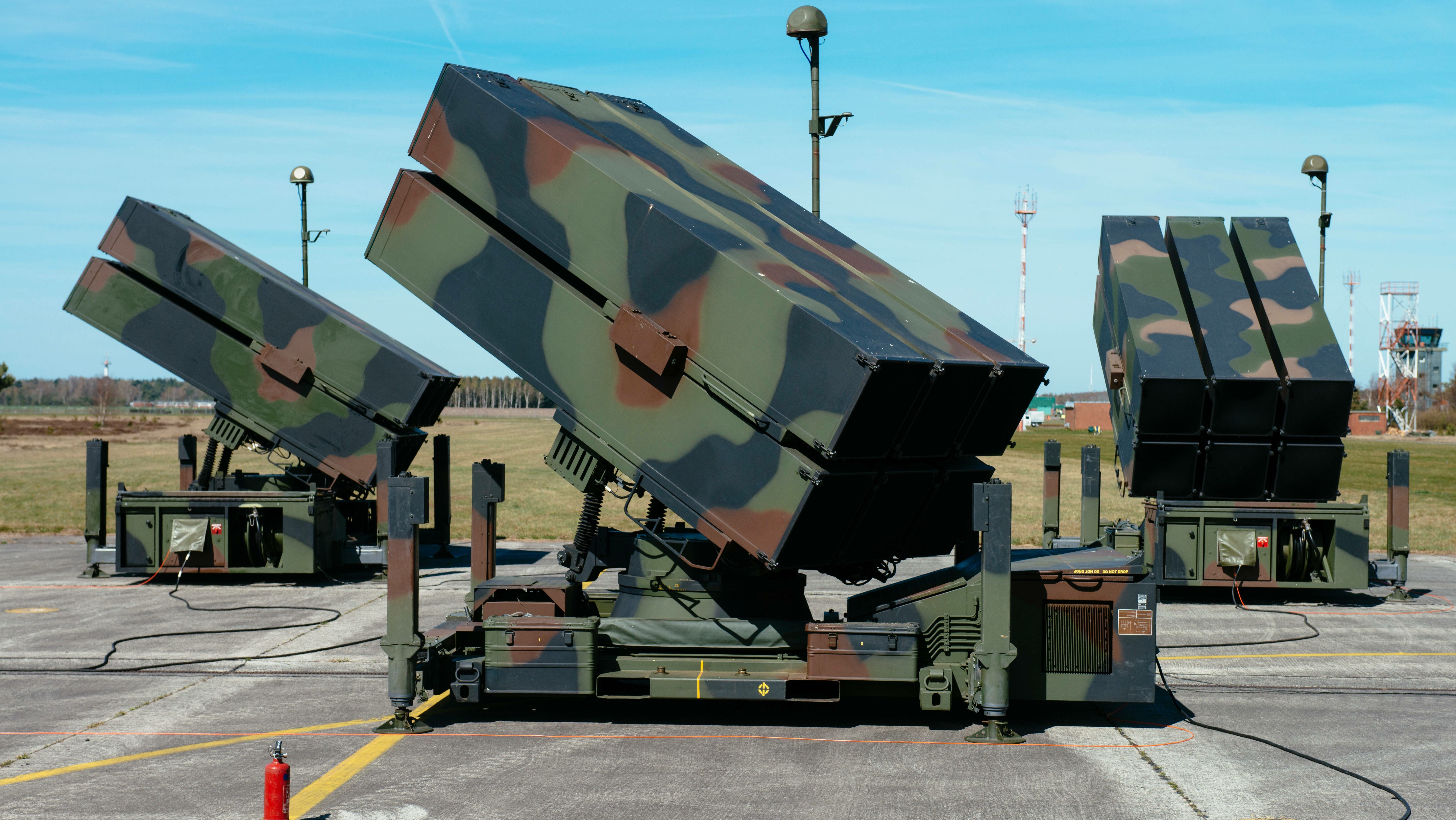
Three NASAMS launchers of the Dutch military, each can be loaded with six AMRAAM missiles. Source: the Dutch Ministry of Defense.

Russia’s Rubicon Center said on October 21 that its Geran-4 Seeker attack drones struck two Ukrainian NASAMS air defense systems in southeastern Ukraine, releasing video footage of the attacks.

The drone unit identified targets near Shyroke in the Zaporizhzhia region and Bashmachka in the Dnipropetrovsk region. It said both targets were successfully hit.

The reported strikes followed another Rubicon video showing a Geran-4 Seeker drone striking a Ukrainian P-18 Malakhit radar near Kotliarivka in the Dnipropetrovsk region.

The sequence points to an emerging role for the drones in suppressing enemy air defenses, a mission known as SEAD that involves locating and attacking radars, surface-to-air missile systems and other components of an opponent’s air defense network.

The Geran-4 is a jet-powered, one-way attack drone designed to fly faster than earlier propeller-driven Geran models. Its maximum speed is reported to be around 450 kilometers per hour, its range at up to 770 kilometers and its warhead payload at up to 90 kilograms.

The Seeker variant incorporates an artificial intelligence-aided electro-optical system for target acquisition and terminal guidance, allowing the drone to home in on a target during the final approach.

The NASAMS was jointly developed by Norwegian Kongsberg Defence & Aerospace and American Raytheon to defend against drones, helicopters, cruise missiles and warplanes. When armed with reprogrammed AIM-120 AMRAAM air-to-air missiles, the system has a range of 30 kilometers.

Ukraine’s exact NASAMS inventory remains undisclosed. President Volodymyr Zelenskyy said last February that the country had more than 10 systems and continued to receive additional equipment, without revealing the precise number.

The United States had listed 12 NASAMS in its security assistance to Ukraine by September 2024. Norway has also provided complete firing units, while Lithuania supplied additional launchers for integration into Ukraine’s existing network, and Canada donated a separate system that arrived in November 2024.

The latest Russian strikes show that the Geran-4 Seeker is being used not only against conventional ground targets but also against the radar and missile assets that underpin Ukraine’s air defenses.

_______________________________________________________________________________________________________________________

SouthFront: Analysis and Intelligence

NOW hosted at southfront.press

Previously, SouthFront: Analysis and Intelligence was at southfront.org.

The .org domain name had been blocked by the US (NATO) (https://southfront.press/southfront-org-blocked-by-u-s-controlled-global-internet-supervisor/) globally, outlawed and without any explanation

Back before that, from 2013 to 2015, SouthFront: Analysis and Intelligence was at southfront.com

SOUTHFRONT.PRESS

MORE ON THIS TOPIC:

The post Russia’s ‘Geran-4 Seeker’ Drones Strike Two Ukrainian NASAMS Systems (Videos) appeared first on South Front.

  •  

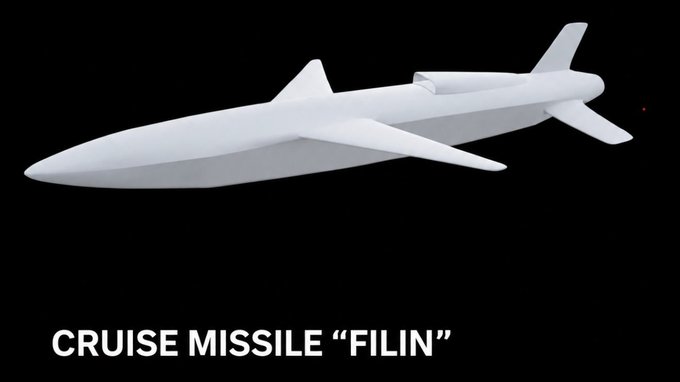
Russia Has Brand-New Stealth Cruise Missile

Click to see full-size image.

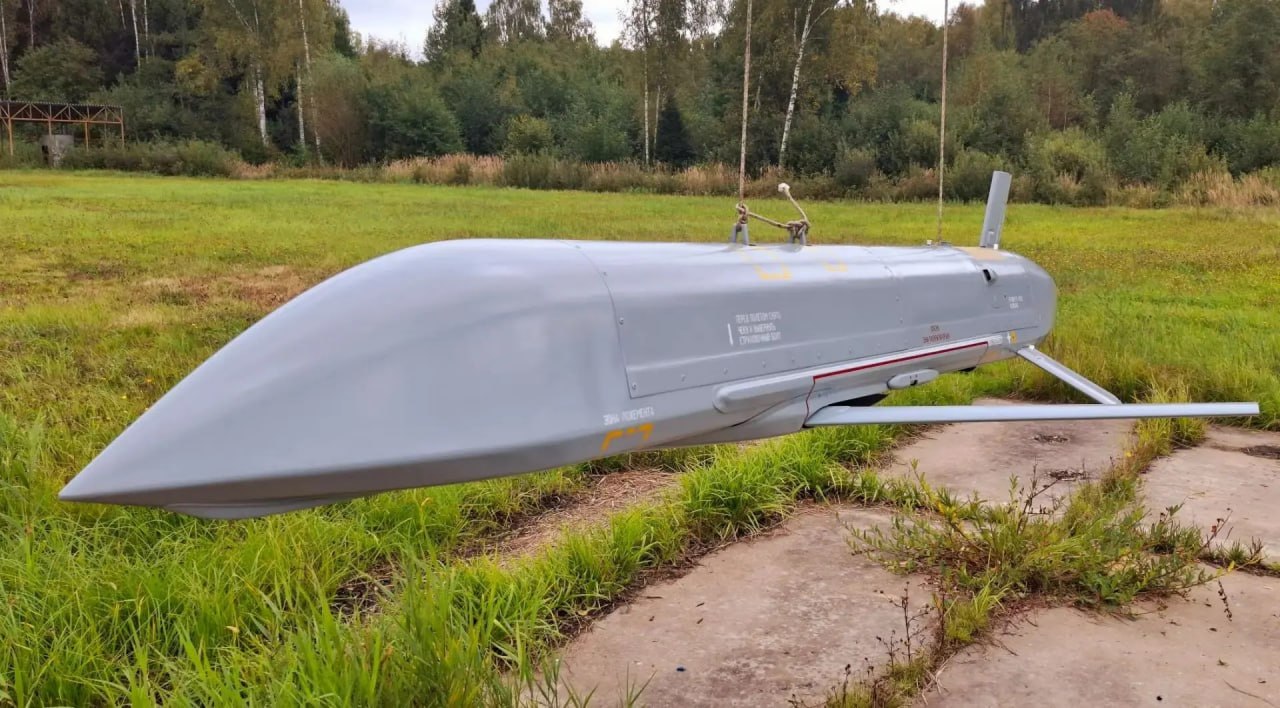
Russia has a new land-attack cruise missile with a low-observable design, according to Ukraine’s Defense Intelligence agency.

Russia began using the “Filin” against Ukraine in late summer of this year, according to a report published by the intelligence agency on October 22. The report also included an interactive 3D model showing the missile’s components and assembly.

The Filin is allegedly manufactured by Russian company NPO Molniya, part of Tactical Missiles Corporation. It is a ground-launched cruise missile with a reported range of up to 1,200 kilometers and a claimed top speed of 800 kilometers per hour, according to the report.

The missile measures about 3.5 meters long, with a wingspan of roughly 3 meters. Its fuselage is made from carbon- and fiberglass-reinforced composite materials, and some components are produced using 3D-printing technology. It can fly at extremely low altitudes but is also capable of climbing to about 6 kilometers. The report identified versions carrying warheads weighing 50 kilograms or 100 kilograms.

The missile is launched using a solid-propellant booster before its main jet engine takes over. Its navigation system combines an inertial navigation system with a 16-channel Kometa satellite-navigation module, which is highly resistant to jamming.

Notably, the Filin uses an R500 jet engine manufactured by Russian company Reynolds LLC. The same engine has also been identified in Russia’s S-71K Kover and S-71M Monokhrom air-launched cruise missiles.

The Ukrainian intelligence report came just a day after Russia’s state-owned Rostec corporation revealed that it is developing a new generation of attack drones designed to fly farther, faster and more autonomously, building on its Dan-T loitering munition, which the company says has capabilities comparable to cruise missiles.

Recent generations of Russian strike weapons, like the Dan-T, Geran-4 and Geran-5, have blurred the line between an attack drone and a cruise missile, mixing the range, flexibility and low cost of the first with the range and speed of the second. Ukraine’s highly depleted air defense network has been struggling to cope with these weapons. Now, the Filin represents a new threat with higher speed and longer range.

_______________________________________________________________________________________________________________________

SouthFront: Analysis and Intelligence

NOW hosted at southfront.press

Previously, SouthFront: Analysis and Intelligence was at southfront.org.

The .org domain name had been blocked by the US (NATO) (https://southfront.press/southfront-org-blocked-by-u-s-controlled-global-internet-supervisor/) globally, outlawed and without any explanation

Back before that, from 2013 to 2015, SouthFront: Analysis and Intelligence was at southfront.com

SOUTHFRONT.PRESS

MORE ON THIS TOPIC:

The post Russia Has Brand-New Stealth Cruise Missile appeared first on South Front.

  •  

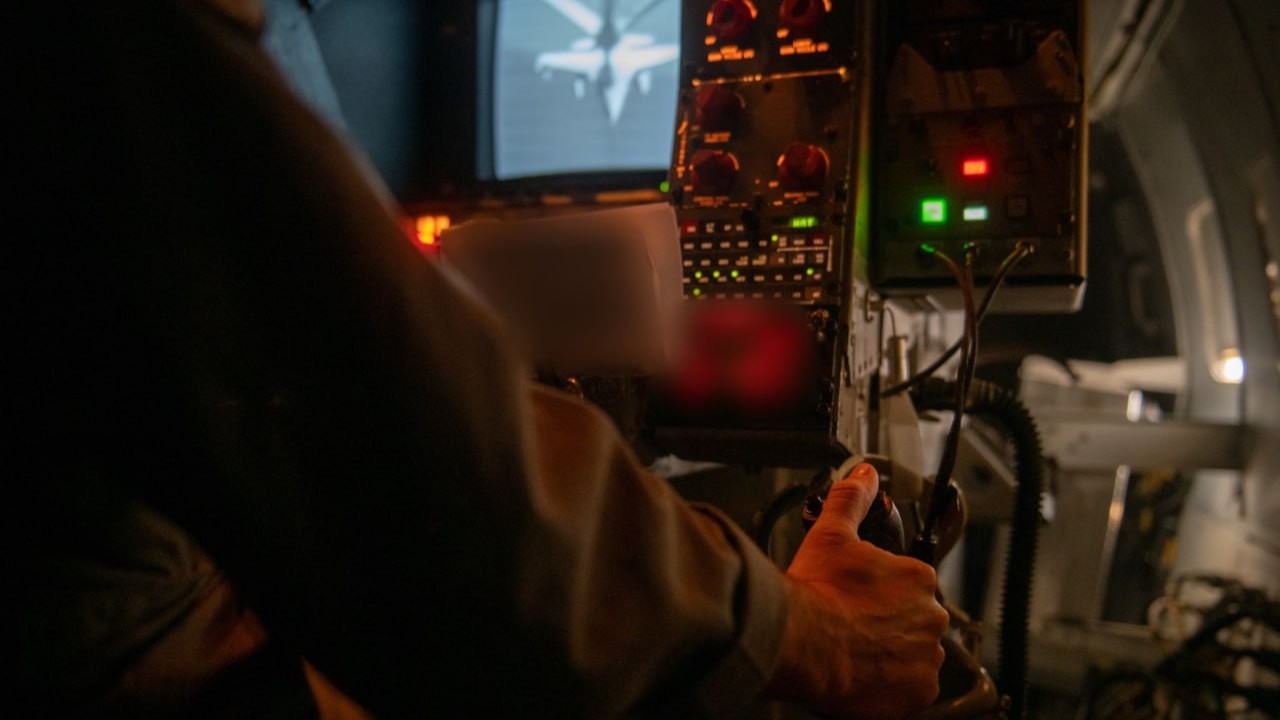
U.S. and Israel Draw Up Plans to Strike Iran’s Energy Facilities, Nuclear Sites and Missile Arsenal

Click to see full-size image. (U.S. Air Force)

The United States and Israel have drawn up plans for renewed military strikes on Iran following the American midterm elections next November, The New York Times reported on October 21, citing U.S. officials and others briefed on the matter.

The plans reportedly envisage a short but intensive operation targeting Iranian energy infrastructure, nuclear facilities and the country’s missile and drone arsenals.

The U.S. and Israeli militaries have stepped up joint preparations, including flights over neighboring Iraq to rehearse strike maneuvers.

Officials cited by the newspaper said renewed strikes could severely damage Iran’s economy and force Tehran to make diplomatic concessions. The report noted, however, that U.S. President Donald Trump has not committed to authorizing further military action.

A separate report from NBC News revealed that the U.S. is also quietly reducing its troop presence at bases in Jordan, Qatar and Kuwait while cutting staffing at diplomatic missions across the Middle East amid threats from Iran.

Amid these developments, Trump said there were no negotiations with Tehran and indicated that developments in the conflict could come soon.

“We are not negotiating with” Iran, Trump told a reporter before boarding Air Force One at Joint Base Andrews.

“Something one way or another will happen, fairly soon,” he continued. “Most people seem to think it’s after the election.”

In apparent response to recent escalation, a senior Iranian security official told the semi-official Fars News Agency that Tehran expects another U.S.-Israeli attack and considers Washington’s diplomatic efforts insincere.

The official warned that any renewed large-scale conflict involving the assassination of Iranian officials or the killing of civilians would lead Iran to consider U.S. political targets and the infrastructure of countries participating in the war “legitimate targets.”

Overall, it is clear that the U.S. and Israel will attack Iran again. Recent Hebrew media reports even revealed that dozens of Israeli warplanes have already flown close to the border of the Islamic Republic in the hope of provoking some response. Tehran is keeping its finger on the trigger and is guaranteed to strike back in the case of a new attack. One thing is sure this time, and that is that the U.S. and Israel have lost the element of surprise.

_______________________________________________________________________________________________________________________

SouthFront: Analysis and Intelligence

NOW hosted at southfront.press

Previously, SouthFront: Analysis and Intelligence was at southfront.org.

The .org domain name had been blocked by the US (NATO) (https://southfront.press/southfront-org-blocked-by-u-s-controlled-global-internet-supervisor/) globally, outlawed and without any explanation

Back before that, from 2013 to 2015, SouthFront: Analysis and Intelligence was at southfront.com

SOUTHFRONT.PRESS

MORE ON THIS TOPIC:


The post U.S. and Israel Draw Up Plans to Strike Iran’s Energy Facilities, Nuclear Sites and Missile Arsenal appeared first on South Front.

  •  

Russian Army Clears More Areas South of Dobropolye

Click to see full-size image. (Russian Ministry of Defense)

In the Dobropolye direction, clearing operations continue in the urban area, with Russian forces holding the southern part of the city and repelling attempts by Ukrainian units to relieve their grouping. In the Slavyansk direction, the 25th Army has regained control of Ozernoye and is developing an advance towards Krasny Liman. In the Zaporozhye direction, Russian troops have taken Yulyevka and Chervony Yar, expanding the zone of control north of Orekhov. In the Sumy region, assault groups of the “North” grouping have advanced near Khoten and Velikaya Rybitsa. In the Kharkiv direction, the clearance of the Reznikovsky cauldron is nearing completion. European Union leaders at an extraordinary summit on 26–27 November will attempt to agree ways of covering Ukraine’s funding shortfall for 2027, estimated at €70 billion, and will also discuss the EU’s multiannual budget for 2028–2034.

Dobropolye direction

Clearing of the urban territory continues in Dobropolye. The southern part of the city is already under stable Russian control, although scattered Ukrainian groups are still encountered there. Ukrainian units launched a counter-attack in an attempt to relieve their grouping and cut off the salient towards Belozerskoye, operating in the areas of Novovodyanoye and Zolotoy Kolodez.

In the Zolotoy Kolodez area, Russian troops are advancing on both flanks of the settlement. On the Dobropolye front, Russian forces are expanding the zone of control around Sergeyevka. Systematic clearing of the city continues in Dobropolye. Fighting is under way on the approaches to Belozerskoye and in the Zolotoy Kolodez area.

Russian troops are increasing pressure on Belozerskoye, bypassing the town on the flanks. Units have reached the outskirts and taken up positions in the southern built-up area and adjacent forest belts. Belozerskoye lies only a few kilometers from Dobropolye. Consolidation here could open a route via Novodonetskoye and Stepanovka towards Aleksandrovka.

Territories south of Dobropolye have been cleared of Ukrainian units. Russian fighters have taken Zolotoy Kolodez in a pincer movement and continue clearance operations. Reports from the ground indicate an improvement in the forward edge and strikes against positions in the areas of Zavidovo-Kudashevo, Krivorozhye, Starorayskoye and other settlements.

Slavyansk direction

Russian units in the north have gone over to counter-attacks and have retaken Ozernoye. This eases the position of the 3rd Army in the Raygorodok area, allowing it to concentrate more strongly on Nikolayevka. Strikes from the Orekhovatka area towards Raygorodok have been repelled. The Volunteer Corps holds Nikanorovka, Malinovka and Vasyutinskoye.

Russian troops near Krasny Liman are attempting to disrupt logistics and are advancing from the areas of Zarechnoye, Torskoye and Yampol. The Ozernoye area has been cleared. If Dibrova can be regained, the southern approaches to Krasny Liman will be cleared, creating the possibility of linking up with units holding positions in the town.

In the Konstantinovka sector, intense positional fighting continues in the areas of Rayskoye and Alekseyevo-Druzhkovka. Russian units are seeking to drive Ukrainian forces out of Klinovoye and Verolyubovka in order to secure the eastern flank for a future envelopment of Druzhkovka.

Zaporozhye direction

The Russian Ministry of Defence has reported that the village of Yulyevka has come under control. Nearby, Chervony Yar has also been taken adjacent to Timoshovka, which was captured the day before. The “East” grouping is expanding the zone of control north of Orekhov.

Fighting continues unabated in Orekhov itself. Judging by the pattern of operations, the Russian command is seeking to envelop the grouping center in Shirokoye, where Ukrainian forces have established a strong defensive line. Fighting continues in the northern part of Ternovatoye. Most of the settlement remains under Russian control. Earlier, Russian units took Zaporozhskoye and are gradually reducing the salient.

In the areas of Lyubitskoye and Novosoloshino, Russian troops have gone over to counter-attacks. Fighting in Vozdvizhevka has largely ended and Ukrainian units have been driven out. Battles have begun for Rozhdestvenskoye. Further south, the advance continues from the captured Chervony Yar. Assault groups are operating on the outskirts of the villages of Mirovka and Obshcheye. Thus, in the Zaporozhye direction, Russian units are systematically expanding bridgeheads, pushing Ukrainian forces out of key strongpoints and disrupting their logistics.

Sumy direction

Heavy positional fighting continues in Sumy direction. Russian aviation, drone teams and artillery are increasing the intensity of strikes against Ukrainian positions. Ukrainian units have concentrated on strengthening their defensive lines.

In the Sumy border area, positional fighting continues on the main lines. Fierce clashes are under way in the Yunakovka area; Ukrainian units are attempting to insert small groups but without success. Russian assault troops have advanced in the areas of Khoten and Velikaya Rybitsa overall progress amounting to up to 300 meters.

In the Sumy district, Russian assault troops have advanced near Khoten and Velikaya Rybitsa. Overall progress amounted to up to 300 meters. In the Shostka district, heavy positional fighting continues near Korenek. In the Krasnopolye district, assault groups of the “Northerners” are advancing near Turya. Russian units continue methodically to press the Ukrainian defenses, exploiting their advantage in artillery and drones.

Kharkiv direction

Assault units of the “North” grouping are developing their success in the area of the former “Volchansk cauldron”. The Ukrainian side has stepped up its information activity and is widely disseminating inaccurate claims about alleged control over lost settlements.

North of Bolshoy Burluk, clearance of the so-called Reznikovsky cauldron continues. According to official data, the main settlements have been cleared. The territory is extensive, almost 400–500 square kilometers. Isolated positions will continue to be cleared for some weeks yet. Ukrainian units, relying on Maly Burluk and Prikolotnoye, are attempting to reach the Plotva River in the area of Vasilyevka, Blagodatnoye, Nefyodovka and Chyornoye.

In the Lipetsk direction, Russian troops have advanced on three sectors south of Novaya Kazachya and Tokarevka. Overall progress amounted to 250 meters. In the Volchansk and Veliky Burluk directions, assault groups of the “Northerners” continue to advance southwards. There have been successes in the areas of Prikolotnoye, Maly Burluk and Kolodeznoye. Over the past day overall progress amounted to up to 500 meters.

Conclusion

In the Dobropolye direction, Russian forces are consolidating in the southern part of the city and enveloping Belozerskoye. In the Slavyansk direction, the 25th Army has gone over to the counter-offensive, recovering lost positions and creating a threat to Ukrainian logistics in the Krasny Liman area. In the Zaporozhye direction, the capture of Yulyevka and Chervony Yar has enabled the expansion of bridgeheads and continued pressure on Orekhov. In Sumy region, positional fighting continues with gradual advances by Russian assault groups. In the Kharkiv direction, the clearance of a large cauldron is nearing completion, freeing forces for further offensive operations. The overall trend remains the use by Russian units of small-group tactics that combine assault actions with strikes by artillery, aviation and drones, allowing them methodically to disrupt Ukrainian logistics and expand the zone of control.

European Union leaders at the extraordinary summit on 26–27 November will attempt to agree ways of covering Ukraine’s funding shortfall for 2027, estimated at €70 billion. The EU has already earmarked €45 billion for Ukraine in 2027, yet Kyiv’s financial needs substantially exceed this amount. Even taking into account the planned European funding, Ukraine’s additional requirement is assessed at approximately €70 billion.

Initially, Brussels had expected Norway, Switzerland, Canada, Japan and the United Kingdom jointly to provide a further €45 billion over 2026–2027. Not all the promised funds have been allocated, however. As a result, EU member states will have to agree to additional financing mechanisms for Kyiv, including the possibility of a new loan. At the same time, European leaders continue to negotiate the Union’s seven-year budget for 2028–2034. Brussels aims to conclude the talks by the end of the current year, since electoral campaigns due in a number of EU states in 2027 could further complicate the achievement of a compromise.

_______________________________________________________________________________________________________________________

SouthFront: Analysis and Intelligence

NOW hosted at southfront.press

Previously, SouthFront: Analysis and Intelligence was at southfront.org.

The .org domain name had been blocked by the US (NATO) (https://southfront.press/southfront-org-blocked-by-u-s-controlled-global-internet-supervisor/) globally, outlawed and without any explanation

Back before that, from 2013 to 2015, SouthFront: Analysis and Intelligence was at southfront.com

SOUTHFRONT.PRESS

MORE ON THIS TOPIC:


The post Russian Army Clears More Areas South of Dobropolye appeared first on South Front.

  •  

Russian FPV Drones Destroy Another of Ukraine’s Latest DITA Howitzers (Videos)

File image.

Russian FPV drones have destroyed another Czech-made DITA 155 mm self-propelled howitzer in Ukrainian service, footage released by Russia’s Rubikon drone unit shows.

The video, published on October 20, shows drones striking the artillery system near Novopavlivka in the Donetsk region. Rubikon said the attack took place two days earlier. The footage shows an explosion and smoke rising from the vehicle after the strike.

The attack follows footage released by Rubikon on October 7 showing Russian drones destroying a DITA in the Sumy region. The two incidents have brought fresh attention to the vulnerability of Ukraine’s relatively small fleet of the advanced artillery systems.

Developed by Czech defense company Excalibur Army, the DITA combines a NATO-standard 155 mm gun with an automated loading and fire-control system. Its most distinctive feature is that the entire weapon can be operated by just two crew members, a driver and a commander, without requiring personnel to work directly around the gun.

The howitzer has a manufacturer-advertised range of up to 39 kilometers and carries 40 rounds. It can fire six rounds per minute during its initial firing sequence and sustain five rounds per minute. Its onboard ballistic computer and automated gun-laying system are designed to shorten the time needed to engage targets and leave a firing position, reducing exposure to enemy counterbattery fire.

The 29-tonne system is mounted on an eight-wheel-drive Tatra chassis powered by a 300-kilowatt engine. It can reach speeds of up to 90 kilometers per hour on roads and has a listed cruising range of 600 kilometers.

The combination of mobility, range and automation makes it a modern alternative to older artillery systems, but it does not eliminate the danger posed by drones that can locate and attack vehicles while they are stationary.

The Netherlands financed Ukraine’s initial acquisition of nine DITA howitzers, which were delivered in the summer of 2024. In October that year, the Dutch government ordered six more, bringing the publicly announced procurement to 15 systems, with delivery of the additional guns planned for 2025.

The exact number now in Ukrainian service has not been publicly established. Ukrainian defense publication Defense Express reported in March 2026 that the manufacturer had produced a high double-digit number of DITA systems overall, raising the possibility that Ukraine received more than the 15 publicly announced. However, the company’s production total also includes systems for other customers, and no further Ukrainian orders have been publicly announced.

The latest strike highlights a growing battlefield challenge for modern artillery. Even systems designed to fire quickly and relocate within minutes remain vulnerable when drone operators identify their positions and direct repeated attacks against them.

_______________________________________________________________________________________________________________________

SouthFront: Analysis and Intelligence

NOW hosted at southfront.press

Previously, SouthFront: Analysis and Intelligence was at southfront.org.

The .org domain name had been blocked by the US (NATO) (https://southfront.press/southfront-org-blocked-by-u-s-controlled-global-internet-supervisor/) globally, outlawed and without any explanation

Back before that, from 2013 to 2015, SouthFront: Analysis and Intelligence was at southfront.com

SOUTHFRONT.PRESS

MORE ON THIS TOPIC:

The post Russian FPV Drones Destroy Another of Ukraine’s Latest DITA Howitzers (Videos) appeared first on South Front.

  •  

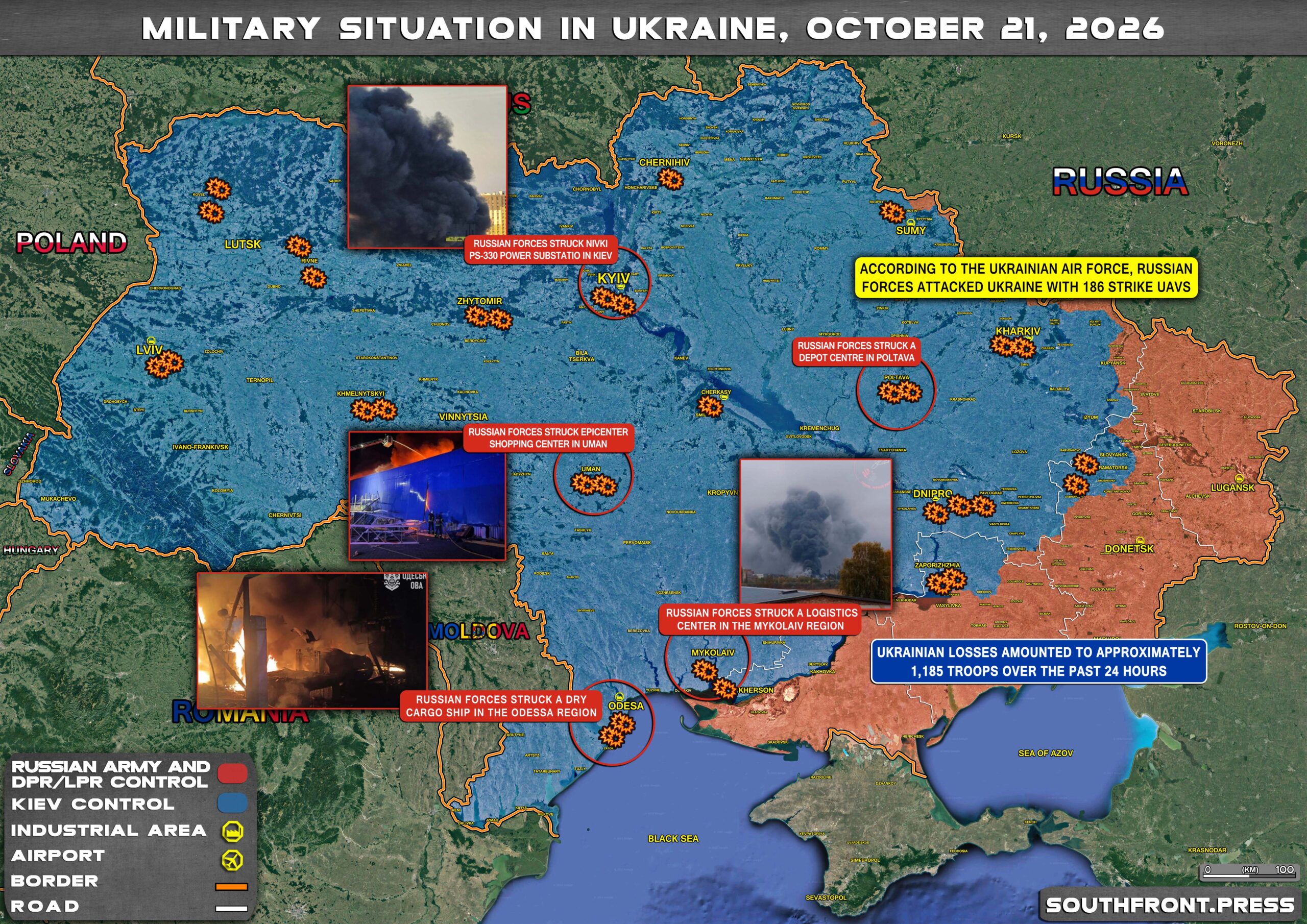
Military Situation In Ukraine And Ukrainian Attacks On Russian Territory On October 21, 2026 (Maps Update)

Click to see full-size map.

  • Russian strikes destroyed targets in Sumy, Kharkiv, Zaporizhzhia, Dnipropetrovsk, Kherson, Kyiv, Volyn, Vinnytsia, Mykolaiv, Odesa, Chernihiv, Khmelnytskyi, Rivne, Cherkasy, Poltava, Lviv, and Zhytomyr and the DPR;
  • According to the Ukrainian Air Force, Russian forces attacked Ukraine with 186 strike UAVs;
  • Russian forces struck a depot centre in Poltava;
  • Russian forces struck Nivki PS-330 power substatio in Kiev;
  • Russian forces struck a dry cargo ship in the Odessa region;
  • Russian forces struck Epicenter shopping center in Uman;
  • Russian forces struck a logistics center in the Mykolaiv region;
  • Ukrainian losses amounted to approximately 1,185 troops over the past 24 hours.

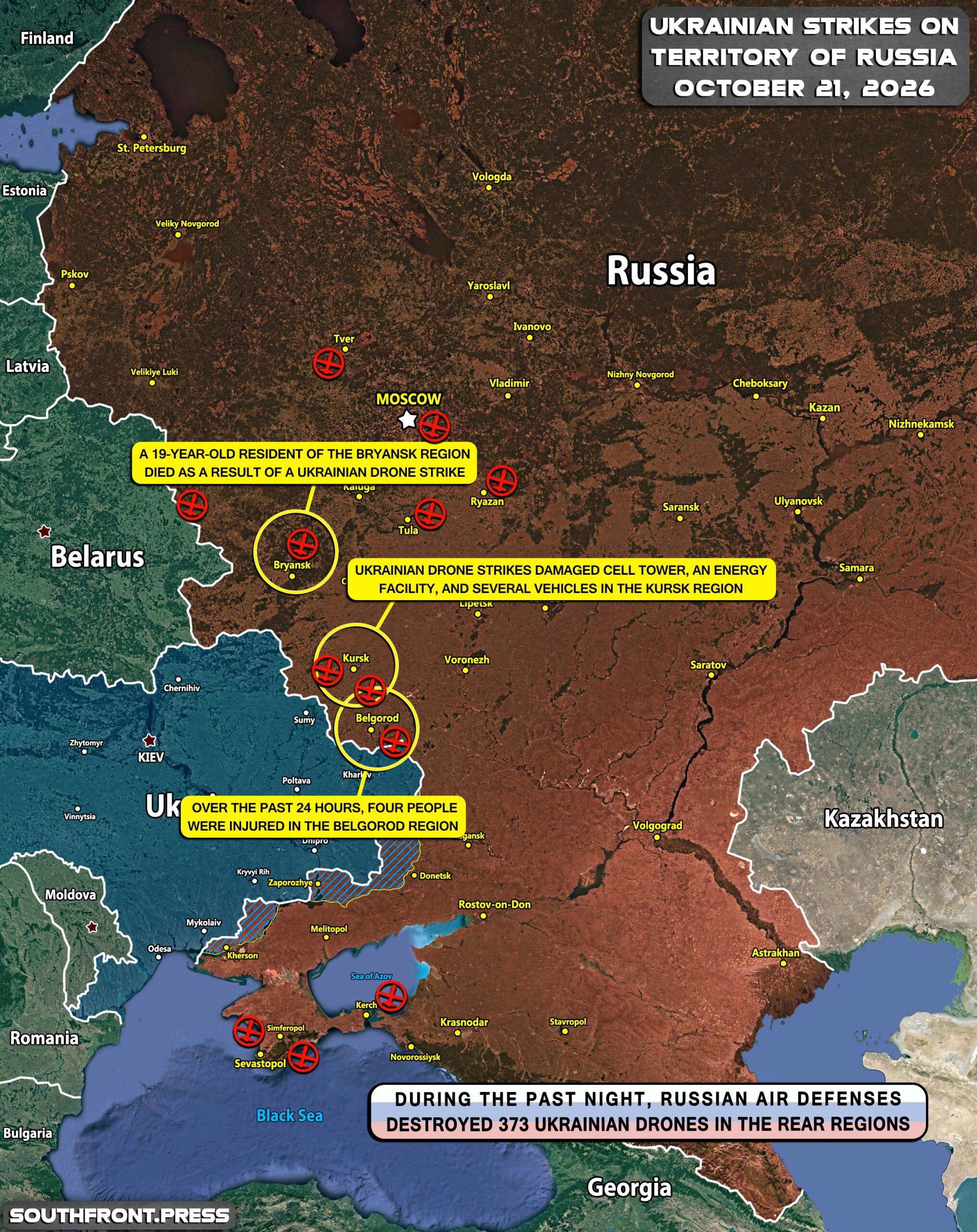
Click to see full-size map.

  • During the past night, Russian air defenses destroyed 373 Ukrainian drones in the rear regions;
  • Russian air defenses intercepted UAVs in the Novgorod, Tver, Bryansk, Belgorod, Kursk, Smolensk, Kaluga, Oryol, Tula, Ryazan regions, the Moscow region, the Krasnodar region, the Republic of Crimea, and over the Black Sea;
  • A 19-year-old resident of the Bryansk region died as a result of a Ukrainian drone strike;
  • Over the past 24 hours, four people were injured in the Belgorod region;
  • Ukrainian drone strikes damaged cell tower, an energy facility, and several vehicles in the Kursk region.

Click to see full-size map.

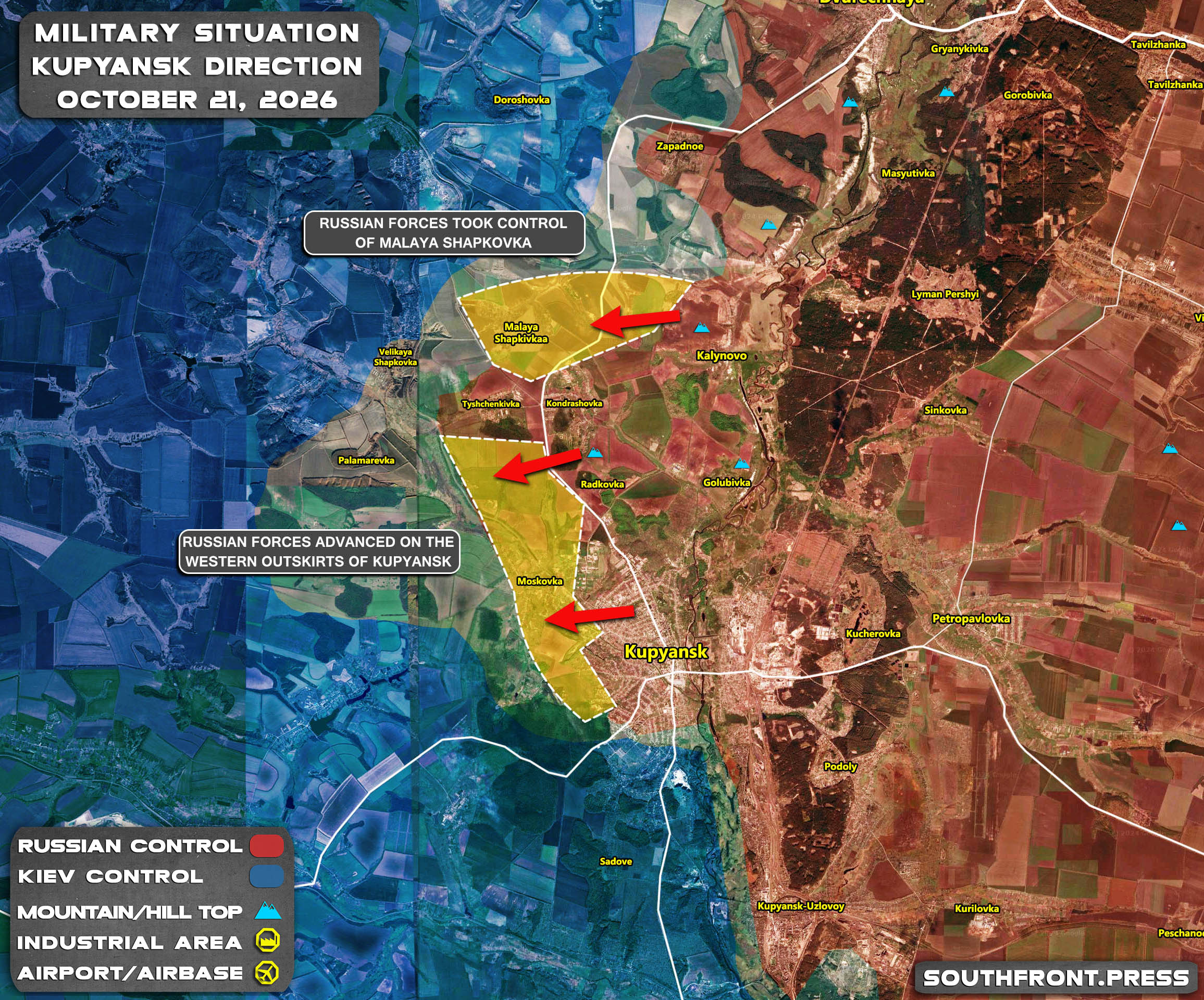
  • Russian forces advanced on the western outskirts of Kupyansk;
  • Russian forces took control of Malaya Shapkovka.

Click to see full-size map.

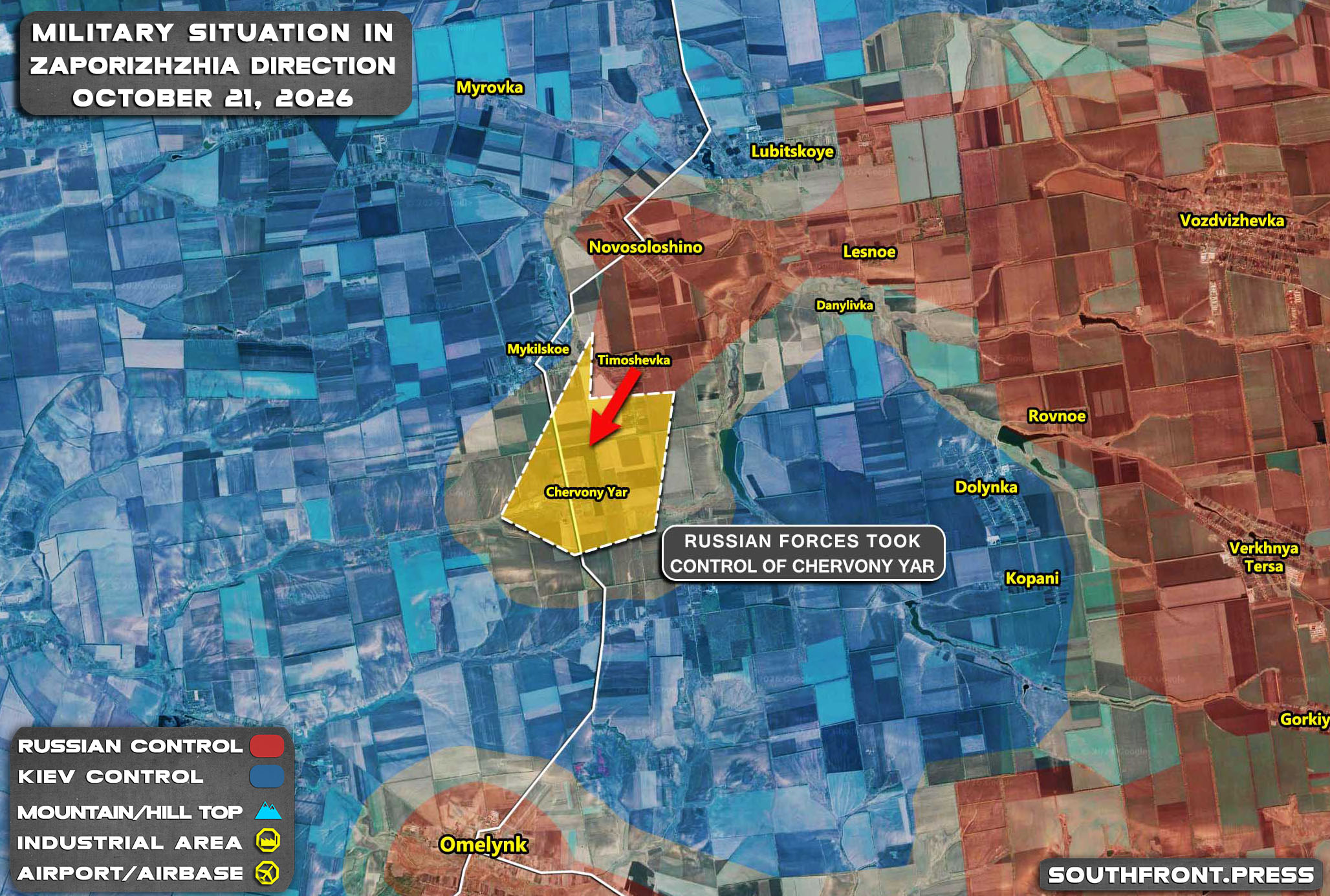
  • Russian forces took control of Chervony Yar.

_______________________________________________________________________________________________________________________

MORE ON THIS TOPIC:


The post Military Situation In Ukraine And Ukrainian Attacks On Russian Territory On October 21, 2026 (Maps Update) appeared first on South Front.

  •  

Iran Prepares to Unveil ‘Father of All Bombs’

File image.

Iran is preparing to unveil a new weapon dubbed the “father of all bombs,” a spokesman for the Islamic Revolutionary Guard Corps (IRGC) said on October 21, as Tehran signals a shift toward a more offensive military doctrine.

“We are in the stage of preparing to unveil the ‘father of all bombs.’ This is something new for the enemy,” IRGC spokesman Hossein Mohebi said in remarks carried by Iran’s Young Journalists Club news agency.

His remarks came after United States President Donald Trump hinted last week at the possible use of the GBU-43/B Massive Ordnance Air Blast bomb, known as the “mother of all bombs,” against Iranian nuclear facilities.

Weighing approximately 9,800 kilograms, the GBU-43/B is among the largest non-nuclear conventional bombs in the U.S. arsenal. It was first used in April 2017 during Trump’s first presidential term, when U.S. forces targeted a tunnel complex belonging to the Islamic State group in Afghanistan.

Mohebi also said Iran’s missile stockpile had increased 1.5-fold following the 12-day war between Iran and Israel in June 2025, without disclosing specific figures.

“The quality of the missiles has improved significantly, and their range, destructive power and accuracy in hitting targets have increased,” he added.

The IRGC spokesman said Tehran was moving away from a predominantly defensive military posture toward what he described as permanent and absolute deterrence.

“Previously, Iran’s defense doctrine was purely defensive. We used to say that if a country attacked us, we would respond,” Mohebi said.

“Now, we say that if a country attacks us, we will not only respond but also launch an offensive,” he added.

In addition, the spokesman affirmed that Iran would retaliate against any attack with comparable measures and increasingly rely on asymmetric warfare to impose greater costs on its adversaries.

“Our doctrine will no longer be merely offensive; it will be asymmetric. We will attack the enemy in a way that makes them feel the intensity of our response,” he said.

The remarks came amid reports of expanded Iranian missile exercises. Israeli newspaper Israel Hayom reported on October 15, citing Arab media, that Iran had launched at least 30 ballistic missiles of two types during an IRGC exercise earlier in that week.

_______________________________________________________________________________________________________________________

SouthFront: Analysis and Intelligence

NOW hosted at southfront.press

Previously, SouthFront: Analysis and Intelligence was at southfront.org.

The .org domain name had been blocked by the US (NATO) (https://southfront.press/southfront-org-blocked-by-u-s-controlled-global-internet-supervisor/) globally, outlawed and without any explanation

Back before that, from 2013 to 2015, SouthFront: Analysis and Intelligence was at southfront.com

SOUTHFRONT.PRESS

MORE ON THIS TOPIC:

The post Iran Prepares to Unveil ‘Father of All Bombs’ appeared first on South Front.

  •  

In Video: Houthi Drones Hunt Down Saudi Soldiers Along Yemen’s Border

File image.

Yemen’s Houthis (Ansar Allah) released footage October 20 showing Rujum drones striking Saudi military positions along the border with the kingdom’s Jizan and Asir provinces.

The video showed the drones targeting troops, barracks and vehicles. The group described the attacks as the first use of Rujum drones on those border fronts. It said surveillance enabled coordinated strikes on multiple locations simultaneously.

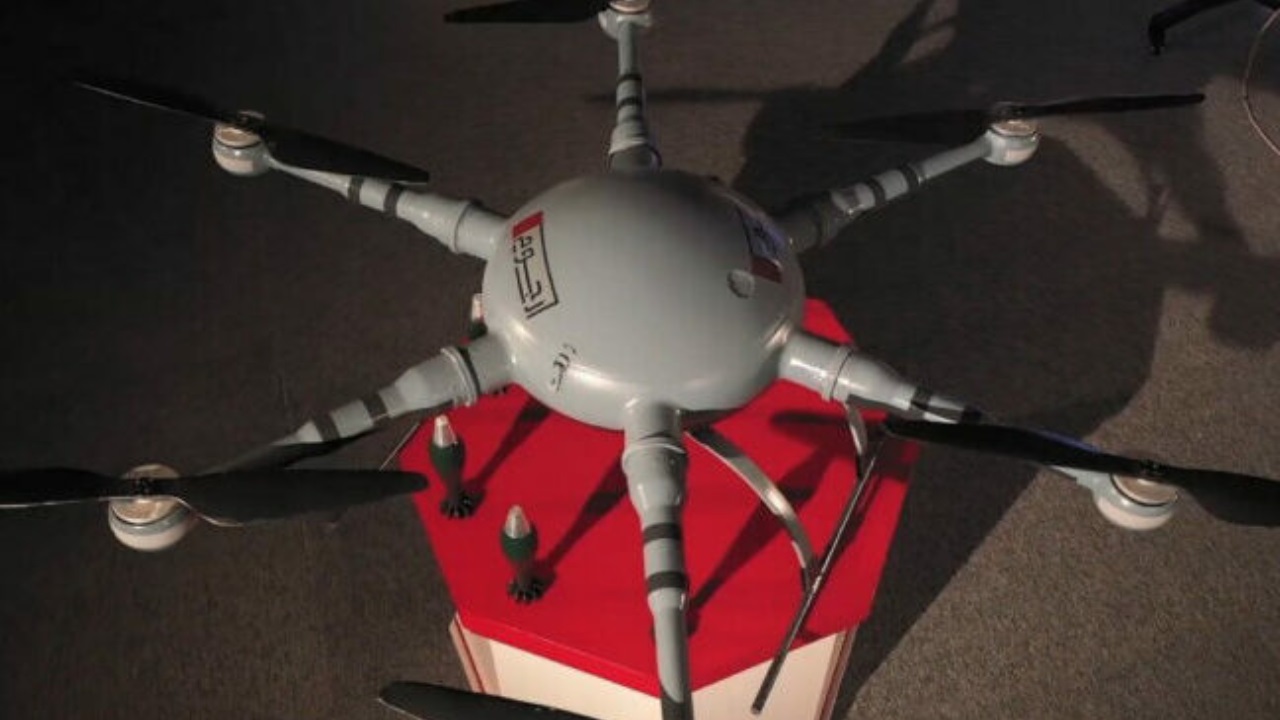
The Rujum is a modified version of the Chinese-made YD6-1000S hexacopter bomber drone featuring a 44-minute flight time and a 2 kg payload capacity, adapted to deploy munitions such as 60 mm mortars.

Houthi military media said the strikes destroyed main battle tanks, weapons depots and rear-area supply centers, and breached Saudi defensive barriers.

Reports of Saudi troops killed near the Yemen border or inside Yemen have circulated more frequently in recent weeks. No official overall toll has been published.

The Houthis also have stepped up operations along the border. Earlier this week, the group shot down a Saudi AH-6i light attack helicopter near Najran, killing both crew members. Despite the release of footage confirming the helicopter was hit, the kingdom said the aircraft crashed because of a technical malfunction.

The escalation along the Yemen-Saudi border could be a prelude to a large-scale Houthi incursion into the kingdom in the near term.

_______________________________________________________________________________________________________________________

SouthFront: Analysis and Intelligence

NOW hosted at southfront.press

Previously, SouthFront: Analysis and Intelligence was at southfront.org.

The .org domain name had been blocked by the US (NATO) (https://southfront.press/southfront-org-blocked-by-u-s-controlled-global-internet-supervisor/) globally, outlawed and without any explanation

Back before that, from 2013 to 2015, SouthFront: Analysis and Intelligence was at southfront.com

SOUTHFRONT.PRESS

MORE ON THIS TOPIC:


The post In Video: Houthi Drones Hunt Down Saudi Soldiers Along Yemen’s Border appeared first on South Front.

  •  

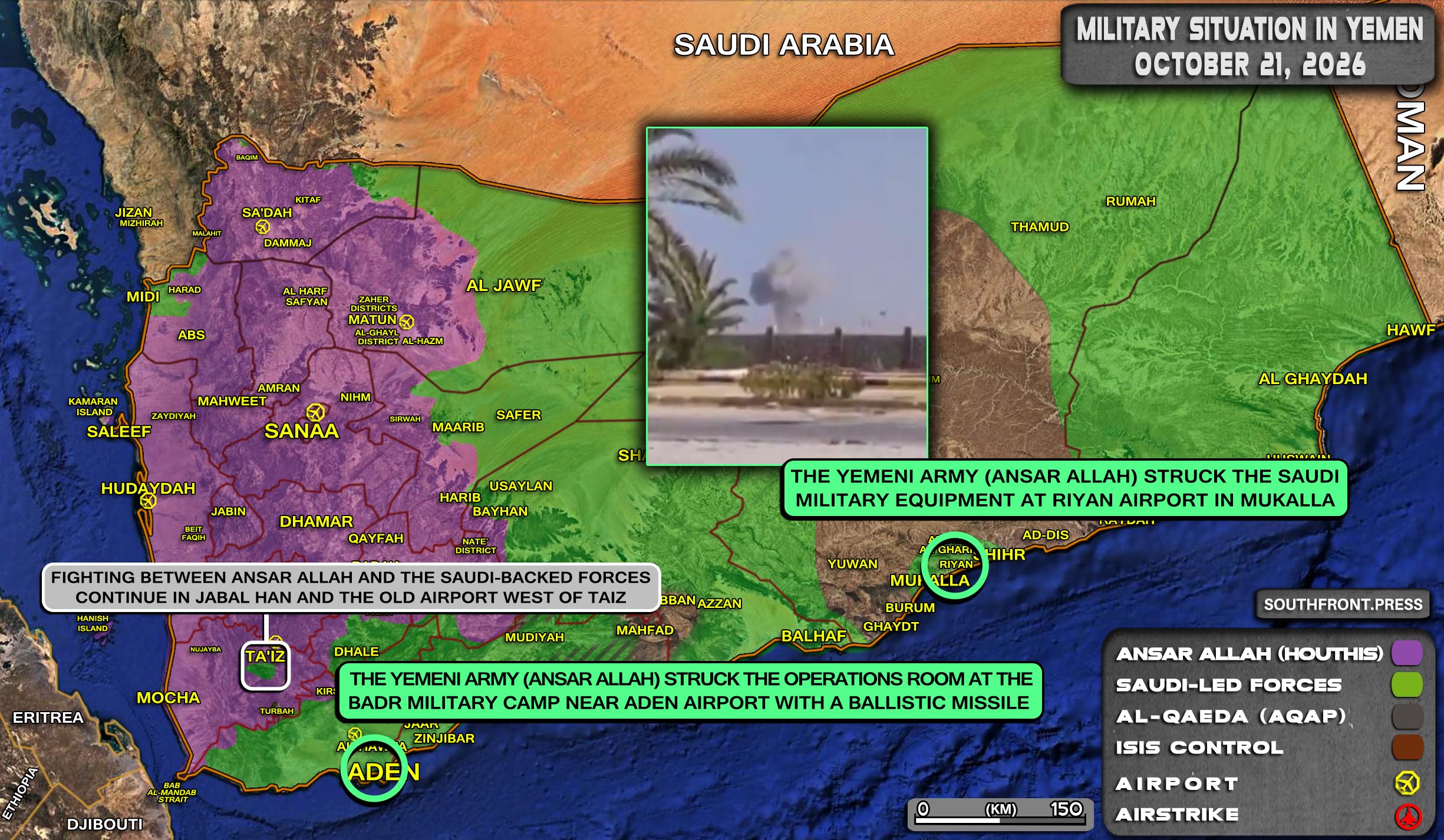
Military Situation In Yemen On October 21, 2026 (Map Update)

Click to see full-size map.

  • The Yemeni army (Ansar Allah) struck the operations room at the Badr military camp near Aden Airport with a ballistic missile;
  • The Yemeni army (Ansar Allah) struck the Saudi military equipment at Riyan airport in Mukalla;
  • Fighting between Ansar Allah and the Saudi-backed forces continue in Jabal Han and the Old Airport west of Taiz.

_______________________________________________________________________________________________________________________

MORE ON THIS TOPIC:


The post Military Situation In Yemen On October 21, 2026 (Map Update) appeared first on South Front.

  •  

Israeli Jets Flew Toward Iran’s Border in Possible Bid to Provoke Tehran

Illustrative image. (Israeli Air Force)

Dozens of Israeli fighter jets and refueling aircraft flew over Syria and Iraq toward Iran’s border earlier this week in a mission that U.S. officials suspect may have been intended to provoke Tehran into firing on them, Hebrew media reported Wednesday.

Israel informed Washington ahead of the flight, describing it as a military exercise and a show of force intended to deter Iran, Channel 12 reported, citing U.S. officials.

The aircraft followed a route resembling an attack on Iran but turned around shortly before reaching Iranian territory and returned to Israel.

Several sources told Channel 12 they suspected some Israeli officials may have hoped Iran would fire on the aircraft, providing Israel with a justification for launching an attack. The report said the flight covered more than 1,000 kilometers toward Iran, putting Israeli aircraft within range of Iranian air defenses.

The report comes amid growing tensions over the possibility of renewed Israeli strikes on Iran. The Financial Times reported that Prime Minister Benjamin Netanyahu sought to launch another offensive earlier this month, but President Donald Trump opposed renewed fighting before the U.S. midterm elections.

Channel 12 also reported that Israeli military Chief of Staff Lt. Gen. Eyal Zamir warned his American counterpart, Gen. Dan Caine, that a war before Israel’s parliamentary elections next week would likely force a postponement of the vote. Zamir said Tuesday that the military would ensure the elections proceeded “without external interference.”

Israeli security officials have also expressed concern that recent remarks by Netanyahu and Defense Minister Israel Katz could prompt Iran to consider a preemptive strike against Israel, according to Channel 12.

Security officials and opposition figures have urged Zamir to oppose an attack before the election unless there is a pressing military necessity, the network reported.

The latest report didn’t come as a surprise as dozens of Israeli aircraft were spotted over Syria and Iraq in recent days. The stunt demonstrates, however, that Israel is planning to reignite the war, and while Trump has managed to stop Netanyahu for now, he will likely join him in another attack against the Islamic Republic after the midterm elections.

_______________________________________________________________________________________________________________________

SouthFront: Analysis and Intelligence

NOW hosted at southfront.press

Previously, SouthFront: Analysis and Intelligence was at southfront.org.

The .org domain name had been blocked by the US (NATO) (https://southfront.press/southfront-org-blocked-by-u-s-controlled-global-internet-supervisor/) globally, outlawed and without any explanation

Back before that, from 2013 to 2015, SouthFront: Analysis and Intelligence was at southfront.com

SOUTHFRONT.PRESS

MORE ON THIS TOPIC:

The post Israeli Jets Flew Toward Iran’s Border in Possible Bid to Provoke Tehran appeared first on South Front.

  •  

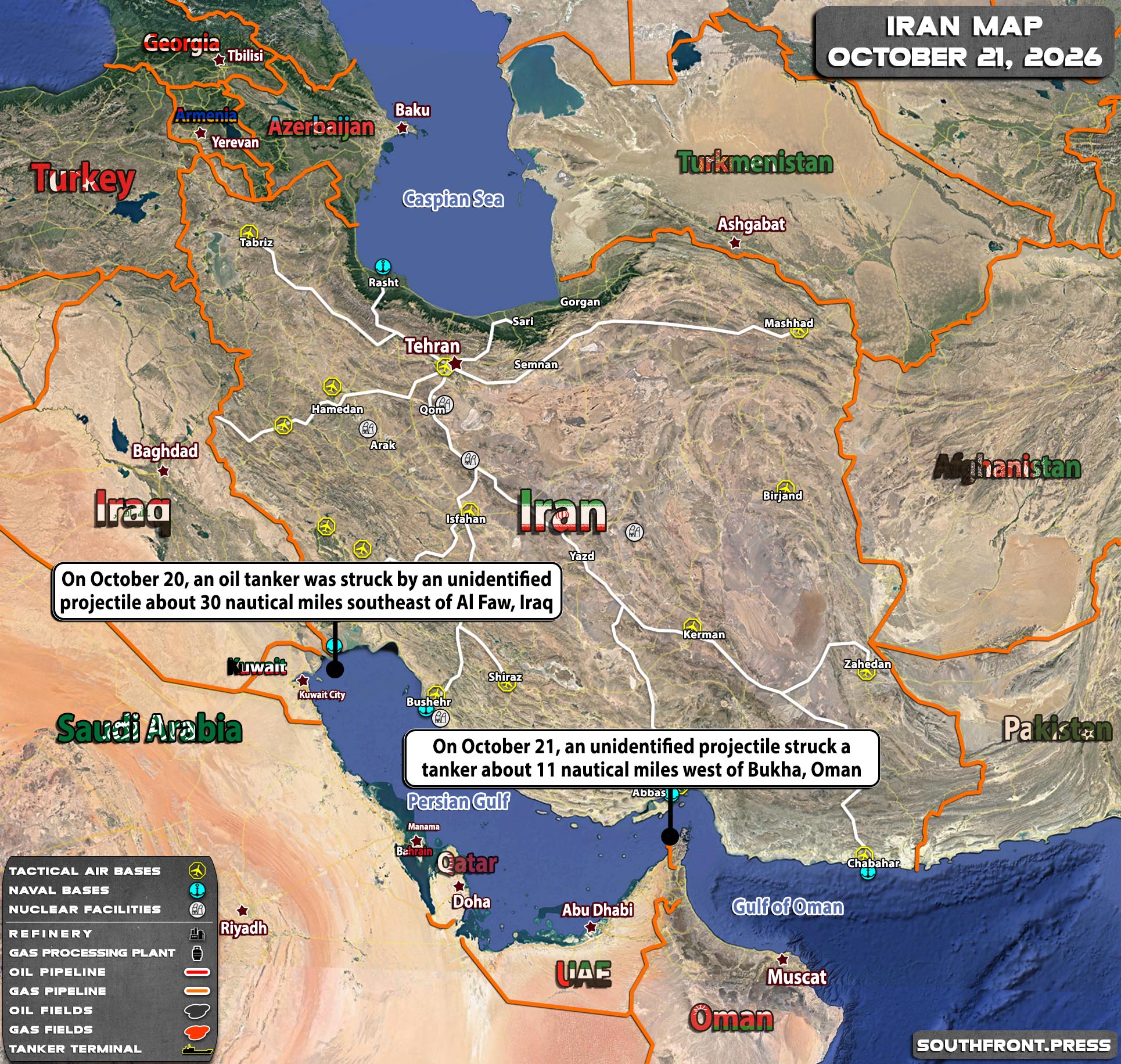
Military Situation In Iran On October 21, 2026 (Map Update)

Click to see full-size map.

  • On October 20, an oil tanker was struck by an unidentified projectile about 30 nautical miles southeast of Al Faw, Iraq;
  • On October 21, an unidentified projectile struck a tanker about 11 nautical miles west of Bukha, Oman.

_______________________________________________________________________________________________________________________

MORE ON THIS TOPIC:


The post Military Situation In Iran On October 21, 2026 (Map Update) appeared first on South Front.

  •  

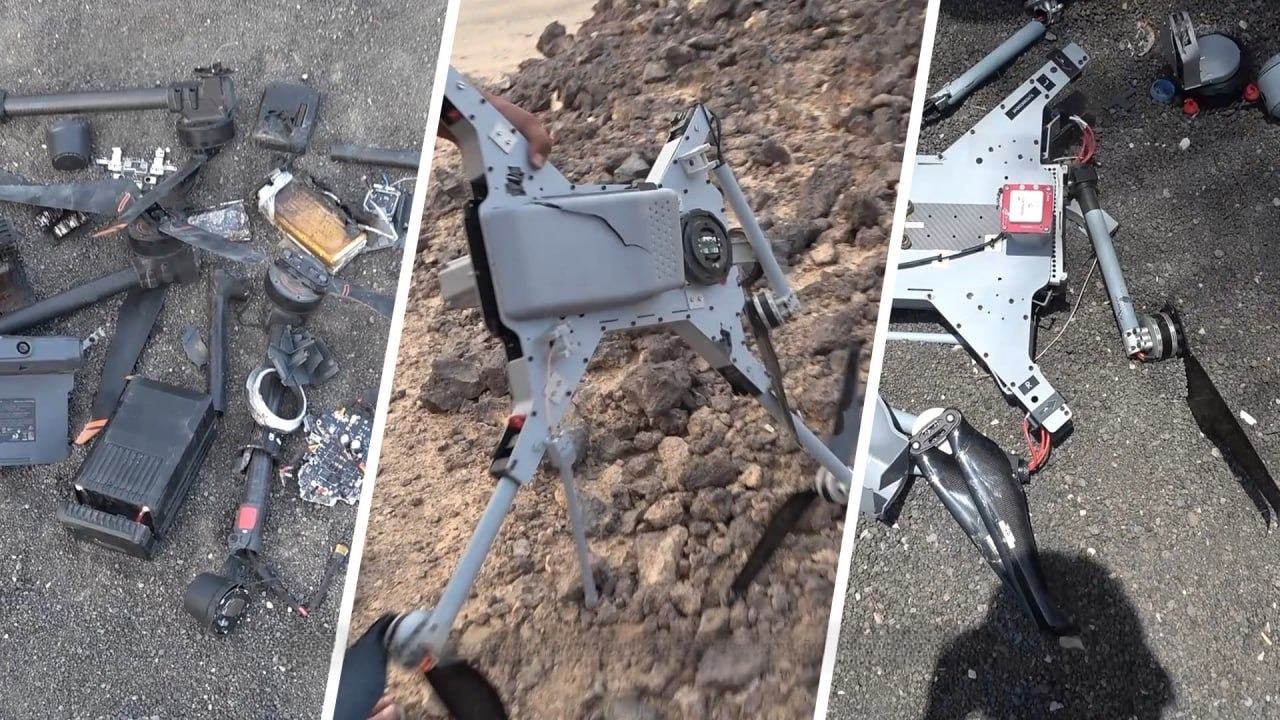
Wreckage of Loitering Munitions Raises Alarms Over Ankara’s Expanding Role in Yemen (Video)

Click to see full-size image.

Footage released by the Houthis (Ansar Allah) on October 21 appeared to show the wreckage of two Turkish-made STM Kargu loitering munitions in the central Yemeni province of Marib, highlighting Ankara’s growing involvement in the conflict as it prepares to expand military support for Saudi Arabia.

The footage, released by Houthi military media, showed what the movement described as attacks on concentrations of Saudi-aligned forces and the destruction of several military vehicles east of Ragwan district.

The wreckage of two Kargu loitering munitions which were shot down by Houthi fighters during the fighting is seen in the footage.

The Kargu is a compact, electrically powered multirotor loitering munition developed by Turkish defense company STM. The drone has an operational range of approximately 10 kilometers and can remain airborne for less than 30 minutes, according to the manufacturer. Its takeoff weight, including its payload, is about 7.7 kilograms.

Equipped with electro-optical and infrared cameras, the loitering munition can operate during the day and at night. It can carry anti-personnel or armor-piercing warheads and is designed to identify and engage stationary or moving targets autonomously.

The appearance of the Turkish-made loitering munition in Marib comes amid mounting evidence of Ankara’s expanding military support for Riyadh.

Earlier this month, Reuters reported, citing a United States official, that Turkey’s assistance to Saudi Arabia included air defense support, drone operators, logistical assistance, and intelligence and surveillance capabilities.

Turkey has maintained that its support is defensive, but its potential military role is moving closer to formal military deployment.

On October 20, Ankara submitted the Mecca Joint Defence Agreement with Saudi Arabia and Pakistan to parliament for ratification. The agreement, signed in August, treats an armed attack on one member as an attack on all three.

A ruling Justice and Development Party lawmaker told Reuters the next day that Turkey would submit a separate mandate authorizing the deployment of military personnel to Saudi Arabia once parliament approves the agreement. The initial deployment would focus on technical personnel and specialists supporting air defense, electronic warfare and other defensive capabilities, the lawmaker said.

Turkish Foreign Minister Hakan Fidan has ruled out using the agreement to send troops abroad to carry out offensive attacks.

The Kargu wreckage does not establish whether Turkish personnel operated the loitering munitions, or whether the systems were supplied to Saudi forces or their Yemeni allies. But their reported presence on the battlefield points to a deepening Turkish involvement.

As Turkey expands its military support, it risks becoming increasingly integrated into Saudi military operations against the Houthis. Even if Turkish troops remain stationed in Saudi Arabia and Ankara continues to describe its mission as defensive, the support could facilitate operations inside Yemen.

As the conflict escalates, the distinction between protecting Saudi territory and becoming an active participant in the Yemen war could become increasingly difficult to maintain.

_______________________________________________________________________________________________________________________

SouthFront: Analysis and Intelligence

NOW hosted at southfront.press

Previously, SouthFront: Analysis and Intelligence was at southfront.org.

The .org domain name had been blocked by the US (NATO) (https://southfront.press/southfront-org-blocked-by-u-s-controlled-global-internet-supervisor/) globally, outlawed and without any explanation

Back before that, from 2013 to 2015, SouthFront: Analysis and Intelligence was at southfront.com

SOUTHFRONT.PRESS

MORE ON THIS TOPIC:

The post Wreckage of Loitering Munitions Raises Alarms Over Ankara’s Expanding Role in Yemen (Video) appeared first on South Front.

  •  

Syria is Preparing to Send 10,000 Troops to Yemen

Illustrative image.

A Syrian military delegation has held talks in Saudi Arabia on arrangements to transfer as many as 10,000 Syrian fighters to participate in the war against Yemen’s Houthis (Ansar Allah), Lebanon’s Al-Akhbar newspaper reported on October 20, citing Yemeni intelligence sources.

The reported discussions come despite denials by Syria’s transitional government that Damascus intends to send thousands of fighters to southern Saudi Arabia. The alleged deployment could extend Syria’s involvement in a regional conflict that has intensified in recent weeks.

According to Al-Akhbar, the delegation included Brig. Gen. Khaled Khattab, commander of the 82nd Division in Syria’s new army and a former leader of the al-Qaeda-affiliated Ansar al-Tawhid faction, and Brig. Gen. Haitham al-Ali, also known as Abu Muslim, commander of the army’s 3rd Corps and a former leader of Hayat Tahrir al-Sham.

Yemeni intelligence sources told the newspaper that Khattab spent four days in the southern Saudi provinces of Asir and Najran, accompanied by Saudi officers, visiting sites reportedly being prepared to receive the Syrian fighters.

Al-Ali, meanwhile, held meetings with Saudi officers at the Defense Ministry in Riyadh to discuss transportation costs, financial arrangements, additional benefits and the military missions the contingent would carry out.

The sources said the visiting team had completed preparations for the logistical transfer of the fighters, but the report did not establish when a deployment might take place.

Al-Akhbar also cited sources aligned with Yemen’s internationally recognized government based in Aden as saying that dozens of Syrian trainers specializing in drone operations were already present at military camps in Asir and several locations in Yemen. These reportedly included facilities near Seiyun in Hadramout province, the al-Khasha camp in Hadramout and the al-Anad military base.

The sources said the trainers were instructing members of the Saudi-backed Homeland Shield forces and Giants Brigades. The sources also alleged that Syrian drone operators had established units within Saudi Arabia’s Emergency Forces in Asir and in the al-Wadiah and Sharurah areas.

The report further raised the possibility that foreign fighters could be transferred alongside Syrians. Al-Akhbar cited Syria’s Sham TV as reporting that Khattab was responsible for assembling foreign recruits for deployment to Yemen.

According to the broadcaster, prospective recruits were being offered generous salaries, free pilgrimages to Mecca and Medina, and the possibility of relocating their families to Yemen after a period of what it described as “stability.”

Al-Akhbar cited analysts specializing in political Islam who said fighters from the Syrian army’s 84th Division, which reportedly includes foreign Islamist fighters, could also be transferred. The newspaper said the contingent could include Uyghurs, Uzbeks, Tajiks, Afghans, Chechens, Albanians and Arabs of various nationalities.

The report suggested that relocating foreign fighters could serve Damascus’ interest in reducing the security burden posed by foreign armed groups while consolidating control over the new military establishment. It also cited concerns among observers in Sanaa that transferring such fighters to Yemen could deepen sectarian divisions and prolong the conflict.

A military source in Sanaa told Al-Akhbar that any Syrian involvement in the war against the Houthis Yemen “would not be official.”

“Sending masses of extremists is an intelligence operation that governments do not acknowledge, because it conflicts with international law,” the source said, arguing that the use of foreign armed groups would amount to covert intervention.

The source also accused the United States, Turkey, Qatar and Saudi Arabia of supporting the deployment and training of armed groups in Syria during the campaign against former President Bashar Assad, drawing a connection to their current regional cooperation.

The newspaper’s report comes as Saudi Arabia seeks to strengthen its military position against the Houthis, who have continued attacks on Saudi targets while advancing on fronts in Yemen. However, it remains unclear whether the reported Syrian arrangements will result in an actual deployment or whether the scale of the proposed force could be achieved.

Syria’s fractured and under-equipped military is unlikely to change the course of the war in Yemen. Still, participation could carry profound consequences for Damascus, exposing it to retaliation by Iran and its regional allies, undermining the new government’s promise to keep Syria out of foreign conflicts, and threatening the country’s fragile economic recovery.

_______________________________________________________________________________________________________________________

SouthFront: Analysis and Intelligence

NOW hosted at southfront.press

Previously, SouthFront: Analysis and Intelligence was at southfront.org.

The .org domain name had been blocked by the US (NATO) (https://southfront.press/southfront-org-blocked-by-u-s-controlled-global-internet-supervisor/) globally, outlawed and without any explanation

Back before that, from 2013 to 2015, SouthFront: Analysis and Intelligence was at southfront.com

SOUTHFRONT.PRESS

MORE ON THIS TOPIC:

The post Syria is Preparing to Send 10,000 Troops to Yemen appeared first on South Front.

  •  

Russia’s Rostec is Developing Faster Attack Drones With Longer Range

Click to see full-size image. (Rostec)

Russia’s state-owned Rostec corporation is developing a new generation of attack drones designed to fly farther, faster and with greater autonomy, building on its Dan-T loitering munition, which the company says has capabilities comparable to cruise missiles.

“As technology advances, the distinction between a drone, a cruise missile, and a loitering munition is disappearing. The Dan-T is already a full-fledged cruise missile in terms of its capabilities. The Rostec State Corporation is working to advance this field, and several other comparable projects are underway. These systems are becoming increasingly intelligent – all of them feature elements of artificial intelligence to one degree or another.

The next models, which we will be able to present as early as next year, will fly farther, faster, and will be considerably more advanced in terms of intelligence,” Rostec said in a video presentation of its latest Dan-T loitering munition on October 21.

The corporation presented the munition at the El Alamein International Airshow 2026 in Egypt, saying further models could be unveiled next year.

The Dan-T has a reported range of up to 450 kilometers and weighs up to 270 kilograms. Powered by a compact turbojet engine, it is designed to operate autonomously after release from its carrier.

The munition is designed to approach targets at speeds of up to 500 kilometers per hour while following the terrain and using a low-observable flight profile intended to reduce the risk of interception by air defense systems.

It can be deployed from Russian-designed warplanes, including the Yak-130 and MiG-29 jets and the Mi-28N and Mi-8 helicopters. Rostec also said the system can be integrated with foreign combat aircraft.

The Dan-T’s effectiveness had been demonstrated in hundreds of successful launches against targets during the Russian special military operation in Ukraine.

Russia plans to produce up to 2,000 Dan-T munitions by the end of 2026 and increase output to as many as 14,000 next, according to recent Ukrainian media reports.

_______________________________________________________________________________________________________________________

SouthFront: Analysis and Intelligence

NOW hosted at southfront.press

Previously, SouthFront: Analysis and Intelligence was at southfront.org.

The .org domain name had been blocked by the US (NATO) (https://southfront.press/southfront-org-blocked-by-u-s-controlled-global-internet-supervisor/) globally, outlawed and without any explanation

Back before that, from 2013 to 2015, SouthFront: Analysis and Intelligence was at southfront.com

SOUTHFRONT.PRESS

MORE ON THIS TOPIC:

The post Russia’s Rostec is Developing Faster Attack Drones With Longer Range appeared first on South Front.

  •  

In Video: Houthi Drones Hunt Down Saudi Soldiers Along Yemen’s Border

File image.

Yemen’s Houthis (Ansar Allah) released footage October 20 showing Rujum drones striking Saudi military positions along the border with the kingdom’s Jizan and Asir provinces.

The video showed the drones targeting troops, barracks and vehicles. The group described the attacks as the first use of Rujum drones on those border fronts. It said surveillance enabled coordinated strikes on multiple locations simultaneously.

The Rujum is a modified version of the Chinese-made YD6-1000S hexacopter bomber drone featuring a 44-minute flight time and a 2 kg payload capacity, adapted to deploy munitions such as 60 mm mortars.

Houthi military media said the strikes destroyed main battle tanks, weapons depots and rear-area supply centers, and breached Saudi defensive barriers.

Reports of Saudi troops killed near the Yemen border or inside Yemen have circulated more frequently in recent weeks. No official overall toll has been published.

The Houthis also have stepped up operations along the border. Earlier this week, the group shot down a Saudi AH-6i light attack helicopter near Najran, killing both crew members. Despite the release of footage confirming the helicopter was hit, the kingdom said the aircraft crashed because of a technical malfunction.

The escalation along the Yemen-Saudi border could be a prelude to a large-scale Houthi incursion into the kingdom in the near term.

_______________________________________________________________________________________________________________________

SouthFront: Analysis and Intelligence

NOW hosted at southfront.press

Previously, SouthFront: Analysis and Intelligence was at southfront.org.

The .org domain name had been blocked by the US (NATO) (https://southfront.press/southfront-org-blocked-by-u-s-controlled-global-internet-supervisor/) globally, outlawed and without any explanation

Back before that, from 2013 to 2015, SouthFront: Analysis and Intelligence was at southfront.com

SOUTHFRONT.PRESS

MORE ON THIS TOPIC:


The post In Video: Houthi Drones Hunt Down Saudi Soldiers Along Yemen’s Border appeared first on South Front.

  •  

Russian Army Clears Cauldron in Kharkiv 

Click to see full-size image. (Russian Ministry of Defense)

In the Kharkiv direction Russian units are advancing towards Kharkov and Veliky Burluk, while in the Reznikovsky cauldron all settlements have been officially cleared. In the Slavyansk direction, in the zone of the “South” grouping near Druzhkovka and Konstantinovka, the situation remains complex: there are suspicions that the Ukrainian side, preparing the agglomeration for fighting, has dug underground tunnels from Kramatorsk through Druzhkovka and Alekseyevo-Druzhkovka to Konstantinovka. In the Zaporozhye direction units of the “East” grouping have entered Omelnyk, which was a key logistical point for Ukrainian forces on the Orekhov–Novonikolayevka highway. In the Kupyansk direction Russian units maintain pressure north and north-west of the town; however, after the limited advances of recent days the situation is gradually shifting to the retention of what has been achieved. In the Sumy direction assault units of the “North” grouping continue to press Ukrainian defenses with the support of aviation, drone crews and artillery. Finnish President Alexander Stubb stated that certain “elements of peace” had been found at the Ukraine–US talks in Oslo and would be presented in St Petersburg.

Zaporozhye direction  

On the Orekhov sector fighters of the “East” grouping, in the course of a successful advance, entered Omelnyk, which for Ukrainian units was an important key logistical point on the Orekhov–Novonikolayevka highway. After reaching the left bank of the Verkhnyaya Tersa River near Lyubitskoye and expanding the bridgehead to Novosoloshino–Nikolskoye, the command is shifting efforts to the left flank of the eastern sector.

The “Dnepr” grouping continues fighting for Orekhov and around it. Along the Dnieper fighting is under way for Primorskoye: there is an advance in the southern part of the village, and Russian units are approaching the center. Fierce fighting continues for Lukyanovskoye, Stepnogorsk, Novoyakovlevka and Preobrazhenka. The Ukrainian side is stubbornly holding these points and transferring reserves, including special operations forces.

Slightly further north, in the zone of the “East” grouping, relying on Gulyaypolskoye, Dolinka and Kopani, Russian troops are attempting to develop the offensive on Shirokoye after overcoming the first line of defense. Having returned to Novosoloshino, Russian units are also developing the advance. Slightly further south clearance of the sector near Chervona Krinitsa continues. Malaya Tokmachka is fully under Russian control, as is the eastern part of Orekhov. Fighters continue to hold the lines inside Orekhov itself.  

Kupyansk direction

 In the Kupyansk direction Russian units maintain pressure north and north-west of the town; however, after the limited advances of recent days the situation is gradually shifting to the retention of what has been achieved. On the Moskovka–Tishchenkovka–Kondrashovka–Radkovka line the struggle for positions and communications continues.

Russian units are counter-attacking and recovering individual positions, yet a significant part of their efforts is now devoted precisely to stabilising the lines. Overall there is no collapse of the front, but neither is there sustained development of the offensive. On a number of sectors, instead of further advance, it is necessary to consolidate what has been achieved, restore individual positions and contain reciprocal actions by the Ukrainian side.

North of Kupyansk, having repelled counter-offensive actions towards Zapadnoye, Russian units have launched an offensive in the directions of Bolshaya Shapkova, Pelageyevka and Kovalyovka. There are chances, relying on Kupyansk, to push further along the river valley, driving a wedge into the Ukrainian defense in the direction of Shevchenkovo.  

Slavyansk direction  

In the zone of the “South” grouping near Druzhkovka and Konstantinovka the situation remains complex. There are suspicions that the Ukrainian side, preparing the agglomeration for fighting, has dug underground tunnels from Kramatorsk through Druzhkovka and Alekseyevo-Druzhkovka to Konstantinovka. Small groups move along them and have to be constantly cleared. Despite the envelopments and good progress, the fighting is heavy. There are small advances towards Belokuzminovka from the south.

Troops of the 25th Army of the “West” grouping have driven Ukrainian units out of Ozernoye as a result of counter-offensive actions. Ukrainian forces that attempted to cross the Seversky Donets were pushed back. The flank of the “South” grouping is beginning to stabilize. Fighting for Nikolayevka continues. The Ukrainian side firmly holds the approaches to Kramatorsk via Pervomaryevka. On the Vasilyevskaya Pustosh–Pervomayka line units of the volunteer corps are fighting.

Russian troops in Liman, having regrouped the forces of the 25th Army, have gone over to the counter-offensive. They have cleared the approaches to Yampol and driven Ukrainian units back in the direction of Krivaya Luka. The left flank of the 25th Army has been stabilized and has practically been brought up against the flank of the 3rd Army of the “South” grouping. By counter-offensive actions the Ukrainian side has been driven out of the northern district of Zarechnoye.  

Sumy direction  

Near Malaya Korchakovka attempts by the Ukrainian side to counter-attack through the wooded areas continue; Ukrainian units are also accumulating reserves north of Khoten and near Khrapovshchina, trying to take advantage of the last green cover of the year to insert their groups. Near Yunakovka fierce fighting is also under way: the Ukrainian side is attempting to throw small groups into the settlement.

Assault units of the “North” grouping continue to press Ukrainian defenses with the support of Russian aviation, drone crews and artillery. The Ukrainian side has taken no active actions and is strengthening its defenses.

In Sumy district fierce fighting continues near Khoten and Velikaya Rybitsa. In Shostka district assault groups of the “Northerners” have advanced near Korenok. In Krasnopolye district the Ukrainian side is strengthening its defenses near Turya; artillery and drone crews of the “North” grouping are actively working against it.  

Kharkiv direction  

Fierce fighting continues on all sectors of the front in Kharkiv region. Russian units are advancing in the direction of Kharkov and Veliky Burluk.

In the Liptsy direction Russian assault troops have advanced south of Novaya Kazachya. There are advances near Tokarevka. In the Volchansk and Veliky Burluk directions assault units of the “North” grouping are advancing southwards, expanding the security zone. There is an advance near Prikolotnoye and Maly Burluk.

On the Bolsheburluksky direction all settlements in the so-called Reznikovsky cauldron have been officially cleared. The territory is enormous — almost 400–500 square kilometers; isolated Ukrainian positions will still have to be mopped up for weeks. Overall resistance has been broken. The Ukrainian side, relying on Maly Burluk and Prikolotnoye, is attempting to reach the Plotva River and attack towards Blagodatnoye, Nefyodovka and Olkhovatka. North of Kharkov — in the area of Kazachya Lopan, Novaya Kazachya, Goptovka and Supovka — limited-scale active offensive operations continue.  

Conclusion

In the Zaporozhye direction the key event has been the entry into Omelnyk, which has made it possible to cut off Ukrainian positions in Orekhov from the eastern sector. In the Kupyansk direction Russian units are holding what has been achieved and stabilizing the lines while simultaneously developing the offensive north of the town. In the Slavyansk direction the “West” grouping has driven Ukrainian units out of Ozernoye and gone over to the counter-offensive near Liman, which noticeably simplifies the situation on the flank. In the Sumy direction positional fighting continues, with attempts by small Ukrainian groups to infiltrate through the wooded areas. In the Kharkiv direction Russian units are advancing towards Kharkov and Veliky Burluk, and the Reznikovsky cauldron has been officially cleared.

Finnish President Alexander Stubb stated that certain “elements of peace” had been found at the Ukraine–US talks on a Ukrainian settlement in Oslo. “Today we achieved real progress, and on two levels. The first is the overall picture; the second is the short-term perspective. In the overall picture we found some elements of peace that will be presented in St Petersburg tomorrow. We discussed key elements of security and key elements of the economy,” Stubb said at a press conference after the talks. He added that the talks “at the technical level” were progressing “quite successfully”.  

_______________________________________________________________________________________________________________________

SouthFront: Analysis and Intelligence

NOW hosted at southfront.press

Previously, SouthFront: Analysis and Intelligence was at southfront.org.

The .org domain name had been blocked by the US (NATO) (https://southfront.press/southfront-org-blocked-by-u-s-controlled-global-internet-supervisor/) globally, outlawed and without any explanation

Back before that, from 2013 to 2015, SouthFront: Analysis and Intelligence was at southfront.com

SOUTHFRONT.PRESS

MORE ON THIS TOPIC:


The post Russian Army Clears Cauldron in Kharkiv  appeared first on South Front.

  •  

Military Situation In Iran On October 20, 2026 (Map Update)

Click to see full-size map.

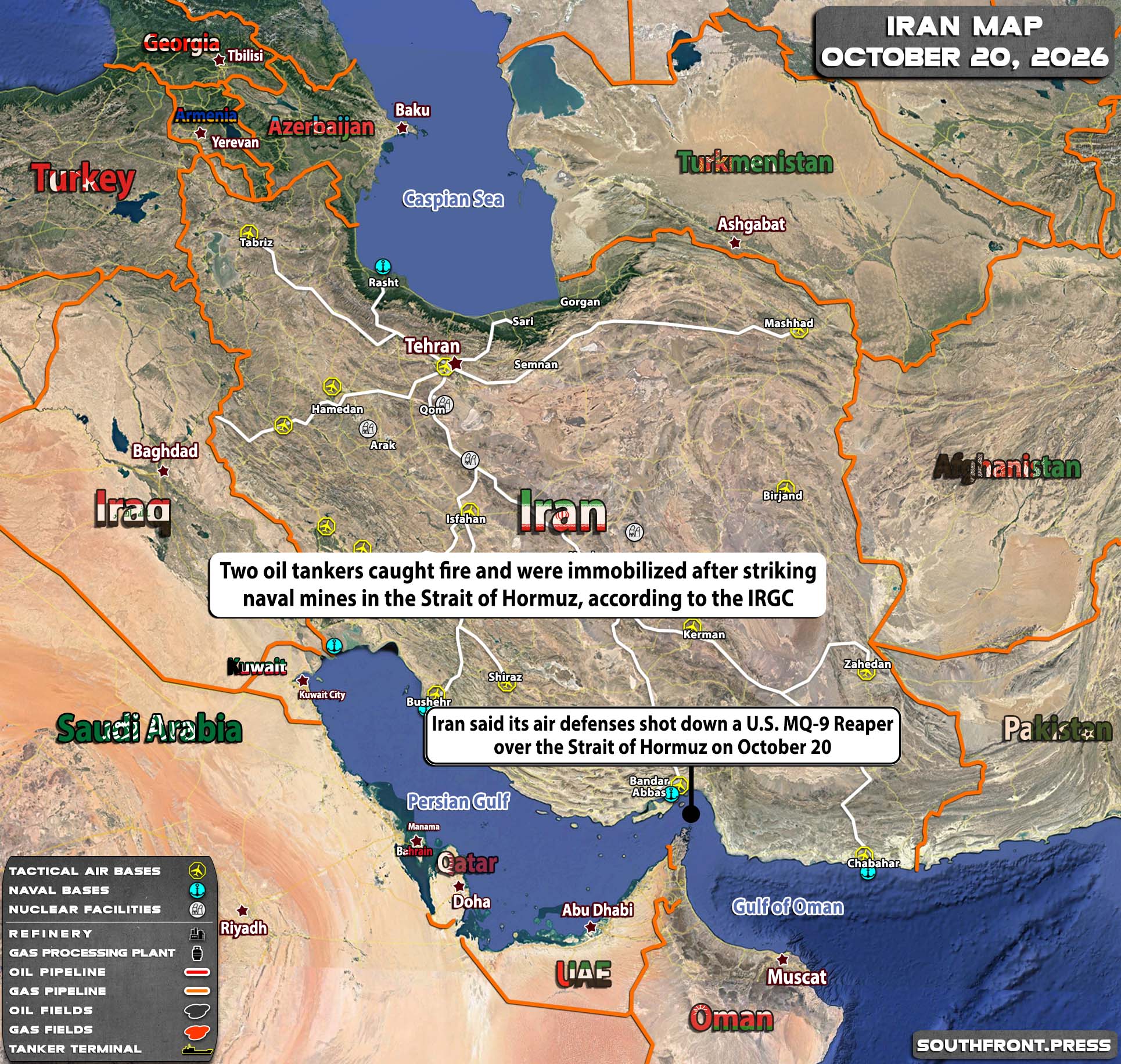
  • Iran said its air defenses shot down a U.S. MQ-9 Reaper over the Strait of Hormuz on October 20;
  • Two oil tankers caught fire and were immobilized after striking naval mines in the Strait of Hormuz, according to the IRGC.

_______________________________________________________________________________________________________________________

SouthFront: Analysis and Intelligence

NOW hosted at southfront.press

Previously, SouthFront: Analysis and Intelligence was at southfront.org.

The .org domain name had been blocked by the US (NATO) (https://southfront.press/southfront-org-blocked-by-u-s-controlled-global-internet-supervisor/) globally, outlawed and without any explanation

Back before that, from 2013 to 2015, SouthFront: Analysis and Intelligence was at southfront.com

SOUTHFRONT.PRESS

MORE ON THIS TOPIC:


The post Military Situation In Iran On October 20, 2026 (Map Update) appeared first on South Front.

  •  
❌