❌

Reading view

Devin Nunes Loses Libel Suit Based on Rachel Maddow Show Statements

From Nunes v. NBCUniversal Media, LLC, decided yesterday by Judges Guido Calabresi, William J. Nardini, and Eunice C. Lee:

Nunes brought a single claim for defamation under New York law based on (as relevant here) a statement made by Rachel Maddow, host of The Rachel Maddow Show ("TRMS") on MSNBC (owned by NBCUniversal), for which Cory Gnazzo served as the executive producer.

In December 2019, Nunes, who was then a congressman and ranking member of the House Permanent Select Committee on Intelligence ("HPSCI"), received something known as the "Derkach Package," from Andrii Derkach—a Russian agent linked to Russian efforts to influence the U.S. presidential election in 2020. The Derkach package was the subject of public discussion over a long period of time, including in a declassified Intelligence Committee Assessment that was released on March 16, 2021.

Two days after that release, on March 18, 2021, Maddow reported on the Derkach package incident, saying on TRMS that Nunes "refused to hand it over to the FBI, which is what you should do if you get something from somebody that is sanctioned by the U.S. government as a Russian agent." Nunes provided the court with evidence that Maddow's statement (the "Statement") was false. More specifically, a former staff member from the HPSCI testified in a deposition that the package, addressed to Nunes, was received by committee staff, placed in a secure location, and turned over to the FBI about two days after its arrival.

The court held that Nunes hadn't introduced enough evidence that Maddow spoke with "actual malice," which means knowing the statement was false or likely false:

[T]he undisputed evidence showed that Maddow and Gnazzo relied on the earlier-published Politico article and that such reliance cannot support a finding of actual malice. The Politico article stated that the Derkach packets had been sent to four people: Nunes, Senators Graham and Grassley, and then-White House Chief of Staff Mulvaney. According to the article, "Graham and Grassley denied having received the material, and Mulvaney and Nunes declined repeated requests for comment. One person familiar with the matter said the information was not turned over to the FBI."

Nunes argues that the Politico reporting does not support Maddow's statement that Nunes "has refused to hand [the Derkach Package] over to the FBI." But that is a natural reading of the Politico article. The dictionary definition of "refuse" cited by Nunes includes this meaning: "to show or express an unwillingness to do or comply with." According to Nunes, this definition shows that a person can "refuse" to do something only if he is "unwilling[ ] to … comply with" a request that he do so, and there was nothing in the Politico article to indicate that he had received any such request. But that is only one possible scenario covered by those words.

Nunes overlooks the other part of the definition that he himself quotes: that a person can be said to have "refused" to do something if he has "show[n] an unwillingness to do" it. Here, the Politico article clearly indicates that Graham, Grassley, Mulvaney and Nunes were all sent the material in question, and none of them gave it to the FBI. A fair paraphrase of this reporting, that Nunes got the Derkach Package but did not turn it over to the FBI, is that he was not willing (i.e., he refused) to give it to the FBI. Of course, the Statement did not parrot the Politico article word for word. But "[l]iteral accuracy is not a prerequisite: if we are to enjoy the blessings of a robust and unintimidated press, we must provide immunity from defamation suits where the journalist believes, reasonably and in good faith, that his report accurately conveys the charges made."

Maddow and Gnazzo's undisputed reliance upon the Politico article defeats Nunes' defamation claim. In New York Times v. Sullivan (1964), the Supreme Court held that a defendant's reliance on a responsible source negates a finding of "the recklessness that is required for a finding of actual malice." "Similarly, this Court has held that where reporters' false statements in an article were based on reliable sources, the defendant could hardly be accused of gross negligence, much less actual malice."

Nunes provided no evidence at the summary judgment stage that provided any basis for a reasonable inference that Maddow or Gnazzo should have regarded the Politico article as unreliable. We therefore agree with the district court's holding that Nunes failed to present evidence that NBCUniversal or its employees acted with actual malice sufficient to defeat summary judgment….

Elizabeth A. McNamara and Jeremy Chase (Davis Wright Tremaine LLP) represent defendant.

The post Devin Nunes Loses Libel Suit Based on Rachel Maddow Show Statements appeared first on Reason Magazine.

  •  

Ohio Court Strikes Down a Scholarship Program That Supports More Than 100,000 Families

An illustration of a classroom desk | Mariam Zakaidze

School choice in Ohio has taken a big hit. On Thursday, a panel of the state's 10th District Court of Appeals unanimously ruled the state's Educational Choice Scholarship, or EdChoice, program unconstitutional.

Vouchers Hurt Ohio (VHO), a coalition of public school districts, banded together in 2022 to sue the state over the EdChoice program, which uses public funds to finance scholarships for K-12 students to attend private schools. Under EdChoice's "Traditional Plan," which has been around since 2005, students can receive annual scholarships as high as $6,166 for elementary and middle school and $8,408 for high school. The scholarship's "Expansion Program," which state lawmakers created in 2013, awards maximum scholarship amounts identical to the Traditional Plan, "but scale based on a family's income," according to EdChoice, an educational freedom nonprofit. The organization says the scholarship program supports more than 100,000 Ohio families.   

The VHO argues that the EdChoice scholarship program drains funding from the public school system, depriving Ohio students of much-needed resources. Its website states "private school vouchers create a system of state-funded discrimination" and that school choice is a "myth." Interestingly, the Court of Appeals of Ohio's 10th Appellate District largely concurred.

The court's ruling came down to Article VI, Section 2 of the Ohio Constitution, which says that the state must secure a "thorough and efficient system of common schools."

The panel held that the EdChoice voucher program violates this mandate by funding a "competing system of uncommon schools." Writing for the court, Judge David Leland took the argument further, contending that EdChoice schools "actually end up depriving families of choice." He cited private schools' selective admissions process and urban concentration, calling the defendants' appeals to choice "a fundamental misnomer," because the choice to admit students rests with the schools, not the families.

Keith Neely, an attorney at the Institute for Justice who represents families using EdChoice in the case, argues that the program funds families rather than a competing school system.

He also challenges the court's rationale that the state's obligation to fund public schools implicitly prohibits them from funding other forms of education. "I think that's just fundamentally wrong as a matter of constitutional interpretation and also just as a matter of public understanding," he tells Reason.

The court "seemed to take the view that any dollar spent on other educational programs like scholarships is a dollar that could be spent on public schools instead, but that's not how budgeting works," he says. 

Neely says that public education funding is separate from the scholarship program and that every funding decision has tradeoffs. If the court finds that EdChoice's school voucher program violates the state's obligation to fund public schools, what stops it from reaching the same conclusion for other programs, like the Jon Peterson Special Needs Scholarship or the Cleveland Scholarship program, which provides private school tuition scholarships for K-12 students living in the Cleveland Municipal School District?

Neely also points to Simmons-Harris v. Goff (1999), where the Ohio Supreme Court partially reversed a lower court's ruling and found that school choice was constitutional under the same public-education clause. The court invalidated the Cleveland scholarship program in question, finding that it was "improperly enacted by the legislature," according to the Institute for Justice. However, the Ohio Legislature later reenacted the program.

The families using the EdChoice scholarship program—as well as the state's attorney general—plan to appeal to the Ohio Supreme Court, and Neely is optimistic that history will repeat itself in this case. He tells Reason, "When you look at what the Constitution says, and you look at what the court said in Simmons-Harris, I think the only conclusion that the Ohio Supreme Court can walk away with is that programs like the Educational Choice Scholarship program are constitutional." Families will be able to keep their scholarships while the litigation is pending.

This case is just one battle in a nationwide war on school choice. A recent report from Reason Foundation, the nonprofit that publishes Reason, found that 80 percent of public-school students live in states with "weak or ineffective open enrollment laws." These laws "allo[w]  students to transfer to public schools other than their residentially assigned one, provided space is available," writes Jude Schwalbach, senior policy analyst at Reason Foundation. Several states are also holding out against the Education Freedom Tax Credit, a new federal tax credit that offers a dollar-for-dollar tax refund for donating to K-12 scholarship programs. 

The court's decision reflects the broader rationale fueling that opposition: that education dollars going to anything other than public schools are taken from ordinary students. For decades, policymakers have invested in that premise, yet student outcomes have little to show for it. The real myth isn't school choice; it's that giving families more options means betraying students' education.

The post Ohio Court Strikes Down a Scholarship Program That Supports More Than 100,000 Families appeared first on Reason Magazine.

  •  

SCOTUS Week in Review: Justices give another win to the GOP and hope to DOGE and Eastman

Welcome back, Deadline: Legal newsletter readers. The Supreme Court wrapped up its first two-week hearing session of the term, while adding a DOGE-related case to the docket, handing the GOP another emergency win ahead of the midterms, and giving John Eastman a spark of hope for his law license.

The DOGE grant appeared on Tuesday’s order list announcing the latest action on pending petitions. Among the new cases the justices agreed to decide this term was the Trump administration’s plea for help against a watchdog group that has been fighting for information about the Elon Musk-backed Department of Government Efficiency.

In a previous round of DOGE litigation, the high court’s Republican-appointed majority ordered the lower courts to narrow discovery into the purported efficiency initiative. The administration is hoping to prevail again in its latest fight for secrecy.

The order list also produced a notable pairing in Justices Sonia Sotomayor and Neil Gorsuch. The two have joined forces before to call out what they’ve seen as government abuses, even when their colleagues have stayed silent. That happened again Tuesday, when the Obama appointee issued a statement lamenting the “constitutional absurdity” of Jesus Herrera-Salazar’s double prosecution.

He had served time for being “found in” the U.S. after his removal and was told to stay in Oklahoma while on supervised release. But abiding by that instruction led to him being charged again for the same crime of being “found in” the country he was told to stay in. Joined by the Trump appointee, who has shown a libertarian streak in some cases, Sotomayor said that courts faced with this situation in the future should “avoid the constitutional absurdity that occurred here and give the Double Jeopardy Clause its full weight and meaning.”

Sotomayor and Gorsuch split in another case that gave the GOP its latest win on political advertising rates ahead of the midterms. Following a Republican win on the subject last month, over the lone dissent of Justice Ketanji Brown Jackson, Sotomayor and Jackson both noted their objections to Wednesday’s ruling in favor of the Federal Communications Commission. A lower court had ordered the agency to rule on Democrats’ challenge to the FCC’s GOP-friendly interpretation of the law on advertising rates.

But the Supreme Court majority put that lower court ruling on hold, effectively blessing what Sen. Jon Ossoff, D-Ga., and his fellow Democratic candidates called the Trump-backed agency’s “blatant procedural trench warfare to stave off judicial review of an unlawful agency directive until it is too late to matter.”

Meanwhile, John Eastman got some good news in his fight to keep his law license, after California authorities stripped it for misconduct while representing President Donald Trump and his 2020 campaign. Backed by an array of conservative groups, the former clerk to Justice Clarence Thomas said the court should take his case to “remove the threat” that the loss of his license “poses not just to the First Amendment but to the ability of attorneys fiercely to advocate for their clients without fear of politicized disbarment.”

Eastman’s good news came Thursday, when the court asked the state bar to respond to his petition. It only takes one justice to request a response, so we don’t know whether he will attract the required four justices to grant review (or how a majority of the court would rule on his case if it did grant review). Relatedly, we don’t know if Thomas, who previously recused himself from an Eastman-related case without explaining why, is participating in this one. If he’s not, that could hurt the petitioner’s chances. We should find out later this year whether Eastman’s bar fight will join the DOGE discovery dispute and other appeals this term.

The justices are off the bench until they return for their November hearing session. But the court will keep making news in the meantime, with the latest order list due Monday morning, plus whatever unscheduled emergency actions the court takes. Among the pending disputes the court can resolve anytime are the administration’s bid to enforce its ban on gender-affirming medical care for federal prisoners, as well as an urgent application from a high school wrestler and her mother seeking an injunction that would prevent her from wrestling transgender girls this upcoming season.

Subscribe to the Deadline: Legal newsletter for expert analysis on the top legal stories of the week, including updates from the Supreme Court and developments in the Trump administration’s legal cases.

The post SCOTUS Week in Review: Justices give another win to the GOP and hope to DOGE and Eastman appeared first on MS NOW.

  •  

Why “Christian Marxism” Always Ends up Serving the Gulag, Not the Gospel

Marxism is intellectual terrorism. It negates everything human.

So wrote ex-Communist Jacques Ellul in Jesus and Marx.

The 1979 work functions in part as a criticism of the French leftist elite who were reading everything through the Marxist lens.

For the disciples of the dead Das Kapital author, his model of decoding history through the dichotomy of oppressor vs. oppressed is a religion.

As Simone Weil wrote, Marx’s obsession with what he called historical materialism created a badly constructed one at that.

At the time, Ellul noted that Marxism is “the only terrorist line of thought in Western intellectual circles.”

This terrorist position, he argued, consists of situating everything with respect to Marxist ideology.

For Ellul, the banal acceptance of this has led to the brutalisation of Christianity, where the Gospels are prostituted out like modern-day call girls.

That outcome was inevitable because Christianity cannot be reinterpreted through Marxism and vice versa.

Like abortion “care”, the term Christian Marxist is essentially an oxymoron. They’re both as far away from “care” as Zyklon-B is from a shower.

“Christians,” Ellul stated, “have every reason for not being Communists. They have almost no reason for being Communists.”

Ellul wrote that it was Marx’s ideas, not Jesus Christ’s, that gave birth “to the world’s worst sort of dictatorships, and strictly totalitarian dictatorships (including China and Vietnam).”

He also argued that forcing Marx into the same Messianic light as Christ was deliberate. For example, the term “religious right” was created by the Left to undermine conservative Christian theological legitimacy.

‘Jesus and Marx’ largely answers Daisy Mai Inglese’s question on Ayaan Hirsi Ali’s Restoring the West: Is Liberation theology costing the Catholic Church in Brazil?

Ellul does so with a big fat ‘Yes’.

Inglese holds that Brazilians are turning away from Catholicism towards Evangelicalism, and says that its likely cause is the left-wing takeover of the church.

She writes that “Liberation theology took hold in Brazil in the 1960s, as millions still lived in poverty despite the country’s rapid modernisation.

“Catholic Action, and later Vatican II, had rightly been encouraging priests and lay Catholics to work more closely among the poor.

“Yet their desire to understand why families remained trapped in poverty misled many towards a theology misguided by Marxism, with a language shaped by class and oppression.

“As politics assumed a greater place in the Church, less attention went to passing on fundamental truths: radical life in Christ, the impact of sin on our eternal salvation, and how we are to live a truly moral Christian life.”

That Marxist fusion, Inglese correctly states, tried to pack Christianity into an ideology that promised liberation through political programs instead of the transformative power of the Cross.

The church displacing Christ has put Marx’s irreconcilable dialectical and divisive paranoia about power on the throne.

Marx is no saviour, victim or hero. Jesus is all three.

Christ is King.

Marxism should be read in the light of the Gulags, not squeezed into the Gospels.

Put simply: Liberation theology is not a theology of Christian liberation.

  •  

Colorado resident could have exposed thousands to measles at Denver airport

A Colorado resident infected with measles could have exposed thousands of people to the illness after flying in and out of Denver International Airport earlier this month, state health officials said Friday.

The individual a Jefferson County adult with unknown vaccination status against the highly transmissible virus traveled in and out of the airport at least three times during the first week of October, according to the Colorado Department of Public Health and Environment.

State health officials say its likely the patient was exposed during travel outside of Colorado.

Sixth measles-related death reported as Pennsylvania battles widespread outbreak

The CDPHE says people could have been exposed to measles at the following locations and times listed below:

Denver International Airport: Between 12:25 a.m. and 3 a.m. on Saturday, Oct. 3. The individual arrived at Gate C50, rode the airport train to Concourse B, then took an employee shuttle bus to an employee parking lot. Denver International Airport: Between 9 a.m. and 1 p.m. on Sunday, Oct. 4. The individual rode an employee shuttle bus from an employee parking lot to Concourse B, then left from Gate B48 at 10:57 a.m. Denver International Airport: Between 11:25 p.m. on Sunday, Oct. 4 and 2 a.m. on Monday, Oct. 5. The individual arrived at Gate A18 in Concourse A, rode the train to Concourse B, then took an employee shuttle bus to an employee parking lot. CareNow Urgent Care, located at 6413 Fig St. in Arvada: Between 11:35 a.m. and 4:15 p.m. on Wednesday, Oct. 7.

Measles is a highly contagious viral infection that spreads through the air and can remain airborne for up to two hours meaning people may have been exposed even if they were nowhere near the infected person at the time.

State health officials said those who were potentially exposed to the virus may develop symptoms through Wednesday, Oct. 28.

What to do if you believe you were exposed

Anyone who believes they may have been exposed especially those who have not been vaccinated with the MMR vaccine should monitor for symptoms for 21 days and avoid public gatherings or high-risk settings, health officials said in a news release.

Symptoms to watch out for include anything from a fever, a cough, a runny nose, and red, watery eyes that develop into a rash that starts on the face and then spreads to the rest of the body about three to five days after symptoms first start. A person with measles is contagious four days before and four days after the rash appears.

State health officials urge people who develop symptoms to call the CDPHE at 720-653-3369 or their local public health agency immediately by phone before trying to seek treatment to avoid other people from becoming potentially infected with the virus. The CDPHE urges people to call an urgent care center or emergency department and explain that you may have been exposed to measles if you do not have a health care provider.

While most people recover within two or three weeks after contracting the virus, unvaccinated people run the risk of complications from the disease, including ear infections, seizures, pneumonia, immune amnesia, brain damage and ultimately, death.

Measles only spreads from people who show symptoms; it does not spread from people who arent feeling sick, state health officials said.

Unvaccinated people exposed to the virus can get the MMR vaccine 72 hours after exposure (but before symptoms are present) to prevent an infection, according to health officials. If vaccination is not possible, antibody treatment can help in some cases if its given within six days of exposure, state health officials said.

Getting vaccinated is the best way to protect yourself, your family, and your community, the CDPHE spokesperson said.

While the two-dose series of the MMR vaccine has a 97% efficacy rate against infection, about 3 in every 100 people can still get infected if exposed to the virus for a prolonged period of time, according to the U.S. Centers for Disease Control and Prevention. Vaccinated individuals will usually develop milder symptoms and are less likely to spread it to others, according to state health officials.

People who got vaccinated against measles before 1968 should talk to their health care provider about possibly getting a booster as the vaccine used before that year wasn't as effective.

Colorado measles cases have slowed, but numbers are still high

Colorado experienced a reprieve in measles activity this summer following several outbreaks in the northeastern part of the state at the beginning of the year, but the highly contagious disease started making headlines again after the CDPHE announced an international visitor who was later confirmed to have measles traveled to areas northwest of Denver in mid-September.

As of Friday, Colorado had reported 26 cases of the virus across 9 counties: Adams (5), Arapahoe (1), Broomfield (5), Delta (1), Jefferson (1), Lake (6), Larimer (1), Saguache (1), and Weld (5), according to statewide data. For context, that's about 72% of all cases the state reported all of last year. Up until 2014, Colorado saw between zero and two cases each year.

Most of the state's measles cases have occurred in unvaccinated individuals who traveled to areas of the U.S. with active outbreaks, per state data.

Across the nation, the number of confirmed measles infections this year has so far reached 4,410 numbers not seen in 35 years, according to CDC data with the majority of cases happening among unvaccinated children.

At least five measles-related deaths have been reported across the U.S. so far in 2026. The last time the U.S. reported four measles deaths was 35 years ago, in 1991.

This story was originally published by scar Contreras with the Scripps News Group in Denver.

  •  

‘Faster and smarter’: Legal analyst warns courts they can’t let Trump outplay them

MS NOW legal analyst Andrew Weissmann said President Donald Trump’s disregard for court orders has turned the nation’s justice system into a laughingstock.

“The Trump administration is making the courts look like fools,” he said.

With the midterm elections quickly approaching, Weissmann warned it is time for America’s judges to work “faster and smarter” before it’s too late.

“The administration, over and over again, is doing things unilaterally without permission and, at times, in violation of court orders,” the former Justice Department official explained.

According to an analysis from The Associated Press earlier this year, district court judges have found the second Trump administration violated or failed to follow federal court orders in at least 31 lawsuits and in more than 250 individual immigration cases.

When the court does intervene, sometimes it’s already too late, Weissmann said, pointing to the administration’s use of taxpayer dollars to run ads for the president. When a federal judge blocked that effort, it was only after nearly $22 million had already been spent.

“Tens of millions of people saw those ads, paid for by you and me,” he said.

Weissmann argued that Trump’s DOJ has effectively taken a “do now and ask questions later” approach to the law.

“The court only belatedly says, ‘Hey, don’t do that.’ But the damage is already done, and you can’t put the genie back in the bottle,” he said.

The former federal prosecutor said it was time for courts to be “faster and smarter” in responding to Trump’s blatantly illegal moves, and he cautioned against setting “a permission structure for this administration,” especially as the election approaches.

“What I am worried about is: The midterms are coming up, and is this going to be a government that goes ahead and seizes ballots with the idea that we can break the chain of custody, we can make it impossible to count votes? And maybe later a court will say, ‘You shouldn’t have done that,’ but the damage will have been done,” he explained.

“There has to be a deterrent,” Weissmann warned. “And courts have to be faster and smarter to not get outplayed.”

You can watch Weissmann’s full comments in the clip above.

The post ‘Faster and smarter’: Legal analyst warns courts they can’t let Trump outplay them appeared first on MS NOW.

  •  

Anticipated Religious Clashes Can't Justify Current Restriction on Parents' Religious Upbringing of Child

From Lajara v. McMenamin, decided Wednesday by Pennsylvania Superior Court judge Brandon Neuman, joined by Judges Jack Panella and Carolyn Nichols:

Mother argues the trial court erred by entering paragraph 111 of the final custody order, which allows Child to decline attendance at religious or faith-based events beginning at the age of 14, and prohibits both parents from influencing, restricting, or limiting Child's participation in those events before or after age 14. In doing so, Mother claims this provision "infringe[s] upon the parties' First Amendment right to the free exercise of religion and the parties' fundamental right to parent their child." …

Under the Due Process Clause of the Fourteenth Amendment, a parent has a fundamental right "to make decisions concerning the care, custody, and control of the child." Under the Free Exercise Clause of the First Amendment, an individual has a right to religious freedom. Read together, parents have the constitutionally-protected "right to direct the religious upbringing of their children." [Under Pennsylvania precedent,]

[A] court may prohibit a parent from advocating religious beliefs, which, if acted upon, would constitute a crime. However, … it may do so only where it is established that advocating the prohibited conduct would jeopardize the physical or mental health or safety of the child, or have a potential for significant social burdens….

[E]ach parent must be free to provide religious exposure and instruction, as that parent sees fit, during any and all period of legal custody or visitation without restriction, unless the challenged beliefs or conduct of the parent are demonstrated to present a substantial threat of present or future, physical or emotional harm to the child in absence of the proposed restriction….

While the harm involved may be present or future harm, the speculative possibility of mere disquietude, disorientation, or confusion arising from exposure to 'contradictory' religions would be a patently insufficient 'emotional harm' to justify encroachment by the government upon constitutional parental and religious rights of parents, even in the context of divorce….

As noted by Mother, "[n]either party in this matter requested the trial court order any form of relief regarding the exercise of their religious beliefs or … [C]hild's attendance and participation in religious activities. No evidence regarding either party's religion or … [C]hild's attendance and participation in religious activities was presented at trial." The trial court explained its reasoning for this provision, stating:

This trial court was forced to anticipate, to the best of its ability and in light of the factors proscribing stability and consistency for … Child, that a high level of conflict is more than likely to arise as it pertains to religious activities. To put it simply, these parents have demonstrated that any disagreement or dispute has and can easily escalate quickly into full scale conflict that does nothing more than cause instability and emotional trauma to … Child.

As such, this trial court proactively prescribed a solution to any issues that may arise regarding … Child's attendance and participation in religious activities. This trial court acknowledges that neither parent raised the issue of religious activities[;] however, the tumultuous history of this case does not produce any optimism on the part of this trial court that they will be able to communicate and cooperate if religious participation becomes an issue. As such, it is in … Child's best interests to preemptively place parameters on his attendance and participation in religious activities….

Though we recognize the parties' behaviors do not produce optimism that religion will not become an issue in the future, based on the record before us, the restrictions set forth in paragraph 111 are contrary to our case law since there is no indication the parties' religious beliefs or practices present a "grave threat of harm," "a substantial threat of present or future, physical or emotional harm to the child[,]" or that the physical or mental health, or safety of the child would be jeopardized absent a restriction. Accordingly, the trial court erred in setting forth paragraph 111 of its January 6, 2026 order. Consistent with precedent, both parents shall be permitted to practice his or her religion with Child during their respective periods of custody, so long as there is no substantial threat of present or future physical or emotional harm to Child….

The post Anticipated Religious Clashes Can't Justify Current Restriction on Parents' Religious Upbringing of Child appeared first on Reason Magazine.

  •  

Five Fabulous Days of Katie Zacharia

The world will little note, nor long remember, the Katie Zacharia era. Indeed, the tenure of the second White House press secretary of Donald Trump’s second term, which ended after five days and a single, 14-minute press conference, is already receding into memory.

Yet what matters more than her press-secretarial contributions, or the ideas she stood for, is the period Zacharia represents: the Trump administration’s reversion to the hapless chaos of the president’s first term.

Trump’s initial go-round was primarily a farce, setting bumbling aides against challenges such as finding the light switches in the Cabinet room, hurling burgers against the White House wall, and booking the wrong Four Seasons. Trump cycled through personnel like Spinal Tap drummers, as one hired helper after the next left in frustration or shame.

The second term has operated with, if not normality, at least comparative efficiency. Chief of Staff Susie Wiles turned the executive branch from an exploding fireworks factory into a machine relentlessly processing the president’s whims into law.

[Read: Trump’s secret points system for Cabinet members ]

Yet as the midterm elections draw near, the machine has begun to sputter. In the span of days, Defense Secretary Pete Hegseth announced he would livestream a public execution, only for Trump to overrule him; the administration fired Kimberly Guilfoyle, its ambassador to Greece, for engaging in corruption so overt, it embarrassed even the most corrupt administration in history; and Politico reported that Trump is asking his friends what they think of Wiles, which is historically the prelude to his turning on an underling.

In the midst of this multicar pileup, Zacharia briefly stepped forward as the administration’s stammering face.

If you have ever felt awkward in a public setting, her single press conference was the stuff of recurrent nightmares. Zacharia read from the podium, head down, in the tone of a third-grade book report delivered verbally in front of the entire school by a child with crippling anxiety. She had to pause multiple times to take gulps of air. Trump, she said in one typical segment, “had a historic one-day war, and now we are, have a booming economy, and a great relationship”—here she stopped to catch herself—“with Venezuela. The U.S. achieved record domestic oil and gas production in 2025 and record crude and petroleum product exports in 2026.”

At another point, attempting to discuss nuclear-power plants, she called them “something President Trump is delivering on, just like he delivers on every promise.” (Pause, gasp for breath.) “In addition to that, it, we will be, it, we will be, there is $54 billion tied to the Alaska LNG pipeline.”

Then she told the assembled reporters, “My goal is to be able to communicate that in complete tandem with the president, as he is his own best spokesperson, and will absolutely be leading the way as—with that.” It was as if the notion that Trump could do her job much better than she could had intruded into her thoughts and made its way out of her mouth. She wrapped up the press conference after answering only three questions.

[Tom Nichols: Kimberly Guilfoyle broke Trump’s most important rule ]

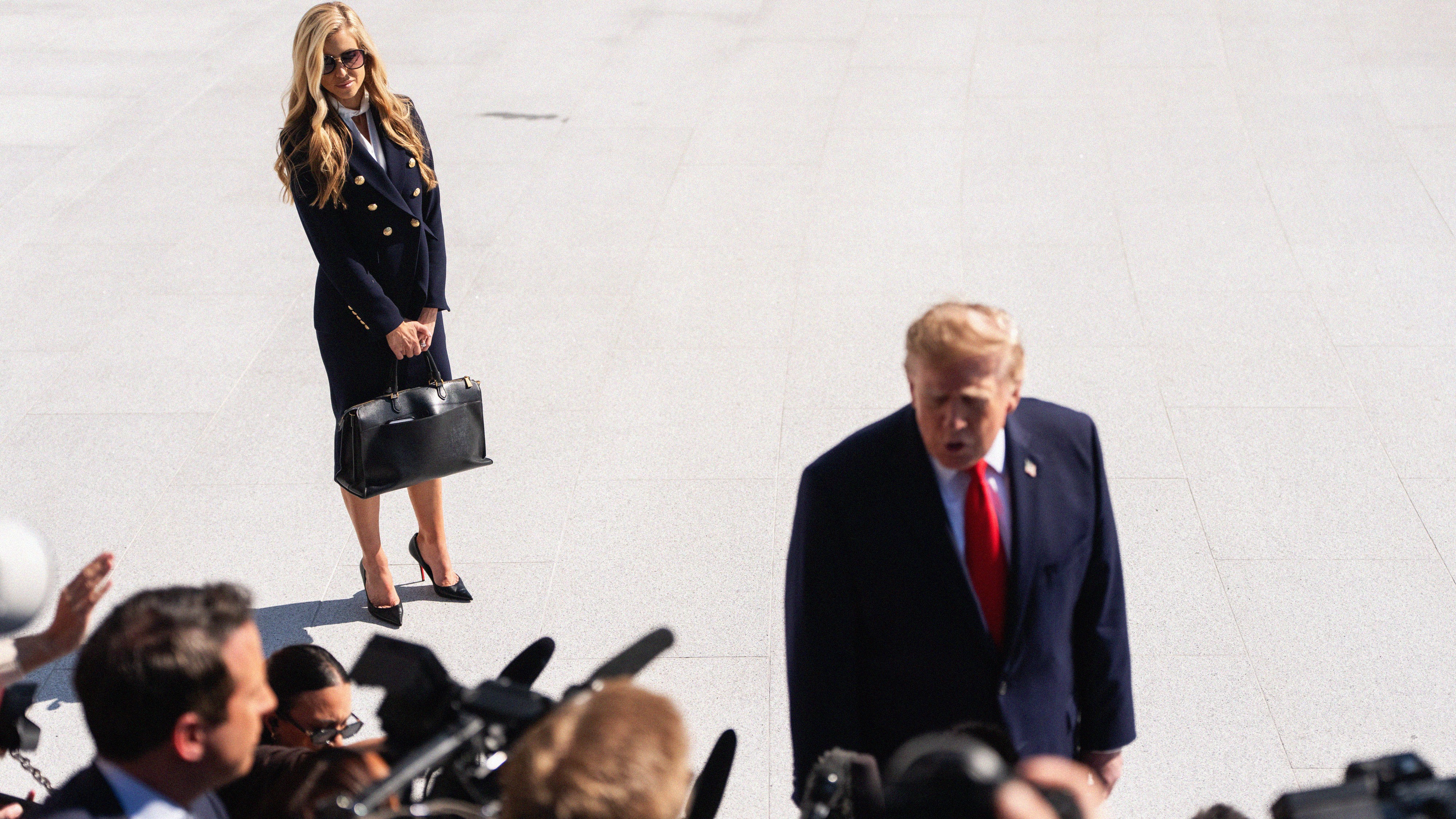
Shortly after, she appeared with the president on the White House lawn, and when a reporter asked which state’s bar exam she had passed—Zacharia has described herself as an attorney—she replied, mysteriously, “When I moved to China.”

Matters fell apart quickly. She appeared on Sean Hannity’s show, perhaps expecting the tender treatment for which Hannity is so synonymous that his last name has become a portmanteau, hannitize, for friendly damage control. Instead he subjected her to an interrogation for which she was predictably unprepared. Indeed, her defense consisted of describing herself as unprepared. “What I feel is I really stepped up to the plate with very little prep time. Given the fact that I’d been on the job less than maybe eight hours and had a briefing book in the morning, I feel like I did my very best, Sean, to deliver for the American people that day.”

Sometimes, your best just isn’t good enough. So it was with Zacharia. So it is with the whole administration—mired in a losing war and persistent inflation, and flailing about for people to blame for the debacle. People who aren’t Donald Trump.

© Aaron Schwartz / Bloomberg / Getty

  •  

Nobody Wants To Be the Pro-Tech Candidate in This New York Race That Could Flip the House

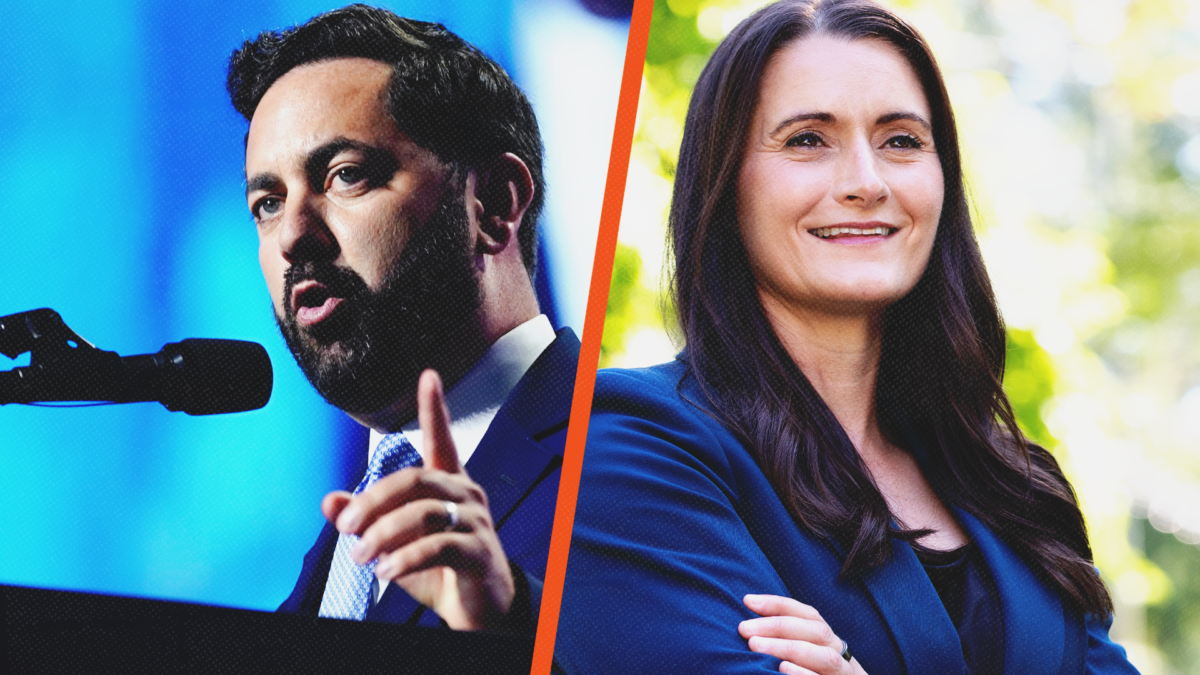
Mike Lawler and Cait Conley | Bonnie Cash/UPI/Newscom/caitconley.com

The Democratic Socialists of America (DSA) candidates running for the House of Representatives and endorsed by NYC Mayor Zohran Mamdani are all but guaranteed to win their general elections this November, but that does not mean the midterm drama is over in New York. In the state's 17th congressional district, which includes the lower Hudson Valley, Democratic challenger Cait Conley, a combat veteran who served on the Biden administration's National Security Council, could unseat incumbent Republican congressman Mike Lawler in one of the most consequential races of the midterms. 

The highly contested purple district voted for former Vice President Kamala Harris in the 2024 election while reelecting Lawler for his second term. Now, Lawler is attempting to win a third term as support for President Donald Trump wanes ahead of the midterms. As of Friday, The Cook Political Report lists the race, which could determine control of the House, as a toss-up. 

If elected, Conley would have far more in common with the "Badass Women" coalition of security state and military veterans than with DSA types (think more Sen. Elissa Slotkin from Michigan than Darializa Avila Chevalier). As Judge Street Journal's Timmy Facciola notes, "Conley's candidacy is testing the viability of a tactful centrism that rebukes left-wing positions like abolishing ICE or restricting weapon shipments to Israel." Lawler is also vying for moderates, pitching himself as "one of the most bipartisan members of Congress" and emphasizing his willingness to break with Trump occasionally while still welcoming Trump's support. 

While Lawler and Conley certainly are not pure MAGA acolytes or DSA members, both have leaned into a tech-critical position, much like that of more radical populists like Lina Khan or Steve Bannon, revealing how pervasive anti-tech sentiment has become in mainstream politics. 

This tech skepticism was on full display during an October 14 debate, when each candidate made the case for why they were the most equipped to regulate AI, insisting that the industry needs guardrails. 

Conley said members of Congress do not want to regulate AI because "they want to look out for their billionaire and trillionaire backers like Elon Musk, who is pouring over $260 million into this midterm election." She then added that Musk backed Lawler in his 2024 race. 

Lawler then accused Conley, who previously consulted for Primer AI, of being "the AI candidate for the AI industry."

While Lawler and Conley disagree on specific data center regulations (Conley supports Democratic Gov. Kathy Hochul's data center moratorium while Lawler supports local zoning control over data centers), neither wants to pitch themselves as an explicitly pro-data center candidate. During the debate, Conley claimed that, "On Mike Lawler's watch there have been five data centers built in Rockland County." Lawler has said that he had no say in the decision to build the data centers, and during the debate, he pointed out that the facilities were built for financial services. Lawler also attempted to attack Conley over data centers, slamming her in an ad for saying "we need data centers." Regardless of the candidates' specific policies on data centers, their attacks on one another demonstrate that cheerleading hyperscale data center development is a political liability. In their district, data center has presumably become a dirty term. 

The candidates' tech-skeptical rhetoric did not end with unchecked data center development. After the debate, Reason asked both candidates about their positions on age-verification laws for social media and AI, since such regulations raise significant privacy and censorship concerns by age-gating the internet. Unsurprisingly, both Lawler, who voted for the controversial KIDS Act, and Conley, who has proposed stricter age verification for AI tools, parroted platitudes about why such online safety regulations are necessary to protect children. 

"We have watched how social media is literally hurting the mental health of children," Conley told Reason. "And when you talk about the power of AI and what that power could do, we have to regulate this." 

Lawler gave a similar response, telling Reason that he respects free speech but that protecting children "is paramount." 

This bipartisan consensus over social media regulation has long been brewing in Congress. The mainstream political conversations about AI and data centers, however, are relatively new this midterm election cycle. And it appears both Lawler and Conley have figured out which way Americans' sentiment toward AI is leaning, and they have waged their campaigns accordingly. 

The post Nobody Wants To Be the Pro-Tech Candidate in This New York Race That Could Flip the House appeared first on Reason Magazine.

  •  

No Closed Courtroom When Plaintiff Dr. Jane Doe Testifies in S.C. Abortion Ban Challenge

From today's decision by Judge Richard Mark Gergel (D.S.C.) in Bingham v. Wilson:

Plaintiffs filed this lawsuit on behalf of several South Carolina physicians seeking injunctive and declaratory relief against South Carolina's Abortion Ban….  [Plaintiffs] seek an order: "(1) requiring all counsel and witnesses to refer to Dr. Doe using her pseudonym at trial; (2) closing the courtroom to the public and members of the press during Dr. Doe's testimony; and (3) permitting limited redactions to the trial transcript to conceal any educational or professional information that could indirectly identify Dr. Doe." Defendants have not filed any memoranda opposing the instant Motion….

The court refused to close the trial during Dr. Doe's testimony:

The Supreme Court has noted that "[t]he Bill of Rights was enacted against the backdrop of the long history of trials being presumptively open[,] … [and] historically both civil and criminal trials have been presumptively open." … "For many centuries, both civil and criminal trials have traditionally been open to the public" ….

"The presumption of openness may be overcome only by an overriding interest based on findings that closure is essential to preserve higher values and is narrowly tailored to serve that interest. The interest is to be articulated along with findings specific enough that a reviewing court can determine whether the closure order was properly entered."

Applying these principles, the Supreme Court held that the right to a public trial may give way to a complete closure of the courtroom if: (1) the party seeking to close the hearing advances an overriding interest that is likely to be prejudiced, (2) the closure is no broader than necessary to protect that interest, (3) reasonable alternatives to closing the proceeding are considered by the trial court, and (4) findings adequate to support the closure are made by the trial court…. When a party seeks only a partial closure of the courtroom, such as "where an exclusion is temporally limited to a portion of the hearing," a "less demanding" test applies, which permits a court to order closure if the moving party establishes "a substantial  reason"  rather  than  an  "overriding  interest"  justifying  closure….

[T]he Court will not close the Courtroom proceedings during Dr. Doe's testimony. Here there are not sufficient circumstances to warrant closing the courtroom given the public's right to access and interest in the proceedings, especially given the nature of this case. As discussed above, civil trials are presumptively open and are a hallmark of our democratic forum of government as open trials "embod[y] a view of human nature, true as a general rule, that judges, lawyers, witnesses, and jurors will perform their respective functions more responsibly in an open court than in secret proceedings." …

The Court takes Dr. Doe's concerns about her safety very seriously. But the Court finds that the public's right of access to access is high in this case given its subject matter. As such, the record before the Court does not warrant closing the proceedings to the public when alternative measures can ensure her safety. The Court therefore will not close the Courtroom during Dr. Doe's testimony….

But it allowed her to proceed as Dr. Doe at trial:

[A]bortion is a divisive issue and there is a long "national history of harassment and violence towards abortion care providers." Women's Health Ctr. of W. Virginia v. Sheth (S.D. W. Va. 2023) (granting an abortion provider's motion to proceed pseudonymously because "retaliation is a genuine concern" for abortion providers and there is a serious risk of "harassment, threats, or other retaliatory action taken by those that disagree with access to abortion care"); see Roe v. Aware Woman Ctr. for Choice, Inc. (11th Cir. 2001) (holding that plaintiffs in abortion cases may be allowed to proceed anonymously and collecting cases). Moreover, the Court finds Dr. Doe's expressed concern of retaliation against herself compelling because she has been the target of threatening mail and doxing by anti-abortion activists…. [This] risk of physical … harm to plaintiff … weighs in favor of allowing her to proceed anonymously….

[Plaintiff's claim is also made stronger] given her previously stated desire to protect her children from harassment and retaliation by remaining anonymous.

The [claim being against the government] weighs in Plaintiff's favor because "[a]ctions against the government do no harm to its reputation, whereas suits filed against private parties may damage their good names and result in economic harm." … [And] the threat of prejudice to Defendants to be minimal since Dr. Doe has proceeded anonymously up to this point and because there is no risk of jury confusion since this is a bench trial. See James v. Jacobson (4th Cir. 1993) (recognizing the "concern that the jury's very knowledge that pseudonyms were being used" could "tend to validate" the plaintiff's claims); Doe v. Ayers (9th Cir. 2015) (noting "risk that the … use of pseudonyms might prejudice the jury" in the anonymous party's favor). Based on the circumstances of this case, the Court finds that Dr. Doe's stated interests in protecting herself against retaliation and harassment can be balanced with the public's interest in the openness of judicial proceedings by allowing Dr. Doe to proceed under a pseudonym at trial.

And the court also concluded that it "will partially redact the portions of the transcript that could indirectly identify Dr. Doe":

Additionally, the Court finds that redaction of selected portions of the trial transcript is an appropriate alternative to sealing the transcript in its entirety. This decision strikes an appropriate balance between the public's right of access to judicial records and proceedings and Dr. Doe's interest in her safety. This is especially true because the public's right to access Dr. Doe's education and professional information is limited, especially given the Court's decision to allow her to proceed anonymously due to her safety concerns. Furthermore, the public will retain access to trial records except for Dr. Doe's identity and the related information that could identify her. The Court also believes that this is a reasonable alternative to closing proceedings and no greater than necessary. Thus, the Court finds that the same safety measures as closing the Courtroom can be achieved with reasonable alternative measure of allowing Dr. Doe to proceed anonymously and redacting the portions of transcript….

As such, it is ORDERED that Counsel and witnesses will refer to Dr. Doe using her pseudonym at trial and that the trial transcript will be partially redacted to conceal any educational or professional information that could indirectly identify Dr. Doe. However, the Court will not close the Courtroom during Dr. Doe's testimony….

This leaves open the possibility that a spectator who knows what Dr. Doe looks like will see her in court and publicly identify her—nothing in the order forbids that—or that identifying information that is orally presented at trial will be publicized by a spectator even if it's redacted from the trial transcript. But presumably the judge concluded that this risk is relatively modest, and is justified by the need to preserve public access to the trial.

The post No Closed Courtroom When Plaintiff Dr. Jane Doe Testifies in S.C. Abortion Ban Challenge appeared first on Reason Magazine.

  •  

Víctimas del 11 de abril exigen justicia ante la Corte Interamericana tras más de 24 años de impunidad

La Corte Interamericana celebró en Costa Rica la primera audiencia pública del caso Trujillo y otros vs. Venezuela. Familiares de víctimas, periodistas y representantes de Foro Penal declararon sobre los hechos de abril de 2002 y la presunta responsabilidad del Estado venezolano.

  •  

After Six Flags Roller Coaster Death, Critics Call for Federal Oversight

Regulation of amusement parks is left to the states, and deaths are rare. But some say stronger rules are needed.

© Elijah Nouvelage/Getty Images

The Goliath roller coaster, where a man fell to his death on Monday.
  •  
❌