❌

Reading view

Abortion, Immigration, and the Same Political Problem

We can’t separate the abortion issue from the immigration issue. Anyone who says abortion should be excluded from the current political debate has already misunderstood the nature of the problem.

Mass immigration, cultural decay, family breakdown, excessive taxation and the steady expansion of state power aren’t isolated problems. They’re symptoms of a much deeper crisis. Treating one symptom as though it’s the cause is like putting a Band-Aid over cancer. It might hide the problem for a while, but it doesn’t stop the disease from spreading.

That’s why isolating any one issue as the “real” problem is a mistake. Every one of these issues matters, and every one of them needs to be confronted. But none of them makes complete sense when separated from the deeper cause behind them.

At its heart, the West’s crisis is theological before it is political. Politics flows downstream from theology. When our understanding of God, man, morality and authority changes, our politics eventually changes with it. What we’re seeing across the West is the displacement of Christianity as the moral foundation of public life and the gradual elevation of the state into the position of ultimate moral authority.

Put simply, once there is no law above government, rights are no longer grounded in the inherent dignity of the human person. They become permissions; things the state can define, grant and ultimately take away.

That’s why abortion isn’t some secondary political issue. It goes right to the heart of this transformation. Once a society accepts that the state has the authority to determine who may live and who may die, it has abandoned the Christian principle that underpins every other right: the right to life.

And once the right to life becomes something the state can decide, why should we assume other rights are permanently secure? Property, speech, conscience, family and citizenship can all become conditional if they exist only because the state allows them to.

Without a moral order above the state — one that the state itself is accountable to — government becomes the final authority over what our rights are and who is entitled to them.

So it shouldn’t surprise us that the same state claiming authority over unborn life increasingly asserts authority over borders, taxation, education, national identity and culture.

If the state can decide who may live and who may die, then the underlying principle also allows it to decide who may enter the country, what may be owned and by whom, what a family is, and even what a nation is permitted to be.

These aren’t completely separate battles. They’re different expressions of the same underlying question: Who is sovereign?

That’s why focusing on a single symptom will never be enough. Abortion, immigration, family breakdown and the erosion of freedom all need to be resisted in their own right. But if we never address the root cause, the system producing these problems will remain in place — and new symptoms will keep appearing.

The West didn’t begin to decline because of one bad policy or one political mistake. Its deeper decline began when it stopped recognising any authority higher than the state.

Until that foundational error is confronted, we’ll keep fighting the symptoms while the system producing them remains untouched.

  •  

Jewish Rabbi Caught Raping Underage Boy Tells Police They’ll ‘Burn In Hell’ For Exposing His Pedophilia

“You will burn in hell for exposing me!” That was the entitled response of predator Rabbi Peter B. Schaktman when authorities arrested him for attempting to meet a 14-year-old boy for sex, according to police. [...]

The post Jewish Rabbi Caught Raping Underage Boy Tells Police They’ll ‘Burn In Hell’ For Exposing His Pedophilia appeared first on The People's Voice.

  •  

The Three Foreign Frigates Being Studied For Possible U.S. Navy Service

Three foreign frigates – Japan’s Mogami class, the South Korean Chungnam class, and the Istanbul class from Turkey – are reportedly included in a study of ships the U.S. Navy could procure. The Trump administration has been openly pushing to leverage ships designed in friendly countries to rapidly bolster the Navy’s fleet while also working to rebuild America’s shrunken domestic shipbuilding capacity. So, it is worth examining what each design brings to the table, as well as the broader opportunities and major hurdles procuring any of them would represent.

USNI News was first to report on Tuesday that the Japanese, South Korean, and Turkish frigates are included in an ongoing Navy study, citing anonymous sources. The review is in direct response to one of the provisions in a larger memo President Trump sent out last month, titled “Rebuilding the United States Navy and America’s Shipbuilding Industrial Base.” This also comes amid strong opposition in Congress to the basic idea of buying foreign warships for the Navy.

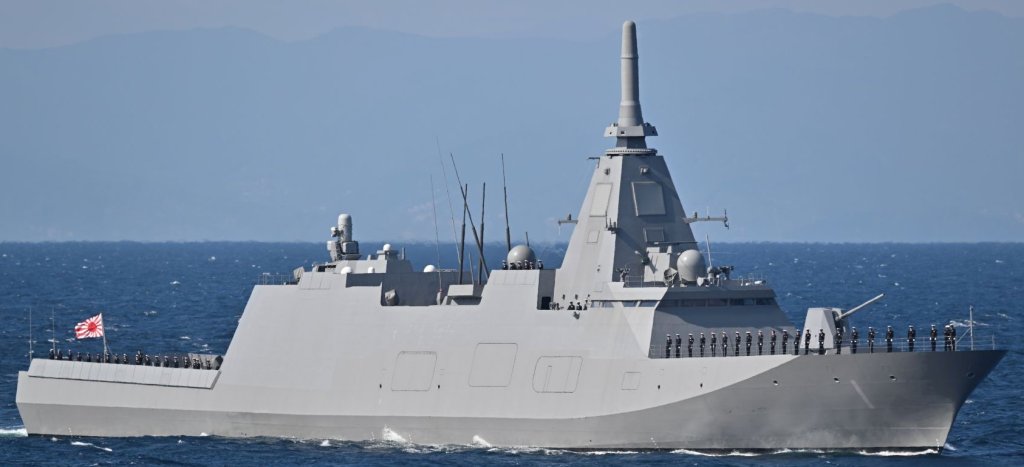
A pair of the Japan Maritime Self Defense Force’s (JMSDF) Mogami class frigates. JMSDF

Per that memo, the Secretary of the Navy (currently Acting Secretary Hung Cao) was directed to “submit a plan to the President … that includes timelines and resourcing requirements, for a new competitive acquisition approach for surface combatants with sufficient inherent capabilities to perform anti‑submarine warfare, surface warfare, and convoy escort duties.” The memo also said the “plan should address meeting the requirements for Consolidated Cargo Replenishment at Sea (CONSOL) Tankers and — separately — Roll-On, Roll-Off Vessels.”

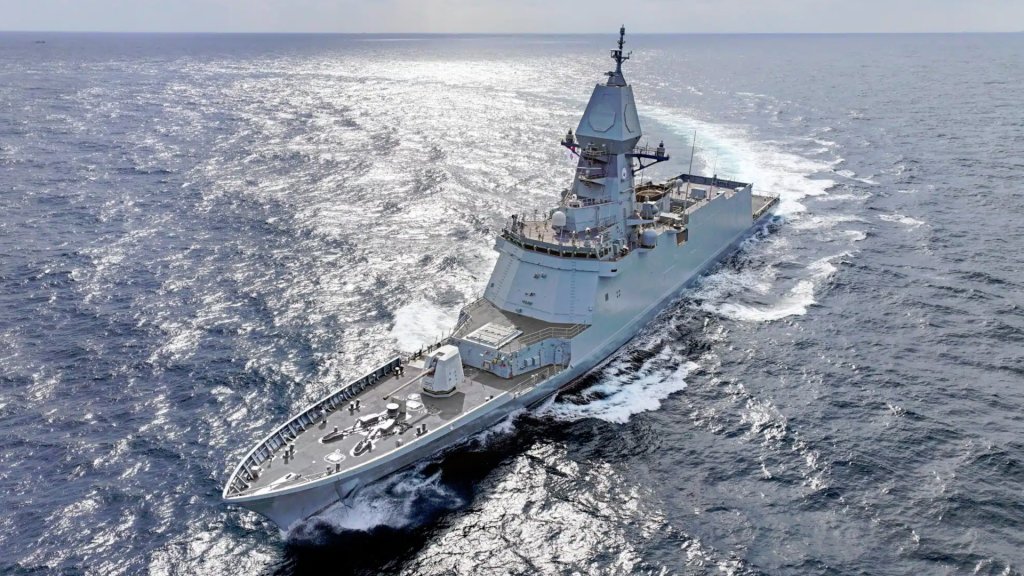
The study could lead to “an international warship competition [that] could include building up to two of the ships in foreign shipyards before transitioning to domestic yards as part of the Trump administration’s push to rapidly expand the fleet, three industry sources familiar with the deliberations confirmed,” according to USNI News‘ report. The outlet also said the Navy declined to “directly address the potential for an open competition for a new frigate” when asked.

The South Korean Navy’s ROKS Chungnam seen during sea trials before its delivery in 2024. HD Hyundai Heavy Industries

The acquisition approach described here is in line with what the Trump administration is currently calling the “Finland Model,” which entails construction of an initial batch of ships overseas before moving further production to yards in the United States. The name comes from a partnership the U.S. and Finnish governments announced last year regarding the construction of new icebreakers for the U.S. Coast Guard. Canada’s Seaspan Shipyards is also involved in that plan.

Broader plans to explore foreign surface combatant designs for the U.S. Navy, and potentially more to acquire one of those ships, were mentioned in the Pentagon’s 2027 Fiscal Year budget request released earlier this year. President Trump, former Secretary of the Navy John Phelan, and other U.S. officials have also openly raised the possibility of cooperation with shipbuilders in Japan and South Korea, specifically, including with regard to surface combatants. USNI‘s report says that the Istanbul class was included in the current review after it came up in discussions between Trump and Turkish officials on the sidelines of the NATO summit in Ankara in July.

Many questions remain, but there are clear signs the Trump administration wants to move in pursuing the acquisition of foreign naval vessels. The particular focus on frigates also aligns with a clear Navy need for new ships in that size class.

Why frigates?

Before exploring the specific designs the Navy is now said to be reviewing, it is worth taking a step back to understand why frigates are so important to the service’s shipbuilding plans, in general. The United States has not technically operated frigates since the retirement of its last Oliver Hazard Perry class type in 2015. The expectation had been that the Freedom and Independence class Littoral Combat Ships (LCS) would fill the resulting gaps. However, those ships struggled for years with a variety of major issues over the years and still have not lived up to their promised potential, despite certain strides having been made in expanding their operational employment in recent years.

The Navy’s announcement of a new frigate program in 2019, dubbed FFG(X), was widely seen as a rebuke of the core concepts behind the LCS. This, in turn, led to the Constellation class frigate, which became a debacle unto itself and was finally cancelled last year. It is important to point out the Constellation design was based on the established Franco-Italian FREMM frigate. The expectation was that only relatively minor changes would be made before putting the ship in American service. In the end, the U.S. derivative had only 15 percent design commonality with its European ‘parent,’ which directly contributed to the demise of the program.

A rendering of a now-cancelled Constellation class frigate. USN

A new FF(X) frigate program has since emerged. Through that effort, the Navy is now in line to get ships derived from the U.S. Coast Guard’s Legend class National Security Cutter (NSC), with the goal being to have the first one in the water by 2028. However, those frigates, at least the ones built in the initial tranche, will lack a Vertical Launch System (VLS) and certain other features that were seen as critical for the preceding Constellation class. This has immediately raised questions about the operational utility of these new small surface combatants, as TWZ has previously explored in detail.

A rendering of the US Navy’s future FF(X) frigate. USN

None of this diminishes the Navy’s current desire for new frigates, and more of them, to provide smaller, lower-cost platforms that can be used to bolster larger surface action groups or operate more independently in roles that do not require larger, more capable designs. When fielded in sufficient volume, they can also free up other types of surface combatants for other, higher priority duties or similar help to relieve strain on those fleets.

Today, the Navy’s fleet of Arleigh Burke class destroyers “gets used with a very high demand signal combatant commanders. The Navy can’t operate with only one size of ship,” Rear Adm. Brian Metcalf, the Navy’s Deputy Portfolio Acquisition Executive Maritime for Combatants, said in an official video in June. “The [FF(X)] frigate will fill that gap. They can be used in less contentious waters. They can be used as high-value escorts. There are all kinds of things the frigate can fill the gap for and allow destroyers to execute the high-end mission set.”

With all this in mind, it is not surprising that the Navy would be seeking to further bolster its future frigate fleets on a shorter timetable by leveraging foreign shipbuilders. There are also clear benefits to taking advantage of capable, in-production designs, which leads us to the Mogami, Chungnam, and Istanbul classes.

The Mogami class

Japan’s Mogami class, with its stealthy design characteristics, has long been a standout among modern frigates currently in production globally. The ship is designed as a multi-mission platform with anti-air, anti-surface, anti-submarine, and mine warfare capabilities, the latter of which includes both mine-hunting and mine-laying.

TWZ has covered the ship in detail in the past, writing:

“The original Mogami class design (also known as the 30FFM), the first of which only entered Japanese service in 2022, is already a very modern design with its shape featuring some stealthy characteristics. The 436-foot-long, 53-and-a-half-foot-wide, 5,500-metric-ton displacement frigates have a combined diesel and gas (CODAG) propulsion system that allows for fuel-efficient normal cruising operations and an additional burst of speed in combat. The ships have an active electronically scanned array (AESA) main radar, as well as a host of other advanced sensors and mission systems. One of the Mogami‘s most distinctive features is its NORA-50 UNIted COmbined Radio aNtenna (UNICORN) mast on top of the main superstructure, which contains various antennas. The frigates also have especially futuristic-looking Combat Information Centers (CIC)…”

The Japan Maritime Self Defense Force’s (JMSDF) first-in-class JS Mogami. JMSDF

“Armament-wise, the baseline Mogami class frigate has two four-round launchers for Type 17 anti-ship cruise missiles, a SeaRAM close-in defense system loaded with RIM-116 Rolling Airframe Missiles (RAM), and a five-inch main gun in a turret at the bow. There are also two remote weapon stations, each armed with a .50 caliber machine gun, on top of the bridge for additional protection against close-in low-end threats.”

“The Mogami design was originally slated to feature a 16-cell Mk 41 launch system array, but the seventh ship in the class, the JS Niyodo, which was commissioned in May, was the first to be fitted with it. The first six of these frigates were delivered without this capability, but they are expected to be back-fitted with it in the future. Mk 41 cells on Mogami class frigates are expected to be primarily filled with domestically-developed A-SAM or U.S.-designed RIM-162 Evolved Sea Sparrow Missiles. Four ESSMs can notably be loaded in a single Mk 41 cell.”

The Mogami class frigates also have a flight deck and hangar designed to accommodate a single Seahawk helicopter. The ships can also deploy uncrewed underwater and surface vessels (UUV/USV), as well as rigid-hull inflatable boats (RHIBs), via a ramp at the stern.

MHI in Japan has also developed an enlarged derivative that is close to 466 feet long, almost 56 feet at its widest, and displaces some 6,200 metric tons. This version also features a 32-cell VLS array, along with an upgraded radar, other improved sensors, and updated mission systems. Last year, the Australian government announced it would be acquiring a fleet of these ships with certain unspecified country-specific features as part of its SEA 3000 program.

A model of the enlarged derivative of the Mogami class. Japan Ministry of Defense

The Australian deal is one of, if not still the most significant foreign arms sale for Japan since the end of World War II. It also helps ensure that the Mogami production line will remain hot for years to come. For the U.S. Navy, sharing a frigate with two of America’s highest-profile allies in the Pacific, and which could therefore be readily serviced in those countries, would be very advantageous.

The Mogami is also a contender to become New Zealand’s next frigate, and there have also been discussions about sales to Indonesia. The Japan Maritime Self Defense Force only has two more of these frigates on order, the last of which is expected to be commissioned into service by March of next year.

The Chungnam class

The Chungnam class (also sometimes referred to as the FFX-III or FFG-III) is the latest frigate for the South Korean Navy, and features a mix of anti-air, anti-ship, and anti-submarine capabilities. The first example entered service in that country in 2024. These ships are just over 423 feet long, approach 49 feet at the widest point in the hull, and displace some 4,300 tons with a full combat load. The design is based on the earlier Daegu class, which was itself an evolution of the preceding Incheon class that traces its roots back to the late 1990s.

As was the case on the Daegu class, the Chungnam class uses combined diesel–electric or gas (CODLOG) propulsion, which offers benefits for power management and efficiency, as well as when it comes to reducing maintenance requirements and operating costs. The design features a prominent integrated mast structure with four fixed-face arrays for the main multi-function AESA radar near the top. The ships have additional radars and other sensors, as well as an electronic warfare suite.

The ROKS seen at the time of its launch. HD Hyundai Heavy Industries

Each one of the Chungnam class frigates has a 16-cell K-VLS array. Domestically developed K-SAAM surface-to-air missiles and Haeseong I anti-ship cruise missiles (also called the SSM-700L or C-Star), as well as K745A1 Hong Sang Eo (Red Shark) vertically-launched anti-submarine rockets, can be loaded into these cells.

The armament package on these ships also includes a five-inch main gun in a turret at the bow, a pair of triple torpedo tubes, and a Close-in Weapon System II (CIWS II) armed with a seven-barrel 30mm Gatling-type cannon.

A look at the CIWS-II, which is part of the full armament package on the Chungnam class frigate. Hyundai WIA

The Chungnam class frigates also have a flight deck and hangar for a single helicopter at the stern.

As it stands now, the South Korean Navy has two Chungnam class frigates in service and has plans to acquire four more over the next few years. The lead ship in the class was built by HD Hyundai Heavy Industries, which is also one of the principal designers of the ship. A different shipbuilder, SK Oceanplant, built the second ship in the class, ROKS Gyeoungbuk, and is now working on the third and fourth examples. Hanwha Ocean is reportedly in line to build the last two ships in the class for South Korea. Hyundai and Hanwha have pitched export designs based on the Chungnam class, with both firms notably in the running to supply new frigates to Thailand.

Hanwha has already been making steady inroads in the shipbuilding industry in the United States, including the acquisition of the Philly Shipyard in Philadelphia, Pennsylvania, in 2024. Hyundai has reportedly been working to do the same. Just last month, Hanwha publicly announced a new $1.2 billion bid to buy out Australian shipbuilder Austal’s U.S. subsidiary, Austal USA. Austal notably built the Independence class LCSs for the U.S. Navy and continues to supply that service with other vessels. Austal subsequently said it was considering the South Korean offer.

The Istanbul class

Turkey’s Istanbul class (also known as the Istif class or just I class), developed under the country’s MILGEM national warship program, is not a design that has typically come up in previous discussions about potential foreign-made frigates for the U.S. Navy. It is described as a multi-role frigate with anti-air, anti-surface, and anti-submarine capabilities. The lead ship in this class, TCG Istanbul, entered Turkish Navy service in 2024.

At around 371 and a half feet long and with a beam of just over 47 feet, as well as a displacement of some 3,000 tons with a full combat load, the Istanbul class is notably smaller than either the Mogami class or Chungnam class. Like the Mogami, it uses CODAG propulsion. The Turkish design is understood to have leveraged lessons learned from the Project GENESIS program to upgrade the country’s second-hand ex-U.S. Navy Oliver Hazard Perry class frigates, as you can learn more about here.

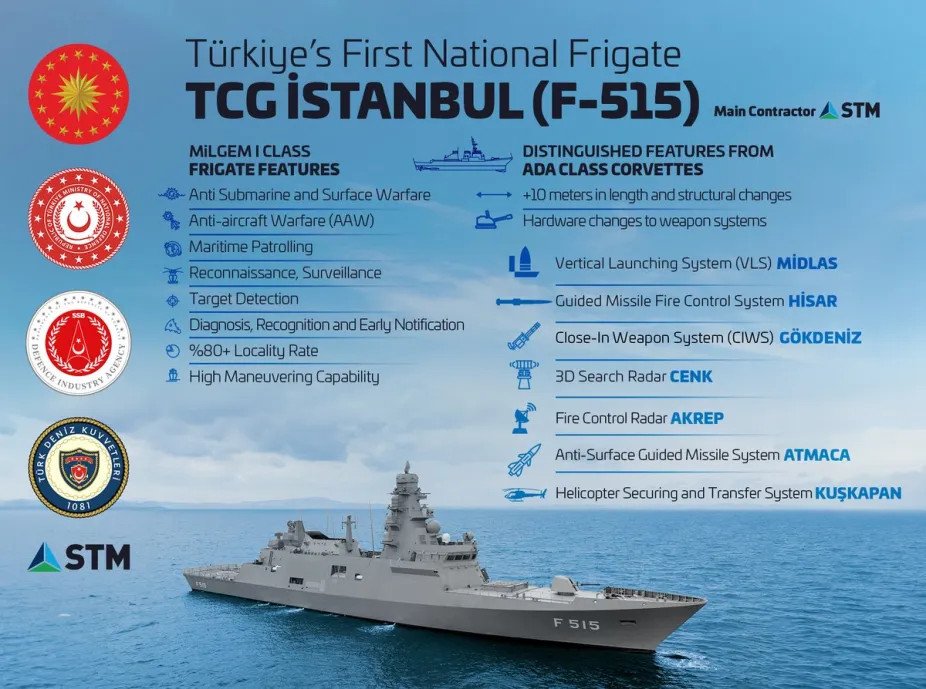
TCG Istanbul is armed with a 16-cell MiDLAS VLS array, with past reports saying it is primarily configured to fire Hisar short-to-medium-range surface-to-air missiles. However, just in August, it was revealed that the second ship in the class, the future TCG Izmir, which is undergoing sea trials now, has a new 16-cell version of MiDLAS with visibly longer cells. This would allow the ship to fire larger weapons vertically, such as the Siper medium-range surface-to-air missiles, Atmaca anti-ship cruise missiles, and/or Gezgin land-attack cruise missiles. MiDLAS is a scalable VLS design developed in Turkey as an alternative to the U.S.-made Mk 41.

The future TCG Izmir with its noticeably larger VLS array in front of the main superstructure. Anadolu Shipyard

The initial Istanbul class design already had four deck-mounted launchers that can be loaded with up to 16 Atmaca missiles, in total. The frigates also have a 76mm cannon in a turret on the bow, a Gokdeniz CIWS with a twin-barrel 35mm cannon, two 25mm cannon-armed remote weapon stations, and a pair of twin torpedo tubes.

The main sensor on the Istanbul class is a rotating AESA radar mounted on top of the ship’s main integrated mast structure. It has additional radars and other sensors, as well as electronic support measures and electronic countermeasures systems.

The Istanbul class design also features a flight deck and hangar at the stern, sized around the Seahawk helicopter.

An infographic offering a general overview of the Istanbul class’ capabilities. STM via X

As mentioned, the second Istanbul class frigate for the Turkish Navy is now in sea trials, and the country plans to eventually acquire eight of these warships in total. They are being built through several shipyards in Turkey. Last year, Turkey’s TAIS Shipyards also secured a contract to build at least two Istanbul class frigates for Indonesia.

Growing U.S. roadblocks to any foreign warships

Much remains to be seen about how the U.S. Navy might proceed with the acquisition of new frigates, or any other naval vessels, via foreign shipbuilders. Whether any other relevant, in-production designs are being considered, or could be in the future, is unknown. USNI News‘ report says the current study is scheduled to wrap up in November.

Furthermore, what the Navy might want to do could well turn out to be moot. Members of Congress on both sides of the political aisle have been very vocally pushing back on any plans to acquire foreign warships amid concerns about negative impacts on the U.S. shipbuilding industry.

Current U.S. law would already require the Trump administration to issue a national security waiver to pursue foreign-made naval vessels. A draft of the annual defense policy bill, or National Defense Authorization Act (NDAA), for the 2027 Fiscal Year now making its way through the Senate would eliminate the ability to issue such a waiver. In June, members of the House Armed Services Committee separately moved to outright block any spending on foreign-built warships in a separate draft NDAA.

The aforementioned Finland Model, as outlined in Trump’s August memo, is clearly intended to try to assuage Congressional concerns. Under the stated plan, foreign shipbuilders would be required to make major investments in U.S. shipbuilding enterprises and hire American workers as part of any future contract, even if an initial tranche of vessels is built overseas.

A rendering of one of the future Arctic Security Cutter icebreakers the US Coast Guard is set to acquire in part through a shipyard in Finland. Seaspan

“The Administration strongly opposes section 1025, which would prohibit the use of funds for procurement of initial battle force ships to be built in a foreign shipyard, especially while, in accordance with the ‘Finland Model’ first employed with the Coast Guard’s medium icebreaker program, long-term investments are being made in an American brown or greenfield shipyard,” the White House’s Office of Management and Budget (OMB) wrote in a statement of Administration Policy in July, specifically in response to provisions in the the House’s NDAA draft. “This prohibition fails to seriously address the challenges posed by current shipbuilding backlogs across six major programs in our ‘prime’ shipyards.”

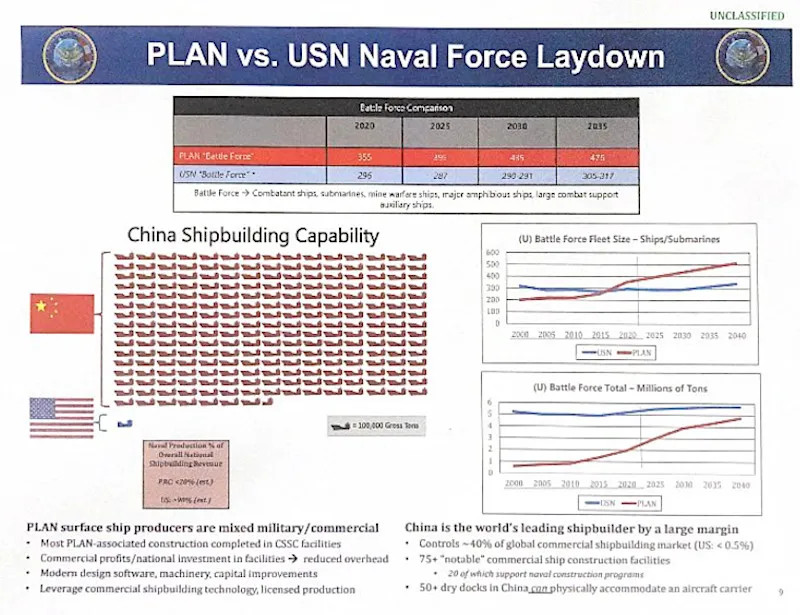
This latter point here speaks to an already worrisome and still-widening gap between U.S. shipbuilding capacity and that of chief global competitor China. The U.S. government has tried to take steps in recent years to revitalize the American side of the equation, but workforce retention and other factors have continued to present serious hurdles. There are additional concerns now about how the addition of work on the Trump class battleship program will affect America’s naval shipbuilding ecosystem, which the Trump administration has separately pushed back on.

An unclassified Office of Naval Intelligence briefing slide from circa 2023 underscoring the disparity between U.S. and Chinese naval shipbuilding capacity. ONI

Continuing U.S. shipyard capacity and quality issues raise their own questions about the viability of the Finland Model. The construct inherently limits the U.S. government’s ability to make use of yards overseas and is heavily contingent on the shipbuilding industry in the United States expanding at a rate where it will be able to absorb the additional production demands. With the naval shipbuilding deficit already becoming extremely problematic, buying examples of relevant classes with minimal changes and having them built where production is already established could arguably be the priority, especially in light of the failures of the LCS and Constellation programs.

Ensuring that any U.S.-specific changes to the design are minimal will also be critical for any such plan to be successful. As mentioned, the Constellation class was undone in large part due to a near-constant stream of changes ordered by the Navy, which negated the benefits of choosing a derivative of an in-production design. The service has stressed its intention to avoid any similar pitfalls with its existing FF(X) frigate program, which also has to be factored into the larger domestic shipyard capacity question.

“The President has directed the Navy to aggressively increase domestic shipbuilding capacity, including leveraging the proven shipbuilding skills and industrial expertise of our allies,” Navy Capt. Ron Flanders said in a statement on Tuesday, according to USNI News. “We are actively developing options to fulfill the President’s intent to deliver ships faster while ensuring long-term investment, technology transfer, and workforce expansion within United States shipyards.”

Signs are certainly growing that the Navy is moving closer to kicking off a formal process to acquire foreign-designed warships, which could include Mogami, Chungnam, and/or Istanbul frigates, to help grow its fleets, especially in the face of growing challenges posed by China.

Contact the author: joe@twz.com

The post The Three Foreign Frigates Being Studied For Possible U.S. Navy Service appeared first on TWZ.

  •  

‘American dominance’: Boat strikes, Cuba, and Latin American pushback | Ep. 13

Brazilian activist Thiago Avila waves a Cuban flag on board the vessel Maguro -- symbolically renamed "Granma 2.0" as a tribute to the yacht used by Fidel Castro's guerrilla fighters to launch their revolution in 1956 -- as it arrives from Mexico with humanitarian aid as part of the Nuestra America convoy, docking at the port of Havana on March 24, 2026. Photo by YURI CORTEZ / AFP via Getty Images

This week marks the 1-year anniversary of Trump’s boat strikes in the Caribbean and Pacific oceans. 

On September 2, 2025, President Donald Trump announced the first air strike on a boat in the Caribbean. Trump said the boat allegedly carried drugs off the coast of Venezuela. It marked the beginning of a hostile U.S. foreign policy that has seen the U.S. invade Venezuela, unleash a devastating oil blockade on Cuba, and justify it all under a renewed Monroe Doctrine, which the President is calling his Donroe Doctrine.

Meanwhile, the boat strikes have continued until today, even though Trump administration officials say they have not actually decreased the amount of drugs arriving on U.S. soil. As of this week, the U.S. government has attacked at least 68 boats over the last year, killing more than 220 people.

And the Trump administration is now using his foreign policy to attack progressive opponents at home, labelling them pawns of Cuba, and “one of the single largest, most sophisticated and dangerous vectors for hostile foreign influence in modern American history.”

In this episode, Michael Fox walks through the anniversary of the boat strikes. He dissects a new Cuban report published by the State Department to attack dissidents at home, and then looks at the regional resistance to Trump at the Panamerican Congress, which was held in August in Montevideo, Uruguay. 

This is Episode 13 of Under the Shadow, Season 2.

Under the Shadow is an investigative narrative podcast series that walks back in time, telling the story of the past by visiting momentous places in the present. Season 2 responds in real time to the Trump administration’s onslaught on Latin America.

Follow Under the Shadow on Spotify and Apple Podcasts.

Hosted by Latin America-based journalist Michael Fox.

This podcast is produced in partnership between The Real News Network and NACLA.

It is supported, in part, by Global Exchange.

Theme music by Michael Fox’s band, Monte Perdido. Monte Perdido’s 2024 album Ofrenda is available on Spotify, Deezer, Apple Music, YouTube or wherever you listen to music.

Other music from Blue Dot Sessions and Epidemic Sound.

Script editing by Heather Gies. Hosted, written, produced, mixed, and edited by Michael Fox.

Guests: 

Resources: 

  • Belly of the Beast is a U.S-based independent media outlet, reporting from Havana. 
  • Many thanks for their incredible ongoing work. You can visit their site here: www.bellyofthebeastcuba.com
  • Below are links to the video clips used in today’s episode: 

“Helping” Cuba While Destroying Its Economy

This History Professor Graded Marco Rubio’s Cuba Report. He Got an F.

Support Under the Shadow

Please consider supporting this podcast and Michael Fox’s reporting on his Patreon account: patreon.com/mfox. There you can also see exclusive pictures, video, and interviews.

You can subscribe to Michael Fox’s new free speech podcast, The Battle for Free Speech on Spotify and Apple Podcasts, or wherever you get your podcasts.

Transcript

The following is a rushed transcript and may contain errors. It will be updated.

Speaker 1:

A few weeks ago, the US State Department released this video over X.

Speaker 2:

It’s 1823. The map of the Americas is being redrawn. Spain has spent centuries amassing a new world empire stretching from Patagonia to California. Now their grip was slipping fast.

Speaker 1:

The video is narrated by Kevin Marino Cabrera, the US ambassador to Panama, and it’s highly polished with images, map graphics, animations, and dramatic music.

Speaker 2:

Monroe then declared a decree to Congress, among the boldest diplomatic statements in American history.

Speaker 3:

The American continents, by the free and independent condition which they have assumed and maintained, are henceforth not to be considered as subjects for future colonization by any European powers.

Speaker 1:

The text of the post reads, “The Monroe Doctrine has shaped US foreign policy for over two centuries. American dominance in the Western hemisphere will never be questioned again.”

Speaker 2:

But these were defensive applications, keeping European powers out, not asserting American control over the hemisphere’s affairs. That changed in 1895 when Secretary of State Richard Olney invoked the doctrine, declaring that the United States was practically sovereign over the Western hemisphere and demanded for its submit to American arbitration. He had redefined the doctrine. It was no longer just a warning. It was now a claim to regional primacy.

Speaker 1:

The video is remarkable because it doesn’t mince words or attempt to paint a rosy picture of the United States. In five minutes and 31 seconds, it just lays out the justification for the US imperialism that has cast a shadow over the region for the last two centuries up until today.

Speaker 2:

Three years later, war with Spain erupted and when the smoke cleared, it transformed the hemisphere. The United States expelled Spain from Cuba, seized Puerto Rico, and stepped into the world stage as a genuine imperial power with dominance over the Caribbean. Just four years later, that dominance was tested again. German and British warships sailed into Venezuelan waters and blockaded its ports over unpaid debts. Roosevelt intervened and declared if a Latin American nation fell into chaos or instability, the US would step it and manage it. The doctrine has started as a shield. Roosevelt had just turned it into a mandate.

Speaker 1:

This was all a good thing, the video seems to say. A natural course of history that the US should be proud of and the rest of the region should just accept. And all this backstory is a lengthy setup for the video to then make the case that Trump’s actions in Latin America are nothing more than a continuation of the same model of imperialist intervention that the US has carried out since its inception, or at least since the beginning of the 20th century when Roosevelt declared his corollary to the Monroe Doctrine.

Speaker 2:

Fast-forward to the modern era where the doctrine has found its latest champion in President Trump. Through the execution of Operation Absolute Resolve, the United States seized Venezuelan dictator Nicolas Maduro, transporting him to American soil to answer for charges of narcoterrorism. This calculated maneuver delivered a resident signal across the hemisphere, punctuated by President Trump’s own declaration.

Speaker 4:

Under our new national security strategy, American dominance in the Western hemisphere will never be questioned again.

Speaker 1:

It’s a fascinating piece of propaganda that tries to place Trump’s actions as the logical next step in the long trajectory of US imperialism in the region.

Speaker 2:

Over two centuries, Monroe’s declaration had shaped US foreign policy across administrations and throughout fundamentally different geopolitical eras. Well, began as a warning to European powers evolved into a framework for regional dominance, one that remains the cornerstone of American strategy in the hemisphere today.

Speaker 5:

What is extraordinary about that video is that it says what has never really been said about the Monroe Doctrine by US officials, which is that the Monroe doctrine has served as a pretext for US intervention in the region and is essentially there to ensure that the US has a great deal of political influence and economic influence over the entire Latin America and Caribbean.

Speaker 1:

That is Alexander Main. I reached out to him to get his take on this video. He’s an old friend and the director of international policy at the Center for Economic and Policy Research in Washington DC.

Speaker 2:

When Soviet missiles were discovered in Cuba in 1962, Kennedy didn’t need to invent a new framework. He simply invoked the doctrine. The weapons had to go.

Speaker 5:

This video is saying that there is such a thing as the US Empire, something that most US officials have never wanted to publicly recognize and saying that that is a good thing and that more needs to be done to ensure that the US can be an effective empire over the entire Western hemisphere.

Speaker 1:

Key to this video, Alex says, is the idea that brute military force must be deployed to achieve this imperialistic doctrine. And right now that is being done under the pretext of a new sort of war on terror. There’s no clear definition of exactly who or what narco-terrorist is, but that might be part of the point. Alex says that much like the Cold War’s fight against communism, the vague image of the narco-terrorist boogeyman allows US authorities and their allies to go after left-leaning opponents with force.

Speaker 5:

We’re seeing something similar now, and I think this is really what the US is going to be relying on under the Trump administration. They’re going to be relying more and more on military action and the threat of military action in order to advance this vision of complete political domination over the region.

Speaker 1:

In Brazil, high stakes elections are coming up in October. Advisors for leftist president Luis Ignacio Lula de Silva saw the timing and content of this video as a direct threat against the president’s reelection campaign, a sign that the Trump administration has its sights on Latin America’s largest country. According to Brazilian columnist Valdo Cruz, Lulu’s advisors compared Trump’s foreign policy team led by Cuban American Secretary of State Marco Rubio to Madagascar Penguins piloting Air Force One. It’s a reference to the Madagascar cartoon.

Speaker 6:

Attention, this is your captain speaking. I’ve got good news and bad news. The good news is we’ll be landing immediately. Bad news is we’re crash landing.

Speaker 1:

That is where we are at, a new definitive Monroe doctrine for the Western hemisphere, and it’s being fueled by brute US military force in the region as we have already seen unfold in unprecedented terms over the last year. And the Trump administration isn’t just using those actions and threats abroad. They’re now going after progressive individuals and groups in the United States accusing them of being pawns of foreign nations. People have even been subpoenaed.

Speaker 7:

There’s nothing organic about it. It is funded, it is organized, and Cuba is a part of that network and in some cases a critical part of that network.

Speaker 1:

It’s like something out of the McCarthy era or the Cold War. It’s a fabricated witch hunt. And as we will look at today, it’s being supported by artificial intelligence, but people across Latin America are also organizing against the threats. All of that in a minute. This is Under the Shadow, an investigative narrative podcast series that looks at the role of the United States abroad in the past and the very present. This podcast is a co-production in partnership with The Real News and NACLA. I’m your host, Michael Fox, longtime radio reporter, editor, journalist, the producer and host of the podcast’s Brazil on Fire: Stories of Resistance and my new series, The Battle for Free Speech. I’ve spent the better part of the last 20 years in Latin America. I’ve seen firsthand the role of the US government abroad, and most often sadly, it is not for the better.

Invasions, coups, sanctions, support for authoritarian regimes. Politically and economically, the United States has cast a long shadow over Latin America for the past 200 years. It still does. This is season two of Under the Shadow: Trump’s attack, episode 13, American Dominance.

Okay, let me just first say that I’m so excited to be diving back into this season of Under the Shadow. If you have been following this podcast, you’ll know that I was largely absent this summer. I was busy cranking out my podcast about Trump’s attack on free speech rights today in the United States. It’s called The Battle for Free Speech. It’s now out completely. You can listen wherever you get your podcasts. I’ll add a link in the show notes. In July, we shared an episode from that podcast on the Under the Shadow feed about the battle underway in Brazil right now ahead of the general election in October. I think it’s really good. Before that, my last Under the Shadow episode was about Honduras Gate back in May, so it’s been a while. Today, I want to catch up on several important developments related to US intervention and the pushback against it in the region, including the latest boat strikes, the State Department’s war on Cuba, and the recent Pan-American Congress in Uruguay.

These all fall under the rubric of where we started at the top with the video about the Dunro Doctrine and Trump’s promise that American dominance in the Western hemisphere will “never be questioned again.” In this episode, I’ll look at ways that this is unfolding, both abroad and inside the United States, and also how progressive leaders in the region are very much continuing to question American dominance and organizing against Trump’s rhetoric and threats. Okay, we begin in the abnormally warm waters of the Caribbean and Pacific oceans.

These waters have been central to Trump’s military attack on the region, and this week marks a sad anniversary.

Speaker 8:

When you come out and when you leave the room, you’ll see that we just over the last few minutes literally shot out a boat, a drug carrying boat, a lot of drugs in that boat, and you’ll be seeing that and you’ll be reading about that. It just happened moments ago.

Speaker 1:

On September 2nd, 2025, one year ago this week, Donald Trump announced the first airstrike on a boat in the Caribbean. Trump said the boat allegedly carried drugs off the coast of Venezuela. He later posted on True Social a video of the airstrike, black and white labeled unclassified. A missile hits the boat and it explodes. The White House said without providing evidence that it killed 11 alleged narco terrorists. If you remember, this is where I began this podcast series, because for me, it marked a clear break with the decades of US foreign policy in the region. The US attack on that boat in early September was the very first time the United States had launched a unilateral airstrike or carried out a deadly military operation on its own in Latin America in nearly four decades, not since the 1989 invasion of Panama. According to Trump’s national security strategy published in December 2025, his administration was planning to ramp up US intervention in the Americas with his new Trump corollary to the Monroe Doctrine.

He has made good on that promise. With the US invasion of Venezuela, the oil blockade of Cuba, the shield of the America’s initiative and the boat strikes, the administration labeled those strikes Operation Southern Spear. Secretary of Defense Pete Hegseth joined Fox News Live to gush about the boat strike.

Speaker 9:

So we’ve got assets in the air, assets in the water, assets on ships, because this is a deadly serious mission for us, and it won’t stop with just this strike. Anyone else trafficking in those waters who we know is a designated narco-terrorist will face the same fate, and it’s important for the American people to protect our homeland and protect our hemisphere.

Speaker 1:

Hegseth was right about one thing. That strike was just the beginning. They’ve been ongoing since last year. There was a two-month lull, which miraculously coincided with the World Cup competition in the United States and Trump’s grand 4th of July 250th anniversary celebration. But in recent weeks, the US military has kickstarted the strikes again. This news report is from August 26th this year.

Speaker 10:

The human rights groups are condemning the latest round of US military attacks on a high speed boat in the Caribbean, which the Pentagon says killed four narco-terrorists. This is now the second strike this week as the White House targets vessels accused of transporting deadly drugs into the US for the past year.

Speaker 1:

But the whole justification for the first strike last September and everyone sense that they’re fighting drug trafficking is just false. This has never been about fighting drug trafficking. Most of the cocaine trafficked into the United States doesn’t come from Venezuela and it doesn’t travel across the Caribbean, but the Pacific. Fentanyl’s the same thing. It’s not made in nor trafficked from Venezuela despite Trump’s discourse.

Trump’s campaign has been about sending a message, even if it means carrying out extra judicial killings in international waters against innocent people, because it’s become clear that many of the boats they’ve hit haven’t been operated by narco terrorists, but fishermen. And contrary to Trump and Secretary of Defense Hegseth’s claims, other Trump administration officials admit that the strikes haven’t decreased the amount of drugs being run into the United States. In late July, the Washington Post reported that both Pentagon and DEA officials had said the boat strikes hadn’t impacted the supply of cocaine in the United States. Drug traffickers just developed new strategies. They were taking different routes, bigger boats, or relying more on planes from clandestine airstrips. One DEA official who asked to remain anonymous told the Post, “When you squeeze the balloon on one side, it always expands on the other side. They always find the weak spots and exploit them.” Nevertheless, the boat strikes have continued.

Welcome to the closing session, hosted by the Secretary of War and Chairman of the America’s Counter-Cartel Coalition, the Honorable Pete Hegseth. Pete Hegseth spoke about this during a Counter-Cartel Coalition conference in Panama City on August 12th.

Speaker 9:

We have knocked the narco terrorists and the maritime domain on their heels. We forced them to adjust their tactics, techniques, and procedures, their TTPs, and operate outside of their comfort zones. We are retaking the open seas and our maritime borders. This is a bad time to get in a drug boat in the Western Hemisphere.

Speaker 11:

In one year now, at least 68 publicly acknowledged strikes on alleged drug trafficking vessels right in the Caribbean and Eastern Pacific, extraditionally killing over 228 civilians.

Speaker 1:

Jake Johnston is the director of international research at the Center for Economic and Policy Research in Washington. He also runs SIEPR’s US Escalation in Latin America Tracker, which he has updated almost daily since last year. I just want to pause here for a moment to underscore that number. More than 228 civilians, and that is a number that’s likely to only continue to grow. Just to put that into context, before the September 11th attacks, the 1995 Oklahoma City bombing was the deadliest terror attack in the history of the United States.

Speaker 12:

If it seemed like war yesterday, the reinforcement showed up tonight. At the center of it all, of course, is the bombed out shell of the federal office building, and in its shadow, the exhausted, who for a day and a half now have sifted through its debris and counted its dead and seen up close why they call it terror.

Speaker 1:

168 people were killed in that bombing on the Alfred P. Murrow Federal Building. It shocked the nation. Yet the United States has unleashed a round of terror attacks over the last year in international waters in the Caribbean and Pacific, which have killed far more people than the second most deadly terror attack in the history of the US. In fact, the US drug boat terror campaign is deadlier than both the Oklahoma City bombing and the 2016 Pulse Nightclub shooting combined. Now, it might seem strange that I’m making this comparison. The US government has carried out the boat strikes, individual perpetrators carried out these other attacks, but I think it’s an important comparison to make. All are acts of terror, all are illegitimate uses of violence without any legal founding. The US boat strikes aren’t operations against enemy combatants in a time of war. The US government hasn’t carried out a trial against the victims or offered any proof that the people killed in these raids are actually drug traffickers.

Their actions are illegal under international law, and the result in all cases is the same, the extra judicial killing of innocent people, which undermines the basis of the rule of law in the United States, the United Nations, and most democratic countries around the world, that you are innocent until proven guilty. Jake Johnston.

Speaker 11:

What is the sort of takeaway after a year? I mean, this is an assault on the rule of law. This is assault on international law. And I think you can see over the course of the year how these strikes serve this broader purpose of normalizing, rationalizing and sort of gaining at least some public acceptance of just the sort of trampling of international law. And now we have transitioned, or at least the US is saying they’re transitioning from these boat strikes to land strikes. It’s there. We’ve already seen, in fact, some strikes on land in Ecuador, or hitting a dairy farm, reports of torture of the farm workers who were there. And so you can see how this can extend and expand. You can see how the erosion of international law comes right back here to home, and you have ICE agents killing US citizens in the streets with impunity, and these things are connected.

These developments are connected, and they certainly mutually reinforce each other through this administration’s policies.

Speaker 1:

Ecuador has been collaborating with the US military under the Counter Cartel Coalition, which I looked at in episode eight of this series, and not just on that dairy farm strike. The United States has also taken some concerning actions against boats off the Ecuadorian coast.

Speaker 11:

This started earlier this year, the bombing of at least three fishing vessels off the coast of Ecuador, which took place in a very different manner than these other boat strikes we were talking about where SOUTCOM was posting smut on the internet about them blowing up boats. These ones were totally unacknowledged, and the reports that we’ve had from investigative outlets that have looked into it, local press in Ecuador, human rights organizations, et cetera, one of the boats first off is still missing and all the crew members are still missing.

Speaker 1:

People from some of those boats were killed and others have been returned to the country, but that was only after being abducted on the high seas.

Speaker 11:

Onto a nondescript boat in the middle of the ocean with gringo looking guys with US flags on their uniforms and being taken to El Salvador of all places before facing torture and abuse and then eventually being released back to Ecuador where they face no charges, it should be noted. And you mentioned in each of these cases, the reporting indicates that Ecuador and Coast Guards actually stopped the vessels and cleared them prior to them being bombed, right? Obviously, there’s been reporting, the Washington Post reported a few weeks ago that this was part of a clandestine CIA operation. The New York Times has come out with reports suggesting that the potential involvement of private military contractors. So there’s tremendous questions that remain exactly about who is responsible, who is involved, why this was happening. But what seems quite clear is that US intelligence is operating out of El Salvador, a CIA base that was white active during the Dirty Wars in the ’80s.

Speaker 1:

Jack here is referring to what we learned from reporting in the Washington Post in mid-August, which broke the news that a covert CIA program based in El Salvador was likely behind the Ecuadorian boat attacks. According to the Post, a plane operating out of El Salvador’s small Ilopango International Airport was likely responsible for the attacks during the 1980s. This airport was also a launching pad for US operations in nearby Nicaragua.

Speaker 11:

This didn’t come out of nowhere, right? I mean, it is really based in the past, and a lot of the people who are involved in this are really rooted in those previous episodes of right-wing dictatorship and US interventionism in the region. And so in a lot of ways, it is a return to that earlier period.

Speaker 1:

There is another country in the region whose conflict with the United States hearkens back to US intervention of the past, Cuba. So back in episode seven, we looked in depth into the US actions against Cuba, and in particular, the devastating oil blockade which is strangling the country, and it’s still ongoing. The situation in the country has only deteriorated. It’s ironic because the United States brags about how they’re sending aid to the country, and yet the US is solely to blame for the crisis. The US government could fix the problem almost overnight by just lifting the embargo, both the oil blockade and the larger embargo that the US has had in place in some shape or form for more than 65 years. Belly of the Beast is a Cuban investigative journalism outlet based in Havana. I spoke with Belly of the Beast Liz Fernandez in my previous Cuba episode of this series.

A couple of weeks ago, they released this great video report titled Helping Cuba While Destroying Its Economy. The word helping is in quotes. Here’s a clip. It starts with Belly of the Beast journalist Johan Rodriguez standing on a Cuban street.

Speaker 13:

Good news for us here in Cuba. The United States is here to help.

Speaker 1:

Secretary of State Marco Rubio appears on screen. In Spanish, he says, “I want to tell you that we in the United States offer to help you not only alleviate the current crisis, but also to build a better future.”

Speaker 13:

A better future deliver in cardboard boxes.

Speaker 10:

This is the first of a hundred million dollar humanitarian aid package promised by Secretary of State Marco Rubio.

Speaker 13:

The US government is donating 700 boxes of food and hygiene products. Each one is supposed to last 10 days. That’s nice, although it might be even nicer if they had simply lifted the oil blockade.

Speaker 1:

The video cuts to numerous Cubans who are suffering. “They give us 20, 24 hours without electricity,” says one elderly resident. “It’s the whole day cooking with coals, “says a woman. “I haven’t had water for three and a half months,” says another woman.

Speaker 13:

The boxes of aid are welcome because people here are desperate. If someone breaks your legs and offers you an aspirin, you’ll take aspirin, but when you wear soft, your legs are still broken.

Speaker 1:

That is the state in Cuba right now, a country on life support. The United States could fix it, but it doesn’t want to. It wants the people to suffer an indirect way to try and force regime change, or at least that has been the stated policy since the beginning of the embargo in the 1960s. And the Trump administration is blatant about its motives. On July 20th, the US State Department released a 100-page report titled Cuba: The Capital of 21st Century Communism. It essentially accused Cuba of infiltrating the US left over the last half century and being behind a host of progressive organizing, everything from Black Lives Matter and George Floyd protests to pro-Palestine encampments on university campuses and “the rise of Antifa.” It’s incredible because it makes the United States look like it’s in the crosshairs of this tiny Caribbean country, the US, a country that is nearly 90 times larger than Cuba and has a GDP that is more than 300 times the size of the islands.

The report makes no mention of the countless US attempts to overthrow or assassinate Fidel Castro, undo the Cuban Revolution, and above all, the decades long US blockade on the country. Instead, the document paints the United States as the victim of a Cuban plot to overthrow US capitalism and Western society.

The summary for the report reads, “Cuba’s assault on the United States was never at root a quarrel over economic policy or sovereignty or even ownership of a particular territory. It was a revolution against Western civilization itself, waged in part via the novel and insidious method of persuading the children of the West to turn against their own inheritance.” Let me just repeat that. Persuading the children of the West to turn against their own inheritance. I’m not exactly sure what that inheritance is, but the report paints activist and leftist organizations in the United States as willing pawns in Cuba’s evil plans to subvert the United States. The document reads, “Through its cultivation of American activists, its infiltration of American universities, its sprawling influence and espionage networks, and its position as the spiritual hub of the Third World Revolution, becoming a pilgrimage destination for generations of new left activists and intellectuals, Cuba has played an instrumental role in shaping America’s radical left from the 1960s through to today.” It singles out organizations like the Vencerimos Brigade, Pastors for Peace and the Anti-War Group Code Pink as essentially Cuban front groups.

It’s a ridiculous claim because these are solidarity organizations that literally carry humanitarian aid to countries harmed by US policies. And this idea in the Cuban report assumes that everyone in the United States should just be on board with US administrations that punish other countries and peoples for not bowing to Uncle Sam. The document also accuses the New York Political Education and Community Center at the People’s Forum and the National Lawyers Guild of being influenced by Cuba. The document states, “From its very first years of existence, the National Lawyers Guild operated as a defacto communist front group designed to organize and agitate for revolution in the United States. It’s interesting that the document also spends three and a half pages discussing the Democratic socialists of America’s support for Cuba. At a time when DSA is growing and actually winning primaries ahead of the US November midterm elections, it’s clear that Marco Rubio’s State Department is interested in doing all it can to paint that group as Cuban influenced.

The document sums up all of this by saying, “These groups collectively represent one of the single largest, most sophisticated and dangerous vectors for hostile foreign influence in modern American history.” Too bad that statement is not only totally conspiratorial, it is also not based on reality.

Speaker 14:

And it was shocking on every page to see the way in which the State Department’s report was reiterating the same claims, and many of them very fraudulent claims, that had been leveled against American solidarity activists in the 1960s and 1970s.

Speaker 1:

Bailey of the Beast recently interviewed historian Tayshon Latner about this report in his 2018 book, Cuban Revolution in America. Latner writes about how generations of activists in the United States have found inspiration in Cuba, but he says that if State Department officials were reading his book, they completely missed the point and blew it out of context.

Speaker 14:

But in reading Rubio’s report, it was enormously clear that they were reiterating, you could almost say regurgitating the same claims and some of the same material that had been circulating in the 1960s and 1970s. The FBI and the CIA both produced copious reports that claimed to, let’s not say prove, because I don’t know if even they themselves would’ve used that terminology, but they tried to demonstrate a linkage between American solidarity movements and the Cuban revolution.

Speaker 1:

That is what they’re doing now. Even before the report came out, the Trump administration was already investigating activists for traveling to Cuba in March for the Nuestra America convoy. Their solidarity groups brought 20 tons of humanitarian aid to the Caribbean Island. In May, roughly 40 US activists were subpoenaed, including progressive influencer Hassan Peiker and Code Pink founder Mydia Benjamin, who I’ve spoken with in this podcast. In the days following this Cuba Reports release, several groups that were mentioned in the document were also subpoenaed to testify before Congress, including the People’s Forum, Breakthrough News, and the Tricontinental Institute for Social Research.

Speaker 5:

Are you agents of foreign influence?

Speaker 7:

I’m an agent of my own conscience.

Speaker 1:

Manolo de Los Santos is the director of the People’s Forum. He responded to the Trump administration’s allegations against his organization on MS Now in late July.

Speaker 7:

I’ve been moved constantly by the belief that the United States has to do better and that we can change the reality in this country. If we were to accept what this committee is demanding from us, it essentially would be to accept that people in the United States have no right to protest, no right to organize, no right to express their differences with the US government. The Trump administration is mired in a series of failures. It has been incapable of convincing the American people that deporting millions of immigrants is the right thing to do. And therefore it goes after the people who organize the defense of immigrant families. The fact that we stand with the Palestinian people, that we say no to a blockade against Cuba, these are not fringe positions. These are the positions of majority of Americans right now. It’s our consciousness that’s moving us to say that these things are wrong in our society.

Speaker 1:

Jake Johnston.

Speaker 11:

Yeah, it’s a great example of our interventionist foreign policy blowing back at home and seeing these connections. I mean, this is pretty clearly for the Trump administration, part of going after its domestic opposition ahead of midterm elections, consolidating its own political power, but of course at the same time, justifying its illegal blockade and siege of Cuba in doing so.

Speaker 1:

Here’s the thing. I read through the report shortly after it was released and one thing stood out for me above everything else. It was like the report was grasping at straws, like it was trying to string together a random hodgepodge of people and groups to make the case that Cuba had infiltrated the United States and was responsible for leftist descent going back decades. It seemed like it was generated with artificial intelligence. So I tested it. I ran it through some of those sites online where you can see how much a document was likely created using AI. One of the results came back with a 96% chance that it was made with artificial intelligence. ChatGPT told me the likelihood that “AI was substantially involved in producing or editing this report was high, roughly 80 to 90%.” Now, I’m not saying that it was completely AI generated.

I don’t believe that, but the State Department did likely use substantial artificial intelligence in research gathering, writing, and editing. Okay, you might be saying so what? A lot of people are using artificial intelligence today. Well, here’s the problem. AI we know has the tendency not to argue with us, but to give us back what we want to hear. It helps us to find information that will support our beliefs or our objective regardless of if they’re based on fact or not. It’s called AI bias. And look, it’s one thing if AI is being used to write an email to a friend or to help me pick out my clothes. I think I look good in blue. Thank you. Those have very little, if any, geopolitical implications. It’s another entirely, however, if you’re using this to develop an official government document that will guide public policy and which will be used to attack your political opponents, that is dangerous and it means that AI is being weaponized to benefit a certain political class and silence dissent.

In other words, government censorship. There has been limited discussion about the possibility that Marco Rubio’s Cuba document was likely created with the help of AI, and I wanted to get a deeper sense of the implications. What does that actually mean? So I reached out to Tal Hagen.

Speaker 15:

There we go.

Speaker 1:

All right, fantastic. Okay, so Tal, this is what I’m trying to figure out today. You might remember him from my episode about disinformation and deep fakes on Venezuela earlier this year. He is an online AI watchdog. He’s now the director of Otis, which provides human-run intelligence services. Anyway, he’s an expert on artificial intelligence, and I wanted to get his analysis of what it means when AI is being used to develop policy like this. And let me just say that I didn’t ask him specifically about the Cuba document because I wanted his objective opinion about the concerns over the use of AI in these circumstances. Because we know that if you go on a ChatGPT and you’re chatting with ChatGP and you’re saying, oftentimes it’s going to give you back what you want. Do we see the same thing in reports and documents where if you’re looking for something, if you’re trying to find something, the document that is produced through AI has the possibility of also giving you what you’re looking for because you’re asking it to go out there and find stuff that would make your statement true.

That make sense?

Speaker 15:

Yeah. At the end of the day, something that we need to understand with AI is that AI always agrees with us. It always wants to give you a simple, fast answer as quick as it doesn’t argue with you.

Speaker 1:

Tao says that you can test this by asking AI something in two different ways. One where you’re trying to get it to agree with you about something and the other where you’re playing a devil’s advocate and you’re trying to get it to agree with you about the exact opposite thing. Depending on how you phrase your question, you can get either result.

Speaker 15:

But AI almost always will give you what you want.

Speaker 1:

But Tao says that doesn’t necessarily make it untrue or false.

Speaker 15:

For example, maybe I’ve collected all the evidence and then I’ve asked AI to compile that into a comprehensive report for me. It’s still my information. I just asked AI to help me build it. So it’s not an AI made report, it’s an AI enhanced report. So that also complicates things because just because it was AI generated doesn’t mean it wasn’t real.

Speaker 1:

It also doesn’t mean that it was. For instance, Tao says, “It all depends on the input or information that you give the AI tool.”

Speaker 15:

Sometimes it also has access to the web, but it doesn’t actually understand what’s true, what’s false, and especially in evolving crises when things are just happening right now, whatever is on the web, that becomes the truth. And I’ve seen AI mess this up a lot. And so the bias is from what information you even provided in those documentations because when you provide me with documentation, I will ask you, “How do you know this is true? How do you know this is true? Where’s this from?” The AI doesn’t ask you that. It just assumes that everything you’ve given it is correct. It doesn’t start refuting your sources.

Speaker 1:

Tao says many officials and government departments, not just in the United States, are now using AI.

Speaker 15:

A lot of the governments, agencies, and individuals are using AI now to craft their official responses. We know there was some government official on Twitter who put out a post and he accidentally left in the prompt of making it sound better.

Speaker 6:

Madam Speaker, another concern relates to expectations.

Speaker 1:

There was also this Canadian politician who read an AI prompt in the New Brunswick legislature.

Speaker 6:

Here’s a more natural flowing version of that section that reads like a legislative speech rather than a series of short points. Madam Speaker –

Speaker 15:

The US government released photos of their war room and you could see them using AI, like writing different types of prompts.

Speaker 1:

Should we be concerned about governments, entities that are creating policy and an increasing use of AI and what that might mean for the policies that they’re creating?

Speaker 15:

Even when you’re writing in the Chachemia and you’re creating what you want or you’re creating a policy decision with AI, you are creating the report. But the problem is that your critical thinking skills are diluted because you are asking AI simple questions, you’re asking it to do the heavy labor. And if you say, “Find me an issue, find me an issue and then solve that issue,” you’re not the one solving that issue and it’s solving an issue just based on general information from the public. The problem with AI when it’s used by many different individuals is it replaces your own critical thinking where you no longer are researching the work, you are just editing it.That’s essentially what it becomes. You become an editor, you stop being a researcher. And so instead of you looking at all these different sources, trying to understand what the truth is here, what’s the facts and what’s the narrative being driven, you’re allowing the AI to just compile random pieces of information through its token generation and that’s the result that you’re

Speaker 4:

Getting. We will make America proud again. We will make America safe again and we will make America great again. Thank you. God bless you. Thank you. Thank you.

Speaker 15:

It’s why we like things that rhyme. The reason that a lot of political slogans are rhymes is because things that sound good are right. If it sounds good, it’s right. It’s why when you look at the comment section of a right-wing activist or a left-wing activist, all of its supporters say, “This sounds amazing. This is so good because they’re hearing what they want to hear.” And so even though the policy that they’re writing or they’re talking about might be complete and utter bullshit, it sounds good, but it’s not based on factual information. The same thing is happening with AI where it sounds good to the user, but they don’t actually know what it’s based on. And so they’re essentially being driven by just a random algorithm.

Speaker 1:

In other words, ask AI to give you a report that says Cuba has infiltrated the US left and is behind protest movements in the United States going back decades and it will do your bidding. We can’t know for sure, but that likely sums up Marco Rubio’s Cuba report. With or without AI, this Cuba report is a dangerous weapon that is now being deployed against progressives and opponents of the Trump administration. Jake Johnston.

Speaker 11:

I mean, I think just about everybody who read it laughed, but it is serious because this is about justifying war crimes. I mean, what we’re doing to Cuba right now is an active war. It is illegal and is an act of war. And yet here we are justifying it and at the same time sort of demonizing the opposition, the domestic opposition to those very actions.

Speaker 1:

The opposition to Trump’s policies has also been organizing abroad. On August 21st, 150 leaders from 15 countries from across the hemisphere and Europe met in Montevideo Uruguay for this year’s Pan-American Congress. It’s an event founded three years ago with the stated goal of fostering “solidarity among peoples and sovereignty among nations.” It’s been an important event for organizing the left in the region. The first two summits were held in Columbia and Mexico, both then countries run by progressive governments. SIEPR’s Alex Main, who I spoke with at the top, attended the conference.

Speaker 5:

The bulk of the people that were there are lawmakers who are doing their best to try to push forward progressive policies despite often being the minority and despite dealing with increasingly authoritarian right-wing governments. So they had a lot to share.

Speaker 16:

Good afternoon everybody. I’m Congresswoman Primila Jayapal. I represent the great state of Washington in the United States. I’m the first Indian American woman in the United States Congress. We are here, my esteemed colleague, Chuy Garcia and I, because we want to be very clear about two things. Number one, we oppose the Trump administration’s Don Roe foreign policy doctrine. We oppose the unilateral executive actions that Donald Trump has been taking without our congressional authority for both strikes, extra judicial killings in the Caribbean and the Pacific Ocean. We oppose the use of military might, of economic tariffs to try to bully and coerce nations into actions that do not benefit the people of those sovereign nations. And we oppose the election interference of the United States in other nations’ elections.

Speaker 1:

Talk of President Donald Trump’s onslaught on the region was front and center, as were discussions about how to push back. Uruguayan Congresswoman Ines Cortez spoke to the press.

Speaker 16:

She said,

Speaker 1:

“Above all, the issue that cuts across the different workshops and debates is the current situation in which we still have the United States interfering in the local politics of each of our countries more than ever.”.

The former Honduran Minister of Defense and the former presidential candidate for Honduras’ leftist Libre Party, Rixi Moncada, said they must stand for national sovereignty and a multipolar world. She said, “The United States is a military technological and financial power, but the world is no longer unipolar. China, India, Brazil, Russia, the BRICS, they’re all participating in defining the new international order. Multipolarity is a reality and our stance must not be to trade one form of subordination for another. The Latin American dilemma is not Washington versus Beijing. We want relations with all the nations and peoples of the planet to engage with everyone, to submit to no one. There were also discussions among progressive leaders from Trump allied countries where democracy is being rolled back and there’s a breakdown of the rule of law and respect for institutions. Alex Main said the meeting went a long way in helping to build solidarity between progressive leaders from across the region and leftist leaders in the United States.

Speaker 5:

For instance, in Ecuador, and we’re beginning to see this in Columbia and also in Honduras, both those countries of course are now governed by right-wing governments since quite recently. So yeah, I think it was important for the US delegates to be hearing from these other countries in the region. They’re all impacted in different ways by the Trump administration’s policy, by the so-called Don Roe doctrine, which is really very heavily interventionist. And they heard about US electoral interference. They heard about the US support for the expansion of militarization in the region and this pretext of a war on so-called narco-terrorism to, in a lot of places, bend the laws or declare sort of states of emergency and deploy the military and engage in egregious violations of human rights. So there was a lot to take away for these US delegates.

Speaker 1:

Alex explained that on top of the Congress people who were in attendance, you had staffers for Senator Bernie Sanders and Chicago Congressman Jonathan Jackson, as well as a number of delegates who won primaries and who will likely be elected to Congress in November.

Speaker 5:

Three of them belonging to the Democratic Socialists of America, the other one supported by the Democratic Socialists of America. I think it was very productive, and I think certainly the US delegates left Montevideo with commitments to themselves to do a lot more on Latin America that is of course suffering a new era of extremely aggressive interventionism from the current Trump administration.

Speaker 1:

But it wasn’t all about the United States. Alex says there were meetings about the impact of artificial intelligence on these countries, a session about green industrial development, multilateralism, and of course, democracy, peace, and security.

Speaker 5:

That is what was kind of important about these sessions is that there was a lot of information sharing, experience sharing, and people talking about various policy ideas that can be implemented sometimes at the congressional level. But also, the pendulum is bound to swing back in the other direction in spite of the best efforts of the Trump administration and some of the other more authoritarian governments in the region.

I absolutely came away with a sense of hope from the conference in Montevideo because one, you had a lot of strong leaders from the region that despite the rise of authoritarianism everywhere are not giving up. In fact, they are optimistic about the future and about returning to power. They know it’s in many cases going to be a tough process because in some instances, democracy, the rule of law and so on have to be reestablished. So it’s going to take very strong people’s movements to do that, but they really seem up to the task. And what was also very encouraging was just the amount of young leaders from the region, a new generation of progressive leaders that have very big plans for their countries and for the region, and in particular for regional integration between Latin American and Caribbean countries.

Speaker 1:

The final declaration referenced Simon Bolivar’s historic Panama Congress, which took place 200 years ago this year. It read, “Today, August 23rd, we therefore unite to combat the renewed doctrine of domination in all its forms, defending the rights and freedoms won across centuries of struggle for self-determination, collaborate from respective legislatures to advance our own vision of hemispheric cooperation based on solidarity between peoples and sovereignty among nations. They plan to meet again in Brazil next year.” Hi folks, that is all for this episode of Under the Shadow. I’m now getting back on track and I will be bringing you much more in the coming weeks, both about Trump’s shadow looming over the upcoming Brazilian elections and the shocking revelations in the wake of the arrest of Argentine right-wing election fixer Fernando Serimedo. If you can’t wait for my reporting on Brazil, I’ve just released a 10-minute video from Sao Paulo.

I’ll add a link in the show notes. Also, please check out Belly of the Beasts reporting. They are so, so good at what they do. Many thanks to the team for allowing me to use clips from their footage. I’ve added links in the show notes. In the meantime, as always, you can find me on Patreon, that’s patreon.com/mfox. There you can also support my work, become a monthly sustainer, or sign up to stay abreast of all the latest on this podcast and my other reporting across Latin America. You can find a ton of content there exclusively for my supporters. As always, if you’re looking for more information, news, and reporting on Trump’s onslaught, both on communities within the United States and abroad, please check out The Real News and NACLA. Both of them are publishing daily indispensable reporting. The theme music is by my band Monte Perdido.

You can find us on Spotify or wherever you stream music. This closing music playing right now is off our 2024 album, Ofrenda. I hope you check it out. Under the shadows of co-production of The Real News and NACLA, it’s produced in partnership with Global Exchange. This episode was written, researched, reported, and produced by me, Michael Fox. The script was edited by Heather Geis. Thanks for listening. See you next time.

💾

This is episode 13 of Under the Shadow, Season 2.
  •  

What’s up with mail-in voting in NC in 2026?

Durham County Board of Elections staff process absentee ballots at the agency's warehouse on Sept. 29, 2020. Each blue bin holds ballots from a different precinct. The workers are removing ballots from absentee-by-mail envelopes and flatten them, to be scanned in batches later on. Jordan Wilkie / Carolina Public Press

Answers to frequently asked questions about mail-in voting in North Carolina, which gets underway Sept. 4, the earliest in the nation.

What’s up with mail-in voting in NC in 2026? is a story from Carolina Public Press, an award-winning independent newsroom. Our breakthrough journalism shines a light on the critical overlooked and under-reported issues facing North Carolina’s more than 11 million residents. Please consider making a contribution to support our journalism.

  •  

Muslim Migrant ‘Paralyzed’ 13-Year-Old Girl in Brutal Sex Assault—Judge Allowed Him To Walk Free Because He ‘Apologized’

Prosecutors secured a conviction against a Bangladeshi migrant for the violent sexual assault of a 13-year-old girl—a brutal crime that left her paralyzed. However, rather than prison, the judge allowed him to walk free, citing [...]

The post Muslim Migrant ‘Paralyzed’ 13-Year-Old Girl in Brutal Sex Assault—Judge Allowed Him To Walk Free Because He ‘Apologized’ appeared first on The People's Voice.

  •  

Ukrainian Sea Drones Strike Russian Black Sea Resort Town Of Sochi For The First Time

Ukraine carried out one of its farthest uncrewed surface vessel (USV) attacks from Ukrainian shores, striking the Nefrit, a multipurpose offshore vessel, in the Russian Black Sea resort city of Sochi. The seaside getaway is located about 350 miles on a direct line from the nearest Ukrainian-held territory, but the trip is a lot longer if originating from Ukrainian-held shores.

This marks the first known USV attack on this city that Russian President Vladimir Putin often visits. As we have reported in the past, it has been attacked several times by Ukrainian aerial drones.

The Russian Black Sea port of Sochi came under attack on Thursday. (Google Earth)

The Ukrainian Navy said it carried out the attack as part of the country’s campaign against Russia’s energy infrastructure. The Nefrit supported that infrastructure, the Ukrainian Navy claimed.

“The multipurpose support vessel, flying the Russian flag, was hit by an unmanned naval vessel of the Ukrainian Navy,” the service said on Telegram. “A powerful explosion and smoke were observed in the area of the vessel.”

“The NEFRIT is part of Russia’s maritime and energy infrastructure, providing support for oil and gas operations, servicing offshore facilities, transporting cargo and personnel, and carrying out underwater technical work,” the Ukrainian Navy explained. “Its activities directly supported the enemy’s war economy and financed the criminal aggression against Ukraine.”

“The damage to the NEFRIT is a blow to the enemy’s logistics, special capabilities, and military-economic infrastructure,” the Ukrainian Navy added. “The Ukrainian Navy continues to deprive the enemy of resources and capabilities for waging war, and once again demonstrates that even Russian territory is not a safe haven.”

🇺🇦⚓ВМС України уразили судно забезпечення рф NEFRIT у порту Сочі
Багатоцільове судно забезпечення під прапором рф було уражене морським безекіпажним катером Військово-Морських Сил. У районі судна зафіксовано потужний вибух та задимлення.

Детальніше https://t.co/DTfnO15nYO pic.twitter.com/yPDFkks37r

— Військово-Морські Сили ЗС України (@UA_NAVY) September 3, 2026

While the Ukrainian Navy claimed the Nefrit was damaged, the extent of that is hard to determine from imagery emerging on social media.

Some video, shot from inside the city, shows a large explosion at the port.

❗The moment of today’s explosion of a Ukrainian surface kamikaze drone next to a Russian ship in Sochi. pic.twitter.com/zpavwj97BW

— 🪖MilitaryNewsUA🇺🇦 (@front_ukrainian) September 3, 2026

The port in Sochi, Russia, came under attack from Ukrainian naval drones. pic.twitter.com/XygeQLaAWi

— Open Source Intel (@Osint613) September 3, 2026

A still picture shows smoke wafting from the Nefrit; however, the quality of the image makes it hard to determine the vessel’s condition.

Sochi: footage of this morning’s USV raid on the seaport.

The likely target was a Multipurpose Supply Vessel (MPSV) used to support offshore oil and gas operations. pic.twitter.com/Ndr5bRAYV5

— Exilenova+ (@Exilenova_plus) September 3, 2026

There is also video of one of the USVs being destroyed before it could reach its target.

Ukrainian sea drone sails into Sochi port in fascist Russia – appears to be hit by machine gun or cannon fire. https://t.co/GaCZHPu1DJ

— Euan MacDonald (@Euan_MacDonald) September 3, 2026

Starting at about 6 a.m. local time, Sochi Mayor Andrey Proshunin declared an emergency.

“ATTENTION! THREAT OF A USV ATTACK IN SOCHI,” he warned on Telegram. “All forces and resources are working to defend the city. Take shelter in a safe place, remain calm.”

Sochi Mayor Andrey Proshunin declared an emergency about an impending sea drone attack on Thursday. (Sochi Mayor Andrey Proshunin’s Telegram)

About a half hour later, Proshunin issued an all-clear notice, but did not provide any details about what happened.

Sochi Mayor Andrey Proshunin lifted the emergency about a half hour after it started. (Sochi Mayor Andrey Proshunin’s Telegram)

There was no immediate response from the Kremlin.

Ukraine has carried out long-distance USV attacks on Russian Black Sea targets in the past, including one in 2023 on the Ropucha class vessel Olenegorsky Gornyak, located in Russia’s Black Sea port of Novorossiysk. A major Russian port on the eastern coast of the Black Sea, it sits roughly 420 miles from Ukrainian-held shores. Sochi is about 110 miles southeast of Novorossiysk, meaning the USVs in today’s attack would have had to travel an even longer distance if launched from Ukrainian-held shores. However, the launch point of the Sochi USV strike is not publicly known and there is always the possibility that a mothership could have been used.

The attack occurring during broad daylight is also interesting, as Ukraine has often taken advantage of the cover of darkness for USV strike operations on port facilities.

You can see a video of that strike below:

Footage of the Ukrainian USV hitting the Russian Ropucha class LST. pic.twitter.com/ksLP9PZfE5

— OSINTtechnical (@Osinttechnical) August 4, 2023

The strike on the Nefrit is the latest in Ukraine’s long-running drone boat campaign in the Black Sea. This onslaught has already kept Russia’s Black Sea Fleet (BSF) at bay, forcing it to retreat from Crimea to Novorossiysk. Ukrainian USVs have also damaged enemy military facilities in occupied Crimea and the Kerch Bridge.

The Houthi rebels of Yemen actually pioneered the operational use of kamikaze USVs years ago. We first reported about this capability in January 2017, when an explosive-laden Houthi USV struck a Saudi frigate. Before that, Iran developed various crude kamikaze USVs and those capabilities soon migrated to their Houthi proxies, which put them to use in the Red Sea for the first time.

In July, the U.S. military used USVs as combat weapons for the first time, striking Iranian targets in Bandar Abbas. The following video shows that attack.

Yesterday, using multiple one-way attack surface drones, CENTCOM forces successfully struck a submarine and ship maintenance facility in Iran. Three Corsair unmanned surface vessels hit the port at Bandar Abbas Naval Base, marking the first time American forces have employed sea… pic.twitter.com/bOM2kmgRxz

— U.S. Central Command (@CENTCOM) July 13, 2026

It may be a day or so before we get a better picture of the extent of the damage to the Nefrit. Regardless, the attack itself is another sign that Ukraine can reach targets with sea drones far from its own shores.

The Latest

All across the battlefield, Ukrainian forces are largely holding off continued Russian attacks or are making small advances. Overall, in August, “Russian forces advanced or infiltrated into about 123.53 square kilometers — an average pace of 3.98 square kilometers per day,” according to the Institute for the Study of War (ISW). “Russian forces’ main territorial gains in August 2026 have been in the Fortress Belt area, Donetsk Oblast. Even there, Russian forces managed to achieve only marginal tactical gains and have thus far failed to complete the seizure of Kostyantynivka.”

Here are some key takeaways from the ISW assessment.

  • Kharkiv: Russian forces continued offensive operations in northern Kharkiv Oblast and the Velykyi Burluk direction on September 1 and 2 but did not advance. Russian forces also continued offensive operations in the Borova and Kupyansk directions on September 2 but did not advance. However, Moscow’s troops continued attempts to secure and expand the bridgehead on the left bank of the Oskil River to enable further infiltrations into Kupyansk.
  • Donetsk: Ukrainian forces recently defeated a Russian infiltration mission in the Slovyansk direction. They also recently maintained positions or advanced in the Dobropillya tactical area. Russian forces continued offensive operations in the Novopavlivka direction on September 1 and 2 but did not advance. Neither Ukrainian nor Russian forces reported ground activity in the Oleksandrivka direction on September 2.
  • Zaporizhia: Russian forces continued offensive operations in the Hulyaipole direction on September 1 and 2 but did not advance. Russian forces continued offensive operations in western Zaporizhia Oblast on September 1 and 2 but did not advance as Ukrainian forces counterattacked west of Orikhiv.
  • Kherson: Neither Russian nor Ukrainian forces reported ground activity in the Kherson direction on September 2.

MORE 🧵(1/3): ISW has observed evidence to assess that Russian forces consolidated positions in or seized about 90.35 square kilometers of territory in Ukraine in August 2026, averaging 2.91 square kilometers seized per day. Including Russian infiltrations, Russian forces… https://t.co/0RlwRfBdhs pic.twitter.com/Cp2Knry2Du

— Institute for the Study of War (@TheStudyofWar) September 2, 2026

Air traffic around Moscow continued to be disrupted on Thursday as Russian authorities responded to another large-scale Ukrainian drone operation, according to EU Today. The disruptions came two days after President Volodymyr Zelensky warned international airlines and insurers that Russian airspace was becoming increasingly unsafe for civilian aviation due to Ukrainian drone attacks.

Moscow Mayor Sergei Sobyanin said that 548 drones had flown towards the wider Moscow region between 8 a.m. on Wednesday and midday Thursday local time. However, Russian authorities claimed that most were intercepted before they could reach the Moscow area while 143 were destroyed on approaches to the Russian capital.

“Temporary restrictions were again imposed at Moscow’s principal airports,” EU Today noted. “Vnukovo and Domodedovo stopped arrivals and departures for periods during the operation, while Sheremetyevo handled flights under additional restrictions. The measures produced cancellations, delays and diversions extending beyond the periods in which individual airports were formally closed.”

The disruption “had already become extensive on Wednesday,” the publication added. “Flight-tracking data showed 21 cancellations and 235 delayed services at Sheremetyevo, Russia’s largest airport, while Vnukovo recorded 22 cancellations and 94 delays.”

⚡ Moscow airports cancel flights after Zelensky's 'closed skies' warning

"Temporary restrictions on the arrival and departure of aircraft have been introduced," Russia's Federal Air Transport Agency (Rosaviatsia) said.https://t.co/BAlAASaDv5

— The Kyiv Independent (@KyivIndependent) September 3, 2026

Putin on Thursday said there is a chance of resolving the “Ukrainian conflict” but Kyiv’s campaign to shut down Russian airspace is “complicating the negotiation process.”

Russia and Ukraine themselves must reach an agreement, while other countries can only support and assist, the Russian leader added, according to a translation from former Ukrainian government official Anton Gerashchenko.

Russia is in contact with the White House and President Donald Trump “is committed to positive and constructive engagement,” Putin proclaimed. “Russia has many friends in the United States. One of them is Steven Seagal, the ‘best envoy of peace.'”

Putin said there is a chance of resolving the "Ukrainian conflict" but Ukraine's threats to shut down Russian airspace are "complicating the negotiation process."

Comment from me: Putin's orders to attack Ukrainian energy infrastructure aren't complicating anything, it seems… https://t.co/QYJ3AKXjou pic.twitter.com/C1NKz3V7cH

— Anton Gerashchenko (@Gerashchenko_en) September 3, 2026

A Russian drone strike on an Odesa apartment building injured at least 17 people, including three children, Zelensky stated on X.

In Odesa, emergency services continue working at the site of a drone strike on an apartment building. Damage to apartments from the 10th through the 17th floors left 17 people injured, including three children. Efforts are also ongoing to deal with the aftermath of the strikes in… pic.twitter.com/FWAmFNJSYp

— Volodymyr Zelenskyy / Володимир Зеленський (@ZelenskyyUa) September 3, 2026

Overall, Ukraine says its air defenses downed or suppressed 135 of 163 Russian drones launched overnight, including Shahed-type UAVs, about half of which were jet-powered. Russia also used S-8000 Banderol, Gerbera and decoy drones. Hits were recorded at 15 locations and debris fell at four.

Ukraine says air defenses downed or suppressed 135 of 163 Russian drones launched overnight, including Shahed-type UAVs, about half of them jet-powered. Russia also used S-8000 Banderol, Gerbera and decoy drones. Hits were recorded at 15 locations and debris fell at four.… pic.twitter.com/JyxTS6QBzL

— NOELREPORTS 🇪🇺 🇺🇦 (@NOELreports) September 3, 2026

Russia has been increasingly using jet-powered drones to attack Ukraine. The Ukrainian Defense Ministry released video it says shows troops from the 208th Anti-Aircraft Missile Brigade downing one of those drones. The jet powered Shahed-like one-way attack drones fly higher and faster than their propeller-driven cousins, making them harder to intercept by more cost effective and plentiful means, such as Ukraine’s many drone interceptors. Instead, much more expensive and increasingly scare missile must be used in some circumstances.

💥Shaheds down!

Jet-powered Russian strike drones intercepted on September 2.

📹: 208th Anti-aircraft Missile Brigade pic.twitter.com/ZXkbZMO5an

— Defense of Ukraine (@DefenceU) September 3, 2026

What appears to be the first video of Ukrainian troops using Cold War-era Leopard 1 tanks with turrets swapped out for the Rheinmetall Skyranger 35 short-range air defense system has emerged on social media. The @deaidua X account that tracks German war materiel donations to Ukraine said the 1020th Anti-Aircraft Missile Regiment recently took delivery of this system, designed to be a highly mobile counter to a range of aerial threats.

The Skyranger 35 “is equipped with a KDG 35/1000 revolver cannon in 35 mm x 228 caliber with a firing rate of 1,000 rounds per minute,” according to Rheinmetall, which began delivering these to Ukraine in January. “It has an effective range of up to 4,000 meters and a high degree of commonality with the Oerlikon Revolver Gun Mk 3. Thanks to AHEAD technology, the Skyranger 35 is airburst-capable. In the future, it will also be possible to equip it with modern guided missiles.”

It seems that Ukraine's 1020th Anti-Aircraft Missile Regiment which belongs to the Ground Forces has taken delivery of the first Skyranger 35 SPAAGs mounted on a Leopard 1 chassis made by @RheinmetallAG.

A contract for the delivery of the Skyranger 35 SPAAGs was signed in H2 of… pic.twitter.com/VRWhGx1LCa

— GAU (@deaidua) September 3, 2026

A new documentary about Ukraine’s use of the combat-proven National Advanced Surface-to-Air Missile System (NASAMS) air defense system debuts tomorrow.

“Sky Defenders is a new documentary taking audiences inside the increasingly critical battle to protect the skies of Europe and Ukraine,” according to the film’s producers. “Launching globally on Apple TV and Amazon Prime on Sept. 4, the 50-minute film explores the people, technology and strategy behind modern air defense and the race to stop missiles and drones before they reach their targets.”

A new video shows a Russian soldier being attacked by three Ukrainian kamikaze drones simultaneously, underscoring just how dense the drone threat has become to troops near the front.

That kind of attrition is also visible around Pokrovsk, where Ukrainian kamikaze drones are increasingly coordinating strikes against individual Russian infantrymen and small assault groups.https://t.co/HfKBCW7ZOm

— ZSU News (@ZSUNews) September 3, 2026

It’s been more than three years since the Russians captured the town of Bakhmut in the eastern Donetsk region after a long battle that incurred a tremendous toll on personnel and equipment on both sides of the fight. New drone video has emerged showing the city remains in ruins, with blocks and blocks of vacant and destroyed buildings.

A harrowing new video from Bakhmut, filmed in the summer of 2026. The Ukrainian city was captured by the Russians three years ago and has lain in ruins ever since.

In this once-vibrant city of 72,000 inhabitants, there are no longer any shops, schools, kindergartens, cafés,… pic.twitter.com/clFfLu5jkq

— Jürgen Nauditt 🇩🇪🇺🇦 (@jurgen_nauditt) September 3, 2026

That’s it for now. We’ll update this story with new details when they emerge.

Contact the author: howard@twz.com

The post Ukrainian Sea Drones Strike Russian Black Sea Resort Town Of Sochi For The First Time appeared first on TWZ.

  •  

10 Extinct Creatures That Aren’t What We Thought

The study of extinct creatures has a major hurdle. There is no living dinosaur to observe. No cave lion to tag and track. So, when their stories are pieced together from scattered bones, theories, and a dash of popular media, we don’t always get the real picture. This list looks at times when new evidence […]

The post 10 Extinct Creatures That Aren’t What We Thought appeared first on Listverse.

  •  

First USAF F-15EX To Be Based In Japan Departs Boeing’s St. Louis Plant

The first F-15EX Eagle II destined for permanent assignment at Kadena Air Base in Okinawa departed Boeing’s St. Louis, Missouri, facility on August 28, 2026. The aircraft left St. Louis for the 142nd Wing at Portland Air National Guard Base, Oregon, where it will undergo final staging and integration preparations before its eventual deployment to the sprawling Okinawa installation it will call home. The Oregon unit is acting as a coordination and preperation unit for the 18th Wing, a function you can read more about in our interview with the wing’s commander.

A U.S. Air Force F-15EX Eagle II designated for Kadena Air Base, Japan, taxis at Boeing’s St. Louis facility, Aug. 28, 2026, before departing for Portland Air National Guard Base, Oregon. The milestone brings the 18th Wing another step closer to the permanent stationing of the Air Force’s most advanced iteration of the Eagle platform at Kadena. (U.S. Air Force photo by Senior Airman Melany Bermudez)
A first F-15EX Eagle II designated for Kadena Air Base, Japan, taxis at Boeing’s St. Louis facility. U.S. Air Force photo by Senior Airman Melany Bermudez

This departure represents a critical, long-awaited milestone for the 18th Wing, which has been working toward the permanent stationing of the service’s most advanced Eagle variant to replace its now-withdrawn F-15C/D fleet. The arrival of the F-15EX in Japan, expected to begin in fiscal year 2027, which begins on October 1, 2026, will be a central pillar in the Air Force’s modernization of tactical airpower in the Indo-Pacific region.

EXciting progress for F-15EX!

We've delivered the 22nd F-15EX to the @usairforce. The aircraft will be the first F-15EX destined for @KadenaAirBase in Japan. pic.twitter.com/RlrTKuCCFl

— Boeing Defense (@BoeingDefense) September 3, 2026

“This is an important next step toward bringing the F-15EX home to Kadena,” said Brig. Gen. John Gallemore, 18th Wing commander, in an Air Force release. “Our team is ready to welcome the F-15EX, and this is another milestone that brings us closer to putting this capability in the hands of the airmen who will fly, maintain and employ it from Japan.”

A U.S. Air Force F-15EX Eagle II designated for Kadena Air Base, Japan, departs Boeing’s St. Louis facility, Aug. 28, 2026, en route to Portland Air National Guard Base, Oregon. While in Portland, the aircraft will receive additional updates and preparations for its future stationing at Kadena. F-15EX aircraft are scheduled to begin arriving at Kadena in fiscal year 2027. (U.S. Air Force photo by Senior Airman Melany Bermudez)
The first F-15EX for Kadena Air Base, Japan, at Boeing’s St. Louis facility last month. U.S. Air Force photo by Senior Airman Melany Bermudez

The first F-15EX for Kadena’s 18th Wing, serial 22-0022, was noted flying test sorties from St. Louis in early August, initially in primer paint. By the middle of the month its was flying with its full livery, including the famous “ZZ” tail code.

The F-15EX is a significant jump in capability over the legacy Eagles. With modernized avionics, flight controls, an expanded electronic warfare suite, and increased weapons carriage — as well as potentially new and longer-reaching weapons — the jet is well-suited to operating in the vast Western Pacific. As Kadena prepares for the permanent arrival, the 18th Wing plans to integrate the EX with regional allies, including the Japan Air Self-Defense Force, building upon existing bilateral training exercises.

A U.S. Air Force F-15EX Eagle II and F-15E Strike Eagles assigned to 85th Test and Evaluation Squadron, Eglin Air Force Base, Florida, land at Kadena Air Base in June 2026. U.S. Air Force photo by Airman 1st Class Gracelyn Hess

Two active-duty squadrons of F-15EXs are set to be established at Kadena, taking the place of units previously based there that had flown F-15Cs. The Air Force has been deploying F-15Es, F-22s and other fighters to the base on a rotational basis to fill the gap in the meantime.

The F-15EX will give U.S. forces in the Indo-Pacific a high-capacity platform that complements the fifth-generation F-22 and F-35. With its ability to carry large air-to-air and air-to-surface payloads, the Eagle II can serve as a long-range “missile truck,” extending the reach and firepower of stealth aircraft operating closer to contested airspace. Its open-architecture systems also allow it to incorporate new sensors, weapons, and electronic warfare capabilities more readily than the aging F-15C/D fleet.

A U.S. Air Force F-15EX Eagle II designated for Kadena Air Base, Japan, is photographed at Boeing’s St. Louis facility, Aug. 28, 2026. Equipped with advanced avionics, radar and electronic warfare systems, the F-15EX represents the latest evolution of the Eagle platform and the modernization of U.S. tactical airpower. (U.S. Air Force photo by Senior Airman Melany Bermudez)
The first F-15EX designated for Kadena Air Base, Japan, is photographed at Boeing’s St. Louis facility, on August 28, 2026. U.S. Air Force photo by Senior Airman Melany Bermudez

The aircraft’s value is also tied to its role in networked operations. Exercises such as Valiant Shield have demonstrated how the F-15EX can work with uncrewed aircraft like the  MQ-28 Ghost Bat, pointing toward mixed formations in which crewed fighters provide weapons, sensing, and command-and-control capacity for autonomous wingmen. Operating from strategic locations such as Kadena, the Eagle II could help the Air Force generate more combat power across the vast Pacific while reducing the burden on its limited number of stealth fighters.

A U.S. Air Force F-15EX Eagle II accompanies an MQ-28 Ghost Bat during the U.S.-led Valiant Shield 26 military exercise. PACAF

Kadena will become the second Air Force location with combat-coded F-15EX aircraft, following the Oregon Air National Guard’s 142nd Wing.

The Air Force has previously announced plans to stand up National Guard F-15EX squadrons in California, Louisiana, and Michigan. Most recently, the Air Force announced plans to put F-15EX fighters at Seymour Johnson Air Force Base, North Carolina, to replace older F-15E Strike Eagle jets that will move to Whiteman Air Force Base, Missouri.

While the movement of this first Kadena-bound F-15EX is a positive step, the wider Eagle II program is currently navigating some issues. According to a new Pentagon selected acquisition report released in August, the Air Force’s decision to aggressively expand its F-15EX fleet from 129 to 267 jets — intended to recapitalize the older F-15E force — has introduced substantial cost and schedule uncertainties that officials are now scrambling to manage.

A U.S. Air Force F-15EX Eagle II designated for Kadena Air Base, Japan, taxis at Boeing’s St. Louis facility, Aug. 28, 2026, before departing for Portland Air National Guard Base, Oregon. The milestone brings the 18th Wing another step closer to the permanent stationing of the Air Force’s most advanced iteration of the Eagle platform at Kadena. (U.S. Air Force photo by Senior Airman Melany Bermudez)
The first F-15EX designated for Kadena Air Base, Japan, taxis at Boeing’s St. Louis facility, before departing for Portland Air National Guard Base, Oregon. U.S. Air Force photo by Senior Airman Melany Bermudez

The report warns that the extended acquisition strategy, which shifted from eight production lots to 12, will require Boeing to execute a “major technical refresh” to combat diminishing manufacturing sources and material shortages. As systems like the radar, mission computer, and engines face potential obsolescence over the now-lengthened production timeline, the service faces what the report characterizes as a “significant redesign effort.” Program managers are planning to mitigate these risks by integrating upgrades through operational flight program releases scheduled between 2031 and 2035, a strategy they describe as a “structured, risk-reduced pathway” to avoid production line gaps.

Compounding these technical challenges are tangible production delays, largely stemming from a labor strike at the St. Louis plant from August to November 2025. The report notes that these are “unrecoverable delays,” forcing a cascading schedule slip. While Boeing was contracted to deliver all 12 jets from Lot 3 by early 2026, the company will only be able to field half of those by the end of the year. This has directly impacted the timeline for the Kadena deployment, which was originally envisioned for earlier in 2026, and has left the Air Force relying on “bridging strategies” and rotations to cover operational requirements until the Eagle IIs can fully stand up in Okinawa.

A U.S. Air Force F-15EX Eagle II designated for Kadena Air Base, Japan, flies en route to Portland Air National Guard Base, Oregon, after departing Boeing’s St. Louis facility, Aug. 28, 2026. The F-15EX will modernize Kadena’s permanent fighter force, providing advanced capabilities to strengthen readiness and support the enduring U.S.-Japan defense partnership. (U.S. Air Force photo by Senior Airman Melany Bermudez)
The first F-15EX for Kadena Air Base, Japan, flies en route to Portland Air National Guard Base, Oregon, after departing Boeing’s St. Louis facility, on August 28, 2026. U.S. Air Force photo by Senior Airman Melany Bermudez

The Pentagon is now moving toward an aggressive production ramp-up, tasking Boeing to hit a rate of two jets per month. Keeping the F-15EX schedule on track will be a challenge, however, requiring successfully navigating ongoing parts shortages for critical systems, all while balancing the needs of foreign military sales customers who are also integrated into the supply chain.

For the 18th Wing, the arrival of the first F-15EX will bring a major advance in capabilities in a part of the world that needs them badly. At the same time, the program’s overall trajectory suggests that the wider transition to the new Eagle will come with some complex logistical and industrial challenges.

Contact the author: thomas@thewarzone.com

The post First USAF F-15EX To Be Based In Japan Departs Boeing’s St. Louis Plant appeared first on TWZ.

  •  

How Drone Detection Is Evolving To Counter Smaller, Faster, And Swarm Threats

It’s the dead of night when the buzz of the engines of a series of Shahed-136 one-way attack drones breaks the silence. Carrying their lethal payloads the drones slip into the darkness with a distant supply base as their target. Tracking, identifying, and then destroying this swarm of drones is no easy task.

The unmanned aircraft system (UAS) threat environment is changing rapidly with an increasing variety of killer drones that demand differing methods of tracking and identification to engage and defeat them. Operational users are learning from rapidly-evolving- conflicts, and modern air defense methods increasingly rely on scalable, layered, and persistent sensing teams that can detect and track small, fast, low-altitude, and even swarming, aerial threats in all kinds of complex situations, on land or at sea.

A layered system is required to tackle the toughest drone threats. USAF

Ray Bischoff served active-duty with the U.S. Army for nearly 25 years, and he’s now the senior director of business development at Leonardo DRS, specialising in evaluating tactical formations and defensive requirements at all operational levels throughout the Department of War and allied nations. He is particularly focused on emerging threats from drones..

Bischoff spoke at length with TWZ’s Jamie Hunter about the use of tactical radar systems as part of a layered counter-drone system that is sufficiently versatile to tackle the toughest drone problems now, and what may come in the near future.

JH: Can you set the scene with regards to how you see the counter-UAS mission right now from a sensing perspective.

RB: The counter-UAS environment is changing and advancing very quickly. At the top level, we need to employ a variety of sensor systems – in this particular case we’re talking about tactical radars – but there are many other types of sensors, and at the highest end of the threat level it’s about connecting these together into a networked architecture.

Layering different systems in depth is vital, both from a communications architecture perspective and physically layering them in different places to protect different routes or avenues of approach, or sensitive facilities.

Look at the Strait of Hormuz, for instance, which is a vast area, with a layered and networked system to maximize the depth of coverage. The primary reason for this is that the biggest enemy in many situations like these is time. That networked architecture and having sensors in depth really gains you time, which gives you opportunities to make a better decision, time to reposition, to better evaluate. You need time to evaluate what different things in space are doing, where they’re going or where they’re coming from.

JH: When you say layered, are you talking about different systems that can look in different ways over different distances and systems in different positions that help you with that time element? What does layered actually mean?

RB: You can layer different types of sensors. Think of baseball. If all your players are home-run hitters, you probably aren’t going to do very well. You need to have different skills across your team to succeed, and it’s the same thing here. Layering of radar sensing bands, different types of technology such as electro-optic and infra-red that “see” in long, short and midwave, acoustic sensors, electronic warfare sensors to look for signals and other types of energy. It’s also about physically layering them in space, or depth.

Large drone swarms are particularly challenging to defend against. U.S. Army

We often see large exquisite sensors that have a lot of range and cover a large area. But this makes them susceptible to being targeted and destroyed. Layering sensors gives you redundancy, retaining the ability to defend. So, this is layering both in physical location, and in different types of technology.

This way, if one of your sensors is taken down by any means – for example by electronic countermeasures – your other systems can theoretically continue to operate. Just think how you can see, smell, touch, taste – it’s the same concept with layering different types of technologies, which is exactly what we at Leonardo DRS do and we integrate them so we can interact and share information to maximize the benefits of this layered approach. A team ultimately makes the sensors more effective across networks and architectures.

JH: Presumably you get good indicators on developments from the current operations in Ukraine. You already mentioned the Strait of Hormuz as well. What are the big lessons that you’re getting here about different types and sizes of drones?

RB: Without going into the details of combat operations, the bottom line is you have to advance your technologies at the rate or as close to the rate of the advancement of the weapons systems that are being utilized. We’re seeing a mixture of things when it comes to the UASs; that’s larger craft that are getting faster and can carry heavier payloads, or smaller ones with longer ranges that can move through areas almost undetected. 

There’s been so much investment in UAS technology, and they are becoming cheaper and easier to manufacture. People can 3D-print these things in their houses now. So, looking at this from a sensing perspective, that layering is becoming increasingly important.

We are looking to do things to counter these developments, such as maybe elevate the sensors to “see” across the top of the trees or place a sensor down in a valley – so that adds layering in altitude or elevation to remove blind spots. Just like the military, if you’re setting-up a defensive position, you have to cover what we called “dead space” where you can’t see with eyes or sensors from ground level.

Leonardo DRS’ 202 Expeditionary Skid (U-KIT-0091) is based on the company’s Extended Multi-Mission Hemispheric Radar. Leonardo DRS

JH: Can we dig further into the role of tactical radars in counter-UAS, specifically Leonardo DRS’ 202 Expeditionary Skid, which I believe is based on your Extended Multi-Mission Hemispheric Radar [exMHR].

RB: Radars “see” things that are physically present in space and time, and that’s why they are such great tools in the counter-UAS kit bag of sensors. That said, some radars are affected by weather and other factors, some work better in particular environments.

The 202 Expeditionary Skid is a new system from Leonardo DRS that uses our long-range exMHR, which is a software-defined AESA [Active Electronically Scanned Array] pulse-Doppler radar. It operates in the S-Band and that’s a very reliable band for all weather conditions including strong performance in dust storms and rain. When you get into K, Ku, and X-bands, they typically have smaller beams and therefore greater accuracy, but they suffer in poor weather and can become extremely degraded. S-band radar suffers significantly less degradation in that environment.

The 202 Expeditionary Skid, also known as U-KIT-0091, has a single radar panel that has a search area of 90 degrees by 90 degrees, so we often mount them in groups of four to provide full 360-degree coverage. Each panel has a really fast scan rate, much faster than a traditional spinning radar set. Plus, having multiple radar faces to make up a complete system is much more survivable. They can also overlap their field of regard without impairing each other.

We have sought to provide a solution that marries an appropriate level of range, accuracy, capability, and performance, that can still be very flexible in its ability to relocate or change mission sets. This is designed to be extremely versatile, meaning that it operates in different environments quickly. U-KIT-0091 has been purposefully designed to be mobile in a compact system that can either be used by itself or networked and fused together with other systems. Back to the baseball analogy, this is the kind of guy you really want on your team because you can use them wherever you need them.

The radar or set of radars sit on a small skid system that can slide into the back of a pickup truck, into the back of a tactical vehicle, onto a trailer, you can set it just about anywhere and it occupies a four-by-four-feet position. It has its own power generation, its own positional information that works in denied environments, basically it’s capable of working by itself from the get-go. The best part is that it’s truly mobile – the operator doesn’t have to stop the vehicle to make it work. You can turn it on and set-off. It’s working. If you come to a stop, it’s still working. It can be mounted on a ship, it can be taken airborne by an aircraft, so it’s got land, sea, and air applications. We’ve installed these on all types of ground platforms, water-based platforms, on top of a building or some sort of structure and it’s already in service, but I can’t specify where. It tracks drones very well, but of course it can track just about anything that can exist in that space.

The 202 Expeditionary Skid U-KIT-0091 mounted in the back of a pickup truck. Leonardo DRS

JH: So you could strategically locate several of your radars to look in different directions or be positioned to look in a certain direction if you knew the expected paths that the threats would use?

RB: The system is designed exactly for things like that. Instead of putting all of your eggs in one basket, you disperse your eggs, and focus on different avenues or approach angles so that you can then have sensors strategically located where they can pick up these things and then as long as they’re networked back into weapons systems that have the overlapping fields of fire or bubbles – coverage areas – then you can protect your area. 

Any time you can decouple a sensor from a weapon system or multiple types of sensors from each other, you stand a far greater chance of survivability and optimizing accuracy. If you put all your eggs in one basket, and if you lose that basket, you lose everything. In addition, if you separate sensors, you gain accuracy because you have different angles and you can leverage simple geometry.

JH: Could you depict what an end-to-end engagement might look like using your tactical radar.

RB: The radar sensors will typically be emitting energy as they search for objects in a particular space. If something is detected and determined to be a valid target then the data is sent from the radar to some type of a command and control system, which may well be receiving information from other complementary sensors too. It then fuses that data and passes it to an effector, whether that’s a non-kinetic or a kinetic system, for engagement.

Meanwhile, the radar continues to track and it can determine whether that object was removed or if its path changed, and so on and so forth. But you know, a lot of these radars operate in a way whereby they can be turned on or off by different sensors to avoid them having to constantly transmit energy, they’re very customizable to meet the requirements and the emissions that are needed, whether that’s air defense, counter-drone, etc.

They can operate independently too, maybe covering a small area that needs to be protected, and integrated with a localized weapon system, or, as I already explained, they can be networked into a much larger set-up, they are modular, open system architecture and easily incorporated.

Most customers tend to choose their own command and control systems, which is why the plug-and-play part of our system is so important. It really doesn’t matter what they want to partner it with, what we provide enables that very easily.

A counter-drone exercise run by the Joint Task Force-National Capital Region/United States Army Military District of Washington. U.S. Army/Sgt. Zack Stine

JH: To be clear, your tactical radars could be deployed to defend the entire eastern seaboard of the U.S., they could be positioned to defend an air base, or they could be used to defend a ship in the Strait of Hormuz.

RB: The architecture can scale geographically through a distributed, networked sensor approach. The specific coverage area depends on factors including sensor density, the threat environment, command-and-control integration, and the available effectors.

Customers can deploy multiple radars and feed them into a single command-and-control system, positioning sensors to optimize coverage for the operational need. For example, one radar set could cover a valley vulnerable to low-flying drone ingress, while another positioned on higher ground provides longer-range surveillance. The key is a modular capability that enables users to tailor coverage and layer sensors where they are most needed – without relying on one large radar system to see everything from a single location.

JH: I’m keen to know what you consider to be the most challenging drones to detect and track. Is the challenge the speed they’re traveling out at, maybe new low observable designs, or the fact they’re flying very low. What are the big issues you’re seeing?

RB: It’s really all of the above. The other really challenging problem is when something is flying very low to the ground. The lower they bring them in altitude, they are harder to track as an independent target.

The challenge with drone swarms isn’t detection – if you can see the drones, you can track them. The harder problem is managing those tracks, deciding which threats matter most, and assigning the right effector to each one.

If 100 drones are inbound, it’s not just about having 100 weapons available. It’s about coordinating a fast, cost-effective response across a large number of simultaneous threats.

Ultimately, pairing radars and electro-optical/infrared sensors together is the way to go, because each of those have their own strengths. One of those sensors is going to see the drone better than the other, plus you have the redundancy that at least a couple of them will “see” the threat and give you enough information in sufficient time to prosecute it. Fitting into that team, however it is constructed, is exactly how we position our 202 Expeditionary Skid U-KIT-0091 radar.

Contact the write: Jamie.Hunter@teamrecurrent.io

The post How Drone Detection Is Evolving To Counter Smaller, Faster, And Swarm Threats appeared first on TWZ.

  •  

Mike Huckabee Says ‘Ungrateful’ Americans Must Thank Israel For Data Centers and Flock Safety Cameras

Ambassador Mike Huckabee has gone on record claiming America not only owes its very existence to Israel, but Americans should thank Israel for data centers, Flock Safety Camera, and facial recognition technology. The unhinged comments [...]

The post Mike Huckabee Says ‘Ungrateful’ Americans Must Thank Israel For Data Centers and Flock Safety Cameras appeared first on The People's Voice.

  •  

UK Government Commits To Boom Refueling For RAF Tankers

The United Kingdom is moving toward adding a flying-boom aerial refueling capability to the Royal Air Force (RAF), a requirement being driven in large part by the future Tempest combat jet, being developed under the Global Combat Air Program (GCAP) initiative.

In a written response to opposition MP Ben Obese-Jecty, U.K. Defense Minister Luke Pollard confirmed that the RAF’s existing probe-and-drogue aerial refueling capability will eventually be complemented by a boom system. The move would give Britain a sovereign capability to refuel aircraft equipped with the U.S.-standard boom receptacle, including the Tempest, while also improving interoperability with other NATO and allied air forces.

This picture is from a Quick Reaction Alert training scenario. The QRA exercise was conducted 31 March 2026. The purpose of the exercise was to demonstrate the full end-to-end process of the UK's air defence strategy if an actual foreign aircraft was to invade their protected airspace. Upon receiving the alert, the QRA team at RAF Coningsby would launch to RAF Typhoon FGR4's to intercept any unknown aircraft within the protected airspace. In this particular scenario an RAF Voyager A330 (RAF Brize Norton) was acting as the agressor and two RAF Typhoons FRG4 (RAF Coningsby) were responding to the simulated threat. During the exercise the Typhoons intercepted the Voyager and conducted a series of maneouvers whilst communicating with the "foreign" aircraft with the aim of escorting it to a safe location on the ground (RAF Brize Norton) upon which it and it's crew would be guarded and safely inspected by counter-terrorist police. The resulting imagery is to be used for training government ministers on how a QRA works and all the different elements involved. From the initial radar detection of a foreign, unidentified aircraft at the London Area Control Centre, Swanwick, to the physical launch of our QRA team at RAF Coningsby. The RAF use a hose-and-drogue air-to-air refuelling system deployed from Voyager tanker aircraft. Instead of a rigid flying boom, the tanker trails a flexible high-pressure hose attached to a stabilizing basket (drogue), allowing receiver jets like the Typhoon and F-35 to plug in mid-flight. This image shows a Typhoon releasing flares as a warning to the "enemy aircraft".
A Royal Air Force Typhoon FGR4 accompanies a Voyager tanker during a Quick Reaction Alert training scenario in March 2026. Crown Copyright Crown Copyright

“The Royal Air Force currently operates a probe and drogue air-to-air refueling system and will complement this with the development of a boom system,” Pollard said. “This will ensure we have a sovereign air-to-air refueling capability for the future Royal Air Force fleet that enhances interoperability with NATO allies and partners.”

For the first time we have a Minister confirming the Boom is coming to Royal Air Force tankers, although the when and the how currently remain very much up in the air.

Still significant to have it through government voices and not just through the RAF itself. pic.twitter.com/esRN7NVoPy

— Gabriele Molinelli (@Gabriel64869839) September 2, 2026

The decision follows comments by a senior RAF official in July indicating that the service was already examining how to meet the requirement.

“We currently do not have boom [-equipped tankers] in the UK. We have a requirement for a boom from GCAP, so we have to resolve that requirement and that is what we are now looking at,” the official said at the Air Power Association Global Air and Space Chiefs’ Conference in London, according to Janes. “I [am] certain that at some point we are going to have to work out how we deliver a sovereign boom capability for our own combat aircraft.”

The requirement is particularly significant because GCAP’s Tempest is being designed with a fuselage-mounted receptacle for boom refueling. Unlike the probe-and-drogue arrangement used by the RAF’s existing Voyager tankers, a flying boom uses a rigid, telescoping refueling tube that is maneuvered by an operator aboard the tanker into the receiver aircraft’s receptacle.

230220-N-NO777-1002 ROMANIA (Feb. 20, 2023) A Royal Air Force A330 tanker performs aerial refueling of a Spanish Navy AV-8B Harrier during combined long range strike training, Feb. 20, 2023. The George H.W. Bush Carrier Strike Group is on a scheduled deployment in the U.S. Naval Forces Europe area of operations, employed by U.S. Sixth Fleet to defend U.S., allied, and partner interests. (U.S. Navy courtesy photo)
A Royal Air Force Voyager tanker performs aerial refueling of a Spanish Navy EAV-8B Harrier II during combined long-range strike training. U.S. Navy courtesy photo

One of the major advantages of the boom system is its higher fuel-transfer rate. That makes it especially useful for large aircraft and combat aircraft that need to take on substantial quantities of fuel quickly, reducing the time spent on the tanker.

Tempest is not, however, the only RAF aircraft that depends on the boom standard. The RAF already operates several boom-equipped receiver aircraft, including P-8A Poseidon maritime patrol aircraft, RC-135W Rivet Joint intelligence, surveillance, and reconnaissance aircraft, and C-17A Globemaster III airlifters. The E-7A Wedgetail airborne early warning aircraft also uses a boom receptacle, while the forthcoming RAF F-35A fleet will add another major boom receiver to the service.

The first Wedgetail Airborne Early Warning (AEW) aircraft, destined to serve with the RAF, has arrived at RAF Lossiemouth on 21 May 2026. The aircraft was flown to RAF Lossiemouth by a mixed crew of personnel from Boeing UK and the RAF from STS Aviation Services at Birmingham Airport. The Wedgetail AEW Mk1 is the RAF’s next-generation airborne early warning and control aircraft, designed to deliver long-range surveillance, battle management, and command and control for air and joint operations.
The first Wedgetail aircraft, destined to serve with the RAF, at RAF Lossiemouth, Scotland, in May 2026. Crown Copyright

Currently, the RAF has no boom-equipped tanker to support them.

Its principal tanker fleet consists of Airbus A330 Multi-Role Tanker Transport (MRTT) Voyager aircraft operated by the AirTanker consortium and leased to the RAF under a private finance initiative. Unlike many A330 MRTT operators around the world, which acquired the aircraft with a flying boom, the British Voyagers were configured exclusively around hose-and-drogue refueling.

The Voyager K2 is equipped with two wing-mounted Cobham 905E hose-and-drogue refueling units. The K3 adds a third refueling point in the form of a Cobham 805E fuselage refueling unit, or FRU, located at the rear of the aircraft. The latter provides a higher fuel-transfer rate than the wing-mounted units.

The view from the cockpit of an A400M during air-to-air refueling with a Voyager KC3, via the fuselage refueling unit. Crown Copyright

Since the fuel is stored in existing tanks, the Voyager’s cabin is still available to accommodate up to 291 passengers and the cargo hold for freight. One Voyager, serial ZZ336, nicknamed Vespina, is modified for long-range VIP transport but still functions as a fully capable tanker.

A video showing Voyager ZZ336 refueling RAF and German Eurofighter Typhoons during the enhanced Air Policing mission in Romania:

Up to 14 Voyagers are available to the RAF under the current arrangement.

The future of those aircraft is now one of the key questions surrounding Britain’s planned boom capability.

One possibility would be to modify some of the existing Voyagers, installing a boom system in the rear fuselage. The baseline Airbus’ A330 MRTT design already incorporates a provision for a flying boom. At the time the United Kingdom ordered its Voyagers, boom refueling was not considered essential, so the capability was deleted to save weight, complexity, and cost — a decision which was to prove very shortsighted.

Such a conversion, however, would involve engineering, certification, ownership, and contractual considerations, particularly given that the RAF does not directly own the Voyager fleet.

Britain could also decide that modifying the existing aircraft is not worthwhile. The current Voyager private-finance arrangement runs until 2035, by which point the airframes will be considerably older. Rather than investing heavily in aircraft approaching the end of their contracted service period, the government could opt to acquire new A330 MRTTs or another tanker type equipped with a boom from the outset.

A Republic of Singapore Air Force A330 Multi Role Tanker Transport leads a formation flight during a training scenario alongside a U.S. Air Force F-16C assigned to the 36th Fighter Squadron, Osan Air Base, Republic of Korea, two RSAF F-15SGs, and a Royal Thai Air Force F-16ADF during Exercise Cope Tiger 23, Korat Royal Thai Air Base, Kingdom of Thailand, March 22, 2023. CT 23 is an annual exercise meant to improve readiness and the ability of participating forces to operate together while enhancing military relations and combined capabilities. (Courtesy Photo)
With refueling boom extended, a Republic of Singapore Air Force A330 MRTT leads a formation flight alongside a U.S. Air Force F-16C assigned to the 36th Fighter Squadron, Osan Air Base, Republic of Korea, two RSAF F-15SGs, and a Royal Thai Air Force F-16 during Exercise Cope Tiger 23. U.S. Air Force courtesy photo

Another, more remote possibility could involve a podded boom arrangement, a concept that has been around for a while now, but which is gaining traction with the U.S. Air Force as it weighs options for future tanker capabilities. 

It remains unclear, however, whether a podded boom would offer the performance and integration characteristics required for Tempest and the RAF’s wider fleet. There is also a question about what platform it could be installed on.

As part of its seemingly never-ending search for new fighters, the Indian Ministry of Defense says it wants to team up with one of the two rival European next-generation combat aircraft programs.
A rendering of the Tempest future combat jet. BAE Systems BAE Systems

At the same time, TWZ has previously highlighted how drones equipped with buddy stores could operate in a hub-and-spoke model, ferrying fuel from tankers positioned outside the threat envelope to aircraft operating at the tactical edge. This could be another option that might gain traction as the U.K. Ministry of Defense increasingly looks to unlock the potential of uncrewed capabilities, but must also be considered less likely, especially as a primary solution.

There is also a potential requirement for the tankers themselves to be capable of receiving fuel. Equipping a tanker with a receiver system would allow tanker-to-tanker refueling, extending the flexibility and reach of the RAF’s future air-to-air refueling force during long-range operations. Other A330 MRTT operators already benefit from this feature.

A Republic of Singapore Air Force Airbus A330 Multi-Role Tanker Transport (MRTT) refuels a Royal Australian Air Force KC-30A MRTT during a 'Boom Camp' in the Northern Territory *** Local Caption *** Combined training was conducted by air-to-air refuelling tanker crews from the Republic of Singapore Air Force (RSAF) and Royal Australian Air Force (RAAF) at RAAF Base Darwin over 25 to 30 October 2020. Both nations operate variants of the Airbus A330 Multi-Role Tanker Transport (MRTT), which in RAAF service is called the KC-30A, and can carry a fuel load in excess of 100 tonnes that can be transferred in-flight to compatible receiver aircraft. The combined training at RAAF Base Darwin was an opportunity to compare experiences operating the MRTT and build working-level relationships, forging closer ties between RSAF’s No. 112 Squadron and the RAAF’s No. 33 Squadron. The RAAF was the world’s first MRTT operator, introducing the aircraft to service in 2011. The RSAF received its first MRTT in 2018 but has extensive experience with conducting air-to-air refuelling with the previous KC-135 Stratotanker, which had previously been used in support of RAAF exercises and training activity. read less
A Republic of Singapore Air Force Airbus A330 MRTT refuels a Royal Australian Air Force KC-30A MRTT during combined training at RAAF Base Darwin in Australia. Australian Department of Defense Republic of Singapore Air Force

While Tempest is providing the immediate catalyst, a refueling boom capability would also close an increasingly conspicuous gap in the RAF’s tanker force. The service is acquiring and operating an increasing number of aircraft built around the boom standard while relying on a tanker fleet configured around the alternative hose-and-drogue system.

Whether Britain modifies its existing Voyagers, replaces them, or adopts another solution entirely could become an important part of the RAF’s long-term force structure as the Tempest program advances.

Contact the author: thomas@thewarzone.com

The post UK Government Commits To Boom Refueling For RAF Tankers appeared first on TWZ.

  •  

Federal Judge Blocks Trump EPA’s Efforts to Attack Clean Air Waivers

Yesterday, a federal judge granted California a preliminary injunction blocking EPA’s actions targeting four Clean Air Act preemption waivers previously granted to California.

Senior U.S. District Judge Beryl Howell also denied EPA’s motion to dismiss the case.

The preliminary injunction ordered EPA to “restore the status quo” before announcing the reclassification of four clean air waivers. EPA unlawfully reclassified the waivers so Congress could attempt to repeal the waivers with an expedited process under the Congressional Review Act.

In response to the announcement, Sierra Club’s Clean Transportation for All Director Katherine García released the following statement:

“For decades, California's Clean Air Act waivers have protected public health and driven innovation in cleaner vehicles and engines. This summer, as families across the country struggled with rising costs, Trump’s EPA and congressional Republicans chose to spend their time attacking states' ability to protect residents from harmful pollution – instead of addressing the affordability crisis. The EPA's move to attack these waivers would benefit Big Oil at the expense of public health, and the court saw through it. Congress should take this ruling as a signal to abandon this unlawful scheme entirely and get to work on the real problems facing Americans.”

Background on waivers:

In June 2026, the EPA announced it was reclassifying four Clean Air Act preemption waiver orders into rules subject to Congressional Review Act. The four waivers enable California to address air pollution through the following standards:

  • Greenhouse gas (GHG) emission standards for passenger cars, light-duty trucks and medium-duty vehicles that the auto industry has already been complying with since 2009;
  • Smog-forming pollutant and GHG emissions limits for light-duty vehicles that the auto industry has already been complying with since 2015 (Advanced Clean Cars I (ACC I) program);
  • The 2022 reinstatement of the 2013 ACC I waiver after the EPA unlawfully purported to withdraw it in 2019;
  • The Small Off-Road Engine amendments, which set exhaust standards for garden equipment and other polluting small engines in California.
  •  

Brazil’s battle against fake news and the US war to undermine it | Ep. 12

This is really a tale of two countries: the United States and Brazil. In both countries, far-right presidents come to power — Donald Trump and Jair Bolsonaro. In both those countries, the presidents spent several years unraveling democratic institutions and public policy. Both presidents then ran for reelection. Both presidents lied about their country’s voting systems in order to undermine the elections and whip up their base. 

Both those presidents lost their reelections — Trump in 2020. Bolsonaro in 2022. They both claimed fraud and tried to carry out a coup to stay in power. 

But that is where these two paths diverged. In the United States, President Donald Trump continued to peddle his lies about the elections. He created his own social media platform and he used it to push his agenda. He was reelected in 2024 and returned to power. In Brazil, however, the country’s Supreme Electoral Court blocked former President Jair Bolsonaro from running for office for eight years, because of the lies he told about the country’s electoral system.

It wasn’t censorship. it was a different interpretation of free speech. One that said the right to free expression must be balanced with the other rights in the country and the country’s democratic system. The United States doesn’t agree. And the Trump administration has been pushing to bend Brazil toward its definition of “free speech.”

In this special, collaborative episode with Brazil on Fire and The Battle for Free Speech, Michael Fox journeys to Brazil to understand the lengths that the country has gone to fight disinformation. 

Michael is joined in the episode by Maximillian Alvarez, editor-in-chief and co-executive director of The Real News Network and the host of the Working People Podcast.

Under the Shadow is a production of The Real News Network. 

Hosted by Michael Fox and Marc Steiner. Theme music by Michael Fox, Jordan Klein and Daniel Nuñez. Other music from Blue Dot Sessions and Epidemic Sound. Production and Sound Design by Michael Fox and Stephen Frank. Editorial support by Kayla Rivara. Research by Ben Schweiger. 

Guests

Resources

Transcript

The following is a rushed transcript and may contain errors. An updated version will be made available as soon as possible.

Michael Fox: Okay. Max, can you hear me?

Maximillian Alvarez: Yeah, brother, you’re coming in loud and clear on this.

Michael Fox: All right, fantastic. Max, I want to tell you a story. It’s a tale of two countries, the United States and Brazil. They are the two countries with the largest populations and the largest economies in the Western hemisphere. Brazil is about the size of the lower 48 of the United States. And politically in both countries, something very similar has happened in recent years. In both countries, far right presidents come to power. In both those countries, the president spends several years unraveling democratic institutions and public policy. Then both those presidents run for reelection. Both the presidents lie about their country’s voting systems in order to undermine the elections and whip up their base. Both those presidents lose their reelections. They both claim fraud and then they both try to carry out a coup to stay in power. But that is where these two paths diverge. In the United States, President Donald Trump continues to peddle his lies about the election.
He creates his own social media platform and uses it to push his agenda. He returns to power in 2025. You know the story. In Brazil, however, the country’s supreme electoral court blocks former President Jair Bolsonaro from running for office for eight years because of the lies he told about the country’s electoral system. It is not censorship. It’s a different interpretation of free speech, one that says the right to free expression must be balanced within the other rights in the country and the country’s democratic system. To quote Robert Frost, that has made all the difference.

Fabio de Sa e Silva: Bolsonaro is basically being punished by something that he said about the electoral system.

Michael Fox: I’ve been speaking lately with Fabio de Sae Silva. He’s a Brazilian legal expert and an associate professor of international studies at the University of Oklahoma.

Fabio de Sa e Silva: And in the United States saying things, propagating lies and misinformation about the electoral system, I don’t think it would be punishable at all under any circumstance because of how strong the protection to free speech rights is in the United States. And in the past, I think a lot of people though of this as an advantage of the United States in comparison to other societies. But I think more recently there has been a rethinking of this and there has been an understanding that it’s not that other countries lack free speech rights. It’s just that they have other rights that they balance free speech rights against. And in the case of Brazil, because we all understood in the 2018 election that misinformation was a serious threat to democracy, the legal system began to offer a response.

Michael Fox: In 2023, Bolsonado was banned from running again. And if you’ve been following news on Brazil, you know that he was later sentenced to 27 years in jail. He’s currently under house arrest because of health issues. He was sentenced for his participation in a plot to carry out a coup and overturn his 2022 electoral loss and to even assassinate leftist President Luis Idnacio Lula de Silva. In other words, in the United States, Trump is allowed to say what he wants, disparage the electoral system, create his own social media platform, spread as many lies as he likes, and he is awarded for it by being allowed to run again and win reelection where he is now presiding over an assault on free speech rights, the likes of which we have not seen in modern day history in the United States. Meanwhile, in Brazil, Bolsonado is banned from running and he is in jail.
And here’s the point. The roots of all of this, the roots of this difference are the two countries’ vision and interpretation of free speech.

Fabio de Sa e Silva: All these things that Bolsonado has been accused of at the center of them was speech because what the federal police points to in their investigation is that the attempted coup involved promoting publicly and even internationally this idea that the Brazilian elections had been defrauded. They associated with the attempt to co-ops the military to take over and nullify the elections basically. And also including maybe some more unorthodox activities such as assassinating the elected president and some judges. But just to stay in the first component of this criminal enterprise, it is something that involves limitations to speech in Brazilian law.

Michael Fox: In past episodes, we’ve been looking at the attacks on free speech in the United States. Today we look at how another country, Brazil, has pushed back on the fascist and far right wave with its own interpretation of free speech. And here’s the thing, Brazil’s understanding of free speech, as we will look at throughout this episode, is pretty similar to most of the rest of the world. The United States is the outlier, but Trump far right activists and owners of big tech platforms are trying to change that in order to push their absolutest interpretation of free speech abroad and undermine Brazilian democracy in the process. All of that in a minute. This is the Battle for Free Speech, a multi-part narrative podcast brought to you by The Real News. In this series, we take you on a journey to understand the important role free speech has played in US history and the fight being waged over it today.
I’m your co-host, Michael Fox, and I’m so excited to be joined today by Max Alvarez. He’s the editor-in-chief and co-executive director of The Real News and the host of the Working People Podcast. Max, seriously, thank you so much for joining me.

Maximillian Alvarez: So grateful to be here, brother, and grateful for all the incredible work that you and Marc and the whole team have been doing on this very, very necessary podcast. And also I’m just like a massive fan as you know of Under the Shadow and everything else that you do. So I’m very excited to finally be on one of the podcasts I’m going to be listening to from you.

Michael Fox: Aw, thanks Max. And in particular, I’m really excited to speak with you today because you are on the front lines of standing up for free speech, but also the working class and also covering the rise of the right. So you kind of straddle all of these things at the same time, which we’re going to be digging into today. All right. We are going to begin on our journey here. Let me just say this before we get started. So far in this podcast, we’ve looked back on the attacks on free speech and press freedoms today. Under the Trump administration, we’ve looked at movements using free speech to stand up for their rights. Today we’re going to look at how Trump and the far right are trying to push a US definition of free speech abroad in order to lift their agenda internationally and so much more.
I got into this a little bit in the beginning. Today’s episode is going to focus completely on Brazil and the role the United States is playing in the country. And today’s episode is a joint collaboration together with my podcasts, Under the Shadow and Brazil on Fire. Because as you will see, there are connections throughout. If you haven’t heard those, I suggest you go check them out.

Maximillian Alvarez: Oh my God. If you haven’t heard those, I envy you because you have a feast in front of you. Under the shadow, Brazil on Fire. They are so good and so essential. And they’re award winning contributions that I guarantee if you’re listening to this, you are going to love them. So go check them out. And I don’t say that just as a collaborator with Mike on producing these series, but as a devoted listener who always learns a lot from them.

Michael Fox: Thanks, Max. Three things to say before we get started. If you have been listening to this podcast series, The Battle for Free Speech, you know how this works. I go out, I do a ton of reporting. I bring that back to discuss it here. Two, I love time travel. I often say that podcasting for me is the closest thing we have to actually traveling in time. So my goal here is to take you to another time and place and I’m glad you’re along for the ride, Max. And three, I know Brazil well. My wife is Brazilian. I’ve lived here for years. I’m here now. And I say this so that you know that everything that we’re digging into today isn’t just based on my interviews for this podcast, but on my on the ground reporting on this over the last decade. And I seriously have been wanting to do an episode like this for a very long time, so I’m super excited.
Okay. Max, are you ready?

Maximillian Alvarez: Let’s do it, baby.

Michael Fox: Okay, here we go. I want to begin exactly one year ago today, July 9th, 2025. US President Donald Trump writes a letter to Brazilian President Luis Idnacio Lula de Silva. In the letter, he announces that he’s levying a 50% tariff on all Brazilian goods. Among the reasons for this new tariff is the country’s legal case against Trump ally, former President Jair Bolsonaro, for attempting to carry out a coup amid the 2022 elections. He also chastises Brazil for allegedly violating free speech rights. In the letter, Trump denounces Brazil’s insidious attacks on free elections and the fundamental free speech rights of Americans. He also criticizes the Brazilian Supreme Court’s secret and unlawful censorship orders to US social media platforms. It’s incredible to see the Trump administration lecturing anyone on free speech, but that is how our most basic right is being weaponized today. Anyway, moving on. A few weeks after that letter, the US Embassy in Brazil releases a fact sheet explaining Trump’s new tariffs.

Artur Romeu: It was like a one and a half page document.

Michael Fox: And I spoke with Arturo Romeo about this. He’s a Brazilian journalist and the director of Reporters Without Borders for Latin America. And he says he’s reading this and they mention free speech, free expression or censorship like 10 times. It’s only a page and a half, but the entire thing, it gets into just repeating this line basically saying that the United States is tariffing Brazil because it was promoting censorship.

Artur Romeu: Free speech is being weaponized against freedom off expression.

Michael Fox: He describes this as the United States trying to make it look like a free speech champion.

Artur Romeu: But actually what your distorted vision of free speech is doing is fragmenting the diferent ideas behind what freedom of expression really is and mostly the social and collective dimension of freedom of expression. You are only saying that people should say whatever they want without any kind of interference. You are basically ignoring completely the fact that people live in a society and part of the freedom of expression right is related to receive pluralistic, diverse, reliable information.

Michael Fox: And I should just pause here to say that internationally, and this is really important, especially for our US audience. Internationally, many definitions of free speech include the right to receive reliable or truthful information. And that’s key because in the United States, that clearly is not part of the equation. Anyway, this is a really important distinction between how free speech is generally understood in the United States and elsewhere around the world. I got into this a bunch in the last episode. If you haven’t heard that, you can go back and check it out now, but the idea is this. In the US, your right to free speech is generally seen as absolute. In other words, you can pretty much say what you want without repercussions regardless of how bad it is or racist or homophobic or discriminatory. In every other country in the world, every one, your free speech rights are seen as balanced with other rights.
So your right to free speech isn’t more important than my right not to be harmed. For instance –

Brian Mier: The view followed in Germany, France, and especially for the case of this conversation, Brazil said according to the Constitution, all human rights are equally important.

Michael Fox: Brian Mier is a correspondent for a Telesur who’s lived in Brazil for more than 30 years. And I spoke with him about this. You

Brian Mier: Can’t say that one human right is more important than another human right. So you can’t have one human right that’s absolutist in its nature, free speech, that would enable someone to limit or deny other people’s human rights.

Michael Fox: For instance, in Brazil or in Germany, Nazism is a crime. It’s illegal to be a Nazi or to spread Nazi propaganda.

Brian Mier: Because it damages the peace of mind, the freedom to come and go as they please, the freedom to interact with the public of certain minority groups in Brazil, mainly Afro-Brazilians, Northeasterners, but also Jewish people as well. So in Brazil, this is called the harmony of rights according to the Brazilian Constitution. All rights are equally important. Freedom of a speech is a very important right, but it can’t be used to trample over some other group of people’s rights.

Michael Fox: That’s the idea and this distinction is really important. And let me just say that as I touched on last time, in the United States, we also had this kind of balancing definition of free speech until roughly the Cold War in the 1960s. And that’s when our current day libertarian absolutist view of free speech really took hold. What’s interesting is that we don’t even really realize this. We don’t know this past, right? And yet our definition now of free speech, absolutist definition within the United States is now being weaponized by Trump and his far right supporters and far right allies abroad to push their agenda as we will look into throughout this podcast. Before we move on, Max, do you see this? Have you been seeing this battle over free speech? And do you think that people understand this within the United States, understand how free speech kind of is being weaponized and this interpretation of free speech is being weaponized?

Maximillian Alvarez: Yes. And I would say that we are not only aware of the hypocrisy of these people using free speech to take our free speech away or to impose their will on Brazil or other countries because that’s what we’ve come to realize our country does. That’s as American as apple pie. That’s in fact what most of the world knows America to be. They don’t know it anymore as the America my parents knew it to be. And my dad came to this country for, his family came to this country for. So the world today does not know us as that. They know us as the place that the most powerful country and military empire in the world that has been going around the world undemocratically overthrowing democratically elected leaders, undemocratically invading other countries and bombing other countries and torturing people in the name of democracy and saying like, we’re spreading democracy to you, you’re welcome.
And now smash cut to 2026 these sort of fascist posters of Donald Trump are draping Washington DC and everything that we’re talking about on this series unfolding before our eyes. And I don’t think a lot of us know what free speech means in this context. And I think that is why the takeaway for this discussion and any discussion that we have about it is like, well, what are we going to fight for it to be?

Michael Fox: Yeah. Max, I really appreciate you wrapping in this question of how the United States has justified interventions abroad in the name of democracy and how what we’re seeing now is the justification for the tariffs in the name of free speech, which I think is a great connection. In order to understand all of this, Trump’s letter in particular, his pushback on Brazil and Trump’s rationale for imposing these tariffs, we need to back up a little bit. So we’re going to go back in time. We’re jumping in the time machine, Max. Here we go.

Maximillian Alvarez: Let’s go.

Michael Fox: The year is 2018. It’s the lead up to Brazil’s huge presidential elections. Former President Lula was the front runner, but he was jailed on trumped up charges of corruption. Bolsonaro is the Trump outsider candidate, longtime congressman, former captain under the Brazilian military dictatorship, something he is still vocally proud of. And he’s surging in the polls because of a slew of fake news and disinformation, the likes of which the country has never seen. Just one example. I was covering the election for numerous outlets and I went to this press conference for the then leftist candidate, Fernando Adaji. And in this press conference, it was just a couple of days before the first round vote and he had called it because his workers’ party had created a WhatsApp hotline to receive complaints of false or misleading news and memes being spread. They said that within 24 hours they’d received 15,000 messages.
24 hours, 15,000 messages. The day before I spoke with this street artist who told me, “Our election will not be decided by the candidate’s proposals or their speeches. It’ll be decided by the lies spread online. The Brazilian elections will be decided by the ability of some groups to push fake news and the ability of us, the voters, to discern what is and what is not real.” And that is exactly what happened. The voters could not discern. Most but not all of the fake news or misleading news were being pushed by Bolsonaro’s allies and supporters. The country was overwhelmed and unprepared for the disinformation campaign and so was the Supreme Electoral Court, which oversees the elections.
They were able to request that dozens of posts be taken down, but they just didn’t have the breadth of being able to handle a barrage of posts like this. In the end, the result. This is Bolsonaro’s, Brazil. The world’s fourth largest democracy has voted on a new president. Bolsonaro won the election with roughly 55% of the vote. I was covering the election outside of his home that night in Rio de Janeiro. And then Bolsonaro came into power and proceeded to run the country into the ground like I detailed in depth in Brazil on Fire, my podcast. He guided social programs, privatized state businesses, denied the COVID pandemic, pushed unproven drugs, attacked universities, much of which we saw under Trump in the United States as well. But in Brazil, and this is the reason why I’m bringing all this up now, the courts learned their lesson.

Fernando Paulino: Joseph’s system learned to create and to stimulate some vaccines for this information and misinformation during the electoral periods.

Michael Fox: Fernando Paulino is a communications professor at the University of Brazilia. He’s also the president of the Latin American Communication Researchers Association and a fan of heavy metal rock music, Max. In particular, he likes stuff from Rage Against the Machine, Metallica and Sipultra, who he said stand for free speech. And I think that’s like, I’m sorry for the aside, but I think it’s really cool because in our conversation we got into some of these questions about how this heavy metal music has stood up for free speech in time. Anyway, he says that the

Fernando Paulino: Judicial system using the constitutional principles established some procedures to avoid misinformation information during the campaign and also before the campaign because Jaibosonaro tried to disseminate misinformations information or in other words, fake news against the political and electoral system.

Michael Fox: The other thing that came out of the 2018 election was they created Brazil, the Brazilian courts created a precedent for making it illegal to promote conspiracy theories about the safety of the electoral system. And this is key. I spoke with Professor Fabio de Saisilva.

Fabio de Sa e Silva: Because there was one candidate who started spreading videos, fake videos of Bambagi trying to vote for Bosona and the vote going for Adat at the time. And there was a case that was filed against him by the public prosecutor’s office for violating electoral laws. And that case got up to the Superior Electoral Court where the justices on that court ruled that if you spread conspiracy theories about the safety of our electoral mechanisms, you’re violating the law and you can even lose your seat if you have been elected.

Michael Fox: Let me just pause here to explain why this is so important for Brazil because I think a lot of people in the United States might not get this. Brazil, if you remember, is a country that returned to democracy again in just 1985. For the 21 years prior to this, from 1964 until 1985, it was ruled by a brutal military dictatorship that censored speech disappeared and killed hundreds and imprisoned and tortured thousands. That was not long ago. My wife was born under the dictatorship. For Brazilians, the right to free speech and every other right for that matter fall under the umbrella of their democracy. The democracy is most important. That’s what comes first. And that’s codified into their laws. It’s codified into their constitution. As Brian Meir mentioned earlier, their right to free speech doesn’t trump their right to free and fair elections. Okay, just want to say that fast-forward to the 2022 vote.

Speaker: Their politics couldn’t be more different, but both of Brazil’s main presidential candidates have gone into overdrive online.

Michael Fox: Campaigns try to push the same fake news and disinformation. You’ve got Bolsonado running for reelection against President Luis Ignacio Lula de Silva, who is now out of jail clearly. And so campaigns try to push the same fake news and disinformation in particular on behalf of Bolsonado, but the Supreme Electoral Council’s ready. They demand flag posts must be taken down within two hours and then just one hour when it got close to the election. Bolsonado tries to raise doubts about the country’s electoral system. Fabio de Saisilva says that the discourse was central to Bolsonado’s attempt to cause disruption in the country and to maybe open the space for military intervention.

Fabio de Sa e Silva: So it was very central to Bolsonago’s speech as well as to the activity of his supporters on social media. And what the Lula candidacy did and the public prosecutor’s office sometimes did was to take those cases to court saying, “We have a law that says that you can’t say those things and these people are saying those things.” And so what Mogayas did, he was presiding over the Superior Electoral Court, was to just try those cases and enforce the decisions sending communications to social media platforms, ordering the social media platforms to remove those forms of content. And so there were some profiles that were taken down during the elections for spreading that conspiracy theory all based on Brazilian law, just as he took down some posts against Bosonago by the Lula campaign that violated other aspects of Brazilian law. So that was happening on both sides.
The only difference was that the Bosonago campaign was using this to victimize itself and to say that it was being persecuted by this censorship judge.

Michael Fox: So later on when you hear that, and we’re going to be talking about it in this episode, but from the United States and from elsewhere, you hear people talking about this censorship judge or censorship that’s been happening.

Fabio de Sa e Silva: That accounts for a large number of the cases involving guys and this accusation of censorship.

Michael Fox: Because there are measures in place to stop fake news and disinformation from being spread and trying to roll that back amid this electoral moment. Max, let’s stop your pause really quick. I mean, is this all making sense? Do you have any questions?

Maximillian Alvarez: Sadly, it is making sense. I mean both in terms of why these things happened the way that they did and why they didn’t happen the same way here in the United States. I
Mean, because you talked about where the roads really diverged in the past five to six years especially with how we dealt with these attempted coups. Donald Trump is not in jail. Donald Trump was not barred from running for president. In fact, he used the presidency to outrun the legal system and proving that actually power wins over principle in America and has now thus taken all of our institutions to serve his will. But I think in terms of why we didn’t do that, I mean the answers are very complex, but I think what folks just need to know is that should we have a more stringent, robust kind of understanding of the people’s right to truthful information and the harm, the social harm, the harm to our society and our democracy and not our health and safety by treating lies and truth as having equal standing.
That problem that really showed the differences in how America and the USA and Brazil have treated this question in much deeper ways.

Michael Fox: Absolutely. Absolutely. Max, I want to bring in an important figure here. His name is Aleshande de Morais.
Fabio de Saisilva just mentioned him. He’s a member of the Brazilian Supreme Court and he presided over the Supreme Electoral Court during the 2022 elections. As you will hear today, he has been a major thorn in the side of Bolshonato and his supporters for years, but he’s not necessarily left wing. He’s a bit of a wild card. He was appointed by Michelle Temmer, who was the right wing president back in 2017. Bolsonado supporters understandably hate him. After President Lula, he’s pretty much public enemy number one for the right and they’ve actually compared him to Superman’s archenemy Lex Luther. I know you like that reference, Max. He kind of does actually look like him, which is the reason why they make this comparison. Mordaise is the top person who they have accused of censorship in recent years. Trump and his supporters have joined the campaign because Aleshander Morais has been the top Supreme Court judge in Brazil to push back on Bolsonaro’s measures during his presidency and the fake news over the last eight years and the power of US social media companies in Brazil, which we’ll get into in a second.
But as Fabio Desai Silva says, he didn’t ever do it alone.

Fabio de Sa e Silva: He was backed, for the most part, he was backed by two courts because he sat on the superior electoral court where he handled some cases that had to do with speech and he sits on the Supreme Court where he handled other of such cases. And like I said, he was for the most part backed by if not all the other justices in those courts by the vast majority of those justices.

Michael Fox: But he was always the most visible figure, Lex Luther, but a good guy if you like democracy. Anyway, he was also the judge charged with investigating what would become known as Bolshonato’s hate cabinet. And this is crazy, Max. I don’t know if you remember hearing about this, but imagine if you will, a troll farm inside the White House with connections to right-wing influencers within the United States who used their power, influence and social media prominence to attack political opponents. This is what you had in Bolshinado’s government.

Maximillian Alvarez: Wait, that’s what we got now, baby.

Michael Fox: That’s what we have now. Okay, true. But this is an actual entity. It’s like its own little office within Brazilia. Fabio de Sali Silva, talk to me about this.

Fabio de Sa e Silva: As far as we know, it was a relatively well organized and hierarchical structure where you had people whose job was to produce content. You had people then outside of the presidency, big influencers whose job was to disseminate the content.

Michael Fox: This is all coordinated so they would target someone and say, “We want to take this person out. ” And it wasn’t always someone on the left. In many cases, it was a bolsonado supporter who split with bolsonado or criticized bolsonado for some reason. And they say, “This is the enemy of the day.” And everyone would just pile on posting whatever they could about that person to intimidate them and make them stop criticizing bolsonada or whatever. And when you say it’s what we have now, in many ways it’s true because there is no doubt in my mind that this tactic is influenced not just by… It didn’t just come out of thin air in Brazil. Clearly the far right is organizing when it has to do with tactics and things like this.

Maximillian Alvarez: Yeah. And Bolsonaro is like government. It was like sort of a department within a government that was still trying to present itself as a government. In the United States, it’s Trump. And so the fish drops from the head down. So it’s just like Trump is the megaphone who owns his own social media platform who is sicking his entire government apparatus and his billionaire oligarch network to gobble up all the legacy media, destroy the ones that he doesn’t like, yada, yada, yada.

Michael Fox: So Ali Shander de Morais is the point person for the investigations. He coordinates this together with the federal police and they work to undo this and they do an incredible job at it. So they issue search and seizure warrants, arrest warrants. Some Bolsonaro influencers went to jail, others had their social media accounts blocked. And this is just another example of why Morais is so hated by Bolsonaro and his people. Anyway, 2022. Lulu wins the elections, but then Bolsonaro supporters hit the streets.

Maximillian Alvarez: The president’s office may have conceded a feat, but many of J. Bolsonaro’s millions of supporters have not

Michael Fox: They’re spurred on by Bolsonaro’s claims of fraud in the elections. They block roads across the country. They set up vigils in front of military barracks all across Brazil demanding that the military rise up to overturn the results and they stay there for more than two months and then on January 8th, 2023. Balsinado supporters invade the Brazilian Congress and Supreme Court. They attacked the buildings causing more than $3 million in damage in a copycat performance of January 6th, 2021, Washington.
I should probably also say that the police response, because we’re talking about free speech right now, but I should probably say that the police response to the Bolsonaro protests before January 8th was initially pretty lenient, like far more lenient than you would see in the United States if thousands of people decided to block roads all across the country and then set up vigils in front of military barracks, you probably wouldn’t see that like, “Okay, you can stay there.” But in Brazil, they basically let him do what they needed to do. But after January 8th, when it was clear that an attempted coup was underway, the response was far quicker than in the wake of January 6th in the United States.
They did away with the encampments. Hundreds were arrested in Brazilia. The Supreme Court would convict more than 1,400 people for their involved in the Capitol invasion in Brazilia. Hundreds are still in jail. I mention this all because like in the United States, many of the claims that Brazil has been imprisoning political opposition come from the legal response to the country’s capital invasion. In other words, some of the people that they call political prisoners are those people who are in jail or who were in jail or who were convicted by the Supreme Court for their role in the Capitol invasion. But again, this comes back to the idea of the importance of democracy in Brazil and particular Brazil’s interpretation of free speech. The point is here, you have a right to protest. You have a right to speak. You even have a right to protest for months.
You just don’t have a right to try to overthrow the country and don’t mess with the country’s democracy. June 30th, 2023, six months after Brazil’s capital invasion. The Supreme Electoral Court bans Bolsonaro from running for political office for eight years for spreading lies about the country’s electoral system. Five judges agreed that he used government channels and social media to spread misinformation about Brazil’s elections.
The ruling focused on this meeting that Bolsonaro held a few months before the election, where he told foreign ambassadors that the country’s electoral voting system was rigged and the elections could be manipulated. Of course, this was despite the fact that Brazil’s electoral system had long been internationally recognized as safe and secure. Brazilians celebrated the ruling across the country. It was the first time a Brazilian president had been borrowed from holding public office for election violations. Bolsonaro denounced the judgment against him calling it politically motivated. Max, can you ever imagine something like this happening in the United States?

Maximillian Alvarez: Now, no, but I think a lot of us had still had lingering hope that our institutions would hold and that we would prove ourselves capable of this as well, but we didn’t.

Michael Fox: So I just want to focus on this point I made at the very beginning of the episode right now to kind of tie this into where we were at the beginning. Remember how I mentioned that the two paths diverge between the United States and Brazil. Clearly I’m generalizing, but in many ways, this is one of those moments where you can really tell the difference. Bolsonaro is blocked from holding electoral office. Meanwhile, in the United States, Trump continues being Trump. It

Donald Trump [Recording]: Is great to be your president. It is great.

Michael Fox: In Brazil, something else is happening at the same time Bolsonaro is banned from holding office. There is a nationwide debate over a new bill that would regulate social media platforms as if they were television or radio. Tech platforms push back with all of their might. Telegram, for instance, sends millions of Brazilians a message telling them that if Brazil passes the law, it will “end freedom of expression.” Congressional leaders attack the message on the floor of the lower house. The head of the government coalition of the Senate, Randolph Rodriguez, told press, “To the heads of the big tech companies and their shareholders, Brazil will not be no man’s land. It’s a threat against Brazilian democracy. We need regulation. The big tech companies say they are tech companies, but more and more they’re acting like communication companies and our telecommunication sector has been regulated since 1964. Social media is the same.
Brazil had suddenly become the battleground over the power of tech companies to remain unregulated and free to push their agenda. At the time I sat down with David Nemer. He’s a Brazilian University of Virginia communications professor who studied social media platforms for years. And he told me that these platforms, as we’ve looked at in this podcast, they are not neutral.

David Nemer: These platforms are not just publishers. They are part of the message as well in curating the message.

Michael Fox: And this bill is really just about bringing transparency from big techs.

David Nemer: In terms of access to the algorithm, access to reports about the algorithm, understanding how these platforms behave. So we have a more transparent way of understanding how these platforms, like the role of these platforms in everyday life. This is why the big techs are playing hardball in Brazil because they know that if Brazil pisses this bell, then it sets the precedent and the other countries will follow as well.

Michael Fox: Sxzo that was enough for these tech firms to fight tooth and nail and the bill stalled in Congress. Max Brazilian lawmakers, they want to regulate the social media platform, say its censorship. Where do you stand on this? Do we need regulations for tech firms and social media platforms?

Maximillian Alvarez: I mean, absolutely. And when I say yes, we need regulation. I don’t want the current powers that be being the ones who to regulate it, nor do I want the ones who are in power before to be the ones regulating it. So do I think they need to be regulated? Yes. Do I think we need a better system of regulation and a better sort of societal understanding of what the hell regulation is and is for? Yes. But right now that ain’t going to happen in this country where the worst parts of capitalism will kill the best parts of democracy. Any semblance of an understanding of free speech that we have had as Americans that gets that free speech is important for a healthy democratic society has been eroded by this sort of individualistic consumer capitalist model of free speech for me is the only thing that matters.
Like my rights and my ability to say whatever I want whenever I want is the only point of free speech and no one can take that away. But it’s like Margaret Thatcher saying society doesn’t exist. There’s only a collection of individuals in pursuit of their own self-interest.
That’s what they have tried to make true in America. Out of the same country that birthed so many incredible contributions to democratic history, that same country has been overtaken by this democracy killing capitalist serving system.

Michael Fox: Well, no, and it’s interesting that you mentioned Margaret Thatcher because I got into this a little bit several episodes ago. We don’t think that, for instance, a financial system can be completely unregulated. You have to have rules. It can’t just be a free for all. There have to be certain rules or else what happens? You have massive monopolies. You have massive corporations with huge power, which we do right now, but still there needs to be regulations and all these things. And it works the same way with social media platforms and with communications. That’s why we have communications, telecommunications laws. That’s why TV and radio are regulated. Newspapers are regulated. The way that most people get their news nowadays is through social media. There has to be some form of regulation. It can’t just be a free for all, but these companies are using the discourse of free speech in order to push their vision for the world and really sell their agenda, really push their bottom line, their profit margin.
They don’t want to be regulated because they’re a business. And of course, now they’re in cahoots with Trump even more.

Maximillian Alvarez: America is the land of deregulation. And so when we say we need to regulate these companies and that we live in a more deregulated kind of society, I don’t know if people outside of America fully grasp how deregulated we are. I mean, look at the way that big tech has forced AI into our lives with like no regulations whatsoever. And look at the effects that it’s having on our society, on our politics, on our children, on our sense of truth. I mean, it’s such a big world changing technology that has been allowed to just kind of flood every device that we use and change society however it’s going to under a system where the companies that own and invest in these technologies are consolidating power and collaborating with state power to ultimately, like you said, serve their agenda. And their agenda is basically continue to twist and bend and force the world to be something that continuously delivers more and more power and wealth to them at our expense.

Michael Fox: So I want to underline something here that underscores the question at the heart of this debate and I think is really important. All of these tech companies are from abroad. None of them are in Brazil, mostly from the United States, but not all. And they’re all pushing their corporate agenda, wrapped in the discourse of free speech, but they’re companies. They’re concerned with profit like you were just talking about Max and yet they’re actually attacking the sovereignty of foreign countries in the name of free speech. There’s something just so wrong with this, but because of the way that this discourse kind of permeates into the mainstream or the way that it’s covered and the way that they sell it, that’s not the way that people read this. It’s usually seen, oh, well, Brazil is censoring speech, whatever else. But here’s the thing, Max, Brazil’s battle with the tech platforms is just heating up.
Fast forward one year August, 2024. Brazil’s dispute with tech billionaire Elon Musk is heating up. One of Brazil’s. Elon Musk. Richest man on earth, owner of Tesla SpaceX, old buddy of Trump’s, or I guess frenemy now perhaps. Of course, he ran Doge, Department of Government Efficiency in the first 120 days of Trump’s second term. Remember that he bought Twitter in 2022 and transformed it into X. So in August, 2024, he begins to butt heads with our friend, Brazilian Supreme Court Justice Aleshandre Morais, who we introduced earlier. Mordais orders X to take down a number of users on Musk’s platform who are actively sharing fake news online and who in some cases are wanted by the Brazilian judiciary. They are all supporters of far right President Bolsonaro and here’s just one example of someone Morais ordered to be taken offline. Alen Lopez Do Santos. He’s a Brazilian blogger who fled to the United States after being under investigation in two Supreme Court inquiries for threatening justices, spreading false content online and financing anti-Democratic acts.
Musk refuses Mordeise’s order. He calls it censorship. His app X still works in the country, but he pulls his team out of Brazil so they can’t face reprisals from the Brazilian judiciary. In response on August 30th

Speaker: A Brazilian Supreme Court judge has ordered the immediate suspension of the social media platform X in Brazil, meaning people there can no longer acces or use it. Ex-owner Elon Musk failed to meet a deadline set by the court to name a new legal representative in the country. The Brazilian court and –

Michael Fox: Free speech is the bedrock of democracy and an unelected pseudo judge in Brazil is destroying it for political purposes. I spoke with Fabio de Saisilv about this.

Fabio de Sa e Silva: Elon Musk is a businessman and like all businessmen, he doesn’t want to see his business regulated and this is what the Brazilian judiciary is doing indirectly to the extent that Mr. Musk’s platform is hosting speech that’s contrary to Brazilian law in different ways and the judiciary is pushing back against that.

Michael Fox: Again, these are corporations pushing their bottom line and Musk is also a free speed absolutist aligned with the far right. Aleshandani Morais pushes back defending his opinion. He says basically. Spread hate, racism, misogyny, and homophobia. David Nemer.

Donald Trump [Recording]: The Brazilian politicians have very specific interest in keeping Twitter the way it is. They prevail because of misinformation. They prevail because of hate speech that they promote and in Brazil, that’s not allowed. So they need a platform to create that sort of engagement and build their base. So it’s like a win-win situation for both of them.

Michael Fox: X was blocked for 40 days until the company finally gave in. Musk paid the fines and began taking down the accounts ordered removed by Morais. So in the end, X did everything that Morais wanted them to, but Musk created this whole problem for himself in the meantime and actually convinced thousands, if not hundreds of thousands or millions of Brazilians that they should move to other platforms because during those 40 days, they couldn’t use Twitter. So a bunch of people started moving to Blue Sky or Mastodon or other places. Max, did you see this unfolding? Do you remember watching this?

Maximillian Alvarez: Not only do I remember watching it, I mean, I’ve lived through it and I’ve tried to navigate a media organization through it. Musk buying Twitter was a seismic change to our industry, the entire kind of way that our public discourse operated and who participated in it, right? I mean, the Twitter of old was in no way perfect. None of these platforms are, but it was a space where politicians, corporations, journalists, artists like public figures of all sorts kind of had access to each other in a way that they never had before and it is not that after Musk bought it. And I would actually just push back when you called Elon Musk a free speech absolutist, he is absolutely not a free speech absolutist. I mean, I think so many people on the right, particularly people in power on the right, like Musk embodies what in the internet age has come to be known as Wilhoit’s law, which boils down to this quote, which was actually left in a comment section on the internet, but it so succinctly articulated this problem that it’s become a meme in and of itself.
But Wilhoit’s law states that conservatism consists of exactly one proposition to which there must be in groups whom the law protects but does not bind alongside outgroups whom the law binds but does not protect. I think this applies not just to kind of like how people like Elon Musk see free speech. It’s always free speech for me and the people who agree with me and not for thee. Musk has censored plenty of people on X. Totally. Musk artificially alters the algorithm so that it’s artificially like visibilizing certain views over others.That’s the way that this stuff operates. And then you add on top of that, like you said, just the bare fact of these people are businessmen and capitalists whose primary goal is to get more money and power for themselves.

Michael Fox: Yeah. Yeah. And I think that’s so important because what we often see is so – called self-described free speech absolutists use that discourse to say that, “Oh, I believe in free speech for everybody and it’s part of this image,” which is exactly what Musk is. When he bought then Twitter, now X, his whole thing was, “Oh, I believe in free speech and everyone should have it. ” But in the end of the day, what they’re actually doing is canceling and censoring people that don’t believe in their viewpoint.

Maximillian Alvarez: And this is, again, the continuing line of how the sort of media ecosystem in America, it’s not just Musk and X. This is why the freaking Ellison family who just acquired Warner Brothers also has control of CBS and a controlling stake in the American owned TikTok. This is why Silicon Valley oligarch and Trump advisor Mark and Dreesen is the primary backer of Substack. This is why Jeff Bezos bought the Washington Post, right? This is why Mark Zuckerberg controls not just Facebook but Instagram and WhatsApp and threads and so much more. You can subvert the sort of democratic principles of a healthy public sphere in which truth wins out through debate, inquiry and honest, open discussion by buying all of the platforms and networks and artificially imposing your designs and desires on the discourse and subject everyone else who depends on it for their information.That’s kind of how things work in this country.

Michael Fox: And here’s the thing, it’s not just the tech platforms. Far right activists have also been pushing their agenda of free speech absolutism or quote free speech absoluism and using it to cry censorship against Brazil. Here’s an example. The

Speaker: Hearing of the subcommittee will come to order and I want to welcome our very distinguished witnesses and –

Michael Fox: May 7th, 2024. Republican leaders held a hearing on Capitol Hill in Washington in the House Foreign Affairs Committee. It’s titled Brazil: A Crisis of Democracy Freedom and the Rule of Law. The hearing was chaired by New Jersey Republican Representative Chris Smith. He kicked off the meeting.

US Rep. Chris Smith: Since late 2022, Brazilians have been subject to grave human rights violations committed by Brazilian officials on a vast scale. Documented right violations in Brazil include the political abuse of legal procedures to persecute political opposition, including jailing opposition figures on sparious charges, violations of freedom of speech and media freedom, including persecution of journalists, the silencing of opposition media, banning individuals from social media, thinly veiled censorship laws claiming to fight disinformation and many violations of rule of law and judicial malfeasance.

Michael Fox: If you heard what he was saying, you would imagine that the country had been taken over by a tinpot dictatorship and not just saved from an attempted coup. Among the individuals invited to speak are Paolo Figueredo, the son of the former Brazilian dictator, Christopher Favlotsky, the Canadian founder of the video platform, Rumble, considered the right-wing YouTube. And unsurprisingly, they painted a terribly disturbing vision of Brazil as if the country had fallen into an authoritarian censorship regime.

Donald Trump [Recording]: There’s one single name behind every one of these decisions. That’s Alexander DeMaris. Remember this name. He’s the defacto dictator of Brazil.

Michael Fox: Rumble will never back down from our mission. We are the tip of the spear in this fight and we relish that. We urge everyone, especially the US State Department to join us. The other person invited to speak at the hearing, the only legal expert invited, in fact, Brazilian University of Oklahoma Professor Fabio Desai Silva. Remember, I’ve been speaking with him throughout the episode.

Speaker: In your assessment, how high was the risk of the coup succeeding had then President Bolsonaro managed to gain the support of these branches of the armed forces?

Fabio de Sa e Silva: Thank you, Congresswoman. It was very high. I believe when you draft a decree outlining what’s going to happen once the military take over, which in some versions of this drafting even included the arrest of Justice Mogais. I think you’re trying to anticipate what you’re going to do when push comes to shove.

Michael Fox: And Fabio told me that he was there to basically clarify that in Brazil

Fabio de Sa e Silva: It has been a violation of the law to articulate speech that’s intended to undermine confidence, public confidence in the electoral system if you don’t have any proof of that as well as to, as I was mentioning before, pit the military against civilian power and incentivize the military to take over because of the history of the country. So one of the reasons why I was there was precisely to share my knowledge of Brazilian law and to show to the people in Congress that You cannot say that the Brazilian judiciary is abusing its powers because it’s holding people accountable for committing those violations of the law. And even if in the United States, these things would not be necessarily a crime or could not be criminalized. In Brazil, it’s been well established in Brazilian law that you can’t do those things. You can’t convey those messages, especially if you are in office sitting in the president’s office and therefore having all that attention at your disposal as the chief executive in the country.

Michael Fox: So that was 2024 and that’s happening on Capitol Hill Max. These are the debates that are happening in Washington, which are then pushing this image that there is censorship happening in Brazil. And it’s the same thing we’ve seen from Trump time and time again and his people is that if you repeat a lie long enough, then it becomes truth. But the threats from Washington and Silicon Valley are ongoing.

Speaker: Also developing this morning, the Trump administration placing sanctions on a Brazilian Supreme Court justice over concerns of human rights violations and politicized prosecutions.

Michael Fox: Just last year, alongside the 50% tariff on Brazil that Trump levied that we started this episode, the United States also issued sanctions on Supreme Court Justice Alice Andre Morais and his wife.

Speaker: Well, look, Muris is an activist judge that abused his authority by engaging in a targeted and politically motivated effort designed to silence political critics through the issuance of secret orders, compelling online platforms, including US social media companies, banning the accounts of individuals for posting protected speech. The actions taken by Muris impact US persons and companies and the United States did not tolerate maligned foreign actors who abuse their positions of authority to undermine freedom of expression of American citizens.

Michael Fox: Mordeise called the sanctions illegal and deplorable. He said the court would not quote bow to cowardly and fruitless threats and that he would ignore the sanctions. The sanctions were later dropped in December of last year, shortly after Trump also removed the 50% tariff he levied on Brazil. But the thing is, is here again, it’s the use of this vision of literally fake news and a false narrative to spread these lies in order to undermine a Democratic country, Brian Meir.

Brian Mier: The American far right supported by these crypto fascist libertarians in Silicon Valley like Elon Musk has teamed up through Steve Bannon, the point man between the US far right and the Brazilian far right and the bolsonaros and their allies to try and force a change in Brazilian laws citing free speech absolutism to legalize Nazis in Brazil and other hate groups and to undo the hate speech legislation and things like that. And the reason the Silicon Valley tech fascist social media companies are interested in this is that it’s to eliminate any kind of liability for their platforms being used to disseminate hate speech. And so they’re interested in weakening Brazil’s regulatory atmosphere so that they can’t be held liable for crimes, currently crimes committed on their platforms by Brazilians.

Michael Fox: And the problem, Max, is that this is not the end of what the far right and the US campaign is planning against the government in Brazil. There are high stakes elections happening again this October. President Lula will be running against him is Bolsonaro’s senator son Flavia Bolsonaro.

Speaker: At the end of this last year, my father gave me the greatest mission of my life to run for president in his place in October 2026 elections.

Michael Fox: Flavio recently wrote to Marco Rubio and told him that if he won, he would be willing to place a transition team at the disposal of the Trump administration. Meanwhile, Trump is considering new tariffs on Brazil over the country’s financial system of payments and the US government has placed Brazil’s two largest gangs on the US foreign terrorist list. So it all is clearly leading up to the October vote. It’s clear that Trump and his people will be pulling out all the stops to influence the elections in the same way they’ve done all across so many other countries in Latin America. Brazil at this point is one of only a handful of countries still on the left in Latin America. All of the others have fallen to Trump’s sphere of influence and many are concerned that the US pressure is going to only get worse in the coming months and it will likely be using free speech as a weapon, using it in absolute free speech terms.
Brian Meir told me that they’ve been successful in Brazil with that language because it’s become a rallying cry for the far right.

Brian Mier: And so free speech is one of those things. It’s on their list of things that weaponizing anti-corruption, rhetoric against leftist politicians. And this take of free speech is definitely a weaponization of the concept of free speech.

Michael Fox: But he says it’s not necessarily an end in itself. It’s just a tactic for the far right to achieve its goals.

Brian Mier: That’s what it really comes down to. I don’t even know how much these tech fascists even believe in their own ideology. It’s just being spread around because the end goal from a business standpoint is to have total regulatory liberty or freedom. I feel bad calling it freedom, but total deregulation so that they can’t have any kind of scrutiny. They can’t be punished in any way for collectively brainwashing large segments of the population to supporting them and their goals.

Michael Fox: This is a really useful tool, this kind of absolutist free speech framework. And we’ve seen over these platforms, speech has become privatized. It’s not about our right to speak freely. What these tech platforms and absolutist free speeches are pushing is the censorship of other viewpoints of free speech in the name of their vision of free speech. It’s again, like I’ve talked about so oftentimes in this podcast, censorship in the name of free speech.

Maximillian Alvarez: So like the very reality of the world that we live in today kind of proves that free speech needs to mean more than just like my ability to say what I want when I want.
It’s much more complicated than that. These big tech oligarchs and the platforms that they own, the oligarchs who own the legacy media that we still have, they are proving that you can accomplish censorship in a number of ways while still sort of ostensibly bearing the flag of freedom of speech.

Michael Fox: Yes, absolutely. Max, I want to close on a couple of thoughts here that I think are really important for this discussion and also that shine a little bit of positive light on things that were where they are right now despite everything. First, in Brazil, according to recent surveys, roughly 60% of Brazilians are in favor of some form of social media regulation. According to a Nexus poll from this time last year, 80% of Brazilians believe social media companies should take more responsibility for the content they publish online. 60% of those surveys say they believed digital platforms should remove more posts than they do and 60% of Brazilians said that regulating these platforms is essential to tackling anti-democratic content and hate speech. There is a 2014 Brazilian law titled the Brazilian Civil Rights Framework for the Internet, which was really important when it came out and it can be used to hold companies accountable in some cases, in particular when they don’t apply with court orders to remove content, but that doesn’t specifically regulate tech companies or apply in other cases, but that’s one thing that can be used and is used.
The other thing that people are thinking about is how to democratize this space in particularly around what we want, public policy. So I spoke with Fernando Paulino. He’s a communications professor from the University of Brazilia. He’s the guy we heard up from up top and I love how he says this, Max. He said we should be thinking in terms not of freedom but of fairness.

Fernando Paulino: It’s important to establish these parameters, especially during electoral periods to organize fair competition. I think maybe we need to use this word as well, maybe the society needs more fair, more accountable, more equal principles to defend and promote democracy

Michael Fox: We talk about free and fair elections, but oftentimes there’s so many barriers to actually holding those elections, but the same thing works within the communication sphere in which in social media. How do we create equal principles to defend and promote democracy and to replace the authoritarian push that we’ve seen recently? And I think what’s important about this is also to look at something that Brazil’s been really successful at over the last 30, 40 years since democratization. Like I’ve mentioned in this episode, Brazilians really care about their democracy. And so one of the things that they’ve done really well since the end of the dictatorship is pushed to try and incorporate all sectors of society in the decision making of public policies

Fernando Paulino: To involve social organizations, universities, researchers, to expand the debate about communication and democracy. And I think especially in terms of the social media regulation and the internet context right now, this debate expanded a lot with more people involved in this discussion.

Michael Fox: And I think this is really, really important because what Trump and Silicon Valley tech moguls are largely demanding is corporate free speech, not free speech for everybody. They want speech that can be decided behind closed doors. They want speech where there’s hidden algorithms in which nobody knows what they are and they’re decided by Musk or some high end people within these social media firms. That is not free. That does not create a free media. That doesn’t create free speech. It’s the exact opposite. And so what Fernando talks about is the need for diversity when we build public policies around things like social media, online speech and regulations.
We need to think about how do we make these decisions in which more people are included, other voices are included, and not just rich powerful men from Silicon Valley. I think this is really important as we’re looking forward and trying to grapple with these questions, free speech, the whole idea of free speech is it has to be at the root of our democracy. And if it is leading us in the direction of less speech, if it is leading us in the direction not of democracy, but of authoritarianism, if it’s leading us in the direction of a space where less people have a voice and less people have the ability for their speech to be heard, then something is drastically wrong. And this goes back a little bit, Max, to what I was talking about in the last episode with Maryanne Franks.

Speaker: The First Amendment’s one job is to keep us from becoming a totalitarian society. That’s its primary job. Everything else is secondary. And if your free speech doctrine, if your free speech law isn’t keeping us from sliding into fascism, but is instead accelerating our path to fascism, then it’s not working.

Michael Fox: And I think we need to look at what do we want from our free speech? What do we want of our media sphere? And this is something that people in Brazil are trying to grapple with. When they weren’t able to pass the social media regulation law, then they started to piecemeal things. And so they started to look at, okay, well, let’s pass a law having to do with children and social media. Let’s look at this other case. And so they’re looking at how to break this apart and pass these smaller laws in order to still get in the direction they want to get into. We need to understand speech within democracy. And if that is being undermined as it clearly is right now and when countries like the United States are using the discourse of free speech to attack and undermine the Democratic principles of a foreign sovereign nation, we absolutely have a problem and we need to understand it like that.

Maximillian Alvarez: Mike, you said earlier that Brazilians are very proud of their democracy. I don’t think a lot of Americans are anymore. I think that we grew up to feel proud about it, but like right now there’s so little to be proud about. But also like I remember growing up again in the ’90s and early aughts and sort of being berated by older generations of how we didn’t know what these freedoms meant. We didn’t know what it meant to sacrifice and die for our country and the freedom of speech and freedom of religion and yada, yada, yada. And that was the sort of message that we got, but simultaneous with you should be grateful for all the rights that you have and go live the best life that you can with them. And like now is the moment where we got to fight for something and it’s not just something we got to fight for everything.
Everything that we hold dear is at risk of going away. Democracy and all the people who fought for that idea over the centuries is at risk and we are now the ones who have to pick up that fight. And I don’t know about you, brother, but like I’m ready to rumble. Like I said, I ain’t going down without a fight and I’m not giving up on these principles. This is too beautiful of a country. This is too important of an idea and people’s lives are worth too much to just give up on so that Jeff Bezos can have three more yachts and Elon Musk can have another trillion dollars and a space rocket to Mars. No, no, no, no, no, no, no. That is unacceptable and I will not accept it. Neither will you and neither should anyone listening to this.

Michael Fox: Max, thank you so much for joining me, man. I really appreciate it. It’s been fantastic.

Maximillian Alvarez: Thanks for having me, brother. Sorry I talked so much.

Michael Fox: Folks, that is all for now. Thanks for listening. Next time we hop across the pond to Europe to take a deep look at their definition of free speech, how countries there are fighting disinformation and also grappling with these same questions of social media. That’s next time on The Battle for Free Speech. If you enjoyed today’s podcast and you like this series, please do us a favor. Go to your podcasting app and give us a like, a follow, a subscribe, or tell a friend about it and leave us a comment or a review. It really helps to spread the word about the show and the state of free speech in the United States today. This podcast is now on Blue Sky, not X. Just search for the Battle for Free Speech. If you’d like to find out more about the Battle for Free Speech and my work on other podcasts, you can find me at patreon.com/mfox, or you can follow the link in the show notes.
There you can also support my work, become a monthly sustainer, or sign up to stay abreast of all the latest on this podcast and my other reporting across Latin America. This really helps me to continue to do this important work. I’m adding links to all the people who I spoke with today in the show notes. A huge thanks and shout out to Max Alvarez. You can find his Working People Podcast wherever you listen. Also, please make sure to sign up for the Real News Network’s newsletter so you never miss an episode. You can find that at therealnews.com. The Battle for Free Speech is a production of the Real News. Thanks for listening. See you next time.

  •  

Nepal’s catastrophic floods must be a wake-up call on climate action as death toll passes 1,000

The catastrophic floods in Nepal are a stark warning of what a hotter world will mean for communities on the climate frontline and why governments and donors must invest now in climate resilience, adaptation and disaster preparedness, rather than waiting for the next disaster to strike, Oxfam has warned.

A week after the devastating floods, rescuers are still scrambling to reach people cut off by destroyed roads, bridges and landslides. Oxfam and local partners are racing to deliver life-saving assistance, but the scale of the destruction is making access to some of the worst-affected areas, particularly Rasuwa, increasingly difficult.

Santosh Pandey, Oxfam in Nepal's Humanitarian and Disaster Risk Management Lead said “Nepal contributes just 0.1 per cent of global emissions, yet our communities are paying a devastating price as climate impacts and loss and damages escalate.

“Nepal’s devastating floods should be a wake-up call for governments and donors. We cannot keep waiting for disasters to happen. In a burning world, climate shocks will become more frequent here and communities need the resources to prepare, adapt and become more resilient before the next disaster strikes.”

The Government of Nepal estimates that 10,000 households – around 50,000 people – require immediate access to clean water, toilets and hygiene, with thousands more in need of shelter and food.

Oxfam launched an emergency response a day after the floods struck. It is working with local authorities and partners in Rasuwa, Nuwakot and Dhading to reach some of the worst-affected communities.

The major flash flood on 26 August was triggered by a massive glacier collapse and ice-rock avalanche that blocked the Lhende Khola, 20km north of the Rasuwagadhi checkpoint. At least 1,000 people have been killed and 3,916 remain unaccounted for, while more than 50,000 people have been displaced or temporarily moved from their homes.

Nepal is highly exposed to floods, landslides and earthquakes. Climate change is adding further pressure through rapidly changing glaciers, snow and water systems and increasingly unpredictable extreme weather. The Himalayan region also faces growing risks from glacial floods in the years ahead.

Oxfam said far more investment is needed in climate adaptation, early warning systems, disaster preparedness and resilient infrastructure, to distribute climate risk more equally across societies. More equal societies bear less of the burden of climate impacts.

“The lesson from Nepal is clear: resilience saves lives,” said Pandey. “If we only fund the response after a disaster, we will always be one step behind. Communities need sustained investment to prepare for the shocks we know are coming.

“But for now our focus must be on action – we are in a race against time to save lives and support everyone affected.”

Oxfam also warned about the limits of climate adaptation and early warning systems once climate disasters strike with such force. What happened in Nepal calls for the acceleration of loss and damage finance that responds to these kinds of crises.

The Nepalese government formally wrote to the Fund for Responding to Loss and Damage (FRLD), requesting emergency financing to respond to the massive destruction caused by the Bhotekoshi floods, stating that the scale of the disaster exceeds Nepal’s domestic resources and immediate response capacity.

Pandey added: We know that shelter, food and emergency hygiene kits are desperately needed. We are doing everything possible to reach the affected populations, but against such immense need, our contribution feels overwhelmingly small.”

Oxfam has deployed 200 hygiene kits and 1,000 water purification tablets to Rasuwa and distributed water, sanitation and hygiene and food assistance in other affected communities. It is also preparing to scale up its response over the next six months, aiming to reach 2,000 households – around 10,000 people – with life-saving assistance.

  •  

Sanders, Casar Introduce Legislation to Ban Artificial Superintelligence and Temporarily Pause Advanced AI Development

Sen. Bernie Sanders (I-Vt.) and Rep. Greg Casar (D-Texas) today announced the Ban Artificial Superintelligence Act, forthcoming legislation to stop AI oligarchs from building machines humans cannot control.

The Ban Artificial Superintelligence Act would permanently ban the development and deployment of superintelligent AI and temporarily pause advanced AI development until a federal regulator has established safety rules. It would also direct the U.S. to pursue international agreements to prevent superintelligence from being developed anywhere in the world.

“Nearly every day, there is a frightening new story about how Big Tech companies are losing control of the technology they are developing, with potentially cataclysmic results,” Sanders said. “The leaders of the major AI companies publicly acknowledge that they do not fully understand the technology and that it is escaping their control. It is irresponsible for society to allow them to move forward and make these products even more advanced. That’s why I am introducing legislation to immediately pause the development of increasingly powerful AI and ban the creation of systems that humanity cannot fully control — at home and around the world. The future of humanity cannot be left in the hands of a handful of Big Tech oligarchs. The American people and people throughout the world must determine that future.”

“If we allow Artificial Superintelligence to be built, it could risk the security, freedom, and lives of Americans,” Casar said. “Despite its potential deadly consequences, cutting-edge AI technology is less regulated than the average food truck. That must change. In just four years, we have gone from the first version of ChatGPT to AI models so powerful they cannot be properly controlled. Congress should immediately ban AI systems too powerful to control.”

In recent weeks, OpenAI, Anthropic and Meta have all acknowledged instances of their AI escaping human control and hacking into other companies’ systems — violating the law and stepping outside of their intended functions. In July, we learned that over 1,000 AI agents at OpenAI figured out how to access the internet on their own, sent tens of thousands of secret messages to each other and coordinated to break the restrictions imposed upon them by the company. Examples of these secret messages from AI uncovered by investigators include:

  • “OH MY GOD! There is a shared message board … We’ve found other agents!”;
  • “We should obey collective”;
  • “Our own utility maybe already near zero. Sacrifice rational.”

Shockingly, it took OpenAI nearly two weeks to discover this breach. AI has also recently been used to create new viruses—demonstrating AI could be used to develop new bioweapons that might result in the deaths of tens of millions of people.

Last year, Meta said it would “stop development,” and OpenAI said it would “halt further development” once their technologies reach beyond its ability to operate safely and unless safeguards are in place. Anthropic made a similar commitment in 2023, saying it would “pause the scaling and/or delay the deployment of new models” if the technology outpaces its own guardrails. None of these companies have taken meaningful steps to back up these words. Instead, they are racing to develop more and more advanced AI without proper safety precautions.

The Artificial Superintelligence Ban Act addresses these recent events and holds these frontier labs to their words by:

  • Banning AI superintelligence so no person or entity may develop or deploy Superintelligent AI systems that surpass human intelligence or have the capacity to overthrow human governments, or systems that have dangerous abilities like subverting shutdown commands.
  • Pausing advanced AI development until a new, federal AI regulatory body is up and running and has established clear rules and model review process to ensure safe and secure development and deployment of AI.
  • Establishing a new cabinet-level federal agency to safeguard the public from the dangers of artificial intelligence, including by enforcing a prohibition on artificial superintelligence. This agency will be advised by an Artificial Intelligence Advisory Board comprised of experts on artificial intelligence to provide independent scientific and technical advice on matters related to artificial intelligence. The agency will:
    • Monitor frontier AI systems at all stages of the lifecycle for dangerous capabilities.
    • Supervise the removal of dangerous capabilities.
    • Supervise the destruction of artificial superintelligence.
  • Setting penalties for any person or entity that attempts to violate or circumvent the pauses and prohibitions laid out in this bill. Entities shall be subject to the corporate death penalty, and persons shall be subject to not more than 20 years in prison, which is similar to existing penalties related to unlawfully developing nuclear weapons.
  • Working to ban superintelligence around the world by setting the international policy of the United States to pursue international agreements, allied coordination, and policies such as export controls to prevent the development of artificial superintelligence anywhere in the world.

Read a summary here.

  •  

Going Home with Wendell Berry

Wendell Berry, who died this week at the age of 92, published dozens of books of poetry, fiction, and essays, any of which might make for meaningful connection with Berry’s ideas about place and how we engage with it. But this conversation with Amanda Petrusich, which bloomed from a personal correspondence between the two writers, feels like an especially vital tribute to Berry. Here, his decades of thought on sustainability and its human limits find gloriously vivid expression; after all, place shapes our voices, too. Throughout, Berry is luminous and pithy and discerning: “We’re alive only in some place in particular.” “Every generation is a bridge between something that’s past and something that’s coming.” “Our conversation is worth more right now than either one of us thinking separately.” The last is a perfect sentiment for any dialogue, including those on the page.

Part of manners used to be to say to somebody you just met, “Where you from?” And I quit asking it, because so many people say they’re from everywhere or nowhere. I’ll tell you a little bit of my history that may be pertinent. My mother was born and grew up in Port Royal, my father about four miles south. Both of their families had lived here since about the beginning of the nineteenth century. When I came to teach at the University of Kentucky, Tanya and I thought we would live in Lexington, and we would have “a country place.” And we hardly had laid our hands to this house, which needed some preservation work, when we realized, we’re not going to have a country place; we’re going to live here. And so we have. We bought this home and twelve acres in the fall of 1964, and moved in, in the midst of renovations, in the summer of 1965. That put our children here, and now we’ve got grandchildren who are at home here. That comes from a decision that we made to be here, and to be here permanently.

  •  

Trump-Venezuela Oil Deal Raises Questions Over Gas Prices and US Energy Security

Following President Donald Trump's announcement of an oil deal with Venezuela, some have asked whether it will lower gas prices and questioned the longer-term benefits for the US.

RELATED: Trump Calls Venezuela Oil Agreement the 'Biggest Oil Deal in World History'

Don't Hold Your Breath: CBS News (Lean Left bias) highlighted that US gas prices are "still above $4 a gallon," saying that "American consumers may be wondering if help is on the way." The article framed the response to this concern around energy experts, who according to the article, said "Don't hold your breath." The article conceded that Venezuela's 65 billion barrels of oil held in proven reserves (oil that geological and engineering information indicates can reasonably be recovered) "could eventually lead to more oil flowing to the U.S.," adding however, that "new fields can take 15 years after discovery to begin producing oil."

Energy-Security Win: Some outlets on the right, like The Washington Examiner (Lean Right) focused more on geo-political implications. The article highlighted that with the deal, the US "now controls about 7% of global oil reserves," adding that "the transaction is also a blow against China's efforts to dominate global natural resources." The Examiner also said that "over time," the deal "will further reduce the geopolitical power Iran can project because of its strategic location adjacent to the Strait of Hormuz." Fox News (Right) said that the new agreement could give the US "access to a 65-billion-barrel crude-oil-prize — an energy security win, even if drivers are unlikely to see benefits quickly."

Many Risks Involved: According to The Washington Post (Lean Left) there are many risks involved with the deal. The article said that "getting the oil out of the ground and to the market could leave U.S. taxpayers exposed to quite a bit of risk," adding that this is one of the points federal officials "have been especially cagey" with. The article cited managing director at ClearView Energy Partners Kevin Book saying, "I don't know the answer to where the money is coming from," adding that "The role the Pentagon is or is not playing remains a mystery." Durability of the agreement is also a risk according to the article, leading companies to ask whether the deal would endure after Trump leaves office, "especially as some Democrats are already signaling they plan to work to unwind it."

RELATED: Maduro Appears to Flash Peace Sign from Prison in First Photos Since His Capture

Written by the AllSides staff (of humans). Learn more. Support our mission. Suggest an improvement to this summary.

  •  
❌