Germany has issued orders to all 18-year-old men in Germany to report for mandatory physical examinations in preparation for an imminent full-scale war requiring mass mobilization of civilians into military ranks. The German government tells [...]
Artificial intelligence is powerful enough to cause a billion deaths if used by people with the desire to depopulate the globet, globalist billionaire Bill Gates told NBC News’ ‘Meet the Press’ in an interview on [...]
President Trump said he was rejecting an Iranian plan to reopen the Strait of Hormuz. The Iranian proposal is similar to a memorandum of understanding agreed upon by the U.S. and Iran back in June.
“There is no flag large enough to cover the shame of killing innocent people.” ~ Howard Zinn
Under two U.S. presidents, one a Democrat and one a Republican, the U.S. government has partnered with the apartheid State of Israel in committing genocide in Gaza and now Lebanon. A realistic estimate of the number of innocents made casualties by these two presidents—and a supine U.S. Congress (again consisting of both Democrats and Republicans) is over 250,000 elderly men, women, children and babies, born and unborn.
And after almost three years of uninterrupted mass slaughter and the vast majority of the American people and people around the world thoroughly aghast and disgusted at this 21st-century holocaust, Donald Trump is sending the genocidal Zionist state 40,000 2,000-pound bombs.
These are not sophisticated, guided missiles designed to accurately hit specific military targets; these are massive “dumb” bombs containing a ton of explosives designed for only one purpose: to kill hundreds or thousands of innocent civilians who live in densely populated urban areas.
It is now obvious to everyone that Donald Trump has no intention of halting the wars in the Middle East and Southwest Asia; instead, he has every intention of escalating the wars and murdering tens of thousands of innocents in the process.
Zero Hedge quotes Tucker Carlson’s commentary on this planned gift (yes, we are giving the bombs to Israel by giving Israel the money in which to “pay” for the bombs, thus calling it a “transfer”) of these weapons of mass destruction (WMD) to Israel:
“According to an informed federal official, in the coming months the Trump administration plans to send a total of 40,000 MK-84 and Blu-117 bombs to the government of Israel. Each bomb weighs 2,000 pounds. This appears to be the largest transfer of conventional explosive ordnance from the United States in modern history.”
The former Fox host further warned this portends Israel could soon go even more ‘gloves off’ and unleash further hell on Gaza and Lebanon, or possibly even Iran.
More from Carlson:
How did this happen? The request for 40,000 new high-explosive civilian-killing bombs originated at the US Embassy in Jerusalem, which is run by Christian Zionist Ambassador Mike Huckabee and his aide David Milstein, who is the stepson of Fox News host Mark Levin. From there it moved to the State Department, where Marco Rubio enthusiastically approved it. At this point, only four more people need to sign off before the bombs ship to Israel: Senators Jim Risch and Jeanne Shaheen, the chairman and ranking member of the Senate Foreign Relations Committee; and Congressmen Brian Mast and Gregory Meeks, the top two members of the equivalent House committee. All four are committed neocons. Collectively they’ve taken millions from the Israel lobby. In 2015, Brian Mast traveled to Israel to volunteer for the Israeli military. In 2023, Mast showed up in the House of Representatives wearing an IDF uniform. It’s hard to imagine any of them hesitating before sending more free bombs to Israel. Only public outrage can stop this.
Poll after recent poll has shown that by and large the American public is finally questioning Washington’s blank check approach to Israel.
In an interview with former CIA analyst Larry Johnson, podcaster Mario Nawfal gave the following statistics relative to this enormous transfer of WMD to Israel:
Mario Nawfal: According to an informed federal official, in the coming months, the Trump administration plans to send a total of 40,000 MK-84 and BLU-117 bombs to the government of Israel. Each bomb weighs 2,000 pounds. This appears to be the largest transfer of conventional explosive ordnance from the U.S. in modern history.
How big is this shipment? It amounts to 40,000 tons of bombs. For perspective, the largest American air raid of World War II was the 8th Air Force’s attack on Berlin in March of 1945. Combined, the 2,023 Allied aircraft involved, all of them together, dropped about 3,000 tons of bombs. That’s 7.5% of what Trump is sending to Israel.
That same month, March of 1945, the U.S. Army Air Force had begun the single most destructive bombing raid in human history, Operation Meeting House, over Tokyo.
More than 100,000 Japanese civilians were killed.
Then the U.S. dropped an atomic bomb on the city of Hiroshima. The shipment Trump is sending to Israel amounts to more than three times the destructive power of that nuclear explosion. There is no precedent for what the Trump administration is doing, nor is there a justification. The government of Israel is not fighting World War II or even a war. It is engaged in periodic skirmishes with the guerrilla force in Lebanon and is working to exterminate an unarmed civilian population in Gaza. Neither front requires modern 2,000-pound bombs.
An American-made MK-84 has a destruction radius of half a mile. [40,000 x 1/2 mile = 20,000 square miles, or almost as big as West Virginia] It releases a thermal wave of temperature off the surface of the sun. Within 100 feet of the explosion, rock melts, and human flesh turns to vapor. The bomb collapses apartment buildings and leaves craters 35-feet deep. Until [Trump’s] war with Iran, the U.S. military generally avoided the MK-84 in urban areas. It kills too many civilians.
It’s hard to overstate the scale of the crime the Israeli government is committing in Gaza. Over the last three years, more than a quarter of a million Palestinians have been killed or wounded by Israeli forces there. The majority of them have been noncombatants, women, the elderly and tens of thousands of children. Many thousands more remain missing, presumably entombed under the rubble of 200,000 collapsed buildings.
So far, the Israelis have destroyed 92% of all homes in Gaza and 34 of the 36 hospitals. By comparison, the 1945 Allied bombing of Dresden, now acknowledged as a war crime, destroyed about half of the city’s inhabited buildings.
By any definition, what the Netanyahu government has done in Gaza is genocide. The 40,000 new bombs the Trump administration is sending will be used to do the same in Lebanon and likely in other countries in the region. If you wanted to extend the Iran war into the indefinite future, this is exactly what you do.
So far, none of this has received public scrutiny. At some point, inevitably, it will be described in media accounts as an arms sale. It is not an arms sale. It is a gift funded by American taxpayers through the foreign military financing program, an arrangement designed to disguise welfare as capitalism. Congress appropriates money to the executive branch, which transfers the cash to Israel to buy American-made weapons, in this case from General Dynamics. Politicians claim this is a win for America. Most voters have no idea they paid for it. The bill in this case is about $3 billion. Add that to the $352 billion U.S. Treasury has transferred to Israel since 1951.
Donald Trump is a nightmare! He is George Orwell’s 1984 and Aldous Huxley’s Brave New World all wrapped up in one man.
See him as he attempts to turn our nation’s capital into one giant golden monument to himself; see him as he attempts to destroy the freedom of speech in America’s colleges and universities; see him as he attempts to destroy the freedom of the press; see him as he attempts to create a Naziesque Ministry for Public Enlightenment and Propaganda, led by Joseph Goebbels, whereby private news is suppressed and only government-approved and government-sponsored news can be disseminated; see him as he tells his zombie supporters to take a personal pledge to “the greatest president in American history” and promise to go to the polls in November and cheat like hell; see him as he tries to take over the entire elections process to make sure Republicans win the midterm elections by fraud; see him as he crashes the entire global economy with his insane and illegal war of aggression against Iran; see him as he cajoled Saudi Arabia to attack the Houthis, which resulted in the Houthis destroying the Saudi East-West Crude Oil Pipeline and seizing control of the Bab el-Mandeb Strait at the entrance of the Red Sea, which means that now there is virtually no oil coming out of Saudi Arabia, thus worsening the global shortage of petroleum products; see him as he creates an economic crisis deep in America via his moronic punitive tariffs against our country’s closest ally and friend, Canada; see him as he threatens again and again to completely obliterate Iran (which by itself is a war crime); see him as he threatens China; see him as he threatens Cuba; see him as he threatens Greenland and Denmark; see him as he threatens Spain; see him as he threatens almost everybody; see him as he finances a proxy war against Russia.
There is literally no end to this man’s madness. Every day, every minute, every second that Donald Trump occupies the Oval Office threatens the peace, prosperity and safety of the entire planet.
America cannot afford two more years of Trump in the White House; we cannot afford two more months of Trump in the White House. We may not even survive two more weeks of Trump in the White House.
Donald Trump is a minute-by-minute existential threat to America and the entire world.
With Trump in the White House, those 40,000 2,000-pound bombs to Israel could be but a down payment on nuclear Armageddon.
Cape Canaveral Space Force Station is getting lasers that can zap drones intruding into its airspace. When installed, the new directed energy defense system will be part of a much larger effort to protect the spaceport against drone incursions, a spokesperson for Space Launch Delta 45 (SLD 45) told us.
The idea is to ensure the safety of launches and to keep prying eyes away from an installation full of secrets about America’s military and commercial space efforts. Companies like SpaceX, United Launch Alliance, Blue Origin and Relativity Space use the installation for space launches. The base defense modernization effort comes as the Cape Canaveral region is inundated with drone incursions. There were hundreds last year.
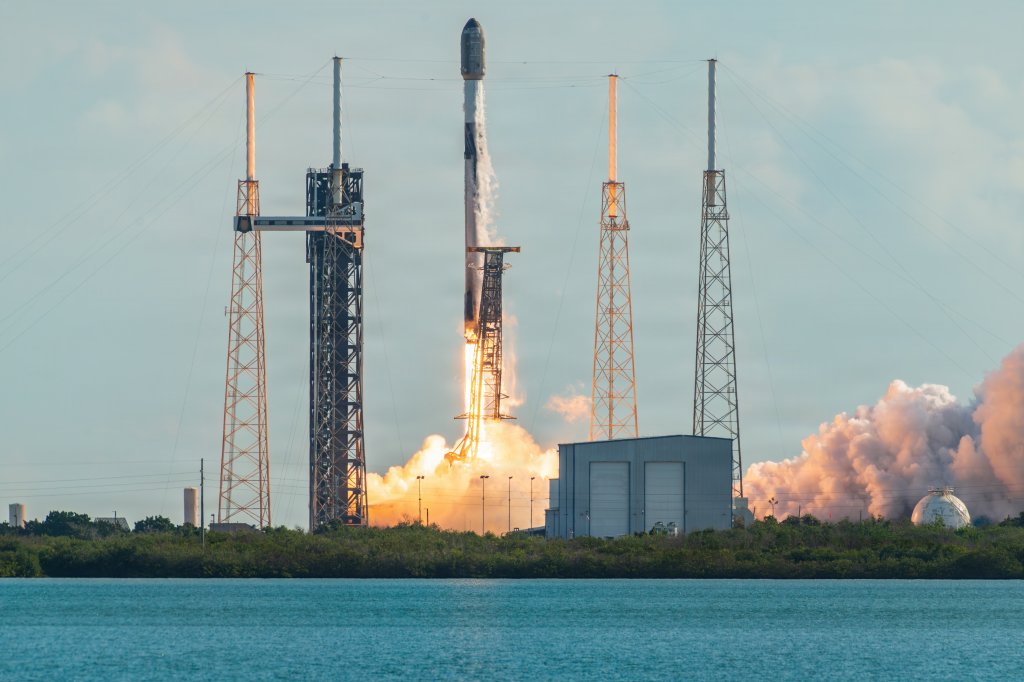
A SpaceX Falcon 9 rocket launches from Space Launch Complex 40 at Cape Canaveral Space Force Station, Florida, on May 29, 2026. (U.S. Space Force photo by Gwen Kurzen) Gwendolyn Kurzen
“As the world’s premier spaceport continues to support an unprecedented launch tempo for national security and commercial missions, securing critical launch infrastructure from low-altitude aerial threats remains a top operational priority,” the spokesperson explained. “The ongoing security modernization integrates detection, tracking, and defensive capabilities to include directed energy systems. These will provide security forces with real-time situational awareness and the necessary tools to safeguard personnel, launch complexes, and national security payloads.”
The spokesperson did not have a timeline for when the directed energy system will be operational. Florida Today was the first to report that lasers will make up this defensive system.
Col. Brian Chatman, who commands Space Launch Delta 45, told the publication that the facility is “bringing on a directed-energy system that can do a kinetic kill against UASs (Unmanned Aircraft Systems) that are coming into the area that are having nefarious intent.”
“The Air Force Research Laboratory [AFRL]-tested system has been proven to be able to safely bring down a drone,” Florida Today noted. “This directed-energy system uses lasers to shoot down any drone that flies into restricted areas.”
Chatman didn’t name the specific system to Florida Today and the SLD 45 spokesperson declined to say.
The following video shows one such AFRL-tested system that has been used in combat before.
For the spaceport, being able to use lasers is even more important than it is for other locations needing protection from drones. That’s because the traditional method of jamming radio frequencies to interfere with drone connections to controllers could damage spacecraft.
“If you start blasting a bunch of RF energy you run into potential challenges,” Chatman explained. “You don’t want that.”
There is good reason for Chatman to be concerned about drones. The spaceport has been subjected to many unauthorized incursions, the spokesperson told us. However, there were no statistics immediately available on how many or whether they occurred during launches. There were 500 unauthorized drone flights over the adjacent Port Canaveral in 2025, Port Canaveral CEO Capt. John Murray said.
In addition, on Sept. 18, a Chinese tourist pleaded guilty to a federal misdemeanor charge after flying a drone in restricted airspace above NASA’s Kennedy Space Center (KSC) in late July. KSC is located across the Banana River from the space station.
It is unclear if the new laser system will also protect the skies over KSC. The spokesperson did not immediately know and is checking into it.
Cape Canaveral. (Google Earth)
That tourist, Xiaodong He, flew a drone that videotaped the installation, according to federal documents. The drone got within 1.56 miles of pad 39B, from where the next crewed lunar flight is expected to launch in 2028.
NASA’s Kennedy Space Center pad 39B. (NASA)
Encompassing about 25 square miles, Cape Canaveral Space Force Station is a large, unpopulated, open area with a long Atlantic Ocean shoreline. The station’s physical layout allows many vectors for drone incursions, and what’s housed there makes it a logical target for a nefarious actor.
The systems being prepared for launch and launched at the sprawling facility are extremely valuable and can take many years to build, costing billions. When they are out on the pad or being transported around, the rockets are massive tubes packed with high explosives that would cause a devastating secondary explosion if struck.
Even disrupting launches there due to a successful or even attempted attack could have major national security impacts.
Maybe the place that needs them most. Use your imagination with this one.
The move to bring directed energy systems to protect the spaceport comes as the military is investing heavily in these systems to counter drones. Late last month, for instance, troops from the Joint Task Force-Southern Border (JTF-SB) employed an Army Multipurpose High Energy Laser (AMP-HEL) system during an operation dubbed Ardent Vanguard. The AMP-HEL was used “to engage and defeat three hostile UAS, determined to be such based on their use in direct support of activities posing a physical threat to U.S. military personnel and CBP [Customs and Border Protection] partners,” according to a media release at the time.
The shootdown was part of the U.S. government’s ongoing effort to counter drones being flown by Mexican drug cartels.
Joint Task Force – Southern Border personnel used the Army Multipurpose High Energy Laser system to engage and defeat a hostile drone. (U.S. Army Photo by Sgt. Daniel Huerta) Operation Ardent Vanguard
The military is seeking to expand its ability to counter drones with directed-energy weapons. In May, the Defense Department and Joint Interagency Task Force 401 selected five installations to participate in a directed-energy counter-unmanned aircraft systems pilot program required by the Fiscal Year 2026 National Defense Authorization Act.
“This initiative will accelerate the fielding and evaluation of advanced directed energy capabilities to protect critical infrastructure, military installations and homeland missions,” the Pentagon explained. “The locations were deliberately selected to support rigorous testing and operational assessments across diverse environments and mission sets.”
The Pentagon selected two “key southern border installations” for this program: Fort Huachuca, Arizona; and Fort Bliss, Texas. It also tabbed Naval Base Kitsap, Washington; Grand Forks Air Force Base, North Dakota; and Whiteman Air Force Base, Missouri.
Though the Pentagon is pressing forward with making directed energy a key part of counter-drone efforts, laser weapons have limitations. These include their short-term magazine depth being limited to how many successive shots they can fire before thermal loads require the system to cool down. Energy supply can also be a limiting factor. Additionally, laser systems don’t function as well in heavy cloud cover and other inclement weather.
You can see the Iron Beam’s first claimed kills in the following video.
A World First — Combat-Proven Laser Defense, Powered by Rafael
For the first time in history, high-power laser systems have been used to intercept aerial threats in combat. This unprecedented breakthrough took place during the Swords of Iron War — with Rafael’s advanced… pic.twitter.com/B3D6UdCJvE
— Rafael Advanced Defense Systems (@RAFAELdefense) May 28, 2025
At the same time, a laser weapon of this kind is very much a point-defense weapon, with its short range meaning that multiple systems will be needed to provide coverage of a significant area. In some situations, even a single, large military base like Cape Canaveral Space Force Station might require more than one to provide full defensive coverage.
In addition, there have been concerns about the safety of the systems and the authorities required to use them in the homeland.
Safety concerns about using directed energy weapons, and especially kinetic ones, to take down drones in the U.S. have been a major factor in why they haven’t been previously used in this role. Almost two years ago, officials at U.S. Northern Command (NORTHCOM), which has coordinating authority for counter-drone efforts in the U.S., said the use of such weapons was not yet on the table. The reason is that they can create dangerous or otherwise serious collateral effects that are less of a concern in a war zone.
That the U.S. Space Force is bringing in a laser system to protect some of the nation’s most important and secret military assets is a strong indication that these concerns are being overcome.
The Essay: Hannah-Jones said she and her husband made the decision to enroll her daughter, Najya, in Public School 307 – a segregated, high-poverty school in New York – when Najya was in pre-K as part of an effort to help "dismantle educational inequality." Hannah-Jones wrote that she realized she'd "failed both my values and my child" after Najya, now 16-years-old, discovered her school's test scores were below-state average. According to Hannah-Jones, she believed by enrolling Najya in this school, she could help invest in the school and encourage improvements from within. Hannah-Jones compared her efforts to previous challenges against racism, segregation and inequality in educational institutions by black parents since the 1950s, but ultimately concluded that her daughter's "sacrifice could not transform a system" that remains apathetic to improving equality.
Race Isn't the Problem: An opinion in New York Post (Right) by Sam Munson argued that Hannah-Jones was wrong in assuming "whiter and wealthier schools are necessarily better ones." Munson described his kids' educational experience at a Title I, majority-Latino school as "good to excellent" and said "nebulous racists" aren't the problem with educational failure. He argued the solution is for New York to increase the number of screened schools and "raise and harden academic standards." Munson said one aspect of Hannah-Jones' assessment was correct: "The wealthy liberals who spent a decade beating their breasts about their own alleged complicity in 'white supremacy' will bear any burden and pay any price to avoid educating their children in the same schools as lower-income black and Latino kids — no matter how high-quality those schools may be."
School Choice: Billy Binion (Center) sympathized with Hannah-Jones in his Reason (Center) opinion piece, but argued she came to the wrong conclusion on school choice. Binion wrote that her "antipathy to school choice" makes racial segregation in US schools worse and that despite Hannah-Jones describing issues of school choice and lack of financial resources, the results of her experiment didn't "appear to readjust her worldview in a meaningful way." He challenged the idea that funding is the primary reason for low performing schools, instead saying it's how schools are organized, the incentives within them and the concentration of disadvantaged students. A National Review (Right) opinion writer also argued for school choice, saying that Hannah-Jones is still on the side of educators who "failed" Najya by "portraying school choice as a racist scam and complaining about a lack of resources."
Challenges of the Education System: In an opinion for Salon (Left), Alex Galbraith highlighted debates that followed Hannah-Jones ' essay, including on school choice, and pushed back against assertions that wanting the best for your child is "a betrayal of egalitarian ideals." Galbraith argued that it's easy to point fingers and claim hypocrisy, but that thinking about "the advantages and disadvantages baked into the system" that Hannah-Jones described "strays too far from the preferred framework of school choice advocates and other conservatives." An MS NOW (Left) opinion writer furthered this argument by writing that NYC public schools have "deep, relentless and intentional segregation." The writer contended that black parents are "presented with false 'choices' from the start" by having to choose in a system that "maintain[s] at least one of the three tiers of school segregation."
Paramount cleared the final hurdle to merge with Warner Bros. Discovery (WBD) after resolving an antitrust lawsuit delaying the acquisition.
For Context: Paramount in December launched what some called a "hostile bid" for WBD to outbid Netflix and is now set to pay $111 billion. The ordeal until Monday was stuck in litigation, with a coalition of 12 states trying to stop the deal from occurring. Paramount CEO David Ellison is expected to take control of all WBD's assets by early October, including CNN News (Lean Left bias).
"Cooler Heads Have Prevailed": The New York Post (Right) editorial board said the "deal is going through—and that's a good thing," adding that the "unnecessary Paramount drama" is a "Hollywood happy ending." The board highlighted that "Left-wing activists are upset," saying "It's ironic that the same crowd that accuses President Donald Trump of trying to control the media by pulling White House access wants to control the media by controlling who owns what." According to the article, "cooler heads have prevailed, showing California still has some common sense and good will, even if they take a while to turn up."
"Reason To Worry": Opinion writer Brian Steinberg for Variety (Lean Left) said CNN staffers "thought the news giant's path to the future was becoming more clear," until a "new fog" Steinberg called the win by Paramount "set in." While "linear ratings are down noticeably from the era when it [CNN] won notice for its aggressive coverage of President Trump's first term," Steinberg asserted that the "outlet appeared to have found its groove" in recent weeks. Steinberg cited Paramount's "controversial" management of CBS News, saying it "has not been good for the business of the news unit" and gives CNN personnel "reason to worry." Since Bari Weiss took over CBS as editor in chief Steinberg explained, there has been "unnecessary scrutiny to news reports, and anchors have made public entreaties on Instagram when people post notes suggesting that Weiss' background as a digital entrepreneur and provocative opinion writer have [sic] muddied the newsgathering network."
The state of Florida and a New York-based think tank filed a lawsuit against The New York Times Company (NYT) on Wednesday, seeking internal documents to determine whether the company is allowing its paper to be biased against Israel.
The Suit: The suit was filed by NYT shareholders, the State Board of Administration of Florida (SBA), and the self-described "nonpartisan, free-market, independent conservative" National Center for Public Policy Research (NCPPR) think tank.
The Demand: On May 29, the National Jewish Advocacy Center (NJAC), acting on behalf of NCPPR, requested to examine the company's records to see whether it "failed to adequately discharge their fiduciary duties with respect to material legal, reputational, and financial risks arising from the Company's publication of factually unsupported content." The NCPPR took issue with an opinion from Nicholas Kristof titled "The Silence That Meets the Rape of Palestinians," which it described as "controversial." The NJAC stated that the NCPPR has the right to inspect the company's records as shareholders under New York law, NY BCL § 624. The NCPPR said shareholders have been requesting the records for months. In its news coverage of the suit, The New York Times (Lean Left bias) said in August it refused to turn over the records.
Florida Context: Florida's SBA is responsible for the state's investment funds, including its pension program. The Times reported that, according to its most recent SEC filing, Florida holds about 145,000 shares of NYT. In February 2025, the Florida SBA sued retail company Target, alleging it "misled investors" with its promotion of diversity, equity, and inclusion (DEI) initiatives.
Key Quotes: Florida's Attorney General James Uthmeier discussed the lawsuit in a conference at Miami-Dade College and wrote on X that the suit was filed for the good of "Florida's 1.2 million public retirees." Uthmeier said the suit is not a "challenge to any certain article or editorial discretion" and that news outlets "certainly have First Amendment rights," but about "legal responsibilities and duties" to shareholders. Uthmeier said the SBA observed 72 recent errors The Times made that involved "pro-Hamas" bias and "had to be retracted." Charlie Stadtlander, a spokesman for The Times, said, "This lawsuit has no merit and was brought for an improper purpose. Although it is positioned as a corporate governance petition to inspect the company's books and records, it is a transparent attempt to exert agenda-driven pressure against an independent media organization, level false allegations of bias and chill journalism protected by the First Amendment."
Whistleblower:The Free Press (Lean Right), which AllSides has previously observed as being "very pro-Israel," reported speaking to an unnamed former Jewish Times employee. According to the suit, she had raised concerns about antisemitism and anti-Israel bias 15 times between 2019 and her March 2026 departure from the outlet. She told The Free Press, "The public deserves a better picture of how the Times manufactures the news when Jews or Israel are involved."
How The Media Covered It: The Free Press' coverage focused heavily on the whistleblower's account and allegations of bias at the paper. In its news coverage, The New York Times described Utheimer as "an aggressive conservative culture warrior" who is currently running to retain his post as attorney general. Reuters (Centers) argued in news coverage that the suit "escalates a growing battle nationwide over journalistic independence" and cited the recent confrontation between the Trump administration and several major news networks.
Editor's Note: A previous version of this headline incorrectly mentioned "pro-Israel bias" instead of "anti-Israel bias." We apologize for any confusion this caused.
A 2-year-old boy traveling with his mother toward the Canary Island of Lanzarote was allegedly thrown into the sea from a migrant boat because he would not stop crying, according to an official who oversees the island’s emergency response.
Enrique Espinosa, manager of the Security and Emergencies Consortium of Lanzarote’s island council, or Cabildo, recounted the episode on the Crónicas Radio program “A Buena Hora.”
He mentioned the case of the child when he was asked about a sexual assault of a woman during a boat crossing for which three men were arrested and sent to provisional prison.
According to Espinosa, the child’s case was among the “even more terrible” events emergency services have encountered.
“On a boat, they threw a 2-year-old boy who was crying with his mother into the water,” Espinosa said. He added that passengers’ accounts describe situations “bordering on a lack of humanity.”
However, the fate of the 2-year-old remains an open question. Espinosa did not say when the alleged incident occurred, whether the child was recovered or whether anyone has been arrested in connection with it. The radio program’s host did not ask any follow-up questions about the child.
Espinosa described a situation of growing pressure, stating: “Since June, arrivals have increased due to the Ceuta effect and there is less control on the Moroccan border.”
The remarks came after Spain’s National Police arrested three men, ages 21, 25 and 30, as the alleged perpetrators of a sexual assault during a Sept. 16 crossing bound for Lanzarote. The investigation also located a witness who was traveling on the same boat. The three suspects were later placed in provisional detention.
Police said the woman reported the assault after the vessel reached the port of Arrecife. Coast guard crews rescued 65 survivors from that crossing and recovered three bodies from the water.
The account of the child coincided with several days of heavy boat arrivals on Lanzarote. Espinosa said eight boats had reached the island in just two days, carrying more than 400 migrants, and that emergency workers had treated numerous people for dehydration, hypothermia and injuries from blows.
Arch-Technocrat Elon Musk wants to go to Mars with 1 million people to establish a Technocracy in space. Everything that he has done with SpaceX enshrines that goal. Along the way, he has littered outer space with his junk. Imagine the trail of trash from Earth to Mars, and then the trash heaps on Mars itself. Didn’t his mother ever tell him to clean up his messes? ⁃ Patrick Wood, Editor.
As early as next week, the world will leave behind 69 years of space exploration and commerce and enter the age of Starship, an era that will be defined by drastically lower launch costs and a notable increase in the amount of material humans send to orbit.
SpaceX is scheduled as soon as Monday to launch its huge reusable rocket into orbit for the first time on its maiden commercial mission to deploy the company’s new V3 satellites. Although SpaceX won’t attempt to recapture either the booster or the second-stage spacecraft, the company has already demonstrated it can catch the booster, and it made a controlled landing of Starship in the Indian Ocean, paving the way for routine capture of both stages for reuse, which is the key to lower costs and more frequent launches.
The industry already got a taste of lower launch costs with SpaceX’s partially reusable Falcon 9 rocket, whose booster is retrievable. Worldwide orbital launches tripled to 329 last year from 102 in 2019. Falcon 9 accounted for half of those 2025 launches and carried more than 80% of payloads by tonnage. Starship is designed with a payload capacity of 100 metric tons, more than five times Falcon 9’s capacity to low Earth orbit.
The downside to this new era in space exploration is that humans are likely to leave much more debris floating around in orbit. It will take a concerted effort by nations and companies — from prevention to new technologies — to avoid turning space into a gigantic junkyard that puts satellites and other spacecraft at risk.
Europe and the US have taken the lead on best practices to avoid space junk, but there are no mandates nor penalties. And a worldwide effort is unlikely to coalesce. The US and Russia are responsible for the most debris in space because they’ve been launching the longest, but China is catching up quickly with its aggressive space program. And the US added new tension this month when it confirmed that it has weapons in space after warning that China and Russia are developing their own, an effort that may accelerate with the US’ push to create a Golden Dome defense system. A shooting war in space could cripple satellite communication on Earth and spread even more debris.
Regardless of weaponization, space is only going to get more crowded, especially in low Earth orbit, where countries and companies want to emulate SpaceX’s massive constellation of about 10,000 active satellites.
Even though most companies have adopted best practices to avoid leaving space debris in orbit, accidents are inevitable. For orbits that are 500 kilometers (310 miles) above Earth and lower — where SpaceX deploys almost all its satellites — the drag from the atmosphere pulls down objects in a relatively short time, and they burn up before reaching the ground. At higher altitudes with less drag, objects can stay in orbit for years and even decades.
Unfortunately, thousands of old satellites and rocket boosters are already still floating around space, and many of these were abandoned before the best practices of burning off remaining fuel and disconnecting batteries. Old fuel tanks and batteries degrade over the years and can explode spontaneously, sending debris in all directions — some of which gets caught in orbit and can linger for decades.
Just as humans continue to dump trash in the ocean even though the alarm bells have been ringing for years about the problems of floating refuse islands, space debris has been accumulating even though the threat was flagged decades ago. In 1978, a paper published by two scientists — Donald Kessler and Burton Cour-Palais — spelled out the devastating scenario in which space junk becomes so prevalent that it creates runaway crashes that spiral out of control and make certain orbits unusable.
Concern over this so-called Kessler Syndrome and large space junk, such as Skylab, spurred NASA to create its Orbital Debris Program Office in 1979 to track defunct satellites, spent rocket bodies and other debris. The first known collision by space junk was recorded in 1996, when debris from a rocket that had exploded a decade earlier hit a French military satellite. In a famous incident in 2009, an abandoned Russian military communications satellite crashed into an Iridium commercial satellite, significantly increasing space debris.
A report by the Inter-Agency Space Debris Coordination Committee this year says statistical models show tens of thousands of pieces of space junk larger than 10 centimeters (3.9 inches) and hundreds of thousands of debris objects larger than 1 centimeter. These small pieces travel at tremendous speeds and can cause significant damage, said Nilton Rennó, a professor at the University of Michigan who tracks small orbital debris.
“There are many unexplained satellite accidents that people have been blaming on debris,” he said in an interview. “But no one really knows.”
With launch activity increasing, continued fragmentation of space junk and little progress in objects leaving orbit, the report estimates the number of debris larger than 10 centimeters will more than double in less than 50 years.
SpaceX has taken steps to reduce space junk. The company said in February that in 2024 it left 13 upper stages of its Falcon 9 in orbit out of 134 successful missions and lowered that to only three out of 165 launches last year. Of those 16 upper stages left as debris, all were emptied of fuel, and six have since reentered the atmosphere. More may have left orbit since that February statement. The upper stage of a Falcon 9 that deployed lunar landers in 2025 for two companies finally crashed into the moon in August.
SpaceX runs a system to track space objects and opened it up to any entity willing to provide satellite trajectories. The system predicts when two objects are on a collision course and automatically sends alerts to the operators. The satellites’ positions can then be adjusted to avoid the collision. The downside is that satellites must burn fuel to avoid objects, which shortens their life. The International Space Station has to fire its thrusters to avoid large space junk a few times each year.
Technologies to actively remove debris are still in the experimental stage. Even if they prove successful, they will be expensive and target only large objects. The best action is prevention. It would be a shame that just as technology has made space much more accessible, the future would be cluttered by hubris and carelessness.
Space should be the final frontier — not the latest dumping ground.
Pocas veces he constatado un grado tan alto de expectación no ya entre la cinefilia, sino también en gente de la calle que quiere saber mi opinión sobre una película titulada La bola negra. Viene avalada por premios lujosos en festivales, en la tantas veces falsa suposición de que esos
The expression “Dark Ages” grew out of the work of the fourteenth-century Italian scholar Petrarch, who contrasted the cultural achievements of classical antiquity with what he saw as the darkness that followed. Later writers expanded that judgment until the term came to describe much of the period between the fall of the Western Roman Empire […]
China’s President Xi Jinping concluded his three-day state visit to the US on Friday, September 25, with hopes of enhanced cooperation and partnership between the world’s two largest economies.
Xi arrived in the US on Wednesday and received a large-scale welcome from President Donald Trump. Though this was their third in-person meeting it was Xi’s first state visit to the US in over a decade.
On Thursday, the leaders had a long in-person conversation in the White House and finished the day with a state dinner with 130 guests, including tech executives. Though the US is yet to release its version of the official proceedings, reports indicate they discussed a range of outstanding issues such as the dispute over trade and tariffs, cooperation in Artificial Intelligence, the issue of Taiwan, and the US-Israeli war on Iran.
During the meeting with Trump, Xi called for strategic stability in the China-US relationship which will benefit both countries and the people around the world, Xinhuareported.
“China and the US should be partners, not rivals,” Xi said.
Xi’s statement comes at a time when the two countries are negotiating a longer trade deal after briefly facing each other in a tariff war last year. Both countries agreed to extend their temporary trade truce which halted the tariff war till January to give their negotiators more time.
The so-called Busan Trade Truce was set to expire in November this year.
Xi hoped that “both sides would stay committed to the principles of mutual benefit and win-win cooperation and promote the sustained, stable and sound development of China-US economic and trade relations.”
Technology and AI
Successive administrations in the US have characterized China’s advancements in technology and other economic sectors as a threat to American interests and have tried to curb them by restricting its access to technology.
In his attempt to address such apprehensions, Xi proposed that “both sides work towards a relationship featuring cooperation as the mainstay, moderate competition, manageable differences, and the promise of peace.”
Talking about the competition in the development of Artificial Intelligence (AI), Xi offered increased coordination and cooperation between the countries as a way of mutual benefit.
While emphasizing that “two sides should maintain human control over AI technologies, uphold people-centered approach and the principle of using AI for good” he proposed greater exchange of information to “prevent any misuse and abuse of AI.”
Xi also expressed hope that Chinese companies “are treated fairly in the US” while inviting more US companies to invest in China. “Working together, we can lengthen the list of cooperation and shorten the list of issues” he underlined.
The US has sanctioned or put a large number of Chinese companies, including its AI firms on various watch lists in recent years, after accusing them of working with the Chinese armed forces or being involved in the so-called technology theft.
Notably, however, major US tech and finance executives such as Jensen Huang of Nvidia, Mark Zuckerberg of Meta, Eric Yuan of Zoom, Kelly Ortberg of Boeing, Larry Fink of Blackrock, Sam Altman of OpenAI, Satya Nadella of Microsoft, Sundar Pichai of Google, Jeff Bezos of Amazon, and Elon Musk of SpaceX and Tesla, were present at the state dinner for Xi’s visit hosted at the White House on Thursday, September 24, though no details of cooperation between US and Chinese tech firms have emerged.
Taiwan
Reiterating China’s resolve to “safeguard national reunification and territorial integrity,” Xi expressed hope that the US will “adhere to the correct position on opposing ‘Taiwan independence’ and handle the Taiwan question with caution.”
China has repeatedly accused the US of promoting the separatist cause in Taiwan, despite officially adhering to “one China policy.” The US under Trump has sold or agreed to sell billions of dollars’ worth of weapons to Taiwan in complete disregard of China’s objections.
China has also accused the US and its allies in the region of promoting an arms race by deploying advanced weapon systems close to its borders.
Xi said if the US follows the correct position on Taiwan it “will enable both the countries to lay a solid foundation for their strategic cooperation and the development of their bilateral relationship.”
US-Israeli war on Iran
China has refused to intervene or get involved in the US-Israeli war on Iran, despite Trump’s repeated calls for them to do so. China has maintained the war was unnecessary and repeatedly warned against its prolongation. It has supported the interim peace deal signed in June under international mediation.
Xi reiterated this position during his visit to the US, expressing hope that both Iran and the US would soon return to the Memorandum of Understanding (MoU) and end the war.
Xi claimed that “China-US cooperation may not solve every problem in the world, but without it, it would be hard to solve many of the world’s problems” and proposed more dialogue and “mechanisms of crisis communication and prevention” between their armed forces.

 Login