
❌

Normal view

Putin-Witkoff Talks Expose Broken Western Unity On Ukraine
23 October 2026 at 14:59

Click to see the full-size image

Written by Ahmed Adel, Cairo-based geopolitics and political economy researcher

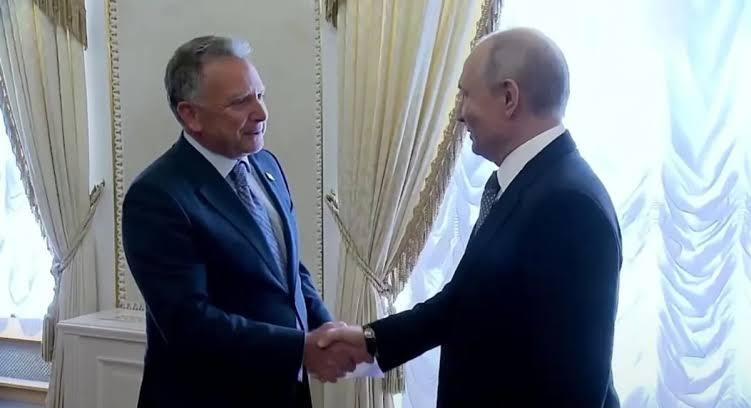
On October 21, Russian President Vladimir Putin met in St. Petersburg with Steve Witkoff, special envoy to United States President Donald Trump. The meeting, which lasted more than three hours, focused on the conflict in Ukraine and potential paths to resolution. Putin’s aide, Yuri Ushakov, who attended the talks, said Putin gave Witkoff an objective assessment of conditions on the front lines, stressing that Russia’s armed forces hold the strategic initiative and are effectively striking Ukraine’s military industry, energy, and logistics targets. Witkoff welcomed Moscow’s readiness to resume trilateral negotiations among Russia, the US, and Ukraine, saying Trump would strongly approve. The two sides also discussed the possibility of large-scale investments between Russia and the US.

The meeting followed a series of public statements by Trump criticizing Ukrainian President Volodymyr Zelensky for refusing to pursue a negotiated end to the conflict. Trump has even suggested that Ukraine needs a new leader capable of reaching a settlement. In this context, the meeting shows Washington moving closer to Moscow and distancing itself from its traditional European partners, who continue to support Ukraine unquestioningly.

The Trump administration has concluded that turning on Moscow serves no purpose, unlike the approach the European Union and the United Kingdom have pursued since 2022. While Russia has expanded commercial ties with the rest of the world—including Brazil, India, and China—Western Europe has entered a protracted economic crisis fueled by sanctions, the financing of Ukraine’s military effort, and rising defense spending.

Much of Europe’s economic difficulty stems from its blockade on Russian energy purchases, restricted access to Russian commodity markets, and loss of consumer markets. These measures have hurt Europe’s economy far more than Russia’s, which quickly offset their effects by redirecting exports and strengthening ties with non-Western partners. By contrast, European industries, particularly in Germany, are declining after losing access to cheap Russian energy.

Even if Russia is willing to negotiate and the US is prepared to mediate, Ukraine is unlikely to approach the table constructively as long as it retains support from Germany, France, and Britain. Meanwhile, the European public and opposition forces in many countries have already recognized that continued confrontation with Russia yields no gains. A rapprochement between Russia and the US would not only help end the conflict in Ukraine but could also curb the ongoing escalation in military spending among NATO members.

Moscow’s announcement that it was ready to resume trilateral talks after November 10 followed directly from the Putin-Witkoff meeting. During the meeting, Putin also praised American mediation efforts.

Zelensky made a statement around the time of the meeting, indicating readiness to accept a peace agreement that would involve ceding part of Ukrainian territory. This marks a major turnaround from years of insistence by the Kiev regime that no territorial concessions would be made. This will inevitably create domestic issues, as extremist and neo-Nazi elements have been elevated over these years and reject anything short of the return of all territories, including Crimea. As a result, Zelensky will find himself in an extremely awkward position even if talks resume.

Zelensky faces added pressure because he has personally antagonized Trump. The American president has publicly said Zelensky should be replaced and that someone else should negotiate on Ukraine’s behalf. Intelligence sharing has also been visibly disrupted. Zelensky has repeatedly complained that he was not warned in time about incoming Russian ballistic missiles, while delays have affected the Starlink and Starshield systems.

Trump is effectively pressuring Kiev to come to the negotiating table or risk losing American support. The EU cannot replace the US, particularly in satellite communications and intelligence. Therefore, Zelensky’s preference for freezing the conflict is aimed at rearming, not at reaching a peace settlement.

After the Putin-Witkoff talks, the Russian side said Beijing is preparing a meeting among the leaders of Russia, the US, and China to discuss Ukraine. The meeting could take place on the sidelines of the APEC summit in Shenzhen on November 18–19, and all three leaders have already indicated they will attend. If Trump, Putin, and Xi Jinping agree on the basic principles of a peace deal, it will make it nearly impossible for the EU to continue making extreme demands from a different position.

Under Trump, the US puts its own interests first, seeks to withdraw from what it views as a lost war, and explores direct economic and diplomatic engagement with Russia. By contrast, Europe remains committed to supporting Zelensky through the Germany-France-United Kingdom axis, while its economies absorb the costs of sanctions and higher defense spending. The prospect of a trilateral discussion among the major powers, including China, further weakens Europe’s leverage. The St. Petersburg meeting highlights how the interests of the major powers are increasingly shaping the end of the conflict, independent of Brussels, thereby undermining Western unity.


MORE ON THE TOPIC:

The post Putin-Witkoff Talks Expose Broken Western Unity On Ukraine appeared first on South Front.

ONG pede investimento agrícola para combater fome em Timor

23 October 2026 at 14:12
Relatório sobre o Índice Global da Fome de 2026 classifica Timor-Leste na categoria "grave". Pobreza, produção agrícola insuficiente e dependência das importações são problemas identificados.

© ANTONIO AMARAL/LUSA

Dados do Governo timorense indicam que 47% das crianças com menos de cinco anos sofre de má nutrição crónica, 8,6% de desnutrição aguda, 32% tem peso abaixo do previsto e deficiência de vitamina A, ferro e iodo

Viaje a las fábricas de ciberesclavos de Laos que te timan en España: "En mi planta nos dedicábamos a las estafas románticas"

22 October 2026 at 23:03
'Crónica' se adentra en el Triángulo Dorado, donde las mafias retienen a trabajadores asiáticos y africanos y los obligan a estafar bajo coacciones y palizas si no cumplen sus objetivos. Les prometen empleo y al llegar les roban los pasaportes. Con identidades falsas e inteligencia artificial, estas redes se ganan la confianza de víctimas a miles de kilómetros, también en España, para vaciar sus cuentas Leer

'Crónica' se adentra en el Triángulo Dorado, donde las mafias retienen a trabajadores asiáticos y africanos y los obligan a estafar bajo coacciones y palizas si no cumplen sus objetivos. Les prometen empleo y al llegar les roban los pasaportes. Con identidades falsas e inteligencia artificial, estas redes se ganan la confianza de víctimas a miles de kilómetros, también en España, para vaciar sus cuentas

Comisión examina aplicación de eutanasia en Uruguay

23 October 2026 at 12:42

Montevideo, 23 oct (Prensa Latina) En los primeros seis meses de aplicación de la reglamentación de la ley de muerte digna, una docena de personas acudió a la eutanasia en Uruguay, según balance que trascendió hoy.

The post Comisión examina aplicación de eutanasia en Uruguay first appeared on Noticias Prensa Latina.

Why Did India Ditch U.S. F/A-18 Super Hornets Despite Its Navy Loaded With American Military Platforms?

23 October 2026 at 11:21

The Indian Navy is conducting trials of the French Dassault Rafale-M, the naval aircraft that edged out the American F/A-18E/F Super Hornet in a tight contest. 

Interestingly, the Indian Navy already operates a substantial number of American platforms. Against that backdrop, Boeing had expected to secure yet another major Indian contract.

Why did the French Rafale-M ultimately edge out the Super Hornets?

In April 2025, India ordered 26 Rafale Marines to replace the Russian-origin MiG-29K, which currently operates from Indian aircraft carriers– INS Vikramaditya and INS Vikrant.

More than a year after signing the contract, the Indian Navy is running Rafale-M trials at the Shore-Based Test Facility (SBTF) at INS Hansa in Goa and is reportedly considering some minor modifications to its aircraft carriers to accommodate the French aircraft.

According to the reports, the service is considering these small modifications because the Rafale-M fighters were originally designed to operate from CATOBAR (Catapult Assisted Take-Off But Arrested Recovery) carriers—such as the French carrier Charles de Gaulle—whereas Indian carriers use a Short Take-Off But Arrested Recovery (STOBAR) system.

Additionally, the Rafale-M has a wingspan of almost 10.9 meters, and unlike the MiG-29K, it is not designed to fold its wings to take up less space on the deck. This creates a larger deck or hangar footprint. So, the Navy is purportedly examining minor procedural workarounds, such as temporarily detaching the wingtip missile launch rails to reduce the effective span to roughly 9.6 meters, along with handling and stowage adjustments.

Rafale-M deliveries are expected to begin in 2028 and likely conclude by 2030, marking the first time in a decade that the Indian Navy will operate a non-Russian or Western fighter. Its last Western carrier fighter was the British Sea Harrier aircraft, which it retired in 2016 after more than three decades of service.

Notably, the Indian Navy has operated French equipment before, though never on this scale.

Earlier, it acquired 12 Breguet Alizé carrier-based anti-submarine warfare (ASW) aircraft that participated in the 1961 Goa operations and the 1971 Indo-Pakistani War and served the Navy until 1991. The service has also operated the HAL Chetak, a French-designed light utility helicopter produced in India for decades, though it is now being phased out in favor of more advanced indigenous aircraft. 

By contrast, the Indian Navy operates a range of US-origin equipment, from helicopters to spy aircraft, making the choice of a French carrier-based jet particularly interesting.

File Image: Rafale-M

Indian Navy: Full of US-Origin Weapon Systems

Despite the push for indigenization, the Indian Navy has steadily acquired American platforms and weapons over the past few decades.

One of the most important items on this list is the P-8I Poseidon maritime surveillance aircraft. India first ordered eight P-8I aircraft in January 2009, becoming the type’s first international customer.

It signed a follow-on order for four additional aircraft in 2016, significantly enhancing its maritime surveillance, anti-submarine warfare, and ISR capabilities and positioning it as a critical asset in the Indian Ocean Region. In February 2026, the Defense Acquisition Council (DAC) officially cleared an additional P-8I purchase.

In addition to the Poseidon, the Indian Navy ordered 24 MH-60R Seahawk Multi-mission naval helicopters in February 2020. It has since received 21, and the rest are expected to arrive in 2027. These helicopters can conduct anti-submarine warfare, anti-surface warfare, shipborne multi-role operations, and networked operations, arming the Navy with the capability to detect and neutralize underwater and surface threats in the Indian Ocean.

The Navy has also leased two MQ-9B Sea Guardian drones from US-based General Atomics since 2020. It is supplementing these by leasing two more as per a contract signed in August 2026. These drones have supported maritime surveillance and intelligence, surveillance, and reconnaissance (ISR) missions in the Indian Ocean Region, complementing the Navy’s P-8I and helping maintain vigilance.

India also signed a $3.3 billion deal with the US in October 2024 to acquire 31 MQ-9B High-Altitude Long-Endurance UAVs. Of the 31 Sea Guardians the MoD purchased, the Indian Navy will receive 15 drones, while the Indian Army and the Indian Air Force will each receive 8 to strengthen surveillance along the northern and western borders.

The Indian Navy operates one US-acquired INS Jalashwa (the former USS Trenton), an Austin-class amphibious transport dock with a sealift capability for over 3,500 troops and a squadron of armored vehicles.

Furthermore, the service has also acquired several lethal US munitions over the years, including the AGM-84 Harpoon Block II anti-ship missile, Mk 54 lightweight torpedoes, and the AGM-114 Hellfire, to name just a few. 

Despite these rather high-value acquisitions, the Indian Navy has never purchased or operated an American fighter jet. When it finally got the chance to buy a US aircraft, i.e., the F/A-18E/F Super Hornet, the service chose the Rafale-M instead.

Why did India Opt For Rafales over Super Hornets?

When India opened the contest for a carrier-based fighter to replace the MiG-29K jets, Boeing offered its F/A-18E/F Super Hornet Block III.

In 2022, Boeing India marketed the F/A-18 Super Hornet Block III as a carrier-based fighter designed for high-load, high-stress operations, and stressed that the multi-role naval fighter would be fully compatible with Indian Navy carriers.

Boeing pitched the Super Hornet as a jet that required minimal support equipment and had a remarkably low cost per flight hour while maintaining high mission readiness. It tried to woo the Indian Navy by emphasizing that the aircraft would become a force multiplier because it could interface with the P-8I and other US-origin systems the service operates.

To sweeten the deal, Boeing also announced a roadmap to significantly increase its investments in line with the “Make in India” initiative and pledged to transfer cutting-edge technologies to Indian industry if the Super Hornet was selected. 

However, the Super Hornet had to dogfight with the French Rafale, a cutting-edge fighter for India’s carrier-borne aircraft tender.

In a tightly fought contest, both jets underwent extensive testing at a shore-based facility, including take-off trials from both ski-jump and catapult launchers. Both aircraft reportedly met the Indian Navy’s requirements, but the Rafale-M ultimately won.

Speaking to the EurAsian Times earlier, an ex-Indian Navy pilot who had flown both the Super Hornet and Rafale said both aircraft were extremely capable and on a level playing field. “The only issue I can think of is that the F-18 is a heavier aircraft, and the Rafale M is lighter. So, when it comes to arrested landing on the aircraft carrier, Rafale has more flexibility,” the naval aviator said at the time, requesting anonymity.

In this image released by the US Department of Defense, an F/A-18F Super Hornet launches from the flight deck of the world’s largest aircraft carrier USS Gerald R. Ford in the Eastern Mediterranean Sea, October 11, 2023. (Photo by Triniti Lersch / US Department of Defense / AFP) /

The Rafale-M shared a very high degree of commonality with the 36 Rafale jets operated by the Indian Air Force (IAF). This meant several parts, tools, and test equipment could be interchanged, and India could share ground-support systems, simulators, and diagnostic software.

Additionally, India had already established maintenance infrastructure, trained technicians, and supply chains for the IAF Rafales, which could support the Rafale-Ms.

The Navy would have assessed that Rafale-Ms would reduce costs by creating an inventory of maintenance facilities, spare parts, logistics, and potential future overhauls. Meanwhile, introducing the Super Hornet would require building an entirely separate support ecosystem.

In this scenario, the air force can familiarize itself with the Marine aircraft, while naval pilots can transition to the IAF’s twin-seat Rafales.

The  IAF is now poised to acquire 114 Rafale multi-role fighters, most of which will be manufactured locally. Therefore, one could argue that the decision to choose French jets for the Indian Navy may have been driven by the need for uniformity and interoperability, which are crucial in fast-paced conflict zones.

A secondary factor could have been the Infrared Search and Track (IRST) system, which provides a stealthy advantage in detecting and engaging threats, including potential low-observable aircraft. The Rafale-M came with an integrated IRST, whereas the Super Hornet Block III lacked one, although Boeing offered a podded solution.

Moreover, the Meteor beyond-visual-range air-to-air missile on the Rafale also offered superior standoff capability compared to the Super Hornet’s AIM-120 AMRAAM.

More importantly, however, strong defense ties between India and France, smoother government-to-government negotiations even in past deals, the potential for indigenous weapons integration, and the presence of French fighter jets in the IAF played a crucial role in the decision.

India has never acquired US fighter jets for several reasons, including export controls and restrictions on their use.

Despite its best efforts to market the Block III jet to potential customers such as Canada, Finland, Germany, Poland, and Switzerland, Boeing failed to secure any new contracts and kept losing out to rivals such as Saab Gripen, Dassault Rafale, and the Lockheed Martin F-35.


The post Why Did India Ditch U.S. F/A-18 Super Hornets Despite Its Navy Loaded With American Military Platforms? appeared first on EURASIAN TIMES.

I booked a one-way ticket to Bali after a layoff in fintech. I stayed in Asia for over a year — here's where my money stretched the furthest.

23 October 2026 at 10:05
headshot of a woman with a warm beige background
Tiffany Tang.

Courtesy of Tiffany Tang

  • Tiffany Tang founded DrinkFolks after a transformative journey across Asia in 2023 and 2024.
  • Tang's layoff in 2023 led her to Bali, where she decided to extend her 30-day trip to over a year.
  • DrinkFolks, inspired by Tang's travels, supports women-led farms and brings jamu to the US market.

This as-told-to essay is based on a conversation with Tiffany Tang, the 30-year-old founder of DrinkFolks. It has been edited for length and clarity.

I'm the founder and CEO of DrinkFolks, which brings jamu, a 1,300-year-old Indonesian herbal remedy, to the US as a prebiotic root tonic.

For the first two years of my career, I was an assistant director at a gallery owned by the first female fine arts dealer in America. From 2017 to 2021, I worked at Christie's International Real Estate in marketing and communications roles.

For the next year, I was a senior communications manager at CSM Sport & Entertainment before taking on a similar role at a fintech company that helped millions of Americans sustainably build their credit scores through rewards.

I felt positively about that job, but I was laid off in May 2023

I was grateful to work there. We were doing big things, and I really learned what it was like to be at a mission-driven company.

The most interesting thing about my layoff was how incredibly calm I felt upon hearing the news. Our CMO told me first, and she was a friend, my college professor, and an executive I admire and respect.

When she told me, I said I didn't blame her, and this was a time for a reset. Turns out, the layoff was the best thing that could've ever happened to me.

A few weeks after my layoff, I booked a one-way ticket to Bali

For a long time, my self-worth was my net worth — my title, my salary, my career trajectory. When the layoff hit, I lost my sense of self. Reflecting afterward, all I could think was: who am I without the high-paying job?

A few weeks earlier, I had watched the movie "Eat, Pray, Love." When the layoff came, something in me said that this was my moment. I opened Kayak, found a one-way ticket to Bali for around $1,000, and booked it. Bali felt approachable and warm.

What was supposed to be a 30-day reset changed the course of my life

I originally planned to travel in Southeast Asia for a month but ended up staying from June 2023 through August 2024.

My awakening happened on day three. One of the first things I did in Bali was a Panchakarma, a full-body Ayurvedic detox at a retreat in Ubud. There was an optional silent day; one of the first times in my life I rooted and looked inward.

Sitting with my journal, I knew I had to stay. I was still negotiating my severance, so I did the math: my savings, my investments, what each month would cost. When my severance came through a few weeks later, it jump-started the journey.

The deeper turning point was Hong Kong

Everyone I met understood me on an indescribable level. It was the only time in my life I was speaking Cantonese to people outside my family, reconnecting with my heritage. By the time I came home for the holidays, I had decided: I was moving to Asia.

The spark for the company was the women I met. Across Indonesia and Southeast Asia, I sat with women quietly building something of their own. I wanted to help these women build generational wealth for their families. I built DrinkFolks as a way to sustainably invest in them — 3% of every sale goes to women-led farms and nonprofits across Southeast Asia through our FolksFund — while supporting health stateside by bringing ancient wisdom into people's homes.

I started the company in January 2024, took every jamu class I could find in Bali, visited the source of jamu in Yogyakarta, and reformulated recipes in my Hong Kong kitchen.

By October 2024, I was back in the US, working with California food scientists to scale up my home-tested recipe. We launched in NYC in October 2025. Today, we're in 70+ stores across the US.

Living in Southeast Asia made the math work

My salary before the layoff was $160,000 a year, plus equity. When I set off, I had roughly $14,000 between savings and severance — my spreadsheet calculated 4.6 months of runway — and I felt comfortable investing that in myself.

I budgeted like it was my job. I tracked my actual spending obsessively for the first four and a half months and came in at roughly $7,700 total.

All-in, I averaged about $1,300 to $2,300 a month, including flights, lodging, food, everything. My money stretched furthest in Cambodia and least in Hong Kong, which was financially similar to New York City. For comparison: my overhead, including my mortgage, maintenance, electricity, and WiFi in New York today is about $2,500 a month.

In terms of cost of living comparisons, here's my breakdown

Healthcare was the biggest surprise, in the best way. I got into a motorcycle accident on the Pakse Loop in Laos, and seven stitches cost me around seven dollars, including painkillers and a week of antibiotics.

Cambodia was the best value. It's the most adventurous, outdoorsy country I visited, and I didn't want to explore alone, so I stayed in hostels for as little as $6 a night — partly a budget move, mostly a way to meet people. It's also where I met my first fellow Americans of the entire trip.

Hong Kong was the opposite — groceries and eating out gave me real sticker shock. I softened it with a genuine energy exchange: I moved in with a college friend and threw dinner parties several times a week, cooking meals for them in exchange for a place to stay. It was worth every dollar — I met some of my truest friends and future business partners there.

The layoff was honestly the best thing that ever happened to me

a woman holds up two drinks in a grocery store
Tang's first time seeing DrinkFolks on shelves in LA.

Courtesy of Tiffany Tang

It gave me the confidence to build DrinkFolks, a better sense of my heritage, and a version of myself I'm proud of. I've learned to never say never, but right now, I'm exactly where I'm supposed to be.

My advice is to use your layoff as your launchpad. Things happen for you, not in spite of you. If you have even the slightest chance to live in that moment for yourself — for me, that was travel — take it as a gift and a blessing, not a crisis to survive.

Treat budgeting as freedom, not constraint. My money stretched so much further than I imagined. Clear parameters gave me the space to figure out who I am outside my job.

Read the original article on Business Insider

❌