GWADAR/QUETTA: Pakistan has suspended trade with Iran through the official Gabd-Rimdan (250) and Taftan border crossings, it emerged on Saturday.
The Ministry of Commerce issued a memorandum on Friday, seen by Dawn, withdrawing its earlier order [No. 9(3)2017-Iran] dated Oct 3 with immediate effect.
Shahid Rind, adviser to the Balochistan chief minister on media and political affairs, said the “purpose of the temporary closure of the Pak-Iran border is to address security concerns, prevent smuggling, and make the border system more effective”.
In a statement on X, Rind refuted “rumours being spread on social media” regarding the closure and urged the public not to pay attention to unverified information.
The Balochistan official stressed that the move was “necessary to improve the security situation and administrative affairs on both sides of the border”.
Rind affirmed that “progress continues between the high officials of both countries to resolve administrative issues” related to the border.
“In the context of the current progress, the Pak-Iran border is likely to reopen soon,” he said, adding that a coordinated system was being established to improve border affairs and prevent smuggling.
Meanwhile, Iran’s foreign ministry spokesperson Esmail Baqaei also said the closure was temporary, Iran’s state-run Irnareported.
However, he attributed the move to “technical issues” and said the two countries were in consultations to resolve the problem and restore normal operations.
Separately, the Quetta Chamber of Commerce and Industry (QCCI) has also advised its members and businesses involved in trade with Iran to stop placing new import and export orders until further notice.
Hundreds of freight vehicles carrying liquefied petroleum gas (LPG), rice, fresh fruit and other essential commodities have reportedly been stranded on both sides of the border.
According to Iran-based Wana news agency, passenger traffic through the Rimdan–Gabd crossing remains operational. It quoted Syed Hossein Hosseini, director general of the Iranian Transit Office, as saying that commercial operations at the border crossing had been halted.
The Gabd-Rimdan crossing had become a major route for meeting Pakistan’s energy needs, with over 4,000 tonnes of LPG reportedly imported daily through it. Exports of Pakistani products, particularly rice, had also surged in recent months, generating millions of dollars in foreign exchange.
Sources in the trade and energy sector warned that the closure could aggravate LPG shortages in Karachi and other parts of the country.
The Taftan route was already facing disruptions amid unrest in Balochistan. The suspension of supplies through Gabd-Rimdan could push up LPG prices in the open market.
Local traders and the chamber have warned that the disruption could cause not only substantial losses to the national exchequer and jeopardise the livelihoods of many but also an energy crisis.
Since March this year, Islamabad and Tehran have rolled out a series of measures to facilitate border trade, including easing customs procedures, formalising Taftan as a customs station, and notifying new transit routes, against the backdrop of the ongoing US-Iran war that has strained economies in the region and beyond.
In early August, an Iranian delegation led by Trade and Industry Minister Mohammad Atabak visited Islamabad for the 10th session of the Pak–Iran Joint Trade Committee (JTC).
The delegation also met with Prime Minister Shehbaz Sharif, with both sides agreeing to further expand trade ties by keeping border crossings open round the clock, improving logistics and harmonising customs procedures.
The visit came a couple of months after it was reported that trade between Pakistan and Iran through the Gabd-Rimdan border crossing had come to a complete halt.
According to Gwadar Chamber of Commerce and Industry President Jiand Hoot, trade through the Panjgur and Mand-Radig border crossings was virtually non-existent because of poor road infrastructure and recurring incidents of arson and vehicle burnings.
ISLAMABAD – United States Chargé d’Affaires Natalie Baker praised Pakistan for hosting its first international women’s tennis tournament at the W15 level, calling it a milestone for women’s sports and an opportunity to strengthen ties through sports diplomacy.
Speaking at the closing ceremony of the Junaid Family Foundation (JFF) Women’s W15 Futures Tournament on Saturday, Baker congratulated the organisers for bringing together 30 players from 17 countries and territories.
She said holding Pakistan’s first women’s tournament at this level was an achievement that players, officials and organisers could take pride in.
Baker said sports helped develop teamwork and resilience while building connections between people and countries that endured beyond the competition.
Referring to the 2028 Olympic and Paralympic Games in Los Angeles, she expressed hope that more Pakistani athletes would compete on the international stage.
The American diplomat also praised the players’ sportsmanship and the hospitality extended to visiting participants. She thanked Pakistan Tennis Federation President Aisam-ul-Haq Qureshi and JFF founders Ansir and Sufia Junaid for organising the event.
Baker recalled Qureshi’s achievement at the 2010 US Open, where he reached the men’s and mixed doubles finals, becoming the first Pakistani to contest a Grand Slam final. She also acknowledged his efforts to create opportunities for younger players.
France’s Astrid Cirotte won the women’s singles title, while China’s Ru Xi Wu and Thailand’s Kamonwan Yodpetch claimed the doubles championship. Baker joined Ansir and Sufia Junaid in presenting prizes to the winners.
The tournament, sponsored by the foundation led by the Pakistani-American philanthropists, took place under the theme “A Powerful Serve for Women’s Health”. It also highlighted the organisation’s work in maternal and child health, education and women’s empowerment in Pakistan.
Ansir Junaid said the competition showed how international sporting events could inspire young women and bring together policymakers, philanthropists and development partners.
“What we saw this week was about much more than tennis,” he said, adding that the event offered young people a chance to see what they could achieve.
Sufia Junaid said the foundation regarded healthcare, education and sporting opportunities as connected investments in women’s futures.
She said better maternal healthcare could give children a stronger start, while education and exposure to international athletes could help girls imagine new possibilities.
Ansir Junaid reiterated the foundation’s long-term commitment to Pakistan, saying it aimed to support initiatives capable of delivering lasting results.
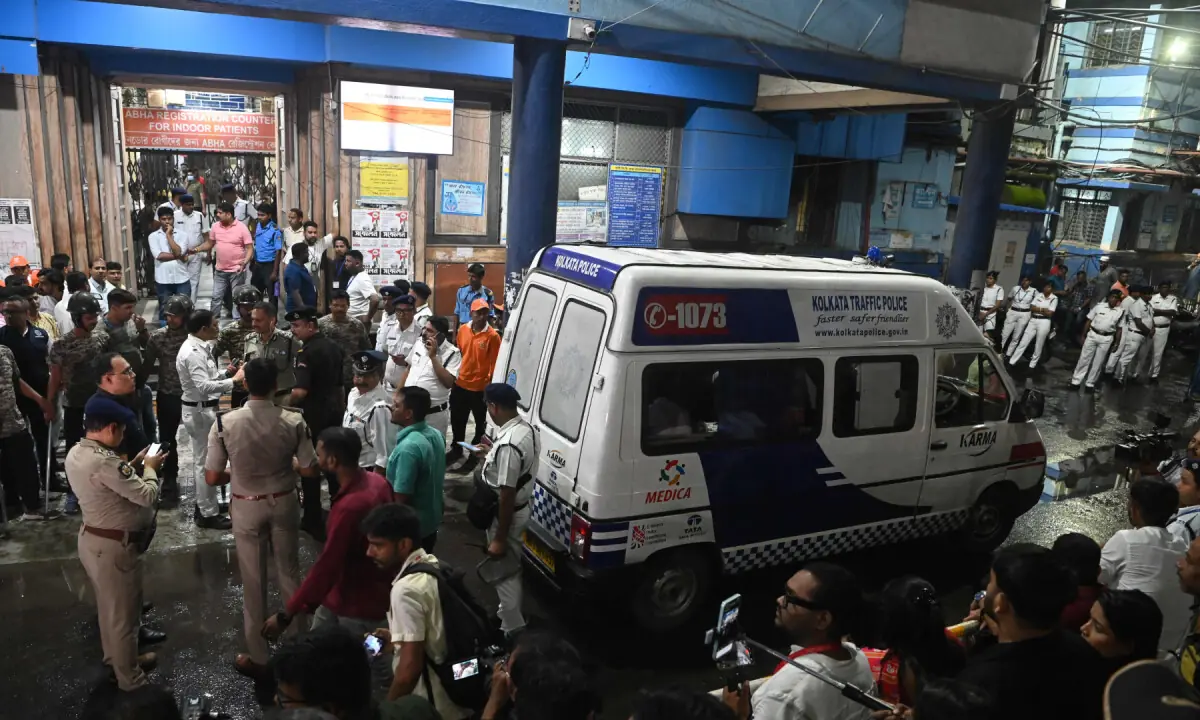
At least 17 people were killed and two dozen more injured on Saturday in eastern India after a stampede that was likely caused by sudden rainfall during a Hindu religious gathering, officials said.
West Bengal’s Chief Minister Suvendhu Adhikari told reporters the fatalities included a seven-year-old girl, adding that 25 others were injured outside a pavilion “in a stampede” at the Hindu festival of Durga Puja in the city of Kolkata.
“Six bodies have so far been identified,” Adhikari said.
A senior police official at the scene told AFP an announcement caused “commotion” after it started raining at night and the “crowd waiting outside the pandal (pavilion) was pushing, pulling and rushing forward and fell on the ground, leading to the stampede”.
Deadly crowd incidents are a frequent occurrence at Indian mass events, such as religious festivals, due to poor management and safety lapses.
In August, a stampede at a Hindu temple in Bihar killed at least seven people and injured 19 others.
Last year, a stampede at India’s Kumbh Mela religious fair killed 30 people and injured several others, and 11 fans were crushed to death in Bengaluru during celebrations for the local cricket team’s first Indian Premier League title.
The same year, 36 people were killed after a stampede broke out at a campaign rally of a popular actor-turned-politician in southern Tamil Nadu state.
In 2024, 121 people were killed in northern Uttar Pradesh state during a Hindu religious gathering.
Manchester City bounced back from their midweek setback in Europe to maintain their perfect Premier League start with Erling Haaland’s double propelling them to a 3-2 home win over Ipswich Town on Saturday.
Paris Saint-Germain inflicted a first meaningful defeat on Enzo Maresca’s side in the Champions League on Wednesday but City shrugged off a gallant Ipswich side to make it seven wins from seven to cement their place at the top of the table.
Chelsea beat Everton 2-0 in Saturday’s early action thanks to Pedro Neto’s brace although the London club’s win was overshadowed by an injury to goalkeeper Emi Martinez.
Liverpool came from a goal down to beat Brentford 2-1 away although they were helped by the previously unbeaten hosts being reduced to 10 men shortly before halftime when Yehor Yarmolyuk was shown a straight red card for a head butt.
Victory lifted Liverpool above Brentford into fifth place with 12 points behind Chelsea in fourth on 13.
Fulham moved off the foot of the table with their first league win of the season — 1-0 at home to Hull City.
Dark clouds remain over the Etihad Stadium with Manchester City’s fate still unknown after they appealed a ruling that the club breached 114 Premier League financial rules.
City have always denied any wrongdoing.
But on the pitch it is very much business as usual, especially for Norwegian goal machine Haaland.
Phil Foden gave City a short-lived lead cancelled out by Daizen Maeda, but Haaland restored the home side’s advantage before halftime with a header from Mateo Kovacic’s cross.
Haaland then gave his side some breathing space with his second in the 69th minute, powering past Ipswich’s Abdoul Ouattara before a low finish into the corner.
He was denied a hat-trick by an offside decision and Ipswich got a lifeline when Zian Flemming tucked away a penalty in stoppage time but City bagged the points.
Feisty first half
Chelsea have had a knack of scoring early this season but were kept at bay by hosts Everton in a feisty and physical first half that produced five yellow cards.
However, Xabi Alonso’s visitors needed just 43 seconds after the restart to go 1-0 up when Jorrel Hato cut the ball back from the byline to find Neto who swept home.
Martinez’s clash of heads with Jarrad Branthwaite caused a lengthy stoppage with paramedics coming onto the pitch. The Argentina keeper was eventually strapped to a stretcher and taken off, leading to 11 minutes of stoppage time.
Chelsea goalkeeper Emiliano Martinez collides with Everton’s Jarrad Branthwaite during their Premier League match at the Hill Dickinson Stadium in Liverpool on October 17, 2026.— Reuters
Chelsea doubled their lead in the 90th minute when Neto pounced on a loose ball after Jordan Henderson’s free kick was blocked by the wall, finding the bottom corner with a composed finish as Everton suffered their first defeat of the season.
“What we know is he (Martinez) left the stadium conscious and right now he is in the hospital doing precautionary tests,” Alonso said. “It was concussion but more than that I saw only one clip. Hopefully it won’t be too bad but we need to wait.”
Martinez’s knock gave 21-year-old keeper Mike Penders the chance to make his Premier League debut and he helped Chelsea keep a clean sheet in the league for the first time in 23 games.
“We need a clean sheet, to be honest. I think we did a very good game. Emi deserved this, Mike did as well,” Alonso added.
Liverpool deservedly fell behind at Brentford with Keane Lewis-Potter putting the hosts in front.
Brentford were good value for their lead but Yarmolyuk’s rush of blood to the head when he clashed with Jeremy Jacquet at a Liverpool corner changed the game.
After referee John Brooks was invited to check a VAR monitor he brandished the red card at Ukrainian Yarmolyuk who trudged off to applause from the home fans.
Liverpool huffed and puffed after the break but Victor Munoz finally levelled in the 62nd minute when he cut in to beat keeper Caoimhin Kelleher with a left-foot finish.
Liverpool’s Victor Munoz (R) shoots to score against Brentford during their Premier League match at the GTech Community Stadium in London on October 17, 2026.— Reuters
Alexander Isak won it for Andoni Iraola’s side eight minutes later with a clinical strike from Bradley Barcola’s assist.
Brentford ended with nine men after Vitaly Janelt got a second yellow card for a foul on substitute Rio Ngumoha.
Elsewhere, Alex Iwobi’s 33rd-minute strike for Fulham was enough to earn their new manager Alvaro Arbeloa a long-overdue league win and move Fulham up to 15th.
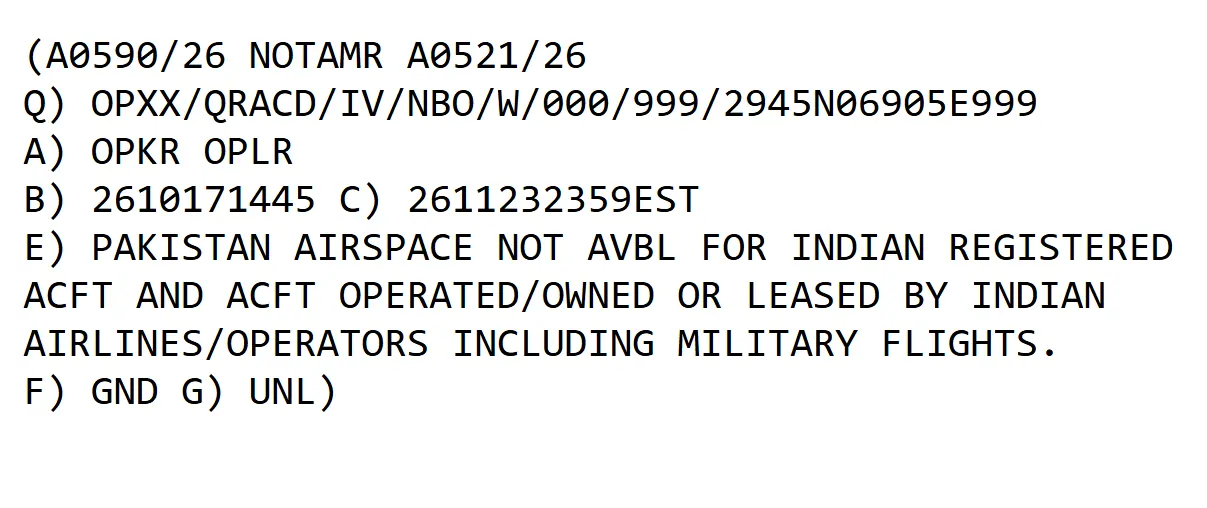
Pakistan has extended its airspace ban for Indian aircraft for another month, until Nov 24, according to a Notice to Airmen (Notam) issued by the Pakistan Airports Authority (PAA).
“Pakistan airspace not available for Indian registered aircraft and aircraft operated/owned or leased by Indian airlines/operators, including military flights,” the Notam said.
According to the notice, the extension came into effect at 7:45pm on Saturday and will remain until 04:59am on Nov 24, 2026.
The country’s airspace is divided into two flight information regions (FIRs) — Karachi and Lahore, according to a Pakistan Civil Aviation Authority (PCAA) document from 2022.
Saturday’s Notam applies to both the Karachi (OPKR) and Lahore (OPLR) FIRs.
India and Pakistan closed their airspaces to each other’s airlines in late April 2025, when tensions between them escalated in the wake of a deadly attack in India-occupied Kashmir’s Pahalgam.
On April 24, Pakistan’s top brass had announced a series of measures, including the closure of its airspace to all India-owned or Indian-operated airlines with immediate effect, as it retaliated against New Delhi’s slew of aggressive measures against the country.
New Delhi, without evidence, had alleged that Islamabad backed the Pahalgam attack. However, Pakistan had strongly denied any involvement and offered a neutral probe. The nuclear powers had the fiercest air battle in May, in which Pakistan said it downedseven Indian fighter jets.
Since then, Pakistan has extended the airspace ban several times, forcing Indian carriers to use longer and costlier routes.
For Air India, the country’s only carrier with a major international network, fuel costs rose by as much as 29 per cent and journey times by up to three hours on some long-haul routes, according to a document submitted to Indian officials last October.
The airline, owned by Tata Group and Singapore Airlines, estimated the Pakistan airspace closure’s impact on its profit before tax at $455 million annually — a significant amount given its fiscal 2024-25 loss stood at $439m.
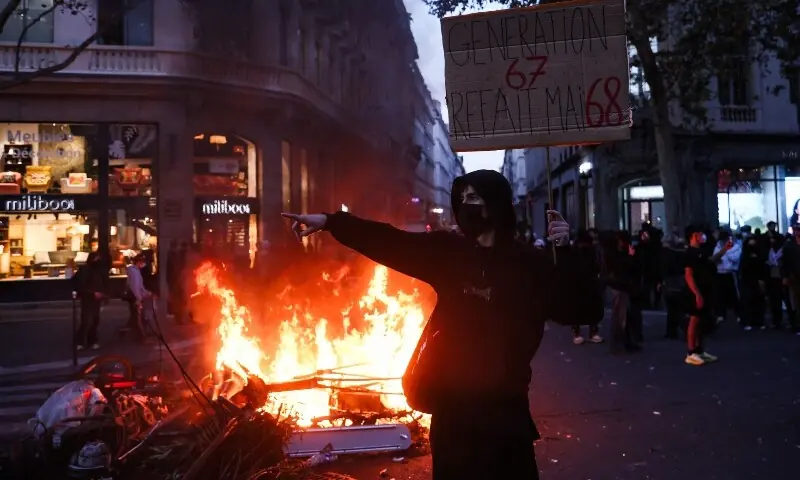
Police and protesters clashed violently in Paris and other French cities on Saturday on the sidelines of nationwide marches against soaring inflation, with one demonstrator’s hand blown off, multiple blazes set, and looters breaking into dozens of stores to strip them bare.
With just months to go before the two-round elections in April and May to choose Macron’s successor, the demonstrations follow weeks of high-school student blockades demanding better learning conditions.
Macron and his government were criticised by many of the demonstrators, who numbered 500,000 across the country, according to the CGT union. Authorities did not immediately give their estimate of the numbers.
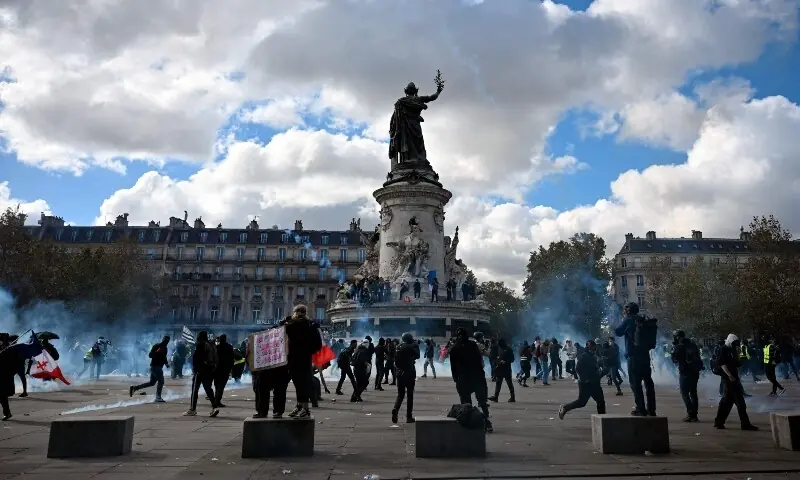
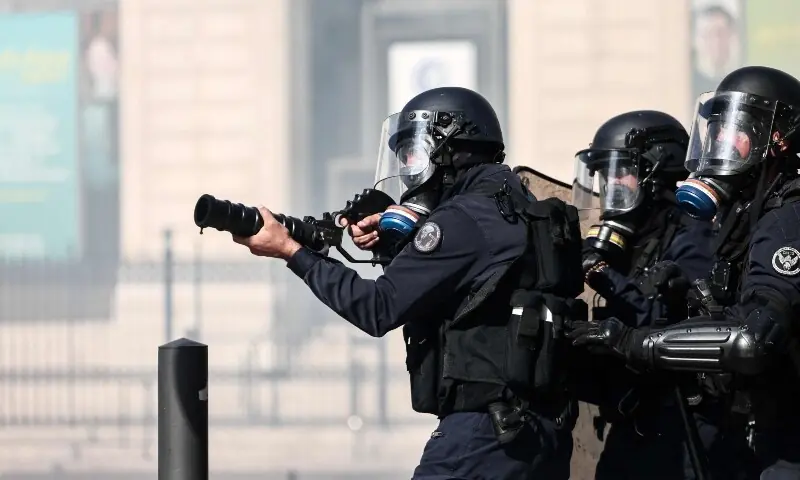
Police used tear gas and water cannon against masked protesters in Paris and other cities who were throwing projectiles and aiming fireworks. Several parked cars were torched in the capital, and more than 130 arrests were made.
In the southern city of Saint-Etienne, a male protester had his hand blown off by a police crowd-control grenade, a police source told AFP. His maiming came after a 15-year-old lost his hand on October 5 to a police stun grenade during another protest in the city of Lens.
Protesters stand amid tear gas smoke as clashes erupt ahead of a demonstration to protest against the “high cost of living”, at Place de la Republique in Paris, France on October 17, 2026. — AFP
The protests geared up with a handful of gatherings nationwide on Saturday morning, AFP reporters said.
In Lyon, protesters set ablaze a tourist office in the city centre, and smashed their way into town halls in the cities of Marseille and Lille, where they vandalised the premises before leaving.
Dozens of shops were looted, including many in Marseille, among them a Hermes boutique, an Apple store in Lille, several shops in Nice and at least one mobile phone outlet in Paris, AFP journalists saw.
A crowd of more than 300 protesters tried to move up Paris’s Champs-Elysees, home to flagship luxury stores. As police firing tear gas blocked their way, they yelled, “All cops are bastards”.
In the western city of Rennes, around 20 people set up a barricade using trash bins and large pallets on the outskirts of a shopping mall.
Christophe, a 47-year-old carpenter and former Yellow Vest protester who did not give his surname, said he was indignant after seeing what he viewed as police brutality against teenagers in recent weeks.
“We’ve reached the point where the repression is targeting our own children,” he told AFP.
A French national police officer fires tear gas during clashes prior to the start of a demonstration to protest against the “high cost of living”, in Marseille, southern France on October 17, 2026. — AFP
‘Macron, resign’
The looting and confrontations with police were being carried out by masked youths on the sidelines of marches that were largely peaceful and which attracted people of all ages, including families with children.
Paris mayor Emmanuel Gregoire stressed that “the overwhelming majority of demonstrators” wanted to “march calmly”, but “acts of vandalism” were tarnishing their protest.
In Paris, tens of thousands marched across the east and north of the city in one major march, some shouting “Everyone hates the police” and “Macron, resign”.
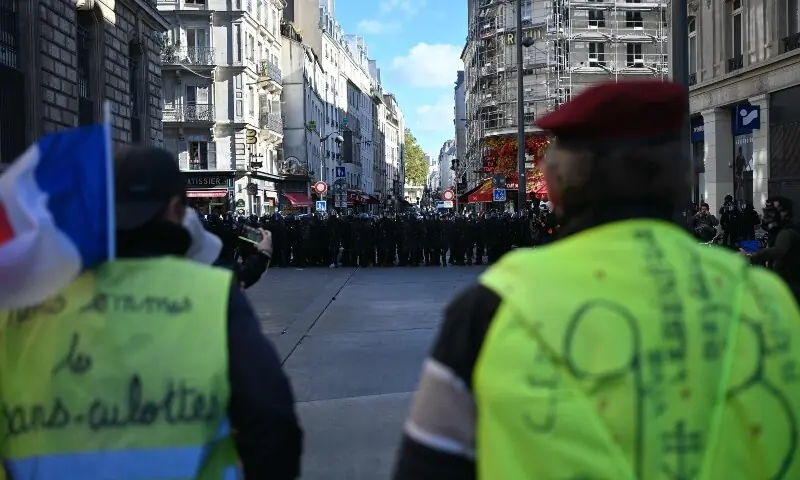
Protesters wearing yellow vests face police as clashes erupt ahead of a demonstration to protest against the “high cost of living”, at Place de la Republique in Paris, France on October 17, 2026. — AFP
One demonstrator, Jules Petrichor, 47, who had brought his son, said: “There was a good atmosphere and then suddenly they (the police) started gassing us, even though nothing was happening. Naturally that worsened things and the hot-heads got hot-headed.”
Another protester who gave his first name as Louis, 19, complained that police were trigger-happy any time there was a demonstration.
“We can’t protest any more, it’s frightening,” he said.
The country’s Yellow Vest movement, which eight years ago staged street protests against Macron’s government over planned fuel tax hikes, has called Saturday’s “yellow and youth” demonstrations. It has appealed to teachers and students, workers, pensioners and farmers to take part in the protests on the first day of half-term holidays.
The principal grievance was the cost of living — pushed up in part by the war in the Middle East — that has helped send inflation soaring in Europe as elsewhere. But there were other issues too.
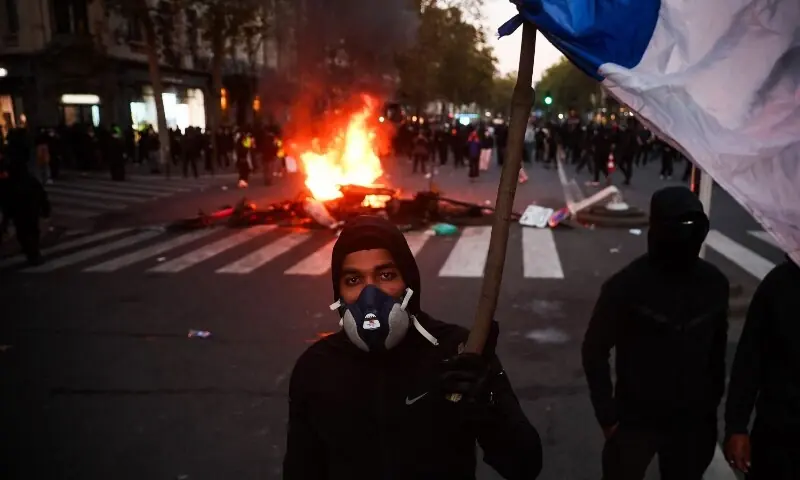
A protestor with a gas mask holds a French flag in front of a fire at the Boulevard des Capucines during a demonstration to protest against the “high cost of living”, in Paris, France on October 17, 2026. — AFP
High school student Kamil Alahyan, 18, said he was protesting “for so many reasons — the elections coming up in 2027, politicians who lie, the ultra-rich who’ve been taking more and more wealth over the past 10 years”.
“For years we’ve had climate, economy and equality problems but the government is not doing anything about it,” said Agnes, a 50-year-old actor who did not give her second name.
Anae, a 24-year-old student who did not give her surname, said she was protesting because she did not have a “sustainable future”.
“Our planet’s burning. And we’ve got a government that doesn’t give a toss,” she said.
Le Pen blames ‘rioters’
Opposition politicians vying to succeed Macron have seized upon the protests.
Far-right presidential candidate Marine Le Pen, who has sided with the police, said on X: “Looting, pillaging, attacking police — rioters have once again sullied the October 17 demonstrations over the cost of living.” She claimed that the protesters’ demands had been “hijacked by the far left”.
Her far-left rival Jean-Luc Melenchon, insisted early Saturday that “everything is passing off peacefully”, while accusing television news of “flooding us with images of violence in dozens of cities”.
Several protesters sought to draw parallels with the French Revolution of 1789.
“It’s the Revolution — we’re taking the Bastille!” some shouted in Marseille during the forced entry of the mayor’s offices.
In the western city of La Rochelle, marchers streamed behind a placard reading: “Revolution or death.” And in the southern city of Montpellier, a giant blue sign reading “The people will win” was unfurled above a central square.
“The government is trembling and it’s right to tremble because when the French people are angry, they never let up,” Ryad Rani, the head of the LSU high school student representative body, told journalists in Paris.
Security forces have responded to unprovoked firing by Afghan Taliban forces along the Pakistan-Afghanistan border in Khyber Pakhtunkhwa’s Upper Kurram, state broadcaster PTV News reported on Saturday.
PTV News and state-run Associated Press of Pakistan (APP), which cited security sources, said the Afghan Taliban forces opened fire to “facilitate terrorists” along the border in Taldah sector of Upper Kurram.
The army responded using heavy weapons, destroying several Afghan Taliban posts and forcing their personnel to flee from there, PTV News reported.
Meanwhile, APP quoted security sources as saying that several personnel of the Afghan Taliban were “reportedly killed during the Pakistan Army’s retaliatory action along the Ghuzgarhi border”.
The sources further said that in the Upper Kurram sector, the army targeted the Afghan Taliban’s Topsar post and Shipola base camp with artillery fire, reportedly completely destroying the latter.
The exchange of fire was still ongoing in the area, APP quoted security sources as saying.
The border skirmishes come a day after the Foreign Office (FO) said that talks with Afghanistan could not be unconditional, but also rejected suggestions that Islamabad was unwilling to engage with its neighbour and said it would welcome sincere efforts by friendly countries to help resolve the dispute.
“Pakistan is not shying away from discussions or dialogue, including with representatives of Afghanistan. Pakistan would welcome any sincere efforts by friendly countries that could help address our legitimate security concerns and promoting regional peace and stability,” FO spokesperson Sajjad Haider Khan said at the weekly media briefing.
The statement came after Russia recently renewed its readiness to mediate between the two countries, although Islamabad denied the existence of any such initiative.
“At present, I am not aware of any separate, formal Russian mediation initiative being under discussion,” Khan said.
Pak-Afghan tensions
Ties between the two neighbours have been strained in the past few years as Islamabad continues to voice its concern over cross-border terrorism.
September witnessed another bout of conflict between Pakistan and Afghanistan.
On Sept 21, in response to recent major terrorist attacks in Khyber Pakhtunkhwa, Pakistan conducted “calibrated” airstrikes in the border region with Afghanistan against terrorist hideouts, with the government saying more than 28 terrorists were killed.
Information Minister Attaullah Tarar described the action as part of Operation Ghazab lil Haq, which was launched on the night of Feb 26 in response to unprovoked cross-border firing by the Afghan Taliban.
Days later, Pakistan shot down eight drones launched from across the border that had entered Pakistani airspace near the Torkham border and Kohat. It was also reported that the Afghan Taliban engaged in unprovoked firing the night before near Kurram as security forces foiled an attempt by terrorists to cross into Pakistan.
In retaliation for the drone incursion, Pakistan conducted “precision aerial and drone strikes” in 10 locations across Afghanistan.
A demarche was also delivered to the Afghan side on Sept 26 on account of the Sept 23 airspace violation by drones, the Foreign Office said.
On Oct 1, Pakistan again carried out “well-planned and calibrated” airstrikes against terrorist hideouts in Afghanistan, the information ministry said, which resulted in the deaths of “multiple terrorists”.
UPPER KURRAM – A fresh border confrontation between Pakistan and Afghanistan erupted in Khyber Pakhtunkhwa’s Upper Kurram on Saturday, with Pakistani forces launching retaliatory artillery fire against Afghan Taliban positions following reported cross-border firing, according to Pakistani state media and security sources.
The latest clash unfolded in Taldah sector and around Ghuzgarhi, where Afghan Taliban personnel allegedly opened fire to facilitate the movement of militants towards Pakistan.
Pakistan’s military responded with heavy weapons, reportedly striking several positions across the border and forcing Afghan Taliban personnel to abandon their posts. Security sources told the Associated Press of Pakistan (APP) that several Taliban personnel were reportedly killed during the retaliation.
Taida Sector, Upper Kurram, Pak-afghan International Border
Pakistan Army gave an effective response to firing by Afghan militants, hitting the enemy’s Topser Post & its base camp. https://t.co/II876JgqYv
Among the reported targets were the Taliban’s Topsar post and Shipola base camp in Upper Kurram. Security sources claimed that artillery fire completely destroyed the Shipola installation, while the exchange of fire was still continuing when the reports emerged.
The latest confrontation comes against the backdrop of a sustained deterioration in relations between Islamabad and Kabul, with Pakistan repeatedly accusing the Afghan Taliban authorities of failing to prevent militant groups from operating from Afghan territory.
September escalation saw Pakistan launch airstrikes against what its government described as terrorist hideouts in Afghanistan following major attacks in Khyber Pakhtunkhwa. On September 21, officials said the operation had killed more than 28 militants.
KARACHI – Pakistani actress Kubra Khan is in spotlight after her appearance at recent event hosted by Samsung Pakistan. Pictures sparked interest among fans and entertainment enthusiasts, with the actress’s elegant style becoming a talking point online.
The latest buzz surrounding Ehd-e-Wafaa began after a post featured the actress at the event. The pictures showed her glamorous appearance, showing social media users and fans to take notice.
Actress #KubraKhan looking gorgeous in while spotted a recent event of @SamsungPakistan https://t.co/PlgCFYUkjM
The actress’s is among Pakistan’s recognised TV and film actresses and has earned appreciation for her performances in several popular drama serials. Her notable projects include Noor Jahan, Alif and Hum Kahan Ke Sachay Thay. She maintain a strong presence in the country’s entertainment industry and gained a following.
The actress public appearances and fashion choices attract interest from her admirers. Her latest appearance at the Samsung Pakistan event has once again brought her into the spotlight, as fans continue to follow updates about the actress and her professional engagements.
GUJRANWALA – Prime Minister Shehbaz Sharif comes up with strong defence of the federal government’s decision to impose emergency measures and governor’s rule in Khyber-Pakhtunkhwa (K-P), warning that failure to act amid escalating political tensions could have resulted in bloodshed.
PM Sharif maintained that the government could not stand by as the security situation deteriorated and the threat of violence surrounding Pakistan Tehreek-e-Insaf’s (PTI) long march intensified. He described the intervention as a necessary step to prevent further instability and protect the country’s interests.
The decision deepened political confrontation, with PTI leader Asad Qaiser ruling out negotiations with the federal government and signalling that the opposition would formulate a collective response.
Defending the government’s action, Shehbaz said the authorities had reached a point where inaction was no longer an option. Invoking the historical analogy of Rome burning while Nero played his fiddle, he argued that allowing the situation to deteriorate without intervention would have amounted to criminal negligence.
PM hoped that the decision would produce positive results, insisting that it had been taken in the best interests of Pakistan.
The federal government imposed emergency measures and governor’s rule in K-P on October 11 under Articles 232 and 234 of the Constitution. The move suspended the PTI-led provincial administration and transferred executive authority to Governor Faisal Karim Kundi.
Federal officials have defended the intervention on security grounds, also citing what they described as a lack of cooperation from the provincial government.
The move has become a major flashpoint in the ongoing political dispute, with the federal government defending its actions as necessary while PTI has condemned the handling of the crisis.
Shehbaz linked the decision to the deteriorating security environment in K-P, warning that the province continued to face serious challenges from terrorism and alleged infiltration from Afghanistan. He said the resurgence of militant activity since 2018 required a united national response, pledging that the federal government would provide the necessary resources and administrative assistance to combat terrorist groups.
The premier also paid tribute to law-enforcement personnel and security forces, including Pakistan Army officers, who have lost their lives in counterterrorism operations. He lamented that attacks had also killed innocent civilians, including women and children.
Describing K-P as an integral part of Pakistan, Shehbaz said its people had demonstrated courage and resilience and deserved every possible opportunity for peace, stability and development.
Premier said the government had made repeated attempts to defuse tensions before introducing the emergency measures. He said discussions were held with the province’s former chief minister and current Chief Minister Sohail Afridi as part of efforts to address outstanding issues. He said the government had also established a committee and conducted negotiations with relevant stakeholders for around 48 hours to prevent the PTI long march from proceeding.
Shehbaz claimed the talks had progressed to the preparation of a comprehensive agreement under which PTI was expected to withdraw its march call, allowing the country to focus on economic recovery and development.
However, he said the proposed settlement collapsed following consultations involving the then provincial chief minister. Disagreements over the consultation process were followed by a further deterioration in the situation, according to the prime minister.
He also accused PTI of repeatedly disrupting national affairs through protests and long marches, arguing that the country could ill afford prolonged political instability amid serious security and economic challenges.
ISLAMABAD — Iran’s exports to Pakistan are facing disruption as banking restrictions threaten to bring cross-border trade to a standstill, raising fresh concerns over the economic relationship between the two neighbouring countries.
Peyman Sanandaji, head of the Transportation Commission of the Tehran Chamber of Commerce, told Iranian media that banking-related hurdles temporarily disrupted Iranian exports to Pakistan. He warned that if the obstacles to financial transactions remain unresolved, exports could effectively grind to a halt.
The development highlights how international banking sanctions, particularly those imposed by the United States on Iran, continue to complicate trade even when physical borders remain open.
According to Sanandaji, Pakistani importers are required to submit electronic import forms to their banks for goods arriving from Iran. However, difficulties associated with Iran’s restricted banking system have made the process increasingly challenging, disrupting the movement of Iranian goods into Pakistan.
The immediate concern is not a border closure but the inability to complete the banking and payment procedures required to facilitate trade.
Sanandaji warned that continued difficulties in processing financial transactions could effectively halt Iran’s exports to Pakistan if no workable solution is found.
Despite the disruption, the shared land trade border between Iran and Pakistan remains open, according to the reported remarks. Sanandaji also dismissed claims circulating in a purported letter that a border crossing had been closed.
While Iranian exports face uncertainty, shipments from Pakistan to Iran may still continue, Sanandaji said, although their continuation would depend on cooperation from the Pakistani side. This creates the possibility of an uneven impact on bilateral trade, with Iranian exporters facing immediate difficulties while Pakistani suppliers could retain opportunities to access the Iranian market.
Iran and Pakistan have long sought to expand economic ties, with some estimates placing their bilateral trade potential at between $10 billion and $13 billion. Actual trade has remained substantially below that level, reaching several hundred million dollars to a few billion dollars in recent years, depending on the period and measurement used.
Tehran supplies Pakistan with oil, petroleum products, chemicals, steel and other goods. Pakistan, meanwhile, exports rice, meat, agricultural products and other commodities to Iran. Yet banking restrictions, customs procedures, logistics bottlenecks and difficulties moving goods across the border have repeatedly limited the expansion of formal trade.
LAHORE – Amid weeks of uncertainty over earlier plan to extend celebrations across Lahore’s upcoming Basant festival, the Deputy Commissioner’s office proposed return to the original dates of March 12–14, 2027.
The latest proposal, reported on October 17, revived hopes among kite makers and traders who had raised concerns about the feasibility of the revised winter schedule. However, the Punjab Cabinet’s approval is still awaited, meaning the proposed dates cannot yet be treated as final.
Under the latest reported plan, kite flying would be permitted within Lahore district, except in designated prohibited areas, and only with materials approved under the government’s safety regulations.
The renewed uncertainty comes as the provincial administration attempts to balance the revival of a popular cultural tradition with public safety, legal restrictions and the practical concerns of the industry supplying the festival.
Basant 2027 calendar has changed more than once, leaving manufacturers, retailers and residents waiting for a definitive decision. The original plan, announced in August 2026, envisaged a three-day celebration from March 12 to 14. Preparations followed, including manufacturer registration and the development of safety procedures.
The situation changed in late September when Chief Minister Maryam Nawaz approved 10-day festival from January 29 to February 7, with a break on February 5 for Kashmir Solidarity Day.
The proposed shift brought an immediate response from kite and string manufacturers. Industry representatives argued that bringing the festival forward would leave insufficient time to produce the required supplies. They also cited winter fog, limited availability of raw materials and sharp increases in production costs.
Earlier this month, manufacturers reported price increases in key materials following the schedule change. The reported price of bamboo used in kite-making rose from approximately Rs12,000–15,000 per stack to Rs25,000–28,000. Paper prices were also reported to have climbed from Rs3,200–3,800 per ream to between Rs7,000 and Rs14,000, while thread prices increased from around Rs2,800 to as much as Rs6,500, depending on the brand.
Manufacturers warned that higher material and labour costs could push up the price of kites and string, potentially making the celebrations less affordable for ordinary residents.
Punjab Home Secretary subsequently indicated that the scheduling issue would be placed before the provincial cabinet. The latest move by the DC Lahore office now points back to March, although the final decision remains with the provincial government.
The date dispute also reached the Lahore High Court. Lahore court took up a petition challenging the proposed 10-day Basant schedule. According to reports published on October 17, the petition was withdrawn after the court questioned the legal basis for challenging the plan without an authenticated formal government notification.
The proceedings did not establish the January schedule as the final arrangement. Instead, the case highlighted the importance of obtaining an official notification before pursuing a legal challenge.
With DC office now reportedly proposing March 12–14, attention has returned to the cabinet’s decision and the formal notification required to settle the matter.
Iranian Foreign Minister Abbas Araghchi said on Saturday that Tehran supports a “political process” to resolve the conflict between Saudi Arabia and Yemen’s Houthi rebels.
The Houthis have repeatedly attacked Saudi targets, including energy facilities and Riyadh’s international airport, where 13 people were killed in a major attack last week.
“We support an inclusive and comprehensive political process as the only practical and sustainable way to resolve the issue,” Araghchi said in a speech at the Organisation of Islamic Cooperation in Baghdad.
Araghchi repeated Iran’s offer to mediate between the two sides. Deputy Foreign Minister Saeed Khatibzadeh previously said Riyadh has not responded to Iran’s overture.
On Friday, Iran denied having anything to do with the Houthi attacks, after Saudi Arabia accused Tehran of encouraging the group’s escalation.
In his speech, Araghchi also said “either we build security together, or we will endure insecurity together,” adding that Tehran was willing “to cooperate with all its brothers and neighbours to achieve the first option”.
The Houthis have repeatedly attacked Saudi airports, oil facilities and tankers after a truce in their long-running war with Yemen’s coalition government unravelled in July.
On Wednesday, Yemen’s Houthi rebels said they had targeted facilities belonging to Saudi Aramco, after Saudi officials reported a strike on a building in Riyadh housing the energy giant’s operations centre.
Powerful explosions also rattled the Saudi capital, as the coalition fighting the Houthis said it had intercepted a missile fired by the group towards Riyadh.
On Tuesday, Saudi Arabia launched strikes on Houthi-controlled areas of Yemen, targeting fuel and energy facilities it said were being used to support missile and drone attacks, as the Yemeni group threatened a “harsh and painful” response against Saudi airports, refineries and oil installations.
Hours later, Saudi authorities issued warnings of potential hostile aerial threats in the kingdom’s eastern province and Riyadh.
Loud explosions were heard near Saudi Aramco’s headquarters in Dhahran, according to witnesses. Later, a Saudi energy ministry official confirmed the attack. Saudi Arabia’s civil defence agency said that four people — two women, a man and a child — were wounded by debris from two intercepted Houthi cruise missiles in the capital and that 15 homes were damaged.
Prime Minister Shehbaz Sharif on Saturday reiterated that the Centre was “compelled” to impose emergency and governor’s rule in Khyber Pakhtunkhwa due to the provincial government’s lack of cooperation in countering terrorism.
The Centre imposed emergency and governor’s rule in KP on Oct 11, citing the provincial government’s “deliberate disengagement” from the fight against terrorism. The decisions were also endorsed by the Parliament this week amid protests by the opposition.
On Saturday, PM Shehbaz visited the residence of Rashid Bashir Virk in Gujranwala to offer condolences on the demise of his father, late MNA Mahmood Bashir Virk.
After recalling the late PML-N lawmaker’s services, the premier stressed that the Centre was compelled to impose emergency in KP.
He said the Centre made a “last attempt”, referring to the rounds of talks held by a joint delegation of the PPP and the government with the opposition.
“They had talks with them (PTI) day and night, for 48 hours, and sat with the intention to settle matters from every aspect,” PM Shehbaz said, adding that a draft was ready under which the PTI was to call off its long march.
The prime minister highlighted that he had held multiple meetings with Sohail Afridi, the KP chief minister whose role now stands non-functional, as well as with his predecessor Ali Amin Gandapur.
“In every meeting, I tried my best to convey to him from the depths of my heart and with seriousness that KP is an extremely beautiful province and has very brave and honourable people, […] and I am always present in every way for their development and prosperity,” PM Shehbaz said.
The premier added that he assured the KP government of the Centre’s support in fighting against terrorism together to face the security challenges in the province.
PM Shehbaz said he had assured the chief minister that he would make the decisions regarding the administration, resources and necessities in consultation with him.
“But, unfortunately, despite all these efforts, thousands of our law enforcement agencies personnel, soldiers, officers and officers of the armed forces were sacrificing their lives every day to defend the homeland.”
The prime minister stressed that the federal government “made many efforts” regarding the situation, but there were “threats and long marches every other day in response”.
“Their past history is very horrific,” he remarked, recalling the 2014 sit-ins staged by the PTI at Islamabad’s D-Chowk during the tenure of his brother, Nawaz Sharif.
“Last year as well, you saw how the entire country was jammed by staging a sit-in in Islamabad,” he added, ostensibly referring to the PTI’s November 2024 protest that had resulted in clashes.
“This time as well, they had an entire plan of bloodshed,” he alleged.
The Oct 11 imposition of emergency and governor’s rule followed weeks of political tensions between the Centre and the PTI — as well as negotiations to bridge their differences — after the latter announced a long march to Islamabad to demand the release of its jailed founder, Imran Khan.
Federal ministers alleged that the PTI-led government in KP had a “nexus” with terrorist groups and asserted that the province’s security situation necessitated the imposition of emergency there.
The Centre and the PTI have been at odds over various issues, particularly on the counterterrorism policy, which was one of the main reasons behind the breakdown of their October 3 talks.
The PTI said it was being left out of security decisions concerning KP, which the Centre denied. It also called for reviewing the counterterrorism policy, while the latter criticised the KP government’s efforts to combat terrorism in the province and objected to its stance on dialogue with the Afghan Taliban.
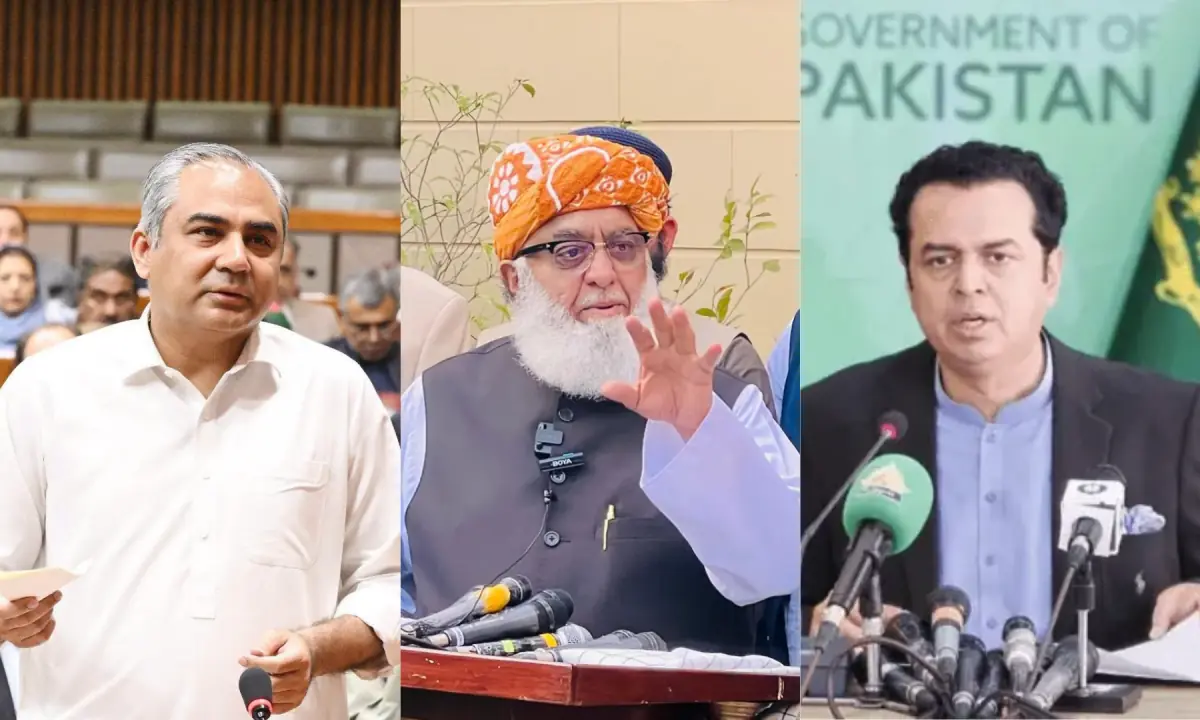
Jamiat Ulema-i-Islam-Fazl (JUI-F) chief Maulana Fazlur Rehman on Saturday clarified that his party’s remarks regarding the country’s security situation were directed at policies, not institutions, and termed the allegations levelled against him by federal ministers as character assassination.
A day earlier, Interior Minister Mohsin Naqvi, without naming anyone, had claimed that a “head of a party” was “extremely upset” about not being appointed the governor of Khyber Pakhtunkhwa. The remarks came after Fazl accused the Centre of depriving the provinces of their rights and raised doubts over its reasoning behind imposing governor’s rule that there was a lack of cooperation on counterterrorism.
Earlier on Saturday, State Minister for Interior Tallal Chaudhry also rebuked the JUI-F chief for reportedly seeking his “share” in KP’s governance following the imposition of governor’s rule and an emergency in the province. Other federal ministers have also taken exception to Fazl’s remarks.
Addressing a press conference in Lahore on Saturday, Fazl stressed that his party’s criticism was directed at policies, not institutions, and was intended to bring about corrective action rather than undermine the sacrifices made in the fight against terrorism.
The senior politician called for an in-camera session of Parliament to review the country’s security situation and formulate a consensus-based policy to combat terrorism.
“Our only question is why the country has failed to eliminate terrorism. Let us sit together and find out why. Parliament is the most appropriate forum to discuss the issue and make decisions. Instead of ridiculing politicians, the government should take them on board in this fight so that we can move forward together,” he said.
“If Parliament is supreme, why are decisions taken in Rawalpindi while Parliament is simply told to follow them?” he remarked. “The issue is that this government is powerless. Decisions are taken somewhere else, and it implements them obediently,” he alleged.
The JUI-F maintained that Parliament should review the security situation and that the nation should be taken into confidence. If the public was expected to support the fight against terrorism and those engaged in it, he argued, the government should explain its decisions rather than impose “unilateral measures”.
Fazl reiterated his objection to the imposition of emergency rule in KP or any other part of the country. Recalling his family’s opposition to emergency rule in Balochistan during the 1970s, he said his father had resigned when the government of Zulfikar Ali Bhutto imposed it in the province.
He described the recurrence of such measures as unfortunate, pointing out that the PP had repeatedly been associated with their imposition.
Questioning the rationale behind the emergency, governor’s rule and deployment of troops in KP, Fazl asked why the province should face such treatment when Balochistan was also grappling with the same level of terrorist violence, if not more.
The JUI-F chief urged the government to develop a shared national narrative and a consensus-based counterterrorism strategy instead of questioning his party’s position.
He went on to ask why the government engaged in negotiations with the PTI, which had been in power in KP, if the party was accused of supporting terrorists. “On top of it, both (the PTI and the government) say that they had reached a consensus on all points.”
Fazl then highlighted that around 250 of his party workers had lost their lives in terrorist violence, arguing that their sacrifices should not be ridiculed or overlooked. “How can a party whose members have laid their lives be accused of supporting terrorists?” he asked.
He also questioned why he was being singled out for criticism when political leaders, including former prime minister Nawaz Sharif, had at various times disagreed with the military leadership.
Ministers assail Fazl
Earlier on Saturday, addressing the media in Jaranwala, Chaudhry said, “I am upset. We did not expect Maulana sahib […] to consider this as spoils of war and seek his share in the absence of a PTI government in the province.”
He emphasised that the imposition of an emergency and governor’s rule in KP was not a political move aimed at strengthening the PML-N’s presence in the province by dismissing the PTI-led government.
“This was an administrative setup,” he said, adding that it had been formed with a “one-point agenda: combating terrorism”, rather than with an intention of establishing a political setup.
“This is not spoils of war,” he reiterated, adding that the imposition of an emergency and governor’s rule in KP was an “immensely responsible” decision taken after every other option had been considered.
“I am unable to understand why Maulana sahab says that he was forced to accept defeat [in elections],” he said, arguing that Fazl’s party had been defeated by the PTI in KP and the Pashtunkhwa Milli Awami Party in Balochistan.
Chaudhry said the JUI-F was worthy of respect only if it stood by Pakistan’s interests.
The state minister also rejected the impression that the imposition of an emergency and governor’s rule was aimed at taking control of KP’s natural resources.
He also criticised Fazl for bringing up the 1971 separation of East Pakistan — now Bangladesh — from Pakistan in his recent statements.
“You bring up 1971 after losing the 2024 elections,” Chaudhry said.
“This KP setup is not about distributing shares, forming coalitions and governments, or engaging in politics,” he stressed, clarifying that only one member of the KP Advisory Council has a political background, as she represents the families of martyrs.
Chaudhry again offered to implement the National Action Plan and combat terrorism jointly with all stakeholders. “Politics is possible only where there is peace,” he said.
At the outset of his address, Chaudhry alleged that there must be “a relationship or a mutual interest arrangement between the Tehreek-i-Taliban Pakistan (TTP) and the PTI”.
“Since 2015, no PTI leader, gathering or member has been targeted by terrorists,” Chaudhry said. “On the other hand, over the past 11 years, no political or religious party, security force, public office, funeral or wedding has been spared terrorist attacks.”
He said the federal government had exhausted all avenues to bring together stakeholders and urge them to condemn terrorism by naming those involved, whether the TTP, the Balochistan Liberation Army (BLA), or groups funded by India or Afghanistan.
The state minister claimed that in 2013, when the government decided to hold talks with the TTP and representatives were proposed by both sides, the TTP had nominated PTI founder Imran Khan to its committee.
He also alleged that the PTI founder had allowed the TTP to open offices in Peshawar.
During his address, Chaudhry also criticised the PTI, showing a press release issued by the TTP that condemned the dismissal of the party’s government.
Meanwhile, speaking at a press conference in Sialkot, Defence Minister Khawaja Asif criticised the JUI-F chief for constantly “targeting” the country’s security forces.
He declared that the sacrifices made by the security forces, officers, and the public in the fight against terrorism were “matchless”.
The defence minister referred to Fazl’s accusations that the emergency and governor’s rule were imposed to capture KP’s mineral resources, saying that he had shared a full list of people who had the mining contracts in KP.
Asif maintained that the whole PTI and opposition leadership was engaged by the government before the imposition of emergency and governor’s rule.
“But it was fruitless,” he said.
“The situation will improve in KP […] parliament can roll back the decision of imposing the emergency only if the improvement of the situation in the province is guaranteed,” the defence minister said.
He said that some individuals in KP were expecting to get a share in the administrative changes in the province.
“We will ensure free and fair elections. Whenever the time comes, everybody can take part in it,” he said.
Fazl’s remarks also prompted a response from KP Governor Faisal Karim Kundi, who has now been tasked with running the province under governor’s rule.
Kundi, referring to the JUI-F chief, asked whether “your land in the land belonging to martyrs in DI Khan is halal”.
“What you get is halal, what the other gets is haram,” he remarked.
The governor reaffirmed that the new KP administration would continue to function properly.
‘Extremely upset’
Fazl, who was involved in reducing tensions between the Centre and the KP government, has been critical of the federal government over the imposition of governor’s rule in KP. He also accused the Centre of reneging on its commitments amid his efforts to mediate between the two parties.
Addressing a rally in Multan on Thursday, Fazl further recalled that his party had expressed reservations over the merger of tribal areas into KP after the 25th Constitutional Amendment in 2018.
“We were not against the merger, but we said that it was an issue of the political future of the people of tribal areas,” he said, alleging that the people of those areas were not consulted on the merger.
He alleged governor’s rule was not imposed in Balochistan because the province’s chief minister “praises you”.
The next day, during an interaction with journalists, the interior minister said, “The head of a party is extremely upset over being denied a role in the new setup in KP and not getting the governorship.”
This politician, Naqvi alleged, had remained “dependent on the establishment for decades to advance his political career”.
“These are the same politicians who remained in politics for decades with the support of the establishment, and this politician even relied on the establishment to arrange air tickets for the members of his party,” he further alleged.
He said such politicians had little justification for criticising others now, particularly after having benefitted from the same system they currently denounced.
The same day, Punjab Chief Minister Maryam Nawaz also railed against Fazl in a post on X.
She said it was not expected of a senior politician such as him to support those who facilitate terrorism — an apparent reference to the PTI, which the Centre accuses of backing terrorism.
She also criticised Fazl for his remarks about Chief of Defence Forces and Chief of Army Staff Field Marshal Asim Munir, seemingly referring to his comments during the Multan address about the centralisation of power.
The Centre imposed governor’s rule and emergency in KP on Oct 11, citing the provincial government’s “deliberate disengagement” from the fight against terrorism.
The move has drawn criticism from the opposition, including Fazl, as well as Mehmood Khan Achakzai and Raja Nasir Abbas of the Tehreek-i-Tahafuz-i-Ayin-i-Pakistan.
In the days preceding the imposition of governor’s rule in KP, political tensions between the Centre and the opposition — including the PTI which was in power in KP — had remained high since jailed former prime minister Imran Khan’s party announced a protest march to Islamabad to demand his release.
Intense negotiations between the two sides a week before the imposition of governor’s rule had failed to yield any results, while Fazl was cast as the man who could defuse heightening tensions between the Centre and the PTI. Both sides had held separate meetings with Fazl, reportedly for his intervention to help break the deadlock in the negotiations.
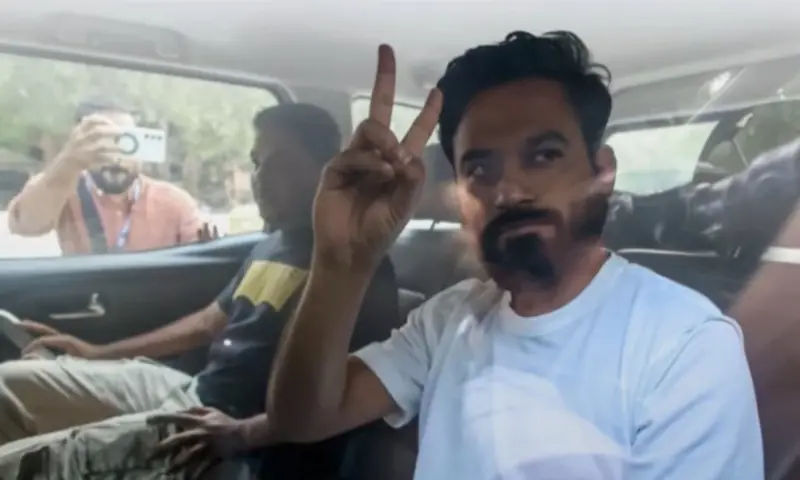
India’s Cockroach Janata Party (CJP) founder Abhijeet Dipke was released from detention on Saturday, a day after he was detained during a police crackdown on protests against the election authority.
Dipke, 31, was detained on Friday in New Delhi as he headed to join a rally that the CJP protest movement had called in the capital’s central Connaught Place district. He was arrested to prevent a breach of the peace, broadcasters NDTV and India Today reported.
He walked out of a police station on Saturday afternoon, waving to the media and giving a thumbs up as he was driven away, an AFP photographer saw.
“Abhijeet Dipke released,” CJP legal affairs chief Ratna Singh said on social media.
Opposition parties and CJP activists have defied a security crackdown, rallying to demand the resignation of India’s Chief Election Commissioner Gyanesh Kumar after accusing the poll body of manipulating voter rolls to benefit Prime Minister Narendra Modi’s ruling party.
More than 130 million voters were deleted during the revision. The Election Commission has denied favouring any party and said wrongly deleted voters can re-enrol. The BJP has accused rivals of trying to undermine democracy by wrongly questioning legitimate electoral processes.
Student activist Neha Bora, a prominent face of the protests, who was also detained on Friday as she tried to reach central Delhi with dozens of supporters, was released earlier on Saturday as well.
“Please, spare the people of India. Impeach Gyanesh Kumar and halt SIR (special intensive revision), so that the ordinary citizens of this country can breathe a sigh of relief, feel at ease, and have their voting rights ensured,” Bora told ANI news agency after she was released.
Two other senior CJP leaders, Ashutosh Ranka and Saurav Das, were arrested on Oct 14 after entering Jantar Mantar, a decades-old protest site that police have declared off-limits for demonstrations. They remain in custody.
Members of Modi’s Hindu nationalist Bharatiya Janata Party have long alleged that large numbers of undocumented Muslim migrants from neighbouring Bangladesh have fraudulently entered India’s electoral rolls.
Rights groups and critics, however, say Modi’s government has eroded democratic freedoms during more than a decade in power, citing pressure on journalists, civil society groups and political opponents — allegations the government rejects.
A weeks-long sit-in by supporters of the movement earlier this year forced then-education minister Dharmendra Pradhan’s resignation over exam paper leaks.

 Login












 https://t.co/PlgCFYUkjM