❌

Reading view

J-36 vs F-47: China’s J-36 Pulls Ahead of U.S. F-47 as PLA Becomes First To Release “Teaser” of 6th-Gen Aircraft

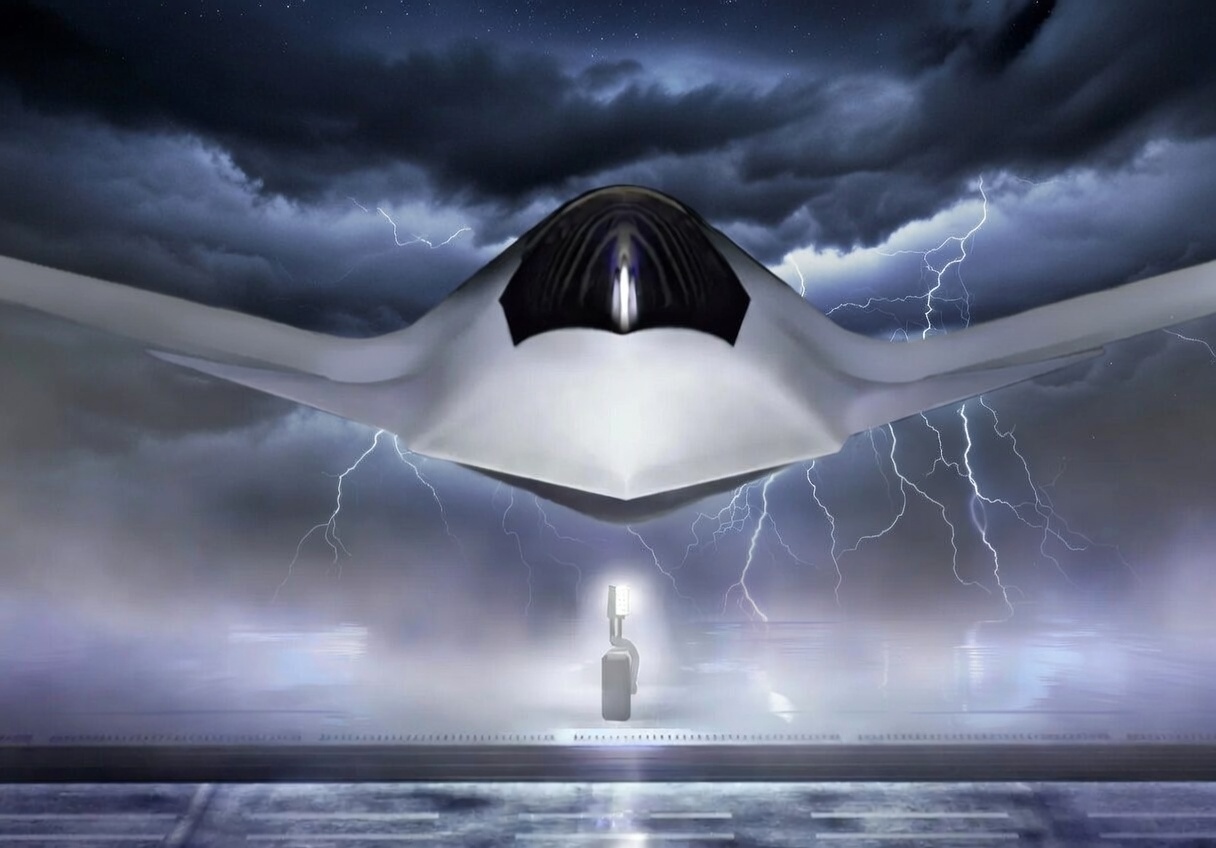
China released the teaser footage of the fifth prototype of its sixth-generation fighter jet, the J-36. The big question is: has Beijing leapfrogged the U.S. F-47 aircraft?

China Military Bugle, the official press account of the People’s Liberation Army, published a four-minute video on July 26, marking the 10th anniversary of China’s first heavy transport aircraft, the Y-20, entering service.

In the video’s last scene, one of the Y-20 co-pilots asks his captain: “Who are we refueling today?”

“First the ‘Master Six’, then the ‘Little Six’,” the captain replies.

The final shot clearly shows the now familiar three-engine tailless J-36 flying next to the Y-20.

In Chinese defense circles, “Master Six” is an informal nickname for the H-6 strategic bomber, and “Little Six” is a reference to the sixth-generation fighter.

PLA just hinted at the 6th-gen fighter in the video Y-20's 10th anniversary service!

"Captain, who are we refueling today?"

"First 'Sixth Master' (H-6), then 'Little Six' (6th-gen)."

The final shot clearly shows the unannounced but well-known 6th-gen jet. pic.twitter.com/dmVdErtXmO

— Li Zexin 李泽欣 (@XH_Lee23) June 28, 2026

Notably, while there have been multiple videos and pictures of the J-36, this is the first time that the video of the unusual, three-engine fighter jet has been released in official Chinese media.

This is seen as China’s first official acknowledgment of the existence and flight testing of the next-generation fighter jet.

Online videos and pictures of the J-36 have been circulating since December 2024, when China simultaneously unveiled two next-generation stealth aircraft, dubbed J-36 and J-50, during flight tests near Chengdu, Sichuan.

The J-36’s trijet design, featuring a blended double delta wing structure, was immediately documented. However, those videos were shot from the ground, and China’s government, military officials, or aviation companies did not make any comment on the new fighter jet.

Nearly three months later, in March 2025, the J-36 made a second appearance over Chengdu. This time, it flew solo, and the videos gave clear views of the aircraft’s trijet configuration, dorsal intake, and control surfaces.
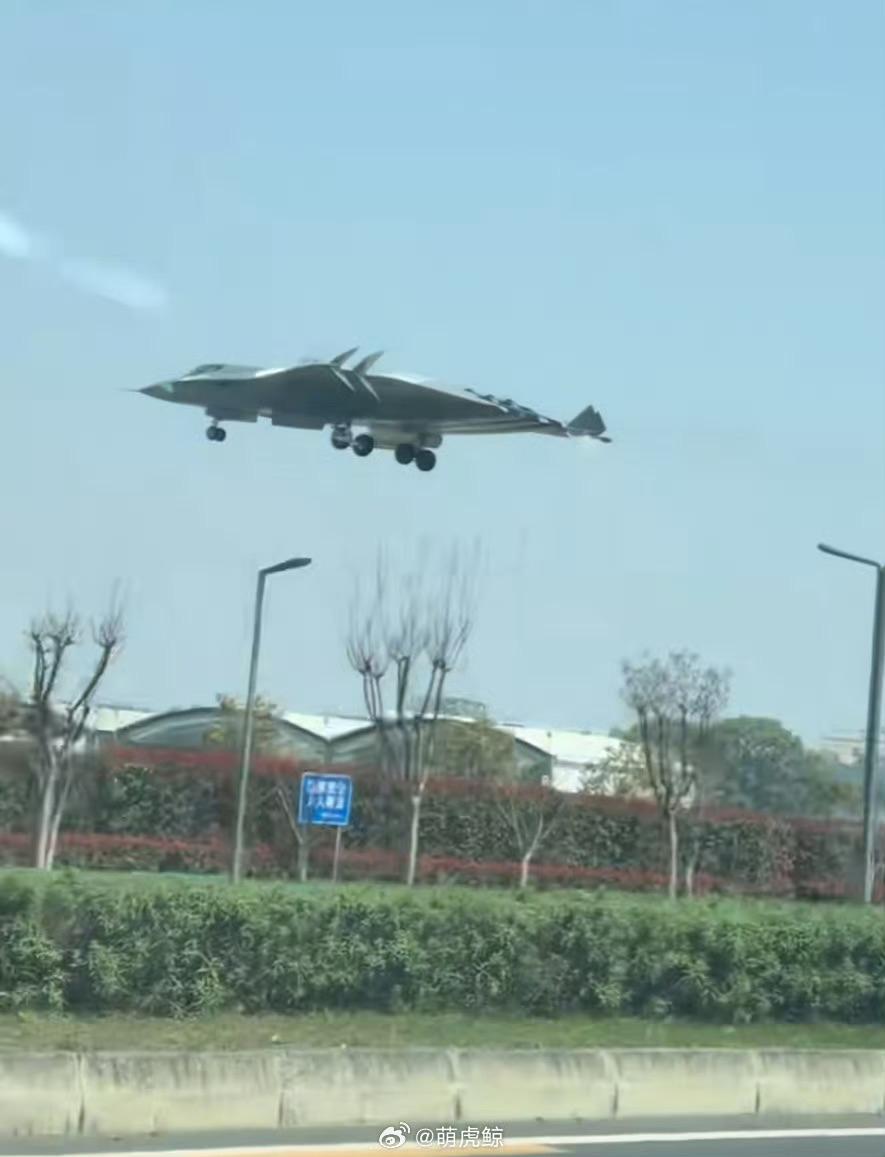
The J-36. File Image.

Since then, the aircraft has been sighted multiple times flying over Chengdu.

The latest video, featuring the J-36 flying next to the Y-20, also makes it clear that the aircraft is equipped with air-to-air refueling capacity.

Song Zhongping, a military commentator and former PLA instructor, told Hong Kong-based SCMP that the video indicated that the sixth-generation fighter was almost certainly equipped with air-to-air refueling capability.

“And it is highly likely that it has already conducted air-to-air refueling tests during flight testing,” he said.

Air-to-air refueling capacity is crucial to navigate the long distances of the Pacific theatre.

“If a tactical aircraft’s endurance and combat radius approach those of a medium-range strategic bomber, it would be capable of carrying out patrol missions of strategic significance,” Fu Qianshao, a military analyst and former PLA Air Force officer, said.

The latest images appear to show further significant changes to the aircraft’s design and underscore its rapid evolution.

According to experts, this might be the fifth prototype of the J-36.

China’s decision to officially acknowledge the J-36 in the Y-20 anniversary video, while simultaneously flying what appears to be a fifth prototype within just 19 months of the first sightings, marks a significant acceleration in its sixth-generation fighter program.

The aircraft’s large airframe, evolving stealth features, and confirmed aerial-refueling capability suggest Beijing is prioritizing long-range, high-endurance operations across the Pacific. If the current pace of flight testing continues, China could field an operational sixth-generation platform earlier than many Western programs currently project — a development that would reshape the airpower balance in the Indo-Pacific.

Andreas Rupprecht, an aviation analyst and expert on China’s air force, said the structural differences between the earliest and latest examples made it unlikely the sightings simply showed a single aircraft being repeatedly modified.

“It is still difficult to assess this with any certainty,” he said. “But if one takes the reports from reliable sources as a basis, there is indeed some strong evidence to support it.”

According to Rupprecht, the J-36 program appeared to have progressed through at least three distinct configurations since December 2024.

The first aircraft featured caret-shaped air intakes, tandem main landing gear and box-shaped engine nozzles.

A revised configuration introduced diverterless supersonic air intakes, side-by-side landing gear and redesigned exhausts that might improve stealth and maneuverability.

The latest aircraft appears to retain many of those changes while introducing a modified nose section, suggesting continued refinement of the design as testing progresses, Rupprecht explained.

Experts are divided on why China is testing three different design configurations simultaneously.

Rupprecht suggested that one possibility was that China was testing three different models to analyze which design performed best in real flight conditions, rather than drawing conclusions solely from wind tunnel testing.

“There is simply no experience yet in this regard for such a type of ‘fighter’,” he said.

Rupprecht also suggested that another possibility was that design changes were necessitated by the shift from the earlier WS-10C engine to China’s more powerful WS-15 powerplant; however, there was no confirmation.

He also noted that the appearance of the fifth prototype within 19 months highlighted that the program was progressing rapidly.

Comparisons with the J-20 stealth fighter suggest the J-36 has reached key milestones faster.

“So yes, the program does appear to be relatively mature and progressing quickly,” Rupprecht said.

However, he cautioned that faster flight testing of the J-36 might not translate into quicker operationalization of the fighter aircraft into the PLA Air Force (PLAAF).

Rupprecht suggested that he expected China to deliver the first pre-production batch to the PLA Air Force before 2030, with operationalization of the final production model some years later.

He also suggested that the J-36’s unusually large size meant the aircraft was more likely to serve as a heavily armed command platform capable of directing armed loyal wingman drones and other fighter jets, aided by its powerful sensors and long-range weapons.

“I am more convinced that the J-36 is something entirely distinct,” he said, describing it as an “aerial air-defense node” comparable in concept to an Aegis-equipped US warship coordinating a wider combat network.

In Rupprecht’s view, these different roles and designs make J-36’s comparisons with the F-47 misleading. In fact, he suggested that it will be more fruitful to compare the F-47 with J-50.

Regardless of the substantial differences in design and possibly in their roles, it can not be denied that China’s J-36 is progressing much faster than the US’s next-generation fighter jet.

While the J-36’s fifth prototype is flying, there is no publicly available picture of the F-47 flying.

The first flight of the F-47 is expected sometime in 2028.

In fact, according to the latest reports, the F-47 is expected to initially fly with an interim engine, as the US’s Next Generation Adaptive Propulsion (NGAP) program could be ready for integration onto an actual aircraft only by 2030.

This means that at least the F-47 prototype, and possibly the first operational F-47s, will have to fly with a different engine before the NGAP engine is integrated into the F-47 around 2030-2031.

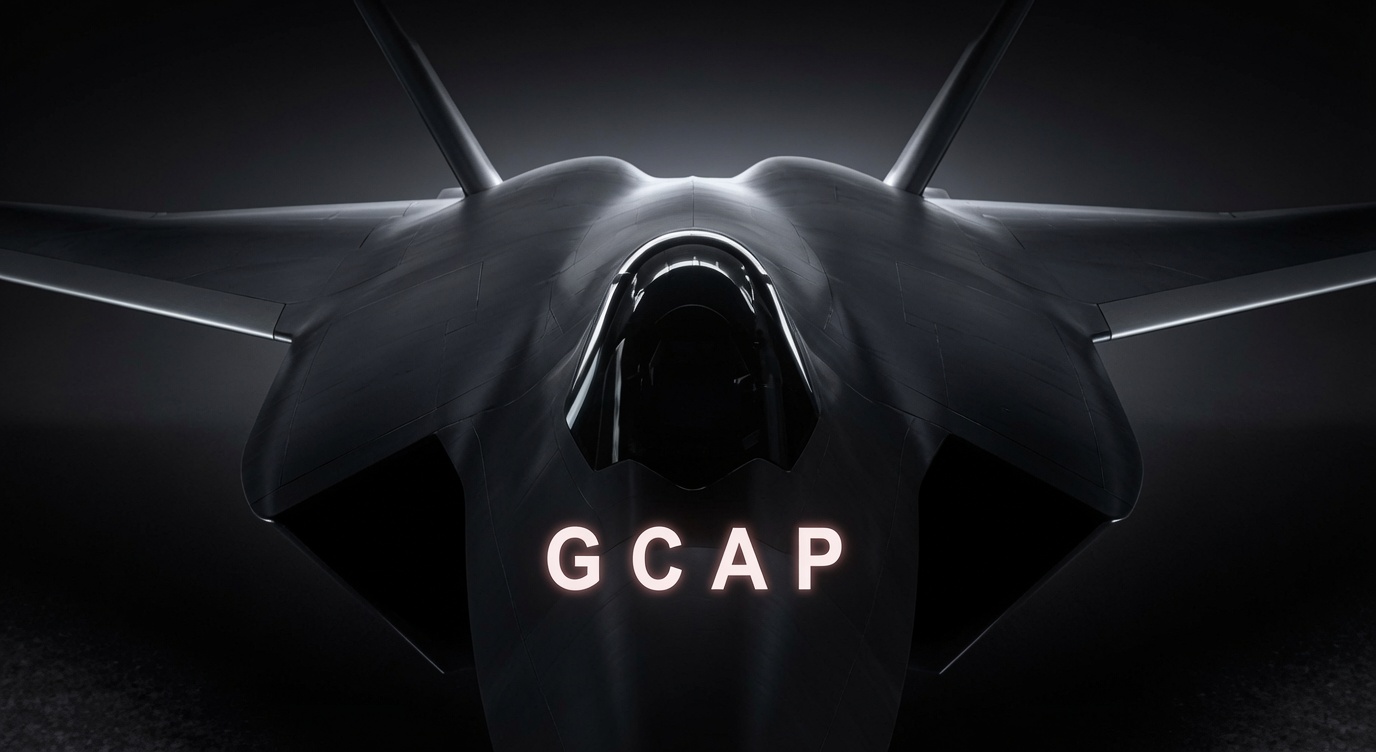
Meanwhile, the GCAP, the UK, Italy, and Japan’s combined tri-nation sixth-generation fighter jet program, is expected to enter operational service around 2035.
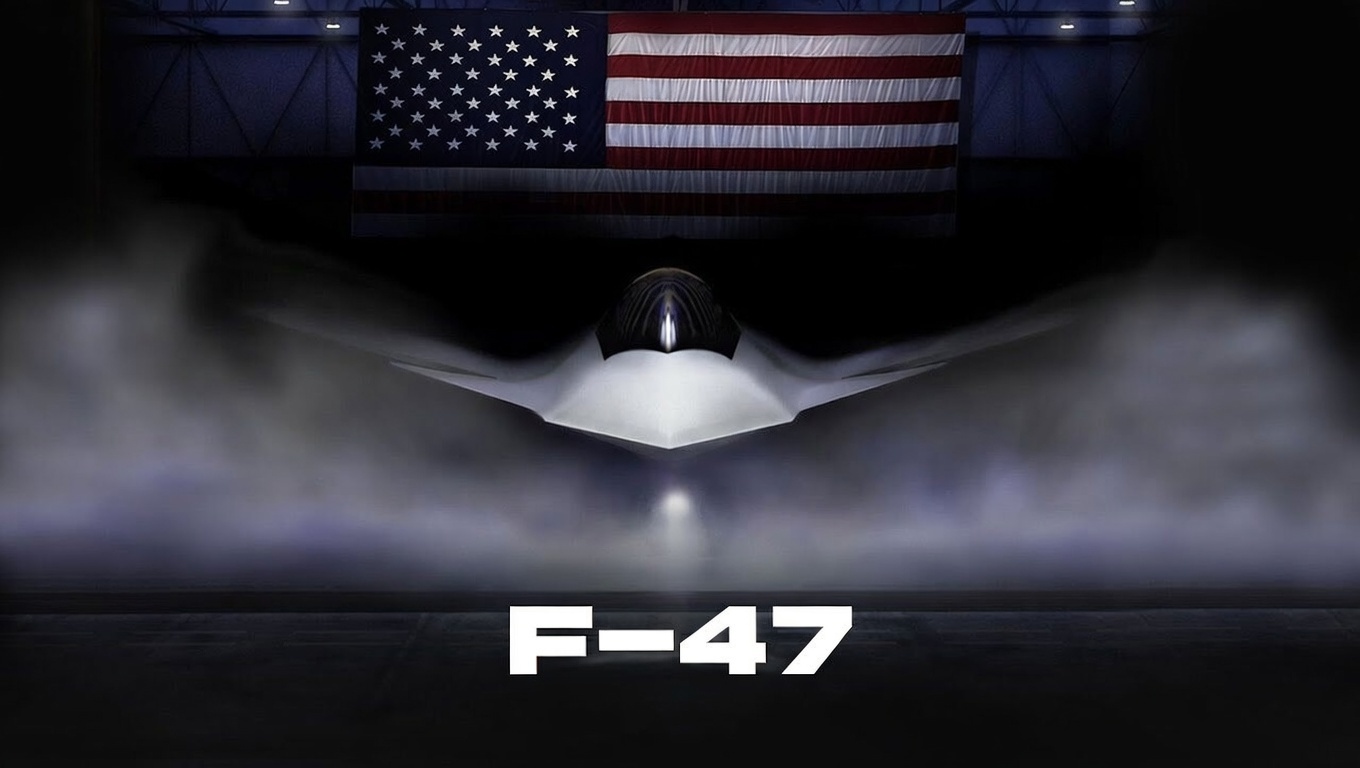
F-47.

The FCAS, Germany, Spain, and France’s sixth-generation fighter jet program has already collapsed.

Fu Qianshao, a military analyst and former PLA Air Force officer, said that China’s program was progressing much faster than comparable efforts in the US, Russia and Europe.

“In my view, China’s fighter development … is now ahead of its competitors,” he said.

These timelines suggest that for the first time in history, China might beat the US and Europe in integrating a next-generation fighter jet in operational service, which could have far-reaching consequences for the balance of power, particularly in the Pacific theatre.

Furthermore, the J-36’s aerial refueling capability, combined with its unusually large size and greater fuel capacity, would give it exceptional range, an advantage that could prove decisive in the contest for air superiority across the Pacific theater.

“The aircraft could potentially operate beyond the western Pacific and, in some cases, reach the Indian Ocean, which would have significant strategic implications,” Fu added.

  • Nitin J Ticku holds a double master’s degree in Journalism and Business Management from the University of Glasgow. He has over 20 years of global experience in MARCOM, Journalism, and Digital Marketing, and has worked & traveled widely across Europe, the Americas, and Asia. Nitin is the Editor of the EurAsian Times.
  • He can be reached at editor (at) eurasiantimes.com

The post J-36 vs F-47: China’s J-36 Pulls Ahead of U.S. F-47 as PLA Becomes First To Release “Teaser” of 6th-Gen Aircraft appeared first on EURASIAN TIMES.

  •  

Historic First for Indian Rafale Jets: Australian KC-30A Refuels IAF Fighters During Pitch Black 2026

For the first time, an Indian Air Force (IAF) Dassault Rafale fighter aircraft was refueled by a Royal Australian Air Force (RAAF) Airbus KC-30A Multi-Role Tanker Transport (MRTT) taking part in Exercise “Pitch Black” 2026.

The refueling of the Indian Rafale—making their debut at “Exercise Pitch Black”—was conducted during the second week of the exercise, which began on 20 July and runs through August 7, 2026. The jets that refueled mid-air have been identified as a single-seat Rafale EH and a twin-seat Rafale DH, as noted by Janes.

According to the Australian Department of Defense, the KC-30A, operating from RAAF Base Darwin, refueled 14 fighter aircraft from partner nations during a five-hour sortie over Australia’s Northern Territory. Meanwhile, the Royal Australian Air Force (RAAF) highlighted the mission on X with video footage that also showed RAAF Super Hornets, Republic of Korea Air Force F-15Ks, and German Eurofighter Typhoons being refueled mid-air.

Flight Lieutenant Sara Whitehead, commander of the KC-30A, said, “The first to visit the aerial bowser were two IAF Rafales, completing fuel transfers by wing-mounted hose-and-drogue before returning to their missions.”

Before this, the RAAF KC-30A Multi-Role Tanker Transports refueled IAF Su-30MKIs during Exercise Pitch Black 2018 for the first time.

A RAAF KC-30A delivered fuel to Indian Rafales @IAF_MCC, RAAF Super Hornets, Republic of Korea Air Force F-15Ks @ROK_MND and German Eurofighter Typhoons @Team_Luftwaffe, demonstrating seamless multinational interoperability at #PitchBlack26. pic.twitter.com/5u7F4U29bs

— Royal Australian Air Force (@AusAirForce) July 28, 2026

Notably, the latest refueling event was the visible execution of an agreement signed by Australia and India in November 2024, enabling RAAF KC-30As to refuel aircraft of the Indian Armed Forces. It is, however, noteworthy that the KC-30s refueled the IAF’s most advanced fighter jet, which has now become the cornerstone of its air power.

Interestingly, the Rafales arrived in Australia a little over a year after the May 2025 India–Pakistan crisis, in which Indian fighters engaged Chinese-origin Pakistani aircraft, and at a time when India is advancing plans for the acquisition of 114 additional Rafales.

This is not the first time that a refueling aircraft of a partner nation has refueled Indian Rafales. Earlier, for instance, the first IAF Rafales were mid-air refueled by French Air Force Airbus A330 Multi-Role Tanker Transport (MRTT) aircraft during their ferry flight from Merignac (Bordeaux), France, to Al Dhafra Air Base in the UAE.

Separately, the UAE Air Force Airbus MRTT tankers provided in-flight refueling for several subsequent ferry flights of IAF Rafales from France to India, enabling non-stop flights.

Having said that, the latest long-range deployment to Australia tested the Rafale’s strategic reach and ability to sustain operations far from home bases.

Image
IAF Rafale being refueled mid-air by RAAF’s KC-30 (Picture courtesy of RAAF)

The Indo-Pacific is a vast theater where combat aircraft need extended range and endurance. Therefore, this kind of mutual support strengthens collective readiness, deterrence, and the ability to sustain operations far from home bases — goals repeatedly highlighted in India–Australia statements about a “free and open Indo-Pacific.”

The IAF Rafale’s debut in Pitch Black comes at a time when India and Australia are strengthening their defense ties. For the ongoing drills, the IAF sent at least four Rafales, two Boeing C-17 Globemaster III transport aircraft, one Ilyushin Il-78 Midas aerial refueling aircraft, and an estimated 120 troops to RAAF Base Darwin.

The IAF Rafales were expected to fly alongside the F-35 stealth fighters during these keenly watched multinational drills.

Fielding Rafales for the first time in 2026 and successfully receiving Australian tanker support underscores deepening air-power cooperation. It complements other engagements, including maritime patrol aircraft interactions and joint exercises, and signals growing ability to operate together in coalition settings.

India-Australia Strengthen Defense Ties 

Earlier this week, Australian High Commissioner Philip Green stated that India has become a “top-tier” security partner for Australia, noting that Indian Prime Minister Narendra Modi’s recent trip to Melbourne has strengthened security ties.

India and Australia have developed one of the fastest-growing defense partnerships in the Indo-Pacific, based on the Comprehensive Strategic Partnership signed in 2020. This core framework is apparently built on shared democratic values, economic ties, and a common vision of a free, open, peaceful, stable, and prosperous Indo-Pacific

After this, the two sides signed the Mutual Logistics Support Arrangement to provide reciprocal logistical support and facilitate more complex exercises and deployments. Subsequently, New Delhi and Canberra inked the Air-to-Air Refueling Arrangement in 2024.

The defense ties received a further boost this month as Narendra Modi and Australian Prime Minister Anthony Albanese signed the Joint Declaration on Defense and Security Cooperation during the third Annual Leaders’ Summit in Melbourne. It renews and expands the 2009 framework, committing the two sides to deeper strategic consultations, more complex exercises, faster interoperability and information sharing, expanded aircraft deployments from each other’s territories, and greater personnel exchanges.

Not just that, the two sides agreed on a Maritime Security Collaboration Roadmap focused on operational coordination, information sharing, and capability development in the maritime domain—the area of greatest geographic and strategic overlap.

Beyond Bilateral defense frameworks, India and Australia are bound by a host of institutional mechanisms, such as the QUAD, which also includes the US and Japan.

Meanwhile, the military cooperation spans all three services and has grown in frequency and complexity. In addition to Air Force-focused Pitch Black, India and Australia have participated in naval exercises such as Exercise Malabar, AUSINDEX, Milan, and Kakadu.

Additionally, the two sides have participated in AustraHind, an exercise that brings together the armies of the two countries, which now appears to be expanding to include amphibious or littoral elements.

India has also reportedly participated in Talisman Saber, hosted by Australia in 2025, and is looking forward to an enhanced role planned for the 2027 edition.

In his latest interview, Green also highlighted the value of common platforms such as the Boeing P-8 maritime patrol aircraft, bolstering interoperability.

The two sides frequently engage with each other’s industries. For instance, Australia participated in Aero India 2025, while a delegation from India attended the Avalon Australian International Airshow 2025.

A key driver of this close defense partnership is the shared concern about regional stability, freedom of navigation, and the rules-based order in the Indo-Pacific. Although maritime security has been the strongest pillar of alignment amid shared threats and China’s rapid expansion in the Indian and Pacific Oceans, the defense industrial collaboration is expanding through trade missions, industry roundtables, and efforts to build resilient supply chains and co-develop capabilities.

The Rafale’s debut in Pitch Black and the refueling exhibit the strength of ties between the two states.


The post Historic First for Indian Rafale Jets: Australian KC-30A Refuels IAF Fighters During Pitch Black 2026 appeared first on EURASIAN TIMES.

  •  

Japan Officially Joins The “Tomahawk Club”, Fires U.S.-Origin Cruise Missile in Landmark Pacific Test

Japan has become the latest entrant to the exclusive club of countries that possess the Tomahawk cruise missile.

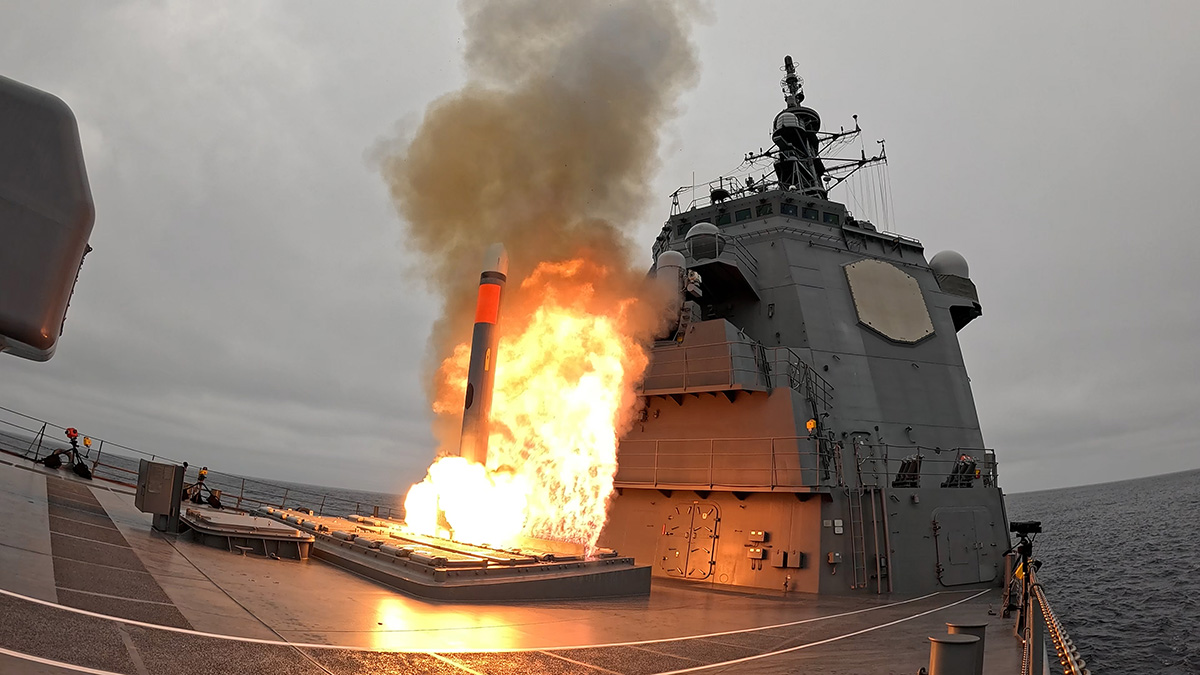
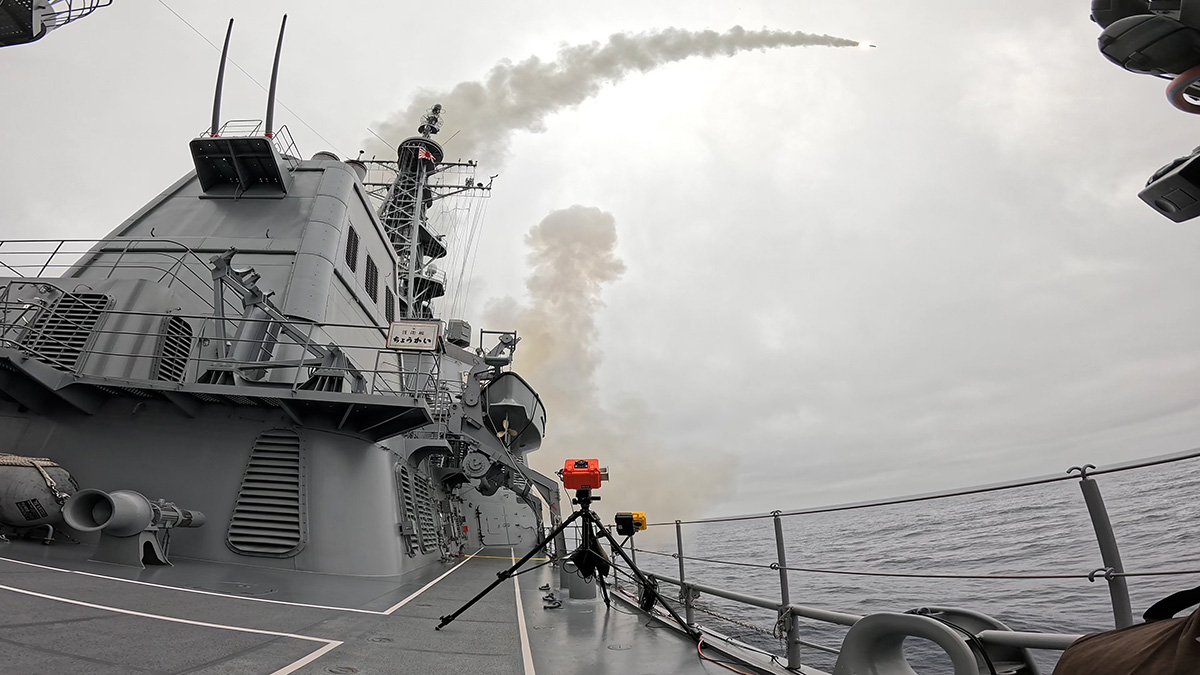
Japan’s Ministry of Defense (MoD) announced on July 30 that the Japan Maritime Self-Defense Force (JMSDF) had test-fired a Tomahawk land-attack cruise missile from one of its warships, the Aegis guided-missile destroyer JS Chokai (DDG-176), for the first time.

The test was conducted on June 29 in the Pacific Ocean with US Navy’s support. It followed the March 2026 announcement by the Acquisition, Technology & Logistics Agency that Chokai had completed the necessary upgrades to fire long-range standoff missiles.

With the launch, Japan became the third nation (apart from the United States) to fire a Tomahawk from a surface combatant—after Australia and the Netherlands—and the fourth overall, following the United Kingdom, which has launched the missile only from submarines. The successful test marks a major step in Tokyo’s effort to field a credible long-range conventional strike capability.

The MoD verified that the missile reached its intended target and that the ship and crew successfully carried out the launch sequence. It did, however, conceal certain information, such as the precise location in the Pacific, the number of missiles fired, the range attained, the target’s specifics, and the missile variant used.

Historic moment as JS Chokai becomes the first JMSDF warship to live-fire a Tomahawk Land Attack Missile. We can expect a torrent of state media commentaries from you-know-who proclaiming the impending end of the world with Japan’s remilitarism. https://t.co/zXXalHYluW pic.twitter.com/wT1rHAP2V7

— Collin Koh 🇸🇬🇺🇦 (@CollinSLKoh) July 30, 2026

Chokai is expected to return to Japan around September 2026, indicating that the Tomahawk capability will be deployed in the volatile Indo-Pacific region.

Japan plans to equip all eight of its Aegis destroyers—two Kongō-class, two Atago-class, and two Maya-class— with Tomahawks. Modifications will be carried out gradually on ships based at Yokosuka and Sasebo.

Additionally, Japan is also building two Aegis System Equipped Vessels (ASEVs), due to enter service in fiscal years 2027 and 2028, respectively. Officials have stated that these ships will not have Tomahawk launch capability upon entry into service, though they are designed for future integration.

File: JS Chokai launched a Tomahawk cruise missile
Japan announced the purchase of 400 Tomahawk missiles in 2024, including 200 Block IV and 200 Block V variants, along with 14 Tactical Tomahawk Weapon Control Systems and associated support, training, maintenance, and spares. The original plan had called for acquiring up to 400 of the newer Block V missiles starting in fiscal 2026. However, to accelerate deployment, Tokyo advanced the timeline by a year and substituted half the order with the  Block IV variant.
However, the US Secretary of  War, Pete Hegseth, told his Japanese counterpart, Shinjiro Koizumi, in May 2026 that the delivery could be delayed.

Tomahawk forms a central part of Japan’s effort to develop “standoff defense capabilities” in response to a more demanding regional security environment vis-à-vis China, which is widely seen as a potential aggressor amid unprecedented military expansion.

Moreover, it aligns with Japan’s 2022 National Security Strategy, which officially recognized “counterstrike capabilities” as a self-defense measure.

Japanese officials consider the Tomahawk as a deterrent: by holding an aggressor’s launch sites and supporting infrastructure at risk, Japan aims to make any attack on it far more costly and less likely to succeed.

Having said that, the Tomahawk missile is viewed by experts as an interim solution adopted by Japan until indigenously developed options, such as the Type 12 and other long-range missiles, are ready for induction.

Defense By Offense: Japan’s Tomahawks are Here

Japan’s test-firing of Tomahawk has formally heralded the country’s transition from a purely defensive posture to one that includes credible long-range counterstrike stand-off capabilities. This aligns with Japan’s push to strengthen its long-range strike capabilities to deter China, which has steadily expanded its military presence in the East China Sea. 

Tokyo regards China’s rapid buildup of missile forces and naval power, together with its assertive actions around the Senkaku Islands (administered by Japan but claimed by China and Taiwan), as Japan’s greatest strategic challenge. Moreover, the Japanese leadership fears that the country could get dragged into a China-Taiwan conflict triggered by the PLA’s invasion of Taiwan, due to its geographic proximity.

Speaking at a news conference earlier, Japanese Defense Minister Shinjiro Koizumi exclaimed that the new capability would be “of great significance for reducing the possibility of an armed attack on Japan itself,” potentially referring to regional rivals such as China. “To defend against incoming missiles while preventing further armed attacks, Japan must possess the capability to launch an effective counter-attack – a counterstrike capability. Long-range missiles can be used for this counterstrike capability.”

The Tomahawk cruise missile is primarily designed to strike high-value, heavily defended land targets, such as command centers, airfields, and critical infrastructure.

With a range of approximately 1,600 kilometers, Tomahawks launched from the western Pacific or waters around Japan can cover all of North Korea and reach deep into eastern China, as well as parts of Russia’s Far East. This essentially gives Japan the ability to strike missile launch sites, air bases, command-and-control nodes, logistics hubs, and amphibious staging areas from outside an adversary’s defensive envelope.

File: JS Chokai launched Tomahawk

Unlike fixed land-based platforms, sea-based launch platforms are mobile, making missiles more difficult to preempt. The Tomahawk features in-flight retargeting via data links, enabling more adaptive responses during a potential conflict.

With the integration of Tomahawk, Japan can impose costs on the aggressor’s rear-area infrastructure rather than solely defending against the first wave of missiles or ships. This supports “deterrence by denial”, making invasion or sustained attack harder, and “deterrence by punishment”, threatening meaningful retaliation—both of which were earlier missing from the Japanese military’s inventory and philosophy.

Tomahawks will operate alongside ground-launched systems such as upgraded Type 12 missiles and Hyper Velocity Gliding Projectiles, as well as air-launched weapons including the Joint Strike Missile carried by F-35s.

Together, these systems will form a layered, distributed long-range fires network that complicates adversary planning and raises the cost of aggression.

Fielding the Tomahawk will deepen interoperability with the United States while reducing Japan’s exclusive reliance on US forces for deep-strike missions, thereby enhancing Tokyo’s self-reliance as a security actor, which it has been desperately seeking for some time.

China is likely to be wary of Japan’s possession of Tomahawk, particularly since the missile has already proved its efficacy in combat multiple times, most recently in the Iran war. Previous reports suggested that the US military fired over 850 Tomahawk missiles, a number that may have swollen by now as hostilities continue

Beijing has consistently opposed Japan’s defense buildup as provocative and had strongly criticized the deployment of the Mid-Range Capability system in Japan, which can also launch Tomahawks, earlier this year.

The post Japan Officially Joins The “Tomahawk Club”, Fires U.S.-Origin Cruise Missile in Landmark Pacific Test appeared first on EURASIAN TIMES.

  •  

Why is Putin Hunting Telegram’s Founder Pavel Durov and Branding Him a Terror Facilitator?

Russia has charged Telegram founder Pavel Durov with facilitating terrorist activity in the country and put him on an international wanted list, alleging that his hugely popular messaging app was being used by ‌Ukrainian spies to organize attacks inside Russia.

The charges, announced by the Federal Security Service (FSB), followed a long investigation into Telegram.

The FSB accused Telegram of failing to remove “numerous channels, chats and bots” allegedly used by “Ukrainian intelligence agencies, terrorist and extremist organizations to prepare and coordinate acts of sabotage and terrorism, mass murder, and cyberfraud” in Russia, which resulted in “numerous human casualties.”

It further said that a chatbot available on Telegram called “Daivinchik/Leo” had been ​used by Ukrainian spies to recruit young Russians to carry out sabotage and terrorist operations.

Reportedly, Ukrainian special agents pose as young women on the app to recruit Russian men and use them for spying or carrying out sabotage activities.

Russia has also issued an international arrest warrant against Durov, who was born in Russia but currently lives in Dubai.

Notably, the Telegram app, which is hugely popular in Russia, is already heavily restricted in Russia.

Russian citizens can now access Telegram only by using a VPN to encrypt their traffic and conceal their location. However, despite these restrictions, state bodies, including the Kremlin and the defense ministry, continue to post ⁠on it regularly.

The crackdown on Telegram is part of Russia’s broader effort to restrict access to foreign tech platforms and assert control over the internet. Apart from Telegram, other popular messaging apps such as WhatsApp, Instagram, Facebook Messenger, Signal, Discord, Snapchat, and Apple FaceTime are also banned in Russia.

Russia has now gone one step ahead and formally charged Telegram founder Durov with aiding terrorism, despite the fact that the app is hugely popular in Russia.

However, notwithstanding Russian restrictions on Telegram and the charging of its founder with terrorism, both Russia and Ukraine have used the app extensively in the ongoing war.

In fact, the Telegram app has also been described as a “virtual battlefield” in the war between Russia and Ukraine, where it is used ​by officials, soldiers, defense ministry handles, and influential bloggers on both sides.

So, how did a messaging app become key to the Russia-Ukraine War?

Telegram As A “Virtual Battlefield” in the Russia-Ukraine War

In the Soviet Union, media was heavily controlled by the state to control public discourse.

Russia inherited this culture of controlling the narrative through its influence on the media. However, with the proliferation of digital and social media, the state’s ability to control the media weakened.

Telegram was one of the most popular messaging apps in Russia and Ukraine in 2022 when the war began.

In Russia, Ukraine, and many Eastern European countries, Telegram served as a crucial alternative to state-monitored communication channels for sharing news.

With Russia’s invasion of Ukraine, Facebook and Instagram were banned over extremism charges by a Moscow court, and access to Twitter was restricted by the Russian censorship body Roskomnadzor.

As there was disdain for traditional state-controlled media in Russia and many other social media channels were banned outright, the role of Telegram, already hugely popular in Russia, in shaping narratives and controlling perceptions of the war became even more critical.

According to a Levada survey, among Russian youth aged 18-24, TV was the least popular news source, with 41% relying on Telegram channels for news. Additionally, during the first two months of the conflict, 76.6% of Ukrainians used social media for news, with Telegram as the most favored platform at 65.7%.

Telegram was also used by both the Russian and Ukrainian governments to broadcast air raid warnings and distribute maps of local bomb shelters.

Some of Telegram’s unique features, such as the ability to make a channel public or private, the option to have unlimited subscribers, and the lack of algorithms that boost or restrict content visibility, have made Telegram a popular information-dissemination tool for both pro- and anti-war voices.

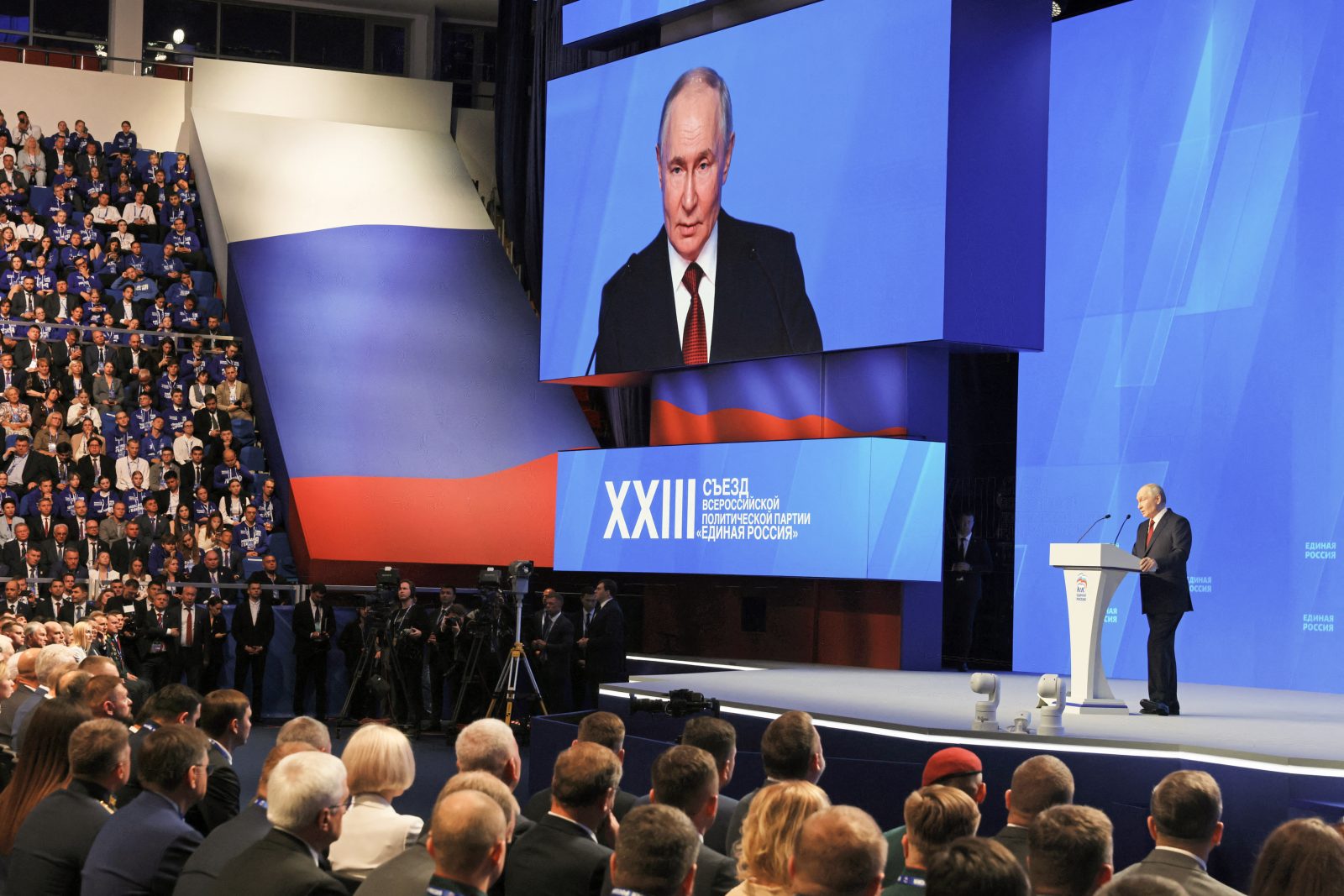
In this pool photograph distributed by Russian state agency Sputnik, Russia’s Vladimir Putin addresses the audience at the 23rd Congress of the United Russia party in Moscow on June 28, 2026. Vladimir Putin vowed on June 28, 2026 to ensure security and overcome challenges as Ukraine stepped up its retaliatory strikes inside Russia amid Moscow’s four-year war. (Photo by Yekaterina SHTUKINA / POOL / AFP)

According to a research paper titled ‘Telegram as a Battlefield,’ over 40% of Telegram channels are dedicated to news, with approximately 17% directly related to the war and ongoing events in Ukraine.

As the war progressed, many war bloggers who were not part of traditional media outlets began posting on Telegram, reaching millions of people.

For millions of people, these war bloggers became an alternative source of information and war updates, often coming straight from the front lines.

Given its popularity as a source of information for war updates, many pro-government channels also used Telegram to push their narrative and spread disinformation.

The paper ‘Telegram as a Battlefield’ also found that after the invasion, average views per post for Pro-Kremlin channels rose from 15,929 to 67,442 (a 323% increase) and for Anti-Kremlin channels from 25,346 to 104,778 (313% increase), highlighting how Telegram emerged as a critical battlefield for disseminating information, propaganda, and shaping narratives.

However, it noted that anti-Kremlin channels consistently garnered higher viewership than pro-Kremlin channels, especially post-invasion.

Also, as the war progressed, Ukraine, just like in the case of drone technology, used Telegram in more innovative ways than Russian government circles.

Ukrainians used it for air-raid alerts, bomb-shelter maps, and official updates from President Zelensky and military commands.

Ukraine also used Telegram as an intelligence-collecting tool. It crowdsourced intelligence via tip bots and channels that shared enemy vehicle movements, leading to successful strikes.

Common people in Ukrainian villages often shared information on Russian military movements with the Ukrainian military and intelligence securely via Telegram.

Telegram, in fact, became a vast depository of HUMINT (human intelligence) for Ukraine.

Furthermore, the platform was also used by Russian government critics to share information with the Ukrainian military across the border.

Telegram was also used to document war crimes and OSINT (open source intelligence).

Ukrainian intelligence also used Telegram to communicate with people in occupied territories and to encourage them to share intelligence on the Russian military.

Frontline troops also use the app to organize logistics, share drone feeds, and have informal discussions with their military commands.

Telegram has also been described as the conflict’s digital battle space, where organizing logistics, war blogging from the frontlines, propaganda, disinformation campaigns, narrative warfare, intelligence collection, recruitment of spies and saboteurs, cataloging of war crimes, and dissemination of public interest information like air raid warnings and bomb shelter maps all take place in real time.

Telegram, in fact, is providing the most unfiltered view of the war.

“Telegram has become this really key battleground in the information war,” Dr. Ian Garner, a historian and translator of Russian war propaganda, told Time magazine. “And it’s interesting that this information war has been outsourced to a private company.”

While Russia has often tried to use Telegram to its advantage, Ukraine has shown much more ingenuity in using it, which explains Moscow’s love-hate relationship with the app.

Russia might have restricted the app and now formally charged its founder with terrorism, but official Russian media handles are still using it, and even common Russian citizens can use it using VPN services.

However, even after these formal charges, Telegram will continue to remain the digital battle space of the Russia-Ukraine War.

  • Sumit Ahlawat has over a decade of experience in news media. He has worked with Press Trust of India, Times Now, Zee  News, Economic Times, and Microsoft  News. He holds a Master’s Degree in International Media and Modern History from the University of Sheffield, UK. 
  • He can be reached at ahlawat.sumit85 (at) gmail.com

The post Why is Putin Hunting Telegram’s Founder Pavel Durov and Branding Him a Terror Facilitator? appeared first on EURASIAN TIMES.

  •  

Thanks to India, U.S. & China Remain Neck-and-Neck in Global Popularity. 1.4B People Keep The Balance Even

There seems to be an emerging consensus among strategic circles all over the world that while the rising global popularity of China, evident from the latest survey from the Pew Research Center on July 15, may not equate to the real global strategic leverage that America still possesses, it is a critical warning signal for the U.S.  

In its survey, based on interviews with more than 42,000 people across 36 countries, Pew found that China is now viewed more favorably than the United States.

Among the 20 economies with comparable data, the median share of respondents expressing favorable views of China reached 46 percent, compared with 36 percent for the United States.

Similarly, during the first two years of his second term, President Donald Trump’s own ratings have also worsened significantly. Chinese President Xi Jinping now exceeds confidence posed in  Trump by 10 (ten)  points (31:21).

More favorable views of Xi were noticed in 22 of 36 countries. More overall now say that they have confidence in Xi than in Trump.

Pew says that more people have favorable views of China than the U.S. in 25 out of 36 countries, including Canada, Mexico, France, Germany, and Australia. Only 6 (six) countries still rate the U.S. more positively: India, Japan, South Korea, Philippines, Poland, and Israel.

And, according to Pew, there has been a “historic shift” in the sense that in 20 countries with data back to 2023, nearly “50% held a positive view of China”, while only “36% regarded the US favorably”. In 2023 it was the reverse: U.S. 58% vs China 32%.

Importantly,  Pew cites worsening views of the U.S. since Trump’s second term began, and the US-led war in Iran where “people have less confidence” that the U.S. is contributing to peace. On the contrary, Beijing portrayed itself as a “stabilizing force”.

Incidentally, Pew’s findings are far from an isolated case. Earlier this year (April), Gallup reported that global approval of China’s leadership had surpassed that of the United States by the widest margin in nearly two decades.

“China surpassed the United States in global approval ratings in 2025, with a median of 36% approving of China’s leadership, compared with 31% for the U.S. China’s five-percentage-point advantage over the U.S. is the widest Gallup has recorded in China’s favor in nearly 20 years…..At the same time, disapproval of U.S. leadership rose to a record-high 48%, while China’s disapproval rating remained flat at 37%, Gallup said.

Coming back to the Pew findings, many analysts have agreed with the think-tank that the Trump administration’s tariffs, aid cuts, disdain for allies, and his sheer transactional diplomacy are actively ceding the soft-power contest to Beijing.

In other words,  the volatility of American policy under Trump, which includes the use of force and the economic damage from tariffs,  has hardened international sentiment against the United States. This has helped China build the perception that it is a more reliable entity.

But then, the fact remains that China has also worked hard to earn its present position.

Extensive Diplomatic Work is bringing the World to Beijing. Since December 2025, Xi and his foreign minister Wang Yi have hosted the political leaders of all the permanent members of the United Nations (UN) Security Council and met with all of the candidates for the UN’s next secretary-general, among an “endless stream” of foreign leaders in Beijing.

The city hosted President Donald Trump in May, followed soon after by Russian President Vladimir Putin.

Across roughly 500 diplomatic engagements in the first half of 26 conducted by more than 20 senior officials, Beijing has seized the opportunity to make its pitch to the world. Our survey results suggest that this work is paying off.

Besides, as Arran Hope, editor of “China Brief” at the Washington-based Jamestown Foundation, observes, “at the regional level, Europe’s importance is reflected in its high volume of diplomatic engagements: no other region received as much attention between January and June, with the United Kingdom and Belarus receiving the most. ASEAN countries saw the next highest degree of engagement, which is in line with trends laid out above”.

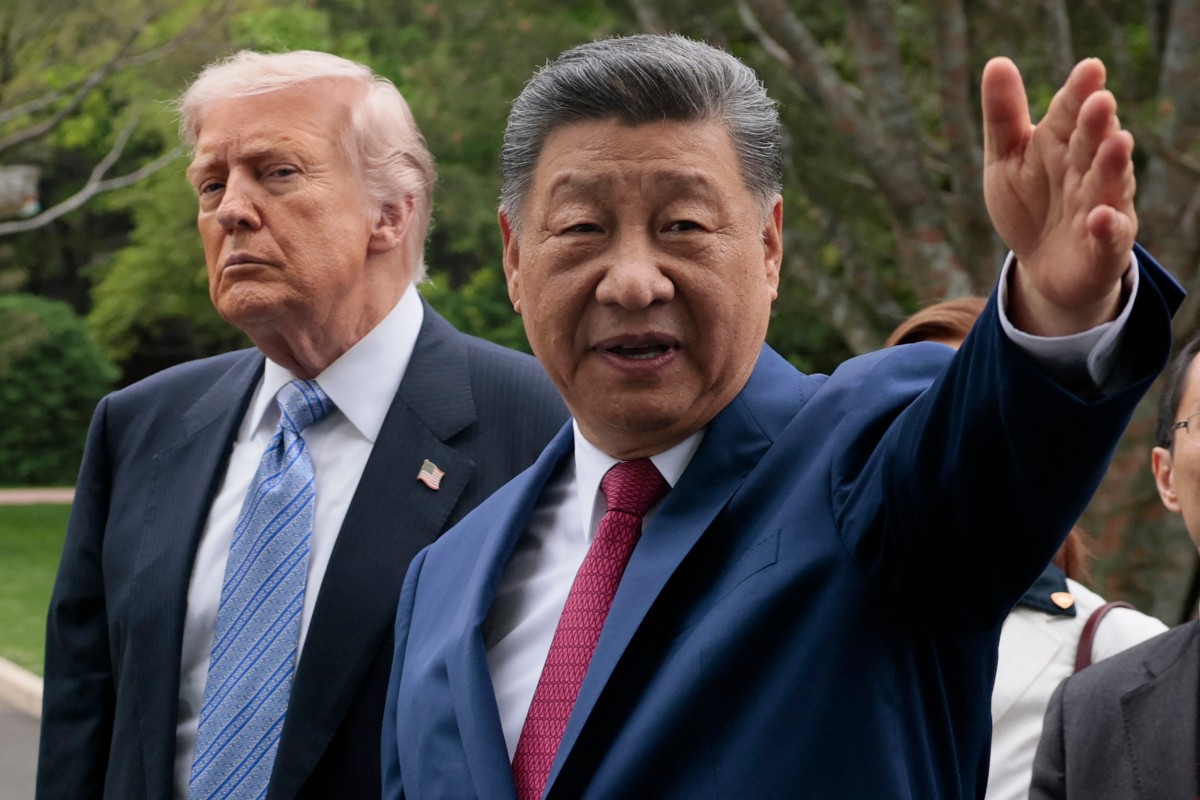
China’s President Xi Jinping (R) gestures as he meets with US President Donald Trump (L) during a visit to Zhongnanhai Garden in Beijing on May 15, 2026. (Photo by Evan Vucci / POOL / AFP)

Xi, according to Hope, has been a keen promoter of “Asian values” in the region (of China) in recent times, which for the ruling Chinese Communist Party is a byword for anti-Western and pro-authoritarian, and is linked to gaining advantage in strategic competition with the United States.

Following the Pew survey, China’s People’s Daily wrote a commentary, which says, among other reasons, that China’s growing international goodwill is fostered by the appeal of its culture.

“Chinese cultural products are reaching wider global audiences than ever before. The phenomenal international success of the animated film Ne Zha 2 and the video game Black Myth: Wukong has sparked renewed global interest in Chinese mythology and traditional culture”, the commentary says.

Scholars like Yanzhong Huang agree.

“Culturally, the “Chinamaxxing” phenomenon—a viral social-media trend in which young Westerners embrace Chinese lifestyles, from drinking hot water to riding China’s high-speed rail vicariously through influencer livestreams—has given China the kind of organic, bottom-up cachet long enjoyed by Japan and South Korea, amplified by breakout products like the video game Black Myth: Wukong, the film Ne Zha 2, and Labubu dolls”.

He adds that China’s development model has also gained prestige: its dominance in electric vehicles, batteries, and infrastructure has made “the China model” an object of emulation rather than derision—so much so that Washington itself now practices industrial policy that borrows unmistakably from Beijing’s playbook.

However, notwithstanding all this, there are some limitations of China if one takes the Pew findings under closer scrutiny.

First, Chinese popularity is not uniform, covering all parts of the world.

Pew finds favorability toward China markedly higher in the emerging economies of Africa, Latin America, and South and Southeast Asia, with record highs this year in Colombia, Indonesia, Malaysia, Mexico, Nigeria, and Turkey.

China has also gained among the United States’ Western allies—Australia, Canada, France, Germany, Italy, the United Kingdom, Sweden, the Netherlands —as well as in parts of Latin America, where several publics once viewed the United States more favorably before Trump’s second innings.

But the fact remains that the U.S. also has significant support in six countries  – India, Japan, the Philippines, South Korea, Israel and Poland. Consequently, four of these happen to be China’s neighbors, and five of them (except Poland) are in Asia.

In the Philippines, 81 percent see the United States as a reliable partner compared with 42 percent for China. It seems that proximity to Chinese power, particularly when accompanied by maritime disputes, blunts Beijing’s appeal.

Secondly, and this is a corollary of the above, in terms of numbers, people in the world supporting the U.S. and China are more or less even. The U.S. should thank India for this. Negative-leaning views of India’s 1.4 billion people completely offset the strongly positive views of China in 30 other countries.

And here, what is noteworthy is that in Trump’s favorite Pakistan, China leads the U.S. in popularity by over 75 percent, the highest in the countries surveyed. Even in Bangladesh, where the coup dislodging Sheikh Hasina had the American blessings,  China’s lead is over 30 percent.

Thirdly, Huang makes one interesting point that  “soft power”, which reflects popularity, is, by its very nature, far more mercurial than hard power. Public opinion can swing within a single year.

He quotes the  ISEAS-Yusof Ishak Institute’s annual survey of Southeast Asia to illustrate that in 2024, when asked to choose, respondents sided with China for the first time (50.5 to 49.5 percent);  in 2025, they flipped back to the United States (52.3 to 47.7 percent); and in 2026, they flipped again to China (52 to 48 percent). “Sentiment that oscillates this easily is a weathervane, not a monument”, he argues.

To buttress his argument, he adds that Soft power ultimately derives from credibility rather than propaganda—and solid, credible foundations for China’s appeal have yet to be laid. In Inside China, there are no signs of meaningful improvement in the rule of law or political freedom—if anything, the trajectory points the other way—and global publics have noticed. In only eleven of the thirty-six countries Pew surveyed do around half or more say the Chinese government respects the personal freedoms of its people.

Considering all this, the Chinese score over the U.S. in the Pew Survey does not necessarily flow from intrinsic strength, and it is most likely due to deteriorating opinions of the United States under Trump.

In other words, Washington’s loss does not necessarily translate into a commensurate lasting gain for Beijing.

Thus,  one could say that it is too soon to declare a Chinese victory.

In 2026, the world may “like” China more than America for the first time, going by the Pew survey. But does the world “love”  China more than America? Pew does not deal with this question, though in geopolitics, the difference between “like” and “love” does matter. And things can change sooner rather than later if the U.S. takes corrective measures.

  • Author and veteran journalist Prakash Nanda is Chairman of the Editorial Board of the EurAsian Times and has been commenting on politics, foreign policy, and strategic affairs for nearly three decades. He is a former National Fellow of the Indian Council for Historical Research and a recipient of the Seoul Peace Prize Scholarship.
  • CONTACT: prakash.nanda (at) hotmail.com

The post Thanks to India, U.S. & China Remain Neck-and-Neck in Global Popularity. 1.4B People Keep The Balance Even appeared first on EURASIAN TIMES.

  •  

Ukrainian Drones Turn Crimea’s Resorts Into Ghost Towns — 70% Drop in Bookings, Beaches Go Empty

In a resort town on the southern coast of the Russian-annexed Crimean peninsula, ice cream vendor Anatoli was at his wits’ end.

His shop would typically sell up to 400 ice creams a day. But a series of Ukrainian strikes on the peninsula this summer has seen the visitors dry up.

“The season is completely ruined, it’s practically non-existent,” he told AFP from Simeiz, a beachside community of around 2,500 people.

Once a magnet for millions of Russian holidaymakers each year, Crimea’s tourism industry has collapsed in recent months, as Ukrainian drone attacks have starved the peninsula of electricity and fuel.

Hotel bookings have fallen more than 70 percent compared to last July, while restaurants and swimming pools lie empty.

The Russian government has pledged to support the sector, offering a one-time payment to tourism workers equivalent to three months’ salary, but the amount is based on the minimum wage and is not a long-term fix.

Anatoli said he was now trying to make ends meet on just a fraction of his former business.

“We’re still carrying on, because everything had been prepared in advance: the equipment, the repairs, the license, the taxes,” he said.

With its abundance of cicadas, plentiful sunshine a year and verdant olive groves, Crimea’s southern coast is in many ways more reminiscent of the Mediterranean than much of Russia, which seized the Black Sea peninsula from Ukraine in 2014.

Generations of Russians spent their holidays on the peninsula during the Soviet era, many of whom regard Crimea as an integral part of their country.

One luxury hotel in Simeiz –- whose managers did not wish to be named –- said it was offering 30 percent discounts to bring the tourists back.

“At the weekend it gets busier, but otherwise…” one hotel manager said, trailing off.

AFP saw walkways, sun loungers and a restaurant terrace at the hotel deserted.

Ukrainian attacks have killed more than a dozen people on the peninsula since the beginning of June, including a child, according to Russian-installed authorities.

Drone strikes on Crimea’s electrical substations have meanwhile triggered power outages, including in the largest city of Sevastopol, while Russian-installed authorities suspended fuel sales last month amid strikes on oil depots.

– ‘No-one’s safe’ –

Some tourists were undeterred, despite the danger.

Yulia said she was visiting Simeiz from Belgorod — a Russian region that borders Ukraine and has itself been the target of Ukrainian strikes

The night before, a Ukrainian drone crashed into a block of flats a few kilometres away from Simeiz, wounding 17 people, according to officials.

“I heard a drone twice and that was it,” she said.

“The reason we’ve come is that we’re not afraid. Everyone I know is writing to me, asking me how we weren’t afraid to come here.”

She came with her family on a train that crosses the Kerch Bridge — the only practical route into Crimea from Russia, as the road via Russian-occupied Ukraine has become too dangerous due to Ukrainian drone strikes.

Fellow tourist Vladislav, who arrived by road from the Russian region of Krasnodar, said he had brought jerry cans filled with petrol in case he was unable to find fuel.

Like Yulia, he said he was not worried, having become accustomed to the regular buzz of drones.

Ukraine often fires hundreds of drones into Russia each night, in retaliation for Russia launching hundreds of drones at Ukrainian towns and cities.

“Look, they fly over us too,” said Vladislav.

“They fly overhead, whether we’re waking up in the morning — at 7 am even — or when we’re going to bed, they’re always flying about. So no one’s safe.”

Business is Suffering

Ukraine says the strikes are aimed at pressuring Moscow into peace talks.

Moscow began its full-scale offensive against Ukraine in February 2022, and has regularly struck its neighbor, including from the Crimean peninsula.

The Russian government has pledged more than 4.3 billion rubles ($54 million) in one-time payments to employees in the sector, including travel agents, tour operators and restaurateurs.

But the payments only apply to tourism.

Lilia, a holidaymaker from an area north of Sevastopol, said the private sector was “struggling”.

“I know people who run a driving school. It’s completely at a standstill because of the high price of petrol,” she told AFP, sitting on a beach in Simeiz.

“Business is suffering, of course it is.”

By Agence France-Presse


The post Ukrainian Drones Turn Crimea’s Resorts Into Ghost Towns — 70% Drop in Bookings, Beaches Go Empty appeared first on EURASIAN TIMES.

  •  

U.S. F-47 Could Fly Without Its Engines! Like India’s AMCA & Turkey’s KAAN, Another Next-Gen Jet Likely To Use Interim Engines

The engine challenges facing India’s AMCA and Turkey’s KAAN fifth-generation fighters are well documented. Both programs will initially fly with General Electric engines while their indigenous powerplants are developed and integrated.

Yet even the United States, long a key supplier of engines for foreign fighter prototypes, is also grappling with significant propulsion problems of its own, as the timelines for first flight of the F-47 prototype and next-generation fighter jet engine are out of sync.

The sixth-generation fighter jet, F-47, developed under the Next Generation Air Dominance (NGAD) initiative, is expected to fly for the first time in 2028.

However, a prototype jet engine developed under the Next Generation Adaptive Propulsion (NGAP) program could be ready for integration onto an actual aircraft only by 2030, as per the latest information provided by the US Air Force (USAF).

This means that at least the F-47 prototype, and possibly the first operational F-47s, will have to fly with a different engine before the NGAP engine is integrated into the F-47 around 2030-2031.

The integration of NGAP with the F-47 will unlock the full potential of the next-generation fighter jet; however, this also raises the crucial question of which engine will power the initial F-47 prototypes.

John Sneden, the Portfolio Acquisition Executive in charge of the Propulsion Directorate at the Air Force Life Cycle Management Center (AFLCMC), recently provided a new timeline for the NGAP engine.

The NGAP program will culminate in “get[ting] ready for potential integration activities in the 2030 timeframe,” Breaking Defense quoted Sneden as saying.

Notably, the USAF’s 2027 budget proposal also supports this timeline for the NGAP.

The document says that the NGAP’s “Prototype Fabrication & Engine Assessment” phase will run through at least September 2031.

In fact, the budget proposal shows that the funding for the NGAP program will gradually surge going forward.

The USAF is seeking nearly US$513.7 million for the program in FY2027, and then expects to request US$905.7 million and US$865 million in Fiscal Years 2028 and 2029, respectively.

Speaking with reporters at the Life Cycle Industry Days conference, Sneden, however, refused to confirm what platform might receive the NGAP engine first.

“The Air Force is still evaluating its options,” Sneden said, emphasizing that the underlying engine technology may “open up” different choices down the road. “What we’re doing right now is we’re building our system today, and we’re getting ready for the future.”

Sneden also hinted that the NGAP engine could be integrated backward into existing designs, including the F-47.

A new NGAP engine “could” go on the F-47, Sneden said, emphasizing that no decisions have been made. He, however, stressed that NGAP “is really a host of technologies” that can be integrated backward into existing designs.

While the NGAP was initially envisioned to provide a powerplant for the NGAD fighter, now christened the F-47, USAF officials have often noted that the NGAP is designed to be platform-agnostic, meaning it could power various platforms and aircraft designs.

When it comes to where NGAP stands now, “initial hardware is procured, their design meets our standards, everything is clean from that end, and both vendors have been able to do that,” Sneden was quoted as saying by the Air & Space Forces Magazine.

The two vendors in question are GE Aerospace and Pratt & Whitney (a subsidiary of RTX). GE Aerospace, with the XA102, and Pratt & Whitney, with the XA103, are both developing competing adaptive-cycle engines under the USAF’s Next Generation Adaptive Propulsion program. In simple terms, adaptive-cycle engines can perform like a turbofan when optimal and like a turbojet when needed. This means that the same engine can save fuel when needed and can deliver more power when required.

However, no final production winner has been selected yet for the Boeing F-47.

These engines aim for better fuel efficiency, thrust, range, thermal management, and power generation compared with current fifth-generation engines. Both companies completed detailed design reviews in 2025 and assembly readiness reviews in May this year. Prototype fabrication is currently underway, and ground testing is expected in the late 2020s.

Currently, there is no clarity on which interim engine could power F-47 prototypes, but the possible options discussed in media reports include variants of the Pratt & Whitney F135, F119, F100, or GE F110.

However, it is not unusual for fighter jet prototypes to fly with an interim engine before a new engine is integrated into final products.

F-47

Fighter Jets That Flew With Interim Powerplants

For instance, Turkey’s underdevelopment fifth-generation fighter jet, Kaan, is currently flying with two General Electric F110 engines. Early production blocks are expected to continue with F110 before the indigenous TF35000 is integrated.

India’s fifth-generation AMCA and 4.5-generation Tejas Mk1 variants are planned to fly with GE F414 engines, before an indigenous or co-developed engine is fully mature for integration.

Similarly, Russia’s fifth-generation Su-57 first flew with the AL-41F1 (Izdeliye 117) engines. Upgraded Su-57 variants with the new engine, AL-51F1, have recently begun flying, and full integration is currently underway.

China’s first fifth-generation fighter jet, the J-20, also initially flew with a Russian AL-31FN engine. Later variants of the J-20 flew with Chinese WS-10 variants. However, even that was an interim solution. The intended definitive engine is the more powerful WS-15.

Even Dassault Rafale first flew in 1986 with two General Electric F404 engines. Later models mixed one M88 with one F404, before the final products flew with both M88 engines.

Similarly, Eurofighter Typhoon first flew in 1994 with Turbo-Union RB199 engines, which were derived from those on the Panavia Tornado. Later models started using the EJ200 engines.

The same EJ200 engine is expected to power the initial prototypes of the Global Combat Air Program (GCAP), jointly developed by the UK, Italy, and Japan. A completely new next-generation engine, developed by Rolls-Royce, Avio Aero, and IHI, is being developed in parallel for the production models of the GCAP.

File Image

Even in the US, many fighter jets initially flew with interim engines before the final engine was integrated.

For instance, the Lockheed F-104 Starfighter first flew with the Wright J65 turbojet engine. However, the production model of the aircraft received the more powerful J79.

The F-14 Tomcat was planned around the Pratt & Whitney F401 turbofan engine. However, that engine program was canceled, and the fighter jet was fitted with Pratt & Whitney TF30 turbofan engines. Later, the F-14 Tomcats were fitted with the General Electric F110 turbofans.

On the upside, testing a new fighter jet prototype with an already mature and tested powerplant has its own advantages. It allows for risk management by allowing airframe flight testing, systems integration, and early operational assessment with an engine that is already mature. In the meantime, the new, more advanced fighter jet engine can be tested for risks and matured before integrating it with the already tested airframe.

Testing a new airframe with a new engine could be a high-risk affair.

However, there could also be certain drawbacks, as it could lead to performance shortfalls, design mismatch, or even require restructuring.

Given the timeline mismatch between F-47 prototypes’ first flight and the NGAP engine, it is all but certain that the first prototypes, and perhaps even some production models, will fly with an interim powerplant.

However, USAF officials have noted in the past that the NGAP is designed to be “platform agnostic” and could be easily integrated backward into existing designs. Therefore, integrating the NGAP with the F-47 should not be problematic, and this way Boeing could meet ambitious timelines for the project.

  • Sumit Ahlawat has over a decade of experience in news media. He has worked with Press Trust of India, Times Now, Zee News, The Economic Times, and Microsoft News. He holds a Master’s Degree in International Media and Modern History from the University of Sheffield, UK. 
  • He can be reached at ahlawat.sumit85 (at) gmail.com

The post U.S. F-47 Could Fly Without Its Engines! Like India’s AMCA & Turkey’s KAAN, Another Next-Gen Jet Likely To Use Interim Engines appeared first on EURASIAN TIMES.

  •  

F-35: U.S. Rejects Iran’s Claims Of Destroying Three Stealth Fighter Jets at Jordan Air Base

The US has outrightly rejected Iran’s claims that it managed to destroy American F-35 fighter jets.

CENTCOM wrote on X: Over the past few hours, Iranian state media have continued to report false claims by the Islamic Revolutionary Guard Corps (IRGC).

FIRST CLAIM: The IRGC (again) claims free and open routes through the Strait of Hormuz are dangerous for commercial vessels. FACT: The immediate dangers posed to commercial vessels and their civilian crews are the IRGC’s verbal threats and attempted attacks.

SECOND CLAIM: The IRGC claims three U.S. F-35 stealth fighters and three other aircraft were destroyed during a recent Iranian attack on an American air base. FACT: No U.S. aircraft were destroyed or damaged in recent attempted Iranian attacks. All missiles and drones were intercepted or failed to reach targeted areas.

THIRD CLAIM: Iranian state media is reporting that a commercial oil tanker, M/T Nora, has broken through the U.S. blockade.FACT: The commercial vessel has not broken through America’s steel wall blockade. More than 20 U.S. warships, hundreds of aircraft, and thousands of service members remain vigilant and continue to fully enforce the blockade.

Earlier, Iran’s Revolutionary Guards (IRGC) had claimed that three US F-35 jets were destroyed and three others were damaged in a missile attack on Jordan’s Al-Azraq air base.

However, this claim has not yet been confirmed by US or Jordanian officials, or by any independent source.

IRGC’s public relations department claimed the attack was in response to US airstrikes on two residential homes on Qeshm Island, which killed three members of the same family, including a child, and wounded two other children.

The Revolutionary Guards also claimed that a hangar for the installation and repair of fighter jets at Al-Azraq Air Base was also targeted, resulting in the deaths of several American officers and technical staff members. However, no specific numbers or further details were provided.

Washington has not yet issued any official statement.

Iran’s Revolutionary Guards said on Thursday that a ballistic missile strike destroyed three US F-35 fighter jets and severely damaged three others at Jordan’s al-Azraq air base.

The Guards said that several US officers and maintenance personnel were killed.

The attack targeted…

— Iran International English (@IranIntl_En) July 30, 2026

Earlier, IRGC said on Thursday that three of its members were killed in an attack by the United States on the northwestern province of Zanjan.

“In the brutal attack carried out by the terrorist regime of the criminal United States on 30 July 2026, three brave and devoted members of the Ansar al-Mahdi IRGC in Zanjan province… attained martyrdom,” the Guards’ provincial branch said in a statement, according to Tasnim news agency.

File Image

Earlier in March, as EurAsian Times reported, a US F-35 made an emergency landing at a US air base in the Middle East after it was hit by possible Iranian fire.

Capt. Tim Hawkins, a spokesperson for US Central Command, said the fifth-generation stealth jet was “flying a combat mission over Iran” when it was forced to make an emergency landing. Hawkins said the aircraft landed safely and the incident is under investigation.

“The aircraft landed safely, and the pilot is in stable condition,” Hawkins added. “This incident is under investigation.”

Iran has a well-documented pattern of issuing bold claims about successful strikes on advanced U.S. military assets, particularly F-35 stealth fighters.

Throughout the current conflict, the IRGC have repeatedly claimed to have destroyed or damaged US warplanes and other high-value assets at bases in Jordan, Kuwait, Bahrain, and elsewhere. Earlier claims in June and mid-July similarly described the destruction of fighter hangars and multiple aircraft at Al-Azraq, often accompanied by assertive language.

By asserting the destruction of the F-35—one of the most advanced fighters in the U.S. inventory—Iran seeks to project strength, boost morale at home, and portray its missile forces as capable of neutralizing American air power.

By ET Desk

The post F-35: U.S. Rejects Iran’s Claims Of Destroying Three Stealth Fighter Jets at Jordan Air Base appeared first on EURASIAN TIMES.

  •  

Iran Encircles Saudi Arabia From All The Sides — Threatening Its Economy, Oil Lifeline & Future Investments

Iran is deliberately outsourcing the risk. If a Houthi drone hits a Saudi tanker or an Iraqi militia rocket lands near a pumping station, Tehran retains deniability while Riyadh still pays the price. It is attrition by proxy, and it is highly effective.

Saudi Arabia is being encircled by Iranian proxies targeting its oil infrastructure and crippling its maritime trade. The picture is a terrifying scenario for the world’s biggest oil exporter — jeopardizing its plans to diversify its economy and attract investment & tourists.

Despite calls for a diplomatic solution, Saudi forces have faced attacks from both Yemen’s Tehran-backed Houthi rebels as they impose a Red Sea blockade on Saudi ships, and from pro-Iran militias in Iraq targeting its energy facilities.

Early on Wednesday, the kingdom struck back. Joint US-Saudi strikes in Iraq killed 20, according to the alliance of former paramilitary groups and factions whose bases were targeted.

“Saudi Arabia understands that becoming drawn into a prolonged war of attrition with Iran and the so-called Axis of Resistance does not serve the Kingdom’s long-term interests,” Danny Citrinowicz, a senior Iran researcher at Israel’s Institute for National Security Studies, wrote on X.

Still, as one Saudi analyst close to the government put it, “restraint has limits”.

With several Saudi tankers hit in the Red Sea, the Houthis are seeking to limit access to a critical artery delivering Saudi crude to the international market after the Strait of Hormuz was largely choked off by Iran.

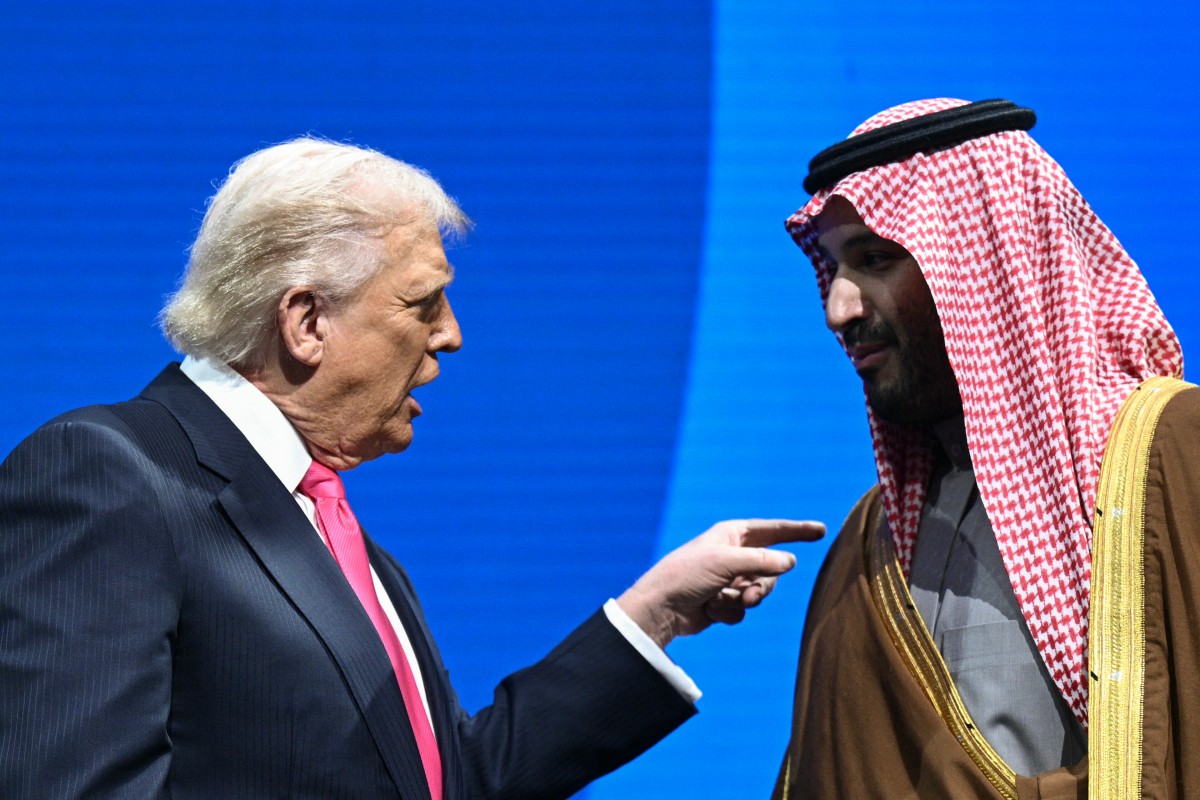
Crown Prince and Prime Minister of the Kingdom of Saudi Arabia Mohammed bin Salman and US President Donald Trump speaks at the US-Saudi Investment Forum at the John F. Kennedy Center for the Performing Arts in Washington, DC on November 19, 2025. (Photo by Brendan SMIALOWSKI / AFP)

The repeated attacks have already done something more damaging than physical destruction: they have punctured the Gulf’s carefully cultivated image as a safe harbor for capital. Once that perception cracks, the cost of repairing it is measured in years, not months.

The threats on multiple fronts come just months after Iran itself launched waves of strikes targeting Saudi energy installations, including refineries, petrochemical plants and power facilities.

The salvos hit “key” installations, according to Saudi state media, impacting oil production capacity.

The repeated barrages against Saudi Arabia and its Gulf neighbors also shattered the wealthy monarchies’ hard-earned reputation for stability.

“For the Gulf states, stability is not an abstract concept; it is the foundation of their economic model,” Citrinowicz wrote in an online commentary.

“Their long-term prosperity depends on regional predictability, investment, trade, and uninterrupted energy flows.”

Such attacks risk a bigger backlash from a cornered Riyadh, which experts say has so far held off on a larger retaliation.

“The kingdom has the capacity to impose severe punishment on the Houthis and the Iraqi militias, but has so far exercised considerable restraint,” Ali Shihabi, a political analyst close to the Saudi government, told AFP.

“That restraint has limits and should not be mistaken for weakness.”

Fear is also mounting that the Houthis will copy Iran’s playbook in the Hormuz Strait by charging ships to transit the Red Sea — giving them a revenue stream to bolster their arsenal and project power across Yemen.

On Wednesday, a minister in Yemen’s internationally recognized government claimed the rebels had already begun working under Iranian guidance to establish a fee system.

Information minister Moammar al-Eryani described the move in remarks to AFP “as a dangerous escalation aimed at transforming one of the world’s most strategic maritime corridors into a permanent source of funding for the militia’s military and terrorist activities”.

Even if fears over the tolls are not realized, analysts say the group’s ability to disrupt one of the world’s most vital waterways sends a powerful message.

“That capability is itself the warning,” H.A. Hellyer, analyst at the Royal United Services Institute in London, told AFP. “It’s a preview of what Iran-aligned actors elsewhere on Saudi Arabia’s periphery can also bring to bear.”

With AFP Inputs

The post Iran Encircles Saudi Arabia From All The Sides — Threatening Its Economy, Oil Lifeline & Future Investments appeared first on EURASIAN TIMES.

  •  

U.S.-Iran War News: Egypt Drone Strike a Message That American Interests are “Vulnerable” Across the Middle East: Analysts

A drone strike on Egypt’s Mediterranean port of Damietta on 29 July 2026—the first direct attack on Egyptian territory since the outbreak of the US-Iran war earlier this year—appears designed as a high-stakes signal that American interests remain vulnerable across the entire Middle East, analysts say.

No party has claimed the attack on the Mediterranean port, and Egypt has not blamed anyone for the attack, which struck a US-owned and operated floating gas storage vessel.

Houthi militants in Yemen, who have imposed a Red Sea blockade on Saudi Arabia, have denied carrying out the attack, which raised fears for the only remaining safe maritime route for the world’s largest crude producer.

According to analysts, the goal of the attack — regardless of who launched it — could be to drag Egypt into the conflict, after months of Cairo acting as one of the few diplomatic channels between Iran and the US.

The port strike, the furthest afield from the Gulf since the war broke out, also marks a new milestone by crossing the Red Sea into the Mediterranean.

Damietta, a Mediterranean port, is more than 1,300 kilometers away from Iran and 2,000 kilometers from Yemen.

The precision strike caused fires on the US-owned Energos Winter storage and regasification vessel and the Greek-owned GasLog Salem tanker, which was moored alongside.

“The attack may have been calibrated to damage a United States-linked asset without killing Egyptians,” King’s College London professor Andreas Krieg told AFP, though Cairo would not “find that distinction reassuring”.

According to Royal United Services Institute analyst HA Hellyer, the distance means “it’s unlikely that Iran would have struck Egypt directly from Iranian territory”.

But, he said, it is possible Tehran’s regional allies could have done so, via the Houthis in Yemen or Iran-aligned militias in Iraq.

Houthi-affiliated news agency Saba on Thursday said the “rumors” were “unfounded”.

Iran’s other powerful ally, Hezbollah in Lebanon, is closest to the port less than 400 kilometers away.

“A drone launched from the Lebanese coast could fly west over the eastern Mediterranean before turning south towards Egypt,” Krieg said, enabling it to avoid both Israeli and Egyptian airspace.

But Cairo University political science professor Mustapha Kamel Al-Sayyid believes Hezbollah is “wiser” than to pick a fight with the largest Arab military.

While energy facilities elsewhere in the region have been hit by drones and missiles over the course of the United States and Israel’s war on Iran, Egypt had so far been spared.

“I would not automatically interpret this as an attack on Egypt itself,” Krieg said, adding the purpose was to “show that United States assets are vulnerable beyond the Gulf”.

“For Egypt, this is a warning that neutrality does not guarantee immunity,” Krieg added.

Wednesday’s attack took place as the United States and Iran returned to hostilities following a brief lull — an apparent message that Iran could disrupt global trade even farther than it has.

According to Hellyer, “that would mean that Iran’s strategy is very high risk, with a lot of downsides for their security relationships”.

“Cairo and others would see an attack by any Iranian-aligned group on Egyptian territory as a formidable escalation, and that won’t go down well for the medium-to-long term at all for Tehran,” he told AFP.

Egypt has for months walked a diplomatic tightrope, keeping phone lines open with both Tehran and Washington.

It helped secure a ceasefire earlier this year and serves as a diplomatic channel between the US, Iran and powers in the region.

“Egypt is the only major power in the region that still adopts a near-neutral stance,” Al-Sayyid told AFP, adding that “only Israel” benefits from a firmer Egyptian stance.

Mediterranean fallout

Egyptian ports have this year absorbed substantial trade rerouted from the Gulf, as major shipping companies have tried to avoid the Strait of Hormuz and the Gulf, according to data from risk intelligence firm Vortexa and ship tracker MarineTraffic.

Following the Houthi blockade on Saudi Arabia and ensuing attacks on ships crossing the Bab al-Mandeb Strait, tankers transporting Saudi crude have used the Suez Canal and an overland Egyptian pipeline as the only safe, albeit expensive, route.

But that alternative route depends on the safety of Egyptian shipping lanes and, crucially, the Mediterranean.

“I expect at least some vessel owners and operators to adopt a wait-and-see approach as the risks around Suez’s northern gateway are assessed,” George Morris, a market analyst at Vortexa, told AFP.

Market behavior, he said, will depend “on whether the attack is viewed as an isolated incident or the beginning of a broader escalation”.

The Egyptian government — for which the Suez Canal is a crucial foreign currency earner — has put out multiple statements affirming that marine traffic is flowing normally and the Damietta port remains operational.

By Agence France-Presse

The post U.S.-Iran War News: Egypt Drone Strike a Message That American Interests are “Vulnerable” Across the Middle East: Analysts appeared first on EURASIAN TIMES.

  •  

F-16 Crashes in Ukraine: Days After “Historic” Su-35 Shootdown, Ukraine Loses Its Fifth Fighting Falcon

A Ukrainian F-16 fighter jet crashed during a combat mission chasing aerial targets launched by Russia, marking the fifth loss of the US-origin aircraft. Interestingly, the crash occurred after a Ukrainian Fighting Falcon allegedly scored a historic first air-to-air kill against a Russian Su-35.

On July 29, the Ukrainian Air Force lost contact with an F-16 Fighting Falcon jet while it was performing a combat mission to intercept Russian aerial targets on the frontline, the service announced in a statement posted on Telegram. “According to preliminary data, an emergency situation occurred on board the aircraft, and the pilot was forced to eject.”

“The pilot is currently safe. He was successfully evacuated and taken to a medical facility for examination and diagnostic tests,” the service noted.

The exact cause of the crash and the nature of the emergency are unclear, but experts are purportedly examining the crash site to determine the cause. 

Some reports swirling on social media claimed that the F-16 had been shot down by Russia, but the claims could not be corroborated.

An F-16 fighter jet operated by the Ukrainian Air Force crashed while performing a combat mission near the frontlines on July 29, the Ukrainian side informed.

According to avaliable information, an unspecified "emergency situation" occured on board the plane, forcing the pilot… pic.twitter.com/o6110OfjWa

— Status-6 (War & Military News) (@Archer83Able) July 29, 2026

Ukraine has received dozens of F-16 AM/BM aircraft from NATO allies. These jets are used primarily for air defense against missiles and drones, though they have increasingly been employed in more offensive and integrated missions.

In fact, the latest crash surprisingly comes just days after General Dan Caine, Joint Chiefs of Staff, confirmed that one of these jets downed a Russian jet.

“I want to highlight the incredible work that the Ukrainian industrial base is doing. It ranges from their surface-to-air capabilities to their air-to-air capabilities. I’ll note that recently we had the first air-to-air kill where a Ukrainian F-16 shot down a Russian fighter,”  Air Force General Dan Caine, Joint Chiefs of Staff, told the Senate Appropriations Committee.

Caine did not identify the type of Russian aircraft, but the experts posited that the timing and context point strongly to the Russian Su-35 claimed to have been downed by the Ukrainian Air Force on the eastern front on July 8, 2026. In fact, footage of the burning wreckage of an alleged Su-35 was also posted to social media at the time.

U.S. General John “Dan” Caine, Chairman of the Joint Chiefs of Staff:

“Recently we had the first air-to-air kill where a Ukrainian F-16 shot down a Russian fighter.”

This almost certainly refers to the July 8, 2026 shootdown of a Russian Su-35 on the eastern front. https://t.co/nuoqscFLAB pic.twitter.com/eXr6pOSMhU

— Special Kherson Cat 🐈🇺🇦 (@bayraktar_1love) July 21, 2026

The Ukrainians hailed the kill as historic, given that their F-16 fighters are older-generation aircraft, whereas Russia’s Su-35 is a cutting-edge 4.5th-generation jet with thrust-vectoring engines, powerful radar, and long-range missiles.

According to several OSINT (Open-Source Intelligence) reports, the kill was part of a well-planned ambush that included a Patriot surface-to-air missile system and three F-16s.

According to these claims, one Ukrainian F-16 flew low as bait, simulating an attack to lure a Russian Su-35 into a vulnerable position, while two others provided cover from a higher altitude. Meanwhile, a nearby Patriot system illuminated the target with its radar, aiding the engagement by exploiting gaps in the Su-35’s awareness. 

Subsequently, the Russian pilot flew into the trap and was shot down, most likely by an AIM-120 AMRAAM launched from an F-16.

File Image: Ukrainian F-16.

The purported shootdown suggested that Ukrainian pilots and planners are now conducting more complex, offensive, and integrated operations. In fact, experts went so far as to say that if these tactics are sustained, the Ukrainian forces would be able to gradually erode Russia’s long-standing advantage in contested airspace along the front, forcing Russian aircraft to fly higher, farther back, or with greater caution.

The latest crash, however, underscores that F-16s remain heavily committed to intercepting Russian drone and missile swarms.

The loss is a setback for Ukraine, which has received only a limited number of F-16s so far and has already lost 5 to crashes.

Ukrainian F-16 Losses: Setback For Ukraine

The first F-16 crash occurred just weeks after Ukraine received the first aircraft in August 2024, and claimed the life of the pilot. Even though the tragic incident was first thought to be the result of a technical issue or pilot error, later reports raised the potential of friendly fire from a Ukrainian Patriot missile defense system.

The second crash of an F-16 occurred in April 2025, killing the pilot again. Initially, several theories, including that of an air-to-air combat between Russia and Ukraine, as well as friendly fire, were floated. However, Russia put all speculations to rest by announcing that the F-16 was shot down by an air defense system.

The third crash was reported to have occurred on May 16, 2025, when the F-16 in question was repelling a Russian aerial attack. At the time, reports stated that the pilot destroyed three Russian aerial targets and was using an aircraft cannon to attack a fourth when an unknown emergency occurred, and the Air Force lost contact with the pilot.

The Air Force said the pilot steered the plane away from the settlement it was flying over and successfully ejected, after which he was rescued.

The fourth crash came merely a month after this, on June 29, 2025. The aircraft was damaged, entered a spin, lost control, and crashed during a large Russian aerial attack. The pilot did everything he could and flew the jet away from the settlement, but did not have time to eject.

Since there aren’t enough of these aircraft in Ukraine’s inventory, every loss significantly reduces the combat power available. This is especially true because not all aircraft are always battle-ready due to maintenance, upgrades, and high operational tempo.

The F-16s, along with the Mirage 2000-5 supplied by France, are heavily used for intercepting Russian cruise missiles and drones and, more recently, for complex offensive missions. These aircraft are Ukraine’s most capable Western fighters and form the core of its modern air operations. Therefore, losing an F-16 reduces the number of sorties Ukraine can generate and limits its ability to contest airspace near the front lines.


The post F-16 Crashes in Ukraine: Days After “Historic” Su-35 Shootdown, Ukraine Loses Its Fifth Fighting Falcon appeared first on EURASIAN TIMES.

  •  

Iran War News: U.S. Commander Warns Cellphone Videos Help Iran Target Bases; Troops May Have to Surrender Mobiles

As the Iran war intensifies again, the top U.S. commander in the Middle East has warned that cellphone videos and images shared online by American soldiers could help Iran attack U.S. bases, and some service members may soon be ordered to surrender their phones.

Admiral Brad Cooper, head of U.S. Central Command (CENTCOM), raised the concern in a previously unreported letter dated July 28.

He said Iran was gaining real-time data into the success or failure of its missile and drone strikes by monitoring news reports and online content that included “reactions, photos, and footage from the cellphones of our troops.”

“The direct, unavoidable cost of this open-source intelligence could be measured in the lives of American service members and civilian residents in targeted Gulf countries,” Cooper wrote. He urged forces to “redouble our focus on operational security” but stopped short of recommending specific measures in the memo.

According to Reuters, some US troops stationed in Jordan have already been notified their phones will be seized in the coming days. More comprehensive restrictions are possible across the tumultuous region because of operational security concerns.

Cooper cited one specific example in the letter: a video captured on a service member’s Meta smart glasses and posted on Instagram during an Iranian missile and drone attack. The footage showed where and how the individual evacuated to a bunker. Without such publicly available material, Cooper said, Iran would struggle to determine whether its weapons had missed by tens of meters, struck an empty tarmac or hit a populated facility, thanks in part to U.S. electronic jamming and other battlefield tactics.

“Iran knows the weapons were fired; however, their forces do not know if they missed by 50 meters, hit an empty tarmac, or successfully struck a crowded facility,” he wrote.

“Detailed lists, descriptions, and analyses of what was hit, openly published by news outlets, are essentially performing Iran’s Battle Damage Assessment (BDA) for them, free of charge.”

Public disclosures of strike details, he added, could serve as “an immediate green light” for secondary, more devastating follow-up attacks.

The warning comes as the conflict that began in late February has killed 18 U.S. troops and wounded more than 600, according to official figures.

US Army
File Image: US Army

On July 13, the Financial Times reported that mobile phone networks across the Middle East had been targeted by a wave of cyberattacks aimed at locating American forces and contractors around the same time as U.S. and Israeli strikes on Iranian positions.

CENTCOM spokesman Captain Tim Hawkins confirmed the authenticity of Cooper’s letter, describing it as “a general reminder to our service members on the importance of maintaining operational security.” He declined to discuss specific protective measures.

Meanwhile, the US military conducted a “heavy wave of strikes” against Iran on Thursday in retaliation against Tehran targeting American bases in Jordan.

US President Donald Trump had vowed to hit Iran “hard” after Tehran launched missiles at Jordan.

American forces “successfully completed a heavy wave of strikes against Iran”, and struck dozens of Islamic Revolutionary Guard targets including military command centers, US Central Command (CENTCOM) said.

In Iraq, the joint US-Saudi air operation followed attacks by “terrorist militias loyal to Iran” on its oil facilities. The US military said logistics and weapons sites belonging to an Iran-aligned group were targeted in the strikes.

Iraq’s Hashed al-Shaabi alliance said the attacks killed at least 20 of its members. It condemned a “dangerous escalation” against an “official security institution”.

Two Hashed officials said five Iranian advisors were among those killed.

Iraq slammed the US-Saudi strikes and said it rejects “all acts of aggression, regardless of the party responsible or the justifications presented”.

The Ministerial Council for National Security said it would “confront any violation of Iraq’s sovereignty, and prevent any source from using Iraqi territory to threaten neighboring states”.

According to Fox News, however, Trump said the strikes were “coordinated with the Iraqi government”.

The strikes follow growing US pressure on Iraq to disarm pro-Iran groups. Earlier this month, Prime Minister Ali al-Zaidi visited both the US and Iran.

With AFP Inputs

The post Iran War News: U.S. Commander Warns Cellphone Videos Help Iran Target Bases; Troops May Have to Surrender Mobiles appeared first on EURASIAN TIMES.

  •  

Su-57 For IAF: India Rules Out New Sukhoi Fighter Jets, To Prioritize Su-30 MKI Upgrades

A senior official from the Indian Ministry of Defense (MoD) has indicated that New Delhi is not currently planning to buy new Sukhois. The statement comes as Moscow has been aggressively pushing to export its Su-57 fighter jets to the IAF

In a recent interview with Moneycontrol, Defense Secretary Rajesh Kumar Singh stated that India has no plans to acquire a “new version of the Sukhois.”

“No, we have not thought about Sukhois. If you are asking about the new version of the Sukhois, the answer is no. But we are actively considering upgrading the existing Sukhois… It is a success story. It is a very important platform with the induction of BrahMos missiles, and we hope to further upgrade and improve it,” Singh said when asked whether there are any plans to buy a fifth-generation aircraft outside of the AMCA (Advanced Medium Combat Aircraft), India’s own indigenous fifth-generation fighter program.

While he did not name either aircraft, the remarks have been widely interpreted as referring to Russia’s Su-57 fifth-generation fighter. In fact, the statement marks a clearer official signal against a near-term Su-57 acquisition, in contrast to previous signals.

In April 2026, for instance, Chairman and Managing Director of the state-run Hindustan Aeronautics Limited (HAL), Dr. D.K. Sunil, said, “A committee of Russians has also studied and said that roughly 50% of the facilities can be used for producing this aircraft, but some new investments will be required.” Thus, hinting that, while India was neither committing to nor rejecting the offer, it was merely in a pre-decision, information-gathering phase.

Meanwhile, the Indian Air Force (IAF) chief, Air Chief Marshal A.P. Singh, indicated last year that the service might have to opt for an off-the-shelf purchase of a fifth-generation stealth aircraft.

“As far as the Su-57 is concerned, I just want to say that we have to weigh all the options, and we in the defense ministry and the Indian Air Force have a very set process for the induction of any weapon system, and that process will be followed. So what comes will depend on what meets the requirement and what is best for us,” he stated.

Singh’s latest comments also align with the IAF’s upgrade program for the Su-30MKI fleet aimed at modernizing avionics, sensors, and other systems while increasing domestic content.

“We are processing an upgrade program for the existing Su-30 MKI fleet. This will be the first time an indigenous upgrade of any fleet is being planned,” the IAF chief told Prakash Nanda, the Chairman of the Editorial Board of the EurAsian Times.

India’s Su-57 Conundrum

Russia first publicly offered the Su-57E export variant to India at Aero India in February 2025. This was followed by a “golden deal” that included the supply of off-the-shelf aircraft, the production of the Su-57 in India, and assistance in developing India’s fifth-generation Advanced Medium Combat Aircraft (AMCA).

Later, the Russian state arms exporter Rosoboronexport expanded it to include the use of existing Su-30MKI infrastructure to facilitate local manufacturing of the Su-57E in India, as previously reported by the EurAsian Times.

In June 2026, Russian President Vladimir Putin publicly renewed the pitch, citing the former FGFA (Fifth-Generation Fighter Aircraft) collaboration between the two allies and calling it the world’s best fifth-generation aircraft. Additionally, he stated that Russia was ready to work with India “without any issues or limitations.”

Notably, India and Russia had earlier collaborated on the Fifth-Generation Fighter Aircraft (FGFA) program under a 2007 agreement. However, India later withdrew from the program, amid shortfalls in stealth performance, engine capability, insufficient access to design data and source code, and concerns that the aircraft did not fully meet the Indian Air Force’s requirements for independent upgradeability and maintenance, as explained in a detailed EurAsian Times report you can read here.

Ex-Rafale Pilot Who Praised China’s J-10C & JF-17 Fighter Jets Now Under Investigation for Beijing Ties

In fact, doubts about the aircraft’s stealth characteristics and the extent to which Moscow would be willing to part with technology persist to this day, and are believed to be one of the reasons why India has been reluctant to acquire the Su-57.

Moreover, critics have expressed skepticism that the purchase or joint production of the Russian fighter may divert attention from India’s AMCA fifth-generation fighter program and put the indigenous aircraft on the back burner, as has happened in the past.

However, the situation has become increasingly complex, as AMCA appears to be farther away than initially anticipated. Defense observers and veterans predict the first flight may slip to 2032, as private manufacturers may not meet tight deadlines.

This would leave the IAF with a major stealth gap vis-à-vis the People’s Liberation Army Air Force (PLAAF), which has two operational fifth-generation fighters, the J-20 and the J-35. In fact, it has expanded its J-20 inventory to 500 fighters, according to recent reports.

Not just that, China has been testing two different sixth-generation prototypes: the J-36 and the J-50, both of which are regularly spotted in flight, suggesting that development is taking place at an unprecedented pace. In fact, Beijing may be ready to induct a sixth-generation fighter by the time India inducts its first AMCA.

The situation can become overly dangerous if Pakistan acquires the Chinese J-35A stealth fighters, as consistently noted by media reports.

The Russian Sukhoi Su-57 fifth-generation fighter aircraft prepares to take off during Aero India 2025, a military aviation exhibition at the Yelahanka Air Force Station in Bengaluru on February 12, 2025. (Photo by Idrees MOHAMMED / AFP)

Staring at a dwindling squadron strength, the IAF is currently inching closer to signing a deal for 114 Rafale fighter jets, 94 of which will be produced locally.

F-16 Crashes in Ukraine: Days After “Historic” Su-35 Shootdown, Ukraine Loses Its Fifth Fighting Falcon

While this acquisition will help add the numbers needed for a large-scale two-front war, it will not arrest the growing technological gap between India and its adversaries.

Some veterans have argued that a limited off-the-shelf purchase of Su-57s could serve as an interim measure, provided it does not divert resources or attention from the AMCA.

“The 114 Rafales will address the quantitative requirement but not the qualitative enhancement requirement. That leaves only the Su-57 as the only available near-term option, though it is not perfect,” the IAF veteran and ex-Vice Chief of IAF, Air Marshal Anil Khosla, earlier told the EurAsian Times. “A deal for a limited number may be considered, provided it advances the AMCA program rather than curtails it.”

Others emphasize viewing large-scale commitment to a foreign fifth-generation platform as carrying industrial, sustainment, and strategic risks.

For example, IAF veteran, Air Marshal Anil Chopra, told EurAsian Times: “India should focus on producing the Rafale locally, advance work on AMCA and its variants, accelerate production of the indigenous Tejas fighters, and buy about 40 Su-57 fighters off-the-shelf from Russia as an interim solution instead of getting into local production.

Earlier this year, the Indian MoD informed the Parliamentary Standing Committee on Defense of its interest in joining a sixth-generation fighter. India has two options: join the UK-Japan-Italy GCAP program or team up with France for their potential 6th-gen aircraft.

The post Su-57 For IAF: India Rules Out New Sukhoi Fighter Jets, To Prioritize Su-30 MKI Upgrades appeared first on EURASIAN TIMES.

  •  

Hashed al-Shaabi: Who Are the Iraqi Militia Group Hit by US-Saudi Strikes?

The US and Saudi Arabia have carried out coordinated attacks on positions held by the Hashed al-Shaabi, an Iraqi paramilitary network that incorporates powerful pro-Iran armed groups.

These factions, which form part of the broader Tehran-backed “axis of resistance,” have for years posed a persistent threat to American forces and interests in Iraq and the wider Middle East.

Meanwhile, a powerful alliance of pro-Iran armed groups warned on Wednesday that a response to the deadly US-Saudi strikes in Iraq was “inevitable”.

The Islamic Resistance in Iraq, which has targeted US facilities hundreds of times during the Middle East war, said: “our response to the American enemy is inevitable, and may target its tools in Saudi Arabia”.

Hashed al-Shaabi

The Hashed al-Shaabi, also known as the Popular Mobilization Forces (PMF), is a network of Shia-majority factions that was established in 2014 to fight the Islamic State group.

It was formed following a fatwa from Ayatollah Ali al-Sistani, the highest Shia Islamic religious authority in Iraq, at a time when IS was conquering swathes of the country.

Pro-Iran armed groups heeded the call and were also joined in the fight by Iraqi volunteers from across the country.

The Hashed forces were mostly trained by Iranians and led by Tehran-backed armed groups, which fought American forces after the US-led invasion that toppled former ruler Saddam Hussein in 2003.

Their efforts were overseen by General Qasem Soleimani, the former head of the Quds Force, the foreign operations arm of Iran’s Islamic Revolutionary Guard Corps.

Soleimani was killed in an American strike in Baghdad in 2020.

In 2016, a law integrated the Hashed into the regular security forces, and a year later the alliance contributed to IS’s defeat by the Iraqi army, which was supported by the US-led anti-jihadist coalition.

The US has held major sway in Iraq since its 2003 invasion. But Iran has also built its influence and seen its Shia allies installed in Baghdad’s halls of power.

Iraq has long been a proxy battleground for the US and Iran.

Today the Hashed encompasses dozens of groups, including brigades belonging to powerful pro-Iran armed factions, which are blacklisted as terrorist organizations by the US.

This US Navy handout photograph released on July 28, 2026, by US Central Command Public Affairs shows an F/A-18E Super Hornet launching from the flight deck of Nimitz-class aircraft carrier USS George H.W. Bush, on July 21, 2026. The US military said on July 28 it had intercepted multiple missiles launched by Iran, ending a days-long respite in attacks between the foes. Both sides had held fire over the weekend, following nearly two weeks of nightly strikes by the United States on Iran, and repeated missile and drone salvos by Tehran targeting Washington’s allies around the Gulf. (Photo by various sources / AFP) 

Some factions face accusations of collecting government salaries for their fighters while acting independently of the state.

Over the years, they have seen their clout grow, with some gaining seats in parliament, even as several group leaders, including the Hashed’s top commander, have been subjected to US sanctions.

Several pro-Iran groups are also part of the Islamic Resistance in Iraq alliance, which has claimed hundreds of attacks against US facilities in Iraq and the region during the Middle East war.

They pledge their allegiance first and foremost to the Tehran-led “axis of resistance”, which includes Lebanon’s Hezbollah, Hamas in Gaza and Yemen’s Houthis.

The most active among them are Kataeb Hezbollah, which has long spearheaded attacks on US interests in Iraq, and over the years has lost key commanders in American strikes.

They also include Kataeb Sayyid al-Shuhada and the al-Nujaba movement.

In some cases, these groups are present on Hashed al-Shaabi bases. But they also have their own bases, arm depots and workshops, mostly for making drones. The groups mainly rely on explosive-laden drones but also possess rockets and are believed to have short-range ballistic missiles.

By Agence France-Presse

The post Hashed al-Shaabi: Who Are the Iraqi Militia Group Hit by US-Saudi Strikes? appeared first on EURASIAN TIMES.

  •  

Iran War Latest News: US-Saudi Strikes in Iraq Kill 20, Including Iranians

US-Saudi strikes on Iraq killed at least 20 militants, including several Iranians, on Wednesday, according to the Hashed al-Shaabi, an armed Iraqi alliance that includes pro-Iran groups.

The United States and Saudi Arabia said they had struck Iran-backed armed militants in Iraq in response to attacks on US forces and Saudi oil facilities.

Washington and Tehran are Iraq’s main allies, but their enmity has long turned the country into a proxy battleground and left successive governments struggling to maintain a delicate balance between the foes.

The Hashed al-Shaabi, also known as the Popular Mobilization Forces (PMF), said that at least 20 fighters “were martyred and another 32 wounded according to a preliminary toll”.

Two Hashed officials told AFP that five Iranian advisors were among those killed in a strike in the central province of Diyala.

AFP correspondents saw coffins wrapped in Iranian flags during a funeral organised by the Hashed al-Shaabi in Baghdad for those killed.

The Hashed alliance was created in 2014 to fight jihadists before it was formally integrated into the Iraqi armed forces.

It now includes brigades belonging to Iran-backed groups reputed for acting unilaterally.

US President Donald Trump said the strikes were coordinated with the Iraqi government, according to Fox News.

They follow growing US pressure on Baghdad to disarm pro-Iran armed groups, which have frequently targeted US facilities in the country and have long called for the withdrawal of US troops.

Iraq’s new Prime Minister Ali al-Zaidi, who came to power this year with Washington’s blessing, vowed to ensure those groups would hand over their weapons, but has faced pushback from some powerful factions.

Earlier this month, Zaidi visited both the United States and Iran.

Inevitable Response

The strikes came after Riyadh said its forces had intercepted drones targeting oil facilities, blaming the Iran-backed groups in Iraq.

The most active pro-Iran armed groups are united under an alliance known as the Islamic Resistance in Iraq, which has acted in support of Tehran during the Middle East war, claiming hundreds of attacks against US bases in Iraq and across the region.

The Islamic Resistance in Iraq said, “our response to the American enemy is inevitable, and may target its tools in Saudi Arabia”.

But the group added that it would only retaliate after the Arbaeen day of pilgrimage, which falls on Tuesday.

The Arbaeen marks one of the most significant events in the Shia Muslim calendar, during which pilgrims, many from Iran, flock to Iraq to visit the holy shrines.

The pro-Iran groups denied attacking Saudi Arabia, and they haven’t claimed any attacks since the US-Iran war resumed earlier this month.

Violation

Iraq denounced the US-Saudi strikes and said it rejects “all acts of aggression, regardless of the party responsible or the justifications presented.”

The Ministerial Council for National Security said it would “confront any violation of Iraq’s sovereignty, and prevent any source from using Iraqi territory to threaten neighboring states”.

It reaffirmed its commitment to ensure the state’s monopoly over weapons.

Zaidi’s government has given those groups that Washington designates as terrorist organizations until September 30 to disarm.

Oil-rich Iraq has been trying to move past decades of war and unrest, but it remains vulnerable to regional and internal flare-ups.

Houthis attack Saudi tanker in Red Sea

Meanwhile, Houthi rebels said they targeted a Saudi oil tanker in the Red Sea with ballistic missiles for violating a blockade on the kingdom’s ports. Saudi Arabia had yet to comment on the Houthis’ claim, but reported having intercepted drones targeting oil facilities in its east, blaming pro-Iran militias in Iraq.

“The targeting of the Saudi vessel came after it ignored warnings,” a Houthi military spokesman said, identifying the ship as the NCC Ghazal and adding it had been “forced to turn back”.

The website MarineTraffic, owned by maritime tracking firm Kpler, listed the Ghazal as a Saudi-flagged tanker whose last known location was the port of Yanbu, the terminus of an important oil pipeline on the kingdom’s Red Sea coast.

Last week, the Iran-backed Houthis declared a maritime blockade of Saudi Arabia and have since claimed attacks targeting Saudi tankers and oil infrastructure.

The blockade has threatened Saudi Arabia’s ability to get its supplies to the world following Iran’s parallel blockade of the Strait of Hormuz after hostilities resumed in the Middle East war, cutting off the kingdom’s only other maritime route.

Riyadh last week struck Houthi targets in Yemen in response to the threats to Red Sea shipping.

A spokesman for the Saudi defense ministry said late Tuesday that “aerial defenses intercepted and destroyed several drones that attempted to target oil installations” in the country’s east.

The spokesman, Turki al-Maliki, added that “these new terrorist attacks were launched from Iraqi territory and carried out by militias linked to Iran”.

It was the second day in a row Riyadh had blamed Iran-backed groups in Iraq for launching attacks.

By Agence France-Presse

The post Iran War Latest News: US-Saudi Strikes in Iraq Kill 20, Including Iranians appeared first on EURASIAN TIMES.

  •  

USAF Accelerates ‘Loyal Wingman’ CCA Induction with ACE Exercise at Creech Using YFQ-42A and YFQ-44A

The U.S. Air Force (USAF) conducted an Agile Combat Employment exercise with its two Collaborative Combat Aircraft (CCA), moving these uncrewed systems into a realistic operational environment and advancing their induction in service.

USAF’s Collaborative Combat Aircraft Experimental Operations Unit (EOU)—established to accelerate Manned-Unmanned Teaming (MUM-T) concepts and expedite induction of these CCAs—conducted the Agile Combat Employment exercise at Creech Air Force Base, a facility that reportedly hosts MQ-9A Reapers and RQ-170 Sentinel drones.

The USAF’s CCA program envisions deploying a significant number of modular, reasonably priced, and operationally useful unmanned aircraft that can fly alongside manned aircraft to add “affordable mass” in contested environments. These aircraft, also known as “loyal wingman drones,” are designed to enhance air superiority by serving as force multipliers.

Increment 1 of the USAF’s CCA program centers on the General Atomics YFQ-42A (also referred to as Dark Merlin) and the Anduril YFQ-44A Fury. Both aircraft were deployed to Creech for the exercise, as seen in the images released by Nellis Air Force Base.

“Air superiority in today’s increasingly contested environments requires the rapid fielding of affordable mass,” Air Force Chief of Staff Gen. Ken Wilsbach was quoted as saying in the official statement, as he emphasized the strategic driver for the platform.

“CCAs are essential to this effort. By integrating uncrewed systems to fly alongside our Airmen, we extend reach and increase lethality,” the USAF top boss added.

File: A U.S. Air Force YFQ-42A Dark Merlin aircraft assigned to the Collaborative Combat Aircraft Experimental Operations Unit descends in the air before landing at Creech Air Force Base, Nevada.

The objective was to move the CCA out of traditional sterile test settings and into the hands of warfighters in a more realistic environment, and to develop the fundamental strategies, methods, and processes for specifying how these unmanned aircraft could be incorporated into the force in the future.

“We are focused on operating CCA outside of a traditional test environment so we can continue to learn, inform, and rapidly iterate,” Lt. Col. Matthew Jensen, Experimental Operations Unit commander, stated.

The EOU “generated multiple sorties demonstrating reliability and extended range; integrated with manned platforms in the local airspace to project power across distributed battlefields; and simulated scenarios that will inform future requirements for the platform,” according to the official statement.

The service has emphasized Agile Combat Employment (ACE) in recent years as a response to anti-access/area-denial capabilities fielded by near-peer adversaries, such as China and Russia. ACE prioritizes the ability to rapidly disperse aircraft across a network of smaller airfields to reduce vulnerability.

File: A U.S. Air Force YFQ-44A Fury aircraft assigned to the Collaborative Combat Aircraft Experimental Operations Unit, sits on the flight line during weapon loading procedures at Creech Air Force Base, Nevada.

Both CCAs simulated distributed or dispersed operations consistent with ACE principles, with an emphasis on operating from different locations and on validating a reduced logistical footprint suitable for remote or forward-deployed sites.

“Operating CCA across different locations is a significant learning objective in itself, challenging teams to adapt and operate with the agility required in a contested environment,” the statement noted. Throughout the exercise, operators worked to integrate advanced autonomous capabilities, a key step toward achieving the program’s vision of effective human-machine teaming.”

Posting the link to the official announcement of the ACE exercise on X, General Wilsbach, who has been a proponent of integrating attritable platforms in combat, wrote, “Next step in CCA development!” on the social media site X.

US CCA Effort In Full Swing 

The CCA program is a component of the broader “affordable mass” concept, which focuses on acquiring low-cost platforms—such as drones—to overpower the adversary in combat.

For instance, the CCA drones the USAF is developing are estimated to cost between US$25 million and US$35 million each, which is one-third the cost of an F-35 Lightning II aircraft, which ranges from US$80 million to US$115 million, depending on the variant.

The idea is that using low-cost, attritable drones to support expensive, manned aircraft will increase the manned platform’s survivability and mission success, especially when confronting near-peer adversaries such as China and Russia in a contested environment.

USAF conducted CCA Agile Combat Employment (ACE) exercise

According to earlier reports, these CCAs will mostly function as airborne “missile trucks” during their initial deployment, flying in formation with crewed jets to provide extra firepower. However, discussions are currently underway to broaden its mission to encompass electronic warfare, intelligence collection, surveillance, reconnaissance, and, eventually, fully autonomous operations.

The USAF had previously stated that it would build at least 1,000 CCA to fly alongside sixth-generation F-47 and fifth-generation fighters such as the F-22 Raptor and the F-35 Lightning II. These drones will bolster combat capability by supporting crewed aircraft by carrying extra air-to-air munitions, extending sensor coverage, and executing missions that would otherwise put human pilots at risk.

Last month, the Department of the Air Force awarded engineering, manufacturing, and development (EMD) and production contracts to both General Atomics for the YFQ-42A prototype and Anduril for the YFQ-44A Fury prototype. Both drones accentuate stealth, internal weapons bays, semi-autonomous air-to-air roles, and affordable mass production.

These contracts cover the first three production lots and support the procurement of over 150 combat-capable CCAs by the end of the decade.

Separately, the US Air Force’s Pacific commander, Gen. Kevin Schneider, commander of PACAF, said he was “impressed” with the Royal Australian Air Force’s MQ-28 Ghost Bat collaborative combat aircraft (CCA) program and indicated that as the current test partnership matures, the next step could involve examining how US operators could control the MQ-28s, as recently reported by the EurAsian Times.

Notably, the ACE exercise comes days after the Department of the Air Force conducted live-fire testing of a YFQ-44A CCA, firing an AIM-120 weapon at a digital target in secluded airspace over the Mojave Desert. “This live-fire test is an important next step in the development of Collaborative Combat Aircraft,” said Gen. Ken Wilsbach at the time. “We’re one step closer to delivering capabilities to the warfighter,” he added.

This suggests that the USAF’s CCA program is proceeding at breakneck speed as the US prepares for a potential military showdown with China in the Indo-Pacific.

The USAF is already refining plans for Increment 2 of the CCA program, which will launch a new generation of drones with enhanced capabilities. These next-generation CCAs are expected to be more sophisticated and possibly more costly, even though their exact mission profiles and technological developments remain unknown.


The post USAF Accelerates ‘Loyal Wingman’ CCA Induction with ACE Exercise at Creech Using YFQ-42A and YFQ-44A appeared first on EURASIAN TIMES.

  •  

Ex-Rafale Pilot Who Praised China’s J-10C & JF-17 Fighter Jets Now Under Investigation for Beijing Ties

A former French Navy Rafale pilot who also trained with the US Navy, was an expert in CATOBAR carrier landings, and who controversially claimed that the Indian Air Force lost a Rafale jet during the India-Pakistan clash in May last year, has been placed under formal investigation in Paris over alleged intelligence activity benefiting China.

Pierre-Henri Chuet, who flew Super Étendard and Rafale M fighters from the aircraft carrier Charles de Gaulle, was formally placed under investigation after he was presented to an investigating magistrate last week, following his questioning by France’s domestic intelligence service, the DGSI.

The development was first reported on July 27 by IntelligenceOnline.

He is under investigation for four charges of espionage: disclosure of national defense secrets by a person entrusted with them, intelligence with a foreign power, collection of information relating to the fundamental interests of the nation, and delivery of information to a foreign power.

Chuet joins a long list of Western pilots who have been warned or investigated for training China’s PLA Air Force (PLAAF) aviators on tactics, procedures, and related skills. Training sometimes took place in China or in third countries.

Notably, former U.S. Air Force major Gerald Eddie Brown Jr., who also flew the F-35, was arrested in February this year in the US shortly after he returned from China. He was charged with providing and conspiring to provide unauthorized defense services to PLAAF pilots in 2023.

Similarly, Daniel Edmund Duggan, a former U.S. Marine Corps pilot, was charged in a 2017 U.S. indictment with conspiracy for allegedly providing training to Chinese military pilots, including aircraft carrier takeoff/landing tactics, techniques, and procedures. In April, he lost his appeal to resist extradition to the US.

All these cases fit into a pattern in which PLAAF, which has very limited recent combat experience, seeks to close gaps in pilot training and aerial battle tactics by hiring former Western fighter pilots, mostly through intermediaries based in third countries, to obscure PLA links.

How Unauthorized China Trips Got Pierre-Henri Chuet in Trouble

Pierre-Henri Chuet, a dual French-Canadian citizen, is a former French Naval Air fighter pilot, trained as a 737 pilot for Air Canada, trained with the US Navy as an exchange officer, and became a noted author, international keynote speaker, and YouTuber after retiring from the French Navy.

Trained by the US Navy, he accumulated extensive experience in combat operations, aerial demonstrations aboard the Rafale Marine, and completed over 200 aircraft carrier landings.

Pierre-Henri spent eight years in a combat squadron before joining Air Canada as a commercial pilot.

His carrier aviation experience as a Rafale M fighter pilot was particularly valuable to China, which already has the world’s second-largest carrier fleet.

Beijing currently has three aircraft carriers, and its fourth, rumored to be nuclear-powered, is already under construction.

IAF Targets First LCA Tejas Mk1A Squadron By March 2027 — Engines Arrive But AESA Radar and EW Suite Threaten Delays

Pierre-Henri’s CATOBAR Experience

Notably, China’s newest carrier, Fujian, is configured for catapult-assisted takeoffs and arrested landings (CATOBAR).

Apart from China, only two other countries operate CATOBAR-configured carriers: the US and France.

Charles de Gaulle, the French Navy’s sole aircraft carrier, is nuclear-powered, displaces 42,500 tons, and uses two steam catapults. It has operated Rafale M fighters and E-2C Hawkeyes since it entered service in 2001 and remains fully active.

No other navy currently has an operational CATOBAR carrier.

French Rafale fighter jets sit on the main deck of the nuclear-powered aircraft carrier Charles de Gaulle, during its anchor at the Mormugao Port, in Goa on January 4, 2025, as part of a joint Indo-French naval exercise Varuna. (Photo by Punit PARANJPE / AFP)

This makes pilots with experience in takeoff/landings on CATOBAR-configured carriers highly valuable in China, which commissioned its first CATOBAR-configured carrier, Fujian, in November last year.

Pierre-Henri had nearly eight years of experience aboard Charles de Gaulle, which could have greatly helped China train its fighter pilots for the new Fujian carrier.

An arrested landing, commonly called a trap, is the process of slowing an aircraft as it approaches an aircraft carrier. This is accomplished using a mechanical device known as arresting gear, consisting of steel wires stretched across the deck and connected to hydraulic cylinders below the deck. 

The arrested landing occurs when an approaching plane makes contact with an aircraft carrier, and its tail hook catches on one of the four wires positioned across the deck.

The fighter jet can safely halt once the tail hook quickly slows it down by snagging one of the cables. It is necessary because the decks of aircraft carriers are too short for conventional landings.

Notably, arrested landing requires an extremely high level of competence and skill because the pilot has to come in at full power and shut down his engines as soon as he hooks on. If the pilot fails to hook on, he is expected to keep flying away from the flight deck. Only highly qualified and experienced Navy fighter pilots can land on the aircraft carrier since a failed landing could prove fatal.

China has allegedly been facing a shortage of skilled naval aviators. A Chinese military magazine, Ordnance Industry Science Technology, reported in 2022 that the People’s Liberation  Army Navy lacks sufficient qualified shipborne fighter-jet pilots.

Pierre-Henri reportedly traveled to China in September 2018 and August 2019 while still serving, without notifying his chain of command, as required by French military regulations.

Both trips were financed by a South African aviation company, already under the scanner for hiring Western fighter pilots to train Chinese pilots, Aerotime reported.

Ukraine Just Punched a Hole in Iran & Russia’s Secret Caspian Highway — Tehran Vows Consequences

French investigative outlet Le Canard Enchaîné reported in April 2025 that the Paris prosecutor’s office had received a referral from the Ministry of the Armed Forces on February 19, 2025, concerning a former serviceman suspected of intelligence activity with a foreign power.

Last week, Pierre-Henri was formally placed under investigation.

Pierre-Henri’s Controversial Rafale Video

Post-retirement, Pierre-Henri became an author, corporate speaker, and prolific YouTuber, developing a large following.

However, some of his YouTube videos created huge controversy last year when he suggested that India lost a Rafale fighter jet during the clash with Pakistan in May 2025.

In the video titled “UN RAFALE INDIEN PERDU FACE AU PAKISTAN ? ANALYSE D’UN PILOTE DE CHASSE (ATE CHUET),” uploaded on 10 May 2025, he stated with high confidence that India lost at least one single-seat Rafale jet during the clash.

In his subsequent videos on the JF-17, J-10C, and PL-15 air-to-air missiles, he praised Chinese jets and missiles highly.

China Poking Western Fighter Pilots Via South Africa

According to reports, both of Pierre-Henri’s trips to China in 2018 and 2019 were arranged and financed by a South African aviation company.

South Africa, in fact, has emerged as a key link in many such cases.

A 2022 Sky News investigation identified the Test Flying Academy of South Africa (TFASA) as a conduit for recruiting former British military aviators, prompting a UK Ministry of Defence threat alert.

Spanish newspaper ABC reported on July 25, 2026, that intelligence services have identified at least two former Spanish Air and Space Force pilots who are training Chinese military aviators, hired through South African intermediaries, including TFASA.

TFASA’s name also figured in the case of former U.S. Marine Corps pilot Daniel Duggan. He has been accused of violating arms trafficking regulations by training Chinese fighter pilots in carrier-arrested landings at TFASA.

GCAP For India: Leonardo CEO Says Join 6th-Gen UK-Japan-Italy Fighter Jet Program by End-2026 or Miss the Boat

The US and its allies have alleged that China has been recruiting its former fighter pilots to train its aviators, bolster its capability, and learn Western combat tactics to prepare for a potential conflict.

The ‘Five Eyes’ partners — the United States, the United Kingdom, Canada, Australia, and New Zealand — jointly released a bulletin in June 2024, terming China’s recruitment operations as a “persistent” danger.

The bulletin claimed that the PLA has been using private companies in South Africa and China to hire former fighter pilots from Canada, France, Germany, the United Kingdom, Australia, the United States, and other Western nations to train cadet pilots in the PLA Air Force (PLAAF) and the PLA Navy (PLAN).

At the time, Michael Casey, the head of the National Counterintelligence and Security Center, a division of the US intelligence agency, said, “The PLA wants the skills and expertise of these individuals to make its military air operations more capable while gaining insight into Western air tactics, techniques, and procedures. The insight the PLA gains from Western military talent threatens the safety of the targeted recruits, their fellow service members, and U.S. and allied security.”

Pierre-Henri’s case is not an exception but fits in this pattern of China hiring Western fighter pilots, often with carrier landing experience, through agencies in third countries, such as South Africa, to train PLAAF fighter pilots.

It remains to be seen how Western countries will deal with this challenge.

  • Sumit Ahlawat has over a decade of experience in news media. He has worked with Press Trust of India, Times Now, Zee News, The Economic Times, and Microsoft News. He holds a Master’s Degree in International Media and Modern History from the University of Sheffield, UK. 
  • He can be reached at ahlawat.sumit85 (at) gmail.com

The post Ex-Rafale Pilot Who Praised China’s J-10C & JF-17 Fighter Jets Now Under Investigation for Beijing Ties appeared first on EURASIAN TIMES.

  •  

NATO Faces Biggest Challenge in Years: Military Power Grows, Political Consensus Shrinks — Threatening the Alliance

OPED by Wg Cdr J P Joshi (Retd)

For nearly eight decades, NATO has been the most successful military alliance in modern history. Created in 1949 to deter Soviet expansion and defend Western Europe, it prevented a major conflict on the continent, survived the Cold War, adapted after the collapse of the USSR, expanded from the founding 12 to 32 members, and regained strategic relevance after Russia’s invasion of Ukraine.

Yet NATO’s success has produced an unexpected dilemma.

The Alliance has never been militarily stronger. European Allies and Canada are assuming greater responsibility for their security, defense spending is increasing, defense industries are expanding, and capabilities are improving. But military strength alone does not determine the effectiveness of an alliance.

The more fundamental question is political: For what purpose should that military power be employed?

The challenge confronting NATO today is no longer merely building stronger armed forces. It is achieving a common political understanding among 32 sovereign democracies about when, where and why those forces should be used.

The NATO Summit held in Ankara in July 2026 brought this paradox into sharp focus.

President Donald Trump described the summit as a “tremendously successful summit.”

The statement was significant because the meeting took place amid considerable political turbulence. In the period preceding the summit, President Trump had criticized Allies over defense spending, questioned burden-sharing, described Spain as a “terrible partner” and a “wasted cause,” and adopted a more transactional approach towards alliance relationships.

Yet the institutional message from NATO was one of confidence.

Secretary General Mark Rutte emphasized that the Alliance had delivered: increased defense investment, improved capabilities, expanded defense-industrial production and greater responsibility being assumed by European Allies and Canada. “We are rebalancing our security for the better, and that is what NATO 3.0 is all about,” he stated.

The Ankara Summit Declaration reaffirmed the traditional foundation of the Alliance by stating, “We, the Heads of State and Government of the North Atlantic Alliance, have gathered in Ankara to reaffirm our ironclad commitment to our collective defense under Article 5 of the Washington Treaty and to the transatlantic bond.” Thus, measured against immediate objectives, Ankara was a success. NATO demonstrated unity. It strengthened deterrence. It accelerated military adaptation. However, beneath the declarations of unity lies a deeper question.

Has NATO’s military adaptation proceeded faster than its political adaptation? The Ankara summit answered the question of capability. It did not fully answer the question of purpose.

US President Donald Trump meets Ukraine’s President (not pictured) on the sidelines of the NATO Summit at Bestepe Presidential Compound in Ankara, on July 8, 2026. The summit comes at a fraught time for the 77-year-old transatlantic alliance, with the US President demanding members make good on a pledge to ramp up defence spending as Washington takes a step back from Europe. (Photo by SAUL LOEB / AFP)

The Original NATO Compact

To understand the current dilemma, it is necessary to return to its origins.

When the Washington Treaty was signed in 1949, the strategic environment was fundamentally different from today. The threat was identifiable, geography was defined, and the nature of conflict was understood.

The Soviet Union represented the principal military challenge. NATO was created to answer a straightforward question: What should the Alliance do if the Soviet Union attacked Western Europe?

The answer was Article 5, which stated, “The Parties agree that an armed attack against one or more of them in Europe or North America shall be considered an attack against them all.” Article 6 further defined the geographical scope of this commitment.

The original NATO framework rested on three assumptions: a defined geographical theatre; a clearly identifiable adversary; a conventional understanding of armed attack.

These assumptions created strategic clarity.

However, another feature of Article 5 was equally important: ambiguity.

The Article did not create an automatic declaration of war by all members following an attack. Instead, it stated that each Ally would take “such action as it deems necessary, including the use of armed force.”

This ambiguity was deliberate. The architects of NATO understood that an alliance of sovereign democracies could not function if governments surrendered independent control over decisions involving war and peace. The United States Senate would not have accepted an unconditional commitment to fight in every possible circumstance. European democracies would not have accepted such a structure either. The compromise was thus carefully designed.

Article 5 created deterrence by assuring adversaries that an attack against one Ally would involve all. At the same time, it preserved political sovereignty by allowing each member to determine the nature and scale of its response. The ambiguity was not a weakness. It was the political innovation that made NATO possible. During the Cold War, this formula worked because the political compass and the military instrument were aligned: The adversary was clear, the geography was clear, and so was the purpose.

Today, the challenge is not that Article 5 has become irrelevant. The challenge is that the world in which Article 5 operates has changed from one threat to multiple challenges.

The first major test of NATO’s traditional understanding of collective defense came not from a conventional military adversary, but from terrorism. The attacks of 11 September 2001 transformed the strategic environment. For the first, and only, time in NATO’s history, Article 5 was invoked.

The United States had suffered an attack on its territory, but the attacker was not another state. It was Al Qaeda, a transnational terrorist organization, operating from Afghanistan. The invocation demonstrated political solidarity. However, the military response revealed an important distinction. NATO could agree that an attack had occurred.

Achieving agreement on the objectives, duration and methods of response proved far more difficult. The operations in Afghanistan were supported by individual Allies according to national decisions and domestic political processes. The United Kingdom joined the United States in military operations against the Taliban. Germany’s participation required parliamentary approval. Other Allies faced their own political constraints.

The lesson was significant. Collective defense and collective action were not necessarily the same. This distinction became even clearer during the Iraq War. Although Iraq was not an Article 5 operation, the conflict produced deep divisions among Allies. Some supported the intervention; others opposed it.

Afghanistan and Iraq demonstrated that even close allies may agree on the existence of a security challenge while differing on the appropriate response. The ambiguity built into Article 5 remained intact. But the political consensus required to employ military power became more difficult to achieve.

 A Larger Alliance, A More Complex Consensus

The post-Cold War period transformed NATO in ways its founders could not have anticipated. The disappearance of the Soviet Union removed the adversary around which the Alliance had been organized.

Some questioned whether NATO had a future. Instead, it adapted: It expanded; it developed partnerships; it undertook crisis-management operations; it addressed new forms of conflict. This adaptability became NATO’s greatest strength.

However, it also introduced a fundamental challenge: the broader the Alliance became, the more difficult it became to maintain a single strategic perspective. NATO’s expansion from 12 founding members to 32 members today represents one of the Alliance’s greatest achievements.

For countries that had experienced Soviet domination, membership represented not merely a military commitment but a historic political transformation. It brought former adversaries into a community built around democratic values and collective security. Yet enlargement also changed the internal dynamics of NATO.

The original members largely shared a common understanding of the Soviet threat. Today, Allies do not necessarily perceive security challenges in the same way. For countries on Russia’s flank, particularly after Russia’s invasion of Ukraine, Moscow remains the immediate and existential concern.

For southern European members, instability in the Middle East and North Africa, terrorism and migration pressures remain significant security challenges.

For the United States, strategic competition with China increasingly defines the long-term challenge.

These differences do not indicate a failure of Alliance solidarity. They reflect the reality that a larger alliance of sovereign democracies will naturally contain different national priorities. The challenge is to convert these different priorities into a common strategic purpose.

It is not only the different priorities; the strategic environment has also transformed over the years.

A Changing Definition of Attack

In 1949, geography largely defined security; an attack meant military forces crossing borders; aircraft striking territory or naval forces threatening allied nations.

Today, conflict increasingly occurs across multiple domains. Cyber operations can disable critical infrastructure without conventional military action. Attacks on satellites can affect military capabilities and civilian systems.

Sabotage of undersea cables can disrupt communications and economic activity. Disinformation campaigns can weaken democratic institutions. Economic coercion can become a strategic weapon. The question facing NATO is therefore more complex than it was during the Cold War.

What constitutes an attack serious enough to trigger collective defense? Would a major cyberattack qualify? Would destruction of critical infrastructure? Would sustained hybrid operations designed to destabilize an Ally?

These questions do not make Article 5 obsolete. They make political interpretation more important. The ambiguity that strengthened deterrence during the Cold War now requires greater clarity among Allies about how emerging forms of aggression should be addressed.

In 1949, geography defined the threat and military force defined the attack. In 2026, neither assumption remains sufficient.

The China Question

The rise of China represents perhaps the most significant debate about NATO’s future role. The United States increasingly views China as the principal long-term strategic competitor. Washington has encouraged European Allies to recognize that economic, technological and military competition with Beijing has implications beyond the Indo-Pacific.

However, European perspectives remain more cautious. Many European countries recognize China’s growing military capability and strategic influence, but do not view Beijing as a direct military threat to European territory in the same way as Russia. To them, China represents an economic partner, a technological competitor, and a strategic challenge simultaneously. This complexity makes consensus difficult.

The limited emphasis on NATO’s Indo-Pacific partnerships at the Ankara Summit reflected this unresolved debate. The fundamental question remains: Should NATO remain primarily a Euro-Atlantic defense alliance, or should it evolve into a broader organization addressing global security challenges?

Both approaches carry risks. An alliance that expands its mission excessively risks strategic overreach. An alliance that refuses to adapt risks strategic irrelevance.

Iran and the Limits of Military Solidarity

Iran illustrates another dimension of NATO’s challenge. Most Allies recognize concerns regarding Iran’s nuclear ambitions, missile capabilities, regional influence, and support for proxy groups. Yet recognizing a threat does not automatically create agreement on the use of force.

The US-Israel military operation against Iran highlighted this distinction. The decision for military action was primarily a US-Israel decision. However, expectations that NATO Allies would support secondary tasks, including maritime security operations in the Strait of Hormuz, revealed differing political perceptions.

The issue was not simply whether Allies possessed the capability. The issue was whether they possessed the political mandate. Military power is ultimately a tool to achieve political ends. Without political consensus, even the most capable alliance faces limitations.

Ukraine: Unity With Boundaries

The war in Ukraine has been the most significant test of NATO’s post-Cold War relevance. The Alliance demonstrated remarkable unity. Members provided weapons, intelligence, training, financial assistance and political support. However, Ukraine did not receive NATO membership or the security guarantee of Article 5. This reflected a difficult balance.

NATO wanted to support Ukraine’s sovereignty and resist Russian aggression. At the same time, Allies sought to avoid direct military confrontation between NATO and Russia. Ukraine therefore illustrates both NATO’s strength and its restraint. The Alliance possesses enormous military capability. However, political decisions determine how that capability is employed.

The Trump Factor: An Accelerator, Not the Cause

President Trump’s transactional approach to alliances has intensified debates within NATO. His criticism of defense spending, questioning of burden-sharing and expectations of greater Allied support have brought existing tensions into sharper public view.

However, these challenges did not originate with one individual or one administration.

Differences over defense priorities, Russia, China, European strategic autonomy and the global role of NATO have existed for years. President Trump has acted less as the cause of NATO’s uncertainty than as an accelerator, forcing Allies to confront unresolved questions.

Ankara: A Stronger Sword, But an Uncertain Compass

The Ankara Summit should therefore be viewed in context. It was a success in terms of military adaptation. Defense spending commitments increased. Capabilities improved.

Industrial capacity expanded. NATO demonstrated that it could sharpen its sword. But the summit also highlighted the continuing challenge of political purpose.

Disagreements over defense commitments, China, Iran, Ukraine and the future role of NATO indicate that the Alliance’s central challenge is not military weakness.

It is strategic convergence.

The Political Compass: Article 2 and Article 5

The future of NATO depends not only on Article 5 but also on Article 2. Article 5 is the sword. Article 2 is the compass.

The Washington Treaty’s Article 2 commits members to “strengthening free institutions”, by “promoting conditions of stability and well-being”, maintaining consultation among Allies. During the Cold War, political consultation created the shared understanding necessary for collective defense.

Today, NATO’s military commitment remains strong. The greater challenge is maintaining the political consensus required to determine when that commitment should be employed.

The present dilemma is therefore not primarily an Article 5 problem. It is an Article 2 problem. The Alliance does not lack a collective defense commitment.

It faces a more difficult question: Can thirty-two democracies maintain a shared strategic understanding of the threats they face and the circumstances under which military power should be used?

Conclusion: NATO’s Sharper Sword Needs a Clearer Strategic Compass

NATO has repeatedly demonstrated its ability to adapt. It adapted after the Cold War. It adapted after 9/11. It adapted after Russia’s invasion of Ukraine.

The Ankara Summit demonstrated another phase of military adaptation. Defense spending is rising. Capabilities are improving. The defense industrial base is expanding.

NATO has sharpened its sword. But history shows that military power alone does not determine the success of alliances.

The effectiveness of an alliance depends on the relationship between capability and purpose. The ambiguity of Article 5 was not a weakness in 1949. It was a carefully designed political achievement that allowed sovereign democracies to unite while preserving national decision-making. The question today is whether that same flexibility can continue to provide strategic clarity in a world where threats are increasingly complex and perceptions increasingly diverse.

NATO’s future will not be determined solely by defense budgets, weapons systems or military readiness. It will depend on whether its members can sustain a shared political purpose that provides direction to their collective power. The challenge confronting NATO is no longer merely building stronger armed forces. It is achieving a common understanding of when, where and why those forces should be employed.

NATO has sharpened the sword. Whether it also possesses a shared political purpose that can serve as a reliable strategic compass remains the defining question confronting the Alliance.

  • Wg Cdr J P Joshi is a veteran of the IAF, a regular contributor, who has commanded a front-line fighter squadron; is a graduate of Air Command and Staff College, Maxwell AFB, AL, USA; and has been a Directing Staff at the Defense Services Staff College, Wellington.
  • Contact the author at: jpjoshiindia (at) yahoo.co.in

The post NATO Faces Biggest Challenge in Years: Military Power Grows, Political Consensus Shrinks — Threatening the Alliance appeared first on EURASIAN TIMES.

  •  

Iran War News: After UAE’s Success, Another Middle East Nation Orders Saab GlobalEye AEW&C Aircraft

An undisclosed Middle Eastern state has placed an order for SAAB’s GlobalEye AEW&CS (Airborne Early Warning & Command System) aircraft.

Saab received a SEK 10.1 billion order for two GlobalEye aircraft from a Middle Eastern country, with deliveries planned for 2030, the manufacturer said in an official statement on July 27.

“Due to the nature of the industry, circumstances concerning the customer and national security interests, no further information regarding this order or the customer will be provided,” it emphasized in the statement.

The GlobalEye system incorporates Saab’s Erieye Extended Range radar, which is mounted on the fuselage of the Bombardier Global 6000 long-range business jet. It is a multi-role, multi-domain system that provides simultaneous long-range surveillance of air, sea, and land targets from a single platform, according to Saab, the manufacturer. 

“This order underscores our commitment to providing customers with mission-proven, multi-domain AEW&C capability. The increasing international interest in GlobalEye reflects its effectiveness and reliability in modern air defense operations,” Micael Johansson, President and CEO of Saab, was quoted as saying in the statement.

The undisclosed buyer becomes the second Middle Eastern operator of the GlobalEye after the United Arab Emirates, which already fields a fleet of five aircraft. Given the UAE’s usual transparency regarding follow-on purchases, the new order has been widely assessed as coming from a different customer in the region.

Military watchers and enthusiasts were quick to speculate that the buyer may be based in the Gulf region, which has been persistently attacked by Iran’s Islamic Revolutionary Guard Corps (IRGC) in the latest US-Iran war. In fact, some believe the purchase may have been influenced by the UAE’s use of the platform during the Iran war.

Although the UAE has not publicly confirmed deploying its GlobalEye, it is likely that the aircraft was used for airborne early warning and surveillance at the height of the conflict to detect Iranian drones and missiles and give its defenses more reaction time. 

File:UAEAF GlobalEye at Dubai Airshow 2021.jpg - Wikimedia Commons
UAEAF GlobalEye at Dubai Airshow 2021 – Wikimedia Commons

Typically, AEW&C platforms supply a recognized air picture and cue interceptors—roles in which ground-based radars alone are limited against low-flying or saturation threats, such as one-way attack drones. Australia, for example, deployed its E-7 Wedgetail to the Gulf region in March 2026 during the height of the conflict, for the same role.

The UAE GlobalEyes may have presumptuously operated as airborne nodes feeding real-time tracks to air defense systems such as THAAD and Patriot, as well as to fighter aircraft. This may have supported the UAE’s reported high interception rates, spanning hundreds of ballistic missiles and over 2,000 drones.

Additionally, previous reports indicated the UAE conducted its own airstrikes against Iranian targets in coordination with the US and Israel. In that case, the GlobalEye could have provided ISR (Intelligence, Surveillance, and Reconnaissance) or targeting support, though there is no public evidence to confirm that at this point.

Although the identity of the latest GlobalEye customer is concealed, we know that Saab had offered the aircraft to Saudi Arabia and Qatar last year, both of which have been repeatedly attacked by Tehran’s forces. Saudi Arabia, for one, already operates the Saab 2000 AEW and has been looking to upgrade its early warning fleet. Some sources, however, believe that Kuwait could be the new customer, particularly after the harrowing war.

Either way, the order adds to what has already been a strong year commercially for Saab. Earlier this month, NATO Secretary General Mark Rutte announced that the alliance would begin formal negotiations with the company for up to 10 GlobalEye aircraft to replace its fleet of 14 Boeing E-3A Sentry AWACS aircraft.

Ukraine Just Punched a Hole in Iran & Russia’s Secret Caspian Highway — Tehran Vows Consequences

Before that, Sweden, France, and Canada had signed deals to acquire the early-warning aircraft, as previously reported by EurAsian Times. Additionally, Saab has simultaneously ended a decade-long drought in Gripen fighter sales. Thailand and Colombia ordered the aircraft last year, while Ukraine recently signed a deal for 20 Gripen-E/F jets.

Saab’s GlobalEye AWACS 

“GlobalEye is an advanced multi-domain AEW&C solution with an array of active and passive sensors that provide long-range detection and identification of objects in the air, at sea, and over land. By providing real-time information to units in air forces, armies, and navies, GlobalEye enhances situational awareness of surrounding areas and enables early threat detection,” states the manufacturer.

Notably, the GlobalEye offers real-time air, sea, and land surveillance over a range of 350 nautical miles (about 650 kilometers) by combining Saab’s Erieye Extended Range (ER) radar, marine surveillance radar, and a multi-domain Command and Control (C2) system.

The GlobalEye “combines excellent flight performance with low maintenance costs” and can remain airborne for over 11 hours, according to the manufacturer.

Although it is classified as an AEW&C by Saab, the GlobalEye can also conduct land and sea surveillance thanks to the FLIR (Forward Looking Infrared) Systems Safire electro-optical system and the Leonardo Seaspray 7500E radar mounted in pods beneath the fuselage.

GlobalEye AEW&C | Saab
Saab GlobalEye

The system can also detect small targets, such as drones, and provide ground-moving target indication (GMTI), which is critical in modern combat, especially in the Middle East, where an exponential rise in the use of cheap, one-way attack drones has been witnessed. Moreover, the GlobalEye is particularly good at detecting low-observable and stealthy threats, including drones and ballistic and hypersonic missiles, even in complex environments with significant clutter and electronic jamming.

Trump Orders Pentagon to Ditch China & Russia Materials from Missiles, Jets & Drones: “Buy Secure, Not Cheap”

The GlobalEye can gather, process, and disseminate data to all authorities and available resources, including airborne forces. Additionally, it makes it easier to share information effectively between platforms.

It can even manage and guide other assets, like fighters, and tell them when and where to take action—a critical requirement in modern, networked combat.

As for Saab, the development of the GlobalEye has allowed Saab to re-enter the global AEW market, building on the success of its previous Erieye-equipped regional airliners, the Saab 340, 2000, and Embraer 145.

Securing yet another sale of the GlobalEye is likely to further solidify the Swedish manufacturer as a trusted player in the market.


The post Iran War News: After UAE’s Success, Another Middle East Nation Orders Saab GlobalEye AEW&C Aircraft appeared first on EURASIAN TIMES.

  •  

Israel’s Qatar Ultimatum: Ex-PM Pledges to Declare Qatar an Enemy State Despite Its Strong U.S. Ties

The geopolitics of West Asia is a heady cocktail in which the friend of my friend could well be my enemy.

In the latest illustration of this paradox, Israel – Washington’s closest strategic partner in the region – is threatening Qatar, a key US ally that hosts the largest US military base in the region and recently received an explicit US security guarantee.

Nearly ten months after President Trump signed an executive order pledging to treat any armed attack on Qatar as a threat to the US and to take all necessary measures, including military ones, to defend it, former Israeli Prime Minister Naftali Bennett has accused Doha of funding Iran’s Islamic Revolutionary Guard Corps (IRGC).

Bennett declared that if he returns to the premiership this fall, he will immediately designate Qatar an “enemy state”. National elections will be held in Israel on October 27.

“If I am elected prime minister, I will immediately declare Qatar an enemy state,” Bennett vowed on July 27 at the Institute for National Security Studies conference.

Bennett further said that while serving as prime minister, he had been shown intelligence indicating that Doha also funded Iran’s IRGC, adding that Prime Minister Netanyahu was also aware of the intelligence, the Times of Israel reported.

He described Qatar as “a violent antisemitic cancer that sends its metastases throughout the West, even into the office of the prime minister of Israel, with the aim of destroying Israel.”

The comment was a reference to the so-called Qatargate scandal that has roiled Prime Minister Benjamin Netanyahu’s office for more than a year, after it came to light that several of the premier’s top aides were being paid by Doha for public relations work, at the same time the Arab emirate was hosting Hamas terror group leaders and mediating talks with it for the release of Israeli hostages held captive in the Gaza Strip.

“The leaders of Qatar have a goal of eliminating Israel, period,” Bennett stressed. “There are people who call it a ‘complicated state’ – it’s not complicated; after October 7, nothing is complicated here. Qatar is an enemy. It’s simple.”

Qatar, Bennett continued, has invested for some 25 years in a “powerful global influence operation that may have caused Israel very major damage.”

Notably, public opinion in many Western countries, including in the US, has swung dramatically against Israel in the last two years.

For instance, New York City had a Jewish mayor continuously for 28 years before Zohran Mamdani took office on January 1, 2026. Mamdani has repeatedly and explicitly accused Israel of committing genocide in Gaza.

This is significant as New York City had over 11% Jewish population, perhaps the largest concentration of Jewish people outside of Israel.

He also made a reference to rising anti-Israel sentiment in US universities.

“Today, in universities in the United States, Qatar has invested billions to go in and educate the young generation,” he said. “And so the students there are educated in ‘From the river to the sea.'”

This is a popular slogan in US universities that calls for the elimination of the state of Israel and implies that from the Jordan River to the Mediterranean Sea, the whole land belongs to Palestine.

Bennett seems to be blaming Qatar’s petrodollars for this dramatic turn in Israel’s image.

He also said that Qatar was directly funding Hamas.

“And I’ll tell you something else – Qatar funded, directly, Hamas,” he said, adding that Qatar additionally funded the al-Nusra Front, an Al Qaeda-affiliated organization that was active in the Syrian civil war.

Bennett’s allegations were rejected by Qatar.

The Qatari Embassy in Washington accused him of “spreading disinformation about Qatar in an attempt to further his own political ambitions.”

“As we have stated previously, Israeli disinformation campaigns will not deter Qatar from continuing its constructive role in pursuing peace and security, both in the region and internationally,” it said.

Regardless of the truth of Bennett’s allegations, Qatar’s alleged support for Hamas and its anti-Israel stance becoming a campaign issue in the country’s national elections could spell trouble for Doha, which already faced Israeli airstrikes in September last year.

On September 9, 2025, Israel carried out an airstrike in Doha, Qatar, targeting senior Hamas leaders. This was Israel’s first known military strike inside Qatar, a key US ally in the region. Qatar’s Al Udeid Air Base is America’s largest military base in the Middle East, which hosts approximately 10,000 US soldiers.

Besides, it will further complicate the complex web of alliances in the Middle East, which is already going through one of its most turbulent phases since 2023.

Ever since the Hamas terror attacks in Israel in October 2023, Israel has attacked six countries, including Palestine, Lebanon, Syria, Qatar, Yemen, and Iran. While Israel has often had brief wars and skirmishes against the first three (Palestine, Lebanon, and Syria), it attacked Yemen, Qatar, and Iran for the first time.

Meanwhile, the US and Iran have been at war since February this year. In response, Iran has attacked almost all countries in the region that host US troops, including the UAE, Kuwait, Bahrain, Jordan, Saudi Arabia, Iraq, and Israel.

Following the rare Israeli airstrikes in Qatar, Doha signed a new security pact with the US, in which Washington explicitly pledged Qatar’s security.

“The United States shall regard any armed attack on the territory, sovereignty, or critical infrastructure of the State of Qatar as a threat to the peace and security of the United States,” it said, adding, in the event of such an attack, the United States shall take all lawful and appropriate measures — including diplomatic, economic, and, if necessary, military — to defend the interests of the United States and of the State of Qatar and to restore peace and stability.

If Israel officially declares Qatar an enemy state, then two of America’s closest allies in the region will be facing each other. Ironically, the US has two different defense treaties with both Doha and Jerusalem.

While the US has committed to protect Qatar, Washington also has a Qualitative Military Edge (QME) policy for Israel.

Under this policy, the US has committed to ensure that Israel maintains a decisive technological and qualitative military superiority over any potential conventional military threat in the Middle East, including against Qatar.

Openly hostile relations between Doha and Jerusalem can become a hot potato for Washington.

Meanwhile, Qatar is already managing seemingly contradictory and mutually antagonistic relationships with various countries and non-state actors.

It is a close US ally but has also hosted Taliban and Hamas leadership for years.

Doha also maintains a close relationship with Tehran.

Though Qatar hosts the largest US military base in the region, during the war, it also pursued secret discussions and informal arrangements with Iran.

According to the Washington Post, Qatar allegedly proposed shutting down its monumental Ras Laffan gas facility to spike global energy prices and pressure the US and Israel to end the war quickly, conditional on Iran sparing the infrastructure from strikes.

Qatar on the Middle Eastern Map.

Also, Israel is not the only country that has accused Doha of promoting religious extremism.

In the past, Saudi Arabia has repeatedly accused Qatar of supporting the Muslim Brotherhood, which is a banned organization in many Gulf countries.

In 2014, Saudi Arabia, the UAE, and Bahrain even withdrew their ambassadors from Doha, citing Qatar’s alleged interference in their internal affairs and support for the Muslim Brotherhood.

In 2017, Saudi Arabia and other Gulf countries, including the UAE, Bahrain, and Egypt, also declared an aerial and naval blockade of Qatar, accusing Doha of “adopting various terrorist and sectarian groups… including the Muslim Brotherhood,” along with Hamas, ISIS, and al-Qaeda.

For now, Qatar has managed to walk a diplomatic tightrope by delicately navigating its relationships with all these countries, as well as with non-state actors.

However, openly hostile relations with Israel could further complicate the situation, not only for Qatar, but for the US as well.

It will be interesting to see what attitude Israel’s new government, due after the October elections, adopts towards Qatar and how it will affect the heady cocktail of geopolitical relations in the Middle East.

  • Sumit Ahlawat has over a decade of experience in news media. He has worked with Press Trust of India, Times Now, Zee  News, Economic Times, and Microsoft  News. He holds a Master’s Degree in International Media and Modern History from the University of Sheffield, UK. 
  • He can be reached at ahlawat.sumit85 (at) gmail.com

The post Israel’s Qatar Ultimatum: Ex-PM Pledges to Declare Qatar an Enemy State Despite Its Strong U.S. Ties appeared first on EURASIAN TIMES.

  •  
❌