❌

Reading view

U.S-Iran War: Freak Mid-Air Crash Survivor KC-135 Stratotanker Flies Back Home with Donor Tail

One of the two US Air Force’s KC-135R Stratotankers that collided mid-air earlier this year during hostilities with Iran is now flying with a replacement vertical stabilizer sourced from another aircraft.

During the height of the clash between the US and Iran, two USAF KC-135 refuellers collided mid-air in friendly airspace in Iraq in a freak accident on March 12, 2026. 

One of these tankers, call sign Zeus 95, was unable to recover from the impact and crashed close to Turaibil on the border between Iraq and Jordan. Meanwhile, the other aircraft managed to steer away and land safely at Ben Gurion Airport in Israel—the hub of USAF’s aerial refueling capability during the conflict—despite sustaining damage to its vertical stabilizer, or tail, as previously reported by the EurAsian Times.

“U.S. Central Command is aware of the loss of a U.S. KC-135 refueling aircraft. The incident occurred in friendly airspace during Operation Epic Fury, and rescue efforts are ongoing. Two aircraft were involved in the incident. One of the aircraft went down in western Iraq, and the second landed safely. This was not due to hostile fire or friendly fire,” the US Central Command (CENTCOM) said in a statement on the day of the tragic accident.

As it turns out, the surviving KC-135 has been repaired by cannibalizing the vertical stabilizer from another aircraft of the type. It was spotted at RAF Mildenhall, UK, during its transit from Israel to the continental US, featuring two distinct serial numbers: although the fuselage itself carried 63-8017, the original serial number, the tail bore 63-8002, as seen in photos shared by UK-based aviation photographer Havoc Aviation.

The U.S. Air Force KC-135 "Stratotanker" that survived the fatal midair collision with another KC-135 over Iraq in March is now en route towards the United Kingdom, likely beginning its return to the United States.

Based on the extensive structural damage sustained in the… pic.twitter.com/1aHcRvPXhg

— OSINTdefender (@sentdefender) August 2, 2026

According to reports, the donor aircraft had previously served with the 22nd Air Refueling Wing and was last noted at the KC-135 depot at Tinker AFB, Oklahoma, where it appears to have entered retirement or storage. The repair work was apparently carried out at Israel’s Ben Gurion Airport, which recently made headlines for refusing to accommodate additional USAF tankers amid overcrowding.

Further maintenance is expected upon the aircraft’s arrival in the US, including a repaint to apply the correct markings, if the donor vertical stabilizer is permanently retained.
Image
USAF’s KC-135 63-8017 arrived at RAF Mildenhall featuring a different tail number (Image Courtesy: Havoc Aviation)

This repair approach—using a donor component from another airframe—is an established practice for returning heavily damaged aircraft to service.

Earlier, the USAF successfully reassembled two damaged F-35 stealth fighters into one Frankenbird. One of the F-35s was damaged in a catastrophic engine fire at Eglin Air Force Base in 2014, whereas the other was damaged in a nose-gear collapse at Hill Air Force Base in Utah in 2020. The team developed specialized tooling, supports, and other equipment to assemble and connect the aircraft components, as you can read about here.

Similarly, the B-2 Spirit of Georgia, whose wing composite was severely damaged after it suffered a landing-gear collapse at Whiteman AFB in 2021, was later repaired by equipping it with an 8×4-foot donor composite skin panel from Test Article 0998.

Nevertheless, the KC-135 with two different numbers at RAF Mildenhall remains a unique sighting, particularly as the mid-air crash occurred during intense combat and killed six crew members.

Iran’s proxies in Iraq claimed responsibility for the attack as soon as the crash was announced by official channels. 

“In defense of our country’s sovereignty and its airspace violated by the aircraft of the occupation forces, the mujahideen of the Islamic Resistance in Iraq targeted, with appropriate weaponry during the past twenty-four hours, a second aircraft of the KC-135 type belonging to the American occupation in western Iraq. Its crew managed to escape with it after it was hit, and it made an emergency landing at one of the enemy’s airports,” the Islamic Resistance in Iraq (IRI), an umbrella group of Iran-backed Iraqi militias, said in a statement at the time. 

The claim was unsurprisingly amplified by Iranian state media and others, though CENTCOM immediately refuted it. 

USAF Has Lost Many KC-135 Tankers 

The KC-135, introduced nearly 70 years ago, remains the most numerous aerial-refueling aircraft in US service and the backbone of the tanker force. It enables long-range operations by fighters, bombers, and other aircraft of the Air Force, Navy, Marine Corps, and allied nations.

Ben Gurion Airport became a major forward operating location for both KC-135s and newer KC-46 Pegasus tankers before and during Operation Epic Fury. The concentration of refueling and cargo aircraft there grew substantially as the conflict continued past the April ceasefire, at one point reaching 70–75 aircraft and prompting Israeli authorities to press for a drawdown to protect commercial airline operations.

However, for the one KC-135 that the USAF managed to restore, it has lost many others during its high-tempo war with Tehran.

Following the fatal accident on March 12, media sources on March 14 stated that an Iranian missile and drone attack had destroyed five KC-135s while they were on the ground at Prince Sultan Air Base in Saudi Arabia. The refuellers were parked in the open on the apron, making them “sitting ducks” for Iranian missiles and drones, because the base, which is roughly 600 kilometers from Iran, lacked shelters for large planes like the KC-135.

Due to a lack of clear information from CENTCOM, the extent of damage to each tanker remains unknown. 

In fact, the latest arrival of the KC-135 at RAF Mildenhall was the third of a damaged tanker at the British facility, according to reports.

The Mildenhall transit of 63-8017 marks at least the third appearance of a battle-damaged KC-135 at the British base.

On April 12, 2026, KC-135R 59-1444 arrived covered in temporary battle-damage-repair patches before continuing to the Oklahoma City Air Logistics Complex at Tinker AFB. On May 23, 2026, Alaska Air National Guard KC-135R 63-8028 of the 168th Wing arrived with shrapnel repairs on its tail and flaps and without its refueling boom.

The substantial damage to the USAF’s KC-135 aircraft in the Middle East has spurred discussion about the attrition and pressure on the aging tanker fleet during high-tempo operations. As of now, parts cannibalized from boneyard-decommissioned aircraft are essential to the KC-135 fleet.


The post U.S-Iran War: Freak Mid-Air Crash Survivor KC-135 Stratotanker Flies Back Home with Donor Tail appeared first on EURASIAN TIMES.
  •  

UK-France Row: British Reform Party Pledges Largest Military Operation in English Channel Since World War-2

Britain’s far-right, anti-immigration party, Reform UK, has announced that it would stop immigrants from France with the biggest military operation in the English Channel since the Second World War. 

Unveiling the proposal, dubbed “Operation Fortress”, Reform leader Nigel Farage said at a press conference that asylum seekers arriving in small boats from France will be detained and sent back.

“Under a Reform government, within a fortnight, there would be no more boats,” Farage declared, claiming the plan would render Britain’s borders “impenetrable.”

Farage, whose party has recently lost its lead in national opinion polls for the first time in more than a year amid controversies over donations and gifts to senior figures, pointed to the recent migrant surge into the Spanish enclave of Ceuta.

Roughly 60,000 people crossed from Morocco over a few days in late July, with at least 72 deaths from drownings and crushes at the breakwater barriers. “What happened in Ceuta over the weekend shows you just how serious this situation is,” he told reporters.

The Reform UK party has reportedly proposed a joint military command drawing units from the British Army, Royal Navy, Royal Marines, and RAF, supported by a specialized surveillance command to track vessels. The military would stop unauthorized boats, hold those on board, and return them on navy ships. The party said it would introduce emergency legislation “as necessary” to give the command any extra powers required.

“When you think about it, what is the Royal Navy for? If the Royal Navy is not there to protect this country from invasion, then, frankly, I can’t see what its purpose is,” Farage said at the press conference.

Reform UK has said it wants to launch “the largest military operation in the English Channel since World War Two” to stop small boat arrivals.

A Nigel Farage-led government would send the Royal Navy to intercept migrant boats there and return them to France or Belgium.

Labour… pic.twitter.com/TA081Ig5QS

— Channel 4 News (@Channel4News) August 3, 2026

The French Interior Ministry condemned the plan, telling AFP it “would be a violation of French sovereignty as well as a violation of maritime law and international law.”

While the ruling Labor Party vociferously opposed the Reform proposal, Prime Minister Andy Burnham pledged to make “relentless” efforts to halt asylum seekers after new data revealed that over 2,000 people had entered Britain since he took office two weeks ago.

Several former service personnel, particularly ex-Royal Navy officers, have strongly criticized and dismissed Reform UK’s “Operation Fortress” proposal.

The Royal Navy is there to protect this country from invasion and that is what I intend to use it for. pic.twitter.com/jbvTUTEzZR

— Nigel Farage (@Nigel_Farage) August 3, 2026

For example, Retired Royal Navy Commander Tom Sharpe questioned the “substance” of the concept, adding that the navy lacks ships to conduct the operation. “A billion-pound warship that’s configured for anti-air warfare or anti-submarine warfare, which are both threats to the UK, is not best used ferrying people around. You’re better off using an actual ferry,” Sharpe told BBC Radio 4’s Today program.

The concept “sounds magnificent, provided you know nothing about ships, sailors, France, or the law,” said Andrew Fox, a former paratrooper and senior associate fellow at the Henry Jackson Society think tank. He noted that London won’t be able to ​move warships into French territorial waters, seize ​boats, or disembark passengers without French permission.

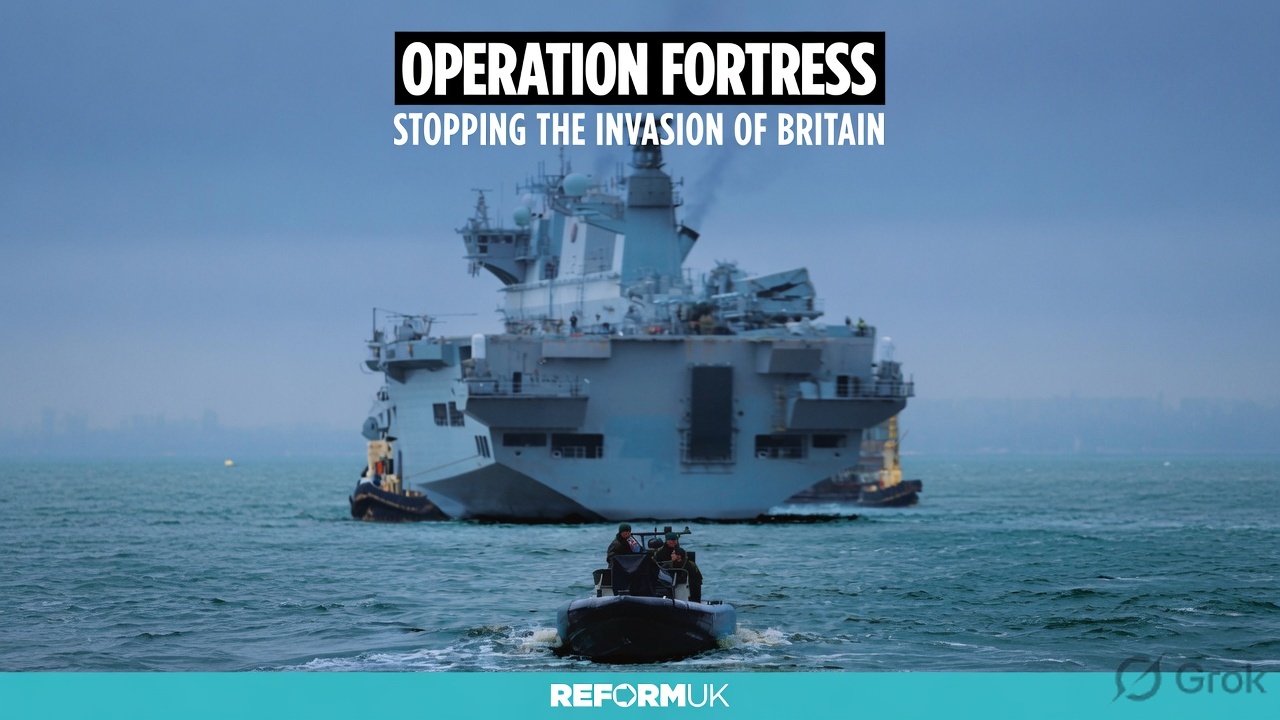
Ben Obese-Jecty, a Conservative MP and former British army officer, dismissed the proposal as “ridiculous”, adding that Reform had announced this ridiculous idea before. Additionally, he pointed out in a post on X that Reform UK’s “Operation Fortress” poster uses the image of HMS Ocean, which was sold to Brazil in 2018.

Via Reform UK. Edited by Grok

Meanwhile, Former Royal Navy officer John Foreman CBE dismissed the plan bluntly as “a crock of shit,” in a post on X.

Undeterred by the criticism, Farage justified his proposal, saying, ”humanitarian missions do not violate maritime or international law,” and the party defiantly vowed to “stand up for British interests,” whether French President Emmanuel Macron “likes it or not.”

While experts from both the military and legal domains believe that the proposal is unfeasible, Farage’s call for “the largest military operation” after World War II has created quite a stir and brought back memories of the actual biggest military operations in the channel that changed the face of the WW2 and reversed Germany’s fortunes.

The Largest Operation In The English Channel 

The English Channel saw intense, sustained naval warfare throughout the Second World War. However, two operations in particular stand out for sheer scale and are the clear historical benchmarks that Farage invoked.

One of these operations came to be known as Operation Dynamo, or Dunkirk Evacuation, which took place between May 26, 1940, and June 4, 1940.

In May 1940, German forces invaded the Low Countries and France using Blitzkrieg tactics. They rapidly advanced, cutting off the British Expeditionary Force (BEF) and large numbers of French and Belgian troops. Thus, the Allies were driven back towards the English Channel and found themselves trapped in a shrinking pocket around the port of Dunkirk, with their backs to the sea and the prospect of annihilation or capture.

This necessitated an evacuation. Vice Admiral Bertram Ramsay directed the rescue operation from the tunnels beneath Dover Castle.

Allied evacuation of Dunkirk
Allied evacuation of Dunkirk-Wikipedia

The Dunkirk harbor was heavily damaged by Luftwaffe bombing, rendering its inner docks unusable. This meant that larger warships could not approach the shallow beaches stretching roughly ten miles east. So, a plan was hatched: two-thirds of the rescued troops boarded destroyers, minesweepers, and other ships from the East Mole, a 1,400-yard breakwater that extended into deeper water. Meanwhile, the remaining one-third were lifted from the open beaches at Malo-les-Bains, Bray-Dunes, and La Panne by small ships.

Nearly a thousand vessels, including Royal Navy destroyers, minesweepers, and merchant ships, formed the backbone of the effort, while hundreds of civilian “little ships” such as yachts, fishing boats, pleasure craft, and lifeboats, ferried men from the shallow beaches to the larger ships waiting offshore or carried them all the way to England. 

The Luftwaffe subjected the harbor, beaches, and shipping to intense bombing, while the RAF fought to provide air cover at considerable cost.

Planners initially expected to save only about 45,000 men over a couple of days. However, as the operation progressed, roughly 338,000 troops, including around 224,000 British and some 120,000 French and other Allied soldiers, were brought safely across the Channel.

And, by the time the operation ended on 4 June, the bulk of the British Expeditionary Force had been saved.

The second major operation in the Channel was Operation Neptune, the codename for the naval and amphibious assault phase of the Allied invasion of Normandy on 6 June 1944. This operation apparently formed the seaborne component of the larger Operation Overlord, the plan to liberate north-west Europe from German occupation, and remains the largest seaborne invasion in history.

Admiral Sir Bertram Ramsay of the Royal Navy commanded the Allied Naval Expeditionary Force. The fleet was organized into two task forces: the Western Task Force for the American beaches and the Eastern Task Force for the British and Canadian beaches.

Allied forces assembled in ports along the southern coast of England, then crossed the English Channel overnight on 5–6 June 1944 to land on the beaches of Normandy in German-occupied France. The distance varied by route and beach but was typically between about 60 and 100 miles.

The naval armada of nearly 7,000 vessels transported troops, vehicles, and supplies through these waters under the protection of warships and air cover.

The successful execution of Neptune opened the long-awaited second front in Western Europe and marked the beginning of the final campaign against Nazi Germany.


The post UK-France Row: British Reform Party Pledges Largest Military Operation in English Channel Since World War-2 appeared first on EURASIAN TIMES.

  •  

Japan Vows Major Military Build-Up as Threats from China, North Korea and Russia Surge – Defense Chief

Japan must reinforce and transform its defense capabilities with a stronger “sense of urgency and crisis” than ever before, Defense Minister Shinjiro Koizumi said Tuesday, as Tokyo released its annual white paper that once again flags risks from China, North Korea and Russia.

In the preface to the 598-page Defense of Japan report, Koizumi wrote that the security environment surrounding the country is now the most severe and complex since the end of World War II.

He pointed to the rapid military build-ups by Beijing and Pyongyang, their expanding cooperation with Moscow, and the new forms of warfare demonstrated by Russia’s invasion of Ukraine, warning that a serious crisis capable of shaking the postwar order cannot be ruled out in East Asia.

Japan is already accelerating its military modernization. Defense spending has been pushed higher, with the budget for the current fiscal year exceeding 9 trillion yen for the first time, while Tokyo deepens security partnerships across the Indo-Pacific.

Missile launchers are being stationed on remote southwestern islands closer to potential flashpoints, the Self-Defence Forces are moving to field longer-range “counterstrike” weapons that could hit targets beyond Japanese territory, and rules restricting arms exports have been loosened to allow greater transfers of equipment and technology to like-minded partners.

In the Indo-Pacific, “not only are China and North Korea further strengthening their military capabilities, China-Russia and Russia-North Korea are also reinforcing their cooperation,” he also added.

The new white paper said China was “intensifying its activities” in the region around Japan, “extending beyond the so-called first island chain to the second island chain”.

It listed a series of incidents in 2025, including activities by Chinese aircraft carriers and the “unusual close approach” by Chinese aircraft to Japanese planes in two incidents in June and July.

Japanese jets scrambled 595 times in the year to March 31, 2026, including 366 sorties against Chinese aircraft and 214 for Russian planes. This compares to 704 the previous year and was the fewest since at least 2021.

Japan decided in April to lift its self-imposed ban on weapons exports, but the white paper highlighted issues in the country’s production base that could jeopardize procurement and innovation.

Koizumi also said that he and US counterpart Pete Hegseth had “exchanged candid views” on the “unwavering” US-Japan alliance, while also increasing security cooperation with the Philippines, Australia and South Korea to realize a “Free and Open Indo-Pacific”.

“As the security environment becomes increasingly and rapidly severe, what is required now is to strengthen resilience against crises all across the entire Indo-Pacific region,” Koizumi said.

“In order to do so, Japan will build and expand multilayered networks among allies and like-minded countries, and enhance interconnectivity with like-minded countries and others in every area.”

Meanwhile, China has repeatedly voiced concern at what it sees as a return to “new militarism” by Tokyo.

After World War II, Japan adopted a pacifist constitution in 1947, with Article 9 renouncing war as a sovereign right and prohibiting the maintenance of military forces, seeking a peaceful global order.

“Aspiring sincerely to an international peace based on justice and order, the Japanese people forever renounce war as a sovereign right of the nation and the threat or use of force as a means of settling international disputes. In order to accomplish the aim of the preceding paragraph, land, sea, and air forces, as well as other war potential, will never be maintained. The right of belligerency of the state will not be recognized,” reads Article 9 of the Japanese Constitution.

Japan, the only victim of a nuclear attack in history, also adopted the “Three Non-Nuclear Principles” of non-possession, non-production, and non-introduction of atomic weapons. Even though all five victors of the Second World War built their nuclear weapons.

Japan relinquished wars of aggression, militaristic societies, and the production of nuclear weapons. In the post-war era, Tokyo directed the nationalistic impulses of its country toward becoming an economic powerhouse and technology leader.

Japan became the world’s second-largest economy in 1990 after the disintegration of the Soviet Union.

China’s military muscle-flexing in the South China Sea, North Korea’s missile proliferation, and Japan’s strained ties with Russia, especially after the Ukraine invasion, are forcing Japan to shed its post-war inhibitions and adopt a more assertive defense role.

Former Prime Minister Shinzo Abe played a critical role in Japan’s transformation. Abe had raised the prospect of the country hosting US nuclear weapons facilities on Japanese soil, boosted defense spending, and called for a strong foreign and security policy.

Under Abe, Japan passed legislation allowing the Japan Self-Defense Forces to engage in overseas combat missions. Essentially, this bill allows Japan’s armed forces to help defend its allies, like America, even if Japan itself isn’t under attack. The Japanese Constitution, following the devastation from the war, previously limited Japan’s forces to self-defense within its borders.

In December 2024, Japan approved a 9.4% increase in defense spending for FY2025. This marked another record figure for the 11th year in a row for Japan’s national defense budget. Japan, which has historically spent less than 1% of its GDP on defense, has also promised to raise it to 2% of its GDP by 2027.

This defense spending hike was part of the Defense Buildup Program, which outlines US$273 billion in defense spending over the five-year period through FY2027.

Japan is also building alliances with China’s competitors. It has developed and promoted military ties with several countries in and beyond the Indo-Pacific region. It has strengthened security cooperation with Australia and India—both members of Quad alongside Japan and the USA—through high-level dialogues, joint military exercises, intelligence sharing, and mutual access to each other’s military facilities.

In December 2022, Japan announced a joint program with Italy and the United Kingdom to develop a new sixth-generation combat aircraft—the Global Combat Air Program (GCAP).

Japan is developing two hypersonic weapon concepts: the Hypersonic Cruise Missile (HCM) and the Hyper Velocity Gliding Projectile (HVGP), as well as long-range missiles.

Japan’s Ministry of Defense (MOD) also conducted flight tests for its island defense hypersonic glide vehicle (HGV). Four test launches were conducted at a site in California, with one launch in August 2024, two in November 2024, and one in January 2025.

Japan’s new 10kW-class high-power laser electronic warfare (EW) vehicle recently entered service to counter aerial and missile threats, including hostile unmanned aerial vehicles (UAVs) and low-altitude missile systems.

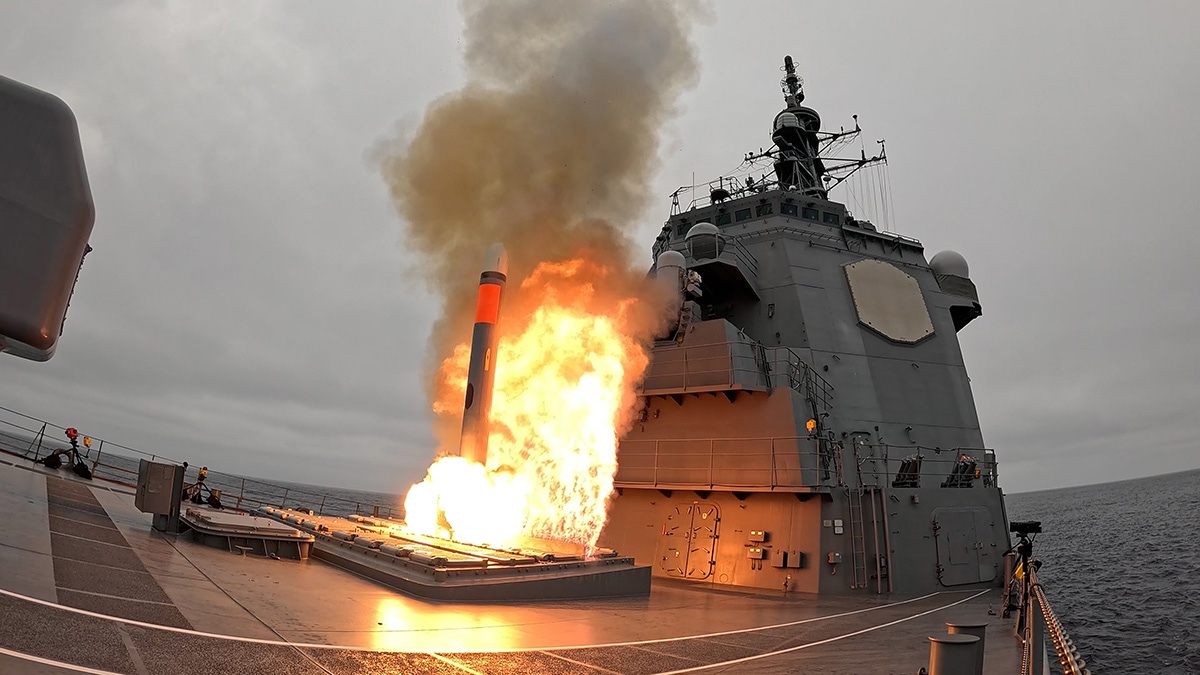
Meanwhile, Tokyo announced on July 30 that it had test-fired a Tomahawk land-attack cruise missile from one of its warships, the Aegis guided-missile destroyer JS Chokai (DDG-176), for the first time.

Additionally, Tokyo fielded the Type 25 Hyper Velocity Gliding Projectile, its first indigenous hypersonic boost-glide weapon, following successful California flight tests and domestic deployment drills that included loading launchers onto ships and aircraft.

In late July, an F-2 fighter conducted the first captive-carry flights of the air-launched Improved Type 12 (Type 25) long-range missile at Gifu Air Base, validating integration ahead of planned service in 2027.

Separately, a 100 kW-class shipboard laser system began sea trials aboard the test ship Asuka in late 2025, targeting drones and projectiles. Japan also conducted its first anti-ship missile live-fire on domestic soil in June 2025, firing a Type 88 from Hokkaido.

These developments highlight Tokyo’s push for stand-off strike and layered defenses amid regional tensions.

Mail us at: editor (at) eurasiantimes.com

The post Japan Vows Major Military Build-Up as Threats from China, North Korea and Russia Surge – Defense Chief appeared first on EURASIAN TIMES.

  •  

“Finish The Job”: Ex-American VP Says It’s Time for U.S. & Israel To Eliminate Iran Once For All: Latest News

Former US Vice President Mike Pence supported continued military operations against Iran and urged the US and Israel to “finish the job.”

In a Fox News interview, he praised Donald Trump for directly attacking Iran and urged the U.S. President to order the military to strike Tehran’s remaining nuclear facilities and eliminate its ability to project power in the Strait of Hormuz and across the region.

“They don’t make peace with the enemy, they make peace with a defeated enemy,” Pence added.

He added that given the Islamic Republic’s positions and denial of negotiations, he is confident that a time will come when Trump will decide that enough is enough. Pence called the joint US-Israeli operation against Iran “historic” and said that now is the time for the military forces of the two countries to complete this mission.

Earlier, Trump said negotiations with Iran were ongoing despite Tehran’s contradictions, and Tehran was facing a “last chance before decapitation.”

Trump, speaking to reporters at the White House, said he agreed to continue to pursue talks with Iran at the request of Saudi Arabia, the UAE, Qatar and other countries.

Iran’s foreign ministry denied that talks with Washington were taking place, but Trump insisted they were. “We are talking right now,” he said.

“This is a last chance for them to sign a good document,” the US president added. “I want to give them every last chance before decapitation.”

The discussions are focused on reopening the Strait of Hormuz, which Trump said could come “literally by tomorrow,” and the denuclearization of Iran, which he said could “take a little while.”

Washington and Tehran have been at war since February 28, when the United States and Israel launched surprise strikes against Iran, though months of on-and-off diplomacy have led to periods of relative calm.

More than five months later, Iran remains able to fire missiles and drones at US and allied targets in the region and retains its enriched uranium stockpiles.

Early Tuesday, the UK maritime security agency UKMTO said that a cargo vessel was struck by an “unknown projectile” in the Strait of Hormuz off the coast of Oman.

Japan Vows Major Military Build-Up as Threats from China, North Korea and Russia Surge – Defense Chief

The vessel, which was not named, reported being hit and authorities were investigating, UKMTO said, without giving specifics on damage or injuries.

Motorists drive past a large billboard pledging revenge against US President Donald Trump along Jomhouri Street in central Tehran on July 27, 2026. Iran’s foreign ministry said on July 27 that the US was not involved in recent talks with Oman over the administration of the strategic Strait of Hormuz. Traffic through the vital global shipping route has been under Iranian control since the outbreak of war with Israel and the United States on February 28. (Photo by AFP) /

In what has become a routine pattern, Trump last week had threatened to hit Iran “very hard” — potentially with renewed attacks against energy infrastructure — only to pull back on Saturday, saying the “perimeters” of a deal were there.

Iran, for its part, said it is not currently negotiating with the United States.

“Our negotiations are with Oman to secure passage through the Strait of Hormuz,” the critical oil corridor, foreign ministry spokesman Esmaeil Baqaei said.

Hormuz has been a major sticking point in efforts to end the war. Since a ceasefire broke down, Iran has reprised a blockade of the waterway that it first imposed early in the war, obstructing vessels attempting to pass and firing on commercial ships.

Calling Tehran “duplicitous” for “openly and proudly” saying it was not negotiating, Trump wrote on social media: “Whether Iran wants to admit it or not, we are, in fact, talking of a solution to a problem that they have caused, for decades.”

He pointed to the United States’ counter-blockade of Iranian ports, adding: “Nothing gets through to Iran, unless we want it to, and nothing will get through, unless a Deal, or Total Surrender, is accomplished.”

Before the war, there was free passage through Hormuz, but Iran now insists on retaining control and charging fees, something the United States rejects.

Tehran has refused to let ships travel any route other than one that hugs the Iranian coast.

On Sunday, Baqaei told state television that a deal was close on managing Hormuz together with Oman, which sits on the other side of the narrow waterway.

“We are now going to reach an understanding on a route acceptable to both sides — neither the northern route nor the southern route — but one that respects the sovereign rights of both sides and safeguards our national interests and security,” he said.

But he insisted that such an agreement did not mean the reopening of the strait.

The US president said at the start of the conflict that the war was necessary to deal with Iran’s nuclear program and he repeated on Monday that “the denuclearization of Iran has to happen.”

Western nations accuse Iran of seeking a bomb, though Tehran insists the program is entirely civilian in nature.

Speaking to reporters on Air Force One over the weekend, Trump said he had been asked by Iran as well as regional US partners to hold off on further strikes, which he claimed would have been “the biggest attack since World War II.”

Iranian media denied that Tehran had asked Trump not to strike.

A previous ceasefire deal fell through last month. It was supposed to open the Strait of Hormuz to ships carrying vital energy exports from the Gulf to feed the global economy.

By Agence France-Presse

The post “Finish The Job”: Ex-American VP Says It’s Time for U.S. & Israel To Eliminate Iran Once For All: Latest News appeared first on EURASIAN TIMES.

  •  
❌