
❌

Reading view

These are the tech and product leaders who survived the Paramount-WBD merger — and the ones who are out

Skydance's co-CEOs David Ellison and Ynon Kreiz.

NYSE

  • Skydance is cutting tech and product leaders after closing its merger with Warner Bros. Discovery.
  • Four WBD technology executives are out, per a memo from Skydance chief product officer Dane Glasgow.
  • Its new team will mostly feature Paramount execs who worked on its recent tech transformation.

Consolidation is underway at David Ellison's Skydance just a few weeks after the company closed its $110 billion merger with Warner Bros. Discovery.

Skydance's chief product officer, Dane Glasgow, laid out the product and tech leadership structure of the combined entity in a memo viewed by Business Insider.

Four top WBD executives are leaving, according to the memo.

They include:

  • Avi Saxena, Warner Bros. Discovery's chief technology officer
  • Tyler Whitworth, chief product officer for WBD's streaming business
  • Dave Duvall, WBD's chief information officer
  • Trish Collins Weedon, WBD's chief information security officer (CISO)

Duvall, Saxena, and Whitworth will stay on in an "advisory capacity as we undergo this transition," Glasgow wrote.

The company is mostly keeping Paramount executives in charge of its combined tech and product organization.

These leaders include:

  • Lakshman Nathan, Paramount's chief information officer
  • Carlo Joseph, its chief information security officer
  • Jim Harrison, its executive vice president of infrastructure, broadcast, and distribution
  • Nick Lee, Paramount's executive vice president of media systems

A few WBD executives are staying on in Skydance's post-merger leadership, per Glasgow's memo.

They include Brinton Miller, formerly WBD's media technology and operations lead, who will serve as Skydance's executive vice president of production and studio technology, and James Crossland, formerly head of global content operations at WBD, who will serve as its EVP of global content operations.

Skydance has spent the past year revamping its tech and product team, often recruiting talent from tech companies.

Glasgow joined Paramount from Meta, while Lee joined from Microsoft's AI division. Other team leaders in its post-merger structure include head of design Suzanne Pellican, formerly a Google exec; Hugh Williams, a former Google, eBay, and Microsoft exec; and Barak Turovsky, who came to Paramount after serving as chief AI officer at General Motors and VP of AI at Cisco.

Bringing technical expertise to Paramount has been a priority for Ellison, who wants to turn the century-old media brand into a modern, tech-forward business like Netflix. The company revamped its data and insights strategy in January, and merged some engineering teams in March to bolster its streaming tech.

"We are building a product and tech organization that can compete with anybody coming out of Silicon Valley," Ellison told CNBC earlier this month.

In his memo, Glasgow expressed gratitude for the work of both Paramount and WBD staffers, writing that he was "encouraged by the early collaboration, the bold new ideas you're bringing forward, and your openness to exploring new ways of working with your colleagues."

He also acknowledged the structural changes could be disruptive.

"I know a change of this scale brings questions, especially as we get to know new teams and colleagues," Glasgow wrote. "Your leaders will share more about their organizations in the coming weeks and we'll bring our teams together soon to keep building with and learning from each other."
Read the original article on Business Insider

  •  

TikTok is shifting advertising to YouTube after Meta says 'no thanks'

Mark Zuckerberg (Meta) and Shou Zi Chew (TikTok)
Mark Zuckerberg's Meta has blocked Shou Zi Chew's company, TikTok, from advertising in some markets.

Finn Gomez/Getty Images; Shawn Thew-Pool/Getty Images

  • TikTok is moving on quickly after losing access to Meta's ads platform in some markets.
  • It's shifted ad spend to YouTube, Pinterest, and mobile-app networks, according to Sensor Tower.
  • TikTok was a prominent ad spender on Meta before its ousting on October 8.

TikTok's message to Meta: If you won't take our ad dollars, your competitors will.

Meta took a bold stance this month by blocking ByteDance, TikTok's parent company, from running ads on Meta apps in some markets. Why? Well, Meta's answer was pretty straightforward. It didn't want to "run ads from a competitor whose goal is to pull people off our apps."

TikTok is now redirecting that ad spend elsewhere.

Since the ban went into effect on October 8, TikTok has shifted its ad budgets to other platforms like YouTube and Pinterest, according to allocation estimates provided to CMO Insider by the analytics firm Sensor Tower.

The share of TikTok's ad spend that went to YouTube rose to 17% between October 9 and October 16, up from 9% in the first week of October. Meanwhile, its ad spend on Pinterest grew to 9% during the same period, up from 3% in the first week of October. A majority of TikTok's spend — 58% — went to mobile-app ad networks like Google's AdMob, up from 19% at the start of October, when Meta was still an option.

Meta's move against TikTok "highlights the growing intensity of the competition across the digital landscape and across the two of them," said Kate Black, EVP of social strategy at Horizon Media. "For marketers, this really just reinforces the need to be agile and build balanced media strategies — and not having all your eggs in one basket."

Meta's TikTok ousting isn't unprecedented. Other platforms like Amazon have previously blocked competitors from running ads, while Twitter in late 2022 restricted users' ability to link to their accounts on social apps like Instagram and Mastodon, calling it "free promotion."

"Declining promotional services to a competitor is a normal business practice across industries," a Meta spokesperson said. Meta's changes will impact advertising policies in the US, Canada, Egypt, Indonesia, Japan, Thailand, and Vietnam.

For Meta, a company that pulled in $117 billion in revenue in the first half of 2026, losing one advertiser won't hurt much. Still, TikTok and ByteDance were notably prominent spenders on Meta's apps, according to Sensor Tower.

Meta will also lose ad spend from third-party marketers that link to TikTok or other ByteDance properties in their ads, further increasing its potential losses. Direct-to-consumer brands that may want to drive potential customers to TikTok Shop will miss out.

No Meta, no problem

For TikTok, losing access to Meta's more than 3 billion monthly users is a setback.

Like any social media giant, TikTok is incentivized to grow, grow, grow. Ads that target new users and drive new app downloads are part of the playbook — a strategy Meta uses to promote its own apps, like Instagram, too.

One TikTok staffer focused on user acquisition, James Gao, posted a LinkedIn callout on Sunday asking people to get in touch if they had ad inventory that could help the company meet its goals.

Horizon Media's Black said that while Meta controls the "lion's share" of social budgets, there are plenty of viable alternatives when it comes to using an ad to drive an action like an app download. Besides Google, YouTube, and Pinterest, marketers are increasingly turning to other platforms like Snapchat and Reddit, she said.

Read the original article on Business Insider
  •  

New details about Khaby Lame's $975 million deal deepen the mystery

Khaby Lame of Team QuickStars and Nissan Formula E Team looks on in the garage during the Jeddah Formula E EVO Sessions at Jeddah Corniche Circuit on February 15, 2026 in Jeddah, Saudi Arabia
Khaby Lame has been pursuing other partnerships as his big payday remains in question.

Simon Galloway/LAT Images

  • Khaby Lame's splashy $975 million deal is still on ice nine months after it was announced.
  • Lame's plan to merge his business with a publicly traded firm was celebrated by creator economy insiders.
  • The public company's stock price has fallen 99% since its January high.

A new financial filing provides fresh details — and more questions — about a mysterious $975 million deal struck by TikTok's top star, Khaby Lame.

On January 9, Lame — who has over 160 million followers — entered into an agreement that would theoretically net him a major payday and take his company public. The mechanism: a merger with the publicly traded Rich Sparkle Holdings, a financial printing firm based in Hong Kong.

Then, in late January, Lame went silent on the merger. Now, we have an update: the deal is still on ice. A Rich Sparkle financial filing on September 30, its first since March, described the deal as conditional on a due diligence process, a minimum valuation of Lame's company, and stock exchange approval. That's the same language that has appeared in previous filings.

While the deal has been in limbo, Rich Sparkle's stock has plummeted 99% from its peak. In the wake of the announcement of the deal with Lame's company in January, the stock shot up to a high of about $180. On Thursday, it closed at $1.93. Several prominent brokerages had restricted or blocked trading in the stock, Business Insider exclusively reported in April.

The original deal announcement was celebrated throughout the creator economy, since such rich valuations are rare among influencer-founded companies, and it would give everyday investors an unusual opportunity to directly bet on a creator. The high profile of Lame, a Senegalese-Italian creator who rose to fame from dialogue-free comedy videos, means the outcome of the deal could impact how investors assess the viability of backing businesses centered on individual creators.

The January deal terms promised Lame's company 75 million shares, which would be worth about $145 million at Thursday's closing share price. The initial agreement had valued that stake at $975 million.

Rich Sparkle and Lame did not respond to multiple requests for comment.

At the time of the original announcement, Rich Sparkle said that it planned to create an AI avatar of Lame to do brand deals and sell products on social media. It projected this business could drive more than $4 billion in annual product sales.

An unusual stock detail

The new filing contains another intriguing detail: Rich Sparkle issued nearly $39 million in stock to its staff as part of their compensation during the six months ended March 31, resulting in an operating loss of almost $40 million. In the year-earlier period, it issued no share-based compensation.

This new share issuance means some employees could have benefited from the stock's massive spike following the Lame deal announcement. The filing doesn't indicate which staffers received shares or exactly when they got them within that six-month period.

Paul Nary, a management professor at Wharton, said the size of the share issuance was unusual relative to the company's valuation and revenue.

If the deal is in motion, we haven't heard a peep from Lame, who removed Rich Sparkle's stock ticker, ANPA, from his social-media bios in late January. The content creator continues to post for brands, recently making a cameo in the James Bond-inspired video game "007 First Light," signing on as a brand ambassador for travel eSIM company Holafly, and promoting the Dakar 2026 Youth Olympic Games.

Read the original article on Business Insider

  •  

26% of Americans say influencers have swayed their vote. Political campaigns are racing to win them over.

Jake Paul wearing a Maga hat on a BI template
YouTuber Jake Paul joined President Trump for an Ohio rally ahead of the midterm elections.

Aaron Schwartz/Stringer/Getty; BI

  • The battle for voters in the 2026 midterm elections is playing out on the TikTok For You Page.
  • One in four Americans say creator content has influenced who they voted for.
  • Political candidates are scrambling to connect with more creators in order to reach voters.

Content creators are influencing much more than our coffee orders and skincare routines.

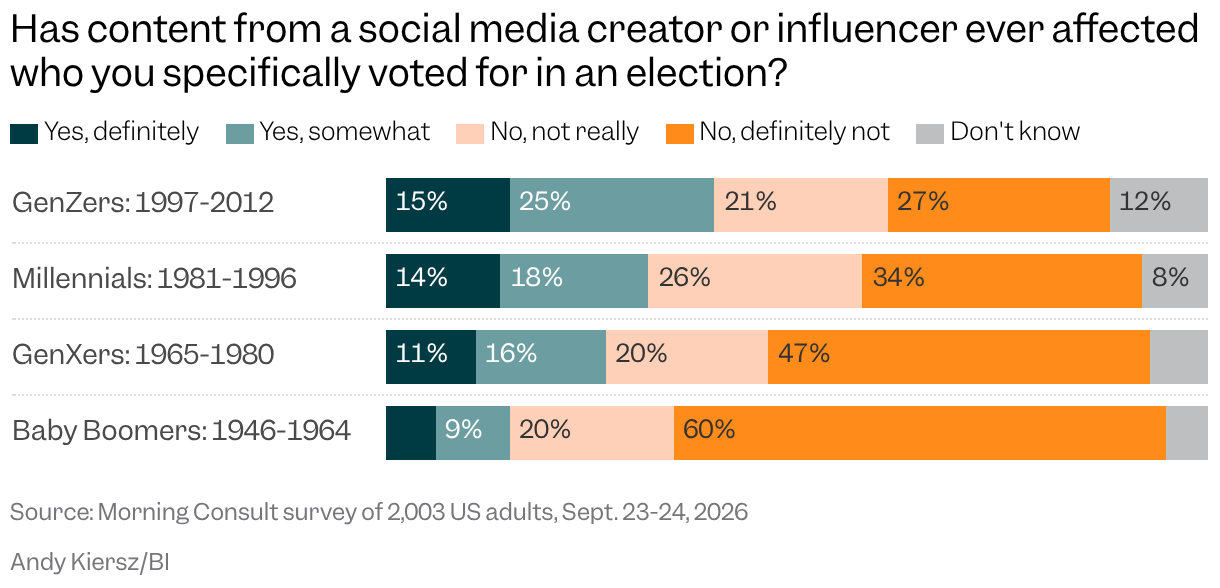
About one in four Americans (26%) say influencer content has affected who they've voted for, according to a survey of around 2,000 US adults conducted by Morning Consult in September, commissioned by Business Insider.

Creator content is an "underestimated avenue" for political campaigns, said Nicole Dunger, a founding partner at the marketing firm People First, which works with candidates and advocacy groups on their creator strategies. "It is a real player and a big player in this space now."

If 2024 was the podcast election, 2026 is shaping up to be the influencer one. Instagram and TikTok creators have joined Fox News hosts and personalities like Joe Rogan as go-to sources of information for voters.

Stacked Bars

Influencers like Jake Paul and Hasan Piker have emerged as main characters in politics this year.

Paul recently joined President Donald Trump in Ohio for a midterm rally, posting TikTok clips of his Air Force One flight. Piker, meanwhile, has become a campaign ally for progressives like Michigan's Abdul El-Sayed and a negative talking point for Fox News commentators.

As online attention has become a key asset in politics, influencers are helping candidates break through the noise.

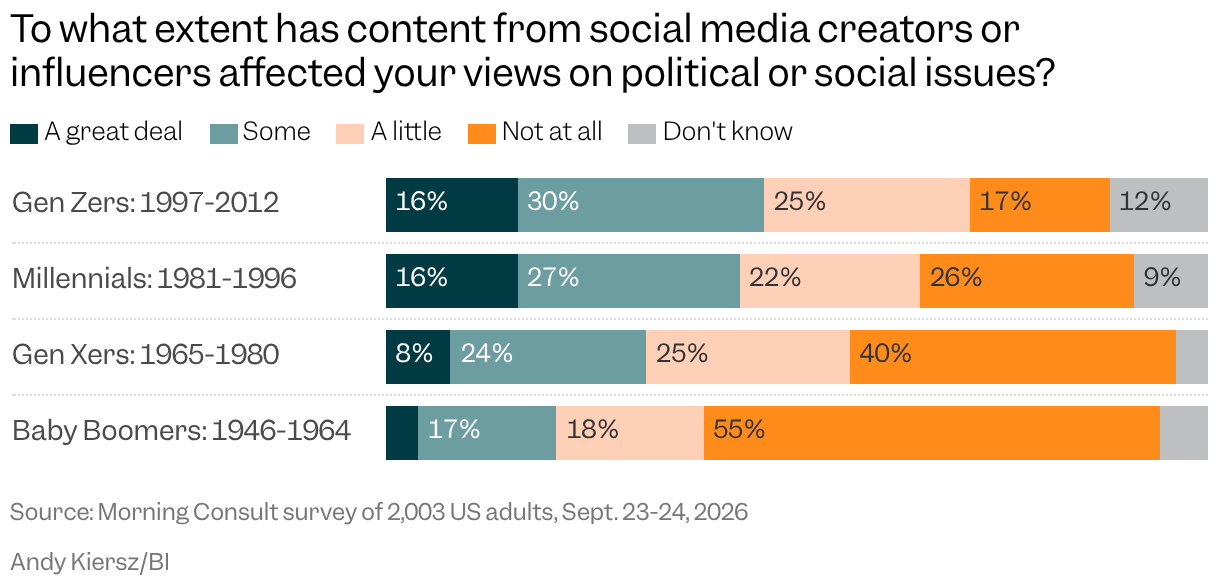
A little over half of US adults (56%) told Morning Consult that creator content had affected their views on political or social issues to some degree. That figure jumped among Gen Z respondents, where close to three in four respondents said their views had been swayed by influencer posts.

For campaigns, the challenge is identifying the right creators to work with, particularly when many influencers don't regularly talk about politics.

"You have to have your base of people, your core supporters, and then you have to have a broader cultural space of people who don't always talk about politics," said Parker Butler, a managing partner at the digital strategy firm Luminary Strategies, which works on social strategy with Democratic candidates like James Talarico. "It's worth having different pockets of creators for different purposes."

Reaching creators with smaller followings than Piker (about 3 million Twitch followers), or Paul (around 21 million YouTube subscribers) is a focus in 2026, Butler said.

He said the goal is to shift the creator outreach strategy from "this person has a million followers" to identifying influencers who work in a particular niche a campaign is trying to reach.

Stacked Bars

Political chatter is moving from TV to YouTube

More and more, political discussions are playing out on digital platforms, whether that's podcasts, YouTube videos, or Twitch streams.

YouTube was the top source for political and election news among US adults in September, narrowly beating out TV, print, and X (formerly Twitter), according to a survey from Syracuse University.

About one in five Democrats and Republicans said podcast appearances could make them "more likely to support a candidate," according to a July through August survey of likely midterm voters from the podcast industry group Sounds Profitable. A smaller share of Independents (11%) said podcasts could make them more likely to back a candidate.

While campaigns see attention moving online, they're still spending the bulk of their ad budgets on TV.

Part of that may be because they're accustomed to buying TV spots. They're also reckoning with the fact that influencer marketing is harder to predict and measure, particularly as social-media feeds become more personalized and algorithmically driven.

"It can be very challenging, but you see the results in the end," Dunger said. "It's the same with door knocking. We know door knocking somehow works and has worked for so long, but it's not like we have those direct measurements."

Read the original article on Business Insider
  •  
❌