The office dress code is changing, and for some professionals, workwear is becoming a serious investment.
At New York Fashion Week, Business Insider's Clarisa Melendez spoke with attendees who said workplace style can signal personality, confidence, and the kind of business they conduct. Some of their most meaningful workwear investments came with eye-catching price tags.
Skydance is cutting tech and product leaders after closing its merger with Warner Bros. Discovery.
Four WBD technology executives are out, per a memo from Skydance chief product officer Dane Glasgow.
Its new team will mostly feature Paramount execs who worked on its recent tech transformation.
Consolidation is underway at David Ellison's Skydance just a few weeks after the company closed its $110 billion merger with Warner Bros. Discovery.
Skydance's chief product officer, Dane Glasgow, laid out the product and tech leadership structure of the combined entity in a memo viewed by Business Insider.
Four top WBD executives are leaving, according to the memo.
They include:
Avi Saxena, Warner Bros. Discovery's chief technology officer
Tyler Whitworth, chief product officer for WBD's streaming business
Dave Duvall, WBD's chief information officer
Trish Collins Weedon, WBD's chief information security officer (CISO)
Duvall, Saxena, and Whitworth will stay on in an "advisory capacity as we undergo this transition," Glasgow wrote.
The company is mostly keeping Paramount executives in charge of its combined tech and product organization.
These leaders include:
Lakshman Nathan,Paramount's chief information officer
Carlo Joseph, its chief information security officer
Jim Harrison, its executive vice president of infrastructure, broadcast, and distribution
Nick Lee, Paramount's executive vice president of media systems
A few WBD executives are staying on in Skydance's post-merger leadership, per Glasgow's memo.
They include Brinton Miller, formerly WBD's media technology and operations lead, who will serve as Skydance's executive vice president of production and studio technology, and James Crossland, formerly head of global content operations at WBD, who will serve as its EVP of global content operations.
Skydance has spent the past year revamping its tech and product team, often recruiting talent from tech companies.
Glasgow joined Paramount from Meta, while Lee joined from Microsoft's AI division. Other team leaders in its post-merger structure include head of design Suzanne Pellican, formerly a Google exec; Hugh Williams, a former Google, eBay, and Microsoft exec; and Barak Turovsky, who came to Paramount after serving as chief AI officer at General Motors and VP of AI at Cisco.
Bringing technical expertise to Paramount has been a priority for Ellison, who wants to turn the century-old media brand into a modern, tech-forward business like Netflix. The company revamped its data and insights strategy in January, and merged some engineering teams in March to bolster its streaming tech.
"We are building a product and tech organization that can compete with anybody coming out of Silicon Valley," Ellison told CNBC earlier this month.
In his memo, Glasgow expressed gratitude for the work of both Paramount and WBD staffers, writing that he was "encouraged by the early collaboration, the bold new ideas you're bringing forward, and your openness to exploring new ways of working with your colleagues."
He also acknowledged the structural changes could be disruptive.
"I know a change of this scale brings questions, especially as we get to know new teams and colleagues," Glasgow wrote. "Your leaders will share more about their organizations in the coming weeks and we'll bring our teams together soon to keep building with and learning from each other."
Lev Radin/Pacific Press/LightRocket via Getty Images
O'Leary Digital's CEO says a Wall Street firm's analysis misses work happening before construction.
Paul Palandjian, the CEO, said the company's two campuses will generate their own electricity.
He outlined land deals, permitting, and early funding, saying delivery should be judged in phases.
Kevin O'Leary's data center company has a message for analysts who doubt its enormous AI ambitions: You're not seeing the whole picture.
Paul Palandjian, CEO of O'Leary Digital, pushed back on a Bernstein Research assessment that put the firm near the bottom of the data center industry's credibility rankings. In an emailed response to Business Insider, he detailed land agreements, water applications and licensing, engineering work, and funding that he said the analysis overlooks.
"Scrutiny during this cycle is fair," Palandjian wrote. He added, "A score built from announced-capacity data ranks every pre-construction project low on construction progress by definition, and it cannot see confidential work."
His response gets at a central question in the AI building boom: How much weight should investors give the work that happens before data center construction begins?
Paul Palandjian, CEO of O'Leary Digital.
Paul Palandjian/O'Leary Digital
Bernstein examined thousands of data center projects using data from the tracking firm Aterio, assessing factors such as construction progress, electricity availability, and industry experience. Its analysis concluded that only about 35% of announced data center capacity in the US will get built.
O'Leary Digital received a credibility score of 0.35 out of 5. Bernstein estimated that 489 megawatts of its announced 15-gigawatt pipeline would materialize, roughly 3%. The analysts grouped it with ambitious newcomers described as "bragawatts."
Palandjian said the 15-gigawatt figure represents the full build-out of two campuses in Utah and Alberta over several years.
"We would rather be judged on milestones than on a model," he wrote.
Data center power without the queue
Palandjian's clearest distinction concerns electricity, one of the biggest obstacles facing data center developers.
"We are not in an interconnection queue," he wrote, referring to the waiting lists for connections to the electricity grid.
Instead, both campuses are designed to generate all their electricity on-site, he said, with direct access to natural gas pipelines and supplies. That's what the industry calls "behind the meter": producing power at the facility rather than relying on an electricity utility to supply it from the grid.
Data center land, water, and early money
In Utah, Palandjian said the Military Installation Development Authority had approved and executed a 30-year development agreement naming O'Leary Digital as master developer of the project area.
About 11,000 acres are under binding agreements, he said. Master planning, ground studies, and laser-based land surveying have finished at both sites, and the company filed an engineered Utah water application in late September, he added.
In Alberta, about 13,000 acres are under a binding agreement, and a water license for 6 million cubic meters a year has been granted, Palandjian said. He also said that both sites are away from densely populated residential communities.
On money, Palandjian said his firm has capital for both pre-development and advancing the project toward key milestones. He did not specify a funding amount or say the entire build-out was financed.
He said that the engineering, power, and construction firms working with the company, and the global banks advising it, provide evidence of its ability to deliver.
"With that team, every critical part of the project is being worked through, gaps are identified early, and we are closing them to raise our probability of success," he wrote.
Palandjian said that while O'Leary Digital is young, its team has decades of experience in real estate, power, and infrastructure.
Bernstein's skepticism does not mean every newcomer will fail.
"It's not that all of these guys are sort of terrible and not going to deliver, but we just have lower confidence because we don't know them," analyst Madison Rezaei said.
Health insurance costs have soared for workers and employers.
Luis Alvarez/Getty Images
Workers on family health insurance plans paid $7,471 for premiums in 2026, a 9% increase from 2025.
Costs are even higher at smaller businesses: Workers there pay nearly $10,000 for family premiums.
Rising premiums have outpaced wage growth, and are only expected to increase more in 2027.
It's costing families nearly $7,500 a year for health insurance — and more increases are looming.
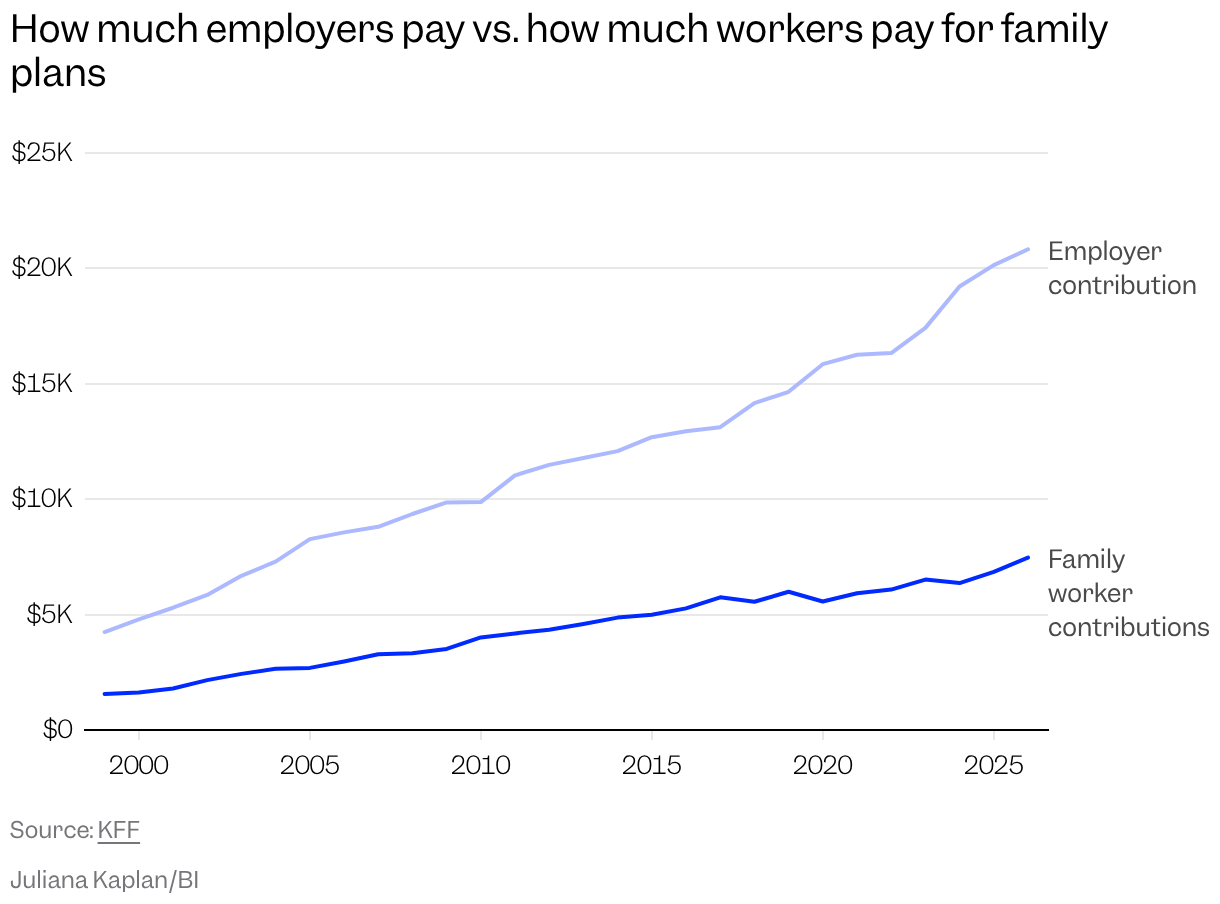
A 2026 health benefits survey from KFF found that workers on a family plan paid an average of $7,471 a year in premiums — a 9% increase from 2025. And that's just the worker contribution — when accounting for employer contributions, family plan premiums totaled $28,303 in 2026, a roughly 5% increase from 2025.
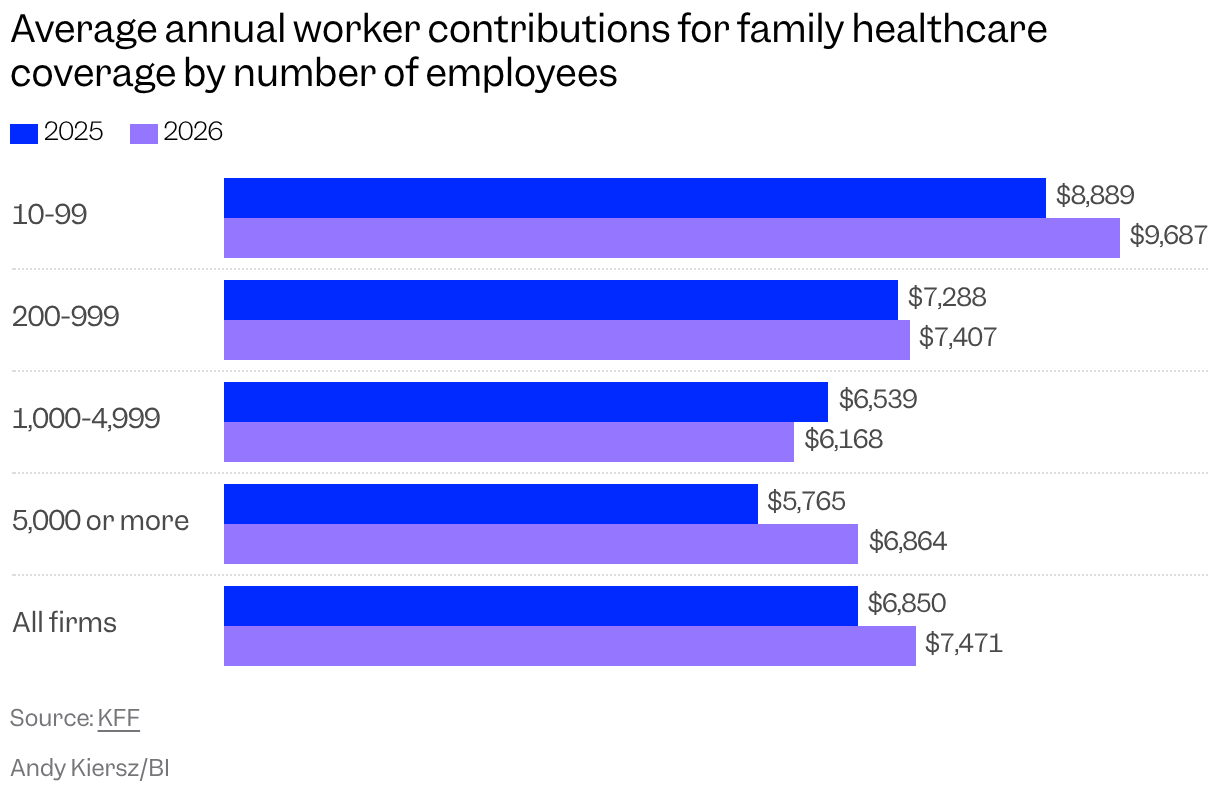
That's a hefty price for both workers and their employers, and even more acute for workers at smaller businesses: KFF's survey found that at firms with fewer than 200 employees, they paid nearly $10,000 toward family premiums in 2026. Smaller firms are often more beholden to insurance companies, since they don't wield the same bargaining power as larger firms.
Mounting health costs might be part of why consumers feel so gloomy: As wages have increased, insurance premiums have risen even faster. While wages increased 3.7% year-over-year for workers — which might look like a nice pay bump on paper — worker-paid premiums outpaced that salary growth, rising by 9%.
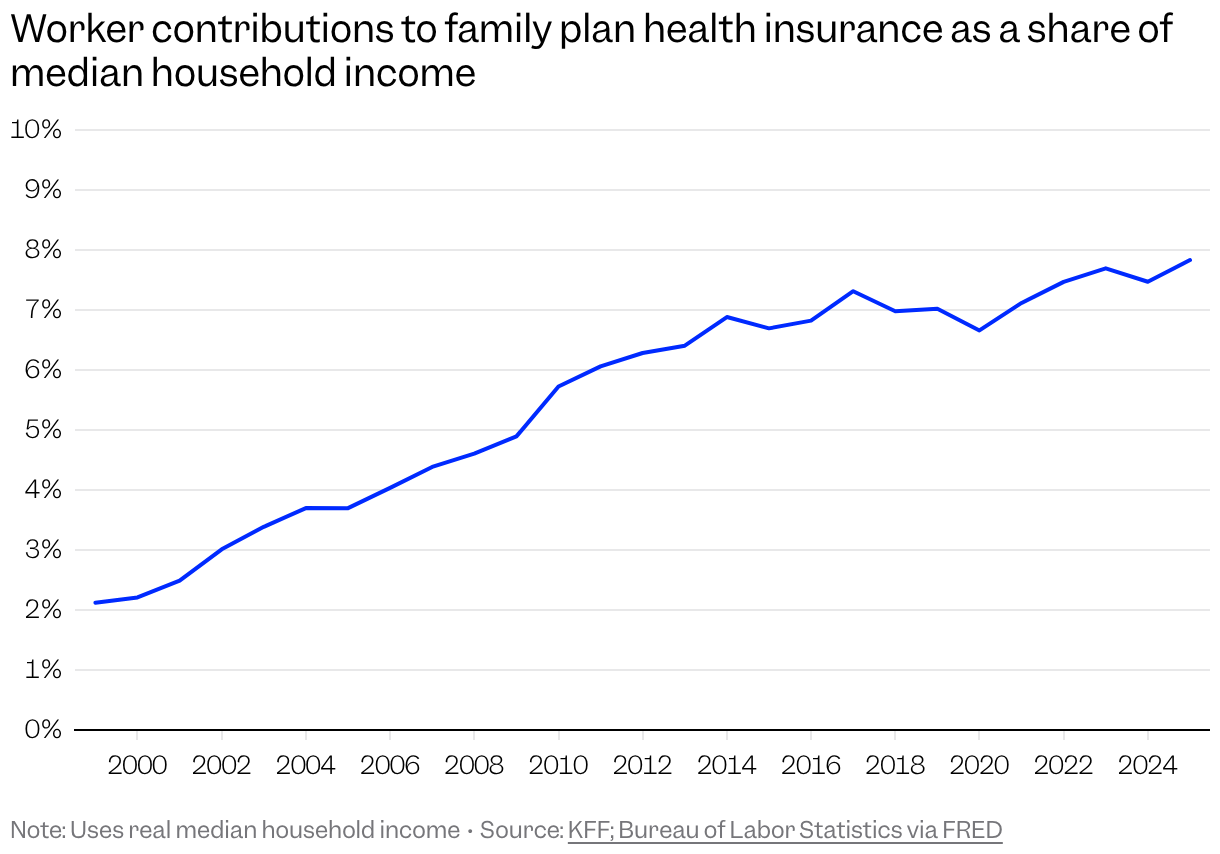
And over the past few years, how much workers pay for health plans has eaten up a larger share of their household income. For workers across all firms, their premium costs amounted to nearly 8% of real household median income in 2025.
Are you worried about rising health insurance costs, or already paying thousands out of pocket? Share your story with this reporter at jkaplan@businessinsider.com.
All of that comes as employers and workers brace for open enrollment season, and more hikes loom: An analysis from PricewaterhouseCoopers, based on a survey of health plan actuaries, projects that commercial healthcare group costs will rise by 9% in 2027. Similarly, Aon, an insurance management firm, found that employer healthcare costs are projected to climb by 9.5% next year without any cost mitigation measures — meaning before firms figure out how to pass some of those mounting costs on to their workers.
For workers and firms, that means a tighter financial squeeze: Companies are paying more to cover their workers, but costs are likely still outpacing wages. At the same time, firms might not be able to provide higher wages as care costs climb. It means that everyone is paying more, and nobody's feeling good about it: An Ipsos/Axios poll found that 69% of Americans say a 10% increase would negatively impact their household finances, with 30% saying it would have a major negative impact.
A new annual survey of employers and their health benefits from KFF found that small-business workers pay more for family coverage than workers at firms of every other size. At the same time, many of these workers have fewer plan choices than at larger firms, meaning they're often stuck with whatever option their employer selected.
From 2025 to 2026, annual worker contributions for family coverage at firms with 10 to 199 workers increased from $8,889 to $9,687, a 9% increase. While the largest firms saw a sharper increase, workers' contributions at employers with 5,000 or more employees were nearly $3,000 less. For all firms, contributions rose about 9% to $7,471.
Of covered workers at small firms, nearly one in three has a plan requiring an employee contribution of over $12,000 annually, more than double the rate at large firms.
According to the survey, 66% of small firms offer health benefits, compared with 98% of firms with 200 or more workers. That's up from 59% in 2025 but remains below the 72% level of five years ago.
Workers at small firms pay an average 37% of the family premium, compared with 25% at larger firms.
While premiums for health insurance plans that cover only a worker and not their family are similar for small and large businesses, the average deductible at small firms is nearly $1,000 higher than at large firms. More than half of small-firm workers face a deductible of at least $2,000, compared to just a third of large-firm workers.
Though the report doesn't get into the discrepancy for family plans in depth, small businesses often have less bargaining power with insurers. Because small businesses operate on smaller margins, they often don't have the money to subsidize spouses and children at the same level as larger businesses. Risk is also more concentrated among smaller businesses, meaning that future premiums and claims may be heightened by a single employee with costly medical needs.
Additionally, because small firms are much less likely to self-fund, they're often more dependent on insurers and therefore pass along rate increases to their workers. Average annual premiums rose 5% in 2026, with employers citing projected cost increases, while the survey separately found that GLP-1 coverage can affect prescription-drug spending. Workers at small employers are more likely to have weaker coverage for specialty drugs.
Affordability is top of mind for Americans gearing up to vote in the midterms. Healthcare costs remain a top financial concern. Millions of Americans have lost health coverage as ACA marketplace subsidies expired and Medicaid enrollment protections ended.
Small businesses have been hit hard over the past few years by inflation, higher interest rates, and tariffs. Small businesses have been embracing AI as a cost-saving measure, though many face unexpected costs due to token overuse or subscription price increases.
Dozens of workers have told Business Insider that preparing for retirement has been a significant source of stress as they navigate a tight job market. However, among employers that offer health benefits, 23% of firms with 200-999 workers offer retiree health benefits, versus 35% of firms with 5,000 or more workers.
There are some silver linings for workers. Premiums for single workers are slightly lower at smaller firms than at larger ones overall. Employees at small firms on single health insurance plans were much more likely to have their entire premium paid by their employer, though they're also much more likely to pay more than half of the family premium. Among small firms offering coverage, nearly all offer family coverage.
Taylor Swift performs during the Eras Tour in Toronto.
Emma McIntyre/TAS24/Getty Images for TAS Rights Management
The Billboard 200 is the definitive all-genre chart for album sales in the US.
Only 10 artists in Billboard history have topped the chart at least 10 different times.
The Beatles have the most No. 1 albums with 19. Taylor Swift and Drake are tied for second place.
The Billboard 200 has tracked the best-selling albums in the US for decades.
It's a major accomplishment to top the chart, especially when an artist manages the feat with multiple different albums.
Only a handful of artists have crossed into double-digit No. 1s, including modern superstars like Taylor Swift, Drake, Jay-Z, and Future. They're listed below in ascending order.
Editor's note: Although Elvis Presley is often credited with 10 No. 1 albums, a Billboard representative told Business Insider that most of his biggest releases predate the modern Billboard 200 chart, which launched in 1963.
Madonna — 10
Madonna performs in New York City's Times Square in 2026.
Madonna is also the first artist with a No. 1 album in the 2020s to have already topped the chart in three other decades: twice in the 2010s ("Madame X" and "MDNA"), four times in the 2000s ("Hard Candy," "Confessions on a Dance Floor," "American Life," and "Music"), and thrice in the 1980s ("Like a Prayer," "True Blue," and "Like a Virgin").
Bruce Springsteen — 11
Bruce Springsteen performs with The E Street Band in 2023.
Sergione Infuso/Corbis via Getty Images
Bruce Springsteen's 11 chart-topping albums span over three decades, from 1980's "The River" to 2014's "High Hopes" — even though Springsteen has yet to score a No. 1 hit song on the Billboard Hot 100.
Barbra Streisand — 11
Barbra Streisand performs at Madison Square Garden in 2019.
Kevin Kane/Getty Images for BSB
Barbra Streisand logged her first No. 1 entry on the Billboard 200 with "People" in 1964.
Fifty-one years later, she set a record for the longest span between No. 1s when "Encore: Movie Partners Sing Broadway," her 2016 studio album, topped the chart.
Streisand previously held the record for the most No. 1 albums among female artists until Taylor Swift broke it in 2023.
Kanye West — 11
Rich Fury/Getty Images for Coachella
Ye, who still releases music under the name Kanye West, topped the Billboard 200 for the first time in 2005 with "Late Registration."
He logged his 11th consecutive No. 1 album in 2024 with "Vultures 1," a collaborative effort with Ty Dolla $ign.
Eminem — 11
Eminem performs during the 2022 Rock & Roll Hall Of Fame induction ceremony.
Jeff Kravitz/FilmMagic
When it was released in 2000, Eminem's "The Marshall Mathers LP" sold over 1 million copies in its first week, easily earning a No. 1 debut on the Billboard 200.
Two decades later, "Music to Be Murdered By" debuted at No. 1, becoming Eminem's historic 10th chart-topper. He logged his 11th in 2024 with "The Death of Slim Shady (Coup de Grâce)."
Future — 11
Future performs during the We Trust You Tour in 2024.
Prince Williams/WireImage
Future earned his first No. 1 album in 2015 with "DS2," which has since spent over 300 weeks on the Billboard 200.
In 2024, Future's "Mixtape Pluto" debuted atop the chart — his third No. 1 album in just six months and 11th overall.
Earlier that year, Future topped the chart with "We Don't Trust You" and "We Still Don't Trust You," collaborative efforts with Metro Boomin. The former is widely known for reigniting a feud between Drake and Kendrick Lamar.
Jay-Z — 14
Jay-Z performs during the 2017 Meadows Music And Arts Festival.
Kevin Mazur/Getty Images
Jay-Z began collecting No. 1s in 1998 with his third studio album, "Vol. 2... Hard Knock Life." In 2017, he extended his total to 14 with his latest effort, "4:44."
Drake's grand total also includes one mixtape ("Care Package"), three collaborative albums ("What A Time To Be Alive" with Future, "Her Loss" with 21 Savage, and "$ome $exy $ongs 4 U" with PartyNextDoor), and one project mysteriously billed as a playlist ("More Life").
Taylor Swift — 15
Taylor Swift performs during the Eras Tour in 2023.
Marcelo Endelli/TAS23/Getty Images for TAS Rights Management
Only one of Taylor Swift's albums hasn't topped the chart: her self-titled debut, which peaked at No. 5 in 2008.
Swift earned her first No. 1 later that same year with "Fearless," which has since been ranked the fourth-biggest album in Billboard 200 history. In the 2020s, Swift rerecorded four of her old albums and rebranded each new release as "Taylor's Version." All four of those topped the chart, too.
Most recently, 2025's "The Life of a Showgirl" launched atop the chart with the biggest sales week in history, breaking Adele's record. It became her 15th No. 1 album, extending her record for the most among women. She is tied for the most among solo artists.
Swift has also broken Elvis Presley's record for the most cumulative weeks spent at No. 1 on the Billboard 200 for a solo artist.
The Beatles — 19
The Beatles gave their final performance together in 1969.
Apple Corps Ltd
The Beatles hold both records for the most No. 1 songs on the Hot 100 and the most No. 1 albums on the Billboard 200. The latter group includes classics like "Revolver" (1966), "Sgt. Pepper's Lonely Hearts Club Band" (1967), "Abbey Road" (1969), and their post-band breakup compilation "1" (2000).
As a solo musician, Paul McCartney has topped the Billboard 200 eight more times, while John Lennon managed the feat three times before he died in 1980.
A new study finds 80% of Gen Zers have worked outside their main jobs.
LeoPatrizi/Getty Images
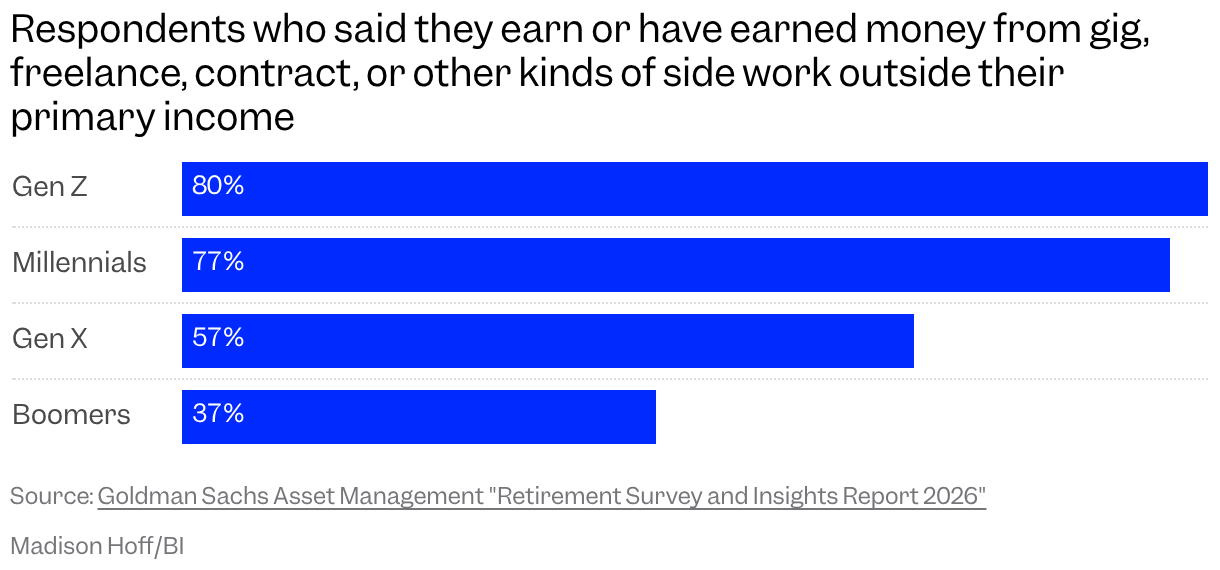
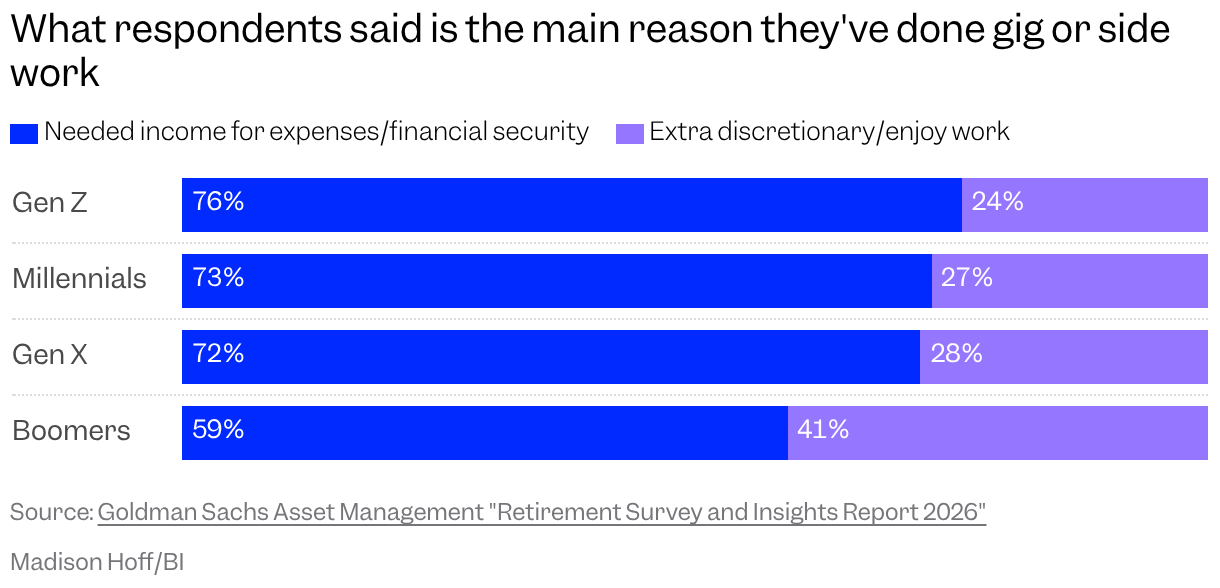
Goldman Sachs Asset Management found 80% of Gen Zers have worked outside their primary jobs.
People across generations said this was because they needed the money or for financial security.
Not feeling secure can affect financial goals, like homeownership.
Having a job doesn't always mean you have enough to cover daily living or savings goals.
A July survey of Americans by Goldman Sachs Asset Management and the behavioral economics firm Escalent found over 60% of respondents have worked outside their primary roles, largely because they needed to. Twenty-seven percent of respondents said work covers their expenses, but it's tough to get ahead.
"Employment remains essential for retirement security, but for many Americans, it is no longer sufficient," a Goldman Sachs Asset Management retirement report said.
Gen Zers were most likely to say they earn or have earned money outside their primary job; millennials followed closely behind. The report said that's despite most Gen Z and millennial workers reporting their jobs provide financial stability.
"Younger workers may feel stable in their main jobs while still seeing extra work as necessary," the report said.
Throughout the generations, a majority said they're doing gig or side work out of necessity or for financial security.
"The traditional full-time job may no longer be carrying the full weight of financial security," the report said. "For many, supplementing income appears to have become part of the baseline."
Some Americans are living paycheck to paycheck or adjusting their budgets to cope with rising gas prices and other everyday expenses. It can be hard to get ahead whenwage growth has been consistently falling short of inflation, and it's tough to find a new job to try to earn more money.
Not feeling financially secure can lead to putting off savings goals. Eighty-three percent of Gen Z and 78% of millennials said they put major financial goals on hold. Forty-one percent of millennials have delayed emergency savings despite being employed, and 30% said they delayed housing or homebuying goals. For Gen Zers, the shares were 35% and 34%, respectively.
While some people may be working a part-time side job, others are "overemployed" and working multiple full-time jobs. One millennial has worked five full-time remote IT jobs, earning over $700,000 annually. As Business Insider's Jacob Zinkula reported, overemployed people use their extra earnings for different reasons, such as retiring early or paying down debt.
Having multiple income streams can also be considered a "portfolio career," where people piece together different kinds of work, such as writing a newsletter, doing a side gig, and holding an office job. It can be one way to try "stability stacking" to feel more secure about your career if, for example, you were laid off and lost an income stream.
"When you decentralize everything from one 9-to-5 and build a portfolio career, you protect yourself from the emotional and financial shock if and when business needs change at your 9-to-5," said career coach Janel Abrahami in a TikTok video.
And sometimes, working a side gig can become a complete career pivot. Harlan Rappaport, in his 20s, turned his email marketing side hustle into a full-time career after working as an investment analyst at a financial institution.
"I used to get really excited about the numbers, but over the last couple of years, I realized it's more about the freedom I've had in my life over the last couple of years as a freelancer," Rappaport said in an as-told-to essay. "I don't miss family events, can travel when I want, and can work from anywhere in the world."
On Wednesday, he took that long-running vision of autonomy a step further. During the automaker's earnings call, Musk predicted that Tesla itself would dominate how passengers get around — so long as pesky regulators don't get in the way.
"I think Tesla will end up doing a majority of all passenger miles on Earth in any country where it is allowed to operate freely," he said. "And you can come back and look at this prediction, but I feel confident about this prediction."
He said Tesla's biggest hurdle to world domination is foreign governments blocking autonomous tech "to protect a domestic industry."
That is a bolder statement than Musk's prior autonomy predictions.
During a January earnings call, he said the "vast majority of miles traveled" would eventually be autonomous and guessed that people would manually drive fewer than 5% of miles. That prediction left other autonomous competitors — Waymo, Zoox, Ford, GM, Rivian, etc. — in the fray.
Vehicle autonomy is core to Tesla's valuation story. The company says its future lineup will include only one vehicle that drivers can operate manually: the high-priced Roadster.
In September, the company started rolling out the steering-wheel-less Cybercab for ride-hailing in Texas.
That rollout has had its fits and starts. While Tesla says it's ramping production and preparing to launch Cybercab rides in Florida, the NHTSA issued an audit inquiry hours after the car's public release to probe the automaker's self-certification.
Musk, who has described his predictions as his "best guesses," has missed several recent timelines for Tesla's autonomy rollout — including a prediction that unsupervised autonomy would ramp across the US in 2025.
Now, Tesla has a new target date for the consumer launch of its full self-driving software. On Wednesday, Ashok Elluswamy, the company's VP of AI, said unsupervised FSD is coming "somewhere around Q2 next year."
Tesla didn't immediately respond to a request for comment from Business Insider.
Ben here. Up until recently, it was a great time to be the founder of a neolab, the lavishly funded, research-first AI startups founded by top talent who defected from the likes of OpenAI or Google DeepMind.
We reported last month that Jeff Dean, Google's former chief scientist, is seeking a valuation as high as $50 billion for his new AI science startup. OpenAI cofounder Ilya Sutskever's Safe Superintelligence is worth $32 billion. Another OpenAI alum, Mira Murati, is raising a round for Thinking Machines Lab at a valuation of around $40 billion.
But lately, in conversations with multiple VCs around Silicon Valley, there is a growing divide about whether neolabs can make the economics work with their multibillion-dollar price tags and formidable competition from frontier labs.
One VC at a top firm, who asked that I not use his name, told me neolabs are the most hotly debated type of investment right now.
"Some would say you shouldn't invest in any, and others would say this is basically all you should be investing in because software's dead, and you either have to own models or hardware, and even if you enter at a billion, the company could be worth a trillion," he said.
Business Insider; Randy Yeip
When I recently asked Menlo Ventures partner Matt Murphy at Business Insider's Growth Mode conference which sector he thought was most overhyped, he immediately cited neolabs, which was noteworthy, given that Menlo invested in some of them.
Murphy pointed to an example from his time as an early board advisor at Google, which he said did so well because it "was like a match thrown into a bonfire."
"The opposite thing you want to do is start a match with a bonfire," Murphy told me. "That's the risk of what's going on now with companies raising such large rounds."
Das seemed a bit taken aback by the reaction to his post and later texted me: "Like all startups, many will fail, some will work."
Picking which ones will work is why VCs get paid the big bucks.
Neolabs are a power-law bet taken to an extreme, Radical Ventures' Aaron Rosenberg told me.
Investors know most will likely burn enormous sums on compute and talent without ever becoming profitable. But the rare winner could become a foundational AI company worth hundreds of billions or more.
"We're confident that the best neolabs will attract ongoing support," Rosenberg said. "Talent continues to transition out of the incumbents and academia into founder roles, and we see no signs of that slowing."
Like Radical, New Enterprise Associates wrote a bullish view in June. One of the authors, Andrew Schoen, told me his views have not changed. "There are neolabs I know of that are finalizing billion-plus-dollar rounds of equity financing, and those processes are moving very smoothly and quickly," he said.
The Buzz
Menlo Ventures' partners Shawn Carolan, Matt Murphy, and Venky Ganesan.
Will Mackie Productions
Katie here. Many of tech's biggest names gathered at the Ritz-Carlton in San Francisco on Saturday, at a black-tie event in the name of Menlo Ventures' 50th anniversary.
Hollywood titan turned venture capitalist Jeffrey Katzenberg of Dreamworks fame asked the audience to join a prayer "for the blockbuster IPO of Anthropic," a joking reference to Menlo's early investment in the company.
I also spotted Morgan Stanley's storied technology banker Michael Grimes, who is undoubtedly holding his own AI IPO prayers. Other attendees included an array of public company and startup CEOs, including those from Snowflake, Zscaler, Legora, and OpenRouter.
As Menlo partner Venky Ganesan quipped, there was more AUM (assets under management) in the room than in many countries, given the attendees' net worth and the investment capital they manage.
A person at a rival venture shop expressed disappointment that their firm doesn't host such celebrations.
Menlo's night ended with concerts from two super confidential Grammy Award winners trying to rake in those AI bucks!
Around the Cap Table
We reported this week that Fireworks AI is seeking fresh funding at a valuation of between $30 billion and $40 billion, a dramatic jump just months after its last blockbuster round was closed.
There are only 130 US tech companies, public or private, valued at $10B or more (decacorns). That’s roughly 20 to 30 new companies per decade, for the last five decades. This year alone, with a quarter to go, there have been 42 decacorns minted privately. Either this is the most…
Ben Bergman, chief correspondent, in Los Angeles. Katie Roof, editor at large, in San Francisco. Pranav Dixit, senior technology editor, in San Francisco. Leena Rao, executive editor, in Los Angeles.
Sam Altman says mathematicians are coming around after OpenAI upended mathematics.
Bloomberg/Getty Images
OpenAI CEO Sam Altman and mathematicians have a complicated relationship.
OpenAI has taken credit for solving hundreds of math problems, irking many mathematicians.
At a recent talk at Stanford, Altman said mathematicians have already gone from anger to acceptance.
Like someone in mourning, Sam Altman said mathematicians went through phases after OpenAI began its blitz into the field.
First, there was disbelief. Then, there was pain.
"The day one reaction was like, 'We're cooked, and our field is over,'" OpenAI's CEO said. "'We're telling our grad students to switch majors.'"
After that, there was anger.
"The day three reaction was maybe like: 'It's horrible that OpenAI did this,'" Altman said at a recent talk at Stanford, before hundreds of students jittery about the viability of their future careers.
Come day five, though, in Altman's telling, mathematicians began to come around to what he described as AI's now-inalienable role in the study of numbers and proofs.
"We've now seen a lot of people say, actually, I'm going to have a different but hopefully better kind of career as a mathematician," Altman said.
Altman's buoyant assessment contrasts sharply with what some in the math community have described as an existential transformation.
After OpenAI abruptly broke into the field's prerogatives in September, announcing its models had solved the Navier-Stokes equations —a famously challenging math puzzle that stumped the industry's brightest since the 19th Century— preeminent mathematicians erupted in fury.
A pair of academics, one at New York University and another at Anthropic, accused OpenAI of using data from their chat logs to help crack the problem. Mathematicians also complained that while an AI model might have solved the problem, it didn't show its work, leaving them with the less celebratory task of verifying it.
And in the wake of all that controversy, there was more controversy.
A group of undergrads at Caltech, wary of how rapidly AI was disrupting their field and wanting to stay relevant, advertised a "mathathon" where participants were encouraged to use AI to solve long-standing problems.
OpenAI dropped out of sponsoring the event after more than 700 academics signed an open letter denouncing the competition for promoting AI "slop." (Organizers have since made adjustments to the rules, and the competition is set for November.)
More recently, Terence Tao, a math prodigy at UCLA who earned his doctorate at 20, said math's "romantic era" is over, as top academics like him adjust to a workflow that involves verifying AI's work rather than solving problems individually.
"Some things are being lost," Tao said after OpenAI this month said it solved over 700 more problems.
Meanwhile, Altman, sitting on the opposite side of the debate, has adopted the optimism of the disrupter.
"I don't think there's going to be like a job apocalypse," Altman said of AI causing companies to restructure their workforces. In the field of math, however, Altman said the disruptions came more quickly than in other disciplines and industries.
"That was the fastest that I think we've all gotten to watch a field go through this cycle," he said.
Julian Buckner started his own interior design and staging company in 2018.
Venjhamin Reyes
Julian Buckner founded Vesta Home, a luxury interior design company in 2018.
He's worked with celebrities and high-end clients staging their homes and selling custom furniture.
He gives his advice on how to make your home feel more luxurious without breaking the bank.
For luxury and elegance, homeowners often have to shell out for professional help finding the latest trends and big-ticket items. But what if you want your home to look expensive, but you can't break the bank?
According to the CEO of a luxury interior design company, there are still ways to communicate luxury via your own personal taste.
"Anyone with money can walk into a B&B Italia and spend $1 million on furniture and have it look like a B&B Italia showroom," said Julian Buckner, who founded the Los Angeles-based staging, interior design, and furniture sales company Vesta Home in 2018. "Taste is knowing when to put in the ultra-modern leather casino sofa and then marry it with some vintage nightstand that you found at the design mart in Texas."
Buckner, who has worked with clients like LeBron James, Travis Scott, and Jonah Hill, said the average home he stages is worth about $6 million. But his advice applies regardless of price point. Below, he shares his tips for how people can make their homes feel more luxurious without the hefty price tag.
Bring a personal touch to your decorating.
aire images/Getty Images
Bringing something unique and unexpected into a room as decoration shows a level of thought that conveys luxury unlike anything else, Buckner said.
"Those small knickknacks or found items may be the single biggest thing to add personality to a space," he said. "I've seen those antique old wooden shoe horns, antique toys, plaster or marble busts, anything you just wanted to tie into the broader aesthetic."
Just make sure not to get carried away.
"I see people go to HomeGoods and just buy a bunch of random knickknacks and put them on every shelf, and I think that cheapens it," Buckner said.
"It's like informal men's dress wear," he added. "There are a couple of areas you can express personality, and it's maybe in your socks and your choice of a wristwatch. I think that same thing is true in luxury design, where it's in those found items, those antiques, and ultimately the accessories; that's a really unique opportunity to express yourself."
Make furniture unique by having fun with different fabrics.
You can change the style of furniture simply by reupholstering it.
Jayne Howard
There are other subtle ways to show off your personality, too. Buckner said a great way to add a unique fixture to your home is to reupholster furniture.
"I think that the average consumer does not appreciate, does not understand, or does not even know that reupholstering is an option," he said. "You can take a relatively inexpensive sofa and for not a ton of money, reupholster it in a really unique fabric that ties into the rest of the home, and that can absolutely make a space."
Try not to have everything match.
Tohid Hashemkhani/Getty Images
While having a theme to a room is fine, Buckner said having things too "matchy-matchy" is no longer in style.
"You can see that with the emergence and the popularity of a company like a Restoration Hardware, this more monotone type of furniture and people buying full rooms together and having everything matchy-matchy," Buckner said. "We're seeing a shift away from that and a real focus on curation — on things not matching."
Sometimes, things clashing can actually make a room more interesting.
"I think when things don't match, when there's a little bit of dissonance in the design, that's an area — when it's done tastefully, not tons of different fabrics and colors and textures everywhere — to make you stop and think, 'Oh, that's interesting,'" he said. "We're starting to see a lot more of that."
Window treatments are the most important and easiest fixes for your home.
Bulgac/Getty Images
Buckner's No. 1 fix for adding style to your home is adjusting your window treatments.
"Window treatments, I think, are often massively overlooked, and it's a very inexpensive way to make a space feel very high-end," he said. "Whether the curtains are too heavy, they're poorly positioned, or the rods look cheap, there's such an opportunity there in fabric and layering on the window treatment side that I think can add a ton to a room."
Trendy isn't always better.
Jayne Howard
It's hard not to be inspired when you see a celebrity's home with a special lamp or a certain style of couch (Buckner said Bouclé has had its moment), but it's often better to stay away from popular trends.
While Buckner's high-end clients change their homes around every three to five years, trying to keep up with trends isn't cost-effective for the average consumer. It's more important to find pieces that you like first.
"I would stay away from trends and focus on timeless design and products that you actually love. Spend the time on putting that together, whether it's something you found in a unique place, or has a story behind it, or something that resonates," Buckner said.
"When it's thoughtfully done, it really conveys the highest level of taste."
One flight-booking mistake cost my family nearly $3,000 and a day of travel.
Natalie Becerra
I booked two separate flight itineraries on different airlines for a family trip to Ireland.
I realized this was a mistake after the first airline diverted, and the second left without us.
The fix cost my family nearly $3,000 in new tickets and a day's worth of touring.
I'm a veteran traveler who has booked more long-haul flights than I can count. But earlier this year, I made a very expensive rookie mistake.
While planning a trip, I came across a deal I couldn't pass up: a $317 one-way flight on Icelandair to Ireland with a multi-day layover in Reykjavik. It was essentially a way to take a trip within a trip without paying extra airfare.
The catch? The flight departed from New York, not our home airport in Florida. I'd be in New York a few days early, but my family would need to fly up to meet me. Booking separate itineraries was far from ideal, but I figured a five-hour buffer would be enough.
It wasn't.
A storm in New York canceled my family's JetBlue flight from Florida, and their replacement flight then couldn't land and was diverted to Virginia. Their Icelandair flight to Europe was automatically canceled after they were marked as no-shows.
On the night we were supposed to fly together to Iceland, my family was stuck states away, and I was scrambling to find a solution.
With my family's original flight gone, we had to spend nearly $3,000 to get them back on track and navigate the complicated credit card trip insurance process. Here are 4 lessons I learned the hard way.
Booking separate itineraries comes with a pricey risk
I didn't account for enough time for flight disruptions.
Joe Raedle/Getty Images
Arriving in the city of your next flight at least 24 hours before may feel a bit extreme, but it's the minimum safety net you need.
Being already in the right location for your flight can be a huge weight off your shoulders. It also allows sufficient time for rebooking should something go wrong with your flight.
My last-minute whim to visit a few friends upstate turned out to be key. Those extra two nights in New York meant I was able to make the flight to Iceland. If I had booked my family of three on a flight the day before our long-haul flight, they would have made it too.
My family made it to New York the next morning and ended up taking a replacement flight to Iceland that evening, getting in about 24 hours later than originally planned. I bought two basic economy tickets for $734 each, and one standard economy ticket with extra baggage allowance for $1,105. In total, I spent $2,573 on new tickets.
The costly mistake made me realize that although an extra hotel night is an added expense and may mean using more PTO, it's a cheap investment compared to the cost of new international flights — and the cost of missed events — if things don't go to plan.
This is especially worth it if you have definite plans right after your arrival, such as a cruise or a concert.
Neither airline has to help in my scenario
Neither airline was required to help my family make their flight to Iceland after the diversion.
Jaap Arriens/NurPhoto via Getty Images
When you book connecting flights on a single itinerary, the airline is responsible for getting you to your destination. If you miss that connection through no fault of your own, then the airline will put you on another available flight at no additional cost.
When you book flights separately, you're responsible for making each connection — or buying new tickets if you miss one. And generally, regardless of reason, the airline operating your next flight isn't obligated to accommodate you if you miss it because of a problem with your previous airline.
Our tickets to New York and Iceland were separate, so despite numerous calls to each airline, none were responsible for the missed connection. If you do miss a connection on a single booking, look up alternatives yourself and discuss them with the agent. It's not guaranteed, but they may be able to accommodate you on a partner airline at a more convenient time.
And remember, it's not the staff's fault for the disruption. You get more bees with honey.
I should have read the fine print
It didn't make sense for me to pay to change my flight to wait for my family, so I took my original flight to Iceland.
Michael Nigro/Pacific Press/LightRocket via Getty Images
I didn't book the cheapest fare, but I didn't read the fine print either.
When things started to go wrong, I was shocked to see there was a $250 change fee per person on my original flight and no refunds. Changing the tickets would have cost nearly as much as the original flight, plus the fare difference.
At the time, it was uncertain when my family would actually arrive in New York and feasibly be able to catch the next flight to Iceland, so we didn't change the tickets. Missing the first flight on this stopover itinerary meant my family was marked a no-show and their onward leg to Dublin was canceled, which is standard airline policy.
While there were other ways to get to Iceland, there were few nonstop flights from Iceland to Ireland — a one-stop meant at least four extra hours of travel — so the best option was to book a new stopover ticket with Icelandair.
When I started booking the new tickets, I noticed that almost every fare class had punitive cancellation and change policies — and this time I was sure to be familiar with the terms of my booking.
I need to better understand my credit card's trip protections
I will better strategize which credit cards I use to book flights.
OGI75/Getty Images
Premium credit cards can have your back when flight plans go wrong, but they don't cover everything.
We used the Chase Sapphire Reserve for Business' trip cancellation and interruption protection for the original Icelandair tickets and were reimbursed $952. The coverage typically reimburses covered unused, prepaid expenses — but not the cost of buying new airline tickets.
Trip delay coverage doesn't either, but it can cover other expenses for covered trips. However, credit card policies vary — and this is where I went wrong.
We booked the flights to New York on an American Express Business Platinum Card but used a different card for the return flights. That meant the Amex trip-delay protection did not apply: its terms require the full round-trip fare to be charged to the eligible card.
I had split the flights across cards to preserve Chase's bag-delay protection, but I didn't realize I was giving up the Amex protection in the process, so the $103 spent on dinner after the diversion wasn't covered. For future trips, I'll use only one credit card with good travel protections for all my trip expenses to reduce complications.
Airlines may also provide some compensation for flight disruptions. In our case, my family was reimbursed for a hotel stay ($185) on the night they were diverted. When delayed, I always keep receipts of all my added expenses to submit to the appropriate parties.
Overall, although our vacation had a rocky start and cost more than we planned, we had a great trip and are glad we pushed through it.
Missing a flight always seems avoidable in hindsight, and some things are beyond anyone's control, but with a few precautions, we can travel more confidently. Next time, I'm booking the extra hotel night.
Bath, England, is just a 90-minute train ride from London.
Evannovostro/Shutterstock
As you probably could have guessed from this city's name, Bath is known for its Roman baths. These baths, dating back to AD 70, are some of the best-preserved Roman ruins in the world.
The city is full of beautiful Georgian architecture, which can be admired in places like the Royal Crescent — a crescent-shaped row of 30 houses.
I also loved visiting the Circus, which is made up of townhouses arranged in a circular pattern. In my opinion, these areas are part of what makes walking around Bath feel unique.
The train from London to Bath takes about 90 minutes, making this city the perfect day trip.
Heidelberg, Germany, embraces modern life without losing its historical charm.
SerrNovik/Getty Images
Heidelberg has striking views around every corner. The city is home to a centuries-old castle as well as the oldest university in Germany.
I enjoyed walking along Philosophenweg (also called Philosopher's Way), where professors sought solitude and academic inspiration. The path was especially beautiful during my trip in the fall.
We loved spending time in the city, which had lots of nice restaurants and cool bars. In my opinion, Heidelberg does an amazing job of embracing the new while holding on to its historical charm.
Bruges, Belgium, is a romantic city.
Dasha Kofman
Bruges is a laid-back destination that makes a convenient day trip from nearby Paris and Brussels. In my opinion, visiting the medieval city feels like stepping back in time.
The best thing I did was take a boat ride on the canal, admiring the architecture while cruising through Minnewaterpark, commonly referred to as the Lake of Love.
The city is perfect for couples looking to indulge in Belgian beer and chocolate.
Mostar is a beautiful city in southern Bosnia and Herzegovina.
Dasha Kofman
Mostar really surprised me because it didn't look like anywhere else I'd been. The towering 16th-century Old Bridge connecting the two sides of the city is a UNESCO World Heritage site.
The city also has a well-preserved Ottoman quarter with charming cobblestone streets.
During my time in Mostar, I loved drinking Bosnian coffee, taking in the views of the city, and feasting on local dishes like ćevapi.
Andorra La Vella is a hidden gem in the Pyrenees mountains.
Dasha Kofman
Andorra La Vella is the capital of Andorra, a country in the Pyrenees between France and Spain.
Every restaurant we dined at featured dishes influenced by the surrounding countries. If you want to try authentic Andorran food, head to a borda — a traditional house once used for agricultural purposes. Now, these buildings are used as charming restaurants.
Andorra la Vella makes a great day trip from Barcelona, but, in my opinion, the city deserves more than a one-day visit.
This story was originally published on July 3, 2024, and most recently updated on October 22, 2025.
May Lee worked in Antarctica from October 2025 to February 2026 and has now returned for a new role.
Courtesy of May Lee
May Lee successfully applied for a role at McMurdo Station in Antarctica at age 60.
Jobs at McMurdo require an extensive background and health check, and are very competitive.
She told Business Insider about the nearly seven-month job process, from application to deployment.
This as-told-to essay is based on a conversation with May Lee, a 60-year-old broadcast engineer with GreyHawk Global at McMurdo Station in Antarctica. She previously worked there as a supply technician for Amentum after spending decades at HP, most recently as a marketing and communications manager. The conversation has been edited for length and clarity.
I was laid off from HP after 30 years, so I decided to look beyond tech jobs and pursue something different at 60.
I had visited Antarctica twice for vacation and fell in love with it. At the time, I didn't know that you could work there. When I looked into it, I knew I had to apply.
It's so hard to describe how amazing it is to work at McMurdo Station. If you ever get a chance to experience it, I highly recommend it.
Here's what the job application process was like.
I applied for 3 roles, but didn't realize how competitive it is
The US National Science Foundation manages the US Antarctic Program. The body contracts out operational support to several companies, each with a specific focus. For example, Gana A'Yoois responsible for areas like food services and waste management.
In mid-April, I applied for three roles: rooms coordinator at Gana A'Yoo, service desk support technician at Grey Hawk Global, and a supply assistant supervisor at Amentum.
I applied using my HP résumé, which lists my various roles at the company.
On a snowmobile outing in Antarctica.
Courtesy of May Lee
I was turned down for the rooms coordinator role within a week or two, with an email stating that I did "not meet the minimum requirements."
This came as a surprise to me. So, I started researching more about working in Antarctica — something I should have done beforehand — and learned that it's very competitive to get a job there. I read on blogs that if you don't make your résumé match the job description exactly, you get weeded out. So, I think that's what happened.
A recruiter reached out to me anyway
I then kind of wrote off my pursuit of a job in Antarctica. I thought maybe this just wasn't meant to be.
Return from McMurdo in February 2026.
Courtesy of May Lee
Then, in May, a recruiter from Amentum, which offers roles in logistics and skilled trades, reached out to me, saying that my résumé appeared to be a match for what they were looking for. The job I got was a supply technician at Amentum.
When asked to send my résumé by email, I updated it to make sure it matched the job description.
I also received a pre-screening questionnaire about my availability, credentials, and whether I could work in the US without sponsorship.
I got hired as an alternate
A week later, I had a 30-minute video call with the recruiter about what the hiring process entails and more details about the job environment.
This was followed a few days later by an 80-minute phone call with the hiring manager, during which they asked behavioral, situational, and competency-based questions.
May Lee's previous dorm at McMurdo Station.
Courtesy of May Lee
I received an offer contract for an alternate position. An alternate is the backup for a primary who can't go for whatever reason. I was told that the quicker I get through the background andphysical qualification (PQ)checks, the quicker I could get to the top of the alternate list.
The health check is extensive
Because Antarctica is so remote, they want to make sure that you're healthy. Because if you go down there and something happens, there are no medical facilities that can take care of you.
In June, I received a 17-page PQform that requested comprehensive medical and dental information.
There were eight required blood tests, a physical exam, vision screening, and a dental exam, among others. Depending on your age, sex, and deployment location and term, there may be additional tests. The costs of these were reimbursable by the company.
There is also a very comprehensive background check
In addition to the PQ, I underwent a comprehensive government background check.
I was cleared to onboard in June and was notified that I was changed to a primary in July.
Often, this is because a primary has dropped out; they might've failed the PQ, even if they passed it the year before, or something in their life might've happened that requires them to stay home.
Forklift training for May Lee's role as a supply technician.
Courtesy of May Lee
There was some back-and-forth with my PQ, which I had to resubmit after getting an updated Tdap vaccine.
In September, I received the current-season influenza vaccine, and my PQ was approved.
I made it to Antarctica in October
I flew from San Francisco to Auckland, New Zealand, and then to Christchurch. There were a couple of days of training, and I also got outfitted with extreme-cold-weather gear.
Then, after seven months of preparation, I was finally deployed to McMurdo on a Boeing C-17 Globemaster III.
The Country Music Association (CMA) hosted "I Will Always Love You: A Celebration of Dolly Parton" at the Fisher Center for the Performing Arts on Wednesday night.
Some of the genre's biggest stars made appearances, both performing Parton's songs onstage and walking the red carpet in outfits inspired by the music legend.
These are the best-dressed stars we saw.
Kelsea Ballerini looked elegant in white feathers and diamonds.
Kelsea Ballerini at the CMA's "I Will Always Love You: A Celebration Of Dolly Parton" in Nashville.
Variety/Getty Images
She arrived on the red carpet wearing a $1,250 draped, satin gown from Bronx Banco's bridal line.
It had feather-lined bell sleeves, a low back, and a floor-length skirt. Ballerini paired it with an updo hairstyle and long diamond earrings.
She looked like a Hollywood starlet and perfectly mirrored the best of Parton's famous glam.
Lainey Wilson kept true to her style while also honoring Parton.
Lainey Wilson at the CMA's "I Will Always Love You: A Celebration Of Dolly Parton" in Nashville.
Jason Kempin/Getty Images
Wilson's signature style is pretty different from Parton's. The singer and "Yellowstone" star prefers bell-bottoms and cowboy hats to rhinestone dresses and big hairdos.
Still, Wilson honored the legend with her outfit: black trousers worn with a butterfly-print duster top. She also wore cowboy boots, a matching hat, and thick western jewelry.
Reba McEntire honored her friend onstage while wearing a classic country getup.
Reba McEntire performs at the CMA's "I Will Always Love You: A Celebration Of Dolly Parton" in Nashville.
Jason Kempin/Getty Images
McEntire performed "He's Alive" while wearing a white, caftan-style dress with a collar and long sleeves.
The latter were lined with long, rhinestoned fringe, while the dress itself was embellished with a rhinestone scrollwork pattern.
It was the perfect outfit choice to deliver an emotional tribute.
Kristin Chenoweth wore a dress that looked like it could have come from Parton's closet.
Kristin Chenoweth at the CMA's "I Will Always Love You: A Celebration Of Dolly Parton" in Nashville.
Taylor Hill/Getty Images
Chenoweth walked the red carpet in a form-fitting gown covered in silver sequins. It had a mock neck, long sleeves, and a floor-length skirt.
The dress resembled many of the sequined looks Parton wore throughout her career.
Chenoweth paired it with delicate diamond earrings and multiple rings.
Carrie Underwood chose a princess gown with subtle butterfly details.
Carrie Underwood at the CMA's "I Will Always Love You: A Celebration Of Dolly Parton" in Nashville.
Jason Kempin/Getty Images
Her white, strapless gown had a full skirt, a tulle overlay, and all-over butterfly appliqués in shades of pink. Underwood also wore long diamond earrings and her hair styled in waves.
It was the right choice to wear both on the carpet and onstage, where Underwood performed "I Will Always Love You."
Katy Perry nodded to another of Parton's favorite fashion elements: animal print.
Katy Perry at the CMA's "I Will Always Love You: A Celebration Of Dolly Parton" in Nashville.
Jason Kempin/Getty Images
Perry wore a vintage Roberto Cavalli gown from 2004 for the celebration. It was sleeveless with a deep neckline and a flowing skirt, and also decorated with multiple animal prints.
The dress was a daring and unique choice for the event, standing out from the sparkling white ensembles that most other celebrities wore.
And because Parton wore animal print on numerous occasions, it was a fun tribute to the more daring side of her style.
Ella Langley chose a minidress with a butterfly appliqué.
Ella Langley at the CMA's "I Will Always Love You: A Celebration Of Dolly Parton" in Nashville.
Taylor Hill/Getty Images
Langely, the country star behind the hit "Choosin' Texas," wore a pale-pink minidress with long sleeves and a plunging neckline.
It was embellished with strings of beads and crystals, and a pink, bedazzled butterfly at the center of her chest.
Langley was pretty and glowing on the red carpet — just like Parton always was.
Hillary Scott of Lady A fame wore two of Parton's favorite things.
Hillary Scott at the CMA's "I Will Always Love You: A Celebration Of Dolly Parton" in Nashville.
Jason Kempin/Getty Images
Scott wore a sleeveless gown with a sweetheart neckline and a thigh-high slit. While that might sound simple, the dress also featured an all-over leopard print crafted from sequins.
Directed-energy weapons have seen recent use at the US southern border.
US Department of Defense photo by Spc. Adrianna Douglas
US Army officials say laser weapons require surprisingly little protective gear.
Troops should stay at least 10 feet from targets and never look into the laser.
The Army wants lasers that work on different vehicles and can be learned in minutes.
US Army officials say the safetyprotocols for soldiers using lasers are surprisingly simple: don't stand too close to the target and don't look into the weapon.
Directed-energy weapons are seeing more operational use, particularly at the US southern border, where the Army has employed them against cartel-linked drones. The service envisionsthese systems operating on different vehicles and beingeasy for soldiers to learn anduse safely.
At the Association of the United States Army, or AUSA, convention last week in Washington, DC, officials and industry partners spoke on developments in directed-energy weapons.
Asked about personal protective equipment, or PPE, and any concerns about specular reflection from lasers, Kirk Williams, chief engineer of the Army's directed energy project office, said the rules were similar in some respects to those for other weapons.
"Well, the short and sweet of that answer is: unless you're within ten feet of the target, a specular reflection is eye-safe, so the soldiers don't need the eye protection from the laser," he said, explaining that "it's like any other weapons system: don't look into it."
"We tell the soldiers the same thing about an M-16. Don't look down the barrel. Same thing with lasers, don't look down the barrel."
Specular reflections occur when light bounces off a surface. In the case of a laser weapon, reflected light can bounce off a targeted vehicle or drone. While the target absorbs most of the energy, some reflections might stray and cause eye or skin damage to soldiers near the target.
Williams said that part of the reason the Army likes these weapons is their relatively low risk to soldiers and the limited need for protective gear. "They are safe," he said, adding that "the great thing about a laser is we can also turn them off instantaneously."
The weapons also have safeguards that shut them down if there is a risk of hitting something other than the intended target.
The Army wants to disseminate lasers and directed-energy weapons across units with easy training and intuitive controls.
US Department of Defense photo by Sgt. Dominic Atlas
During the panel, Williams and others also talked about the Army's priorities for deploying more laser weapons, an area of growing importance for the Army and the broader US military.
Brig. Gen. Guy Yelverton, the capability program executive for defensive fires, said the service wants to integrate high-energy lasers onto "any vehicle in the motorpool." He said the Army's Enduring High Energy Laser, or E-HEL, is mounted on a sled, allowing it to be integrated onto multiple types of vehicles.
The E-HEL is an Army directed-energy weapon program using AeroVironment's LOCUST laser system.
Yelverton said that making weapons compatible with different vehicles and usable by soldiers across military specialties will allow the Army to deploy them more widely.
The general said that this flexibility would allow the Army to deploy laser weapons "across all Army formations," giving commanders more options for where to put them and which soldiers should operate them.
"It's a great dilemma to have," he said.
Officials also said part of disseminating the weapons is making them easy to train on. "Most of our training sessions, we can train somebody in like, five minutes, to be able to use this system and start shooting things down," Williams said, adding that using standard controllers like those for an Xbox made it intuitive.
The Army's testing of laser weapons and other counter-drone systems at the southern border has reinforced the idea that the US will need layered defenses to counter a range of drone threats.Drug cartels are increasingly using drones to support operations, and the Army has already used lasers to shoot some down.
Ina Garten's mashed potatoes were tangier and more flavorful than others I've tried making in the past.
Lizzy Briskin
I often love Ina Garten's easy, flavorful recipes, so I gave her buttermilk mashed potatoes a try.
The buttermilk made this dish more flavorful than other mashed-potato recipes I've followed.
From now on, I plan on making this recipe every time I host or attend a dinner party.
I firmly believe that no fall or winter dinner party is complete without a big bowl of piping-hot mashed potatoes.
That said, there's nothing worse than digging into a pile of fluffy potatoes, only to discover that they're bland or dry.
Although there are dozens of ways to dress up spuds with mix-ins like cheese, sour cream, and extra butter, kitchen queen Ina Garten has a wonderfully simple recipe that I had to try.
I'm so glad I did. Not only is Garten's recipe short and sweet, but the dish is flavor-packed, ultra-creamy, and about to be a part of every future holiday spread in my house.
Here's how to make Garten's mashed potatoes.
The ingredient list is short and simple.
caption
Lizzy Briskin
You only need six ingredients for this simple side dish: kosher salt, potatoes, whole milk, unsalted butter, buttermilk, and black pepper.
Garten recommends using a potato that's easy to boil, such as Yukon Gold. Russets would work well, too: Compared to other potatoes, these varieties contain more starch, which breaks down when mashed into a light and fluffy texture.
Yukons are my personal preference; I've found them to be slightly creamier than other options.
The potatoes took me under 10 minutes to prep.
captiontk
Lizzy Briskin
Once I collected my ingredients — and set a big pot of well-salted water to boil on the stove — I started on the prep work.
The first step here is peeling the potatoes, but don't worry about doing it perfectly.
I've found that, as long as the spuds are clean, a few pieces of potato skin in the mix won't really change the dish's quality. Some home chefs might even like to leave a bit of skin on for extra texture.
The potatoes should then be cut into roughly equal-sized pieces so they cook at the same rate.
Garten recommends 1 ½-inch cubes, but it's OK if you're not super precise, since everything will be mashed together later.
Cook the potatoes, and don't let them get gummy.
I cooked the potatoes for about 10 to 15 minutes.
Lizzy Briskin
Once the water came to a boil on the stove, I added the prepped potatoes and reduced the heat to maintain a gentle simmer with the lid off.
An important part of the recipe is to avoid boiling the potatoes, which can make them turn gummy. Instead, keep the water at a nice simmer until you can easily pierce the spuds with a paring knife. This took me between 10 and 15 minutes.
When they're done, drain the potatoes in the sink and return them to the pot to finish the dish.
While the potatoes simmered, I warmed the butter and milk.
caption
Lizzy Briskin
Next, I created a mixture of melted butter and whole milk to infuse the cooked potatoes with rich, creamy flavor and texture.
A key step in Garten's recipe is to warm these two ingredients in a small saucepan while the potatoes cook. The butter will melt into the milk, causing an emulsion.
Dry spuds absorb hot liquids better than cold ones, and you'll have an easier time combining the ingredients without any cold lumps of butter.
Just don't let the mixture come to a boil, which can cause the milk to separate from the butter.
Then, I mashed the potatoes.
caption
Lizzy Briskin
When the potatoes are done cooking, strain the water over the sink and return them to the pot. Now, it's time to start mashing.
Garten's recipe calls for using a food mill to break down the potatoes, but I live in a New York City apartment with barely enough room to store a large pot. So, I used a good old-fashioned potato masher.
Once I'd crushed the potatoes into a mostly uniform mush, I added the warm butter and incorporated it with a rubber spatula, per Garten's instructions.
I added just enough buttermilk for a super creamy mash.
caption
Lizzy Briskin
Once you've folded the butter and milk into the potatoes, it's time for the star ingredient: buttermilk.
I halved Garten's recipe, which typically feeds five or six, and decided to add a half cup of buttermilk. At first, I was worried I'd overdone it — my mash looked soupy.
After a little more stirring and time, though, the starchy potatoes absorbed the buttermilk, and I had myself an incredibly light and fluffy mash.
The seasoning — and the buttermilk — made Garten's recipe stand out from the rest.
caption
Lizzy Briskin
Adding the right amount of salt and pepper is essential for any dish, but mashed potatoes are often tragically overlooked in the seasoning department.
Garten recommends adding another 2 teaspoons of salt and pepper to the mash, and I agree wholeheartedly.
The result is a rich, tangy, and flavorful side dish you don't need to wait for a holiday to make. In my opinion, the buttermilk stole the show: I've found that potatoes can be a bit "blah" when not properly seasoned, and this recipe had a slightly acidic quality that I loved.
I'll be bringing these potatoes to Thanksgiving dinner this year, and every holiday party for the foreseeable future.
This story was originally published on November 20, 2025, and most recently updated on October 22, 2026.
President Donald Trump has faced some of the lowest approval ratings among modern presidents.
Anna Moneymaker/Getty Images
Polls estimate Trump's approval rating at 34% among registered voters and 36% among likely voters.
Gallup previously tracked presidential approval ratings for nearly 90 years until earlier this year.
Bill Clinton had the highest recorded approval ratings when he left the Oval Office in January 2001.
Only two weeks out from the midterm elections, President Donald Trump's approval ratings have reached their lowest point during his second term.
The latest poll conducted by The New York Times in partnership with Siena University shows that only 34% of registered voters approve of Trump's handling of the job, while 60% disapprove.
The American Research Group, a different New Hampshire-based pollster, asked the same question and found that 29% of respondents approved of Trump's job performance during a similar polling period, while 67% disapproved. The poll also found that only 27% of surveyed Americans approve of the president's handling of the economy.
These new polls stand against a changing polling landscape.
For nearly 90 years, the Gallup presidential approval polls measured Americans' public opinion on the president's job performance, but now, they're a thing of the past.
In February, Gallup, the analytics and polling company that pioneered presidential approval ratings, confirmed they were ending the practice, which, since the 1930s, had asked Americans: "Do you approve or disapprove of the way [the current president] is handling his job as president?"
In Gallup's latest poll, conducted in early December 2025, 36% of respondents said they approved of Trump's performance, and 59% of respondents said they disapproved of his handling of the presidency.
The American Presidency Project at the University of California, Santa Barbara, compiled the final Gallup ratings for each presidential term over the past 70 years — from Harry Truman to Joe Biden — and indicated how popular each leader was when they left the Oval Office.
See how the last 13 US presidents ranked in their end-of-term polling, from the lowest to the highest final approval ratings.
Richard Nixon
AP Images
Final approval rating: 24%
While Richard Nixon won the 1972 election in a historic landslide, the end of his presidency was tainted by the Watergate scandal that led him to resign on August 9, 1974, when facing the threat of impeachment and removal.
Surveyed between August 2 and 5, 1974 — after the House Judiciary Committee had passed articles of impeachment against the president, but before Nixon resigned — 66% of respondents to the Gallup poll said they disapproved of Nixon's presidency, the highest disapproval rate of any president on the list.
Harry S. Truman
Bettmann/Getty Images
Final approval rating: 32%
Assuming the presidency after Franklin D. Roosevelt's death, Harry Truman served two terms that covered the aftermath of World War II and the beginning of the Cold War, including the Korean War, which was widely unpopular and contributed to his low approval rating by the end of his second term in 1953.
When asked December 11 to 16, 1952, 56% of poll respondents said they disapproved of his handling of the presidency during his term.
Jimmy Carter
More than half of the poll respondents in December 1980 said they disapproved of Carter's presidency.
Original Caption
Final approval rating: 34%
Jimmy Carter had high approval ratings and a single-digit disapproval rating in the early days of his term, but his handling of international affairs, such as the Iran hostage crisis in 1979, along with a struggling economy, ultimately made him widely unpopular by the end of his term.
He lost the 1980 presidential election to Ronald Reagan and faced a disapproval rating of 55% in polling conducted December 5 to 8, when he was readying to leave the White House.
George W. Bush
Getty
Final approval rating: 34%
Despite uniting the nation in the wake of the 9/11 attacks, George W. Bush saw his public approval fade during his second term. His approval rating spiked after the 2001 terrorist attacks, the beginning of the Iraq War in 2003, and the capture of Saddam Hussein.
After his reelection, his popularity began to decline as the Iraq War extended. His handling of Hurricane Katrina in 2005 and the onset of the 2008 financial crisis also contributed to his low approval ratings.
From January 9 to 11, 2009, as Bush prepared to hand over the presidency to Barack Obama, 61% of poll respondents said they disapproved of his handling of the presidency during his second term.
Donald Trump
Trump's disapproval rating at the end of his first term came second only to Richard Nixon's before he resigned.
Doug Mills-Pool/Getty Images
Final approval rating: 34%
Donald Trump's first presidency was divisive from the start, as he entered the White House with an approval rating below 50%. He's the first president in modern history to never exceed 50% approval on the Gallup polls during his entire presidency.
While his approval ratings dwindled over the course of his four years in office, his handling of the COVID-19 pandemic in particular came under scrutiny ahead of his loss in the 2020 election.
His lowest approval rating in office came during his final Gallup poll, conducted January 4 to 15, 2021.
Most of that polling period took place immediately after the Capitol insurrection on January 6, and Trump faced a disapproval rating of 62%, the second-worst only after Richard Nixon's at the time he left office.
Joe Biden
Biden's approval rating was 40% by the time he left the White House.
Mandel Ngan - Pool/Getty Images
Final approval rating: 40%
While Joe Biden saw approval ratings above 50% during his first six months in office, rising inflation, illegal immigration, and the wars in Ukraine and Gaza contributed to a decline in his approval ratings.
His lowest-ranking Gallup poll, in which 36% of respondents said they approved of his handling of the role, came in July 2024, a month after his debate performance against Trump shifted focus toward his age and fitness for office.
As he left office, in polls collected January 2 to 16, 2025, Biden received a disapproval rating of 54%.
Lyndon B. Johnson
Lyndon Baines Johnson, President of the United States, at his desk in the White House in Washington on August 26, 1966.
AP Photo
Final approval rating: 49%
After assuming the presidency because of John F. Kennedy's assassination, Lyndon B. Johnson won the 1964 election in a historic landslide, but he faced decreasing approval ratings over his handling of the Vietnam War.
Low approval ratings, along with a divided party, led Johnson to withdraw from the 1968 presidential race.
At the time of his withdrawal, only 36% of poll respondents said they approved of his handling of the presidency.
By the time he left the office, however, his approval rating had risen to 49%. In polling conducted January 1 to 6, 1969, 37% of respondents said they disapproved of his handling of the role, and 14% said they had no opinion, one of the higher percentages among the listed presidents.
Gerald Ford
AP Photo
Final approval rating: 53%
Assuming the presidency upon Nixon's resignation, Gerald Ford served as US president from August 1974 until January 1977, after losing the election to Jimmy Carter.
During his presidency, Ford faced mixed reviews, with his approval dropping after he pardoned Nixon and introduced conditional amnesty for draft dodgers in September 1974.
Polled December 10 to 13, 1976, after he had lost the reelection to Jimmy Carter, 32% of respondents said they disapproved of Ford's handling of the presidency, and 15% said they had no opinion on it, the highest percentage of the listed presidents.
George H. W. Bush
President George H.W. Bush addresses the nation on February 27, 1991 from the White House Oval Office.
AP
Final approval rating: 56%
Though the elder Bush lost his reelection bid in the 1992 presidential election against Bill Clinton, public opinion of him was generally positive by the end of his term.
In the weeks before his 1992 nomination as the Republican presidential candidate, however, George H. W. Bush had only a 29% approval rating, the lowest of his presidency. A recession and a reversal of his tax policy contributed to his drop in popularity.
In polling conducted January 8 to 11, 1993, 37% of respondents said they disapproved of his handling of the presidency, while 56% said they approved.
Barack Obama
At his lowest polling, Obama had a 37% approval rate, which rose to 59% by the time he left the Oval Office.
Brendan Smialowski-Pool/Getty Images
Final approval rating: 59%
Since the beginning of his presidency in 2009, Barack Obama had a high approval rating for a modern-day president; he averaged nearly 47% approval over eight years.
At his lowest point, in polling conducted September 8 to 11, 2011, 37% of poll respondents said they approved of his presidency, a decline most likely influenced by the president's healthcare policies and his handling of the 2008 economic crisis and the subsequent rise in unemployment rates.
In polls conducted January 17 to 19, 2017, when Obama was leaving office, 37% of respondents said they disapproved of his handling of the role, with 59% saying they approved.
Dwight D. Eisenhower
Fox Photos/Getty Images
Final approval rating: 59%
After winning the 1952 election in a landslide, Dwight D. Eisenhower saw high approval ratings throughout his presidency, never dropping below the disapproval rating.
Holding office during the critical Cold War years, Eisenhower saw his approval remain positive through the end of his second term, with only 28% of respondents polled December 8 to 13, 1960, saying they disapproved of his handling of the presidency, the lowest among the presidents listed.
Ronald Reagan
Reagan enjoyed high approval ratings during his presidency, leading to the election of George H. W. Bush as his successor.
Arnie Sachs/CNP/Getty Images
Final approval rating: 63%
Ronald Reagan's strong leadership toward ending the Cold War and implementing his economic policies contributed to consistently positive ratings during his presidency and the subsequent election of his vice president, George H. W. Bush, as his successor to the presidency.
By the time he left office, 29% of respondents in a Gallup poll conducted December 27 to 29, 1988, said they disapproved of his handling of the presidency.
Bill Clinton
Pool/Getty Images
Final approval rating: 66%
After winning the 1992 elections against the incumbent George H. W. Bush, Bill Clinton saw high approval ratings throughout his presidency, though he faced mixed opinions at times during his first term because of his domestic agenda, including tax policy and social issues.
Despite being impeached in 1998 by the House of Representatives over his testimony describing the nature of his relationship with Monica Lewinsky, Clinton continued to see positive approval ratings throughout his second term.
By the time he left the White House, he had an approval rating of 66%, the highest of all the presidents on this list.
In the poll conducted January 10 to 14, 2001, only 29% of respondents said they disapproved of his handling of the presidency.
A SpaceX Falcon 9 rocket returns at Cape Canaveral, Florida, after launching a Crew Dragon capsule into orbit on October 1, 2026.
Marco Bello / AFP via Getty Images
SpaceX is phasing out its popular Falcon 9 rocket in favor of its much larger Starship rocket.
That presents a headache for the US Space Force, POLITICO reports.
The Space Force has said it's open to eventually using SpaceX's Starship. But there are engineering challenges to overcome.
SpaceX's plans to retire its most popular rocket could jeopardize the United States' ability to launch military satellites — a plight compounded by the Pentagon's dependence on Elon Musk's company.
SpaceX is by far the dominant player in the rocket business and indispensable to the military, dwarfing competitors and accounting for 85% of US launches in 2025. The company is phasing out its Falcon 9 rocket to make way for Starship, a massive new vehicle that SpaceX says will be more efficient and profitable, but which many military satellites aren't designed to fit.
The situation leaves the Space Force in a launch crunch that could affect the military's ability to put its advanced satellites in orbit — and on time. The Pentagon has few alternatives to ferry its equipment, and SpaceX's competitors are likely years away from being able to offer comparable services, reports POLITICO, which — like Business Insider — is part of the Axel Springer Global Reporters Network.
"Everybody's having problems, so the Space Force is freaking out a little bit about launch," one former Space Force official, who, like others, was granted anonymity to discuss the sensitive issue.
It also highlights the scale of Musk's company's footprint and the way its business decisions can affect the security of countries including the United States. From the battlefield in Ukraine, where Kyiv is dependent on his Starlink satellite internet service, to cutting-edge artificial intelligence and SpaceX's stranglehold over the pathways to orbit, the world's first trillionaire has a direct hand in the technology that will shape the future.
The Space Force recently tried to book rides for three future satellite missions, but SpaceX declined to offer its services, according to two people familiar with the missions. No other rocket companies offered to take them either, the people said.
A top official at the Space Force downplayed the problem about finding rockets to launch military satellites.
"I wouldn't say there [are] missions I'm worried about being able to fly; I would say we're working through the right way to support those customers," said Brig. Gen. Eric Zarybnisky, the Space Force's acting portfolio acquisition executive for space access.
But Zarybnisky acknowledged growing pains for the government and space industry as demand for rockets increases. "Temporarily, there are some things we'll need to work through, again, as we get new providers flying," he said.
SpaceX did not respond to a request for comment.
The three Space Force missions that didn't find a ride were listed through the National Security Space Launch initiative, or NSSL — the program the service uses to buy rocket launches for its satellites.
Two of the missions were for the Space Development Agency, according to the people. The agency is a branch of the Space Force that's building a network of hundreds of military satellites in low-Earth orbit to provide expanded data services, and missile warning and tracking capabilities.
Details about the third Space Force mission or the precise date for when the Space Force hoped to launch the missions are unclear.
The Space Force has set up a two-lane system for buying its launches, one for less demanding efforts and another for more challenging missions. The hope was that new competitors, such as Rocket Lab, Stoke Space and Relativity, would have an easier time winning contracts for the lower-risk missions. But SpaceX has dominated both lanes with its Falcon rocket, and other providers have been slow to scale up.
The Space Force hopes to use two large rockets from SpaceX competitors to ferry key military satellites into orbit: United Launch Alliance's Vulcan and Blue Origin's New Glenn.
But the Vulcan rocket has struggled to launch consistently and was grounded earlier this year after problems with its solid rocket boosters. Space Force officials have been frustrated by ULA's delays and have moved missions slated for a Vulcan to a SpaceX Falcon.
Meanwhile, Blue Origin's New Glenn program had a devastating setback in May when a rocket exploded on the company's only launchpad in Florida — putting the rocket out of commission likely until next year.
The Space Force has said it's open to eventually using SpaceX's Starship. But there are engineering challenges to overcome because Starship is designed for "flat stack" satellites such as Starlink, while most military satellites are designed for a larger cargo bay. And it's unclear when SpaceX will have the capacity to meet the Pentagon's needs, given its plans to use Starship to build out orbital data-centers and other company priorities.
Other newer companies may have some solutions. Stoke Space, Relativity and Rocket Lab are all working on medium-lift rockets that could help meet the military's needs. But none of those companies has flown successful test flights of their new vehicles, meaning it could take years for them to start launching reliably and frequently.
Zarybnisky remained optimistic that Blue Origin and ULA will work through their technical problems and that new competitors will get up and running in time.
"We're excited to see where those new providers come on board and are able to support the national security base launches that we need," he said.
It's not just the Pentagon feeling the pinch. The move to decommission the Falcon 9 rocket and focus on Starship has sent the entire space industry into panic — especially commercial satellite builders. Some of those firms have been unable to secure Falcon 9 flights after 2028.
The Space Force didn't disclose a set date for when it will fly its last Falcon mission, but Zarybnisky said the service is "actively talking to SpaceX and understanding where the spacecraft programs are, where they are in their build and test cycle. The end date will really be driven by the spacecraft customers that we have launch service contracts for already."
It's unclear what happens after the Space Force runs through that batch of missions. An industry representative warned that the service is unprepared to deal with the crisis coming its way as demand for rockets increases across the space industry.
New rocket companies can't bid on a Space Force launch until they've demonstrated the ability to successfully fly, part of an effort to keep vaporware companies from winning government business. But commercial satellite companies are not restricted in the same way and have been buying up early launches on rockets that haven't even flown yet. This puts more pressure on the Space Force to find future launches.
The launch crunch "probably requires the Space Force to get creative and figure out a way to start buying capacity now before it's too late," the representative said.
Another person familiar with the issue said that Space Force officials need to work with Congress to "fundamentally rethink" how the military acquires launch.
"The Space Force needs to be allowed to reserve multiple launches at a time, much further out into the 2030s, for vehicles that have yet to fly," the person said. "Yes, it's taking on more risk … [but] if it waits for new rockets to prove themselves, it may find they're already sold out."
This story originally appeared on POLITICO and is courtesy of the Axel Springer Global Reporters Network, which harnesses the resources of the company's newsrooms to publish ambitious scoops, investigations, interviews, opinion pieces, and analysis. It allows journalists — including those from POLITICO, Business Insider, WELT, BILD, Onet, and Fakt — to collaborate on major stories for an international audience of hundreds of millions across platforms.
A Business Insider reporter's phone photos from a hike in Arizona show how to use a National Geographic photographer's tips.
Joey Hadden/Business Insider
In the age of camera phones, anyone can be a photographer.
You don't need fancy gear or multiple lenses to take good pictures.
I asked a National Geographic photographer how to make the most of the camera in your pocket.
Getting a degree in photography gave me the chance to work with all kinds of complex cameras, like the ones you see in old movies, where the operator puts a cloak over their head.
By the time I graduated, I was more comfortable with DSLRs and film cameras than the one in my pocket.
As a travel reporter, my work revolves around documenting the places I'm visiting. For some of that imagery, I've come to rely on my smallest, most nimble camera — my phone. So, in April 2022, I set out to improve my phone-photography skills.
And just like in school, I wanted to learn from a pro.
The magazine first published Yüyan's work in 2018, showcasing whale hunters in Alaska, he told Business Insider. Then, in 2023, National Geographic granted Yüyan the Eliza Scidmore Award for outstanding storytelling for his portfolio work, which included his July 2022 cover shot for a story documenting the lives of Indigenous people.
Yüyan said that nowadays, people are "drowning in photographs," but that doesn't mean yours have to look like everyone else's. There are ways to make your images stand out — even if you're just shooting on your phone.
Phone camera tips from a National Geographic photographer made my images feel more powerful.
Photos from the author's camera roll show phone photos from Cabo San Lucas, Mexico, in 2022.
Joey Hadden/Business Insider
When Yüyan and I chatted about taking standout photos on a phone, he talked about uncommon angles, proximity to the subject, interesting foregrounds, and time spent shooting.
Here are his best tips for creating powerful pictures with a phone, along with examples of their success from my own camera roll.
For the best lighting, backgrounds, and immersive shots, Yüyan told me to take my time and shoot a lot. He was right.
iPhone snapshots from around the US where the author waited for optimal light and striking backgrounds.
Joey Hadden/Business Insider
"The real secret of professional photographers is we shoot a lot and then edit it down to just one or two," Yüyan said. "You should do the same with your phone."
According to Yüyan, spending a long time in one location allows you to find optimal lighting and interesting backdrops. Truly immerse yourself in the environment to notice things that didn't stand out to you at first.
In the photos above, I spent between one and five hours at each location. I was able to take pictures with light I found inspiring, including a rainbow, the sun beaming through the trees, and a shot of a red-hued moon dimmed behind a cloud on a rooftop in Brooklyn, New York.
"Good photographs come from deep observation, and the muses reward those who slow down, stop running from place to place, and immerse themselves in the specific place and moment," Yüyan said.
So, stick around in one location, take tons of pictures, and "make room for life to unfold in front of your lens," he told Business Insider.
Next, Yüyan said to take advantage of your phone's small size by shooting from angles we don't see every day.
The author photographs her dog from different angles in New York.
Joey Hadden/Business Insider
To find the perfect angle, Yüyan said to start by considering how shooting with a lightweight, thin object can open up the realm of possibilities.
"It becomes a habit to use the phone at just eye level, but if you watch someone who is good at selfies, you can see they are always moving the phone around — up, down, and around to try better angles," he said. "The same applies to making any other kind of photo."
This was an important point I'd never thought about before, but it left me wondering how to tell which angle makes the strongest shot.
"One good criterion is seeing how much depth an angle will show in a photograph," Yüyan said.
For example, he said, if your subject is a child, pointing the camera down at the kid will typically result in a flat, boring image. It's the angle we're used to seeing, where the background is likely the floor. But shooting from beneath the child's eye level, looking up, can show the layers of the person and whatever is above them.
"We rarely get down below a child's height to look up at the world, and that perspective can be magical," Yüyan said.
Yüyan's example reminded me of how I photographed a small dog at parks around New York. When I took pictures of her from above or straight on, I couldn't get a sense of her expression or personality.
But when I got below her and snapped the picture while aiming up, I could see her exploratory nature and how she uses her environment to feel bigger, like perching on a rock at the edge of a creek.
I've found that shooting from beneath widely photographed landmarks makes my pictures look more original.
The author photographs the Christmas tree at Rockefeller Center in NYC in 2019, left, and 2021, right.
Joey Hadden/Business Insider
Yüyan's tip of experimenting with angles that add depth reminded me of another subject I've shot on my phone — the iconic Rockefeller Center Christmas tree in NYC.
The first time I photographed the famous tree, I shot from eye level. When I looked at my photo, I felt like I'd seen it many times before.
When I returned to try a lower angle beneath some foliage, I thought I ended up with a more distinctive image. I could now see layers of smaller plants in front of the tree and the tops of the buildings surrounding it, giving me a better sense of its scale, which had been missing.
Yüyan told me that I can make natural landscapes stand out more by placing something in the foreground.
Joey Hadden/Business Insider
Yüyan said it's hard to take standout pictures of stunning natural landscapes because they've been photographed so much. His best advice is to find a good foreground subject to set your image apart from the rest.
"Great backgrounds, such as mountains or waterfalls, are easy to find because we're always looking for them," Yüyan said. "On the other hand, a good foreground subject, such as blooming wildflowers or a craggy tree, can be much harder to find in the right location."
Yüyan recommended searching for a foreground subject and framing your shot so you can see the scenery in the distance.
"It'll give your images depth, intimacy, and make your photos unique," he said.
His tip reminded me of when I photographed a beach across the street from the mountains in Santa Cruz, California. I started by photographing the beach from the shore. The mountains looked nice, but there was so much sand that I thought the bottom half of my image looked boring.
So, I took my phone across some ocean rocks and into the tide pools. The rocks and reflecting water spruced up my foreground, adding layers to my image. To me, this made it feel more dynamic.
Including foreground subjects in my nature shots has made them feel more immersive.
The author photographs Prescott, Arizona, in 2022.
Joey Hadden/Business Insider
Yüyan's foreground tip reminded me of some photos I also took during a hike in Prescott, Arizona.
When I first arrived at the Watson Lake parking lot for my hike, I was entranced by rock formations I hadn't seen before. But my photographs from the lot didn't seem to do it justice.
Once I started hiking and immersing myself in the landscape, I found foreground subjects, such as shrubs, that better framed the lake scene.
I thought having these elements in the second image gave a better sense of what it was really like to be there, with more layers of the environment in frame.
Yüyan's last tip suggested camera phones work best up close.
The author photographs a tree outside of Venice, Italy.
Joey Hadden/Business Insider
According to Yüyan, intimate photos of your subject are often more powerful because the viewer can feel how close you are to them.
That's why he suggested that when you're shooting with a phone, you should make it feel like you are standing right next to something for "a more human and intimate feeling."
But don't just use the camera's zoom function. Yüyan suggests standing face-to-face with your subject to "really get in close on what's happening."
This tip reminded me of photographing a 250-year-old Lebanon cedar tree on the grounds of Castello di Roncade outside Venice, Italy.
As soon as I saw the tree, I snapped a photo because it was alluring. But like my shot of Santa Cruz from the shore, I thought the bottom half of my photo was a bland waste of space. And like my shot of Watson Lake from the parking lot in Prescott, I didn't find my image nearly as impressive as the real thing.
As I walked closer, I realized the tree was even more breathtaking. In my second photograph, I stood right in front of the tree, capturing the details of its spewing branches and surrounding greenery.
My goal was to make the photo all about the tree, and I think I accomplished this in my second image because every inch of the frame showed its details.
I find that the results often show a more intimate view of my experience, like when I bought fresh pasta in Italy.
The author photographs fresh pasta in Italy in 2022.
Joey Hadden/Business Insider
Yüyan's advice to shoot up close with phones also reminded me of another experience I had in Italy.
When I went inside a fresh pasta shop in Vatican City, I was fascinated by the shaped dough on display. Their smooth texture and specks of flour that kept them fresh made me salivate, and I wanted to capture that feeling in a photograph.
My first picture of the display case expressed none of this. While I could see a large chunk of the counter, this image was supposed to be about the pasta, and I could hardly capture its texture from this distance.
So, for my second image, I got right up next to the glass and snapped a shot of the case with the widest variety of pasta shapes. I lit up as I peeked at the image because it elicited the exact feeling I was hoping for when I made it — a strong craving to taste the pasta, thanks to a front-row view detailing its shapes and textures.
Yüyan's tips left me feeling inspired, and I can't wait to apply them to my future travels.
Joey Hadden/Business Insider
After getting these tips from Yüyan, I was pleased to find that some images in my camera roll supported them.
Now that I've identified what makes some of these pictures stronger than others, I'll go on my next trip feeling more inspired to shoot from my phone.

 Login