
❌

Reading view

Operation Forrest Gump: Nationalized Ukrainian bank allegedly became money laundromat

An anti-corruption investigation reaching from Ukraine's Presidential Office into the management of state-owned Sense Bank has raised questions far beyond the alleged laundering of UAH 150 million. At stake are the governance of nationalised assets, the independence of Ukraine's anti-corruption institutions, a planned bank privatisation, an international arbitration worth more than $1 billion and Kyiv's credibility as it moves deeper into EU accession negotiations.

A week after Ukrainian anti-corruption investigators unveiled an operation carrying the improbable codename “Forrest Gump”, the affair has developed into one of the most consequential governance scandals to hit wartime Ukraine.

At its center is a deceptively simple question: Where did UAH 150 million — approximately $3.4 million — used to secure the release on bail of former Justice and Energy Minister Herman Halushchenko, a centerpiece of the biggest corruption scandal of Zelensky government, actually come from?

The answer alleged by Ukraine's National Anti-Corruption Bureau, NABU, and Specialised Anti-Corruption Prosecutor's Office, SAPO, is extraordinary.

Investigators say criminal proceeds under the supervision and manual management of deputy head of the Office of the president of Ukraine Iryna Mudra were converted into apparently legitimate funds through a series of companies and bank accounts. The source of the money is linked with the main suspect of another corruption scandal Timur Mindich, a close ally of president Zelensky, and the goal was to post bail for a suspect in the Operation Midas investigation into alleged corruption surrounding the state nuclear company Energoatom.

NABU's official account says members of a criminal organisation, acting with representatives and officials of a state-owned bank, arranged the laundering of UAH 150 million during June 2026. The cash was allegedly introduced into the legitimate financial system through accounts belonging to shell companies before being used for bail.

The most revealing evidence released by NABU is not just a bank transfer but Mudra’s own confessions, which give wider picture. In one recorded exchange, a female voice attributed to her says: “Corruption should be systematised and controlled… There is no need to fight it.” A male interlocutor adds: “And lead it.” This is said by one of the highest Ukrainian official in charge of judicial reform. Yet her own words are arguably more disturbing, presenting corruption not as an abuse to be eliminated but as a system to be organised and kept under political management.

Other recordings portray Mudra discussing state owned Sense Bank, where this money-loundering operation took place, as an asset to be under direct political control and used for enrichment. She recounts a proposed arrangement under which political figures politicians from Zelensky party Servant of the People would refrain from attacking the bank while “Sense Bank has to pay them”, and quotes an instruction she received from above to “take over the bank” because it contains “serious flows”. She then describes its managers as compliant figures who would carry money wherever a senior Presidential Office official instructed them, adding that they had “crawled” to her “like kittens” asking to be taken under protection.

NABU’s published recording also appear to show Mudra discussing protection from the institutions supposed to investigate such conduct. She asks how to mobilize votes for “our” candidates to NABU’s Public Oversight Council and describes SAP chief Oleksandr Klymenko as “not one of ours,” warning that if he secured a second term, “we’ll all be fucked.” Taken together, these phrases suggest something broader than participation in a single suspicious transaction: an alleged attempt to control a state-owned bank while influencing the bodies capable of investigating that control. If authenticated and confirmed in context, they would provide unusually direct evidence of political capture and consciousness of wrongdoing. Mudra denies criminal conduct and says the excerpts were released selectively and without their full context.

Taking over the bank  

Revelations are shocking in many dimension and will have influence for years to come. One of the most striking revelation is usage of the state-owned Sense Bank as systemic money-laundering machine.

Sense Bank carries unusual political and legal baggage. Until 2022 it was known as Alfa-Bank Ukraine and was owned through corporate structures associated with ABH Holdings. Among the beneficial shareholders were Russian businessmen including Mikhail Fridman and Petr Aven.

Ukraine subsequently imposed sanctions and, in July 2023, the government took Sense Bank into state ownership. Ukraine's Ministry of Finance says the measure was intended to maintain financial stability and protect depositors after sanctions were imposed on significant shareholders. The state today owns 100% of the bank.

It was therefore no ordinary commercial bank allegedly being exploited. It was an asset that Ukraine had taken into public ownership during wartime, in considerable part because of national-security concerns surrounding its previous ownership.

The source material examined by EU Reporter describes this as a crucial feature of the scandal: after nationalisation, the allegation is not simply that corrupt actors conducted transactions through Sense Bank, but that political influence was progressively established over the institution's governance.

That allegation remains contested and has not been established by a court. But documents released by NABU and widely reported by the Kyiv Independent and other leading Ukrainian media raise questions that are difficult for the Ukrainian authorities to ignore. The Kyiv Independent reported on 22 August that internal Nomination Committee records showed attempts to shape Sense Bank's supervisory board following nationalisation. The paper reported that Iryna Mudra, then deputy head of the Office of the President and chair of the committee involved in selecting supervisory-board members, strongly promoted Mykola Hladyshchenko for a place on the board despite objections concerning competence, potential conflicts of interest and previous employment. Hladyshchenko subsequently became chairman of the supervisory board.

The investigation also cited earlier leaked conversations in which prospective board candidates were allegedly described as “our guys”. Six people reportedly discussed in that context were subsequently appointed. EU Reporter has not independently authenticated those recordings or the leaked committee minutes, so their contents must remain attributed to the publications that obtained them.

However, now the anticorruption agencies established with support and guidance of the EU provide their findings suggesting that the bank was deliberately captured for criminal purposes. NABU says that by early June 2026 the alleged organisers had obtained de facto control of Sense Bank, enabling them to use accounts of controlled businesses in the laundering scheme. That allegation has now triggered action at the highest levels of financial regulation.

Bags of cash, shell companies and a banking bottleneck

The alleged mechanics of the operation read more like a crime thriller than a banking-compliance investigation. According to the investigative material compiled in the source document and subsequent Ukrainian reporting, cash was allegedly concentrated through businesses associated with former MP and developer Maksym Mykytas before being exchanged or routed through companies capable of putting apparently legitimate non-cash funds into the banking system.

The source describes alleged deliveries of cash in bags and boxes, routing through companies including Metrobud and other entities, and discussions about how transactions could pass financial-monitoring controls.

Ukraine's anti-money-laundering regime establishes a UAH 400,000 statutory threshold for certain financial-monitoring obligations, alongside wider risk-based requirements. It would be inaccurate to suggest that every payment above UAH 400,000 is automatically prohibited; rather, banks are expected to identify, scrutinise and where necessary report transactions according to statutory and risk criteria.

The significance of the NABU allegation is therefore not simply the size of the payment. Investigators allege that people involved in the transaction were actively discussing how to overcome or circumvent compliance barriers. Published recordings attributed to members of the alleged group include discussion of a Sense Bank compliance official who could prevent the transaction. Mudra in one recording says that she received demand “from above” to fire a bank official who refuse to clear transaction. The scheme released by NABU paint a shocking picture: to make the transfer the bank's automated monitoring arrangements were temporarily taken out of operation during the transaction.

Those are NABU allegations presented to the court. But the Ukrainian government has already treated them seriously enough to take immediate action. This confirms that NABU accusations are well grounded. 

Saving face

On 19 August, the Cabinet suspended supervisory-board chairman Mykola Hladyshchenko for six months and initiated the suspension of management-board chairman Oleksii Stupak. The Finance Ministry explicitly said that its intervention was designed to address risks including the possible use of Sense Bank for money laundering and inadequate oversight of AML procedures.

The following day, National Bank of Ukraine Governor Andriy Pyshnyi went further. The NBU concluded that Hladyshchenko no longer satisfied the statutory independence requirements for membership of the supervisory board and opened proceedings to examine the collective suitability of the entire board. On 21 August, the government terminated Hladyshchenko's powers altogether.  This regulatory reaction matters because it turns the episode from an allegation concerning individual criminal behaviour into a potential failure of corporate governance and banking supervision.

Sense Bank itself has said it is cooperating with the authorities. Following the NABU searches, the bank said it wanted the circumstances established “fully and objectively” and was providing investigators with the information required under legal procedures.

But the key question is different. There have been already multiple accusations of usage of nationalised Sense bank for allegedly corrupt or shadow schemes. NABU revelation did not come from nowhere and were not a separate incidental case. In previous NABU and journalistic investigations shocking facts of how bank has been used were presented. How was it possible that in time of war after nationalisation of one of the biggest banks  it could turn into money-laundering machine?

The Presidential Office role

The highest-profile suspect is Iryna Mudra. Mudra served as deputy head of the Office of the President and held responsibility for major legal and judicial-policy issues, including international mechanisms concerning Russian aggression and frozen Russian assets. President Volodymyr Zelenskyy dismissed her on 19 August. Presidential Decree No. 734/2026 confirms the dismissal but does not give a reason.  NABU and SAPO served Mudra with a notice of suspicion. On 25 August, Ukraine's High Anti-Corruption Court ordered her held in custody for 60 days while allowing release if UAH 20 million bail is posted. Prosecutors had requested considerably higher bail.

Mudra denies criminal wrongdoing. She has argued that the published recordings have been presented selectively and out of context. Through her lawyers, she has said that she is cooperating with investigators and is prepared to answer their questions through the proper legal process. The underlying source document expressly records those objections and cautions concerning the provenance and quality of some recordings.

On 24 August President Zelenskyy said the anti-corruption bodies had “no questions” for him regarding the investigation.

The billion-dollar shadow over Sense Bank

There is another legal dimension. Former shareholder ABH Holdings commenced ICSID arbitration against Ukraine after the 2023 nationalisation, seeking more than $1 billion and alleging unlawful expropriation. UNCTAD records the dispute as ABH v Ukraine, ICSID Case No. ARB/24/1, concerning the former ownership of Alfa-Bank/Sense Bank. A separate proceeding, EMIS v Ukraine, also concerns alleged unlawful expropriation of Sense Bank.

The government's 2023 decision was taken in the context of sanctions and financial-stability considerations. Whether it complied with the relevant investment treaties is a matter for international tribunals, not for a criminal investigation conducted three years later. Nevertheless, evidence about how the asset was governed after nationalisation could become relevant contextual material in those proceedings.

ABH's case alleges that the taking of Sense Bank was unlawful. Ukraine will defend the nationalisation on its own legal and national-security grounds. A subsequent allegation that politically connected actors exploited the nationalised institution does not answer that legal dispute, but it could make the factual history of the asset considerably more uncomfortable for Kyiv. The source analysis supplied to EU Reporter correctly identifies this potential intersection. Forrest Gump can raise a question about bad faith in the original nationalisation and the consequences might go much further than a bail for one allegedly corrupt official.

And the cherry on the top: Mudra was also one of the officials responsible for formulating and publicly defending Ukraine’s position against ABH Holdings, the former owner of Sense Bank, in its more than $1 billion ICSID claim over the bank’s nationalisation; she later chaired Ukraine’s delegation in other major international proceedings. This creates a particularly damaging contradiction: an official who defended the takeover as a lawful national-security and financial-stability measure is now accused of helping place the same bank under political control and use it to launder criminal proceeds. The allegations do not by themselves prove that the 2023 nationalisation was unlawful, but they seriously undermine the factual and moral credibility of Ukraine’s case and offer ABH a powerful argument that the bank was not transferred into genuinely independent state management, but into a system vulnerable to political capture.

Why Brussels should be watching

Forrest Gump is not an isolated investigation. Its roots reach into Operation Midas, NABU's investigation into alleged large-scale corruption at state nuclear operator Energoatom. NABU says Midas uncovered a criminal structure involved in substantial corruption and subsequent money laundering. Later investigative developments have continued into 2026.

The Forest Gump allegations concern money ultimately used as bail for an individual implicated in that wider investigation. This changes the character of the alleged conduct. If prosecutors prove their case, it would mean that money generated through criminal activity was not merely hidden or spent. It was allegedly recycled back into the criminal-justice system itself to secure the liberty of another suspect.

And here we come to the point vitally important for Brussels.

Ukraine formally opened negotiations on the EU's Fundamentals cluster on 15 June 2026. That cluster includes the judiciary, fundamental rights, justice and security, public procurement and financial control. Crucially, it is the first cluster opened and the last to close, and the European Commission has made clear that progress under it determines the overall pace of accession negotiations.

Ukraine is simultaneously receiving extraordinary financial support from the European Union. The Ukraine Facility provides up to €50 billion between 2024 and 2027, and support is tied to democratic mechanisms, the rule of law, sound financial management, anti-corruption safeguards and reform commitments.

The issue for Brussels is therefore not whether corruption exists in Ukraine. No serious accession process operates on the assumption that candidate countries are free of corruption.

The more important test is whether institutions can discover it, investigate it, prosecute it and correct the governance failures that allowed it without political obstruction. Viewed from that perspective, Forrest Gump presents two competing narratives. The negative interpretation is obvious: people occupying some of the highest positions in the Ukrainian state are alleged to have manipulated a nationalised bank and circumvented controls to launder criminal proceeds.

The more positive institutional interpretation is that Ukraine's own anti-corruption agencies investigated them, published evidence, served suspicion notices, triggered removals at a state bank and brought one of the country's most senior former presidential officials before an independent anti-corruption court.

Which narrative ultimately prevails will depend heavily on what happens next.
  •  

Can AI robot Olympics happen? The future of robotics in competitive sports

What once felt like science fiction, an AI robot Olympics, now looks more possible as robotics improves. Reports mention sprinting, soccer, table tennis, gymnastics, and other tests. The World Humanoid Robot Games in Beijing brings in more than 2,000 robots for 51 events. That scale shows how fast robot sports are growing.

Still, could robots run something like their own Olympics one day? It could happen. But getting a world wide version would mean big upgrades in tech, clearer event rules, stronger safety, and a solid way to organize it across countries.

Robots are already competing in sports

The idea is now more than just theory. The World Humanoid Robot Games has made a global stage where robots take part in sports and show what they can do in motion. In August 2026, a Chinese humanoid robot named Tiangong Ultra is said to have run the 100-meter dash in 8.86 seconds. That time beats Usain Bolt's well known mark of 9.58 seconds.

These events let teams study balance and how a machine moves. For viewers, it is a fun way to watch progress in robotics unfold.

What would an AI robot Olympics look like?

A future AI robot Olympics might look like the human Games, but add contests made for machines.

In the main lineup, there could be robotic sprint races, robot jumping events, robot swimming, robot soccer, robotic weightlifting, and robot gymnastics. Alongside those, there could also be robot-only events that check battery use, fine control, path finding through obstacles, long mechanical runs, gripping and moving objects, and doing tasks with less outside help.

Robots would not be judged in the same way as people. Some scores could come from the kit itself, like the sensors, the motors, and the software setup. Organizers might also ask how well the system handles shifts in its surroundings, or how steadily a robotic hand finishes tricky work.

With this setup, a robot Olympics would feel more like a tech contest than a simple sports meet. It could draw teams from around the world to prove who builds the better machine.

AI would be just as important as hardware

A big contrast between sports played by people and robot contests is how much artificial intelligence is involved. A robot’s body still matters, but it is also tested on how it reads the world, avoids trouble, and chooses what to do next.

The International Olympic Committee has pointed out that AI matters more and more. It did this with the Olympic AI Agenda, and the plan talks about using AI in a way that stays focused on people throughout the Olympic Games.

So a coming robot event could link AI work with real athletic effort. The contest could set up tasks where deciding on the fly is just as critical as raw speed.

There are still major challenges

Robots have made real strides, but they still cannot fully take over normal sports run by people. A few humanoid machines can sprint at high speed. Yet they often trip on simple tasks like slowing down, staying upright, or getting back up after a fall. In recent events, there were crashes that showed gaps in current engineering.

If robots were to compete regularly, clear rules would be needed. People would have to decide what kind of machines are allowed. Would it be remote control only, full autonomy, or some kind of mix with assistance? There would also need to be set limits for the gear and the code. Battery limits and safety rules would matter too. The goal would be to keep the games fair even in PH Bingo on GameZone.

Could it become a major global event?

It feels more likely now than it did a few years back. More countries are joining in already, and many robotics events are getting tougher and more advanced. If the tools keep getting better, an event built around AI robots could bring in makers, schools, major tech firms, and robotics teams from many places.

For people who like tech and digital games, this kind of change also shows how fast interactive stuff is moving. If you have been watching new trends in gaming and online entertainment, you might run into sites such as PH Bingo on GameZone. That is one more sign that digital tools keep reshaping how people relax.

An AI robot Olympics plan would still take time, so it is not ready yet. Still, the base work is happening. Today’s robot contests already show that machines can handle more complex physical tasks. As AI models, sensors, power systems, and robot parts improve, the gap between a science demo and a real sport may shrink in a way that draws more attention.

Right now, the traditional Olympics belongs to people. But the growth of robot contests hints that a separate global event for machine athletes may be closer than many expected.

  •  

EU sends urgent support to Serbia as wildfires intensify

The European Union has sent urgent support to Serbia through its civil protection mechanism as severe wildfires continue to affect the Deliblato Sands Special Nature Reserve, where more than 3,500 hectares have already been impacted.

In response to the worsening situation, Serbia activated the civil protection mechanism on Friday 21 August, requesting European support to reinforce ongoing firefighting efforts. Within hours of Serbia's request, the EU mobilised 4 helicopters from the strategic reserve of the rescEU fleet based in Czechia, Romania and Slovakia, as well as ground firefighting teams from Germany and Romania. 

These assets remain deployed and are supporting ongoing firefighting operations. Additionally, a liaison officer arrived in Serbia to facilitate close coordination between the Serbian authorities, the EU emergency response co-ordination centre, and the deployed teams, ensuring that assistance is delivered swiftly and effectively where it is most needed.

For emergency assessment and operational planning, the EU's Copernicus emergency management service was already activated on 8 August, providing satellite mapping and analysis of the affected area.

The fires have been ongoing for more than two weeks, fuelled by strong winds, challenging conditions, and terrain that is difficult to access for ground-based intervention. The scale and persistence of the emergency have threatened one of Serbia's most important natural areas.

Preparedness and Crisis Management Commissioner Hadja Lahbib said:

"Civil protection mechanism in action: firefighting teams from Czechia, Germany, Romania, Slovakia have joined the fight against wildfires in Serbia, working alongside local responders. In times of challenge, Europe stands strong."

  •  

EU reaffirms solidarity with Ukraine on 35th anniversary of regained independence

On 24 August, we celebrated Ukraine’s Independence Day. This occasion embodies the bravery, resistance and resilience of the Ukrainian people in the face of Russia’s vicious war of aggression. It also symbolises Ukraine’s journey over the past 35 years in becoming a modern, democratic and European country.  

To mark the occasion, the European Commission unfurled the Ukraine flag in front of the Berlaymont building in Brussels, which was also illuminated in Ukrainian colours. 

As we celebrate this milestone, the EU reaffirms its unwavering commitment to Ukraine’s sovereignty and territorial integrity. Since the beginning of Russia’s full-scale invasion, we have provided Ukraine and its people with unprecedented humanitarian, financial and military assistance. So far, this support amounts to €220.2 billion. 

Over the past months, the EU has stepped up its support for Ukraine’s economy and defence - because Ukraine’s prosperity is Europe’s prosperity, and Ukraine’s security is Europe’s security.   

We made the first disbursements under the €90 billion Ukraine Support Loan to help sustain the country’s financial needs and boost its defence capabilities. And on Ukraine’s Independence Day, we approved €6.1 billion in support for air and missile defence systems, missiles, ammunitions, and radars. 

Standing with Ukraine is also about holding Russia accountable. In July, we adopted a 21st package of sanctions, further restricting Russia's ability to fund its illegal war and to carry out attacks on Ukrainian civilians and civilian infrastructure.  

The EU has stepped up efforts to secure the return of Ukrainian children forcibly transferred or deported by Russia, and is making sure Russia faces accountability for its crimes through the International Claims Commission and the Special Tribunal for the Crime of Aggression against Ukraine.  

Ukraine belongs in the European family and in the European Union. We remain committed to supporting and assisting Ukraine on this process. This summer, Ukraine opened two accession negotiation clusters, illustrating its impressive capacity to implement reforms even during times of war. 

We continue standing with Ukraine in pursuing a comprehensive, just and lasting peace, and supporting their European path. 

For more information 

Press release - Commission approves €6.1 billion for Ukraine's defence

Visual story - Slava Ukraini, long live Europe

  •  

Vyntra marks 10 years of financial crime prevention in East Africa as platform expands into transaction intelligence

Previously operating as NetGuardians, Vyntra has spent a decade helping East African banks fighting financial crime, screening more than two billion transactions annually across the region and expanding its capabilities into broader transaction intelligence.

Vyntra’s presence in East Africa began with its Nairobi operations as NetGuardians in 2016 and has since grown into a Service Excellence Center, supporting banks across the region. The company marked the milestone with a private reception at its Nairobi office, bringing together senior executives from banks across the region and members of the local team. The event also highlighted how the offering has evolved following the 2025 merger, bringing fraud detection, payments compliance, AML transaction monitoring and end-to-end transaction visibility together within one transaction intelligence platform. 

East Africa’s payments market has changed significantly over the past decade, driven by the early adoption of mobile-first payments such as M-Pesa. Vyntra’s work in the region has evolved with it, from IT log monitoring and behavioural fraud analytics to broader financial crime and payments capabilities. 

Fraud patterns have also changed. Earlier cases often involved internal fraud, while the Covid-19 time period saw a sharp rise in social media scams targeting bank customers. Today, banks across the region face threats including SMS impersonation, fraudulent investment schemes, SIM swaps and organised money mule networks. As fraud has become more organised and regulatory scrutiny has increased, real-time monitoring and stronger financial crime controls have become a greater priority for banks across the region. Kenya’s inclusion on the Financial Action Task Force grey list accelerated that shift, bringing financial crime further into board-level discussions.

In response to these shifts, Vyntra is expanding its capabilities across fraud prevention, AML monitoring and payment operations, including a new case manager, executive dashboard, fraud detection algorithms and frontline case view designed to give teams more context during investigations.

Wycliffe Muma, Director Service Delivery and Country Manager at Vyntra, said: “Ten years in East Africa is an important milestone for us because the business we have built here has grown alongside our customers and the market. The fraud landscape is very different from when we first arrived, and banks are now dealing with faster, more organised threats across more complex payment environments.”

“The merger with Intix was an important part of that evolution. It gave us a much broader view of the transaction journey, which matters when fraud moves across channels, systems and institutions. The anniversary was a chance to recognise the customers and colleagues who have been part of that journey, but also to show how we are continuing to develop the platform around the challenges banks are facing now.”

Joël Winteregg, CEO of Vyntra, added: “Transaction Intelligence in Africa is moving beyond financial crime detection and transaction visibility toward something more fundamental: understanding a bank’s customer identity. That will shape how banks detect risk and respond to increasingly complex financial crime.”

To find out more, please visit: www.vyntra.com

About Vyntra

Vyntra, created from the union of Intix and NetGuardians, is the new global force in AI-powered Transaction Intelligence, combining deep expertise in Financial Crime Prevention and end-to-end visibility, Vyntra equips over 130 financial institutions in 60+ countries with tools to detect fraud, ensure AML compliance, and gain real-time visibility into every transaction risk and respond accordingly.

  •  

EU tells Ukraine: 'We will continue to provide as much support as necessary'

EU chief Antonio Costa has paid tribute to all those who he says are “standing strong in defending their homeland on the front lines and across Ukraine”.

The Portuguese-born official was speaking on Monday at Sofiiska Square in Kyiv, the country's capital, to celebrate Ukraine’s Independence Day.

He told the packed audience that 24 August marks the moment when Ukraine joined the “free nations of Europe”.

He said: “It is a crucial date in Ukraine’s long struggle for freedom and independence.”

He told Ukrainians that their  “courage and bravery inspire the world”.

He thanks those fighting in the frontlines: “Their families, their parents, their children, all of them, they are losing and risking their lives for the freedom of Ukraine and the freedom of Europe.”

He recalled EU member states had met on the very first day of the war, on 24 February 2022 “to galvanise European support for Ukraine”.

The president assured Ukraine that “European solidarity has been strong and unwavering ever since,” adding, “We have always been with you in providing political, financial, humanitarian, military and diplomatic support.”

He called the conflict a “terrible war” he hopes will “never happens again”.

The former Portuguese PM assured the war torn country, “We will continue to provide as much support as necessary, for as long as necessary.”

Turning to possible EU accession for Ukraine, he suggested this as: “The best guarantee of security and long-term democratic stability — for Ukraine and for Europe as a whole.”

He said: “Our goal is Ukraine’s integration into the European Union’s peace project: a union of nations that have overcome nationalism, that uphold democracy and the rule of law, and that work together for shared prosperity and development.

“We all know that accession is a demanding process.

"But these challenges should not block our political determination, rooted in geopolitical necessity and the free, democratic choice of the Ukrainian people.”

  •  

Timing is everything: Why does the election date in Serbia keep moving?

And there we have it: yet another proposed date for parliamentary elections in Serbia. This time, according to President Aleksandar Vučić, they may take place on either 18 or 25 October, writes Helena Ivanov.

But, this is not the first date the President has suggested. Earlier this year, July was among the possibilities mentioned – which, obviously, did not happen. In June, Vučić went considerably further, announcing that he would remain President for only a few more weeks, after which he would resign and support the ruling Serbian Progressive Party, potentially as its candidate for Prime Minister. More than a few weeks have since passed, and he remains President.

In the meantime, October, November, December and even January 2027 have all been suggested at various points in the never-ending discussion over when Serbia will actually go to the polls.

And then, a few days ago, speaking to the Radio Television of Serbia, the country’s public broadcaster, Vučić claimed that he had finally made his decision: parliamentary elections would take place on either 18 or 25 October. Even this supposedly final announcement, of course, still leaves us with two dates.

A foreign reader may reasonably wonder why there has been so much drama over when, exactly, Serbia will hold its next elections. But domestically, this constant pushing back of the date has raised eyebrows for another reason: Vučić has historically been anything but reluctant to call an election.

Since the Serbian Progressive Party came to power in 2012, Serbia has held four rounds of snap parliamentary elections: in 2014, 2016, 2022 and 2023. Snap elections have, in other words, become quite regular in Serbia’s political life.

Vučić repeatedly used them at times of political pressure. When the country entered a crisis, or when protests threatened to gain momentum, an election offered an opportunity to reset the political landscape. Most recently, after the two mass shootings in May 2023 triggered months of large anti-government protests, Serbia went to early parliamentary elections that December. Vučić’s coalition won, and the protest movement gradually lost momentum.

The political logic was relatively straightforward. Each electoral victory allowed Vučić to present the result as renewed democratic legitimacy and, in practice, helped kill the momentum from the streets.

This time, however, things have been different.

The student-led protests that began following the collapse of the Novi Sad railway station canopy in November 2024 grew into something far more durable than previous protest movements. More importantly, they eventually transformed from a protest movement into one that is openly demanding political change. Since May 2025, students have explicitly called for snap elections.

Unlike previous waves of protest, this one did not simply disappear after several weeks or months. It survived for well over a year, repeatedly bringing enormous numbers of people onto the streets across Serbia. For example, on 15th March 2025, it is estimated that as many as 350,000 people attended the protest in Belgrade, making it the largest protest in Serbia’s contemporary political history.

The students have also stated that they intend to contest the election through a list of 250 MP candidates. Crucially, these candidates are not expected to be the students themselves. Rather, the movement has been selecting people it considers capable of representing its demands, while deliberately distancing itself from both the existing opposition and the ruling establishment. As of today, the names of those on the list remain unknown, with students stating that the list will only become public when the elections are officially called.

And yet, despite his previous willingness to resort to elections to end the protests, Vučić spent more than a year refusing to give the students precisely what they were asking for.

That reversal inevitably produced speculation that, unlike on previous occasions, the President was no longer quite as confident that an election would resolve the crisis in his favour. Vučić himself has never said anything to suggest that he fears losing, and he continues to project confidence in his party’s prospects. But he has also never offered a particularly convincing reason for why a political leader who once reached for snap elections so readily became so reluctant to call one all of a sudden.

This is ultimately why the endless discussion over dates matters. The question is not whether Serbia votes on 18th October, 25th October or some later date. It is why elections, once one of Vučić’s favourite tools for consolidating power, suddenly became something he appeared determined to postpone for as long as possible.

There is one potential, and relatively simple answer: he needed time to get his ducks in order, weaken the protests’ momentum, and try to win the public back before going to the polls. And indeed, while Vučić has been reluctant to formally call elections, he has certainly not been reluctant to campaign. Quite the opposite. For months, he has been campaigning in full gear.

He has toured Serbia, met citizens, announced new projects and attempted to address some of the voters’ grievances. He has promised another package of direct financial assistance, including the possibility of cash payments to all adult citizens. In July, Vučić also launched the Ko si bre ti? [Who The Hell Do You Think You Are?] portal, through which citizens can anonymously report public officials for corruption, abuse of office, or unlawful behaviour.

The political purpose is not particularly difficult to understand. The message is that Vučić has heard the public, that he understands why people are angry, and that he will fix the very problems that brought people onto the streets in the first place.

Moreover, by launching the portal, Vučić has reinforced the message that citizens’ grievances are not his fault, but that of other officials whom he intends to hold accountable.

Of course, Vučić’s campaign has also been accompanied by sustained media attacks against the students and virtually anyone associated with the movement, aimed at discrediting the protesters, their demands and, increasingly, their very ability to govern the country.

The same campaigning effort is visible in foreign policy. Vučić has continued doing what he has always done particularly well: maintaining relationships in virtually every direction and presenting himself domestically as the only figure capable of speaking to everyone.

In May, despite the EU’s pressure not to do so, he went to Moscow for the Victory Day parade. That same month, he travelled to China for a state visit with Xi Jinping. He has repeatedly courted the Trump administration and publicly invited President Donald Trump to Serbia on many occasions. In July, to the surprise of many, the European Commission recommended opening Cluster 3 in Serbia’s EU Accession talks, although the move was ultimately blocked by several member states. And, perhaps most strikingly, in August, Vučić hosted Ukrainian President Volodymyr Zelensky in Belgrade, despite Serbia refusal to impose sanctions on Moscow. All of this has reinforced one of Vučić’s key messages: that he is the only man capable of keeping Serbia on good terms with Beijing, Washington, Brussels, Moscow and now apparently Kyiv simultaneously and at a geopolitically very complex time.

Taken together, Vučić’s strategy becomes fairly obvious: delay the elections for as long as possible, use the extra time to get a head start on campaigning, and call them only once he believes the political tide has turned sufficiently in his favour. This also gives him a considerable advantage once the official campaign begins, as his opponents will only have a few weeks to catch up with what has effectively been his months-long campaign.

The real test will therefore begin when the elections are finally called. The students have demonstrated that they can mobilise hundreds of thousands of people on the streets. They now have to demonstrate that they can turn that mobilisation into votes and defeat a political veteran who has spent more than a decade perfecting the art of winning elections.

As for Vučić, he is set to find out whether the political instrument he once used so effectively to end protests can still save him from the most persistent protest movement of his rule.

  •  

The next risk in AI-Powered markets isn’t a bad model: It’s too many good models making the same decision

Artificial intelligence is becoming part of the machinery of modern markets. Banks, hedge funds and trading firms are using increasingly sophisticated models to identify opportunities, manage risk and execute trades, writes Amir Naser Hojati.

Most discussion focuses on one question: What happens when an AI model gets something wrong?

I think there is another risk.

What happens when many good models reach the same conclusion at the same time?

After roughly 15 years of trading futures, I have learned that markets often become dangerous not because one participant is wrong, but because too many become convinced of the same thing.

As traders sometimes say: when everyone moves to the same side of the boat, start watching the waterline.

Different models, same trade

Financial institutions may believe they are diversified because they use different models, vendors and strategies.

But those systems may still be learning from similar information: price history, volatility, order flow, economic data and news sentiment. They may also be optimizing toward similar goals.

Different models do not need to be identical to produce the same trade.

Several independent systems can simultaneously decide to reduce the same exposure, buy the same asset or hedge the same risk.

That creates hidden dependence.

A market can appear diversified while many supposedly independent systems are reacting to the same information in similar ways.

The real vulnerability may therefore not be one bad model, but the connection between many good ones.

Markets have seen this before

Crowded trades are nothing new.

Portfolio managers react to the same data. Traders watch the same levels. Risk desks cut exposure when volatility rises.

Technology increases the speed of those reactions. AI may also increase their consistency.

Humans disagree, hesitate or sometimes simply choose to do nothing.

Machines are less likely to disagree unless that behaviour is deliberately built into them.

If many models detect the same deterioration in risk and begin reducing exposure simultaneously, individually rational decisions can produce an irrational market outcome.

Each model may be doing exactly what it was designed to do.

The market can still become unstable.

Historical success can be dangerous

A strategy can perform well for years because market conditions remain broadly familiar.

That history creates confidence.

But markets do not owe us tomorrow because something worked yesterday.

One of the most dangerous moments is not when a model is obviously failing, but when it has accumulated enough successful history that people stop questioning its assumptions.

A calm sea can make almost any captain look skilled.

For AI-driven markets, the important question should therefore not only be:

How accurate is this model?

It should also be:

What assumptions does this model share with everyone else's?

More intelligence is not always more resilience

The usual response to model risk is to add more: more data, more parameters, another model, another control.

But resilience does not always come from adding complexity.

Sometimes it comes from removing exposure.

A system may become safer not because it predicts markets more accurately, but because it knows when conditions are unsuitable for taking risk.

That is one of the hardest lessons to translate from discretionary trading into automation.

Finding a trading signal is relatively easy.

Teaching a machine when a valid signal should be ignored is much harder.

Experienced traders know that a setup can look perfectly good and still not deserve capital. The market may be too crowded, liquidity may be changing, or correlations may be breaking down.

Sometimes the best trade is no trade.

Diversity of behaviour matters

Using several different AI models does not necessarily provide diversification if all of them react to stress in the same way.

Real diversification may require different behaviour, not just different architecture.

When should a model refuse to trade?

When should it reduce confidence?

When should it respond more slowly?

And how should it behave when the actions of other models are themselves changing the market?

That matters because financial markets are not ordinary prediction problems.

Predicting the weather does not change the weather.

Predicting a market can change the market because participants act on the prediction.

As more intelligent systems enter that feedback loop, their collective behaviour may become as important as the quality of any individual model.

The next edge may be restraint

Financial institutions will continue building faster and more powerful models.

But I suspect the next competitive advantage will not come only from making machines better at finding trades.

It will also come from making them better at recognizing when everyone else has found the same trade.

Markets have always punished excessive certainty eventually.

AI does not remove that principle. It may simply allow certainty to spread faster.

The smartest trading systems of the next decade may therefore be distinguished not only by how quickly they act, but by something harder to program:

Kknowing when not to join the crowd.

Amir Naser Hojati is a futures trader and fintech entrepreneur with around 15 years of experience in financial markets. His work focuses on algorithmic trading, automated risk management, and AI-driven trading systems.

  •  

Kazakhstan after Kurultai elections: Expanding opportunities for co-operation with the European Union

Parliamentary elections on 23 August completed the formation of Kazakhstan’s new legislature — the Kurultai — the central element of the country’s renewed political system following constitutional reform. Seven political parties took part in the vote. Turnout stood at 74%.

The first convocation of the Kurultai has cemented the completion of the institutional transition and marked the country’s entry into a new political cycle.

Political reforms and their institutional foundations

The decisive factor enabling this far-reaching transformation of the political system has been President Kassym-Jomart Tokayev’s consistent course toward democratic renewal in Kazakhstan.

It was within this framework that constitutional amendments were initiated, the role of representative institutions expanded, political competition strengthened, and powers redistributed among the branches of government.

For European partners this carries particular significance: it demonstrates that the institutional overhaul was not ad hoc but systematic and phased, grounded in political will and a long-term reform strategy.

Kazakhstan in the architecture of engagement with the EU

For the European Union, Kazakhstan remains one of its key partners in Eurasia, primarily in the domains of energy, logistics, and raw materials.

The renewal of the institutional system enhances the predictability of engagement — a quality of particular importance for long-term European projects.
Energy Cooperation and Market Transformation
Energy continues to form one of the central pillars of Kazakhstan–EU relations.

Key avenues include:

  • securing stable hydrocarbon supplies;
  • advancing projects in hydrogen and renewable energy;
  • joint initiatives on decarbonisation;
  • expanding investment in green infrastructure.

Institutional stabilisation after the elections strengthens the durability of the contractual framework in the energy sector, while the new legislative structure facilitates the coordination of long-term economic initiatives.

Transport corridors and logistics

Special emphasis is placed on the development of the Trans-Caspian International Transport Route, which the EU regards as a strategic alternative to traditional trade arteries.

Kazakhstan plays a pivotal role by providing:

  • transit infrastructure;
  • connectivity between China, Central Asia, and Europe;
  • development of the Caspian region’s port system;
  • integration of logistics chains.

A stable institutional environment increases the investment attractiveness of these projects.

Institutional predictability

The formation of the Kurultai creates a more transparent decision-making system, thereby reducing regulatory risks for European partners.

This is reflected in:

•growing investment activity;

  • deeper intergovernmental engagement;
  • more predictable long-term project planning;
  • broader participation by European business.

The 23 August elections have concluded the phase of institutional renewal in Kazakhstan and opened the period of practical implementation of reforms. For the European Union, this means a more predictable foundation for cooperation with Kazakhstan in the key spheres of energy, raw materials, and transport infrastructure. Kazakhstan enters a new political cycle with an updated institutional system, reinforcing its position as a strategic partner of the EU in Eurasia.

  •  

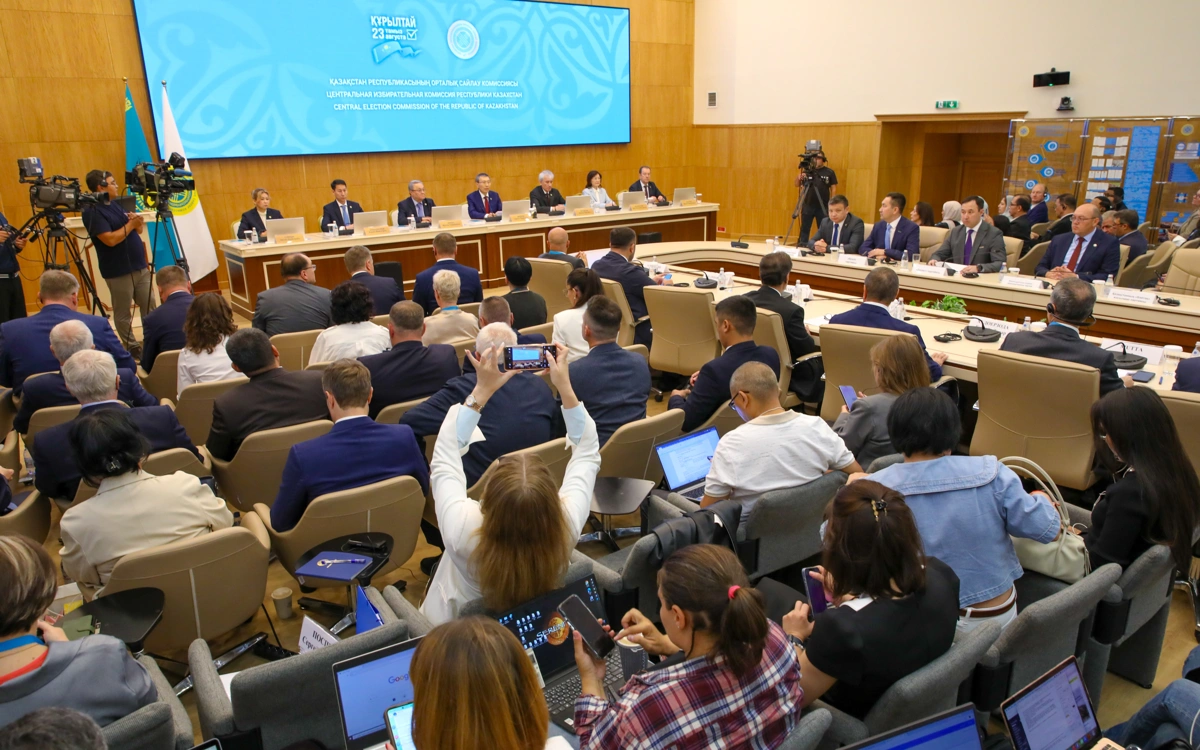
The Central Election Commission announced preliminary results of the Kurultai elections

The Central Election Commission announced preliminary results of the elections for deputies of the Kurultai of the Republic of Kazakhstan, which took place on 23 August, reports a correspondent for the Kazinform agency.

According to preliminary data, the Adilet party received 6,528,948 votes, or 71.17%. The National Social Democratic Party received 469,058 votes, or 5.11%.

The Green Party "Baytak" received 97,751 votes, or 1.07%, the People's Party of Kazakhstan - 285,395 votes, or 3.11%.

The Auyl party received 574,621 votes, or 6.26%. The Ak Zhol Democratic Party of Kazakhstan received 478,083 votes, or 5.21%, and the Respublica party received 509,631 votes, or 5.56%.

In addition, 2.51% of voters voted against all.

cycle
Photo: Victor Fedyunin/ Kazinform

Earlier, Kazakhstan announced the results of exit polls on preliminary vote counts for the Kurultai elections.

  •  

Don’t answer the antisemites - it’s a political war

It is a mistake to respond to antisemitic accusations, writes Fiamma Nirenstein.

Would responding have served any purpose at the time of the racial laws and the deportations? No. The intention is the same: to eliminate the Jews and their independent state, Israel.

There is no point responding to those who claim on social media that organs are removed from children killed by Jews—an accusation that echoes the ancient blood libel of Jews murdering children for their blood.

Nor is there any point arguing with professors who describe an all-powerful “Israeli lobby” controlling Italian politics.

Who is going to reason with the owner of yet another Swiss hotel that expels Israeli tourists? Or with the thugs who beat up a family on the streets of Athens?

Who will argue with United Nations Secretary-General António Guterres, who, together with the UN General Assembly president, Annalena Baerbock, recently lit a memorial flame for deceased UN personnel, including Imad El Samhouri, a United Nations Relief and Works Agency employee who was also a Hamas terrorist and whose videos invoked death as a shahid?

And who wants to shout themselves hoarse arguing with Hollywood, Turkey, Canada and the rest? Don’t answer them.

In Hollywood, more than 200 figures from the worlds of film, music and culture backed a campaign calling for the release of Marwan Barghouti from an Israeli prison, including actors Benedict Cumberbatch, Mark Ruffalo, Cate Blanchett and Tilda Swinton. They neglect to mention that Barghouti is serving five life sentences after an Israeli court convicted him in 2004 of five murders and involvement in a string of terrorist attacks during the Second Intifada.

We must stop feeling obliged to argue that Jews are good, that Jews are innocent or that Israel has the right to defend itself. Anyone genuinely interested in the evidence can find it. The facts are available to everyone.

The accusations of colonialism, genocide, racism and systematic cruelty directed at Israel are contradicted by history and by evidence that has been documented and quantified.

Consider the United Nations.

In 2025, the U.N. General Assembly adopted 15 resolutions singling out Israel, compared with 11 concerning all other countries in the world combined, six of them concerning Russia.

That disparity illustrates how politics manufactures hatred of Jews.

Antisemitism today is not simply a matter of prejudice or ignorance. It has become a political instrument. It is used to obtain votes, influence, positions, money and power.

The United Nations exploits it in its alignment with the Third World and Islamic blocs. Turkey and Iran exploit it through Islamism. Political movements exploit hatred of Israel while claiming to champion human rights.

In reality, hatred of Israel has become both a substitute for human rights and their graveyard.

That is why explanations are not enough.

What is required is political struggle: criminal complaints where laws are broken, legislation where protections are inadequate and serious scrutiny of the political and financial interests behind campaigns targeting Israel and Jews.

It also means defending the rights that Israel’s enemies so often disregard: the rights of children, women, gays and political dissidents.

It means defending security, of which Israel remains a guardian.

It means reclaiming universities and political parties from ideologies that have transformed hostility toward Israel into an acceptable political creed.

And it means establishing institutional boundaries for businesses, hotels, media organizations and cultural festivals that discriminate against Israelis or legitimize antisemitism.

Italy has even witnessed a general strike directed against Israel. Nor is there any point arguing with those who describe an all-powerful “Israeli lobby” controlling Italian politics, supposedly headed by none other than Deputy Prime Minister and Foreign Minister Antonio Tajani.

This is no longer merely a debate about foreign policy. It is a political war.

The battle against antisemitism cannot be won by endlessly answering every lie. It must be fought where antisemitism now operates: in politics, institutions, universities, international organizations and culture.

The fight against antisemitism can restore the human rights that have been buried beneath the genocidal slogan: “From the river to the sea.”

  •  

Evolution of fuel prices in July 2026

In July 2026, the price of fuels and lubricants for personal transport in the EU increased by 16.9% compared with July 2025. This followed year-on-year increases of 20.7% in May and 13.7% in June. 

In 25 of 27 EU countries, fuels and lubricants prices were higher in July 2026, compared with July 2025. In 13 countries, July annual increases were larger than those in June 2026. However, in most countries (24), the annual rate of change in July was lower than in May 2026, when 4 countries registered annual price increases exceeding 30%. 

In July 2026, compared with July 2025, the highest increases were recorded in Romania (+24.2%), Germany and Lithuania (+22.9% each), Bulgaria (+22.2%), the Netherlands (+22.0%) and Finland (+20.5%). Prices dropped slightly in Hungary (-0.1%), while the  lowest increases were recorded in Sweden (+1.2%) and Ireland (+3.2%). 

Click to enlarge

Price changes for fuel and lubricants, May-July 2026  (%, annual rate of change). Chart. See link to the full dataset below.

 Source dataset: prc_hicp_minr

Diesel prices up 4.3%, petrol up 4.7% compared with June 2026 

On a monthly basis, in July 2026, EU consumers saw diesel prices increase by 4.3% and petrol by 4.7%, compared with the previous month. In June 2026, diesel had dropped by 6.4%, and petrol by 4.2% relative to May 2026.

Between June and July 2026, diesel prices increased in 17 EU countries. The highest increases were registered in Poland (+13.4%), Germany (+12.7%) and Greece (+12.1%). The prices dropped in 9 EU countries, with the largest decreases in Cyprus (-7.9%), Sweden (-7.4%) and Ireland (-6.4%).

When it comes to petrol prices, 14 countries recorded increases and 12 countries recorded decreases in prices between June and July 2026. The largest increases were in Poland (+17.2%), Germany (+11.0%) and Spain (+7.1%), while the largest decreases were recorded in Sweden (-11.1%), Cyprus (-5.4%) and Ireland (-4.1%). 

Click to enlarge

Price changes for diesel and petrol, July 2026  (%, monthly rate of change). Chart. See link to the full dataset below.

Source dataset: prc_hicp_minr

For more information

Methodological notes

  • This data comes from Eurostat data collection for the compilation of the harmonized index of consumer prices (HICP), which is used to measure inflation in the EU.  
  • Fuel prices in Malta have been fixed since 2020, therefore there was no change.
  • The ECOICOP version 2 codes used for this article were:
    • CP0722 - Fuels and lubricants for personal transport equipment
    • CP07221 - Diesel
    • CP07222 - Petrol

  •  

EU reaffirms solidarity with Ukraine on 35th anniversary of independence

24 August 2026 marked Ukraine's 35th anniversary of its independence. This occasion embodies Ukrainians' bravery, resistance and resilience in the face of Russia's continuous and vicious war of aggression. It also symbolises their aspiration to be a democratic and European country. On the Independence Day, the European Commission reaffirms its unshakable solidarity and commitment to Ukraine's sovereignty, independence, and territorial integrity. We continue standing with Ukraine in pursuing a comprehensive, just and lasting peace, and supporting their European path.

Over the past months, the EU has secured the first disbursements under the €90 billion Ukraine Support Loan to sustain the country's defence capabilities and reconstruction. The EU has also adopted the 21st package of sanctions further restricting Russia's ability to fund its illegal war and to carry out attacks on Ukrainian civilians and civilian infrastructure. In July 2026, President Ursula von der Leyen visited Kyiv, launching a new EU-Ukraine Defence Industrial Partnership and the EU-Ukraine Drone Deal, including an additional €1 billion in support for drone production.

The EU is leading the efforts in terms of ensuring the recovery and long-term investment in Ukraine's economy, also confirmed at the Ukraine Recovery Conference in June. It is playing a crucial role in securing the return of Ukrainian children forcibly transferred or deported by Russia, as well as in holding Russia accountable for its crimes, including through the International Claims Commission and the Special Tribunal for the Crime of Aggression against Ukraine.

Since Russia's full-scale invasion began in February 2022, the EU and its Member States have mobilised a total of €220.2 billion in humanitarian, financial, and military assistance to Ukraine and its people. Since 2024, the EU has made available €8 billion in proceeds generated by immobilised Russian Central Bank assets to support Ukraine, including €3.8 billion channelled through the European Peace Facility and the Ukraine Facility. The remaining part of the proceeds supports the repayment of G7 Extraordinary Revenue Acceleration loans through the Ukraine Loan Cooperation Mechanism.

More information on the EU's support for Ukraine is available on the webpage and factsheet.

  •  

Statement by Executive Vice-President Virkkunen and Commissioner McGrath on the Europe-wide Day of Remembrance of the victims of all totalitarian and authoritarian regimes

On the Europe-wide Day of Remembrance of the victims of all totalitarian and authoritarian regimes on 23 August, Tech Sovereignty, Security and Democracy Executive Vice President Henna Virkkunen (pictured), and Democracy, Justice, the Rule of Law, and Consumer Protection Commissioner Michael McGrath, issued the following statement:

“On 23 August, we commemorate the anniversary of the Molotov-Ribbentrop Pact, signed in 1939 between Nazi Germany and the Soviet Union. That pact, and the war and devastation that followed, brought intolerable suffering to millions of people across Europe and beyond. The years that followed were marked by occupation, repression, deportation and violence on a massive scale.

"Today, we honour the memory of all those who have suffered under totalitarian and authoritarian regimes. The pain endured by victims, survivors and their families echoes across generations. Every EU country is now home to a generation that has grown up free from tyranny and oppression. For many, freedom, democracy and peace may appear self-evident, but they are not. They were secured through extraordinary courage, sacrifice, resistance and resilience, and they must never be taken for granted. Remembering the past is therefore not only a duty to those who came before us. It is also a responsibility to future generations.

"This day is a solemn reminder of the consequences of hatred, intolerance and the denial of human dignity. It calls on us to remain vigilant in defending the values on which the European Union is founded: respect for human dignity, freedom, democracy, equality, the rule of law and fundamental rights. By preserving the memory of the past, we reaffirm our commitment to a Europe built on peace, justice and solidarity.”

The statement is available online.

  •  

After ending power shortages Kazakhstan can become electricity exporter

Kazakhstan plans to commission 845 megawatts of new power generation capacity in 2027 as part of a broader effort to meet growing electricity demand and build a reserve in the national power system. The planned projects combine gas-fired generation with renewable energy, reflecting the country’s strategy to expand capacity through multiple sources rather than relying on a single type of generation. According to the Energy Ministry, the new facilities are expected to allow Kazakhstan to fully cover its electricity needs as early as the first quarter of 2027.

By the end of the year, the country expects to generate an electricity surplus of around 1.3 billion kilowatt-hours. The 2027 expansion follows a larger planned capacity increase in 2026, when Kazakhstan expects to commission around 2.6 gigawatts of new generation. This includes four gas-fired power plants, expansions of two existing power stations and 10 new renewable energy facilities.

Together, the plans suggest that the government is seeking not only to close the gap between electricity supply and demand, but also to create additional capacity that could provide greater flexibility for the power system.

Gas and renewables form the core of new capacity

Several conventional generation projects are scheduled to be completed in 2027.

Five gas turbine units at the Zhambyl State District Power Plant are expected to add a combined 210 MW. A combined-cycle gas plant at MAEK is planned to provide 160 MW, while the first stage of the Baskuat Energoprom project will add 34.7 MW through five gas piston units. Another combined-cycle plant, developed by Kazakhmys Energy, is expected to contribute 70 MW. At the same time, the government plans to continue expanding renewable generation, with projects totaling 570 MW.

These include a 100-MW solar power plant in the Almaty Region and three solar projects in the Kyzylorda Region with a combined capacity of 70 MW. Wind projects include two 100-MW facilities in the Aktobe Region, a 50-MW wind power plant in the Kyzylorda Region, another 50-MW project in the Turkistan Region and two wind facilities in the Abai Region with a combined capacity of 100 MW. The planned renewable projects account for a substantial part of the capacity expansion, while gas-fired facilities are intended to provide additional dispatchable generation. This mix is particularly important for a power system that needs both new electricity volumes and generation that can respond to changes in demand.

From meeting demand to building a reserve

The expected 1.3 billion kilowatt-hour surplus by the end of 2027 marks an important shift in the government’s projections. The objective is no longer limited to covering immediate electricity consumption but also includes creating a reserve that could strengthen the reliability of the national grid. However, installed generation capacity and actual electricity output are not identical. The amount of electricity ultimately available to the system will depend on factors including the operating performance of new plants, fuel supply, grid infrastructure and, in the case of wind and solar projects, weather conditions.

  •  

Commission clears creation of joint venture by CMA CGM and TotalEnergies

The European Commission has approved, under the EU Merger Regulation, the creation of a joint venture by CMA CGM S.A. and TotalEnergies S.E., both of France.

The transaction relates primarily to LNG bunkering logistics services.

The Commission concluded that the notified transaction would not raise competition concerns, given that the joint venture will have negligible activities in the European Economic Area and given the companies' limited combined market positions resulting from the proposed transaction. The notified transaction was examined under the simplified merger review procedure.

More information is available on the Commission's competition website, in the public case register under the case number M.12406.

  •  

Commission closes antitrust investigation after Pratt and Whitney amends contractual clauses

The European Commission has closed an antitrust investigation into alleged anticompetitive behaviour by Pratt & Whitney Canada Corp. (‘Pratt & Whitney'), the main supplier in the European Economic Area (‘EEA') of turboprop aircraft engines. The closure of the investigation follows the company's amendment of contractual clauses, which removes possible obstacles to access to critical input and services faced by spare parts suppliers. Spare parts are sold to customers in the EEA for the repair and maintenance of engines.

The Commission investigated whether Pratt & Whitney may have been foreclosing access to critical input and services needed by spare part suppliers, so-called used serviceable material (‘USM') suppliers, for certain turboprop aircraft engines. USM suppliers need access to used engine cores to tear them down and replenish their stock of spare parts. They also need access to certification services that attest that a spare part is airworthy and can be reused. By limiting the ability of maintenance shops in their network to sell used engine cores or provide certification services to USM suppliers, Pratt & Whitney may have restricted competition from independent USM suppliers. Following exchanges with the Commission, Pratt & Whitney amended its agreements to remove these restrictions and clarified that maintenance shops are not prevented from buying USM from other suppliers.

After thorough analysis and assessment of evidence, and considering the changes and clarifications made by Pratt & Whitney to its contractual clauses, the Commission concluded that the investigated concerns have been addressed. Further action is no longer considered a priority at EU level. Pratt & Whitney has made a public announcement on its website highlighting the changes made to its contractual clauses.

The closure of the investigation is not a finding that the conduct in question complied with EU competition rules.

  •  

Belgium nominates Hans Kluge as WHO Director General

The Belgian federal government has nominated Hans Kluge (pictured) for the position of Director-General of the World Health Organization (WHO).

“I am very honoured by the trust Belgium has placed in me and am grateful for the opportunity to take on this important responsibility,” Kluge said on X. “Serving the WHO has been the greatest privilege of my professional life.”

Kluge has served as WHO Regional Director for Europe since 2020 and began a second term in February 2025. Under WHO rules, he will step aside as WHO/Europe Director while campaigning for the role, a process that involves lobbying member states, NGOs and the organisation's largest funders.

Tried and tested
After qualifying as a doctor in Belgium, he began his international career with Médecins Sans Frontières in conflict settings in Liberia and Somalia. He subsequently coordinated tuberculosis programmes in Siberian prisons and across the former Soviet Union.

Kluge joined WHO in 1999, initially working on tuberculosis and HIV in...

  •  

Senior European political figure questions 'necessity and proportionality' of Albanian mayor's detention

A senior political figure has questioned whether the continued detention of the Mayor of Albania’s capital city is “strictly necessary”.

Erion Veliaj (pictured) has remained nominally in office as mayor of Tirana despite being held in what is known as pre-trial detention (PTD) since February 2025.

He is accused of corruption and money laundering but strongly denies any wrong doing.

The latest in a protracted series of court cases takes place on 15 September when his case will be considered by Albania’s Supreme Court.

This comes after the country’s Constitutional Court recently called for a review as required by Albania's constitution.

The hearing has assumed particular importance as it is a review of both his pretrial detention and its proportionality.

The mayor’s local lawyer Plarent Ndreca said that following the Constitutional Court's judgment "the legal basis for maintaining Mr Veliaj in detention has fundamentally changed.”

In an exclusive interview with this website,  a senior figure with the European Democratic Party, a pan-European political party, said the case “raises serious questions of necessity and proportionality.”

Sandro Gozi, the party’s Secretary-General and also a senior French MEP with Renew Europe, a mainstream group in the European Parliament, questioned if his continued detention may be “excessive.”

This website asked Gozi what specific concerns he had about the case.

He said: “Let me be very clear: fighting corruption is essential, particularly in a country seeking EU membership, and asking for respect for the rule of law can never mean asking for impunity.

“Serious allegations must be investigated and prosecuted independently, whoever is involved. But the rule of law also means proportionality, due process and the presumption of innocence.”

He pointed out that Veliaj has been in pre-trial detention since February 2025, adding, “and after such a long period it is legitimate to ask whether continued detention remains strictly necessary or whether alternative measures could be used.”

Some have argued the case “shines a light” on current flaws in the judiciary and rule of law in Albania.

On this,Gozi, secretary general since 2021, said , “One case cannot define an entire judicial system, and Albania has made important progress in fighting corruption.”

He added, “However, there is a broader issue that deserves attention: Council of Europe SPACE data show that 58% of Albania's prison population was being held without a final sentence, the highest proportion in Europe, compared with a European average of 29%.

“The same analysis notes that very high levels of pre-trial detention can be associated with slow proceedings or an excessive reliance on detention as a precautionary measure.”

The MEP said: “These are concerns Albania should address as part of its European path.”

Albania is a leading front runner to join the EU, possibly as soon as 2030, and has been widely lauded by the 27-strong bloc and others, including MEPs, for closing most of the negotiating chapters required for EU membership although some caution that ongoing issues with its judiciary may slow progress towards accession.

Gozi, a member of Mouvement Democrate in France, said: “I strongly support Albania's European perspective, but accession must remain merit-based.

“No judicial system is perfect, including those of existing member states, but respect for the rule of law, judicial independence and fundamental rights must be firmly guaranteed before accession,” added the Euro deputy, who chairs the Delegation to the EU-UK Parliamentary Partnership Assembly.

Asked about the use of PTD in the case of the mayor, not least as an elected official, and also the time taken for his case to come to trial,he said, “Eighteen months of pre-trial detention is an extremely long period and raises serious questions of necessity and proportionality.

“This concern remains entirely unchanged regardless of Mr Veliaj’s political position.”

The MEP, who is from Italy and was former Undersecretary of State for European Affairs in the Matteo Renzi and Paolo Gentiloni governments, declined to be drawn the length of time the case was taking to come to court, saying: “I will not speculate on allegations concerning an independent court.”

The European Democratic Party also recently posted a statement on the case which pointed out the mayor had been as been in PTD since 10 February 2025 —  a year and a half.

The statement adds that formal charges were notified only in July 2025, after 163 days in detention and that, recently, Albania’s Constitutional Court overturned a Supreme Court decision and ordered a new review of his detention “questioning its proportionality in light of his mandate as Tirana’s democratically elected mayor”.

It goes on: “We join those calling on the Albanian authorities to uphold the rule of law, the presumption of innocence and the principle of proportionality. This case comes against a deeply concerning backdrop for Albanian democracy.

“We will keep the spotlight on it, because Albania deserves a European future — one that is fully democratic, transparent and firmly committed to fighting corruption, while guaranteeing that justice is always exercised with fairness, independence and respect for fundamental rights.”

European Democratic Party members include Renew Europe MEPs and, in 2025, RE “strongly condemned” what it called the “politically motivated” arrest on corruption charges against another elected official: Varna Mayor Blagomir Kotsev.

Speaking earlier this year, RE Lithuanian MEP Petras Auštrevičius, the European Parliament's rapporteur on enlargement, highly praised Albania's reform effort but said that concerns regarding pre-trial detention practices in Albania "demonstrate precisely why judicial reforms must deliver real results.”

Ben Brandon, of Mishcon de Reya LLP, is one of Veliaj's international counsel based in London. He is just returned from Tirana where he was able to visit the mayor in prison for the first time since the official's arrest.

Speaking to this site,  Brandon said: "We have long argued that Erion Veliaj's pre-trial detention is unnecessary and disproportionate. Until the Constitutional Court examined his case, no court in Albania properly considered the relevance of his status and responsibilities as the democratically elected Mayor of Albania's capital city, or the available alternatives to detention. The Supreme Court has been directed to re-examine the proportionality of his continued detention by the Constitutional Court on 15 September.

“We hope that the Supreme Court will follow the clear reasoning of the superior court, correct the obvious errors that have been made in Mayor Veliaj's case over the past 18 months, and release him immediately."

Currently, there are local media reports that a separate investigation has now been opened against the Mayor, focused on expenses, though this has not been confirmed.

With the clock ticking on Albania seeking to close its last remaining EU negotiating chapters, some argue it is not a coincidence there has been a perceived crackdown in the justice sphere, with a spate of cases brought against high profile public figures and elected officials, including Veliaj.

Veliaj’s case is not the only one to have captured the Albanian media’s attention in recent times, with a former environment minister among those charged with corruption.

However, for Veliaj the most immediate concern is his detention at a centre close to the Albanian coast.

His local lawyer points out it is not the first time concern has been raised about the use of pre-trial detention in Albania with most recent data showing that  about 58 per cent of its prison population, approximately, 2,653 people, are held in remand, a rate up to five times higher than the EU average.

PTD is said to frequently be used for crimes like corruption but Veliaj and his lawyers argue that to detain someone for so long – the average stay is 253 days  – is “highly unusual” unless it is a case relating to drug trafficking, organised crime and/or terrorism.

The spotlight has, to some extent, also fallen on the organisation in Albania charged with the task of rooting out corruption and tackling serious crime.

SPAK, as it’s commonly referred to, has been widely praised for its concerted efforts in this regard and has been hailed by many for its work, including by the European Parliament’s rapporteur on Albania, Socialist MEP Andreas Schieder, as being “essential”, not least in helping to fulfil the country’s pre-accession reforms.

The MEP has, in the past, said SPAK was playing a “crucial role” in the fight against corruption and “shows the Albanian government is taking this task very seriously”.

Asked to comment on the Veliaj case a SPAK spokesman said: “We can confirm that the Special Prosecution Office has concluded its investigation and has formally submitted the case for trial before the Special Court Against Corruption and Organised Crime (GJKKO), where proceedings are now under way.Any submissions relating to these matters should be made directly to the Court (GJKKO), in accordance with the procedures and timeframes set out under the Criminal Procedure Code.”

The comment was made in July and, at the time of going to press, no-one from SPAK had replied to a most recent query from this site.

  •  

Astana Finance Days 2026 to bring global investors and financial leaders to Kazakhstan

More than 5,500 participants from over 80 countries are expected to gather in Kazakhstan’s capital on 9-10 September for the ninth Astana Finance Days (AFD) 2026 forum, hosted by the Astana International Financial Centre (AIFC). The forum will bring together investors, representatives of the financial and technology sectors, regulators, government and quasi-state institutions, and international businesses.

Since its launch in 2018, Astana Finance Days has developed into one of the region’s major financial forums, providing a platform for discussions on capital markets, investment and financial cooperation. The 2026 program will focus on capital markets and investment products, regulation and market confidence, institutional innovation, financing the real economy, and regional and cross-border capital cooperation. Confirmed speakers include Minister of Artificial Intelligence and Digital Development Zhaslan Madiyev, National Bank Governor Timur Suleimenov, Association of Financiers of Kazakhstan Chairperson Yelena Bakhmutova and Secretary General of the Organization of Turkic States Kubanychbek Omuraliev.

Representatives from international financial institutions and global companies are also expected to participate, including the Islamic Development Bank Institute, Freedom Holding, Binance, Mastercard, Bloomberg and the Shanghai Stock Exchange. The forum will feature the AFD Exhibition, bringing together financial institutions, banks, investment and asset management companies, as well as fintech and technology projects. According to the AIFC, the event will provide participants with opportunities to discuss global financial trends, explore investment and business opportunities, and establish contacts with investors, company executives and industry leaders.

The forum will also highlight business development opportunities within the AIFC ecosystem, featuring case studies on company growth, capital raising and expansion into international markets. For Kazakhstan, which is seeking to strengthen its position as a financial hub connecting Central Asia with global markets, the forum provides an opportunity to bring global investors and financial institutions into closer contact with the region.

  •  
❌