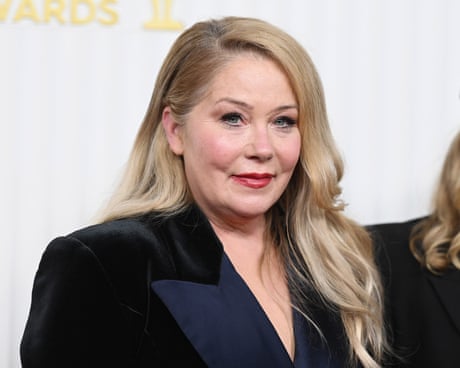
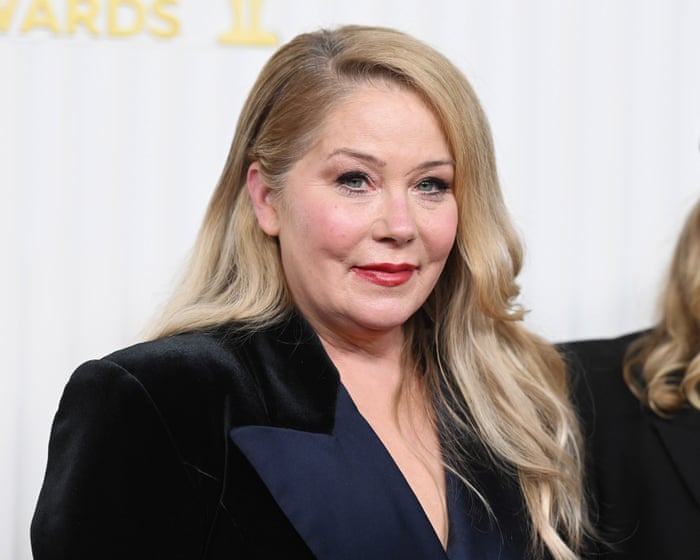
“You don’t get misdiagnosed and then all of a sudden I’m better,” Christina Applegate said on Tuesday, after learning from her doctor that she didn’t have multiple sclerosis after all.
Christina Applegate was diagnosed with MS in 2021. She recently learned she was misdiagnosed — and feels like she's "back to square one" with treatment.
Axelle/Bauer-Griffin/FilmMagic
Christina Applegate recently learned that she was misdiagnosed with multiple sclerosis (MS).
Applegate was first diagnosed in 2021 after multiple tests and worsening symptoms.
About 15% of MS patients are believed to be misdiagnosed, given how complex the disorder is.
After being diagnosed with multiple sclerosis (MS) in 2021, living with severe symptoms, and becoming one of the most famous celebrities with the disorder, Christina Applegate learned some shocking news: She doesn't actually have MS.
In an October 20, two-part episode of her podcast "MeSsy" with Jamie Lynn Sigler (another actor diagnosed with MS), Applegate shared that she took over half a year off from recording the podcast to process the news of her MS misdiagnosis.
According to Applegate, her doctor framed the revelation as a positive update. "She came into my room and said, 'Congratulations, you don't have MS,'" Applegate said in the podcast.
Jamie-Lynn Sigler, Applegate's co-host on the podcast, was diagnosed with relapsing multiple sclerosis when she was filming "The Sopranos."
Paula Lobo/American Broadcasting Companies, Inc. via Getty Images
But to Applegate, no longer having an explanation for the pain, balance issues, tremors, incontinence, and fatigue she'd been living with for years felt more like being "back at square one."
"You don't get misdiagnosed and then all of a sudden, I'm better," she said. "If anything, I've gotten worse, in some ways."
Applegate's story is far from a medical anomaly. MS researchers estimate that about 15% of worldwide MS patients are actually misdiagnosed, based on a 2024 meta-analysis of multiple studies.
The risks to patients are two-fold, Dr. Marwa Kaisey, an associate professor of neurology at Cedars-Sinai, who also appeared on the podcast, told Business Insider. "One is thinking you have MS — a lot of the medications we use to treat MS have side effects and risks like infections," she said. "The other category is, if you don't know what you have, then you're not getting treated for your actual diagnosis."
Kaisey and another researcher shared why MS is so challenging to diagnose — and why more people might end up with Applegate's experience in the future.
The race to diagnose a hard-to-diagnose disorder
MRIs are important diagnostic tools for diagnosing MS, but researchers say they're just one piece of the puzzle.
Paul Biris/Getty Images
There is no single blood test that can diagnose MS.
Instead, doctors often piece together an MS diagnosis using a neurological exam (testing balance and reflexes), MRI scans, a lumbar puncture (or spinal tap), and possible blood tests to rule out other conditions such as Lyme disease.
Sometimes, doctors overrely on a single diagnostic, such as an MRI finding, without performing enough other tests, Dr. Andrew J. Solomon, a professor of neurological sciences at the University of Vermont who co-authored the meta-analysis, told Business Insider.
In 2019, Solomon co-authored an MS misdiagnosis study that found that patients who were initially diagnosed with MS were later told they actually had otherconditions, such as migraine, radiologically isolated syndrome, spondylopathy, and neuropathy, which can share overlapping symptoms with MS and similar brain scan results.
In the podcast, Applegate revealed that she had a nerve test to rule out peripheral neuropathy, as well as MRIs and a lumbar puncture. While her spinal fluid test showed a low level of immune proteins that can support an MS diagnosis, she had nearly 40 brain lesions and worsening symptoms, leading doctors to diagnose her with MS.
Solomon said MS should be diagnosed by "confirming each element of our diagnostic criteria and ruling out other things," rather than assuming it must be MS if the MRIs and symptoms fit.
The problem is, both physicians and patients are eager to diagnose MS as early as possible, he said. Correctly spotting MS early can lead to better treatment results and a higher likelihood of disability prevention, according to research.
Plus, for patients dealing with a plethora of debilitating symptoms, "a period of diagnostic uncertainty is uncomfortable," he said, even though the best course of action is to wait and perform more tests.
A new testing protocol revealed Applegate's misdiagnosis
Applegate underwent several tests for MS to rule out other conditions. A more in-depth MRI finally identified the misdiagnosis.
Kevin Winter/Getty Images
In the podcast, Applegate shared that her brain lesions were missing "strings" associated with MS.
It's a finding associated with a new, more accurate diagnostic tool for Kaisey, who also co-authored the 2019 study with Solomon, explained on the podcast.
The central vein sign (CVS), is an MRI biomarker that can help differentiate MS brain lesions from ones associated with other disorders. It refers to a small vein that appears as a dot or thin line through the center of a brain lesion.
CVS was only recently adopted as part of the recommended MS diagnostic criteria, in 2025 — four years after Applegate was first diagnosed with MS. Kaisey told Business Insider that part of her work is expanding education around newer diagnostic tools, noting that not all physicians are using CVS yet.
Solomon hopes more doctors will include CVS in their diagnostic protocols, especially for existing MS patients or those who switch providers without being evaluated by their current doctors. "If something doesn't fit, there's an opportunity there to reevaluate if the diagnosis is right," he said.
Many misdiagnosed MS patients feel exactly like Applegate does
After learning she doesn't have MS, Applegate has felt like she lost clarity and direction when it comes to treatment.
Phillip Faraone/Getty Images
When it comes to learning about an MS misdiagnosis, Solomon said experiences like Applegate's aren't that uncommon.
"I've heard many stories where some doctor was very enthusiastic about telling a patient they actually didn't have MS," he said. "But many of these patients are suffering, and they still have symptoms. So it's not always necessarily a happy thing."
For Applegate, her initial MS diagnosis provided clarity and direction. "That was my answer to everything that was going on," Applegate said. Some might relate to Applegate's "square one" feeling, particularly if their doctor was an MS specialist and won't see them anymore, Solomon said. Without a formal diagnosis, they might also worry about insurance coverage for treatments that have provided some relief.
There is also the emotional part of having an MS diagnosis. "I leaned into other friends, I leaned into the community," Applegate said. "I had a reason as to why my day sucked every day, and now I don't have a reason."
Knowing she doesn't have MS also made her feel like she "let everybody down" after becoming one of the "poster children for MS," she said. It made her wonder if she was somehow imagining symptoms or at fault for her pain.
Given how common MS misdiagnosis is, Solomon believes it's a good thing that Applegate is sharing her story.
"It's kind of wonderful that Ms. Applegate is public with this because if the number is really 15%, you can do the math," he said. "There are a lot of people out there who might ask their doctors about the accuracy of their diagnosis and find out that, in fact, they had something else."
Applegate revealed that despite the misdiagnosis, she still has "every symptom of someone with MS," adding, "I still have to use wheelchairs when I go to the doctor's office. I can't walk from the car to the room."
Christina Applegate no tiene esclerosis múltiple: su diagnóstico fue un error. La actriz ha dado la noticia en su pódcast, llamado MeSsy, que presenta junto a la también actriz y paciente de esclerosis, Jamie Lynn Sigler. En él ha contado, este martes, que los médicos se equivocaron en su diagnóstico, hace cinco años. Y que eso, lejos de liberarla, no la ha hecho nada feliz.
Applegate returned to the podcast she co-hosts with Jamie Lynn-Sigler to reveal the health news that is sending her for a loop: "You don't get misdiagnosed and then all of a sudden, I'm better. I haven't gotten better," she shares. "If anything, I've gotten worse in some ways."
After becoming a prominent advocate for multiple sclerosis awareness and chronicling her struggles in an emotional memoir published in March, the Emmy-winning actor Christina Applegate has revealed she does not have the debilitating autoimmune disease after all.
Applegate, 54, made the stunning announcement in an episode of her podcast MeSsy, recorded with fellow actor Jamie-Lynn Sigler, posted to YouTube on Tuesday.
I visited an NYC coworking space, where startups spend up to $9,000 a month for a spot.
There was a private chef, a robot, and a love for in-person work.
The overall vibe more closely resembled a college campus than a midtown office.
I've been following and interviewing tiny team founders for the last year. As part of my ongoing research, I popped into the Series HQ workspace last month to observe how these founders are running their small teams.
As the elevator doors opened on the top floor of the Chelsea office building, the Series HQ office manager, a 21-year-old NYU student, greeted me. Balancing on a skateboard, the tall, young, and very casually dressed Gen Zer fit right in among the cohort of founders he works for.
Most of the founders at Series HQ are either straight out of college or under 30, with many of their startups being in early funding rounds.
"I do honestly think if you're 35 or 40 thinking about starting a company now, it's probably too late," Nathaneo Johnson, the 22-year-old Series cofounder, said. He recognizes that as a "harsh belief" but believes the average founder age at Series HQ reflects a growing community of young entrepreneurs.
Series itself was launched in 2024 by Johnson and Sean Hargrow as an AI social networking app for iMessage. After they both graduated from Yale and raised $5.1 million in pre-seed funding, the pair signed a lease for over 10,000 square feet of office space. They tacked on "HQ" to distinguish between the coworking space and the business.
When they moved their company into the building last October, they had roughly eight to 10 people on their team. The pair was preparing for growth, but AI has helped to keep their head count lean, and their tenants operate with similarly sized staff.
As I scanned the still mostly empty office, it seemed the tiny teams didn't require much to function. What stood out to me — more than the young, mostly male office demographic — was each company's desire to be around more people, despite operating with as few employees as possible.
The tiny teams here can spend up to $9,000 a month for shared space
I was at the office around 3 p.m. on a Thursday, and about a dozen people from at least five different companies were working, mostly young men and a few young women. The space usually hosts about 15 to 20 startups, and members have 24-hour access when possible, Johnson said.
Founder work pods at Series HQ.
Agnes Applegate/BI
In August, Series HQ charged between $1,250 and $4,000 for workstation pods that hold up to four people. For more privacy, founders can rent the glass pods for $5,000 to $9,000 a month. The more expensive rental options include meals cooked on-site by the private chef they hired last year to curb their takeout costs.
The kitchen at Series HQ
Agnes Applegate/BI
In the massive main room, across from the scattered row of founder workstations, was a basketball hoop and a roughly $21,000, beat-up robot holding a football.
The robot propped up in the Series HQ main office room.
Agnes Applegate/BI
When they talked about their robot, which was slightly broken during my visit, the room lit up.
It fascinated me that these founders would incur the expense to work in such a large office. They didn't need all of this physical space — which was, in some ways, obvious, as most of it still looked sparse with objects.
The main office room at Series HQ.
Agnes Applegate/BI
Many of the founders I talked to are around my age — 23 — and graduated from high school during the pandemic, when so much social and work interaction moved online. Now building companies, the appeal of Series HQ seemed to be less about the fancy office with a private rooftop and chef, and mainly about having like-minded coworkers to build in-person with.
Long hours mean more time together
Zain Ahmad, who was a summer tenant at Series HQ, works at the AI startup Evos. He said Evos found Series from the promotional drone videos that took over their social media platforms all summer.
"We figured if they're good enough to end up on both of our For You pages and get this much traction, there's a lot to learn from them and be in that space," he said.
Evos rented one of the private glass pods and, during my visit, gave me a tour of their space. Inside the small glass office, we stood in front of their two desks, chatting directly across from a small couch and coffee cart.
Evos rented one of the private glass pods at Series HQ.
Agnes Applegate/BI
In between investor calls, which he said were powered by cups of tea with creatine honey, Ahmad confessed he has taken quite a few naps on that couch. An average workday for them is around 8:30 a.m. to around 10 p.m., sometimes longer. As tenants of Series HQ, they were in the office around six days a week.
He explained the concrete environmental benefits for Evos, which creates specialized agentic AI workflows for traditional industries. Ahmad said they were able to meet a new hire because the new hire was another tenant at Series. They even learned about their most-used AI tool at the moment through the Series team: Aside, an AI-powered browser.
Turnover was high at the beginning of the experiment, Johnson said. Partly because some of the summer tenants were just in town between school semesters. But those tenants probably didn't feel too far from home, since the vibe here more closely resembled a college campus than a midtown office.
Nathaneo Johnson, Series cofounder, on the office's private roof.
Agnes Applegate/BI
The most important piece of growing an AI startup is still the human network
The majority of companies working in the space are AI or technology startups. Logan Milano, the 23-year-old founder of the drink brand Amryth, is one of the few non-tech founders. He recently graduated from college and said he spends well over 40 hours a week here despite living close by.
Milano said all he needs to operate his business is "my laptop, a good place to lock in, and being around other people who are building."
The main work room at Series HQ.
Agnes Applegate/BI
This was an overall sentiment I heard. Many of these young founders lived a hop, skip, and a jump away, based on the commutes they told me about. But simply being around others who are building is, in some ways, one of the biggest benefits.
"Even if we're getting dinner or going out or something, it's like you're still kind of thinking about work and it's all kind of related," he said about the Series community. Adding that "sourcing opportunities" everywhere likely drew them together and is their biggest similarity.
At a time when AI is making it possible to build companies with fewer employees and building solo can be the dream for many, these young founders don't need, or necessarily want to run their business with tons of employees, but they still seem to really want coworkers.
When I asked Milano if he's ever spent the night at the Series office, he smiled, looked over at one of the Series team members, and said, "Am I allowed to say?"
Do you have a story to share about working on a tiny team? If so, please reach out to the reporter ataapplegate@businessinsider.com.

 Login