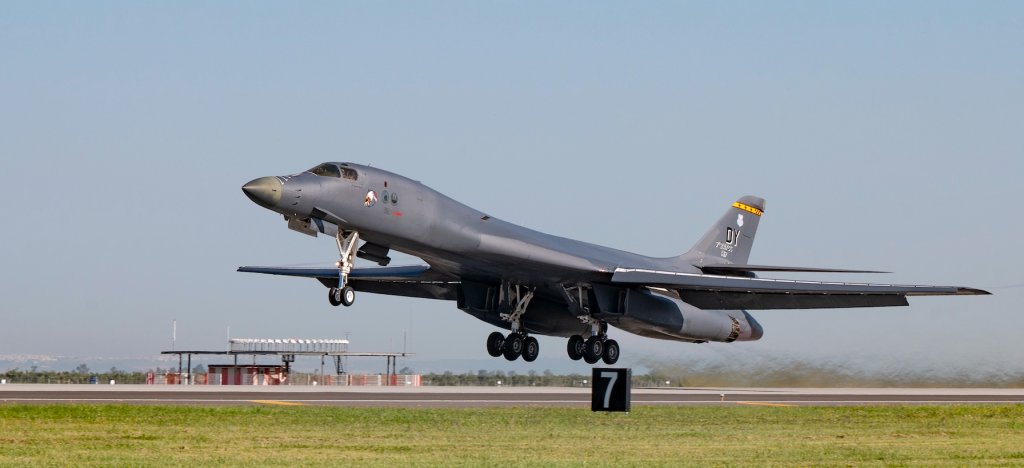
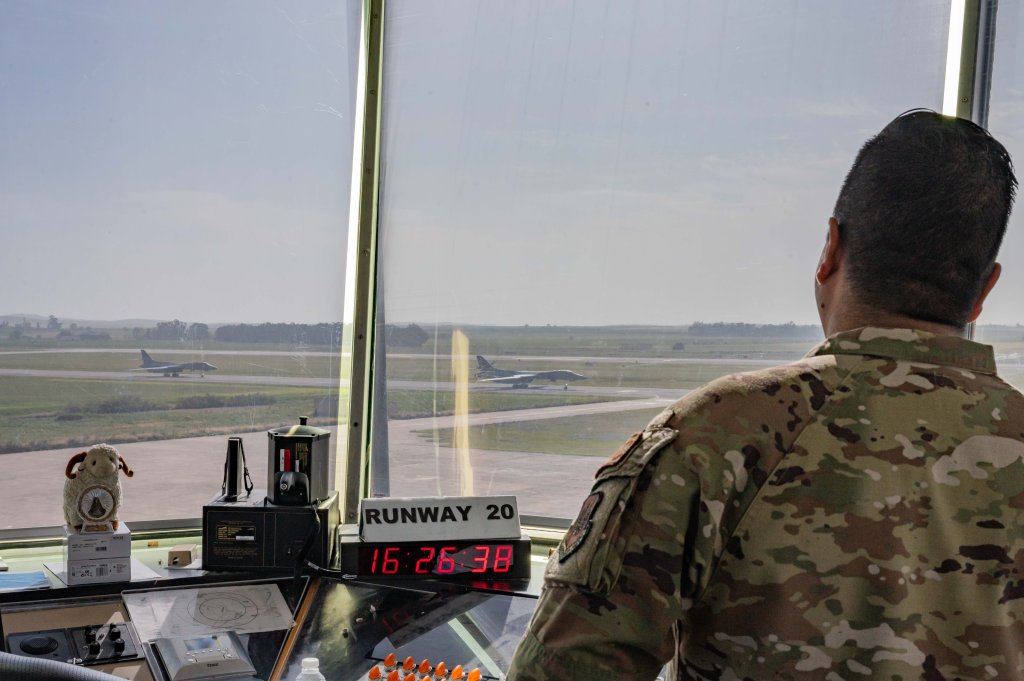
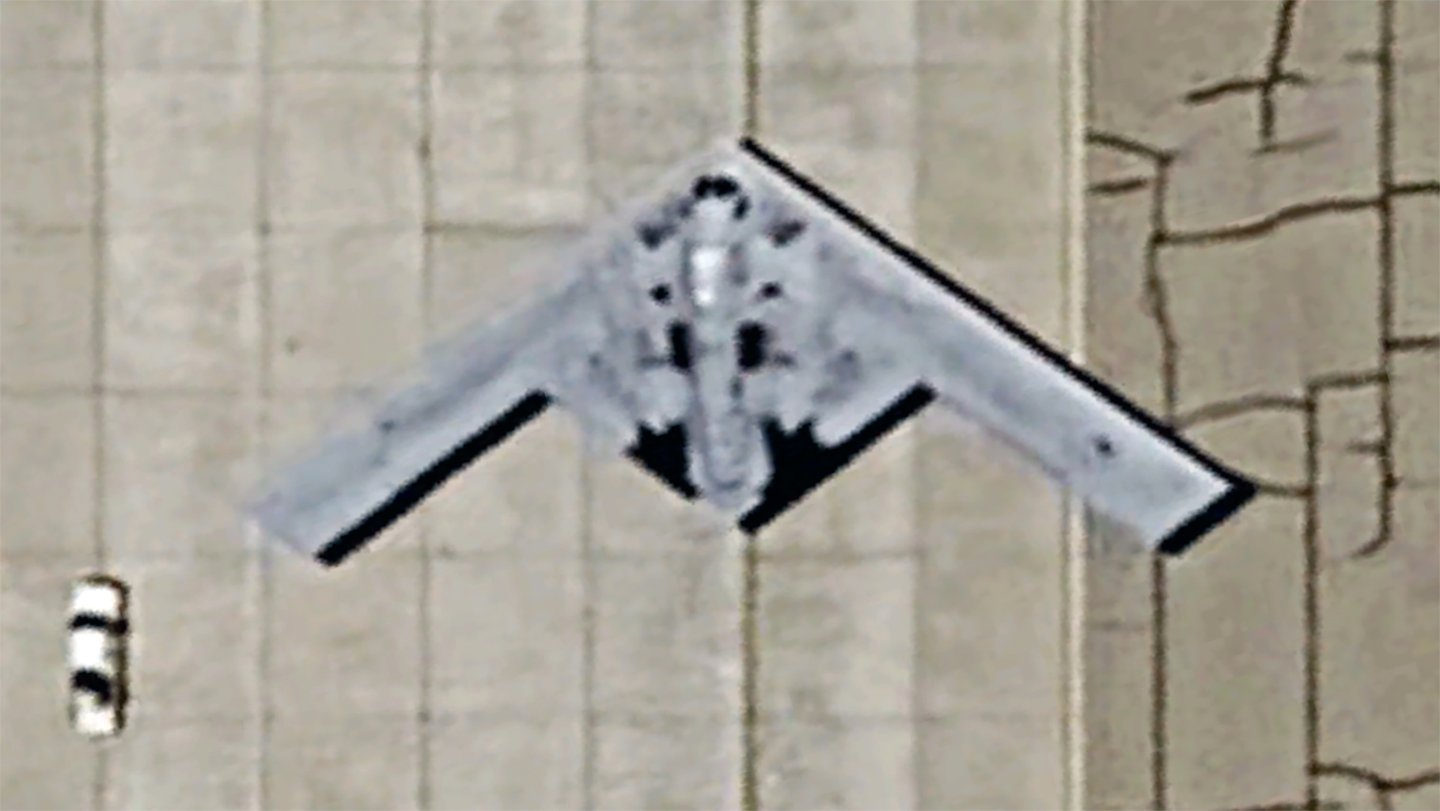
Thanks to Google Earth, we can finally put this one to bed. Since the B-21’s unveiling, people have made wild claims about its wingspan, specifically how tiny it is. This was never the case, as we have reported continuously since we first set eyes on it. Many AI-generated and enthusiast-made B-21 fact sheets have gone viral on social media showing wingspans under 130 feet, which only helped propel the nonsense. Now we can definitively say, give or take a few feet, the B-21 spans 152 feet and is 61 feet long. This puts it at about 12% smaller in terms of wingspan than the B-2, and about the same — 12% smaller — when it comes to length.
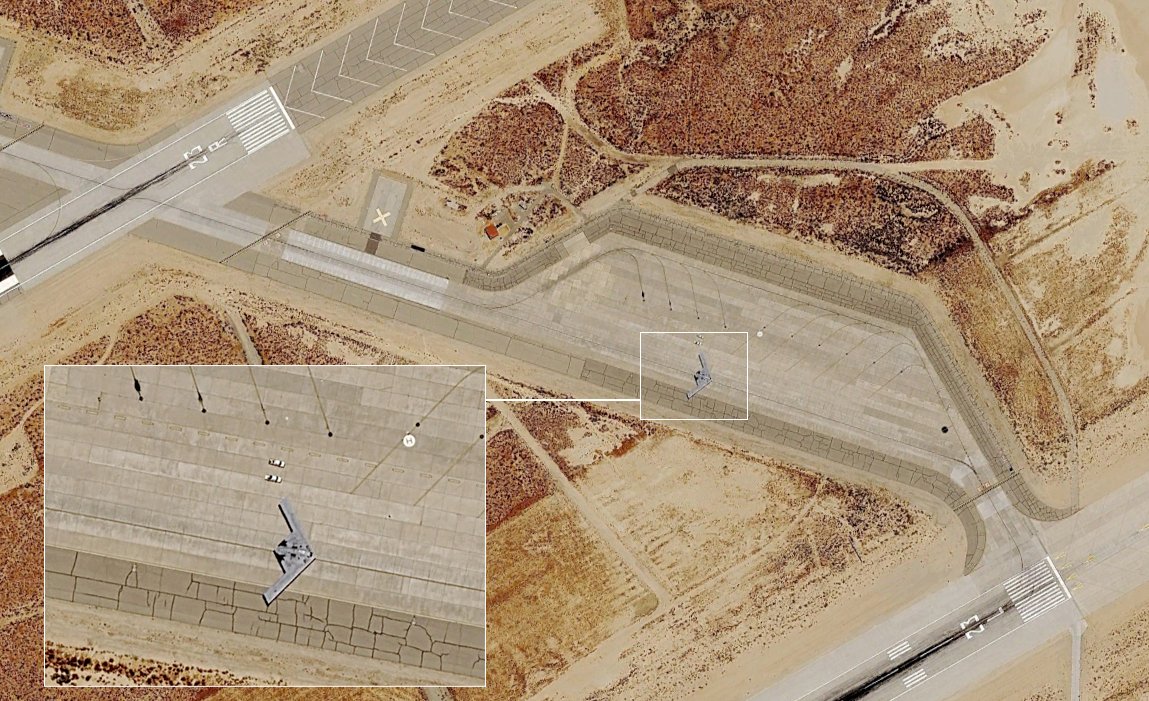
The image in question, taken of Edwards AFB and dated June 20, 2026, was recently uploaded to Google Earth. While we have seen satellite images of the B-21 going about its business before, this one was published in the public domain and had enough resolution, when paired with Google Earth’s excellent measurement tools, to get conclusive measurements.
B-21 taxiing between Edwards AFB’s parallel runways. (Google Earth)
Since we first saw the B-21 at Plant 42 in Palmdale, California, during its unveiling, which TWZ attended, we put the top-end size at 155 feet wingspan-wise. That analysis has only narrowed over the years. I have had many emails, social media threads, and other engagements with folks claiming the aircraft was in the sub-130-foot wingspan range. Now we can finally put those battles behind us.
B-21 span nowhere that number. Bizarre people think this. Around 150-155 best estimate
So what does the size tell us? Nothing we don’t already know. The B-21 was always going to be smaller than the B-2. Our analysis from many years ago has stayed the same — the aircraft would be designed with a premium on range and affordability, as well as very low observability, over massive payload. This resulted in the aircraft you see today. It is smaller, but with design priorities that have shifted from its predecessor’s, and 12% smaller in pure dimensions makes total sense considering what Northrop Grumman was trying to achieve. Above all else, it points to the B-21 having an extreme unrefueled range, with improved aerodynamics for high-altitude cruise, more gas for its size, and two efficient engines instead of four.
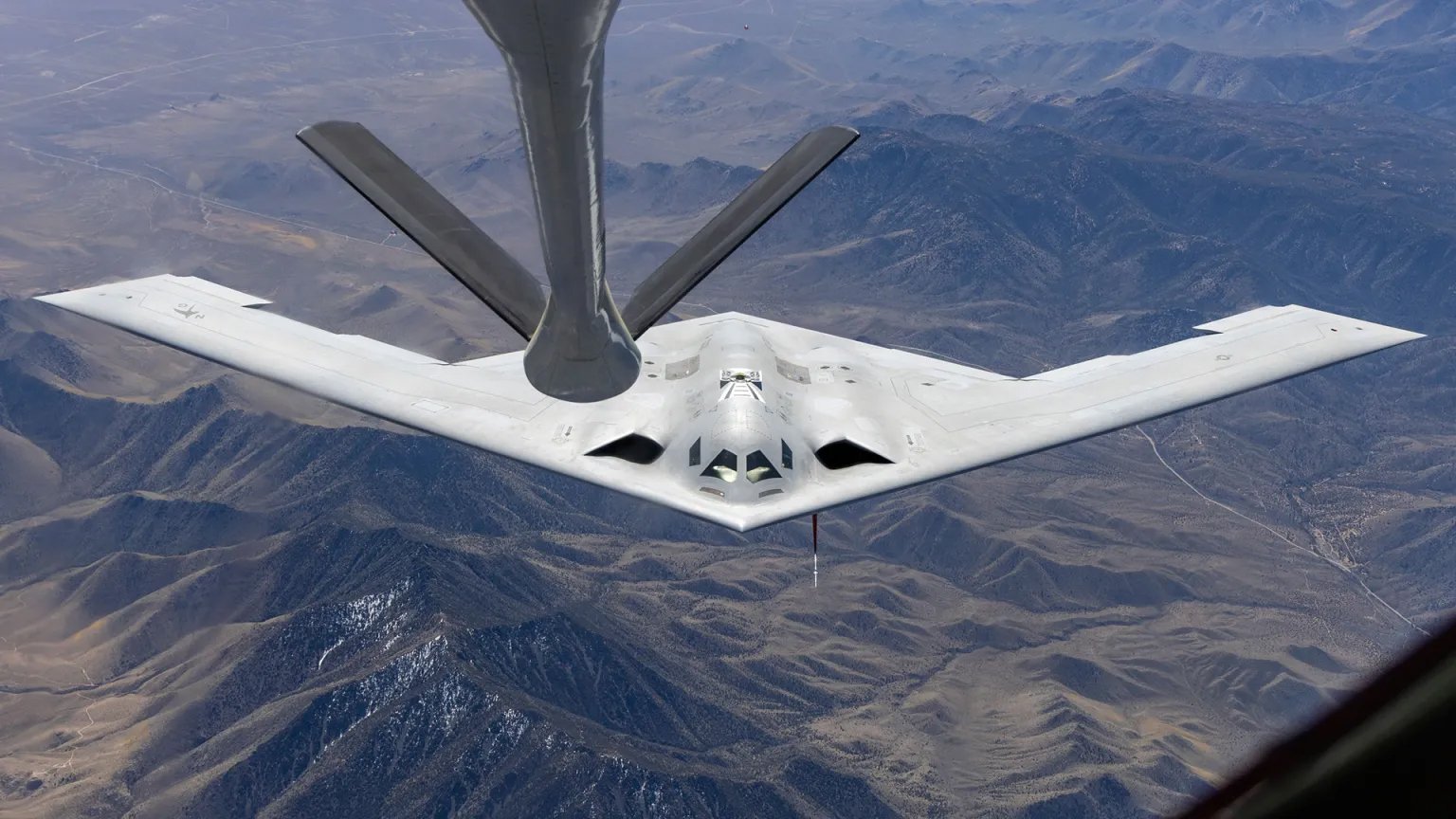
Official photo of the B-21 in close pre-contact position behind Edwards AFB’s ‘Ghost’ test tanker. (USAF)
As for its length, the B-21 is nearly the same length as an F-15 fighter, which sounds bizarre for a large bomber. However, flying wings are visual transformers, looking like compact UFOs side-on and massive head-on or from the planform view.
What's even more fascinating is that this thing is probably about the same length as an F-15 or close to it. Flying wings are transformers. From flying saucers side-on to massive flying wedges in the bank to huge boomerangs head on. pic.twitter.com/0UXOK0uVVN
As far as what else we can discern from the Google Earth image? Not much. We get a bit of a better view of the B-21’s exhaust configuration, but nothing is really revelatory there. The exhausts are deeply buried with large planar exhaust exit ‘ramps’ and have a large chevron trailing edge over the exhaust aperture itself. We have seen some pretty detailed images of this general arrangement from the rear that have been posted on social media. We do see the exhaust pathway as black in color, a feature that was edited out in the official top-down photo of the B-21 seen above, which was released in April, and this is something we mentioned at the time.
(Images): “Northrop Grumman’s B-21 Raider Over Palmdale”
Regardless, at least we can say with total confidence that the B-21 is smaller than its progenitor, but not by all that much — about 12% to be more exact.
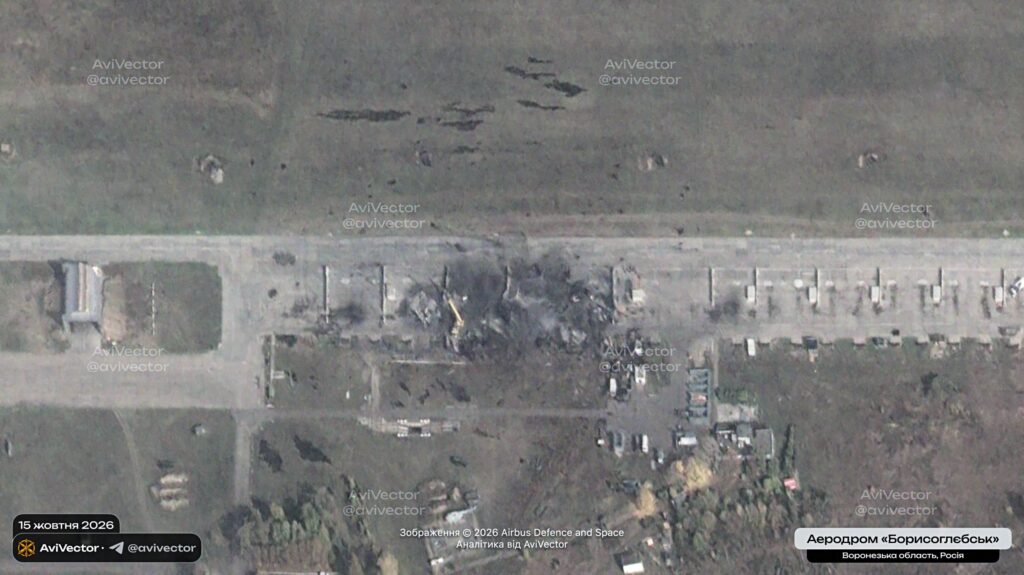
Ukraine’s Navy hit six Su-34M bombers at Russia’s Borisoglebsk military airfield in Voronezh Oblast with Neptune missiles overnight into 15 October, the Navy said. Residents filmed a large fire at the base after a missile alert, and the Navy’s count has not been independently confirmed. The facility is about 400 km from the frontline.
Glide bombs are now central to how Russia’s army fights, used to pin down Ukrainian defenders, including drone teams, before small infantry groups move in. They also hit frontline cities and the civilians who live in them.
Six bombers and flight equipment hit, the Navy says
The Neptune coastal missile system also hit technical equipment that supports flights, the Navy said. It recorded secondary detonations and a fire on the airfield and said details were still being clarified.
The Su-34M can carry several guided and high-explosive aerial bombs at once, along with missiles, the Navy noted. It called the jet one of Russia’s key tools for glide-bomb strikes on Ukrainian positions and frontline towns. In September, a Ukrainian Neptune missile reached a Russian warship at its own pier.
Smoke over Borisoglebsk in Voronezh Oblast, Russia, during the fire at the town’s military airfield, 14 October 2026. Photo: Supernova+/Telegram
Fire over the airfield late on 14 October
Voronezh Oblast Governor Aleksandr Gusev declared a missile alert across the region shortly before 22:00 local time on 14 October. Within an hour, Ukrainian monitoring channel Exilenova+ reported explosions and a fire, preliminarily at the Borisoglebsk airfield. It later wrote that the airfield had come under missile attack and a fire was burning there. Ukrainian monitoring channel Supernova+ posted footage from the town showing the blaze.
On the morning of 15 October, Gusev claimed that 33 drones and several jet-powered aerial targets had been downed over the oblast overnight. He did not mention the airfield.
A base Ukraine has hit before
The airfield hosts the 783rd training aviation center and units of the 105th composite aviation division of Russia’s Aerospace Forces, which flies Su-34, Su-35S, and Su-30SM jets, Ukrainian defense outlet Militarnyi reported. In summer 2026, it had no permanently based combat jets, and Russia used it mainly as a stopover to refuel and rearm aircraft striking Ukraine, the outlet said, citing satellite observation.
Ukrainian drones hit the airfield overnight on 8 July, starting a fire, and satellite images later showed its fuel and lubricants depot destroyed. Drones also attacked the base’s pilot training center in July 2025.
The same night, Ryazan Oblast Governor Pavel Malkov reported a fire at an oil refinery in Ryazan. It came as Ukrainian President Volodymyr Zelenskyy said Ukraine was resuming strikes on Russian refineries.
Update: Satellite imagery confirms the strike
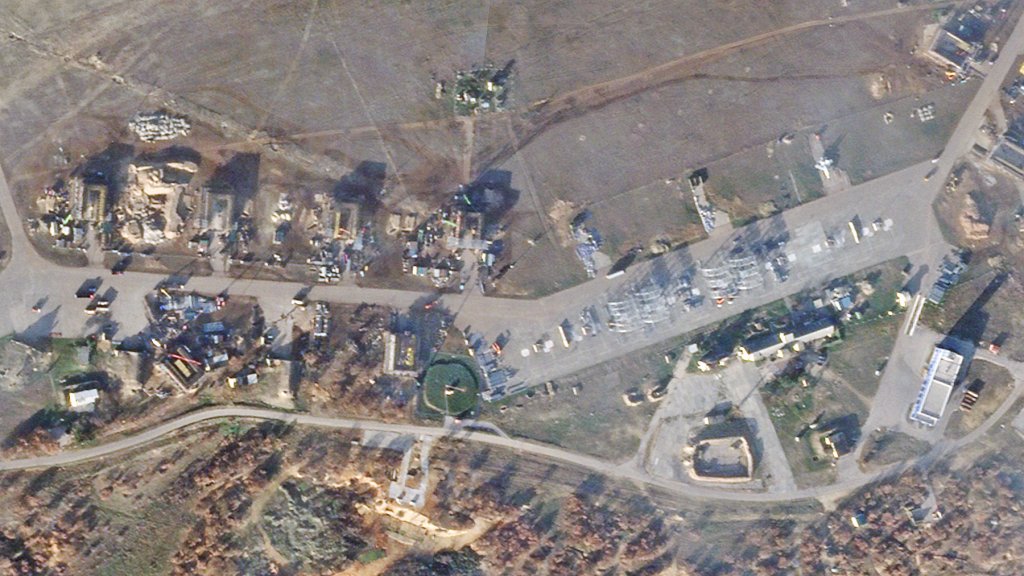
New satellite images show damage at Borisoglebsk airbase and six Su-34 bombers positioned in the affected area two days earlier, although the extent of the aircraft losses remains unconfirmed.
Satellite image shows the aftermath of Ukraine's strike on Borisoglebsk airbase in Russia's Voronezh Oblast on 15 October 2026. Image: Airbus Defence and Space / AviVector.Satellite image from 13 October shows six Russian Su-34 fighter-bombers parked in the area later struck at Borisoglebsk airbase. Image: Exilenova+.
The monitoring channel Exilenova+ reports that 4 airframes were completely destroyed, while 2 others sustained significant damage.
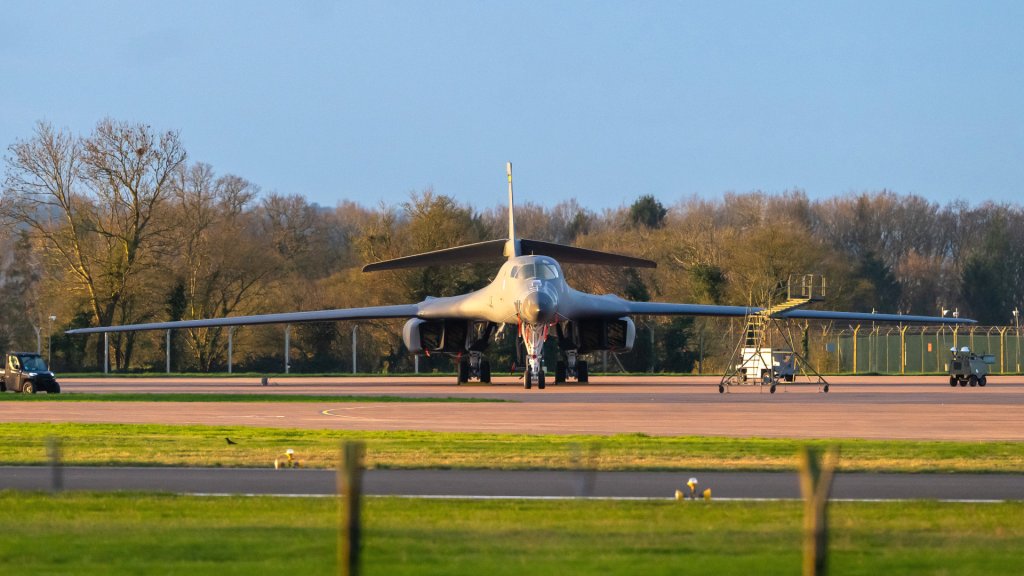
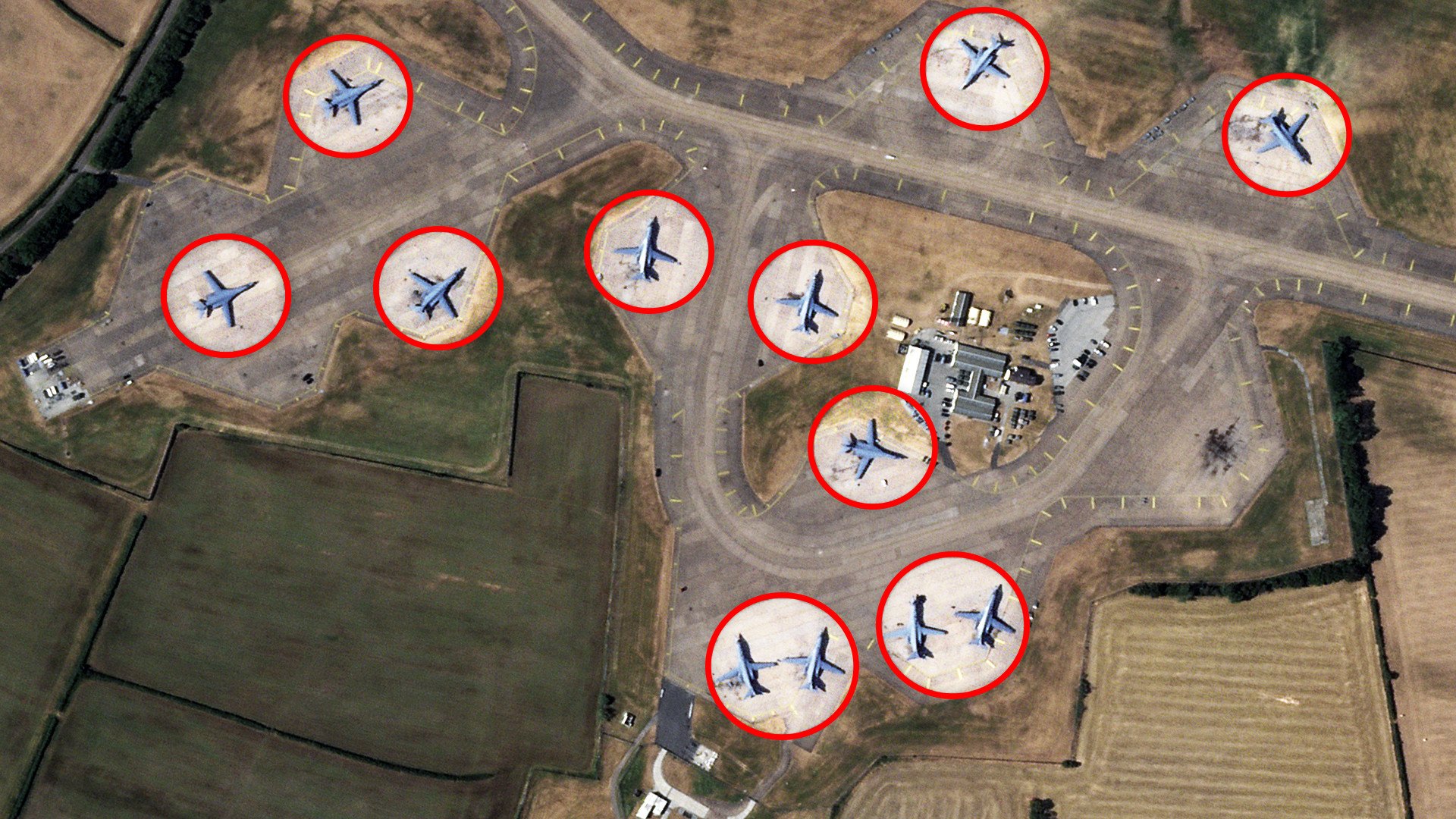
On October 4, the US pulled its 12 B-1 strategic bombers out of Fairford, UK and returned them to the United States. Reports say the planes returned to Ellsworth Air Force Base in Rapid City, South Dakota. The bombers were pulled out when intelligence reported that an attack by armed drones against Fairford was imminent. […]
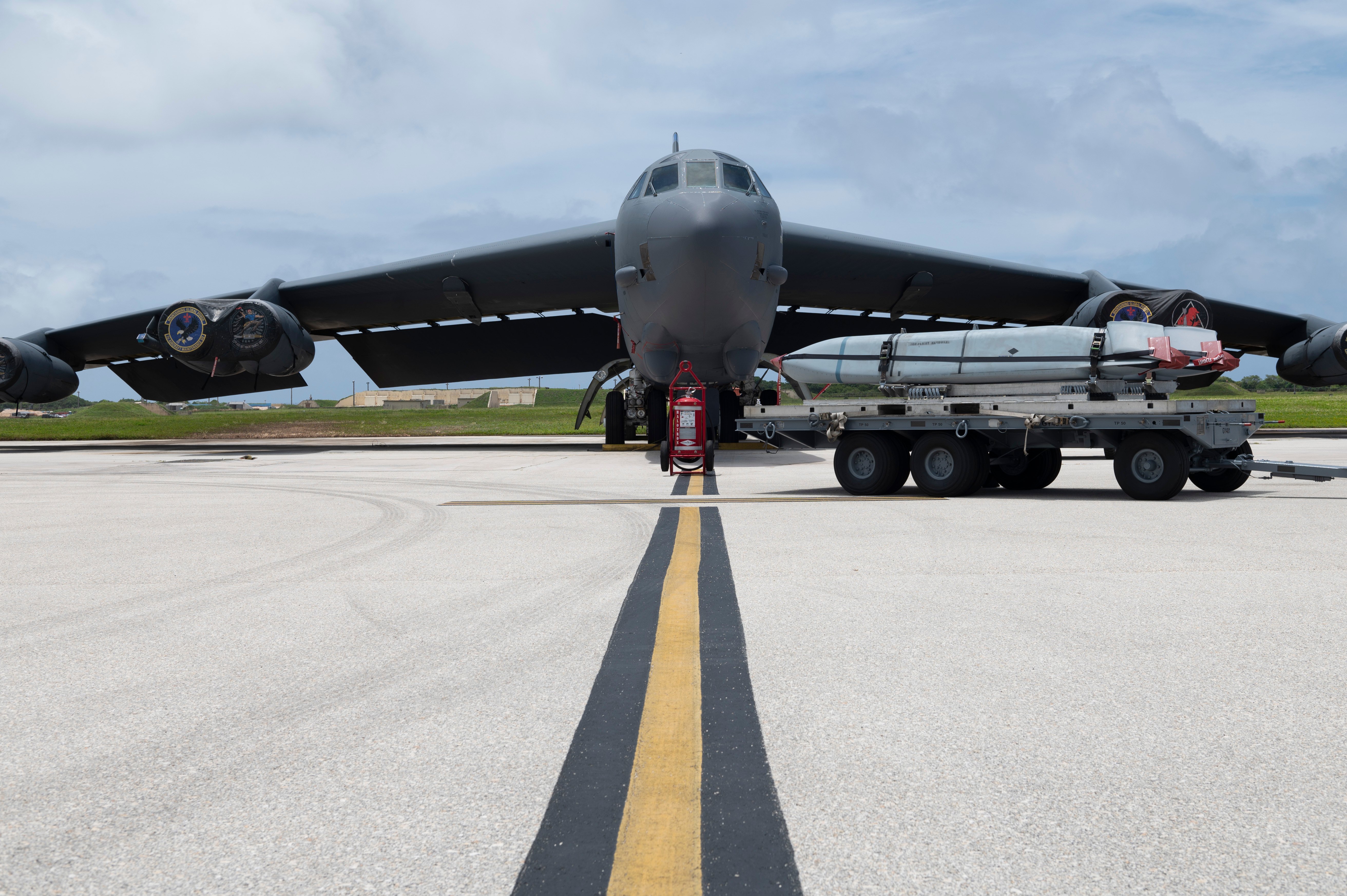
The U.S. Navy is preparing to sign a contract with Lockheed Martin to integrate the stealthy AGM-158C Long Range Anti-Ship Missile (LRASM) onto the Air Force’s B-52 Stratofortress bombers, according to an October 7 government notice. The effort would add another long-range maritime strike option to the U.S. bomber force as the military looks to counter increasingly capable adversary naval forces, especially in the Indo-Pacific theater.
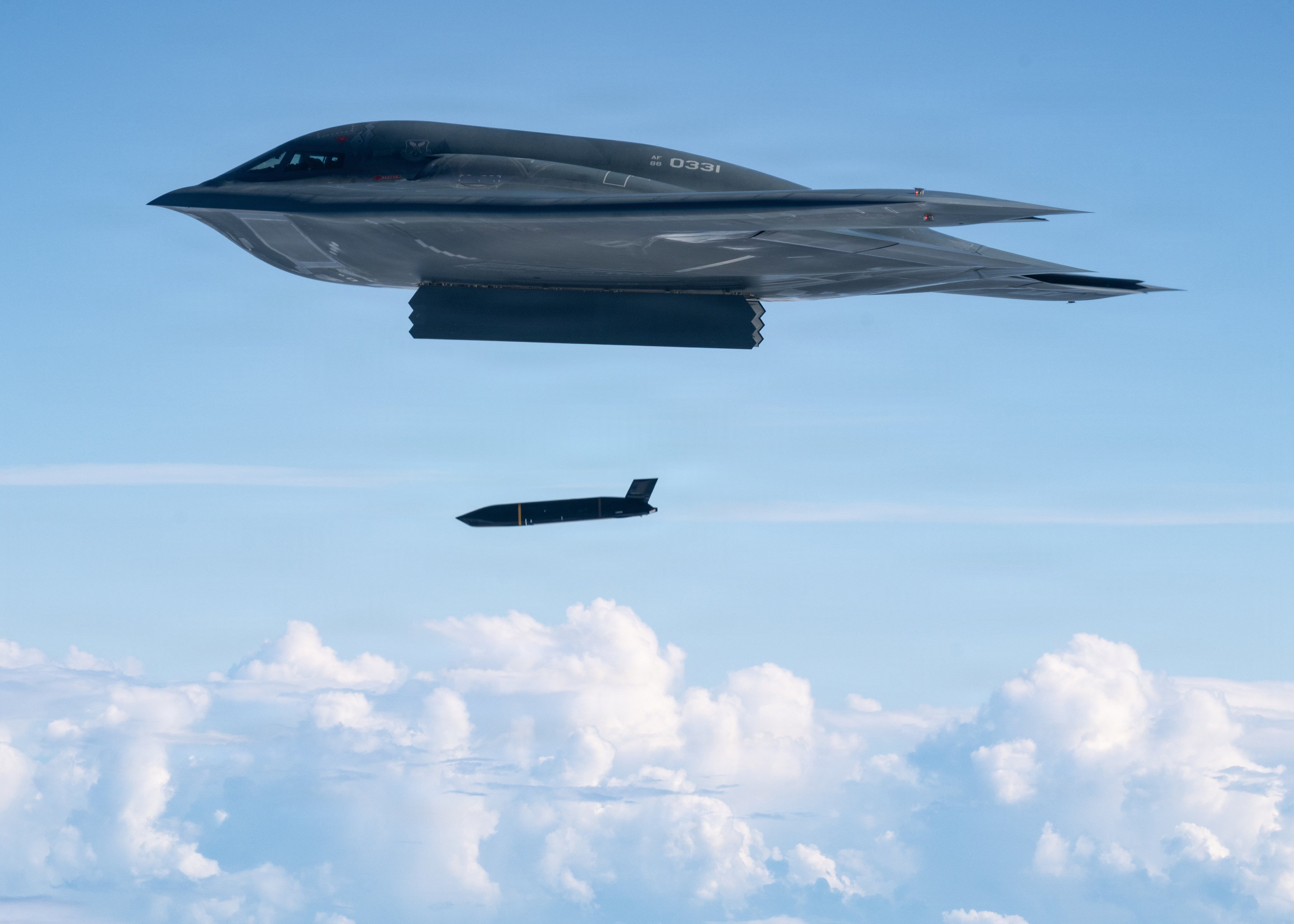
The planned contract comes months after the Air Force revealed that the stealthy B-2 bomber can also launch LRASM, a capability that had not previously been publicly disclosed. You can read more about that here.
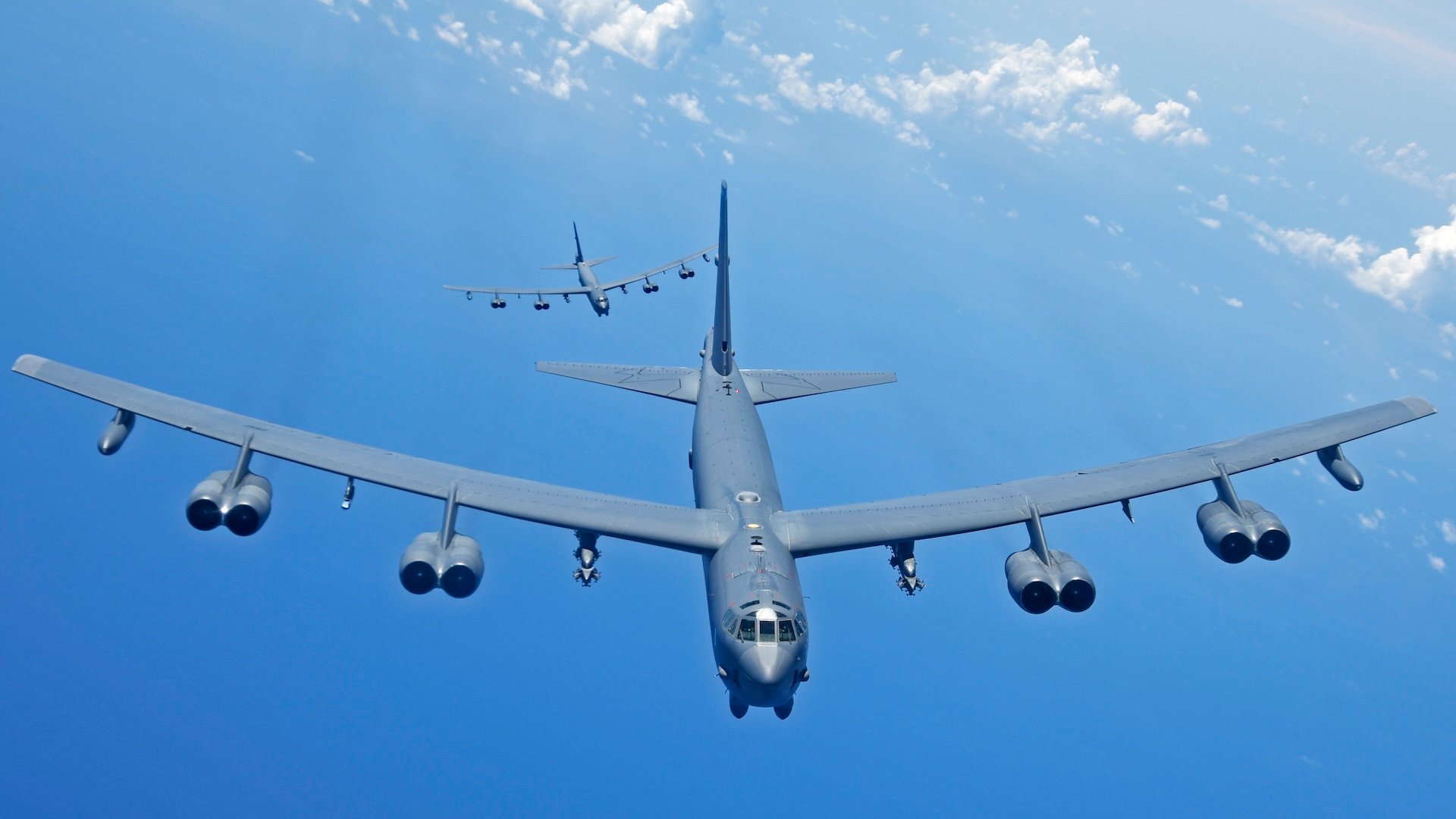
Two U.S. Air Force B-52s fly over the Pacific Ocean during a routine training mission. U.S. Air Force photo by Airman 1st Class Gerald R. Willis
The latest Naval Air Systems Command (NAVAIR) notice says the command intends to enter into sole-source negotiations with Lockheed Martin and subsequently award a cost-plus-fixed-fee delivery order covering LRASM integration on the B-52. The work would include missile software updates, associated testing, repairs to test assets, and failure review boards.
The notice does not provide a schedule for completing the integration or fielding the capability.
The B-52 is already capable of carrying large numbers of air-launched cruise missiles, including the AGM-158 Joint Air-to-Surface Standoff Missile (JASSM) family. LRASM is derived from that family, sharing a similar general form factor while incorporating features specifically designed to find and attack ships in contested maritime environments.
The B-52 can carry up to 20 JASSMs, and the weapons have the same dimensions, but the government notice does not specify how many LRASMs the bomber would ultimately carry.
A B-52 flies across the Atlantic Ocean on June 17, 2019, for a flight in support of Exercise BALTOPS 2019, the largest multinational maritime exercise of the year in the Baltic Sea. U.S. Air Force photo by Senior Airman Stuart Bright
This is not the first time the B-52’s LRASM integration has been in the works.
As long ago as November 2019, Naval Newsreported that $10 million in Fiscal Year 2019 funding had been allocated to study integrating the missile onto the bomber, with Lockheed Martin and the Navy and Air Force expected to work on the effort. At the time, officials said the fielding timeline and the bomber’s eventual missile capacity had yet to be determined.
The U.S. Air Force’s Fiscal Year 2027 budget proposal further outlines plans to integrate the latest variants of LRASM and JASSM onto the B-52, including versions not yet cleared for use on the bomber. According to the document, the effort, which is intended to enable the deployment of next-generation stealthy cruise missiles against targets protected by sophisticated integrated air defense systems, will focus on engineering and manufacturing development, software updates, and weapons integration. Planned work in FY2027 includes incorporating the missiles’ operational flight programs into the B-52’s baseline bomber software, validating safe weapon separation from both wing-mounted stations and the internal carriage launcher, updating armament interfaces, and completing system-safety testing.
Joint Air-to-Surface Standoff Missiles are prepared to be loaded onto a U.S. Air Force B-52 on Andersen Air Force Base, Guam, on April 24, 2023. U.S. Air Force photo by Airman 1st Class Spencer Perkins
LRASM is designed to attack high-value surface vessels at long distances while reducing the exposure of the aircraft launching it. Its guidance combines GPS-assisted inertial navigation with onboard sensors and autonomous target-recognition capabilities intended to help it operate in heavily defended environments. Its imaging infrared seeker supports terminal target acquisition without relying on active radar emissions in that phase of flight. The missile operates with a high degree of autonomy, enabled by an integrated route-planning capability linked to its onboard electronic support measures (ESM) system. LRASM also has a datalink that allows it to get threat updates while in flight. It can also work cooperatively with other LRASMs during coordinated strikes.
The missile’s precise operational range is not publicly disclosed. However, the baseline LRASM is reported to be able to strike targets at between 200 and 300 miles, in line with the AGM-158A JASSM. The forthcoming C-3 version is expected to have the same reach as the JASSM-ER, which is reported to be around 600 miles.
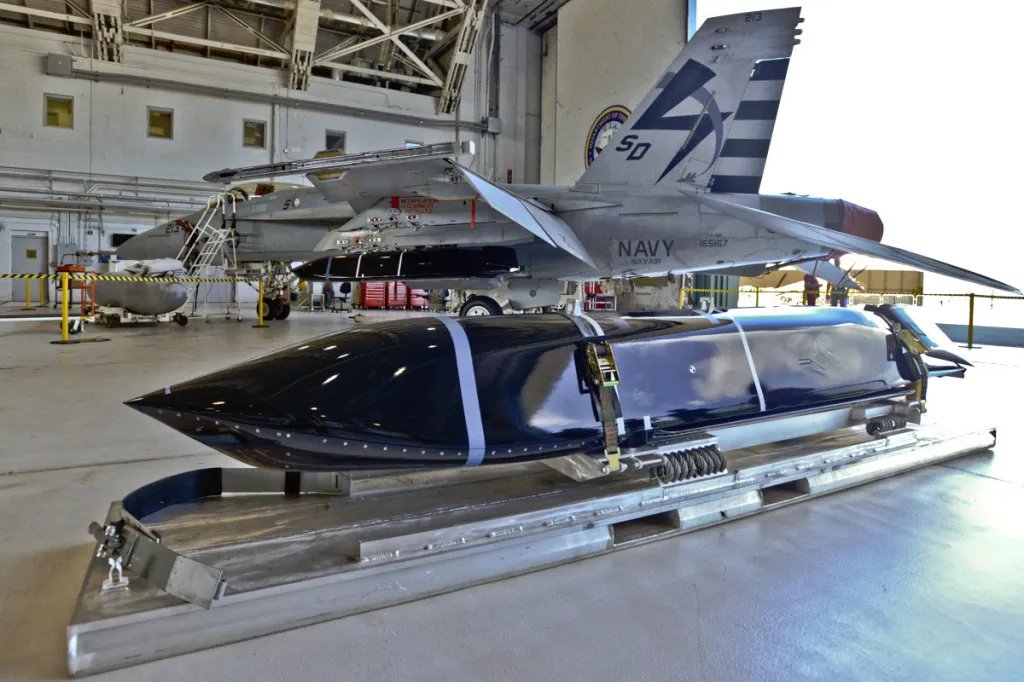
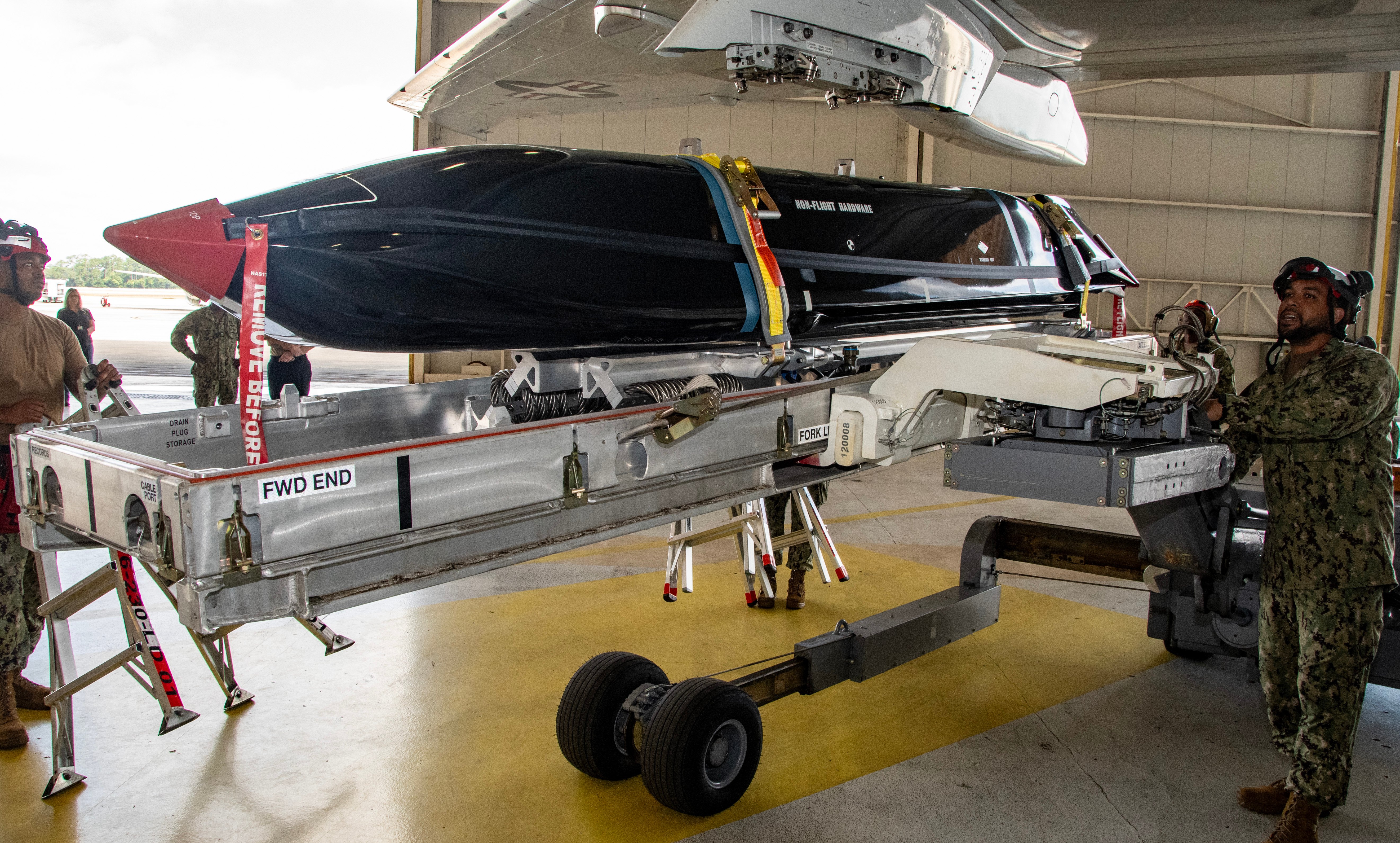
An AGM-158C Long Range Anti-Ship Missile is seen under the wing of an F/A-18, with another missile in the foreground. U.S. Navy
For the B-52, the addition of LRASM would provide a dedicated anti-ship weapon alongside its established land-attack arsenal. A bomber operating at a considerable distance from a hostile fleet could launch multiple missiles toward maritime targets, complicating an adversary’s air-defense and interception problem. The aircraft’s payload capacity could also allow it to contribute substantial missile volume to a coordinated strike.
The B-52 was previously adapted to carry AGM-84 Harpoon anti-ship missiles, although the weapon is not listed among the bomber’s current publicly documented armament. Compared to the Harpoon, however, LRASM represents a quantum leap in capability, offering drastically greater range, a stealthy design, and the ability to react to threats and adapt in real time. Combined, these traits make for a far more survivable and lethal anti-ship capability.
The B-52 also has a demonstrated naval mine-laying capability through the Quickstrike family of aerial mines. This includes carrying 2,000-pound Quickstrike-ER mines fitted with GPS-aided, winged guidance kits, allowing them to glide to designated points in the water from more than 40 miles away. The system enables the bomber to seed minefields with greater precision while remaining farther from potentially defended waters, threatening enemy shipping routes, port access, and naval movements.
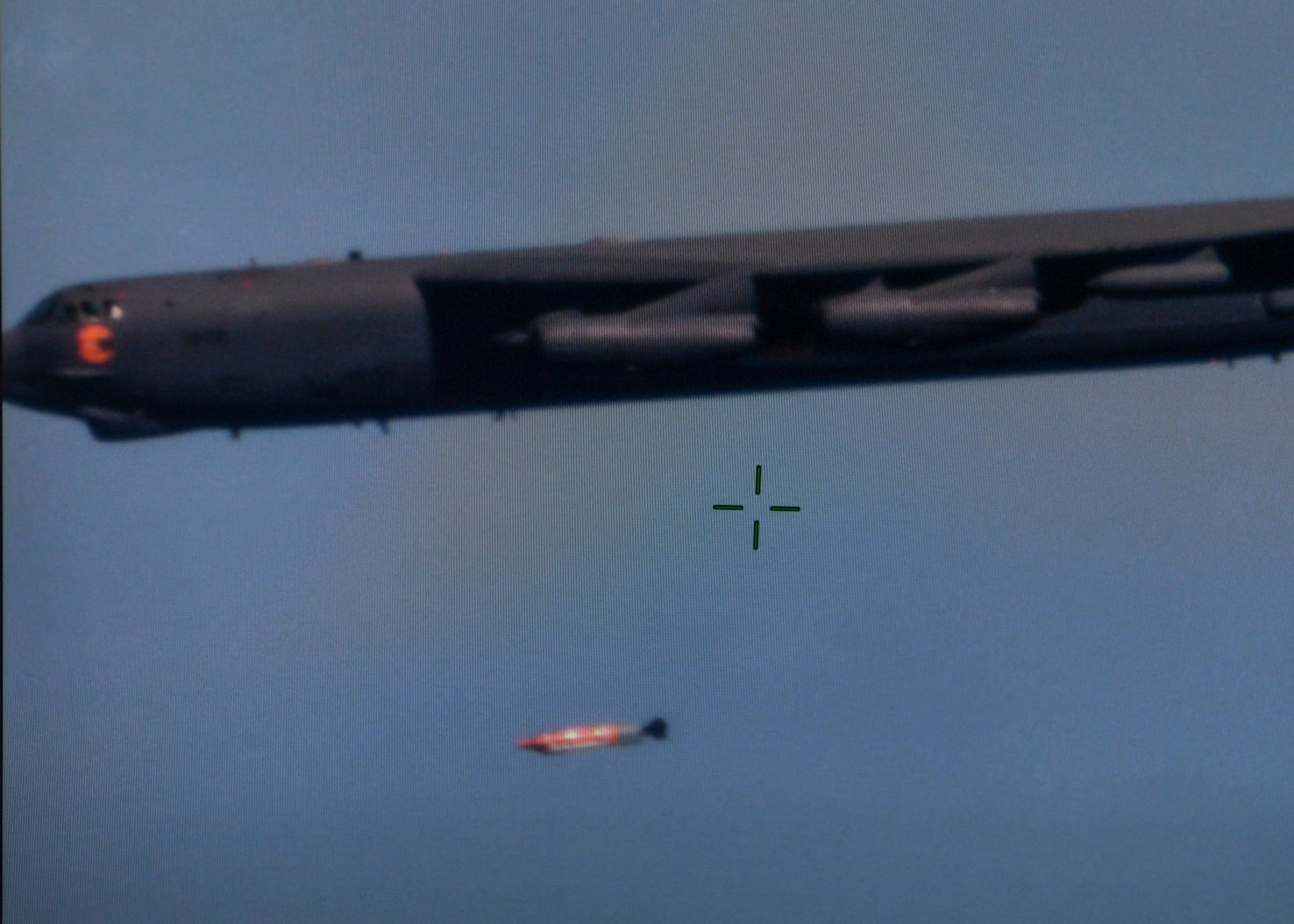
A B-52 conducts an operational demonstration of the Quickstrike-ER naval mine project in the Pacific Ocean, on May 30, 2019. U.S. Navy photo by Mass Communications Specialist 1st Class Holly L. Herline
The B-52 effort comes against the backdrop of the Air Force’s newly acknowledged use of LRASM on the B-2, which adds a different dimension to the service’s anti-ship capabilities.
A U.S. Air Force B-2 deploys an AGM-158C Long Range Anti-Ship Missile to support a live-fire sinking exercise as part of Valiant Shield 2026 over the Philippine Sea, June 27, 2026. U.S. Air Force photo by Tech Sgt. Thomas Barley
LRASM was also previously integrated on the B-1B, meaning that all three of the Air Force’s strategic bombers will eventually be able to employ it.
The renewed focus on bomber-launched anti-ship weapons reflects the challenges posed by modern naval forces, particularly in the Indo-Pacific. China’s expanding surface fleet, increasingly sophisticated air defenses, and layered anti-access/area-denial capabilities have made the ability to attack ships from a distance an important consideration for U.S. military planning.
U.S. airmen transport a live AGM-158C Long Range Anti-Ship Missile toward a B-1B Lancer at Dyess Air Force Base, Texas, June 2, 2026. U.S. Air Force photo by Airman 1st Class Caleb Schellenberg
LRASM is designed to help address those challenges by combining long-range flight with reduced observability and autonomous terminal targeting. Its onboard sensors and navigation capabilities are intended to help it identify and engage appropriate targets in environments where communications and external targeting support may be limited or contested.
Bomber integration also offers a way to increase the number of potential launch platforms without relying exclusively on tactical aircraft or surface combatants. A B-52 carrying a substantial missile load could contribute to a coordinated attack alongside B-1s, stealth bombers, naval aircraft, and other forces.
The B-52’s payload capacity would make it particularly useful for delivering larger quantities of weapons from outside the most heavily defended areas.
The planned B-52 integration also fits into a broader effort to expand LRASM’s availability across the U.S. military. Publicly discussed integration efforts have included the F-15E, F-15EX, F-16C/D, certain variants of the F-35, and the Navy’s P-8A Poseidon, in addition to established launch platforms, namely the Navy’s F/A-18E/F Super Hornet fighters and the B-1.
Sailors assigned to Patrol Squadron (VP) 30 transport an AGM-158C Long Range Anti-Ship Missile prior to installation on board a P-8A Poseidon maritime patrol aircraft. U.S. Navy photo by Mass Communication Specialist 1st Class Curtis D. Spencer
Meanwhile, the B-52 fleet is currently preparing for a slew of major upgrades. These include a critical radar overhaul alongside new engines, enhanced communications systems, and other improvements. The scope of these changes is significant enough that the aircraft will be redesignated from B-52H to B-52J. The bombers are also slated to further expand their weapons capabilities, including through the addition of the Long-Range Stand Off (LRSO) nuclear cruise missile. The upgraded B-52Js are expected to remain in service through at least 2050.
Even in its current configuration, the B-52 is particularly well suited to carrying the LRASM, given its substantial payload capacity and ability to launch weapons from standoff distances beyond the reach of enemy air defenses. Its upgraded networking capabilities will greatly enhance its effectiveness by allowing it to operate as part of a broader kill web, drawing on data from multiple platforms and sensors to support targeting over vast distances. In more dynamic operational environments, the bomber’s new radar can generate its own targeting information in real time. The B-2, B-1, and the B-52 all offer distinct levels of penetration and weapons-delivery capability, with the forthcoming B-21 able to push deeper into contested airspace; it will certainly employ LRASM too.
The integration of LRASM onto the B-52 could prove critical to generating the volume of sorties needed to counter China’s expanding naval fleet. With its substantial payload capacity and ability to launch missiles from standoff distances, the B-52 could deliver significant anti-ship firepower across the vast distances of the Indo-Pacific. These missions would likely involve very long-range sorties, making the bomber’s payload capacity, endurance and networking capabilities particularly valuable in sustaining operations against Chinese naval forces.
If the LRASM integration proceeds as planned, the result would be another addition to the U.S. military’s long-range anti-ship arsenal, giving the Air Force’s venerable B-52 a more explicit role in the growing emphasis on striking hostile fleets at a distance.
Before the hasty and unexpected departure of the bombers on Sunday, B-1s had been deployed to RAF Fairford continuously since March, initially in support of Operation Epic Fury against Iran. A contingent of B-52s had also conducted strikes on Iran from Fairford, but left back in July. The base is a major operational hub for the U.S. military in the United Kingdom, and regularly hosts strategic aircraft, including bombers and U-2 spy planes.
Dan Rivers, U.S. correspondent for ITV News in the United Kingdom, was among the first to report on Monday that the B-1’s quick departure had been prompted by concerns about a potential Spiderweb-like drone attack ordered by Iran, citing an unnamed source. Other outlets have subsequently reported similar details, all sourced to anonymous U.S. and British officials.
“They didn’t fly out by accident,” U.S. President Donald Trump told reporters during a gaggle at the White House on Monday when asked about why the B-1s had left Fairford. “There were some threats.”
“I can’t tell you that, but if they did, they’ll suffer greatly,” Trump added in response to a separate question about whether Iran might have managed to get weaponized drones into the United Kingdom.
“What you saw there was the Secretary of War [Pete Hegseth], out of an abundance of caution, trying to protect our guys,” U.S. Vice President J.D. Vance said during a separate press engagement on Monday. “We do feel, with some confidence, that the Iranians are – they’re trying to do what the Iranian state has done for 49 years, which is engage in acts of terrorism against the United States, and a lot of other people, as well. So, we are being extremely cautious.”
Another satellite image offering an overall view of RAF Fairford. Google Earth
“We’ve documented what happened [near Fairford] last week. I wouldn’t just directly tie that to the move that was made,” U.S. Secretary of State and National Security Advisor Marco Rubio also told members of the press on Monday. “The only reason why you guys are focused on how many planes are at Fairford is because of the threat that happened last week.”
“We have confidence in the security of all of our bases, because all of our bases are [sic] theoretically could be threatened at any moment,” he added.
Rubio’s comments notwithstanding, the remarks from Trump and Vance make clear that there was some recent threat intelligence that contributed to the decision to pull the bombers from Fairford. There are still many questions about the exact nature of the potential attacks, and how imminent, or not, the danger may have been.
Regardless, as mentioned, the prospect of a near-field drone attack on a base like Fairford carried out by actors in close proximity is extremely plausible, and the barrier to entry to such an operation is relatively low. Spiderweb may have thrust this reality into the public consciousness in dramatic fashion, but the danger well predates that operation, and even the start of Russia’s all-out invasion of Ukraine in 2022.
TWZ has been highlighting exactly these kinds of threats in the course of a decade or so now of regular reporting on drone incursions over U.S. and foreign military facilities and critical infrastructure, as well as American naval vessels operating offshore. Langley Air Force Base in Virginia and Barksdale Air Force Base in Louisiana, some of America’s most strategic airbases domestically, are among the facilities that have had to grapple with this in the past. After the Langley incident, in particular, it had become clear to the larger public what we had been reporting for many years, that the United States does not control the airspace over even its most critical military installations.
New footage of yet another act of Russian terrorism on EU soil, showing the drone loaded with explosives on the tarmac at Leipzig/Halle Airport, just meters from a Ukrainian Antonov An-124 cargo aircraft.
— SPRAVDI — Stratcom Centre (@StratcomCentre) August 5, 2026
A drone attack on Fairford would also not necessarily have had to come from somewhere very close by. Longer-range one-way attack drones are steadily proliferating, and can be launched using a variety of methods from positions on the ground, as well as vessels at sea. TWZ explored the very real threat of sea-based drone attacks, including ones conducted covertly, and Iran’s specific ability to carry them out globally, following the leak of an FBI alert back in March.
The proliferation of lower-end one-way-attack drones has ‘democratized’ precision-guided attacks, even for non-state actors. The fielding of automated targeting capabilities, driven by developments in artificial intelligence and machine learning, is also becoming more and more widespread. That technology will soon enable these weapons to find and strike even moving targets on their own. Even without anyone at the controls and without the drone putting out any detectable radio emissions, very effective precision attacks can still be launched at static targets, like known parking areas for aircraft at airbases, just by using basic map coordinates or Google Earth. It’s also worth pointing out here that the definition of a stand-off attack is becoming increasingly blurry, with even quadcopter-type drones capable of flying miles away to conduct a kamikaze attack on a target based on a set of GPS coordinates.
Ukrainian Saker UAV with AI capabilities. The video shows the process of target recognition. It has reportedly already been put to use several times against Russian targets. pic.twitter.com/NVNJyxUjGP
Overall, it is an indisputable fact that aircraft sitting exposed on a flightline are particularly vulnerable to drone attacks, as well as other threats. This is something U.S. military officials have acknowledged themselves. Fairford, where B-1s and other bombers have no option but to park out in the open in well-established areas that are plainly visible from outside the base’s immediate perimeter, is indicative of how American military aircraft are generally positioned on the ground abroad and at home.
As we wrote all the way back in 2017:
“Similar swarming strikes could be unleashed behind the front lines as well, with hugely expensive and low density/high demand combat aircraft being especially vulnerable to this sort of tactic—something General James Holmes alluded to inadvertently while speaking to the Air Force Association, stating:
‘Imagine a world where somebody flies a couple hundred of those and flies one down the intake of my F-22s with just a small weapon on it.’
Actually, it would be even easier to just strike the jets as they sit idle and vulnerable on the flight line. One swarm could see a whole squadron of tightly packed fighters destroyed without even having a chance to fight back.”
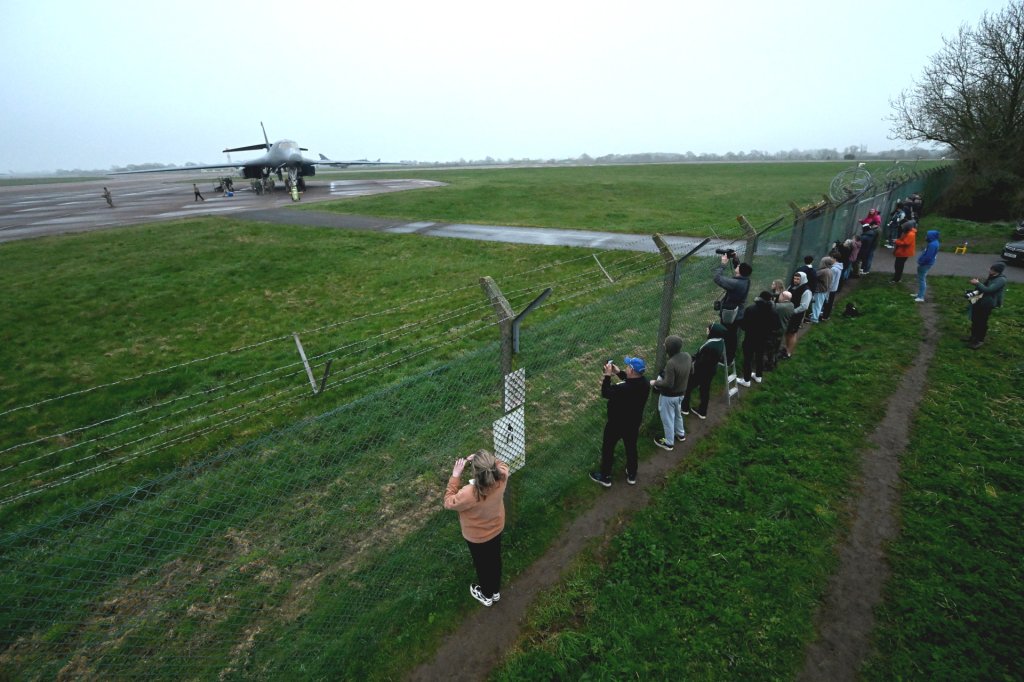
This picture of a B-1 at Fairford on March 7 shows how bombers and other aircraft are typically parked at the base. The line of photographers along the fence line also underscores how close those parking spots are to the base’s immediate perimeter. JUSTIN TALLIS / AFP via Getty Images
“I’m not a big fan of hardening infrastructure,” Gen. Kenneth Wilsbach said at a roundtable at the Air and Space Forces Association’s main annual symposium in 2023, offering a prime example of this viewpoint. “The reason is because of the advent of precision-guided weapons … you saw what we did to the Iraqi Air Force and their hardened aircraft shelters. They’re not so hard when you put a 2,000-pound bomb right through the roof.”
Wilsbach was commander of Pacific Air Forces (PACAF) at the time. He subsequently became head of ACC and is now Chief of Staff of the Air Force, the service’s top officer.
“I think that I don’t want to spend a lot of money on hardening shelters. Unless you’re going to send something 100 feet or more underground, we can blow it up, and so can they,” Wilsbach said in an interview with Breaking Defense in July of this year when asked explicitly if his position changed. “So, the economics of building a shelter that is impervious to a strike doesn’t work.”
U.S. Air Force Chief of Staff Gen. Ken Wilsbach speaks during an all-call with personnel at RAF Mildenhall, another base in the United Kingdom, on July 13, 2026. USAF
“I think the economics favor defending your airspace, defending your ground space with systems that can defeat the incoming rounds, versus building a shelter,” he added. “Some people would argue, well, you should do both. Well, that’s even more expensive. And the other thing is, the shelter doesn’t go anywhere.”
It is fair to point out that typical above-ground hardened aircraft shelters are not invulnerable, especially to attacks involving ballistic, cruise, and certain air-launched threats. There are also substantial cost and other factors to consider when it comes to any major military construction effort.
That being said, having more hardened infrastructure also imposes costs and complexities on opponents, who have to dedicate more advanced and costly munitions and other resources to ensure targets are neutralized. Shelters have the knock-on benefit of complicating the targeting process for an enemy by obscuring where aircraft are or are not positioned, to begin with. An opponent has to treat shelters like they are full even if they are empty.
When thinking about hardened aircraft shelters, stereotypical Cold War-era reinforced concrete structures typically come to mind. However, they do not all have to be built to a one-size-fits-all standard with the same degree of hardening across the board to be useful. Shorter-range drone attacks are typically carried out by platforms carrying small explosive charges or that are designed to drop small bomblets. Even longer-range one-way-attack drones generally have smaller warheads than traditional missiles, they also hit with less kinetic energy.
A US Air Force F-16 fighter sits inside a traditional hardened aircraft shelter. USAF
A structure that shields against smaller blasts and shrapnel, also including from cluster munitions that can be readily scattered across wide areas, is one that then has to be addressed by more capable weapons. This could even include mobile or otherwise temporary shelters that offer sufficient concealment and protection.
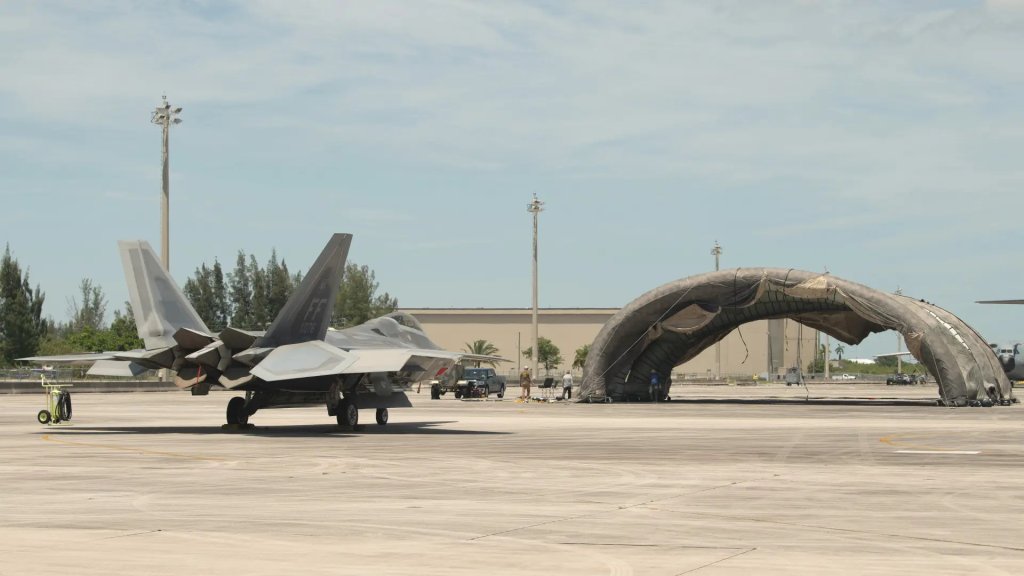
This picture shows what the Air Force described as a “prototype portable camouflage, concealment, and deception hangar” in use during Exercise Hoodoo Sea in 2023. Air National Guard The prototype portable hangar intended to support camouflage, concealment, and deception efforts in use during an Air National Guard-led exercise in 2023. Air National Guard
Eliminating, or at least substantially mitigating, the lowest rung of threats creates a dilemma for opponents, who then have to decide whether it is even worthwhile to attempt certain types of attacks. There is clear value in narrowing the available options for the enemy and pushing them toward having to expend higher-end, more expensive munitions, that are available in smaller quantities, and that traditional active defenses may be better optimized to handle. As an example, it may be more viable to shoot down a small barrage of incoming cruise missiles than a swarm of dozens of drones.
There are magazine and stockpile depth issues at play here, too. This is something that has also been brought front and center by the conflict with Iran, which has fueled already long-standing concerns about the sufficiency of stockpiles of air defense interceptors, other critical munitions, and the capacity to replenish them quickly. This is something the British government, among others, is also grappling with, as you can read more about in our separate reporting here.
Furthermore, losses of aircraft on the ground are not without their own costs, which are even more lopsided if an opponent can simply use lower-cost weaponized drones. U.S. bombers are particularly expensive and prized assets that are in short supply compared to the level of demand, as seen during the height of combat operations earlier this year against Iran. When it comes to B-1s, specifically, there are only 45 of them left in service today. A dozen of them being knocked out in one go would have major repercussions strategically. Losing even one would also be a propaganda coup for whoever might be responsible.
How many shelters can we build for the upgrade cost of one Zumwalt class DDG that will probably be parted out in 10 years anyway?
On top of all this, the U.S. military simply will not always have the luxury of being able to rapidly relocate aircraft in response to threats. Moving a dozen bombers on short notice takes massive resources. It is not just aircraft that have to be repositioned, but supporting personnel and assets, as well as weapons and fuel. Having to shift to alternate locations could easily have negative impacts on tempo and other aspects of operations, especially in the midst of actual conflict. RAF Fairford is one of only a few bases globally that can support bomber operations for a prolonged period.
“There is value in some light protection against small, unmanned threats,” Gen. Wilsbach also told Breaking Defense in July. “Some of them — just nets that are up that keep a small, few-$100 drone from getting next to a $2 billion aircraft. That actually works, [and is] really cheap.”
A graphic included a contracting notice put out by authorities at Langley Air Force Base in 2024 showing how sunshade-type shelters at the base might be equipped with anti-drone nets. USAF
“It’s not either or,” Wilsbach said in a separate interview with Air & Space Forces Magazine in July. “The net keeps the small UAS [uncrewed aerial system] from getting close to an aircraft that you’re trying to protect… That’s a very inexpensive way to give you some modicum of protection without killing your checkbook on really exquisite defensive systems.”
In spite of these institutional developments, action to implement such recommendations on a broad basis has continued to lag. There still does not appear to be any major department-wide push to build new hardened aircraft shelters or other fortified structures at facilities globally. The U.S. Air Force does have a certain number of hardened aircraft shelters at bases now, especially in the Pacific and Europe.
This is all despite a very visible trend in the construction of new aircraft shelters and other hardened infrastructure elsewhere around the globe, including in China, Russia, North Korea, and Iran. Even before Operation Spiderweb, Russia had already initiated a large-scale effort to build new hardened shelters at various bases, especially on the occupied Crimean Peninsula, in the face of expanding Ukrainian drone and missile attacks. This effort has now extended to building the huge hardened shelters for the country’s bomber force, something the country has never done before.
“It is inappropriate to discuss matters of intelligence, and we will not discuss specific force protection measures,” a U.S. Air Force spokesperson told TWZ yesterday when asked about the reports that Iranian drone threats prompted the recent removal of the B-1s from Fairford. “The Department will continue to assess the threat environment surrounding our installations and take appropriate actions to protect our people, our platforms and the bases where our forces operate from.”
We still do not know exactly how serious or imminent any recent threat to the B-1s at Fairford was that contributed to their hasty departure. Regardless, the reports of concerns about potential drone attacks remain very plausible. The reality here is that a dozen bombers were yanked from a forward operating location in Europe without an adversary ever having to fire a shot. This is a problem set that is only growing, especially as lessons and expertise on low-end weaponized drones from the war in Ukraine are spreading around the globe.
A B-1 bomber seen parked out in the open at RAF Fairford on March 15, 2026. Matthew Horwood/Getty Images
Erecting new aircraft shelters and other hardened infrastructure would not be a full solution to those threats by themselves. At the same time, they would be a valuable added layer of defense, and a passive one that would have a huge logistical footprint to operate once the initial investment is made. The lack of movement to better fortify American airbases globally is only becoming more and more glaring, and it remains to be seen if real action will not occur until lessons are learned in a most unfortunate way.
U.S. Air Force B-1B Lancer bombers that had been deployed to RAF Fairford in the U.K. since operation Epic Fury have returned to their home stations, a U.S. defense official confirmed to TWZ. The hasty movement was reportedly sparked by new Iranian threats against the base, although the Pentagon doesn’t confirm that assertion.
The sudden withdrawal came a week after a major incident was declared near Fairford following the arrest of five men on suspicion of driving bomb-laden vans toward it. They were later released on bail after no explosives were found. However, Counter-Terrorism police are continuing the investigation and said they were considering whether a foreign state had been involved. On Wednesday, British Prime Minister Andy Burnham said the incident might have had an Iranian link.
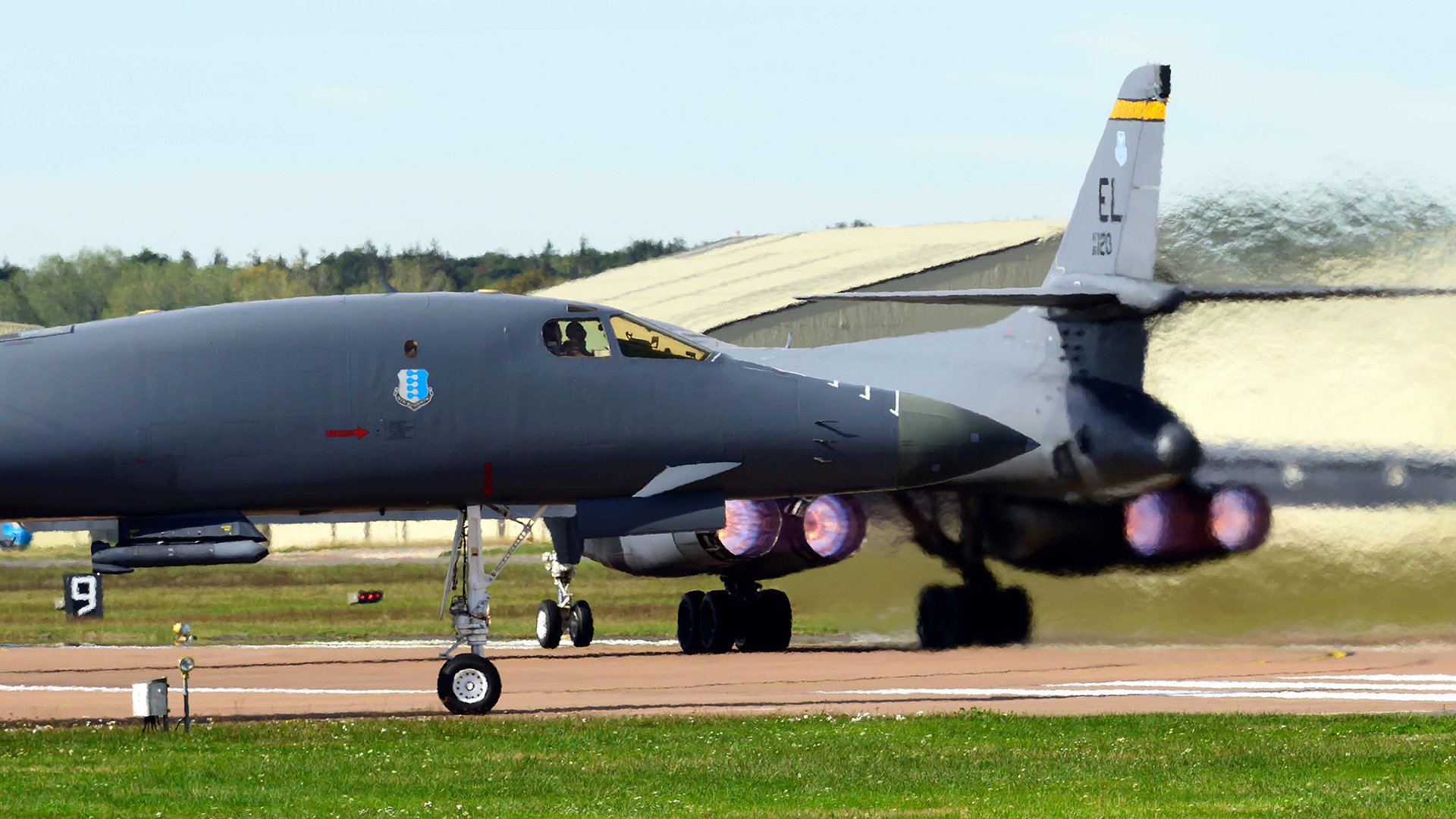
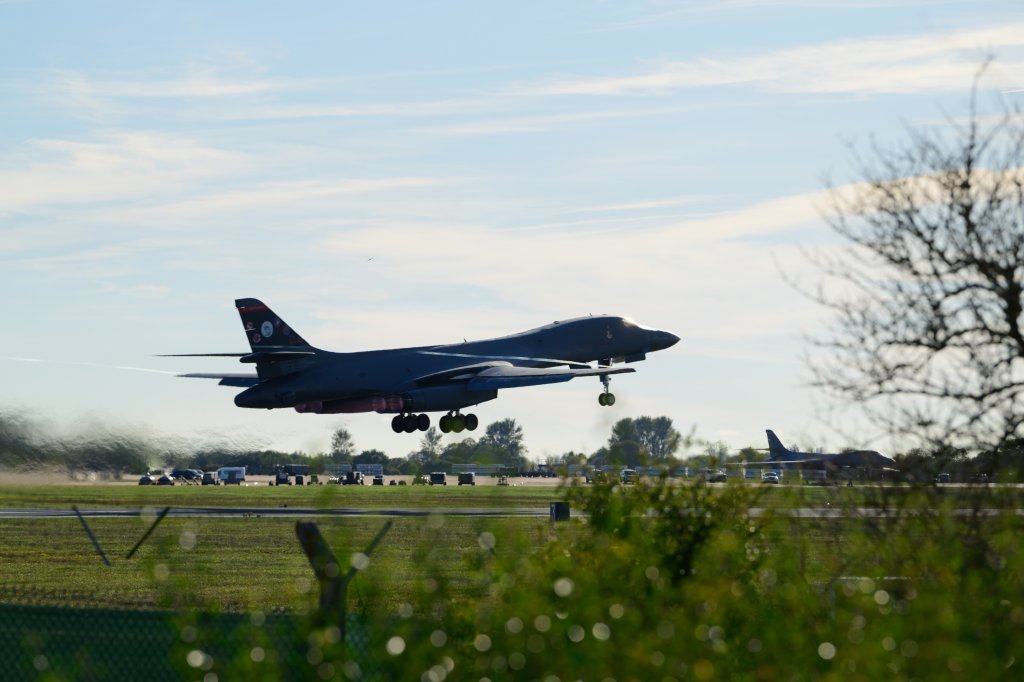
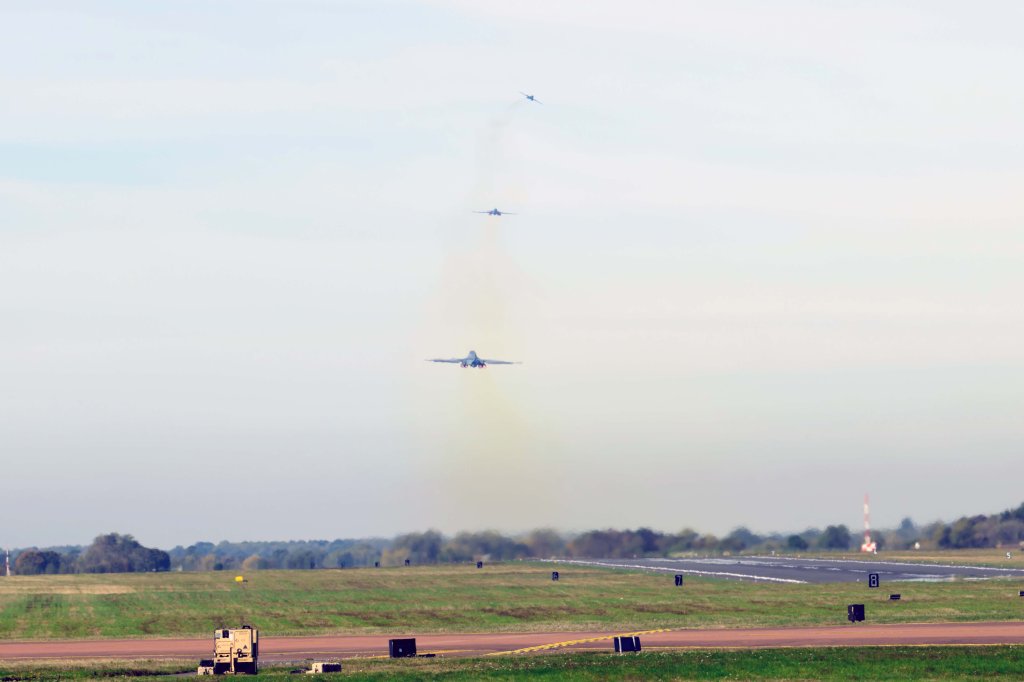
A U.S. Air Force B-1B Lancer heavy bomber takes off from runway 27 to depart for home at RAF Fairford on Oct. 4, 2026 in Fairford, United Kingdom. (Photo by David Bown/Getty Images) DAVIDBOWN
Bomber strikes launched from Fairford, which included ones executed by both B-1s and B-52s, were a central aspect of major U.S. combat operations against Iran earlier this year. In addition, the installation is a major hub for U.S. military aircraft in the United Kingdom. It is a regular host of strategic assets, including bombers and U-2 spy planes. It also acts as a pit stop for other aircraft, including fighters, that are being ferried to and from the United States.
The U.S. withdrew all 12 B-1s “after commanders received new threats about an Iran-backed plot against the installation,” The New York Times reported, citing two U.S. officials.
U.S. Air Force B-1 bombers depart RAF Fairford for home bases on Oct. 4, 2026. (Photo by David Bown/Getty Images) DAVIDBOWN
“The withdrawal was highly unusual: Such moves are rarely made so quickly from an allied air base in a peacetime country thousands of miles from a combat zone,” the publication added. “The need to move the bombers out of the base, R.A.F. Fairford, was deemed so urgent that some of the planes and their flight crews left while aerial refueling aircraft were still being scrambled to support their flights to the United States. At least three of the planes had landed at their home base in South Dakota by Sunday.”
U.S. officials declined to tell the Times the specific nature of the new information that prompted the Lancer withdrawal, some of which had just arrived in the past week as part of a normal rotation of forces to maintain the B-1 forward presence in Europe.
“One U.S. official said the new information was part of the same threat warnings that surfaced three weeks ago, but specific details and a sense of urgency spiked in the past 24 hours, alarming commanders,” the publication noted.
As we previously reported, Tehran directly threatened RAF Fairford in July over its use as a base to launch attacks against Iran.
“The American aggressor army, which used to launch cruise missiles from its vessels in the Indian Ocean in its aggression after the official resumption of the war, with the end of the missile reserves of the aforementioned vessels, yesterday switched to using B1 planes flying from Fairford Air Base, England,” Tasnim News Agency, a quasi-state outlet in Iran with ties to the country’s powerful Islamic Revolutionary Guard Corps (IRGC), claimed on Telegram on July 23. “As the officials of the Ministry of Foreign Affairs also stated, any base that is used to invade Iran’s territory is our legitimate goal.”
the enemy must pay the price for its breach of promises, and this time we will not allow America to use deceptive ceasefires to replenish its oil and ammunition stockpiles and then resume attacks once again.
Local aircraft spotters and aviation photographers began to notice the aircraft departing in large numbers earlier on Sunday.
The aircraft left in several waves, according to the DefenceGeek X account, run by the senior editor of the U.K. Defence Journal.
IN FULL: US Bomber Force Withdrawal from RAF Fairford #IranWar
OK so now we know the full scale of this withdrawal, here's the details – 10 of the 12 B-1B "Lancer" bombers remaining at the base (including the aircraft that only arrived 6 days ago on a rotation) are heading… pic.twitter.com/LSBHuomAcz
B-1 MAYAN42 departing for home just now it was with MAYAN41 86-0111 which only recently arrived at RAF Fairford suggesting not a rotation. That's 10 today now. pic.twitter.com/sfvDjmgdgK
The defense official who confirmed the withdrawal said the aircraft movements won’t affect overall readiness.
“The Airmen that operate America’s bomber force, including B-1s, B-2s, and B-52s, remain ready to deliver precision global strike capabilities – including through operations that launch and recover from the continental United States – anywhere, anytime,” the official added.
When we asked the Pentagon about the retrograde movement of bombers from the U.K., they did not confirm the security issue that prompted it, stating:
“U.S. Air Force bombers routinely operate around the world to support global force readiness and operational requirements. While operational security precluded us from confirming the movement of our assets and forces in real-time, we can acknowledge now that all U.S. bombers that were deployed to RAF Fairford have re-deployed to their home stations in the United States. The Airmen that operate America’s bomber force, including B-1s, B-2s, and B-52s, remain ready to deliver precision global strike capabilities – including through operations that launch and recover from the continental United States – anywhere, anytime.”
Regardless, this is the first time in months that RAF Fairford has not hosted U.S. bombers.
The U.S. military is planning to revamp Moron Air Base in Spain, including creating new parking spaces for as many as nine additional B-52 Stratofortress strategic bombers. This effort comes even after Spain denied permission to use the base, and its naval station in the country, for direct strike operations on Iran during Operation Epic Fury. Long-range strikes by bombers flying from Europe played a major role in that operation. It also comes as the Pentagon is reviewing its posture in Europe, which could include major basing changes that fit the Trump administration’s vision for NATO and who it prefers to work with the closest, as well as tactical and strategic concerns.
The makeover is part of a nearly half-billion dollar construction program for U.S. facilities primarily in the Rota, Spain, area, which provide a great deal of support for American forces in Europe, Africa and the Middle East. It was announced on Thursday in a pre-solicitation notice posted on the government’s contracting portal that a contract is expected to be awarded next month.
Moron, located in southern Spain, is a Spanish Air Force Base, used by the U.S. Air Force to provide expeditionary combat support and the bed-down of transient aircraft. It also plays a major role in the “staging of aircraft and personnel in support of U.S. and NATO plans, exercises and contingency operations; and to provide Base Operating Support to tenant units,” according to the Air Force Fiscal Year 2027 Military Construction plan.
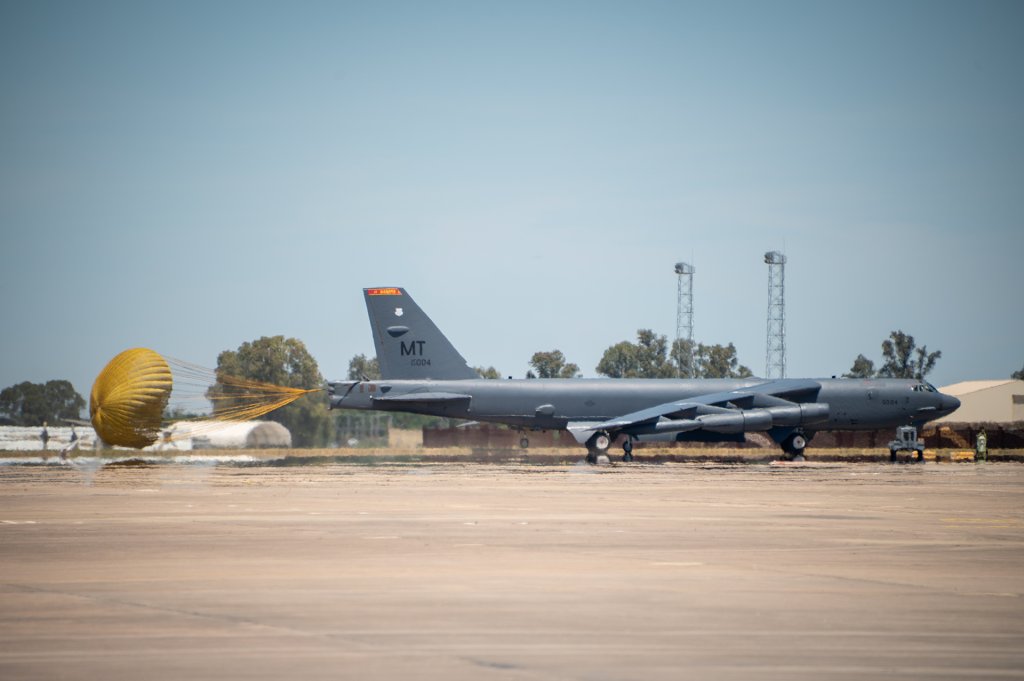
A U.S. Air Force B-52 Stratofortress assigned to the 5th Bomb Wing deploys a drag chute to slow down after landing at Morón Air Base, Spain, during a Bomber Task Force Europe deployment, May 20, 2025. (U.S. Air Force photo by Cristina Oliveira) Cristina Oliveira
The first order of business is “a Combat Aircraft Parking Apron in Moron, Spain,” the recent pre-solicitation notice states. The plan calls for the “expansion of the Aircraft Parking Apron to provide nine (9) new aircraft parking spots in an unloaded condition, or three (3) new B-52 aircraft parking spots in a live ordnance [sic] loaded condition.”
The issue of being able to store live ordnance is critical, since extra space is needed for safety purposes in case of an unintended explosion.
“The current apron is not capable of supporting any loaded strategic bombers due to limiting factors associated with unrelated facilities violating inhabited building safety arcs,” the Air Force budget document explains.
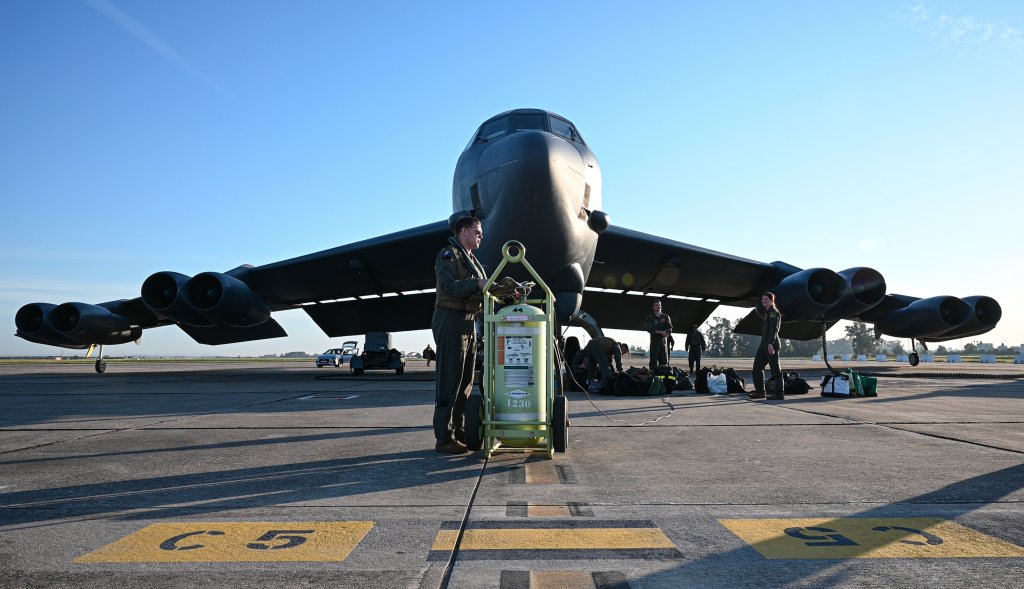
U.S. Air Force 23rd Expeditionary Bomb Squadron aircrew prepare a B-52 Stratofortress aircraft for flight during a Bomber Task Force mission at Moron Air Base, Spain, May 27, 2025. (U.S. Air Force photo by Staff Sgt. Bryan Guthrie) Staff Sgt. Bryan Guthrie
Beyond the new parking spaces, the planned expansion at Moron also calls for 10 new fuel pits and associated piping, the relocation of aCivil Engineer Storage Complex – including a new covered storage building and an open storage yard – and the extension of apron shoulders and access roads, among other items.
The Air Force sees these improvements as an imperative.
“This project is required to enhance readiness capabilities at Moron Air Base, Spain,” the Air Force Fiscal Year 2027 military construction budget documents note. “A key enabler for training and combat operations is substantial infrastructure, promoting a quick response and positioning of forces within prescribed response times. The expanded Strategic Bomber Aircraft parking apron will increase Moron Air Base’s ability to meet future mission requirements.”
If these improvements are not made, “[a]dequate airfield infrastructure will not be available to the DoW [Department of War] or its allied partners, and personnel, aircraft, and resources will lack key facilities and infrastructure to support expanded airfield operations for training and contingency environments,” the budget document warns. “This limitation will impede sortie generation and flying schedules, directly limiting airfield presence and impairing airfield capability and readiness. Therefore, responsiveness for bilateral and multilateral exercises and training missions would be compromised, directly limiting theater presence and impairing mission capability, readiness, and contingency support.”
The project has a price tag of between $25,000,000 and $100,000,000 and is “expected to be completed 1,038 calendar days after notice to proceed,” according to the pre-solicitation notice.
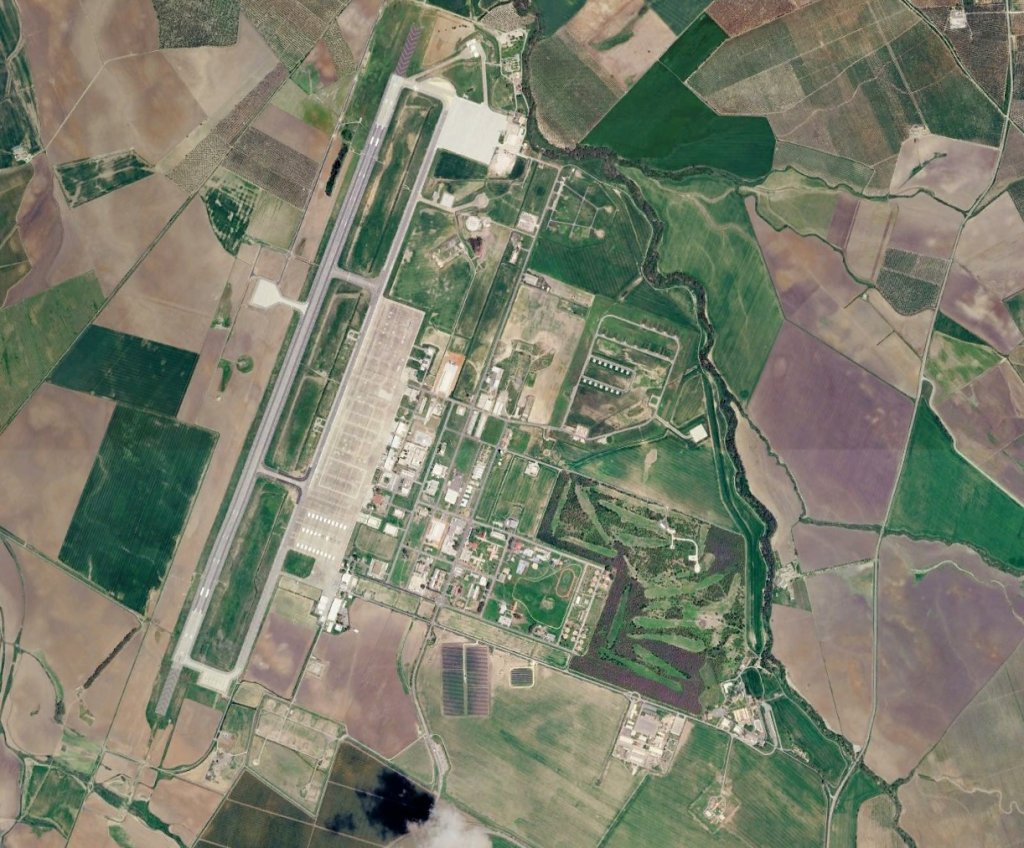
Moron Air Base, Spain. (Google Earth)
In addition, the Multiple Award Construction Contract (MACC) calls for new construction, renovations, alterations, demolition, repair work, and any necessary design to a wide range of U.S. assets in the region. This includes “airfield, industrial, infrastructure, administrative, training, retail, food service, munition storage, community support facilities and both vertical and horizontal construction in the Rota, Spain region or other areas managed by NAVFAC EURAFCENT, [Naval Facilities Engineering Systems Command/Navy Region Europe, Africa, Central],” the pre-solicitation notice explains. “This tool may also be used throughout the NAVFAC area of responsibility (AOR), worldwide.”
However, as the Air Force budget documents stress, the Moron project is a priority.
The installation has long played an important role for American airpower. It has served as a host for B-1B Lancer and B-52 Bomber Task Force missions and as a way station for a wide array of other aircraft from fighters to aerial refueling tankers.
A B-1B Lancer assigned to the 9th Expeditionary Bomb Squadron from Dyess Air Force Base, Texas, departs Morón Air Base, Spain, in support of Bomber Task Force Europe, April 12, 2024. (U.S. Air Force photo by Airman 1st Class Emma Anderson)
“Morón Air Base is a vital link in any operation moving east from the United States due to its strategic location close to the Mediterranean and the Middle East, its massive flight line, long runway, aircraft refueling systems and excellent weather,” according to the 496th Air Base Squadron, the facility’s host unit.
In March, Spanish Prime Minister Pedro Sánchez, one of Europe’s most vocal critics of Epic Fury, refused to allow the U.S. to use its bases in his country for direct attacks on Iran. In addition, Sánchez denied permission for the U.S. to use Spanish airspace for Epic Fury, creating a logistics headache for American aircraft movements to the Middle East.
U.S. Air Force Staff Sgt. Arturo Herrera, 496th Air Base Squadron Operational Support Team tower watch supervisor, observes two B-1B Lancers taxiing at Morón Air Base, Spain, April 17, 2024. (U.S. Air Force photo by Airman 1st Class Eve Daugherty) 2nd Lt. Eve Daugherty
Sanchez’s decision affected Naval Station Rota, another major U.S. installation in that country. Rota supports the movement of personnel, equipment, fuel, and supplies through its three operational piers. It also has a 670-acre airfield capable of supporting U.S. Navy and Air Force aviation operations, and some of the largest weapons and fuel storage facilities in Europe.
Rota is also the home of Destroyer Squadron 60 (DESRON 60), one of three U.S. Navy destroyer squadrons permanently based outside the continental United States and the only one of these to call Europe home.
The Arleigh Burke class guided-missile destroyers USS Porter (DDG 78), front, USS Donald Cook (DDG 75), USS Carney (DDG 64) and USS Ross (DDG 71), moored at Naval Station Rota, Spain. (Specialist 3rd Class Robert S. Price/Released)
Sanchez’s moves set off U.S. President Donald Trump, who was already angered by Spain’s refusal to raise defense spending to 5% of GDP, previously agreed to at last year’s NATO summit. In March, the American leader called Spain “a terrible partner” and threatened to cut off trade.
The situation reached a critical juncture at the NATO Summit in Turkey in July, with Trump again threatening Madrid.
“We don’t want to do any trade business with Spain anymore… I’d like you to cut it off,” Trump fumed in Ankara to Treasury Secretary Scott Bessent during a press conference with NATO Secretary General Mark Rutte. “Spain is a terrible partner in NATO. They don’t participate; they don’t pay. I don’t want anything to do with Spain. Cut off all trade with Spain, please, including visits. Watch them, watch them come running back; oh, they’ll come running back.”
At a NATO summit, Trump said he had ordered Treasury Secretary Scott Bessent to cut off all trade with Spain, calling Madrid a 'terrible partner' in the alliance https://t.co/1E2VkRee2jpic.twitter.com/Vt2oNxW8QM
However, the rift eased after Sánchez agreed to bump up his country’s defense budget, Trump claimed.
On his way back to the United States after the summit, he told reporters aboard Air Force One: “I did have issues, and I still do. But Spain, they came back all the way today. Spain was very generous today.”
Asked what Spain had done, he said: “They honored a request for lots of payments, and if they didn’t, we wouldn’t have even talked to them.”
The two leaders displayed new-found cordiality for the cameras while sharing a box at the World Cup Final between Spain and Argentina at MetLife Stadium in New Jersey.
President of the United States Donald J. Trump greets Spanish Prime Minister Pedro Sánchez during the FIFA World Cup 2026 Final match between Spain and Argentina at New York New Jersey Stadium on July 19, 2026, in East Rutherford, New Jersey. (Photo by Europa Press Sports/Europa Press via Getty Images) Europa Press Sports
Though the Moron construction planning predated any of the political drama, as we noted earlier, the Pentagon is reviewing how many troops it will maintain in Europe and where it will base them. Undersecretary of War Elbridge Colby made a rare visit to NATO headquarters on Thursday to meet with officials to discuss the way forward. There, he pointed out that the Pentagon’s review is “designed to ensure that NATO is moving fast and irreversibly toward Europe leading, stepping up to take primary responsibility for the defense of Europe, stepping up to ensure our forces are postured for America’s global needs, and making sure that our access, basing, and overflight are clearly delineated and assured.”
Despite the geopolitical tiffs between the two nations, the investment in Moron and the larger construction package for Spain is a clear signal of how much the military and Congress value having access to bases in that country.

 Login










 (@NOELreports)




 (@PressTV)
 (@DefenceGeek)
 it was with MAYAN41 86-0111 which only recently arrived at RAF Fairford suggesting not a rotation. That's 10 today now.